



Abstract
Community policing has over the last four decades developed into a widely accepted method for police to engage the public. It is now being used extensively in diverse countries. The Janamaitri community policing program in Kerala state in India is one initiative that is being implemented in a programmatic manner. This article examines the components of the Janamaitri program, and whether it had any impact on public satisfaction with police services and perception of police in community. The study is conducted through an initial overview of the program, followed by a survey of people in the area. It illuminates the immediate impact of the program on different aspects of police–public relations such as greater accessibility, better behavior of police, greater sense of security among the populace, and better perception of police. It also demonstrates how these different factors are interrelated. The study demonstrates the importance of community policing, especially in developing societies, as a way forward for better police service delivery and reforms.
Demands for better police services and greater security have led to constant evolution and change in methods of policing in democratic societies. From the days of the Bow Street runners, the advent of modern policing with the enactment of the Metropolitan Police Act of 1829, to innovative methods such as problem-oriented policing, societies have been constantly reinventing policing to meet the challenges of modernization and change. With the advancement of policing in North America, the late 19th century and early 20th century saw progressive changes as a response to dysfunctionalities that developed in the working of police. Reforms against political influence and corruption, and the contributions of the progressive movement to reform police through the introduction of trained leadership, job security, and centralized organization redefined its structure and working. Signal contributions of police leaders like August Vollmer in focusing on efficiency, emphasis on hierarchical command structure, and use of modern technology to combat crime transformed street-level policing. The latter part of the 20th century saw great amount of research and its application in field-level policing, with development of ideas such as problem-oriented policing (Goldstein, 1990), and advancements in use of digital computing techniques through programs such as compstat and crime mapping. However, one of the most far reaching developments in policing has been the growth of community policing. “So popular is the concept with politicians, city managers, and the general public, that few police chiefs want to be caught without some program they can call community policing” (Skogan, 2006, p. 27).
While policing continues to be local, there has been greater cooperation, flow of ideas, and methods across societies. Ideas developed in one country have been adopted by others. At the same time with increasing commonality in nature of security challenges across the world, there has developed similarities in contours of problems faced by police agencies. The last three decades have therefore witnessed rapid exchange of ideas in policing methods across the globe. Community policing is one of the policing programs that has attained global acceptance with it being implemented in all corners of the world. Some of the early community policing programs were implemented in developed countries such as the United States, Japan, Singapore, Sweden, England, New Zealand, and France. Over the last decade community policing is being actively conducted in countries such as South Africa (Brogden, 2003, Pelser, 1999), Northern Ireland, Sierra Leone (Baker, 2008), and other parts of the world (Brogden, 2005).
In India, community policing programs have been adopted and implemented in different states. There has been effective use of this technique to rebuild relations between communities in conflict, in areas impacted by insurgency, and in urban areas. The development of community policing faced many hurdles in the form of resistance from the police itself, lack of programmatic approach, absence of support from the government—especially financial support, lack of faith and confidence in the intent of police by the public, and so on. However, over the years there has been a degree of development and improvement in community policing methods and acceptance of the same by the people.
This article examines a major community policing initiative called Janamaitri Suraksha, being implemented in the state of Kerala, since 2008. It studies the main features of the program, the process of implementation, and its impact on the public. The study analyses data from surveys conducted in police station areas in which community policing was being conducted and in neighboring police station areas where community police had not been implemented. It measures people’s perception of police in areas with and without community policing and uses multivariate analyses to understand and explain the differing perceptions of people across the two areas. The analysis provides insight into the impact of community policing on people’s perception of policing.
Community Policing and Public Perception of Police—A Review of Research
The core aspect of community policing is to develop partnership between police and community members. “Community policing is a new philosophy of policing, based on the concept that police officers and private citizens working together in creative ways can help solve contemporary community problems related to crime, fear of crime, social and physical disorder, and neighborhood decay” (Trojanowicz & Bucqueroux, 1990, p. 5). “Community policing rests on the belief that only by working together will people and the police be able to improve the quality of life in the community, with the police not only as enforcers, but also as advisors, facilitators, and supporters of new community-based, police-supervised initiatives” (Trojanowicz & Bucqueroux, 1990, p. 3). The police and community are therefore seen as coproducers of safety. 1 This is a marked change in strategy and process of policing.
Community policing entails forging of relationship between police and members of the community or with civic organizations. This partnership is to understand public’s definition of their problems and be aware of day-to-day issues bothering them. Often people are more concerned about threatening and fear provoking environment than individual illegal events. Though the two are intricately connected, the existence of threatening environment is a continuing problem that impacts quality of life and causes great anxiety among the public. However, it may not generate any public complaint because of lack of coordinated social action and due to the nature of the threat which may overcome any individual initiative to lodge a complaint. In these circumstances, community policing has a role to integrate public needs with police resources (Jiao, 1998). “Community policing promises to strengthen the capacity of communities to fight and prevent crime on their own” (Skogan, 2006, p. 29). In some areas, police may even have to take steps to build community cohesion to combat common social problems. 2
Community policing also aims at building trust in police among community members and ensuring support for police among the people. The trust and support has two-way influence of an increased feeling among the public that the police will ensure safety and security in the community, and in turn community trust and confidence greatly assists in police tasks of public order maintenance, and crime prevention and detection. Underlying this social dynamics is the idea of greater legitimacy of the police among the public. People cooperate with the police not only because of legal requirements, but also because they view the police as a legitimate authority. “A legitimacy-based strategy of policing increases cooperation with the law by drawing on people’s feeling of responsibility and obligation. The advantage of such a strategy lies in its ability to facilitate voluntary cooperation” (Tyler, 2004, p. 88).
The development of greater trust among the public is mainly through a process of continuous and sustained community contact and greater levels of communication. While traditional policing focuses more on crime and criminal events, community policing has a much broader focus on society as a whole. “. . . Community policing broadens the focus to solicit information from the law-abiding people, through both formal and informal contacts” (Trojanowicz & Bocqueroux, 1990, p. 11). In contrast to interaction with the police as a witness or complainant, routine interactions envisaged in community policing between the police and public is different in both nature and content. Interactions in the process of community policing is not marked by a power differential between the police and the individual, and there are fairly unrestrained channels of communication. As a complainant, witness, suspect, or accused, interactions with police are colored by fear, self-interest, and guarded restraint. Moreover, police interaction with the public in such circumstances is limited to a small percentage of the population.
Another important change in strategy is that community policing is proactive in its approach, compared to the reactive response in traditional policing (Ponsaers, 2001) . Instead of waiting for the public to come to police stations for service or call for assistance over the telephone, community policing entails deployment of resources in the field to actively engage with the community and identify problems and issues requiring police attention. This involves face-to-face interaction between community police officers (CPOs) and community members, interaction during house visits, public meetings, and so on. Proactive response forms the basis of crime prevention efforts of police. This transformed nature of interaction also entails problem-solving skills in the police. “This problem solving process provides police agencies a routine method for identifying, analyzing and solving problems” (Eck & Spelman, 1987). They go on to identify the problem-solving process as scanning or identifying the problem, analysis or learning the problems causes, scope and effects, response or action to alleviate the problem, and assessment or determining whether the response worked.
Community policing entails adopting of new methods of functioning of police beyond traditional policing. Skolnick and Bayley (1988) identified “four programmatic elements occurring again and again under the banner of community policing: (1) community-based crime prevention, (2) reorientation of patrol activities to emphasize nonemergency servicing, (3) increased accountability to the public, and (4) decentralization of command, including, under certain circumstances, civilianization…” (Skolnick & Bayley, 1988, p. 5). These strategies and processes of community policing therefore lead to unique and novel methods of police service delivery.
Community policing has been attempted in different states of India. Some of the programs such as the Mohalla committees of Maharashtra, people’s policing committees in Himachal Pradesh, neighborhood watch schemes in New Delhi, Trichy community policing program have achieved a degree of success. The efforts of Mohalla committees in Mumbai and Bhiwandi in Maharashtra had attracted international attention due to its success in mitigating interreligious conflict (Nilesh, 2011; Varshney, 2003). There have been few studies examining community policing programmes in India. Mishra (2011) provides an outline of community policing in India and delineates measures that would enhance success of community policing in India. Brogden (2005) provides a critique of community policing programmes in “transitional” societies including India. He concludes that such programmes must acknowledge and be sensitive to local customs, traditions, and conditions. They must also strive for public ownership and must not be supplanted as a state-run program. These studies are largely based on overviews, and do not depend on empirical data collected through direct observation, surveys, and so on. The present study is one of the first intensive empirical examinations of community policing programs in India and therefore provides rich data for analyses and insight into such programmes in developing societies. It also underlines the efficacy and importance of community policing paradigm across societies.
Assessment of Police Performance
The public assess the police by different methods. The most common method of police assessment are through measures such as crime rates, arrests made, cases charge sheeted in court, convictions obtained, and so on. The problems of official crime data range from nonreporting, to underreporting, biases in recording, and conceptual and methodological problems (Mosher, Miethe, & Philips, 2002; Pepinsky, 1980; Selke & Pepinsky, 1982). Police performance is also assessed, especially by the media, through a qualitative manner by evaluating response of the police to different crimes and other public events. Media reporting of crime however, has limitations of selection bias and limitations in reflecting exact reality (Sacco, 1995).
The most important assessment of police work and performance is done by the people who are clients of police service. Assessment of police performance is done by the public at two levels—assessment of individual level experience involving contact between police and individual and general assessment of police performance by both their overall experience in society and through contact if any with the police. The factor that could influence public satisfaction and perception of police are broadly at two levels—the individual level sociodemographic variables such as age, gender, religion, level of education and income, and contextual factors (Worrall, 1999) such as levels of police presence in society, courteousness of police, and sense of security. As this study is primarily examining the manifest difference in perception of police among the public as an outcome of different methods of policing, it focuses on contextual factors such as rating performance of police, accessibility of people to police, levels of courteousness, how much safer they felt compared to 6 months earlier, whether there has been a difference in police presence over the 6 months, and change in perception about the police over the last 6 months.
Performance of police has been measured differently in different studies. Reisig and Correia (1997) computed police performance from three factors—that the police treat all citizens equally, that police officers are usually courteous, and on the basis of an assessment of the quality of service provided by the police agency. Hinds (2009) measured police performance from responses to the statement that “police do their job well.” Assessment of police performance by the public is impacted by aspects of police functioning and by social factors. There are studies that indicate that perception of police performance among community members is a function of racial attributes (Grinc, 1994; Skogan 1978), cultural factors (Long-Song, 1992), prior victimization, and location of residence (Kusow, Wilson, & Martin, 1997).
A helpful nature is a prerequisite for good police work. Indifference or hesitation to respond to calls for assistance is viewed unfavorably by the public. This aspect of expectation of the people is brought out well by Bittner (1974). “. . . [T]he duties of patrolmen are of a mindboggling variety, it compels the stronger inference that no human problem exists, or is imaginable, about which it could be said with finality that this certainly could not become the proper business of the police” (Bittner, 1974, p. 30). Bittner argues that “police are ‘good’ at helping people in trouble and dealing with troublesome people” (Bittner, 1974, p. 31) and attributes it to the compulsions on police to respond to events involving “something that ought not to be happening about which somebody had better do something now” (Bittner, 1974, p. 30). The quality of being helpful is also reflected in Wilson’s (1968) “service” style of policing.
Another important factor for proper delivery of police services is accessibility of public to police. Accessibility to police is chiefly determined by two factors. First, the capacity of police to meet the demands for service of the public which is determined by factors such as police–public ratio, infrastructural capacities like number of police station available to cover area and population, availability of sufficient communication facilities like telephone lines at police stations or control rooms, and use of Internet and websites to reach out to people. Police also reach out to the community through both foot and vehicle-borne patrols. Availability of resources both personnel and vehicles determine the degree to which police can interact and be accessible to people. The second factor that determines accessibility to police is the manner in which police regulate police–public contact through bureaucratic process of management of the front desk of the police station or though use of rules in day-to-day interaction with clients. This may be through effective management of the contact point, allowing people to have access to an efficient police–public interface that enables quick understanding of the problem and efficient and effective response. On the other hand, organizations and officials may also regulate service delivery by developing routines and processes that has the effect of rationing of services by limiting access and demands, by allocating services differently across different classes of clienteles, and by using procedures and routines to control clients and work schedule (Lipsky, 1980). In the context of functioning of police, the latter form of response creates discontent and dissatisfaction among the people. Without doubt, easy accessibility is a sine qua non for efficient functioning of police in society.
Courtesy and good behavior by police is an important factor in assessing functioning of police. Rude and indifferent behavior by police discourage the public from approaching police for services, increases the divide between police and public, and creates a social environment that makes prevention and detection of crime and maintenance of order difficult. In the Indian context, there is a general opinion that the police are rude and behave in a manner that reflects their colonial legacy. In their study, Nalla and Madan (2011) measured politeness in police behavior on a scale of 1 to 5. The average value of whether police officers handle traffic accidents or violations politely or not was 2.74 (standard deviation [SD] = 1.15), and whether police persons handle calls for assistance with politeness was 2.75 (SD = .99). “. . . [O]nly 32 percent of the respondents perceive that police officers perform politely in handling traffic accidents or violations. Almost two-third of the respondents do not view police as handling calls for assistance with politeness (mean 2.8). This finding can be quite revealing and is likely to have an impact on citizen–police cooperation. Since citizens do not view that police handle calls for assistance politely they are rather likely to feel repelled by the police presence” (Nalla & Madan, 2011).
Another important variable is the sense of safety among the respondents. Fear of crime is classified into three broad types of intense fear suffered by victims of crime, fear of specific crime by individuals, and a more generalized fear of being unsafe (Trojanowicz & Bucqueroux, 1990). “Crime victims obviously have good reasons to feel afraid—their experience is not only traumatic in and of itself, but it also proves to them that they are vulnerable to crime in a dramatic way they may not have been aware of before” (Trojanowicz & Bucqueroux, 1990, p. 146). The second category of fear is apprehension of being victims of specific crimes such as murder, rape, robbery, assault, and so on and is more localized among certain sections of society such as the youth, women, and urban population. This form of fear is fostered by access to information about crime through media and other sources (Figgie, 1980). Formless fear of crime “relates to a diffuse feeling of being unsafe as a result of crime and disorder in the immediate environment” (Kappeler & Gaines, 2009, p. 188). Fear of crime has been explained by different causal factors such as disorder in neighborhood (McGarrell , Giocomazzi, & Thurman, 1997; Ross & Jang, 2000; Wilson & Kelling, 1982), lack of social cohesion and poor community level interaction and dynamics (Bursik, 2000), and culturally diverse neighborhood (Bennett & Flavin, 1994). There is evidence that community policing, good police–community relations, and contact between police and people reduce fear of crime (Weisburd & Eck, 2004; Zhao, Schneider, & Thurman, 2002). Such measures would therefore have an impact on sense of safety among the people.
The variable of perception of police is a holistic measure of what the public think of the police. The overall perception of the public determines many other factors such as cooperation with police, support of police action, and obedience to directions of police. “Thus, it is conceivable that negative perceptions of the police contribute to a cycle of reduced police effectiveness, increased crime, and further distrust of police” (Brown & Benedict, 2002, p. 545). There is research that indicates that perception of police is determined by individual variables such as ethnicity and socioeconomic status, and contextual variables such as crime rate and victimization (Brown & Benedict, 2002; Decker, 1981). The importance of these factors in the context of community policing has been revealed in the existing literature on community policing and citizen’s perception of police (Reisig & Giocomazzi, 1998; Schafer, Huebner, & Bynum, 2003).
Police performance in India is largely measured in terms of crime rates and number of crimes occurring in society. In the absence of victimization surveys, public policy formulation, academic and media analyses depend on data collected by police. In police departments and government, the other indices that are utilized to assess police performance are detection rates of crimes and conviction rates of offenses. Undoubtedly these are statistical indices that are fraught with many disadvantages (Black, 1970; Pepinsky, 1980). During the last decade, there have been efforts to collect data on people’s perception of police and satisfaction with police services through surveys and observation of police work. There have been few published studies analyzing public perception of police in India (Banerjee, Chattopadhyay, Duflo, Keniston, & Singh, 2012). The present study adds to the understanding of the variation in public perception of police across areas with and without community policing and demonstrates the advantages of introducing community policing measures. It also demonstrates the interrelationship between variables such as assessment of performance of police, sense of security among the public, assessment of change in police presence, and perception about police.
The Janamaitri Suraksha Project
The police in Kerala state have a program-based approach in implementing community policing. The program named Janamaitri Suraksha program literally translates to mean people’s friendship safety program and refers to the cooperation between the police and community in ensuring greater safety. The program was authorized by the state government through a government order, had generous budgetary support, and was initially implemented in 40 police stations and thereafter extended to hundred stations. The objectives of the program are (a) prevention of crimes, (b) furthering cooperation and mutual understanding between police and community, and (c) furthering security-related mutual cooperation between citizens. 3 The program has three important components for the implementation of its goals—the district advisory committee headed by the district superintendent of police who oversees the implementation of the community policing scheme in the district, the Janamaitri Suraksha committees in each police station, and the Janamaitri beat with a beat officer who is in charge of the beat.
The district advisory committee is headed by the district superintendent of police and constitutes of 10–20 prominent persons of the community such as members of parliament, members of legislative assembly, mayors, municipal councilors, and so on. The committee is to meet at least once every 3 months to review the working of the Janamaitri Suraksha committees and suggest measures for improvement of community policing. This is a body tasked with oversight of all community policing programs in the district.
The Janamaitri Suraksha committee is a police station–level body consisting of the police inspector in charge of the area, the sub inspector of police, the community relations officers of the police station, and selected members of the community living in the jurisdiction of the police station. Members of the community included in the committee reflect the demographic profile of the area, representing all social groups and include important public persons. The committee is constituted for a period of 2 years and is to meet at least once a month to assess the functioning of the program in the area. The matters that can be discussed by the committee include issues of public safety and security such as problems of theft and robbery, problems of road traffic management, illicit sale of liquor and drugs, improvement of police response through changes in police patrolling patterns for better crime prevention, eliciting assistance of public for enhancing capacity of response to social problems, and organizing awareness programs among public. These efforts are translated into practical programs such as night patrolling with public cooperation, coordination with private security agencies, traffic warden systems, organizing of counseling centers for resolving family discords and for assistance to persons having drug and alcohol-related problems, and victim support centers. In its functioning, the committee tries to develop a consensus and matters that are opposed by more than 20% of its members are not taken up for implementation.
Though the two committees provide an organizational–structural framework, the core functional element of the program is the Janamaitri beat and the beat policeman. A police station area is divided into beat areas that generally have around 500 houses, within approximately 3 km2 area. The beat police officer is the face of the Janamaitri program, walking the beat every day, meeting residents, developing strong social relations with people of the area, performing routine police duties such as serving summons from courts, enquiring public complaints, and so on. The beat police officer conducts regular preannounced public interactions such as public meetings or one-to-one meetings with residents of the area.
The Janamaitri beat police also conduct house-to-house visits of each residence in their beat area. The house visits help in bringing the police closer to the people, identifying their needs, and attending to any of their specific requirements. These requirements may be of elder citizens living alone, individuals or families being harassed or repeat victimized, and so on. This provides easier and better access to police services and develops a better image of the police among the people. The house visits stand in stark contrast to the standard procedures of members of the public having to visit the police station to lodge complaints in case of any problem and approach the police station and officers for any help. As the beat constable makes regular house visits, the public develop better understanding of the police, know a person whom they can approach in the police station, and this infuses confidence in the relationship between the police and the public. The concept of house visits therefore not only contrasts with the existing relations but is a shift in relationship between the police and public and changes the format, mode, and manner of service delivery.
Another important program undertaken as a part of the Janamaitri Suraksha Community Policing is the traffic safety measures in which steps were taken to educate the public on traffic rules and good road use behavior. These goals were pursued through programs such as formation of road safety clubs and conduct of traffic awareness classes among school children, public awareness campaigns such as street plays, individual level contact programs, and assistance to professional drivers such as taxi drivers and interstate truck drivers. Keeping in view the high rate of accidents 4 and its adverse impact on public health, these programs are generally welcome by the people.
The community policing program endeavors to create greater awareness of security among the populace. This includes sensitizing women and children of various forms of abuse and the legal protective measures available. Awareness programs are conducted in coordination with civic groups engaged in this field to make women conscious of their rights, how to respond to any danger, and how to obtain help from public resources such as help lines, counseling centers, and police control room. People are also sensitized of preventive measures that can be taken to protect children while they are outside their homes.
Similar security awareness programs are also conducted in coordination with Resident Welfare Associations to sensitize people regarding crime prevention by securing their homes and ensuring personal safety. This includes precautions of keeping their homes secure during long absence by informing police, measures to conceal signs of their absence that may alert property criminals, and conduct of security checks of persons employed for domestic chores. The police work with private security agencies for sensitizing them about possible security threats, steps to prevent crime, and how to obtain help from police. The police also conduct joint night patrolling with willing individuals of the area. It ensures police attention and presence in areas where the people feel or perceive greater threat. These efforts are intended not only to create a better security environment but also to build better police–public relationship.
Like most societies abuse of alcohol and drugs have had a deeply deleterious impact on families and society in Kerala. Alcohol and drug abuse especially by the breadwinner of the house have caused domestic violence, neglect and abuse of children, and destroyed families. The local bars and liquor shops which are licensed by the government, and outlets of illicit liquor become centers of disorderly behavior disturbing peace and order in the local community. Through the Janamaitri Suraksha scheme, efforts were made to sensitize the public regarding ill effects of alcohol and drug abuse. The police conducted field-level legal actions against illegal sales of drugs and alcohol on the basis of information from members of the community. The police also assisted in alleviating the problem by cooperating and coordinating with de-addiction centers to make such efforts a success. These efforts by police were generally welcome by women’s groups and religious organizations that have traditionally been in the forefront in the fight against such social menace.
The community policing initiatives also addressed problems that are not strictly in the realm of policing. The police in coordination with the community formed blood donor forums to mobilize potential donors, to conduct blood donation camps, and help people in need of blood, in emergencies. The police also coordinated with the health department and hospitals to conduct health camps for the public in the area. These are measures that are generally welcome due to the constant demand for good medical facilities and benefits of proactive medical services in the community. Another social problem that has endemic proportions in Kerala is the high suicide rates. The police created suicide prevention call centers which came to the aid of people in distress. Police personnel were trained on how to respond to such calls for help and also provide leadership to community self-help groups. Police were also associated with the conduct of training in first aid and trauma care, especially for taxi drivers who were generally the first to be present at the scene of road accidents.
These social initiatives by police were a major shift in the nature of police public engagement. The traditional methods of policing were fairly impervious to these widely prevalent problems in society and focused on responding to events of crime and public disorder management. It is evident that the Janamaitri Program adopted a new and different method of engaging with the people.
Research Method and Data
This article examines whether the community policing program had any impact on public satisfaction with police services and perception of police in the community. For this purpose a study was conducted in the City of Calicut where the Janamaitri Program was implemented in some of the police stations. The city has a history of modern police system of over a century, with the origin of the modern force that can be traced to the implementation of the Indian Police Act of 1861. In the period prior to independence of India, the city was part of the larger Malabar district. The police in the district have a great legacy with contributions made by some outstanding police leaders. Of course, the police organization then had colonial goals and methods different from the democratic system that was established after independence of the country. Since independence of India, police in the city have adopted modern methods of policing, with police control room, forensic unit, crime records bureau, and round-the-clock police patrolling.
The study is based on two levels of examination of first a detailed study of the Janamaitri program to understand the differences in policing styles in police stations with Janamaitri policing and those without the scheme. This initial overview provided information on what are the salient features of the community policing program and how it differs from conventional policing in the district. This was followed by a survey that was conducted in two police stations where the Janamaitri program had been conducted for nearly a year and in two adjoining police stations where Janamaitri program was not conducted. This was done for the purpose of comparison. The four police station limits have similar economic and demographic profiles and are therefore ideal for comparison of similarities and differences in public perception of police and satisfaction with police services. 5 The survey was conducted on 1,101 individuals in the area where the community policing program was conducted and on 440 respondents in the adjoining police stations, where the community policing program was not conducted. It is cautioned here that the study is based on comparison of public perception of policing in areas with and without community policing. It is not based on comparison of before and after effect of introduction of community policing in an area. 6
Each police station is divided into smaller municipal units called wards. For the conduct of the survey, small teams of two individuals were deployed in all wards. There were multiple teams in all wards, covering different locations which allowed covering of the entire area at a fast pace. This form of sampling procedure allowed random sampling across the entire geographic area of the police stations. Most of the surveys were conducted through house visits, but surveys were also conducted in the streets and in the market places. In all, 73.8% of the surveys were administered by visiting homes, 11.1% on the streets, 9.6% in the market place, and the remaining at other locations.
For conduct of the survey, the services of the sociology department of a prominent college in the city were utilized. Students of the college were selected and trained for conducting the survey. The selected students were mostly from the state and the region and were well versed in Malayalam—the local language—and English and had a good knowledge of the local culture, customs, and mores. They were called for a 1-day workshop for training on how to conduct the survey in which they were briefed regarding the survey instrument, the correct method for conduct of the survey, and the precautions to be taken in the conduct of the survey.
The surveyors were advised to find a comfortable place to conduct the survey and to finish the survey in one sitting. They were made aware of basic precautions to maintain the integrity of the survey, such as revealing their name and identity, to conduct survey of individuals separately and not in groups so that respondents are not under peer pressure to answer questions in any particular way, to establish a rapport with the respondents so as to elicit honest replies, to respect the cultural mores of the respondents, to be polite to the respondents, and to ensure their own safety. They were instructed to ensure that the survey instruments were filled out in the field itself and that no entries were made later on the basis of memory to avoid any error. In planning for the conduct of the survey, care was taken that each surveyor had optimal load in number of respondents, and they did not have to do more than three interviews per day, allowing nearly 2½ hr for each survey. The survey was conducted in three waves of 2 days each.
As this study compares public perception of police and satisfaction with police services across police stations with and without community policing programs, it focuses on parameters that reflect the functioning of police (see Table 1 ).
Variables Measured and Descriptive Statistics

Note. Dependent variable is the attribute of whether the area has a community policing programme or not. Area without community policing is coded as 0 and area with community policing is coded as 1.
Table 1 provides details of the variables used in the study, the scales of measurement, the number of missing cases and response rate to questions, and major descriptive statistics of the measured variables. Of the 1,541 respondents, the number of males and females surveyed are nearly equal, providing a very balanced distribution across the two genders. The average age of the respondents is 42.15 years with a normal distribution around the mean. The levels of education of the respondents were measured on a scale of 0 to 4, with 0 indicating no formal education; 1, primary education; 2, high school; 3, college level education; and 4, a postgraduate degree. It is observed that majority of the respondents (44.6%) have attended high school, whereas on the two ends of the spectrum, a small percentage of the respondents either had postgraduate degrees (3.7%) or had no formal education at all (4.9%).
In this study, the variable of performance of police is a holistic assessment of the functioning of police, measured through a single question to the respondents—“How do you rate the performance of the police?” This variable is a measure of how the police as a public service was assessed by the people who are clients and consumers of the service. The respondents were asked to rate the performance of the police on a scale from 1 to 7, with 1 indicating poor performance and 7 indicating excellent performance. The mean value of the rating of performance is 4.99 (SD = 1.28).
The variable of whether police were helpful or not is coded as 1 for “not helpful” and 2 for “helpful.” The average value of the variable at 1.91 indicates that most of the respondents were of the opinion that police are helpful to the people. Similarly the mean value of the variable of accessibility of police is 4.89 (SD = 1.22) on a scale of 1 to 7, indicating that the respondents rated accessibility much above the halfway mark, indicating a functional accessibility to the police.
The variable of courteousness of police measures people’s perception of how polite the police are toward them. The mean score of the variable is 5.48 (SD = 1.27) on a scale of 1 to 7. The mean value of ratings of politeness of police is higher in this study compared to the values reported by Nalla and Madan (2011). This is largely due to the fact that the present study has been conducted in Kerala, which has more developed social and human indices compared to other states of India. This and the vibrant social and political discourse in Kerala could possibly account for the healthier relationship between police and public in the State. This article however focuses on assessing whether there is a statistically significant difference in courteousness of behavior of police in areas with and without community policing.
Another important variable measured is how much safer the respondents felt compared to 6 months earlier. The question assesses whether there was any change in sense of security among the people during a period of 6 months with implementation of community policing. The term sense of safety and security is a more encompassing term than the concept of fear of crime. Sense of safety is a broader and positive feeling of well-being of an individual compared to the negative state of fear of crime or satisfactory state of absence of fear of crime. While both variables are expected to be necessarily correlated, complete sense of security would require absence of fear of crime. Comparison of the measure of sense of safety in areas with community policing with areas without the program aids in delineating the impact of community policing measures on this variable. The scale of measurement extended from −3 to +3, with any value lower than 0 indicating lower levels of feeling of safety compared to 6 months ago and values above 0 indicating higher levels of feeling of safety. The response rate of the question is a high 82.8% and the mean value of the variable is 0.93 (SD = 1.2).
The variable of difference in police presence over the last 6 months was introduced to assess whether the strategy of community policing of having everyday interactions with members of the community, individually, and in groups had any impact on the perception of police presence in the community. This was measured on a scale of −3 to +3, and the average value of police presence measured is 1.08 (SD = 1.3). The respondents were also asked regarding change in perception about police. The variable was measured on a scale from −3 to +3, to account for any decline in perception of the police. The average value of the perception of police among the respondent is 1.62 (SD = 1.01) which was much above the midpoint mark.
As the independent variables are related, they were tested for collinearity. The variance inflation factor (VIF) of the variables iswell below 10, which is the value recommended by Myers (1990) as a reference point for concerns of collinearity. The VIF of all the independent variables are close to 1. Similarly the tolerance levels are much above the preferred value of .2 (Menard, 1995), with values ranging from .5 to .93. This indicates that the regression is not impacted by problems of multicollinearity.
The dependent variable of this study is the attribute of whether the area had community policing or not. The area without community policing is coded as 0 and area with community policing is coded as 1.
Findings and Discussion
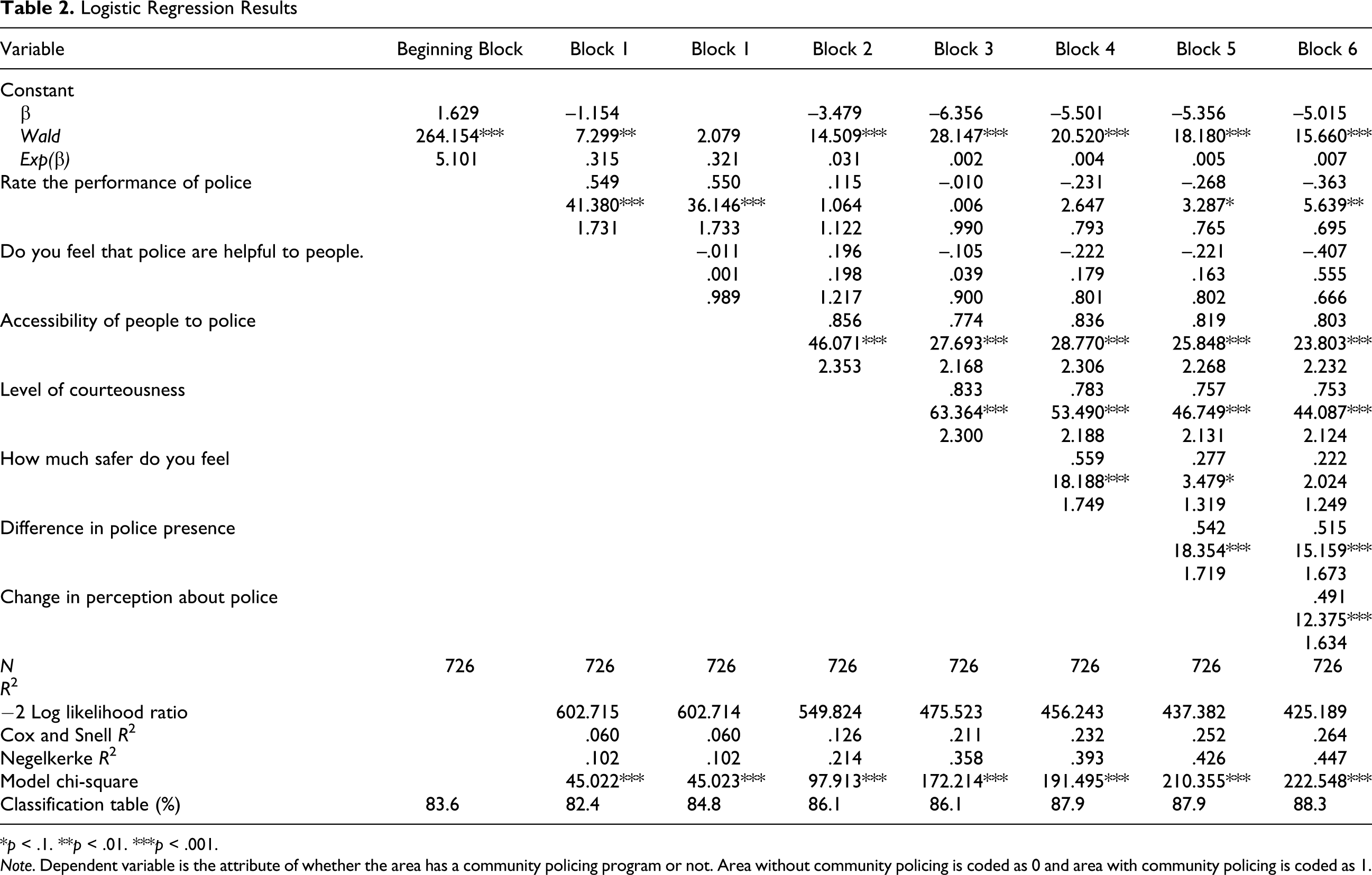
For comparing areas where community policing was conducted with areas without the program, the method of multivariate analyses chosen for analyses is logistic regression. Each independent variable was put in separate blocks and hierarchical block wise entry of logistic regression was conducted (see Table 2). This method of regression was chosen on the basis of existing research findings, preliminary assessment of the relationship between the independent and dependent variable and to better reveal the impact of each independent variable and relationship between them. The first variable that is entered in the model is people’s rating of performance of police. The β value of the variable is .549, with a statistically significant Wald statistic of 41.380 (p < .001), and Exp(β) of 1.731. A statistically significant model chi-square value of 45.02 and Negelkerke R 2 value of .102 indicate the impact of the independent variable and that it explains 10.2% of the variance of the dependent variable. It is evident that if only the rating of performance of police is taken, then the performance of police is rated higher in areas with community policing. However the rating of performance of police is in itself a complex index that to an extent is determined by various other tangible indices of police work. This becomes clearer with the introduction of other variables in the model.
Logistic Regression Results
*p < .1. **p < .01. ***p < .001.
Note. Dependent variable is the attribute of whether the area has a community policing program or not. Area without community policing is coded as 0 and area with community policing is coded as 1.
The next variable that is introduced in the model is whether the respondents thought that the police were helpful to the people. It is observed that the variable has no statistically significant impact in correctly classifying the different cases into the two categories of whether the respondents were from the area with community policing or the area without the program. It is clear that among the two areas with and without community policing there is no differences in the degree to which police were helpful to the people. The community policing program by itself did not add to the perception of the people that the police were helpful to them. This could be because the degree to which police are helpful to the people is a function of the infrastructural and personnel resources at the disposal of the police, and as there is no difference in resources in police stations with and without community policing only in methods of policing adopted, a perceptible difference in capacity of police to help people is not created. Moreover, community policing is focused mainly on building relationship with the police at both the individual and community level. Building of better relationship by itself does not translate into a feeling that the police are helpful to the people. But at the same time, building of better relationship can lay the foundation and basis for police to provide better services and for being of greater help in the future. However, as the survey was conducted at the end of 1 year of start of the program, this may not have provided sufficient gestation period for development of such perception among the people. Conduct of community policing program for longer periods of time may reveal a different outcome. This does indicate that community policing programs may go through phases and there is a need for research into the distinct phases of implementation of community policing programs.
People’s assessment of their accessibility to police has a high β value of .856 with a Wald statistics of 46.071 (p < .001). This indicates unambiguously that accessibility of people to police is very high in areas with community policing compared to areas without community policing. The increase in the model chi-square and R 2 values reveal the impact of the variable on the model. The entire process of community policing, of beat police personnel meeting members of the community, conducting house visits or community level meetings, brings police closer to the people, makes them more accessible, and breaks down barriers between them. A significant associated phenomenon is that with the introduction of the third variable of accessibility of police the variable of performance of police becomes statistically insignificant, indicating that the variance of dependent variable caused by police performance is greatly accounted for by the measure of accessibility of people to police. This points to the fact that in people’s assessment of performance of police, aspect of access to police has an important influence.
The fourth variable that is introduced in the model is the levels of courteousness of police. This variable has a β value of .833, with a Wald Statistics of 63.36 (p < .001). The variable has a statistically significant impact in differentiating the two categories of the dependent variable. The chi-square statistics of the model increased to 172.21 (p < .001), and the Negelkerke’s R 2 value increased to .358. The community policing program clearly had an impact on the levels of courteousness of the police and there is a perception among the people in the areas with community policing of higher levels of courteous behavior by police compared to people in areas without community policing. A major reason for this is that implementation of community policing results in a paradigm shift in the nature of interaction and engagement between the police and the public. In areas without community policing, the functioning of police is in a reactive mode, with minimal efforts at reaching out to people at normal times, and police responding to events or reacting when people seek help or assistance. Even when the public have some problems, the police service is not easily available due to factors such as general apathy of police to people’s needs, lack of training and sensitivity of police towards the public, and exercise of unbridled power by the police.
In contrast, the community policing model attempts to build a relationship with every member of the community. Differing from routine interactions through telephones and at the police stations, community policing interactions are in the setting of their homes or in community forums. Unlike interactions in conventional policing where the public are in need of and are seeking assistance from the police, during these interactions police have equal if not more interest in establishing a working relationship with the people. For this form of engagement of the public, police have to be proactive, take initiative to start communication with the people whether or not they require any imminent help or service, and adopt polite and courteous behavior to develop an engagement useful for both the police and the public. Efforts on the part of the police to initiate the interaction lowers bureaucratic and other barriers that police consciously create in their routine interaction with the public. The detailed training prior to the conduct of the program also has an impact on better behavior on the part of the police. This naturally creates a sense of greater accessibility to the police and more courteousness on the part of the police.
The variable of how much safer they felt compared to 6 months earlier was entered next into the model. The variable has a β value of .559 with a Wald statistics of 18.18 (p < .001). The model chi-square value increased to 191.49 (p < .001) and the −2 log likelihood ratio decreased from 475.52 to 456.24. The value of β indicates that there is a greater feeling of safety among the people living in the area covered by community policing. This is an important goal of community policing and similar findings have been observed in earlier studies (Scheider, Rowell, & Bezdekian, 2003). This is a significant achievement of the program as this greatly enhances the quality of life. This increased sense of security would make community policing program welcome among the people and improve police–public relationship.
The next variable that is entered in the model is the difference in police presence perceived by respondents compared to 6 months earlier. This variable is statistically significant with a regression coefficient of .542, with a Wald statistics of 18.354 (p < .001). The addition of this variable also has an impact on the overall model with the −2 log likelihood value being reduced to 437.382 and the Negelkerke’s R 2 value increasing to .426. This indicates that in the area with community policing programs there is a perception of increased police presence. This perception is mainly due to two factors, first the use of beat patrol policemen on foot in the community policing program and second the greater levels of interaction between the police and people during the program. Foot patrol fosters a greater sense of safety that is related to the perception of police presence. There is evidence of this in the Flint foot patrol program conducted in 1979. “At the end of the third year of the program, roughly 70 percent of the people surveyed reported feeling safer as a result of the foot patrols. Many of the respondents qualified their answers by saying that they felt especially safe when their foot patrol officer was well known and highly visible” (Kappeler & Gaines, 2009, p. 190). These findings are confirmed in this study of the Janamaitri community policing scheme.
This is further confirmed by the fact that when the variable of difference in police presence is added to the model we see that the impact of the earlier introduced variable of sense of security on the dependent variable declines with the β value reduced to .277, with a Wald statistics of 3.479 (p < .1). This indicates reduced difference in the sense of security between the two areas with and without community policing, if we control for police presence in the area. This shows that the greater sense of safety is due to higher levels of police presence in the area with the introduction of community police programs. However, other aspects of the community policing programs continue to have a small effect on the sense of safety which is reflected in the small value of β.
The last variable that is introduced in the model is the change in perception about police among the people during the last 6 months. There is a statistically significant impact of this variable on the dependent variable with β value at .491 and the Wald statistics value of 12.375 (p < .001). The introduction of the variable has an impact on the model with the model chi-square value increasing to 222.54 (p < .001) from 210.33, and the Negelkerke’s R 2 increasing to .447. There is therefore an improvement in perception about police with the introduction of the community policing programs. An improved perception of police is in itself a major achievement of the program and impacts other areas of police work. This is especially important for police organizations faced with the problem of poor public image.
However, an interesting associated phenomenon with the introduction of this variable of change in perception about police is that the variable of sense of safety becomes statistically insignificant. This indicates that the variable of change in perception about police accounts for the residual impact of the variable of sense of security among the people on the dependent variable. Therefore, it can be deduced that there is a relationship between the improved perception about the police in areas with community policing program, which leads to increased sense of confidence of the people in the police, and the consequent improved sense of safety among the people.
Another equally interesting finding in this step is that with the introduction of different variables and finally change in perception of police, the variable of performance of police has significant statistical impact with the β value of −.363 and Wald statistics at 5.639 (p < .05). Analysis of this phenomenon illuminates how people conceptualize police performance and the relationship between the different independent variables. Taking the effect of the independent variable of performance of police alone, which is introduced in the first block, it is observed that by itself there is a great difference in rating of performance of police in areas with community policing and areas without. Respondents in areas with the community policing program rate performance of police significantly higher than those living in areas without such a program. This is a positive aspect of the community policing program, as the improved opinion of police performance raises the confidence of the people in the police and this could drive other productive partnerships between the police and public.
The process of development of the model by introducing other variables into it disaggregates the factors that lead to higher ratings of police performance. The model reveals that the variables of accessibility to police, courteousness, improved perception of safety, police presence, and perception about police are significantly better in areas with community policing and has a role in improving the rating of police performance in such areas. It is also revealed that if we control for these variables that are significantly better in areas with community policing, the areas without community policing have a better rate of performance compared to areas with community policing.
In areas without community policing, people’s assessment of performance of policing will largely be determined by the core functions of crime detection and prevention and maintenance of order. In such areas police and public will generally be coming into contact only on a need-based manner that is when the public need a specific service from the police. This may be when they have been victimized or when they need some help such as for resolving dispute with neighbors or some other public nuisance such as bad behavior by youth in the locality, or a feeling of insecurity due to presence of strangers in the neighborhood. If the response of the police is positive, there is a great sense of satisfaction among the people whose difficulties have been addressed by the police. This is especially so in Kerala where the police system compared to other states in India does have a fair degree of capacity to respond to people’s request for assistance. On the other hand, in areas with community policing, in the short run, there may be skepticism among the people in the capacity of the “softer” police in tackling the hard problems of crime fighting. Moreover, a police station embarking on community policing efforts has to expend resources, time, and effort in this endeavor, which otherwise would have been used only for crime detection and public order maintenance. There is an opportunity cost of community policing and a trade-off in deployment of resources that may result in diversion of resources used in normal police station from routine police work for community policing. This factor could account for a sense of higher rating of performance of police in the short term, if we control for the immediate gains of community policing. These assessments are undoubtedly speculative in nature in the absence of data on crime prevention and detection and public order management.
Conclusion
This study underlines the importance of community policing as a strategy to improve functioning of police. This is of great importance for societies where there is distance between police and public, and functioning of police does not meet standards expected in a democracy. The study indicates improvements in factors, such as greater accessibility, better police behavior, greater sense of security among the populace, and better perception of police through the conduct of the community policing program, which are in themselves no small gains.
The study points to a complex interrelationships between different aspects of police–public interaction. There are clear links between people’s assessment of police performance with other factors such as accessibility to police, courteousness, sense of security, police presence and public perception of police, and interrelationships between the variables. Understanding these aspects would be vital, in improving police service delivery, in cost-effective and efficient manner. There is little research available at present, which maps these linkages and interrelations. While regression analyses provide insight into these relationships, there is a need to examine the multiple and interrelated simultaneous relationships that could be examined using advanced multivariate techniques such as structural equation modeling.
Community policing is expected to provide police with greater moorings in society, and thereby assist them in crime prevention and detection, and in marshalling public opinion against public disorder. There are strong theoretical reasons to believe in the efficacy of community policing. Community policing practices are based on situational crime prevention techniques (Clarke, 1980), routine activities theory (Cohen & Felson, 1979), and social disorganization and development of social capital (Sampson & Groves, 1989; Sampson, Raudenbush, & Earls, 1997). It therefore provides a method for reforming police functioning, which is embedded in the delivery of police services. These capacities are not developed in the short term but over a longer period of time. There is a need for greater research on factors that determine the trajectory of improvement of police service delivery, the time period over which community policing would result in positive returns, and the organizational–functional aspects of police and social variables that impact the process.
Community policing has over the years developed and attained a unique place in policing methods globally. Implementation of the Janamaitri community policing program and its impact on public satisfaction and perception of police demonstrates the importance of community policing, especially in developing societies. It is undoubtedly the way forward for better police service delivery and even police reforms.
Footnotes
Declaration of Conflicting Interests
The author declared no potential conflicts of interest with respect to the research, authorship, and/or publication of this article.
Funding
The author received no financial support for the research, authorship, and/or publication of this article