



Abstract
The prevalence of performance-enhancing drug (PED) use at different levels of professional sport has become an important social issue, particularly when considering recent high-profile incidents from professional sports and the Olympics. Due to the myriad of individual, team, and sociopolitical consequences that can stem from PED use, it becomes critical to study the etiology of PED involvement among athletes regarding this deviant behavior. Gottfredson and Hirschi’s general theory of crime is one such theory that may aid in explaining this phenomenon. As such, the main purpose of this study was to investigate the relationships between effective parenting, self-control, and athletes’ use of banned PEDs. Survey data from 784 professional athletes in Iran were collected, and the findings indicated that ineffective parenting, low self-control capacity, and self-control desire had significant effects on PED use. In addition, moderation effects and gender analyses were examined. Specific findings, policy implications, and study limitations are discussed.
The use of performance-enhancing drugs (PEDs) is not a new problem in sports, but it is one that can carry significant consequences for the individual athlete, team, nation, and global community. One of the hallmark cornerstones of sports—and competition more generally—is fair play. There is an implicit assumption when an athlete and/or team competes that there is an even playing field. That both sides are playing by the rules and letting their natural talent dictate the outcome of the match. Athletes are supposed to engage in their sport in professional and ethical ways, and the fans who support them expect nothing less. Given the current social climate—coupled with an ever-increasing call for public scrutiny and accountability—the topics of fair play and PEDs are at the forefront of the world’s attention. Thus, it is important to investigate the correlates of banned PED use, so that governing bodies of sports can be in a better position to address the problem.
One such correlate that is worthy of empirical scrutiny in this context is low self-control. Gottfredson and Hirschi’s (1990) general theory of crime posits that low self-control (LSC) can explain a wide variety of deviant behavior. Moreover, low self-control has previously been identified in the literature as a robust predictor of general criminal behavior (e.g., Pratt & Cullen, 2000), substance use in the general population (e.g., Ford & Blumenstein, 2013), and PED use among athletes (e.g., Chan et al., 2015; Kabiri et al., 2018). This latter line of research has provides some preliminary evidence that there is a statistical relationship between low self-control and sport doping. However, no study to date of which we are aware has investigated the development of self-control in those individuals who become athletes and the subsequent relationship that self-control has to PED use.
To that end, and in building upon previous research, this study contributes to the literature by testing the theoretical sequence linking effective parenting, self-control, and the use of banned PEDs among athletes. More specifically, structural equation modeling is used to investigate whether self-control mediates the relationship between effective parenting and PED use in a sample (n = 784) of Iranian athletes. Additionly, the study explores the effects of the self-control model on PED use among male and female athletes through a gender-based approach.
Theoretical Framework and Literature Review
The General Theory of Crime
Gottfredson and Hirschi’s (1990) general theory of crime is one of the most scrutinized—and validated—theories in criminology (e.g., Pratt & Cullen, 2000; Vazsonyi, Mikuska, & Kelley, 2017). According to Gottfredson and Hirschi (1990), people are naturally selfish and hedonistic. That is, they pursue activities that benefit them. In order to refrain from beneficial—yet, deviant—behavior, one must have an individual or societal control placed upon them. Accordingly, Gottfredson and Hirschi’s (1990) theory centers on the concept of self-control, which refers to people’s differential propensity to avoid deviant activities. More specifically, they define self-control as the ability to avoid behaviors whose long-term costs exceed their immediate rewards.
Alternatively, people with low self-control are impulsive, present minded, risk seeking, and quick to anger; have a low tolerance for frustration; and are less able to delay immediate gratification. In the present context, although low self-control individuals easily recognize the benefits of their deviant behavior, like prohibited PED use, they have problems in evaluating the potential long-term consequences. Therefore, the likelihood of being involved in deviant behavior is greater for low self-control individuals because they are focused on the benefits of the behavior rather than the possible costs (e.g., Nofziger & Rosen, 2017). This premise has been well-documented in the literature across many different samples and dependent variables (for meta-analyses, see Pratt & Cullen, 2000; Vazsonyi et al., 2017).
Although the link between low self-control and deviant behavior is well established, the body of research examining the development of self-control is less voluminous and less clear. According to Gottfredson and Hirschi (1990), self-control is acquired during childhood socialization, which primarily occurs through effective parenting. The theorists credit their parental management hypothesis to the work of Patterson (1980). His research suggests that children participate in antisocial behaviors due, in large part, to the inability of primary caregivers to manage their children effectively. He suggests that parents who care about their children will monitor them closely, identify antisocial behavior, and correct the deviant behavior if—and when—it occurs. 1
There is considerable research supporting Gottfredson and Hirschi’s parental management hypothesis (e.g., Gibson, Sullivan, Jones, & Piquero, 2010; Hay, 2001; McKee, 2012; Xu, Farver, & Zhang, 2009). For example, Lynskey, Winfree, Esbensen, and Clason (2000) found that both parental attachment and parental monitoring were predictive of higher self-control in adolescents among a multicity sample of eighth-grade students. In a study utilizing a nationally representative sample of children, Perrone, Sullivan, Pratt, and Margaryan (2004) demonstrated that parental efficacy was an important component in the acquisition of self-control. Using a multinational sample of high school and college students, Vazsonyi and Belliston’s (2007) research found that maternal monitoring and maternal were both predictive of the participants’ level of self-control. Moreover, longitudinal data on teenagers and young adults showed that respondents were more likely to acquire self-control when their mother consistently voiced concern for the respondents’ deviant acts committed as children (Nofziger, 2008).
The body of research reviewed above specifies support for Gottfredson and Hirschi’s parental management hypothesis. However, one question that still remains is how precisely does the parental management to self-control association relate to deviant behavior? Their theory contends that self-control should fully mediate this relationship. A small body of research has examined this contention, and it ultimately yields mixed results. Some studies find support for Gottfredson and Hirschi (e.g., Gibbs, Giever, & Martin, 1998; McKee, 2012). Gibbs, Giever, and Martin’s (1998) research, for example, demonstrated that the relationship between parenting and delinquency was fully mediated by self-control. Conversely, some studies have also found that self-control acts as a partial mediator and that parental management continues to exert a significant effect on deviance (Eisenberg et al., 2005; Hay, 2001; Janssen, Eichelsheim, Deković, & Bruinsma, 2016; Perrone, Sullivan, Pratt, & Margaryan, 2004). For instance, Janssen, Eichelsheim, Deković, and Bruinsma’s (2016) longitudinal study in the Netherlands demonstrated that the relationship between parenting and deviant behavior was only partially mediated by self-control. Overall, this research documents two critical findings: (1) parenting is important in acquiring self-control and (2) the relationship between parenting and deviance runs—partially or fully—through self-control. 2
After reviewing the role of effective parenting within the general theory of crime, it is important to consider the role of gender. The theorists suggest that because girls are more likely to be subject to intensive supervision by their parents and are often socialized to care more for others (while boys are often socialized to pursue self-interest), that gender differences in deviant behavior can be attributed to a “substantial self-control difference between sexes” (Gottfredson & Hirschi, 1990, p. 147).
According to the theory, parents exert more control on girls compared boys. Therefore, girls’ transgressions are more likely to be recognized and punished, whereas boys’ misbehavior is more often overlooked. Accordingly, if differentially socialized, women, on average, might be more likely to refrain from deviant behaviors. Previous research demonstrates that men have lower self-control level compared to women (e.g., Botchkovar, Marshall, Rocque, & Posick, 2015; Shekarkhar & Gibson, 2011) and that this difference can explain gender disparities in deviant behavior (e.g., Botchkovar et al., 2015).
With respect to the concept of self-control, Tittle, Ward, and Grasmick (2004) extended the theory by positing that self-control has two dimensions: (1) the capacity for self-control and (2) the desire for self-control. As these authors suggest, when individuals are capable of controlling themselves (i.e., self-control capacity), it does not necessarily mean that they always want to control themselves (i.e., self-control desire). Sometimes, they deliberately choose to be involved in deviant behaviors. Alternatively, there are those who have the desire to control themselves but are limited through low self-control capacity. Additionally, there are those who have both self-control capacity and self-control desire and those who with low self-control capacity and low self-control desire (e.g., Cochran, Aleksa, & Chamlin, 2006).
Previous research in this area indicates that self-control capacity and self-control desire are, indeed, distinct constructs (e.g., Brewer, Cochran, Powers, & Sellers, 2018; Cochran et al., 2006; A. R. Piquero, Schoepfer, & Langton, 2010; Schoepfer, Piquero, & Langton, 2014; Tittle, Ward, & Grasmick, 2004). Moreover, empirical research has also demonstrated that the interactive effect of self-control capacity and self-control desire on deviant behavior is significant. In Brewer, Cochran, Powers, and Sellers’s (2018) opinion, although self-control capacity is shaped in childhood and remains relatively stable over the life-course, self-control desire is malleable at different stages of life. Further, N. L. Piquero, Schoepfer, and Langton (2010) contend that the desire for control is one’s general tendency to exert control over daily events and that this tendency has a significant effect on athletes’ involvement in deviant behaviors. An important distinction to highlight between self-control capacity and self-control desire is in their forethought: High self-control desired athletes think more about the way their current actions influence their present and future lives, while low self-control desired athletes have a temporary orientation and do not think about the consequences of their behaviors (N. L. Piquero, Exum, & Simpson, 2005). As a result, the lack of these two important dimensions (self-control capacity and self-control desire) leads to a greater likelihood of deviant behavior involvement, such as PED use.
PED Use
The use of banned PEDs is often referred to as “doping,” which is generally defined as the prohibited use of drugs among amateur and professional athletes (Lazuras, Barkoukis, Rodafinos, & Tzorbatzoudis, 2010). According to Chan et al. (2015), the use of banned PEDs in sports is not only a violation against the Anti-Doping Code of the World Anti-Doping Agency (WADA, 2015), but it also has negative consequences such as a tarnished reputation for the athletes, being excluded from competitions, and moral outrage from fans. Rough estimates of PED use indicate that its prevalence among athletes is 10–40% (e.g., de Hon, Kuipers, & van Bottenburg, 2015; Sekulic et al., 2016). For example, a study from Sottas et al.’s (2011) study demonstrated that approximately 15% of track and field athletes had abnormal blood profiles between 2000 and 2010. Pitsch and Emrich’s (2012) self-report study of German athletes revealed a 35% prevalence rate. Similar results have also been reported for athletes in cycling (Zorzoli & Rossi, 2010), soccer (Vouillamoz et al., 2009), and speed skating (Kuipers et al., 2007). Previous studies conducted in Iran, from which the current sample is drawn, indicated that athletes’ involvement in PED use is 27–67% and that the highest recorded prevalence is among weight lifting, wrestling, and football athletes (Allahverdipour, Jalilian, & Shaghaghi, 2012; Angoorani et al., 2012; Kabiri et al., 2018; Manouchehri & Tojari, 2013; Nakhaee, Pakravan, & Nakhaee, 2013; Shakeri, Parvizifard, Sadeghi, Kaviani, & Hashemian, 2009).
Gender-based analyses on PED use is one of the most important research gaps in the sports doping literature, particularly in non-Western settings. Within this limited literature, some studies have shown that male athletes have a higher propensity to use PEDs (e.g., Chan et al., 2015; Sekulic et al., 2016). For example, Chan et al. (2015) found that female athletes in Australia had significantly lower attitudes and intentions toward doping than their male counterparts. Other studies, however, have found statistically similar levels of PED use/intentions among male and female athletes (e.g., Elbe & Pitsch, 2018; Lazuras et al., 2010). For example, analyses from Lazuras, Barkoukis, Rodafinos, and Tzorbatzoudis (2010) demonstrated that female athletes from Greece initially had lower intentions to use PEDs compared to their male counterparts, but this effect was rendered nonsignificant once other relevant variables were entered into the model.
Low Self-Control and PED Use
Most athletes are aware of the consequences of PED use, but they will use PEDs if they cannot resist its temptations and other social pressures. Self-control theorists and researchers argue that low self-control individuals do not have the ability to delay their short-term pleasures or to carefully consider the potential long-term costs of such behavior (e.g., Gottfredson & Hirschi, 1990; Nofziger & Rosen, 2017). In fact, a few recent studies have provided some preliminary evidence to support this contention. For example, Allahverdipour, Jalilian, and Shaghaghi’s (2012) study of male gym users in Iran found that perceived behavioral control—a variable conceptually similar to self-control—was negatively related to intentions to use PEDs. Likewise, a study from Lazuras and colleagues (2010) revealed that perceived behavioral control was negatively related to doping intentions among a sample of Greek athletes. Analyses from Lucidi et al.’s (2008) study of Italian high school students further demonstrated that self-regulation was negatively related to doping intentions. Similarly, research from Boardley, Smith, Mills, Grix, and Wynne (2017) found that a measure of self-regulation was negatively associated with doping behavior among individual and team athletes in the United Kingdom.
Erickson, McKenna, and Backhouse’s (2015) qualitative study of athletes from the United Kingdom found that self-control was a protective factor against sports doping. As one athlete noted, I am motivated to make myself better by training hard and putting in the extra miles I need to…. I couldn’t live with myself knowing that I was doing better, but not how I wanted to be doing better. (Erickson, McKenna, & Backhouse, 2015, p. 151)
Among the handful of studies that have examined the link between self-control and sports doping, some have utilized male-only samples (e.g., Allahverdipour et al., 2012), while others have used male/female samples (e.g., Chan et al., 2015; Lazuras et al., 2010). These latter studies, though, analyzed the self-control and gender effects separately. One study even recognized this drawback, with Erickson et al. (2015) writing, “A further limitation of the present study was that we have made no distinctions between the attitudes and experiences amongst males and females across these sports. This is a common limitation in the literature…” (p. 154). Thus, a gendered approach examining male and female athletes’ PED use has not yet been undertaken within the theoretical context of parenting and self-control, and it is where the current research makes an important contribution to the literature.
Current Study
Building off previous research, this study aims to investigate the effect of prohibitive factors such as parenting, self-control capacity, and self-control desire in athletes’ use of banned PEDs in a non-Western setting. To do so, data are analyzed from a sample of professional athletes in Iran. We seek to better understand the effects of parenting, self-control capacity, and self-control desire on professional athletes’ PED use and the process through which effective parenting and self-control impact PED use. Considering the aforementioned theoretical framework, the study hypotheses are as follows: (1) ineffective parenting has a positive effect on PED use, (2) low self-control capacity has a positive effect on PED use, (3) low self-control desire has a positive effect on PED use, (4) self-control has a mediating effect on the relationship between effective parenting and PED use, (5) self-control desire has a moderating effect on the relationship between self-control capacity and PED use, and (6) female athletes will have higher levels of self-control and, subsequently, lower levels of PED use.
Method
This study was conducted using a random sample of 784 professional athletes from Rasht and Bandar Anzali, Iran. A research team from the University of Guilan, Iran, developed the survey instrument, drew the random sample of subjects, and conducted the data collection and analysis. The 2017 list of registered professional athletes from Rasht and Bandar Anzali served as the sampling frame for the present study. Registration in the physical education department is important because it is the process by which professional athletes are distinguished from amateurs. 3
For data collection, the complete list of athletes from all sports clubs located in Rasht and Bandar Anzali was obtained from the Physical Education Organization. Subsequently, the 10 highest involvement clubs were selected: football, taekwondo, karate, volleyball, basketball, futsal, swimming, wrestling, weight lifting, and handball. In total, from these 10 sports, there were 80,206 registered athletes in Rasht and 14,019 registered athletes in Bandar Anzali. From this condensed list of 10 sports, 825 athletes were randomly selected. Once this sample was drawn, the sampled athletes were invited to a large meeting area at the sporting complex. As per approved institutional review board requirements, the purpose of the study was discussed, and voluntary consent was provided by the participating athletes. A self-administered questionnaire was then distributed over several days throughout the week, and 784 completed questionnaires were returned, yielding a 95% response rate. See Table 1 for sample demographics.
Sample Demographics.

Note. N = 784.
Independent Variables
Ineffective parenting was measured as a latent trait, comprised of attachment and monitoring variables. Furthermore, the survey items used in this study to measure ineffective parenting have been utilized in previous research (e.g., Botchkovar & Broidy, 2013). The Attachment scale was measured by 4 items: “Your parents supported you throughout childhood and adolescence,” “Your parents helped you to identify the right path throughout your childhood and adolescence,” “Your parents support you throughout your childhood and adolescence with the right and proper understanding of your needs,” and “In general, during childhood and adolescence, your relationship with your parents was friendly and positive.” The responses ranged from 1 (strongly agree) to 5 (strongly disagree). The Monitoring scale was measured with 3 items: “When you were a child, your parents monitored your behavior,” “Your parents reminded and advised you when you did something wrong,” and “Your parents were punished for your wrong behaviors.” The responses ranged from 1 (strongly agree) to 5 (strongly disagree). Higher scores for both variables indicated lower childhood attachment and lower childhood monitoring, and the combined Ineffective Parenting scale demonstrated strong internal consistency (Cronbach’s α = .885). 4
Self-control capacity was measured with the widely used Grasmick et al.’s (1993) Self-Control scale, which taps into Gottfredson and Hirschi’s (1990) six dimensions of low self-control (impulsivity, simple tasks, risk-seeking, self-centeredness, temper, and a preference for physical activities). The scale consists of 24 items and responses ranged from 1 (totally disagree) to 5 (totally agree), and it included such items as “I’m more concerned about what happens to me in the short run than in the long run,” “Sometimes, I will take a risk just for the fun of it,” and “I lose my temper pretty easily.” Higher scores indicated lower levels self-control, and this scale demonstrated acceptable internal consistency (Cronbach’s α = .876).
Using modified scales from Tittle et al. (2004) and Cochran, Aleksa, and Chamlin (2006), self-control desire was measured through five elements: significant others’ definition, significant others’ reaction, formal sanction, feeling of shame and guilt, and morality. The significant others’ definition variable consisted of 4 items (e.g., “My family members think it is okay to use PED”), and it was measured on a 4-point scale from 1 (strongly disagree) to 4 (strongly agree): The significant others’ reaction variable consisted of 4 items (e.g., “What would be the reaction of your family members if you use PED?”), and it was measured on a 4-point scale from 1 (reject you) to 4 (confirm and encourage more doping). The formal sanction variable consisted of 2 items. The first one tapped into perceived certainty of punishment (“Do you think there is a great risk of getting caught if you use a banned PED?”), and it was measured on a 4-point scale from 1 (very great risk) to 4 (no risk at all). The second one tapped into perceived severity of punishment (“Would you be in great trouble if you got caught using a banned PED?”), and it was measured on a 4-point scale from 1 (very much trouble) to 4 (no trouble at all). The feeling of shame and guilt variable consisted of 2 items (e.g., “Would you feel guilty if you used a banned PED?”), and it was measured on a 4-point scale from 1 (very much) to 4 (none at all). Lastly, the morality variable consisted of 2 items (e.g. “Using PED is morally unacceptable”), and it was measured on a 4-point scale from 1 (strongly agree) to 4 (strongly disagree). Higher scores indicated lower levels self-control desire, and this scale demonstrated strong internal consistency (Cronbach’s α = .893).
Dependent Variable
We operationalized PED use as the use of any banned substance to improve athletic performance during competition, with such use prohibited by WADA in Iran. During the introductory meeting to explain the survey, the research team informed participants that the PED questions related to the use of banned substances to improve athletic performance during competition. Based on a scale developed by Kabiri et al. (2018), PED use was measured with 3 survey items tapping into past, present, and future intention PED use. Participants were asked to report whether they currently use a banned substance, had previously used a banned substance, or intended to use a banned substance at least once within the next 12 months. For these 3 items, the responses ranged from 0 (never used/would never use) to 3 (systematically used/would systematically use). Higher scores on these survey items indicated greater use (or greater likelihood of future use).
Validity and Reliability of Measurement Scales
All scales were found to have high internal consistency (Cronbach’s α > .70 and CR > .70) as recommended by Nunnally, Bernstein, and Berge (1967). We also tested their discriminant validity by exploring the average variance shared between a construct and its measures (see Table 2 for full measurement statistics). These indices were found to be higher than .50 as recommend by Fornell and Larcker (1981). Finally, we conducted a first-order confirmatory factor analysis (CFA) for these scales. The factor loadings for all of the items were significant (factor loadings greater than .50). The CFA also revealed good fit indices for each of the scales (Kline, 2015).
Validity and Reliability of Measurement Scales.
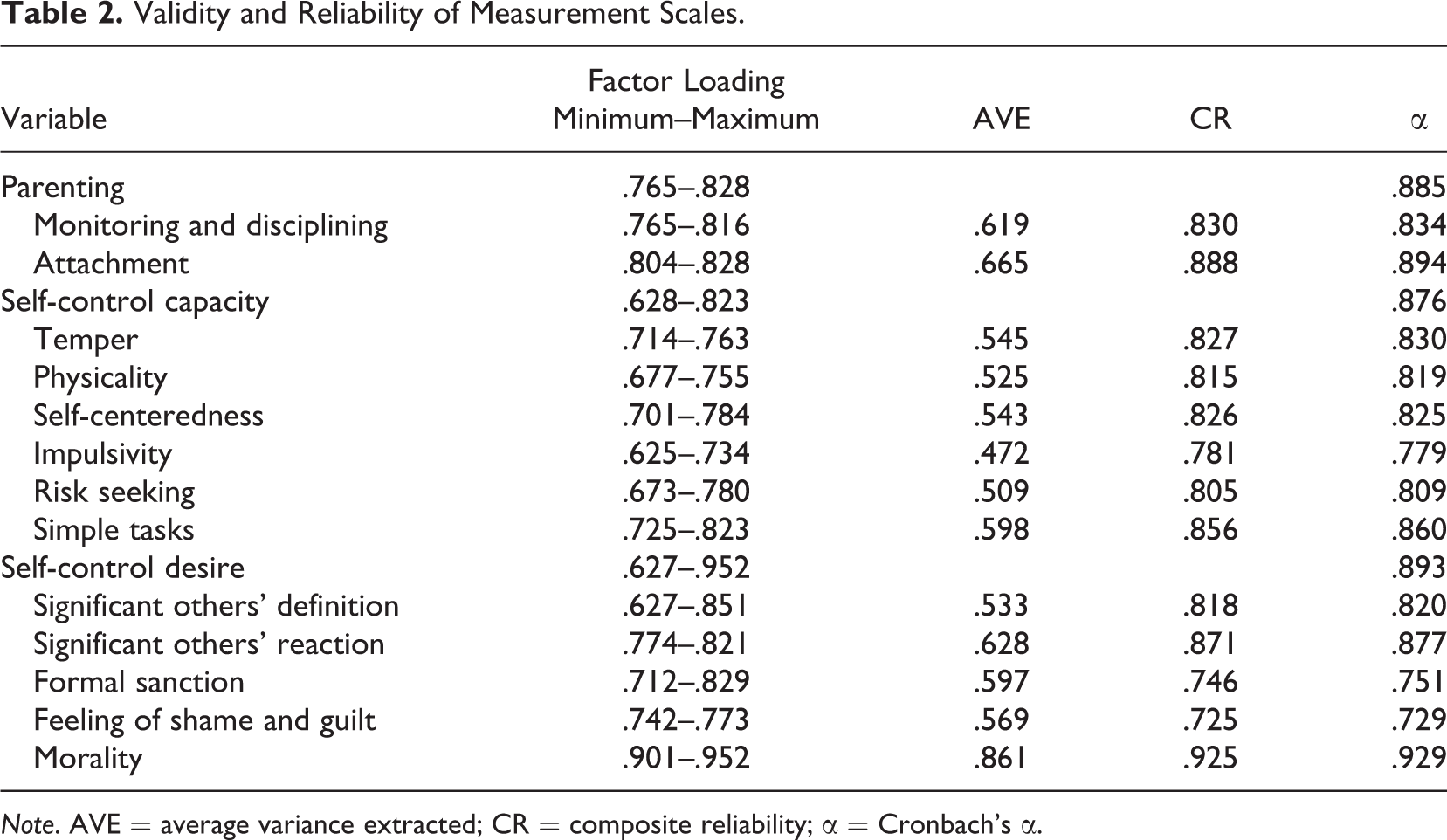
Note. AVE = average variance extracted; CR = composite reliability; α = Cronbach’s α.
Analytic Strategy
The analyses proceeded in several steps. First, frequency analyses were conducted to illustrate the prevalence of PED use among the sample participants. Second, bivariate correlations were conducted to examine initial associations between the independent and dependent variables. Third, independent sample t tests were conducted to examine ineffective parenting, low self-control, and PED use by gender. Fourth, due to the presence of latent variables, along with complex mediated and moderated relationships, we use structural equation modeling to analyze the data. See Figure 1 for the proposed theoretical model.
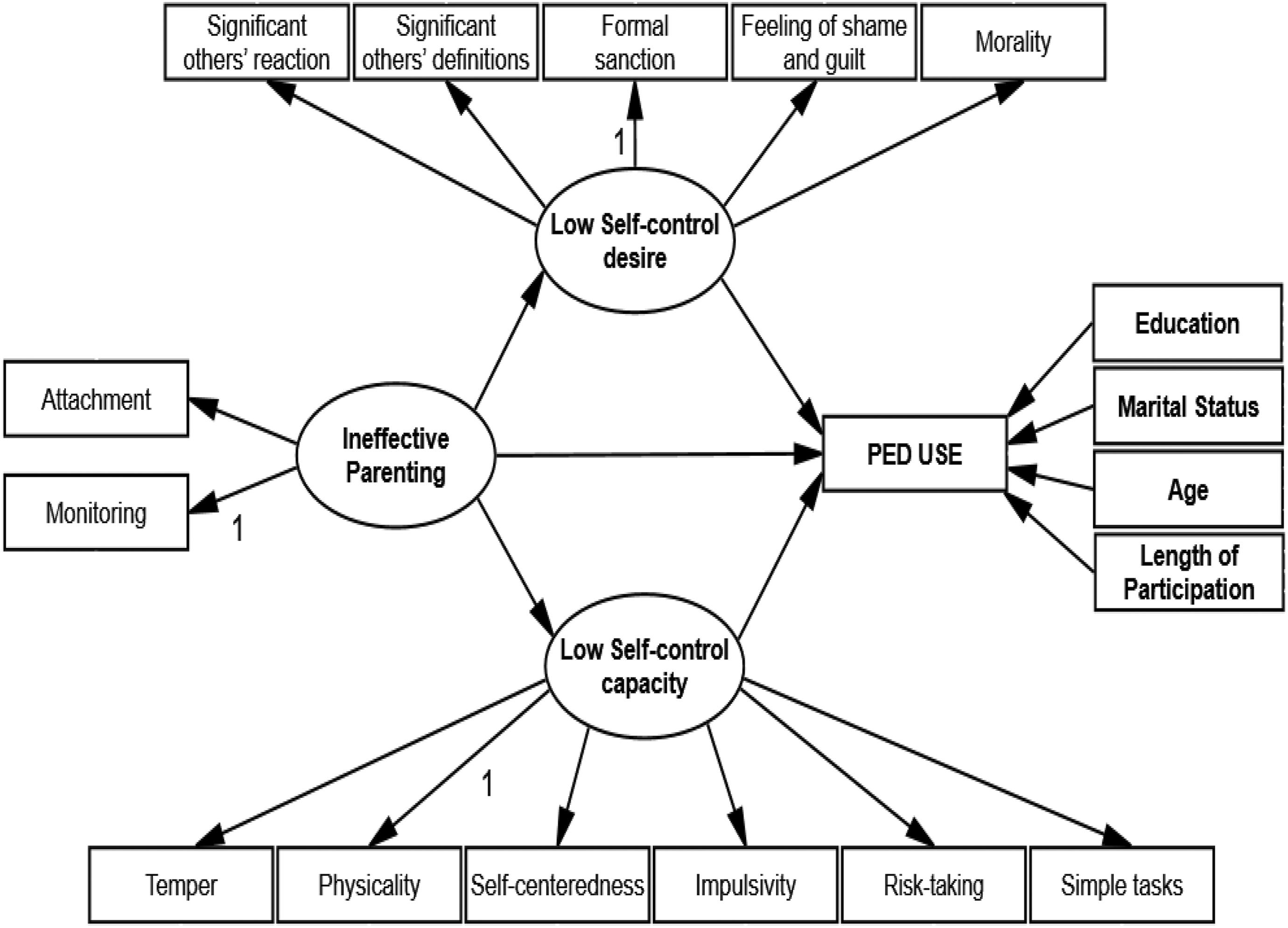
Proposed theoretical model.
Results
Descriptive statistics were analyzed to illustrate the athletes’ past use, current use, and future intention of use. With respect to past use, 26% of respondents had never used PEDs, 26% reported low use of PEDs, 29% reported moderate use, and 19% reported high use. With regard to current use, 41% of the sample reported not currently using PEDs, 27% reported low use, 21% reported moderate use, and 11% reported high use of PEDs (i.e., regular and systematic use). Lastly, with respect to the future intention of use, 36% of respondents stated they were unwilling to use PEDs, 28% reported a low likelihood of use, 23% reported a moderate likelihood of use, and 13% reported a high likelihood of future use.
Bivariate Results
Table 3 reports the zero-order correlations between the independent variables and PED use. As the results indicate, there are moderately strong correlations (r > .20) between ineffective parenting, low self-control capacity, low self-control desire, and PED use. Additionally, the analysis demonstrated significant (p < .01) and moderately strong correlations (r > .20) between PED use and each dimension of the latent independent variables.
Descriptive Statistics and Correlations Between the Independent and Dependent Variables.

Note. PED = performance-enhancing drug.
*p < .05. **p < .01.
Next, a series of independent sample t tests were conducted to examine potential gender differences in PED use among the athletes. Table 4 displays the group differences between males and females in low self-control, ineffective parenting, and PED use. As expected, there are significant differences between male and female PED use. Specifically, males had significantly higher group means for past use (t = −3.131, p < .01), current use (t = −3.075, p < .01), and future intention of use (t = −5.504, p < .01). Males and females also significantly differed in low self-control desire, with females having a lower group mean (i.e., higher self-control desire; t = −2.971, p < .01). Interestingly, however, they did not differ in low self-control capacity or ineffective parenting.
Group Differences Between Male and Female Athletes in Ineffective Parenting, Low Self-Control, and PED Use.
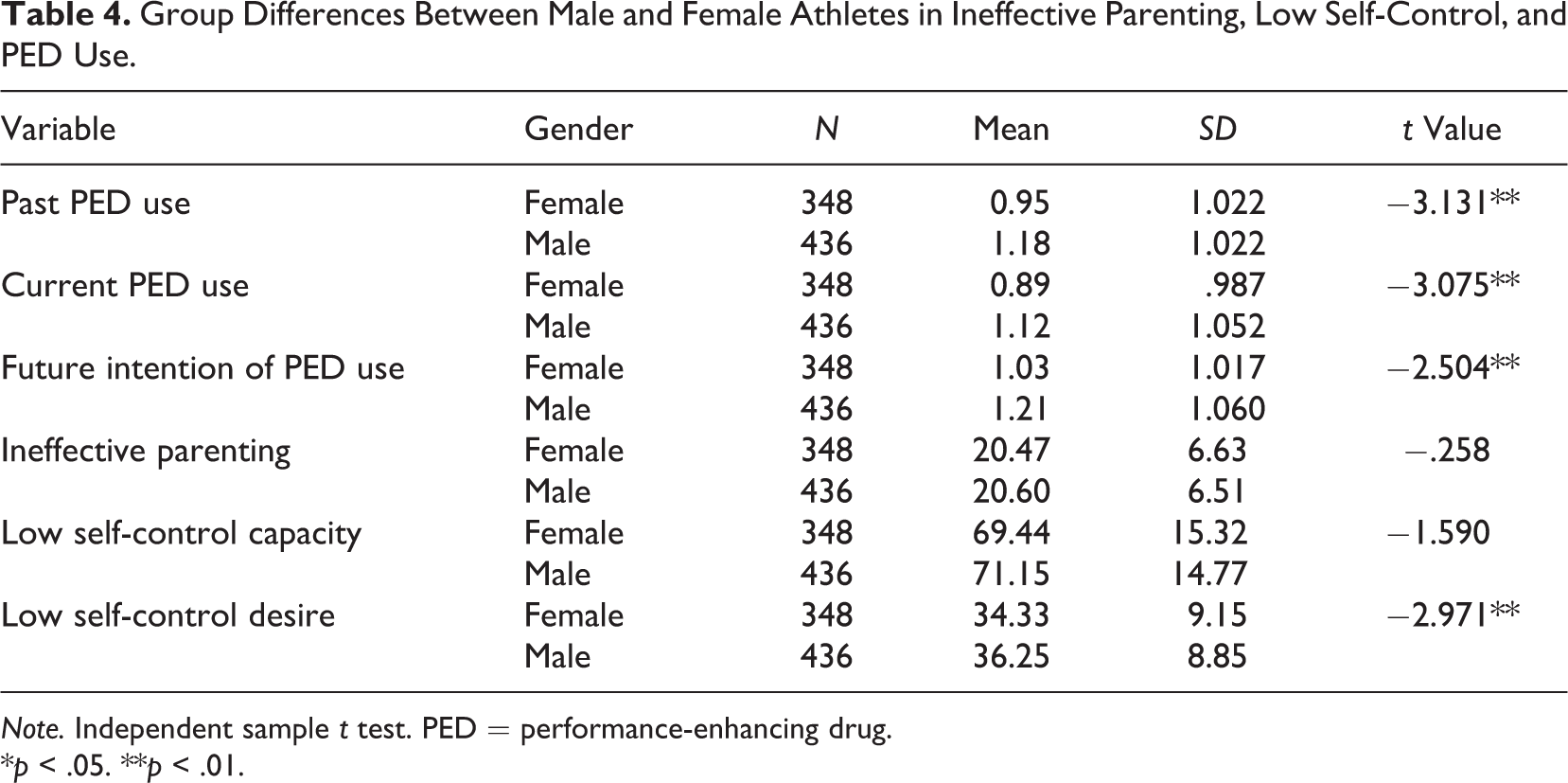
Note. Independent sample t test. PED = performance-enhancing drug.
*p < .05. **p < .01.
While the bivariate analyses were able to shed some light into the relationships between ineffective parenting, low self-control, and PED use, it was important to consider them in a multivariate context. According to recent research from Kabiri et al. (2018), ineffective parenting and low self-control have an influence on athletes’ PED use. However, to fully investigate the direct and indirect paths of the self-control model on PED use, structural equation modeling with a bootstrapping method was employed in the current study. 5
Multivariate Results: Past PED Use
We begin by examining the theory’s applicability to prior PED use (see Table 5 and Appendix A). In the full model, ineffective parenting (β = .109, p < .01), low self-control capacity (β = .306, p < .01), and low self-control desire (β =.261, p < .01) were significantly and directly associated with past PED use. Therefore, Hypotheses 1–3 were supported. Additionally, ineffective parenting had direct effects on low self-control capacity (β = .290, p < .01) and low self-control desire (β = .219, p < .01). From these paths, it was also discovered that ineffective parenting has an indirect effect (partial mediation) on prior PED use (β = .098, p < .01), which partially supported Hypothesis 4.
Direct and Indirect Effects of the Self-Control Model on Athletes’ Past PED Use.

Note. PEDs = performance-enhancing drugs; CMIN = normed χ2; df = degrees of freedom; CMIN/df = normed χ2 divided by its degrees of freedom; GFI = goodness-of-fit index; AGFI = adjusted goodness-of-fit index; NFI = normed fit index; IFI = incremental fit index; CFI = comparative fit index; RMSEA = root mean square error of approximation.
*p < .05. **p < .01.
In the female model, low self-control capacity (β = .311, p < .01) and low self-control desire (β =.258, p < .01) had significant and direct effects on past PED use. Ineffective parenting had an indirect effect (full mediation) on PED use (β = .148, p < .01). In the male model, low self-control capacity (β = .309, p < .01) and low self-control desire (β =.258, p < .01) once again had significant and direct effects on prior PED use. Unlike the female model, the male model demonstrated that ineffective parenting had both direct (β = .145, p < .01) and indirect effects (β = .145, p < .01), which suggests partial mediation. As multiple group path analyses of the self-control model established, there was no significant difference between male and female athletes regarding the effect of low self-control on prior PED use. Because the measured parameters do not show a difference in low self-control, it suggests that the self-control model has approximately equal applicability for the two groups. It was also demonstrated that age had a significant and direct effect for female athletes only. Thus, older female athletes were more likely to have had a history with PEDs.
Multivariate Results: Current PED Use
Next, we turn to the analyses examining current PED use (see Table 6 and Appendix B). The full model demonstrated substantially similar results as the prior PED model. Ineffective parenting (β = .175, p < .01), low self-control capacity (β = .285, p < .01), and low self-control desire (β =.251, p < .01) were all positively related to current PED use. Again, Hypotheses 1–3 are supported. Additionally, ineffective parenting had direct effects on low self-control capacity (β = .287, p < .01) and low self-control desire (β = .219, p < .01). From these paths, it was also found that ineffective parenting had an indirect effect (partial mediation) on current PED use (β = .137, p < .01), which partially supported Hypothesis 4.
Direct and Indirect Effects of the Self-Control Model on Athletes’ Current PED Use.

Note. PEDs = performance-enhancing drugs; CMIN = normed χ2; df = degrees of freedom; CMIN/df = normed χ2 divided by its degrees of freedom; GFI = goodness-of-fit index; AGFI = adjusted goodness-of-fit index; NFI = normed fit index; IFI = incremental fit index; CFI = comparative fit index; RMSEA = root mean square error of approximation.
*p < .05. **p < .01.
With regard to the female model for current PED use, ineffective parenting yielded a direct effect (β = .128, p < .05), which it did not for prior PED use. Again, low self-control capacity (β = .340, p < .01) and low self-control desire (β =.241, p < .01) both had significant and direct effects on current PED use. Moreover, ineffective parenting had an indirect effect (partial mediation) on current PED use (β = .154, p < .01). In the male model, ineffective parting had a direct effect (β =.215, p < .01), again, which it did not for prior use. Low self-control capacity (β = .250, p < .01) and low self-control desire (β =.253, p < .01) both had significant and direct effects on current PED use. Similar to the female model, ineffective parenting yielded an indirect effect (partial mediation) on current use (β = .125, p < .01). Once again, multiple group path analyses of the self-control model demonstrated that there was no significant difference between male and female athletes regarding the effect of low self-control on current PED use. This suggests that the self-control model has approximately equal applicability for the two groups. Furthermore, age once again had a significant and positive effect for female athletes only.
Multivariate Results: Future Intention of PED Use
Next, we explored the predictive utility of the theory on athletes’ future intention of PED use (see Table 7 and Appendix C). In the full model, ineffective parenting (β = .085, p < .05), low self-control capacity (β = .305, p < .01), and low self-control desire (β =.291, p < .01) were all significantly and directly associated with the future intention of PED use. Therefore, Hypotheses 1–3 were again supported. Moreover, ineffective parenting was shown to have direct effects on low self-control capacity (β = .288, p < .01) and low self-control desire (β = .220, p < .01). From these paths, it was further uncovered that ineffective parenting had an indirect effect (partial mediation) on the future intention of PED use (β = .152, p < .01), which partially supported Hypothesis 4.
Direct and Indirect Effects of the Self-Control Model on Athletes’ Future Intentions of PED Use.

Note. PEDs = performance-enhancing drugs; CMIN = normed χ2; df = degrees of freedom; CMIN/df = normed χ2 divided by its degrees of freedom; GFI = goodness-of-fit index; AGFI = adjusted goodness-of-fit index; NFI = normed fit index; IFI = incremental fit index; CFI = comparative fit index; RMSEA = root mean square error of approximation.
*p < .05. **p < .01.
In the female model, low self-control capacity (β = .279, p < .01) and low self-control desire (β =.302, p < .01) had significant and direct effects on the future intention of PED use. Similar to the findings on past PED use, ineffective parenting did not have a direct effect on the future intention of PED use, but it did have an indirect effect (full mediation; β = .143, p < .01). In the male model, low self-control capacity (β = .327, p < .01) and low self-control desire (β =.273, p < .01) again had significant and direct effects on the future intention of PED use, while ineffective parenting only had an indirect effect (full mediation; β = .156, p < .01). These findings were consistent with past PED use models. As multiple group path analyses of the self-control model indicated, there was no significant difference between male and female athletes regarding the effect of low self-control on the future intention of PED use and suggests that the self-control model has approximately equal applicability for the two groups. Unlike the previous dependent variables, age was not significantly related to the future intention of PED use in either of these three models.
Multivariate Results: Interaction Effects
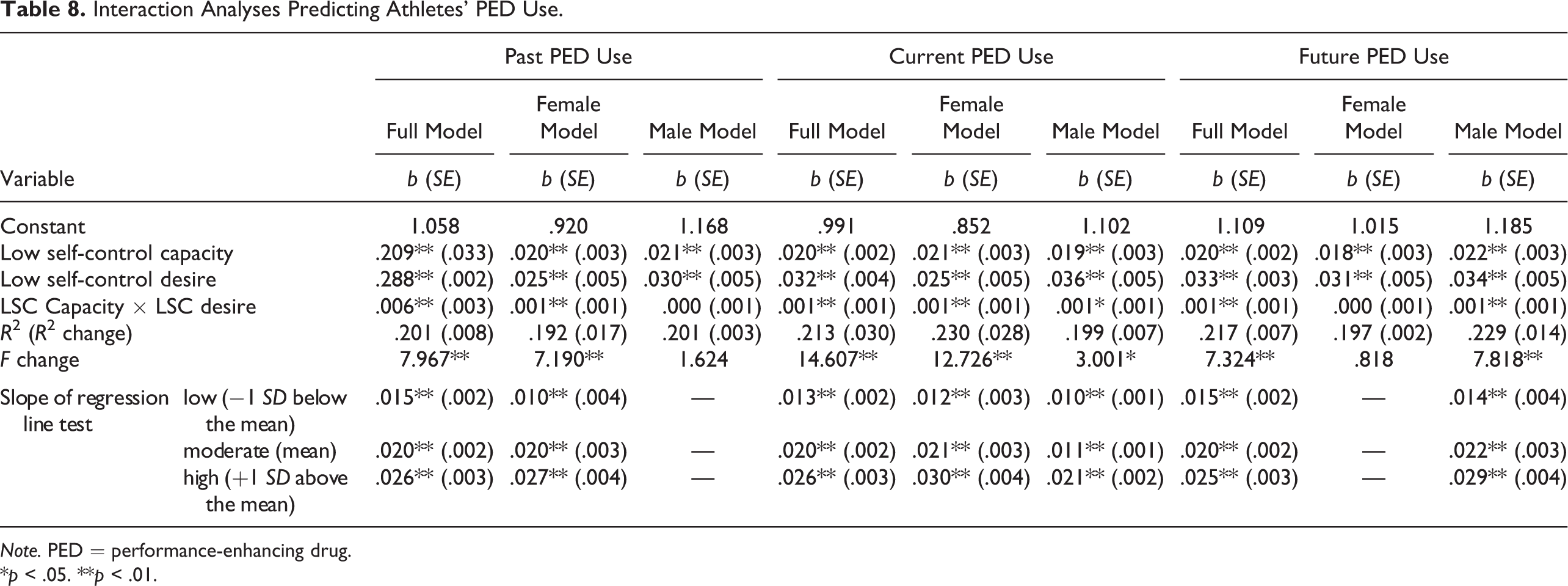
Lastly, we tested the moderation effect of self-control desire on the relationship between self-control capacity and PED use. According to Tittle et al. (2004), the propensity to exercise self-control (i.e., self-control desire) is a distinct construct from one’s self-control capacity. This construct is proposed to enhance the capacity of self-control in such a way that people with high self-control desire are less likely to be involved in deviant behaviors. This claim is backed by research from Cochran et al. (2006) who found that self-control desire had a moderation effect on the relationship between self-control capacity and academic cheating among a sample of university students. Here, we investigate the interaction effect of the moderator variable (i.e., self-control desire) with the Hyes process command in SPSS 24 (see Table 8). Additionally, simple slopes for the association between low self-control capacity and PED use were tested for low (1 SD below the mean), moderate (mean), and high (1 SD above the mean) levels of low self-control desire. In other words, Hypothesis 5 posited that the effect of low self-control capacity on PED use is contingent on an athlete’s low self-control desire.
Interaction Analyses Predicting Athletes’ PED Use.
Note. PED = performance-enhancing drug.
*p < .05. **p < .01.
With regard to prior PED use in the full model, the interaction variable predicted an increase in past PED use (b = .006, p < .01). Moreover, the simple slope tests of high self-control desire (b = .026, p < .01), medium self-control desire (b = .020, p < .01), and low self-control desire (b = .015, p < .01) revealed significant moderating effects on the relationship between low self-control capacity and athletes’ past PED use. Substantively similar findings were seen in the female model. However, the interaction variable did not reveal a significant moderating effect in the male model, which indicates that the contingent effect of self-control desire is not the same across both groups.
For current PED use, the full model again demonstrated a significant interaction variable (b = .001, p < .01) and significant moderating effects for the simple slope tests of high self-control desire (b = .026, p < .01), medium self-control desire (b = .020, p < .01), and low self-control desire (b = .013, p < .01). Moreover, substantively similar findings were seen in both the female and male models, indicating that the contingent effect of self-control desire is approximately equal for the two groups.
Lastly, with respect to the future intention of PED use in the full model, the interaction variable was again significant (b = .001, p < .01). This is consistent with the previous two dependent variables. Also consistent, the simple slope tests of high self-control desire (b = .025, p < .01), medium self-control desire (b = .020, p < .01), and low self-control desire (b = .015, p < .01) revealed significant moderating effects on the relationship between low self-control capacity and athletes’ future intention of PED use. For this dependent variable, substantively similar findings were seen in the male model. However, the interaction variable did not reveal a significant moderating effect in the female model, which indicates that the contingent effect of self-control desire is not the same across both groups. These latter findings are the opposite of what was seen in the prior PED use interaction models.
Discussion
Gottfredson and Hirschi’s (1990) general theory of crime is one of the most important theories for explaining deviant behaviors. Generally, this theory posits that self-control is acquired through effective parental socialization in the first decade of life. If not developed, the relative stable nature low self-control increases the likelihood of deviant behaviors because these individuals are more likely to give in to their hedonistic nature and in to the temptations of crime. More specifically, low self-control individuals are less able to delay their need for immediate gratification and less able to consider the long-term consequences of their actions. In the case of low self-control athletes, this theory would suggest that they are more likely to take a shortcut (e.g., use a banned PED) to achieve their athletic goals.
Recent studies have explored the effect of self-control on sport doping (e.g., Chan et al., 2015; Kabiri et al., 2018) and have provided preliminary evidence that there is a relationship between these variables. However, no study to date has (1) fully investigated the self-control model, (2) examined the direct and indirect effects of ineffective parenting on PED use among athletes, or (3) provided a gendered analysis of these relationships. Thus, the current study was undertaken to address these gaps in the literature. Additionally, this study employed a random sampling strategy of professional athletes from Iran, which is a country rarely examined in social science research.
The findings from this study illuminate these relationships and provide general support for the research hypotheses. The results demonstrated that inefficient parenting has a positive and direct effect on male and female athletes’ PED use, and they indicated that ineffective parenting has positive and direct effects on athletes’ low self-control capacity and low self-control desire. Moreover, the findings revealed that the low self-control variables had positive and significant effects on PED use. These results are consistent with Gottfredson and Hirschi’s (1990) general theory as well as with Tittle et al.’s (2004) extension of the self-control model. Furthermore, while many of the previous studies examining the effect of low self-control on sports doping have utilized samples from Western countries, the current study supports the generalizability of the effect of low self-control on deviant behavior by analyzing data from Iranian athletes.
Also consistent with the theoretical premise, low self-control was found to partially mediate the relationship between ineffective parenting and PED use. This study hypothesis, however, was only partially supported as Gottfredson and Hirschi (1990) contend that there should be a full mediation effect. With respect to moderation, Tittle et al. (2004) argue that there is a fundamental distinction between self-control capacity and self-control desire, and this difference plays an important role in explaining deviant behaviors. Although having self-control capacity is a vital precondition of noninvolvement in deviant behavior, self-control desire must also be considered (e.g., Brewer et al., 2018; Cochran et al., 2006; Schoepfer, Piquero, and Langton 2014). In the current context, athletes may have self-control capacity but still use PEDs in certain situations. In other words, although prior studies have indicated that PED use is sometimes considered normative in the sport subculture (Kabiri et al., 2018) and/or that coaches and teammates may encourage athletes to use PEDs (Kabiri et al., 2018), the athletes who have lower levels of self-control capacity and low self-control desire are most likely to use PEDs. Consistent with Tittle et al. (2004), the current findings support the hypothesis that self-control desire has a moderating effect on the relationship between self-control capacity and deviant behavior. They are two distinct and important constructs that have predictive utility in athletes’ PED use.
Lastly, the analyses revealed several interesting findings with respect to gender. First, at the bivariate level, female athletes demonstrated significantly lower levels of past use, present use, and the future intention of use. These results, which partially support Hypothesis 6, are consistent with the general substance use literature on gender and drug use (e.g., Chen & Jacobson, 2012; McCabe et al., 2007) and with several studies in the sports doping literature (e.g., Chan et al., 2015; Sekulic et al., 2016). However, the reason(s) behind their lower prevalence are theoretically inconsistent; although female athletes had significantly lower levels of low self-control desire (i.e., higher self-control desire), they did not statistically differ with their male counterparts in terms of ineffective parenting or low self-control capacity. This suggests that Tittle et al.’s (2004) concept of self-control desire may be more important than originally conceived by Gottfredson and Hirschi (1990). Second, the influence of ineffective parenting did not apply equally across the dependent variables with respect to gender. For both males and females, ineffective parenting had both direct and indirect effects for current use, but it only had indirect effects for future use. Finally, a significant moderation effect (LSC Capacity × LSC Desire) appeared only for female athletes for prior use, for both genders for current use, and only for male athletes for future intention of use. This suggests that the moderating effect is not consistent across gender and PED outcome.
Study Limitations and Directions for Future Research
Although this study makes an important contribution to the literature, it is necessary to acknowledge a few study limitations. First, the generalizability of the findings may be limited based on the two city, single country sample used in this study. Due to potential regional differences in PED use and sport doping culture, these findings may be specific to athletes from the sampled cities. Future research should be conducted to assess the generalizability of the results across time, methods, and other populations. Second, the data come from a cross-sectional survey of athletes. Future studies should explore these relationships over the course of an athlete’s career. If self-control is less stable than the theorists hypothesize (see, e.g., Mitchell & Mackenzie, 2006; A. R. Piquero, Jennings, et al., 2010), it would be interesting to see how self-control—and PED use—change over the life course of an athlete’s career. Third, our measurement of self-control capacity was attitudinal in nature based on the Grasmick et al. (1993) scale. Future research may want to consider a measurement strategy that is more consistent with Hirschi’s (2004) reconceptualization of self-control. Fourth, all of the measures are based on data collected from a single source—the athlete—which could contribute to common method variance (e.g., Lindell & Whitney, 2001). Future research should address this limitation by collecting data from multiple sources. Fifth, the use of self-report data may be limited by social desirability bias, wherein participants underreport deviant behavior because they respond in such a way as to present themselves in the best possible light (Jennings & Reingle, 2014). To combat this effect, participants were informed numerous times as to the voluntary and anonymous nature of participation.
Policy Implications
Despite the study limitations, the results yield important policy and practice implications to reduce PED use among athletes. This study has two overarching recommendations for reducing PED use: (1) broad efforts to improve anti-doping education and (2) strategies designed to develop/strengthen self-control capacity and desire. Education and positive reinforcement strategies may be an effective way to combat sports doping (e.g., Kondric et al., 2011; Striegel, Vollkommer, & Dickhuth, 2002). Global sport organizations should regularly offer and implement anti-education doping programs, such as the Athlete Learning Program about Health and Anti-Doping and Coach True. According to Backhouse, McKenna, Robinson, and Atkin (2007), successful education programs utilize a comprehensive and multifaceted approach to doping prevention. The Adolescents Training and Learning to Avoid Steroid program, for example, addresses a range of topics including peer and media resistance training, body image and self-esteem issues, and alternatives to PED use. Overall, these programs offer new approaches to anti-doping education by addressing how athletes’ attitudes shape their intentions and behaviors. Additionally, family members, friends, coaches, and trainers must encourage athletes to compete fairly. These social messages can help change favorable attitudes toward doping to unfavorable ones (e.g., Mazanov, Backhouse, Connor, Hemphill, & Quirk, 2014). Thus, both formal and informal education related to antidoping should prove to be an effective way to reduce PED use.
Furthermore, in order to decrease the use of PEDs, relevant authorities and officials must design and implement training programs to promote ethics and restraint. This can start early in life through primary prevention and intervention. This can also take place later in life through athletic training programs focusing on sport integrity and fairness. Recent research suggests, contrary to Gottfredson and Hirschi’s (1990) stability hypothesis, that self-control can actually be strengthened over time (e.g., Baumeister, Gailliot, DeWall, & Oaten, 2006; Muraven, 2010). Therefore, the various governing bodies in sports should be committed to training programs which implement strategies to bolster one’s level of self-control. Like a muscle in the body, this research suggests that one’s level of self-control can be strengthened through repeated exercise. If athletes are subjected to vigorous training regimens, it should be able to boost their self-control, which should then decrease their likelihood of doping.
Footnotes
Appendix A
Appendix B
Appendix C
Acknowledgments
The authors would like to express our appreciation to the anonymous reviewers for their comments and suggestions on earlier drafts of this article. This version has been considerably improved because of their efforts.
Declaration of Conflicting Interests
The authors declared no potential conflicts of interest with respect to the research, authorship, and/or publication of this article.
Funding
The authors received no financial support for the research, authorship, and/or publication of this article.