



Abstract
Offenders in South Africa face dehumanizing conditions in overcrowded correctional centers known for constant violence and corruption. These offenders need to cope and adjust to life within a correctional center. However, the majority of young adult male offenders use aggression to adjust to the correctional environment. It is, therefore, essential to identify which predictor variables predict aggression the best among incarcerated young adult male offenders. This study focused on 243 young adult male maximum-security offenders sampled through convenience sampling. Hierarchical multiple regression analyses were conducted to investigate which variable(s) or set(s) of variables explain a significant percentage of the variance of aggression. The results indicated that problem-solving, seeking social support, and avoidance, as a set of predictors, significantly predicted physical aggression, anger, and hostility. These findings seem to suggest that to decrease physical aggression, anger, and hostility among young adult offenders, it would be advisable to implement interventions that would (i) increase their problem-solving skills, (ii) improve their social support, and (iii) teach them to refrain from making use of avoidance as a coping strategy.
Background
South Africa is a country riddled with crime, especially violent, aggressive types of crime (Faull, 2017; Fourie, 2018; Thobane & Prinsloo, 2018; Weierstall et al., 2013). However, a concern is that violent crimes nowadays are more committed by younger individuals (Hanson, 2018). Subsequently, these young adult offenders are housed in correctional environments plagued with unique challenges, stresses, frustrations, and deprivations (Weiten et al., 2018). Within these perplexing correctional environments, young adult offenders face daunting challenges such as overcrowding, corruption, bullying, sexual victimization, forced sex, gang activity, offender-on-offender violence, offender-on-staff violence, exploitation, suicide, and even murder (De Viggiani, 2007; Gear, 2007a, 2007b, 2008, 2010; Hesselink-Louw, 2004; Lahm, 2008, 2009; Morash et al., 2010; Perez et al., 2009; Sarchiapone et al., 2009). Young adult male offenders are particularly inclined to experience aggression, violence, and assault within the correctional environment, but are even more inclined to cope with daily challenges in correctional environments by using aggression themselves (Casey et al., 2016; Chahal et al., 2016; DeVeaux, 2013; McGuire, 2018; Moore et al., 2018; Reid & Listwan, 2018; Steiner et al., 2014; Tomar, 2013; Valentine et al., 2015), as they tend to be developmentally unprepared to adjust to the challenges of the correctional environment (Scott & Steinberg, 2008; Valentine et al., 2015). Reid and Listwan (2018) reiterated the importance of research on aggression and violence within correctional environments, as aggression and violence within the correctional environment lead to severe consequences such as loss of life, personal injury, fear, increased security, longer sentences, increased levels of recidivism, reduced access to programs, and sexual victimization (Reid & Listwan, 2018; Ricciardelli, 2014a, 2014b; Rocheleau, 2015; Trulson et al., 2010).
Incarceration in South Africa
South Africa has 235 active correctional centers that accommodate an estimated 162,875 incarcerated offenders with approved bed space for only 118,723 offenders (Department of Correctional Services, 2019). Correctional centers in South Africa fall into three categories: minimum-security, medium-security, and maximum-security centers (Neser, 1993). Also, two types of maximum-security correctional centers exist in South Africa, namely (i) government-operated maximum-security correctional centers and (ii) private maximum-security correctional centers. In this regard, the South African government contracted two private companies to render correctional services and to manage these correctional centers on their (the government) behalf (Du Preez & Luyt, 2006; Hesselink-Louw, 2004; Matshaba, 2007; Seiter, 2008). Thus, two private correctional centers currently operate in South Africa (Du Preez & Luyt, 2006; Hesselink-Louw, 2004; Matshaba, 2007), and they function differently with regard to different operational structures, housing facilities, staff–inmate ratio, management styles, and rehabilitation efforts in relation to government-operated maximum-security centers. However, the private maximum-security correctional centers have no authorization in deciding which (types of offenders) and where (in which correctional centers in South Africa) incarcerated offenders are detained. The private correctional centers have no input or power regarding which incarcerated offenders (i.e., some of the most violent, aggressive, and unmanageable offenders and notorious gangsters) they receive and house in their correctional environment (Correctional Services Act 111 of 1998).
Social Learning and Aggression
The social learning theory has been used in previous studies (Siegel, 2016) to understand and explain nondeviant and deviant behavior. Akers (1998) stated that individuals are more inclined to engage in criminal and deviant behavior (i.e., violence, aggression) when they engage and associate with deviant and violent others (i.e., other violent and aggressive inmates and gang members) that they observed and learned from. This has been referred to as differential association (Akers & Sellers, 2004; Siegel, 2016). In explaining the relationship between aggression and violence and learned behavior in the correctional environment, Siegel and Bartollas (2016) produced an outlay on “The Youthful Offender and a Future Life of Crime,” outlining the relationship between learned behavior and further or adult crime. These researchers note that within a correctional setup, more serious violent behavior is learned from more experienced (older) and influential offenders (gang members), impacting youths’ inclination to future and ongoing learned aggression and violent behavior (Siegel & Bartollas, 2016). In this regard, a correctional environment characterized by aggression and violence becomes a training school for youth for more ingrained aggressive and violent behavior (Siegel & Bartollas, 2016). Putting it differently, young offenders incarcerated for aggressive crimes and those who are frequently exposed to aggressive and violent behavior face serious compromises (in being “programmed” with the same behavior, thus learned behavior) in adult adjustment (Siegel & Bartollas, 2016). Siegel and Bartollas (2016) cited an example of a young offender incarcerated for a violent crime. The already violently persuaded youth was overwhelmed and impressed by older and more aggressive offenders (learning to be even more violent), and he subsequently joined these offenders’ violent gang (Siegel & Bartollas, 2016).
From Siegel and Bartollas’ (2016) citing, young adult offenders housed in a maximum-security correctional center tend to be exposed to unacceptable behavior from behavioral models (i.e., violent and aggressive offenders, assault, and gang fights) that reinforce their deviant and criminal behavior. Offenders tend to justify their deviant behavior as necessary and tend to anticipate more rewards than punishments for their actions (Akers, 1998). Siegel (2016) adds that people who reside in a violent environment (such as a correctional center), where violence is a frequent occurrence, are more inclined to act violently, as violence is used as a conflict resolution mechanism. Therefore, an environment susceptible to assault, attacks, insults, and verbal taunts (i.e., a correctional center) will be viewed as a challenge, and this triggers violent responses and actions (Siegel, 2016). This premise directly relates to differential reinforcement (Akers, 1998; Akers & Jennings, 2016; Siegel, 2016).
However, definitions (the values and norms that these offenders hold) influence whether offenders will view aggressive and violent behavior as acceptable or unacceptable (Akers & Jennings, 2016; Siegel, 2016). These attitudes (a pro-violent mindset) and values (where violence is associated with masculinity and “being tough”) tend to be learned and reinforced through the process of differential association (Akers, 1998; Akers & Sellers, 2004, 2013; Siegel, 2016). Thus, young adult offenders are more inclined and often predisposed to be involved in violence when their learning experiences (from childhood and in a correctional center) are linked to aggression and violence (Akers & Jennings, 2016; Siegel, 2016).
Expanding on the previous arguments, Weierstall et al. (2013) found that young offenders involved in violent and appetitive aggressive behavior in the correctional environment tend to have improved psychosocial functioning and are less worried about future threats. Furthermore, Siegel and Bartollas (2016) and Sommer et al. (2017) found that previous trauma and substance abuse played a role in the appetitive aggression among young offenders. Thus, young offenders tend to use violence and aggression, although forms of maladjustment, to cope within the correctional environment (Crank, 2010). The likelihood that offenders will continue to be involved in deviant or criminal behaviors will increase as they associate and align themselves with more dangerous and violent offenders (definitions favorable to violence) than refraining from violence in a correctional center (definitions unfavorable toward violence, such as deviant behavior; Akers & Jennings, 2016; Siegel, 2016). These definitions also influence how offenders think about and behave regarding deviant behavior. On a cognitive level, definitions that favor deviant behavior will lead to a mindset (i.e., decision making and coping mechanism) where offenders are more willing to commit deviant behavior when opportunities occur. On a behavioral level, these definitions influence the occurrence of deviant behavior by acting as internal discriminative stimuli—responding to violence with aggression and violence—supporting the notion that “violence begets violence” (Akers & Jennings, 2016; Akers & Silverman, 2004; Siegel, 2016). Imitation also plays a role where offenders tend to imitate the behaviors that they observed of other offenders, including the consequences of such behavior (Akers, 1998; Akers & Jennings, 2016). Young adult offenders are more inclined to imitate violent behavior within a correctional environment that heightens arousal (i.e., provocation, assault, verbal abuse, and violence) when they observe the rewards (instilling fear, status, and masculinity) of such behavior. These young adult offenders have learned and imitated poor decision-making and problem-solving skills that predispose them to aggressive and violent responses and actions within the correctional environment (Siegel, 2016).
Aggression and Coping
Offenders tend to use passive ways (i.e., avoiding activities, withdrawing oneself) or aggressive ways (i.e., misconduct, acting out, joining gangs) to adjust within the correctional environment (Chahal et al., 2016; McCorkle, 1993). Young adult offenders are especially more inclined to use aggression as a coping strategy (Reid & Listwan, 2018; Wooldredge, 2020), and various explanations exist about why young adult offenders are more inclined to exhibit aggressive behavior and violence as a form of coping within the correctional environment. One such view is that young adult offenders are more prone to experience victimization and therefore resort to aggression and violence in an attempt to protect themselves (Ricciardelli, 2014a; Valentine et al., 2015). Crighton and Towl (2008) also stated that offenders use aggression within the correctional environment to survive. Another view includes young adult offenders who resort to violence to prove their toughness and gain a higher status within the correctional environment (Bishop & Frazier, 2000; Ricciardelli, 2014a; Valentine et al., 2015). However, young adult male incarcerated offenders with better basic coping skills (i.e., problem-solving, seeking social support) are less inclined to resort to aggression to deal with the challenges in the correctional environment (Bouffard, 2015; Jordaan, 2014).
Problem-solving skills enable offenders to request information and assistance from correctional staff in dealing with the daily challenges of the correctional environment (Van Herreveld et al., 2007). Offenders who are more inclined to use problem-solving as a coping strategy tend to experience incarceration more effectively and positively (Hesselink-Louw, 2004; Jordaan, 2014). Offenders tend to use avoidance as a coping strategy in the form of denial and externalization (Carr, 2013; Chahal et al., 2016; Picken, 2012). Offenders are more inclined to ignore stressors within the correctional environment or minimize the effect that the stressors have on them (Chahal et al., 2016). However, avoidance as a coping strategy may be useful within the challenging correctional environment (Lazarus & Folkman, 1984), as it includes efforts to avoid stressful situations and thinking about them (Mohino et al., 2004). Social support plays a vital role in reducing aggression among offenders (Woo et al., 2016), as it enables them to satisfy their basic needs and find security within the correctional environment (Liu & Chui, 2013). Support from significant others in the correctional context reduces negative emotions such as anger and hostility (Cullen, 1994). It serves as a buffer against the daily stressors of the correctional environment (Carr, 2013). Rogers (2019) found that problem-solving and social support play a role in better adjustment among incarcerated male offenders.
Aggression and Decision Making
Young adult offenders tend to be involved in misconduct within the correctional environment when they utilize cautious decision making (Bouffard, 2015). When young adult male incarcerated offenders make better decisions, it can positively impact their interaction with other offenders and staff during their incarceration period (Loewenstein & Lerner, 2003). Toch (1997) stated that young adult offenders who are proactively involved in decision-making processes are more inclined to cope better. Pretorius (2019) found that young adult offenders who are more vigilant regarding decision making can solve problems better and adjust to the correctional environment. However, individuals with poor decision-making capabilities and low self-control are more inclined to aggravate and provoke other individuals without considering that others may retaliate against them. When situations occur where confrontation can be avoided, individuals with low self-control and poor decision-making capabilities would instead utilize verbal or physical aggression rather than walk away from the encounter (Stewart et al., 2004).
Aggression and Age
Age is a significant predictor of aggression among young adult offenders (Camp et al., 2003), and young adult offenders typically tend to cope through aggression (McCorkle, 1993; Rocheleau, 2015). However, as offenders become older, they tend to learn the expenses and consequences of aggression, and in turn, the frequency and rigorousness of disciplinary violations decrease (Camp et al., 2003; Kuanliang et al., 2008; Mandell, 2006). Young adult offenders need to be equipped with effective coping strategies to deal with the stressful circumstances of the correctional environment (Chahal et al., 2016; Rocheleau, 2015; Zamble & Porporino, 1990), which will result in improved mental and physical health (Reid & Listwan, 2018).
Aggression and Sentence Length
Sentence length tends to determine how incarcerated offenders cope with and adjust to incarceration (Agbakwuru & Ibe-Godfrey, 2017). Most offenders tend to struggle with adjusting to the correctional environment during the initial stages of their sentences (Mandell, 2006; Rocheleau, 2015). As offenders progress in their sentences, they report reduced feelings of hopelessness, lower levels of violence and misconduct, and increased participation in rehabilitative programs and activities (Smith et al., 2002).
Aggression and Type of Crime
Offenders who committed violent crimes tend to be more inclined to exhibit aggressive behavior in the correctional environment than offenders who were incarcerated for nonviolent crimes (Finn, 1995; Griffin & Hepburn, 2006; Logan, 2015). When violent incarcerated offenders use aggression and violence as coping strategies, it tends to lead to a repeating cycle of maladaptive behavior and health and mental health concerns (Looman, 1995; Proulx et al., 1996).
Aggression and Gang Involvement
Young adult male offenders tend to join gangs in an attempt to survive and cope with the daily challenges in the correctional environment (Grobler & Hesselink, 2015; Peacock & Theron, 2007). Being involved in gangs in the correctional environment is usually linked with various problematic outcomes (Motz et al., 2017) such as higher rates of violent and aggressive behavior (Griffin & Hepburn, 2006; Pyrooz et al., 2016), increased smuggling (Grobler & Hesselink, 2015), an increased unwillingness to adhere to rehabilitation programs, and an increase in riots (Useem & Reisig, 1999).
Purpose of Study
Correctional centers in South Africa seem to be unable to effectively and securely house offenders due to overcrowding, gang activities, physical violence, and sexual violence (Gear, 2010; Grobler & Hesselink, 2015; Mapumulo, 2011; Maravanyika, 2016). Offenders tend to fear for their safety and act out with aggression and violence in an attempt to protect themselves (Mapumulo, 2011; Sommer et al., 2017; Wooldredge, 2020). Aggression as a form of coping among offenders should, however, be addressed, as offenders who exhibit aggression within the correctional environment are more inclined to continue with criminal behavior upon their release (French & Gendreau, 2006; Steiner et al., 2014; Trulson et al., 2010; Trulson, DeLisi, & Marquart, 2011; Trulson, Haerle et al., 2011; Valentine et al., 2015). Thus, a greater understanding of how basic coping skills (i.e., problem-solving, seeking social support, avoidance) and decision-making skills, learned through social learning, predict aggression among young adult offenders has important practical implications for the development of interventions to address aggression and violence among them.
Methodology
Participants and Research Design
The researchers received official authorization to conduct the study in a private maximum-security correctional center located in South Africa. This private correctional center was the first of its kind in South Africa and became operational on July 1, 2001. The private correctional center houses 2,928 maximum-security incarcerated offenders who serve sentences of more than 25 years for different types of violent crimes. Approximately 500 staff members are employed at this correctional center responsible for the housing, safekeeping, and development of maximum-security offenders.
Convenience sampling (Stangor, 2015) was used to recruit the participants. Initially, 287 young adult offenders out of the 326 housed in the correctional center were approached to participate in the study, with 243 young adult male offenders subsequently forming part of the sample. Thus, 74.5% of the young adult male offenders housed in the correctional center participated in the study. The researchers obtained written informed consent from each participant and informed them that participation in this research study is voluntary and that they may withdraw at any time. The participants were also informed of any possible risks pertaining to their involvement in this study. The researchers followed a quantitative approach and used a nonexperimental research type in this study. The objective of the research was to determine whether correlations exist between the variables of this study, thus utilizing a correlational design (Stangor, 2015).
Measuring Instruments
The researchers used three measuring instruments in this study, namely (i) the Buss and Perry Aggression Questionnaire (BPAQ; Buss & Perry, 1992), (ii) the Coping Strategy Indicator (CSI; Desmond et al., 2006), and (iii) the Melbourne Decision Making Questionnaire (MDMQ; Mann et al., 1997).
The BPAQ was used to measure the offenders’ levels of aggression. The researchers used the BPAQ in this study instead of the BPAQ-SF (Buss and Perry Aggression Questionniare-Short-Form), as substantially better internal reliability scores were obtained for the BPAQ. The BPAQ consists of 29 items, and responses to these items are rated on a 5-point Likert-type scale that ranges from 1 (extremely uncharacteristic of me) to 5 (extremely characteristic of me). The BPAQ contains four subscales, namely (i) Physical Aggression, (ii) Verbal Aggression, (iii) Anger, and (iv) Hostility. Higher scores on each subscale signify higher aggression levels (Herzog et al., 2010; Lahm, 2008; Moller & Deci, 2010). In South African studies on male maximum-security offenders, Loots (2010), Jordaan (2014), Jordaan et al. (2018), and Rogers (2019) found that the internal consistency of each factor on this scale ranged between .62 and .87.
The CSI was used to measure the offenders’ coping strategies. The CSI consists of 33 items and has three subscales, namely (i) Problem-Solving, (ii) Avoidance, and (iii) Seeking Social Support. Responses to the items are rated on a 3-point Likert-type scale ranging from 1 (not at all) to 3 (a lot; Marsh et al., 2010; Sullivan et al., 2010). High scores on the Problem-Solving and Seeking Social Support subscales and low scores on the Avoidance subscale will indicate better coping strategies. In South African studies on maximum-security male offenders, each subscale’s internal consistency ranged between .62 and .90 (Jordaan, 2014; Jordaan et al., 2018; Rogers, 2019).
The MDMQ was used to measure the offenders’ decision-making abilities. The MDMQ has four subscales, namely (i) Buckpassing, (ii) Procrastination, (iii) Vigilance, and (iv) Hypervigilance (Mann et al., 1998). The MDMQ consists of 22 items, and responses are rated based on a 3-point Likert-type scale, with 1 referring to not true, 2 to sometimes true, and 3 to true (Mann et al., 1998). Effective decision-making skills are indicated by high scores on the Vigilance subscale and low scores on the Hypervigilance, Procrastination, and Buckpassing subscales. The Cronbach’s α for each subscale has been identified as .73–.83 for Buckpassing, .67–.79 for Procrastination, .67–.83 for Vigilance, and .61–.71 for Hypervigilance (Jordaan, 2014; Jordaan et al., 2018; Mann et al., 1998).
Statistical Analysis
Cronbach’s α coefficients were calculated to determine the reliability of the various scales. Hierarchical multiple regression analyses were conducted to investigate which variable(s) explain a significant percentage of the variance of aggression. The hierarchical regression analyses enabled the researchers to predict a criterion variable, namely aggression, with a set of predictor variables (coping, decision making, and demographic variables), as well as the individual predictors. Thus, the researchers worked with the contribution of three sets, as well as each of the individual predictors (within these sets), to explain the percentage of variance of the criterion variable. Interpreting the practical significance of results required the calculation of the effect sizes (Steyn, 2005). For correlations, an effect size of .1 is small, .3 is medium, and .5 is large. When performing a hierarchical regression analysis, an effect size of .02 is small, .15 is medium, and .35 is large. Only results with medium to large effect sizes were focused on.
Results
Descriptive Analysis
The frequencies for the research sample, as illustrated in Table 1, are calculated regarding their age, ethnicity, type of crime, sentence length, time already incarcerated, and gang involvement.
Frequency Distribution of Participants According to Age, Ethnicity, Type of Crime, Sentence Length, and Time Already Incarcerated.
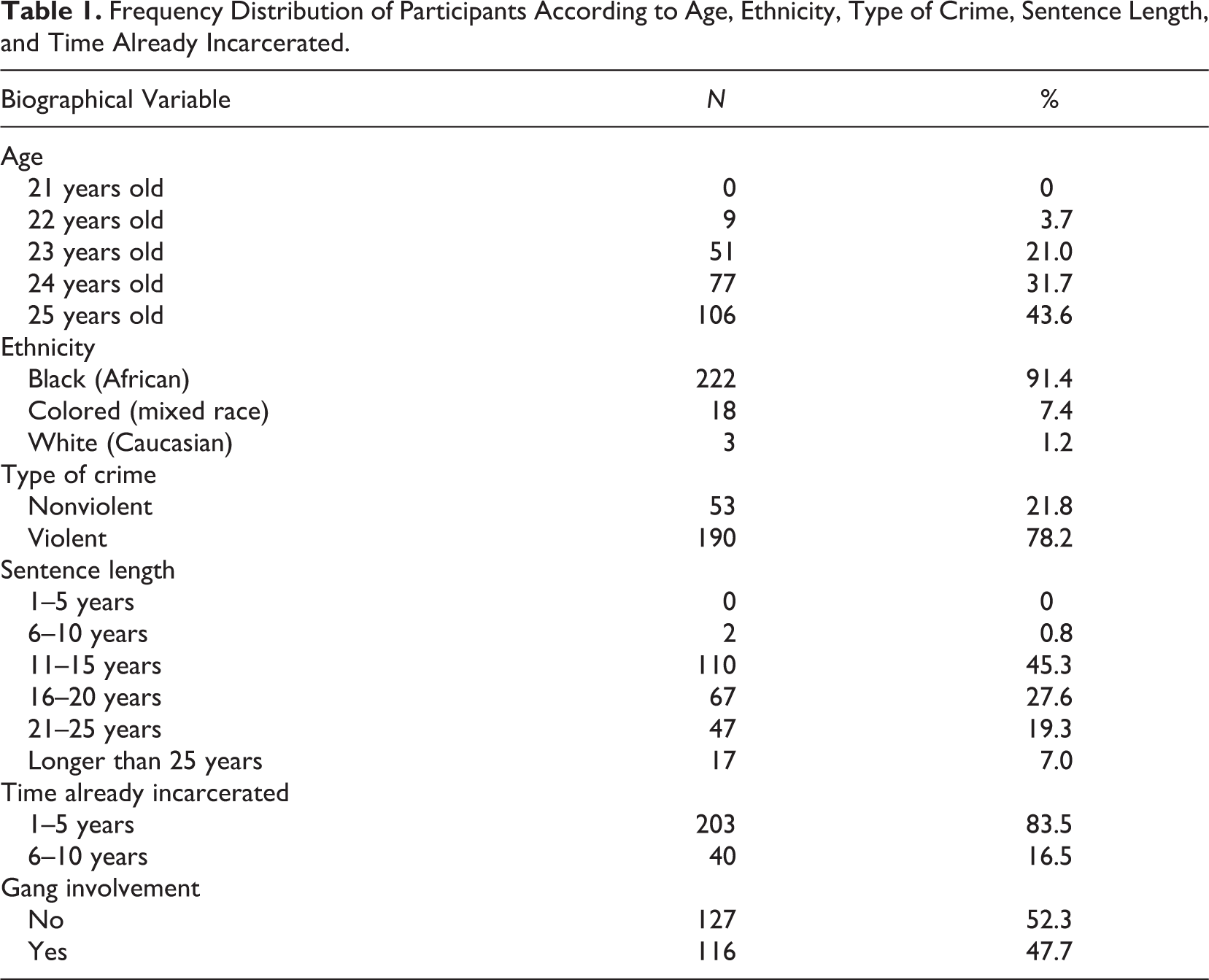
Based on the demographic information, the majority of the participants were Black (African) offenders (91.4%), while the remaining were Colored (individuals of a mixed race) offenders (7.4%) and White (Caucasian) offenders (1.2%). Furthermore, most of the participants were 25 years old (43.6%). Regarding the type of crime, most of the participants (78.2%) were sentenced for violent crimes such as murder and sexual crimes. In comparison, 21.8% were incarcerated for nonviolent crimes such as fraud, forgery, and theft. The majority of the participants (45.3%) were sentenced to between 11 and 15 years. Most participants (83.5%) were at the beginning of their sentences and already completed between 1 and 5 years of their sentences. Almost half of the participants (47.7%) indicated that they belong to a gang within the correctional environment. The internal consistencies of the various subscales of the measuring instruments are reported in Table 2.
Descriptive Statistics and Reliability Data for the BPAQ, CSI, and MDMQ.
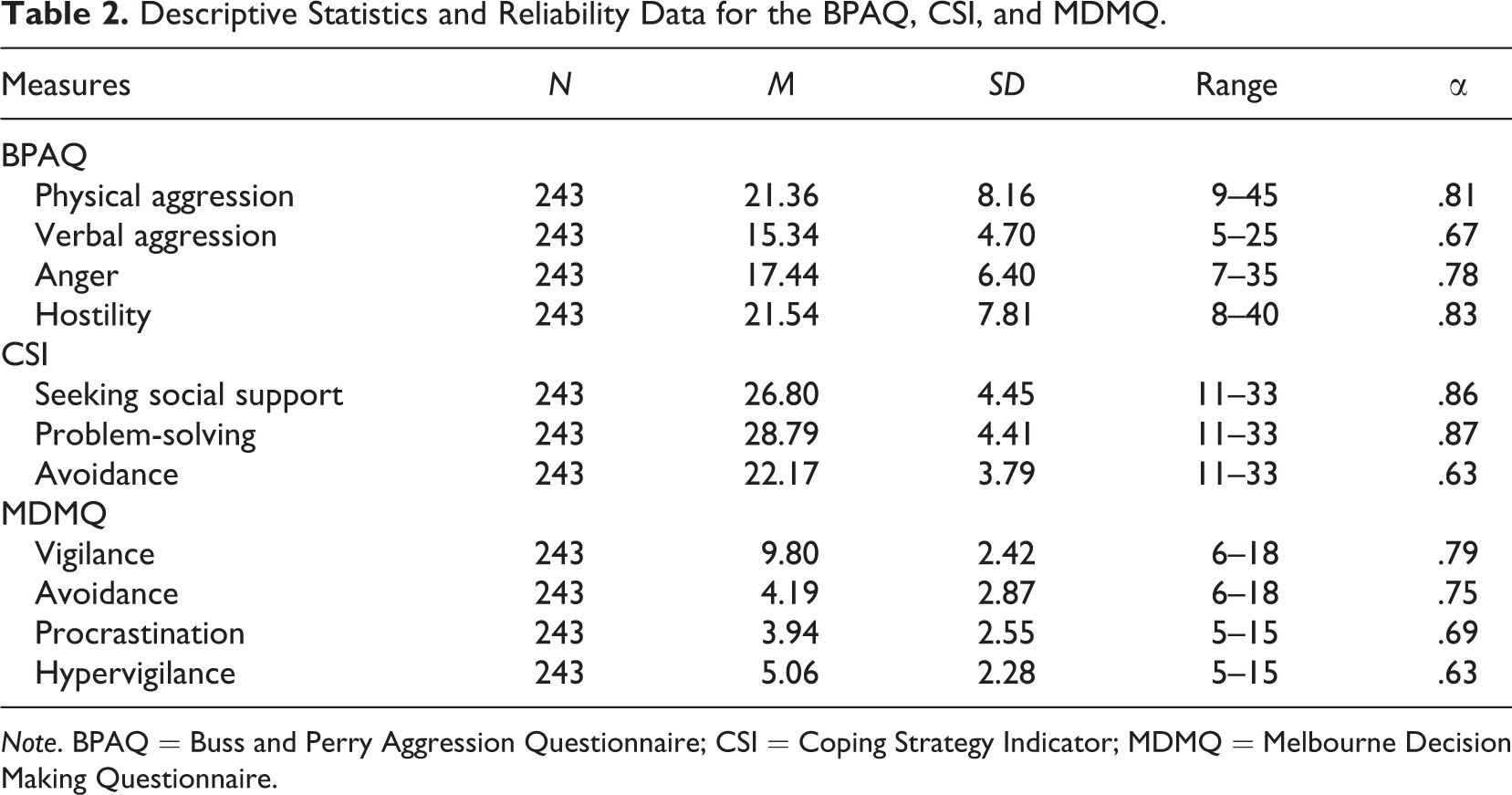
Note. BPAQ = Buss and Perry Aggression Questionnaire; CSI = Coping Strategy Indicator; MDMQ = Melbourne Decision Making Questionnaire.
From Table 2, it is evident that the Cronbach’s α for the subscales of the BPAQ, CSI, and MDMQ ranges from .63 to .87, which indicates adequate levels of internal consistency. Both the skewness and kurtosis values were within acceptable ranges, and no univariate or multivariate outliers were found. Prior to the regression analysis, the Pearson product-moment correlation coefficients were calculated for the predictor and outcome variables. The correlation coefficients can be viewed in Table 3.
Correlations Between the BPAQ Subscales, CSI Subscales, MDMQ Subscales and Demographic Variables for the Total Sample.

Note. N = 243. BPAQ = Buss and Perry Aggression Questionnaire; CSI = Coping Strategy Indicator; MDMQ = Melbourne Decision Making Questionnaire.
*p ≤ .05. **p ≤ .01.
Table 3 indicates that the Physical Aggression subscale of the BPAQ demonstrated statistically and practically significant correlations with the Problem-Solving (r = −.32; p ≤ .01) and Seeking Social Support (r = −.30; p ≤ .01) subscales of the CSI, and the Vigilance (r = −.33; p ≤ .01), Procrastination (r = .39; p ≤ .01), and Hypervigilance (r = .39; p ≤ .01) subscales of the MDMQ. These findings seem to suggest that (i) as problem-solving, seeking social support, and vigilance increase, physical aggression decreases, and (ii) as procrastination and hypervigilance increase, physical aggression seems to increase. The Verbal Aggression subscale of the BPAQ exhibited positive, statistically, and practically significant correlations with the Avoidance subscale of the CSI (r = .32; p ≤ .01) and the Hypervigilance subscale of the MDMQ (r = .34; p ≤ .01), as well as a negative, statistically significant correlation with the Vigilance subscale of the MDMQ (r = −.30; p ≤ .01). These findings seem to suggest that (i) as avoidance (as a coping strategy) and hypervigilance increase, verbal aggression increases, and (ii) as vigilance increases, verbal aggression seems to decrease. Table 3 further shows that the Anger subscale of the BPAQ demonstrated statistically and practically significant correlations with the Problem-Solving subscale of the CSI (r = −.31; p ≤ .01), the Vigilance subscale of the MDMQ (r = −.30; p ≤ .01), the Procrastination subscale of the MDMQ (r = .39; p ≤ .01), and the Hypervigilance subscale of the MDMQ (r = .34; p ≤ .01). These findings seem to suggest that (i) as problem-solving and vigilance increase, anger appears to decrease, and (ii) as procrastination and hypervigilance increase, anger seems to increase. The Hostility subscale of the BPAQ also exhibited statistically and practically significant correlations with the Procrastination subscale of the MDMQ (r = .31; p ≤ .01) and the Hypervigilance subscale of the MDMQ (r = .42; p ≤ .01). These findings seem to suggest that as procrastination and hypervigilance increase, physical aggression increases.
Hierarchical Regression Results
Table 4 depicts the results of the hierarchical regression analysis with physical aggression as the criterion variable.
Contributions of CSI Subscales, MDMQ Subscales, and Demographic Variables to R 2 With Physical Aggression as Criterion Variable.

Note. A = age; SL = sentence length; TC = type of crime; GI = gang involvement; PS = problem-solving; SSS = seeking social support; AVC = avoidance (coping); V = vigilance; AVD = avoidance (decision making); P = procrastination; HV = hypervigilance; CSI = Coping Strategy Indicator; MDMQ = Melbourne Decision Making Questionnaire.
*p ≤ .05. **p ≤ .01.
It is clear from Table 4 that the combination of the independent variables is responsible for 30.1%, F(11, 231) = 9.056; p ≤ .01, of the variance in the physical aggression scores of the young adult male incarcerated offenders, which is at the 1% level of significance. The CSI scales (Problem-Solving, Seeking Social Support, and Avoidance), as a set of predictors, are responsible for 7.3% of the variance in the physical aggression scores of the young adult male incarcerated offenders. This finding is statistically significant at the 1% level, and the corresponding effect size (f 2 = .15) suggests that it is of medium practical significance. The MDMQ scales (Vigilance, Avoidance, Procrastination, and Hypervigilance), as a set of predictors, are responsible for 7.1% of the variance in the physical aggression scores of the young adult male incarcerated offenders. This finding is statistically significant at the 1% level. Table 5 depicts the results of the hierarchical regression analysis with verbal aggression as the criterion variable.
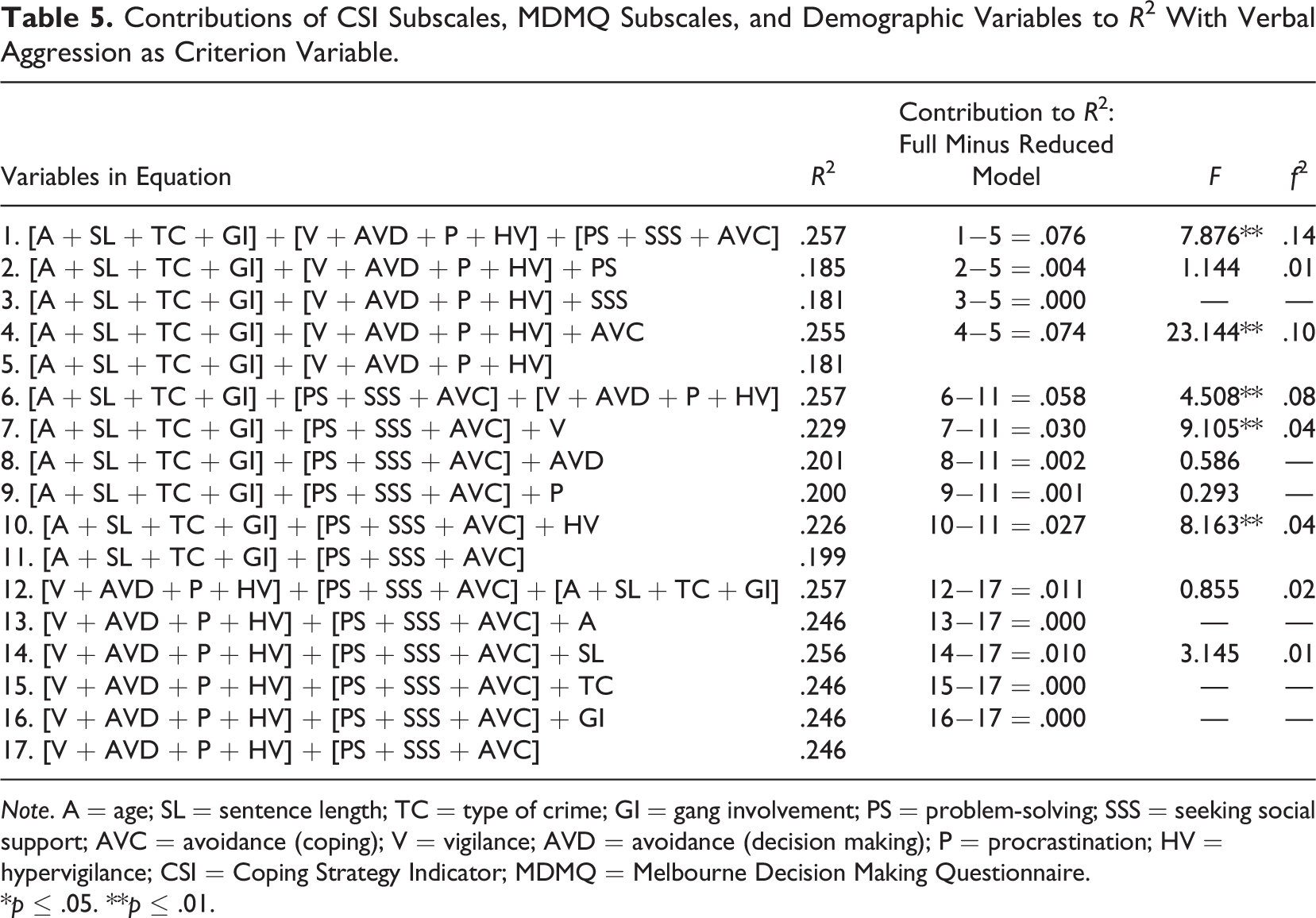
Contributions of CSI Subscales, MDMQ Subscales, and Demographic Variables to R 2 With Verbal Aggression as Criterion Variable.
Note. A = age; SL = sentence length; TC = type of crime; GI = gang involvement; PS = problem-solving; SSS = seeking social support; AVC = avoidance (coping); V = vigilance; AVD = avoidance (decision making); P = procrastination; HV = hypervigilance; CSI = Coping Strategy Indicator; MDMQ = Melbourne Decision Making Questionnaire.
*p ≤ .05. **p ≤ .01.
Table 5 indicates that the combination of the independent variables is responsible for 25.7%, F(11, 231) = 7.250; p ≤ .01, of the variance in the verbal aggression scores of the young adult male incarcerated offenders, which is at the 1% level of significance. The CSI scales (Problem-Solving, Seeking Social Support, and Avoidance), as a set of predictors, are responsible for 7.6% of the variance in the verbal aggression scores of the young adult male incarcerated offenders. This finding is statistically significant at the 1% level, and the corresponding effect size (f 2 = .14) suggests that it is almost of medium practical significance. The MDMQ scales (Vigilance, Avoidance, Procrastination, and Hypervigilance), as a set of predictors, are responsible for 5.8% of the variance in the verbal aggression scores of the young adult male incarcerated offenders. This finding is statistically significant at the 1% level. Table 6 depicts the results of the hierarchical regression analysis with anger as the criterion variable.
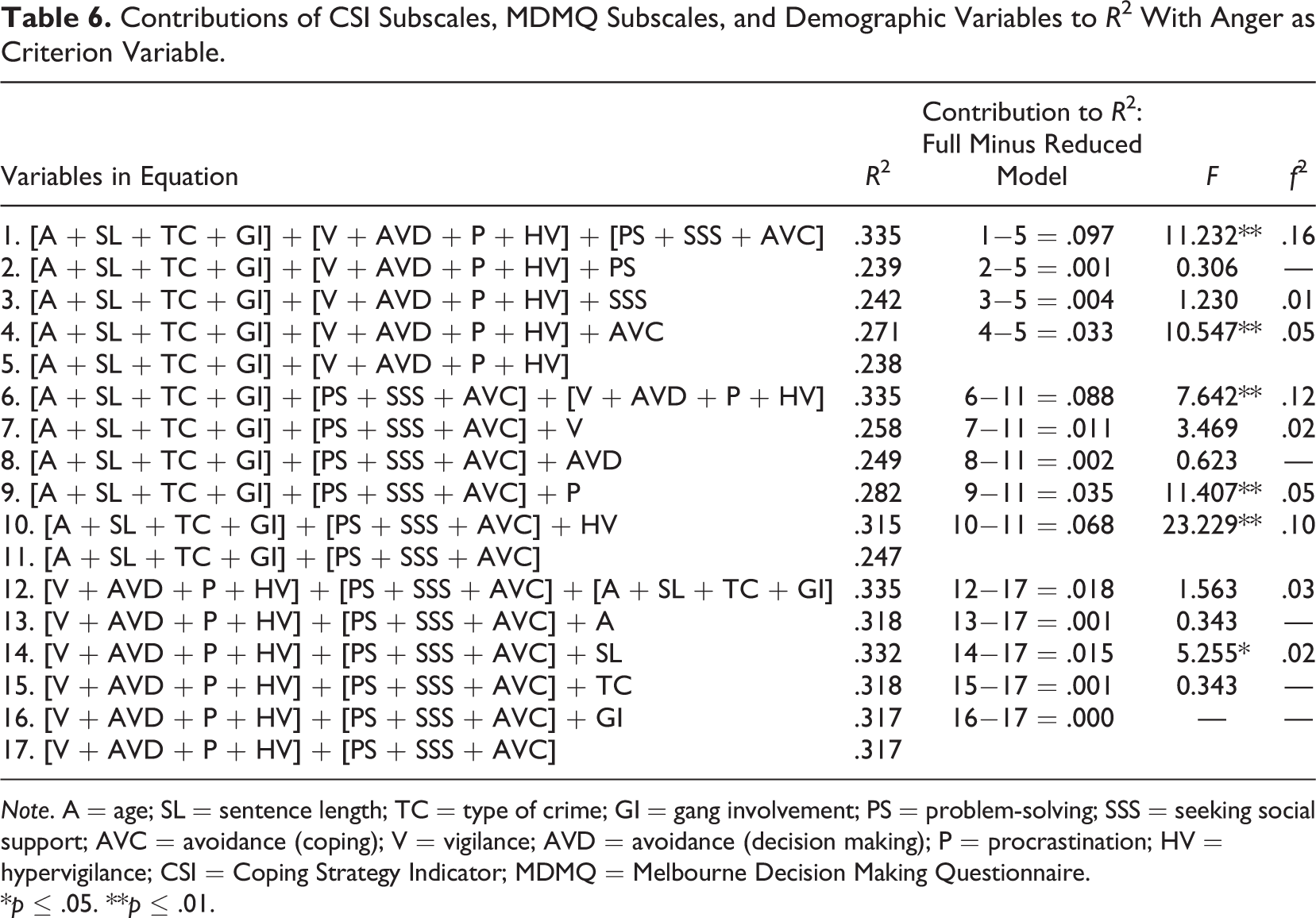
Contributions of CSI Subscales, MDMQ Subscales, and Demographic Variables to R 2 With Anger as Criterion Variable.
Note. A = age; SL = sentence length; TC = type of crime; GI = gang involvement; PS = problem-solving; SSS = seeking social support; AVC = avoidance (coping); V = vigilance; AVD = avoidance (decision making); P = procrastination; HV = hypervigilance; CSI = Coping Strategy Indicator; MDMQ = Melbourne Decision Making Questionnaire.
*p ≤ .05. **p ≤ .01.
It is evident from Table 6 that the combination of the independent variables is responsible for 33.5%, F(11, 231) = 10.575; p ≤ .01, of the variance in the anger scores of the young adult male incarcerated offenders, which is at the 1% level of significance. The CSI scales (Problem-Solving, Seeking Social Support, and Avoidance), as a set of predictors, are responsible for 9.7% of the variance in the anger scores of the young adult male incarcerated offenders. This finding is statistically significant at the 1% level, and the corresponding effect size (f 2 = .16) suggests that it is of medium practical significance. The MDMQ scales (Vigilance, Avoidance, Procrastination, and Hypervigilance), as a set of predictors, are responsible for 8.8% of the variance in the anger scores of the young adult male incarcerated offenders. This finding is statistically significant at the 1% level. Table 7 depicts the results of the hierarchical regression analysis with hostility as the criterion variable.
Contributions of CSI Subscales, MDMQ Subscales, and Demographic Variables to R 2 With Hostility as Criterion Variable.

Note. A = age; SL = sentence length; TC = type of crime; GI = gang involvement; PS = problem-solving; SSS = seeking social support; AVC = avoidance (coping); V = vigilance; AVD = avoidance (decision making); P = procrastination; HV = hypervigilance; CSI = Coping Strategy Indicator; MDMQ = Melbourne Decision Making Questionnaire.
*p ≤ .05. **p ≤ .01.
The data displayed in Table 7 indicate that the combination of the independent variables is responsible for 28.2%, F(11, 231) = 8.241; p ≤ .01, of the variance in the hostility scores of the young adult male incarcerated offenders, which is at the 1% level of significance. The CSI scales (Problem-Solving, Seeking Social Support, and Avoidance), as a set of predictors, are responsible for 8.6% of the variance in the hostility scores of the young adult male incarcerated offenders. This finding is statistically significant at the 1% level, and the corresponding effect size (f 2 = .17) suggests that it is of medium practical significance. The MDMQ scales (Vigilance, Avoidance, Procrastination, and Hypervigilance), as a set of predictors, are responsible for 7.7% of the variance in the hostility scores of the young adult male incarcerated offenders. This finding is statistically significant at the 1% level.
Discussion
The results of the statistical analyses indicated that the combination of the predictor variables (problem-solving, seeking social support, avoidance [CSI], vigilance, avoidance [MDMQ], procrastination, hypervigilance, age, sentence length, type of crime, and gang involvement) significantly predicted physical aggression, verbal aggression, anger, and hostility. The CSI scales (Problem-Solving, Seeking Social Support, and Avoidance), as a set of predictors, significantly predicted physical aggression, anger, and hostility with medium corresponding effect sizes. These findings seem to suggest that to decrease physical aggression, anger, and hostility among young adult offenders, it would be advisable to implement an intervention that would simultaneously (i) increase their problem-solving skills, (ii) improve their social support levels, and (iii) teach them to refrain from making use of avoidance as a coping strategy.
These findings seem to imply that when the problem-solving skills of offenders increase or improve, their levels of physical aggression, anger, and hostility will decrease. This finding concurs with findings from previous studies (Akbari et al., 2012; Biggam & Power, 2002; Chahal et al., 2016; Dreer et al., 2005; Guerra & Slaby, 1990; McGuire, 2008; McMurran et al., 2002; Pretorius, 2019; Rocheleau, 2015; Spradling, 2001) that found that offenders’ levels of aggression improved/reduced when taught better problem-solving skills.
These findings also suggest that aggression increases when avoidance is used as a form of coping strategy. Previous research (Contardi et al., 2016; Nezu et al., 2007; Rocheleau, 2015) found similar results. According to Novo et al. (2017), offenders tend to use avoidance to cope, which can lead to emotional discharge and aggression. Ricciardelli (2014a), however, found that older offenders are more inclined to use avoidance as a coping strategy, while younger offenders are more inclined to use aggression and violence.
Furthermore, the findings seem to suggest that social support also plays a role when it comes to physical aggression, anger, and hostility. Within the South African context, this finding makes sense as most of the cultures in South Africa are collectivist cultures that believe in social support to all family members (Spangenberg & Henderson, 2001; Yen & Wilbraham, 2003). This finding seems to support other research that found that when the social support of offenders increases, those negative aspects such as aggression, anger, and hostility decrease (Loper, 2002; Palermo, 2015; Rocheleau, 2015; Woo et al., 2016). A. Hesselink and Jordaan (2018) and Jordaan and Hesselink (2018) indicated that offenders with poor social support are usually more inclined to be involved in serious, violent, aggressive behavior and crimes. Help from the correctional institution, as well as support from significant others, may positively influence offenders’ coping abilities (Fedock, 2017; Ricciardelli, 2014a; Rogers, 2019).
Previous research found that violence breeds further violence and that abused individuals (victims) often become abusers (perpetrators) themselves to overcome the violence they experienced and reduce their feelings of powerlessness (A. Hesselink & Jordaan, 2018; Jordaan & Hesselink, 2018; Strong, 2018). This concern should be addressed among young adult offenders as various factors contribute to these offenders becoming involved in and continuing with violence, such as absent parents, previous abuse, exposure to domestic violence, violence in general, violence within the correctional environment, negative role models, exposure to violent others, and parental substance abuse (Akers & Sellers, 2004; Gear, 2007a, 2007b, 2008, 2010; A. E. Hesselink & Dastile, 2016; A. Hesselink & Jordaan, 2018; Hesselink-Louw, 2004; Jordaan & Hesselink, 2018; Siegel, 2016).
Lastly, as younger offenders are more prone to aggression and violence, it seems clear that this population should receive heightened attention to help them adjust and cope better within the correctional environment (Jordaan, 2014; Rogers, 2019). Crewe et al. (2019) highlight this by stating that care should be provided to offenders early in their sentences when feelings of anger are at its highest. These offenders need help to cope effectively rather than resorting to anger and aggression to deal with circumstances in the correctional center.
Reid and Listwan (2018) indicated that being aware of maladaptive coping strategies is essential as offenders exhibiting aggression will be more inclined to be involved in misconduct within the correctional center and more inclined to use aggression on the outside upon their release. Knowing what maladaptive coping strategies young adult offenders tend to use can enable correctional centers to develop interventions that will help these offenders to develop prosocial coping strategies.
Limitations and Recommendations
A limitation is that the study focused on a sample of maximum-security young adult offenders. Thus, the results cannot be generalized to the general population of young adult offenders. Future studies can focus on young adult offenders from minimum-, medium-, and maximum-security correctional centers to compare their levels of aggression and coping.
Another limitation of this study is that the self-report survey data depended on the truthfulness of the offenders. The offenders were requested to complete the questionnaires truthfully. Still, it cannot be ignored that the offenders might have completed the questionnaires in such a way as to appear as if they were able to cope with their anger and aggression.
A recommendation is to develop and implement intervention programs that enable young adult offenders to better adjust to the correctional environment and realize that there are better ways (e.g., problem-solving, social support, anger management) of dealing with challenges other than being aggressive and violent. These programs can support young adult offenders and teach them effective coping skills. Due to South Africa’s culture of violence, these programs are crucial (Pandey, 2012; Peacock, 2013), as focusing on effective life skills (i.e., coping, problem-solving, decision making, anger management, adjustment; Jordaan, 2014; Rogers, 2019) might teach these young adult offenders to break the cycle of violence.
Conclusion
These findings suggest that decreasing aggression among young adult offenders would require implementing an intervention that would (i) increase their problem-solving skills, (ii) teach them to refrain from making use of avoidance as a coping strategy, and (iii) share the importance of social support. These intervention programs should make use of the social learning principles to change behavior in a positive direction. Social learning principles that could be used in interventions can include mentoring, behavioral modification, delinquency prevention, peer counseling, and gang interventions. The idea behind some of these types of programs is that providing positive experiences and role models for young people serves to expose them to conventional norms and values that might diminish future delinquent or criminal acts. This is fundamental as aggressive, violent behavior and misconduct in correctional centers are predictive of recidivism (Palermo, 2015). Research conducted by Beijersbergen et al. (2015) found that offenders are less likely to be aggressive and violent during incarceration when they are treated with fairness and respect. This might be an important aspect that is lacking in the South African context.
Footnotes
Declaration of Conflicting Interests
The authors declared no potential conflicts of interest with respect to the research, authorship, and/or publication of this article.
Funding
The authors received no financial support for the research, authorship, and/or publication of this article.
