



Abstract
In this paper, we propose that only some of the conventional findings pertaining to the enhancing effects of feedback and recognition on performance success as well as the moderating role they play in the goal–performance relationship may apply to project teams, whereas others may not. We focus on the above activities that are well grounded in the general organizational research and reexamine them within the project management context. Data were collected from 88 project managers and their direct supervisors via questionnaires. Results showed that leader goal, feedback, and recognition activities were important only for improved team effectiveness, but not for team efficiency. Furthermore, feedback and recognition moderated the goal–performance relationship, regardless of the performance measures used. The implications of these findings for future research on project teams are discussed.
Keywords
As a result of the dominant role teams play in organizations of today (e.g., Balkundi & Harrison, 2006; Rousseau & Aubé, 2010), a vast amount of effort has been put forth to identify the factors that contribute to team effectiveness (Kozlowski & Bell, 2003). Due to the growing importance of projects in organizations (Dvir & Lechler, 2004; Zwikael & Smyrk, 2012), this study focuses on project teams and is aimed at reexamining the role of feedback and recognition in the goal–performance relationship. Specifically, we propose that due to characteristics that are unique to project teams, some of the conventional findings in the literature pertaining to the positive effects of feedback and recognition on performance as well as the moderating role they play in the goal–performance relationship may not necessarily apply.
Project teams differ from other types of teams in that they are temporary (i.e., team members disperse on project completion) and devised by the organization to carry out defined, specialized, time-limited projects (Chen, Donahue, & Klimoski, 2004). Project team members come from different departments within the organization (Richards & Moger, 2000; Sundstrom, De Meuse, & Futrell, 1990) and are expected to (a) collaborate on complex tasks that involve the application of considerable knowledge and expertise (Simpson, 2006) and (b) provide innovative solutions within the dynamic and uncertain environments within which they operate. These unique characteristics have a crucial impact on the leadership behaviors of project managers (PMs), who must be highly knowledgeable about the environment in which they operate, technically competent, and highly skilled in team leadership and management activities (Zimmerer & Yasin, 1998) to lead project teams to success.
The importance of PMs’ team leadership and management activities to project performance and success is recognized in the project management literature (Thamhain, 2004b; Zwikael & Unger-Aviram, 2010); however, there are some studies that found PM leadership and motivational activities to have only a marginal effect on project success (Belout & Gauvreau, 2004; Ebtehaj & Afshari, 2006; J. K. Pinto & Prescott, 1988). Furthermore, more recent research has shown that PMs tend to engage mostly in job or task-related activities, rather than in person-oriented activities (Meredith & Mantel, 2009). The tendency to engage in task-oriented as opposed to performance-oriented activities stems from PMs’ perception that task-oriented activities directly advance project progress, whereas person-oriented activities are unfamiliar and time-consuming activities that do not have a direct impact on task or project progress (Dvir, Sadeh, & Malach-Pines, 2006; Larson & Gobeli, 1989; Meredith & Mantel, 2009; J. K. Pinto & Slevin, 1988; Zwikael & Globerson, 2004; Zwikael & Unger-Aviram, 2010). These tendencies are especially surprising, given that performance problems in project teams have been mostly associated with management, behavioral, and organizational issues, and to a significantly lesser extent with technical difficulties (Hartman & Afshari, 2002).
Recent leadership, motivation, and project management literature (Thamhain, 2004a) has shown leadership and motivational activities to crucially contribute to work performance in that they shape the direction and intensity of work effort (Zaccaro, Ely, & Nelson, 2008) and serve as prominent inputs to the motivational choices and effort of employees (Chen & Kanfer, 2006). The extent to which team members identify with team objectives and are motivated to achieve them is dependent on leadership behaviors and activities (Sivasubramaniam, Murray, Avolio, & Jung, 2002). Although previous studies have examined numerous PM leadership behaviors and their impact on project performance, there are no studies that examine the unique and combined effects of PM goal attainment activities (i.e., the amount of effort PMs put forth to ensure that the team members direct the required/desirable amount of attention, effort, and behavior to attain project goals and successfully complete the project), feedback, and recognition activities on project team performance.
It is important to examine the unique and combined effects of these specific PM goal and motivational activities on project team performance, as there is minimal data pertaining to the conditions under which these particular activities may enhance, impede, or have no association with project team performance. Although there is extensive research relating to the effect of goals, feedback, and recognition and the moderating role of feedback in the goal–performance association at the individual level of analysis, there is less research at the team level, in general, and on project teams, in particular. Feedback and recognition have the potential of impacting performance at the team level. However, given the unique characteristics of project teams previously mentioned and the different types of information included in each of these motivational activities, we question the effectiveness of feedback and recognition within project teams and propose to examine how they interact with PM goal attainment activities to affect project performance success.
Leadership Behavior in Teams
Recently, researchers have directed their attention toward reevaluating the relevance of leadership behaviors to leadership effectiveness and team performance (Burke et al., 2006; Judge, Piccolo, & Ilies, 2004; Wang, Oh, Courtright, & Colbert, 2011), mainly because the role of the team leader had been somewhat neglected in the team literature (Salas, Burke, & Stagl, 2004). One purpose of this current study is to examine the role of PM task- (i.e., goal attainment) and person-focused motivational activities (i.e., feedback and recognition) on project team performance success.
Goal Attainment
Task-focused leadership behaviors emphasize the accomplishment of task objectives. Through directive behaviors such as task assignment, specification of the way work is to be conducted, and emphasis on goal attainment activities, leaders initiate a structure that orients individuals and teams toward task accomplishment (Burke et al., 2006; Judge et al., 2004), thus enabling them to direct their attention and effort toward specific task attainments (Burke et al., 2006).
Leader engagement in task-focused goal attainment activities in particular are especially important in project teams due to the conditions and characteristics reviewed earlier and that are unique to project teams. Accordingly, PMs are expected to ensure that the attention, effort, and behavior of team members are directed toward goal attainment activities to achieve compliance with project specifications and limitations (of time, cost, customer demands, etc.) set by the project funder and to successfully complete the project (Den Hartog, De Hoogh, & Keegan, 2007).
Goal attainment and performance
Goals are a major source of motivation and they serve as immediate regulators of behavior (Erez, 2005; Locke & Latham, 2002). Thus, leader initiation of structure that emphasizes clear and compelling goals provides the team with a purpose-oriented direction and guides team effort, action, and perseverance toward goal attainment. Leader goal attainment activity has been found to (a) have moderate relationships with group and organization performance (Judge et al., 2004), (b) be important to orienting teams toward the attainment of common objectives (Kirkman & Rosen, 1999), (c) improve project performance (J. K. Pinto & Slevin, 1988), and (d) foster cooperation, resulting in superior team performance (Scott-Young & Samson, 2008).
The positive effects of goals on performance are immediate and direct in simple task situations, as successful performance is a result of routine and automatized individual behavior. However, in complex task situations, the positive effects of goals on performance are less clear (Locke & Latham, 2002), because successful performance is dependent on the individual’s ability to discover and develop effective plans and strategies (Erez, 2005). As individuals differ in their ability to discover and develop appropriate task strategies, the effect of goals on performance will be smaller in complex tasks in comparison with simple tasks (Wood, Mento, & Locke, 1987).
At the group level, task type and project complexity influence team behavior and are perceived as core elements that influence project performance (Malach-Pines, Dvir, & Sadeh, 2009). Specifically, task type and complexity moderate the impact of group processes on group performance and satisfaction; when tasks are routine and standardized, each team member knows exactly what is to be done and the group is expected to perform effectively. However, if task complexity is high, trying to generate new ideas, solutions, and action as well as the need to coordinate tasks, ideas, and activities with other team members may affect team performance and behavior (Argote, Insko, Yovetich, & Romero, 1995; Jehn, Northcraft, & Neale, 1999). Project teams engage in highly complex tasks that require the generation of innovative ideas, solutions and action as well as having to coordinate each of these activities with one another. They also have to cope with additional pressures that are imposed on them, such as fluctuating workloads, uncertain requirements, and multiple role demands (Turner, Huemann, & Keegan, 2008). Given these conditions and demands, we expect a significant but moderate association with project team performance.
Hypothesis 1: Leader (PM) goal attainment activity is positively related to team performance success.
Feedback and Recognition
In this paper, we focus on the specific person-focused activities of feedback and recognition provided by the team leader to the project team members and their impact on project team performance. Feedback and recognition are the nonfinancial performance-enhancing motivators most frequently used in organizations (Stajkovic & Luthans, 1997). Through the provision of feedback and recognition, PMs can impact the motivation and sustainment of continued team effort resulting in team performance and project success. These interventions are particularly attractive due to their potential for greatly improving performance with no direct financial costs to the organization (Stajkovic & Luthans, 2001).
Feedback
Feedback refers to information regarding the level of performance and/or the manner and efficiency in which performance processes were executed. Feedback is considered to be a most influential means for influencing individual performance and behavior (Jawahar, 2010); however, the impact of feedback on individual performance and behavior is not always positive (Jawahar, 2010) and may even reduce performance (Kluger & DeNisi, 1996). Specifically, Kluger and DeNisi (1996) conducted a meta-analysis that found feedback to reduce performance in above one third of the studies examined. According to Kluger and DeNisi (1998), the problem with the feedback–performance research is that in spite of the empirical inconsistencies that appear within the literature, there is still a (misguided) but widely held view that the positive effect of feedback on performance is “ . . . one of the most accepted principles in psychology” (p. 68). In their view and to (pre)determine whether feedback will have a positive or negative effect on performance, there are certain conditions that ought to be considered. These conditions include (a) the type of task performed, its (objective) complexities, and (subjective) level of mastery; (b) the comparisons individuals make to the previously set goals or standards, and the gaps/discrepancies between the previously set goals and current performance; and (c) the manner in which individuals regulate their behavior as a result of the feedback provided. If the feedback provided causes a change of individual locus of attention such that locus of attention will be directed to the self as opposed to the task, this type of feedback is more likely to debilitate rather than enhance performance.
In this current study, we focus on outcome feedback or knowledge of results, which emphasizes information relating to performance levels and performance discrepancies. Outcome feedback emphasizing discrepancies has a negative impact on individual behavior (Jawahar, 2010) and performance (Kluger & DeNisi, 1998). In such situations, individuals tend to redirect their attention to off-task ego-centered processes (Bandura & Cervone, 1983; Dweck, 2006; Erez, 1977). Furthermore, when task complexity is high and performance is heavily dependent on cognitive resources, extra motivation cannot be translated into better performance. Complex task demands and external pressures to perform cause individuals to direct cognitive resources toward metatask processes, resulting in task disengagement and/or weakened performance (Kanfer & Ackerman, 1989; Kluger & DeNisi, 1996).
Research relating to the effect of feedback on individual performance is well documented in the motivation literature; however, the effect of feedback on team processes and outcomes is less understood (Marks & Panzer, 2004). Recently, Kozlowski and Klein (2000) as well as Chen and Kanfer (2006) proposed that motivational processes of teams are homologous at the individual and team levels. The meaning of this proposed homology is that motivational constructs and goal processes share similar meanings and functions and relate similarly to each other across the individual and team levels. There is initial empirical evidence that goal orientations, goal processes, and self-regulation processes function in a similar manner across the individual and team levels of analysis (Chen & Bliese, 2002; Chen & Gogus, 2008; Chen, Kanfer, DeShon, Mathieu, & Kozlowski, 2009; DeShon, Kozlowski, Schmidt, Milner, & Weichmann, 2004; Porter, Webb, & Gogus, 2010). For example, Chen and Bliese (2002) found individual-level motivation (i.e., high self-efficacy) to emerge as a team-level motivational construct (i.e., high team efficacy); DeShon et al. (2004) found individual-level goal generation and goal striving processes and team-level goal striving processes to have a positive and similar impact on performance at the individual and team levels. Furthermore, Chen, Thomas, and Wallace (2005) also found goal striving processes to positively promote individual- and team-level performance, indicating that motivational and goal processes function in a similar manner across the individual and team levels of analysis. The implication of these findings to this current study is that, just as outcome-focused feedback is expected to have no effect or a detrimental effect on individual performance, due to allocation of cognitive resources to metatask processes, the same type of behaviors and outcomes are expected to appear within a team context. The negative effect of feedback on team processes and performance may even be aggravated due to additional complexities above and beyond “the self.” Hence, individuals will not only be concerned with directing their attention toward questioning their own ability and capabilities, but also directing their attention toward questioning the ability and capabilities of the other team members in attaining their shared goal, instead of directing their cognitive resources toward task engagement and accomplishment (Chen & Gogus, 2008).
As project teams engage in novel and complex tasks, there are no prior work routines or task schemas that exist on which they can rely on to ensure successful performance. Team activity, understanding, and knowledge pertaining to performance efficiency or correctness are dependent on task strategy experimentation and resulting performance attained on completion of the process or task. Therefore, PM feedback for the most part focuses on outcomes or discrepancies relating to the progress (or lack of progress) toward desired outcomes, planned schedules or/and cost constraints. This type of feedback is expected to affect team allocation of resources to other (metatask) processes, rather than toward actual performance, resulting in a negative association of feedback with project team performance success.
Hypothesis 2: Feedback is negatively related to team performance success.
Feedback as a moderator in the goal–performance association
Considerable research supports the moderating role of feedback in the goal–performance relationship (e.g., Earley, Northcraft, Lee, & Lituchy, 1990; Erez, 1977). In the particular case of project teams, we expect feedback to reduce the positive association of goals with performance. As previously mentioned, PM feedback will impact team member behavior such that team members will shift cognitive resources, initially intended to be directed toward task attainment activities, to off-task ego-centered processes (Bandura & Cervone, 1983; Dweck, 2006; Erez, 1977). When task complexity is high and project team members are trying to generate new ideas and solutions as well as coordinate action with the other team members, they will allocate their cognitive resources toward two types of activities and processes. On one hand, they will be concerned with performing tasks and activities that will directly advance goal actual attainment. On the other hand, they will direct cognitive resources to metatask processes concerning self-abilities/adequacy, resulting in weakened performance (Kanfer & Ackerman, 1989; Kluger & DeNisi, 1996).
Hypothesis 3: Feedback moderates the relationship between leader (PM) goal attainment activity and team performance success. Specifically, under conditions of high feedback, there is a significant negative relationship between PM goal attainment activity and team performance success.
Recognition
Reward systems are key management tools that can potentially contribute to organizational effectiveness through their impact on individual and group behavior (Lawler & Cohen, 1992). Reward structure and allocation may affect team member motivation, team member coordination, team-level processes, and resulting team effectiveness (DeMatteo, Eby, & Sundstrom, 1998). External rewards, such as pay, promotion, and recognition, indicate to employees that their effort and achievements are valued. Recognition provided for tasks or subtasks performed during the project will affect employee motivation, perseverance, and commitment to project goals.
Recognition refers to personal attention, usually conveyed verbally, emphasizing interest, approval, and appreciation for a job well done (Luthans & Stajkovic, 2009). Although there are no direct financial costs to social recognition, it does require managers to direct their time, effort, and social skills toward this particular activity. Recognition differs from feedback in that it does not entail much task-related information that may be useful for future performance. The informative value of recognition lies in the social content of what is said and to the extent that it expresses genuine personal appreciation of the effort extended by the individual that results in successful performance (Stajkovic & Luthans, 2001).
Recognition is particularly important to employees engaging in complex tasks (Stajkovic & Luthans, 1998). For example, Luthans and Stajkovic (2009) found that employees performing complex tasks, such as product development, placed more value on social recognition obtained from relevant others than on monetary rewards. Recognition is more valued than monetary rewards as employees who engage in complex tasks are usually highly educated, hold professional positions, and are well paid (Stajkovic & Luthans, 2001); hence, additional money is not rewarding to them. However, supervisor recognition emphasizing employee effort and accomplishment is rewarding to these employees (Stajkovic & Luthans, 2001).
Team-level research has been generally supportive of the motivational effects of recognition on team effort and performance, particularly when it relates to individual as well as to combined team efforts (e.g., DeShon et al., 2004). Team motivational states are influenced by individual- and team-level factors. Applying Chen and Kanfer’s (2006) principle of homology, we assume that, just as individuals respond to motivational influences with extended effort and persistence to attain a valued goal, teams, too, will collectively direct and extend their effort and be persistent in their attempt to attain their shared goal. Thus, to maintain high levels of motivation toward team goal attainment, individual and collective team efforts must be recognized and rewarded (DeShon et al., 2004), especially in highly interdependent teams with team members of diverse expertise, such as project teams (Pearsall, Christian, & Ellis, 2010). Previous research shows that the use of hybrid reward structures (i.e., structures that reward individual and team effort and accomplishment) for highly interdependent teams results in the highest levels of team performance (Pearsall et al., 2010). Therefore, PM recognition emphasizing individual and combined team effort and achievements will significantly impact team performance.
Hypothesis 4: Recognition is positively related to team performance success.
Recognition as a moderator in the goal–performance association
Previous research found (monetary) rewards to be situational factors that moderate the effects of goals on performance (Erez, 2005). In this study, we focus on recognition—a nonmonetary reward highly valued by employees engaging in complex tasks. Recognition allows for others (external to the team) to acknowledge the outstanding knowledge, skills, effort, and persistence put forth to successfully deal with the challenges of a particular complex task and/or project.
The impact of recognition on performance may decrease for complex tasks (Luthans & Stajkovic, 2009), depending on the context within which it is provided. This weakened effect can be attributed to two main reasons. First, when PM goal attainment activity is high, recognition of team member effort may be interpreted by those members as insignificant because they perceive it as being provided only because they actually attained the desired goals and not because the PM sincerely appreciates the knowledge, skills, and effort put forth by the team members to cope with the task (regardless of the results). Second, recognition may not have a significant impact on the goal–performance relationship because actual goal accomplishment is in itself an intrinsic reward, particularly in situations in which successful performance is a result of overcoming the challenges inherent in complex tasks (Luthans & Stajkovic, 2009). However, when recognition is provided under lower levels of PM goal attainment activity, it may be interpreted as genuine appreciation and acknowledgment of the PM regarding the outstanding effort and skills that were put forth by the team members to overcome and successfully complete the task at hand. Thus, the impact of recognition on the goal–performance relationship depends on the way in which team members interpret PM recognition within this context. Therefore, we hypothesize:
Hypothesis 5: Recognition moderates the relationship between leader (PM) goal attainment activity and team performance success. Specifically, under conditions of low recognition, there is a positive relationship between PM goal attainment activity and performance success.
Figure 1 depicts the theoretical relationships hypothesized in the preceding sections.

The study theoretical model.
Method
Participants and Procedure
Data were collected from 88 PMs (out of 99 PMs who initially agreed to participate) and their immediate supervisors from 37 different organizations in Israel. Organizations were randomly chosen to include small and large companies and to reflect various industry types. All projects included in this study had already been completed, making it possible to evaluate team performance.
For each organization, a member of the research team was assigned to personally visit the organization and meet with top management, PM supervisors, and PMs to explain the importance of this study as well as to attend to questions. The same individual also delivered and gathered the questionnaires. All questionnaires were anonymous. Only those questionnaires with less than 10% missing data were included in this study. This criterion resulted in a total of 81 questionnaires, representing a response rate of 82%. This figure represents a relatively high response rate (Baruch & Holtom, 2008), which can be attributed to (a) general support of top management, (b) initial agreement of participants to voluntarily complete the questionnaires, (c) the promise of anonymity, (d) the personalization of correspondence (between research team member and survey participants), and (e) the accessibility of the researcher and language to the participants (i.e., the questionnaires were distributed within the researchers’ home country and in the Hebrew language). Finally, this sample size is acceptable in team research (Scott-Young & Samson, 2008; Stewart & Barrick, 2000).
Team size analysis showed that 36% of the projects consisted of small teams with no more than 5 members and with the 54% of project teams consisting of 10 or fewer members. A total of 43% of the teams had worked together on previous projects; 42% of the team members had worked jointly with some of the other team members, and 15% had not worked with any team member in the past. In addition, 67% of the project teams were from organizations in the private sector and 33% were from public sector organizations. Furthermore, 37% of the projects were executed in software organizations, 16% in communications, 15% in production, and 12% in engineering and service organizations. This distribution is representative of the sectors in the local Israeli industry. Projects were completed with an average schedule overrun of 12.8% and cost overrun of 8.9%. These figures are typical to projects of these types (Zwikael & Globerson, 2004). Finally, on a 1 to 7 point scale (1 = not complex at all; 7 = extremely highly complex), supervisors perceived the projects to be highly complex (M = 5.62, SD = 1.01).
Measures
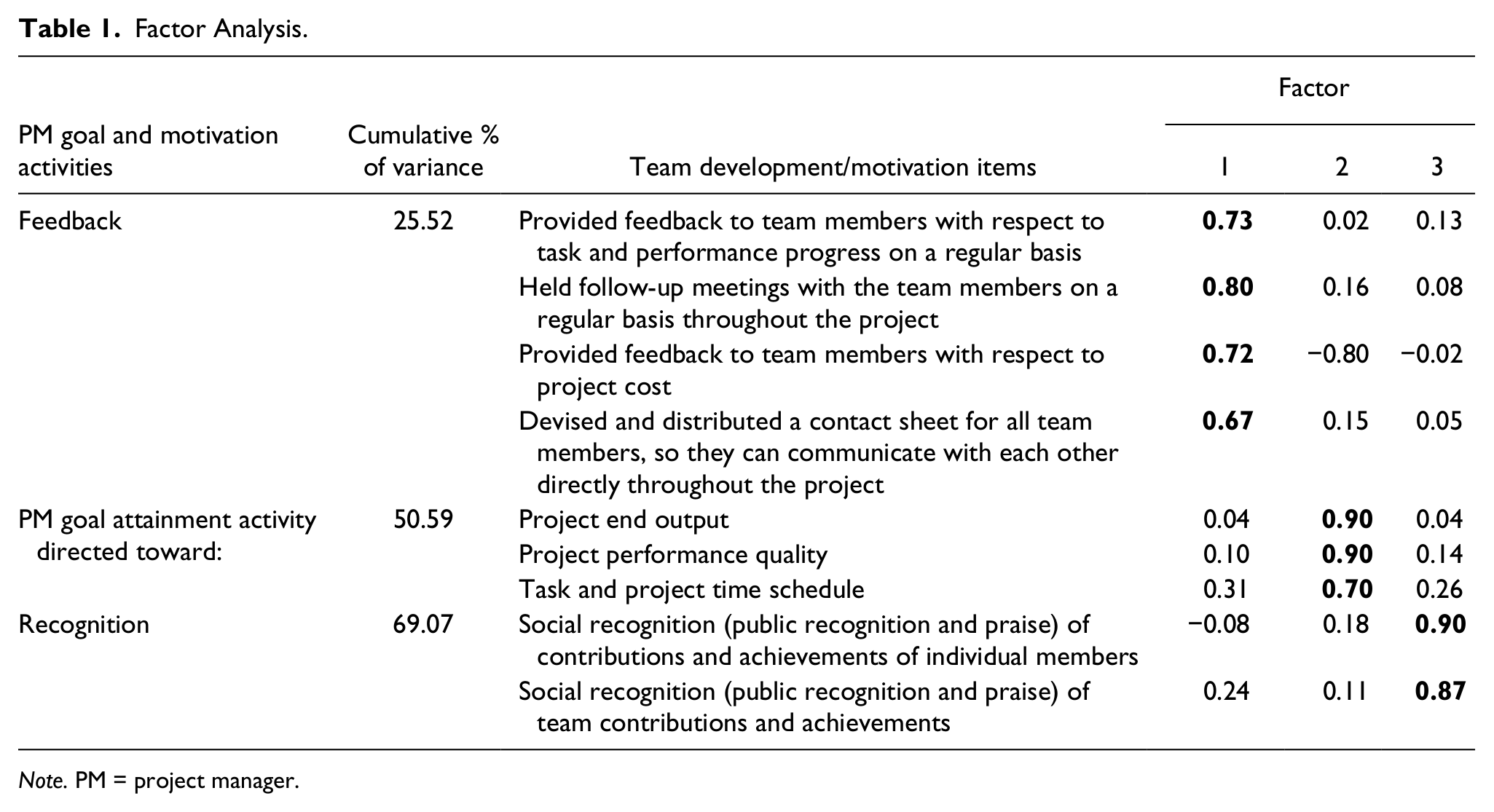
We distributed two questionnaires to gather data about each project: one to the PM and the other to the PM’s supervisor. The PM questionnaire focused on the amount of effort he or she had invested in goal attainment, feedback, and recognition activities (see Table 1) in the last project completed.
Factor Analysis.
Note. PM = project manager.
All items were rated on a 7-point Likert-type scale ranging from 1 (low) to 7 (high). PMs were instructed to indicate the extent to which they personally engaged in each of these activities.
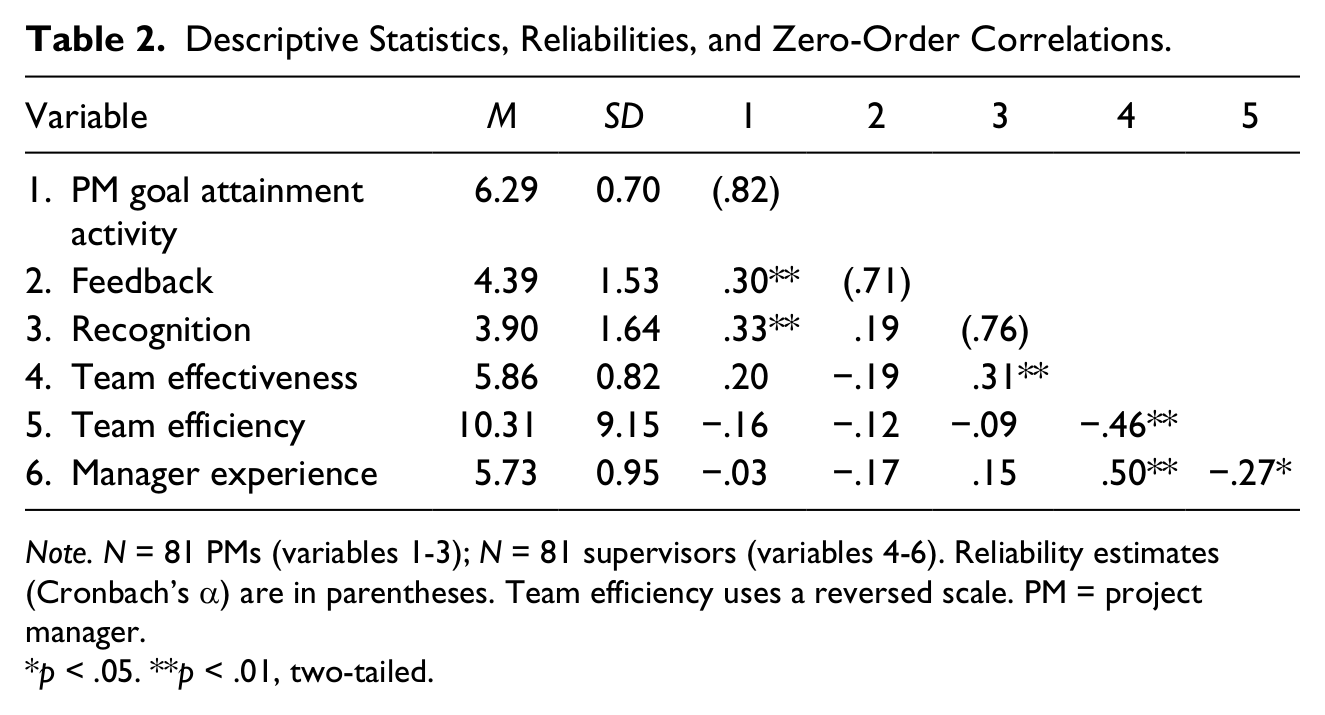
We performed a rotated Varimax factor analysis with Kaiser Normalization to ensure that the items fell into the appropriate goal and motivation activities. This analysis showed the nine items to fall into three groups: goals, feedback, and recognition. They explained 69% of the variance (see Table 1). Cronbach’s alpha for each component was higher than .70 (see Table 2), hence they were reliable (Garmezy, Harlow, Jones, & Stevenson, 1967).
Descriptive Statistics, Reliabilities, and Zero-Order Correlations.
Note. N = 81 PMs (variables 1-3); N = 81 supervisors (variables 4-6). Reliability estimates (Cronbach’s α) are in parentheses. Team efficiency uses a reversed scale. PM = project manager.
p < .05. **p < .01, two-tailed.
PM goal attainment activity
The three goal attainment items related to the amount of effort the PM personally directed toward clarifying to the team the expectations for specific team goal attainment with reference to final project output, performance quality, and time schedule during engagement on project tasks. These items were based on the goal striving items used by Chen et al. (2005).
Feedback
Feedback was measured through four items. PMs were asked to indicate the extent to which they had personally engaged in feedback activities throughout the project. For example, PMs were asked to indicate the amount of effort they directed toward providing formal performance feedback to team members with respect to task and performance progress on a regular basis.
Recognition
Recognition was measured through two items: social recognition of individual contributions and achievements along with social recognition of team contributions and achievements. For example, PMs were asked to indicate the amount of effort they had directed toward providing social recognition of team contributions and achievements directed toward the overall organization.
Team performance success: Effectiveness and efficiency
In the second questionnaire PM supervisors were instructed to provide team performance success ratings for their respective project teams. Although some project management studies aggregated separate measures of project performance success criteria (i.e., cost deviation, schedule deviation, and operability) into a single and overarching measure of project performance success (Muller, Geraldi, & Turner, 2012; Scott-Young & Samson, 2008), this tendency does not allow for the identification of which of the project management factors are associated with each of the individual project performance success criteria. The aggregation of different success measures into a single overarching measure of project performance success may explain why some of the studies that used such aggregate measures of performance success found PM leadership and motivational activities to be only marginally or not significantly related to project success (Belout & Gauvreau, 2004; J. K. Pinto & Prescott, 1988, 1990).
An alternative approach is to use distinctive performance success criteria, such as performance efficiency and performance effectiveness (Jugdev & Muller, 2005). Project efficiency refers to the agreed on time and budget limitations of the defined project. A project will be successful to the extent that the project was completed within the predetermined time and budget limitations. Project teams that exceeded these predetermined limitations would be considered inefficient. Efficiency is an objective evaluation that is based on “hard data” pertaining to predetermined budgets and (time) schedules. Project effectiveness refers to the degree to which project specifications and customer needs are met, that is, stakeholder satisfaction (Shenhar, Levy, & Dvir, 1997). Effectiveness is evaluated by a given stakeholder (e.g., the project supervisor or project customer) and is, therefore, a subjective measure of performance success. In this current study we used efficiency and effectiveness as two separate and distinctive measures of project team performance success.
Project supervisors were asked to rate team performance effectiveness on a 7-point Likert-type scale ranging from 1 (low) to 7 (high). There were two items included in this measure. Project supervisors were asked to rate (a) overall team performance and (b) customer satisfaction with overall team performance as reported to the project supervisor by the project customer. Supervisor rating of overall team performance and customer satisfaction were used to gauge satisfaction with project performance as perceived by the two most important stakeholders: the customer and top management (Zwikael & Globerson, 2006). The customer’s assessment is particularly relevant to the project environment, as it can have a potentially detrimental effect on the ability to obtain future projects (i.e., potential customers), thus impacting organizational viability, survival, and success (Dvir & Lechler, 2004; Lipovetsky, Tishler, Dvir, & Shenhar, 1997; Scott-Young & Samson, 2008; Zwikael & Sadeh, 2007).
Team performance efficiency was also rated on two items. Project supervisors were asked to indicate the extent to which the project team deviated from planned project schedule and project cost (as a continuous variable measured in percentages) in comparison with the initial schedules and costs set at the start of the project. In cases in which the project came in early (or under budget), these variables received negative values. This measure uses a reverse scale and, in essence, measures inefficiency (i.e., schedule and cost overruns), as previously suggested in the literature (see, for example, Dvir & Lechler, 2004; M. B. Pinto, Pinto, & Prescott, 1993). Obtaining all of the above information from the project supervisor enabled us to minimize same source bias.
Control variable
Based on the team literature (e.g., Joshi & Roth, 2009), we statistically controlled for the effects of PM managerial experience when testing the hypotheses to ensure that this variable will not have a confounding effect on PM leadership activities and team performance.
Results
Means, standard deviations, and zero-order correlations among the study variables are presented in Table 2.
The means show that PMs direct the highest levels of effort toward goal attainment in comparison with all other activities. The least amount of effort was directed toward recognition and the difference between the two was significant, t(1, 80) = 13.85, p < .001. Zero-order correlations were generally low to moderate and multicollinearity was not a threat to the stability of the regression analysis (Tabachnick & Fidell, 1996).
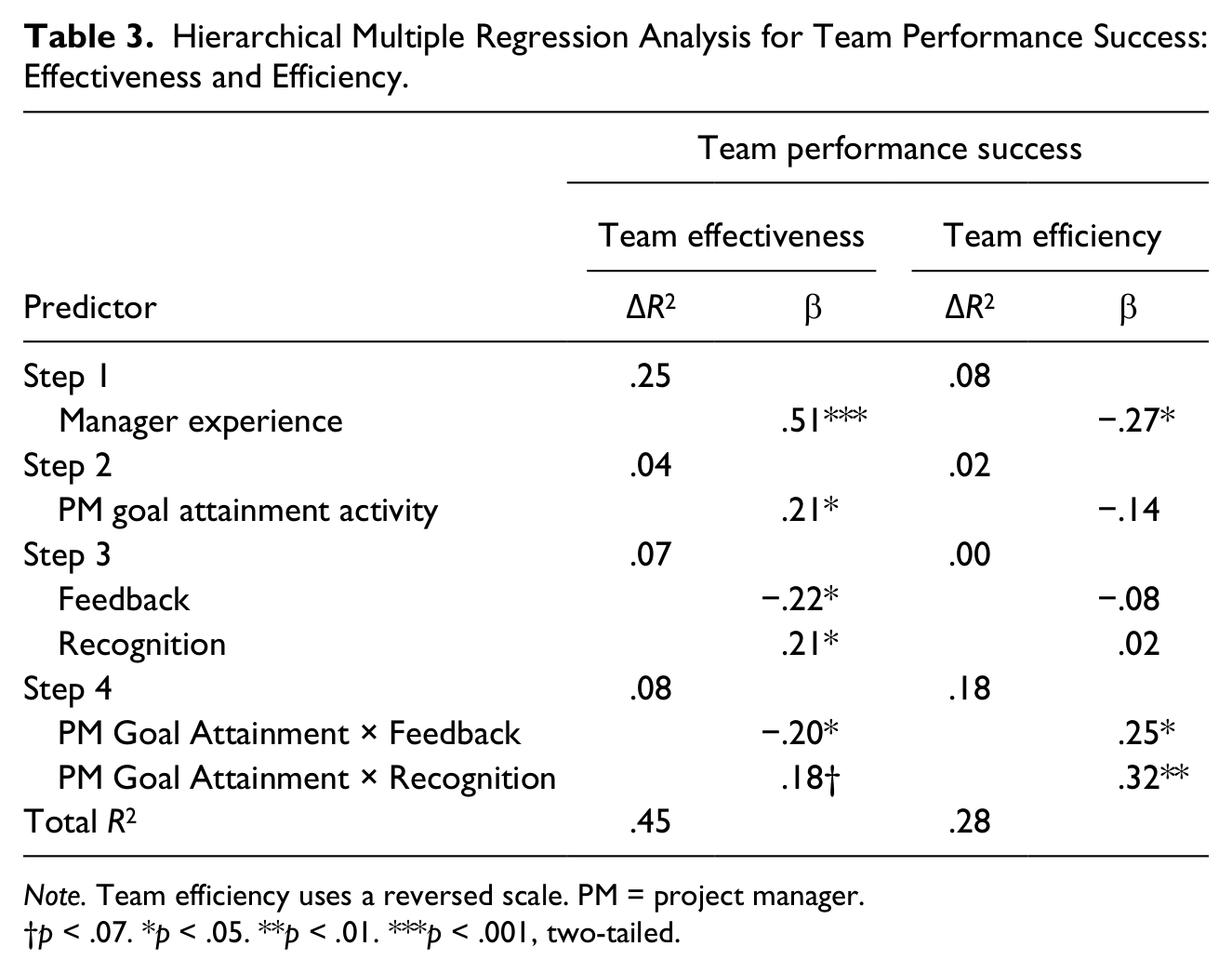
Next, we conducted a hierarchical multiple regression to analyze the additive and interactive explanatory power of the variables. Following the guidelines by Aiken and West (1991), the predictor and moderator variables were mean centered before creating an interaction term. The control variable (managerial experience) was entered in Step 1; the predictor (PM goal attainment activity) and moderating variables (recognition and feedback) were entered in Steps 2 and 3, respectively, to test for main effects; the interaction terms were entered in Step 4. Information from the regression equations was extracted to plot the relationship between PM goal attainment activity and team performance success (team effectiveness and team inefficiency) at low and high levels of recognition and feedback. Low feedback and low recognition pertain to −1 SD below the mean of feedback and recognition, respectively. In contrast, high feedback and high recognition refer to +1 SD above the mean of feedback and recognition, respectively. The results of the regression analysis are presented in Table 3.
Hierarchical Multiple Regression Analysis for Team Performance Success: Effectiveness and Efficiency.
Note. Team efficiency uses a reversed scale. PM = project manager.
p < .07. *p < .05. **p < .01. ***p < .001, two-tailed.
In Hypothesis 1, we proposed a positive association of PM goal attainment activity with team performance success. The results show a positive and significant relationship of PM goal attainment activity and team effectiveness, β = .21, t(77) = 2.02, p = .047. However, there was no significant relationship between goal attainment activity and team efficiency, β = −.14, t(69) = −1.21, ns.
In Hypotheses 2 and 4, we proposed that feedback will have a negative association with performance, whereas recognition will have a significant positive association with performance. The results support both hypotheses pertaining to team effectiveness; however, there was no support for these hypotheses for team efficiency (see Table 3). Specifically, there was a significant and negative association between feedback and team effectiveness, β = −.22, t(75) = −2.28, p = .025, and a positive and significant association between recognition and team effectiveness, β = .21, t(75) = 2.10, p = .039. However, there was no significant association between feedback or recognition and team efficiency, β = −.08, t(67) = −.63, ns; β = .02, t(67) = .18, ns, respectively.
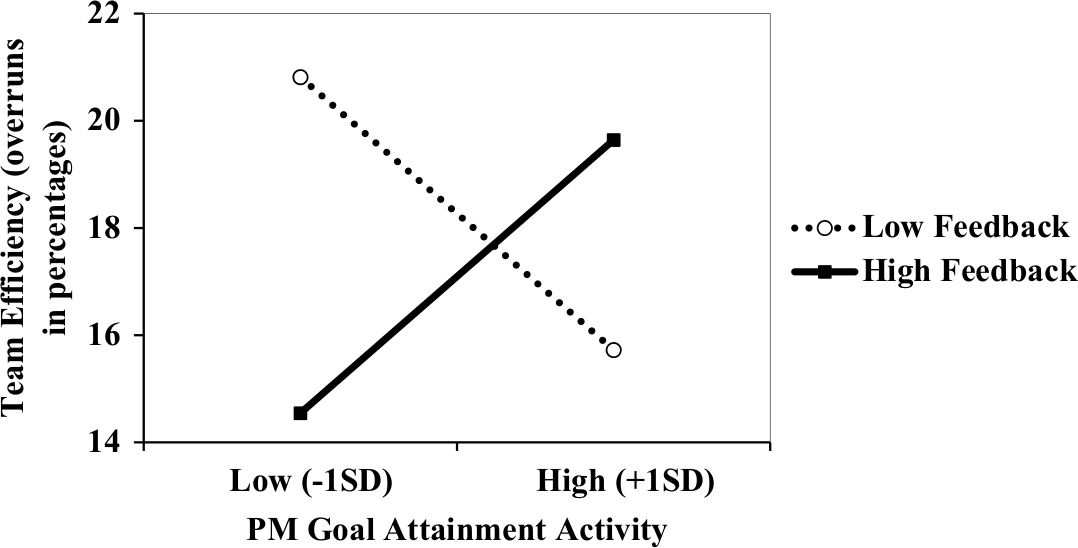
Hypotheses 3 and 5 proposed that feedback will have a significant but negative interaction with PM goal attainment activity in the prediction of performance, whereas recognition will have a significant and positive interaction with PM goal attainment activity in the prediction of performance. The results show that the interaction terms significantly add to the explained variance in team effectiveness, ΔR2 = .80, F(6, 73) = 9.81, p < .01, and even more so in team efficiency ΔR2 = .18, F(6, 65) = 4.27, p < .01. In line with Hypothesis 3, feedback served as a moderator in the goal activity–performance relationship. Further analysis showed that the interaction term representing Goal Attainment Activity × Feedback on team effectiveness was significant and negative, β = −.20, t(73) = −2.05, p = .044, indicating that with low levels of feedback, higher goal attainment activity is associated with higher levels of performance (see Figure 2). This finding is in contrast to the significant and positive interaction term representing Goal Attainment Activity × Feedback on team efficiency, β = .25, t(65) = 2.10, p = .04, indicating that that higher project efficiency (i.e., lower cost and schedule overrun) is best achieved with either high levels of feedback or high levels of PM goal attainment activity, but not with both.

Interaction effect of PM goal attainment activity and feedback on team effectiveness.
Having high levels of feedback and PM goal attainment activity reduces team efficiency, indicating that there is a substitution effect of PM goal attainment activity and feedback within the project context (see Figure 3).
Interaction effect of PM goal attainment activity and feedback on team efficiency.
Furthermore, in line with Hypothesis 5, a marginally significant interaction between recognition and PM goal attainment activity in the prediction of team effectiveness was obtained, β = −.18, t(73) = −1.88, p = .06, indicating that, given low levels of recognition, higher PM goal attainment activity is associated with higher levels of performance. However, the highest levels of team effectiveness were associated with high levels of recognition and low levels of PM goal attainment activity (see Figure 4).

Interaction effect of goal attainment activity and recognition on team effectiveness.
Finally, the interaction term representing recognition and goal attainment activity in predicting team efficiency was positive, β = .32, t(65) = 2.74, p = .008, indicating that that higher project efficiency is best achieved with either high levels of recognition or high levels of goal attainment, but not with both. The associations observed here are almost identical to those that appear in Figure 3, that is, high levels of recognition and goal attainment activity reduces project efficiency (see Figure 5), indicating that there is a substitution effect of goal attainment activity and feedback within the project context. Hence, feedback and recognition interacted with goal attainment on team performance.
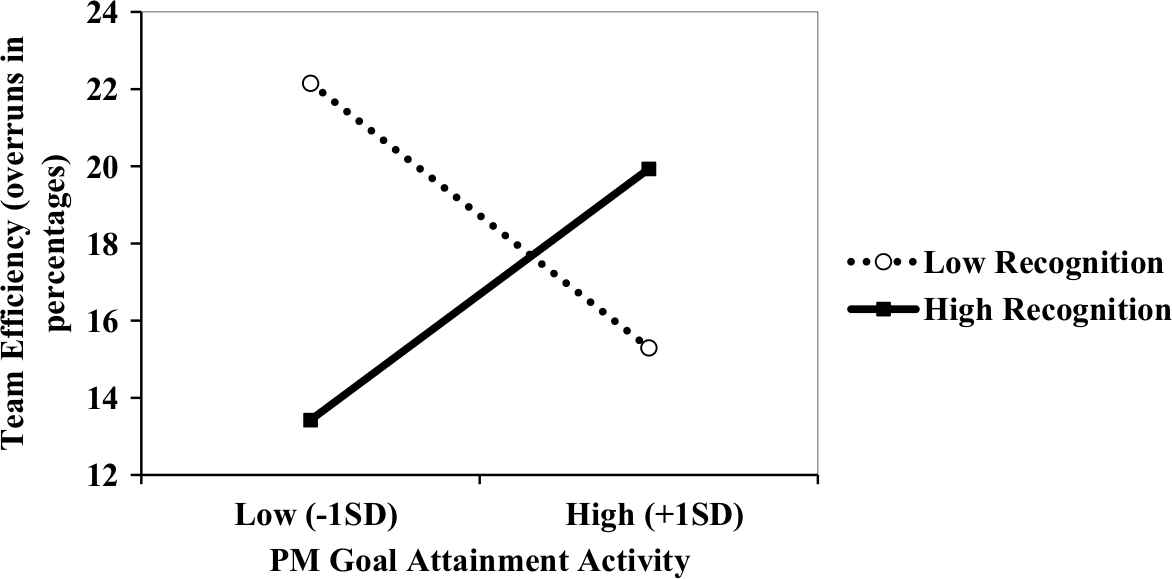
Interaction effect of PM goal attainment activity and recognition on team efficiency.
Discussion
The primary objective of this study was to obtain a deeper understanding of the role PM task-related and person-related activities play in the performance success of project teams. Taking into account characteristics unique to these teams, the results of this study supported the hypothesis that project team performance is best explained by PM task and person motivation leadership activities. In support of previous research (Wood et al., 1987), the results showed PM goal attainment activity to be positively associated with performance; however this association was contingent on the performance success dimension measured. In line with a previous meta-analysis (Salas, Rozell, Mullen, & Driskell, 1999), we, too, found team development activities to have a significant association with subjective, but not with objective, performance indicators. Specifically, PM goal attainment activity was significantly associated with team effectiveness, but had no such association with team efficiency. This pattern of results was also mirrored with the other predictors included in this study, in that feedback and recognition were significantly associated with the dimension of team effectiveness, but not with the team efficiency dimension. Furthermore, and in line with previous research (e.g., Earley et al., 1990; Erez, 1977), all hypothesized interactions were significant. However, the interaction effects of goal attainment activity and feedback as well as goal attainment activity and recognition on team effectiveness were negative, whereas these same interaction effects on team efficiency were positive.
The results of this study show that PM leadership and motivation activities are associated differently with different performance success measures and are in line with Turner and Muller (2005), who claimed the impact of PM leadership style on success varies according to the type of tasks and outcomes measured. Therefore, as suggested by J. K. Pinto and Prescott (1988), to best understand the particular associations and relationships, project management research ought to adopt the use of distinct measures of performance and avoid the more common use of aggregated performance success measures (Muller et al., 2012; Scott-Young & Samson, 2008).
Aggregating performance dimensions into one performance success index may result in misguided conclusions regarding the effects of leader and manager motivational and goal related practices on team performance (J. K. Pinto & Prescott, 1988). Indeed, Shenhar and colleagues (1997) found that performance goals or specifications are different from cost and budget types of goals (also referred to as project resource constraints; in this study they serve as measures of project efficiency). Customer performance goals and specifications were found to be associated with customer satisfaction, but not with project efficiency. The implication of these findings is that meeting project efficiency targets set at the beginning of the project does not necessarily ensure stakeholder satisfaction. Well-executed and efficiently managed projects will not be a success unless stakeholder specifications, expectations, needs and requirements are met. Therefore, PM goal attainment and motivation activities that direct the team and enable its members to adjust their behavior to meet stakeholders’ specifications and requirements will impact stakeholder satisfaction and not predetermined measures of project efficiency. Hence, it is imperative that project management research considers not only the characteristics that are unique to the project environment, but also the inclusion of separate measures of project team performance. Obtaining a better understanding of the differences inherent in each type of performance measure may help to shed some light on the inconsistencies found within project management research relating to the efficacy of PM leader and motivation activities on project team performance success
PM Goal Attainment Activity, Feedback, Recognition, and Team Performance
Leader goal attainment and motivational activities relating to feedback and recognition were found to be associated with performance measures of team effectiveness, but not with team efficiency. This finding may best be explained through the characteristics of these measures and the sources from which they are obtained. Performance measures of project efficiency refer to the extent to which the project team completed project performance within the predetermined limitations of cost and schedule. Higher team efficiency means no or lower cost deviation and schedule overrun. These performance measures are usually set by, or in accordance with, the project customer (Shenhar et al., 1997) and are intended to remain unchanged. The extent to which performance was obtained within these predefined criteria can be easily and objectively determined on project completion.
In this study, performance effectiveness included the project supervisors’ evaluation of overall team performance and project customer satisfaction. Team performance effectiveness is a subjective measure, as it relies largely on rater(s) judgment or evaluation of team behavior, effort, and outcome. Although performance satisfaction is also obtained after the completion of the project, it may be affected by the raters’ exposure to and interpretation of events, processes, and the perceived ability of the team to cope with difficult situations and uncertainties encountered throughout project performance. Thus, being exposed to PM and team activities throughout the project may impact the raters’ evaluation of team performance at any given time throughout the project.
Keeping in mind the subjective nature of these evaluations and their implications, PM leadership activities do have a strong impact on the subjective evaluation and/or final judgment of customer and supervisor satisfaction. This point is crucial, as stakeholder satisfaction may affect the ability of the organization to obtain future projects and potentially impact organizational survival and success (Scott-Young & Samson, 2008).
Feedback and Recognition as Moderators in the Goal–Performance Relationship
In this study, feedback and recognition were found to moderate the goal attainment–performance relationship. However, the pattern of interaction was dependent on whether the performance outcome related to efficiency or effectiveness.
Team efficiency
Feedback and recognition were found to moderate the relationship between goal attainment and team efficiency. The results show that team efficiency (i.e., cost and schedule conformance) is best achieved with either high levels of feedback or high levels of PM goal attainment activity (see Figure 2). Having PM goal attainment and feedback activities reduces efficiency. In addition, project efficiency is also best achieved with either high levels of recognition or high levels of goal attainment (see Figure 3). Thus, having PM goal attainment activity and recognition activity also reduces efficiency. These findings suggest that there is a substitute effect of goal attainment activity and feedback activity or of goal attainment activity and recognition activity within the project context. PMs operating within the limitations of project cost and time to deliver may harm team efficiency if they opt to engage in task and motivational activities. Engaging in task and motivational activities may be harmful to efficient performance such that the project deadlines will be missed. Therefore, to avoid harming team efficiency, PMs ought to choose to engage in either goal or motivational activities, but not to engage in both at the same time. Engaging in both activities at the same time may be harmful to performance because the different types of information relevant to each of these activities puts simultaneous demands on the cognitive resources of the individual team member. These simultaneous demands will impact individual ability to regulate behavior, cause a change in individual locus of attention (from task to self, task to team, self to team and back), and impact individual ability to adequately attend to additional task and situational complexities.
Information that highlights performance discrepancies will have a negative impact on individual behavior (Jawahar, 2010) and performance, resulting in the redirection of individual attention to off-task, ego-centered processes (Bandura & Cervone, 1983; Dweck, 2006; Erez, 1977) and not to task-related processes that enhance performance. Furthermore, if performance is heavily dependent on cognitive resources, extra motivation cannot be translated into better performance. Given complex task demands and PM pressure to perform, team members are likely to direct their cognitive resources toward metatask processes, resulting in task disengagement and/or weakened performance (Kanfer & Ackerman, 1989; Kluger & DeNisi, 1996).
In addition, the results show that when team members have a clear understanding of the work that needs to be done and focus on doing it, high recognition appears to be somewhat irrelevant (“Let us do our job . . . and don’t bother us”). As recognition is a reward to be provided after goal performance (e.g., Locke & Latham, 2002), it serves as an extrinsic reward that can diminish intrinsic motivation (Amabile, DeJong, & Lepper, 1976; Deci, 1971).
Team effectiveness
Goal attainment activity, feedback, and recognition have significant and direct effects on team effectiveness. In addition, feedback and recognition also have a quasi-moderating effect (Sharma, Durand, & Gur-Arie, 1981) on the relationship between goal attainment and team effectiveness. These results indicate that when PMs engage in high levels of feedback activity, high levels of PM goal attainment activity will not improve team effectiveness (Figure 4). A similar pattern is revealed with the goal attainment activity-recognition interaction on team effectiveness (Figure 5). High levels of PM recognition along with high levels of PM goal attainment activity will not improve effectiveness. It is an “either/or” situation in both cases. Hence, we suggest that PMs be proficient in goal and motivational activities and choose in which of these activities to engage in order significantly impact team effectiveness.
Practical Implications
At a practical level, this study shows that, similar to the general group literature, team leadership and motivation activities are also crucial to project team success and highlight the particular conditions under which leader activities may enhance or impede project team performance. Hence, PMs who are knowledgeable about when, why, and how to engage in motivational activities, such as recognition, are better equipped to lead project teams to high performance.
With regard to feedback, it is important that PMs carefully plan the particular information and cues that they include in their feedback and consider the way in which different tasks and situational characteristics may further enhance or impede team member performance and behavior. Outcome feedback is important to project team performance. This realization has brought about the development of practical tools, such as Earned Value, Tracking Gantt charts (Zwikael & Smyrk, 2011) that may be used by PMs to assist them in the planning and controlling of the project. These tools ensure that managers and project teams remain “in line” with the predetermined goals and schedules of the project. Indeed, PMs receive much training in project management tools, but less in interpersonal processes entailed in the management of projects (see, for example, Zwikael & Globerson, 2006).
Feedback is an interpersonal process in which the manager provides information relating to the success or failure of processes and activities with respect to project goals. As such, individuals may take this feedback not only at its face value (relating to the task itself), but also interpret the success or failure to be attributed to oneself or to other team members. This scenario may occur due to the complex and competitive environments within which project teams operate. Therefore, it is important that PMs understand the complexities entailed in the provision of feedback and in the interpretation that individuals may invest in the feedback offered. The content of the feedback provided and the (subjective) interpretation of this feedback by the individual may significantly highlight his or her contribution to the performance discrepancies, affect the meaning that he or she ascribes to these discrepancies (whether to his or her own self, team, or task strategy), and, in turn, influence his or her intentions pertaining to the amount of resources and direction of effort to direct toward the upcoming task activities. Hence, it is important that PMs be knowledgeable and skilled not only in project management tools and activities, but also in understanding the underlying processes that task-related outcome feedback may elicit within the team and its individual members. Furthermore, in line with Kluger and DeNisi (1998), as feedback can be a “double-edged sword” (p. 71), PMs need to understand the complexities of providing feedback to project team members and be careful not to assume that by the simple provision of feedback, performance will be enhanced. Managers who are interested in providing feedback that will enhance performance need to examine the characteristics and complexities of the (particular) situation at hand and plan feedback interventions accordingly.
Limitations and Future Directions
We acknowledge that this study has certain limitations. First, although data included in this study were gathered from projects performed within a number of industries, all of them were located in one country, limiting the generalizability of these results to other cultures. Therefore, we suggest that future research examining these issues be performed in additional contexts and cultures to enable greater generalizability.
Second, PM effort directed toward goal attainment, feedback, and recognition activities was reported by the PMs after the completion of their projects. To enhance the reliability of this measure, we suggest that PM effort be measured as closely as possible to actual PM engagement in the specified activities (e.g., through the use of diaries or “real time” observation and journal entries) and on a daily basis, from the start of the project up to completion, as was done previously by Chen and colleagues (2004). Observing PMs and their teams from project initiation until project completion can help obtain a better understanding of the continuous effects of goal attainment and motivation activities on the various dimensions of project team performance success.
Third, feedback and recognition served as quasi-moderators and were not pure moderators, because there was no direct and significant association of either feedback or recognition with team efficiency (Sharma et al., 1981). These nonsignificant results may suggest that feedback and recognition are not salient determinants of team efficiency. Thus, future research should seek to uncover other situational conditions as well as person factors that operate as moderators.
Finally, we acknowledge that the data were cross-sectional in nature and, as such, the cause-and-effect relationships cannot be ascertained. Longitudinal designs are needed to provide more definitive conclusions.
Footnotes
Declaration of Conflicting Interests
The author(s) declared no potential conflicts of interest with respect to the research, authorship, and/or publication of this article.
Funding
The author(s) received no financial support for the research, authorship, and/or publication of this article.