




Abstract
Guided by a framework for multilevel construct validation, this study identified incivility climate as a new facet-specific climate construct. Referring to shared perceptions about the uncivil behaviors, practices, and norms that exist within a team, the construct of incivility climate is fundamental for future research investigating and estimating the effect of workplace incivility at the team level. Data from three separate samples totaling 1,110 employees and 50 work teams were used to test the internal consistency, confirm factor structure, and assess convergent and incremental validity of a new measure at both the individual and team level. The results support the construct validity of incivility climate along with the utility of the Team Incivility Climate Scale. Theoretical implications and practical applications of the construct and measure are described.
Referring to rude or disrespectful behavior that violates workplace norms for mutual respect, workplace incivility is one of the most prevalent forms of workplace deviance (Lim, Cortina, & Magley, 2008). With business costs estimated to be as much as $14,000 per employee per year (Pearson & Porath, 2009), it is not surprising that research on workplace incivility has flourished over the last decade. In addition to the business costs, workplace incivility has been shown to have detrimental effects on a range of individual outcomes, including job satisfaction, organizational commitment, and counterproductive work behaviors (Cortina, Magley, Williams, & Langhout, 2001; Lim et al., 2008; O’Boyle, Forsyth, & O’Boyle, 2010). In the health care setting, uncivil behavior and poor interpersonal relationships between coworkers has been shown to negatively affect not only employee outcomes but also their patients (Laschinger, 2010). Such between-person findings have also recently been found at the within-person level, where on days when employees experience uncivil behavior at work, they are more stressed and recover more poorly (Nicholson & Griffin, 2015) than on days when they are treated in a respectful manner. Theoretical and practical understandings of how such interpersonal treatment operates at the individual level are quite advanced. For example, the characteristics of both instigators and targets, the outcomes of individuals’ experiences of incivility, and the interactive effect of individual appraisal have all been investigated (Milam, Spitzmueller, & Penney, 2009).
More recently, there has been a shift to focus on workplace incivility as a group-based construct. For example, both Lim et al. (2008) and Griffin (2010) aggregated employees’ direct experiences of uncivil behavior to examine incivility at the environmental or collective level. Both studies found that the aggregated incivility construct accounted for unique variance in employee outcomes, over and above individuals’ personal experiences of incivility. Together, these studies provide some of the first evidence that work groups and organizations differ in the extent that their environments promote or inhibit incivility between colleagues, and suggest that the full cost of workplace incivility may not be fully appreciated. The present study, therefore, extends this research by examining the concept of “incivility climate” and validating an instrument that can be used for future research investigating how incivility can permeate work teams. Although incivility might function as a climate variable at a number of different group levels, such as the organization or team, this study focuses on teams.
Teams are defined here as a permanent and formal group of at least three interdependent individuals who are responsible for, and work collectively to accomplish, shared tasks or goals (Aube, Rousseau, & Tremblay, 2011; Hackman, 1992). Even though the terms group and team are often used interchangeably in the literature, it has been suggested that teams are different to groups in that they (a) work interdependently toward a common goal(s), (b) share common leadership, (c) are held jointly accountable for their performance, and (d) have a shared mental model where they identify as being part of the team (Katzenbach & Smith, 1993). Having a focus on teams (as distinct from groups) is potentially more valid when examining incivility because it is interdependent and relational in nature.
Conceptualizing Team-Level Incivility as a Facet-Specific Climate Construct
According to Chen, Mathieu, and Bliese (2003), all multilevel construct and measure validation efforts begin with a clear articulation of the focal construct at the different levels at which it is thought to operate. At the individual level, incivility climate refers to a person’s perceptions of their team’s practices, behaviors, and norms regarding workplace incivility. At the team level, incivility climate refers to a distinct team cognition about the practices, procedures, and norms that are rewarded or supported concerning workplace incivility. A climate for incivility exists when team practices or norms encourage, or do not prevent, uncivil behavior occurring within the team. Thus, at both levels, a team’s incivility climate serves as a frame of reference for team members, guiding normative and expected work behavior (Probst, Brubaker, & Barsotti, 2008).
Focusing on the collective or shared perceptions of the civil or uncivil behaviors, practices and norms that exist within a team provide a new direction for incivility research. According to Kuenzi and Schminke (2009), workplace climate shapes the salience and meaning of organizational events and drives employees’ behaviors and attitudes. This is evident by the large body of research demonstrating the influence the work context has, not only on individual employees but also on the performance of the teams and organizations within which they work. Within the climate literature, there has also been growing interest in how particular facets of workplace climate lead to different individual, team, and organizational outcomes. For example, the facet-specific climate construct is well developed in the organizational safety area, with safety climate shown to be significantly related to both safe behavior and reduced accidents (Neal & Griffin, 2006; Zohar & Luria, 2005). Similarly, climate research has been applied to the concept of organizational justice, revealing a significant relationship between justice climate and team performance (Whitman, Caleo, Carpenter, Horner, & Bernerth, 2012). Such research has shown that workplace climate, which develops as team members interpret cues about group norms, practices, and procedures, is central to employees’ work experiences and is a critical factor affecting employee behavior and team performance (Ehrhart, Schneider, & Macey, 2014). Conceptualizing group-level incivility as a facet-specific climate construct will allow researchers and practitioners to more effectively assess and address those factors in the work climate that encourage or discourage uncivil behavior, as well as the impact of multiple climates existing simultaneously in the workplace (Ehrhart et al., 2014).
It is not the intent of this article to review the large body of literature on how team climate develops. Nevertheless, Hackman (1992) suggested that team members are influenced by ambient stimuli that saturate the setting and potentially affect everyone present (e.g., team composition, shared norms, and workplace climate). Acts of incivility between team members would be an example of ambient stimuli. Andersson and Pearson (1999) extended this idea with their concept of the “incivility spiral,” whereby experienced acts of low-intensity, uncivil behavior can trigger an upward spiral of tit for tat incivility. Over time, the increasingly hostile and uncivil behavior is likely to become embedded in the work environment. “Secondary spirals” are also thought to occur when people witness acts of incivility among colleagues, further eroding group norms for civil behavior and treatment (Andersson & Pearson, 1999). If left unaddressed, or when such behavior is allowed to continue, incivility is likely to become the new group norm.
Measuring the Incivility Climate Construct
Despite the increased focus on facets of workplace climate, and the shift to examining higher-order workplace incivility constructs, a robust and valid measurement instrument of incivility climate is lacking (Patterson et al., 2005). Methodological issues resulting from the fragmented climate research can have sizable impacts on study results (Klein, Conn, Smith, & Sorra, 2001) and, therefore, a validated scale for assessing the incivility facet of workplace climate is important for both research and practice. Kuenzi and Schminke (2009) described a number of issues that need to be accounted for when assessing climate, including clarifying the level of analysis (which includes understanding the impact of item referent) and covering the content domain of the climate construct.
Level of Analysis
Organizations are inherently multilevel, in that individuals operate within work teams, which operate within business units and so on, and therefore it is essential that the Team Incivility Climate Scale (TICS) was designed with a clear level of analysis in mind. Although there is continuing debate about whether work climates are a product of the organization or the team (Kozlowski & Klein, 2000), this study draws upon the growing team effectiveness literature to suggest that within those levels, work teams is the most appropriate level for examining the incivility climate construct. Issues related to the level of analysis represent a limitation in the current body of research investigating workplace incivility at levels above the individual.
Research on team effectiveness and emergent states provides support for conceptualizing and measuring incivility climate at the team level. Marks, Mathieu, and Zaccaro (2001) referred to emergent states (such as climate) as properties of a team, which include attitudes, motivations, values, and cognitions that influence team outcomes, and evolve as a team-level phenomenon based on a social interaction process. According to Pirola-Merlo, Hartel, Mann, and Hirst (2002), climate emerges from the norms, attitudes, and expectations individuals perceive to operate within their team. In particular, the trend toward establishing teams with greater discretion in terms of policy setting and procedure implementation provides the necessary conditions for the formation of shared climates (Mathieu, Maynard, Rapp, & Gilson, 2008) and, therefore, climate may be more salient at the team level of analysis than at other levels within organizations (Tesluk, Vance, & Mathieu, 1999). Anderson and West (1998) also argued that common experiences, shared patterns of understanding, and collective behavioral norms are most likely to exist at the team level. Extrapolating their work on group innovation, we suggest that work teams represent the primary medium through which incivility climate should be examined.
Empirical support for examining climate at the team level includes the finding by Tesluk et al. (1999) that work teams exerted more influence than the divisional level on work-related attitudes and behaviors. Similarly, Whitman et al. (2012) found the relationship between climate and team effectiveness to be stronger when climate was examined at the team rather than organizational level. When examining incivility at the organizational level, Griffin (2010) found relatively little of the variance in the outcome variable was accounted for by between-organizational incivility and suggested that stronger effects may be found at the team level. Together, these studies suggest that the team climate may exert a stronger influence on employee outcomes, because the teamwork environment is more proximal and psychologically meaningful for individuals.
There is also some skepticism about the extent to which shared climate perceptions are likely to form across an entire organization, due to the sheer size of many organizations and the evidence of differences in climate between teams within the same organization (Mathieu et al., 2008). Building on team effectiveness theories, which identify leadership as an important input to climate, disparate team climates within the same organization may be explained by significant variations in leadership styles, skills, and behaviors. For example, research has shown that the personality and visibility of the leader significantly influence the development of a team’s justice climate (Mayer, Nishii, Schneider, & Goldstein, 2007). This evidence of the existence of different climates within an organization further supports examination of incivility climate as a team-level construct.
Inherent in the levels of analysis issue is the notion of item referent. Incivility climate is seen as an emergent team state, whereby the team-level phenomenon manifests from individual team member’s cognitions, affect, and behaviors, through a social interaction, exchange, and amplification process (Kozlowski & Klein, 2000). For this reason, incivility climate represents the collective influence of individuals’ perceptions of their team’s incivility climate. Therefore, the construct should be measured using a referent-shift composition model whereby the item reference is “shifted” from the individual to the team (Chen et al., 2003). Simply aggregating individuals’ personal experiences of workplace incivility using a summary-index model, as done by Griffin (2010) and Lim et al. (2008), may not adequately measure the shared nature of the experience or require any form of interdependence, and therefore may miss aspects of the emergent higher level construct and in some cases may in fact measure a different construct entirely (Anderson & West, 1998; Chen et al., 2003). When examining climate constructs, both theoretically and practically, summary-index models fail to acknowledge the dynamic social processes that occur within them (Lindsley, Brass, & Thomas, 1995). Lindsley et al. (1995) highlighted this issue in a multilevel examination of collective efficacy, arguing that the sum of individually experienced efficacy may sometimes be representative of the teams’ efficacy but perceptions of collective efficacy could equally be different from personal efficacy. In the same way, we suggest that even though there may be situations where the sum of individuals’ direct experiences of incivility is representative of the team climate, it is just as likely that the perceptions of team climate are quite different and distinguishable from personal experiences. For example, a team member may not personally experience incivility, but when they consider the team as a collective entity, may rate their team’s climate as one of incivility. Furthermore, even when the sum of individuals’ direct experiences of incivility is representative of the team’s experience, as we describe shortly, the current individually focused incivility scales, such as the Workplace Incivility Scale (WIS) and the Uncivil Workplace Behavior Questionnaire (UWBQ), would still be deficient, only examining the team-level practices dimension but ignoring other important components of climate constructs.
Chen et al. (2003) argued that referent-shift models are the most appropriate for exploring constructs that require shared perceptions or are interdependent in nature. Furthermore, Zohar (2003) posited that referent-shift models are the best to capture and measure climate constructs. Conceptualizing incivility climate as a team-level climate construct, and subsequently developing a valid measure to match the defined level of analysis, will help reduce the ambiguity currently plaguing multilevel incivility research.
Choice of referent can have a significant impact on study results (Klein et al., 2001). For example, having the team as the referent is conceptually important for justifying the aggregation of team member ratings to form a climate score for the team. When a construct is aggregated to the team level, it changes from being a measure of psychological climate (i.e., employees’ perceptions of the team climate) to a measure of shared team climate (Chan, 1998). This conceptual distinction is supported by empirical evidence showing aggregated measures of workplace climate that explain variance in behavior beyond that accounted for by individual perceptions (Morrison, Wheeler-Smith, & Kamdar, 2011).
It is important to note that, despite its appeal, it would not be conceptually appropriate to simply change the stems of existing incivility scales (e.g., the WIS; Cortina et al., 2001 and the UWBQ; Martin & Hine, 2005), which measure employees’ direct and personal experiences of uncivil behavior, to reference the team to assess incivility climate. It is through team practices, policies, and norms collectively that climate influences employees’ behavior at work and affects individual and team outcomes (Whitman et al., 2012) and, therefore, even though altering stems of items asking about personal experience might address the item referent issue, it fails to capture the effect of established team policies and procedures, or the shared norms that exist within a work team. Furthermore, as individuals may not be able to actually view specific acts of incivility that occur within their team, they will have perceptions of the policy that are shared.
The emphasis in climate theory on the important role played by team procedures and norms, in allowing behavior such as incivility to become embedded within the team or in deterring escalating acts of incivility justifies the development of a climate-specific scale that captures these aspects. Although the four-item Civility Norms Questionnaire–Brief (CNQ-B; Walsh et al., 2012) does address the need to assess work group norms, its narrow focus on norms only represents part of the incivility climate construct, omitting items examining employee perceptions of the policies and procedures in place within a team, as well as the actual uncivil practices that occur. In addition, because the CNQ-B is limited to the individual level of analysis, it only represents a measure of psychological climate.
In summary, the existing incivility scales were designed to measure individual experience or psychological climate and may not meet the conceptual or methodological requirements for a group-level measure. None of them can, therefore, be used to accurately, or comprehensively, assess incivility as a facet-specific climate construct.
Development and Validation of a New Measure: The TICS
Guided by the process recommended by Hinkin (1998) and Chen et al. (2003), the TICS validation reported in this article was conducted in three phases. Phase 1 involved the initial generation of potential items to measure the team incivility climate construct, along with the reduction of items through an exploratory factor analysis (EFA). Phase 2 involved a confirmatory factor analysis (CFA) and test of the psychometric proprieties (i.e., reliability and factor structure) at the individual level of analysis, before examining the individual-level measure’s convergent, and criterion-related validity. Phase 3 examined the group-level properties of the instrument, including its factor structure, within-group inter-rater reliability, team-level internal consistency reliability, between group variation, and predictive validity.
Phase 1: Item Generation and Reduction
This study applied a deductive approach to item generation and was guided by Kuenzi and Schminke’s (2009) recommendations about climate scale item development. Based on a review of the incivility and climate literature, as well as a small focus group conducted with employees from one of the participating organizations, the researchers developed an initial pool of 30 scale items consistent with the definition of the incivility climate construct (Hinkin, 1998). The definition of incivility climate, along with examples of how it is experienced within a work team as generated by employees in the focus group, guided the development of the specific items used to measure the construct. To date, there has been wide variety in the types of items used to measure climate constructs, resulting in discrepancies across the facet-specific climate literature (see Kuenzi & Schminke, 2009, for a review). This is often due to inconsistencies in the contextual factors referenced by climate items, whether the items require a descriptive or affective evaluation of the work environment and whether the items focus on single or multiple dimensions. Defined as shared perceptions about the team norms, practices, and procedures about uncivil team behavior, items for the TICS were designed to explicitly match these elements. The item domains covered by the TICS helps differentiate its measured construct from existing workplace incivility scales. For example, both Cortina et al.’s (2001) WIS and Martin and Hine’s (2005) UWBQ ask individual employees to rate the extent to which they are “targets” of uncivil behavior and how often they experience specific types of uncivil behaviors such as derogatory remarks, jokes made at their expense, or being ignored. The TICS, on the contrary, focuses on the normative practices and team members’ perceptions of the extent to which incivility is rewarded or supported within their team.
Scale items were also written such that team members were asked to describe how they perceive the team environment, rather than making an affective evaluation of it. In addition, the items were focused on the intended level, that is, the team level, and utilized the referent-shift approach. Utilizing a team referent distinguishes the TICS from other measures investigating both experienced incivility and higher-order incivility. For example, existing measures of individual workplace incivility (e.g., Cortina et al., 2001) and interactional justice (e.g., Colquitt, 2001) include items that refer to the frequency with which individuals personally experience specific acts of uncivil or unjust behavior, and, as such, use the individual as the referent (e.g., “I” or “my”). The TICS, which aims to measure a team-level climate construct, was developed utilizing the referent-shift model, in that it uses the team as the construct’s referent.
In attempting to reduce the risk of item misinterpretation, we followed the recommendations of Christian and Dillman (2004) of bolding and italicizing key words to emphasize key elements of the items. Similar items were presented together to further facilitate comprehension. Although we recognize that there are ongoing challenges associated with instructional comprehension (Hardy & Ford, 2014), care was taken with both the wording and placement of instructions.
An expert panel (consisting of two experienced researchers of incivility and multilevel processes, two organizational development practitioners, and two organizational psychology doctoral students) was assembled to independently review the pool of items for content, clarity, and representativeness. They were also asked to examine factors such as item length, readability, grammar, multiple negatives, and ambiguity (DeVellis, 2011; Hardy & Ford, 2014). Based on the review by the expert panel, the item pool was reduced to 15 items. Although there are some challenges associated with including both positively and negatively worded scale items, in consultation with the expert panel, we retained a mix of item polarity to better capture the nature of the incivility construct and reduce the potential for response bias.
Method
Participants
Sample 1 consisted of 116 participants (35% male), aged from 21 to 75 (M = 37.00; SD = 13.08). Participants worked across a range of not-for-profit, public, and private sector Australian organizations and were employed in diverse occupations, which included financial services, health, marketing, professional services, and telecommunications. Participants had been employed in their current jobs for an average of 5.0 years (SD = 6.78). A total of 57.8% of respondents were employed as employees/team members, 25.9% were middle managers/team leaders, and 16.4% were senior managers. The education levels of participants varied: 10.4% had a high school level education, 20.7% had a technical college certificate or equivalent, 40.5% had an undergraduate university degree, and 28.4% had a postgraduate or higher education degree. All respondents were employees working within well-established work teams and indicated that they worked within their team on a regular basis to achieve common goals. Survey data were collected using a snowball approach to participant recruitment.
Measures
The 15-item TICS (see Table 1) assessed incivility climate. In contrast to the traditional frequency response scales commonly used to assess incivility (Cortina et al., 2001), a 5-point Likert-type scale (1 = strongly disagree and 5 = strongly agree) was used to examine the extent to which incivility was encouraged in team practices, procedures, and norms, rather than the frequency within which uncivil incidents occurred.
Means, Standard Deviations, Communalities, and Factor Loadings: Exploratory Factor Analysis (N = 116).

Note. Dashes indicate those items that were removed in the item reduction process. (r) indicates reverse-scored items. Items in bold represent the final eight items included in the TICS. TICS = Team Incivility Climate Scale.
Analysis
To determine the underlying factor structure, an EFA using maximum likelihood (ML) extraction with direct oblimin rotation was conducted (Netemeyer, Bearden, & Sharma, 2003). Fabrigar, Wegener, MacCallum, and Strahan (1999) recommended the use of ML extraction as it allows for the computation of goodness-of-fit measures and testing the significance of loadings and correlations between factors.
Results
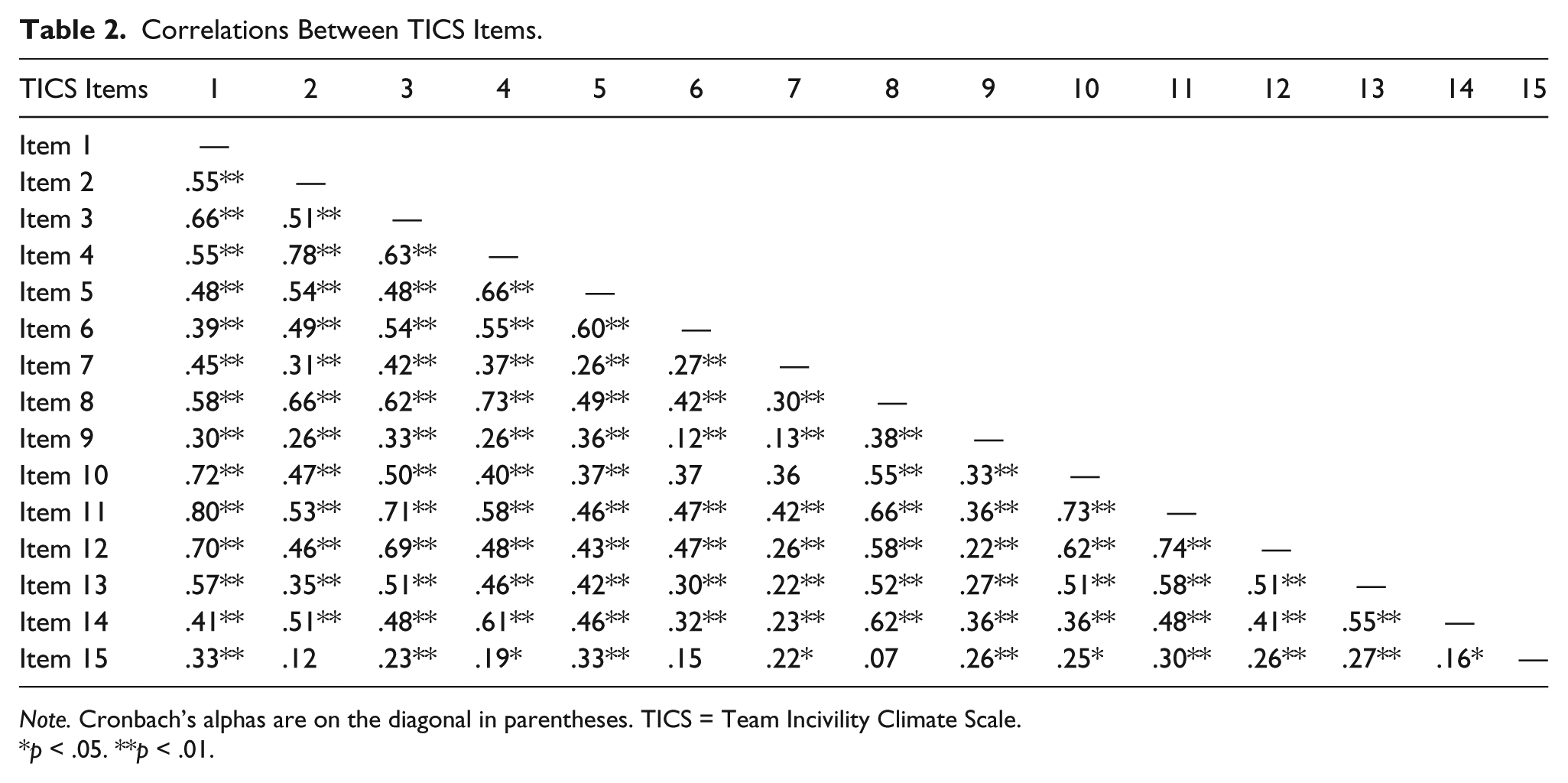
Examination of the descriptive statistics revealed that all 15 items were normally distributed, meeting the assumption of multivariate normality required for ML extraction. Correlations are presented in Table 2. The EFA with ML extraction revealed a single factor, which accounted for 46.3% of the total variance. Items 17, 10, 7, 6, 5, 15, and 14 were removed iteratively, in that order, due to low extraction communalities (see Table 1). The final EFA (see Table 1) revealed a single factor solution, accounting for 61.3% of the total variance. There was a moderate initial fit for the single factor model, χ2(20, N = 116) = 120.01. The Cronbach’s alpha reliability for the remaining eight-item scale was .89. The remaining eight items were reviewed for their completeness in measuring the full domain of the team incivility climate construct. The final scale included items assessing the uncivil practices that are allowed to occur within work teams, the policies and tacit procedures in place that serve as a frame of reference for team members, and the unwritten set of informal team rules that guide work behavior. Together, these eight items are, therefore, aligned with the proposed definition of team incivility climate, and the single factor identified is not merely the result of targeting one aspect of climate.
Correlations Between TICS Items.
Note. Cronbach’s alphas are on the diagonal in parentheses. TICS = Team Incivility Climate Scale.
p < .05. **p < .01.
Phase 2: CFA, Psychometric Properties, and Construct Validity
This phase sought to cross-validate the unitary factor structure obtained in the EFA conducted in Phase 1, using a separate independent sample. To build the nomological network surrounding the incivility climate construct, we then examined convergent validity and criterion-related validity of the TICS instrument.
In terms of convergent validity, we expected the TICS to be positively related at the individual level to the person’s experience of uncivil behavior. In other words, when employees work within uncivil team climates, members are more likely to engage in uncivil behavior themselves as such practices are rewarded and supported within their team. However, the two constructs are nevertheless conceptually unique (as argued above). Likewise, we also expected incivility climate (as perceived by the individual) to be highly correlated with perceived interactional justice, and, to a lesser extent, distributive justice.
Interactional justice refers to the quality of the interpersonal treatment received during the enactment of organizational procedures (Colquitt, 2001; Niehoff & Moorman, 1993). It is a measure of treatment received from the organization or its leaders whereas incivility climate is more about the way team members treat each other. However, when interactional injustice is high, it is likely to influence perceptions of normative behavior that in turn impact the way team members treat each other. Indeed, research has established that interpersonal justice is a key construct in explaining workplace deviance (Berry, Ones, & Sackett, 2007). Distributive justice refers to the extent to which decision outcomes are perceived as equitable (Colquitt, 2001), and not only is it a function of the organization rather than the team dynamic but is also less interpersonal in focus. Perhaps not surprisingly, distributive justice perceptions influence workplace deviance that is directed at the organization (Berry et al., 2007). However, the negative emotion that it arouses is likely to affect the way team members respond to each other (Berry et al., 2007); therefore, we expected its relationship with incivility climate to be moderate but less strong than the correlation between incivility climate and interactional justice.
To further establish the construct validity of the TICS, we examined the concurrent criterion-related validity of the measure, or the relationship between the measure and outcomes with which the measure would be expected to correlate (Hinkin, 1998). Specifically, we focused on the relationship between our measure and job satisfaction and turnover intentions. Cortina et al. (2001) argued that uncivil working environments will be related to critical job attitudes, where those working in teams with high incivility climates are likely to experience more negative feelings about their workplace, in turn, lowering their feelings of job satisfaction and increasing their intention to leave. This is supported by fairness theories, suggesting that team members are likely to respond to violations of workplace norms for mutual respect with reduced satisfaction, commitment, and withdrawal (Loi, Hang-Yue, & Foley, 2006; Sliter, Sliter, & Jex, 2012). By altering their commitment to the team or organization, employees are able to reduce dissonance and restore feelings of justice (Karriker & Williams, 2007).
Method
Participants
Sample 2 (collected separately to Sample 1 data) consisted of 357 participants recruited from a commercial survey pool. Just under half (48%) were male, with ages ranging from 21 to 82 (M = 45; SD = 14.51). They were employed in diverse occupations across a range of Australian organizations, and had been employed in their current jobs for an average of 8.4 years (SD = 9.49). The majority (60.8%) were employed as employees/team members, 26.3% were middle managers/team leaders, and 12.9% were senior managers. Education level varied: 20.7% had a high school level education, 30.5% had a technical college certificate or equivalent, 34.7% had an undergraduate university degree, and 14.0% had a postgraduate or higher education degree. Similar to Sample 1, respondents worked within well-established work teams, and were employed in roles requiring a high degree of interdependence and interpersonal interaction. Those who indicated that they did not work within permanent work teams that worked together to accomplish a set of tasks were excluded from the study. Participants worked in teams that ranged from six to 29, with a mean of 18.8 (SD = 5.8).
Measures
Incivility climate was measured with the eight-item TICS developed in Phase 1, using a 5-point rating scale (1 = strongly disagree and 5 = strongly agree). Coefficient alpha was .89.
Experienced incivility was assessed using the 11-item WIS (Cortina et al., 2001). Participants were required to rate on a 5-point scale (from 1 = never to 5 = very often) how often they had experienced uncivil behaviors from supervisors or coworkers within the past 6 months. Items included “ignored you or failed to speak to you”; and “made jokes at your expense.” Coefficient alpha was .94.
Interactional justice was assessed using Moorman’s (1991) 6-item scale. Participants were asked to assess the interpersonal behavior of their supervisor on a 5-point scale (from 1 = strongly disagree to 5 = strongly agree). Example items include “my supervisor is able to suppress personal biases” and “my supervisor takes steps to deal with me in a truthful manner.” Coefficient alpha was .93.
Distributive justice was assessed using the 5-item scale developed by Niehoff and Moorman (1993). Using a 5-point scale (from 1 = strongly disagree to 5 = strongly agree), participants were asked to assess the fairness of different work outcomes, such as pay level, work schedule, workload, and job responsibilities. Example items include “I think that my level of pay is fair” and “I consider my workload to be quite fair.” Coefficient alpha was .85.
Job satisfaction was measured with the 3-item scale from Cammann, Fichman, Jenkins, and Klesh (1983). On a 5-point scale (from 1 = strongly disagree to 5 = strongly agree), participants indicated the extent to which they were satisfied with their current job. An example item is “all in all, I am satisfied with my job.” Coefficient alpha was .85.
Turnover intention was assessed on a 5-point scale (from 1 = strongly disagree to 5 = strongly agree) using three items from Landau and Hammer (1986). Example items include “I am actively looking for a job outside my organization” and “as soon as I can find a better job, I’ll leave my organization.” Coefficient alpha was .89.
Analysis
A CFA was performed using IBM SPSS AMOS v. 22 with ML estimation. Descriptive statistics, correlations, and reliability analyses were then conducted in SPSS to test convergent and criterion-related validity. A series of CFAs were then conducted to test the uniqueness of the TICS against related measures. Finally, we conducted a Harman’s single factor test for common method variance (Podsakoff, MacKenzie, Lee, & Podsakoff, 2003), which involved including all items in the study in an EFA to determine whether a single factor structure accounted for the majority of covariance among the variables.
Results
CFA
In support of the EFA, the CFA revealed a single factor structure that provided a moderate fit for the data, χ2(20, N = 357) = 197.06, p < .05, comparative fit index (CFI) = 0.91, standardized root mean square residual (SRMR) = 0.04 (Hu & Bentler, 1999). It is recognized that approximate fit indices in structural equation modelling is a topic of continuous debate (e.g., see special issue 42 in the Journal of Personality and Individual Differences, 2007). Therefore, in addition to the fit indices reported above, we also conducted a detailed examination of the correlations, variances, and standardized discrepancies, which suggests that a one-factor solution for the eight-item TICS is likely to be the most acceptable model (McDonald & Ho, 2002; Tomarken & Waller, 2003). All items significantly loaded onto the latent incivility climate variable (ranging from 0.54 to 0.88), the final eight-item scale showed satisfactory internal consistency, with a Cronbach’s alpha reliability of .92, and the eight items were also substantially correlated with each other, with a mean inter-item correlation of +.63.
Validity
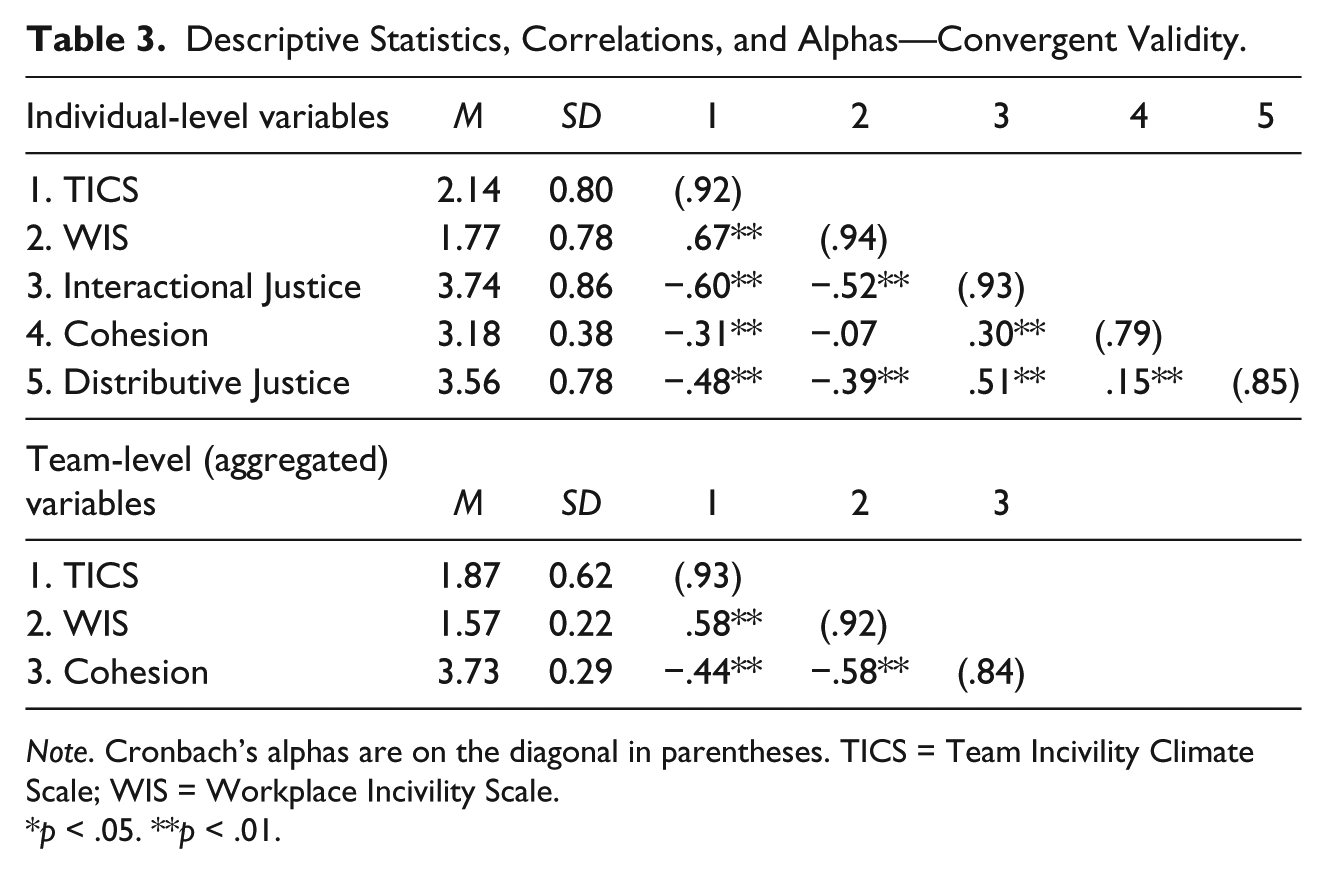
As shown in Table 3, the psychological TICS demonstrated convergent validity, being significantly and positively related to the WIS (r = .67), and negatively correlated with both interactional justice (r = –.60) and distributional justice (r = –.48), supporting Hypothesis 1. In light of the moderately high correlations between psychological TICS, WIS, interactional justice, and distributive justice (i.e., greater than .4), a factor analysis was conducted to test the uniqueness of these constructs. CFA showed that a four-factor model with psychological TICS, WIS, interactional justice, and distributive justice as separate variables, χ2(399, N = 357) = 1,391.91, p < .001, CFI = 0.89, SRMR = 0.06, provided a significantly better fit than a one-factor model, χ2(405, N = 375) = 3,853.95, p < .001, CFI = 0.61, SRMR = 0.11, resulting in a significant chi-square difference score (
Descriptive Statistics, Correlations, and Alphas—Convergent Validity.
Note. Cronbach’s alphas are on the diagonal in parentheses. TICS = Team Incivility Climate Scale; WIS = Workplace Incivility Scale.
p < .05. **p < .01.
Table 4 reports the scale’s concurrent criterion-related validity. Psychological incivility climate was significantly and negatively related to job satisfaction (r = –.61) and significantly and positively related to turnover intentions (r = .56), supporting Hypothesis 2. Through a series of regression analyses presented in Table 5, the psychological TICS showed significant incremental validity in the two outcome measures, over and above the effects of the WIS.
Descriptive Statistics, Correlations, and Alphas for Sample 2 Combined (n = 357)—Criterion-Related Validity.

Note. Cronbach’s alphas are on the diagonal in parentheses.
p < .05. **p < .01.
Regression Analysis Examining Experienced Incivility and Team Incivility Climates.

Note. TICS = Team Incivility Climate Scale; WIS = Workplace Incivility Scale.
p < .05. **p < .01.
Results of the Harman’s single factor test revealed a nine-factor solution, with the first factor accounting for 30% of the variance, suggesting that common method variance is not a substantial concern in this study.
Phase 3: Team-Level Construct Validity
Given the shared or multilevel nature of the incivility climate construct, it is particularly important that we validated the TICS instrument at the team level of analysis (Chan, 1998; Chen et al., 2003). First, the multilevel factor structure of the team-level incivility climate variable was examined through a CFA. Next, we examined within-group agreement, which refers to the extent to which respondents from one team agree in terms of their perceptions of the team environment, which is an important index to indicate that a construct exists at a group level (James, Demaree, & Wolf, 1984). According to Chan (1998), within-group agreement is fundamental in developing and validating climate constructs and multilevel scales. To assess within-group agreement and test the assumption of justifiable aggregation, we calculated rwg(j) scores using a uniform null distribution (James et al., 1984). However, given that the items used to measure incivility climate relate to interpersonal behavior within a team, it is possible that some of the variance is due to social desirability and, thus, contains systematic response bias. In this case, the use of uniform null distributions is likely to inflate interrater agreement levels (LeBreton & Senter, 2008). Therefore, we also calculated rwg(j) scores assuming a moderately skewed distribution of responses to represent this possible source of variance.
Following Chen et al.’s (2003) framework for multilevel construct validation, the reliability of the TICS at the aggregated team level of analysis was also assessed using the average item response per team. We then conducted an unconditional means model to determine if there was meaningful variation in incivility climate between work teams.
Next, the convergent validity of the team-level TICS was examined. It was expected that the team-level incivility climate construct would be positively associated with the aggregated WIS (Cortina et al., 2001). As described earlier, when aggregated to a higher level of analysis, the WIS represents a distinct environmental construct, measuring the average level of incivility individuals experience within the team. Incivility climate in contrast refers to a distinct team-level cognition about the practices, procedures, and norms that are rewarded or expected concerning uncivil workplace behavior. Climate research supports the concept of team incivility climate and aggregated instances of workplace incivility as being distinct but related constructs. For example, safety climate has been shown to play a critical role in determining its effect on individual safety behavior and the number of accidents experienced within a team (Hofmann, Morgeson, & Gerras, 2003). Similarly, violence climate was significantly related to the amount of violence, aggression, and strain experienced beyond specific incidents of violence (Spector, Coulter, Stockwell, & Matz, 2007). Therefore, it is expected that team incivility climate and the aggregated WIS will be correlated yet distinct constructs.
It is also expected that the team-level incivility climate construct will be negatively associated with team cohesion measured at the team level, which refers to team members’ affinity for one another and their desire to remain part of the team (Andrews, Kacmar, Blakely, & Bucklew, 2008). Social identity theory supports a negative relationship between team cohesion and incivility climate, by suggesting that team behavior is affected by how teams think about themselves. The more employees identify with their teams, the more likely they are to actively contribute to the welfare of their team and, thus, behave in a way that is positively aligned with the team’s interests (Blader & Tyler, 2009). Social identity theory also suggests that team cohesiveness is likely to influence the level of norm conformity. Higher norm conformity is present in cohesive teams due to the pressures exerted by team members on one another, and the interpersonal rewards that are available through team interactions (Hackman, 1992; Kidwell, Mossholder, & Bennant, 1997). Therefore, it was expected that in cohesive teams, there will be greater conformity to team norms of mutual respect, and, thus, lower incivility climate.
To further validate team-level incivility climate, we also examined the criterion-related validity by investigating the multilevel link between incivility climate and important employee outcomes. Research has shown interpersonal climate constructs relate to a range of behavioral, attitudinal, and health related outcomes, such as job satisfaction and turnover intentions (Kuenzi & Schminke, 2009). For example, Kessler, Spector, Chang, and Parr (2008) found that violence climate was related to both psychological and physical strain. The study suggested that favorable violence climates would lead to employee behavior that discourages violence, making employees feel less vulnerable to assault and feel safer and more satisfied at work. Consistent with this, we expected that incivility climate will add incremental predictability to important employee outcomes, over and above both individual exposure to uncivil acts and psychological incivility climate. In other words, team incivility climate will have a cross-level influence on employees’ job satisfaction and intention to leave that is incremental to both their individual experience of being a direct target of incivility and their individual perceptions of incivility climate. Applying broader climate theories (Klein & Kozlowski, 2000), this would occur because when a climate of incivility is allowed to permeate the work team, members are likely to develop negative feelings toward the team, prompting withdrawal and dissatisfaction. The emergence of uncivil team climates also increases the likelihood of vicarious exposure to incivility that has been shown to have similar detrimental effects on satisfaction and engagement as actual experiences of incivility (Griffin, 2010; Lim et al., 2008). On the contrary, when a respectful and civil team climate emerges, team members are likely to experience pride in the team, along with feelings of team efficacy and worth. Such positive attitudes and identification with the team are likely to result in increased satisfaction and commitment.
Method
Participants
Sample 3 consisted of 637 participants (45% male) nested within 50 work teams from five large organizations, which included not-for-profit, public, and private sector companies. The industries represented included infrastructure, transport, financial services, health, marketing, professional services, and telecommunications. Participants were aged between 18 and 73 (M = 34; SD = 9.44) and had been employed in their current jobs for an average of 5.7 years (SD = 6.51). The education levels of participants varied: 25% had a high school level education, 43% had a bachelor or technical college certificate or equivalent, and 32% had a postgraduate or higher education degree. The size of these teams ranged from six to 44 members, with a mean of 24 (SD = 11.37). The average response rate per team was 46%, with four to 23 responding from each team (M = 11; SD = 5.09).
Measures
Incivility climate was measured using the eight-item TICS with a 5-point rating scale (1 = strongly disagree and 5 = strongly agree).
Analysis
A CFA was conducted at the team level of analysis to examine the factor structure and rwg(j) scores were computed to justify aggregation to the team level (James et al., 1984). A series of mixed models were conducted in SPSS to test the cross-level hypotheses.
Results
The CFA provided moderate support for the unitary factor structure of the TICS, χ2(20, N = 60) = 47.61, p < .001, CFI = 0.90, SRMR = 0.06. A review of the correlations, variances, and standardized discrepancies also supported the eight-item TICS as an acceptable model. The rwg(j) scores using a uniform null distribution were used to assess the within-group agreement (James et al., 1984). The mean rwg(j) was .91, with 97% of teams having an rwg(j) score greater than .70 (range = .57-.99), which meets the guidelines recommended by Klein and Kozlowski (2000) for adequate within-group interrater reliability. The rwg(j) scores were then calculated using a moderately skewed distribution. The mean rwg(j) was .90, with 92% of teams having an rwg(j) score greater than .70 (range = .40-.99) which, although slightly lower, again met the guidelines for adequate within-group interrater reliability. Together, these results justify aggregation of the TICS items to a team level.
Given that team members exhibited sufficient agreement to warrant aggregation, an average incivility climate score was calculated for each team. The final eight-item scale showed high internal consistency at the aggregated team level of analysis, with a Cronbach’s alpha reliability of .93. An unconditional means model was then conducted to assess if there was meaningful variation in incivility climate between the 50 work teams. The Intralass Correlation (ICC) for incivility climate was 0.36, with significant between group variance, Wald Z(57) = 16.57, p < .001. This result indicates that the measure reliably discriminates between different work teams.
As shown in Table 3, the TICS at the team level of analysis demonstrated convergent validity, being significantly and positively related to the aggregated WIS scale (r = .58) and significantly and negatively related to team cohesion (r = –.44). In light of the moderately high correlations between TICS and the WIS at the aggregated or team level of analysis (i.e., greater than .4), a CFA at the aggregated or team level was conducted to test the uniqueness of these constructs. The result of the CFA showed that the two-factor model, χ2(151, N = 60) = 265.82, p < .001, CFI = 0.89, SRMR = 0.08, provided a significantly better fit than the one-factor model, χ2(152, N = 60) = 383.30, p < .001, CFI = 0.69, SRMR = 0.13, resulting in a significant chi-square difference score (
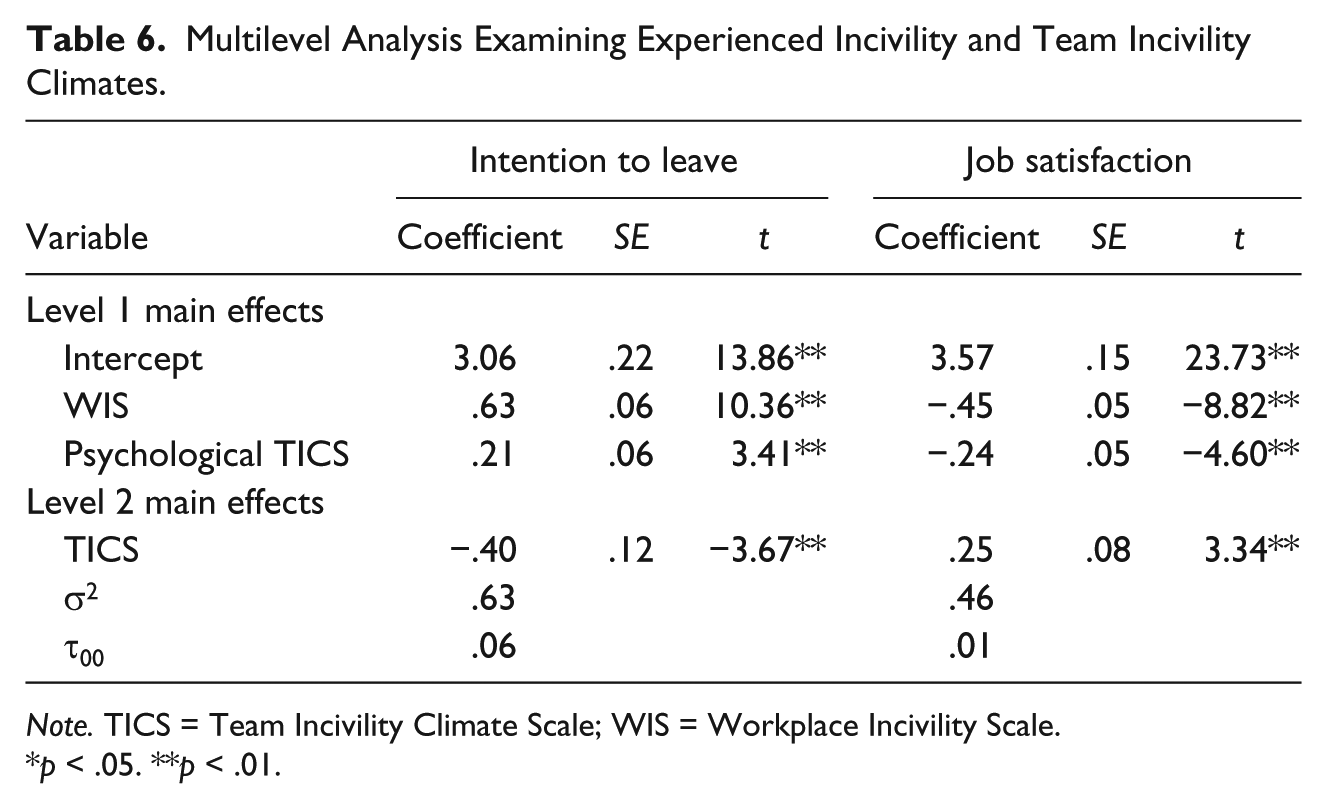
Table 6 shows the results of the multilevel analysis conducted using the mixed-model procedure in SPSS (Peugh & Enders, 2005). Group mean centering of the experienced incivility and psychological incivility climate variables and grand mean centering of incivility climate was used for hypothesis testing. The results show that team incivility climate was negatively related to job satisfaction over the effects of individuals’ direct experiences of workplace incivility and perceptions of teams’ incivility climate. Furthermore, team incivility climate was positively related to intention to leave, over the effect of individuals’ direct experiences of workplace incivility and perceptions of teams’ incivility climate. Together, these results support Hypothesis 4 and provide support for the criterion-related validity of the TICS. It demonstrates that incivility climate plays a unique role beyond the uncivil behavior experienced for both outcome variables, and, perhaps more importantly, demonstrates the utility of the TICS.
Multilevel Analysis Examining Experienced Incivility and Team Incivility Climates.
Note. TICS = Team Incivility Climate Scale; WIS = Workplace Incivility Scale.
p < .05. **p < .01.
Discussion
Despite the increased focus on facet-specific climate constructs and increasing evidence that group-level incivility has a multitude of negative effects (Griffin, 2010; Lim et al., 2008), there is an absence of robust and valid measures of incivility suitable for multilevel analysis. The purpose of our study was to develop a reliable and valid instrument for assessing climate for incivility at multiple levels of the workplace, and to assist researchers who seek to accurately examine this important area of research. Using three separate samples, totaling 1,110 participants and 50 identifiable work teams, the pattern of our results provide encouraging support for the reliability and validity of the TICS at both the individual level and the aggregated team level of analysis.
At the individual level, the TICS demonstrated a single factor structure and good internal consistency, supporting adequate psychometric properties of the new scale. Convergent validity was demonstrated across samples, with incivility climate related to experienced incivility, interactional, and distributive justice. Despite moderately strong correlations, the results of a CFA indicated that incivility climate is a distinct construct from an individual’s experiences of incivility and other similar constructs of interpersonal treatment (e.g., interactional justice). Furthermore, our results suggest that individual perceptions of incivility climate accounts for significant variance in work attitudes, over and above the effects of experienced incivility.
When examining incivility climate at the team level, the TICS again demonstrated a single factor structure with good internal consistency. The results also justified aggregation within teams and demonstrated significant between-team variance, which was quite large comparable with those usually found in applied organizational research (Bliese & Jex, 2002). The presence of between-team variability suggests that work teams are the appropriate level for aggregation and provides evidence of both the predictive value of the team-level incivility climate construct (Chan, 1998; Chen et al., 2003). Convergent validity was also demonstrated with results revealing a significant, yet unique, correlation with both the aggregated WIS and team cohesion. Finally, the team-level TICS demonstrated incremental validity to individual-level measures of incivility when aggregated to the team level, with incivility climate significantly related to all outcomes, over and above the effects of experienced incivility and psychological incivility climate.
These findings indicate that employees are affected not only by their direct personal experiences of incivility but also by the team environment and climate that they are exposed to. Indeed, the negative impact of climates for incivility on turnover intentions and satisfaction, even after controlling for personal experiences of uncivil behavior, highlights workplace incivility as a team or organizational problem, rather than just a result of individual experiences. Together, the results provide support for the conceptualization of team-level incivility as a facet-specific climate construct, and the validity of the TICS at both the individual and team level of analysis.
Despite the strong multilevel methodology and encouraging results, the study is not without some limitations. The first is the result’s vulnerability to common method bias due the reliance on single source self-report data. To control and check for method variance, a number of recommended procedural and statistical remedies were used (Podsakoff et al., 2003). First, anonymity was guaranteed and identifiable demographic questions were removed to encourage honest responses. Second, item stems were carefully worded to assure respondents that there were no right or wrong answers and reduce evaluation apprehension. Finally, the use of multilevel analysis minimized the common method variance problem, increasing confidence in the results (Podsakoff et al., 2003). The results of the Harman’s single factor test also suggested that common method bias was not a substantial concern in the current study. Nevertheless, future studies using the TICS should (a) collect and use multisource data to examine the outcomes of incivility climate and (b) conduct longitudinal studies to investigate the effect of incivility climate on outcomes over time.
Similar to most studies of workplace incivility, our study also relied on cross-sectional data, limiting the ability to infer causality and directionality. Despite this, longitudinal research on interpersonal deviance provides strong support for turnover and employee satisfaction resulting from workplace incivility, rather than preceding it (Glomb, Munson, Hulin, Bergman, & Drasgow, 1999). Causality is also less of an issue given that a major aim of the current study was to design a valid measure of incivility climate. Nonetheless, future research should employ longitudinal research methods to address causality concerns and trace team’s incivility climate over time.
The generalizability of the results may also be a concern because the TICS was validated using participants located in just one country. Team behaviors and norms vary significantly across cultural settings and are likely to affect employee attitudes and outcomes differently, with evidence that culture has both direct and moderating effects (e.g., Liu, Chi, Friedman, & Tasi, 2009). Consequently, future research should examine the extent to which the TICS exhibit the same properties in other cultures. Understanding cultural impact also represents an important area for future research given that organizations are increasingly operating across multiple countries, increasing the number of multicultural work teams.
Having provided conceptual and empirical evidence for the existence of incivility climates, there is now a need to explore how uncivil team climates relate to other specific climate constructs, such as hostile climate. Referring to consistent acrimonious, antagonistic, and suspicious feelings within the work group, scales measuring hostile climates include items that specifically relate to more aggressive, persistent, and intentional types of work behavior, such as “employees in my work group wonder what others want if they are being especially nice” and “employees in my work group have to be suspicious of overly friendly strangers” (Mawritz, Mayer, Hoobler, Wayne, & Marinova, 2012). However, Mawritz et al.’s (2012) hostile climate scale questions about what people “would do” and “commonly feel,” thus requiring team members to provide an affective evaluation of their work environment (Kuenzi & Schminke, 2009). Ehrhart et al. (2014) recently argued that climate is not a measure of affect. The TICS, in contrast, requires respondents to describe the work environment. Although the behavioral domains covered by the incivility climate scale conceptually distinguish it from hostile climates, research on incivility spirals suggest that over time if left unaddressed, uncivil climates could escalate into more hostile and volatile work environments. Understanding this process, both at individual and group levels, is an important endeavor for future research.
The current study revealed that team incivility climate exerted a meaningful impact on a number of important employee outcomes. There is now a need to focus on moving beyond direct effects to more precise examinations of potential moderating and mediating effects of incivility climate on employee outcomes. Drawing on the team effectiveness literature, researchers could investigate the mediating effect of team characteristics (e.g., team size and composition) and team process variables (e.g., team potency and efficacy) to provide a better understanding of the process by which uncivil team climates influence team performance. Indeed, examining the influence of team size on team incivility climate is an important area for further investigation, with evidence demonstrating that as teams get larger, key team processes such as cohesion, social comparison, and cooperation decrease (Wheelan, 2009). Finally, recognizing the recent trend toward examining the influence of climate strength, that is, the degree to which members of a specific team agree on the level of incivility climate perceptions, future researchers should explore the effect of the strength of team incivility climate (Schneider, Salvaggio, & Subirats, 2002).
Given that the current study did not allow a direct examination of objective organizational or team-level outcomes, a further extension of this research would be to examine additional outcomes at various levels of analysis. For example, it would be valuable to explore the impact that uncivil team climates have on aspects of team performance, such as quality, productivity, customer outcomes, and costs. Similarly, exploration of individual, team, and organizational antecedents of team incivility climate would also add value to the existing research on workplace incivility.
This study extended understanding of incivility by describing team incivility climate and providing a validated tool, the TICS, to give both researchers and practitioners the ability to diagnose and monitor uncivil team climates and for progressing research on this new facet-specific climate construct.
This study extended the understanding of incivility by describing team incivility climate and providing a validated tool to measure it. The TICS gives both researchers and practitioners the ability to diagnose and monitor uncivil team climates and to progress research on this new facet-specific climate construct. In summary, we believe the results of the study provide the needed conceptual and empirical support for the TICS that will allow researchers to more accurately examine team climates for incivility.
Footnotes
Declaration of Conflicting Interests
The author(s) declared no potential conflicts of interest with respect to the research, authorship, and/or publication of this article.
Funding
The author(s) received no financial support for the research, authorship, and/or publication of this article.
Associate Editor: William Gardner