




Abstract
In this article, we examine the effects of paternalism on experienced incivility across two studies. Study 1 examines the paternalism—experienced incivility relationship in a sample of health care employees, and Study 2 examines a moderated–mediated relationship, with incivility climate as the moderator of the paternalism—experienced incivility relationship, and counterproductive work behavior as the outcome. Results from these studies suggest that paternalism has a significant positive direct effect on incivility, and an indirect effect on counterproductive work behavior through experienced incivility. Moreover, our results suggest that the relationship between paternalism and experienced incivility is moderated by incivility climate, such that the effect of paternalism on experienced incivility is stronger at higher levels of incivility climate tolerance and lower levels of incivility climate policy.
Disrespectful behaviors have become commonplace in the workplace (Andersson & Pearson, 1999). According to recent data more than 90% of employees’ report experiencing incivility or observing uncivil behaviors in the workplace (Porath & Pearson, 2013). Incivility is often described as “low intensity deviant behavior with ambiguous intent to harm the target” (Andersson & Pearson, 1999, p. 457). Incivility includes actions such as interrupting others, acting in a condescending manner, and acting rudely toward people at work. Research supports that along with various individual and organizational characteristics that influence uncivil behavior, other factors such as job stress, competition for resources, and workplace climate are key in the experience of incivility.
Andersson and Pearson’s (1999) theorizing on the incivility spiral suggests that the impetus for incivility is when one employee targets another employee with incivility. Most of the research in this domain suggests that incivility once initiated escalates in intensity, and suggests that people indeed respond to the act. Current research on incivility focuses on the target’s personality, power structure at work, and the consequences related to being targeted with incivility (Cortina & Magley, 2009; Milam, Spitzmueller, & Penney, 2009).We argue that it is important to give attention to the role management has for setting the norms for how supervisors engage with employees in the workplace. According to Cortina (2008), “leaders set the tone for the entire organization, and employees look to them for cues about what constitutes acceptable conduct” (p. 62).
Currently, researchers have a limited understanding of how supervisors manage employees and its relationship with mistreatment. Scholars have called for more research investigating the relationship between incivility and counterproductive work behavior (CWB; Andersson & Pearson, 1999; Gallus, Bunk, Matthews, Barnes-Farrell, & Magley, 2014). Defined as subordinates’ overall perceptions that a supervisor’s behavior is altruistic and controlling (Wagstaff, Collela, Triana, Smith, & Watkins, 2015), paternalism has been suggested to have important implications for employees in organizational contexts (Ackers, 2001; Aycan, Kanungo, & Sinha, 1999). In the current article, we argue that supervisor paternalism, constitutes an important factor that may contribute to the spread of workplace incivility and subsequent adverse work outcomes due to employee perceptions of a lack of autonomy, limited growth opportunities, and the modeling of negative social norms.
To unpack our investigation, we rely on Andersson and Pearson’s (1999) incivility spiral framework. The spiral framework considers a number of interpersonal and environmental factors that contribute to workplace incivility. Circular patterns of amplified or reduced behavior have been studied previously in organizational contexts (Ashforth, 1994; Bies & Tripp, 1995), typically the result of an unwillingness or inability to alter reoccurring behaviors (Masuch, 1985). According to the spiral framework, an initial perception of incivility triggers an incivility spiral between two (or more) parties. As incivility continues, the party (or multiple parties) reaches a “tipping point,” after which the incivility escalates to a greater degree. The amplification process escalates at each “tipping point” as the parties fight to reciprocate perceived injustices within their contextual environment.
The spiral framework, like other social interactionist perspectives, highlights how the perceptions of others’ actions and contextual factors are key drivers of human behavior. We hypothesize that supervisor paternalism may directly influence whether employees perceive they have been the target of incivility. Additionally, we posit that paternalism will indirectly influence counterproductive workplace behavior through incivility experiences at the hands of a supervisor. Moreover, consistent with social interactionist theory (e.g., Lewin, 1936), we examine the interaction among supervisor paternalism, experienced incivility, and organizational climate for incivility. By examining individual and contextual variables that impact incivility experiences and CWB, we contribute to knowledge on understanding the role of supervisor management style and incivility.
Theoretical Background
Workplace incivility is known as rude behavior enacted at work. Although incivility is a less severe form of mistreatment, there is research that suggests there are adverse personal and organizational outcomes associated with experiencing incivility. For example, in a survey field study with a variety sectors, Porath and Pearson (2013) found that over 40% of targets of incivility experienced loss in work motivation, decline in work quality, and decreased task related outcomes. Additionally, other research suggests that experiencing incivility is associated with a decline in job attitudes, and an increase turnover cognitions (Cortina, Magley, Williams, & Langhout, 2001; Lim, Cortina, & Magley, 2008; Pearson, Andersson, & Porath, 2000; Pearson, Andersson, & Wegner, 2001).
Given the harmful impact of incivility, it is important for organizations to better understand antecedents to workplace incivility to ensure incivility escalations do not go unchecked. Unfortunately, limited scholarly attention has focused on factors that enable and motivate incivility (van Jaarsveld, Walker, & Skarlicki, 2010). This dearth of research is unfortunate given how pervasive and costly workplace incivility is to an organization’s financial health. According to recent reports, organizations report that investigating reports of incivility is becoming a consequential negative workplace norm; which can lead to costly financial implications for employers (Porath & Pearson, 2013).
Accordingly, a greater understanding of the impact of supervisors in influencing incivility is necessary to design workplace interventions that are focused on preventing incivility spirals. In the extreme cases where incivility spirals go unchecked for extended periods of time, Pearson et al. (2000) offer a number of “corrective and protective actions available throughout the employment lifecycle that help minimize the occurrence or reoccurrence of uncivil episodes” (p. 133). Such actions include the (a) setting of social expectations at an organizational level, (b) recruitment and selection of employees who understand and agree to abide by organizational civility standards, (c) orientation and training of employees to ensure comprehension of “appropriate” interpersonal behavior, (d) encouraging and offering feedback to correct uncivil behavior, and (e) reprimanding of incivility instigators.
The Effects of Paternalism and Incivility
Andersson and Pearson’s (1999) incivility spiral framework, which is based on the social interactionist framework, provides support for the relationship between paternalism and incivility. The incivility spiral typically begins when a person engages in an uncivil act and attributions made for the behavior impact how an individual will respond to incivility. Furthermore, the social interactionist perspective highlights the influence of situational factors that affect workplace incivility. In this way, situational factors include the relationship between situational and personal dynamics that impact behavior. For example, management style and the work context including policies, processes, and workplace norms are thought to influence incivility (Andersson & Pearson, 1999).
With this understanding as the backdrop, we argue that paternalism, as exhibited by supervisors, represents an important factor that may affect workplace incivility. As such, it is vital for managers to establish and maintain positive interpersonal relationships with employees. With respect to preventing incivility, supervisors should monitor whether their paternalistic management style
Supervisor paternalism is defined as subordinates’ perceptions that a supervisor’s behavior is helpful, but controlling. Previous research describes the helpful nature of paternalism as benevolence which is defined as goodwill, which transcends to positive acts in the workplace (Koutsouvilis, 1976). The paternalistic supervisor, to some extent, protects his subordinates. On the other hand, control is defined as direct or vicarious power over the target (Fiske, Morling, & Stevens, 1996). Control suggests that the supervisor acts in ways that places boundaries on the autonomy of an individual much like a parent would constrain a child’s behavior. However, supervisor paternalism may have unintended negative outcomes for subordinates because it will likely reduce one’s autonomy and opportunities for growth on the job (Ackers, 2001).
Consequently, there is an inherent conflict between autonomy and paternalism. On the one hand, autonomy suggests that employees are given the freedom to make their own decisions regarding work. That is, they can choose and forge their own path in terms of how they accomplish their work. On the other hand, paternalism suggests that supervisors would limit autonomy. In this way, it is conceivable that employees would reject any attempt of supervisor paternalism, as a form of perceived incivility, and would respond in a passive-aggressive manner by engaging in CWBs.
Although paternalistic supervisors do not necessarily treat employees in an uncivil manner, the spiral framework (Andersson & Pearson, 1999) suggests that controlling and modeling negative social norms may foster the perception of work incivility. For example, a paternalistic supervisor may choose to limit the difficulty of work a subordinate receives throughout the course of the day in the hopes of protecting them from work exhaustion or fatigue. However, the unambitious workload can hinder the subordinate from developing the skills and abilities necessary to become independently successful. Therefore, the subordinate may perceive the restricted workload as a hindrance to workplace growth and, consequently, as an act of incivility. Furthermore, the perception of subordinate favoritism by other employees may result in increased incivility, further exacerbating targeted incivility perceptions on behalf of the subordinate. Thus, we expect a positive relationship between paternalism and perceived incivility.
CWB is employee behavior that goes against the positive interests of an organization. These behaviors can harm organizations or people in organizations. Many researchers have emphasized the distinct nature of CWB that targets the organization (CWB-O) and CWB that targets other people (CWB-P; R. A. Baron & Neuman, 1996; Bennett & Robinson, 2000). Their finding suggests that the incivility spiral model which highlights a social dynamic, wherein a target of incivility directs his or her reciprocated response to the perceived actor. In our case, the organization and its inhabitants are sources of reciprocation given that they are tolerant of supervisor paternalistic behaviors. Thus, individuals who experience incivility should be more likely to perform CWB as a means of “getting even.”
As discussed previously, the spiral framework (Andersson & Pearson, 1999) suggests that there will be a positive relationship between paternalism and incivility. We extend the previous arguments by considering incivility as a mechanism through which paternalism leads to CWBs. Namely, paternalism may have an indirect effect on CWB through perceived incivility. Furthermore, the spiral framework proposes that employees who experience incivility tend to reciprocate with a similar uncivil act. Taken together, we expect that an employee working for a paternalistic supervisor will be more likely to experience incivility, which, in turn, will increase the likelihood that the employee will engage in CWB toward the target and the organization.
Moderating Effect of Incivility Climate
To date, only a few studies have examined environmental factors that impact incivility (Cortina, 2008; Gallus et al., 2014). However, research on other types of mistreatment suggest context is an important factor in understanding mistreatment (Timmerman & Bajema, 2000; Williams, Fitzgerald, & Drasgow, 1999). Given the need for more research on context (Magley, Gallus, & Bunk, 2010), we examined organizational climate for incivility. Specifically, we hypothesized that organizational climate for incivility will moderate the relationship between paternalism and incivility.
As the norms and values of an organization become inseparable from personal employee norms and values (Duckworth, 2016), climate plays an impactful role on employee perceptions, opinions, and actions. Much of the climate literature can fall within a simple 2 × 2 matrix where climate can be conceptualized and measured with a molar- or specific-focus (Carr, Schmidt, Ford, & DeShon, 2003; Gallus et al., 2014) at the psychological- or organizational-level (Gallus et al., 2014). Molar climate highlights the importance and achievement of overarching organizational goals, whereas specific climate focuses on one particular aspect of an organization’s values (Gallus et al., 2014). Furthermore, psychological climate is conceptualized as individual-level perceptions, while organizational climate is conceptualized as organizational-level variables (Ostroff, Kinicki, & Tamkins, 2003). To adhere to Carr et al.’s (2003) suggestion for predicting specific aspects of a work environment, we focus on a specific organizational climate, organizational climate for incivility, in our subsequent theorizing.
In the current study, and consistent with previous research, we use the term “organizational climate for incivility” (Gallus et al., 2014) which is the extent to which incivility is accepted within an organization. A civil context is one where uncivil behavior is not accepted. In a civil climate, perceptions of workplace practices, policies, and disciplinary actions indicate that uncivil behaviors are discouraged within that organization (Gallus et al., 2014). Such perceptions can be based on both formal and informal organizational norms and institutions. On the other hand, an uncivil context indicates that uncivil behaviors are accepted. Organizations with a climate for incivility traditionally lack formal policies discouraging workplace incivility, and in many cases such climates intentionally and informally reward uncivil behaviors (Gallus et al., 2014).
According to Gallus et al. (2014), individuals examine organizational norms for behavior when formulating workplace perceptions. With regard to paternalism and incivility, subordinates assess organizational incivility climate to determine if uncivil behavior on behalf of a supervisor is tolerated or condoned. If incivility is generally discouraged, employees are more likely to perceive experienced paternalism as socially justified and, consequently, civil. According to norms of reciprocity, given the positive paternalistic perceptions, employees will also be more likely to reciprocate positive supervisor behavior with increased (decreased) positive (negative) workplace behaviors.
When organizational climates are more tolerant of incivility, paternalistic behavior will be perceived as prescribing to organizational norms of incivility, and in need of reciprocation due to unfairness perceptions. Drawing from dominance theories, we argue that supervisor paternalism stems from real or implied status differences in supervisor–subordinate dyadic relationships (Jackman, 1994). Given the amount of subordinate vulnerability embedded in such unequal relations (Klaussner, 2014), it is not surprising that subordinate perceptions of unfair treatment reach a tipping point. At such a threshold, subordinates perceiving paternalism in an organization accepting of incivility, reciprocate in the form of counterproductive and deviant workplace behavior. It is important to acknowledge that such counterproductive behavior is utilized by the subordinate as a means of inhibiting asymmetry in the face of unfairness without directly targeting the supervisor (i.e., the source of the injustice), who in the social exchange relationship holds most, if not all, of the power.
Following the incivility spiral framework, developed by Andersson and Pearson (1999), such reciprocated behavior in a contextually uncivil organizational climate further instigates supervisor paternalistic tendencies to control and protect the subordinate, escalating the impact of paternalism on incivility perceptions, and reciprocated CWB. Furthermore, the spiral framework also accounts for the spillover affects which arise when an individual engaged in an incivility spiral reciprocates incivility toward a relatively innocent third party. In the case of the paternalism incivility spiral denoted here, the subordinate knowingly engages in counterproductive behaviors toward organizational members and the organization itself, instead of the source of perceived incivility. Again, such misplaced behavior is perceived rationally given the vulnerability subordinates report in dyadic supervisor–subordinate relationships (Klaussner, 2014).
In light of the above, we propose that climate for incivility will moderate the relationship between paternalism and experienced incivility, such that the relationship between paternalism and experienced incivility will be weaker when incivility is discouraged through formal policy (i.e., incivility climate policy) and stronger when the organizational climate is more accepting of incivility (i.e., incivility climate tolerance). Additionally, following norms of reciprocity and the spiral framework literature, such moderating affects will also affect the indirect effect paternalism plays on counterproductive behaviors through perceived incivility.
Overview of Studies
Lindsay and Ehrenberg (1993) argue empirical investigations in isolation are “meaningless” in terms of advancing scientific knowledge due to an inability to consider extraneous variables across contexts and samples (i.e., a lack of generalizability). Accordingly, Hochwarter, Ferris, and Hanes (2011) argue for the importance of replication and extension, through multistudy research packages, as a means of “checking” and “balancing” empirical results. The implementation of multistudy packages is suggested to increase the generalizability of study results (Hochwarter et al., 2011), while offering a means of reducing convergent validity concerns (Lindsay & Ehrenberg, 1993).
To address common method concerns regarding the generalizability of results in single-study designs (Hochwarter et al., 2011), a two-sample investigation was developed to test the moderating role of incivility climate policies and incivility climate tolerance on the paternalism—targeted incivility relationship, as well as the mediating role of targeted incivility on the paternalism—CWB relationship. Using student-recruitment sampling procedures, Sample 1 was used as a preliminary test of the role of paternalism on perceptions of targeted incivility. To increase the validity of drawn inferences, Sample 2 was distributed to employees from varying industries in the hopes of replicating and extending Sample 1 findings, while examining a new moderated mediation paternalism—CWB model (See Figure 1).
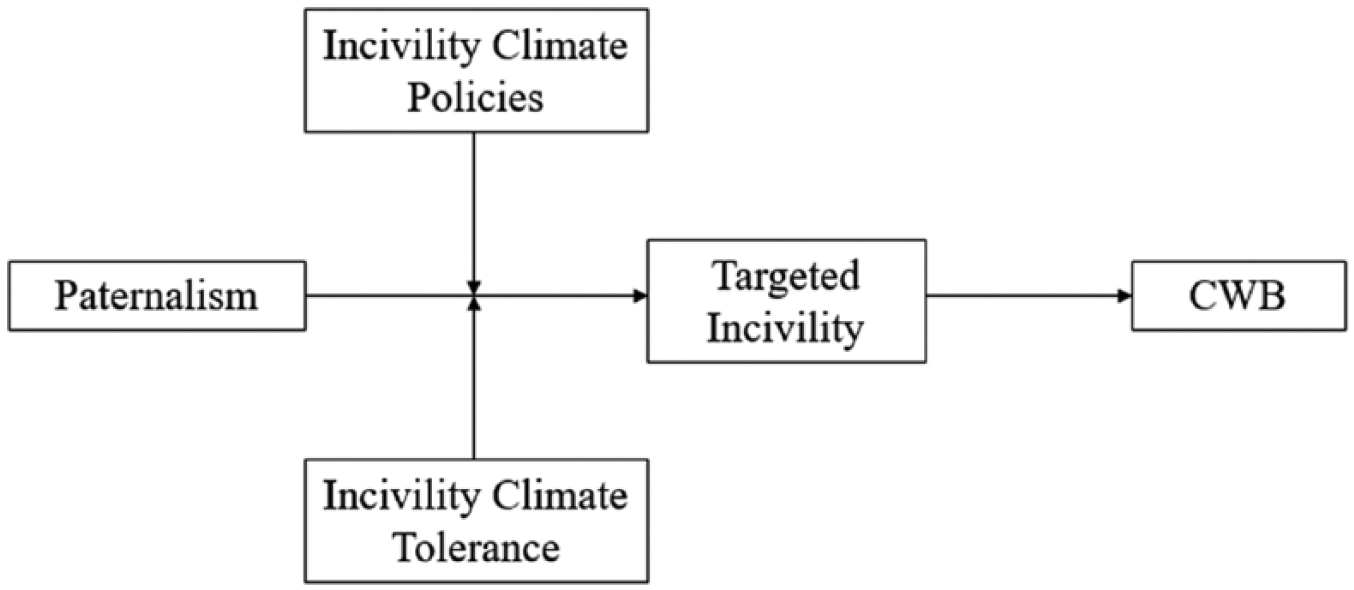
A moderated mediation paternalism—Counterproductive work behavior model.
Method
Participants and Procedures
Sample 1
To examine the role of paternalism on perceptions of targeted incivility, surveys were administered to full-time employees using a student-recruited sampling procedure. Students enrolled in an undergraduate Organizational Behavior class at a large Southeastern university were asked to recruit participants who were working full-time. Recruited employees received an e-mail containing a hyperlink to complete the survey. Of the employees contacted to participate, 151 responses were received. After omitting seven surveys due to missing or incomplete data, a final sample of 144 participants remained. Participants had a mean age of 43 years (M = 42.83, SD = 12.75) and more than half reported having a professional specialty or holding an executive, administrative, or managerial position (e.g., 51%). Indeed, 64% of participants were female and 80% identified as Caucasian. A total of 55% were married with children (e.g., 55%) and 70% had received a 4-year degree or higher. Average organizational tenure was between 5 and 9 years of service.
Sample 2
Cross-sectional data were collected on full-time employees working in the health care industry. Indeed, 59% of participants surveyed held entry level or nonmanagerial positions. Of the employees contacted to participate in the survey, 295 completed all applicable items. The final sample was comprised of 44% women, and 74% of participants were Caucasian. Participants’ average age was 34 years old (M = 34.41, SD = 9.90), and 54% has received a 4-year degree of higher. The average organizational tenure was between 5 and 9 years of service.
Variables were measured at the individual level. All survey correspondence was conducted via employees’ work e-mail. Respondents were contacted with an initial e-mail informing them that the study was a part of a PhD student’s dissertation research and that, although their participation was highly appreciated, it was voluntary. A few days following the initial e-mail, a second message was sent with an electronic link to the survey. Respondents accessed the survey by clicking on the link in the e-mail memo. Survey instructions reiterated the voluntariness of participation and the confidentiality of all results. The electronic survey was designed such that respondents did not have the option of returning to previously completed questions. This feature has been employed in previous research to prevent consistency bias when participants respond to subsequent survey items (Schwab, 1999). Employees were also informed that those who participated would be entered into a prize lottery, as an incentive for respondent participation.
Measures
Supervisor Paternalism
To measure perceptions of supervisor paternalism, participants completed Wagstaff et al.’s (2015) five-item paternalism scale (α = .90—Sample 1; α = .91—Sample 2). Sample items include “My supervisor acts like a parent toward me” and “My supervisor protects me from unpleasant news, independently of my wishes.” A 5-point Likert-type response format ranging from strongly disagree (1) to strongly agree (5) was utilized.
Targeted Incivility
The seven-item Workplace Incivility Scale (Cortina et al., 2001) was used to measure employee experiences of targeted incivility within the workplace (α = .91—Sample 1; α = .92—Sample 2). Employees were asked to report how often they experienced certain behaviors on a 5-point Likert-type response scale ranging from never (1) to daily (5). Sample behaviors include “Paid little attention to your statement or showed little interest in your opinion” and “Addressed you in unprofessional terms, either publicly or privately.”
Counterproductive Work Behavior
The 45-item CWB–Checklist (Spector et al., 2004) was administered to assess CWBs (α = .98—Sample 2). Employees were asked to report how often they engaged in certain behaviors on a 5-point Likert-type response scale ranging from never (1) to always (5). Sample items include “Insulted or made fun of someone at work” and “Took money from your employer without permission.”
Organizational Policies Regarding and Tolerance for Incivility
Organizational policies regarding incivility (α = .80—Sample 2) and organizational tolerance for incivility (α = .89—Sample 2) were assessed using the four-item scale developed by Gallus et al. (2014). Items were scored such that higher scores indicated more organizational policies opposing incivility or more organizational tolerance for incivility. Policy items include “There are no company guidelines on how to treat each other in my workplace” and “There is no training about how coworkers are supposed to treat each other in my workplace.” Tolerance items include “You would be reprimanded if you were rude to others in my workplace” and “You would have career problems if you were rude to others in my workplace.” All items were measured on a 5-point Likert-type response scale ranging from strongly disagree (1) to strongly agree (5).
Control Variables—Demographics
Age-related differences have been documented in relation to perceptions of workplace incivility. Einarsen and Raknes (1997) found that younger workers experience more harassment and uncivil behavior then their older counterparts. According to Scheibe and Zacher (2013), although increases in age are associated with an increase in frequency of stress encounters, older individuals are better able to successfully manage their emotions ensuring more positive reactions to stressors. Due to this rise in resilience and adaptation with increasing age (Aldwin & Levenson, 2001), participant age was included as a necessary control; therefore, negating the role of age on perceptions of incivility.
Gender disparities in perceptions of incivility have been reported previously (Cortina et al., 2001; Cortina et al., 2002). These researchers found that women endured and perceived incivility at greater frequencies than men, but that both genders experienced negative effects when incivility occurred. Gender differences in response to work stress have also been documented (Bolino & Turnley, 2005); therefore, participant gender was included as a necessary covariate.
Prior work has suggested that racial minority members, compared with their White counterparts, are at an increased risk for workplace mistreatment and abuse (Berdahl & Moore, 2006), finding racial differences in vulnerability to incivility on the job (Cortina, Kabat-Farr, Leskinen, Huerta, & Magley, 2013). Consistent with modern discrimination, researchers have argued that racial minorities may be targeted with more incivility because the ambiguity inherent in uncivil behavior allows incivility instigators to rationalize behaviors as being unbiased (Cortina, 2008). Therefore, race is included as a covariate.
Analyses and Results
Sample 1
Statistical analyses were conducted using Statistical Package for the Social Sciences (SPSS) 23.0. Means, standard deviations, and bivariate correlations are presented above the diagonal in Table 1. Prior to testing the relationship between paternalism and targeted incivility, descriptive statistics were analyzed to determine the distribution shape of both variables of interest. Paternalism had a skewness value of 1.05 (standard error [SE] = 0.20) and a kurtosis value of .273 (SE = 0.40). Similarly, targeted incivility demonstrated a skewness value of 1.41 (SE = 0.20) and a kurtosis value of 1.26 (SE = 0.40). Based on these acceptable values, distribution normality was assumed. Hypothesis 1 predicted a positive relationship between paternalism and perceptions of targeted incivility. As predicted, paternalism and incivility were significantly correlated (r = .18). A linear regression analysis confirmed this significant association, b = 0.12, SE = 0.05, t(143) = 2.23, p < .05; thus, finding support for Hypothesis 1.
Means, Standard Deviations, and Intercorrelations Among Study Variables.
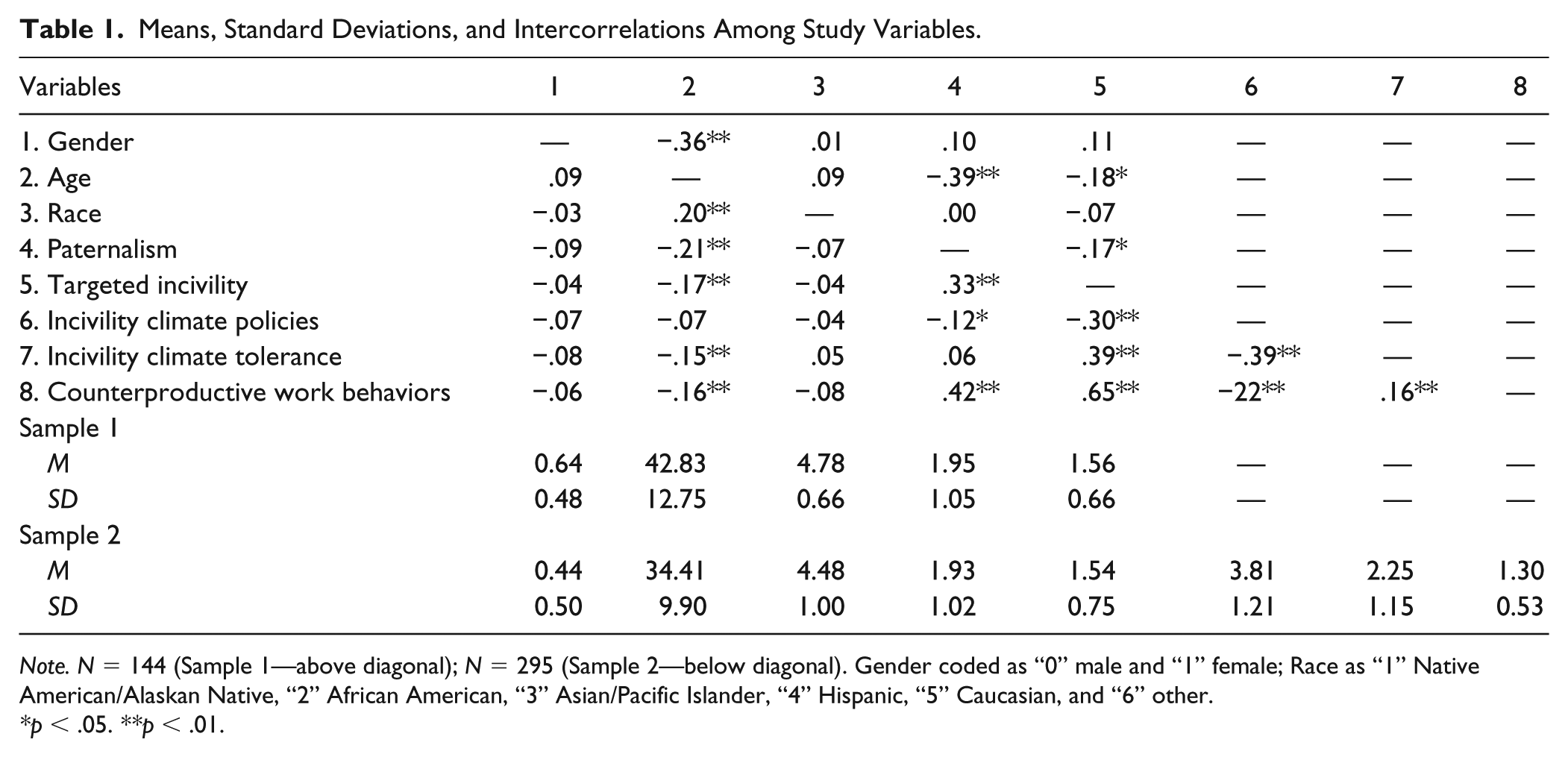
Note. N = 144 (Sample 1—above diagonal); N = 295 (Sample 2—below diagonal). Gender coded as “0” male and “1” female; Race as “1” Native American/Alaskan Native, “2” African American, “3” Asian/Pacific Islander, “4” Hispanic, “5” Caucasian, and “6” other.
p < .05. **p < .01.
As suggested by Podsakoff, MacKenzie, Lee, and Podsakoff (2003), we conducted a Harman’s single-factor test for common method variance (CMV) using principle component factoring. The Harman’s test showed the single-factor test explained only 43.5% of the total variance in the underlying items. Despite finding the single factor did not account for the majority of the variance among the indicators, to add further validity to our initial findings, we tested the effect of paternalism on targeted incivility while controlling for CMV using structural equation modeling (SEM) and, again, found support for Hypothesis 1 (b = 0.22, SE = 0.09, p = .02). The SEM showed acceptable model-data fit (χ2/df = 2.39, p < .001, comparative fit index = .96, standardized root mean square residual = .05, and root mean square error of approximation = .10).
Sample 2
Prior to testing the proposed moderated mediation model, we conducted a Harman’s single-factor test using principle component factoring to test for common method issues (Podsakoff et al., 2003). The Harman’s test showed the single factor explained only 40.8% of the total variance in the underlying items, which is below the 50% majority threshold. Moreover, given that our primary contribution lies in the documentation of an interaction effect of climate tolerance and policies on the paternalism—targeted incivility relationship, we recognize prior research demonstrating the implausibility of CMV for explaining moderation effects (Siemsen, Roth, & Oliveira, 2010). Siemsen et al. (2010) document that artificial nonlinear effects cannot be created through CMV and that, in fact, CMV usually causes deflated interaction terms. Despite the inability of CMV to explain moderation effects, we did use several procedural remedies to address CMV concerns (Podsakoff et al., 2003; Podsakoff, MacKenzie, & Podsakoff, 2012), including measuring all predictor and criterion variables using already established measures with varied response methods and formats.
Given the Harman’s test showed a lack of substantial CMV present in the data and prior research demonstrating the inability of CMV to produce significant interaction effects, we tested the full proposed moderated mediation model in SPSS 23.0 using PROCESS extension procedures and models as described by Hayes (2013). PROCESS was used because of the programs ability to test moderated mediation models with covariates, while examining direct, mediated, and moderating effects simultaneously (Baron & Kenny, 1986). Our analyses were conducted using PROCESS Model 7 with 95% bias-corrected confidence intervals (CIs) and 5,000 bootstrap iterations, while requesting heteroscedasticity-consistent SEs. All hypotheses were tested controlling for participant gender, age, and race.
Sample 2 means, standard deviations, and bivariate correlations are presented below the diagonal in Table 1. All bivariate relationships were consistent with expectations. When examining the moderated mediation model including incivility climate policies as a moderator, support for Hypothesis 1 predicting a positive association between paternalism and targeted incivility was again found, b = 0.54, SE = 0.21, t(294) = 2.61, p < .01; Table 2. However, when examining the moderated mediation model including incivility climate tolerance, Hypothesis 1 was not supported (b = −0.01, ns; Table 3).
Regression Results for the Conditional Effects of Incivility Climate Policies on the Paternalism—Incivility Relationship While Controlling for Age, Gender, and Race.

Note. N = 295. CWB = counterproductive work behavior; SE = standard error; LLCI = lower limit confidence interval; ULCI = upper limit confidence interval. Unstandardized regression coefficients reported. Statistical tests based on two-tailed tests.
Regression Results for the Conditional Effects of Incivility Climate Tolerance on the Paternalism—Incivility Relationship While Controlling for Age, Gender, and Race.
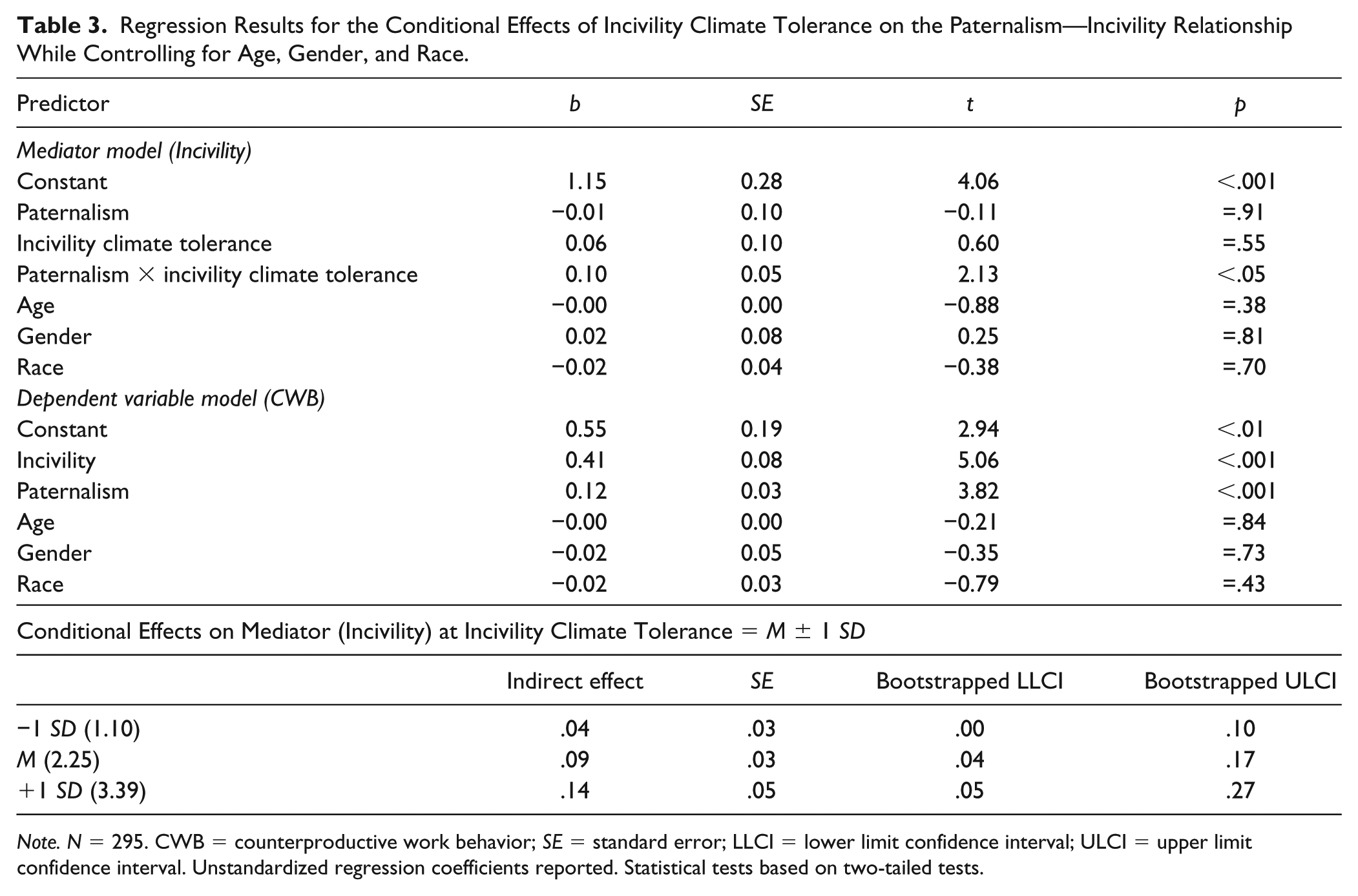
Note. N = 295. CWB = counterproductive work behavior; SE = standard error; LLCI = lower limit confidence interval; ULCI = upper limit confidence interval. Unstandardized regression coefficients reported. Statistical tests based on two-tailed tests.
Hypothesis 2 predicted a positive association between perceptions of targeted incivility and CWB. Results demonstrated the significant role of targeted incivility on CWB, b = 0.41, SE = 0.08, t(294) = 5.06, p < .001; thus, Hypothesis 2 was also supported. Hypothesis 3 predicted the mediating role of targeted incivility on the relationship between paternalism and CWB. Both the effect of incivility, b = 0.41, SE = 0.08, t(294) = 5.06, p < .001, and paternalism, b = 0.12, SE = 0.03, t(294) = 3.82, p < .001, on CWB were significant, suggesting the presence of partial mediation; thus, Hypothesis 3 was supported.
Hypothesis 4a predicted the attenuating role of incivility climate policies on the positive paternalism—targeted incivility relationship. Moderation results supported Hypothesis 4a, b = −0.09, SE = 0.05, t(294) = −2.01, p < .05 (Figure 2). Hypothesis 4b predicted the exacerbating role of incivility climate tolerance on the paternalism—targeted incivility relationship. Hypothesis 4b was also supported, b = 0.10, SE = 0.05, t(294) = 2.13, p < .05 (Figure 3).

Role of incivility climate policies on the paternalism—targeted incivility relationship.
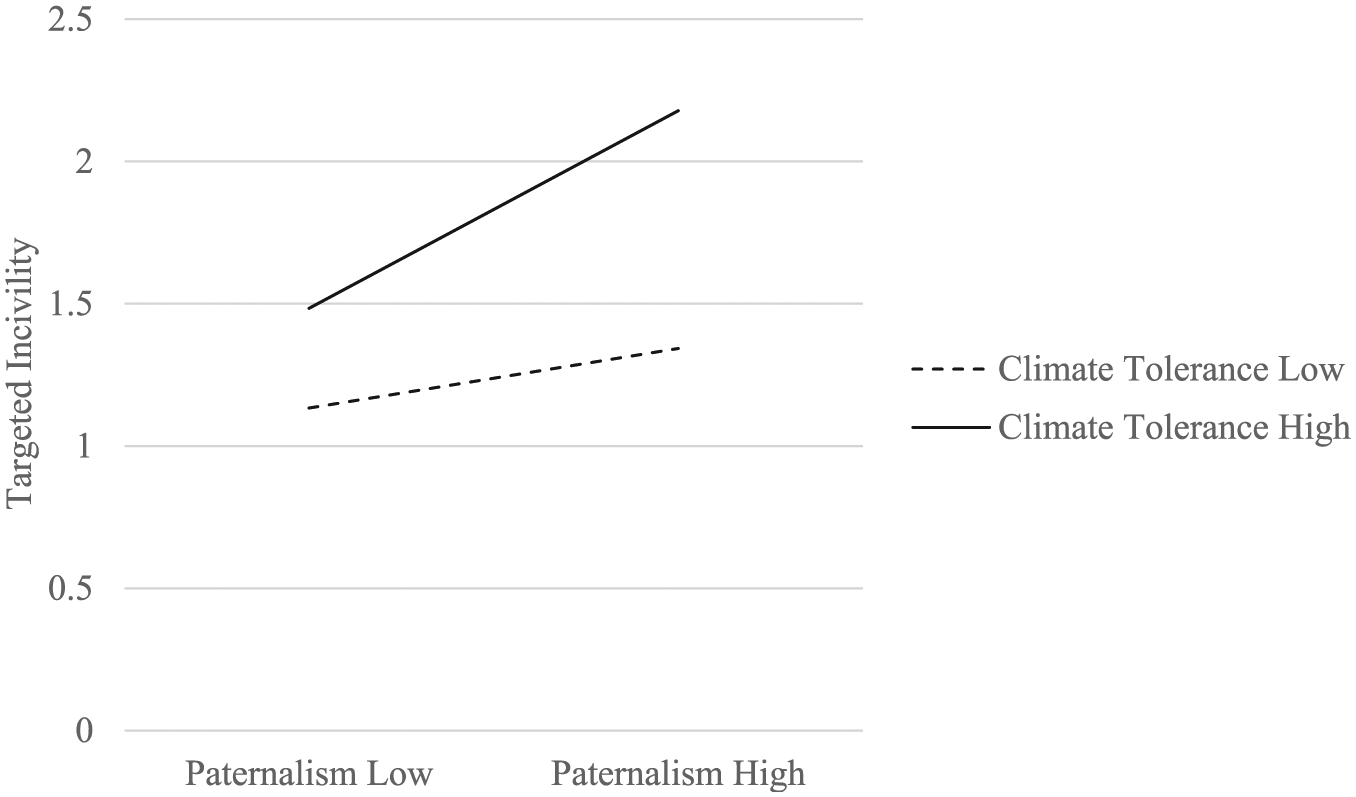
Role of incivility climate tolerance on the paternalism—targeted incivility relationship.
To examine whether each moderated mediation model was significant, indexes of moderated mediation were examined. Hypothesis 5a predicted incivility climate policies would moderate the indirect effect of paternalism on CWB (through targeted incivility). This hypothesis was supported as the bootstrap CI did not include 0 (Preacher & Hayes, 2004). Hypothesis 5b predicted incivility climate tolerance would moderate the indirect effect of paternalism on CWB (through targeted incivility). This hypothesis was also supported as the bootstrapping CI, again, did not include 0. See Table 4 for indexes of moderated mediation.
Index of Moderated Mediation While Controlling for Age, Gender, and Race.

Note. SE = standard error; LLCI = lower limit confidence interval; ULCI = upper limit confidence interval.
A post hoc analysis demonstrated that when controlling for the original covariates (i.e., age, gender, and race) and incivility climate tolerance, the moderating role of incivility climate policies on the indirect effect of paternalism on CWB (through targeted incivility) was still significant, as the bootstrap CI did not include 0, index = −.04, SE(boot) = .02, boot CI [−.10, −.01]. Similarly, when including the original covariates and incivility climate policies, the moderating role of incivility climate tolerance on the indirect effect of paternalism on CWB (through targeted incivility) was still significant, as the bootstrap CI did not include 0, index = .04, SE(boot) = .02, boot CI [.00, .09].
Discussion
Drawing on Andersson and Pearson’s (1999) incivility spiral and the social interactionist perspective, this study was designed to examine the antecedents of incivility perceptions and CWB. In doing so, we examine the influence of paternalism on incivility, and the conditions under which incivility climate perceptions strengthen or attenuate the relationship. In line with the hypotheses presented, Sample 1 was used as a preliminary examination of the role of paternalism on perceptions of targeted incivility. Our findings demonstrate that as perceptions of supervisor paternalism increase, perceptions of targeted incivility increase as well. In an attempt to verify these initial findings, Sample 2 examined and confirmed this positive association again, as part of a larger moderated mediation model. As expected, targeted incivility mediated the relationship between paternalism and CWB and both incivility climate policies and incivility climate tolerance moderated the paternalism—targeted incivility relationship.
In examining each moderated mediation model separately, we determined that both models had a significant index of moderated mediation value. These results indicate that both incivility climate policies and incivility climate tolerance are significant moderators of the indirect effect of paternalism on CWB (through targeted incivility) such that as paternalism increases, perceptions of targeted incivility increase, resulting in more CWBs. Moreover, as perceptions of incivility climate policies increase, the positive relationship between paternalism and incivility is attenuated. Inversely, when perceptions of incivility climate tolerance increase, the positive relationship between paternalism and incivility is exacerbated. Both moderated mediation models were also significant when including the other as a covariate, suggesting that incivility climate policies and incivility climate tolerance are significant moderators of the indirect effect even when controlling for shared variance between incivility climate policies and incivility climate tolerance.
In using a multistudy package, we develop a more comprehensive and replicable understanding of the role of incivility policies, incivility tolerance, and targeted incivility on the paternalism—CWB relationship, and in doing so, we hope to address typical concerns regarding the generalizability of study results across samples and contexts (Ferris, Hall, Royle, & Martocchio, 2004; Hendrick, 1990).
Accordingly, this research contributes to the incivility literature in several important ways. First, this study moves beyond existing research on incivility by examining organizational contexts for mistreatment. Understanding the extent to which employees perceive a climate for incivility is key for paving the way to developing workplace interventions for positive behavioral norms at work. Second, although the role of leadership has been established as a key factor in targeting subordinates with incivility, we are unaware of previous research that examines the role of paternalism as a management style and its subsequent influence on incivility. Furthermore, examining the impact of paternalism in relationship to incivility climate and targeted incivility, and CWB provides a more in-depth understanding of the complex dynamics surrounding workplace incivility and also offers further support for previous arguments that present workplace incivility as a top-down phenomenon (Cortina et al., 2001). Finally, this research is the first to tackle the benevolent and controlling nature of paternalism, and the unintended consequences of this management style on workplace engagement.
Limitations
We acknowledge some limitations that might be addressed in future research. First, Sample 1 utilized a student-recruited sampling procedure. Researchers have found that student-recruited and nonstudent-recruited samples do not differ in their representativeness of the average workplace (Wheeler, Shanine, Leon, & Whitman, 2014). Similarly, other researchers have argued for the generalizability and external validity of many student-recruited sampling procedures (Demerouti & Rispens, 2014; Druckman & Kam, 2011). Hochwarter (2014) found that student-recruited sampling procedures are useful when examining sensitive topics that are inappropriate to measure in organizational contexts. Due to the sensitive nature of some of the study variables, we felt a student-recruitment sample was beneficial and justifiable. However, to confirm there are no differences across samples, future researchers may want to utilize an organizational sample.
Another potential limitation of our study includes the single-sourced nature of both Sample 1 and 2. However, we believe CMV has limited plausibility for explaining our study relationships for a number of reasons. First, both studies included a priori procedural remedies and post hoc tests for accessing CMV (Podsakoff et al., 2003). For example, all predictor and criterion variables were collected using varied response methods. Moreover, to further add to the validity of our findings, we utilized only previously established measures. We also conducted Harman’s single-factor tests for both samples.
For Sample 1, we controlled for CMV by including a common methods factor in our SEM of paternalism on incivility. For Sample 2, given that our primary contribution lies in the documentation of an interaction effect of climate tolerance and policies on the paternalism—targeted incivility relationship, we recognize prior research demonstrating the implausibility of CMV for explaining moderation effects (Siemsen et al., 2010). Siemsen et al. (2010) document that artificial nonlinear effects cannot be created through CMV and that, in fact, CMV usually causes deflated interaction terms. Despite this information, future research should consider collecting multisource data using longitudinal and experimental design.
Practical Implications
We hope our paternalism—CWB framework will inform practitioner practice. As alluded to previously, understanding the extent to which employees perceive a climate for incivility is key when developing workplace interventions for positive behavioral norms. In developing incivility-related policies and practices and by demonstrating the presence of a climate intolerant of incivility, practitioners can reduce the negative impact of incivility on workplace contexts. Furthermore, by creating and implementing stated policies regarding the consequences of incivility, practitioners can also reduce the prominence of incivility and, in turn, reduce the frequency and desire employees feel to reciprocate incivility by engaging in CWBs (among other negative outcomes). This framework could also be used to justify the importance of intervention and training practices. If organizations undergo incivility training, they may be better able to spot and prevent workplace incivility.
Conclusion
Using two samples, we found incivility climate policies, incivility climate tolerance, and targeted incivility play an important role in explaining the relationship between paternalism and CWB. Post hoc analyses demonstrated that when controlling for the shared variance between age, gender, race, and incivility climate policies (tolerance), the moderating role of incivility climate tolerance (policies) on the indirect effect of paternalism on CWB (through targeted incivility) was still significant. As research on the paternalism—CWB relationship continues to develop, we hope our findings will stimulate further studies examining the role of intervening and moderating variables on this relationship.
Footnotes
Appendix
Declaration of Conflicting Interests
The author(s) declared no potential conflicts of interest with respect to the research, authorship, and/or publication of this article.
Funding
The author(s) received no financial support for the research, authorship, and/or publication of this article.