



Abstract
We are making the following clarifications/corrections regarding the original
publication: Zhu, W., Avolio, B. J., & Walumbwa, F. O. (2009). Moderating role of
follower characteristics with transformational leadership and follower work engagement.
Group & Organization Management, 34, 590-619. (Original DOI:
In the hierarchical linear modeling (HLM) analysis testing the hypotheses on pp. 604-608, we used a final sample of 140 followers as reported in the article. To create this final dataset, we deleted those leader cases that had only 1 follower rating to reduce potential for idiosyncratic bias and error (see Mount & Scullen, 2001; Scullen, Mount, & Goff, 2000). The initial confirmatory factor analysis (CFA) results that were done to test for common method variance reported on p. 604 of the original publication were based on the dataset that included leaders with 1 follower rating the leader versus the reduced sample after dropping those cases.
To re-test for common method variance with the final dataset without the leaders who had only one follower, we conducted the CFA for common method variance with the final dataset that included 140 cases. On p. 604, based on the new CFA results, lines 1 to 9 should read as follows: “The general factor explained only 38.44% of the total variance. Finally, we performed a CFA including these three scales using Mplus (Muthén & Muthén, 1998-2010). Results showed that the goodness-of-fit indices of the hypothesized model (i.e., three separate factors) exhibited a much better fit to the data: (χ2 = 866.28, df = 586, p < .01, CFI = .92, TLI = .91, RMSEA = .06, SRMR = .07) than the one-factor model (χ2 = 1196.37, df = 591, p < .01, CFI = .82, TLI = .80, RMSEA = .09, SRMR = .08).”
Furthermore, on p. 601, lines 14 to 30, regarding the follower characteristics scale, we would like to clarify that we originally collected data on 14 items, shown in Table 1. These items came from an unpublished scale designed to measure follower characteristics. This survey was based on earlier dissertation work by Dvir, and the discussion of positive follower characteristics referred to by Dvir and Shamir (2003), as noted in the original article. Among these 14 items, 10 items measured what we considered positive follower transformational characteristics, and four items were used to measure follower transactional/non-transactional characteristics.
Items for Follower Characteristics.
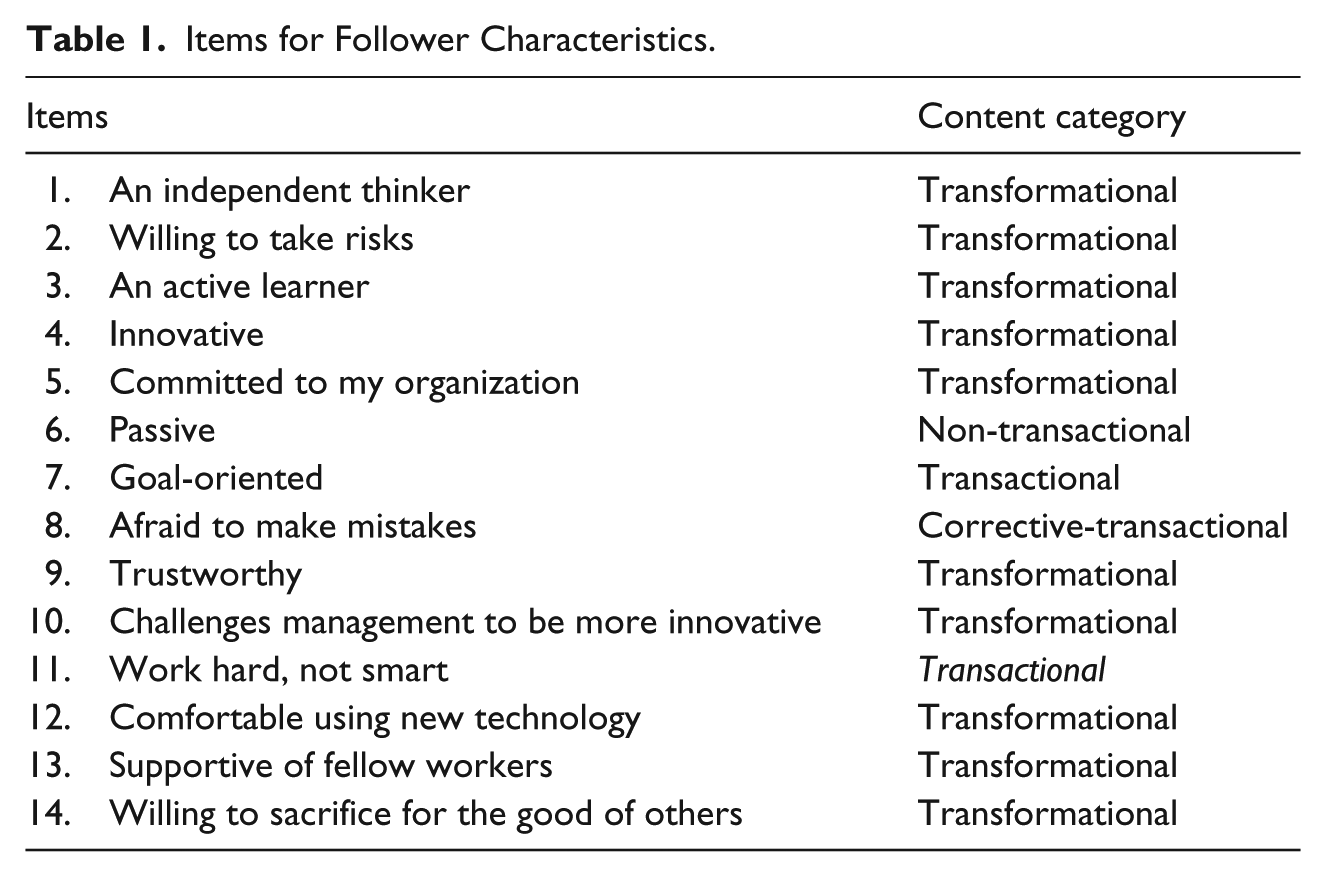
Because the original 14-item scale was preliminary and had not gone through any extensive validation work, as well as based on the comments we received during the review process, we revised the scale of positive follower transformational characteristics deriving the four-item scale listed on p. 614. This four-item scale exhibits the best psychometric properties based on the results of exploratory factor analyses (EFAs) and CFAs using the current dataset. Also, we would like to clarify the degrees of freedom for this scale, which was reported as 166, but should have been 2 on p. 602 of the original article.
To conclude, the empirical findings reported in the original Group & Organization Management (GOM) publication are valid and accurate, thus the revisions above do not change any conclusions made in the article. First, the new test for common source variance using the four-item scale of follower characteristics shows again that the three-factor model fits the data better than the one-factor model, indicating that common source variance was not a serious problem in this study. Second, the current four-item scale of follower characteristics used in this study, exhibits the best psychometric properties based on the current dataset.