



Abstract
This study explores team-level mechanisms linking team regulatory focus and team creativity. Drawing on the team self-regulation perspective and regulatory fit theory, the mediating roles of team exploratory and exploitative learning and the moderating effect of team bureaucracy were examined. Team-level analyses conducted on data captured from the leaders and members of 135 teams. The results showed that team exploratory learning mediates the relationship between team promotion focus and team radical creativity, whereas team exploitative learning mediates the relationship between team prevention focus and incremental creativity. Furthermore, the team bureaucratic context, including centralization and formalization, moderated the indirect relationship between team regulatory focus and team creativity. The findings improve understanding of why team regulatory focus differentially contributes to team radical and incremental creativity. The findings also provide meaningful insight into the role of team bureaucracy in the team regulatory focus–team creativity relationship.
Keywords
Recently, team regulatory focus has attracted the interest of researchers as a predictor of team creativity and innovation (Rietzschel, 2011; Sacramento, Fay, & West, 2013; Y. Shin, 2014). By definition (Faddegon, Ellemers, & Scheepers, 2009), team regulatory focus refers to a collective motivational state representing team members’ shared understanding of their team focus on striving to achieve positive outcomes (team promotion focus) or seeking to avoid negative outcomes (team prevention focus). Prior research has examined how team regulatory focus differentially affects team decision-making, team coordination, and team performance (Beersma, Homan, Van Kleef, & De Dreu, 2013; Y. Shin, Kim, Choi, & Lee, 2016; Spanjol, Tam, Qualls, & Bohlmann, 2011).
Despite all of the accumulated knowledge, some questions remain unanswered. The team promotion and team prevention foci represent two different motivational systems, which begs the question of whether these two systems differentially affect team radical creativity and incremental creativity and, if so, how. Research is rapidly emerging on the different relationships that these two systems have with team creative performance, where the promotion (prevention) focus is (in)effective at promoting team creativity. Much of the prior research on this topic has tended to treat team creativity as a single overarching construct (Y. Shin, 2014; Y. Shin et al., 2016), despite the recognition that conceptually and empirically, there are two types of creativity: radical and incremental (Gilson & Madjar, 2011; Madjar, Greenberg, & Chen, 2011). As a result, the question of how the differing concerns of the two motivational systems relate to the distinct types of team creativity remains unanswered.
To address this question, we consider the team self-regulation perspective (Mehta, Feild, Armenakis, & Mehta, 2009) and the regulatory focus hierarchy view (Johnson, Smith, Wallace, Hill, & Baron, 2015). We propose that one team regulatory focus uses a self-regulation strategy—team exploratory learning or exploitative learning—more often than the other system and is thereby more effective at promoting one type of team creativity. Based on prior research (Kostopoulos & Bozionelos, 2011), we identify team exploratory and exploitative learning as different team regulatory strategies with distinct goal-relevant means for regulating collective efforts to foster radical and incremental creativity, respectively. More specifically, we suggest and test the proposal that team promotion focus (team prevention focus) is more likely to lead a team to engage in exploratory learning (exploitative learning) than team prevention focus (team promotion focus) and, thus, is more conducive to team radical creativity (team incremental creativity).
Practically, team bureaucracy has often been used to regulate team effectiveness (Davila & Ditillo, 2017). However, it is surprising that no research has explored the effect of team bureaucratic structures on the relationship between team regulatory focus and team creativity. Therefore, our second research question explores whether team bureaucracy moderates the relationship between team regulatory focus and team creativity. This question pertains to regulatory fit theory, which has received some attention in team regulatory focus research (Higgins, 2000). Prior research has demonstrated that the effects of regulatory focus are accentuated when a team’s promotion and prevention foci are congruent with its team structure (Dimotakis, Davison, & Hollenbeck, 2012). Because the passive nature of bureaucracy sustains vigilant motivational states (Hirst, van Knippenberg, Chen, & Sacramento, 2011), we expect that team bureaucracy may fit better with the motivational system of team prevention focus rather with that of team promotion focus.
Our study intends to make two theoretical contributions. First, we take a closer look at the relationship between team regulatory focus and team creativity. We advance and test whether both motivational systems can benefit team creativity but one system is more closely related to one type of creativity than the other and whether this effect is mediated by team learning. Second, we respond to a recent call for research focusing on the regulatory fit effect of team structures (Dimotakis et al., 2012). By examining the moderating role of team bureaucracy, this study enriches current scholarly understanding of how team structures influence the motivational systems behind team regulatory focus.
Theory and Hypotheses
Figure 1 depicts the hypothesized model. The first objective of our study is to examine whether different preferences toward using exploratory learning or exploitative learning lead to differential relationships between team promotion and prevention foci and team radical and incremental creativity. Thus, we first delineate the relative role of team regulatory focus in bolstering team exploratory and exploitative learning. We then examine team exploratory and exploitative learning as the intermediary mechanisms underlying the differential relationships. Finally, we articulate how team bureaucracy moderates the indirect relationship between team regulatory focus and team creativity.

The conceptual model.
Team Regulatory Focus and Team Learning
Team regulatory focus, as a team-level property, emerges from contextual inputs such as leadership and team culture. In line with individual-level research, there are two types of team regulatory systems: team promotion focus and team prevention focus (Faddegon et al., 2009). In this study, we define team promotion focus as a collective promotion orientation that motivates members to focus on what they want to achieve; this focus is associated with high risk taking and maximal goals (Ferris et al., 2013). In contrast, team prevention focus is defined as a collective prevention orientation that leads members to focus on possible negative outcomes; this focus is associated with low risk taking by solely focusing on completing individual duties and responsibilities (Ferris et al., 2013). Notably, a team may simultaneously have high levels of both team promotion and team prevention foci because promotion and prevention foci at the team level are independent of each other (Y. Shin et al., 2016).
The regulatory focus hierarchy view (Johnson et al., 2015) considers that promotion and prevention foci, at the strategic level, lead to different preferred strategies for goal pursuit. Thus, we propose that differences in the foci of promotion and prevention relate to different preferences toward using exploratory and exploitative learning strategies, respectively. However, we do not claim that a prevention-focused (promotion focused) team does not engage in exploratory (exploitative) learning (Tuncdogan, Van Den Bosch, & Volberda, 2015). At the strategic level, under normal conditions, one motivational system is used more often with one type of team-learning activity than the other (Scholer & Higgins, 2011). Thus, we also examine the relative strength of team promotion focus and prevention focus in encouraging team-learning activities.
In this study, team exploratory learning comprises activities that enable a team to search for, experiment with, and develop new ideas (Li, Chu, & Lin, 2010). We argue that when a team exhibits a high promotion focus, team members have a common objective for new knowledge creation (Friedman & Förster, 2001) and are thus motivated to engage in exploratory learning. Because eagerly seizing all possible opportunities is an inherent component of promotion focus (Scholer & Higgins, 2010), team members with a promotion focus will employ the exploratory learning process to derive information from a variety of perspectives. In contrast, teams with a prevention focus are primarily concerned with the avoidance of potential failure. They thereby engage in less team exploratory learning because it inherently includes a risk of failure; this constrains the actions of prevention-focused teams as they pursue their goals. Based on the discussion above, the following are hypothesized:
In this study, team exploitative learning comprises activities that help a team refine, recombine, and implement existing knowledge (Li et al., 2010). We propose that compared to team members with a team promotion focus, those with a team prevention focus collectively prefer using vigilant avoidance strategies (Y. Shin et al., 2016) and thus are more motivated to engage in exploitative learning. A collective desire to avoid mistakes motivates team members to concentrate on safely achieving team goals (Y. Shin et al., 2016) and reliable and known outcomes (Hamstra, Bolderdijk, & Veldstra, 2011), which are both inherent components of exploitative learning. Although exploitative learning can serve to create new knowledge (March, 1991), the level of exploitative learning in teams with a promotion focus is expected to be lower than it is in prevention-focused teams because team members with a team promotion focus fail to enjoy the process of exploitative learning, such as adopting a backward-looking orientation. Therefore, extending the individual-level findings to the team level, we also postulate that a stronger link exists between team prevention focus and exploitative learning than between team promotion focus and exploitative learning. To summarize, we propose the following hypotheses:
Intervening Roles of Team Exploratory and Exploitative Learning
In this study, radical creativity refers to the generation of highly novel ideas that differ substantially from an organization’s existing practices, whereas incremental creativity refers to the generation of adaptive, relatively new ideas, which are associated with minor modifications to and upgrades of existing practices and products (Gilson & Madjar, 2011). Teams involved in exploratory learning are likely to explore different perspectives that result in more novel ideas as they increasingly move beyond their current practices (Li et al., 2010). Working in a manner that differs from existing work practices is likely to trigger the generation of radical team creativity. Although exploitative learning increases the overall amount of knowledge, we expect team exploitative learning to have a positive relationship with only team incremental creativity. This relationship is expected because as teams obtain information from a given knowledge channel, they engage in more internal scanning, which is likely to result in modifications or adjustments (Li & Yeh, 2017). Thus, we propose that team exploratory and exploitative learning are conducive to team radical and incremental creativity, respectively.
By considering a combination of the proposed relationships, we predict that these two team-learning activities will differentially mediate the relationships between team regulatory focus and team radical/incremental creativity. As explained in the previous sections, team exploratory learning and team exploitative learning appear to be more dominantly related to team promotion focus and team prevention focus, respectively. Thus, compared to prevention-focused teams, promotion-focused teams are more conducive in team radical creativity because the development of more novel ideas requires exploratory learning (Li & Yeh, 2017). Prevention-focused teams are more likely to achieve adaptive goals of team incremental creativity because they engage in more exploitative learning than teams with a promotion focus. Considering the above discussion, we propose the following:
Moderating Effects of Team Bureaucratic Context
Because the strength of regulatory focus inherently depends on the situations within which individuals act (Scholer & Higgins, 2011), a complete understanding of the effect of “team” regulatory focus requires consideration of the characteristics of the teams in which individuals work. As teams often rely on a certain level of bureaucratic practices, including centralization and formalization, it is important to explore how regulatory focus interacts with team bureaucratic structures in team self-regulation processes. Building on the regulatory fit theory (Higgins, 2000), we expect that the strength of team regulatory focus on the preferred team-learning type can be accentuated if the team regulatory system fits with team bureaucratic practices.
In teams, centralization relates to the extent to which team decision authority lies solely with the team’s leader (Chen, Kirkman, Kanfer, Allen, & Rosen, 2007). Because less participative decision making occurs in centralized teams, team members have limited opportunities to share their unique novel views (Arnold, Arad, Rhoades, & Drasgow, 2000) and may be unaware of important issues facing the team. The reduced opportunity for the expression of novel views caused by centralization fails to support the eager approach orientation of promotion focus. Due to a lack of fit between team promotion focus and centralization, team members may “feel wrong” about engaging in eager strategies (i.e., exploration). In addition, centralization fails to promote exploratory learning because it provides a less supportive climate for engaging in work that moves beyond current practices (Ahearne, Mathieu, & Rapp, 2005). We, therefore, expect that team promotion focus is related to radical creativity through team exploratory learning when centralization is low rather than high.
Formalization relates to the extent to which team rules and procedures are clearly specified and standardized (Hirst et al., 2011). In other words, teams with formalized structures limit the choices of team members regarding their behaviors and decisions. A small set of choices offers little opportunity or support for taking risks; this approach also fails to sustain the underlying orientation of team promotion focus. Furthermore, formalization inhibits the tendency to engage in discretionary behaviors (i.e., exploration) because it regulates and restrains such behaviors by instituting clear behavioral protocols involving administrative checks (Li et al., 2010). Due to a lack of fit between formalization and team promotion focus and the lack of support for exploratory learning, we expect team promotion focus to be related to radical creativity via team exploratory learning when formalization is low rather than high. Taken together, we hypothesize the following:
In contrast, we expect team bureaucracy to play a motivation-activating role that reinforces the link between team prevention focus and team exploitative learning. Because team leaders have control in centralized teams (Ghemawat & Ricart Costa, 1993), increased rule observation leads team members to focus more on their own responsibilities and follow existing rules. That is, centralization sustains the prevention focus and its underlying orientation, which leads team members to “feel right” about engaging in more vigilant strategies. We, therefore, expect that team prevention focus is more strongly related to incremental creativity via team exploitative learning when centralization is high rather than low. Furthermore, high formalization sets clear guidelines as to the type of behavior that is expected and deemed appropriate by team members. This situation invites more variance-reducing and structured behavior (Weick, 1979), which sustains the underlying orientation of team prevention focus. Because formalization fits the prevention focus and its underlying orientation, team members are more willing to engage in the preferred vigilant strategies such as exploitative learning (Higgins, 2006). Taken together, we hypothesized the following:
Method
Sample and Data Collection
We randomly selected 50 firms from the “Info Tech 100 Taiwan” as our sample firms. We contacted each firm through an international consulting firm to solicit their participation in our study, and a total of 27 high-technology firms ultimately participated. The firms were involved in the computer systems (n = 6), electronic communications (n = 7), optoelectronics (n = 8), semiconductors (n = 9), and integrated circuit design (n = 5) industries. Through the consulting firm, we contacted the human resource managers of these firms and asked them to randomly provide us with contacts for six teams in their firms.
With the permission of these firms, all members of these teams were invited to complete this study. The members of the participating teams worked interdependently. The team leader was responsible for making important decisions for the team, such as goal setting, work scheduling, work assignments, performance monitoring and assessment, and reward allocation. Participation was voluntary, and the respondents were assured of the anonymity of their responses. After the research assistants introduced the purpose of the survey, the participants completed a questionnaire in a conference room during their work shift. Data were collected from two sources: team members and team leaders.
We conducted our survey at three time points, with 3 months between each survey. At Time 1, we asked team members to complete a survey on their team-level regulatory focus and leaders to complete a survey to collect control variables. At Time 2, we asked team members to complete the second wave survey on team centralization context, team exploratory learning, team formalization context, and team exploitative learning. After 3 months (Time 3), research assistants interviewed each team leader and asked them to assess their team creativity: radical creativity and incremental creativity.
Of the 162 teams contacted by the human resource managers, 145 teams (comprising 145 team leaders and 1,003 team members) agreed to participate in this study. To reduce potential aggregation biases of small teams (Bliese & Halverson, 1998), we eliminated teams with fewer than four respondents and those exhibiting a low within-team response rate (less than 75%), which resulted in a final sample comprising 135 leaders and 959 members of 135 teams (response rate = 77%). The average team size was 7.1 members (ranging = 5-12), and the average team longevity was 1.98 years (23.7 months). Of these team members, 32.3% were female and 59.4% were between ages of 25 and 45 years. They had an average of 11 years work experience, and the average current organizational tenure was 7.1 years. Of the team leaders, 23% were female, their average age was 42 years, and average tenure at the current organization was 11.3 years.
Measures
All measures were assessed with multi-items using a 7-point Likert-type scale (See Appendix). Following relevant research (Y. Shin et al., 2016), we employed team-referent items for all measures to capture group-level phenomena. All research variables, except for team radical creativity and team incremental creativity that were rated by leaders, were assessed by team members and aggregated to the team level based on a set of psychometric properties including Interrater Agreement Index, rwg(j) values, and Intraclass Correlation Coefficients, ICC(1) and ICC(2).
Team regulatory focus
To measure team regulatory focus, we adopted the Work Regulatory Focus (WRF) scale of Neubert, Kacmar, Carlson, Chonko and Roberts (2008), and then revised the items of this scale to team-referent items to capture the collective regulatory focus (promotion focus and prevention focus) of the team. The Cronbach’s alpha values for the team promotion focus and the team prevention focus were .98 and .97, respectively. The test of the within-team agreement for team regulatory focus showed that the mean rwg for team promotion focus was .95 (range = .84-.97) and that for team prevention focus was .94 (range = .87-.98). The ICC(1) estimates were .25 for team promotion focus and .38 for team prevention focus. The ICC(2) estimates were .69 and .65, respectively. Thus, we aggregated the individual-level response to the team level.
Team centralization context
Using the four-item scale developed by Hirst and his colleagues (2011), team members were asked to assess the extent to which team decision making was centralized in the team leader. A sample item is “gives all work team members a chance to voice their opinions.” We then reverse-scored the scale so that higher ratings reflected greater centralization of decision making. The Cronbach’s alpha for this measure was .90. The mean rwg for team centralization context was .89 (range = .81-.94). The ICC(1) value was .21 and the ICC(2) value was .63, supporting the appropriateness of aggregating the individual-level responses to the team level.
Team formalization context
To measure team formalization context, we used the three-item scale of Rafferty and Griffin (2004). A sample item is “In my team, there are a lot of rules and regulations.” The Cronbach’s alpha for this measure is .92. The mean rwg for team formalization context was .81 (range = .50-.97). The ICC(1) and ICC(2) values were .31 and .58, respectively. These results suggest that aggregating the team formalization context ratings to the team level was warranted.
Team exploratory learning
Adopting items from previous studies (Kostopoulos & Bozionelos, 2011; Li et al., 2010), we used a five-item measure (α = .94) to assess the extent to which the team members searched for and used information unrelated to the firm’s current experience and knowledge in the project. A sample item is “Our team looks for opportunities to employ entirely new skills and knowledge to solve work problems.” The mean rwg for team exploratory learning was .89 (range = .55-.95). The ICC(1) and ICC(2) estimates for team exploratory learning were .36 and .61, respectively. These results indicated that aggregating team members’ responses to the team level was justified.
Team exploitative learning
Drawn from prior studies (Kostopoulos & Bozionelos, 2011; Li et al., 2010), we used a five-item measure (α = .93) to assess the extent to which the learning activities emphasized the acquisition of information aligned with the firm’s current knowledge for the project. A sample item is “Our team tends to exploit mature knowledge and expertise that increase efficiency of accomplishing work.” The mean rwg for team exploratory learning was .91 (range = .64-.97). The ICC(1) estimate was .28 and ICC(2) estimate was .53, justifying aggregation of the individual-level responses to the team level.
Team radical creativity
To measure team radical creativity, four items were adopted from Gilson and Madjar’s (2011) measure and revised into team-referent items. Leaders were given the prompt “For the ideas your team comes up with while working on team tasks, to what extent would you characterize them as.” A sample item is “Discoveries of completely new processes/products than what the company currently does.” The Cronbach’s alpha for this measure is .86.
Team incremental creativity
To measure team incremental creativity, we employed four items (α = .88) derived from the measure of Gilson and Madjar (2011). Similar to the items for team radical creativity, the items for incremental creativity were modified as team-referent items to reflect a team’s incremental creativity. A sample item is “Adaptations to existing processes/products used at the company.”
Control variables
We included team size and average team tenure as control variables to partial out their potential influences on team processes and team creativity (Li, Lin, Tien, & Chen, 2017; S. J. Shin & Zhou, 2007). Moreover, in keeping with S. J. Shin and Zhou (2007), we controlled for the type of task performed by the teams to partial out any potential confounding effects of task requirements. Based on Keller’s (1992) categorizations of research and development teams, we created three dummy variables that included the existing product or process improvement as the reference, coded as follows: Task 1: 0 = others, 1 = basic or nonmission tasks; Task 2: 0 = others, 1 = new product or process development; Task 3: 0 = others, 1 = applied or mission oriented.
Hypotheses were tested with multilevel modeling (MLM) using Stata because the research and development teams (n = 135) were from different organizations (n = 27). To control for any possible confounding effects of organization-level factors on the relationships we tested, we conducted an intercept-only model of MLM at the organization level in all of the analyses.
Results
To assess the discriminant validity of our study measures, we conducted a confirmatory factor analysis (CFA) using structural equation modeling (SEM) with Stata. We conducted CFA on the team leaders’ ratings of team radical creativity and team incremental creativity. The proposed two-factor model, χ2 (df = 19) = 30.62, p < .05, CFI (comparative fit index) = .98, RMSEA (root mean square error approximation) = .07, yielded a significantly better fit than the one-factor model, χ2 (df = 20) = 271.62, p < .001, CFI = .51, RMSEA = .31; Δχ2 (df = 1) = 241, p < .01. In addition, we conducted a separate CFA for team learning, regulatory foci and bureaucratic context. Table 1 shows that the hypothesized six-factor model exhibited a good fit to the data, χ2 (df = 545) = 1,882.03, p < .01, CFI = .97, RMSEA = .05 and also fit the data significantly better than alternative models. These CFA results indicate that the measure of the study variables possesses sufficient discriminant validity. Finally, all factor loading estimates for our study variables were higher than the cut-off value of .50 and significant, thus providing evidence of convergent validity (Hair, Tatham, Anderson, & Black, 1998). Descriptive statistics and intercorrelations are presented in Table 2.
Results of CFA and Chi-Square Difference Tests.
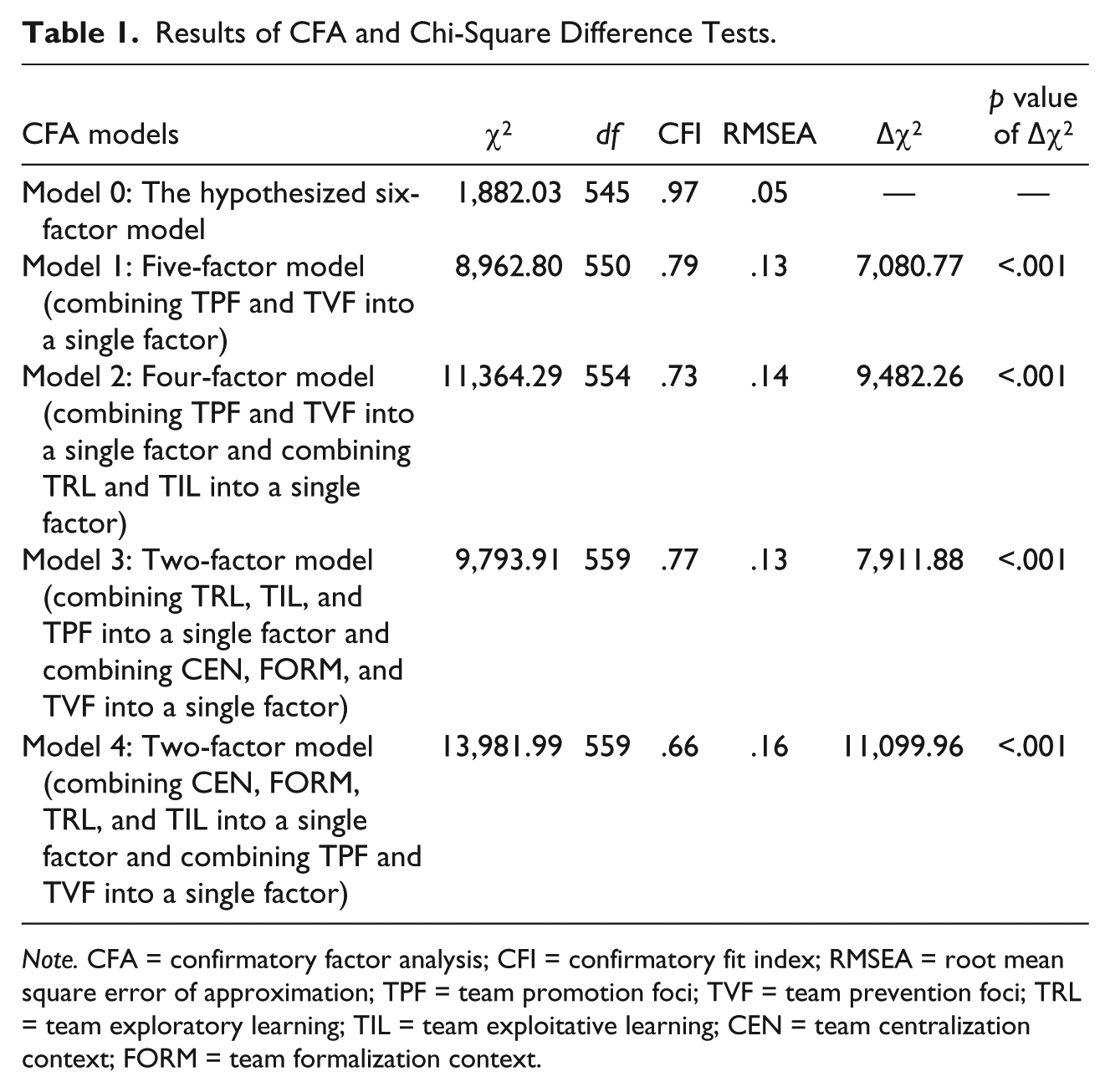
Note. CFA = confirmatory factor analysis; CFI = confirmatory fit index; RMSEA = root mean square error of approximation; TPF = team promotion foci; TVF = team prevention foci; TRL = team exploratory learning; TIL = team exploitative learning; CEN = team centralization context; FORM = team formalization context.
Descriptive Statistics and Intercorrelations.
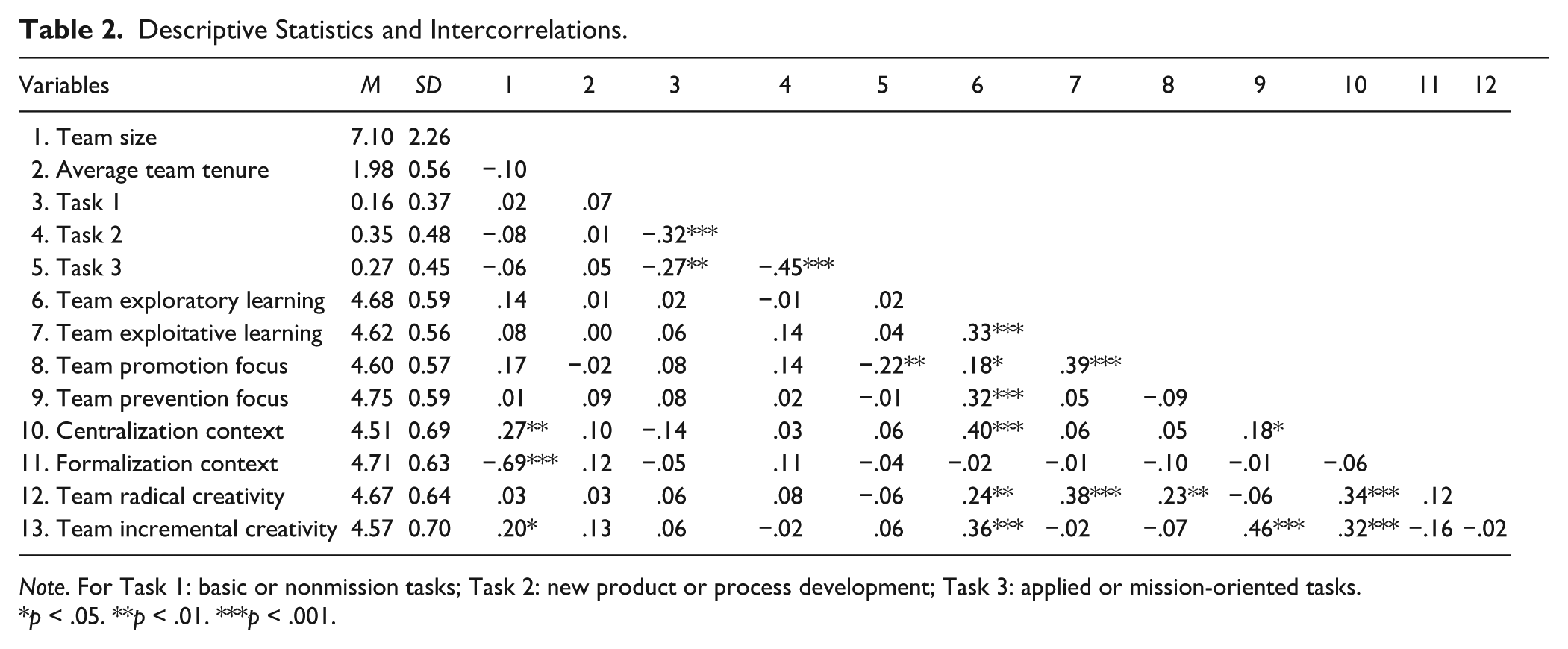
Note. For Task 1: basic or nonmission tasks; Task 2: new product or process development; Task 3: applied or mission-oriented tasks.
*p < .05. **p < .01. ***p < .001.
Relationships Between Team Regulatory Focus and Team Learning
Hypothesis 1a predicted positive associations between team promotion focus and team exploratory learning. Hypothesis 1b further proposed a stronger relationship between team promotion focus and team exploratory learning than between team prevention focus and team exploratory learning. As reported in Model 5 of Table 3, team promotion focus has a positive relationship with team exploratory learning (γ = .39, p < .001), supporting Hypothesis 1a. However, the effect of team prevention focus on team exploratory learning was nonsignificant (γ = .07, ns). To test Hypothesis 1b, we conducted a t test to compare the coefficients of team promotion and prevention focus and detected significant difference in the coefficients (t = 3.28, p < .01). Thus, Hypothesis 1b was supported.
Results of MLM Analyses of Team Regulatory Focus and Team Creativity.

Note. For Task 1: 0 = others, 1 = basic or nonmission tasks; Task 2: 0 = others, 1 = new product or process development; Task 3: 0 = others, 1 = applied or mission-oriented tasks. MLM = multilevel modeling.
*p < .05. **p < .01. ***p < .001.
Hypothesis 2a proposed a positive link between team prevention focus and team exploitative learning. Hypothesis 2b further suggested a stronger association between team prevention focus and team exploitative learning than between team promotion focus and team exploitative learning. As illustrated in Model 7 of Table 3, team prevention focus was positively associated with team exploitative learning (γ = .34, p < .001), supporting Hypothesis 2a. In addition, team promotion focus has a positive relationship with team exploitative learning (γ = .21, p < .05). We conducted a t test for the coefficients of team promotion and prevention foci to compare their relative strength in bolstering team exploitative learning. The results of the t test demonstrated significant difference in the coefficients (t = 2.04, p < .05), which supported Hypothesis 2b.
Mediating Roles of Team Learning on the Relationship Between Team Regulatory Focus and Team Creativity
To test Hypothesis 3, we first assessed the mediating role of team exploratory learning on the relationship between team promotion focus and team radical creativity. As shown earlier, team promotion focus was significantly related to team exploratory learning, whereas team exploratory learning was significantly related to team radical creativity (Model 2, Table 3: γ = .36, p < .001). Based on Bauer, Preacher and Gil’s (2006) suggestion, we adopted the bootstrapping test to examine these indirect relationships. In this study, completely standardized indirect effect (abcs) scores were calculated to assess the effect size for each indirect relationship (Preacher & Kelley, 2011). The team promotion focus exerted a significant indirect effect on team radical creativity through team exploratory learning (abcs = .165, 95% confidence interval (CI) = [.085, .371], effect power = 89.3%). Then, we examined the indirect relationship between team prevention focus and radical creativity (abcs = .028, 95% CI = [−.020, .077]). Combined with the results of Hypothesis 1b, the results fully supported Hypothesis 3.
To test Hypothesis 4, we first examined whether the team prevention focus had an indirect positive relationship, through team exploitative learning, with team incremental creativity. As shown earlier, team prevention focus was significantly related to team exploitative learning. Team exploitative learning was significantly related to team incremental creativity (Model 4, Table 3: γ = .33, p < .01). The bootstrapping test indicated that the team prevention focus had a significant indirect effect on team incremental creativity through team exploitative learning (abcs = .094; 95% CI = [.014, .195]; effect power = 90.7%). Next, we examined the indirect relationship between team promotion focus and incremental creativity (abcs = .059; 95% CI = [.007, .128]; effect power = 85.3%). In conjunction with the support for Hypothesis 2b, the results fully supported Hypothesis 4.
Moderating Role of Team Bureaucracy
The results of the tests of Hypotheses 5a and 5b are reported in Model 6 of Table 3. The interaction between the team promotion focus and the team centralization context was significantly related to team exploratory learning (γ = −.31, p < .01). As shown in Figure 2, the simple slope of the relationship between team promotion focus and team exploratory learning was weaker and nonsignificant (simple slope b = .15, ns) when the team centralization context was high, but was stronger (simple slope b = .77, p < .01) when it was low. The moderating effect of the team formalization context on the relationship between team promotion focus and team exploratory learning was also significant (γ = −.34, p < .01). The simple slope of the relationship between the team promotion focus and team exploratory learning was weaker and nonsignificant (simple slope b = .12, ns) when the team formalization context was high but was stronger (simple slope b = .80, p < .01) when it was low (Figure 3).
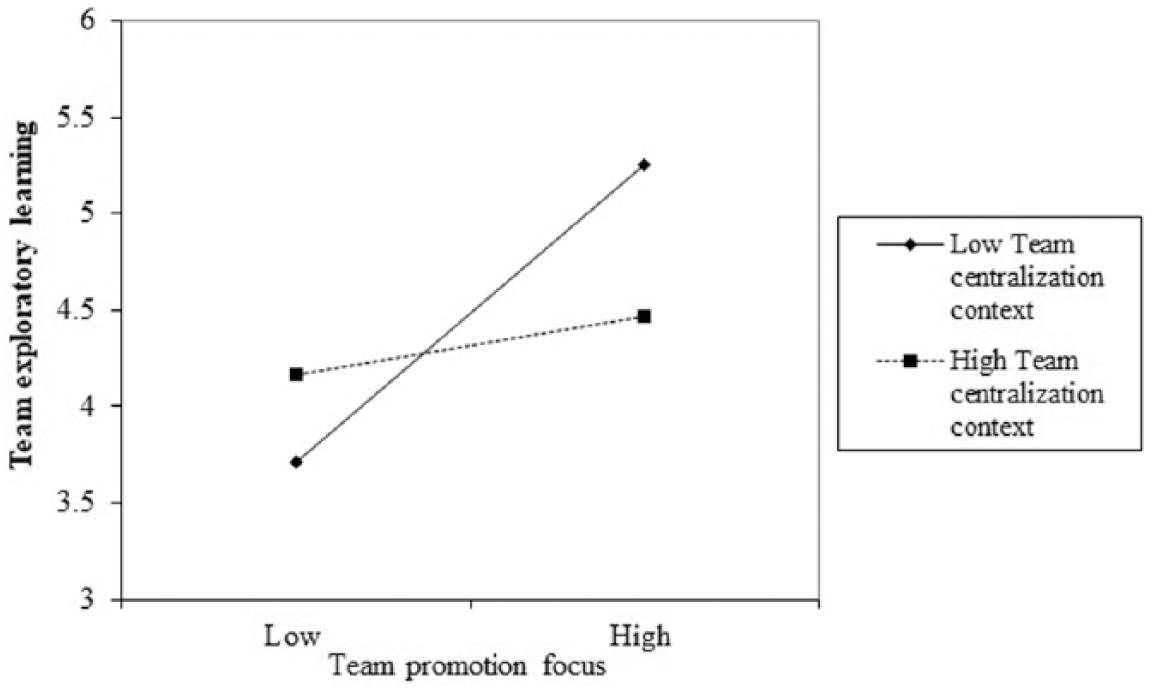
Team exploratory learning: Interaction between team promotion focus and centralization.
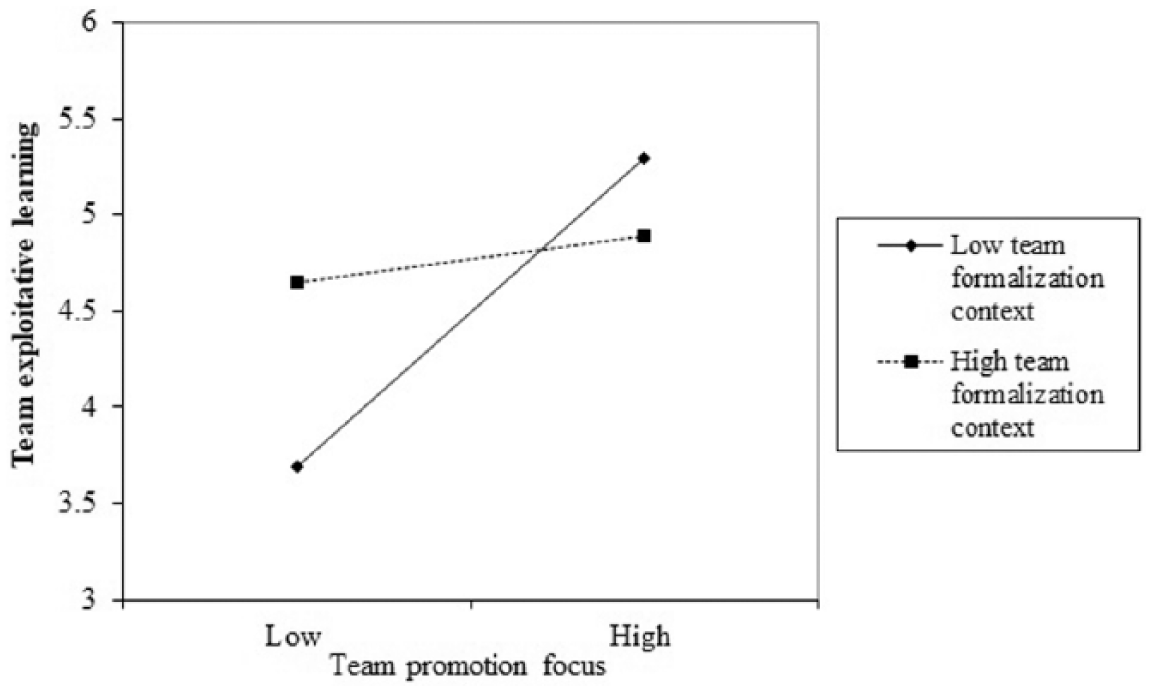
Team exploratory learning: Interaction between team promotion focus and formalization.
We used the first-stage moderation model to examine whether the moderated indirect relationship was significant. The indirect relationship that the interaction term of team promotion focus and team centralization had with team radical creativity, via team exploratory learning, was significant (abcs = −.063, 95% CI = [−.173, −.006], effect power = 65.9%). The indirect relationship that the interaction term of team promotion focus and team formalization had with team radical creativity, via team exploratory learning, was significant (abcs = −.118, 95% CI = [−.310, −.023], effect power = 85.8%). Thus, Hypothesis 5 was fully supported.
As presented in Model 8 of Table 3, the interaction between the team prevention focus and the team centralization context was significantly related to team exploitative learning (Model 8, Table 3: γ = .43, p < .001), which provided initial support for Hypothesis 6a. As shown in Figure 4, the simple slope of the relationship between the team prevention focus and team exploitative learning was weaker (simple slope b = .09, ns) when the team centralization context was low but was stronger (simple slope b = .95, p < .001) when it was high. The indirect relationship that the interaction term of team prevention focus and team centralization had with team incremental creativity, via team exploitative learning, was significant (abcs = .164; 95% CI = [.054, .273]; effect power = 80.8%).

Team exploitative learning: Interaction between team prevention focus and centralization.
By contrast, the moderating effect of the team formalization context on the link between team prevention focus and team exploitative learning is also significant (Model 8, Table 3: γ = .40, p < .01), supporting Hypothesis 6b. The simple slope of the relationship between the team prevention focus and team exploitative learning was weaker and nonsignificant (simple slope b = .12, ns) when the team formalization context was low, but was stronger (simple slope b = .92, p < .01) when it was high (Figure 5). The indirect relationship that the interaction term of team prevention focus and team formalization had with team incremental creativity, via team exploitative learning, was significant (abcs = .108; 95% CI = [.002, 0.249]; effect power = 85.1%). Thus, Hypothesis 6 was fully supported.

Team exploitative learning: Interaction between team prevention focus and formalization.
Discussion
Our results demonstrate that the differing concerns of team regulatory foci result in different preferences for the use of team exploratory learning and team exploitative learning and that these, in turn, have different effects on team radical creativity and incremental creativity. As predicted, we found that the indirect relationship between team promotion focus and team radical creativity (through team exploratory learning) was moderated by both team centralization and team formalization, such that the positive relationship was weakened, in centralized or formalized team context. In contrast, the indirect relationship between team prevention focus (through team exploitative learning) and team incremental creativity was strengthened when team centralization or team formalization was high. These findings provide important implications for theory and practice.
Implications for Research
The current findings provide meaningful insights into the emerging research on team regulatory focus. Similar to the research conducted by Rietzschel (2011), which outlined the different relationships between the two types of collective regulatory focus and aspects of team innovation, our study demonstrates the differential roles of team promotion and prevention foci in pursuing two distinct types of team creativity: radical creativity and incremental creativity. This study, together with that of Rietzschel (2011), suggests that the team regulatory focus entails distinct motivational states that differentially contribute to different types of team innovative outcomes. Thus, we suggest that team regulatory focus theory and research would benefit from considering the type of innovative outcomes as a boundary condition, which aligns with evidence regarding individual-level regulatory focus (Lam & Chiu, 2002).
It is important for future research to take our findings into consideration when drawing conclusions about the implications of team regulatory focus for creativity. Previous research has shown that only the team promotion focus benefits creativity (Y. Shin et al., 2016), but our results show that two distinct team regulatory foci facilitate team creativity but they promote different types of team creativity. Thus, scholars should not simply focus on the nonsignificant or even negative relationship that team prevention focus has with radical creativity, as this may put its creativity implication to be in danger of fading into obscurity.
One significant theoretical contribution of this study is the examination of team learning as the key team regulatory process through which team regulatory focus differently influences two types of team creativity. Despite some evidence for the different relationships between team regulatory focus and team creativity and innovation, no prior research has investigated potential explanatory mechanisms for these differential relationships. In particular, this study demonstrates that promotion-focused teams are more effective than prevention-focused teams at developing more novel ideas because of their preferential use of team exploratory learning. In contrast, prevention-focused teams are more willing than promotion-focused teams to use team exploitative learning, which is conducive to eliciting more adaptive ideas.
Our study responds to calls for inquiries into the relative strength of regulatory focus on exploitation and exploration (Tuncdogan et al., 2015). Our results support the view of these scholars. Notably, our results show that there is no direct association between team promotion focus and team incremental creativity. Intuitively, promotion-focused individuals or teams may generate more ideas because a promotion focus improves memory search for novel responses (Friedman & Förster, 2001). One possible explanation is that incremental and radical creativity differ in the type of ideas that are pursued (more novel vs. more adaptive; Madjar et al., 2011), although both types of creativity are concerned with the generation of ideas. At the strategic level, under normal conditions, the promotion focus will result in the adoption of more eager approaches (e.g., exploration), which are more effective for generating novel ideas than for generating adaptive ideas. Therefore, in-depth research is required to determine the conditions under which promotion focus is associated with the generation of adaptive ideas.
In an important departure from Y. Shin et al. (2016), who found a nonsignificant relationship between team prevention focus and team creative performance, this study shows that team prevention focus has a relationship with the incremental type of team creativity through team exploitative learning. Although one possible reason for Y. Shin et al.’s (2016) result is that team creative performance is closely related to the radical type of team creativity, another reason is the lack of attention given to the cognitive processing effect of the prevention focus state, which motivates in-depth deliberation of domain knowledge (De Dreu, Baas, & Nijstad, 2008). Our results demonstrate that these two distinct team regulatory foci will both trigger collective cognitive processing efforts but have different preferences, such as exploration versus exploitation. Therefore, the present study advances a team-level nomological network of regulatory foci in work teams and highlights the value of team-learning activities as the key team regulatory tactic linking team regulatory focus and team outcomes.
Our study first examines when team regulatory focus may be more closely related to team creativity, and it identifies team bureaucracy as a novel boundary condition. In an important counterpoint to earlier evidence, which seems to favor less team bureaucracy when aiming to engender team creativity (Jansen, van Den Bosch, & Volberda, 2006), the findings of this study reveal that team bureaucracy may inhibit as well as stimulate the relationship between team regulatory focus and team creativity and that it may not always inhibit creativity. An important issue to consider in this respect is that team centralization and team formalization contexts have both motivation-inhibiting and motivation-activating influences, depending on the shared motivational states of team regulatory focus such as promotion or prevention. Our findings reveal that both centralized decision making and formalization weaken the indirect relationships between team promotion focus and team radical creativity, but they actually enhance the indirect relationships between team prevention focus and team incremental creativity. We rationalize that this result arises from the empowering nature of decentralization and the uncertain nature of low formalization, which fit the eager motivational state of promotion focus but not the vigilant motivational state of prevention focus. However, because the passive nature of team bureaucracy fits well with the vigilant motivational state of prevention focus, both centralization and formalization are likely to activate the members of prevention-focused teams to engage in team learning. Our findings also advance the regulatory fit perspective as well as the associated research that generally holds a view of team bureaucracy as inhibiting. Departing from the dominant inhibiting view, we suggest that team bureaucracy may actually play a negative moderating role but only when teams adopt a promotion-focused state. This study, therefore, provides new insight into the neutral view of team bureaucracy in the regulatory focus and team creativity literature.
Implications for Practice
The current findings provide practitioners with fruitful insights into ways to promote radical or incremental creativity in their teams. Throughout our analyses, we found that the two systems of team regulatory focus are differentially advantageous for different kinds of team creativity because one is more conducive to exploratory learning and the other is more conducive to exploitative learning. This finding has implications for practice. Under conditions of complexity and unpredictability, managers should consider that promotion-focused teams may perform better than prevention-focused teams. Under such conditions (e.g., radical creativity tasks), leaders should require the teams to develop a high collective promotion focus and help them develop exploration-related tactics. For example, team leaders should actively seek to establish autonomy for experimentation or encourage specialized team training for exploration (Li et al., 2010). A prevention-focused team might be more effective than a promotion-focused team at engaging in adaptive, competitive tasks. When teams engage in adaptive tasks, managers should ensure teams have a higher collective prevention focus and create contexts that encourage the use of exploitation-related tactics. For instance, they can employ disciplined project management procedures to facilitate exploitative learning activities (Li & Yeh, 2017). To summarize, team leaders should ensure that the collective regulatory orientation fits the work teams’ goals (e.g., more novel vs. more adaptive or eagerness vs. vigilance).
Our results regarding team bureaucracy also have important implications for practice. To bolster creativity in their teams, leaders need to tailor their team regulatory focus to the work context in which their team members perform. Increasing the collective motivational state of promotion focus is unlikely to produce team radical creativity under centralized decision making and formalized work contexts. It would be advantageous to match the collective motivational state of promotion focus with an autonomous work context or self-managed teams, which would also facilitate exploratory learning (Power & Waddell, 2004). However, when prevention focus is evoked in a team, building a work context with highly formalized procedures that facilitate exploitative learning (Li et al., 2010) may actually help elevate the team’s level of incremental creativity.
Limitations and Future Research Directions
The findings and implications of this study should be interpreted within the context of the study’s limitations. First, our findings were based on self-reported data. Common method variance may have potentially affected the results. To avoid this problem, we conducted a temporally lagged design: the independent variables and the moderator were all collected at Time 1, the mediator was collected at Time 2, and the dependent variable was collected at Time 3. Following Podsakoff and his colleagues’ (2013) recommendations, we also conducted a CFA by adding a common method factor, which did not significantly improve the model fit. Thus, the common method variance may not be a serious problem in our study.
Second, the cross-sectional design of our study does not establish causality in relationship. For example, a team with previous success in creativity might reinforce their tendency toward team-learning activities (either exploratory learning or exploitative learning) for team creativity, which in turn will regulate their focus on how to gain novelty (either radical or incremental) in a research and development task. We assume that the previously mentioned concerns may not significantly influence our interpretation because the hypotheses proposed in this study are based on theory. However, we encourage future researchers to use a longitudinal or experimental design to demonstrate the direction of causality.
Third, to examine if a significant mediating effect, but with relatively small effect size, was adequate, we conducted a post hoc power analysis using the MedPower (Kenny, 2017). The findings showed that at an alpha level of .05 (two tailed), the values of effect power for most indirect relationships were higher than 80% except for the indirect relationship between the interaction of team promotion focus and centralization on team radical creativity. Thus, the indirect relationship with a relatively lower effect power should be interpreted carefully, and a larger sample is suggested for future research to examine these indirect effects. However, it should be noted that a power value only suggests the possibility of detecting a true population effect if it exists but does not indicate the existence of the population effect (Sun, Pan, & Wang, 2011).
Fourth, the present data was collected from diverse research and development teams operating within technology and knowledge-intensive environments, yet our sample was selected by human resource managers of each organization, which may weaken the generalizability of the current findings due to factors such as organization-level contexts or potential selection bias (Heckman, 1986). Thus, future research should test the propositions of the present study by collecting broader samples and investigating teams that operate within less knowledge-intensive environments. Moreover, multilevel investigations of organizational culture and structure could constitute a meaningful research agenda (Kostopoulos & Bozionelos, 2011).
Finally, this study only examined team-learning activities as a mechanism that links team regulatory focus and team radical and incremental creativity based on team-learning perspective. However, other potential mechanisms using various theoretical approaches might exist and should not be ruled out. For example, when regulatory focus activates either approach or avoidance motivation (Lanaj, Chang, & Johnson, 2012), it can also influence a team’s creative expression through team approach focus and avoidance focus, as both motivational foci influence team engagement during the creative process. Thus, future research might develop a model to capture this phenomenon and examine this model by integrating an approach/avoidance motivation view to further elaborate on our findings.
Conclusion
In this study, we provide initial evidence that the differences between team promotion focus and prevention focus lead to differences in the preference of teams to engage in exploratory and exploitative learning, which, in turn, are differentially related to team radical creativity and team incremental creativity. Furthermore, team bureaucracy plays a moderating role: when team bureaucracy is higher, the indirect positive relationship between team promotion focus and team radical creativity is weaker, but the indirect positive relationship between team incremental creativity and team prevention focus is stronger. We hope that this study will stimulate further empirical research on the area of team regulatory focus and further research on radical and incremental creativity.
Footnotes
Appendix
Measures and Confirmatory Factor Analysis Results.

| Constructs | Operational Measure | SFL |
|---|---|---|
| Team radical creativity | For the ideas your team comes up with while working on team tasks, to what extent would you characterize them as: 1. Departures from what is currently done/offered at the company 2. Discoveries of completely new processes/products than what the company currently does 3. Fundamental changes to how things are currently done/what is currently offered at the organization. 4. Radical inventions beyond existing processes/products. |
.78 .78 .80 .78 |
| Team incremental creativity | For the ideas your team comes up with while working on team tasks, to what extent would you characterize them as: 1. Extensions built on what was currently done/what is currently done by the organization 2. Adaptations to existing processes/products used at the company 3. Refinements of how things are currently done/what is currently done at the company 4. Incremental improvements upon existing processes/products |
.79 .79 .81 .82 |
| Team exploratory learning | 1. Our team looks for opportunities to employ entirely new skills and knowledge to solve work problems. 2. Our team members are willing to take risks on new ideas or thoughts for performing their tasks. 3. In the team, our aim was to collect new information that forced us to learn new things in the current tasks. 4. In the team, our aim was to acquire knowledge to accomplish work that led us into new areas of learning such as new technological practices. 5. In information search, we focused on acquiring task knowledge and skills that involved experimentation and high risks |
.81 .89 .89 .90 .89 |
| Team exploitative learning | 1. Our team prefers to apply information and know-how gained in prior projects to current project. 2. Our team tends to exploit mature knowledge and expertise that increase efficiency of accomplishing work 3. Our aim was to search for information to refine common methods and ideas in terms of solving work problems during the project. 4. In the team, we search for the usual and generally proven methods and solutions to perform tasks. 5. In the team, we used information acquisition methods (i.e., survey of prior project reports) that helped us understand and update current task and work problems. |
.89 .86 .87 .79 .87 |
| Centralization | Our leader … 1. Uses my team’s suggestions to make decisions that affect us. 2. Listens to my team’s ideas and suggestions. 3. Encourages team members to express ideas/suggestions. 4. Gives all team members a chance to voice their opinions. |
.78 .87 .90 .81 |
| Formalization | In my team, 1. there are a lot of rules and regulations. 2. our work involves a great deal of paper-work and administration. 3. our work is highly regulated by bureaucratic procedures. |
.90 .89 .87 |
| Team promotion focus | 1. People in my team take chances at work to maximize their goals for advancement. 2. People in my team tend to take risks at work in order to achieve success. 3. If people in my team had an opportunity to participate on a high-risk, high-reward project they would definitely take it. 4. If the job of people in my team did not allow for advancement, they would likely find a new one. 5. A chance to grow is an important factor for people in my team when looking for a job. 6. People in my team focus on accomplishing job tasks that will further their advancement. 7. At work, people in my team are motivated by their hopes and aspirations. 8. The work priorities of people in my team are impacted by a clear picture of what they aspire to be. 9. People in my team spend a great deal of time envisioning how to fulfill their aspirations. |
.90 .91 .90 .91 .90 .89 .90 .90 .90 |
| Team prevention focus | 1. People in my team concentrate on their work correctly to increase their job security. 2. At work, people in my team focus their attention on completing their assigned responsibilities. 3. Fulfilling their work duties is very important to people in my team. 4. At work, people in my team strive to live up to the responsibilities and duties given to them by others. |
.91 .89 .90 .90 |
| 5. At work, people in my team are often focused on accomplishing tasks that will support their need for security. |
.90 |
SFL: standardized factor loading
Declaration of Conflicting Interests
The author(s) declared no potential conflicts of interest with respect to the research, authorship, and/or publication of this article.
Funding
The author(s) disclosed receipt of the following financial support for the research, authorship, and/or publication of this article: The authors are grateful to the National Natural Science Foundation of China (71602067; 71702029), the Humanity and Social Science on Youth Fund of the Ministry of Education (15YJCZH084), and the China Postdoctoral Science Foundation (2016M601387) for their research support.
Associate Editor: Jin Nam Choi