



Abstract
Using social learning theory, the job demands-resources model and idiosyncrasy credit theory, the present study casts additional light on the explanatory mechanisms underlying the effects of service leadership on service performance. We examine employee work engagement as an important mediator of this relationship and explore the moderating role of leader task-based professional and managerial skills on the indirect relationship between service leadership and service performance via work engagement. Drawing upon 903 leader–follower dyads nested in 187 teams, with data collected from two sources, we find that after controlling for transformational leadership, follower work engagement mediates the relationship between service leadership and follower service performance. Furthermore, the results support the moderating role of leader task-based professional skills, but not of managerial skills. Specifically, the indirect effect of service leadership on service performance via work engagement is stronger when leaders display high levels of task-based professional skills. Theoretical and practical implications of these findings are discussed.
Introduction
Due to the importance of the service sector in world markets and the overall growth in the service industry, service settings and managerial practices for the delivery of high-quality service have received a lot of attention (Chi, Yang, & Lin, 2018; Corsun & Enz, 1999; Grandey, Dickter, & Sin, 2004). The service industry has unique characteristics that make it distinct from the manufacturing industry, such as high levels of customer participation, an integrated process of production and consumption, and a lack of uniform measurement of quality (Martinez, Bastl, Kingston, & Evans, 2010; Parasuraman, Berry, & Zeithaml, 1991; Parasuraman, Zeithaml, & Berry, 1985). As a result, service management has been studied as a unique research area (Hong, Liao, Hu, & Jiang, 2013; Jiang, Chuang, & Chiao, 2015; Schneider, Ehrhart, Mayer, Saltz, & Niles-Jolly, 2005). Prior research has focused on the antecedents of increased levels of employee service performance, including human resource practices (Liao & Chuang, 2004), service climate (Salanova, Agut, & Peiró, 2005), and employee personality (T. J. Brown, Mowen, Donavan, & Licata, 2002). Several studies have shown that positive leadership styles, such as transformational leadership, serve a critical role in enhancing employee service performance and customer outcomes (Dong, Liao, Chuang, Zhou, & Campbell, 2015; Liao & Chuang, 2007; Liaw, Chi, & Chuang, 2010).
More recently, service leadership – a leadership style more specifically related to the service context, has received substantial attention in the extant literature (Hong et al., 2013; Jiang et al., 2015; Liao, Toya, Lepak, & Hong, 2009; Schneider et al., 2005). Service leaders communicate a strong commitment to service and reinforce customer-oriented behaviors. They also encourage employees to go the extra mile to meet customers’ needs and deliver high-quality service (Schneider, White, & Paul, 1998). The majority of service leadership research has utilized social learning theory (Bandura, 1977) and argued that at a group level, service leadership increases the levels of service performance through building a collective service climate, which shapes employees’ perceptions of the importance of service quality (Jiang et al., 2015). However, more research is needed to identify why and when service leadership can motivate employees to engage in high-quality service behavior. Our study focuses on a dyadic level and expands the lens of a social learning perspective on service leadership through focusing on a relatively unexamined motivational mechanism of work engagement.
Work engagement captures whether employees experience their work as stimulating, meaningful and engrossing and something they wish to invest their time and energy into (Bakker, Albrecht, & Leiter, 2011; Rich, Lepine, & Crawford, 2010). The job demands-resources (JD-R) model outlines how work engagement arises through a motivational pathway, whereby employees utilize available job resources to deal with the challenging demands of their job and further become involved in their work (Bakker & Demerouti, 2007; Demerouti & Bakker, 2011). Despite the theoretical predictions of the JD-R model that leadership is an important resource and antecedent of work engagement, the empirical research on the role of leaders in fostering work engagement is still limited (Bakker et al., 2011). Prior studies have mainly examined the role of transformational leadership (e.g., Tims, Bakker, & Xanthopoulou, 2011). Bakker et al. (2011) and Bakker and Demerouti (2017) called for alternative models of leadership to be considered and examined. To meet these calls, we argue that service leaders who inspire high levels of service behaviors in their employees will also increase the levels of stimulation, meaningfulness, and absorption employees experience in their service role and their service performance.
We further expand the framework to include factors that could influence the role-modeling effects of service leadership on employee service performance via work engagement. We specifically examine the moderating role of leader skills, both task-based professional skills and managerial skills (Connelly et al., 2000; M. D. Mumford, Todd, Higgs, & McIntosh, 2017; M. D. Mumford, Zaccaro, Harding, Jacobs, & Fleishman, 2000) of the relationship between service leadership and work engagement. The idiosyncrasy credit model proposed by Hollander (1958, 2006) suggests that leaders can influence followers to the extent to which they are granted to be “credible” to take actions or make recommendations on behalf of the group. In this “credibility-building” process, leader skills form an important foundation to motivate followers to perceive leaders as credible role models (e.g., Hollander, 1958; Hollander & Offermann, 1990). The core argument of the idiosyncrasy credit model is that leaders need to show competence and exhibit skills to encourage followers to have good work attitudes and behaviors (e.g., M. D. Mumford et al., 2017; M. D. Mumford et al., 2000). In a service context, because the primary goal of service groups is to develop employees’ knowledge and skills to increase service performance and customer experience (Liao & Chuang, 2004) we argue that by exhibiting a higher level of expertise and skills, service leaders are more likely to earn credit with followers and motivate them to engage with high service standards. We argue that the joint effect of task-based professional and managerial skills will accentuate the role-modeling influence of service leaders on employees’ work engagement and service performance (as shown in Figure 1).

Conceptual model.
The contribution of the present study is two-fold. First, although work engagement has been previously utilized as an important mechanism to explain the motivational influences of leadership on followers (e.g., Zhang & Bartol, 2010), researchers have not tested the pivotal function that work engagement can play as a key explanatory mechanism in the context of service leadership. By integrating social learning theory (Bandura, 1977) with the JD-R model and work engagement (e.g., Bakker & Demerouti, 2017; Bakker, Schaufeli, Leiter, & Taris, 2008; Schaufeli, Salanova, González-Romá, & Bakker, 2002) this study empirically evaluates the basic assumption that service leaders serve as role models and energize employees to engage in service delivery. We highlight the utility of work engagement as an important motivational mechanism underlying the service leadership – service performance relationship. Second, we examine leader-related contingencies such as leader task-based professional and managerial skills that may strengthen the impact of service leadership on employees. We additionally contribute to the literature on leader skills by examining how different sets of leader skills help to increase the leader’s credibility and their influence in service-oriented work environments. The leadership literature emphasizes the importance of leaders as role models (Bass & Avolio, 1994) and recently scholars have been interested in examining leader characteristics or qualities that can alter the strength of leaders’ role-modeling effects on followers (Kranabetter & Niessen, 2017; Ogunfowora, 2014). We extend this knowledge by introducing leaders’ different sets of skills as important boundary conditions. In doing this, this study also provides greater insight into the social learning process of service leadership and the impact on employee behavior.
Theoretical Framework and Hypotheses
Service Leadership and Work Engagement
The importance of context in leadership research has been previously highlighted (e.g., Liden & Antonakis, 2009). Compared to generic positive leadership behaviors, specific leadership behaviors that focus on promoting specific practices are particularly effective in facilitating specific outcomes in certain contexts. Examples of context-specific leadership constructs include safety leadership (Kelloway, Mullen, & Francis, 2006) and creative leadership (Mainemelis, Kark, & Epitropaki, 2015; Selznick, 1957/1984). Consistent with this research line, the concept of service leadership is derived from the notion that for service excellence to be provided to customers, service providers should receive sufficient guidance and support from their leaders (Schneider et al., 1998). Service leaders emphasize the setting of performance standards, identification of high-quality service, and the cultivation of employees’ ability to handle customer needs (Schneider et al., 2005). Empirical research has found service leadership plays a pivotal role in facilitating service excellence (Antioco, Moenaert, Lindgreen, & Wetzels, 2008; Hong et al., 2013; Jiang et al., 2015).
It is important to note that service leadership represents a model of leadership that is theoretically distinct from other leadership styles, such as transformational leadership (Podsakoff, MacKenzie, Moorman, & Fetter, 1990). Transformational leaders, who articulate a compelling vision of the future, engage in charismatic behaviors, encourage followers to think creatively, and provide individualized consideration, have been found to increase employee work performance in various contexts (see meta-analyses by Judge & Piccolo, 2004; Wang, Oh, Courtright, & Colbert, 2011). However, we argue that within a service context, service leadership explains additional variance in predicting employee service performance above and beyond transformational leadership. The reason for this is that service leadership provides a clear direction for employees to be aligned with the objective of enhancing service quality (Hong et al., 2013). Although service leadership and transformational leadership both set high performance expectations, service leadership focuses on communicating a commitment to customer service – a concept that transformational leadership lacks by definition. Second, transformational leaders provide individualized consideration for followers’ personal feelings and needs, whereas service leaders provide support to develop followers’ service skills and knowledge. Furthermore, transformational leaders intellectually stimulate followers to rethink problems, reframe assumptions, and make interventions, while service leaders directly remove obstacles that prevent followers from producing high-quality service. Finally, although service leadership contains role-modeling behaviors similar to transformational leadership, the focus is different. The role-modeling process of service leadership uniquely emphasizes inspiring followers to engage with developing advanced service skills and knowledge. Conversely, the focus of transformational leadership is on inspiring followers to realize the vision of the organization (House & Howell, 1992). The distinction of service leadership from other leadership constructs has also been empirically supported by Hong et al.’s (2013) meta-analysis, which showed that service leadership had a stronger impact on service climate than generic positive leadership and provided support for the incremental validity of service leadership over and above other positive leadership constructs in service contexts.
Prior research in service leadership has mainly drawn upon social learning theory (Bandura, 1977) and has regarded service leadership as a motivational source that enables employees to view service leaders as role models and learn which behaviors are expected (Jiang et al., 2015). Work engagement is a key motivational construct that captures how individuals experience their work (Den Hartog & Belschak, 2012; Schaufeli, Bakker, & Salanova, 2006; Schmitt, Den Hartog, & Belschak, 2016). It consists of vigor, dedication, and absorption. Vigor refers to having high levels of energy and willingness to invest effort in one’s work. Dedication refers to a sense of meaning, inspiration, significance, pride, and challenge at work. Absorption refers to feelings of happiness, concentration, and being deeply engrossed in one’s work (Schaufeli et al., 2002). According to the JD-R model, work engagement arises through a motivational pathway, whereby available job resources help employees tackle the demands of their job and further become engrossed in their work (Bakker & Demerouti, 2007; Demerouti & Bakker, 2011). Leaders are highly instrumental in providing important resources (such as autonomy, feedback, etc.) that help employees become involved in their work and further inspire work engagement via role-modeling processes (Babcock-Roberson & Strickland, 2010; Zhu, Avolio, & Walumbwa, 2009). However, as suggested in a critical review by Bakker et al. (2011) empirical studies investigating the relationship between leadership and work engagement are scarce and there is pressing need for additional research in this domain.
We argue that service leadership fosters service employees’ work engagement. Social learning theory posits that employees learn by observing and imitating the behaviors of attractive, credible leaders (Bandura, 1977; M. E. Brown, Treviño, & Harrison, 2005). In a social learning process, through the observation of their leader’s behavior and values regarding the provision of high-quality service, employees learn that high-quality service is a critical theme in their workplace. In this situation, employees will tend to adopt the service leader’s standards and feel motivated to invest time and energy into their jobs, leading to an increased level of work engagement. In addition, service leaders often express appreciation and enthusiasm for the provision of high-quality service. These positive emotions can be modeled and adopted by employees and result in them experiencing their work as more attractive and meaningful (Britt, Adler, & Bartone, 2001) and consequently, they become more highly engaged in their work (Tims et al., 2011).
We suggest that individuals who feel engaged in their work are motivated to deliver a higher level of service performance. Rich et al. (2010) argue that engagement reflects an individual’s investment of cognitive, emotional and physical energies into their work to achieve superior performance. Prior research has shown that engagement is an antecedent of employee job performance (Demerouti & Cropanzano, 2010; Halbesleben & Wheeler, 2008; Salanova et al., 2005) and that work engagement is an important mediator of the link between leadership and employee job performance (Babcock-Roberson & Strickland, 2010; Den Hartog & Belschak, 2012). In line with these arguments, we expect that the relationship between service leadership and service performance is mediated by work engagement. Therefore, we hypothesize the following:
The Moderating Role of Leader Task-Based Professional Skills and Managerial Skills
Scholars have long suggested that leadership is an influence process that is not just about leaders, but also involves followers who can accept or reject leadership (Lord, 1985; Lord & Brown, 2003; McGregor, 1960). The idiosyncrasy credit model suggests that leaders are given latitude to take actions for the achievement of group goals via which followers perceive leaders as being qualified and credible (Hollander, 1958, 1960). Idiosyncrasy credit refers to a perceived accumulation of positive attributes and resources of a leader in the eyes of followers and serves as a fundamental way to understand how followers’ perceptions of their leader can affect the impact of their leader’s behaviors. In specific, once idiosyncrasy credits are earned by a leader, he or she is more likely to be perceived as a role model and his or her behaviors tend to be recognized, identified, and emulated by followers (Hollander, 1958; Stone & Cooper, 2009). Given that service leadership is a type of goal-setting behavior that focuses on specifying performance standards for followers to accomplish (Schneider et al., 1998) we contend that the motivational impact of service leadership rests on the assumption that employees accept and see their service leader as credible role models. The social learning process of service leadership depends on the extent to which the service leader is perceived as being credible to set appropriate goals for employees and as being reliable in their provision of valuable guidance to employees.
Furthermore, prior research has noted that one prominent way of leaders earning idiosyncrasy credits with followers is through showing competence in helping achieve the group’s goals (Sauer, 2011; Shapiro, Boss, Salas, Tangirala, & Von Glinow, 2011). This underscores the importance of leaders’ skills as a key source of idiosyncrasy credit in accumulating respect, loyalty, and identification from followers (Hollander, 1958; Stone & Cooper, 2009). Following these arguments, we suggest that the relationship between service leadership and work engagement is strengthened by a higher level of leader skills. In this article, we include two types of skills – task-based professional skills and managerial skills. Prior research has long argued that professional and managerial skills are two important intangible resources obtained by leaders that underpin organizational functionality (Lawson & Samson, 2001; Nonaka & Takeuchi, 1995; Stewart, 1997). We focused on followers’ perceptions of leader skills rather than objective measures of leader skills. This approach is consistent with previous research that viewed leadership as a product of followers’ perceptual processes (Lord, 1985; Lord & Maher, 2002). We suggest that these two types of skills contribute to the perceived credibility of service leaders and strengthen the relationship between service leadership and engagement.
Leader task-based professional skills are defined as advanced and well-organized knowledge bearing on the requirements for performance in certain domains (M. D. Mumford et al., 2017). We expect that a service leader with high levels of task-based professional skills can exhibit his or her idiosyncrasy credit through demonstrating his or her own competence and through their ability to successfully guide followers to develop their service delivery skills. In such settings, having advanced customer knowledge and specific service skills is critical for leading improved service performance and achieving increased financial profits of service groups (Grant, 1996; Hitt, Bierman, Shimizu, & Kochhar, 2001; Von Nordenflycht, 2010). Thus, service leaders with desired task-based professional skills are more likely to be perceived as credible sources who can coach followers to also exhibit advanced skills and important customer knowledge. Therefore, having good task-based professional skills is of great importance for service leaders to earn idiosyncrasy credits and to be viewed as role models.
We expect the relationship between service leadership and employee work engagement to be stronger when the level of leader task-based professional skills is higher. More specifically, through displaying high levels of task-based professional skills during interactions with customers, service leaders will be attractive role models as they are able to be seen as embodying the high-performance standards that employees are required to engage with. In addition, when employees approach the leader for advice on customer-related issues, a service leader with high professional skills can provide useful suggestions or solutions, which may strengthen followers’ confidence in the leader and perceptions of the leader being their role model. Finally, a leader with high professional knowledge can provide useful feedback for employees’ skills development and help them better understand the nuances of a specific service industry through personal communication and coaching. Employees will thus feel motivated to learn from their leaders and work more effectively. In contrast, when leaders have lower levels of task-based professional skills, employees may question the ability of the leaders to be able to guide them to achieve high levels of customer service skills. In this regard, the high-performance goals set by the leaders will not be implementable as leaders themselves may not be able to achieve them. Due to a lack of credibility, employees are less likely to perceive these leaders as role models and will therefore tend to be reluctant to make high levels of investment of effort in their work, will feel less engaged, and consequently will have lower levels of service performance. Taken together, we suggest the following hypothesis:
We also suggest that leader managerial skills influence the relationship between service leadership and work engagement. In the service context, leader managerial skills include communication skills with employees and customers, decision-making ability, and ability of assigning tasks to employees (Carmeli & Tishler, 2006; T. V. Mumford, Campion, & Morgeson, 2007). High levels of managerial skills are important for leaders to not only understand their employees’ needs for development, but also to understand the external environment so that they can effectively implement their strategies in accordance with situational demands (Lord & Hall, 2005; Marta, Leritz, & Mumford, 2005). Kanungo and Misra (1992) suggest that managerial skills, which ensure internal functionality (planning, coordinating, etc.) of an organization, are required for individuals to be perceived as being credible in fulfilling the leadership role. Further support for the importance of leader managerial skills is provided by theory and evidence that have shown that leader managerial skills are positively associated with employees’ views of leadership effectiveness (e.g., Marta et al., 2005; M. D. Mumford et al., 2000; T. V. Mumford et al., 2007).
We suggest that when working with leaders who have high levels of managerial skills, employees have a clear picture of how performance goals are formulated, and how the service distribution is supported by administrative and technical input. In this sense, leaders are perceived as being credible in their leadership role as the methods and strategies they apply effectively secure the functionality of the group. Therefore, employees tend to identify with the leaders and feel motivated to engage in their jobs. However, when service leaders have low levels of managerial skills, they may not be able to effectively direct, coordinate, and manage responses to different situations and demands (e.g., administrative or technical). These leaders will tend to increase employees’ feelings of uncertainty through a lack of a clear formulation of management procedures. Moreover, low-skilled leaders may also lack interpersonal skills, so that they are not able to convey the positive values of customer service and motivate employees to identity with the proposed missions and goals. In this regard, employees are less likely to gain meaning in their job and feel engaged in the delivery of service performance. Therefore, we propose the following hypothesis:
Finally, as suggested, task-based professional skills and general managerial skills have been argued as two main competencies of a successful leader (Kanungo & Misra, 1992; Lord & Hall, 2005; T. V. Mumford et al., 2007). Importantly, the service literature has also suggested that service leaders need to become “hybrids,” that is, leaders need to simultaneously maintain high task-based professional skills as well as develop their managerial responsibilities and skills (Fitzgerald, Ferlie, McGivern, & Buchanan, 2013). Thus, service leaders are required to be professionals who can coach employees to achieve high-quality service, while at the same time, they should also possess good managerial skills to allow them to effectively allocate tasks and resources and to maintain positive group functionality.
Therefore, we propose that service leadership will make the strongest motivational impact on employee engagement in high-quality service performance when leaders simultaneously exhibit high task-based professional skills and high managerial skills. As previously theorized, when a leader shows his or her capabilities of providing high-quality customer service, employees are expected to personally identify with their leader and have a stronger motivation to engage in service performance. We also predict that service leaders will have a larger impact on employee work engagement, and service performance in turn, when they exhibit higher levels of managerial skills. Taken together, we suggest that the relationship between service leadership and employee service performance via work engagement will be strongest when the leaders have higher levels of both task-based professional skills and managerial skills.
Method
Sample and Procedure
The sample used in this study was drawn from employees from a large hairdressing organization in the United Kingdom. To minimize common method bias (Podsakoff, MacKenzie, Lee, & Podsakoff, 2003) we collected data from two sources. Service employees rated their supervisor’s service leadership, task-based professional skills, managerial skills, and their own levels of work engagement. Supervisors rated employees’ service performance. To match employee responses with their immediate supervisor’s evaluations, each questionnaire was coded with an assigned identification number.
We obtained 903 valid employee responses (response rate of 48.3%).These employees reported to 187 supervisors. The average number of employees per supervisor was five. In the employee sample, 25.5% were male and 74.5% of them were female. The average age of employees was 26.6 years and their average tenure with their supervisor was 4.83 years.
Measures
All of the scales used in this study used a 7-point Likert-type scale, ranging from 1 = strongly disagree to 7 = strongly agree.
Employee-rated
Service leadership
Service leadership was measured using a four-item scale developed by Schneider et al. (1998). Sample items were “my manager recognizes and appreciates high quality work and service” and “my manager supports employees when they come up with new ideas on client service.” The Cronbach’s alpha of this scale was .90.
Leader managerial skills
We measured leader managerial skills by adapting the three items of the professional respect subscale of Liden and Maslyn’s (1998) Leader-Member Exchange-Multidimensionality Scale (LMX-MDM). We referent-shifted the items to focus on the leadership skill of salon managers. The three items used were “I am impressed with my salon manager’s knowledge of his/her job in running the salon”, “I respect my salon manager’s knowledge of and competence in the job of salon manager” and “I admire my salon manager’s professional skills in running the salon”. The Cronbach’s alpha of this scale was .96.
Leader task-based professional skills
Similar to leader managerial skills, we measured leader task-based professional skills by adapting the same three items from Liden and Maslyn’s (1998) LMX-MDM scale. In this case we referent-shifted the items to focus on the task-based professional skills needed in the context of hairdressing. Items include “I am impressed with my salon manager’s knowledge as a hairstylist/technician”, “I respect my salon manager’s competence as a hairstylist/technician” and “I admire my salon manager’s professional skills as a hairstylist/technician”. The Cronbach’s alpha of this scale was .97.
To assess whether these two scales were discriminant from one another, we conducted a confirmatory factor analysis (CFA). The two-factor model provided a superior model fit (χ2 = 26.07, df = 8; root mean square error approximation [RMSEA] = 0.06; comparative fit index [CFI] = 0.99; Tucker–Lewis index [TLI] = 0.99; standardized root mean square residual [SRMR] = 0.01) when compared to a single-factor model (χ2 = 1,642.78, df = 9; RMSEA = 0.49; CFI = 0.73; TLI = 0.55; SRMR = 0.14); significant chi-square difference (∆χ2 = 1,616.71, p < .001). These results supported the assumption that the two scales were discriminant.
Work engagement
Engagement was measured by a nine-item scale developed by Schaufeli et al. (2006). Sample items include “at my job, I feel strong and vigorous,” “I am enthusiastic about my job” and “my job inspires me.” The Cronbach’s alpha of this scale was .91.
Leader-rated
Service performance
To measure employee service performance we adapted the five-item job performance scale developed by Williams and Anderson (1991) to a hairdressing context. Sample items were “this employee performs all those tasks for clients that are required of him or her”, “this employee meets formal performance requirements when serving clients” and “this employee adequately completes all expected client service behaviors.” The Cronbach’s alpha of this scale was .94.
Control variables
As previous research has suggested that employees gender and age may influence their response to leadership (Carmeli, Ben-Hador, Waldman, & Rupp, 2009; Chen, Eberly, Chiang, Farh, & Cheng, 2014) and their work performance (Turban & Jones, 1988; B. van Knippenberg, van Knippenberg, De Cremer, & Hogg, 2005) we included gender (0 = male, 1 = female) and age (in years) as control variables.
Antonakis (2017) identified the importance of controlling for competing correlated leadership variables when testing the effect of a focal leadership variable on outcomes and establishing its incremental validity. Prior research has shown that transformational leadership increases employee service performance (Dong et al., 2015; Liao & Chuang, 2007; Liaw et al., 2010). Therefore, to establish the incremental effect of service leadership on service performance we controlled for transformational leadership in the analysis. Transformational leadership was measured using the 23-item scale develop by Podsakoff et al. (1990). Sample items include “inspires others with his or her plans for the future”, “has a clear understanding of where we are going” and “leads by example.” The Cronbach’s alpha of this scale was .97.
Finally, past leadership research has shown that employees’ liking of their supervisor, referring to mutual affection between the follower and leader based on interpersonal attraction (Liden & Maslyn, 1998), is a salient source of bias influencing leadership ratings as well as its substantial relationships with outcomes (D. J. Brown & Keeping, 2005; Lord, Brown, & Freiberg, 1999). We thus controlled for employees’ liking of their supervisor in the analysis. Liking was measured using three items from the Liden and Maslyn’s (1998) Leader-Member Exchange scale. Items include “I like my salon manager very much as a person”, “my salon manager is the kind of person one would like to have as a friend” and “my salon manager is a lot of fun to work with”. The Cronbach’s alpha of this scale was .93.
Analytical Strategy
Given that employees were nested in salons and reported to the same supervisor, we considered the possibility of data homogeneity due to the same supervisor’s assessment of service performance (Bickel, 2007). We calculated intraclass correlation coefficients (ICC1) for service performance to examine whether there were supervisor effects on the nested data. The ICC1 value was high .79 (>.10; Bliese, 2000) for service performance, indicating a significant portion of the variance was generated by the same-supervisor effect. We followed the recommendation of Janssen, Lam, and Huang (2010) and used random intercept models to test the proposed individual-level relationships and take into account possible same-supervisor effects. All independent variables were standardized prior to the analyses (Aiken & West, 1991).
Specifically, we first employed mixed-modeling in SPSS to account for the multilevel structure of our data and investigate the hypothesized individual-level relationships. We derived percentile confidence intervals (CIs) for the population values of the indirect effect of service leadership on service performance via engagement, as well as the conditional indirect effects of service leadership on performance via engagement at higher and lower levels of the moderators, using Selig and Preacher’s (2008) Monte Carlo method. This method is recommended by researchers to examine multilevel (conditional) indirect effects as it considers nonnormal sampling distributions of the data (MacKinnon, Lockwood, & Williams, 2004).
Results
Preliminary Analyses
We conducted CFAs and average variance extracted (AVE) calculations to examine the validity of our measurement model. As shown in Table 1 the model fit indices of the six-factor model (service leadership, transformational leadership, leader managerial skills, leader task-based professional skills, engagement, and service performance) showed a more acceptable fit: χ2(1,019) = 4,180.00, RMSEA = 0.06, CFI = 0.91, TLI = 0.90, SRMR = 0.04, than other alternative models. We followed Fornell and Larcker’s (1981) average variance extracted (AVE) approach and calculated the average amount of variation that a latent construct is able to explain in its hypothesized factor. This approach is widely applied in later studies to demonstrate the discriminant validity of variables (e.g., Lam, Huang, & Chan, 2015). In our study, the AVE of the highly correlated variables, that of service leadership, transformational leadership, leader professional skills, and leader managerial skills, were .69, .57, .92, and .88, respectively. These results exceeded the recommended level of .50 (Hair, Anderson, Tatham, & Black, 1992) which suggests that more than half of the variance in the items was explained by their respective factors. These results support the discriminant validity of the variables used in this study.
Fit Comparisons of Alternative Factor Models.
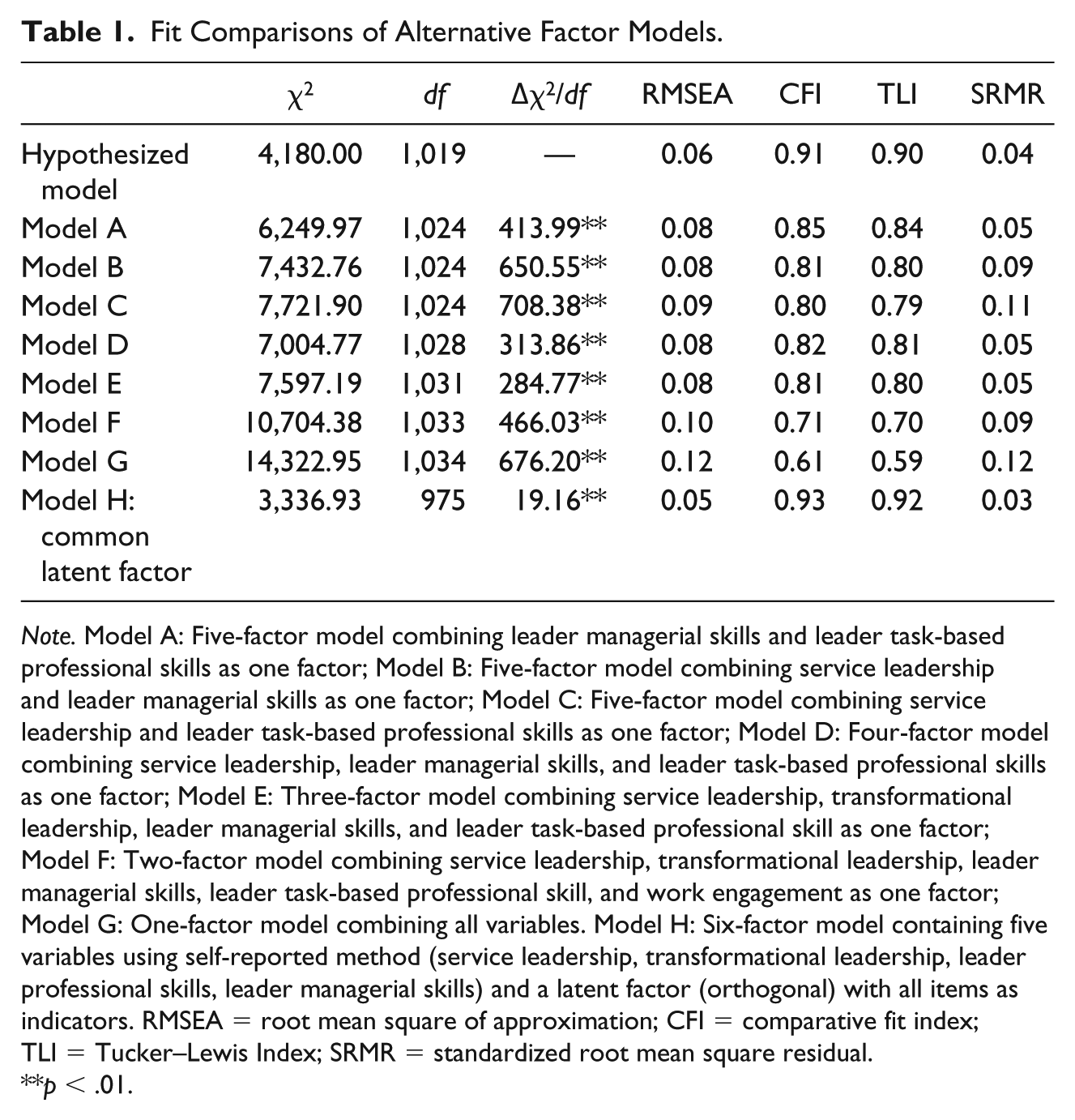
Note. Model A: Five-factor model combining leader managerial skills and leader task-based professional skills as one factor; Model B: Five-factor model combining service leadership and leader managerial skills as one factor; Model C: Five-factor model combining service leadership and leader task-based professional skills as one factor; Model D: Four-factor model combining service leadership, leader managerial skills, and leader task-based professional skills as one factor; Model E: Three-factor model combining service leadership, transformational leadership, leader managerial skills, and leader task-based professional skill as one factor; Model F: Two-factor model combining service leadership, transformational leadership, leader managerial skills, leader task-based professional skill, and work engagement as one factor; Model G: One-factor model combining all variables. Model H: Six-factor model containing five variables using self-reported method (service leadership, transformational leadership, leader professional skills, leader managerial skills) and a latent factor (orthogonal) with all items as indicators. RMSEA = root mean square of approximation; CFI = comparative fit index; TLI = Tucker–Lewis Index; SRMR = standardized root mean square residual.
p < .01.
We also followed Podsakoff et al.’s (2003) unmeasured latent method factor approach to assess common method variance (CMV) in our data. We conducted CFAs to compare the model fit of the hypothesized six-factor model with an alternative model including an additional latent factor to account for self-report method with all of the items from the variables measured by employees (i.e., service leadership, transformational leadership, leader professional skills, leader managerial skills, and engagement) as its indicators. As shown in Table 1, including the common method factor improved the model fit significantly, Δχ2/df = 19.16, p < .01 suggesting that CMV is present in our data. To further examine the influence of CMV, we follower prior studies and calculated the variance explained by the method factor (Neubert, Kacmar, Carlson, Chonko, & Roberts, 2008; Porter, Woo, & Campion, 2016). We found that the method factor explained 18% of the total variance, which is lower than the amount usually found in similar studies (cf., Williams, Cote, & Buckley, 1989). Therefore, we concluded that CMV had a limited influence on our results.
Descriptive Statistics
Table 2 demonstrates descriptive statistics and bivariate correlations for all study variables. As expected, service leadership was positively related to engagement (r = .32, p < .01) and engagement was positively to service performance (r = .13, p < .01).
Variable, Ms, SDs, and Correlations (N = 903).
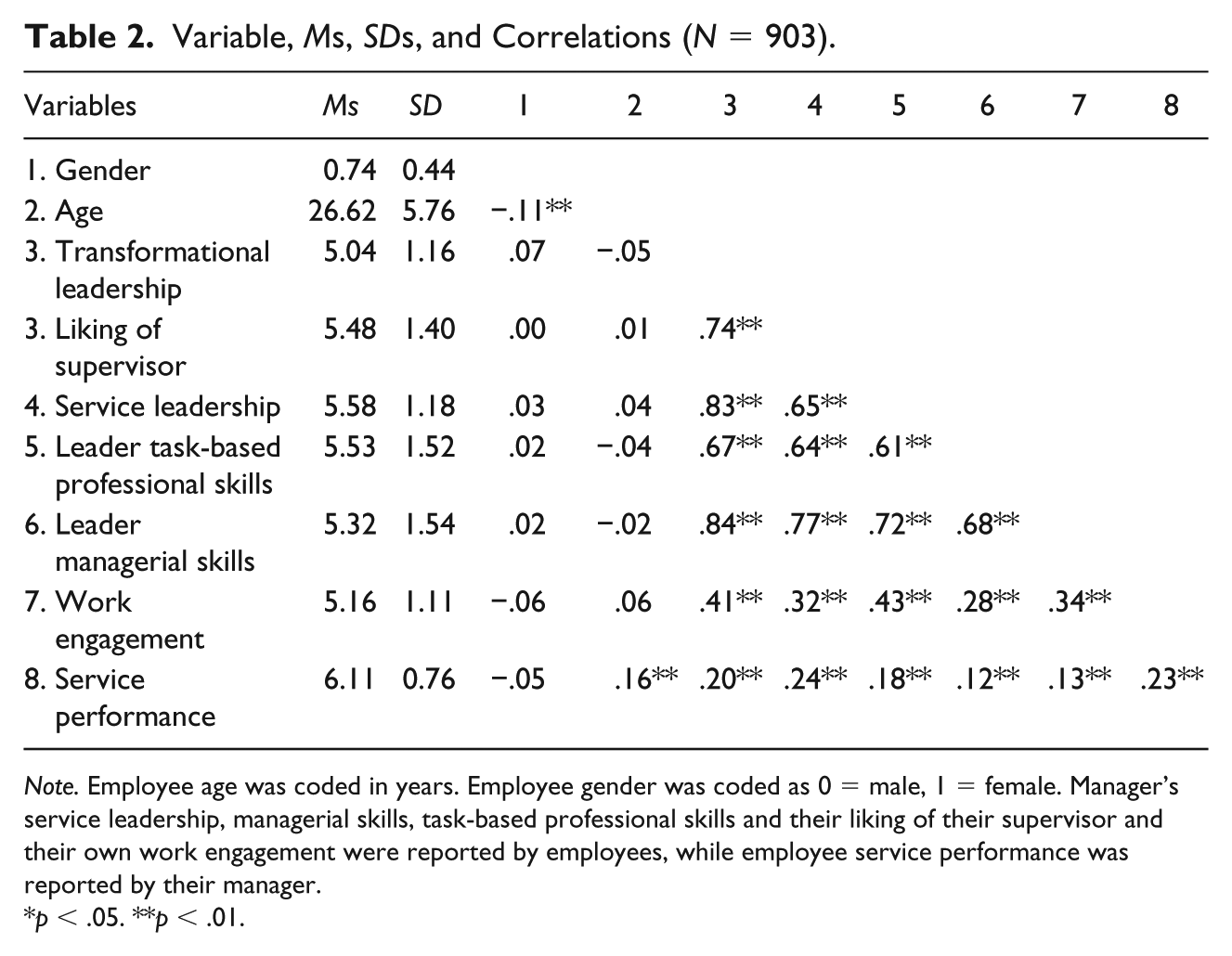
Note. Employee age was coded in years. Employee gender was coded as 0 = male, 1 = female. Manager’s service leadership, managerial skills, task-based professional skills and their liking of their supervisor and their own work engagement were reported by employees, while employee service performance was reported by their manager.
p < .05. **p < .01.
Hypotheses Testing
Table 3 depicts the results of the regression test of Hypothesis 1. In support of Hypothesis 1, service leadership was found to be positively related to engagement (B = .28, p < .001; Model 1a), and engagement was positively related to service performance (B = .14, p < .001; Model 2b). Although service leadership was not significantly related to service performance in Model 1b, there has been a growing consensus among quantitative methodologists that establishing a significant total effect of X on Y is not a necessary prerequisite to searching for evidence of indirect effects (Cerin & MacKinnon, 2009; Hayes, 2009; Rucker, Preacher, Tormala, & Petty, 2011; Shrout & Bolger, 2002). We therefore followed Selig and Preacher’s (2008) recommendation to directly test the mediating effect using a Monte Carlo method. As shown in Table 4, the indirect effect with 20,000 resampling was significant (indirect effect = .04, 95% CIs = [.02, .07], which excluded 0). Hence, the results provide support for Hypothesis 1.
Hierarchical Multilevel Analyses for the Hypothesized Two-Way Interactions (N = 903).

Note. Unstandardized regression coefficients are shown.
p < .05. **p < .01. ***p < .01.
Summary of the (Conditional) Indirect Effects of Service Leadership on Service Performance via Engagement (N = 903).
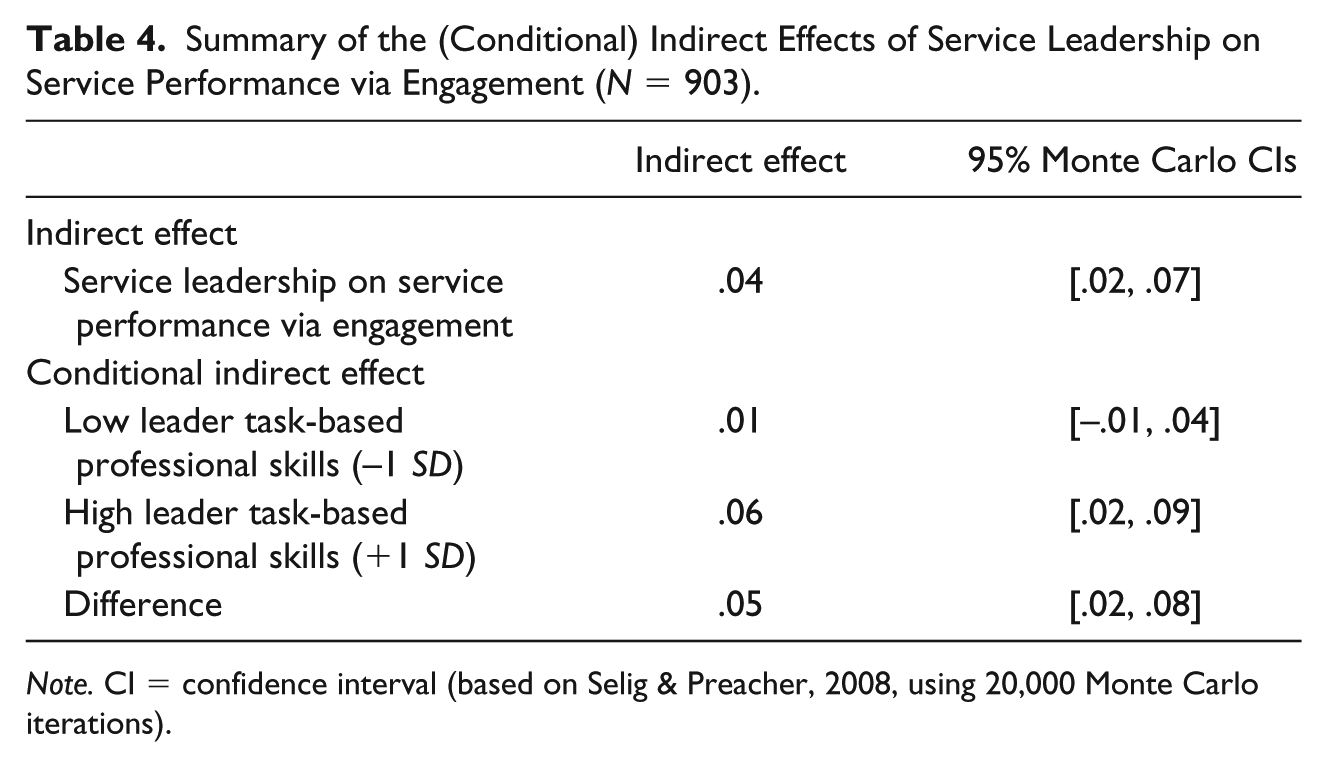
Note. CI = confidence interval (based on Selig & Preacher, 2008, using 20,000 Monte Carlo iterations).
Hypothesis 2 and 3 predicted leader task-based professional skills and managerial skills moderate the indirect effect of service leadership on service performance via engagement, respectively. As can be seen in Table 3, the interaction term of service leadership and leader task-based professional skills was significant in predicting work engagement (B = .14, p < .01; Model 3a), providing support for Hypothesis 2. However, the interaction term of service leadership and leader managerial skills was not significantly related to work engagement (B = .05, ns; Model 3a), indicating that Hypothesis 3 is not supported. Finally, the three-way interaction of service leadership, leader task-based professional skills and leader managerial skills was not significantly related to work engagement (B = −.02, ns). Therefore, Hypothesis 4 is not supported. 1
The pattern of the interaction between service leadership and leader task-based professional skills on work engagement is shown in Figure 2. Consistent with our expectation, the simple slope of the relationship between service leadership and engagement was more positive under high leader task-based professional skills (B = .50, p < .001), than under low leader task-based professional skills (B = .24, p < .01). Furthermore, we followed Edwards and Lambert’s (2007) method that has been largely used in later studies (Chan, Huang, Snape, & Lam., 2013; Grant, Gino, & Hofmann, 2011) to test the difference of the conditional indirect effects under low and high levels of a moderator. We found the conditional indirect effect of engagement under low leader task-based professional skills (Table 4: indirect effect = .01, 95% CIs = [−.01, .04]), was nonsignificant and smaller than the conditional indirect effect of engagement under high task-based professional skills (indirect effect = .06, 95% CIs = [.02, .09]) with a significant different estimate (difference = .05, 95% CIs = [.02 .08]), consistent with Hypothesis 3.
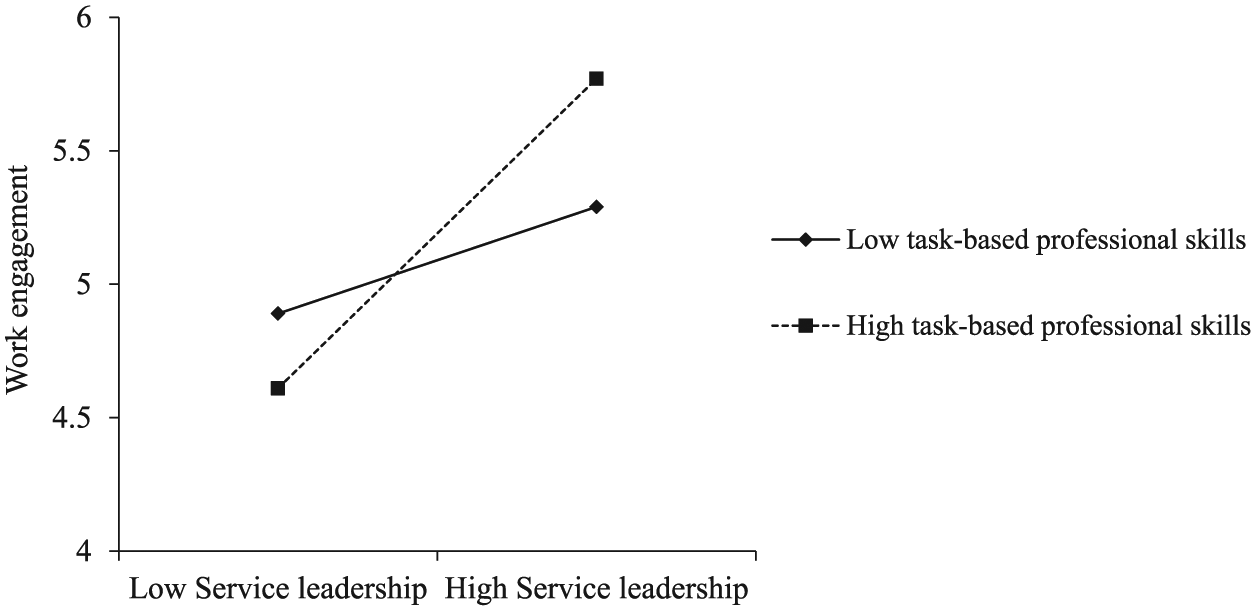
The relationship between service leadership and work engagement under conditions of low and high leader task-based professional skills.
Discussion
This study attempted to cast additional light on the mechanisms underlying the relationship between service leadership and employee service performance. By integrating social learning theory with the JD-R model, we found that employee work engagement is a significant mediator of this relationship. Furthermore, based on idiosyncrasy credit theory (Hollander, 1958), we examined the role of leader skills, specifically task-based professional and managerial skills, as moderators of the indirect relationship between service leadership and service performance via work engagement. Our results provided support for the moderating role of task-based professional skills. The moderating role of managerial skills and the joint interaction effect of task-based professional and managerial skills on the indirect relationship between service leadership and service performance were not supported. These findings highlight the role of work engagement as an important motivational mechanism through which service leadership drives service performance. The findings also demonstrate the role of task-based professional skills in the “credit-building” process of a leaders’ legitimacy and role-modeling capacity in service environments.
Theoretical Implications
This study has several theoretical implications. First, although past research has suggested that service leaders are viewed as role models who influence employees’ commitment to improving service quality (Jiang et al., 2015) limited empirical studies have attempted to expand the lens of the motivational processes through which service leadership influences employee outcomes. By theorizing and testing work engagement as a mediator, we offered additional insight on the motivational mechanism of service leadership. We find service leaders increase the level of stimulation, meaningfulness, and absorption employees experience in their service roles and subsequently inspire high levels of service behaviors via this elevated work experience. Given the importance of motivational processes in a service context, there is scope for future research to investigate other motivational-related mediators, such as job meaningfulness (Hackman & Oldham, 1976) and psychological empowerment (Spreitzer, 1995) to advance our understanding of the process via which service leadership affects service employee behaviors and performance.
In addition, the idiosyncrasy credit model (Hollander, 1958) utilized in our study enabled us to develop boundary conditions for the effects of service leadership. We proposed that both leader task-based professional skills and managerial skills contribute to follower perceptions of leader credibility and strengthen the relationship between service leadership and work engagement. Our results showed task-based professional skills moderate the relationship between service leadership and work engagement. This finding suggests that leader task-based professional skills are important which is consistent with the skills literature, which highlights that in certain organizational contexts leaders need to develop certain domain-specific expertise (Lord & Hall, 2005; M. D. Mumford et al., 2017). The results did not support managerial skills as a moderator of this relationship. This suggests that task-based professional skills weigh heavily on service employees’ judgments of their leaders. In front-line service-oriented environments, such as hairdressing salons where leaders are present in the salon and are often directly involved in operational work, their task-based professional skills are more likely to legitimate leaders as role models rather than their managerial skills. A further explanation could be that high professional skills help leaders to develop their followers in a more systematic manner via provision of specific knowledge sharing. This enhances followers’ confidence in successfully performing tasks and keeps them engaged in their job roles. It is also possible that in such a service context, a front-line leader requires a high level of task-based professional skills to be seen as prototypical of the service team (e.g., Hogg, Hains, & Mason, 1998; Tajfel, 1978, 1982). Our results suggest that obtaining high levels of task-based professional skills may be more consistent with the attributes that define a prototypical leader in a front-line service context than possessing high levels of management skills. Therefore, we suggest that future studies examine other theoretically relevant mechanisms, such as followers self-efficacy and perceived leader prototypicality (e.g., D. van Knippenberg, 2011) to cast additional light on the role of leader skills in a service context.
In terms of managerial skills, as the sample in this study is front-line hairstylists and their immediate supervisors, it may be that these employees expect and rely on their leader to support them in technical areas, but see their supervisor’s managerial skills as less immediately relevant to their own work. However, we do not conclude that leader managerial skills are less important than task-based professional skills in the service leadership process. Managerial skills such as strategic planning and creating visions may be more critical for the leadership process at higher levels (Lord & Hall, 2005). For example, prior research has suggested that unit-level service-oriented leadership creates a service climate in teams where employees have a shared perception of policies, practices, and procedures concerning customer service (Jiang et al., 2015; Walumbwa, Hartnell, & Oke, 2010; Widianto & Wilderom, 2017). Compared with task-based skills, leaders’ managerial skills may be more important in this regard as they help service leaders clearly communicate organizational policies and practices to employees and inspire service values in teams. Thus, future studies could include additional theoretically relevant mechanisms (i.e., service climate) and use multilevel data, to further investigate the moderating role of leaders’ managerial skills in the leadership process.
Practical Implications
Our findings have practical implications for service companies and managers. First, according to our findings, service leadership has a positive effect on employee work engagement and hence their service performance. Considering the positive impact of service leadership on employees, organizations should provide training opportunities and programs for service managers to learn and be able to display service leadership behaviors to their followers.
Second, this research also casts light on the conditions under which front-line service leaders are more likely to foster employee work engagement and service performance. The results show service leadership has a larger impact on work engagement when a service leader demonstrates higher levels of task-based professional skills. It is worthwhile for service companies to reinforce the utility of task-based professional skills as a useful selection tool for potential service managers. In addition, leadership development programs can be designed to increase awareness of the importance of task-based professional skills for building idiosyncrasy credit. Finally, service companies should encourage close working relationships between front-line leaders and their followers to create more opportunities for leaders to demonstrate their skills and for followers to observe and learn from their leader’s expertise and knowledge. Service managers are therefore encouraged to continually develop their technical skills and knowledge in order to be able to maintain high levels of domain-specific skills that can reinforce the motivational impact they can make on employees.
Limitations and Future Research
This study has several limitations. From a methodological perspective, first, although the outcome variable was rated by a different source (i.e., supervisors), the independent variable and the mediator, service leadership, and work engagement were rated at the same time by followers. Therefore, we cannot rule out CMV in our study. To reduce potential CMV, we followed the recommendations of Podsakoff et al. (2003) and tested empirically the impact of CMV in our study. We further attempted to reduce evaluation apprehension through assuring respondents of confidentiality and making clear there were no right or wrong answers. Our CMV analyses showed that CMV had a limited influence on our results. Our confidence in our findings is further strengthened by the moderating effects found. Siemsen, Roth, and Oliveira (2010), for example, argued that interaction effects cannot be an artefact of CMV. When CMV is a serious issue, moderation is difficult to find due to interaction terms being deflated through CMV. Nevertheless, future research would benefit from longitudinal or experimental research designs.
Although employee service performance is an important outcome as it is closely related to financial profits in the services industry (e.g., Yee, Yeung, & Cheng, 2010), future studies could examine additional outcomes. For example, prior research has utilized customer data (e.g., customer satisfaction, intention to return) to depict a complete picture of the effectiveness of service leadership (Schneider et al., 2005; Schneider et al., 1998). Future studies could replicate our model by using a wider range of outcome measures, especially customer ratings. In addition, as noted earlier, we used perceptual ratings of leader skills. Although this approach is consistent with existing leadership research, ratings of leader skills could have still been influenced by a number of potential factors, such as whether follower had adequate opportunities to observe their leader, or whether followers had sufficient expertise to appraise their leader’s skills. Future studies are encouraged to examine these issues. Finally, to enhance the response rate we used relatively short scales. However, these short scales may not have captured the full representation of the theoretical constructs of interest, especially for the two types of leader skills that are referent-shifted from the LMX scale. Thus, future studies are encouraged to replicate our findings by using other validated scales to measure leaders’ skills.
Second, although we argued from an idiosyncrasy credit perspective that the level of leader task-based professional skills is a boundary condition of the motivational impact of service leadership on employees, we did not explicitly measure leader role-modeling in our study. This could be addressed in future research.
Finally, we used a sample of salon managers in a single company, which may limit the generalizability of our findings to other service units. However, a number of studies in the service literature have adopted this approach and found results that are largely consistent across samples, and in line with extant leadership theory and service research (Mayer, Ehrhart, & Schneider, 2009; McKay, Avery, Liao, & Morris, 2011; Schneider et al., 2005). Nevertheless, our findings should be replicated in other service organisations. Furthermore, we focused on the service leadership of salon managers who are at a low level of the organization’s hierarchy. Moreover, the hair salon managers in this study are expected to directly coach employees and monitor their performance. As such, it may be that salon manager task-based professional skills are more likely to be of importance to their employees in comparison with their management skills. It would be interesting to examine whether task-based professional skills are still an important moderator for service leadership at higher ranks of service organizations and more senior leadership positions. Future research could also examine the external validity of our findings in different organizational settings. In particular, it would be interesting to test a model with a sample of public sector workers (e.g., police officers) or employees of manufacturing companies where for example, authoritarian leadership (Farh & Cheng, 2000) may be prevalent to examine the role of professional and managerial skills in the relationship between other leadership variables and outcomes.
Conclusion
The results of this study support the notion that service leadership influences service performance via elevating employees work engagement and this effect is further accentuated when leader task-based professional skills are high. Our study connects service leadership with the work engagement and leader skills literatures, and advances our understanding of the motivational foundations and boundary conditions of service leadership. Future studies should continue to examine the motivational mechanisms of service leadership and further identify leader skill sets that may act as important contingencies in a service context.
Footnotes
Declaration of Conflicting Interests
The author(s) declared no potential conflicts of interest with respect to the research, authorship, and/or publication of this article.
Funding
The author(s) received no financial support for the research, authorship, and/or publication of this article.
Notes

Associate Editor: Rebecca Reichard