



Abstract
Over the past few decades, a growing number of women have been becoming entrepreneurs and assuming a greater percentage of leader roles in the world. In this research, we develop a model, grounded in a family embeddedness perspective and expectancy violations theory, that explores why and when women entrepreneurs behave dominantly in the workplace, and what consequences this pattern produces. We propose that when a female entrepreneur is the primary income earner at home, she is more likely to behave dominantly in the workplace, and subsequently, her workplace dominance is positively related to subjective firm performance. Less industry experience strengthens the positive relationship between being the primary income earner and workplace dominance, and further accentuates the indirect effect of being the primary income earner on subjective firm performance through workplace dominance. Data collected from 58 women entrepreneurs and 271 members of their top management teams in China through a two-wave survey support our hypotheses.
Keywords
Challenges to gender roles are emerging all over the world, especially as a growing number of women become entrepreneurs and assume leader roles in the workforce. Women’s traditional gender roles have tended to encompass communal characteristics described as showing concern for the welfare of other people, such as kindness, consideration, and sympathy (Eagly & Karau, 2002). By comparison, women entrepreneurs and leaders often behave agentically, going against their traditional gender roles (Heilman, Block, & Martell, 1995; Livingston, Rosette, & Washington, 2012). In the literature, however, agentic behaviors are a mixed blessing for them. On the one hand, women entrepreneurs and leaders often behave agentically to be successful (Heilman et al., 1995; Livingston et al., 2012). For example, women leaders can achieve the advantages (e.g., well-being, firm performance, and leader effectiveness) if they manifest male-stereotypical and agentic attributes (Eagly & Karau, 2002; Hmieleski & Sheppard, 2019). On the other hand, women leaders face unique challenges, such as backlash, being penalized in terms of their career prospects, and being regarded as hostile and as less rational than their male counterparts (Carli, 2010; Eagly & Carli, 2007; Heilman et al., 1995; Heilman & Chen, 2005; Heilman, Wallen, Fuchs, & Tamkins, 2004), when they go against their traditional gender roles to act agentically. Moreover, other people are less likely to endorse their startups when women entrepreneurs send signals incongruent with the gender stereotypes (Yang, Kher, & Newbert, 2020). Thus, agentic behaviors warrant our attention, as they can be regarded as gender-role–paradoxical behaviors for women entrepreneurs depending on the context (Eagly & Chaiken, 1993, 1998). Additionally, agentic demonstrations seem to contradict the communal characteristics associated with women’s traditional gender roles, leading to a salient comparison. These conflicts create an urgent need to understand why female entrepreneurs choose to engage in agentic behaviors and whether that pattern helps them gain an advantage in entrepreneurship.
Unfortunately, although studies have shed some light on this topic, the examination of why women entrepreneurs engage in dominance as a typical kind of agentic demonstration and what the consequences of this behavior are remains in a nascent stage (Brush, De Bruin, & Welter, 2009). So far, the literature includes only indirect evidence of the antecedents of dominance, such as work characteristics, emotional expression, and entrepreneurial parents (Haleblian & Finkelstein, 1993; Hareli, Shomrat, & Hess, 2009; Palmer, Fasbender, Kraus, Birkner, & Kailer, 2019), or initial findings on the outcomes of dominance (Harel, Schwartz, & Dan, 2021; Hmieleski & Sheppard, 2019; Jiraporn, Chintrakarn, & Liu, 2012; Livingston et al., 2012), but has not focused specifically on women entrepreneurs. Given the unique features of women entrepreneurs—namely, that they start their own businesses and occupy higher positions in their companies—it is crucial to explore the unique antecedents and effects of their dominance-related behaviors, as such insights will help us better understand this unique group.
In investigating entrepreneurs’ behaviors, the role of family factors warrants attention because business and family are inextricably linked in affecting entrepreneurs’ behaviors (Aldrich & Cliff, 2003). Thus, a family embeddedness perspective is especially helpful to expand the research questions. Indeed, entrepreneurial decisions, processes, and outcomes are embedded in family systems (Jennings & Brush, 2013), underlining that family plays a significant role in shaping women entrepreneurs’ (agentic) behaviors. Any omission in this regard may hinder our complete understanding of why women entrepreneurs behave in certain ways (Aldrich & Cliff, 2003). While a volume of research on reasons for starting entrepreneurial businesses and work–family interface experiences supported the family embeddedness perspective, relatively little research has examined the importance of family in shaping women entrepreneurs’ workplace behaviors (Bowen & Hisrich, 1986; Gundry & Ben-Yoseph, 1998). This dearth of research inhibits our comprehensive knowledge of women entrepreneurs’ dominant behaviors in the work domain.
In this study, we examine why and when women entrepreneurs violate traditional gendered expectations by engaging in dominant workplace behaviors, and what consequences these behaviors have for firms. Dominance in family income (i.e., being the primary income earner) is defined as providing primary financial support for the family such that the person earns money that pays the family’s major expenses. We adopt a family embeddedness perspective to explore the spillover effect of dominance in family income on women entrepreneur’s workplace dominance. Workplace dominance entails the display of agentic behaviors and indicates the extent to which people use control to attain and maintain their social status in the workplace (Cheng et al., 2013; Cheng et al., 2010; Megargee, 1969). It manifests as actions such as demonstrating ascendant, decisive, and assertive manners; taking the initiative; and being self-assured in achieving one’s goals. Being the primary income earner is a family factor that captures one’s dominant status in family income and underlies one’s power in discourse and decision making at home. It is also the most salient factor informed by gender roles and relates to agentic status (Zhang, Liao, Li, & Colbert, 2020). Further, income status, as a basic element of experiences at home, allows us to know more about the spillover effect of dominance at home on workplace dominance; indeed, research provided evidence of the natural link between income status and dominant-related behaviors (Dema-Moreno & Díaz-Martínez, 2010; Lammers, Stoker, & Stapel, 2010).
We examine the boundary conditions of this spillover effect by integrating industry experience into this process. Industry experience refers to how long women entrepreneurs have worked in the same industry as the one that they are engaging in now, which directly captures their accumulated knowledge in this industry. Prior related experience helps entrepreneurs obtain relevant knowledge, skills, and capital (Shane, 2000); whereas, other types of experiences, such as entrepreneurial experience or working tenure, reflect the duration of entrepreneurship or working and do not necessarily represent their cumulative knowledge in the current industry. Hence, industry experience is a crucial and more proximal work-related factor that influences the extent to which people lean on their family experiences. When women entrepreneurs have less (vs. more) specific industry experience, they tend to rely more heavily on other experiences (e.g., experiences in the family domain) as guides for their behavior, strengthening the effect of being the primary income earner on workplace dominance.
We further integrate expectancy violations theory (Burgoon, 1993; Burgoon & Jones, 1976) to propose that workplace dominance relates to subjective firm performance, the evaluation of the firm’s broader and nonfinancial performance relative to its competitors (Stam & Elfring, 2008). Subjective firm performance is our focus because it reveals crucial supplementary information compared to objective measures (cf. Vij & Bedi, 2016) and is generally relative rather than absolute (Wall et al., 2004), which is beneficial for making a cross-industry comparison (Brewer, 2006). Meanwhile, subjective firm performance is not independent of objective firm performance because studies verified that subjective firm performance is closely linked to objective firm performance (Venkatraman & Ramanujam, 1987; Vij & Bedi, 2016; Wall et al., 2004). Notably, it not only has been more commonly used in entrepreneurship research but also plays an important role in entrepreneurs’ well-being (for a review, see Stephan, 2018) and their firms’ future development (Gimeno, Folta, Cooper, & Woo, 1997; Reijonen & Komppula, 2007). We suggest that dominant displays might violate traditional expectations, but they are preferred due to the implications of dominance as an agentic feature in entrepreneurship (Cejka & Eagly, 1999) and women entrepreneurs’ higher-level work positions. Thus, displaying positive counter-stereotypical characteristics (dominance) is a favorable violation for women entrepreneurs and will enhance their evaluations of firm performance.
Our study contributes to the women entrepreneurship literature. First, we provide insights into the reasons why women entrepreneurs behave agentically from an underexplored family embeddedness perspective. Departing from the views cited in earlier research (e.g., individual, company, and environmental factors), we highlight the importance of family factors for women entrepreneurs’ business outcomes. Adopting a family embeddedness lens improves our understanding of why women entrepreneurs engage in dominance. We also respond to the call made by Jennings and Brush (2013), who indicated that a key direction in women entrepreneurship research is to examine decisions, processes, and outcomes from the perspective of family factors.
Second, we advance research on how family factors influence firm-related outcomes. Research suggested the role of family factors such as family success, support, and resources in explaining business/entrepreneurship outcomes (Alam, Jani, & Omar, 2011; Heck et al., 2006; Kamitewoko, 2013; Masuo, Fong, Yanagida, & Cabal, 2001), but most of them have been descriptive; there was little examination of the underlying mechanisms, impairing our understanding of how women entrepreneurs’ family experiences affect firm outcomes. We take a step forward by highlighting the importance of family factors in subjective firm performance as a distal entrepreneurial outcome of being the primary income earner; we represent the first effort to investigate the mediation process (the spillover effect) underlying this linkage. In doing so, we outline a new direction for future theory and research on gender stereotypes, as well as women entrepreneurs’ behaviors and their performance.
Third, we add insights to the extant women entrepreneurship research by linking women entrepreneurs’ non-work-related and work-related experiences to clarify when they are dominant at work. The substitution effect is emphasized in this study: If women entrepreneurs lack work-related experience, they rely more on their non-work-related experience to inform their behaviors at work. Given our poor understanding of the boundary conditions that limit how women entrepreneurs’ behaviors emerge, this investigation helps us gain a fuller picture of the effects of being the primary income earner on outcomes in the work domain.
Theory and Hypotheses
Being the Primary Income Earner and Workplace Dominance
The family embeddedness perspective highlights that family is increasingly being acknowledged as a critical factor in entrepreneurial activities (Habbershon & Pistrui, 2002; Sabah, Carsrud, & Kocak, 2014). Women entrepreneurs do not view their businesses as separate economic entities, but rather as endeavors entwined with other aspects of their lives (Aldrich & Cliff, 2003; Jennings & Brush, 2013; Jennings & McDougald, 2007). Given the increasing proportion of household income accounted for by women’s income, the current social environment highlights that women entrepreneurs now have higher status or rank in terms of family economic situations than ever before. Because their workplace behaviors are socially embedded in their family domain (Aldrich & Cliff, 2003; Jennings & Brush, 2013), we propose that being the primary income earner (i.e., having dominance in family income) is an important indicator of women entrepreneurs’ dominant behaviors at workplace.
Dominant behaviors can be seen as the most proximal variable linked to dominance in family income because being the primary income earner essentially reflects one’s status or rank in terms of the family economic situation. It is consistent with the dominant characteristics embedded in this behavior, which reflects a typical evolved status/rank-ascending strategy (Cheng et al., 2013; Cheng et al., 2010). Moreover, we focus on dominance rather than other kinds of agentic behaviors because the former is not only a broader construct capturing one’s agentic expressions but also exemplified by relationships based on coercion between a leader and employees (Cheng et al., 2013). Thus, it has more relevance in our research context, given that we emphasize how top management team (TMT) members perceive and evaluate women entrepreneurs’ behaviors.
Specifically, being the primary income earner both reflects one’s higher-income status within the family and influences one’s behavioral approaches (Lammers et al., 2010). When a woman brings more economic resources into the household, she tends to be viewed as a person who is able to make her own decisions independently and autonomously on daily family issues and has greater power to speak out on family matters compared to other family members who do not occupy the dominant position because of basic economic power exchange (Bear & Glick, 2017; Meisenbach, 2010). Thus, it is reasonable to expect that if a woman entrepreneur provides major financial support for her family, she will have higher freedom of action as well as fewer obstacles in her pursuit of goals (Anderson & Berdahl, 2002; Keltner, Gruenfeld, & Anderson, 2003; Smith & Bargh, 2008). Through the spillover effect (Staines, 1980), such experiences in one domain (home) can be transmitted to another domain (work) and influence one’s behavior there. Thus, their approach-oriented experiences and intentions voiced at home could spill over into the work domain and further encourage women entrepreneurs to engage in assertive or dominant behaviors (Carver & White, 1994) in the workplace. Indeed, dominant behaviors often focus on control over access to resources (Cheng et al., 2013) and thus function as a status- and rank-ascending strategy (Cheng et al., 2013; Cheng et al., 2010). For instance, women entrepreneurs might also seek to make decisions autonomously and independently in the workplace and become more assertive as they pursue their work goals. In this way, a family–work spillover effect is expected to become manifest.
Following the logic implied by family embeddedness, family factors also have implications for women entrepreneurs’ attitudes toward, norms of, and values associated with family and work (Aldrich & Cliff, 2003), which may potentially trigger family transitions and thereby either facilitate or hinder women entrepreneurs’ subsequent behaviors in the workplace (Welter, Smallbone, & Isakova, 2006). Research suggests that income status has meaningful consequences for women entrepreneurs’ behaviors (Carli, 1999; Eagly, 1987) by influencing the construction of their beliefs (Berger, Webster, Ridgeway, & Rosenholtz, 1986). Hence, we argue that being the primary income earner in the family domain could instill in women entrepreneurs the belief and value that women should behave dominantly just as men do and, in turn, motivate them to behave dominantly in the workplace. For example, women entrepreneurs who are their family’s primary breadwinners may face greater pressure to act as a pillar of their family because their income needs to cover the main household expenses. Because entrepreneurial ventures (not separate economic entities) are inevitably entwined with many other aspects of the entrepreneur’s life (Jennings & Brush, 2013), this expectation is likely to spill over from the family domain to the work domain, where it encourages the entrepreneur to behave assertively in their decision making and communication and take the initiative to promote the projects. Consistent with this rationale, research has emphasized that relative economic status implies performance expectations and shapes human decision making and appropriate behavior (Berger et al., 1986).
In contrast, if women entrepreneurs are not the primary income earners in the household, their experiences embedded in the family are less likely to influence not only their behavioral approaches but also their work and family beliefs and values. Thus, they will not prompt women entrepreneurs to display dominant characteristics in the work domain. As such, these female leaders are less likely to be decisive in the workplace and self-assured in achieving their goals.
Workplace Dominance and Subjective Firm Performance
We further integrate expectancy violations theory to examine the relationship between workplace dominance and subjective firm performance. This theory is relevant in the family context because this context can make traditional gender roles more salient, which provides a basis for considering possible violations of these traditional expectations. More importantly, the family embeddedness perspective suggests that evaluations of women entrepreneurs’ distal outcomes are influenced by socially constructed expectations (Amine & Staub, 2009; Jamali, 2009; Marlow & McAdam, 2012), highlighting the significance of social embeddedness (Aldrich & Cliff, 2003; Jennings & Brush, 2013). As such, expectancy violations theory is an appropriate perspective to investigate the role of behaving dominantly in influencing firm outcomes.
An expectation is a consistent pattern of predictable behavior for an individual, context, or relationship (Burgoon, 1993). People use expectations to assess available information (Burgoon & Hale, 1988). According to expectancy violations theory, expectations are violated when someone acts in a manner that deviates from typical behaviors (Afifi & Metts, 1998). Two types of expectation violations are possible (Jussim, Coleman, & Lerch, 1987): a favorable expectation violation (i.e., individuals who perform positive behaviors not expected of them) and an unfavorable expectation violation (i.e., individuals who perform negative behaviors not expected of them). One’s behaviors that run counter to stereotype-based expectations are evaluated in the direction of the expectation violation, and specific expectation violations lead to different outcomes. When women engage in positive behaviors demanded by a certain situation (e.g., prototypical leader behaviors) but atypical for their gender role, their actions may lead to a favorable expectation violation. Such violators are likely to be evaluated favorably (Jussim et al., 1987) and benefit from those positive counter-stereotypical qualities (Bettencourt, Charlton, Dorr, & Hume, 2001; Prentice & Carranza, 2004).
Research suggests that different genders are associated with specific expectations. Demonstrating communal characteristics as consideration, warmth, kindness, and sympathy is particularly expected of women (Eagly & Karau, 2002). Women entrepreneurs who behave dominantly do not act in accordance with what women are assumed to be like and, therefore, violate the role expectations for women. According to expectancy violations theory (Burgoon, 1993; Burgoon & Hale, 1988; Burgoon & Jones, 1976), displaying the opposite gender’s prescriptive traits elicits positive evaluations and outcomes when positive expectancy violations occur (Jussim et al., 1987; Prentice & Carranza, 2004). Although the extant literature indicates that women who act in a dominant way may suffer from backlash (Koenig, Eagly, Mitchell, & Ristikari, 2011; Livingston et al., 2012; Sergent & Stajkovic, 2020), the actual outcome depends on various conditions that may moderate such prejudices (Eagly & Karau, 2002). We suggest that in the entrepreneurship and workplace contexts, agentic characteristics can be viewed as necessary and important by women entrepreneurs (Cejka & Eagly, 1999) so that their demonstration is viewed as a positive violation.
Specifically, in the entrepreneurship context, which features competitiveness, complexity, and dynamics as salient characteristics (Abdesselam, Bonnet, Renou-Maissant, & Aubry, 2018; Khazaei, 2021), leaders are expected to play a leading role in decision making and daily operations as well as to be competitive and directive in achieving goals that will enable the organization to succeed (Lumpkin & Dess, 2001; Quagrainie, 2016), rather than to exhibit over-deference or indecision that leads to loss of valuable opportunities. For instance, Gupta, Javadian, & Jalili (2014) found that women entrepreneurs are effective when they use a directive management style, and that those who employ the directive style elicit better performance from their employees. Women entrepreneurs may develop a competitive edge to survive in a competitive environment. These behaviors are consistent with the characteristics of workplace dominance, such as showing ascendant and assertive manners; taking the initiative; and being self-assured (Cheng et al., 2013; Megargee, 1969). Hence, women entrepreneurs are more likely to view their dominance as necessary and crucial in the entrepreneurship environment (Cejka & Eagly, 1999; Livingston et al., 2012), thereby representing a positive violation.
Women entrepreneurs are not just front-line employees or leaders in a non-self-created organization; instead, they not only occupy a high status at work but also (co-)created the company. Notably, women are less likely to be considered leaders than are identically qualified men since they are assumed to lack the traditional characteristics associated with this role. Women entrepreneurs’ dominance is characterized by behaving decisively and coercively (Cheng et al., 2013; Megargee, 1969), however, that brings them closer to matching the traditional notions of a leader and overcoming this obstacle because they exhibit the qualities desired in this unique role. Put differently, given their high position at work, the dominant behaviors of them fit the expected leader role. Thus, workplace dominance will influence their perceptions of firm performance by seeing their dominant behavior in this context as a positive (rather than a negative) violation as well as bringing actual benefits to firm performance.
In essence, women entrepreneurs may view dominant behavior as appropriate for their unique leader roles (Eagly & Karau, 2002) in the entrepreneurship setting, such that their positive violation then helps them to escape punishment and be accepted and identified as a leader at work. In turn, women entrepreneurs are more likely to experience a high level of firm performance. Empirically, high-assertiveness constructs, such as dominance, authoritarianism, and aggressiveness (Bass, 1990; Gough, 1990), have been positively related to leadership effectiveness. Studies showed that dominance helps individuals overcome gender bias (Eagly & Karau, 1991; Rudman & Glick, 1999) and attain a great deal of social influence (Cheng et al., 2013)—a factor important for women entrepreneurs as they aim to implement their firms’ strategies and projects smoothly. Hence, women entrepreneurs who behave dominantly are likely to obtain support from others and find it easier to lead and build an effective TMT within the firm. In this case, women entrepreneurs may experience a high level of firm performance and their actual firm performance such as financial and marketing outcomes may also be facilitated, which will enhance their subjective evaluations of firm performance. Given the above evidence, we expect that workplace dominance helps women entrepreneurs who violate expectations improve their subjective evaluations of firm performance.
Conversely, if women entrepreneurs exhibit a low level of dominance, they may not violate the expectations for women; accordingly, the benefits of a favorable violation for subjective evaluations of firm performance will be limited. Indeed, research has provided evidence supporting this relationship. For example, Miller and Friesen (1977) found that some unsuccessful firms were managed by weak CEOs. In line with these ideas, women entrepreneurs who exhibit dominant behaviors are expected to create favorable violations that bring benefits for higher evaluations of firm performance.
Women entrepreneurs’ workplace dominance is positively related to subjective firm performance.
The Mediating Role of Workplace Dominance
Combining the arguments for Hypotheses 1 and 2 based on a family embeddedness perspective and expectancy violations theory, we further suggest that workplace dominance mediates the relationship between being the primary income earner and subjective firm performance.
For women entrepreneurs who occupy the role of primary income earner, this economic status can influence their experiences and behavioral intentions at home. Such experiences and intentions can spill over into the work domain through the family–work spillover process (Staines, 1980). As the family embeddedness perspective suggests, women entrepreneurs view their entrepreneurial ventures as closely entwined with their lives (Jennings & Brush, 2013). Thus, women entrepreneurs tend to make decisions autonomously and take the initiative in the workplace, just as they do at home. Meanwhile, family factors also influence women entrepreneurs’ beliefs about and attitudes toward family and work (Aldrich & Cliff, 2003). Being the primary income earner instills in women entrepreneurs the belief and value that women should behave dominantly just as men do, which in turn encourages them to behave dominantly in the workplace. As their entrepreneurial ventures are entwined with other aspects of their lives (Jennings & Brush, 2013), this expectation is likely to spill over from the family domain to the work domain. In keeping with this expectation and belief, women entrepreneurs will then behave dominantly in the workplace.
Furthermore, as stated earlier, women entrepreneurs have relatively high status and historical roots in their own firms. In this setting, their dominant behavior brings them closer to matching their own and others’ notions about an entrepreneurial leader and is considered important to achieve work goals. Hence, their dominant behavior may be viewed as a positive violation, which prevents them from facing backlash and enhances the subjective firm performance. Overall, the experiences and intentions resulting from their family factors are expected to spill over into the work domain to affect women entrepreneurs’ workplace behavior, which in turn influences subjective firm performance via a family and work process.
The Moderating Role of Industry Experience
In the spillover process by which being the primary income earner (i.e., having dominance in family income) induces women entrepreneurs’ workplace dominance, industry experience—that is, the degree to which individuals have accumulated relevant experiences in this industry in the form of knowledge, information, networks, and skills in the past—serves as an important boundary condition. This is because the extent to which women entrepreneurs accumulate work-related experiences influences how they rely on non-work-related experiences when acting at work. According to the family embeddedness perspective, the influence of their family-related experiences on women’s entrepreneurial activity varies across different situations. Industry experience, as an explicitly important work experience, creates a situation in which women entrepreneurs depend on their family experiences to differing degrees. When their experience in the workplace is sufficient (rather than rare), family factors are less likely to operate as a trigger of these entrepreneurs’ workplace-related behavior (Aldrich & Cliff, 2003; Jennings & Brush, 2013).
Industry experience captures one’s proximal work-related skills and knowledge. Given the direct influences of specific industry experience within the entrepreneurship context (Baron & Ensley, 2006; Cassar, 2014), it is reasonable to expect that women entrepreneurs will largely depend on this experience when conducting entrepreneurial activities and engaging in some workplace actions. Based on their learning and knowledge gained from industry experience, women entrepreneurs tend to gradually revise their beliefs and expectations about what are considered appropriate activities for them in this role. Because people not only learn from their experiences but also rely on experiences in different domains and knowledge gained from these experiences to guide their actions, a substitution effect between industry experience and family experience is likely to occur. That is, women entrepreneurs with more industry experience will depend more on these work-related experiences rather than exclusively on family factors (e.g., being the primary income earner) to guide their behaviors and bring about better outcomes. In this way, the effect of being the primary income earner on women entrepreneurs’ workplace dominance is weakened.
Conversely, if women entrepreneurs have little industry experience, they may not have access to prior accumulated knowledge and information about their current industry; instead, they will pay more attention to other experiences (e.g., family factors) when forming or changing their role expectations and adjust their behaviors accordingly. As the family embeddedness perspective states, family and work are intertwined (Aldrich & Cliff, 2003; Jennings & Brush, 2013). Hence, a substitution effect occurs such that when women entrepreneurs are lacking in industry experience, they are more likely to draw on experiences from another domain to guide their behaviors. In our model, they depend more on their experiences of being the primary income earner. In this condition, the effect of being the primary income earner on women entrepreneurs’ workplace dominance is enhanced.
These arguments lead to the hypothesis that when women entrepreneurs have more industry experience, the relationship between being the primary income earner and demonstrating workplace dominance is weakened, compared with those who have less industry experience. Further, combining this rationale with the proposed indirect effect of being the primary income earner on subjective firm performance via women entrepreneurs’ workplace dominance (Hypothesis 3), we propose a moderated mediation model.
Figure 1 depicts our hypothesized model.
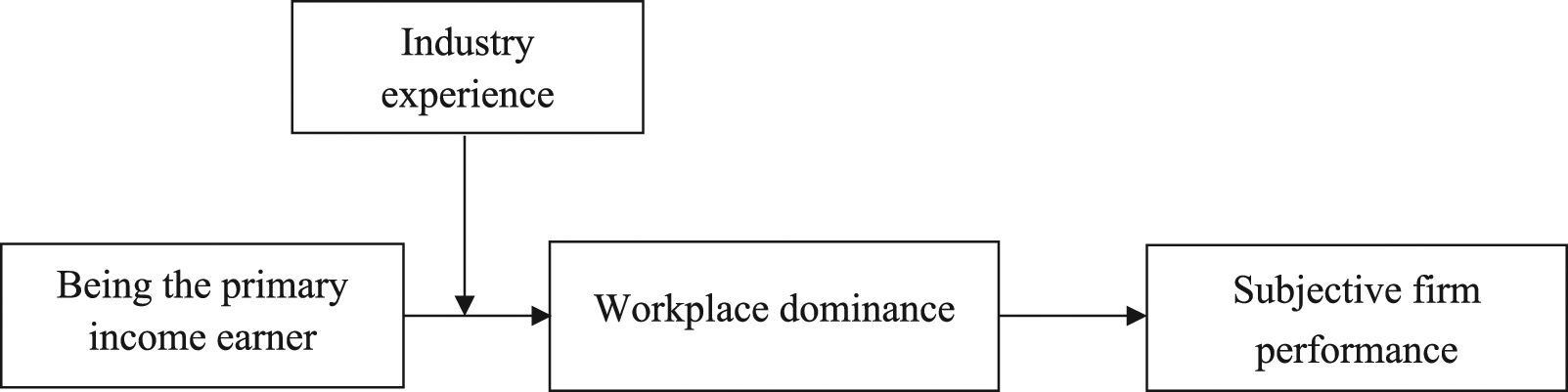
The hypothesized model.
Methods
Sample and Procedures
We conducted a field study to test our hypotheses. To mitigate common method bias, we collected data at different times and from different sources. Specifically, we invited 247 women entrepreneurs who attended a training program geared toward improving women entrepreneurs’ management skills, which took place in a university in northern China, to participate in our study. They independently or cooperated with TMT members to create their companies and represented 247 different firms. The respondents came from diverse industries, such as education, beauty therapy, IT, and manufacturing. Prior to starting the survey, we held a briefing session for all of the women entrepreneurs. Our research team clarified the content and procedures of the study, and also ensured the anonymity and voluntary nature of participation. We explained that TMT members were invited to participate in the study as well. The director of the training program expressed high support and encouragement for this study, enhancing the participation rate.
After the briefing session, women entrepreneurs were asked to confirm whether they were willing to participate in this survey. Given that they were from different cities, we sent our Time 1 (T1) e-questionnaire links to women entrepreneurs via a popular messaging application in China to enhance the feasibility of completing the survey and the response rate. At T1, we asked them to rate whether they are the primary income earner, to provide data on their industry experience and demographics, and to provide some company background. We collected 134 questionnaires from women entrepreneurs at T1.
Four months after the T1 survey, we asked those women entrepreneurs to invite their TMT members to fill in the e-questionnaires. In this phase, the women entrepreneurs rated their perceived firm performance and the TMT members rated the women entrepreneurs’ dominance. At Time 2 (T2), 78 women entrepreneurs and 308 TMT members completed the e-questionnaires.
After excluding invalid questionnaires with large amounts of missing data and response groups with fewer than two TMT members, our final sample consisted of 58 women entrepreneurs and their 271 TMT members, representing 58 different firms. For the women entrepreneurs, 87.90% were married, their average age was 40.52 years (SD = 5.50), and 58.60% had obtained a bachelor’s degree or above (SD = 1.00). Their positions included chairman, chief executive officer, and executive vice-president. The average number of years for which their companies had been in business was 7 years (SD = 4.49), and the average number of employees working in those companies was 48.47 (SD = 44.96). We also compared the final group of 58 respondents of women entrepreneurs with the remaining 76 women entrepreneurs. There were no significant differences in age (t = .48, n.s.), education (t = 1.31, n.s.), marital status (t = −.87, n.s.), firm size (t = 1.13, n.s.), number of children (t = .28, n.s.), being the primary income earner (t = .92, n.s.), or industry experience (t = .28, n.s.).
Measures
For all scales originally developed in English, we followed Brislin’s (1970) translation/back-translation procedures to ensure participants’ proper understanding of the items.
Being the Primary Income Earner
To measure whether the women entrepreneurs were primary income earners, we asked them to complete one item: “Who is the primary financial provider in your family?” In this study, the family members include their spouses, parents, and children. Thus, they selected answers from the following options: self or others (such as spouse, parents, and children). The instruction stated that “The main source refers to providing more than 50% of overall family income. For example, if you earned $40,000 and your spouse/parents/children earned $10,000, the household’s primary income is from you, and other family members earn a supplemental income. In this case, your income is the main source of your family income.” In the subsequent analysis, being the primary income earner was coded as a dichotomous variable such that “0” represents others (e.g., spouse, parents, and children) and “1” represents women entrepreneurs.
Although some women entrepreneurs may earn more than their spouses, the specific situations in families may differ. Hence, we collected more data to further validate the measure of being the primary income earner. Specifically, we collected new data from 66 women entrepreneurs. 1 They answered the following two questions: (1) Who is the primary financial provider in your family? (0 = others, e.g., spouse, parents, and children, 1 = women entrepreneurs) and (2) How much of your family’s total income does your income account for? (1 = no more than 20%, 2 = 21%–40%, 3 = 41%–60%, 4 = 61%–80%, 5 = more than 80%). The results showed that being the primary income earner was positively and significantly related to women entrepreneurs’ income as a percentage of the family income (r = .58, p < .001). Hence, these findings validated our approach used in this study.
Workplace Dominance
To measure women entrepreneurs’ workplace dominance, TMT members completed eight items from the subscale developed by Cheng et al. (2013). Participants used a 5-point response scale (1 = “strongly disagree” to 5 = “strongly agree”) to report their level of agreement with items such as “She enjoys having control over other members of the group.” The average alpha coefficient was .72.
To test whether it was appropriate to aggregate the data on women entrepreneurs’ dominance, as rated by multiple TMT members, to the firm level, we calculated r wg(j) (James, Demaree, & Wolf, 1984; James, Demaree, & Wolf, 1993) and intra-class correlations including ICC(1) and ICC(2) (Bliese, 2000). We also tested whether average scores differed significantly across teams (indicated by an F test from a one-way analysis of variance contrasting team means on this variable). The results showed that the median r wg(j) was .80; ICC(1) and ICC(2) were .11 and .88, respectively; and F = 1.62, p < .01.
Subjective Firm Performance
Women entrepreneurs were asked to rate subjective firm performance using an 11-item measure developed by Stam and Elfring (2008). Ratings were based on a 5-point response scale (1 = “much worse than competitors” to 5 = “much better than competitors”). A sample item is “employment growth in my company.” The average alpha coefficient was .90. We adopted a subjective measure of firm performance because this approach is beneficial for evaluating the broader and nonfinancial dimensions of performance, and has been found to have high reliability and validity (Dess & Robinson, 1984; Stam & Elfring, 2008).
Industry Experience
Women entrepreneurs were asked to indicate how many years of experience they had in their current industry before.
Control Variables
Prior research has found that demographics, family factors, traits, and firm characteristics affect firm performance and success (Aldrich & Cliff, 2003; Batjargal et al., 2013; Jennings & Brush, 2013; Lee & Lee, 2014; Stam & Elfring, 2008). Hence, we controlled for demographics of women entrepreneurs—age, education (1 = primary school, 2 = junior high school, 3 = technical secondary school, 4 = senior high school, 5 = junior college, 6 = bachelor’s degree, 7 = master’s degree, 8 = doctorate), entrepreneurial experience coded by counts, independent founder (0 = not independently create the company, 1 = independently create the company), position in the company (1 = chief executive, 2 = general manager, 3 = vice-general manager, 4 = others); family factors—marital status (0 = unmarried, 1 = married), number of children, and spouse working in the company (0 = no, 1 = yes); personality traits—extraversion and masculinity personality; and firm characteristics—firm size (the number of full-time employees), gender composition of the TMT (the proportion of female TMT members in the total number of TMT members), female-dominated industry, and firm age measured by years to allow for stronger inferences about the predictors of women entrepreneurs’ dominance and subjective firm performance.
We used four items from Goldberg (1992) and Saucier (1994) to measure women entrepreneurs’ extraversion: “talkative,” “extroverted,” “quiet” (reversed coded), and “withdrawn” (reversed coded). Ratings were based on a 5-point response scale (1 = “strongly disagree” to 5 = “strongly agree”). The average alpha coefficient was .73. Women entrepreneurs’ masculinity was measured using Spence’s (1993) eight-item scale. Sample items are “I am independent” and “I am self-confident.” Ratings were based on a 5-point response scale (1 = “not at all” to 5 = “extremely”). The average alpha coefficient was .90. Female-dominated industry was measured using two items: “CEOs in the industry in which the company operates” and “workforce of the industry in which the company operates.” Ratings were based on a 5-point response scale (1 = “completely male-dominated” to 5 = “completely female-dominated”). The average alpha coefficient was .71. All of the control variables were measured or collected at T1.
Results
Power Analyses
Given the challenges of obtaining samples of women entrepreneurs and matched TMT members, our final sample size was 58. We thus conducted a power analysis to determine whether our sample size was sufficient to test our hypotheses. A power analysis using the methods described by Cohen (1988) showed that based on a two-tailed test, with significance at the .05 level and a moderate effect size of .30, we need a sample of 53 individuals to achieve a power of .60. Thus, the results from our sample of 58 subjects were sufficient to achieve a power of .60.
Confirmatory Factor Analyses
We first conducted confirmatory factor analyses (CFAs) to examine the distinctiveness of the variables (i.e., women entrepreneurs’ workplace dominance and subjective firm performance). Given that women entrepreneurs’ dominance was rated by each team member, we aggregated every item for this construct within the team to perform the team-level CFAs, following the approaches established by prior team studies (e.g., Jiang, Hu, Hong, Liao, & Liu, 2016; Li, Zhao, Walter, Zhang, & Yu, 2015). As the ratio of the sample size to the total number of items may impair the overall model fit, scholars suggest adopting item parceling strategies (Little, Rhemtulla, Gibson, & Schoemann, 2013). Thus, given the number of items and our sample size, we parceled women entrepreneurs’ workplace dominance into three items and subjective firm performance into three items using a factorial algorithm (Rogers & Schmitt, 2004). The results showed that the two-factor model displayed an acceptable fit, χ2(8) = 6.51, RMSEA = .00, SRMR = .05, CFI = 1.00, TLI = 1.02. Importantly, this approach produced significant improvements in the chi-square value over the alternative model that combined dominance and subjective firm performance as a single factor, χ2(9) = 45.41, RMSEA = .26, SRMR = .16, CFI = .81, TLI = .68. There was significant Chi-square difference among two models, Δχ 2 (Δdf) = 38.90(1), p < .001. Thus, the focal variables were distinct from each other.
Hypotheses Testing
Descriptive Statistics and Correlations among Study Variables.
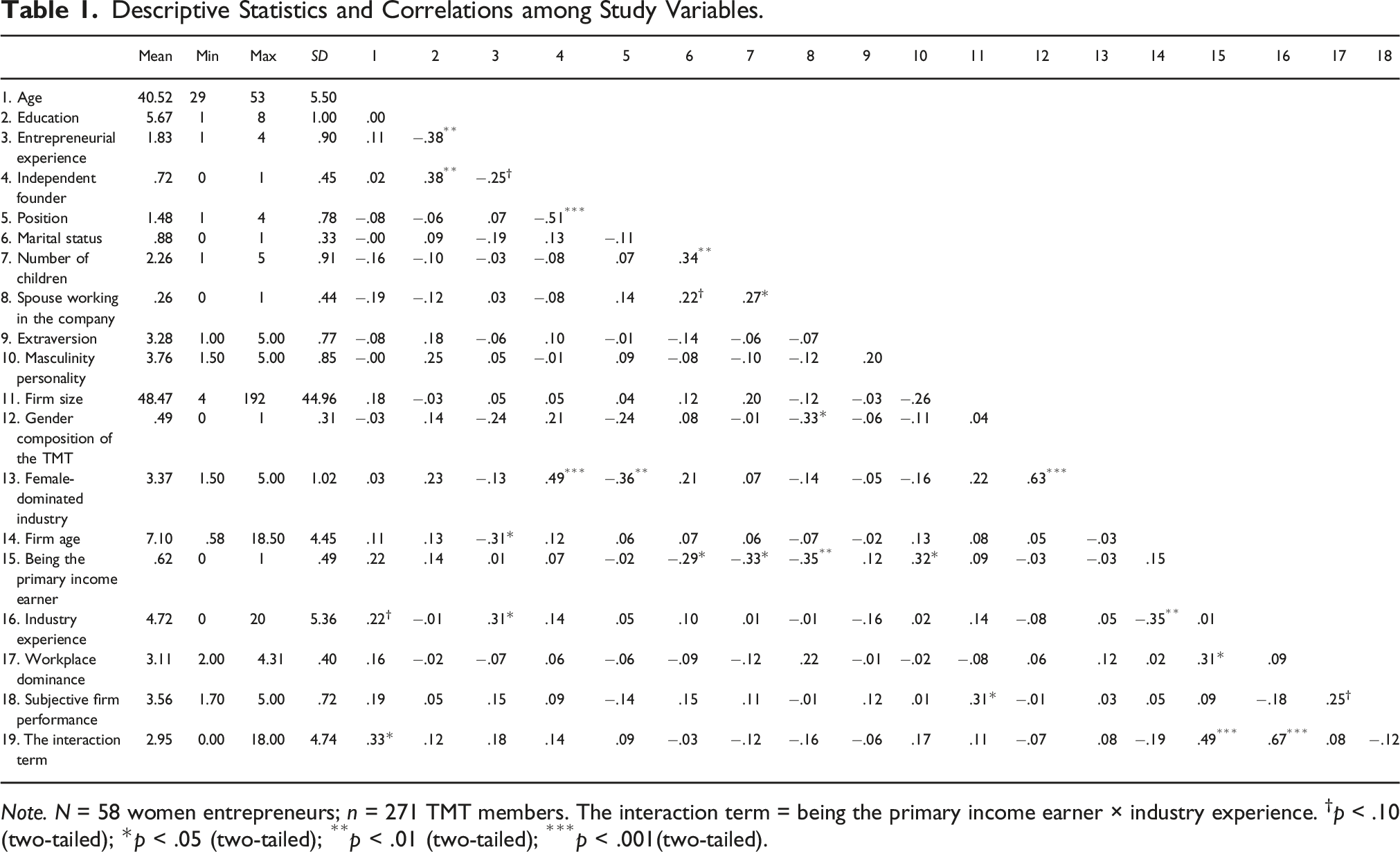
Note. N = 58 women entrepreneurs; n = 271 TMT members. The interaction term = being the primary income earner × industry experience. †p < .10 (two-tailed); *p < .05 (two-tailed); **p < .01 (two-tailed); ***p < .001(two-tailed).
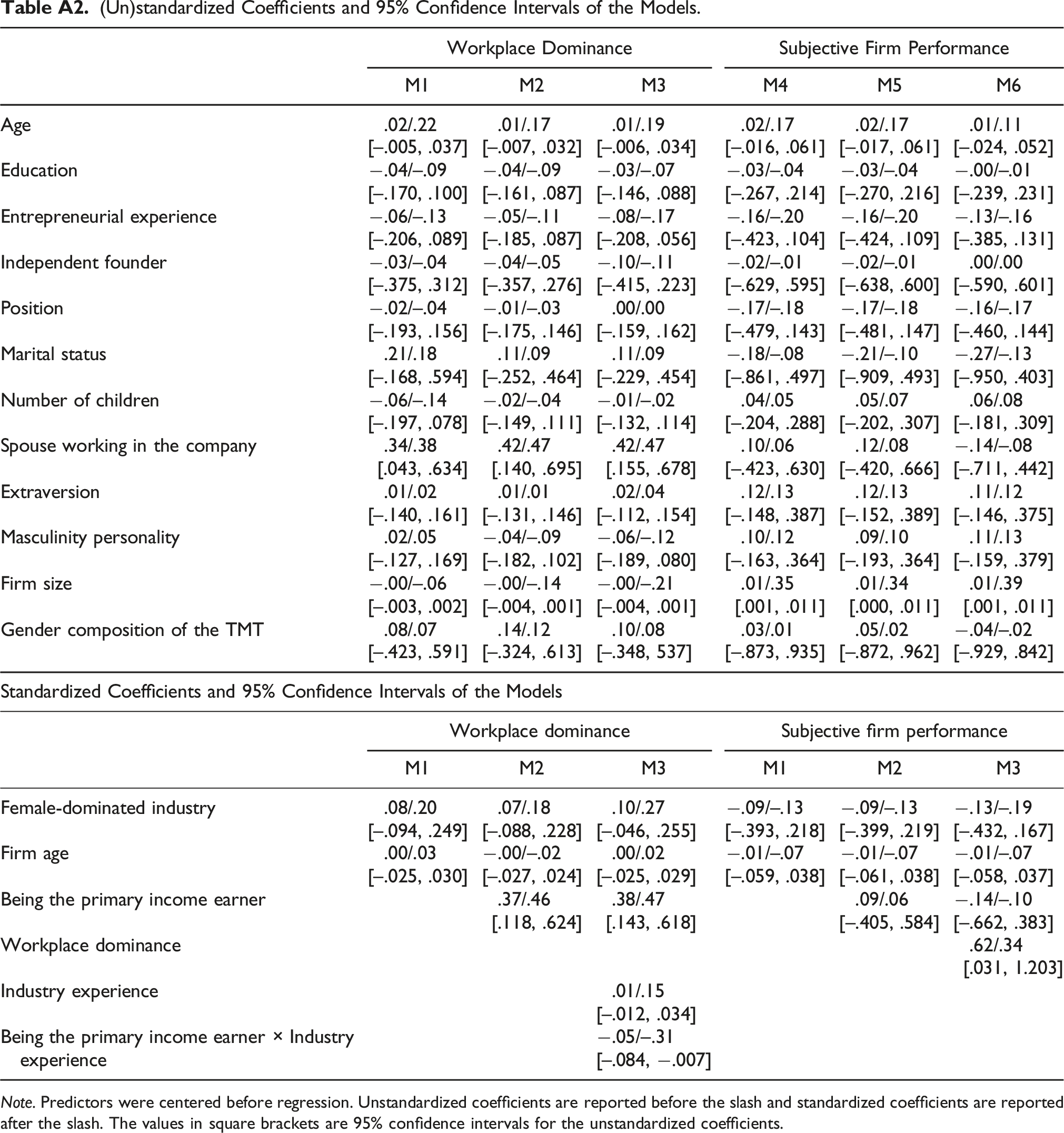
Hypothesis 1 posits that for women entrepreneurs, being the primary income earner is positively related to dominance in the work domain. For our data set, the results (see Table 2) indicated that being the primary income earner was positively and significantly associated with women entrepreneurs’ workplace dominance (B = .37, p < .01; Model 2). Thus, Hypothesis 1 was supported.
Hypothesis 2 posits that women entrepreneurs’ workplace dominance was positively related to subjective firm performance. Our results confirmed this relationship (B = .62, p < .05; Model 6). Therefore, Hypothesis 2 was supported.
The Regression Results on Workplace Dominance and Subjective Firm Performance.
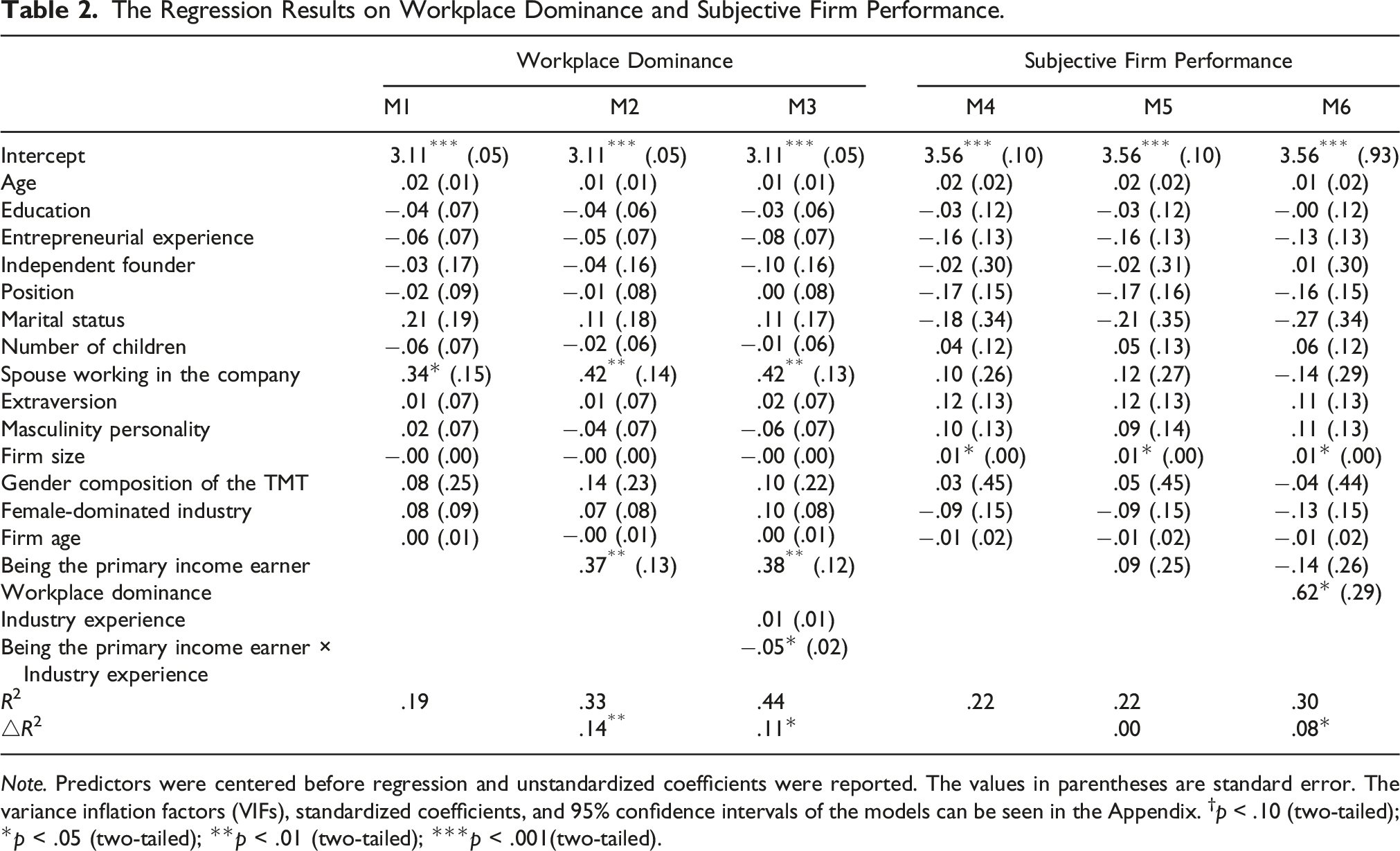
Note. Predictors were centered before regression and unstandardized coefficients were reported. The values in parentheses are standard error. The variance inflation factors (VIFs), standardized coefficients, and 95% confidence intervals of the models can be seen in the Appendix. †p < .10 (two-tailed); *p < .05 (two-tailed); **p < .01 (two-tailed); ***p < .001(two-tailed).
Hypothesis 3 predicts the mediation effect of women entrepreneurs’ dominance on the relationship between being the primary income earner and subjective firm performance. We tested this hypothesis using the PROCESS macro for SPSS, specifying Model 4 with 5000 resamples (Hayes, 2013). After including the control variables, the bootstrapping analyses (5000 resamples) showed a significant indirect effect. The coefficient for the indirect effect of women entrepreneurs’ workplace dominance was .23 (SE = .15), and the bias-corrected 95% confidence interval (CI) did not include zero (95% CI = [.026, .628]), indicating support for Hypothesis 3.
Hypothesis 4 predicts that when women entrepreneurs have more industry experience, being the primary income earner is less likely to increase their dominance in the work domain. Our results confirmed the interactive effect of being the primary income earner and industry experience on women entrepreneurs’ workplace dominance (B = −.05, p < .05; Model 3). Figure 2 graphs this interaction effect. When industry experience was at a lower level (1 SD below the mean), the relationship between being the primary income earner and women entrepreneurs’ workplace dominance was significantly positive (simple slope = .60, p < .001). In contrast, when industry experience was at a higher level (1 SD above the mean), the relationship became nonsignificant (simple slope = .13, n.s.). Thus, Hypothesis 4 was supported.
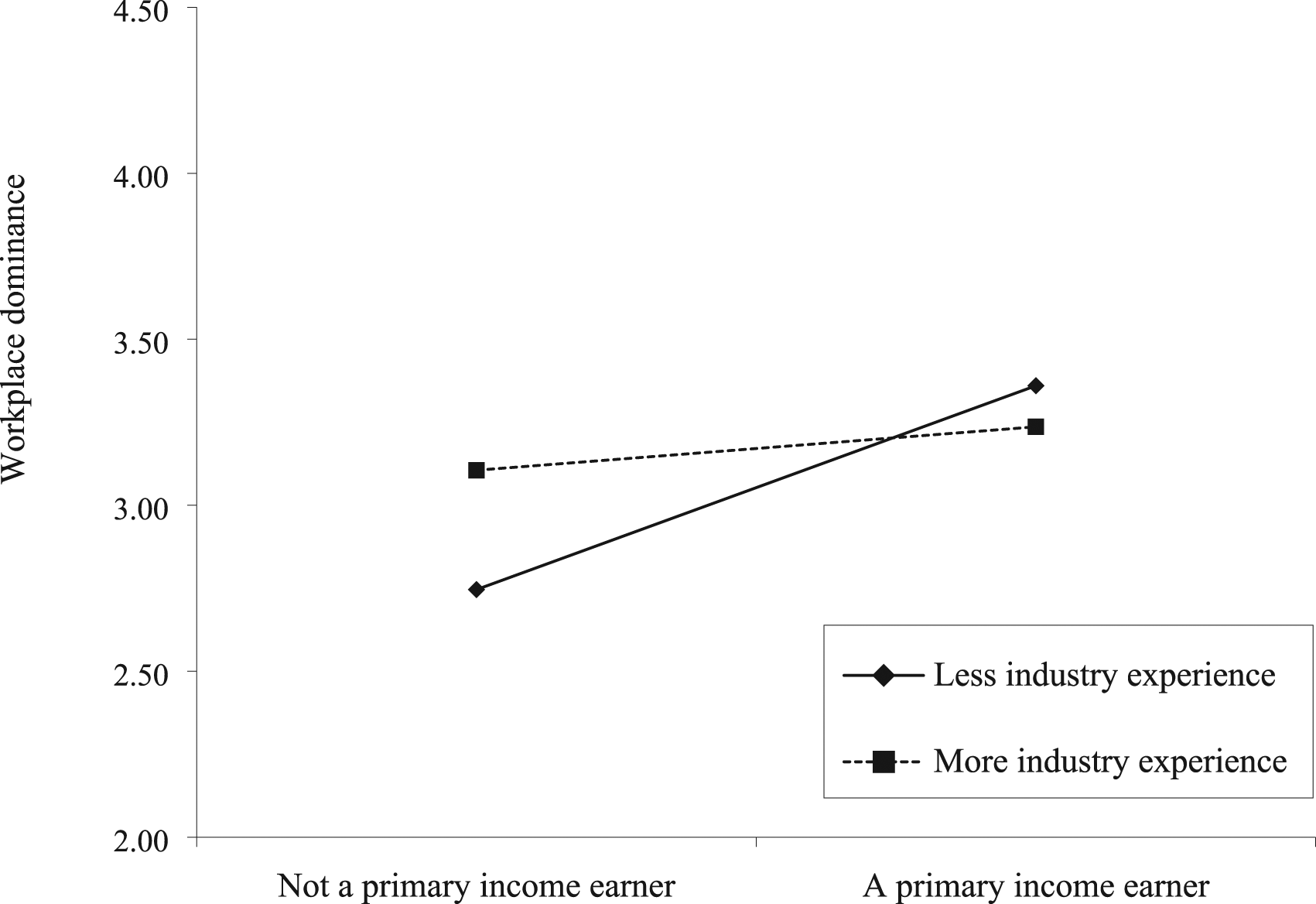
The moderation effect of industry experience on the relationship between being the primary income earner and workplace dominance.
Hypothesis 5 proposes an integrative moderated mediation model, in which industry experience moderates the indirect effect of being the primary income earner on subjective firm performance through women entrepreneurs’ workplace dominance, such that this indirect effect is weakened when they have more (rather than less) industry experience. We tested this hypothesis using the PROCESS macro for SPSS, specifying Model 7 with 5000 resamples (Hayes, 2013) after including all control variables. The results showed that the index of the moderated mediation effect was −.03 (95% CI = [–.095, −.001]. When industry experience was at a lower level (1 SD below the mean), the indirect effect of being the primary income earner on subjective firm performance through women entrepreneurs’ workplace dominance was significant (indirect effect = .37, 95% CI = [.045, .940]). By contrast, when industry experience was at a higher level (1 SD above the mean), the indirect effect of being the primary income earner on subjective firm performance through women entrepreneurs’ workplace dominance was not significant (indirect effect = .08; 95% CI = [–.066, .440]). Thus, Hypothesis 5 was supported.
Supplemental Analyses
To reach more robust conclusions, we tested whether the reverse relationship exists. It seems that women entrepreneurs who are more dominant in the workplace tend to earn more money, and such desirable firm performance allows them to provide a larger share of the household income. However, our results showed that the indirect effect of workplace dominance on being the primary income earner via subjective firm performance was not significant (indirect effect = .02, CI = [–.543, .638]). When we included the control variables mentioned earlier, we also reached the same conclusion. These results may allow us to rule out this alternative explanation.
Although the aim of our research is to understand firm consequences, it is also interesting to consider the influences of family factors and workplace dominance on women entrepreneurs’ psychological reactions (Byrne & Barling, 2017). Hence, we conducted a supplemental analysis that focused on well-being and job satisfaction measured in T2 as outcomes. 2 The results showed that being the primary income earner was not significantly related to well-being (B = −.18, p = .360) and job satisfaction (B = .26, p = .154); workplace dominance was also not significantly related to well-being (B = .15, p = .529) but was significantly related to job satisfaction (B = .45, p = .040). Without any control variables, we reached consistent conclusions except for the marginally significant relationship between workplace dominance and job satisfaction (B = .33, p = .089). In regard to the positive relationship between workplace dominance and job satisfaction, we suspect that dominant behavior may satisfy women entrepreneurs’ need for autonomy and control motivation/preferences and thus enhance their satisfaction in the workplace. Overall, we concluded that being the primary income earner and workplace dominance play only minor roles in inducing women entrepreneurs’ well-being and job satisfaction.
Discussion
While based on an admittedly small sample, our study offers some intriguing results. Specifically, we found that being the primary income earner was positively related to women entrepreneurs’ workplace dominance and, in turn, positively related to subjective firm performance. Further, more industry experience weakened the positive relationship between being the primary income earner and workplace dominance as well as the indirect effect of being the primary income earner on subjective firm performance via workplace dominance.
Theoretical Contributions
The study makes important contributions to the literature on women entrepreneurship. First, we addressed a fundamental but unexplored question, “Why do some women entrepreneurs behave dominantly while others do not?”, based on the family embeddedness perspective (Aldrich & Cliff, 2003; Jennings & Brush, 2013). Notably, while women entrepreneurs tend to adopt certain behaviors, little research has explicitly explored which factors trigger these behaviors. More recent studies have mostly examined women entrepreneurs’ traits as the antecedents of their behaviors (Bamiatzi, Jones, Mitchelmore, & Nikolopoulos, 2015), leaving us still unclear about the relationship between family factors and women entrepreneurs’ workplace behaviors. Indeed, as Quagrainie (2016) indicated, family issues (e.g., marital status and children) that affect women entrepreneurial activities have not been highlighted in the literature.
To bridge this gap, our study verified that those women entrepreneurs who become primary income earners are more likely to behave dominantly than those who are not primary income earners. This factor plays a significant role in trigging their dominant behaviors in the workplace, and we found that this relationship persisted even when we controlled for a variety of demographic attributes, family factors, personalities, and firm characteristics. Although gender stereotypes describe and strongly prescribe expected and acceptable behaviors for individuals (Brescoll & Uhlmann, 2005; Heilman, 2001; Prentice & Carranza, 2002), our research confirms that women entrepreneurs’ workplace behavior results from self-selection, demonstrating that being the primary income earner is a key source of influence on women entrepreneurs’ displays of dominance in the workplace.
To our knowledge, although family factors—family composition, women’s roles in the family (i.e., employment rates, time spent on housework, and proportion of children work for their own income), and relationships (i.e., parents’ involvement in their children’s activities, parents’ reduced role in the socialization of their children, and declines in intergenerational contact)—have been explicitly proposed to be salient influences in the prior entrepreneurship research, the income issue—that is, women entrepreneurs’ contribution to the family income—has been understudied, despite the importance of this topic (for a review, see Aldrich & Cliff, 2003). Notably, being the primary income earner has high relevance for agentic behaviors in the workplace (Lundberg & Kristenson, 2008). In this study, we argue that being the primary income earner (or not) is an important family factor because it accurately reflects one’s financial status at home—that is, whether women entrepreneurs wield economic power in their own households (or not). Thus, it is important to examine the role of the family income structure to understand women entrepreneurs’ work-related behavior (Aldrich & Cliff, 2003; Jennings & Brush, 2013). Our research further highlights the family embeddedness perspective by examining this across-domain phenomenon and improves our understanding of why women entrepreneurs go against their instincts to engage in dominant behaviors by introducing “being the primary income earner” as a key factor. More broadly, our work responds to the call to emphasize and examine the role of family factors in the women’s entrepreneurship phenomenon using a family embeddedness lens (e.g., Aldrich & Cliff, 2003; Jennings & Brush, 2013; Tedmanson, Verduyn, Essers, & Gartner, 2012).
Additionally, in the extant financial and income status research, most research has verified the influences of one’s financial or income status on health (e.g., Hamilton, Noh, & Adlaf, 2009; Kohlbacher & Chéron, 2012) and well-being (e.g., Martos & Kopp, 2012). However, little is known about what role this status plays in the entrepreneurship domain. By emphasizing the role of being the primary income earner, our study advances the financial and income status research by extending its outcomes across domains (from family to work).
Second, our findings allow us to conclude that for women entrepreneurs, being the primary income provider rather than a minor income earner (i.e., having dominance in family income) has a spillover effect on subjective firm performance through increased display of dominant behaviors in the workplace. Previous studies have focused on the linkage between family experiences and firm outcomes (e.g., Alam et al., 2011; Heck et al., 2006; Kamitewoko, 2013; Masuo et al., 2001), yet it remains an open question how family factors shape this process, especially for women entrepreneurs. The present research is among the first studies to elucidate the mechanism by which crucial family factors indirectly affect women entrepreneurs’ firm outcomes. By doing so, this research advances the dialogue about a spillover effect connecting the family domain to the work domain (Menges, Tussing, Wihler, & Grant, 2017) and adds to the knowledge base by clarifying how a family factor works in influencing women entrepreneurs’ firm-related outcomes.
Relatedly, though much research has addressed the antecedents of firm performance, little attention has been paid to family factors. Our results indicated that compared with those who show little dominance in the workplace, women entrepreneurs who behave dominantly are more likely to achieve better subjective firm performance due to their positive expectation violations. Hence, our study provides important insights by highlighting a distal outcome of being the primary income earner (i.e., subjective firm performance), thereby adding to our understanding of the link between women entrepreneurs’ family factors and entrepreneurial outcomes. It seems as if a mixture of influences combines to prompt women entrepreneurs to behave dominantly, but we still know little about when such behaviors are more likely to benefit them. Our study reveals that under one condition (i.e., the entrepreneurship circumstance), there are positive consequences for women entrepreneurs who behave dominantly. That is, workplace dominance as a favorable expectation violation leads to more salient positive outcomes.
Finally, this study contributes to the women entrepreneurship literature by illuminating the moderating role of industry experience in the process by which dominance spills over from family to work. Our findings suggest that being the primary income earner serves as a less powerful influence on workplace dominance when women entrepreneurs have more industry experience. In revealing this relationship, our study clarifies the importance of examining work-related factors when investigating the impact of family factors on women entrepreneurs’ behaviors. To date, little research has investigated why women entrepreneurs engage in dominant behaviors, but our study not only verified the important role of family factors, but also highlighted the substitution effect in family and work factors. We believe that this investigation sheds light on the functions of a work factor in explaining how the link between a family factor (i.e., being the primary income earner) and women entrepreneurs’ dominant behaviors plays out. More importantly, this understanding is important and timely given the application of the family embeddedness perspective (Aldrich & Cliff, 2003; Jennings & Brush, 2013), as it highlights that both family and work factors are critical in understanding women entrepreneurs’ dominant behaviors in the workplace and suggests that focusing on just one aspect may stymie attempts to gain a full picture of women entrepreneurs’ behaviors.
Practical Implications
Our research findings have several important managerial implications for women entrepreneurs. Our study sheds light on one possible reason why women entrepreneurs may engage in dominant behaviors in the workplace. Although traditional views assume women should possess communal (rather than agentic) characteristics, family factors play a crucial role in shaping women entrepreneurs’ behaviors. Women entrepreneurs are encouraged to be aware of the importance of family factors because their economic status at home matters for their workplace behavior and firm performance. Relatedly, women entrepreneurs could engage in appropriate adjustments of the economic structures in their families. That is, they are encouraged to exert more control over their family’s financial resources and sources by contributing more to family income where possible. At the least, women entrepreneurs can increase their awareness that they can assume greater financial responsibility at home, which would then influence their attitudes toward, and values related to family and work (Aldrich & Cliff, 2003). In turn, this perspective is expected to urge them to behave dominantly at work. Moreover, women entrepreneurs should not allow their financial situations at home (i.e., being a primary earner or not) for influencing their work-related attitudes and behaviors in a harmful way. We suggest that they should fully and appropriately apply the functions of economic situations in the family domain to achieve success in the work domain.
Our research also speaks to how industry experiences feed into entrepreneurial activities and actions. Our study indicates that less industry experience translates into a positive effect of being the primary income earner on outcomes in the work domain. Put differently, being the primary income earner is able to compensate for less industry experience. Given that, we suggest that when women entrepreneurs have little industry experience, they need bold actions (i.e., being primary income earners) to establish their dominance and to succeed. Conversely, when women entrepreneurs have sufficient industry experience, they are encouraged to avoid excessive reliance on prior experiences when forming and changing their role expectations in the workplace, but can still pay great attention to lessons learned from being the primary income earner. We do not mean to suggest that industry experience does not matter in entrepreneurship; rather, our research emphasizes that women entrepreneurs should take both industry experience and family factors (i.e., being the primary income earner) into consideration and enhance the awareness of their substitution effects. In essence, our results help legitimize the notion that families and businesses are inextricably intertwined in the entrepreneurial setting (Aldrich & Cliff, 2003).
Finally, given the potential beneficial effects of workplace dominance on subjective firm performance, we suggest that women entrepreneurs actively break away from traditional expectations, and try to cultivate their agentic characteristics in the workplace. In other words, women entrepreneurs may be well served by adjusting their behaviors so that they exhibit more dominance in the workplace. For example, they can claim a dominant position and experience success in this role by acting assertively rather than being submissive in decision-making processes. However, we also caution that women entrepreneurs cannot act more dominantly at will and regardless of the specific context, because the consequences of one’s behaviors inevitably depend on the context (Burgoon, 1993; Burgoon & Jones, 1976). Our study highlights that in China and the entrepreneurship context, behaving dominantly could benefit subjective firm performance, but that relationship may not hold in some other environments. For instance, Ayub, Razzaq, Aslam, & Iftekhar (2013) revealed that women entrepreneurs in fast-paced businesses need to be competitive to survive—but the same may not be true in less competitive industries. In this study, we push for a more inclusive view of success and behaviors for women entrepreneurs. Hence, when women entrepreneurs engage in dominant behavior, they should recognize the current context and take pains to avoid any backlash from exhibiting such behaviors in the workplace.
Additionally, we emphasize that the perception of firm performance is important for women entrepreneurs and their ventures. This is because our additional analysis showed that subjective firm performance was significantly and positively related to such psychological outcomes as well-being (r = .48, p < .001) and job satisfaction (r = .49, p < .001). Indeed, the above results are consistent with the findings of prior research such that subjective evaluations of firm performance positively influence entrepreneurs’ well-being (for a review, see Stephan, 2018). As such, we encourage women entrepreneurs not to only focus on objective performance; instead, they should also pay attention to and enhance their subjective evaluations of firm performance.
Limitations and Future Directions
Although our hypotheses were supported, we note some limitations that suggest directions for future research. First, we integrated a new family embeddedness perspective in our model to examine why women entrepreneurs behave dominantly by focusing on one family factor (i.e., being the primary income earner). Future research should explore other important family factors to expand our understating of the link between family factors and women entrepreneurs’ specific behaviors. For example, household characteristics such as marriage and spousal self-employment may impact the way women entrepreneurs behave. If women entrepreneurs have high family-driven motivation, they may be more likely to perceive an additional impetus to get work done (e.g., Greenhaus & Powell, 2006; Rothbard, 2001). Relatedly, given the uncertainty inherent in entrepreneurship, being the primary income earner at home could be an unstable variable that might change over time. We encourage further research to adopt experience sampling methods to collect daily or weekly data to capture this phenomenon more accurately. Likewise, it would be interesting to examine how changes in incomes influence changes in women entrepreneurs’ behaviors and how long the effects endure.
Second, workplace dominance plays the mediating role in our model. Although it explains how being the primary income earner influences subjective firm performance, alternative mechanisms might also exist. For instance, women entrepreneurs’ leadership may be affected by the family factor (i.e., being the primary income earner), which in turn exerts an effect on subjective firm performance. Relatedly, our investigation of the moderating effect of industry experience adds to our knowledge of when family does (and does not) matter for women entrepreneurs’ workplace dominance. It also provides a new direction for future research—namely, taking other important factors into consideration, such as women entrepreneurs’ personal factors and experiences. For example, if women entrepreneurs believe in gender determinism (Tinsley, Howell, & Amanatullah, 2015) and tend to recognize the necessity of having agentic characteristics in the workplace, those factors may enhance the positive effects of being the primary income earner on workplace dominance. In addition to the firm consequences, it would be interesting to explore the relationships between dominant behavior and women entrepreneurs’ psychological reactions and outcomes. Despite the initial findings in our supplemental analysis, we argue that those non-significant relationships may be affected by as-yet-unexamined boundary conditions. Hence, we encourage further research to take a further step to investigate this issue by examining other boundary conditions and including more psychological or health-related outcomes.
Third, we did not measure some of the mechanisms underlined in developing our hypotheses. For instance, based on expectancy violations theory, we argue that women entrepreneurs’ workplace dominance will lead to favorable violations, yet we did not ask our participants to measure their perceptions of expectation violations. These theories have been strongly supported in many research fields (Burgoon, 1993; Burgoon & Hale, 1988; Eagly, 1987; Eagly & Karau, 1991; Franke, Crown, & Spake, 1997), but we suggest that future research empirically test whether these mechanisms exist; such investigations would be beneficial for explaining women entrepreneurs’ behaviors and outcomes.
Fourth, despite our use of a multi-wave survey, we cannot draw any conclusions about the causality of the hypothesized relationships or speak to their overall temporal dynamics. Our supplemental analysis indicated that the indirect effect of workplace dominance on being the primary income earner via increased subjective firm performance was not significant, which to some extent rules out alternative explanations. However, it is plausible that other reverse relationships may exist. We suggest that future longitudinal studies with differing time frames explore these possible relationships proposed in our study. Furthermore, our research focused on subjective firm performance theoretically and empirically. Subjective measures are not only preferable when the emphasis is on inter-firm comparisons (Ketokivi & Schroeder, 2004), but also warranted because they are positively related to objective measures (Venkatraman & Ramanujam, 1987; Wall et al., 2004). Despite this caveat, we encourage scholars to consider objective measures, such as financial outcomes, to provide a more robust conclusion.
Fifth, our study suffers from a small sample, though we have shown it has adequate power and found support for our hypotheses. It is reasonable for future research to collect more data to enhance research power. Another important direction is to examine whether the present findings generalize to other countries. Cultural differences may potentially be an issue in our research, as our sample of Chinese women entrepreneurs may not necessarily be representative of most of the world’s populations (Henrich, Heine, & Norenzayan, 2010). For example, in a Western culture, people may prefer low power distance and thus may consider women entrepreneurs’ dominance to be a negative expectancy violation. However, given that the phenomenon of women entrepreneurship generally exists around the world, and since even in one country, people may have various cultural tendencies owing to their previous personal experiences (Moschis, Sim Ong, Abessi, Yamashita, & Mathur, 2013), we believe that our findings should apply to other countries. To verify this, future studies could replicate these findings in diverse populations, to test whether the effects of being the primary income earner on subjective firm performance via women’s workplace dominance and the moderating effect of industry experience generalize across different industries, countries, and cultures.
Conclusion
This research, drawing on a family embeddedness perspective and expectancy violations theory, represents an initial attempt to explore the impacts of being the primary income earner on subjective firm performance via workplace dominance and to clarify the role of industry experience. It contributes to the women entrepreneurship literature in several important ways. We hope our study arouses scholars’ interest and prompts them to explore these issues further.
Footnotes
Appendix
First, we provided the variance inflation factors (VIFs) of all models to assess the potential influence that multicollinearity had on the findings. These results, which are shown in Table A1, indicated that the values of the VIFs were less than 2.64. Hence, our findings are not susceptive to multicollinearity. Second, we reported (un)standardized coefficients as well as 95% confidence intervals of the models in Table A2. Variance Inflation Factors (VIFs) of the Models. (Un)standardized Coefficients and 95% Confidence Intervals of the Models. Note. Predictors were centered before regression. Unstandardized coefficients are reported before the slash and standardized coefficients are reported after the slash. The values in square brackets are 95% confidence intervals for the unstandardized coefficients.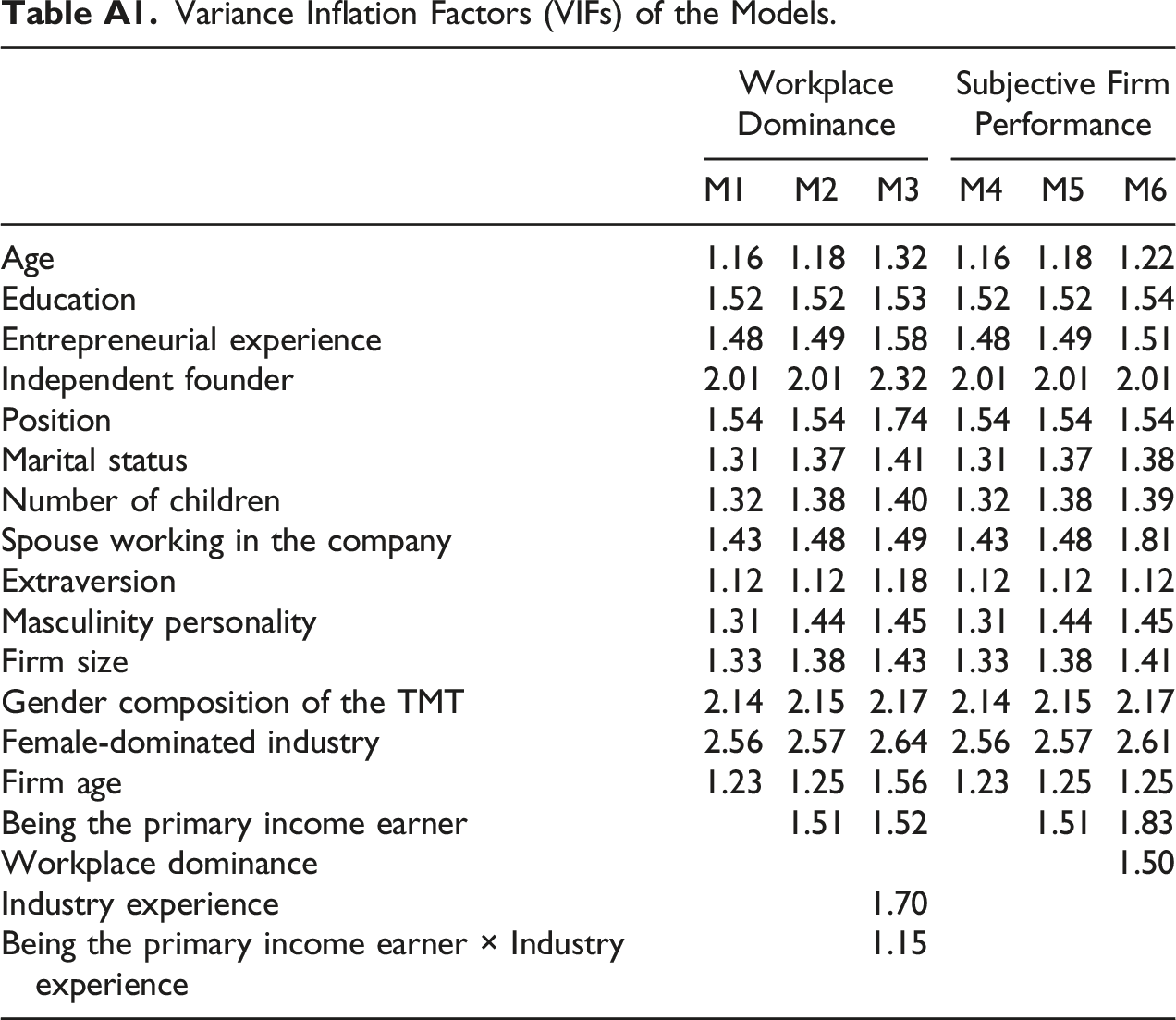
Workplace Dominance
Subjective Firm Performance
M1
M2
M3
M4
M5
M6
Age
1.16
1.18
1.32
1.16
1.18
1.22
Education
1.52
1.52
1.53
1.52
1.52
1.54
Entrepreneurial experience
1.48
1.49
1.58
1.48
1.49
1.51
Independent founder
2.01
2.01
2.32
2.01
2.01
2.01
Position
1.54
1.54
1.74
1.54
1.54
1.54
Marital status
1.31
1.37
1.41
1.31
1.37
1.38
Number of children
1.32
1.38
1.40
1.32
1.38
1.39
Spouse working in the company
1.43
1.48
1.49
1.43
1.48
1.81
Extraversion
1.12
1.12
1.18
1.12
1.12
1.12
Masculinity personality
1.31
1.44
1.45
1.31
1.44
1.45
Firm size
1.33
1.38
1.43
1.33
1.38
1.41
Gender composition of the TMT
2.14
2.15
2.17
2.14
2.15
2.17
Female-dominated industry
2.56
2.57
2.64
2.56
2.57
2.61
Firm age
1.23
1.25
1.56
1.23
1.25
1.25
Being the primary income earner
1.51
1.52
1.51
1.83
Workplace dominance
1.50
Industry experience
1.70
Being the primary income earner × Industry experience
1.15
Workplace Dominance
Subjective Firm Performance
M1
M2
M3
M4
M5
M6
Age
.02/.22
.01/.17
.01/.19
.02/.17
.02/.17
.01/.11
[–.005, .037]
[–.007, .032]
[–.006, .034]
[–.016, .061]
[–.017, .061]
[–.024, .052]
Education
−.04/–.09
−.04/–.09
−.03/–.07
−.03/–.04
−.03/–.04
−.00/–.01
[–.170, .100]
[–.161, .087]
[–.146, .088]
[–.267, .214]
[–.270, .216]
[–.239, .231]
Entrepreneurial experience
−.06/–.13
−.05/–.11
−.08/–.17
−.16/–.20
−.16/–.20
−.13/–.16
[–.206, .089]
[–.185, .087]
[–.208, .056]
[–.423, .104]
[–.424, .109]
[–.385, .131]
Independent founder
−.03/–.04
−.04/–.05
−.10/–.11
−.02/–.01
−.02/–.01
.00/.00
[–.375, .312]
[–.357, .276]
[–.415, .223]
[–.629, .595]
[–.638, .600]
[–.590, .601]
Position
−.02/–.04
−.01/–.03
.00/.00
−.17/–.18
−.17/–.18
−.16/–.17
[–.193, .156]
[–.175, .146]
[–.159, .162]
[–.479, .143]
[–.481, .147]
[–.460, .144]
Marital status
.21/.18
.11/.09
.11/.09
−.18/–.08
−.21/–.10
−.27/–.13
[–.168, .594]
[–.252, .464]
[–.229, .454]
[–.861, .497]
[–.909, .493]
[–.950, .403]
Number of children
−.06/–.14
−.02/–.04
−.01/–.02
.04/.05
.05/.07
.06/.08
[–.197, .078]
[–.149, .111]
[–.132, .114]
[–.204, .288]
[–.202, .307]
[–.181, .309]
Spouse working in the company
.34/.38
.42/.47
.42/.47
.10/.06
.12/.08
−.14/–.08
[.043, .634]
[.140, .695]
[.155, .678]
[–.423, .630]
[–.420, .666]
[–.711, .442]
Extraversion
.01/.02
.01/.01
.02/.04
.12/.13
.12/.13
.11/.12
[–.140, .161]
[–.131, .146]
[–.112, .154]
[–.148, .387]
[–.152, .389]
[–.146, .375]
Masculinity personality
.02/.05
−.04/–.09
−.06/–.12
.10/.12
.09/.10
.11/.13
[–.127, .169]
[–.182, .102]
[–.189, .080]
[–.163, .364]
[–.193, .364]
[–.159, .379]
Firm size
−.00/–.06
−.00/–.14
−.00/–.21
.01/.35
.01/.34
.01/.39
[–.003, .002]
[–.004, .001]
[–.004, .001]
[.001, .011]
[.000, .011]
[.001, .011]
Gender composition of the TMT
.08/.07
.14/.12
.10/.08
.03/.01
.05/.02
−.04/–.02
[–.423, .591]
[–.324, .613]
[–.348, 537]
[–.873, .935]
[–.872, .962]
[–.929, .842]
Standardized Coefficients and 95% Confidence Intervals of the Models
Workplace dominance
Subjective firm performance
M1
M2
M3
M1
M2
M3
Female-dominated industry
.08/.20
.07/.18
.10/.27
−.09/–.13
−.09/–.13
−.13/–.19
[–.094, .249]
[–.088, .228]
[–.046, .255]
[–.393, .218]
[–.399, .219]
[–.432, .167]
Firm age
.00/.03
−.00/–.02
.00/.02
−.01/–.07
−.01/–.07
−.01/–.07
[–.025, .030]
[–.027, .024]
[–.025, .029]
[–.059, .038]
[–.061, .038]
[–.058, .037]
Being the primary income earner
.37/.46
.38/.47
.09/.06
−.14/–.10
[.118, .624]
[.143, .618]
[–.405, .584]
[–.662, .383]
Workplace dominance
.62/.34
[.031, 1.203]
Industry experience
.01/.15
[–.012, .034]
Being the primary income earner × Industry experience
−.05/–.31
[–.084, −.007]
Declaration of Conflicting Interests
The author(s) declared no potential conflicts of interest with respect to the research, authorship, and/or publication of this article.
Funding
The author(s) disclosed receipt of the following financial support for the research, authorship, and/or publication of this article: This research was supported by the Tsinghua University Initiative Scientific Research Program (No. 2021THZWJC29) awarded to Xiaoming Zheng, and was supported by the Interactive Technology Research Fund of the Research Center for Interactive Technology Industry, School of Economics and Management, Tsinghua University (No. RCITI2022T001) awarded to Xiaoming Zheng.
