




Abstract
Of the violent crimes, sexual assault remains the least likely to be reported to law enforcement across various countries, particularly for male victims. Addressing this gap in the literature, this study uses National Crime Victimization Survey data from 1992 to 2020 to examine the relationship between victim, offender, and situational characteristics to the reporting of rape for male victims by both male and female offenders. Of the 330 male victims, only one in six (16%) reported it to law enforcement. In the multivariate model, men were less likely to report the incident when the offender was a woman or a juvenile, the victim was college educated and lived in a rural area, and when the incident was a completed rape and occurred at night-time. Older victims are more likely to report, and when a weapon is used or there are injuries. Implications for efforts to increase reporting among victims of male sexual violence are discussed.
Rape and sexual assault are among the least reported serious crimes, with significant consequences for society and individual victims. Lack of reporting enables perpetrators to remain at large and diminishes the criminal justice system’s deterrent impact on sexual violence (Basile et al., 2022; Cotter, 2021; Morgan & Thompson, 2021; Office for National Statistics, 2023; Tjaden & Thoennes, 2006). Many victims abstain from reporting due to fear of secondary victimization, skepticism about criminal justice personnel, in particular law enforcement’s ability to help, and concerns of not being believed (Black et al., 2011; Jones et al., 2009). The likelihood of victims seeking essential services decreases when incidents of rape are not reported to law enforcement which is especially alarming considering the potential need for medical and mental health interventions or may be eligible for victim compensation (Fisher et al., 2003; Rennison, 2002; Williams & Toney, 2003). Male victims, in particular, face negative stereotypes and disbelief (Donnelly & Kenyon, 1996; Kassing et al., 2005), and their experiences are often overlooked in research that predominantly focuses on the male offender-female victim paradigm (Walfield, 2021). This study aims to elucidate the reporting behaviors of male victims of sexual assault to law enforcement using self-report data.
Prevalence of Sexual Offenses Among Men
Research across a number of English-speaking countries have consistently found a large number of men are victims of sexual assault, yet the vast majority never report it to law enforcement. Nationally representative surveys conducted in the United States, Canada, England, and Wales have reported that approximately 0.1%–1.2% of men experienced a sexual assault in the last year (Basile et al., 2007, 2022; Cotter, 2021; Office for National Statistics, 2023; Tjaden & Thoennes, 2006). When expanding this to an individual’s lifetime, rates are much higher and again are consistent between countries with studies conducted in the United States typically finding that 1–4% of men have reported completed or attempted rape victimization (Basile et al., 2022; Black et al., 2011; Tjaden & Thoennes, 2006). Results from the most recent National Intimate Partner and Sexual Violence Survey, conducted in 2016–2017, indicate that at some point in their lives, 3.8% of men reported completed or attempted rape victimization, 10.7% reported being made to penetrate someone or were sexually coerced, and one quarter of men indicated unwanted sexual contact; while high, these rates are substantially lower than female victims (Basile et al., 2022). Data outside of the U.S. is limited, with the Crime Survey for England and Wales ([CSEW] Cotter, 2021), estimating that 5.7% of men have experienced sexual assault since the age of 16—though they caution that COVID may have caused undercounting due to lower response rates. Data from Australia suggest a similar prevalence rate, with 5.1% of men experiencing sexual assault since the age of 18—however, the in-depth report on sexual violence was limited to women’s sexual victimization by men (Australian Bureau of Statistics, 2023).
These surveys likely underestimate the true prevalence of sexual violence, particularly for male victims who may not want to identify as a victim (Fisher et al., 2003; National Research Council, 2014; Reed et al., 2019; Stemple & Meyer, 2014). For example, a study conducted among female college students who experienced the legal definition of rape labeled it as such (Fisher et al., 2003). A more recent study that included both male and female victims found that among college students who had experienced rape since the age of 14, male victims were much less likely to acknowledge their own victimization than female victims (Reed et al., 2019). Specifically, 80% of men did not acknowledge their victimization and men were more likely to endorse rape myths which are stereotypical and false beliefs that result in a rape-supportive climate hostile to victims (e.g., “the extent of a man’s resistance should be a major factor in determining whether he was raped” and “if a woman doesn’t say ‘no’, she can’t claim rape” (Walfield, 2021)). However, many studies do not include other aspects of sexual violence pertinent to male victims such as when they are made to penetrate others (see Basile et al., 2022; Black et al., 2011; Weare, 2021). In the United States, the FBI, which publishes the authoritative source of national-level crime statistics, only began collecting data on male victims of sexual assaults in 2012 (Bierie & Davis-Siegel, 2015).
Reporting Rape and Barriers
Studies of crime reporting have consistently found that victims of sexual assault are less likely to notify police of their victimization than for other serious, violent crimes. How a victim perceives others will respond has important implications for who the victim will confide in, should he do so. The choice of victims to report can be shaped by the specifics and circumstances surrounding the rape, alongside the victim’s personal difficulty in recognizing the incident as a criminal act (Reed et al., 2019). Fisher et al. (2003) observed that victims tend to report the assault to law enforcement when the characteristics of the assault enhance its believability. Research has indicated rapes, which include violence, require medical care, are committed by a stranger, and involved co-occurring offenses, are more likely to be reported but less likely if the victim had used drugs and/or alcohol, engaged in “risky” behavior, or violated traditional gender norms; other characteristics such as employment, income, education, and victim sex have also been found to be associated with reporting as well (Jones et al., 2009; Pino & Meier, 1999).
Specifically, Jones et al. (2009) found that female victims that were employed, engaged in alcohol or drug use in the preceding 24 hours, and knew the aggressor were less likely to report. Among those that did not report, more than half indicated they did not do so because police would be insensitive or engage in victim blaming—the second most endorsed statement. Results from the National Women’s Study Replication were similar, with nearly half (43%) of the victims who did not report state it was because of criminal justice concerns (Cohn et al., 2013). However, both studies only included female victims. Hart and Rennison (2003) found that 32% of females reported their victimization—slightly higher than males (27%)—between 1992 and 2000. These numbers are higher than what was found in Canada as well as England and Wales, with approximately one in seven reporting their victimization to law enforcement in those countries (Cotter, 2021; Office for National Statistics, 2023).
In one of the first studies to include both males and females, researchers found women were 20 times more likely than men to report to law enforcement: 15.7% and 0.8%, respectively; and none of the victimized males sought services at a rape crisis center (Sorenson & Siegel, 1992). Results from the nationally representative National Violence Against Women Survey (NVAWS) indicated slightly higher reporting rates of male victims who were raped since their 18th birthday (12.9%), though these data suggest males were still half as likely as females to report (Tjaden & Thoennes, 2006). Similarly, research utilizing the NCVS has consistently found women are more likely to report than men, albeit these surveys show higher report rates than the NVAWS (Hart & Rennison, 2003; Pino & Meier, 1999; Weiss, 2010). However, as other nationally representative studies examining rape experiences in the United States have not included male victims, such as the National Women’s Study Replication (Wolitzky-Taylor et al., 2011) and the National Drug-Facilitated, Incapacitated, and Forcible Rape study (Kilpatrick et al., 2007), data are limited in this regard. Additionally, the most recent NISVS does not query respondents on whether they reported their victimization to law enforcement (Basile et al., 2022).
The lack of reporting is especially salient for male victims—as Scarce notes (1997, p. 230), “men, in general, do not want to identify men as being victimized by sexual crimes because there is no way to see men as ‘victims’ and still as men”. This is particularly pertinent when men are sexually victimized by women who must confront sex and gender roles such as always wanting to have sex even if it is forced or not being believed in the first place (Walfield, 2021). Furthermore, male victims must also deal with perceptions of the incidents whereby “the negative experiences involve negative judgements pertaining to homosexuality, which seem to impact not only homosexual male rape victims, but also heterosexual male rape victims in that the police presume that all male rape victims are gay” (Javaid, 2015, p. 88).
This is particularly pertinent considering the masculine culture of law enforcement and these concerns are well founded. For instance, Page, 2008 found that among eight different types of victims including men, women, and children, men were the second most likely group to not be believed by law enforcement, only prostitutes were met with more disbelief. Likewise, in a study of providers who offer services to sexual assault victims which included both law enforcement and the third sector, most respondents were influenced by gender role stereotypes and adhered to traditional stereotypes of men (Donnelly & Kenyon, 1996). One law enforcement officer remarked that “most males that are fondled or sodomized are males that want to be sodomized. . . we just don’t see that many adult males, so that leads me to believe that there is just not a problem” (Donnelly & Kenyon, 1996, p. 445). Collectively, as the limited research conducted has identified the reporting rate to be quite low as well and the consequences to an individual’s mental and psychological health apparent, this represents a pressing issue that has started to gain increasing attention (Weare, 2021).
Aggravated and Simple Rape
Since the 1960s, researchers have argued that the criminal justice system treats sexual assaults differently based on their legal and extralegal characteristics (Brownmiller, 1975; Estrich, 1984; Kalven & Zeisel, 1966; Williams, 1984). Early researchers posited that jury decision making in rape cases varied based on the classification of the rape as either “simple” or “aggravated.” 1 They described “simple rape” as an incident involving a solitary acquaintance without the use of a weapon or visible injuries to the victim. In contrast, “aggravated” cases were characterized by one or more of the following: attacks by strangers, involvement of multiple assailants, the employment of a weapon, and/or visible harm to the victim.
Expanding upon this conceptual foundation, Estrich (1984) contends that the criminal justice system and societal perceptions are swayed by the non-legal characteristics of rape incidents. She noted that certain cases are deemed more credible and severe due to prevailing rape stereotypes and perceptions of victims, a phenomenon she labeled as “real rape.” According to Venema (2016) and Williams (1984), “real rape” scenarios typically involve strangers as perpetrators, evidence of violence or victim resistance like injuries or the use of weapons, multiple assailants, and additional concurrent crimes, all contributing to the notion of a “legitimate” rape occurrence (Du Mont et al., 2003). However, research conducted across multiple countries indicate these types of rapes are quite rare, with most incidents committed resembling simple rape (Basile et al., 2022; Black et al., 2011; Fisher et al., 2003; Kilpatrick et al., 2007; Office for National Statistics, 2023; Tjaden & Thoennes, 2006; Wolitzky-Taylor et al., 2011). Supporting this, Pino and Meier (1999) found these types of offenses rare but if they involved a physical injury and required medical attention, they were significantly more likely to be reported to law enforcement than when these factors were absent. However, only a limited number of victim and incident characteristics were tested, including the sex of the offender which was not related to the decision to report in the multivariate analysis. Using medical records rather than survey data, researchers examined 112 male victims of sexual violence who sought out medical services in Italy, and found only 40% were adults at the time of the assault, were victimized by a male, and their cases resembled ‘simple rape’: only 4% used weapons, the majority of victims knew the perpetrator, two thirds involved a solo offender, and less than half were victims of anal rape (Margherita et al., 2021).
Rapes that lack these qualities are taken less seriously throughout the criminal justice system. Studies typically reveal that incidents resembling “simple rape” are not only less frequently reported, but when they are, such cases are more likely to be exceptionally cleared or remain unresolved rather than leading to the arrest of the perpetrator. (Du Mont et al., 2003; Pattavina et al., 2016 Tellis & Spohn, 2008; Walfield et al., 2022; Williams, 1984; c.f., Horney & Spohn, 1996). Even among the cases that do go to trial, recent research conducted in England and Wales found that the “real rape” stereotype was used as the standard by defense attorneys in order to mislead the jury—a tactic rarely challenged by either the prosecution or the judges (Temkin et al., 2018). In conclusion, victims, like law enforcement, may take a “downstream orientation” to how the case may play out when making the decision to report.
Current Study
The objective of this study was to gain an understanding of what factors (victim and offender demographics in addition to incident characteristics) predict reporting to law enforcement by a male victim following sexual violence.
To what extent are legal and extralegal characteristics associated with the decision to report to law enforcement?
How does the victim’s background affect the decision to report sexual violence to law enforcement?
Methodology
Data
This study used the United States National Crime Victimization Survey (NCVS) concatenated file from 1992 to 2020 (U.S. Department of Justice, 2021). These years represent available NCVS data since its redesign in 1992 (see Bachman & Saltzman, 1995; Rennison & Rand, 2007) which was meant to elicit greater reports on special types of victimizations (e.g., rape) and changed how survey respondents were queried. The NCVS is the primary source of information on criminal victimization in the United States regarding crimes both reported and not reported to law enforcement, collecting data annually since 1973 on a wide range of victimizations, including sexual assault and rape (U.S. Department of Justice, 2021). This anonymous survey employs a nationally representative sample of households and collects data annually from residents aged 12 and older, excluding those living in institutions, such as detention facilities, prisons, and nursing homes, and has high response rates; data are collected through a combination of face-to-face and telephone interviews. Participants regardless of gender are asked about their experiences with crime via screening questions; only male respondents who indicated that they were a victim of rape, defined as “the unlawful penetration of a person against the will of the victim, with use or threatened use of force, or attempting such an act” or sexual assault, defined as “attacks or attempted attacks generally involving unwanted sexual contact between a victim and offender … may or may not involve force and includes grabbing or fondling [and] also includes verbal threats” (U.S. Department of Justice, 2021, pp. 667–668) are included in the current study. Since four men did not indicate whether they reported the offense, they were dropped from the analysis, resulting in a final sample of 330 male victims of sexual violence, e.g. rape and sexual assault.
Specifically, respondents were asked if they have been the victim of a crime in the past six months; one question probes if any incidents were of a sexual nature: “Incidents involving forced or unwanted sexual acts are often difficult to talk about. (Other than any incidents already mentioned,) have you been forced or coerced to engage in unwanted sexual activity by: (a) Someone you didn’t know before; (b) A casual acquaintance; or (c) Someone you know well?” If the respondent indicates any of the three occurred, a crime incident report was completed. This provided in-depth information about each incident including information about the offender (e.g., age, race, victim-offender relationship) and situational (e.g., location, weapon use, injury) characteristics as well as whether it was reported and the reasons why it was not reported.
Dependent Variables
The dependent variable was based on the respondents’ answers to two questions. Individuals were questioned if the incident was reported to law enforcement and for those who responded in the affirmative, they were asked who reported it. From this, the variable reported to police was measured dichotomously: reported by the victim (1) or not reported (0). This omits reporting by third parties (e.g., family members).
Independent Variables
Two groups of variables are included: individual (i.e., victim and offender) and incident (i.e., severity and situational) variables are examined as determinants of police reporting and perceptions of bias. Victim age was measured as a continuous variable and standardized prior to entering it into the multivariate model. Because the NCVS captures offender age using several categories, this was recoded as a binary variable to measure juvenile offender, contrasting if any of the individuals involved were a juvenile (1) with adults (0). Female offender was measured as a dummy variable contrasting any incident that involved females (1) to males (0). To assess the victim-offender relationship, two dummy variables were used to indicate if the offender was a stranger (1) or known to the victim (0) and if the offender was an intimate partner (i.e., current spouse, former spouse, and current or former boyfriend or girlfriend) (1) or not (0). Several control variables were included related to the victim: college education degree (1 = at least a 2-year associate degree; 0 = some college or less) and married (1 = married, 0 = other). Rural is a dummy variable indicating if the respondent lives in a rural area (1 = yes, 0 = no).
A number of variables were included to indicate the severity of incident and situational factors to test the difference between aggravated rape and other sex offenses: series, weapon present, injury, multiple offenders, nighttime, offender substance use, residence, and completed rape. Series was a dummy variable contrasting incidents that occurred more than once in the past six months (1) relative to solo-occurring incidents (0). Weapon was coded as a dummy variable to indicate any weapon (e.g., gun, blunt object, sharp object; 1) in comparison to no weapons (0). Injury measured any injury (e.g., broken bones, internal injuries, bruises; 1) or none (0); due to the psychological and emotional effect of rape on the victim, it is important to note the reference category indicates no physical injury beyond the act itself was sustained. A binary variable is used to indicate the presence of multiple offenders (1) relative to a single offender (0). A measure indicating when the incident took place was included as well; while the NCVS measures this using multiple categories, a dichotomous variable was created contrasting sexual assaults that occurred at nighttime between 6 pm and 6 am (1) to those that occurred during the day (0). Offender substance use indicates if the offender was under the influence of alcohol or drugs (1) or was sober (0); this information is not collected for the victim. Residence indicates if it occurred in an individual’s home (1) or other location (0). A dummy variable was used to account for the type of offense: completed rape (1) relative to all others (0).
Missing Data
It is expected the data will contain some incomplete surveys. Listwise deletion, a common strategy for dealing with missing data, discards all cases with any missing values (Horton & Kleinman, 2007). However, as individuals with missing data still have considerable information, listwise deletion would be inefficient and this practice fails to utilize all of the available data. Furthermore, this may potentially bias the results and lessens the model’s power, increasing the risk of a Type I error (Allison, 2001; Horton & Kleinman, 2007). Multiple imputation represents the best available option in handling missing data and offers substantial improvements over listwise deletion and other methods that have been utilized (e.g., mean imputation). This process uses observed data to impute missing values; to capture uncertainty when imputing, ten datasets were created and merged. The R package Amelia II was utilized which employs an expectation-maximization with bootstrapping algorithm to produce the maximum likelihood and allows for logical bounds on the imputed data (Honaker et al., 2011). To ensure the multiple imputation process produced sensible results, a sensitivity analysis and various diagnostics were run to ensure the imputation process was valid which was confirmed (Allison, 2001; Honaker et al., 2011). One dataset was selected at random to present the results.
Analytic Procedure
The analysis will first proceed with descriptive statistics and bivariate comparisons by the decision to report; one of the ten randomly generated datasets was used to present the results. In the bivariate analysis, the focus is on presenting effect sizes—Cohen’s d for continuous variables and the phi coefficient for categorical comparisons—instead of p-values. According to the established criterion by Cohen (1992), an effect size threshold of at least .10 is used to classify observed relationships as “small”. This was followed by a series of multivariate analyses first involving demographic information regarding the victim and offender(s) followed by incident characteristics. As the dependent variable is binary, logistic regression is appropriate. Data preparation and analyses were performed in R 4.2.3 (R Core Team, 2022).
Results
Descriptive Statistics and Bivariate Comparisons.
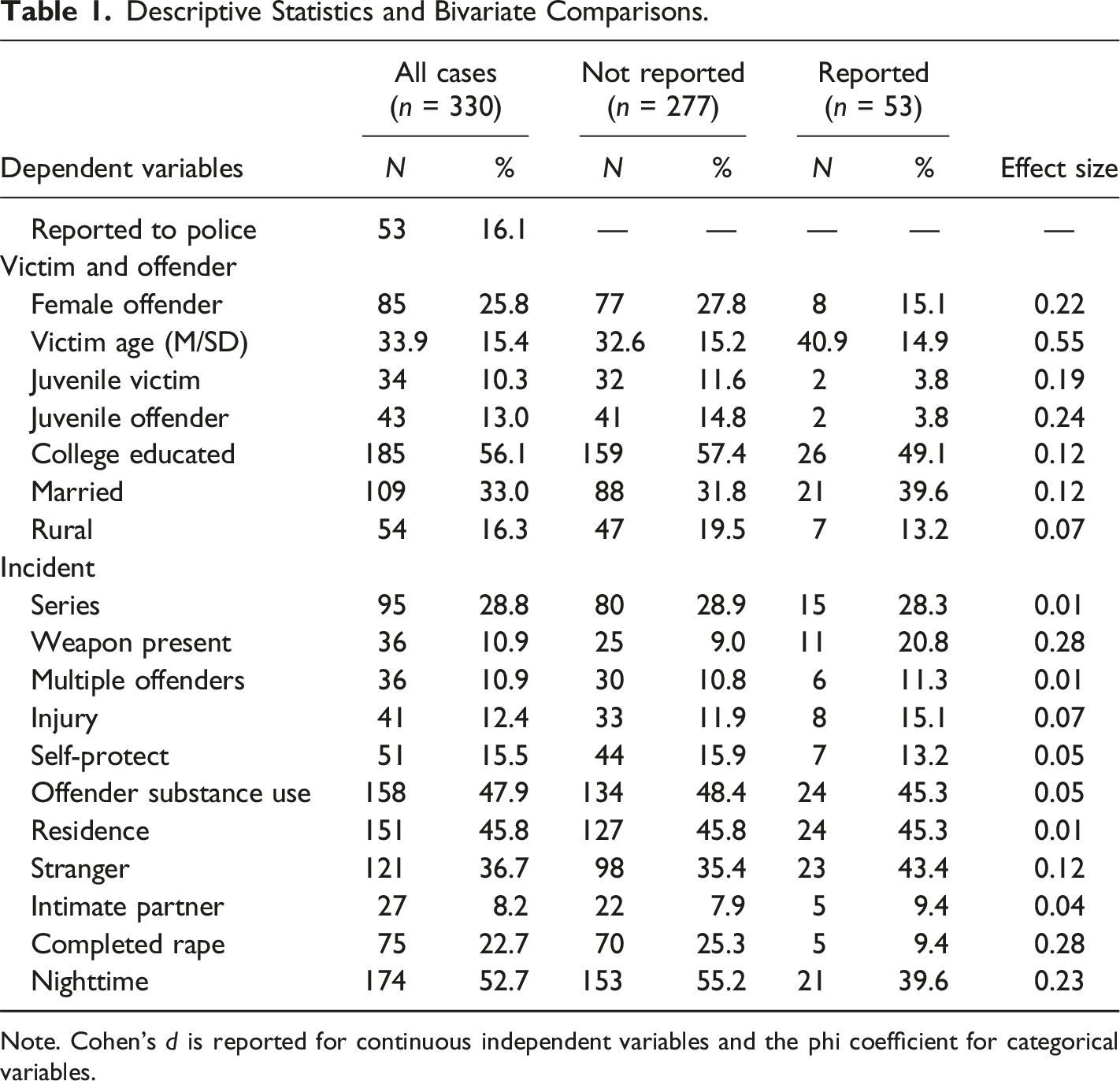
Note. Cohen’s d is reported for continuous independent variables and the phi coefficient for categorical variables.
There were several differences between men who did report to law enforcement and those that did not that exceeded the small effect threshold (>.10). The largest effect was the age of the victim (0.55) as older victims were more likely to report; status as a juvenile, regardless if they were a victim or offender, was important as well. Cases involving either a juvenile offender (0.24) or juvenile victim (0.19) were less likely to be reported. Four other variables approached a medium effect. Whereas the presence of a weapon doubled the likelihood of reporting the offense, for those offenses that occurred at night-time, were completed, or were committed by a female were less likely to be reported.
Logistic Regression Analysis Predicting Reporting to Law Enforcement (n = 330).

Note. Odds ratios (O.R.) that are statistically significant are bolded for ease of interpretation. An odds ratio greater than 1 increases the odds of the victim reporting to law enforcement. †p < .10; *p < .05; **p < .01; ***p < .001.
Model 2 presents the full model including the incident and situational variables. This model was a better model fit (χ2 = 18.522, p < .05) and explained 24% of the variance. Particularly of note, all of the variables in model 1 that were statistically significant remained so with similar odds ratios. When including the incident and situational variables, four are significant predictors. The largest effect was the presence of a weapon which increased the odds of reporting by 354% whereas an injury more than doubled the odds of reporting, by 104%. However, for individuals who experienced a completed rape or the incident occurred at night-time, this decreased the odds of reporting by 61% and 50%, respectively.
Discussion
This study sought to fill several, interrelated gaps in the reporting of sexual violence victimization literature as it pertains to male victims. First, as only one in six male victims reported, they appear to be as unlikely to report to law enforcement as female victims in the United States (Tjaden & Thoennes, 2006) and elsewhere (Cotter, 2021; Office for National Statistics, 2023). The lack of reporting to law enforcement is significant; a prior study found that those who report are three times as likely to receive medical treatment (Rennison, 2002). Given the acute and chronic effects of sexual assault when they go untreated, it is important that society and the criminal justice system improve policies that encourage victims to report without fear of secondary victimization by individuals in the criminal justice system, whether it be law enforcement officers or attorneys.
Second, both demographic and incident characteristics were important in predicting those cases that do get reported which will be discussed in turn. Whereas cases involving older victims are more likely to report, when cases involve juvenile offenders, these are less likely to be reported. This may be due to the unique nature of juvenile justice in the United States; crimes reported to law enforcement in the United States can be exceptionally cleared via “the handling of a juvenile offender either orally or by written notice to parents … no referral is made to juvenile court as a matter of publicly accepted law enforcement policy” (FBI, 2004, p. 81), though there is no data available on how prevalent this is. The pervasive attitude that “boys will be boys” is often used to justify sexual violence, an adage from which victims may either internalize that what happened was not a crime (or if so, not a serious crime) or view they would not be taken seriously which can further act as a barrier to reporting. Additionally, individuals residing in rural areas were less likely to report. This may be a result of a lack of victim services in these areas, either offered through law enforcement or the third sector, which could help encourage individuals to report and to guide them through the criminal justice system; male victims with marginalized identities have even more barriers to overcome in these areas. As Lewis (2003) notes, rural victims struggle with disclosing their sexual assault, particularly when they know the offender, along with the lack of anonymity when reporting due to the low population density.
Of particular interest is the finding regarding the sex of the offender—men were far less likely to report when the offender was a woman. Men who are sexually victimized by women face significant societal and cultural barriers as it relates to the male sexual drive and gender roles. For instance, in the United Kingdom, the definition of rape remains gendered and outdated—women cannot be convicted of rape as it requires penile penetration of the victim by the perpetrator (McKeever, 2019; Weare, 2021); three states in the U.S., Georgia, Mississippi, and Idaho, still do not use gender-neutral rape laws (Thomas & Kopel, 2023). In a study of male rape myths, Walfield (2021) reported that the most adhered to myth was that women who rape men were seen as sexually frustrated individuals, rather than the notion that when men rape women, it is generally accepted that this is an act of power and control (Brownmiller, 1975). Likewise, victims may internalize deeply ingrained societal myths regarding female-on-male rape such as men enjoying sex when it is forced, men are to be blamed for not fighting off women, men would not be upset, and men who obtained an erection is a sign of pleasure which may reduce the likelihood of reporting as they may fear they would not be taken seriously even though these beliefs are not true (Walfield, 2021). Indeed, the act of a woman assaulting a man also goes against societal expectations of how men are to behave, male strength and superiority, and their ability to fightback—a commonly endorsed rape myth is that men should be able to fight back successfully. Yet in the current study, the vast majority of individuals did not engage in actions that they defined as self-protection which is true of most victims regardless of gender. It is not surprising, then, that incidents that resulted in a completed rape, which could be seen as an inability to successfully fight back, are less likely to be reported than other types in which the offender was only able to attempt to sexually offend, suggesting that the victim did successfully resist the attempt. Likewise, a popular rape myth is that the victim may have changed their mind after having consented to homosexual relations (Walfield, 2021). As noted earlier, Page, 2008 reported law enforcement officers were unlikely to believe a man who reported they were raped by a woman. As Donnelly and Kenyon (1996, pp. 446–447) note, “because of traditional stereotypes of men as ‘always in control sexually’ some providers feel, however, that males cannot be raped and thus perceive the problem as inconsequential.”
Finally, there was some support for the “real rape” hypothesis. Three of the variables were related to the decision to report in the expected direction; whereas cases involving a weapon or injury increased the likelihood, those that occurred at night were less likely. Specifically, an injury to the victim can serve as evidence that the individual did resist and did not consent to the sexual activity. Similarly, the presence of a weapon can further serve as proof that they were forced to engage in unwanted sexual activity. Both of these are indicative of the use (or threat) of force (Estrich, 1984; Williams, 1984). In accordance with this hypothesis, sexual assaults at nighttime may suggest the victim was engaging in risky behavior. However, other variables related to the “real rape” hypothesis, such as an incident committed by a stranger or there were multiple offenders, were not related to the decision to report.
Limitations
As researchers have noted, surveys such as NCVS and the CSEW that have a criminal justice context and attempt to measure sexual violence and crime reporting underestimate the rate at which this occurs relative to a public health approach (Sinozich & Langton, 2014). As a result, the National Research Council (2014) suggested a new survey be developed by the Bureau of Justice Statistics with the intent to more accurately measure this, particularly given that many individuals do not see their experience as a criminal sexual offense and that the NCVS fails to capture men who are made to penetrate, which is included in the NISVS, resulting in substantial undercounting (Basile et al., 2022; Reed et al., 2019; Weiss, 2010). Other important variables, such as whether the victim was also engaging in alcohol or drug abuse and prior history with law enforcement or mental illness were not collected though research has indicated this can influence female victims of sexual assault when deciding to report as well as police believability of victims (Carbone-Lopez, Slocum, & Kruttschnitt, 2015; Du Mont et al., 2003; Weiss, 2010). Additionally, there was a small number of male victims reporting to law enforcement as well as a reliance on nearly exclusively categorical independent variables which led to large standard errors in the statistical models. Thus, the generalizability of regression models may be limited.
Conclusion
Despite these limitations, the NCVS remains a valuable source of data as this remains a relatively understudied topic. Furthermore, this study was able to conduct a multivariate analysis and more advanced analysis with a larger sample of male victims, including strategies to incorporate multiple offenders that prior studies have lacked. As certain factors in a person’s background or sexual assault experience may be associated with reporting, it is important to understand which factors influence these decision-making processes and how they differ. Additionally, certain rapes may be more likely to be reported, which might have an impact on law enforcement’s perception of victims who come forward. Given that prior research has suggested male victims are less likely to be believed than other types of victims, this has important implications for not only support systems and law enforcement but victims as well. The disbelief or dismissal of male victims can exacerbate the psychological trauma associated with the crime, leading to increased feelings of isolation, shame, and distress, while creating a significant barrier in the criminal justice process, reducing the likelihood that they seek justice. Increasing awareness and education about male victimization, particularly among individuals in the criminal justice field who interact with victims of sexual violence but also the community at large, can help change societal attitudes, reduce stigma, and address the unique issues male victims experience. Developing and promoting accessible, male-friendly support services can provide much needed help to male victims, which has the potential to lead to an increase in reporting and other positive benefits.
Footnotes
Declaration of conflicting interests
The author(s) declared no potential conflicts of interest with respect to the research, authorship, and/or publication of this article.
Funding
The author(s) received no financial support for the research, authorship, and/or publication of this article.
IRB Statement
Review from the corresponding author’s University’s Institutional Review Board was not needed as the National Crime Victimization Survey is a public use dataset.
