



Abstract
For adolescents with severe disabilities, efforts to enhance the social dimensions of schooling are widely advocated, yet rarely implemented. The peer interactions and relationships so critical to school success and individual well-being can be elusive for many students with intellectual disability, autism, and multiple disabilities. This article highlights promising approaches for enhancing the social lives of secondary students with severe disabilities. The author presents five areas of intervention for secondary schools: student-related factors, peer-related factors, support-related factors, opportunity-related factors, and context-related factors. Attention then turns to how various peer-mediated approaches—peer support arrangements, peer network interventions, and peer partner programs—can be drawn upon to address one or more of these important factors. Recommendations are offered for (a) implementing multicomponent interventions, (b) addressing fidelity in the context of individualized interventions, (c) measuring the social-related impact, (d) promoting changes in social outcomes that have widespread and long-term impact, and (e) encouraging schoolwide and sustained adoption of these approaches.
It is not good to be alone. This concise conclusion emerges from work carried out across diverse disciplines. Theologians proclaim we were designed for relationship and created for community (e.g., Swinton, 2012). Social scientists warn that a paucity of social connections can negatively affect well-being (e.g., Chu, Saucier, & Hafner, 2010). Educational experts caution that social isolation can contribute to disengagement and delinquency from school (e.g., Fredericks, Blumenfeld, & Paris, 2004). And health researchers point to significant associations among isolation, loneliness, and mortality risk (e.g., Holt-Lunstad, Smith, & Layton, 2010). Each finding echoes what so many adolescents would affirm—it is not good to be alone.
The opposite is also true. Flourishing is most likely found when positive interactions, supportive relationships, and a sense of belonging are evident in people’s lives (Siedlecki, Salthouse, Oishi, & Jeswani, 2014). For adolescents, strong social connections are especially salient. Interactions with peers provide access to an array of social and emotional supports, build valuable social capital, expand learning opportunities, and promote participation in school and community activities. Likewise, the relationships adolescents develop in middle and high school can contribute to a sense of acceptance, membership, and belonging. Young people tend to thrive in the midst of supportive and satisfying relationships (Rubin, Bukowski, & Laursen, 2009).
Unfortunately, the social interactions and peer relationships so central to school success and quality of life are especially elusive for adolescents who have severe disabilities. These students—who are typically served under the special education categories of intellectual disability, autism, multiple disabilities, and deaf-blindness—often struggle to forge and maintain the social connections so many adolescents point to as paramount. Observational studies consistently highlight the infrequency or absence of peer interactions within secondary school classrooms, cafeterias, extracurricular activities, and hallways (e.g., Carter, Hughes, Guth, & Copeland, 2005; Raghavendra, Olsson, Sampson, Mcinerney, & Connell, 2012). Even within inclusive settings, sustained social contacts can be rare and isolation the norm (Carter, Sisco, Brown, Brickham, & Al-Khabbaz, 2008; Feldman, Carter, Asmus, & Brock, 2016). This dearth of interactions often extends beyond the school day. According to the National Longitudinal Transition Study–2, a substantial proportion of adolescents rarely see friends outside of school, infrequently receive telephone calls from friends, and do not regularly spend time with friends outside of formal groups (see Table 1). Indeed, the friendship networks of adolescents with severe disabilities often remain restricted and comprised primarily of students who also have extensive support needs (e.g., Webster & Carter, 2007).
Social Outcomes and Educational Placements of Adolescents Across Special Education Categories.

National Longitudinal Transition Study–2 (www.nlts2.org). bEducational Placement Data (www.ideadata.org).
Article Overview
Although the social dimensions of schooling have been a long-standing focus of conversations within the field (Carter, Bottema-Beutel, & Brock, 2014; Gaylord-Ross & Haring, 1987), prevailing practices are not leading to rich social lives. The purpose of this article is to raise key considerations when designing special education services and supports for these students. I begin by addressing five factors that can coalesce to limit peer interactions and relationships for students. I then present three peer-mediated intervention approaches—peer support arrangements, peer networks, and peer partner programs—shown to effectively address one or more of these factors. I conclude with research recommendations to move the field forward.
My accent in this article is on secondary schools as a context for intervention. Myriad changes marking middle and high school introduce unique complexity both to peer relationships and the task of intervention (Carter, 2017). Developmentally, the importance of peer affiliations and acceptance elevates during adolescence, as does students’ desire for independence from adults. Structurally, the size and scope of schooling changes dramatically. Larger schools and rotating classrooms expand both the number of peers students encounter and the social contexts students must learn to navigate. Academically, the curriculum becomes more challenging and diffuse, requiring careful consideration of the supports students with disabilities will need to participate meaningfully in regular classrooms. These challenges all combine to make secondary school a particularly difficult—yet opportune—time for social-focused intervention.
Considerations for Social-Focused Interventions
A constellation of factors can converge to limit the social interactions and peer relationships of students with severe disabilities (Biggs & Carter, 2017; Carter, Bottema-Beutel, & Brock, 2014). Figure 1 presents five factors that comprise potential (and promising) areas for intervention. Although each factor is addressed individually, the need for multifaceted interventions aiming toward a combination of these factors quickly becomes apparent.
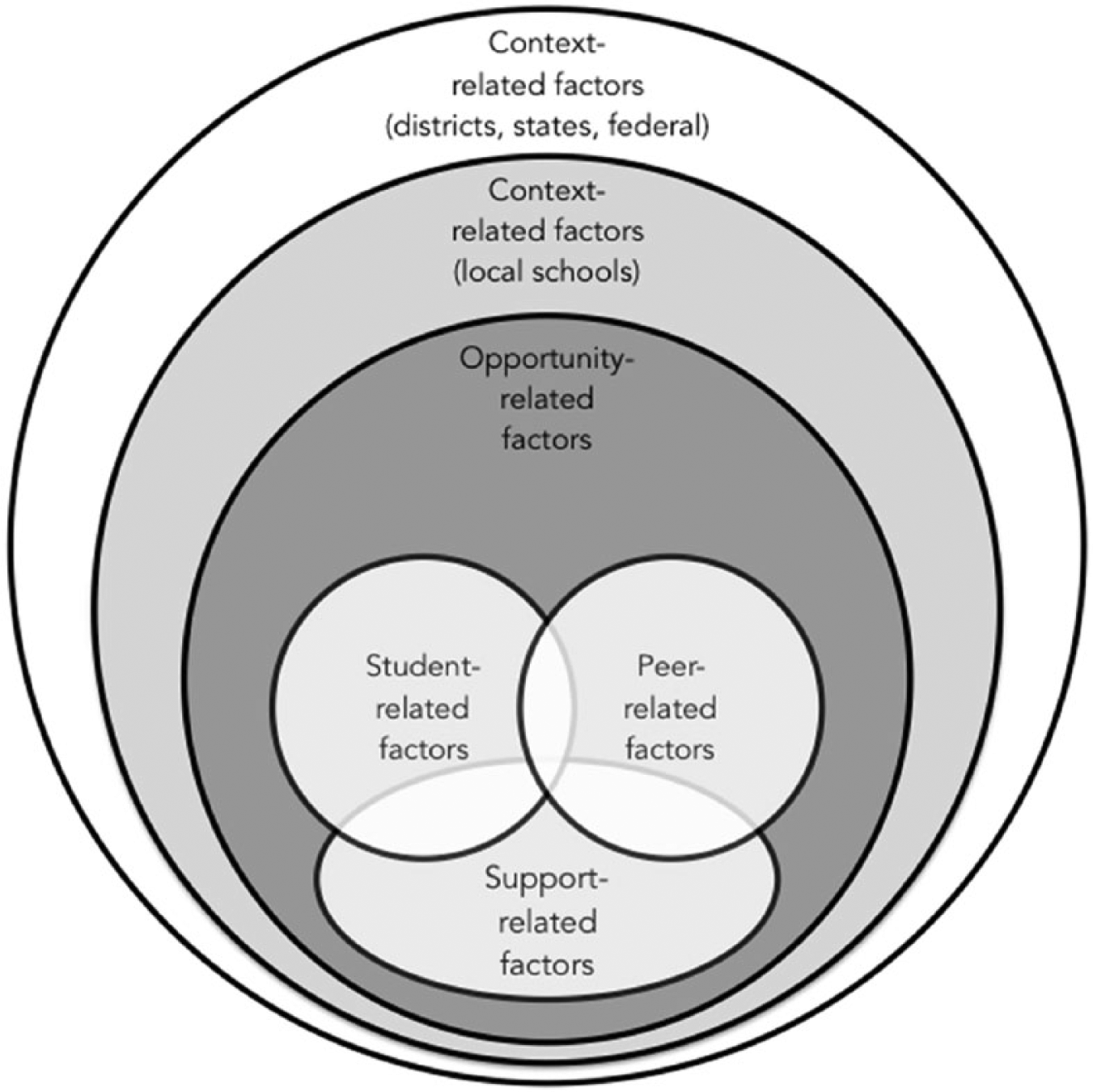
Factors affecting the social interactions and relationships of adolescents with severe disabilities.
Student-Related Factors
Efforts to enhance the social, communicative, and behavioral competence of students with severe disabilities have long permeated the intervention literature (Carter, Sisco, Chung, & Stanton-Chapman, 2010; Hughes et al., 2013). Social-related skill deficits are reflected within most diagnostic criteria and are evident on the individualized education programs (IEPs) of most students with severe disabilities. Such an emphasis reflects recognition that the skills students possess can directly affect their social participation and relationships. For example, substantial social skills deficits can make it difficult for students with severe disabilities to enter, participate in, and maintain interactions with peers throughout the school day. Lyons, Huber, Carter, Chen, and Asmus (2016) solicited teacher and parent assessments of the social skills of 137 high school students with severe disabilities and identified substantial deficits across a range of social-related skills. Specifically, 82% of students in their sample had below average scores on at least one of the seven social skills subdomains (i.e., assertion, communication, cooperation, empathy, engagement, responsibility, self-control). Moreover, Carter, Brock, and Trainor (2014) found that a substantial number of high school students with severe disabilities were rated by teachers and parents as having low to moderate levels of competence in areas related to interpersonal relationships on a comprehensive transition assessment. Likewise, students with severe disabilities often have complex communication needs that can affect the quality and quantity of their social interactions with peers. For example, Kearns, Towles-Reeves, Kleinert, Kleinert, and Thomas (2011) found that 13% of high school students eligible for the alternate assessment were still emerging symbolic language communicators (e.g., using gestures, objects/textures, or pointing) and 9% still communicated at a presymbolic level (e.g., using cries, facial expressions, or changes in muscle tone); the rest communicated symbolically (e.g., using verbal or written words, signs, Braille, or augmentative and alternative communication). Such findings suggest a substantial proportion of adolescents with severe disabilities still lack a reliable or easily interpretable form of expressive communication, severely limiting communication opportunities. Finally, a small proportion of students also exhibit behaviors (e.g., aggressive, stereotypic, self-injurious, or inappropriate social behaviors) that can limit social interactions or prevent access to school contexts in which peer interactions take place (Lyons et al., 2016).
The substantial challenges students with severe disabilities experience in these areas underscore the need for interventions aimed at strengthening students’ social-related competence. Intervention approaches that incorporate social skill instruction (e.g., Plavnick, Kaid, & MacFarland, 2015), develop communicative competence (e.g., Biggs, Carter, & Gustafson, 2017), or reduce behavioral challenges (e.g., McDonald & Machalicek, 2013) could equip adolescents with skills to participate more fully or successfully in peer interactions, as well as enhance how students are viewed by their peers. At the same time, it is important to emphasize that skill-related difficulties need not be addressed as a prerequisite to peer interaction, but rather might be best taught within the context of ongoing peer interaction. In other words, there is limited evidence that providing student-focused skill instruction alone (i.e., apart from addressing other factors discussed in this article) will increase peer interactions and promote new relationships. Moreover, ample evidence indicates that students with severe disabilities with poor social skills, substantial communication difficulties, and challenging behaviors can still enjoy rich friendships with peers when provided opportunities and supports.
Peer-Related Factors
Amid the complexities of adolescent peer culture and changing roles of adults in the social lives of youth, educators must also consider carefully the place and preparation of peers in social-focused intervention efforts. The attitudes, skills, qualities, and priorities peers bring to their encounters with their schoolmates who have severe disabilities can influence whether and how interactions take place, as well as the types of relationships that will develop. First, the views and knowledge adolescents hold about disability can still be quite mixed (Carter, Hughes, Copeland, & Breen, 2001). For example, in their national study of youth attitudes, Siperstein, Parker, Bardon, and Widaman (2007) found that middle school students held widely varied perspectives on the capabilities of students with intellectual disability, the activities in which they would be willing to participate with them, and the benefits they attributed to inclusive educational experiences. Because attitudes can predict future contact, efforts to elevate expectations and attitudes may need to be addressed within social-focused intervention efforts. Second, some peers may feel they lack the needed skills and strategies to work alongside and converse with students who have complex communication challenges, unconventional behaviors, or extensive support needs. The provision of information and guidance from educators can serve to bolster the confidence and competence of peers as they interact. Third, decisions about which peers to involve in school-based interventions are likely to influence the social experiences of students with severe disabilities (Schaefer, Cannella-Malone, & Carter, 2016). Prior studies have identified a range of factors educators might consider when identifying potential peers, including the extent to which they reliably attend school, have expressed an interest in getting to know the focus student with a severe disability, work well with others, are considered a positive model, or would benefit academically or socially from their involvement. However, which combinations of characteristics are most important to consider has received little empirical attention. Moreover, the extent to which educators understand and attend to the peer dynamics within their classroom or school when selecting peers for involvement may be particularly important (Farmer, Chen, et al., 2016). The social roles and reputations of peers are quite likely to affect the success of any partnerships. Fourth, the social priorities and pressures that can accompany adolescence should prompt careful consideration regarding how social groups are formed and supported, as well as where and when students spend time together. For example, peers become much more concerned about their group affiliations and reputations in secondary school and friendships form more on the basis of shared interests and commonalities.
Support-Related Factors
The “invisible hand” of adults (Farmer, Lines, & Hamm, 2011) is not so hidden for adolescents with severe disabilities. Educators have a very prominent presence across students’ academic and social experiences throughout the day. In particular, the growing use of individually assigned paraprofessionals has been alternately discussed as both an advantageous approach and a troubling trend. In most states, the number of paraprofessionals exceeds the number of special education teachers (U.S. Department of Education, 2016). The heavy reliance on this one-to-one support model can affect peer interactions and relationships in multiple ways. First, paraprofessionals can become mediators within interactions among students or function as substitute social partners. In other words, peer initiations become directed to staff rather than students, students ask questions of staff rather than classmates, and the involvement of an adult inadvertently closes off the social circle. In their observations of middle school students who used augmentative and alternative communication, Chung, Carter, and Sisco (2012) reported that the interactions of students with severe disabilities took place almost exclusively with support staff, even in the midst of general education classrooms. Second, the close and constant presence of an adult in classrooms, hallways, and cafeterias can be stigmatizing during adolescence. Interviews with students who have disabilities indicate a reluctance to be accompanied by adults or a preference for being partnered with peers (Mortier, Desimpel, De Schauwer, & Van Hove, 2011; Whitburn, 2013). Third, peers may be reluctant to engage in conversations when adults are present or monitoring interactions. Fourth, paraprofessionals rarely receive training to facilitate social interactions or to support access to shared activities within the general education classroom (Carter, O’Rourke, Sisco, & Pelsue, 2009). Such concerns highlight the importance of thinking through whether and how adolescents with disabilities will access specialized adult supports within inclusive settings.
Opportunity-Related Factors
Peer interactions and relationships remain limited when students with and without severe disabilities have few opportunities to participate in shared activities throughout the school day. Efforts to improve students’ skills, prepare their peers, and strengthen available supports are unlikely to elevate social outcomes unless coupled with ongoing opportunities for students to spend time together. Yet shared activities still remain rare in secondary schools. As shown in Table 1, the majority of students (ages 12–21) with intellectual disability, multiple disabilities, and deaf-blindness spend the majority of their instructional day apart from their peers without disabilities. For students eligible for the alternate assessment, participation is considerably more constrained. In their study of students who were eligible for the alternate assessment across 15 states, Kleinert et al. (2015) found that only 7% were served in general education classes at least 40% of the day; 71% were served in special education classrooms, with some involvement in specials (e.g., art, music, physical education; less than 40% of the day); 9% were served in special education classrooms, with some academic inclusion (e.g., math, science, reading; less than 40% of the day); and 13% were served in entirely separate schools.
Even when students with severe disabilities enrolled in general education courses, they infrequently work alongside their classmates without disabilities. In their observations of 108 inclusive high school classrooms, Feldman et al. (2016) found that students with severe disabilities were in proximity to peers without disabilities an average of less than half (42%) of the class period. Instead, they worked at separate tables with other students with severe disabilities, sat next to a paraprofessional rather than peers, or had left the classroom. Such findings highlight the influential role of general educators in establishing a positive and participatory social atmosphere within the classroom. In addition to modeling how students with severe disabilities should be viewed and treated, classroom teachers can establish seating arrangements and collaborative assignments that encourage interactions and interdependency.
Context-Related Factors
To date, most social-focused intervention efforts have centered on one (or more) of the factors discussed thus far. Meager attention has been given to contextual factors at the proximal level of the school or the more distal level of educational systems (i.e., districts, states, federal). Yet each can shape the degree to which social outcomes, inclusive practices, and intervention efforts are prioritized and pursued by educational teams (Ryndak et al., 2014). For example, secondary schools vary widely in the degree to which they prioritize relationships alongside academic rigor, the service delivery and staffing models they adopt, the resources they allocate to staff training, and the school climate they cultivate. Additional attention to school-level priorities and practices could serve to create more supportive and sustainable contexts for social-focused interventions. Similarly, policies crafted in district, state, and federal contexts can have influence on local practices related to social participation. Interpretations of the least restrictive environment principle, understandings of access to general education, the focus and function of large-scale assessments, and conceptualizations of the core curriculum—among others—can affect how educators allocate their time and resources, as well as which outcomes are monitored and reinforced. In addition, the limited extent to which pre-service teachers are taught to deliver instruction and supports addressing the social dimensions of their students’ lives affects their preparation for and prioritization of this intervention area (Zagona, Kurth, & MacFarland, 2017).
Promise of Peer-Mediated Interventions
My colleagues and I have invested in a program of research focused on creating meaningful opportunities for adolescents with and without severe disabilities to learn alongside one another in ways that lead to the development of satisfying and supportive relationships. Our particular emphasis has been on the ways in which peer-mediated approaches might address the confluence of factors that can limit peer interactions and friendships in middle and high schools. In this section, I elaborate on how peer support arrangements, peer network interventions, and peer partner programs can be implemented to enhance different dimensions of the social lives of adolescents with severe disabilities.
Peer Support Arrangements
Peer support arrangements are individualized interventions designed to promote access to the full range of learning and social opportunities available within inclusive general education courses (Carter, Cushing, & Kennedy, 2009; Carter & Kennedy, 2006). Educational teams identify and equip one or more peers without disabilities to provide academic and social supports to their classmate with a severe disability throughout the semester. Special educators first develop a written plan detailing how a student with a disability will participate in various aspects of the class (e.g., large-group discussions, lectures, small-group projects, independent seat work, noninstructional times), the roles of peers and paraprofessionals in supporting the student’s academic and social participation, and the facilitation strategies adults will adopt to encourage shared work and appropriate interactions. Next, special and general educators collaborate to identify and invite one to three classmates to serve as “peer partners” within the intervention. Input from the student with a severe disability is sought and efforts are made to identify peers with shared interests, strong commitment, sufficient skills, and appropriate fit. The peer partners attend a short orientation session addressing the reasons for their involvement, their roles and responsibilities within the intervention, and the individualized supports they will provide to their classmate. Likewise, the paraprofessional who will facilitate the intervention is taught to deliver it with both fidelity (i.e., ensuring core components are implemented) and flexibility (tailoring the approach to fit both the student and the classroom). Peer partners provide a variety of contextually relevant academic and social supports. Socially, peer partners might prompt the student’s use of an augmentative and alternative communication (AAC) device, encourage participation in a group discussion, converse about their class work, discuss the interests they hold in common (when appropriate), make introductions to other classmates, or model how to respond to a question. Academically, they might collaborate on a class assignment, share a textbook or other materials, rephrase an important concept, or write down an answer given on an AAC device. During the first few days of shared work, the paraprofessional remains in close proximity to model effective support strategies, provide targeted feedback, and encourage the student and peer partners as they work together. However, the direct support of the paraprofessional soon fades as everyone accrues experience and gains confidence working with one another. Paraprofessionals may then adopt a broader support role within a classroom, providing assistance to the teacher or other classmates.
Peer support arrangements create ongoing opportunities for interaction amid academically demanding academic, elective, and vocational courses. They incorporate training and ongoing support that ensures peers are comfortable and confident in their interactions and provision of supports. They reconceptualize prevailing support models so that classmates, rather than adults, are the first line of support. And they situate social and communication skill instruction for students with severe disabilities within the context of ongoing interactions and peer modeling in natural settings. To date, more than a dozen studies have examined the efficacy and social validity of these interventions within secondary school classrooms (see Carter, 2017). This research finds that introduction of peer support arrangements produces substantial increases in the quantity and quality of peer interactions throughout the class period (Biggs et al., 2017; Carter et al., 2011; Huber, Carter, Shaw, & Stankiewicz, in press), promotes progress in social and communication goals (e.g., Carter et al., 2016; Chung & Carter, 2013), provides access to a broader range of individualized supports, and fosters the development of reciprocated and durable friendships (Carter, Moss, Hoffman, Chung, & Sisco, 2011; Carter et al., 2016). Moreover, these improvements do not come at the expense of academic engagement and curricular contact. Finally, feedback from participating students and staff indicate these interventions are both feasible to implement and fit well within the secondary classroom context.
Peer Networks
Peer networks are individualized interventions designed to establish cohesive social groups and sustained social interactions outside of instructional contexts (Carter et al., 2013; Haring & Breen, 1992). As a group, students meet formally and informally around mutually enjoyable activities across an entire semester or school year. After asking the students with a severe disability about their interest in involvement and their preferences for peers, educators invite three to six “peer partners” who have interests or experiences in common with the focus student. They may also look to existing peer groups or attend to other social dynamics within their school. An initial orientation meeting is held to launch the peer network and is led by an adult facilitator (e.g., general educator, coach, club leader). During weekly peer network meetings, students participate in a shared activity (e.g., interactive game, service activity, eating lunch), plan other times to meet up socially throughout the week (e.g., between classes, during lunch, afterschool events), and identify ways to involve the focus student more fully in other aspects of school life. The facilitator leads the orientation meeting, attends weekly meetings, implements strategies to promote enjoyable interactions among network members, encourages them to connect outside of formal meetings, and fades back his or her direct involvement as the group coalesces and members take increasing responsibility for organizing future activities.
Peer network interventions create new opportunities for students with severe disabilities to practice social-communication skills amid the “in between” times that punctuate each school day (e.g., lunch, breaks, passing periods, before and after school, clubs). Such windows are often overlooked by educators as strategic contexts for intervention. The design of these interventions recognizes the group-based nature of relationships during adolescence, when dyadic interactions shift to small groups and cliques (Rubin et al., 2009). This group structure may provide a more comfortable entry point for peers while providing the student more access to diverse social modeling. Although an adult delivers an initial training to participants and remains available to offer any needed support, their involvement takes place behind the scenes and focuses on social facilitation. To date, eight studies have examined the efficacy and social validity of these interventions within secondary schools. This research indicates that involvement in a peer network leads to substantial increases in the occurrence of peer interactions, improvements in social engagement, expands informal social connections throughout the week, and promotes the development of lasting friendships (e.g., Asmus et al., 2017; Gardner et al., 2014; Hochman, Carter, Bottema-Beutel, Harvey, & Gustafson, 2015; Koegel et al., 2012). Moreover, peer networks provide a way of engaging additional school staff in social-focused interventions, are considered feasible to implement, and require few resources to carry out.
Peer Partner Programs
Peer partner programs are group-based interventions that establish regular social opportunities within specialized or self-contained school settings (Hughes & Carter, 2008). They differ from peer support arrangements and peer network interventions in their focus on creating opportunities for groups of students with severe disabilities to spend time with groups of peers. Although an array of names and variations are associated with this intervention approach (e.g., peer buddy programs, peer partner clubs, Best Buddies), their common feature is the structuring of regular interaction opportunities for students under the guidance of special education staff. Peer partner programs are most often implemented as a “reverse-mainstreaming” approach delivered within special education classrooms. For example, many schools offer course credit that make it possible for peer partners to spend one period each day with students in their classrooms. Peers participate in an initial training, provide academic assistance or social support to various students throughout the semester, and complete required assignments and reflections on their experiences. Other schools establish more episodic groups that meet weekly or monthly for social- and/or service-focused activities. In this approach, shared activities are more time-limited and may involve a rotating combination of peer partners.
Peer partner programs take place in quite different social contexts than the previous two interventions. The provision of training ensures peers are confident in their roles, the organization of planned activities creates an engaging context for interactions, the availability of adult support furnishes the guidance and facilitation needed to enhance those interactions, and the group-based structure connects students with severe disabilities with a wide range of peers. Although peer partner programs have provided the backdrop for more individualized student- and peer-focused interventions (e.g., Hughes, Carter, Hughes, Bradford, & Copeland, 2002) and have been widely adopted, the programs themselves have not been rigorously evaluated. However, descriptive studies have affirmed the social validity and feasibility of peer partner programs in secondary schools (e.g., Carter & Pesko, 2008; Copeland et al., 2004).
Some Complexities and Future Directions
Peer-mediated interventions are promising approaches for addressing the multiple factors that can coalesce to limit social opportunities for adolescents with severe disabilities. Although much is now known about the design and delivery of social-focused interventions, there is a continued need for research that expands the impact and reach of these interventions. This section addresses five challenges associated with initiating change in this area.
First, substantially shifting the social outcomes of students with severe disabilities is a complex endeavor. Multicomponent interventions are needed to ensure (a) students with severe disabilities acquire the skills and knowledge that will enhance their interactions, (b) peers are equipped for and excited about involvement in shared activities, (c) support from educators is provided in ways that help rather than hinder social connections, (d) opportunities abound for students to spend time together throughout the school day, and (e) contexts are created that prioritize and promote positive social relationships as an important dimension of secondary schooling. To date, most studies have focused on a smaller subset of these factors (e.g., peer- and support-focused practices). For example, integrating a more explicit focus on student skill instruction within peer support arrangements or peer network interventions could help maximize the social opportunities introduced by these interventions. Likewise, little attention has focused on how school-level changes might create contexts and climates that are more conducive to social-focused intervention efforts. For example, intervention efforts might look somewhat different against a backdrop of schoolwide positive behavior supports or broad disability awareness initiatives.
Second, conceptualizations of fidelity may have to look somewhat different in this area of intervention. The multifaceted and heterogeneous needs of adolescents with severe disabilities typically require high levels of individualization and adaptation. Although each of the intervention approaches highlighted in this article include critical components, the ways in which they are applied can vary depending on the goals and profiles of participating students with severe disabilities, the activities they are engaging in with peers, the school settings in which the interventions are delivered, and the professionals responsible for their facilitation. More recent studies have attempted to differentiate between core and optional intervention components, to collect data across these components, and to present findings for consideration alongside both social validity and outcome data. Future researchers should examine how variations in implementation affects intervention delivery, efficacy, and feasibility.
Third, documenting meaningful changes in the social experiences of adolescents is replete with measurement challenges. Understanding and improving the social lives of students with severe disabilities requires attention to multiple aspects of social inclusion, including their skills, interactions, affiliations, relationships, sense of belonging, and active participation. Measuring the more subjective of these constructs is made all the more difficult when students experience complex communication challenges or significant cognitive impairments. To date, most studies have addressed a fairly small subset of relevant measures and have provided only a limited window into the nature and quality of relationships students form as a result of school-based interventions.
Fourth, social dynamics during adolescence are fluid. Friendships typically form over time, and they maintain, deepen, or dissolve for a host of reasons. Although establishing interdependent or collaborative activities (e.g., peer support arrangements, peer networks) clearly sets the occasion for frequent interactions among students with and without severe disabilities, much more must be known about whether those interactions maintain when activities change. Likewise, the ways in which early patterns of interaction transform into new friendships is still uncertain. Unfortunately, most prior studies have examined the impact of peer-mediated interventions across a fairly short time span (i.e., typically less than one semester). Among studies that have continued data collection up to 1 year after the conclusion of the intervention, nearly half of friendships endured across the summer and changing semesters (Asmus et al., 2017; Carter et al., 2016). It is also unclear how the status and reputations of peer partners are affected by their involvement in these interventions. Although peers self-report substantial benefits from their involvement, the social ramifications of their involvement has not been studied.
Fifth, research is needed to understand how best to approach the schoolwide and sustained adoption of social-focused interventions at the secondary level. Only a few studies have addressed the extent to which peer-mediated social interventions are being implemented in secondary schools (Carter et al., 2009; Wagner, Newman, Cameto, Levine, & Marder, 2003). None of these descriptive studies, however, have addressed the configuration, quality, or duration of implementation. Our own partnerships with schools suggest peer-mediated interventions are inconsistently implemented across students, classes, staff, semesters, and schools. For example, special educators who have tried these interventions, observed their impact, and affirmed their feasibility still may not continue to use them in the future. The fairly modest and uneven adoption of these interventions might be considered surprising given the strong evidence of efficacy and social validity reported in the literature. This suggests other contextual factors likely are at play that may limit broader adoption (e.g., the focus of accountability efforts, the training and familiarity of professionals, the priorities of schools and staff). Identifying the most promising pathways for scaling up these interventions is a much-needed next step in this program of research.
Meaningful access in the social interactions and relationships that take place at school is considered an essential component of inclusive education and high-quality secondary transition programming. Educators can play a powerful role in ensuring students with severe disabilities obtain the skills, supports, and opportunities needed to work alongside and develop relationships with a wide range of peers at their school. This potential for influence reinforces the importance of ensuring strong pre-service and in-service training is available to educators so they are well-equipped to understand and address these social dynamics. Although a constellation of factors can make this work quite challenging, there is strong support for including peer-mediated interventions within the portfolio of efforts schools adopt to enhance social outcomes for these students. Moving forward, the continued investment of researchers in this area of inquiry can provide secondary educators with effective practices that can be readily implemented within their daily work with students.
Footnotes
Declaration of Conflicting Interests
The author declared no potential conflicts of interest with respect to the research, authorship, and/or publication of this article.
Funding
The author received no financial support for the research, authorship, and/or publication of this article.