



Abstract
Product sound design is a current topic in the field of product design. It proposes the study and application of sound as one of the essential configurable parameters in the product design process, given its potential to communicate relevant and complex information to the user. In this article, we describe some of the basic principles of this discipline based on different examples and reflect on the importance of implementing specific design methodologies available for product design teams. Finally, we propose possible lines of work that can contribute to new knowledge and facilitate access to future work in this field.
Keywords
Sound, an important element of product design that is not much studied or applied, can boost user acceptance and market success.
Industrial design is a technical, orderly, and multidisciplinary field that is continuously employed in the development of innovative products. By properly designing their products, manufacturers can increase their products’ success in the marketplace. The main objective is to meet the users’ needs by ensuring that users fully understand the product’s technology. The product must be able not only to function properly but also to communicate specific messages to the user. That is why it is so important for design teams to have tools that control and develop the communicative capacity of the product.
The role of product communication has relied almost exclusively on aesthetics, but it is becoming increasingly clear that this process of communication is by far richer and more complex, given that the user also perceives messages from many different stimuli arising from the technical aspects and functional features of the product.
Product sound design is a current topic in the specialist literature on product design. Its contribution to the field of industrial design begins with the acceptance that sound is one of the essential channels for the transmission of information by the product and, consequently, one of the essential parameters configurable by the development team during the design process. However, many designers still find it difficult to understand several aspects related to sound and to apply them in their projects.
In this article, we state the importance of product sound design as a valuable tool for product design processes and offer some fundamental considerations that should be taken into account by designers who are starting out in this discipline.
Product Design that Includes Product Sound Design
Any product provides its user with abundant information in visual, auditory, tactile, and, to a lesser extent, olfactory and gustatory format (Schifferstein & Spence, 2008). As the need to interact with the product increases, so does the amount and complexity of the information to be provided and the need for congruence and balance between the different messages provided to the user (as happens, for example, in car navigation systems). The meaning and value attributed to the product by its user depend to a great extent on the effectiveness with which designers are able to develop the product’s communicative structure. Thus, in the design of a vehicle, one recognizes its quality when its technical capabilities are consistent with its visual quality, materials, or design of the dashboard, as should the sounds derived from the vehicle’s operation or those forming part of its interface.
Consumers are continuously perceiving sounds that are generated by products. Some of these sounds are the result of the proper functioning of the product’s components, known as consequential sounds (Langeveld, van Egmond, Jansen, & Özcan, 2013). When users become accustomed to the function of a product, a change in some of these sounds conveys some meaning. For example, the characteristic and consequential sound of the washing machine motor enables one to differentiate a rinse cycle from a spin cycle, and the sound of the coffee brewing in a coffee maker informs one that the process is completed.
On the other hand, some sounds are deliberately generated with a communicative function, such as digital displays and interfaces that offer sound messages selected or developed by the design team. These can be called intentional sounds (Langeveld et al., 2013), although other authors, such as Bodden (2002), prefer to use the term active sound design. Intentional or active sounds include the audible warnings (or beeps) from a digital alarm clock, microwave beeps, mobile phone notifications, or the audible feedback when the “trash” bin on a computer is emptied (Gaver, 1989), as the examples shown in Figure 1.
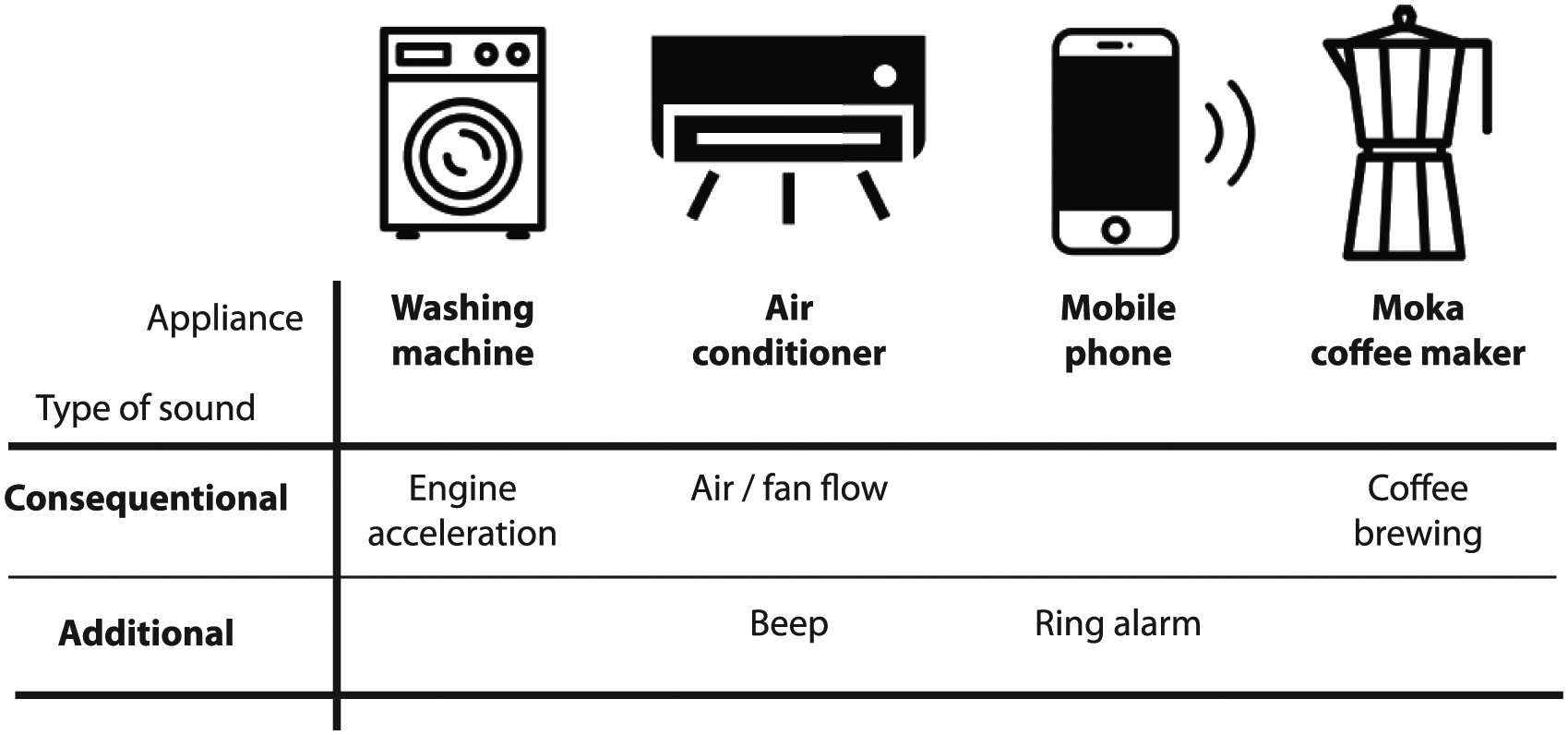
Consequential sounds versus additional sounds in different appliances.
There are two disadvantages when product communication relies solely on consequential sounds: The number of available sounds is very limited, and attempting any modification involves incorporating changes to the sound source, such as changes in mechanical function (Bodden, 2002). Therefore, it is convenient to consider the approach of active sounds, which involves the application of additional sounds, generated specifically and superimposed over the original sounds and greatly expanding the design and communication options.
At this point, it is clear that the study of sounds and their properties needs to be incorporated into the realm of product design if designers are to succeed in optimizing the user experience. But often, decisions regarding sound assignment are made independently of the general design process because members of the development team do not have sufficient knowledge. For this reason, product sound design as a discipline should be applied to convey specific knowledge, methodologies, processes, and tools to help designers optimize the relationship between products and their sounds.
Main Applications of Product Sound Design to Product Development
There is rapid growth in interest relating to scientific research about product sound design that can be applied at technical development stages, especially among designers who are trying to anticipate how some variations in physical parameters of auditory signals could produce changes in user perception that are linked to the understanding of the functional structure of the product. In these types of studies, everyday objects are generally analyzed, such as household appliances (cooking robots, electric toothbrushes, etc.) or food products during consumption (soft drinks, potato snacks, etc.), as well as user−product interaction interfaces (Chamberlain et al., 2017).
Documented experiments show how the user experience of product qualities (level of pleasure experienced or perception of energy, power, etc.) also can be altered by modifying the auditory signals associated with their functioning. Furthermore, the manipulation of some auditory signals can provide a sound identity linked to a particular brand (Lindstrom, 2005). Lyon (2004) showed that the sound applied to the product provides an opportunity to differentiate it from competitors, which is applicable as a marketing strategy (Sapherstein, 1998). A good example is the Harley-Davidson motorcycle brand, which in 1994 filed a sound trademark application for its distinctive V-twin engine sound. Sapherstein realized that if he could capture the engine’s sound, it was possible to distinguish the brand at every point of customer interaction (“Sonic Branding,” 2010). As with a visual logo, sound identity should be managed with the same uniqueness, memorability, and flexibility.
Norman (2004) pointed out how the designers of the Segway, a personal two-wheeled scooter, “were so obsessed with the details on the Segway HT that they designed the meshes in the gearbox to produce sounds exactly two musical octaves apart – when the Segway HT moves, it makes music, not noise” (p. 119). Another example cited by Norman is the “kettle that sings” – the Whistle Alessi 9091, designed by Richard Sapper. Sapper made considerable effort in modifying the sound quality produced by the whistle: “a string of e and b,” as described by Alberto Alessi, “inspired by the sound of the steamers and barges that cross the Rhine” (Norman, 2004, p. 121).
Thus, as shown in Figure 2, product sound design can be applied to modify or deliberately create a sound not only to increase consumers’ comprehension of the functionality of the product but also to enhance the customer experience on an emotional level (Björk, 1985; Jekosch, 2005).
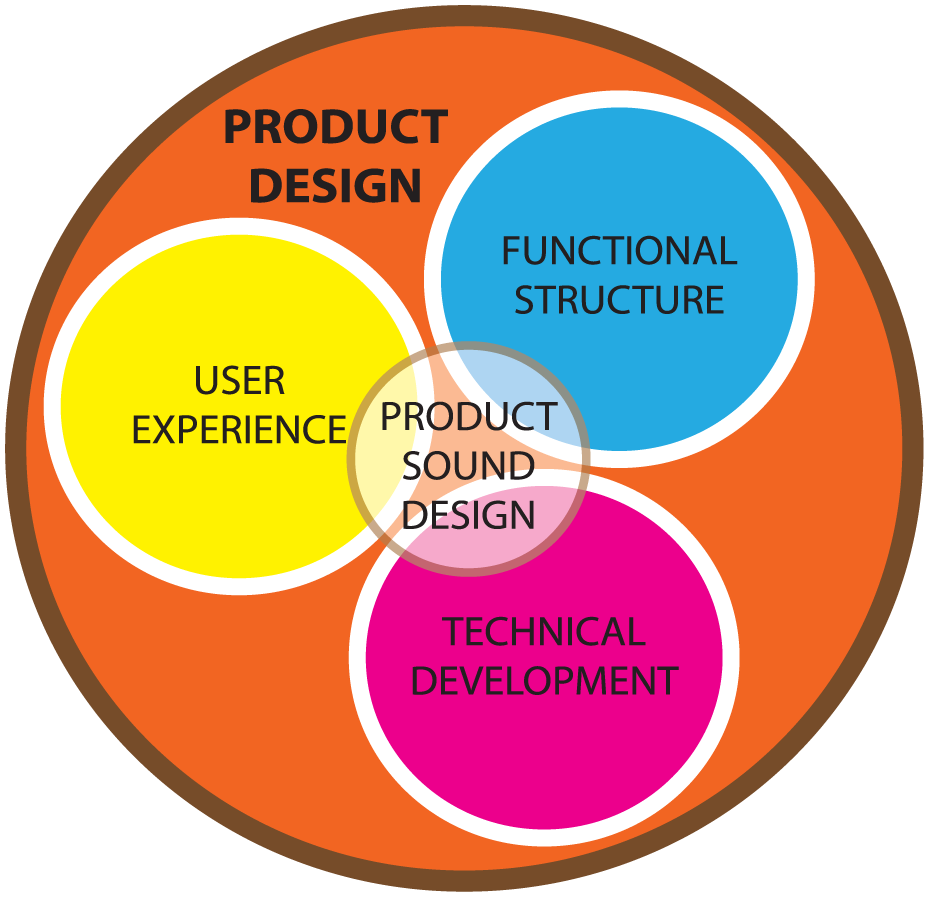
Product sound design when applied to the general context of product design involves several aspects, including the development of technical features of the product, the recognition of its functions, and the user experience.
New Products, Richer Interfaces
The development of certain modern product functions (connectivity, information management, etc.) requires richer and more complex interfaces to facilitate users’ access to these functions. As an example, the increased complexity of the sensory functions of automobiles has encouraged the development of more efficient interfaces, which should adequately rank the importance of the multiple messages, warnings, and other notification, to avoid increasing the degree of visual and mental attention required by the user (who is also concentrating on driving and navigating, and using mobile, radio, or other component management systems). This, in turn, influences the level of pleasure or displeasure that the user can experience while driving.
Similarly, in the context of the automobile, work zones present an increased risk to drivers and the work crew. To mitigate these risks and reduce the rate of crashes in work zones, authors of a recent study investigated the potential advantages and disadvantages of in-vehicle messages to communicate work zone events to the driver (Craig, Achtemeier, Morris, Tian, & Patzer, 2017).
The inclusion of product sound design in the development of multimodal interfaces (not merely visual or tactile) allows for an improvement in user control of the product and offers benefits in terms of user security, understanding, and acceptance of the product. In addition, because of the magnitude of the potential application of product sound design, it offers researchers ample opportunity for future studies.
This contribution is especially significant in critical contexts, such as intensive care units, aircraft piloting, or vehicle driving. In those contexts, the quality of sound becomes essential in eliciting the appropriate user response, as it is closely linked to the criticality of the occurring events. Obviously, a warning from a mobile phone about its battery level is not as relevant as a warning from a medical monitoring system informing of a low heart rate (Shneiderman, 2010), so a classification and/or hierarchy of different needs of communication also can be considered (Sousa et al., 2017).
New Challenges in Product Sound Design When Applied to Development Processes
Although it is a promising field, product sound design is not yet as strong and consolidated a discipline as others, such as visual product design. Product sound design is a field of incipient action. In this section, we discuss various aspects demonstrating that sound design applied to products is not yet entirely established and some further research is expected (Figure 3).
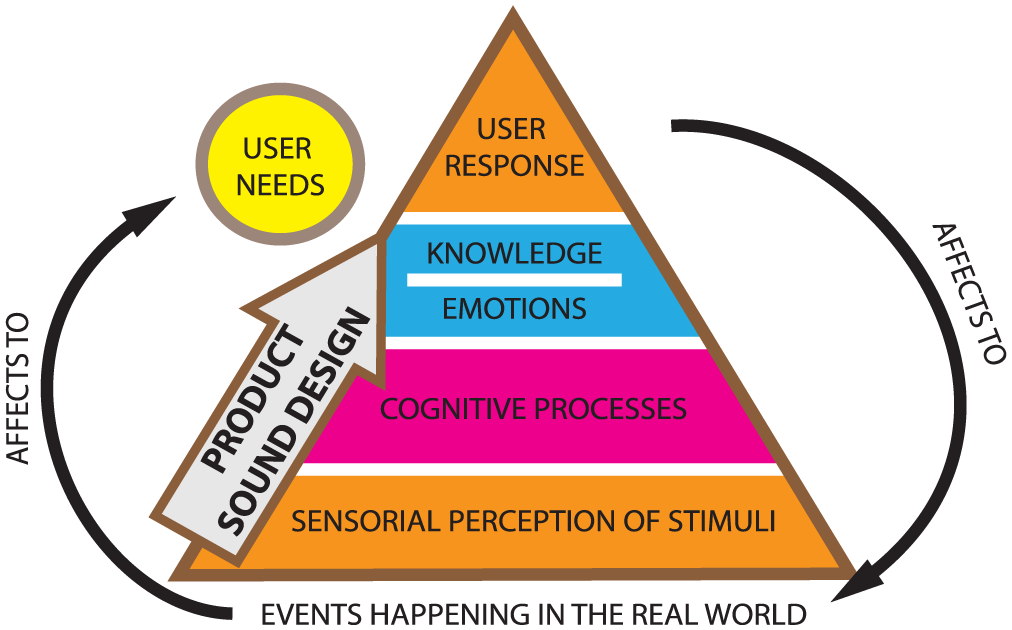
The study of sound properties applied to the interaction between user and product begins with analysis of sensory perception of stimuli and of cognitive processes and, to a lesser extent, to their relationship with emotions, the generation of knowledge, and the response that this perception provokes in the user.
First, a greater pooling of available knowledge on the perception of sound is required. This aspect is studied mainly in the field of acoustic analysis and its psychoacoustic correlation, which focuses on the physiology and neurology of hearing, and in determining attributes of perception, such as tone, intensity, duration, or timbre of the sound. Conversely, the semantic association of sound to some relevant product features has little representation in the literature as yet.
Second, most of the available methods for measuring sound (since Susini, 1999) are well suited for characterizing acoustic discomfort or user preference (psychophysical methods and psychoacoustic measuring instruments). However, they do not yet take into account the cognitive processes and emotional responses of the user, which is also related to perception of the functional and aesthetic aspects of the product.
There is agreement that most everyday sounds have emotional connotations that precede their conscious interpretation, so that these emotional connotations influence the way a listener understands a given sound (Västfjäll & Kleiner, 2002). Therefore, it is useful to develop tools and instruments to measure emotional response to stimuli, the results of which can be integrated into the design process to facilitate the anticipation of an adequate emotional response by the user.
Third, knowledge pooling should begin by seeking unanimity in a common and appropriate vocabulary that describes and characterizes the study and analysis of the sound of the product, thus fostering the emergence of systematic methodologies.
Finally, in order for design teams to be able to optimize the user experience through the development of the sound of products, it is necessary to make some effort to integrate the product sound design methodologies into a project environment that is often already established, sometimes extremely complex, and multidisciplinary. Thus, when designing product sounds, one should take into account the role of previous users’ experience, the environment of use, and the cultural context, among other factors. For example, an alarm sound should be loud enough to be audible in a possibly noisy environment, but in the context of an intensive care unit, sound quality becomes very important in eliciting the appropriate user response and is linked to the criticality of the occurring events (Sousa et al., 2017).
Therefore, product sound designers should also have in-depth knowledge of the expected user interactions with products prior to defining the sound. In addition, they should know how the manufacturing processes (i.e., assembly accuracy and parts-manufacturing accuracy) can affect the physical properties of the product and, consequently, product sound quality. Unfortunately, existing design rules for domestic appliances, for example, do not provide insight into the type of product sounds that might suit a particular design solution or any consideration of how to include product sound design in general design processes.
To conclude, we have shown that the recognition and application of sound as one of the main channels for providing product-to-user information is an emerging, promising field and is especially relevant for configuring the user experience of a product, interactive system, or service. Therefore, in-depth study of the different stages of its interaction with the user can yield valuable knowledge for product designers.
Similarly, analysis of the ways in which sound design as a discipline can be integrated into product development processes is an interesting challenge, which can add value to the product design process and thus offer the opportunity for future research.
