



Abstract
Voter registration is thought to have a substantial negative effect on American voter turnout. The authors clarify this understanding in two ways. First, using a natural experiment in Wisconsin, they estimate the pure effect of registration, stripped of aspects such as the closing date. Registration lowers turnout by about 2 percentage points. Second, the authors argue that administrative capacities of local election officials are important moderators of how much registration affects turnout. Municipalities with less capacity are associated with bigger decreases in turnout. Researchers and policy makers should consider administrative capacity as a component in the equal application of voting laws.
Since the Progressive Era, the U.S. electoral system has distinguished itself by requiring most people to register with the state before being permitted to vote. It is widely believed that the registration burden depresses turnout, particularly among some disadvantaged subgroups of the population. Dating back at least thirty years to Wolfinger and Rosenstone’s (1980) seminal book, Who Votes?, researchers have spilled a tremendous amount of ink in efforts to estimate the effects of registration on turnout and in investigating whether the effects depend on sociodemographic variables.
While this line of research has been immensely valuable to both scholars and policy makers, we seek to redirect the inquiry in two ways. First, we clarify what is meant by the effects of registration, distinguishing its pure effect from various aspects of registration such as closing dates and residency requirements. Second, we focus on institutional rather than individual-level moderators of this effect. In particular, we ask whether the administrative capacity of the local election official enhances or diminishes the depressant effects of registration requirements. Using data from a natural experiment in Wisconsin in which registration was simultaneously imposed on many municipalities of varying capacities, we estimate for the first time that registration’s pure effect is about 2 percentage points, far below the most commonly cited figures. In addition, we show that the negative effect of registration is larger in municipalities with less administrative capacity. These dual findings suggest that policy makers should not blame low levels of voter turnout on registration itself. Instead, we argue here that both aspects of registration and the abilities of local officials to implement election laws should be seriously considered so that all potential voters are treated equally under the law.
Existing Research
Numerous studies, employing a wide range of data and methods, have concluded that state-level regulations can affect levels of voter participation. Among these are things such as early closing dates, residency requirements, felon disenfranchisement laws, and policies for purging the voter rolls. 1 Using cross-state analysis, scholars have carefully distinguished the effects of each type of restriction independent from the others. This approach allowed researchers to pose the counterfactual question of how high turnout would be if every state adopted the most lenient of policies. Early estimates were substantial: Wolfinger and Rosenstone’s (1980) seminal analysis put the effect at 9 percentage points, Powell’s (1986) cross-national study estimated it to be 14 percentage points, and Mitchell and Wlezien’s (1995) more recent analysis found an effect of 7.6 percentage points. These sizable estimates have framed subsequent research and have prompted many observers to conclude that “voter registration arrangements . . . carry much of the burden of sustaining a system of limited electoral participation” (Piven and Cloward 1988, 21), even as they have acknowledged that other factors, such as the nature of party competition, play perhaps an even more important role in discouraging turnout.
Some recent work has challenged the belief that registration is a major cause of voter abstention. Timpone’s (1998, 155) dual analysis of registration and turnout concludes that “chronic nonparticipants are not likely to flood the polls simply because registration barriers diminish.” Highton (2004, 508) similarly notes that “it is a mistake to argue that if registration barriers were removed, non-registered citizens would vote at the same high rate as those who are registered.” He reminds the reader that North Dakota, which lacks registration entirely, actually has lower turnout than among registrants in other states.
While it is vitally important to understand how aspects of registration such as closing dates influence turnout, we should also be careful not to confuse the effect of registration itself with other facets of voter registration, each of which has a distinct effect. A related methodological problem is asking a counterfactual question in which unmeasured differences across jurisdictions could be partly responsible for the observed effects. As Hanmer (2009) argues, the social and political character of a state is often related to the kinds of registration reforms that it adopts. The relationship between registration laws and turnout is thus frequently endogenous, as states that already had high rates of voter turnout and strong participatory cultures to begin with were among the first to begin eliminating legal barriers to voting.
A recent study by Ansolabehere and Konisky (2006, 84) documents this concern nicely. As they explain, “[C]ross-sectional studies may suffer from an omitted variables problem” because they fail to “control for unobserved state-level characteristics that may affect voter participation rates.” This flaw would exaggerate the effects of registration, suggesting that existing estimates cited above are inflated. Although perhaps the most sophisticated treatment of the topic to date, their study is not without its own share of shortcomings: the states they examine not only gradually expanded voter registration to every county within the state during the time frame under consideration but also added closing dates and other restrictions simultaneously. 2 As they admit, it is impossible to determine whether their estimates reflect the impact of the costs associated with making a separate trip to register ahead of a particular closing date or those incurred simply from having to register before being able to vote.
What is needed to estimate these effects with confidence is a quasi-experimental design in which a single state would implement a voter registration requirement exogenously and where turnout data could be collected in many jurisdictions at multiple points in time. By fixing state-level factors such as political culture and party competition, such an approach would rule out unmeasured state characteristics. Furthermore, an implementation that is unadorned by the various facets of registration such as closing dates and identification requirements would permit a clear view of the impact of the registration requirement itself (Nicholson-Crotty and Meier 2002). As Keele and Minozzi’s (2010, 40) study of election law effects concludes, “[T]he best research design would be one where the analysis is conducted within a single state” and thus “would hold a number of state level factors constant.”
It is for this reason that we turn to the state of Wisconsin. Prior to 2006, more than 80 percent of the state’s municipalities were exempt from voter registration. It was not until after the state implemented a statewide voter registration system in response to federal legislation that it was necessary for voters in all of Wisconsin’s municipalities to register before casting their ballots. We use this intrastate variation in the application of voter registration requirements to overcome many of the methodological shortcomings found in previous studies. This design is especially useful because Wisconsin has few legal barriers to voting. Indeed, with the exception of North Dakota, a state that has no system of voter registration, Wisconsin has among the most lenient registration laws in America, having implemented election day registration (EDR) and registration by mail in 1976. Absent the closing dates and other restrictions that are still common in other states, we believe this makes it possible to estimate the pure effects of registration on voter turnout.
We also use this opportunity to explore an overlooked component of the nexus between registration requirements and voter turnout: administrative capacity. Most studies of voting have focused on how various legal barriers affect turnout through individual-level variables such as education without giving much thought to the ways in which the resources available to the governing bodies in charge of administering elections influence turnout rates. Without doubting that registration’s effects are conditioned by individual characteristics, we believe that the institutional factors that moderate the impact of registration also deserve theoretical and empirical attention.
Some local governments allocate a great deal of funding to elections, ensuring that each polling place has adequate supplies, well-maintained facilities, and election workers who are appropriately trained and compensated for their services. Local election officials with sufficient staff and resources are also able to engage the public and reduce the costs of voting through public education and various accommodations. Other municipalities, however, have to make do with considerably less. Because of resource disparities among municipalities, voters in some communities often must overcome additional burdens such as long lines at polling places that their fellow citizens in neighboring communities are spared. Yet few existing studies have examined how inequalities in the capacities of local governments influence voter turnout. One exception is Wolfinger, Highton, and Mullin’s (2005) analysis showing that state election officials who engage in proactive practices such as mailing sample ballots and extending polling hours produce higher levels of turnout. Here we rectify the limited attention paid to administrative efforts. Specifically, we suggest that the additional costs imposed on voters by the registration requirement may in fact be moderated by administrative capacity. While most of the existing research focuses on how the registration burden differentially affects people of varying levels of education and income, our analysis demonstrates the important effect that institutional practices have in translating policies into participation.
Research Design and Aspects of Voter Registration
Study after study has found that legal barriers to voting reduce turnout (Highton 1997; Mitchell and Wlezien 1995; Wolfinger and Rosenstone 1980; cf. Fitzgerald 2005). But while numerous studies have attempted to determine which reforms are the most effective in stimulating voter turnout and which types of legal restrictions are most to blame for keeping voters away from the polls, scholars are rarely able to observe the effects of a single requirement or reform, absent other confounding factors affecting rates of turnout that vary between states.
By exploiting within-state variation in the application of registration laws, however, a recent study by Ansolabehere and Konisky (2006) was able to overcome most of the shortcomings apparent in previous studies. Even though they were able to focus on changes within two states, both had closing dates well in advance of the election. It is unclear whether their estimates reflect only the costs associated with forcing residents to register before they can vote or the formidable costs imposed by the closing date. The forgiving brand of EDR practiced in Wisconsin eliminates these concerns, leaving little but the registration requirement itself.
At least in theory, then, EDR allows voters to register and vote in “one essentially continuous act” (Wolfinger, Highton, and Mullin 2005, 3; see also Brians and Grofman 2001; Highton 1997; Highton and Wolfinger 1998; Knack 1995). Some have even gone so far as to argue that same-day registration eliminates “all barriers to voting that are associated with registration” (Mitchell and Wlezien 1995, 191). But there are reasons to challenge this assumption. EDR is not the absence of registration. As others have noted, EDR is actually more restrictive than the system that existed in many Wisconsin municipalities that lacked registration prior to HAVA (Ansolabehere and Konisky 2006; Hanmer 2009; Smolka 1977). EDR eliminates the closing date, which is probably the most consequential dimension of registration, but it does not eliminate registration itself. One still needs to bring proper identification, complete paperwork, and find the correct polling place (Hanmer 2009). Indeed, all of the extensive research conducted on the effects of registration on turnout focuses on aspects of registration such as closing dates, locations, residency requirements, and the like. This allows for estimates of which dimensions are most important but does not identify the influence of registration per se. A research design that leverages the existence of EDR to isolate the pure effect of registration, distinct from other aspects of registration processes, would go a long way toward remedying this shortcoming.
The natural experiment in Wisconsin allows us to do just that. When registration requirements were introduced statewide in Wisconsin in 2006, individuals registering to vote for the first time were not forced to navigate many bureaucratic hurdles beyond registration itself. Because Wisconsin offered EDR, new voters were able to register at the polls. Identification and residency requirements in Wisconsin were also fairly light by comparison, as voters were able to use utility bills, bank statements, pay stubs, and even a statement by a friend with identification as proof of residence. In Wisconsin, citizens who wish to register to vote on the day of the election must make their way through a separate registration line before moving over into another line to cast their ballots. While it is hardly an onerous process when compared with other systems in which citizens must register at a separate location before the election, additional lines and the need for identification increase the cost of voting, however slightly, and may dissuade some from coming to the polls. Thus, this slightly more restrictive system of voting in place in 2006 and 2008 represents the lightest possible treatment of registration minus other complications. Before describing the data and methods we employ, however, we provide a brief history of voter registration in Wisconsin, highlighting the aspects of the state’s system that make it perhaps the ideal test case with which to examine the effects of registration requirements on voter turnout.
The Wisconsin Natural Experiment
Elections in Wisconsin are largely administered at the municipal level. Each municipality has a clerk who is responsible for running elections. 3 The first voter registration law in Wisconsin, passed in 1864, permitted but did not require municipalities to compile lists of registered voters before each general election. This system was changed in 1912 when Milwaukee adopted the first permanent voter registration system in the state (Smolka 1977). More important for our purposes is a legal change in 1927, when the state legislature passed a bill requiring a permanent voter registration system in municipalities of over five thousand persons (Harris 1929; White 1928). 4 This population threshold is the first of three elements in our research design.
The second element of our design is the state’s adoption of EDR. The state’s voter registration system remained essentially unchanged until 1976 when the state introduced EDR in those municipalities that already had voter registration. 5 When the new law went into effect, 245 of the state’s 1,850 municipalities had voter registration, and of that number 125 had voluntarily decided to establish permanent voter registration lists. As a result, most of the state’s municipalities did not require voters to register; the remainder operated under lenient policies that included EDR. This near absence of registration requirements persisted for three decades. 6
The unexpected crisis of the 2000 presidential election produced the third element of our research design. In response to the controversies in Florida over registration lists and voting equipment, in 2002 Congress and President Bush enacted the Help America Vote Act (HAVA). Among the mandates of HAVA was that each state would create a “single, uniform, official, centralized, interactive computerized voter registration list” that contains the “name and registration information of every legally registered voter in the State.” 7 In response, Wisconsin officials created a statewide database and system of voter registration essentially from scratch. When the Statewide Voter Registration System (SVRS) was adopted in 2006, 339 municipalities already had voter registration, but the remaining 1,512 municipalities began registering voters for the first time. Importantly, this new mandate emerged from events taking place in Florida and Washington, D.C., and thus cannot be endogenous to levels of voter turnout or any other state-and community-specific factors.
Only a handful of studies even acknowledge the fact that “states are not perfectly internally homogenous with regard to their registration requirements” (Rhine 1996, 182). Here we use this within-state heterogeneity to good effect, providing the first glimpse at the effects of the registration requirement in isolation. Because so many different municipalities were suddenly required to implement voter registration in 2006, we are able to examine how variations in the administrative capacities of these communities either enhanced or softened the impact of the new requirements. While earlier work emphasized variation in how registration requirements affected different kinds of people, we are able to investigate how the effects of registration depend on the administrative capacity of the local election officials responsible for its implementation.
This line of argumentation does not directly challenge existing behavioral theories behind why registration and other legal restrictions on the franchise dissuade some potential voters from coming to the polls. We do not doubt that the additional costs imposed on voters by such barriers outweigh the benefits of voting for many Americans and are particularly detrimental to those who occupy the lowest rungs on the socioeconomic ladder. Instead, our theory adds an administrative component to the common micro view of how voter registration requirements affect turnout rates. When registration was implemented statewide, election officials in municipalities with less administrative capacity lacked many of the necessary resources to help voters transition to a system of voter registration where no such requirement had existed previously.
Data and Method
We evaluate the effect of voter registration on turnout using the exogenous intervention of HAVA and the new statewide registration system. The data compiled for this study were obtained from a variety of government sources. Our key explanatory indicator is whether or not a municipality registered voters prior to 2006, gleaned from a report released by the state of Wisconsin’s Legislative Audit Bureau in 2005 (Report 05-12). 8 Vote totals for each municipality were used to calculate the numerator for our dependent variable—voter turnout—which is constructed in the traditional way by dividing the total number of voters in each municipality by the municipality’s voting age population (VAP). 9 For presidential election years we use the total number of votes cast for president, while for midterm years we use the total number of votes cast for either senator or governor. This departs somewhat from previous studies in that, for years in which there was both a senatorial and gubernatorial race, we use the highest vote total from either of those two races to provide the most accurate picture of how many people actually cast ballots. 10 Unlike previous studies that have been forced to use linear interpolation to estimate VAP in noncensus years (Ansolabehere and Konisky 2006), we were able to obtain yearly estimates that adjust for a number of factors that, since population change is not a uniform, linear process, go unaccounted for using simple interpolation.
The highly decentralized nature of Wisconsin’s system of election administration provides an attractive research design environment. Elections and voter registration are conducted at the municipal level. This provides substantial variance on the dependent variable and abundant statistical power, allowing for substantial leverage. Moreover, there is tremendous variation across the state’s 1,851 municipalities in terms of their size. Populations extend from the largest city of Milwaukee (with a 2000 VAP of 425,990) down to the town of Cedar Rapids (with a 2000 VAP of 24). This population range is critical because it is strongly correlated with the resources each municipality had available to implement registration once it became a statewide requirement (Smolka 1977). The multivariate models we present below control for population differences.
After estimating the effect of registration itself, we explore the moderating effects of administrative capacity. We test our prediction by allowing the effect to vary by municipalities’ spending levels culled from a series of reports released by the Wisconsin Department of Revenue. From these reports we acquired data on administrative expenditures by municipality, figures that include “the operating expenditures and capital outlay for board, clerk, treasurer, assessor, accounting, administration, election, legal counsel, municipal buildings, and unallocated insurance.” As Smolka (1977) observed in his study of Wisconsin elections, municipal budgets strongly influence how well local elections are run.
To validate this measure, we conducted a separate survey of municipal clerks in Wisconsin in the spring of 2009, asking them about aspects of their jobs that should correlate with administrative capacity. The survey showed that as the administrative spending of a municipality increases, so does the amount that clerks are paid. A clerk’s income category was strongly correlated with spending (Spearman’s ρ = .56). Our survey also indicated that municipalities that spent more on administration were much more likely to have full-time clerks. In other parts of our survey, clerks employed by higher spending municipalities were more likely to belong to the state’s professional association (.43), have been given a written job description (.29), and work full-time (.57). Administrative spending is also correlated with a clerk’s formal education (.12) and how they rated the quality of job training they received (.11). Moreover, external measures of efforts made to accommodate voter demand are positively related to administrative spending. We compute the number of precincts and polling places per capita using data from the EAC’s 2008 Election Administration and Voting Survey. These measures, which we presume are also proxies for the deployment of poll workers and other efforts, are (Pearson) correlated with spending at .37 and .24. 11 While the measure of administrative capacity is surely not a perfect representation of the amount of resources devoted to running elections, it appears to be a fair proxy for the professionalism and resources brought to bear on local election administration.
Table 1 compares the demographic characteristics of Wisconsin municipalities with voter registration and those that did not register voters in 2000. As with previous studies, perhaps the most notable difference between the municipalities that had voter registration and those that did not is population. This is hardly surprising because registration was required in the largest municipalities. The average population size in municipalities that were forced to register voters is about twenty times as large as the average population in municipalities without voter registration, although this figure is inflated because of the inclusion of Milwaukee, by far the state’s largest city. In addition, municipalities with registration were more educated on average, had higher median family incomes, and had more African Americans than those without registration. Differences in the median age were negligible. As Table 1 shows, among those that had registration prior to the HAVA mandate there are some disparities between municipalities that voluntarily implemented a system of registration and those that were forced to do so by virtue of population size. Because larger population municipalities also tended to have larger administrative budgets, there are sizable differences in operating expenditures between those that did and did not register voters in 2000.
Characteristics of Wisconsin Municipalities with and without Voter Registration, 2000.
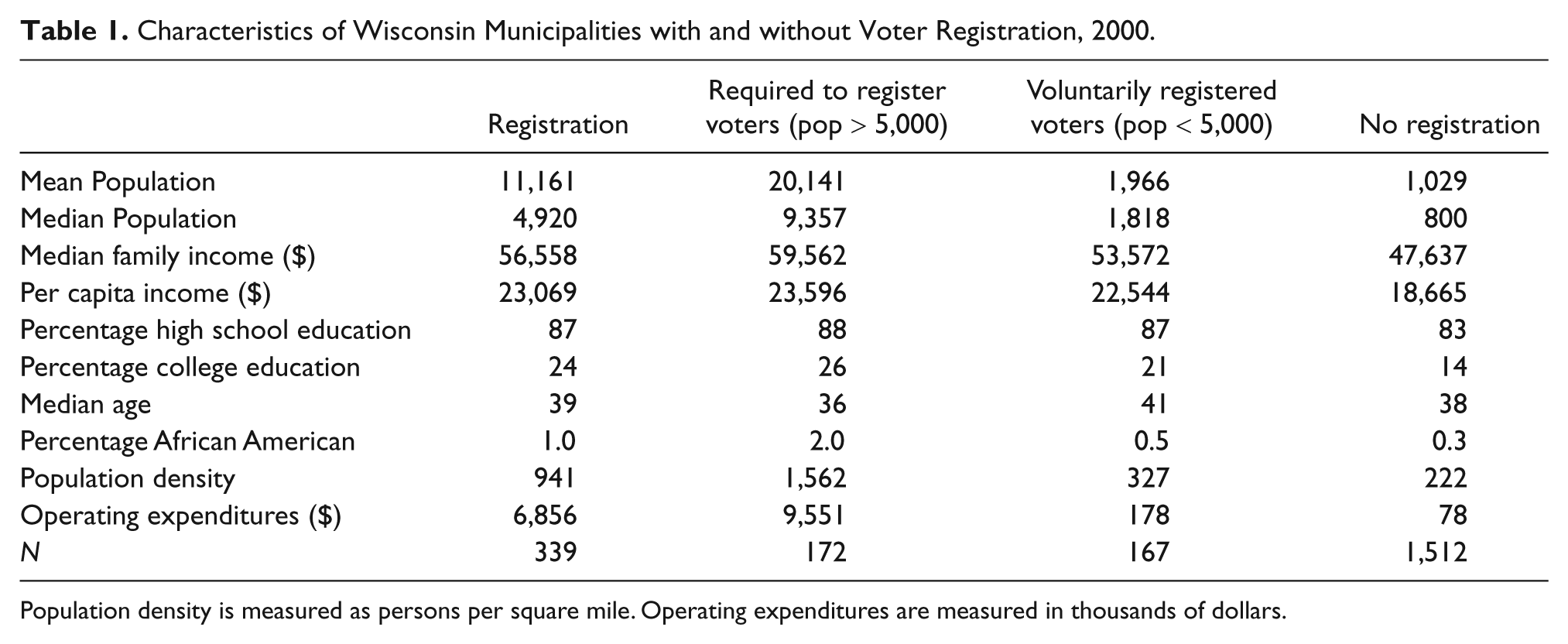
Population density is measured as persons per square mile. Operating expenditures are measured in thousands of dollars.
To guard against other potential confounds, we estimate panel models that include fixed effects for each municipality and year. The inclusion of fixed effects at the municipal level allows us to remove any time-invariant, unobserved factors that might influence turnout across communities (Angrist and Pischke 2009; Wooldridge 2002). While we might prefer to measure the socioeconomic characteristics of each municipality directly, we believe that it is reasonable to assume that such characteristics are relatively stable over the time period under examination. In addition, we also estimate “differences-in-differences” models that allow us to examine the short-term influence of the treatment—the introduction of voter registration—on turnout with a powerful but simple specification. By modeling the differences in turnout between two elections as a function of the difference in registration laws, the model conveniently factors out any municipality-specific factors that might be influencing the results. Because these models rely on a shorter time period (one election before to one election after the implementation of statewide registration) it is more likely that these potential confounders are invariant. It is in this way that we minimize the risk of bias resulting from omitted variables. 12
In summary, these data afford tremendous leverage in our attempt to estimate the effect of the registration requirement itself on voter turnout. Not only is the statewide adoption of voter registration in 2006 exogenous, owing to the requirements imposed on the state by HAVA, but the presence of a flexible EDR law in Wisconsin does away with the confounding influence of the closing date and other related aspects of registration.
Basic Results
Our first regression model is a basic fixed effects specification that exploits the panel structure of the data, making use of both cross-sectional and over-time variation in the application of voter registration requirements. To examine the long-term average difference in turnout between municipalities with registration and those without, we estimated the following linear model,

where i denotes municipalities and t denotes time and Tit is voter turnout percentage in a particular municipality and year. The key independent variable is Rit, which is a dummy variable equal to 1 if the municipality introduced voter registration in 2006 as a result of the HAVA mandate. We include year dummies for all but one year, δ t , to control for year-specific shocks and ballot effects, and municipal-level fixed effects, α i , which allow us to account for any unobserved, time-invariant factors that might influence turnout. The vector Cit represents the natural log of the administrative spending measure in each municipality, while β0 is a constant and ϵ it is an error term. 13 The Xit term includes a measure of (logged) population—a variable that is known to be correlated with turnout and administrative capacity. These controls are not necessary to produce valid estimates; we present the model with and without them both because of the relationship between population size and turnout (Geys 2006) and the tremendous heterogeneity in populations in our data. This setup is merely a pooled cross-sectional model with both space and time fixed effects. We also cluster standard errors by municipality to account for errors correlated across years (Bertrand, Duflo, and Mullainathan 2004). Beyond accounting for spending and population differences, the only moving part in the model is the treatment of introducing a new registration requirement for municipalities that did not previously have it.
Table 2 displays several specifications of the model, all of which unambiguously support the hypothesis that voter registration requirements have a negative but modest impact on turnout. In the “baseline” model we include only the registration treatment variable and get a coefficient estimate of −0.017 with a standard error of 0.002, suggesting a 1.7-percentage-point decline in voter turnout for municipalities moving from no registration to having registration. Given the exogeneity of the intervention—coming as it did from the federal government and motivated by a crisis in another state six years earlier—we are confident that the estimate captures the actual causal effect accurately. We regard this estimate as a pure estimate of the effect of registration because it depends on the most minimalist definition of registration. The effect is far smaller than existing estimates, which tend to be four to seven times as large. This is precisely as expected: avoiding endogeneity and focusing on registration in isolation produces a pure estimate of the influence of registration on aggregate turnout.
The Effect of Registration on Voter Turnout, 2000–2008.
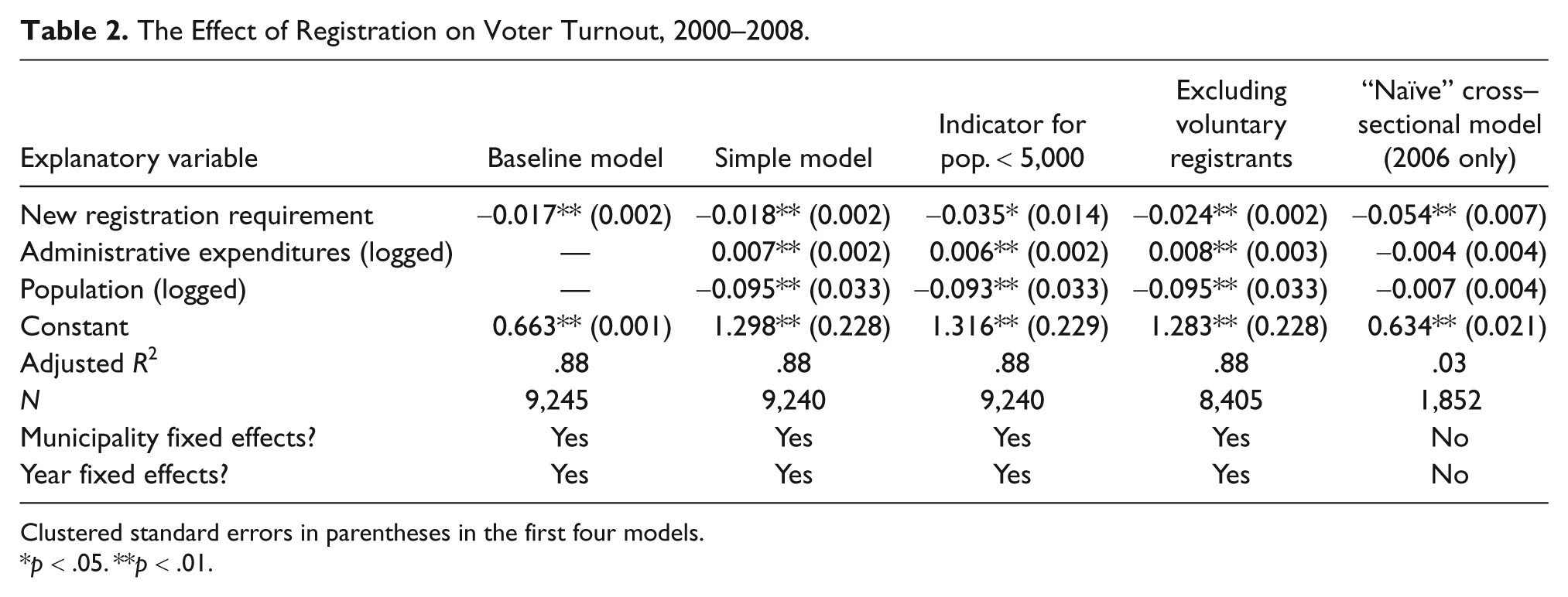
Clustered standard errors in parentheses in the first four models.
p < .05. **p < .01.
Robustness Checks
We estimated several additional models to test the robustness of these initial results. These robustness checks are attempts to alleviate concerns about the skewness of municipal populations, inertia in aggregate turnout, the nonrandom selection effects of municipalities that voluntarily adopted the treatment, and the validity of our treatment variable. The second column of Table 2 modifies the baseline model by adding measures of administrative capacity and population. The results of this “simple” model show that while turnout is increasing in administrative spending and decreasing in population, the effect of registration remains essentially unchanged at 1.8 points. The third column in Table 2 displays results from a model that includes an indicator for whether a municipality was under the five thousand population threshold as our measure of new voter registration. This increases the point estimate of registration’s effect somewhat but also its standard error, so that the effect is not statistically different from the baseline estimate of 1.7 points.
A concern is that there might be something distinctive about those municipalities that voluntarily began to register voters before 2006. Recall from Table 1 that the median age in these municipalities was higher than that in the other municipalities that were required by statute to have voter registration while population density and administrative expenditures were lower. Even though most other differences were negligible, there is still the possibility that these municipalities differ from those that were forced to register voters by virtue of population size. Excluding these municipalities from the analysis increases the point estimate that we found in previous models, but the basic relationship remains unchanged. With voluntary registration municipalities dropped from the analysis, the introduction of voter registration requirements statewide in 2006 nevertheless reduced turnout in municipalities that were not required to register voters by a little over 2 percentage points on average, as shown in the fourth column in Table 2. 14
It is also reassuring that population has a negative effect, supporting the frequent result that more populous locales tend to have lower turnout. Earlier estimates of the effect of registration on turnout levels, in addition to confounding multiple aspects of the registration process with the registration requirement itself, relied heavily on cross-sectional evidence that likely overstated the true impact of voter registration. As Ansolabehere and Konisky (2006) point out, cross-sectional studies fail to account for the numerous ways in which states vary apart from the measured differences in electoral laws. To verify this point, the last column in Table 2 presents a “naïve” regression that uses cross-sectional variation between municipalities to identify the effect of voter registration. In 2006 the size of the coefficient on the treatment variable is approximately 5.4 percentage points. A similar result is obtained when looking only at 2008 (results available on request). This is in line with the existing literature but is two to three times the size of the estimates from any of our panel models, thereby suggesting that earlier estimates of the effects of voter registration requirements on turnout are inflated.
In addition to these reported models, we considered other robustness checks. Dropping the state’s ten most populous and ten least populous municipalities does not noticeably change our estimates. We also estimated the model with an AR1 (first order autoregressive) error process, explicitly acknowledging that voter turnout may not be independent from one election to the next (Ansolabehere and Konisky 2006; Bertrand, Duflo, and Mullainathan 2004). Once again, the results are little changed, as the coefficient on our key independent variable indicates that voter registration reduced turnout by less than 2 percentage points on average (results available on request). This consistency of findings is reassuring but also unsurprising because the municipal fixed effects already account for most of the over-time continuity of turnout within communities.
Taken together, the results of these various models strongly suggest that the introduction of voter registration requirements statewide lowered voter turnout modestly. While informative, the fixed effects models reported above afford a look at only the average long-term effect of introducing voter registration and tell us little about the immediate effect of registration requirements on turnout. Our next models therefore build on the fixed effects specification, estimating a differences-in-differences model that allows us to examine the short-term change in turnout in municipalities with registration requirements in place prior to 2006 as compared to those that adopt registration because of the statewide mandate.
The specification is as follows,

where, as in equation 1 above, i indexes municipalities, t indexes years, and our dependent variable, T, is voter turnout at the municipal level. R is a dummy variable coded 1 if a municipality had voter registration prior to 2006 and 0 if it did not have registration. Because all municipalities had registration following the adoption of SVRS in 2006, R equals 1 in the election immediately after the change. The difference is 1 – Rit-1, and so municipalities that had voter registration before the law changed take on a value of 0 in the post period. Once again, Xit is the natural log of each municipality’s population and Cit is the natural log of the amount each municipality spent on administrative costs; the differences, ΔXi = Xit – Xit-1 and ΔCi = Cit – Cit-1, represent the change in these variables between the pre and post time periods. As before, β1, β2, and β3 are regression coefficients, β0 is a constant, and ϵ it is an error term.
We estimated this model separately for midterm and presidential elections, examining the short-term effects of introducing voter registration in each, comparing 2006 to 2002 in the first model and 2008 to 2004 in the second model. The results of these models, presented in Table 3, tell a story that comports well with the results of the fixed effects models described above. The coefficient on the registration variable for the first model, comparing turnout in 2002 to turnout in 2006, is −0.019, which suggests that there was an immediate effect of the registration requirement on turnout at the municipal level of about 2 percentage points. This effect appears to be slightly larger in presidential years but is nevertheless still on par with our panel estimates of about a 2-percentage-point decline in turnout. 15 Importantly, the persistence of a negative effect of registration on voter turnout in 2008 suggests more than simply an implementation effect that would be observed only in the first election after the treatment.
The Effect of Registration on Voter Turnout: Differences-in-Differences Models.

Clustered standard errors in parentheses. All variables are measured in changes (Δ).
p < .01.
A final way to verify the robustness of our estimated effect is to consider the data in the regression discontinuity (RD) framework. In the RD approach, one looks for nearly experimental effects in the neighborhood of a discontinuity such as a threshold or boundary. The assumption is that, after accounting for a conditioning variable, the treatment is essentially randomized around the discontinuity. In our application, the registration requirement for municipalities over five thousand people before 2006 serves as the discontinuity. Because of the presence of some municipalities below the five thousand threshold that voluntarily began to register voters prior to 2006, though, treatment status is not deterministically related to the threshold as it is in “sharp” applications of RD. As an example of a “fuzzy” RD design, we therefore use the population cutoff as an instrument for treatment status. Following Angrist and Pischke (2009), we use two-stage least squares to estimate the effect of voter registration on turnout.
The first column in Table 4 displays results from a model that pools data from 2006 and 2008 and uses the simplest fuzzy RD estimator—an indicator for whether a municipality was below the population threshold—as an instrument for registration requirements. Once again we observe that the introduction of voter registration requirements in Wisconsin decreased voter turnout by 2 to 3 percentage points. A slightly more complicated model that includes logged population (the “forcing” variable) produces a similar point estimate in the second column, although it is no longer statistically significant. This effect is consistent no matter whether we use the pooled data set or only examine individual years (results for individual years available on request).
The Effect of Registration on Voter Turnout in 2006 and 2008: “Fuzzy” Regression Discontinuity Estimates.

Standard errors in parentheses.
p = .075. **p < .01.
Finally, the last column in Table 4 displays point estimates from a model that estimates a nonparametric version of fuzzy RD using the Imbens–Kalyanaraman approach to bandwidth selection (Imbens and Kalyanaraman 2009). Although the coefficient estimate does not quite reach conventional levels of statistical significance (p = .075), the point estimate is similar to results from other models and also suggests that voter turnout decreased by 2 to 3 percentage points with the introduction of registration requirements.
Administrative Capacity as a Mechanism
Collectively the results suggest that voter registration requirements themselves reduce turnout by about 2 percentage points on average. Yet the mechanism underlying this connection has yet to be investigated. Having established the magnitude of the pure registration effect for the first time, we are now prepared to illuminate its cause. If decades of research on this topic were our only guide, we would hypothesize that registration is primarily a burden on the less educated and experienced voters (e.g., Wolfinger and Rosenstone 1980), although even this assumption has come under challenge (Nagler 1991). Rather than add to the debate about exactly how individual-level variables such as education might mitigate the effect of registration, we suggest a different line of inquiry that focuses on institutional factors that either exaggerate or alleviate the burden of registration.
We expect that municipalities that devote more resources to election administration will be better poised to soften the negative impact of registration on voter turnout. Municipal clerks representing communities with greater capacities—larger full-time staff, more abundant funds, better training, and other resources—will be better situated to educate the public in advance of the election and process new registration forms effectively, thus easing the transition from the era without registration to the era where it is required. In contrast, municipalities with lower levels of administrative capacity are less likely to engage in public information campaigns and to have the necessary equipment, expertise, personnel, and time to facilitate the new registration mandate (see Creek and Karnes 2010; Gerken 2009). We have already shown that municipalities that spend less on administration tend to have clerks who work less, have fewer professional connections, are less likely to have formal job descriptions, and deploy fewer precincts and polling places per capita, thus leading to greater demands on poll workers. These more skeletal governments might in fact magnify the impact of registration, depressing turnout more than it otherwise would have been. In short, local governments with more resources should temper the dampening effect of registration on turnout.
We reason that the degree of disturbance caused by the introduction of registration is a function of variations in election administration. While the average effect of introducing registration requirements statewide may be negative, some municipalities were probably better equipped to handle the additional administrative costs than others. In terms of modeling, this suggests an interaction between capacity and the treatment. We expect a significant interaction effect between registration and administrative spending, with turnout in higher capacity municipalities suffering far less as a result of the introduction of the registration requirement than in lower capacity municipalities where the implementation of registration would have been more challenging.
To test this conjecture, we returned to our original fixed effects model and added an interaction term multiplying spending with our indicator for whether a municipality had voter registration. 16 The results of this reestimation are shown in the first column of Table 5 and indicate the presence of a significant positive interaction effect between registration laws and administrative spending. Consistent with our expectations, it appears that better funded municipalities suffered less of a drop in voter turnout as a result of the change, while turnout in the lowest capacity municipalities in Wisconsin fell even more sharply than might have been expected based on the average effect of having voter registration reported in the initial fixed effects models. The main effect of administrative spending remains positive, but the interaction suggests that registration was more of a hindrance in smaller municipalities than in larger ones. The main effect of registration grows to 3.6 percentage points, a bit larger than other estimates presented thus far, but it is not directly comparable to other models because the total effect will be a combination of this estimate and the interaction term. We do this below.
The Effect of Registration on Voter Turnout, 2000–2008: Interactive Models.
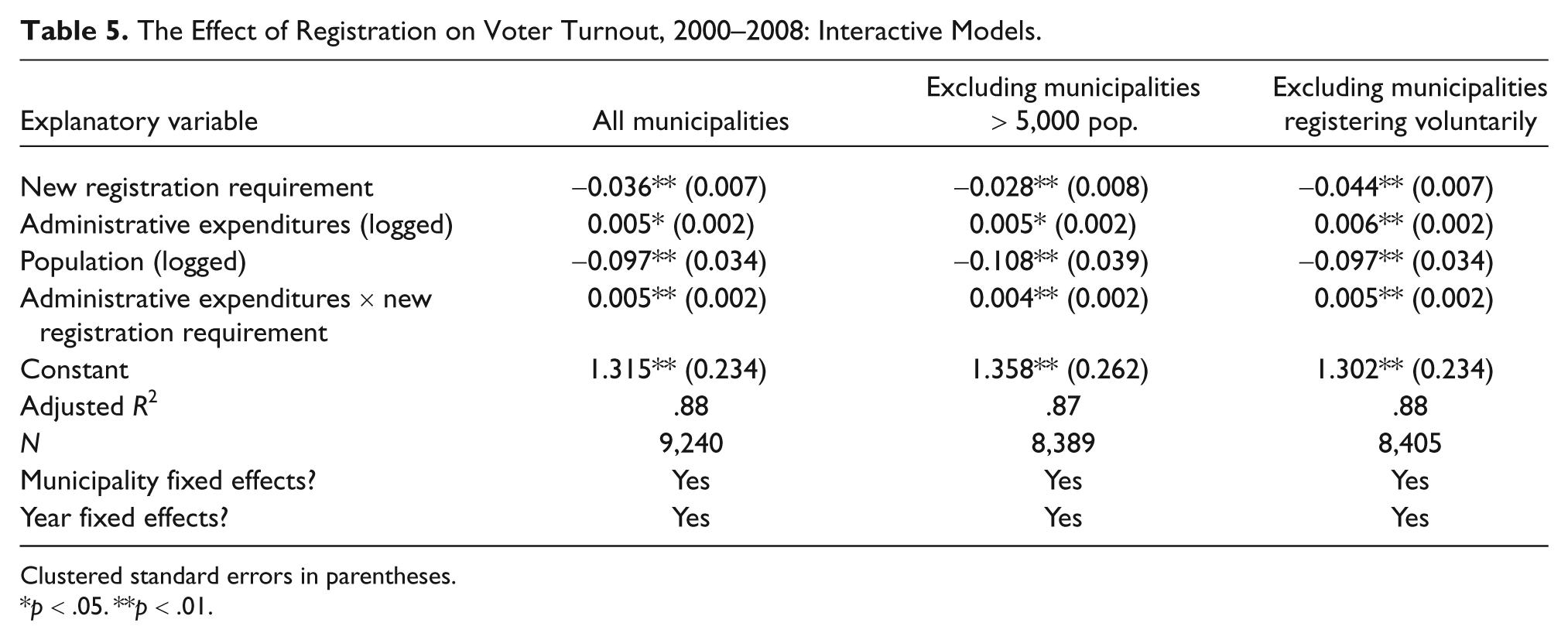
Clustered standard errors in parentheses.
p < .05. **p < .01.
The second column in Table 5 checks the robustness of the basic results presented in the first column. Restricting the sample to municipalities with populations under five thousand where registration was not previously required does not noticeably affect our estimates. The final column shows that excluding from the analysis municipalities that voluntarily began registering voters before 2006 actually increases the estimated effect size.
Figure 1 displays these interactive effects graphically. 17 There are three important lessons here. First, administrative capacity increases turnout. Regardless of whether a municipality had registration or not, spending more on its operations improved voter participation, even after controlling for related variables such as population. This is reassuring in that increasing resources for administering elections appears to have a payoff in terms of greater voter participation. Second, turnout is lower when registration is required. A registration mandate (the dashed line) produces lower turnout than in communities without registration (the solid line). Recall that the typical effect in the models is about 1.8 percentage points. Third, the depressant effect of registration is largest in municipalities with the least administrative capacity. At the low end of capacity the turnout gap is 1.95 points, but the treatment effect drops to a mere 0.55 points for a municipality with the highest administrative spending. 18 Thus, for a realistic set of values in one Midwestern state, the range in capacity is large enough to reduce the registration effect by two-thirds. 19 Extrapolating to even larger municipalities—where the data are thinner and the inferences more tenuous—suggests sufficient resources might eliminate the effect of registration on turnout altogether.
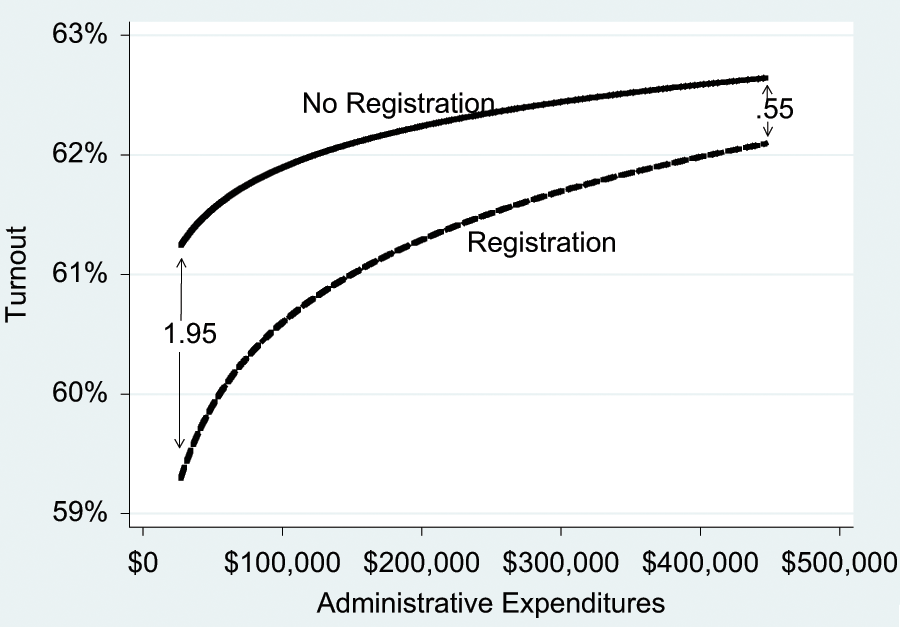
Varying effect of registration on turnout.
We thus conclude that registration’s influence on voter turnout is sharply moderated by the local institutions designed to implement the policy. When election officials have adequate training, staff, and resources, they are able to absorb much of the negative impact of registration. In contrast, voter participation is affected more sharply in poorly served communities. This is troubling in that election laws affect municipalities differently depending on the resources allocated for administration. And while we can only speculate as to whether administrative resources will continue to moderate the effect of registration on voter turnout in coming elections, our general expectation is that the effects might diminish as voters become more informed about registration requirements. To the degree that the short-term estimates that we have identified here will shrink with time, this further supports our broad conclusion that registration has a more modest effect on turnout than previous research has suggested.
Discussion and Conclusion
For over a century registration with the state has been a prerequisite for voting throughout most of the United States. Registration was introduced during the Progressive Era to combat fraud, among other things, but all reforms have multiple consequences, some of them unexpected. The introduction of registration is widely believed to have lowered turnout and worked to keep turnout at lower levels in the U.S. than in other comparable democracies, or at least that has been the conventional wisdom (Piven and Cloward 1988; Powell 1986). We have scrutinized this assumption on two fronts.
First, we have made clear that most studies of the effects of registration have not been of registration per se but rather of dimensions, or significant facets, of registration. Prime among these has been the closing date by which registration must be completed. We have shown that, while such variations in registration laws may be vitally important both legally and normatively, neither is registration itself. Using data on the exogenous introduction of the most minimal of registration laws in Wisconsin municipalities, we have shown through a variety of modeling approaches that the pure effect of registration is approximately 2 percentage points. This is well below the most commonly cited figures, which we contend are estimating different quantities of interest that include this effect as well as other elements in the registration process.
The larger estimates found in previous studies suggest that add-ons to the registration process such as closing dates, residency requirements, roll purging processes, and felon disenfranchisement laws are in combination more consequential than registration itself. Furthermore, although small when compared to earlier estimates of the effects of registration requirements on voter turnout, our estimate is not zero, as previous studies of EDR have suggested (Mitchell and Wlezien 1995; Wolfinger, Highton, and Mullin 2005). Nevertheless, in considering why turnout is so much lower in the United States than in other advanced industrial democracies, registration itself cannot account for much of the explanation.
Second, we have shown that the varying effects of registration are not solely the result of the capacities of individuals. Although individual-level differences may well be important determinants of how consequential registration requirements are, we have shown for the first time that administrative capacity is also a central determinant. Based on our understanding of the varying resources available to clerks, we have shown that registration had a much larger negative impact in low-capacity municipalities where election administrators were presumably less able to implement a new registration requirement with ease. The effect was almost four times as large in a municipality with low capacity as one with high capacity. A little extrapolation suggests that the effect of registration could have been even more substantial in the most poorly funded jurisdictions in America, but only negligible in those with abundant resources. Election reforms do not exist in isolation but rather depend on the ability and willingness of election officials to implement them. In the case of registration it seems that administrative capacities made the introduction of registration disproportionately affect electorates in resource-scarce communities.
What is more, even though Wisconsin’s decentralized election administration system might not be representative of the typical state, America’s “hyper-federalized” system of election administration (Gerken 2009; Hasen 2005) seems almost certain to create inequalities across jurisdictions in other states. There are some ten thousand local electoral districts in the United States (Kimball et al. 2010). “The crux of the problem,” Gerken (2009, 20) writes, “is that many election jurisdictions in the United States are starved for resources.” Some jurisdictions are equipped with modern voting equipment and have election workers who are well trained and up to the task of ensuring that everyone who is eligible to cast a ballot is able to do so. Others must make do with far less. A generation of scholarship, however, has taught that legal barriers to voting, coupled with the inability or unwillingness of the average citizen to pay the additional costs associated with such restrictions on the franchise, have been responsible for the low rates of voter turnout in the United States. We do not directly challenge the validity of this argument, although we believe it to be incomplete. One must take into account the extent to which communities differ in administrative capacity. While election laws may differ from state to state in America, so does the ability of substate governments to implement the laws that are on the books.
Footnotes
Acknowledgements
The authors would like to thank Stéphane Lavertu, Phil Wells of the Wisconsin Department of Administration, and Nathan Judnic and Logan Dixon at the Wisconsin Government Accountability Board for providing some of the data used in this article. They would also like to thank Scott Gehlbach, Mike Hanmer, Matt Holleque, Luke Keele, Marc Meredith, Marc Ratkovic, members of the Political Behavior Research Group and Models and Data Group at the University of Wisconsin-Madison, and anonymous reviewers for helpful comments. Special thanks to Patrick Moran for providing invaluable research assistance.
Declaration of Conflicting Interests
The author(s) declared no potential conflicts of interest with respect to the research, authorship, and/or publication of this article.
Funding
The author(s) received no financial support for the research, authorship, and/or publication of this article.