



Abstract
While judicial turnover in Latin American high courts is often the result of political realignments within the executive branch, the judiciary may also be sensitive to realignments in the legislative branch. The authors use data from the Ecuadorian Constitutional Court to show that under some circumstances, congressional deputies will seek to remove judges further from their own ideal points as the composition of the legislative coalition changes. This provides some of the first empirical evidence of the role legislatures play in Latin American judicial instability and may be broadly generalizable to other countries with similar institutional profiles and rates of interbranch crisis.
What are causes of judicial instability in Latin America’s high courts? While the literature on the U.S. judiciary assumes that it is the justices themselves who determine when they retire from the bench (Hagle 1993; Zorn and Van Winkle 2000; Epstein and Segal 2005), this is not often true in Latin America (Verner 1984; Rosenn 1987). As Pérez-Liñán and Castagnola (2009) show, judicial turnover in Latin America is frequently manifested as removal by the executive branch under the cloak of partisanship. But what about political contexts where the executive must rely on the legislature to govern? Under what conditions may the legislature also play an antagonistic role in these interbranch relations? And what triggers the removal of judges in a context where the partisan composition of the legislative branch does not change?
To solve these research questions, we make two general arguments. First, while judicial turnover is often the result of political realignments within the executive branch, realignments in the legislative branch may also cause turnover in contexts of legislative dominance. Second, turnover in institutionally volatile contexts is determined by ideology and partisanship—unlike the United States, where removal of judges is not often determined by these factors (Epstein and Segal 2005). Specifically, we argue that in environments of political uncertainty, all else being equal, an increase in the ideological distance between the government and individual judges decreases the likelihood of judicial survival. We test these conjectures using data from the Ecuadorian Constitutional Court (Tribunal Constitucional, TC) and political party ideological scores between 1999 and 2007. The frequent changes in executive office and legislative coalitions during this time provide a high amount of variation on our chief independent variable (ideology of mean government coalition member) while holding constant the actual partisan composition of the congress, while the nearly four wholesale changes in the TC rovide variation on our dependent variable (judicial turnover).
The second part of the article reviews the literature on judicial turnover, followed by a description of removal and instability in the Ecuadorian Constitutional Court since 1999, a representative case in Latin American judicial politics. Then, we present a theoretical framework that establishes causal linkages and some testable hypotheses. In the fourth part, we describe our data and methodology, focusing on the operationalization of ideology scores for justices and for political parties. In the fifth part, we analyze our findings and then conclude with some suggestions for the development of future research agendas in the subfields of judicial politics and legislative studies as well as the broader area of democratic regime accountability.
Judicial Turnover in the Literature
U.S. scholarship on judicial turnover focuses on judges who voluntarily leave office, although there is no general consensus on the causal factors of judicial exit. For some, the ideological difference between judges and the president is the decisive variable (Barrow and Zuk 1990; Zorn and Van Winkle 2000; Ward 2003; Calabresi and Lindgren 2006). For others, physical limitations or retirement plans are most influential factors (Squire 1988; Nixon and Haskin 2000; Yoon 2006). A third group argues that judicial exit is a strategy pursued by the retiring judges when the potential replacement shares similar ideological preferences (Hagle 1993; Spriggs and Wahlbeck 1995; Segal, Spaeth, and Walker 2007). Finally, a last group argues that strategic judicial retirement is a “myth” created by the specialized literature (Brenner 1999). What all of this has in common is the assumption that it is the justices themselves who determine when they retire from the bench. As the literature on Latin American courts shows, this is not always true outside the United States (Verner 1984; Helmke 2005a; Pérez-Liñán and Castagnola 2009).
Although recent literature examines the effects of judicial instability on the administration of justice and democratic accountability in Latin American courts (O’Donnell 1999; Spiller and Tommasi 2000; Iaryczower, Spiller, and Tommasi 2002; Feld and Voigt 2003; Ríos-Figueroa 2007; Kapiszewski and Taylor 2008), there is little research into the anticipated yet unconstitutional removal of high court justices and courts. Helmke (2010) develops and tests a framework for explaining interbranch crisis in Latin America, relying on cases of conflict between pairs of the executive, legislative power, or judiciary.
She finds that between 1985 and 2008, courts in Latin America acted as the main aggressor against the legislature in just 6 percent of all cases (and never against the executive), while facing aggression at a higher rate than the other two branches (Helmke 2010, 743). However, she does not specifically explore the resolution of conflict involving the judiciary. The most complete regional picture is offered by Pérez-Liñán and Castagnola (2009), who examine almost one hundred years of courts in eleven Latin American countries to find that high court judicial turnover is often the result of political realignments in the executive branch. Specifically, the arrival of a new administration to power consistently results in the appointment of new justices. Yet this research does not directly address the mechanisms by which presidents or dictators reshuffle the courts (Pérez-Liñán and Castagnola 2009, 109-10).
The case of the Argentine Supreme Court, where the average duration in office for judges is around 67.5 months (Helmke 2002, 292), the Peruvian Supreme Court, where justices were replaced by transitory judges during the Fujimori presidency (Comisión Andina de Juristas 2009), and Ecuador’s Constitutional Court, whose members were removed on four separate occasions between 1997 and 2007, are some empirical references to this political phenomenon. Yet while the Argentine, Peruvian, or current Venezuelan cases can be explained as a consequence of executive strong-arming, Ecuadorian executives are often beholden to the legislature, or a part of it since their minority governments often rely on coalitions to govern (Mejía Acosta 2009). In addition, partisan influence on the judiciary in Ecuador may be selective and highly dependent on institutional characteristics (Grijalva 2010). We briefly sketch the progression of Ecuadorian Constitutional Court instability from its creation to the present, demonstrating the legislature’s role in undermining stability and highlighting partisan factors at play.
Judicial Removal in Ecuador’s Constitutional Court
Between the establishment of the TC in 1999 and 2007, Ecuador had five different presidents and at least fourteen distinct legislative coalitions or mobile majorities (see Table 1). During this same time the TC was completely turned over four different times, with small groups of judges managing to continue in power in the following term. A brief history of the creation and functioning of the TC, along with corresponding executive and legislative developments, will show how judicial survival is not a random event but is tied directly to executive turnover and the formation of certain new government coalitions.
Administration, Government Seat Share in Legislature, Coalitions, and Coalition Seat Share in Legislature (1998–2007).
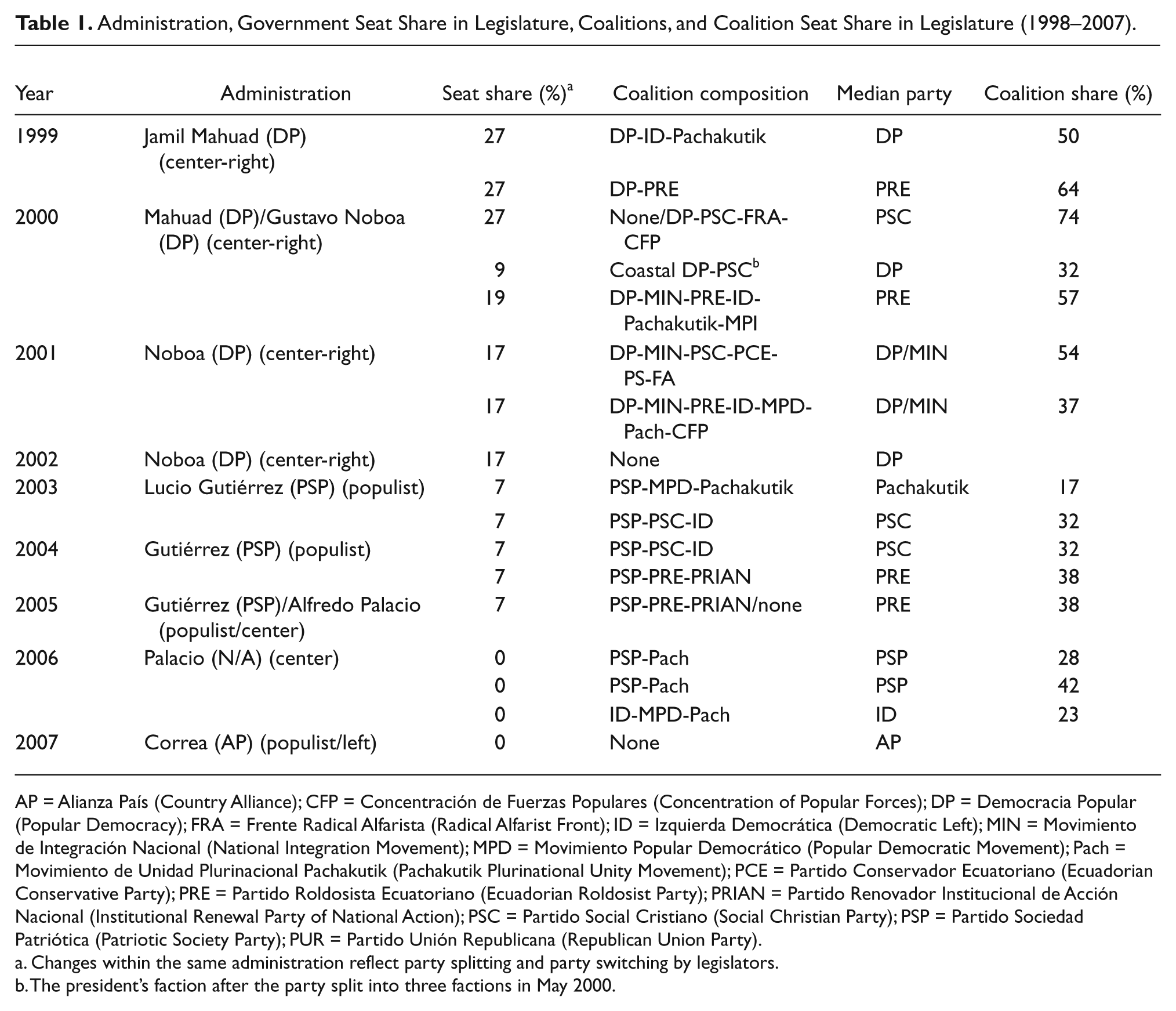
AP = Alianza País (Country Alliance); CFP = Concentración de Fuerzas Populares (Concentration of Popular Forces); DP = Democracia Popular (Popular Democracy); FRA = Frente Radical Alfarista (Radical Alfarist Front); ID = Izquierda Democrática (Democratic Left); MIN = Movimiento de Integración Nacional (National Integration Movement); MPD = Movimiento Popular Democrático (Popular Democratic Movement); Pach = Movimiento de Unidad Plurinacional Pachakutik (Pachakutik Plurinational Unity Movement); PCE = Partido Conservador Ecuatoriano (Ecuadorian Conservative Party); PRE = Partido Roldosista Ecuatoriano (Ecuadorian Roldosist Party); PRIAN = Partido Renovador Institucional de Acción Nacional (Institutional Renewal Party of National Action); PSC = Partido Social Cristiano (Social Christian Party); PSP = Partido Sociedad Patriótica (Patriotic Society Party); PUR = Partido Unión Republicana (Republican Union Party).
Changes within the same administration reflect party splitting and party switching by legislators.
The president’s faction after the party split into three factions in May 2000.
Ecuador’s Constitutional Court was unofficially created in June 1997, when the first judges took possession, although no law existed that regulated the court’s functioning until the adoption of the 1998 constitution. Following the creation of constitutional courts in other South American countries, article 198 of Ecuador’s 1998 constitution established the TC as an institution of control over legislative and executive actions, separate from the judiciary, and composed of nine magistrates. 1 It was established for the express purpose of judicial review—reviewing the constitutionality of laws, decrees, orders, statutes, rules, and resolutions passed in the legislature, decreed by the executive, or issued by any other state institution—and upholding constitutionally guaranteed rights. The TC has more policy-making power as well as greater capacity in changing the legal status quo than the Ecuadorian Supreme Court. Without a doubt, its inclusion in the policy-making arena makes it a political veto player, on which change or maintenance of the status quo depends on a simple majority vote.
As established in the constitution, congress is ultimately responsible for choosing the judges from lists of three candidates (called ternas) submitted by different representative bodies. A simple congressional majority is responsible for choosing two of its own candidates. After this, the same simple majority is required to pick one candidate from each of the seven ternas submitted by other representative bodies: two from the president, two from the Supreme Court, one from municipalities and provincial councils, one from the chambers of commerce, and one from labor syndicates and peasant organizations (Gobierno Nacional de la República del Ecuador 1998, article 275). This group is supposed to hold power for four years, although, in practice, this has never occurred.
Much like the Ecuadorian Executive since 1996, no TC or individual judge has managed to complete the constitutionally stipulated forty-eight-month term. On four distinct occasions (March 2003, November 2004, April 2005, and April 2007), the entire court was unconstitutionally restructured by the legislature. 2 This involved the removal of nearly all judges—although some individual judges managed to survive. We argue that it is a change in coalition configuration, and particularly a change in the decisive median legislator, that results in this judicial turnover.
The Febres Cordero–Gutiérrez Agreement
Ecuador’s first Constitutional Court was supposed to endure to from June 1999 to June 2003, but judges were removed in March 2003. This was due, in part, to the electoral coalition formed by the government of Lucio Gutiérrez with political caudillo León Febres Cordero and his Social Christian Party (PSC). The process of turnover began on January 9, 2003, less than a week before President Gutiérrez’s inauguration, when the legislature designated two new judges to represent it on the TC. A simple majority of fifty-four legislators, made up of deputies from the PSC, ID, DP, and PRIAN, then declared that the current nine justices had then served a complete term. 3
This not only opened up the path for a total restructuring of the court, but also constituted the first political defeat of the incoming government, Gutiérrez’s PSP and the indigenous party, Pachakutik, which had not participated in the vote. This signal from the “mobile majority” in the legislature to the new PSP-Pachakutik government was met with negotiation. On March 19, Gutiérrez had a private meeting in the coastal city of Guayaquil with PSC leader Febres Cordero, and shortly thereafter the mobile majority—minus the left-of-center ID and populist PRE, but now including the PSP and Pachakutik—designated the other seven TC judges. 4 Shortly thereafter, Pachakutik formally pulled out of the governing coalition, and the PSC stepped in. Despite the unconstitutionality of the legislative decision adopted, none of the judges resisted, nor did they present any legal demands against the government. Furthermore, two of the judges, René de la Torre and Oswaldo Cevallos, continued on for a second term (Basabe-Serrano 2012).
The Gutiérrez–Bucaram Agreement
By mid-2004, the government’s coalition with the PSC had deteriorated, and amid embezzlement and corruption charges by the PSP and PSC, they parted ways. By November, the PSC had formed an opposition alliance with the ID and Pachakutik to seek revenge against Gutiérrez by calling for his impeachment on the ground of corruption (PSC) and jeopardizing state security (Pachakutik and the ID). The congressional opposition lacked the two-thirds majority required to dismiss the president, but the government nevertheless tried to form a legislative shield with the support of exiled ex-President Bucaram’s PRE and Álvaro Noboa’s PRIAN parties. Immediately after this vote, PRE deputy María Augusta Rivas received the president’s support to “restructure” a range of judicial branches, including the TC.
After a period of negotiation and legislative bargaining among the legislators of the new PSP-PRIAN-PRE majority, the TC judges were unconstitutionally removed from their positions on November 25, and a new group of nine judges was designated to take their place. Like the previous case of removal, the judges did not formally contest their exit, and they left office peacefully. Once again, two judges from the previous court, René de la Torre (for a second time) and Milton Burbano, survived. In March 2004, the similarly restructured Supreme Court of Justice rescinded corruption charges against the PRE’s Bucaram, leading to his return from exile in Panama and contributing to the popular protest against Gutiérrez.
The Fall of Gutiérrez and Constitutional Crisis
The constitutional violations and Bucaram’s return angered a broad social segment, including urban middle-class protesters (forajidos) in Quito, who rejected Gutiérrez’s authoritarian style. In the context of widespread protests, the Armed Forces Joint Command publicly declared its withdrawal of support for the president. A legislative session was convened by opposition parties on April 20, 2005, and the legislature voted sixty to zero (with two abstentions) to declare Gutiérrez guilty of “abandonment of office.” Vice President Alfredo Palacio was named president.
The new majority, made up of the PSC and ID (as President Palacio was an Independent), approved a resolution on April 26 that declared the new TC judges unconstitutional after only five months in office. In a similar fashion to the two previous cases of removal, the fallen judges did not offer great resistance to this declaration or question the constitutionality of the removal. However, at this time, the legislature decided to hold a merit-based public contest to name the next Supreme Court justices. This complex ad hoc procedure designed by the congress was not finalized until November 2005, and the submitted TC ternas were not discussed until February 22, 2006, when the new judges were finally chosen.
The Arrival of Correa
Rafael Correa was elected president of Ecuador on November 26, 2006, after defeating banana tycoon and PRIAN party leader, Álvaro Noboa. Correa assumed office in January with an antiparty and antiestablishment discourse, and although he carried not a single congressional deputy in the congress, the high level of public support for him allowed him to pursue his agenda of a National Constituent Assembly. 5 Circumventing the legislature, on March 1, Correa was able to get the Supreme Electoral Tribunal (TSE) to call a plebiscite for the purpose of convoking a constituent assembly. In the following days, the legislative majority of the PSP, PRIAN, PSC, and UDC (previously DP) asked the TC to rule on the constitutionality of the TSE’s decision. At the same time, they also decided to remove the TSE’s head judge, Jorge Acosta, and impeach the four judges who had sided with Acosta in favor of the president.
The TSE responded by removing the fifty-seven deputies who had questioned their decision. On April 23, the TC tried to reinstate fifty-one of the fifty-seven deputies who had been thrown out office by the TSE, arguing through a petition that it had been illegal to remove them in the first place. Before the reinstated congressmen had the chance to reenter the congress, the assembly voted to fire all nine TC judges for their “unconstitutional actions.” As in the previous cases, the justices took leave of their positions without resistance on hearing of the legislative resolution, while the ex-president of the court, Santiago Velásquez, permitted himself to say only that he and his colleagues would meet to determine if they would bring the matter before the Organization of American States. 6 Justice Manuel Viteri Olvera remained on the bench through the following reconfiguration of the court (Basabe-Serrano 2012).
Theoretical Considerations
This account indicates that Ecuadorian constitutional justices work in a very unstable environment—reflected in the higher rates of insecurity in their branches—and that changes in the judiciary are often correlated with changes in the executive or the executive’s governing coalition. Nonetheless, they do not provide a systematic account of the cause of judicial turnover since some coalitional or governmental changes do not result in judicial changes. Furthermore, these large-scale changes in coalition do not explain why certain magistrates are able to maintain themselves on the bench while others perish. So what factors explain judicial instability in Ecuador, and how do these factors fit into the broader literature on judicial turnover?
Our argument is straightforward: (1) turnover of the TC in Ecuador has been driven largely by the legislature, specifically the parties allied to the president, and (2) this turnover does not occur automatically with a change in coalition but is conditional on variation in the distance between the judge’s ideal point and the median coalition member’s ideal point. Although much of the U.S. judicial politics literature conceptualizes judicial turnover as voluntary, strategic, and based on ideology (Hagle 1993; Zorn and Van Winkle 2000; Epstein and Segal 2005), and the Latin American literature sees turnover as involuntary and controlled by the executive for political purposes (Verner 1984; Rosenn 1987; Pérez-Liñán and Castagnola 2009), judicial turnover in Ecuador appears to be a combination of the two: involuntary, driven by ideology and partisanship, and controlled by (part of) the legislature instead of exclusively the executive or the judges themselves.
Given that the judicial branch can act as a veto player of public politics, especially via judicial review action, executives and legislatures will want judges who are closest to their ideological ideal point. To achieve this, legislators and presidents will use their institutional power to nominate and select judges for supreme or constitutional courts whose preferences are consistent with the preferences of these actors (Tsebelis 2002). Assuming that congress is rational, it will choose candidates with the closest ideological affinity.
Although this argument does not consider how changes in political coalitions could affect judicial stability, it is useful for deducing some possible causes of that phenomenon. According to spatial theory, we argue that if the status quo—in our case represented by the median legislator of the government coalition—does not change, both legislators and presidents lack the incentives to remove judges from their benches. By contrast, if the status quo changes radically, political actors will have sufficient incentives for designating a new court.
The volatile nature of coalition government and the unpredictability of who the following coalition partner(s) will be implies that justices are often unable to vote strategically. Combined with the fact that they are often more interested in protecting their futures outside of the TC, they therefore tend to vote according to their ideological preference (Basabe-Serrano 2011; see Grijalva 2010 for possible exceptions to this rule). The result is judicial removal. In other words, judicial turnover in Ecuador—and possibly other countries in Latin America and the world at large—seems to be driven, in part, by ideological differences between the court and the executive or governing coalition. As a result, we propose that as the ideological distance between a judge and the median legislator of the governing coalition increases, the greater the likelihood that the judge will be removed.
We also identify other factors and alternative explanations for the removal of TC judges. In addition to the aforementioned increase in ideological distance between the governing coalition and each judge, the historical sketch of the courts suggest that the size of the presidential coalition and an affiliation with the dominant political party of this era, the PSC, may be able to explain some of the instability. Although some (Bill Chávez 2003, 2004; Ríos-Figueroa 2007) argue that a larger presidential coalition may be able to exercise more power over executive decisions and influence the status of the courts, this argument does not consider judicial seats as goods distributed by the president to acquire legislative support. Accordingly, if the executive seeks to remove judges as a mechanism to redistribute those positions and seek legislative allies, then he will be less likely to intervene as the coalition grows larger. Simply, as the president’s coalition grows, the chance of judicial exit will decrease.
Nevertheless, like in other Latin American countries, it may also be possible for strong actors outside of official channels to exert control over the judicial branch. The narratives from above show that the PSC, led by ex-president León Febres Cordero, participated in many of the negotiations over judicial removals. This is not surprising. Febres Cordero was known as the “owner of the country” for his control over state political and economic institutions and served as president of Ecuador from 1984 to 1988 and mayor of Guayaquil from 1992 to 2000 as well as the de facto leader of the PSC until his death in 2008. Given this, it is possible that the real power of judicial impeachment during this period lay with Febres Cordero. If this is the case in Ecuador, then changing executives and shifting government coalitions should have little impact on the TC. Therefore, it seems plausible that judges who hold an affinity—if not affiliation—with the PSC will have a lower likelihood of judicial exit than other justices.
We also examine the possible destabilizing effect of negative public opinion and public protest. In countries with an unconsolidated rule of law and fragile political institutions, a high presidential approval rate might increase judicial stability since citizens’ support can be utilized by presidents as a means of control over the courts and their decisions. There are many examples of this relationship in Latin American history. For instance, Peruvian and Venezuelan Supreme Court judges were removed by presidents Fujimori and Chávez, respectively, without any public opposition (Arce 2003). In both events, strong and popular executive leadership was sufficient to legitimize judicial turnover. Consequently, in Ecuador we consider the possibility that under conditions of weak rule of law and deficient institutions, an increase in presidential approval will increase the likelihood that a judge will be removed from office.
Last, much research about institutional instability in Latin American countries has shown that social protests played a decisive role in the resolution of recent presidential crises (Hochstetler 2006; Pérez-Liñán 2007). In fact, presidential impeachments, near impeachments, and quasi-impeachments in Argentina, Bolivia, Brazil, Colombia, Ecuador, Paraguay, and Venezuela are all cases in which social protests played a decisive role in triggering legislative and even military action to remove presidents. In some cases, such as Argentina in 2002, street protests may also directly result in the impeachment or removal of Supreme Court or Constitutional Court justices (Helmke 2005b). Yet in addition to this direct relationship, social protest may also be an indicator of other processes that affect justices. In Ecuador, as the executive’s survival has become less certain as triggered by or reflected by social protest, the president has sought greater legislative support (Mejía Acosta and Polga-Hecimovich 2011), indicating a higher proclivity toward judicial instability. Social upheaval then becomes a type of indicator or intervening variable to explain the underlying context of instability. As a consequence of these two reasons, we control for the possibility that as social protests increase in number, the likelihood that a judge will be removed from office increases.
According to Bill Chávez (2003, 2004) the fragmentation of political power increases judicial instability; however, we do not consider this variable because the fragmentation of political power in Ecuador has remained constant over the past three decades (Pachano 2007; Basabe-Serrano, Pachano, and Mejía Acosta 2010; Grijalva 2010).
Testing for Causes of Removal
In a survey of the Latin American judicial politics literature, Kapiszewski and Taylor (2008) note the abundance of historical narrative accounts and paucity of quantitative data to make systematic inferences. While we use a historical account to develop our hypotheses, we also respond to Kapiszewski and Taylor’s challenge to be more scientific by testing these hypotheses with a quantitative database of TC justice and political party ideal points. The unit of analysis for this section is judge–month. This is appropriate since coding by a larger unit of time, such as year, would be a clumsy approximation of the reality of Ecuador’s shifting legislative coalitions and the circumstances that caused the removal, while monthly coding is able to incorporate less dramatic shifts in the mobile majorities that did not affect judicial stability.
Our dependent variable is “judicial exit,” which is coded as 0 if the judge was in office for a given month and as 1 if the judge was removed in that month (N = 765). Our principle independent variable is the distance between the ideological preference of a given judge and the ideological preference of the median legislator in the government coalition during that month. Our other independent variables are (1) months the judge has been in office (since Helmke 2002 argues that judicial survival may be more tenuous as time passes), (2) coalition share of the legislature, (3) affinity with the PSC, (4) net presidential approval rating, and (5) the number of social rotests in the country by month.
To determine the ideological preference of the median legislator of the coalition party, we first establish the party composition of the governing coalition. In the Ecuadorian context, a coalition is defined as a public or clandestine agreement between the executive and party leaders or other legislators in which legislative support is exchanged for pork, patronage, or other concessions. The composition of these coalitions is taken primarily from Mejía Acosta and Polga-Hecimovich (2011), who argue that presidential crises in Ecuador are linked to, and accelerated by, the rapid erosion of legislative coalitions, especially in the post-1996 period. They use interviews with Ecuadorian political leaders, primary- and secondary-source materials, and variables such as bill success rate and party switching rates to fix the establishment and erosion of coalitions between 1979 and 2006 to the month, as laid out in Table 1.
Using the coalition composition, we then label the ideological preference point of each party and count the number of legislators in each party to arrive at the median legislator. This may be problematic because it conflates individuals’ interests with party interests. However, assigning individual deputies their own party’s ideological scores is theoretically justifiable on the ground that coalitions are nearly always negotiated with party leaders and not rank-and-file legislators. The median coalition party is also included in Table 1.
Given this, we use the work of Freidenberg (2006), who fixes the ideological position of relevant political parties in Ecuador for each electoral period between 1996 and 2006 (1996–98, 1998–2002, and 2002–6) through three waves of surveys of congressional deputies (1996, 1998, and 2003), as well as Alcántara Sáez (2009), who uses the same surveys and methodology to fix the position of President Correa’s Alianza País (AP) political movement. In the surveys, legislators are asked to assign an ideological preference point of 1 to 10, with 1 being the farthest left and 10 being the farthest right, to themselves, to their party, and to all other parties. For the purposes of coalition building, we are concerned with the latter measure, or the ideological preference point of each party as perceived by all other parties.
After fixing the government’s coalition from month to month between 1999 and 2007 and establishing the median legislator of the coalition (and his or her ideological preference point), our last step is to model TC magistrates’ individual policy preferences, commonly used in judicial politics to determine ideal preference points on a left–right scale (Segal and Cover 1989; Segal, Cameron, and Cover 1992). An initial way to measure this would be via TC judges’ votes on cases of unconstitutionality of laws passed by the executive or the National Congress, of which there are over three hundred observable cases between 1999 and 2007. However, there would be no way to tell if votes were sincere or strategic. This would violate conditional independence and lead to potential problems of endogeneity, as the values of the explanatory variable would come from the values of the dependent variable, instead of serving as a cause (King, Keohane, and Verba 1994).
To address this, we use data collected by Basabe-Serrano (2011). He uses an expert survey to fix judicial preference points based on survey information from lawyers, academics, political actors, judicial actors, social organization representatives, and social voices in four of Ecuador’s major population centers (Guayaquil, Quito, Cuenca, and Loja). He constructs a representative sample through surveys of the 110 participants from the four regions of the country, 7 in different fields, and self-identified as lying on a broad ideological scale, but all aware of the proceedings of the TC magistrates. 8 In total, this data set includes measures for all thirty TC judges between 1999 and 2007, with ideological preference points ranging from a low value of 1.5 to a high value of 8.4.
Finally, we generate ideological distance between each judge and the median legislator of the government coalition in a given month by simply taking the absolute value of the difference between the two measures. 9 This variable thus has a range from 0.03 to 7.42 (on a 10-point scale), with a mean value of 2.12. All summary statistics are available in the supplementary appendix (at http://prq.sagepub.com/supplemental/).
The second independent variable, months in office, is simply a value for how many months a justice has served at any given time. Its value ranges from a minimum of 4 to a maximum of 71, and (despite supposedly fixed terms of 48 months), the average judge lasted just under 20 months (19.66) in the court before being removed. The third independent variable, coalition size, is a calculation of the total government coalition share of the national congress. Its mean is surprisingly low, at around 26 percent of the total congress over the time period sampled. The fourth variable, PSC affinity, is a dummy variable that lists party affinities for each justice based on case deci-sions and interviews. Of the judges in a given month (201 out of 772 observations), 39 percent held an affinity—if not an affiliation—with the PSC in our sample. The fifth variable, protests per month in Quito and Guayaquil, as recorded by the Centro Andino de Acción Popular in Ecuador Debate, has a range of fourteen to ninety-six with a mean of just under thirty-six protests per month. Last, net presidential approval rating is taken from the monthly or bimonthly public opinion surveys of Informe Confidencial. It is an ordinal variable from negative 100 (0 percent approval and 100 percent disapproval) to positive 100 (100 percent approval and 0 percent disapproval) with an actual range of −70.25 to 82.75.
We begin by modeling using logistic regression with robust standard errors. However, given that judicial turnover in any given month in the sample is about 4.18 percent (32/765, or less than 1 in 20), we also employ a rare events logistic regression (RELogit), which is an appropriate modeling method to check for the robustness of the baseline logistic regression (King and Zeng 2001). The first specification we estimate includes all of the independent variables discussed except “net presidential approval rating” to maximize the number of observations since approval rating has a number of missing values. For the second specification, we add approval rating, which decreases the number of observations from 765 to 693. Last, to account for the possibility that approval rating has a curvilinear effect on judicial exit—a very popular president will be more likely to interfere in the Constitutional Court because he is strong, while a very unpopular president will be more likely to do so to gain legislative allies—we square the approval rating variable.
Results
The statistical results are consistent with our theoretical expectations, principally that an increase in ideological distance between a judge and the median legislator of the governing coalition increases the probability of judicial exit. This variable is positive and statistically significant to under the .001 level for all three estimations. It is striking that, as displayed in Table 2, the magnitude and direction of all the independent variables remain constant across the specifications.
Logistic and Rare Events Models of Judicial Survival.
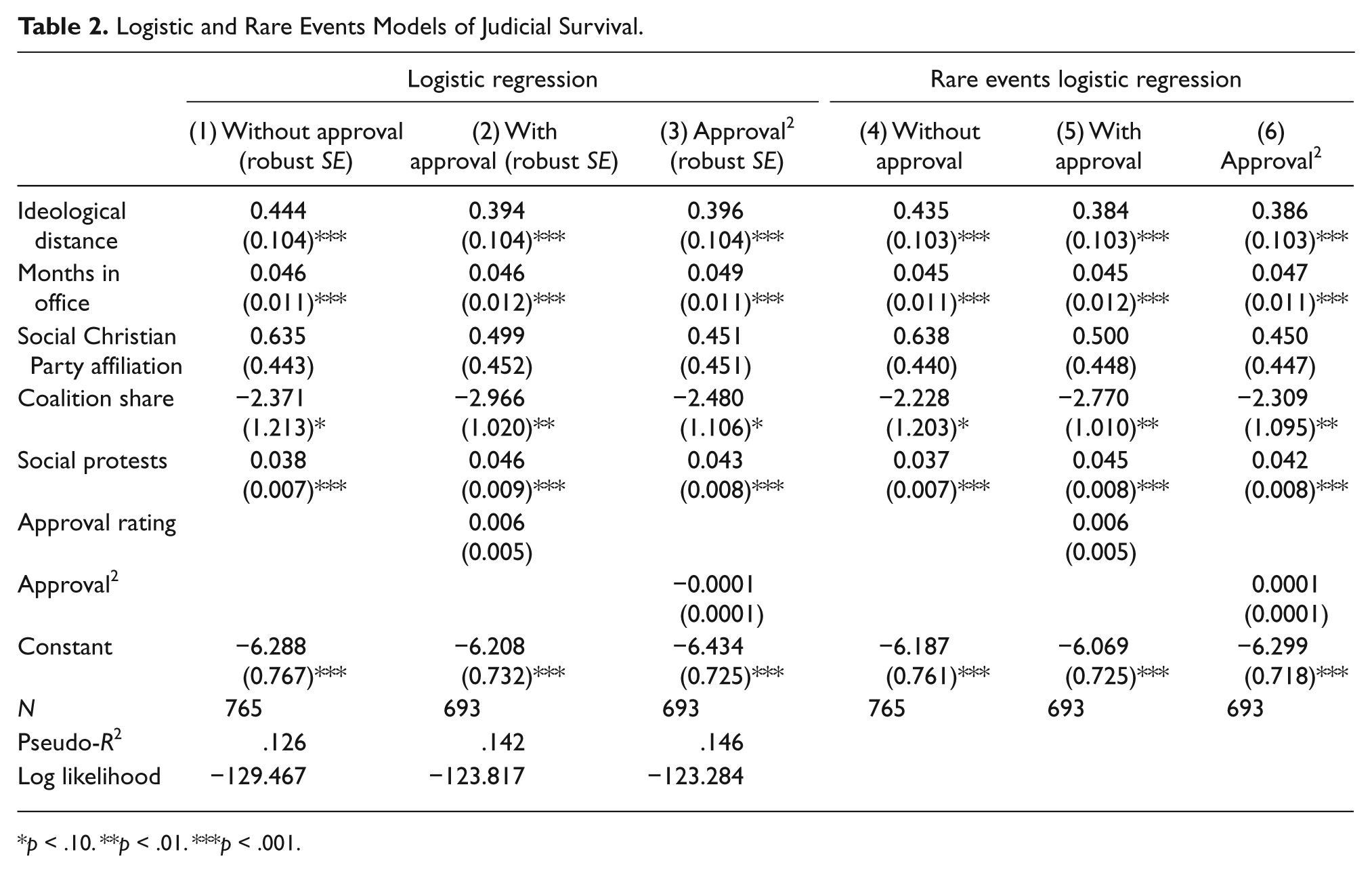
p < .10. **p < .01. ***p < .001.
Number of months in office is also a positive, statistically significant estimator in all of the models. This is a logical conclusion since more time in office should imply a greater the probability of being removed. Briefly, the time variable follows a similar pattern from model to model as ideological distance while the statistical significance retains its robustness across all models. 10
However, our PSC affinity dummy variable is not significant in any of the models, which means that it did not benefit judges to align themselves to Febres Cordero and his party to decrease their likelihood of being removed from office. This may be the result of the fact that the volatile legislative environment of Ecuador in the years studied, not even León Febres Cordero or the PSC was able to exercise constant control of the judicial branch. The nonsignificant coefficient for the PSC also contradicts much of the popular wisdom regarding the influence of Febres Cordero and his party during this time.
Coalition size is significant across all specifications, indicating with a high level of certainty the ability to reject the null hypotheses of no relationship between an increase in the government’s share of congress and probability of judicial turnover. The sign for this variable is negative, which means that an increase in the size of the government coalition decreases the likelihood of judicial exit. This may be because the greater the executive’s legislative support, the less likely he is to seek further support by removing judges.
The social protests variable is also positive and significant in all models. This indicates that an increase in social protests in Quito or Guayaquil in a given month increases the probability of the executive initiating a process of removing judges. Given the significance, this can be considered an intervening variable that represents the state of politics or the economy at any point in time. Therefore, an increase in the probability of judicial turnover may not be directly caused by social protests (although this seems to be true in April 2005) but by political and economic problems that may also be causes of the protests.
Neither simple net presidential approval rating (model 2) nor the squared term of net presidential approval (model 3) is significant. Unlike the previously mentioned cases of Fujimori and Chávez, these results indicate that strong and popular executive leadership may be a sufficient but not necessary condition to legitimize judicial turnover across countries (Arce 2003). Last, we also included a dummy variable for a new presidential administration to see if this was a cause of judicial instability, but Stata dropped this from the estimations because there was no overlap of the dependent variable with the administration dummy. This nonfinding is noted and notable since it is consistent with Pérez-Liñán and Castagnola’s (2009) findings.
We use Clarify (Tomz, Wittenberg, and King 2001) to calculate the marginal effects of the independent variables (summarized in Table 3). These marginal effects predict that when all variables are held at their mean, the chance of judicial exit is about 3.2 percent. From this value, the impact of increasing ideological distance by one unit increases the probability of exit by 1.2 percent. In fact, of all the variables, the magnitude of ideological distance’s impact is second only to coalition share (−9.2 percent).
Marginal Effects for Model 2 (logistic regression, full specification, robust SE).
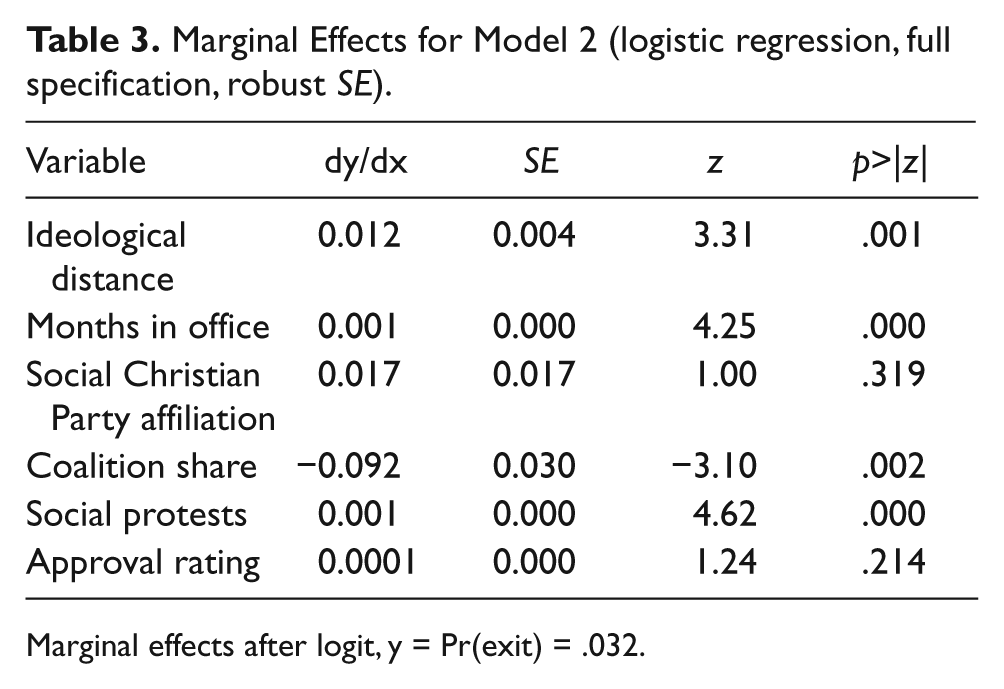
Marginal effects after logit, y = Pr(exit) = .032.
As King and Zeng (2001) argue, logistic and probit regression can sharply underestimate the probability of rarely occurring events and bias results. To overcome this weakness and show the robustness of our data, we ran RELogit as an improved method of computing probability estimates. This is necessary since—despite higher rates in Ecuador than in other countries—a judge being removed from the TC is still a rare event. Of 765 judge–months observed, 740 (95.82 percent) of them were “no exit,” while only 32 (4.18 percent) were “exit.” Like before, we run three different specifications: (1) without the approval variable and maximizing the number of observations, (2) a full specification including net presidential approval rating, and (3) a full specification that squares presidential approval rating.
As models 4 through 6 in Table 2 show, the direction and magnitude of the coefficients are remarkably similar to the previous estimations as well as among the different specifications. Ideological distance, months in office, and social protests are all positive and significant, while coalition share is negative and significant. Although the coefficients are still not substantively interpretable, the signs are consistent with the results of the previous models as well as our theoretical expectations. Holding all else constant, an increase in ideological distance, the amount of time spent on a court, and the number of social protests all increase the likelihood of judicial exit. Conversely, an increase in the coalition’s share of the lower house decreases the chance of judicial exit. Again, like before, neither PSC affiliation nor net presidential approval rating is significant in any of the specifications.
Unlike basic logistic regression, RELogit cannot be interpreted via Clarify to show the marginal effects (Tomz, Wittenberg, and King 2001). Instead, we use the full RELogit specification with presidential approval at its true value (not squared) to calculate the predicted probabilities when all variables are held at their mean and one variable is manipulated. Table 4 shows these results when adjusting the statistically significant variables one standard deviation above and below their mean values. The inverse of this number, which corresponds to the expected duration in months, is also included.
Predicted Probabilities for Variable in Model 4 (rare events logistic regression, without approval).
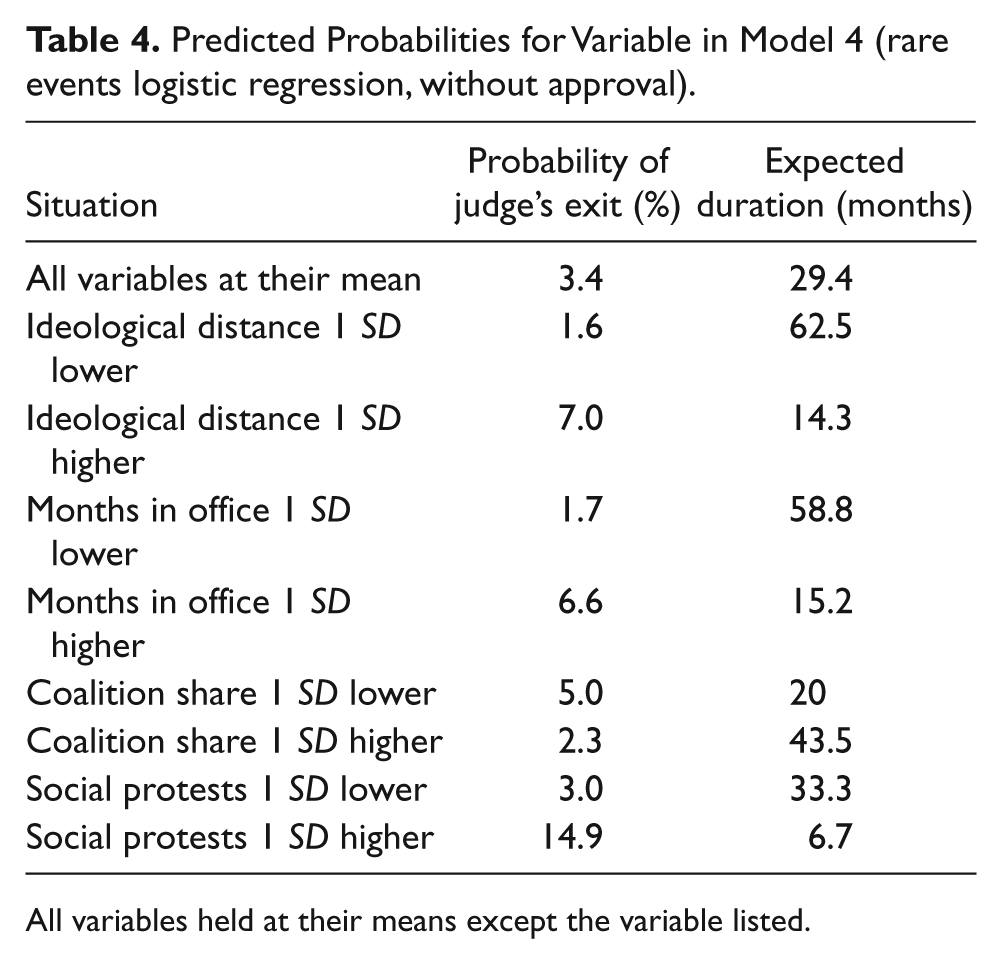
All variables held at their means except the variable listed.
Ideological distance also has a significantly substantive impact on the probability of a judge’s removal (see Table 4). When all variables are held at their mean, the chance of a judge being removed is around 3.4 percent in any given month, meaning that the judge can expect to survive a total of 29.4 months. However, this probability changes as the statistically significance variables are manipulated. When each variable is first set one standard deviation above its mean and then one standard deviation below the mean, the largest substantive impact comes first from social protest (a range of 3.0 percent to 14.9 percent), followed by ideological distance (1.6 percent to 7.0 percent), months in office (1.7 percent to 6.6 percent), and, last, coalition share (2.3 percent to 5.0 percent). In other words, increasing the ideological distance between a judge and the median member of the governing coalition by one standard deviation more than doubles the judge’s chance of removal (3.4 percent to 7.0 percent, from an expected duration of 29.4 months to only 14.3 months), while decreasing the distance by one standard deviation cuts the probability of removal by nearly half (3.4 percent to 1.6 percent, from 29.4 to 62.5 months).
The impact for all values of ideological distance is shown in Figure 1. When ideological distance is kept at its minimum of 0, the probability of removal is around 1.4 percent. However, this rises steadily to 3.4 percent at its mean value, and then to over 23.0 percent at the data’s maximum value. Although the line continues upward to a 53.4 percent chance of removal at the theoretical maximum, this never occurred in the data and would be unlikely to occur with rational judges who tend to exhibit less extreme behavior.
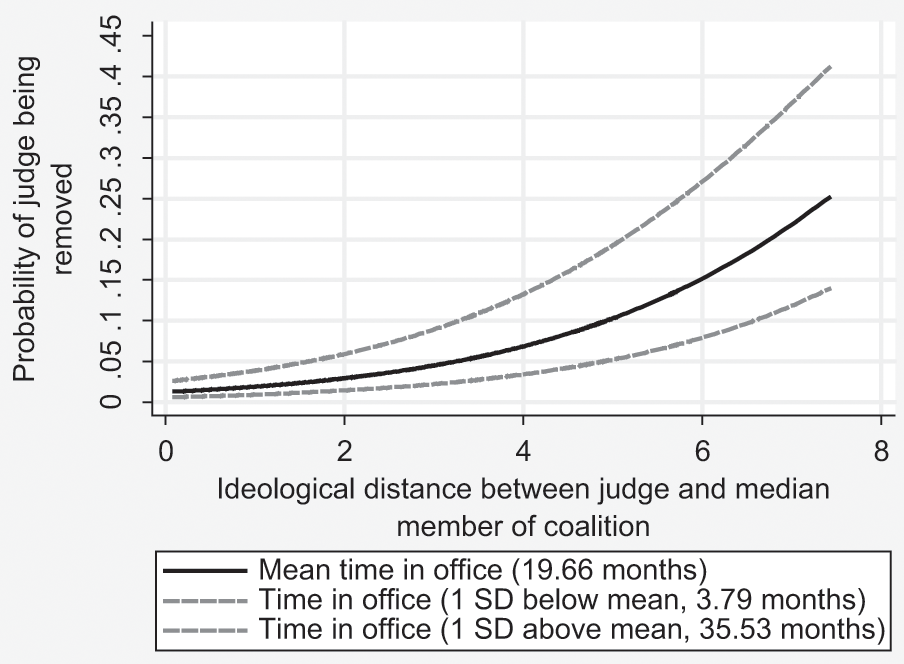
Probability of judicial removal over range of ideological distance for three different values of time, all other variables held at their means.
Amount of time in office conditionally affects ideological distance’s impact on judicial exit. The dotted lines in Figure 1 represent the effect of a judge being removed when time in office is one standard deviation above the mean, around 35.5 months, and one standard deviation below the mean, at around 3.8 months (the upper line corresponds to the greater number of months and the lower line to the fewer number of months). In the data set, the true values of ideological distance range from around 0 to around 7. As shown by the convergence of lines around distance zero, there is a low probability of removal no matter the number of months the justice has served on the Constitutional Court when the ideological preferences of the justice and the median member of the government coalition align. However, when divergent ideologies are pitted against each other, as when distance reaches 7, the time on the court becomes more important, with the range of probability increasing to around 25 percent. In other words, time on the court matters more for the judge’s survival as the ideological distance between the judge and median coalition member increases.
Empirically, judicial turnover has occurred roughly after the formation of some new governments or legislative coalitions, which indicates that some aspect of that process was influential in causing the judicial instability. In addition to this, not all judges exited at the same time, invalidating the idea that any given court suffered from a serious defect. Using data on party ideology and individual TC judges’ ideology, we have shown that as the distance between a judge’s ideological preference point and the ideological preference point of the coalition’s median member increases, the probability of that judge being removed from office also increases in a substantively significant way. Other factors, such as the amount of time a justice has served on the court, the size of the government coalition, and the level of social instability in the country (representing presidential weakness), also have a significant effect on the judicial exit.
Conclusions: Legislative Realignment, Ideology, and Judicial Removal
This article has shown that of the myriad reasons judges are removed in democracies with an unconsolidated rule of law, a change in the ideological distance between the court’s judges and the government—here, government coalitions—is a salient factor. Although these findings are specific to Ecuador’s TC from 1999 to 2007, they are also generalizable to other countries with similar institutional profiles. As Helmke (2010) shows, it is legislatures that are most often aggressors in cases of interbranch conflict in Latin America and judiciaries that are most often the victims. These findings may provide a systematic explanation for judicial turnover and instability in places with high incidence of interbranch conflict, such as Argentina, Bolivia, Colombia, Nicaragua, Paraguay, and Venezuela. In addition, our findings also show that in unstable environments judicial turnover is often manifested as judicial removal and driven largely by partisan or ideological realignments in the executive.
In sum, the findings of this article are novel in that they demonstrate conditions under which a judiciary may be sensitive to realignments in the legislature rather than exclusively the executive, while showing consistency with the overall model of judicial subordination to other branches of government in Latin America. The results support the role of judicial, executive, and legislator ideology in driving decision making. The empirics bear out the theory. Taking up Kapiszewski and Taylor’s (2008) challenge to improve the research design and testability of theories surrounding Latin American judicial politics, we use a database of ideological ideal points for Ecuadorian Constitutional Court judges and political parties to test the oft-theorized claim that ideology and partisanship play a role in judicial instability in Latin America (Verner 1984; Pérez-Liñán and Castagnola 2009). Yet the conclusions are not limited to Ecuador or even the Americas. Many governments the world over rely on multiparty coalitions to govern, and in uncertain political environments, frequent changes in the ideological composition of the government coalition may pose a threat to judicial survival, especially in contexts of political uncertainty.
From a judicial politics perspective these results reveal a cause of judicial instability (changes in government composition or, more specifically here, coalition instability), while from a legislative perspective we show one potentially negative effect of coalition instability (i.e., judicial instability). This article may also provide clues as to why strategic voting in the court may be difficult. Specifically, as the narratives of political and judicial instability illustrate, the Constitutional Court exists in an uncertain environment. Not only are judges unable to predict their own fates, but they are unlikely to foresee all changing political conditions. In fact, the volatility of the coalitions and mobile majorities make it hard, if not impossible, for myopic judges to vote strategically because they are unable to anticipate toward whom to direct their vote.
In fact, the implications for judicial behavior in this unstable environment are consistent with the conclusions of Segal, Westerland, and Lindquist (2011), who find that the Supreme Court does not appear to rationally anticipate congressional action in the United States but instead responds to increased ideological distance by decreasing its likelihood of striking down legislation to avoid constraints such as curbs to its authority or resources. However, since Ecuadorian TC justices respond to their uncertain environment by voting sincerely (Basabe-Serrano 2011), a change in coalition or government that results in increased ideological distance is likely to be result in a different constraint: judicial removal. Pérez-Liñán and Castagnola (2009) suggest comparative research to determine how presidents in Latin America have been able to manipulate the partisan composition of courts. We agree with this research challenge, although we believe this framework must also include members of the executive’s ruling coalition.
Footnotes
Acknowledgements
A previous version of this article was presented at the twenty-eighth Congress of the Latin American Studies Association, June 11–14, 2009, Río de Janeiro, Brazil. We would like to thank Aníbal Pérez-Liñan, Gretchen Helmke, and Heidy Ocampo Meneses for their insightful criticism and comments and Andrés Mejía Acosta for encouraging this project at the Capacity Building Applied Research Methods Workshop at the Institute for Development Studies. All errors and omissions are our responsibility.
Declaration of Conflicting Interests
The author(s) declared no potential conflicts of interest with respect to the research, authorship, and/or publication of this article.
Funding
The author(s) received no financial support for the research, authorship, and/or publication of this article.
Notes
References
Supplementary Material
Please find the following supplemental material available below.
For Open Access articles published under a Creative Commons License, all supplemental material carries the same license as the article it is associated with.
For non-Open Access articles published, all supplemental material carries a non-exclusive license, and permission requests for re-use of supplemental material or any part of supplemental material shall be sent directly to the copyright owner as specified in the copyright notice associated with the article.
