



Abstract
There is a debate about the extent of the Senate majority party’s influence and the conditions under which it is used. This article demonstrates that the majority party influences legislative outcomes to meet electoral goals and protect its reputation by manipulating the consideration of the dozen annual appropriations bills. The majority party limits amendments and eases passage of the budget when it abandons the “regular order” and creates an omnibus appropriations bill. It is more likely to abandon the regular order when it is ideologically divided, has a small margin of control, or is distant from the minority.
In the summer of 1996, the Republicans who had triumphantly captured Congress two years earlier were in disarray. Their effort to leverage a partial government shutdown into substantial budget cuts had left the party politically damaged and anxious to show that it could govern responsibly. Senate Majority Leader Trent Lott’s immediate goal was to avoid another budget confrontation and quickly pass 13 individual spending bills that would provide funding to run the government in the upcoming fiscal year. Instead, the narrow Republican majority in the Senate faced an onslaught of Democratic amendments aimed at scoring “pre-election” points by forcing Republicans to cast difficult votes on guns, terrorism, health care and drugs (Washington Post, September 13, 1996, A20). Progress on the bills ground to a halt.
Fed up with the political battering they were taking, Majority Leader Lott and Speaker Newt Gingrich announced that the Senate would abandon its effort to pass spending bills on an individual basis. Instead, both chambers would package them together into an omnibus spending bill:
It is clear that Senate Democrats are using delaying tactics and political stunts designed more for the upcoming elections than for the completion of the people’s business . . . Given the Democrat strategy to tie up the Senate floor, House and Senate leaders have decided that the defense appropriations conference report will be the vehicle for final consideration of all uncompleted appropriations issues. The remaining issues will be resolved through bipartisan negotiations between congressional leaders and the White House. (Congressional Press Releases, September 19, 1996)
Packaging the remaining spending bills together in conference meant that two of the bills would not reach the floor on an individual basis and the Senate would have no opportunity to offer amendments to them. The Republican majority’s further aim was to bring the omnibus itself to the floor as a non-amendable conference report to preclude amendments when it was debated. After additional haggling with the Democrats, an omnibus package containing six spending bills was brought to the Senate floor and passed without amendment. The plan worked, but at a cost. President Clinton and congressional Democrats received so much of what they wanted in the final omnibus package that 14 Republican senators voted against it. Republicans shielded their members from further votes on amendments and passed the budget but were unable to pursue their broader policy goals.
Overview
There is an active debate over the nature and extent of the majority party’s influence in the Senate (Den Hartog and Monroe 2011; Fenno 1989; Gailmard and Jenkins 2007; Monroe and Roberts 2008; Sinclair 2012a; Smith 2005). In this article, I describe the “limited influence” theory of majority party power in the Senate. I show that the majority party has an important but constrained ability to influence legislative outcomes in the appropriations process that it uses when it is weakly positioned in the chamber and has difficulty managing the floor. It can manipulate the appropriations process by opting to pass some or all of the 12 annual appropriations bills as a package rather than individually. Its influence meets electoral goals by protecting the party’s reputation but falls short of an ability to secure preferred policy outcomes.
I test three expectations associated with the limited influence theory. First, the Senate majority party is likely to avoid bringing individual spending bills to a vote and to create an omnibus package instead when it is small, divided, and ideologically distant from the minority. Second, the majority’s decision to create an omnibus package rather than consider bills on an individual basis reduces the total amount of amending in the appropriations process. Third, omnibus bills are used to build broad bipartisan coalitions rather than to push policy toward the majority median. I test these expectations with a new dataset tracking the legislative history of spending bills (1975–2012) and the number of votes on amendments in the appropriations process (1981–2012). The results of the analysis support all three expectations.
Majority Party Influence in the Senate
It is common to conceptualize members of Congress as strategic actors who systematically pursue goals such as re-election and good public policy (Fenno 1973). Political parties in Congress help members to meet these goals. Parties provide candidates with logistical and financial support, and a “brand name” that conveys key information to the electorate (Aldrich 2011; Jacobson 2009). A good party reputation helps members to attract voters (Cox and McCubbins 2005; Lee 2009). Parties provide an organizational framework that helps members to overcome collective action problems and pursue shared policy goals (Aldrich 2011). A majority party in Congress is said to wield “influence” if it is able to help members meet their goals by shifting legislative outcomes in the direction they prefer and away from what would have occurred on the floor without the party’s intervention (Aldrich 2011; Krehbiel 1998).
There is a wide-ranging debate about the conditions under which the majority party is able and likely to influence outcomes and the goals it can meet through its efforts. One well-known framework is the theory of Conditional Party Government in which members who are unified and have distinct preferences from the minority delegate authority to their leaders to influence outcomes to pursue shared policy goals (Aldrich and Rohde 2001). Smith offers an alternative framework in which party influence is exercised to pursue electoral and policy goals “when the party’s small size or lack of cohesiveness puts floor victories at risk. Weakness in the majority party generates the need for influence” (Smith 2007, 78). A third alternative is that party members have a continuous ability and incentive to influence legislative outcomes to enhance their party reputation in the pursuit of re-election goals (Cox and McCubbins 2005; Lee 2009). These three frameworks are quite different in spirit. In the first, a dominant majority party uses its influence to extend its control over the floor. In the second, a struggling majority party uses its influence to stave off defeat. In the third, the majority party influences outcomes without regard to the strength or weakness of its position.
The traditional account of the Senate emphasizes the majority party’s lack of influence (Fenno 1989; Sinclair 1986; Smith 2005). The standard account rests on two crucial rules that make it difficult for the majority to control the agenda. First, debate in the Senate is unlimited. Second, senators are generally free to offer amendments regardless of their germaneness to the topic at hand. The combination of these two rules is said to make it virtually impossible for the majority to conduct the routine business of the chamber without the cooperation of the minority or to control what policy proposals receive a vote. Instead, the majority governs the Senate through “unanimous consent” (UC) agreements negotiated with the minority setting out time limits and rules for debating matters such as amendments (Sinclair 2005).
Recent work on the Senate has identified party effects in the chamber (Monroe and Roberts 2008) but there is disagreement over the extent to which parties can influence outcomes and whether they meet policy or electoral goals by doing so. One possibility that tracks the traditional understanding is that parties contribute to gridlock (Brady and Volden 2006; Rae and Campbell 2001; Sinclair 2002). Conflict between the parties creates a “parliamentary arms race” in which “the minority is quick to obstruct and the majority is quick to restrict” (Smith 2010, 1-2). Lee (2009) finds that parties meet electoral goals by shaping the legislative agenda to support messaging efforts and strengthen their reputation. Gailmard and Jenkins (2007) see a “coalescing theoretical agreement” that the Senate majority party can impose negative agenda control but do not reach definitive conclusions about the goals it meets. Den Hartog and Monroe (2011) conclude the majority party can meet policy goals by shifting legislation that passes the chamber in its preferred direction.
This article describes the “limited influence” theory of the Senate. I show that the Senate majority party can influence legislative outcomes, but that its influence is properly described as “limited” because the majority uses it to meet electoral but not policy goals. I also address the broader debate about the circumstances under which influence is used by demonstrating that the majority party is likely to exercise influence when it is small, divided, and distant from the minority—in other words, when it is weak. Given these findings, I do not employ the common shorthand of using the terms strong and weak to indicate the ability of the majority party to influence legislative outcomes. This jargon has confused discussion about party power in Congress because it conflates a party’s ability to exercise influence with its descriptive characteristics. By its terms, a large, unified party that is not observed influencing legislative outcomes because it has the numbers to win any vote is “weak” while a small, divided party that uses influence because it must is “strong.” Given this incongruity, I use the terms strong and weak in a more intuitive fashion to describe the majority party’s overall strategic position in the chamber based on the size of its majority and its homogeneity. Large, homogeneous parties are strong. Small, divided parties are weak. A large distance between the minority and the majority in the Senate weakens the majority party by raising the likelihood of disagreements that can slow the progress of legislation on the floor. I use the term influence to indicate the majority’s ability to shape legislative outcomes beyond what would be achieved on the floor absent its efforts.
I study majority party influence in the Senate by analyzing a subset of legislation: appropriations bills. The annual legislation that funds the government is particularly well suited to the study of party influence. With rare exceptions, members agree that the government should be funded even if they disagree over the details. Gridlock is an undesired outcome. Despite this fact, the majority party may face obstacles on the floor that threaten the passage of a budget and may seek to influence legislative outcomes to overcome them. Studying variation in the majority’s management of the appropriations bills offers a way to observe whether the majority can exercise influence, and if so, the conditions under which it does so and the kind of goals it can meet. The distinctive features of the appropriations process, and in particular the undesirability of gridlock, limit the extent to which findings drawn from it can be generalized to other categories of legislation. Nonetheless, majority party influence in the Senate is poorly understood relative to the House of Representatives (Smith 2007) and Lee (2009) demonstrates that studying subsets of legislation can provide important insights into aspects of majority party power that may otherwise be overlooked. There is a long tradition of studying the annual appropriations process to understand the characteristics of Congress (Aldrich and Rohde 2000; Evans 2004; Fenno 1966; Kiewiet and McCubbins 1991; Schickler and Sides 2000; Shepsle et al. 2009; Shepsle and Weingast 1981; Wawro and Schickler 2006).
An important source of variation in the annual appropriations process is the majority party’s decision to pass a dozen annual spending bills on an individual basis or to package some or all of them together into an omnibus spending bill (Sinclair 2012b). The House and the Senate traditionally follow a textbook procedure known as the “regular order” that requires both chambers to pass spending bills covering different policy domains such as agriculture or defense to fund the government (Oleszek 2007; Schick 2007). Under the regular order, the bills are drafted in the subcommittees of the House and Senate Appropriations Committees, debated on the floor of each chamber, and adopted on an individual basis. Policymakers say that the House and Senate almost always begin the appropriations process by following the regular order even if they ultimately deviate from it and combine some or all of the individual bills into a package. “I don’t ever remember starting a year where it was the majority’s goal to have an omnibus bill,” one long-time staff member reported (Staff Interview D 2012). 1
The alternative to passing bills in the regular order is for Congress to adopt a full-year continuing resolution (CR) or omnibus appropriations bill. CRs in theory fund the government by extending the previous year’s appropriations bills for the remainder of the fiscal year, but in practice often contain new legislation or even the entire texts of appropriations bills. Omnibus bills assemble some or all of the year’s appropriations bills into a single legislative package. For the purpose of this analysis, I treat these types of legislation as functionally equivalent and part of a larger family of “omnibus” legislation because they are multidimensional packages and because policymakers say they are regarded as less desirable than passing bills in the regular order.
The “Limited Influence” Theory
Next, I review previous research on the general practice of omnibus legislating. Little work has been done to analyze the majority party’s management of the appropriations process in the Senate, so I supplement past scholarship with interviews of policymakers to establish several key points of the limited influence theory. First, abandoning the regular order and creating an omnibus package is a form of influence that eases the passage of the budget and reduces amending opportunities. Second, members of the majority party weigh a set of costs and benefits to determine whether to support the creation of an omnibus package. Third, the majority party is more likely to create an omnibus package when it is small, divided, and distant from the minority because that is when its reputation is more likely to be threatened.
First, creating an omnibus package is a form of majority party influence that eases passage of legislation. “An agenda-control and coalition-building tool, the omnibus bill is typically assembled to get something passed that otherwise faces uncertainty” (Krutz 2000). Broadening the number of policy domains covered by a bill helps to overcome opposition on the floor because it creates a wide coalition of support (Davidson, Oleszek, and Lee 2012; Riker 1982; Shepsle and Bonchek 1997). Abandoning the regular order and forming an omnibus package also influences legislative outcomes by reducing opportunities for members to participate in lawmaking on the floor (Davidson, Oleszek, and Lee 2012; Krutz 2001; Nelson 1953). Omnibus bills “may reduce the opportunities for careful scrutiny of the legislation’s provisions and for broad participation by rank-and-file members” (Sinclair 2012b, 111). Policymakers say that debate on single omnibus package is not an equivalent substitute for the debate that otherwise occurs when each component of the package is considered in the regular order. 2 Majority Leader Tom Daschle stated thus: “There’s more opportunity to provide some meaningful direction to individual bills over anything that is lumped together in an aggregate legislative form” (Daschle Interview 2012). Omnibus bills also limit participation when they are brought to the floor as non-amendable conference reports, as has been the case in seven of the twenty-four years in which omnibus bills have been created.
Second, members of the majority weigh a set of costs and benefits when deciding whether to support the creation of an omnibus bill (Krutz 2001). The regular order gives all members the opportunity to participate in lawmaking (Schick 2007), providing them with the chance to receive electoral benefits by taking positions and claiming credit for legislative accomplishments (Mayhew 1974). The openness of the regular order has a downside for the majority party: The minority may offer amendments designed to force the majority to take votes that will damage its reputation (Lee 2009, 2012). Limiting participation in lawmaking can help the majority protect its reputation by avoiding difficult votes (Cox and McCubbins 2005) at the cost of limiting credit claiming and position taking opportunities for the majority and minority alike. The regular order also creates the risk that the majority party may fail in its effort to pass one of the dozen individual spending bills, raising the prospect of a government shutdown. Shutdowns are rare but policymakers report that seasoned members view them as a real possibility if the parties miscalculate (Staff Interview A 2012). Members understand that their reputation may suffer severe damage if they are blamed for a government shutdown (Brady and Volden 2006; LeLoup 2005; Wildavsky and Caiden 2004). Omnibus bills help the majority party to pass a budget but require members to sacrifice the opportunity for greater participation in the legislative process through the regular order. 3
Third, the majority party is more likely to abandon the regular order and form an omnibus bill when it has a small margin of control, is ideologically divided, or is distant from the minority. These conditions raise the risk that the majority will fail to pass a spending bill or face reputational damage from voting on amendments. They shift the costs and benefits of managing the appropriations process in favor of creating an omnibus bill. Consistent with this description, omnibus bills arise out of what Sinclair describes as “severe policy and political problems” (Sinclair 2012b, 116). Contextual factors such as large budget deficits, divided government, divided control of Congress and minority obstruction create challenging legislative environments that encourage the use of omnibus bills (Krutz 2001). Policymakers agree that the majority party is likely to abandon the regular order when members fear it will lead them into a quagmire. In the words of one staff member, Senate leaders conclude, “There’s a much easier way to do this—we just won’t take things to the Senate floor” (Staff Interview C 2012). 4
Hypotheses and Data
Creating an omnibus appropriations bill is a form of influence with two distinct steps in the Senate. First, the majority party abandons the regular order by opting not to bring one or more of the appropriations bills to the floor on an individual basis. Second, it packages those bills together with others into an omnibus package. In the “limited influence” theory of the Senate, the majority party is more likely to use this influence when it is small, divided, and distant from the minority because that is when the reputation of majority is most at risk, and when its members have the greatest incentive to give up their right to participate in lawmaking. The effect of this influence is to reduce the opportunity for members to participate in the appropriations process and to ease the passage of the budget by attracting a bipartisan coalition of support. The majority’s influence generally does not help it to secure partisan policy goals. I test three hypotheses consistent with this account:
The data to test these expectations come from an original dataset tracking the appropriations process between 1975 and 2012 and including 485 individual bills. The dataset includes regular appropriations bills considered on an annual basis but not one-time bills such as supplemental appropriations bills. Regular appropriations bills are defined as the primary bill that each subcommittee of the Appropriations Committee is tasked to write on an annual basis, for example, the “Departments of Labor, Health and Human Services, and Education, and Related Agencies” appropriations bill. The dataset identifies changes in subcommittee jurisdictions at the beginning and end of the period under study with a long period of stability in jurisdictions in the middle. There is slight variation in the number of bills considered each year. I identify 26 separate bill domains used by the House or Senate between 1975 and 2012 based on the name of the bill and relevant subcommittee. I use all bill domains for the purpose of analysis, but for ease of discussion, I illustrate my findings with the “Core 13” bills. The Core 13 bills are those that were considered each year by Congress during a period of stable subcommittee jurisdictions between 1979 and 2002. The dataset also includes omnibus spending bills and the total level of majority and minority support for each bill.
The dataset identifies the total number of voice and roll call votes related to amendments that occurred on every regular and omnibus spending bill between 1981 and 2012. Digital copies of the legislative histories of the bills were retrieved from the Library of Congress’s THOMAS database. All votes cast in the Senate related to amendments, including votes on passage and procedural votes such as tabling motions, were tallied electronically by a Yahoo! Pipe to generate a picture of the total amount of legislative activity on each bill. I aggregated this information to identify the total number of amendment-related votes that occurred during the appropriations process each year, defined as all of the floor debate that took place on regular and omnibus spending bills for a fiscal year. The Senate held 6,339 votes related to amendments between 1981 and 2012 during the appropriations process, including 1,413 roll call votes and 4,926 voice votes. On average, the Senate held a total of 198 votes on amendments per year, ranging from 0 to 415 with a standard deviation of 107. An average of 154 votes each year were voice votes, ranging from 0 to 338 with a standard deviation of 93. An average of 44 were roll call votes, ranging from 0 to 97 with a standard deviation of 22.
Variables
Bill Fate is the first dependent variable. It is a categorical variable that indicates whether or not a regular appropriations bill for a given year was adopted in the regular order. The variable is coded 1 if the bill was adopted on an individual basis in the regular order. It is coded 2 if there was no attempt to pass the bill on an individual basis in the Senate (either by voice vote, roll call vote, or unanimous consent request) and it was later adopted in an omnibus package. The variable is coded 3 if the bill received an initial vote or UC request for passage but was later incorporated into an omnibus package.
In Omnibus is the second dependent variable. Omnibus bills consist both of bills that received a vote and bills that did not. I code a bill that was enacted individually as 0 and a bill that was enacted as part of a package as 1.
Congress showed substantial variation by year and chamber in the degree to which it did not hold floor votes on appropriations bills and placed them in omnibus packages (Figure 1). The data show two waves of abandoning the regular order. The first occurred from 1979 to 1987 and was followed by an eight-year period in which all bills were passed in regular order. The second began in 1995 and continues today. The House gave an initial vote to 425 bills (88%) in the regular order, and failed to vote on 60 (12%). The Senate gave an initial vote to 358 bills (74%) in the regular order, and failed to vote on 127 (26%). A total of 189 (39%) of all regular spending bills passed as part of an omnibus package. 5
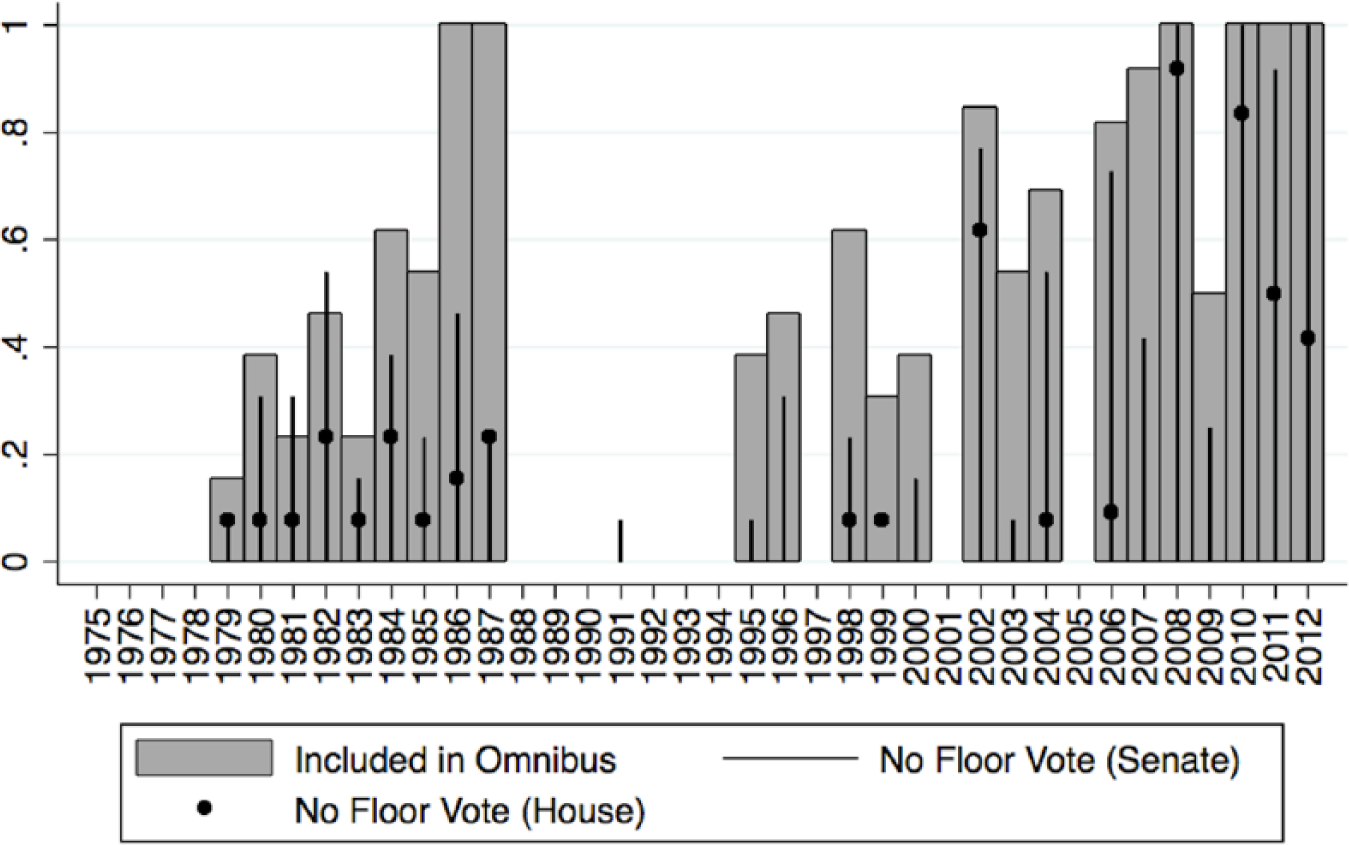
Consideration of annual appropriations bills: U.S. Congress, 1975–2012.
There is substantial variation in the data in the number of times a particular bill was not brought to a vote in the Senate or was included in an omnibus package. Some appropriations bills, such as Labor, Health and Human Services, are regarded as more controversial than others because of their subject matter (Daschle Interview 2012). The Senate did not vote on the Labor, Health and Human Services bill 37 percent of the time and included it in an omnibus package 55 percent of the time. In contrast, it failed to vote on the popular Military Construction bill only once and included it in an omnibus package only 10 percent of the time. I account for this group variation by assigning each bill domain a fixed effect in my analysis.
Majority party power is operationalized with three variables:
Margin of Control
The majority party’s margin of control is the proportion of seats it controls in the Senate. This margin can change over the course of a session due to death or retirement when a member of the majority party is replaced by a member in the minority. I use the majority’s average margin for the session, rescaled from 0 to 1 for my time period to aid in calculating marginal effects. Prior to rescaling, the margin of control in the Senate ranged from 0.51 to 0.62 with an average of 0.55. A large margin of control is a sign of majority party strength because a large party, on average, is more likely to have the voting strength to meet its goals than a small one (Smith 2007).
Majority Homogeneity
The ideological unity of the majority party is defined in the same manner as Aldrich and Rohde as the standard deviation of the first dimension DW-NOMINATE score of the majority party divided by the standard deviation of the chamber. Ideological homogeneity is a sign of majority party strength because unified parties are more likely to be able to win votes on the floor than divided parties (Smith 2007). The scale of the variable is reversed so that the majority party grows increasingly unified as the variable increases. It ranges from 0.39 to 0.74 in the Senate with a mean of 0.58 (0.12 standard deviation). I rescale the variable from 0 to 1 for easier interpretation.
Distance
The distance between the two parties is coded as the absolute value of the distance between the median Democrat and the median Republican on the first dimension DW-NOMINATE scale. It ranges from 0.54 to 0.83 in the Senate with a mean of 0.68. A prominent feature of the variable is that it increases monotonically over time with the lowest levels of distance at the beginning of the time period and highest at the end. I rescale the variable from 0 to 1 for the purpose of calculating marginal effects. A large distance between the parties is a sign of majority party weakness in the Senate because it raises the risk of disagreements or filibusters that delay the passage of legislation (Rae and Campbell 2001).
I also employ a series of variables to control for factors that have been found to influence the appropriations process and the likelihood of forming omnibus spending bills. Divided control of Congress may increase the likelihood of omnibus bills because they help to overcome the difficulty of negotiating with a chamber controlled by the other party (Krutz 2000). It is coded 0 if control of Congress is unified under one party, and 1 if it is not. Divided government may promote omnibus bills because negotiating over a single package is an effective way for Congress to deal with a president of the opposite party (Sinclair 2012b). It is coded as 0 if the presidency and Congress are under the control of one party and 1 if they are not. One party may be more likely than the other to use an omnibus strategy. The variable for partisan control of the Senate is 0 if the majority party is Democratic and 1 if it is Republican. Election years may affect legislative productivity and make it more difficult to pass spending bills (Binder 2003). I code this variable as 1 if it is an election year and 0 if it is not. Finally, both waves of omnibus creation show an increase in failing to vote on bills and in the size of omnibus packages over time. A common observation in interviews was that omnibus bills are beginning to be regarded as routine by members (Staff Interview D 2012). I include a lagged variable for the total number of bills included in an omnibus bill the previous year to control for the possibility that member resistance to omnibus packages declines as they become more common.
Variation in the size of the federal deficit is said to force difficult budgetary choices and enhance partisan conflict (Krutz 2000; Sinclair 2012b). Following Krutz, the deficit variable is coded as the proportion of annual expenditures that exceed revenues using figures from the Congressional Budget Office. The sign is reversed so that the deficit increases as the proportion grows. The variable ranges from −0.13 to 0.40 with a mean of 0.15. Deficit reduction agreements negotiated between Congress and the president may ease budgetary pressures as long as the terms of the agreement remain generally acceptable to major players in the budget process. The Budget Enforcement Act (BEA) of 1990 is widely regarded as the most effective deficit reduction agreement. Testimony from the director of the Congressional Budget Office indicates that members of Congress generally abided by the terms of the BEA from 1990 to 1997 but the return of surpluses in 1998 undermined the act’s effectiveness (Holtz-Eakin 2004). I include a dummy variable for the BEA coded as 0 for all years but 1990 to 1997 in my analysis.
Abandoning the Regular Order and Majority Party Power
I begin the analysis by examining the relationship between majority party power in the Senate and abandoning the regular order. I expect that a decision by the majority to abandon the regular order will be negatively correlated with the majority party’s margin of control and homogeneity, and positively correlated with its distance from the minority. I test these expectations by estimating the effects of three logistic regression models. All three include fixed effects for each category of bill (defense, agriculture, etc.) and standard errors clustered by year. Limitations in the data, particularly high levels of collinearity among control variables from the House, present several obstacles to the analysis of bills included in omnibus packages that I address below.
Model A is a multinomial logistic regression that uses “Bill Fate” as the dependent variable. The base outcome is the adoption of a bill in the regular order. The second outcome is the inclusion of a bill in an omnibus package after the Senate majority party failed to vote on it in the regular order. The third outcome is the inclusion of a bill in an omnibus package after the Senate majority party voted on it in the regular order. The Senate will not consider any bill in the regular order that has not first passed the House of Representatives (Schick 2007). 6 Accordingly, the sample of bills used for analysis in Model A is restricted to those that passed the House of Representatives. A total of 423 bills passed the House and were disposed of in the Senate with one of the three outcomes. 7 Of those, 291 (69%) were adopted in the regular order, 66 (16%) were included in an omnibus bill without first being voted on in the regular order, and 66 (16%) were included in an omnibus after first being voted on in the regular order.
Outcome 2 is the critical test of the limited influence theory. According to the theory, the majority party opts not to vote on a bill and includes it in an omnibus package when the party faces difficulty passing it in the regular order. In Krutz’s terms, bills that do not receive a vote in the regular order are those that face uncertainty and may not pass unless they are included in an omnibus. They are the “canary in the coal mine” signaling that the costs imposed on the majority have risen high enough to persuade it to abandon the regular order. Majority party power should have a robust, negative relationship with such bills because weak parties are more likely to have difficulty passing bills. Party power is expected to have a less-systematic relationship with Outcome 3 because it is less likely that these bills cause the majority difficulty. For example, the majority party may include a bill in an omnibus package after it received a vote on the floor because it is popular and will help to build a broad coalition of support.
The results of Model A support the expectations of the limited influence theory (Table 1). The majority party’s margin of control and homogeneity are both negatively correlated with Outcome 2 at a level of p < .01. The distance between the majority and minority parties is positively correlated with Outcome 2 at a level of p = .01. Failing to bring a bill to a vote also is more likely at statistically significant levels when there is Democratic control of the Senate, it is an election year, and the deficit is high. It is less likely at statistically significant levels in years in which the BEA was effective. The marginal effect of a change from 0 to 1 (minimum to maximum) in the three party power variables varies with the conditions set for the model and can be substantial. For example, assuming there is unified control of government, Republican control of the Senate, it is not an election year, the BEA is not in effect, and all other variables are at their means, the marginal effect of a change in the party power variables decreases the likelihood that the majority party will not bring the Labor, Health and Human Services bill to a vote by 13 percent for margin of control, 28 percent for majority homogeneity, and 52 percent for distance. In an alternative scenario in which there is divided control of Congress, divided government, Democratic control of the Senate, it is an election year, and the BEA is not in effect, the marginal effects are 74 percent, 80 percent, and 100 percent respectively. 8
Abandoning the Regular Order in the Appropriations Process, 1975–2012. Logistic Regression Models with Fixed Effects by Bill Type and Standard Errors Clustered by Year.

Standard errors are clustered by year (38 clusters). Coefficients for individual bills omitted.
Effects are significantly different from zero at *p < .10. **p < .05. ***p < .01; two-tailed test.
Significant effects in bold.
The relationship between party power and Outcome 3 is weaker, as expected, but in the proper direction. The majority party’s margin of control and homogeneity both have a negative relationship with a bill being included in an omnibus package after first being voted on in the Senate. The coefficient for each variable is smaller than its counterpart in Outcome 2, and in the case of majority homogeneity, less significant (p = .07). The distance between the majority and minority is in the proper direction, but is no longer statistically significant. Divided control of Congress and the BEA both have a statistically significant relationship with the inclusion of a bill in an omnibus after it was voted on.
I assume that the characteristics of the House majority party do not affect the decision of the Senate to vote on a bill, but the House majority party may influence the overall group of bills that is included in an omnibus package either by not voting on a bill itself or by shaping the contents of an omnibus package in negotiations with the Senate. Models B and C are designed to control for influence from the House. The models use the “In Omnibus” dependent variable that indicates whether or not a bill was included in an omnibus package. The sample used for the analysis includes all bills, including those that failed to pass the House. Controlling for the effects of the House majority party is a challenge. The House majority party’s margin of control, homogeneity, and distance to the minority are highly correlated with each other at a level of .76 or higher. Homogeneity and distance in the House are also correlated with distance in the Senate at a level of .94 and .98 respectively. The danger of including highly correlated variables in the same model is that they may cause multicollinearity that gives overconfident standard errors and imprecise estimates of coefficients (Berry and Feldman 1985). My approach is to estimate the effect of Senate variables only in Model B and both House and Senate variables together in Model C and assess both models together. 10
Together, Models B and C are consistent with the limited influence theory. All three party power variables in Model B are in the proper direction although their relationship with including a bill in an omnibus package is weaker than that estimated in Model A. The majority’s margin of control is negatively correlated with including a bill in an omnibus package (p < .01), while majority party homogeneity and distance are less statistically significant at p = .11 and p = .08, respectively. The results in Model C show strong signs of multicollinearity. The standard errors and coefficients for the three Senate majority party power variables are all inflated relative to Model B. Majority margin of control and homogeneity are significant and in the proper direction, but the sign on distance is reversed. The reversal of the sign for the Senate distance variable is likely a consequence of its high level of correlation with the homogeneity and distance variables from the House.
Despite the limitations of the data, the preponderance of evidence from these models supports the limited influence theory. The decision not to vote on an appropriations bill and include it in an omnibus has a robust relationship with majority party weakness in the Senate. A similar relationship is visible for the broad group of bills included in omnibus packages. Partisan theories of Congress such as Conditional Party Government offer no rationale that would explain the negative relationship between party power and the abandonment of the regular order in the Senate. Nor is there evidence that the majority party abandons the regular order in a routine fashion regardless of its strength or weakness. The evidence fits well with the account that abandoning the regular order is a form of influence that the majority party uses when it is weak.
Abandoning the Regular Order and Voting on Amendments
I next examine the relationship between the majority’s decision to abandon the regular order and the total number of amendment-related votes that are cast during the appropriations process. The limited influence theory treats abandoning the regular order as a form of influence in part because it reduces opportunities for members to participate in lawmaking. Members lose the opportunity to debate a spending bill on an individual basis and the subsequent debate on an omnibus package generally offers fewer opportunities to participate than they would have had in the regular order. Limiting participation not only protects the majority from troublesome amendments, but it also limits the ability of rank-and-file members to take positions or claim credit during debates.
I expect the total number of amendment-related votes in the appropriations process to decline as the majority deviates from the regular order. The total number of amendment-related votes includes all voice and roll call votes on regular appropriations bills and on omnibus bills if an omnibus bill was debated during the appropriations process that year. I test these expectations by examining the correlation of two variables, (1) the proportion of bills that do not receive a vote and (2) the proportion of bills that are included in omnibus packages, with voting on amendments between 1981 and 2012. The proportion of spending bills that did not receive a vote each year is negatively correlated with the number of roll call votes in the appropriations process at a level of −.60, voice votes at −.78, and all votes on amendments at −.80. Figure 2 illustrates this relationship using a scatterplot and loess curves with 95 percent confidence intervals shaded in gray. The horizontal gray lines on each plot indicate the average number of votes during years in which all bills were considered in the regular order. There was an average of 50 roll call votes per year during years in which all bills passed in the regular order. As the proportion of bills that did not receive a vote increases, the number of roll call votes on amendments declines gradually and approaches zero. The decline in voice votes is far steeper. The number of voice votes declines from an average of 200 in years during which all bills pass in regular order and approaches zero as the proportion of bills that did not receive a vote equals 1. The relationship between the proportion of bills included in omnibus packages and voting on amendments is weaker but in the same direction. It is correlated with the number of roll call votes at a level of −.47, voice votes at −.56, and all votes at −.58.

Abandoning the regular order and voting on amendments: U.S. Senate (1981–2012).
Another way to estimate the effect of abandoning the regular order on amending is with regression analysis. I fit a series of six bivariate negative binominal regression models appropriate for count variables (Carson and Madonna 2010) using the number of roll call, voice, and all votes as dependent variables (see Table 2). In Models A to C, the proportion of bills that did not receive a vote is the independent variable. In Models D to F, the proportion of bills in an omnibus package is the independent variable. The results exceed standard levels of statistical significance (p < .05) in each case and can be reported as Incidence Rate Ratios that indicate the change in the expected rate of the dependent variable with a one-unit change in the independent variable. Failing to vote on all regular appropriations bills during a year reduces the number of roll call votes to 29 percent of the normal level, voice votes to 7 percent of the normal level, and all votes to 11 percent of the normal level. Simply including a bill in an omnibus package has a weaker and less precisely estimated effect on amending. Including all bills in an omnibus package reduces roll call votes to 49 percent of their usual level, voice votes to 32 percent of their usual level, and all votes to 35 percent of their usual level.
Abandoning the Regular Order and Amending in the Appropriations Process, 1981–2012. Negative Binomial Regression Analysis.

Effects are significantly different from zero at *p < .10. **p < .05. ***p < .01; two-tailed test.
The majority party abandons the regular order in the limited influence theory in part to escape a tide of amendments that bogs down bills and forces the majority party to take difficult votes. An expectation consistent with this argument is that the majority party will be more likely to fail to vote on spending bills that typically receive a large number of amendments. Figure 3 plots each of the Core 13 spending bills by the average number of amendment-related roll call votes they receive in the Senate during years that they are adopted in the regular order and the proportion of times the majority party failed to vote on the bill (assuming the House first passed it). The results meet expectations. The proportion of times the majority fails to vote on a bill rises along with the average number of roll call votes on amendments it typically receives. I estimated a bivariate ordinary least squares regression (full results not reported here) for all bill categories to further analyze the relationship between the two variables. The relationship between the average number of amendment-related roll call votes on a bill and the proportion of times the Senate does not vote on it is positive and statistically significant (p < .01).
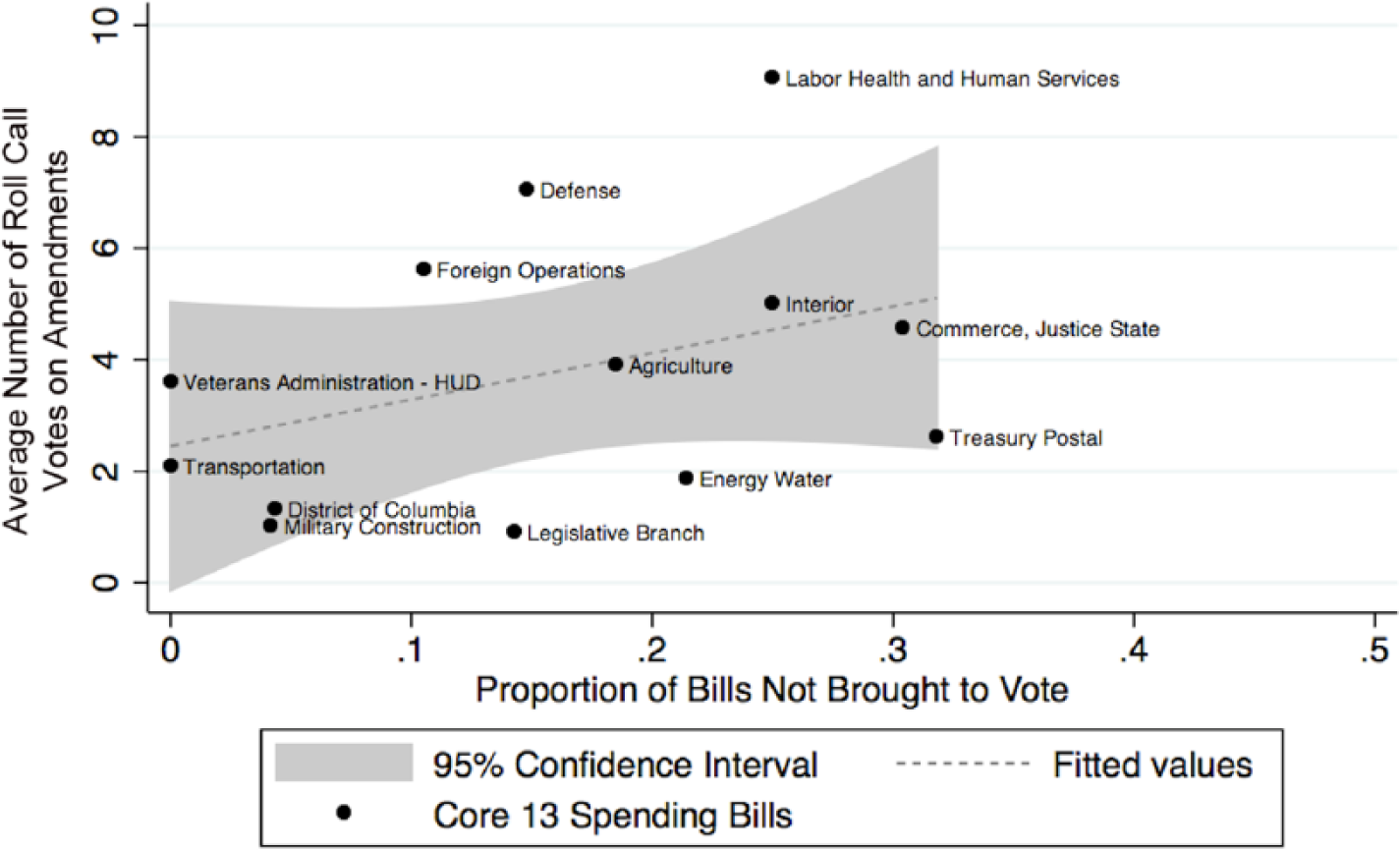
Frequently amended bills and abandoning the regular order: U.S. Senate, 1981–2012; “HUD” indicates the Department of Housing and Urban Development.
The findings in this section strongly support the expectation that failing to vote on an individual spending bill and later incorporating it into an omnibus package reduces the total amount of amending in the appropriations process. Debating spending legislation in an omnibus format cannot make up for the more robust debate that would otherwise occur on individual spending bills. Furthermore, the data support the argument that the majority party is more likely to skip debate on spending bills that historically attract a large number of amendments.
Voting Patterns on Omnibus Legislation
Research on multidimensional packages finds that they are likely to attract broad coalitions of support. Policymakers also say that omnibus spending bills generally attract bipartisan support and are not used to shift policy outcomes toward the majority median. In the last section of this article, I test this proposition by analyzing the votes on omnibus bills using the vote for final passage of the conference report as the benchmark. Omnibus bills were passed in twenty-four of the thirty-eight years under study. There were twenty-three recorded votes on the packages, four voice votes, and one adoption by unanimous consent. 9
Table 3 lists the levels of majority and minority opposition to omnibus packages in every year in which an omnibus bill was considered between 1975 and 2012. Nineteen votes on passage for omnibus packages have levels of minority opposition below 50 percent or were not recorded. Only nine votes exceed the threshold of 50 percent minority opposition. On seven occasions, majority opposition actually exceeded minority opposition. These patterns are more consistent with bills that are bipartisan in nature rather than bills that are being used to push policy in the majority’s preferred direction.
Opposition Levels to Omnibus Spending Bills, 1979-2012.

Bill names (Defense, Labor, etc.) indicate that a regular appropriations bill carried the omnibus package.
H.J. Res. 370 provided funding through March 31, 1982. H.J. Res. 409 provided funding for the remainder of the fiscal year.
Congress passed two separate packages in 2000 and 2011.
Passed by the next Congress.
Two separate votes were taken on the omnibus in 2007, one related to war spending and the other on the remainder of the bill.
H.R. 3610 was the final omnibus conference report. Prior to its passage by voice vote, the Senate first adopted an identical bill (H.R. 4278) by roll call vote. I report the roll call vote for H.R. 4278 here.
VA-HUD: Veterans Administration-Housing Urban Development; Mil-Vets: Military Construction-Veterans Administration.”
Conclusion
This article offers an important new perspective on the extent of majority party influence in the Senate and the conditions under which it is used. Not calling a vote on an appropriations bill combined with including it in an omnibus package amounts to a one-two punch that shapes legislative outcomes and helps members to meet their electoral goals by protecting the party’s reputation. It shields members from difficult votes on amendments and protects them from the political fallout of a government shutdown by easing the passage of the budget. The costs and benefits of abandoning the regular order explain why the Senate majority party is likely to use its influence when it is small, divided, and distant from the minority. Omnibus bills impose a cost on members of the majority by reducing the opportunity to participate in legislating. Majority party members accept a reduced role in lawmaking and create an omnibus package when there is a high potential for damage to the party reputation in the regular order.
The findings in this article modify the traditional understanding of the Senate, but they are consistent with its basic theme of limited majority party influence. The majority party can ease the passage of a budget, but it is aided in this task by the fact that gridlock is an unacceptable outcome in the appropriations process. The majority’s control over the agenda falls short of giving it a systematic ability to shift policy outcomes in its preferred position. Consistent with previous research and statements from policymakers, omnibus bills typically attract strong bipartisan support. The majority party’s ability to limit amending is also constrained. The majority is more successful limiting relatively harmless voice votes and less successful at limiting more controversial roll call votes. Members have less exposure to damaging votes when the majority abandons the regular order, but they cannot escape them. Packaging bills together gives the Senate majority party some advantages and is an important way in which it can wield influence, but its capabilities are still far less than those of its House counterpart.
Footnotes
Acknowledgements
I am grateful to many people who provided advice and assistance during the development of this project, including Jonathan Hanson, Eric Schickler, Robert Van Houweling, Seth Masket, Tony Madonna, Frances Lee, Devin Caughey, Miranda Yaver, and my undergraduate research assistant Ben Horblit of the University of Denver.
Declaration of Conflicting Interests
The author(s) declared no potential conflicts of interest with respect to the research, authorship, and/or publication of this article.
Funding
This research was supported with funds from the Mike Synar Research Fellowship from the Institute of Governmental Studies at the University of California, Berkeley, and funds from the Division of Arts, Humanities and Social Sciences at the University of Denver.
Notes
References
Supplementary Material
Please find the following supplemental material available below.
For Open Access articles published under a Creative Commons License, all supplemental material carries the same license as the article it is associated with.
For non-Open Access articles published, all supplemental material carries a non-exclusive license, and permission requests for re-use of supplemental material or any part of supplemental material shall be sent directly to the copyright owner as specified in the copyright notice associated with the article.
