




Abstract
Although the “Gingrich Senators” thesis solves a vexing issue, a broader theoretical question remains: Why does the House have a polarizing effect on its members that seems to persist even after a representative wins election to the Senate? In the first section, I propose that lawmakers learn partisan norms in the House and simply continue those extreme behavioral routines after switching chambers. And in the second part, I test possible sources of this effect. Results show that senators who came from the House display greater ideological extremism if they (a) served in the House within an extreme partisan cohort and (b) won election to the Senate after representing a partisan district. In contrast, serving within a polarized chamber and during periods of divided party control have no long-term effects on a senator’s ideological extremism. Robustness checks reveal that the effect of a senator’s House partisan cohort persists even when we control for his/her ideological extremism before winning election to the House as well as selection effects caused by electoral dynamics. Additional analyses show that the partisan cohort effect is the largest determinant of partisan learning, exists throughout most of congressional history, is strongest when the parties are homogeneous, and persists for much of a senator’s career. As a whole, the results show that the House’s effect on Senate polarization is not due to a single person or a function of chamber polarization. Rather, the “Housification of the Senate” is a consequence of cohort socializing effects and is observable throughout congressional history.
Introduction
In the American political lexicon, the Senate possesses “coolness” and “wisdom” while the House of Representatives is responsive to “popular whims and passions.” But by any measure, the Senate has polarized at about the same rate as the House (McCarty, Poole, & Rosenthal, 2006). Given the normative virtues of bicameralism, as well as the two chambers’ institutional and electoral differences, the concurrent polarization of the House and Senate is a vexing issue for students of American politics.
In two landmark studies, however, Theriault (2013) and Theriault and Rohde (2011) provide an elegant solution to this puzzle. According to the Gingrich Senators thesis, the Senate’s polarization can be explained, almost entirely, by the replacement of moderate Republicans with junior brethren who won election from the House and were “baptized” during Gingrich’s reign. Like any landmark study, however, while Theriault and Rohde solve one issue, their results raise additional questions. For example, despite the title of their work, a lawmaker’s proximity to Newt Gingrich is not a cause of the Gingrich Senators effect. In fact, some of the most ideologically extreme senators (Jim DeMint, Pat Toomey, and David Vitter) never actually served with Gingrich. As a result, an important theoretical question remains: Why does service in the House have a polarizing effect on its members that seems to persist even after representatives win election to the Senate? As Theriault and Rohde themselves note,
While we think this article is a significant step in this line of research, we do not think it is the final step. Our findings move the question of interest back a step . . . what is it about Gingrich’s baptizing in the House that so radicalizes his former colleagues in the Senate? (p. 1023) Gerald C. Wright (2015) raised the same issue in his review of Theriault (2013), More could be done to address the question of why these senators are so different. Theriault deals with the question indirectly in some rough quantitative controls for state characteristics, but he does not confront the question head on. (p. 344)
Drawing from studies in organizational theory, social psychology, and political science, this article situates the polarizing effect of chamber switching in a behavioral framework. While virtually all studies view polarization as a by-product of lawmakers’ rational or goal-seeking actions, this article advances a theory that lawmakers’ behaviors are also the product of reinforced day-to-day actions and a general process of institutional socialization. As Gerald C. Wright (2015, p. 345) put it: “Explaining the distinctiveness of the Gingrich senators poses an interesting challenge for contemporary legislative theory, which focuses on institutional incentives and rules to account for the behavior of individuals.”
After elaborating the theoretical expectations, the analysis tests possible sources of the Gingrich Senators effect. Results show that senators who won election from the House display greater ideological extremism if they (a) served in the lower chamber within an extreme partisan cohort and (b) won election to the Senate from a partisan district. According to the results, a senator’s lower chamber cohort is the largest single determinant of ideological extremism and therefore explains the bulk of the Gingrich Senators effect. In contrast, serving within an ideologically extreme chamber and during periods of divided party control are not predictive of Senate roll-call behavior. Robustness checks reveal that the effect of a senator’s former cohort persists even when we control for a representative’s ideological extremism before winning election to the House (Bonica, 2014) as well as possible selection effects caused by electoral dynamics (Heckman, 1979; Sartori, 2003). Additional analyses reveal that the cohort effect exists throughout much of congressional history (1911-2012), is strongest in periods when the parties are organizationally homogeneous and distinct, and persists for much of a senator’s career.
As a whole, although the theory of partisan learning can only be inferred from observational data, the empirics show that senators who are exposed to polarized cohorts in the House carry those partisan behaviors with them into the Senate. While the theory requires further testing, Gailmard and Jenkins (2007) note that a “social psychological” theory of partisanship would be powerful because it could “account for the similarity in party power across legislative chambers with relatively different internal institutions” (p. 699). And, although the findings confirm that chamber switching has contributed to the Senate’s polarization (Theriault & Rohde, 2011), the results also show that this effect is not historically unique (due to a single party or individual) or a function of chamber processes (as Theriault, 2013, suggests). In contrast, the polarizing effect of chamber switching is a function of partisan effects and exists for much of congressional history. In other words, this article solves a question Theriault and Rohde (2011) themselves pose, finding that the Gingrich Senators effect is not isolated to Newt Gingrich or the Republican Party but is part of a more broadly generalizable partisan process.
The Senate’s Polarization and the Gingrich Senators
The Gingrich Senators thesis has drawn much-deserved attention from both academics and journalists. Indeed, the effect uncovered jointly by Theriault and Rohde (2011), and developed further by Theriault (2013), solves a vexing issue in the congressional literature: Why has the Senate polarized at the same rate as the House? As several researchers note, the conventional explanations of polarization—from institutional reforms (Deering & Smith, 1997; Zelizer, 2006) to electoral developments (Bishop & Cushing, 2008; Carson, Crespin, Finocchario, & Rohde, 2007; Gimpel & Schuknecht, 2003)—fit the House much better than the Senate. In both works, Theriault and Rohde show that Republican senators who served in the House after Gingrich’s election in 1978 exhibit greater ideological extremism in their roll-call behavior than any other group. As an empirical matter, this powerful result explains both the timing and the bulk of the variation in the Senate’s polarization (Theriault & Rohde, 2011).
But what is a Gingrich Senator, exactly? In both projects, Gingrich Senators (a) are Republicans, (b) who served in the House, and (c) were first elected after 1978. On its face, “Gingrich Senator” suggests that some connection to Newt Gingrich caused the Senate’s polarization. In a subsequent analysis, however, Theriault (2013) notes that spatial proximity to Gingrich does not explain the result. Indeed, some of the most partisan senators (Jim DeMint, Pat Toomey, and David Vitter) entered in the House after Gingrich has already resigned! In concluding, Theriault speculates that serving in a “highly partisan chamber . . . seems to have affected future senators” (p. 72, italics added).
As a whole, although the Gingrich Senators thesis is a powerful empirical result, it remains unclear why the House has a durable polarizing effect on ex-representatives. I propose a parsimonious solution to this puzzle: The Gingrich Senators internalized partisan norms in the House and simply carried those behaviors with them into the Senate.
Partisan Learning: A Behavioral Explanation of Polarization
What makes one lawmaker a moderate and another an extremist? Although the explanatory factors differ from one study to the next, the conventional wisdom is that polarization is a rational choice. Indeed, researchers posit that lawmakers respond to exogenous forces—constituents’ policy preferences, policy realignments, and so on—in pursuit of reelection (e.g., Mayhew, 1974) or that lawmakers manipulate institutional rules in their pursuit of non-majoritarian policy and a beneficial party record (e.g., Cox & McCubbins, 1993; Rohde, 1991). But while rational choice theory certainly explains the bulk of the variation in polarization, a behavioral theory would consider the possibility that lawmakers’ actions are also the product of learned routines (Bendor, Diermeier, & Ting, 2003).
Before discussing the possible sources of partisan learning, it is important to acknowledge that labeling the causal process “learning” is meant to illustrate key features of the hypothesized effects. First, the theory proposes that the underlying cause of the Gingrich Senators effect manifests at the individual level. Second, learning emphasizes that the specific behavior under examination (ideological extremity) is quite durable. In other words, the polarized norms and routines adopted in the House are not simply undone upon entering the Senate. And third, learning indicates that polarized behaviors can be reinforced by institutional structures or internalized from the broader political environment. Simply put, learning is clearest about the most likely processes generating these effects. It is important to note, however, that learning cannot be proven in observational data sets. Nonetheless, dozens of published studies in political science (cited below) reference a theory of legislative learning.
Reinforcement
According to organizational theorists, learning is a “relatively permanent change in behavior” caused by “reinforced practice or experience” (Hamner, 1974, p. 87; March & Olsen, 1989). In its simplest form, this article theorizes that political institutions (elections, chambers, parties) structure the behavioral norms, routines, and strategies lawmakers internalize from one Congress to the next. Unlike rational choice institutionalism, congressional learning posits that the effect of political institutions can persist even after lawmakers exit an institutional setting.
According to classic studies in behavioral theory, learning is a function of reinforced practices and experiences (Pavlov, 1927; Skinner, 1953). Do legislative institutions operate in the same manner, rewarding certain behaviors and punishing others? Yes. Among the political structures that might reinforce specific actions, none is more consequential than political parties. Given their well-documented organizational powers, it is reasonable to posit that parties have considerable ability to inculcate ideologically extreme behaviors. Such an effect can occur directly or indirectly. As an example of direct effects, both Sinclair (1981) and Loomis (1984) describe a partisan strategy they call “inclusion,” where junior members are brought into the leadership with the goal of creating loyal partisans. Dodd (1986) similarly argues that parties “use the resources and the learning opportunities that it to build a large group of supportive legislators” (p. 7), while Garand and Clayton (1986) maintain that the Speaker’s task force can be used to “build and strengthen the norm that one should be a“team” player” (p. 411). Indirectly, we might think of partisan inducements such as favorable committee assignments (Rohde, 1991) or negative agenda control (Cox & McCubbins, 1993) as “positive reinforcement mechanisms.” In other words, from a behavioral perspective, organizational actions designed to achieve short-term policy goals may—over repeated iterations—have the indirect effect of enhancing partisan loyalties.
Social Learning
At the same time, congressional learning could occur as a by-product of larger socio-institutional conditions. According to more contemporaneous research in organizational theory and social psychology, behavior is not merely a function of iterated responses to external stimuli, as classic behaviorists posit, but also a product of social learning. According to social learning theory, individuals internalize norms and behavioral routines by modeling the actions of proximate actors. In other words, although rewarding and punishing mechanisms could produce learning, most human behaviors are learned unintentionally “through the influence of example” (Bandura, 1976, p. 5).
In political science, social learning theory is implicit in prior work (though see Hall, 1996). Lupia and McCubbins (1994) posit that “Legislators, like most people, learn by watching what others do and listening to what they say” (p. 365). In their extensive interviews with freshman members of the California assembly, Price and Bell (1970) identified the importance of interpersonal interaction and group membership for the process of “freshman socialization” (but see also Barnett, 1999; Matthews, 1959). As they write “there are a host of unwritten rules, traditions, customs and ways of doing things which must be learned and absorbed by the freshmen” (p. 178). J. A. Clark, Caldeira, and Patterson (1993) note the importance of interpersonal interaction in explanations of legislative decision making while Caldeira and Patterson (1987) find that political “friendships” are key determinants of information flow. Dodd has written extensively that congressional development can be explained by epistemological (1994) or paradigmatic (2005) crises. And finally, recent work by Masket (2008) notes the importance of physical proximity in legislatures on roll-call behavior, concluding that such effects merit further research.
Hypotheses
If congressional behavior is indeed learned over the course of a lawmaker’s career, as the theory proposes, the question is whether such an effect can explain why senators seem to carry ideologically extreme behaviors across chambers. Five hypotheses test the possible source(s) of this effect.
First, and foremost, if ideologically extreme behaviors are (a) reinforced by partisan strategies, (b) positive externalities created by repeated partisan inducements, or (c) a result of the socializing capacity of a party’s social network, we should observe a relationship between the ideological extremism of lawmaker’s partisan cohort and their subsequent roll-call behavior. In this context, “cohort” is used in a statistical sense to refer to a group of individuals with shared experiences in a given time period. In other words, perhaps chamber switchers exhibit greater ideological extremism in the Senate because they adopted the extreme behaviors of their House co-partisans.
For Hypothesis 1, House Cohort is operationalized as the median ideological extremism of a representative’s caucus (with his or her own score removed to limit endogeneity). Specifically, it is the median absolute DW-NOMINATE score for lawmakers of the same party who served in the House together (Poole, 1998). For example, although Jim DeMint and John McCain are both Gingrich Senators, they served in the House within very different caucuses. McCain’s Republican cohort in the House (1983-1986) had a median ideology of just 0.29 while DeMint’s Republican cohort (1999-2004) had a median ideology of 0.53. Notably, although both DeMint and McCaain are considered “Gingrich” Senators, DeMint never served in the House with Gingrich. On the flip side, neither Chuck Grassley nor Bob Dole is a Gingrich Senator. And, although their terms were separated by 6 years, they served in the House within ideologically similar Republican caucuses. Dole’s co-partisans (1963-1969) had a median ideology of 0.23 while Grassley’s co-partisans (1975-1981) had a median ideology of 0.22.
Second, if congressional behaviors are the product of social learning, we might observe a relationship between socio-institutional conditions and a lawmaker’s roll-call patterns. In other words, members of Congress might learn partisan behaviors indirectly from the broader environment. Unlike Hypothesis 1, which emphasizes the role of parties, perhaps chamber switchers learned extreme behaviors from their day-to-day interactions in the House. For his part, Theriault (2013) speculates that this is the specific mechanism driving the Gingrich Senators effect, noting, “It is the service in this highly partisan chamber that seems to have affected future senators” (p. 72, italics added). At the same time, inter-institutional conflict (for the same underling reasons) may have contributed to the extremism of the Gingrich Senators as well. For example, in 1992, Herrnson suggested that House Republicans exhibited ideological extremism in the Gingrich era because of their inability to win favorable policy outcomes. In other words, perhaps the Gingrich Senators adopted ideologically extreme behaviors as a consequence of divided government and partisan conflicts with the Clinton White House.
For Hypothesis 2, House Median is operationalized in the same manner as House Cohort except that the variable records the median ideological extremism of the entire House of Representatives. For Hypothesis 3, Divided Government is operationalized as the average number of Congresses where the White House and House majority were of opposite parties. For example, if a member served three terms in the House, but only one was during divided control, the variable is coded as 0.33.
Finally, partisan habits could be reinforced by electoral factors (Fenno, 1978). We know, for example, that representatives fairly accurately represent their constituents and “die in their ideological boots” (Poole, 2007, p. 435). Furthermore, recent research by Parker and Goodman (2009) shows that constituents are able to perceive their members’ particular “home styles” while Grimmer, Messing, and Westwood (2012) show that lawmakers’ credit claiming actions indeed have electoral benefits. It seems plausible, in other words, that the representative style forged over repeated House elections may have had a durable effect on a lawmaker’s legislative style. Hypothesis 4 therefore suggests that lawmakers have a reason to continue their representational style even after they exit the House.
For Hypothesis 4, House PVA is operationalized in the same manner as the variable State PVA in Theriault and Rohde (2011). PVA is the two-party vote for the representative’s presidential candidate in his or her district subtracted from the national two-party vote averaged over their time in the House. Higher values indicate a reliably partisan district while lower values indicate a more moderate district. For example, both John Ensign (R-NV) and David Vitter (R-LA) are Gingrich Senators. However, Ensign’s former congressional district (NV-1) leaned Democratic in presidential elections while Vitter’s district (LA-1) was heavily Republican. Conceivably, once we control for Ensign and Vitter’s current constituency (i.e., State PVA), the effect of their old district should have no effect from a purely “reelection seeking” perspective.
Method: The Polarizing Effect of Chamber Switching Reexamined
In each model in this section, the covariates are identical to those in Theriault and Rohde’s (2011) constituency analysis. Given the question animating this article, however, we must adopt one key refinement: The analysis is restricted to senators who first served in the House of Representatives. 1 In addition to isolating the causal process of interest, this methodological refinement limits selection effects caused by House-to-Senate career patterns. As just one example, perhaps senators who won election from the House are simply more partisan before entering the lower chamber. In other words, ideological extremity could be a component of progressive ambition in the contemporary period (Rohde, 1979; Schlesinger, 1966). While restricting the sample should reduce this possibility, a separate section controls for the effect of a senator’s pre-House ideology and tests for selection bias.
As in Theriault and Rohde (2011), the dependent variable is a senator’s ideological extremism from the 93rd Congress (1973-1974) to the 110th Congress (2007-2008). It is the absolute value 2 of a senator’s DW-NOMINATE score (Poole, 1998). In the second and third analyses, the dependent variable is constructed in the same manner but with Nokken and Poole’s (2004) ideal points. The Gingrich Senator variable is an interaction between party identification (Republican) and whether a member entered after the 96th Congress (Post 96th). 3 A linear trend (Time Trend) and an interaction with party (Time × Republican) are included as well. Constituency factors include population size (State Population) and whether a senator is from the south (South). Both variables are interacted with party (denoted Republican × South and Republican × Population). Each model accounts for state partisanship as well. State PVA records the national two-party vote for the presidential candidate of the senator’s party subtracted from his state’s two-party vote averaged over each decade.
Each model was estimated as a random effects ordinary least squares (OLS; also known as a linear mixed model) in an attempt to treat unobserved heterogeneity. In the first set of results, the random effects are estimated at the senator level (following Theriault and Rohde), while in the second and third sets, the random effects are estimated at the congress level. Following recent publications in this journal,
4
in the tables,
While the methodology follows Theriault and Rohde (2011), given the question under examination here, additional controls are included. 5 One possibility is that in the modern Congress, the parties have a greater capacity to “vet” senators and discourage moderates from running. In the forthcoming analysis, the variable Legislative Record records the total number of years a senator served in the House and/or state legislature and is designed to account for this possible effect. In addition, while the analysis limits the possibility of selection effects by restricting the data set to senators who previously served in the House, perhaps state-level career patterns matter. For this reason, the analysis introduces dichotomous controls for whether a lawmaker was a Mayor/Governor or served in the State Legislature prior to joining the House. Admittedly, the possible effect(s) of state-level service on a lawmaker’s ideological extremism are significantly more complex than these variables capture. In forthcoming section an additional analysis controls for a lawmaker’s extremism before winning election to the House (Bonica, 2014), which should account for these effects. In the end, an explicit examination of the effects of state career patterns on ideological extremism in the House is a worthwhile avenue for future research.
Main Findings
Table 1 presents the results. Model 1 contains the Gingrich Senator interaction term (without the primary covariates) while Models 2 to 5 introduce the congressional learning variables one by one. To produce the most stringent test of the congressional learning variables, the Gingrich Senators base terms remain in every model. We can compare the performance of each model by examining the percentage of explained variation (R2) and the information criterion (where a lower Akaike information criterion [AIC] indicates a better fitting model).
Congressional Learning and the Gingrich Senators.

Note. Dependent Variable is ideological extremism (DW-NOMINATE). AIC = Akaike information criterion.
p < .1. **p < .05. ***p < .01.
Looking at Model 1, the control variables perform as expected. We see that the interaction between time and party (Time × Republican) is significant and positive, indicating that polarization has increased in the Senate from the 1970s to the 2000s with the greatest increase among Republicans. Regarding the constituency variables, the results reveal that lawmakers from the most partisan states (State PVA) and Republicans from the South (Republican × South) exhibit the most extreme roll-call patterns. Although each of these effects match Theriault and Rohde’s findings, there are two differences. First, the results do not find a significant effect of state population (where Theriault and Rohde find small populations correlate with greater ideological extremism among Republicans). And second, the results show that senators who served as a state or local executive (Governor/Mayor) exhibit less ideological extremism (this was not tested by Theriault and Rohde).
Most important, however, in Model 1, the Gingrich Senator covariate is statistically significant and correctly signed despite the presence of additional control variables and a refined sample. Specifically, a Gingrich Senator in the 110th Congress has an estimated ideology of 0.42 according to Model 1. In Theriault and Rohde (2011), the same effect is estimated to be 0.43. While this demonstrates the robustness of Theriault and Rohde’s (2011) findings, it also ensures the analysis used to isolate the cause of the Gingrich Senators effect does not change the substantive results.
When we examine Models 2 to 5, which introduce the congressional learning variables one at a time, we find that House Cohort (Hypothesis 1) and House PVA (Hypothesis 4) are statistically significant and correctly signed while House Median (Hypothesis 2) and Divided Government (Hypothesis 3) are insignificant. According to Model 2, a one-unit increase in the ideology of a senator’s House partisan cohort increases the senator’s ideology by about 1/2 in the same direction. Given that House Republicans had an average ideology of 0.43 following Gingrich’s election to the House, the Gingrich Senators’ lower chamber co-partisans account for about 0.19 of their ideological extremism. In Theriault and Rohde (2011), the Gingrich Senators are 0.23 more ideological compared with senators who served in the House prior to Gingrich’s election. Thus, the two effects are roughly the same magnitude, suggesting that they indeed stem from the same underlying force. According to Model 5, by comparison, a 1% increase in the partisanship of a senator’s House district adds 0.01 to the senator’s ideological extremism. Based on this result, it would seem that the representative style forged during a senator’s time in the House persists even after he/she exits his/her district (and this effect persists even when controlling for the same effect at the state level). Given that House Republicans during the Gingrich era represented districts that leaned about 6.5 percentage points more Republican than the national two-party vote, Model 5 suggests that electoral forces added about 0.065 to the Gingrich Senators’ ideological extremism. Finally, when we estimate a single model with the two significant congressional learning covariates (reported in Table 1 as Model 6), that model outperforms the initial Gingrich Senators model according to both the AIC statistic and R2. Ultimately, the multivariate model confirms the robustness of Hypotheses 1 and 4, and suggests that congressional learning represents a useful framework for understanding the dynamics of chamber switching and underlying causes of the Gingrich Senators effect.
Figure 1 presents the average effects of House Cohort and House PVA from Model 6 for Republicans and Democrats. To get a handle on the temporal dynamics, the estimates were calculated for those who served in the House: (a) before Gingrich’s election in 1978, (b) with Newt Gingrich from 1979 to 1998, and (c) after Gingrich resigned in 1999. The “base effect” is simply the average estimated ideological extremism predicted by the remaining covariates in the model. Figure 1 reveals a few notable patterns. For starters, we can see just how consequential the cohort and electoral effects are relative to the base determinants of ideological extremism. Averaged for all senators and time periods, the base factors account for 54% of a senator’s ideological extremism while House PVA and House Cohort account for 10% and 36%, respectively. As a general matter, therefore, the effect of senator’s lower chamber cohort is sizable relative to the “usual” causes of polarization. But perhaps most important, we can see that historical variation in the effect of a senator’s time in the House exists among Republicans only. In particular, House Cohort and House PVA contribute about 0.30 to a Republican senator’s ideological extremism in the post-Gingrich sample compared with 0.22 in the Gingrich sample (a 36% increase) and 0.15 in the pre-Gingrich sample (a 100% increase). Among Democrats, however, we do not see comparable changes over time as the contribution of House PVA and House Cohort account for 0.17 (pre-Gingrich), 0.20 (Gingrich), and 0.20 (post-Gingrich) in Senate Democrats’ extremism.
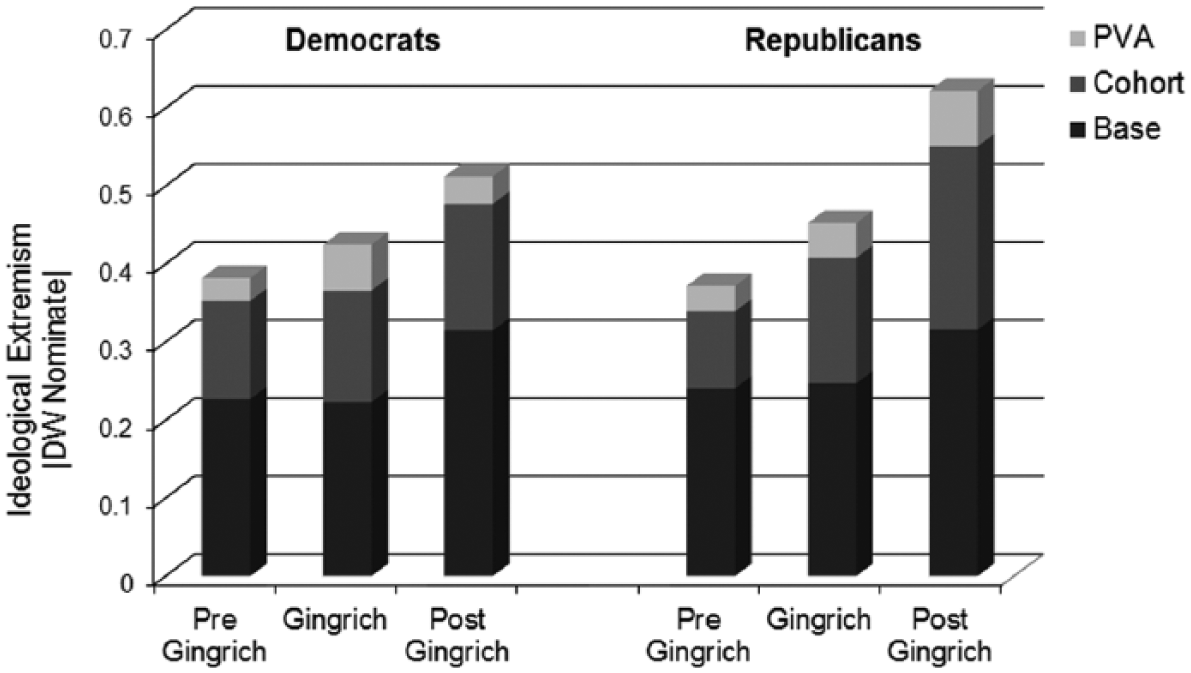
Contributors to ideological extremism.
Although these results are broadly consistent with Theriault and Rohde’s (2011) findings, there are a few key differences. First, we can see that although there has been no change since the 1970s in the polarized behaviors Democrats bring with them from the House to the Senate, Figure 1 reveals that the underlying dynamics of the Gingrich Senators effect is not restricted to Republicans. Even Democrats have sizable House Cohort effects (though they are smaller than the effect for Republicans). Second, Figure 1 shows that the process of congressional learning continued unabated after Gingrich resigned. In fact, the largest overall polarizing effect belongs to what we might call the Hastert Senators! In both respects, one of the overarching conclusions of this article is that the effect first uncovered by Theriault and Rohde (2011) is much more widespread than they uncovered. As a theoretical matter, this suggests that the underlying cause of the Gingrich Senators effect is a more broadly generalizable behavioral process.
Matched Pairs Design: 1911 to 2012
While dozens of studies reference a process of legislative learning, it is impossible in an observational design to isolate the cognitive process at work and prove lawmakers learn partisan behaviors. Congressional researchers must, instead, rely on statistical control when linking roll-call patterns with their theories. Nonetheless, we can leverage natural variation in lawmakers’ past experiences, mimic the control present in experimental studies, and significantly reduce omitted variable bias.
In this section, the data set isolates pairs of senators who are identical in key ways: (a) Both served in the Senate together, (b) both belong to the same party, (c) both represent the same state and therefore share identical constituencies, and (d) both senators won election after having served in the House. For example, Tom Coburn (R-OK) and Jim Inhofe (R-OK) are matched as are Jim DeMint (R-SC) and Lindsey Graham (R-SC). In the forthcoming analysis, the ideology of a senator’s “twin” is used as a control with both senators serving as a dependent variable and independent variable. 6 For example, Lindsey Graham and Jim DeMint served in the Senate together from the 109th to 112th congresses. In the data set, Graham contributes four observations (as the response, with DeMint serving as the control) and DeMint contributes four observations (as the response, with Graham serving as the control). Ultimately, by including data for both senators, the analysis leverages considerable variation in the twins’ House experiences. MacDonald and O’Brien (2011) adopted the same approach in their examination of gender and representation. Conceptually, the twin variable accounts for a range of unobservable causes of polarization such as constituency characteristics, geographic factors such as population and region, party affiliation, and potential selection effects. Indeed, the twin control variable—alone—explains 75% of the between variation in a senator’s ideological extremism. A handful of studies in the congressional literature have utilized similar matching procedures (see Butler & Nickerson, 2011; Carson, Lynch, & Madonna, 2011; MacDonald & O’Brien, 2011).
In addition to the matching procedure, the data set extends the analysis back to 1911 (the 62nd Congress) while also extending it forward to 2012 (the 112th Congress). Extending the time series has two purposes. First, it ensures the primary findings are robust out of sample. Second, and most important, it provides an additional test of whether the underlying causal process is one of learning. On one hand, if the lower chamber cohort effect is the result of lawmakers internalizing partisan behaviors in the House, it is unlikely that such an effect would be restricted to the modern period. But also, if partisan learning stems from the socializing capacity of political parties, the effect should be historically heterogeneous. In other words, we should observe a larger effect in periods when the parties have greater organizational centralization. Stated formally, the hypothesis is as follows:
Analytically, the 62nd Congress is notable for being the first after the revolt against Joe Cannon. Following the revolt, the Speaker no longer had the power to chair the Rules committee and appoint committee members and chairs. In the end, the organizational strength of parties declined. From the 94th Congress to the 112th, however, a series of reforms enhanced the organizational capacity of parties, and intraparty homogeneity increased. By comparing these two periods—the “Textbook” (1911-1973) period with the “Post-Reform” period (1974-2012)—we should be able to discern whether the socializing capacity of political parties indeed waxes and wanes with their organizational strength.
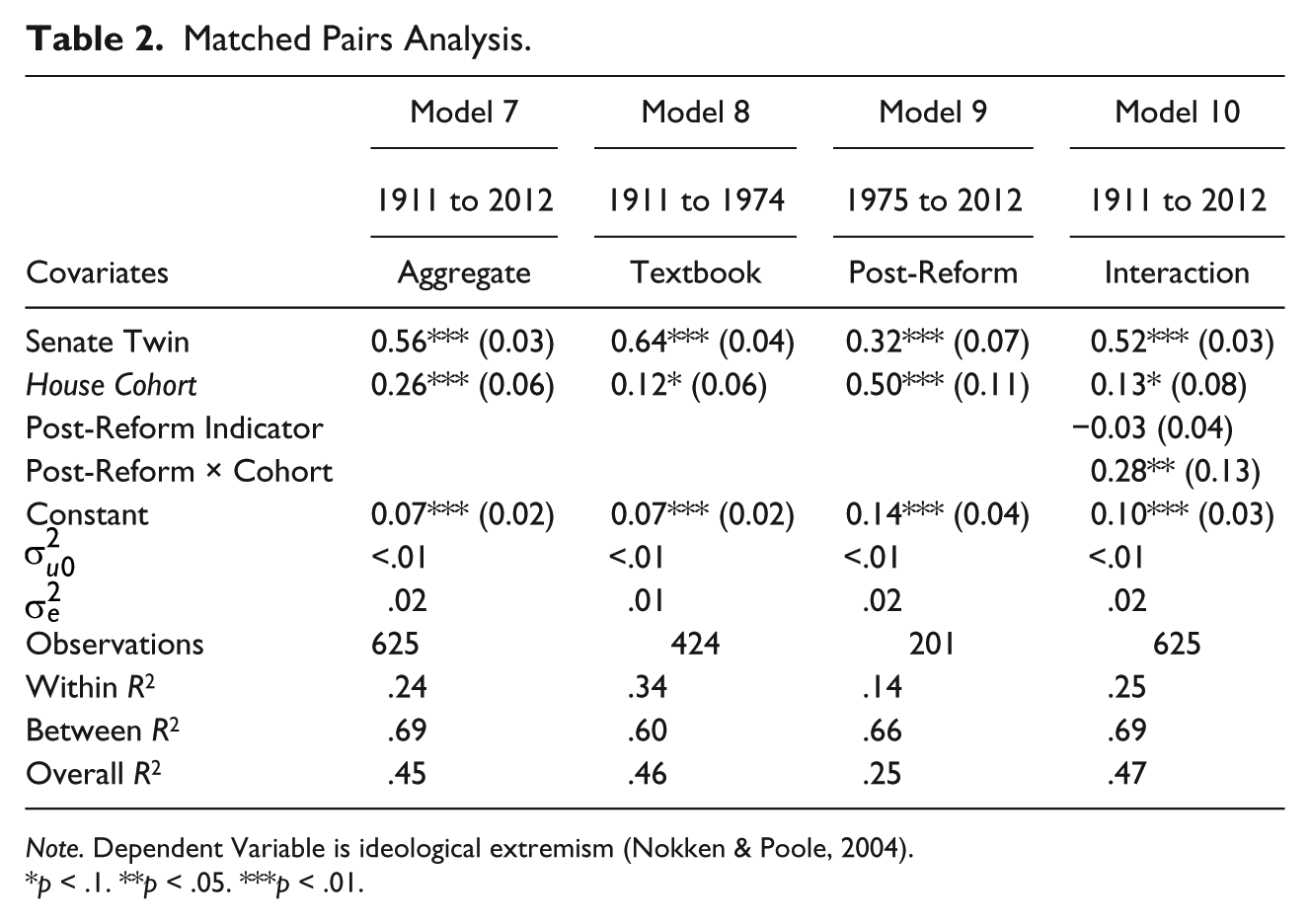
As with earlier, the key independent variable is the ideological extremity of a senator’s cohort in the House while the dependent variable is their ideological extremity in the Senate. In this analysis, however, there are two important modeling adjustments. First, while the model uses random effects to treat unobserved panel heterogeneity, in the forthcoming analysis, the random effects are set at the Congress level. Estimating a model with member random effects is unwarranted because some senators appear just once as a result of the matching procedure. Moreover, the twin variable captures the lion’s share of between-senator variation in extremism. Second, the forthcoming results were produced using Nokken and Poole’s (2004) “one Congress at a time” scaling procedure. As Nokken and Poole explain, their measure allows a lawmaker’s ideal point to move non-linearly from one Congress to the next. Given that we are interested in historical variation in ideological extremism, and the fact the Senate roll-call record varies considerably over time (Lee, 2008), allowing a member’s ideal point the maximum variation is warranted. In addition to relaxing the linearity constraint in DW-NOMINATE scores, testing the primary results with alternative measures serves as an important robustness check. 7 Table 2 presents the results.
Matched Pairs Analysis.
Note. Dependent Variable is ideological extremism (Nokken & Poole, 2004).
p < .1. **p < .05. ***p < .01.
Five models are reported. Model 7 spans the entire period, Model 8 is restricted to the “Textbook” era (1911-1973), and Model 9 is restricted to the “Post-Reform” era (1974-2012). Finally, Model 10 tests whether effect of House Cohort varies between time periods by interacting a time period indicator (1 = “Post-Reform” era, 0 = “Textbook” era) with the cohort variable. 8 A statistically significant interaction effect indicates a meaningful difference between time periods in the socializing capacity of a senator’s lower chamber cohort.
As expected, the twin variable is statistically significant in each model and captures the lion’s share of variation in ideological extremism. Because of this variable, we can be confident that the matching procedure controls for countless unobservable factors and limits the possibility that confounding factors bias the primary results. With respect to the variable House Cohort, the results are consistent with the earlier findings. On one hand, the effect of a senator’s lower chamber cohort is statistically significant and positive in every model. According to Model 7, for the entire time series, a one-unit increase in the ideological extremism of a senator’s House Cohort increases their ideological extremism in the Senate by about 1/4 units. In sum, a senator’s lower chamber cohort has a statistically meaningful effect even in the presence of a strong control variable (a senator’s twin), an extended time period (dating back to 1911), and alternative ideal points (Nokken & Poole, 2004). On the other hand, and more importantly, Table 2 reveals that the effect of House Cohort is indeed smallest in magnitude during the “Textbook Era” and largest in magnitude in the “Post-Reform Era.” In fact, the effect of a senator’s House partisan cohort is just “marginally” significant from 1911 to 1973 (p = .06). Finally, the significant interaction term in Model 10 confirms that this difference is statistically meaningful. In particular, the interaction term indicates that the magnitude of House Cohort is 0.28 larger in the Post-Reform period. In sum, from this section, we can conclude that the socializing capacity of political parties indeed varies as a function of their organizational centralization.
Senate Cohorts
When representatives win election to the Senate, what happens to their ideological extremism? In other words, do Senate cohorts simply undo the effect of House Cohorts? Indeed, it could be that while representatives enter the Senate to the left or right of their co-partisans, these chamber switchers quickly moderate their voting behavior in the upper chamber in the direction of their party’s median member. Most importantly, if the lower chamber cohort effect is ephemeral in nature, it would seriously undermine the possibility that congressional learning is at the root of the Senate’s polarization.
But while this “degradation effect” is intuitive, there is at least one reason to doubt its existence: Cohort effects are almost certainly stronger in the House than in the Senate. First, with more extensive partisan networks and stronger partisan resources, parties in the House almost certainly have a greater capacity to socialize members. Second, the Senate’s individualism norm (Sinclair, 2005) and permissive rules afford members greater “behavioral latitude” (quoted in Baker, 2009, p. 57). Simply put, the Senate is more lenient of deviant behavior than the House. And third, a lawmaker’s experiences in the lower chamber are probably more consequential for the simple reason that they happened first. If anything, the expectation is that this degradation effect happens very gradually.
In this section, we explore the rate at which the effect of a senator’s House Cohort dissipates. As with earlier, the analysis utilizes a senator’s twin as means of controlling for countless unobservable factors. 9 Given that we are interested in temporal variation in the effect of a senator’s House Cohort, an interaction term between this variable and the logged 10 number of 2-year terms served in the Senate tests the degradation hypothesis (denoted House Cohort × Ln Terms).
Because of space constraints, this additional model is not reported. 11 Instead, Figure 2 presents the substantive result. In the model, the interaction effect is negative, indicating that the ideologically extreme norms learned in the House indeed degrade over the course of a senator’s career. However, this degradation is quite small in magnitude and is statistically insignificant (p = .22). Figure 2 plots the magnitude of a one-unit change in House Cohort over the span of ten 2-year terms. We can see that the House Cohort effect is statistically significant at the p < .05 level from the first to the eighth terms (i.e., for 16 years). But because the confidence interval in Figure 2 just crosses the zero line at the ninth term, the cohort effect is considered just “marginally” significant at this point.

Longitudinal variation in the effect of House Cohort.
In the end, there is modest evidence that Senate cohorts undo the partisan norms caused by House Cohorts. It would seem that there is indeed a parallel process at work: Senate learning. However, this effect is very gradual, taking more than 16 years before the House Cohort effect is undone. Consistent with expectations, it would seem that effect of a senator’s time in the House has a durable effect on their ideological extremism.
Entering and Exiting: Pre-House Ideology and Selection Bias
In this final section, an addition set of models attempt to validate whether a lawmaker’s legislative experiences in the House are a cause of ideological extremism. Although the results seem to suggest that something happens over the course of a member’s congressional career, the empirics could be spuriously generated for two related reasons. First, a senator could be ideologically extreme before winning election to the House. In other words, a host of pre-House factors could cause ideological extremism rather than factors related to a representative’s legislative experiences. Second, ideologically extreme representatives may be more likely to win election to the Senate in a more polarized period. In other words, perhaps ideological extremity is simply a component of progressive ambition in the contemporary period (Rohde, 1979; Schlesinger, 1966). If true, the empirics could be caused by an increase in ideological extremists winning election to the Senate to the contemporary period (Thomsen, 2014).
Models 11 to 13 explore these possibilities using the matched pairs framework from the section “Matched Pairs Design: 1911 to 2012” (including Nokken and Poole’s ideal points rather than DW-NOMINATE scores). At the heart of the matter are two factors: (a) a senator’s ideological extremism before winning election to the House and (b) the extremism of candidates who ran but did not win election to the Senate. Accounting for the former would help validate the theory that a senator’s experiences in the House have a polarizing effect (i.e., as opposed to pre-House factors). Accounting for the latter would ensure that the dynamics uncovered earlier are not due to changing electoral patterns (i.e., selection bias).
Fortunately the Database on Ideology, Money in Politics, and Elections (DIME) has data on the ideology of politicians, which are perfectly suited for exactly these two applications (for a similar use, see Rogowski & Langella, 2015). 12 As Bonica (2014, p. 367) explains, his candidate financial (CF) scores measure ideology using the distribution of a candidate’s campaign receipts (based on the belief that individuals donate according to their evaluation of a candidate’s ideology). Because they are derived from campaign contributions, CF Scores are available (a) before lawmakers win election to the House and (b) for candidates who ran for the Senate but did not win. Bonica’s ideal points correlate at .92 with DW-NOMINATE scores, demonstrating that they “map onto the same liberal-conservative dimensions recovered from roll-call data” (Bonica, 2014, p. 371). Indeed, like Keith Poole’s measures, higher CF Scores indicate conservative candidates while lower CF Scores indicate liberal candidates. 13
Model 11 in Table 3 examines the effect of a senator’s pre-House ideological extremism by controlling for this construct in the prior matched pairs analysis. 14 Model 11 is the same as Models 7 to 10, just with this additional variable. In Model 11, Ideological Extremism (CF) is the absolute value of a candidate’s dynamic CF Score in their first campaign for the House. Looking at the results, we can see that the variable House Cohort is statistically significant and positive even when controlling for a senator’s pre-House ideological extremism. We can therefore conclude that the effect of a senator’s lower chamber partisan cohort indeed stems from his or her experiences in the House rather than from unobservable factors that make them extreme before winning their first election (i.e., at the state or local level). Model 11 also reveals that a senator’s pre-House extremism is statistically significant. However, it is negative, indicating that ideological extremism in a senator’s first House campaign correlates with ideological moderation when elected to the Senate. Although this may seem counterintuitive, it almost certainly reflects the fact the congressional districts are more partisan on average than states. For example, according to the data collected for the period 1980 to 2012, the average partisan vote advantage (using the two-party vote for president) is 11.8 in congressional districts compared with 7.7 in the states. In running for election to the House, representatives adopt a more extreme campaign style compared with their roll-call votes in the Senate. Baker (2009) discusses these varied constituency pressures, referring to states as like a “circus big top” (p. 86), while in congressional districts, “interests run in a narrower track.” In sum, it is not that ideologically extreme House campaigns produce moderates in the Senate, just that the more extreme a senator’s old district the more he or she has to moderate (in a relative sense) when representing voters statewide.
Pre-House Extremism and Selection Bias (1980-2012).

Note. Dependent Variable in outcome equation is ideological extremism (Nokken & Poole, 2004) while the DV in selection equation indicates if a candidate won a Senate election (Bonica, 2014). OLS = ordinary least squares.
p < .1. **p < .05. ***p < .01.
Model 12 in Table 3 examines the possible effect of changing electoral dynamics. In particular, the analysis accounts for who wins election to the Senate with a selection model following Heckman’s two-step routine (Heckman, 1979; Sartori, 2003). 15 In particular, the procedure estimates two equations: a probit selection equation (modeling whether a lawmaker wins election to the Senate from the population of all candidates who ran in a general election) and a continuous outcome equation (which is the same matched pairs design as earlier, modeling a senator’s ideological extremism). Such models adjust the outcome estimates for any selection bias and have been used in recent studies in this journal (Deering & Wahlbeck, 2006; McDonald, 2011; Nicholson & Collins, 2008). For the selection equation, the observations consist of all candidates who were “active” in a general election according to Bonica’s DIME data set, with the dependent variable recording whether they won election to the Senate (coded “1”) or lost (coded “0”).
In the selection equation, eight variables are included. 16 First, the analysis tests an interaction between the state’s two-party vote for the Republican presidential candidate (State Republican PVA), as a measure of state partisanship, and the candidate’s raw ideology using the DIME data set (CF Score), where higher values indicate more conservative candidates. Second, the model includes an indicator for incumbents (denoted Incumbent). And third, the model contains a triple interaction between a candidate’s extremism (Ideological Extremism [CF]), an indicator for their party (Republican), and an indicator for whether the election took place from the Republican Revolution to the present period (1994-2012). In the selection model, this interaction is of primary interest, testing whether extreme Senate candidates are more likely to win election to the upper chamber following the Republican Revolution (and whether the effect varies by party). 17 A linear time trend was tested as well, instead of the dichotomous Republican Revolution indicator, and all results were the same.
Examining the selection equation, there are four results. First, incumbents (Incumbent) have a higher probability of winning election to the Senate. Second, the interaction of a lawmaker’s ideology and their state’s partisan leanings (CF × State PVA) is significant and positive, indicating that conservative candidates are more likely to win election to the Senate if their state is Republican leaning. And third, the results show that ideological extremism (Ideological Extremism [CF]) lowers the probability a candidate wins a Senate election. On the motivating question—changing dynamics in extreme candidates winning election to the Senate—the selection equation indicates some evidence in the affirmative. We can see that the interaction between a candidate’s extremism and the Republican Revolution indicator (Extremism × 1994−2012) is approaching significance with a p value of less than .10. Because the effect is not significant at the p < .05 level, however, some caution is warranted. But in general, this effect suggests that in the contemporary period, extreme candidates are marginally more likely to win election to the Senate (see also Thomsen, 2014).
Given the extremism result, selection bias could indeed be the root cause of the primary findings. When we look at the outcome equation, we notice two things of importance. First, the variable Lambda (which is the non-selection hazard) corrects the main estimates for possible selection bias (Heckman, 1979). If Lambda is significant in the outcome equation, it indicates that the residuals are correlated with the selection process (Greene, 1999). With a p value of .44, however, the variable does not indicate a selection effect in the outcome equation. Simply put, although a host of factors that explain why someone runs for the Senate (Rohde, 1979; Schlesinger, 1966) and polarized policy positions are likely part of that calculation in a polarized era (Thomsen, 2014), these processes do not seem to bias the primary findings of this article. Second, and relatedly, we can see that House Cohort remains statistically significant and correctly signed. Although the size of the coefficient is reduced once we control selection processes, it remains the case that ideologically extreme House Cohorts have an effect on the roll-call behavior of lawmakers that persists even after they win election to the Senate.
Finally, Model 13 in Table 3 combines the selection equation (Model 12) with the pre-House ideology variable (Model 11). In Model 13, every result is identical to Model 11 and Model 12. Most important, the effect of a senator’s House partisan cohort once again has a significant effect on ideological extremism in the upper chamber. And as with earlier, Lambda is far from statistical significance—with a p value of .36—indicating that selection effects do not bias the primary results. All in all, these three models help validate that the effect of a senator’s House Cohort stems from his or her experiences in the House rather than from pre-House factors or possible selection effects caused by electoral dynamics.
Conclusion: The “Housification of the Senate”
Woodrow Wilson (1885) remarked that “the Senate can have in it no better men than the best men of the House of Representatives” (p. 195). Based on the results of this article, a literal interpretation of Wilson’s critique is accurate. Like Theriault and Rohde (2011), the results show that the contemporary Senate’s polarization is largely a consequence of the replacement of moderate lawmakers with ideological extremists who were first elected to the House of Representatives. However, this article extends the Gingrich Senators thesis in two important ways. First, the article develops a theory of “partisan learning”—developed from various works in organizational theory, social psychology, and political science—which explains why the House seems to have a polarizing effect on individual lawmakers that persists even after a lawmaker exits the lower chamber. Second, the empirics pinpoint the precise cause of this effect, finding that partisan learning stems almost entirely from the socializing effect of homogeneous partisan cohorts. In the end, although the theory and empirics are unconventional in the modern congressional literature, researchers have noted for decades that behavioral theories can make sense of congressional actions. Nonetheless, further research is needed.
What do lawmakers learn, exactly? Although this article isolates the intermediate causes in the lower chamber, it is difficult to statistically model the specific “lessons” individual lawmakers internalize. Nevertheless, there are three plausible answers, and each is worthy of future research. First, partisan learning may be a function of instrumental rationality. Simply put, it may be that lawmakers who began their career in the House develop a belief system that views party loyalty and teamsmanship as the most effective means to satisfying their electoral and policy goals. Even in the more permissive and individualistic Senate, which ostensibly rewards compromise, lawmakers who were first elected to the House may favor conflict as a strategic from of behavior. Second, partisan learning may stem from a deep-seated antipathy toward rivals. Having been first elected to a hierarchical institution that is both more ideological and rewarding of partisan conflict, former representatives may enter the Senate with greater hostility toward members of the opposite party. And third, partisan learning may stem from the particular representative style lawmakers forge early in their congressional career. Because congressional districts are more homogeneously partisan on average than states, senators who won election from the House may have learned a more combative campaign style compared with their non-House colleagues.
Although the findings confirm that chamber switching is the primary cause of the Senate’s polarization, there are a few key distinctions between the present study and Theriault and Rohde’s (2011) work. Most importantly, the results show that the effect is not historically unique (due to a single party or person) or a function of chamber polarization (as Theriault suggests). Rather, the results show that the polarizing effect of chamber switching is a function of cohort polarization and exists throughout much congressional history. For this reason, the broader effect is perhaps best described as the “Housification of the Senate” rather than the “Gingrich Senators” effect. 18 In the end, the two chambers’ synchronous polarization is not a spurious effect caused by factors simply shared by the two bodies, nor is it due to a single individual of party, but the product of a lawmaker’s socializing experiences in the lower chamber and the corresponding increase in the number of senators winning election from the House to the Senate from the 1950s to the 2000s. Indeed, the number of senators who first served in the House has more than doubled over the post–World War II era. In the 112th Congress, 48 senators previously served in the House compared with just 19 in the 80th.
As a final matter, the theory and results require further theoretical and substantive scrutiny. First, greater theoretical attention should be given to how, exactly, legislative institutions foster long-term behavioral routines. For example, the theory suggests that the lack of direct party effects (e.g., Krehbiel, 1993) does not negate their existence as lawmakers can adopt partisan behaviors indirectly by simply belonging to ideologically homogeneous groups. A recent simulation supports this contention, demonstrating that partisanship can emerge in a legislature through informal rules such as winning and competition (Schreiber, 2013). Ultimately, however, the theory articulated here should be considered a first step. And second, congressional learning requires greater empirical scrutiny as well. As just one example, the theory may make sense of congressional reform efforts. Where the House reforms of the 1970s were driven by an influx of liberal Democrats who viewed the House as unsatisfactorily arranged to meet their needs (Rohde, 1991), Senate reforms in the 1990s may be explained by a surge of conservative Republicans who were accustomed to the House’s more hierarchal and partisan structure (see Sinclair, 2000). Relatedly, while this article examines the effects of polarized cohorts, divided government, and party homogeneity, additional factors are worth exploring such as the effect of partisan competition (Hicks, 2015), the effect of lobbying (Gray, Cluverius, Harden, Shor, & Lowery, 2015), the role of partisan primaries (Rogowski & Langella, 2015), and the effect of state-level career patterns on ideological extremism in the House (Shor & McCarty, 2011).
Footnotes
Acknowledgements
I would like to thank the Dirksen Congressional Center for its financial support of this project. Thanks to Dave Rohde and Sean Theriault for providing helpful feedback on the data and methods. Larry Dodd, Chris Cooper, Gibbs Knotts, Josh Huder, Michael Heaney, Seth Masket, and Greg Koger commented on an earlier version of this article. I am also appreciative of Brian Gaines and three anonymous referees at American Politics Research for their helpful suggestions. As always, all errors are my own.
Author’s Note
An earlier version of this article won the “Best Graduate Student Paper Award” at the 2010 meeting of the Florida Political Science Association.
Declaration of Conflicting Interests
The author(s) declared no potential conflicts of interest with respect to the research, authorship, and/or publication of this article.
Funding
The author(s) disclosed receipt of the following financial support for the research, authorship, and/or publication of this article: This study was supported by the 2012 Dirksen Congressional Center “Congressional Research Grant.”