



Abstract
Existing research concludes that acculturation converges Latino immigration policy views with those of Anglo-Americans. Yet, polls show few Latinos support restricting immigration. This article reconciles these statements with theory and evidence. I argue acculturation is part of a broader give-and-take process, the two-way street in which the contrast between expected and perceived treatment by the receiving community shapes whether or not Latino acculturation leads to restrictionism and “convergence” with Anglos. Regression analysis of survey data shows that perceived group discrimination, but not perceived individual discrimination or Latino within-group discrimination, moderates the link between acculturation and support for restrictive policy.
Thrown together in a sociopolitical context in which Mexican Americans occupied an inferior social status and Mexican immigrants were, by definition, aliens, both groups found themselves viewed as outsiders in American society.
When thinking of issues central to the development of Latinos as political actors, for many, immigration tops the list. Immigration debates matter to Latinos, in part, because of their proximity to the immigrant experience. Fifteen percent of Latinos were foreign-born in 1970; today, this figure is about 40 percent (U.S. Census Bureau 2013). This translates to 85 percent of all Latinos having at least one foreign-born grandparent (Fraga et al. 2012). Immigration issues also resonate with Latinos because discrimination has always been closely tied to how immigration policies are understood by Latinos (Gonzalez 2011). These two sources of issue salience, immigrant generation and discrimination, reveal a puzzle in Latino immigration policy attitudes.
On one hand, “[a]s Hispanics live in the United States through succeeding generations and are exposed to the socialization experiences of Americans their opinions increasingly resemble those of other Americans” (Garcia and Sanchez 2008, 98). This line of reasoning can be traced to classic straight-line assimilation theories (Dahl 1961; Gordon 1964; Park 1928; Warner and Srole 1946) and, as detailed below, is empirically supported in research on Latino immigration policy preferences. On the other, despite differences by acculturation, perceived group discrimination might generate the outlook captured in the epigraph above. The result would be to nudge support away from exclusionary policies and dampen acculturation’s tendency to converge Latino views with those held by other Americans. Missing from the literature is a solution that reconciles these opposing theoretical expectations.
To what extent do Latino immigration policy preferences follow a path of convergence with other Americans? Why do some Latinos not converge as expected? To answer these questions, I revisit two critiques of straight-line assimilation and relate each to a line of research on Latino immigration policy preferences. One critique is the presumption that “Americanization” goes hand in hand with integrating immigrants into other areas of life. A second critique is the tendency to view immigrants and their children as having more power and agency to generate desirable outcomes from their adjustment efforts than they actually possess. These critiques feature prominently in the sociological framework of segmented assimilation (Portes and Rumbaut 2006b; Portes and Zhou 1993) and have been marshaled by political scientists in critical statements about the contemporary immigration debate (Fraga and Segura 2006). However, the implications of these critiques are not considered in analyses of Latino immigration policy preferences.
Different levels of acculturation generate different interpretations about rebuff from the receiving society. For newly arrived immigrant Latinos, whether they reject the burden of cultural adaptation or view it as a legitimate charge, their actual level of acculturation makes it easier to judge perceived discrimination as a response to insufficient cultural adaptation. This view is less plausible for Latinos who are the most acculturated. An alternative interpretation is that perceived discrimination means that integration into the “core” part of society is exclusive. The implication is that perceived discrimination signals a shared position of disadvantage in society and communicates the extent to which the receiving society appreciates acculturation as a distinguishing attribute of Latinos. If so, believing there is no discrimination toward Latinos promotes the convergent influence of acculturation on immigration policy preferences and perceiving discrimination hinders convergence with the dominant receiving society.
Unpacking this puzzle is important because political scientists care about the policy attitudes of ordinary people. There is a lot of evidence showing acculturation is a key explanatory variable of Latino political attitudes (Abrajano and Alvarez 2010a; Barreto and Pedraza 2009; Branton 2007; Michelson 2003; Sanchez 2006). This article bridges this evidence with a classic theoretical debate about how ordinary immigrants assimilate in American society. At stake is extending models of data so that they represent acculturation’s influence on most Latinos who back expansionist positions and the fewer, but no less important, who prefer restrictive immigration policy. Resolving the puzzle benefits public opinion researchers who seek to be theoretically current in their study of the U.S. population, of which one-fifth does not experience pre-adult socialization in American politics as prevailing theories assume.
In the next sections I trace interpretations of the empirical relationship between Latino acculturation and immigration policy preferences to the classic views of assimilation. Drawing on critiques of straight-line assimilation, I develop a theory about perceived discrimination as a moderator of the relationship between acculturation and Latino support for restrictive immigration policy. The section after that describes the data and strategy for comparison. In the fourth section, I evaluate the convergent influence of acculturation on Latino immigration policy attitudes depending on perceived group discrimination. In the final section, I reconcile the findings with the prevailing scholarly wisdom and outline future research directions for the study of acculturation and Latino political attitudes.
Latino Immigration Views and Prevailing Theory
Acculturation is often conceptualized by social scientists as the process of newcomers integrating culturally into the receiving or host society (Cruz et al. 2009; Redfield, Linton, and Herskovits 1936). In political science, acculturation is operationalized with measures of generation status, English language proficiency, and length of time in the United States. For Latinos, these factors are positively related to the acquisition of partisanship (Cain, Kiewiet, and Uhlaner 1991), the development of an American identity over national origin or pan-ethnic identity (Mohamed 2012; Schildkraut 2011), and support for the U.S. War in Iraq (Abrajano and Alvarez 2010b), and negatively related to trust in government (Abrajano and Alvarez 2010a; Michelson 2003; Wenzel 2006). In general, these studies highlight the importance of acculturation for explaining a variety of Latino attitudes. In this study, the focus is on Latino immigration policy preferences.
The conceptual importance of acculturation has roots in the work of Park (1928) who emphasizes cultural exchanges coincide with the arrival of newcomers. Outlining the terms of cultural exchange, Warner and Srole (1946), privilege “American” culture over immigrant culture, and predict an orderly march across generations toward a unified, middle-class American society. Later work by Gordon (1964, 77) defines acculturation as “the taking on of the English language and American behavior patterns.” He argues that acculturation is central to the “Anglo conformity” vision of assimilation in America. Applying this logic to political life, Dahl (1961, 34) proposes that “an ethnic group passes through three stages on the way to political assimilation” with each successive stage loosening the grip of ethnic ties on individual political behavior. These early works laid the theoretical foundation for what Abrajano and Singh (2009, 6) summarize as the generational status hypothesis, which says that “[t]hose who are second and third generation Latinos may be less supportive of immigration policies that would ease immigration laws than would foreign-born Latinos.” They explain that “Because these later generation Latinos are the ones who should be most integrated and assimilated into U.S. society, they may possess the policy views of the dominant society.” How well is this theoretical expectation represented in models of data?
Studies of Latino immigration policy preferences reveal the influence of this earlier line of thinking. They establish a strong positive correlation between Latino acculturation and support for restrictive policy positions. Among others, Miller, Polinard, and Wrinkle (1984) report that third-generation Mexican Americans are more supportive of restrictive immigration policy (Binder, Polinard, and Wrinkle 1997; Polinard, Wrinkle, and de la Garza 1984). Complimenting these patterns, studies demonstrate that English language proficiency, another key indicator of acculturation, is positively associated with backing restrictive policies (de la Garza, Falcon, and Garcia 2003; de la Garza et al. 1993; Hood, Morris, and Shirkey 1997). A key innovation in this vein of research is the combination of these factors into a single measure. Branton (2007, 298) demonstrates strong evidence that an additive index of acculturation is consistent with the classical expectation of acculturation’s convergent effect and concludes that “‘fully’ acculturated Latinos are in greater agreement with Anglos than with less acculturated Latinos.” These studies are important because they establish two empirical patterns. First, Anglo-Americans typically offer greater support for restrictive immigration policy. Second, Latinos who are more acculturated express immigration policy attitudes that are closer to Anglos than their less acculturated counterparts.
Models of data featured in studies of Latino immigration policy views accurately represent “Anglo conformity,” the prevailing expectation of straight-line assimilation theories. However, they have also missed an important theoretical subtlety from the classic works. A critical acknowledgment in early studies is the expectation that more acculturated members of immigrant-proximate communities would be favorably distinguished from the less acculturated by the receiving society. In a clear example, Gordon (1964, 104) recognized that in the Anglo-conformity model, “the implicit assumption is that if the immigrant will conform [culturally] in all the above respects, unfavorable attitudes and behavior toward him will disappear.” The aim of this study is to re-purpose models of Latino immigration policy attitudes to also account for how this overlooked dynamic—the implied reciprocity condition of acculturation—might hinder the convergent influence of acculturation.
Theory
It is worth noting from the outset that socioeconomic outcomes and upward mobility occupy center stage in classic and contemporary models of assimilation. Strictly speaking, their development and later reformulations were not customized for explicating political attitude formation. Nevertheless, some aspects of their frameworks offer valuable guidance to public opinion research. The core challenge for models of Latino immigration policy attitudes is to retain their aspects of central tendency and enhance their flexibility for valuable nuance. One way to begin meeting this challenge is to revisit critiques of straight-line assimilation.
Among other shortcomings, one of the major critiques of straight-line assimilation is the inclination to see immigrants and their children as masters of their assimilation destiny (Fraga and Segura 2006, 284). Some of this view is rooted in misguided comparisons between contemporary immigrants and those of yesteryear. We know Americans view past immigrants with grand nostalgia, and as exemplars of individualism whose lives validate “boot-strap” ideology. If folks back then were able to do it, then immigrants today should also be able to. But this line of reasoning exaggerates the agency of past immigrants. It overlooks how achieving the economic American dream depends on the framework of government response to immigrants that can range from “active encouragement” to “exclusionary” (Portes and Rumbaut 2006a, 93), to expulsion (Fox 2013), and leaves out the role of civic organizations in helping immigrants to fulfill civic duties (Ramakrishnan and Bloemraad 2008; Wong 2006). By assuming that members of immigrant-proximate communities hold more power than they actually possess, the implication is that members of the dominant Anglo community, as a matter of contrast, are mere spectators of acculturation drama.
A second critique of straight-line assimilation is the notion that cultural adaptation inevitably coincides with integration in other domains (Kasinitz et.al. 2009). The main problem with this expectation is that it is at odds with facts on the ground. As Portes and Rumbaut (2006b, 45) state in the context of economic mobility, “the process is subject to too many contingencies and affected by too many variables to render the image of a relatively uniform and straightforward path credible.” 1 The analog for Latino immigration policy attitudes is the fact that highly acculturated Latinos differ in their support for restrictive policy—that is, some do and some do not. While Latino cultural adaptation, on average, goes hand in hand with immigration policy attitudes that are similar to those of Anglo-Americans, the claim of this article is that important nuance variation remains unrepresented in our statistical models. How can we more fairly specify the agency of the dominant receiving society and explain why some Latinos do not converge in their immigration policy attitudes as expected?
One answer is that the distribution of immigration policy attitudes among Latinos reflects a two-way street process. 2 One side involves Latino acculturative achievements and the other is whether Latinos believe the receiving society has met their end of the reciprocity condition implied in straight-line assimilation theories. Thus, perceived discrimination conveys that despite one’s nativity, degree of adaptation to “mainstream” behaviors, or English language proficiency, one remains indistinguishable from less acculturated Latinos in the eyes of the receiving society. In other words, Latinos anticipate their cultural adaptation will be favorably recognized by members of the dominant receiving society, and as long they perceive it is, acculturation follows the path of convergence expected by straight-line assimilation theory. But when acculturative demands are met and Latinos perceive unfavorable attitudes or behavior toward them, then the relationship between acculturation and support for restrictive immigration policy changes. This reasoning underpins this study’s first hypothesis:
By “moderates,” I mean what Baron and Kenny (1986, 1174) describe as “affects the direction and/or strength of the relation between an independent or predictor variable and a dependent or criterion variable.” It is not the claim here that perceived discrimination accounts for the relationship that previous studies have already established, or that it is a “mediator” or mechanism through which acculturation is causally antecedent. 3 Instead, I acknowledge the general relationship between acculturation and support for restrictive immigration policy that has been reported in the literature for over twenty years and seek to evaluate a condition under which that relationship holds more or less.
Conceptualizing acculturation’s convergent influence as part of a broader social exchange process suggests sensitivity to the implied reciprocity of assimilation theories should differ by level of acculturation. I do not mean that more acculturated Latinos are better able or more likely to detect discrimination. In fact, survey data suggest that less acculturated Latinos and those with less formal education report perceived group discrimination more frequently. 4 By sensitivity, I mean the contrast between expected and perceived treatment by the receiving community is likely more jarring for Latinos who feel they have held up their end of the acculturation bargain. By contrast, less acculturated Latinos discount perceived discrimination in forming their immigration policy preferences because they are aware of their early stage in the acculturation process. In addition, immigrant optimism may buffer the impact of perceived discrimination for the foreign-born. Moreover, those with less cultural adaptation may value more the direct benefits of expansive immigration policies. This is not to say that immigrant optimism, economic self-interest, or family-mediated considerations do not exist for more acculturated Latinos, just that such considerations are probably emphasized to a greater degree by the less acculturated. The focus of this study is not to systematically inventory and understand the inner-working of each of these particular theoretical mechanisms. However, collectively they suggest a second hypothesis that perceived discrimination moderates the relationship between acculturation and immigration policy preferences differently for more and less acculturated Latinos.
The hypotheses proposed thus far are about individuals supporting or opposing restrictive immigration policy. As the epigraph makes clear, however, the dynamics of acculturation are group-centric. Immigration policy alternatives, by definition, always cue a social group (i.e., immigrants) as targets of benefit or burden. The implication is that acculturation’s convergent influence hinges on group-based perceived discrimination. This reasoning is supported by historical accounts of immigration politics in the United States. For instance, a remarkable pattern in Mexican American politics is the shift from deep ambivalence toward immigration policy alternatives in the early twentieth century, to a more or less unified position against restrictive proposals (Gutiérrez 1995, 202). According to Camarillo (1979, 188), a nativity schism developed in the Chicano community over concerns that newcomers pose an economic threat to U.S.-born workers, exacerbate cultural heterogeneity, and induce anxiety about “external prejudices from Anglo society.” These tensions still exist in the community; however, Gutiérrez (1995, 167) explains that Mexican Americans shifted their interpretation of perceived discrimination by the majority group and concluded that “the immigration issue had become inextricably enmeshed with Mexican Americans’ future in the United States.” This linkage is arguably stronger since the 1960s and 1970s civil rights movement and extends beyond Mexican Americans to Latinos in general.
The continued role of discrimination in binding U.S.-born Latinos to their immigrant counterparts was expressed in 2008 by Janet Murguía, president of the National Council of La Raza, who proclaimed in response to vitriol aimed at undocumented immigrants: “Make no mistake. This is about all of us.” 5 Moreover, the most visible immigrant rights advocate in U.S. Congress is Luis Guitiérrez, who is of Puerto Rican heritage. 6 Scholars attribute pan-ethnic solidarity for consistently blocking federal restrictive immigration proposals since the 1970s (Gutiérrez 1995, 209). At the mass level, Voss and Bloemraad (2011) underscore the national origin and generation diversity of participants and supporters of the 2006 immigrant rallies that took place across the country. These observations suggest a third hypothesis:
The historical and continuing importance of discrimination in immigration politics as it concerns Latinos places in sharp relief two facets of research on Latino immigration policy attitudes. First, it highlights the impressive empirical regularity of acculturation’s convergent influence. Second, despite the centrality of discrimination for how Latinos understand immigration as a political issue, a study by Sanchez (2006), stands out as the only work empirically testing its role in shaping Latino immigration policy attitudes in a multivariate analysis. His analysis indicates that Latinos who perceive discrimination to be a major problem are less likely to favor decreasing immigration. I agree with Sanchez (2006, 439) that perceived discrimination is an indicator of “individuals recognizing that their group shares a disadvantaged position in society,” a key dimension of the group consciousness framework advanced by (A. H. Miller et al. 1981). I take this interpretation further by adding that it implies Latinos evaluate their position with respect to whites, the dominant group in America. Just as perceived discrimination indicates relative group position, it also approximates the group-level relationship between Latinos and whites. Under the account advanced here, perceived discrimination also tells us something about the implicit agreement between immigrant-proximate communities and receiving societies. By conceiving of perceived discrimination as a countervailing force of acculturation’s convergent influence, this study contributes theory that anticipates why Latino acculturation might be a path for supporting or opposing restrictive immigration policy. This idea has not been proposed in previous research. In this respect, it offers a solution to the puzzle introduced above, connects the scholarship that evaluates the relationship between acculturation and Latino immigration policy to key critiques of the straight-line assimilation model, and provides a compelling argument for integrating literatures that separately emphasize acculturation and discrimination.
Table 1 illustrates initial support for the argument with aggregate survey distributions of Latino support for reducing immigration into the United States, the most widely studied indicator of restrictive immigration policy preference. Data are from surveys used by key studies in the literature—one from 1999 used by Sanchez (2006), another from 2002 used by Branton (2007), and a third from 2004 that will help round out more detailed analyses below. Each data source includes an Anglo sample for comparison. The aggregate-level evidence shows opposite pull for generation status and discrimination. The former suggests acculturation tracks convergence with aggregate Anglo views, shown in the right hand column, while discrimination pushes away from a preference to reduce immigration. From multiple data sources, we see the potential to observe perceived group discrimination as a consistent moderator of the link between acculturation and a restrictive immigration policy attitude.
Comparing Latino and Anglo Support for Reducing Immigration into the United States. Latino Respondents Are Also Tabulated by Nativity and Perceived Group Discrimination.
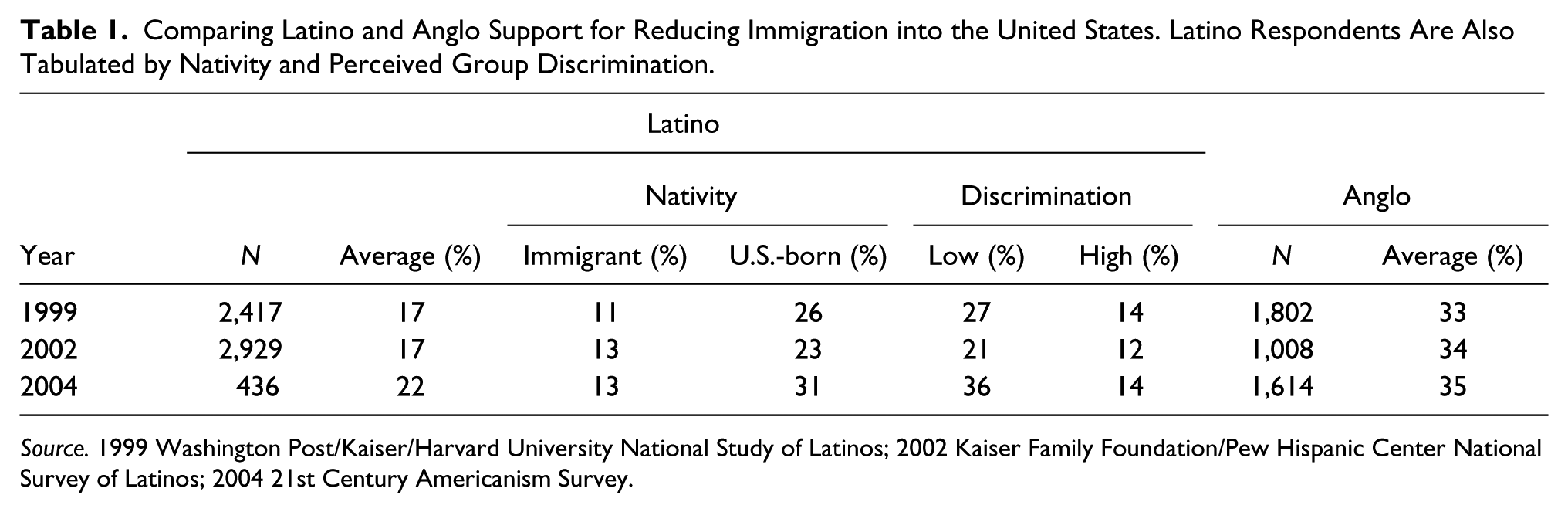
Source. 1999 Washington Post/Kaiser/Harvard University National Study of Latinos; 2002 Kaiser Family Foundation/Pew Hispanic Center National Survey of Latinos; 2004 21st Century Americanism Survey.
The next task of this study is to examine these seemingly countervailing forces on individual Latino immigration policy views while controlling known correlates. The literature on Latino political behavior identifies other factors such as national origin (Bedolla 2009; Garcia and Sanchez 2008), economic outlook and competition (Alvarez and Butterfield 2006; Hood, Morris, and Shirkey 1997), among other demographic indicators entering the calculus of Latino policy attitudes (de la Garza, Falcon, and Garcia 2003; de la Garza et al. 1993). In the statistical analysis that follows, I evaluate the above proposed hypotheses using a multiplicative term that allows for the relationship between acculturation and support for restrictive immigration policy to vary depending on the value of perceived group discrimination.
Data and Measures
This study builds on existing research by evaluating perceived group discrimination as a moderator of acculturation’s convergent influence on Latino policy preferences. The analysis uses three different survey data sources: 1999 Washington Post/Kaiser/Harvard University National Survey of Latinos (hereafter WPKH 1999), 2002 Kaiser Family Foundation/Pew Hispanic Center National Survey of Latinos ( hereafter KP 2002), 2004 21st Century Americanism Survey (hereafter CAS 2004). Although some time has passed since these surveys were fielded, these particular data offer several critical advantages. First, each shares a common immigration policy item, includes appropriate items to craft a valid and reliable proxy acculturation scale, an indicator of perceived group discrimination, and representative national samples of Latinos and non-Hispanic white respondents for comparison. Second, each survey offers English and Spanish language versions of the questionnaire to Latino respondents and includes indicators for national origin, thus ensuring representation of key dimensions of Latino diversity.
These data are also advantageous because they allow the analysis to engage key studies of Latino immigration policy attitudes on the same empirical grounds. For example, the WPKH 1999 data allow control of group consciousness factors, the determinants of primary interest in Sanchez (2006). The analysis also improves the additive acculturation scale introduced by Branton (2007) using KP 2002 data and applies it to two different data sets. In addition, I leverage KP 2002 data to explore whether within-group discrimination moderates acculturation in the same fashion I predict for perceived out-group discrimination. Evidence that it does not bolsters the two-way street interpretation that perceived group discrimination is a moderator rooted in intergroup dynamics. Finally, as shown in Table 1, the CAS 2004 data include a Latino sample that is less than 20 percent of the sample size from the other two data sources. If results from the smaller sample in CAS 2004 support the theory, then confidence in the robustness of the empirical pattern will be greater.
The empirical aim of the statistical analysis that follows is specifically to model Latino support for restrictive policy preference. Earlier, I presented Table 1 showing survey-level distributions for Latinos and non-Hispanic whites for the following question: “Do you think the number of immigrants to America should be increased, stay the same or reduced?” This item is the most commonly used for measuring public opinion on immigration policy. I collapse the multiple response options into a dichotomous indicator, coded 1 for favoring reduced immigration and 0 otherwise. This strategy allows the estimation to focus on the contrast between restrictive and non-restrictive positions, whether neutral or expansive.
Measuring Acculturation and Perceived Discrimination
A major challenge to this analysis is formulating and including comparable measures of factors shown in the literature to predict Latino restrictive attitudes. The variables of primary interest here are acculturation, discrimination, and their interaction. Previous research operationalizes acculturation using items that measure generation status, whether the interview was conducted in English language, self-reported English language proficiency, and proportion of life lived in the United States. An important measurement analysis by Cruz et al. (2009) demonstrates the validity of combining these specific factors as an additive scale. They validate three-item (not including generation status) and four-item “Proxy Acculturation Scales” (PAS) against “gold-standard” acculturation scales based on twelve to twenty-five items. They report that three- and four-item PAS have high internal consistency (reliability) and are highly correlated with scales made with many more and different items (validity). Important to this study, the validity of PAS holds separately for Latinos of Mexico, Cuba, and Puerto Rico ancestry. Although the acculturation index that Branton (2007) introduces in political science relies on only two indicators, generation status and primary language use, the study by Cruz and colleagues suggests that Branton’s additive scale, however lean, is on the right conceptual track. Moreover, Branton’s analysis still reports a consistently strong relationship between acculturation and support for restrictive immigration policy.
Fortunately, it is possible to construct the more robust 4-item PAS validated by Cruz et al. (2009) using items commonly included on surveys of Latino public opinion. All models shown below include indicators of generation status, English language interview, whether English language is spoken in the home, and the percent of life that one has spent in the United States. As for reliability, the Cronbach’s alpha for the acculturation scale constructed from each survey used in this analysis are as follows: WPKH 1999, four-item PAS 0.79; KP 2002, four-item 0.83; and CAS 2004, four-item 0.74. These coefficients of internal consistency corroborate the findings that Cruz et al. (2009) report in their study. In summary, we have strong assurances that our key measure of acculturation is separately valid and reliable across each data set used.
The argument advanced here is that perceived group discrimination moderates the relationship between acculturation and support for restrictive immigration policy. I use variants of a survey item asking whether discrimination toward Latinos is a major problem, minor problem, or not a problem facing Latinos in America today. For the WPKH 1999 data, I use two items to construct this measure. The first item asks, “Is discrimination against Latinos in our society today a problem or not?” I assign those who say “no” a value of 1. Those who say “yes” are asked the follow-up question: “Is it a big problem or not such a big problem?” Those who say “not such a big problem” are assigned the value 2, reserving the highest value of 3 for those who perceive discrimination against Latinos is a “big problem.” For the other two data, I combine responses from items that ask separately about perceived group discrimination in schools, the workplace, and preventing Latinos from succeeding in America in general. Summing the indicators in each domain, individuals are assigned a score that ranges between 1, meaning that discrimination is not seen as a “major problem” in any of the three domains, and 4, indicating belief that it is a major problem in all three areas. 7
Models and Strategy for Comparison
The prevailing expectation is that acculturation is positively associated, on average, with Latino restrictive positions. To assess whether this relationship is conditional on perceived group discrimination (H1), I specify an interaction term that is the product of the PAS and discrimination measures described above. Three key variables—acculturation, discrimination, and their interaction—are included in a logistic regression model below:
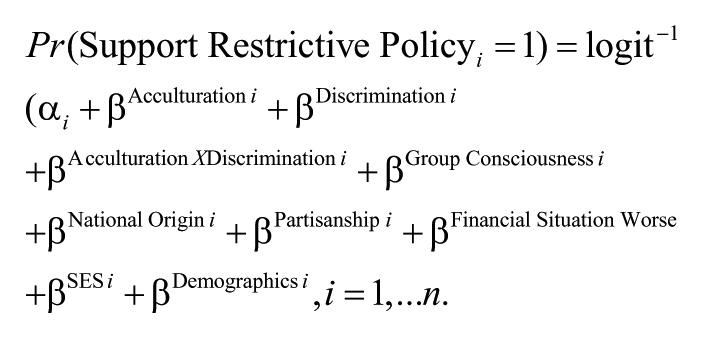
Including a product term means that the constitutive coefficients cannot be interpreted independently of other covariates in the statistical model. We must read the coefficient for PAS as the relationship between acculturation and support for reduced immigration among Latinos who perceive discrimination is “not a problem.” Likewise, the coefficient for perceived group discrimination is the association with support for reducing immigration among the least acculturated Latinos. For the purpose of identifying a moderating relationship, the coefficient capturing their interaction can be either negative or positive. However, a negative coefficient would indicate that when discrimination is set to its lowest value, acculturation leads more toward restrictive preferences and convergence with “typical” whites.
I adopt the comparison strategy used by Branton (2007, 298) to juxtapose Latinos at different levels of acculturation with “typical” whites. Branton calculates the predicted probability of supporting reduced immigration for whites who identify as Democrats and for whites who identify as Republicans. These post-estimation figures are extracted from regression models estimated separately for whites. 8 Using charts of the predicted probability of Latino support for reducing immigration across the full range of acculturation values, I illustrate different paths of acculturation depending on the level of perceived group discrimination, relative to “typical” non-Hispanic whites. The visual analysis in the next section is an assessment of H1 and H2. The strategy used to identify “typical” white immigration policy preferences is strictly for the purpose of operationalizing what straight-line assimilation theories designate as the benchmarks for evaluating adjustment by newcomers. I fully acknowledge the critique that designating a particular group with benchmark status implies that it is normatively ideal. It also risks masking important heterogeneity in white policy attitudes. At the same time, distilling an entire group to an abstract representation of the average helps me to meet an analytical goal of assessing why some Latinos do not converge in their immigration policy preferences. In this spirit, the strategy helps improve the literature that derives hypotheses from, and finds support for, the expectation of Latino convergence.
As part of this effort, it is important to see if the interaction between acculturation and perceived group discrimination holds even while controlling potential confounders. To account for the diverse social and political positions that different national origin Latinos occupy with respect to immigration policy, I include three indicators of country of ancestry. Puerto Rico (about 13% across samples), Cuba (12% across samples), and Other National Origin (35% across samples) ancestry are coded 1 to represent the respective ancestry and 0 otherwise, reserving Mexican ancestry (40%) as the reference group for comparison. 9 Where available, I include measures of group consciousness. 10
I include three indicator variables of partisanship. Republican and Independent are each coded 1 for respondents who identify, respectively, and 0 otherwise. A meaningful share of Latinos (about 26% across surveys) responded “Don’t Know,” “Something Else,” or refused to the party identification items. Hajnal and Lee (2011) suggest the failure of the Democratic and Republican parties to bring Latino concerns into their fold produces non-identifiers. I partial out Latinos who do not identify with either of the two major political parties in the United States, using an indicator variable, non-identifier, coding 1 for affirmative responses and 0 otherwise. This coding scheme leaves respondents who identify or lean toward the Democratic Party as the reference group, and I anticipate Republican and Independent are positively associated with restrictionism in comparison with Democratic identifiers.
Attitude convergence could be driven by economic threat. I can account for pressures on Latinos of low socio-economic status to favor restrictionist policy in response to economic competition from newcomers (Newton 2000). I include measures of household income and evaluations of personal financial situation used in earlier studies of immigration policy preferences (Alvarez and Butterfield 2006). Using available information from each data set on employment status, race/ethnicity, sex, age, and education, I impute missing income values to craft a continuous measure of income level, with categories across the surveys ranging between 1 (under $20,000 annual household income) and 10 (over $100,000 annual household income). Where available, I include responses to the item, “In the past year, has your personal financial situation gotten better, worse or stayed the same,” coding an indicator for those who say “worse.” The interpretation for this variable is relative to the combined responses, “same” and “better.”
A final set of controls consists of indicators for Age in years, an indicator for Female is coded 1 for female respondents and 0 for male respondents, and a scale for Education that ranges between one and five to six categories across surveys. 11 Support for the hypotheses advanced here calls for evidence that perceived discrimination moderates acculturation effects on support for restrictive immigration policy. Do highly acculturated Latinos who perceive discrimination toward their group as a “major problem” report lower levels of support for reducing immigration? Are they less likely to converge with the average views expressed by whites?
Findings
The regression estimates in Table 2 start us off with the answers. The results are organized so that the first three columns report models that evaluate H1, focusing on perceived group discrimination as the key moderator. Models of data from three different surveys indicate that acculturation is positive and significantly related to a preference for reducing immigration. However, accounting for the interaction term means that the acculturation coefficient captures specifically the relationship for Latinos who perceive low levels of discrimination.
Logistic Regressions Predicting Latino Preference to Reduce Immigrants to the United States.
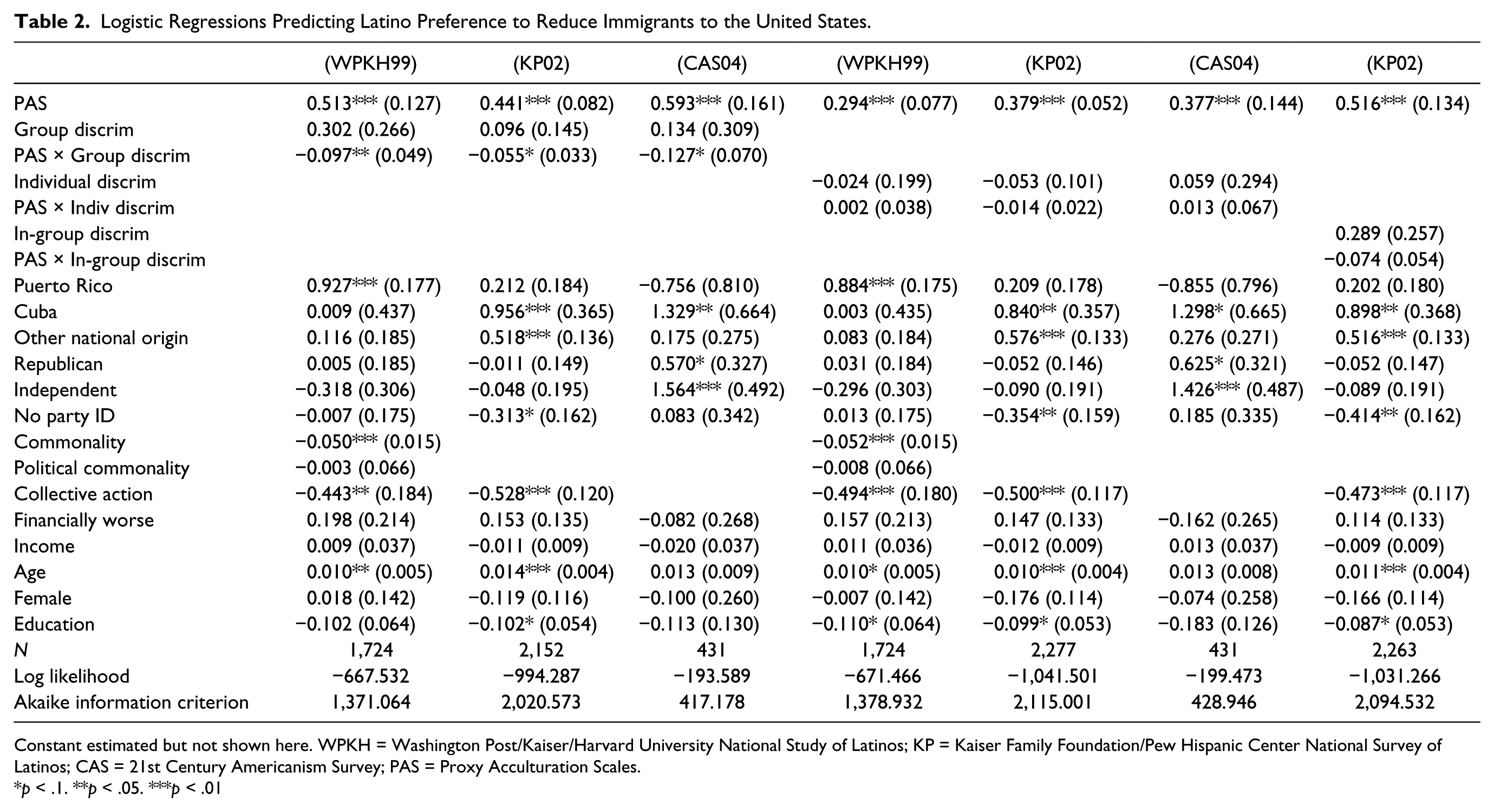
Constant estimated but not shown here. WPKH = Washington Post/Kaiser/Harvard University National Study of Latinos; KP = Kaiser Family Foundation/Pew Hispanic Center National Survey of Latinos; CAS = 21st Century Americanism Survey; PAS = Proxy Acculturation Scales.
p < .1. **p < .05. ***p < .01
The coefficients for the interaction term PAS X Group discrim are −0.097, 0.055, and −0.127, from the WPKH 99, KP 2002, and CAS 2004 data, respectively. These negative and significant estimates suggest that for Latinos who perceived discrimination toward their group is a major problem, support of restrictive policies is reduced, controlling national origin, partisan attachment, economic outlook, and various demographic groupings. The study hypotheses are directional, permitting a lower empirical hurdle for statistical rejection based on a one-tail test (p < .01 or 90% confidence). This logic applies to interactive hypotheses (Kam and Franzese 2007). The indicators and notes in the tabular results flag for the more conservative two-tailed test. Thus far, we have strong evidence in support of the theoretical argument.
I unpack the moderating impact of perceived discrimination by simulating predicted probabilities of support for restrictive immigration policy. Figure 1 is a visual link between the results in Table 2 and the study hypotheses. The figure includes one panel for each data source analyzed. In each panel, the solid black line traces Latinos who perceive discrimination toward Latinos is “not a problem.” The dashed black line represents Latinos who believe perceived group discrimination is a “major problem.” I add the predicted probability of restrictive preferences for white Democrats and Republicans in gray to assess “convergence.” At lower values of acculturation, Latino policy preferences are indistinguishable by level of perceived group discrimination, ranging between 0.05 and 0.07 for each panel. Moving from low to high, across the full range of acculturation values, the difference by perceived discrimination increases. Using estimates from the WPKH 1999 data, the expected valuation for supporting fewer immigrants enter the United States among Latinos who perceive “no discrimination” is 0.32, while those who see “major discrimination” are at about 0.18. Relative to the expected valuation for white respondents of either partisan persuasion, Latinos who do not perceive discrimination are more likely to “converge.” Because the difference between what they perceive does not square with the treatment they expect from the majority group, highly acculturated Latinos are less likely to support reducing immigration. This general “moderator” pattern is found in the simulations that are based on estimates from KP 2002 data (no discrimination = 0.39, major discrimination = 0.21); and for estimates using CAS 2004 data (no discrimination = 0.38, major discrimination = 0.08). Critical for the theoretical claims advanced here, the “convergence” path of acculturation toward majority-group opinion is observed, but less so, as hypothesized (H2), for Latinos who perceive discrimination is “a major problem.”
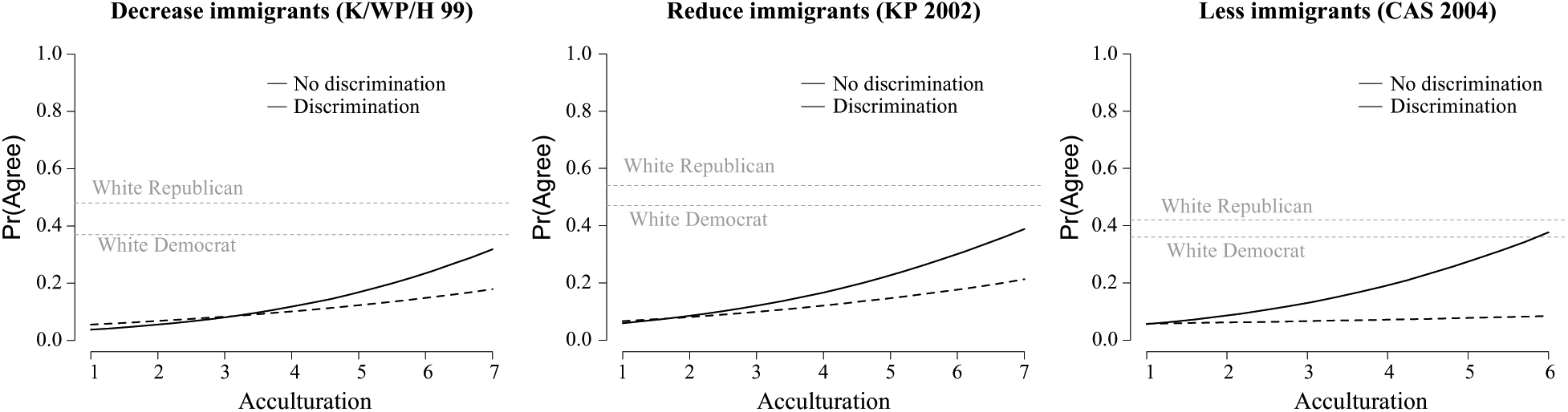
In-sample predicted probability plots for the moderator PAS X Group Discrimination.
Alternative Measures and Models
Are these estimates sensitive to the measurement and model specification choices outlined previously? The robustness probe returns the analyses to Table 2. Columns 4–6 show that indicators of perceived individual discrimination do not moderate the relationship between acculturation and support for reducing immigration. 12 This suggests that the moderating influence of discrimination is about how Latinos as a group are treated by the receiving society, in support of H3. Thus far, the analysis focuses on out-group discrimination. However, the findings may reflect intragroup dynamics. For example, Jiménez (2008) argues that immigration has “replenished ethnicity” for Mexican Americans, and this has consequences for out-group and in-group relations. For out-group behavior, immigration renews nativism and sharpens out-group boundaries. For in-group behavior, concerns of ethnic authenticity sharpen within-group boundaries. Elaborating this complexity, Garcia Bedolla (2005, 89) argues that beliefs about out-group discrimination among the most acculturated Latinos can lead to a selective disassociation response because “[i]n many cases, it is the need to counteract stereotypes that leads them to treat first-generation Latinos badly.” Furthermore, critiquing and investigating the assumption that Anglos are the sole source of discrimination facing Latinos, Lavariega Monforti and Sanchez (2010) turn to the KP 2002 data. They report that 84 percent of Latinos believe within-group Latino discrimination is problematic. Looking to the last column in Table 2, I find no evidence of a moderating effect on acculturation using measures of in-group discrimination.
One might also wonder if the statistical models above leave important factors out of the equation. For instance, in addition to national origin, diversity in Latino identity also maps onto racial categories like white, black, and, to a lesser extent, Asian. While there is evidence that Latinos view immigration as a national issue (Michelson 2001b), there may be important geographic variation that explains the findings. Figure 1 is also suggestive of a temporal dynamic; perhaps, the moderator is tapping a cohort effect that confounds Latinos who arrived or came of political age in a period when anti-immigrant sentiment was pronounced (i.e., during debates preceding enactment of the 1986 Immigration Reform and Control Act or in the aftermath of California’s 1994 Proposition 187 or 9/11 terrorist attacks). It is also possible that Latinos who live in urban settings may not perceive discrimination targeting their group as acutely as Latinos who live in rural areas with a smaller share, or more recent tenure, of Latinos. However, a major limitation of simply including more theoretically plausible factors in the same regression model is that significant results for any one predictor may be heavily dependent on which covariates are included or left out. A growing number of political scientists are noting that statistical significance tests (i.e., p values) are ill-suited for addressing this particular concern (Bartels 1997; Montgomery and Nyhan 2010; Ward, Greenhill, and Bakke 2010). Including factors like race, national origin, group consciousness, Hispanic population, immigrant cohort arrival, and geographic indicators to explain Latino attitudes risks overfitting the model.
One way to add systematically to the previous model is with a technique that averages the effect of each predictor over the different ways that a set of variables can be included or excluded in a statistical regression. Bayesian Model Averaging (BMA) is a method for identifying empirically the “best” set of predictors and is superior to stepwise regression (Hoeting et al. 1999) or haphazard variable selection. As Montgomery and Nyhan (2010, 250) summarize, the basic idea is that BMA helps us answer two questions about the moderator of interest in this study:
Does the variable contribute to the models explanatory power? (i.e., what is the posterior probability of all models that include this variable?) Is it correlated with unexplained variance when it is included? (i.e., what is the conditional posterior distribution assuming that the variable is included?).
The posterior probability plots for the moderator PAS X Group Discrimination shown in Figure 2 help answer both questions. These BMA results account for all the covariates from previous models and indicators for self-identified race, 13 the cohort of immigrant arrival, 14 the percent county Hispanic population growth from 1980 to 2000, 15 an indicator of county urbanity, 16 and the U.S. Census region where the respondent lives. 17 The vertical line located at 0 on the x axis corresponds to P (β! = 0 | Y), the posterior probability of models that exclude the moderator, which helps us answer the first question. The left panel corresponds to the WPKH 1999 data and shows the posterior probability of models that include this variable is 33.1, meaning that the moderator’s explanatory contribution is modest. By contrast, the posterior probabilities of 54.3 and 77.8 found for the KP 2002, and CAS 2004 data, respectively, indicate greater certainty in the moderator’s explanatory contribution. The BMA results indicate that the moderator is slightly less robust in the WPKH 1999 data than in the KP 2002 and the CAS 2004 data. The moderator appears consistently in the highest predictive and parsimonious models (results not shown). Assuming the moderator is included in the model, for each data set, the density or conditional posterior distribution shown in Figure 2 consistently peaks at values different from zero, meaning that the moderator has a statistically significant impact on the relationship between acculturation and a preference for restricting immigration.
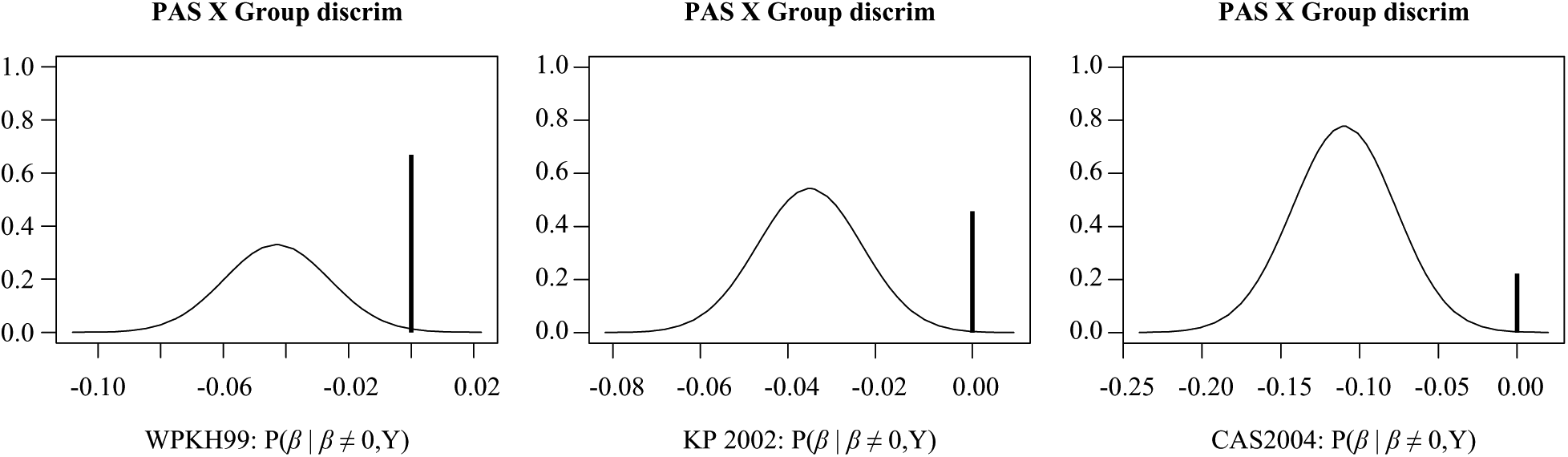
Posterior probability plot for the moderator PAS X Group Discrimination.
Full results of the BMA analysis in Table 3 let us further examine the robustness of the moderator. First, alternative specifications of discrimination—individual and in-group—contribute very little explanatory power as indicated in the column labeled p! = 0. Second, in the column labeled “Rank,” which corresponds to higher values of p! = 0, the moderator predicts very well relative to other covariates. Third, in the WPKH 1999 data, the BMA analysis drops some controls from the estimation because of multicollinearity (i.e., Latino commonality, Puerto Rico) and favors the U.S. Census region indicator. The empirical trade-off, it would seem, is between proper noun geography variables and variables of concepts that are more grounded in theories of Latino political behavior, such as group consciousness and national origin. To the extent that we place a premium on theory to inform our statistical model specification, then the raw empirical gain from including U.S. Census region indicators may not satisfy as well as indicators of group consciousness or national origin. Finally, the moderator’s robustness across the other data sets may reflect the inclusion of additional covariates available in the WPKH 1999 data (but were dropped). Alternatively, it could indicate that the moderating influence of perceived group discrimination increases after the 1986 Immigration Reform and Control Act, the last major expansionist immigration policy reform to pass in the United States. Although the BMA analysis accounts for immigrant cohort arrival, the KP 2002 and CAS 2004 data could be capturing the growing potency of perceived group discrimination in the early 2000s as the immigration debate in the United States heated up at the national level (Michelson 2001b). The data limit us from examining temporal dynamics of immigrant cohorts as distinct from age, period, and birth cohort effects in more detail. However, the BMA approach has provided a rigorous assessment of the moderator’s robustness taking into consideration model uncertainty.
Bayesian Model Average Summary of Logistic Regressions Predicting Latino Preference to Reduce Immigrants to United States.
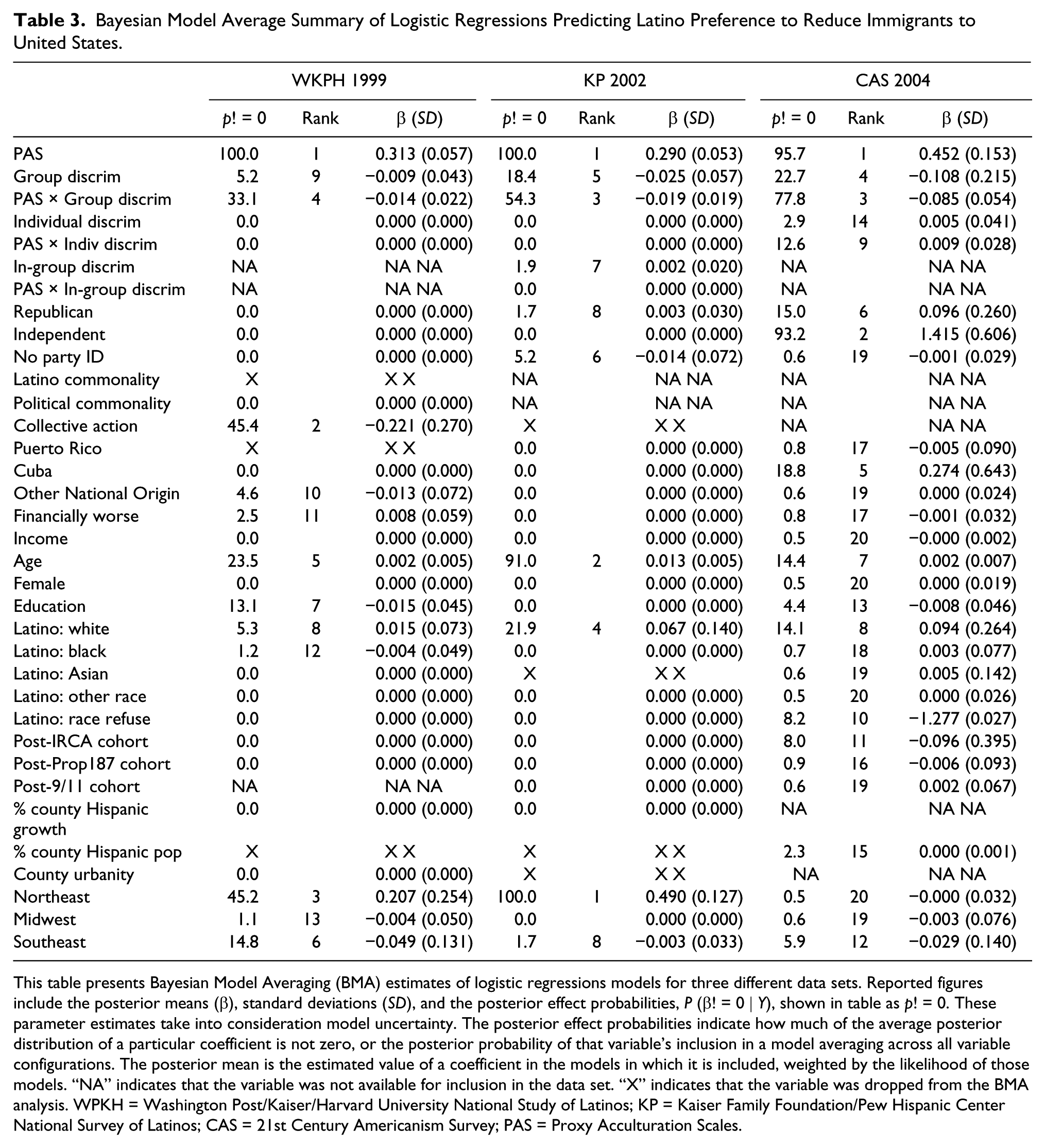
This table presents Bayesian Model Averaging (BMA) estimates of logistic regressions models for three different data sets. Reported figures include the posterior means (β), standard deviations (SD), and the posterior effect probabilities, P (β! = 0 | Y), shown in table as p! = 0. These parameter estimates take into consideration model uncertainty. The posterior effect probabilities indicate how much of the average posterior distribution of a particular coefficient is not zero, or the posterior probability of that variable’s inclusion in a model averaging across all variable configurations. The posterior mean is the estimated value of a coefficient in the models in which it is included, weighted by the likelihood of those models. “NA” indicates that the variable was not available for inclusion in the data set. “X” indicates that the variable was dropped from the BMA analysis. WPKH = Washington Post/Kaiser/Harvard University National Study of Latinos; KP = Kaiser Family Foundation/Pew Hispanic Center National Survey of Latinos; CAS = 21st Century Americanism Survey; PAS = Proxy Acculturation Scales.
Evaluative Discussion
Two generations worth of scholarship finds acculturation leads the children of immigrants to adopt restrictive immigration policy positions and converge with the dominant group in society. Yet, another line of reasoning and evidence indicates that acculturation leads to opposing restrictive measures. When we think about how aggregate-level evidence shows most Latinos reject restrictionist immigration policy, the evidence of acculturation’s convergent influence is a curious pattern. Why do some Latinos not converge as expected?
This analysis answers the question with theory and evidence. Conceptualizing acculturation as a process of brokered exchanges between Latinos and the dominant Anglo society, the two-way street anticipates that acculturation’s convergent influence is tempered when treatment from the receiving society does not square with what is anticipated given acculturative achievement. Integrating perceived group discrimination into theory provides analytical space to specify acculturation as part of a broader set of processes that involve the receiving society. As the epigraph notes, this was true for Chicanos in the middle of the twentieth century. This study shows how this idea applies to contemporary Latinos as well.
A summary of this study’s answer is found in Figure 1. The plots show perceived group discrimination works as the hinge directing the influence of acculturation. The role of out- group discrimination is validated with null results from analyses of effects of individual perceived discrimination and internal, Latino-on-Latino discrimination. These results engage the literature by meeting two key studies of Latino immigration policy attitude on the same empirical ground. The left and middle panels of Figure 1 illustrate how previous studies accurately represent different parts of the puzzle—Sanchez (2006) focusing on discrimination and Branton (2007) on acculturation—and brings them together in conversation. This study also bridges the body of empirical work on Latino immigration policy views with widely accepted critiques of straight-line assimilation. Ultimately, this evidence is an important update to the political science literature because it improves our collective understanding of the complex role that acculturation plays for Latino policy attitude formation.
Thus, the formation of Latino immigration policy attitudes is not a one-way street characterized exclusively as a path toward convergence with the “stationary” views held by members of the dominant group. The robustness of perceived group discrimination holds in reduced and complex models and appears strongest in the mid-2000s relative to the late 1990s. Future research should examine “convergence” with more contemporary data and use other indicators of restrictive immigration policy. In addition to restrictions on who can and cannot enter, contemporary immigration debates are about fights to include or exclude immigrants and their children from social safety net programs, higher education at in-state tuition rates, and voting on ballots in non-English languages. Assessing whether discrimination moderates the influence of acculturation on these other dimensions of immigration policy will help identify the boundaries of the theory advanced here.
A second avenue for future research is to examine alternative sources of discrimination. Institutional and policy-based discrimination may shape immigration policy attitudes in a way similar to the perceptions of group discrimination evaluated in this study. Assuming Latinos perceive policy and institutions to be controlled primarily by members of the dominant receiving society, then acculturation-based differences in support of policy and institutions may be subject to the brokering process outlined in the two-way street argument. The rich variation in state and local response to immigrants offers ripe terrain for an institution-based moderator of acculturation’s effect on Latino immigration policy attitudes.
A third area worth exploring is the relationship between discrimination, perceived or policy-related, and political orientations. The literature documents an empirical regularity between acculturation and low trust in government for Latinos (Michelson 2001a; Wenzel 2006) The two-way street theory invites the question of whether this is about adopting the skeptical view toward government expressed by most Americans, or whether it is rooted in perceptions of how the government and dominant group is perceived to treat Latinos.
A fourth possibility for future research acknowledges the broader set of stakeholders in contemporary immigration debates. One in four of the U.S. foreign-born arrive from Asian countries, but a much higher proportion of Asians, 66 percent, were born outside the United States compared with 40 percent among Latinos (U.S. Census Bureau 2013). Speaking to the importance of discrimination for immigrant-proximate groups that are not Hispanic, Rogers (2006) reports that discrimination interferes in the process of political incorporation for Afro-Caribbean immigrants. Thus, a reasonable extension of this study is to apply the models of data here to other immigrant-proximate groups in America.
Finally, immigrant generation is a critical component of acculturation measures. However, social scientists rarely discuss the utility of leveraging immigrant generation or migration cohort in research design (Telles and Ortiz 2008). This is unfortunate because the moderating effect of discrimination on acculturation’s influence may be pronounced for immigrants who arrived in a particular era, or differ when immigration is a more contested issue. Such a challenge could not be met with the data in hand for this study; however, such questions underscore the value of panel survey designs, an opportunity that grows riper as the population of Latinos and other immigrant-proximate groups grows. Nationally representative panel data of Latinos and non-Latinos might position analysts to interrogate assumptions about parental socialization that have served as the cornerstone of American political behavior studies since the 1950s (Campbell et al. 1960; Lewis-Beck et al. 2008) It might also allow empirical work to catch up with new theories of partisanship (Hajnal and Lee 2011).
In summary, this investigation re-purposes existing models of data that evaluate the relationship between acculturation and support for restrictive immigration policy. The epigraph inspired the task and serves as reminder that acculturation is not simply something that Latinos do (or resist) while non-Latinos watch. In this respect, it echoes Fraga and Segura (2006) in their response to claims that the American national identity is threatened by new waves of immigrants from Latin America. “Whether or not immigration changes the nature and identity of a people,” they explain, “is the product of the collective decisions of two sets of actors—both the immigrants and those in the receiving society” (Fraga and Segura 2006, 283). In other words, acculturation’s impact on the attitudinal development of Latinos is a two-way street.
Footnotes
Declaration of Conflicting Interests
The author(s) declared no potential conflicts of interest with respect to the research, authorship, and/or publication of this article.
Funding
The author(s) received no financial support for the research, authorship, and/or publication of this article.
1.
 , 45) argue that immigrants and their children assimilate into distinct segments of society, and upward mobility can be achieved with resources in ethnic enclaves, not necessarily through exclusive use of “Anglo-Protestant” institutions. In addition, for many newcomers and their progeny, not all sub-processes of assimilation go together, or move in the direction of Anglo cultural conformity or the middle class.
2.
Hirschman, Kasinitz, and DeWind (1999) use the two-way street term to describe the idea that immigrants and the receiving society change one another’s cultures in the course of their interactions. Their use of the term is similar to what mean by “remaking the American mainstream.”
4.
Support for this claim can be found in 1999 Washington Post/Kaiser/Harvard National Survey of Latinos, and 2004 21st Century Americanism Survey. Cross tabulations available by request from author.
5.
President Murguía made this statement at the 2008 annual meeting of the National Council of La Raza.
6.
This is notable because all island-born Puerto Ricans are U.S. citizens by birthright.
7.
The Kaiser Family Foundation/Pew Hispanic Center National Survey of Latinos (KP) 2002 and 21st Century Americanism Survey (CAS) 2004 ask the following questions: (1) “In general, do you think discrimination against Latinos is a major problem, minor problem, or not a problem in schools?” (2) “What about in the workplace?” (3) “What about in preventing Latinos in general from succeeding in America?” For each domain, school, workplace, and life in general, respondents who view discrimination against Latinos is a “major problem” are assigned a value of 1. Those who see it as “a minor problem” or “not a problem” are assigned a value of 0. The sharpest contrast in perceptions is between those who see discrimination as a “major problem” and those who say it is “not a problem.” By grouping those who perceive group discrimination to be a “minor problem” with those who say it is “not a problem,” this measurement strategy works against the study’s hypotheses.
8.
The regression estimates for white policy attitudes are available by request to author.
9.
Garcia and Sanchez (2008) argue that support for restrictionist policies among Latinos of Puerto Rican and Cuban ancestry differs from those of Mexican ancestry because U.S. immigration policy burdens to a greater extent Mexico as a sender nation. As , 136–137) explains, Puerto Ricans are U.S. citizens, and Cuban immigrants benefit from refugee policy and economic resettlement programs.
10.
The 1999 Washington Post/Kaiser/Harvard University National Survey of Latinos (WPKH) includes the full cluster of group consciousness items, while the KP 2002 only asks whether Latinos are working together.
11.
Education scales typically range from 1 for no schooling, 2 for less than High school, 3 for H.S. graduate or General Education Diploma, 4 for at least some college, 5 for college graduate, and 6 for postgraduate studies.
12.
Individual-perceived discrimination is measured in the WPKH 1999 data with two indicators. The first asks, “During the last 5 years, have you, a family member, or a close friend experienced discrimination because of your racial or ethnic background, or not?” The follow-up item asks, “Was that you personally or was that someone else?” For the KP 2002 data, the measure of individual-perceived discrimination is based on items that asks, “In your day-to-day life, how often do any of the following things happen to you because of your racial or ethnic background?: 1) treated with less respect than other people; 2) You receive poorer service than other people at restaurants or stores; 3) You are called names or insulted.” For the CAS 2004 data, the measure is constructed with these items: (1) “Do you think you have ever been denied a job or a promotion because of your racial or ethnic background?” (2) “Do you think you generally receive worse service than other people at restaurants or stores because of your racial or ethnic background?” (3) “Do you think your racial or ethnic background has made it difficult for you to succeed in America?”
13.
White, black, Asian, “Other” Race, and “Refused” Race are dummy variables compared with the category “Latino.” About 44 percent, 45 percent, and 62 percent of respondents selected “Latino” as their race in the WPKH 1999, KP 2002, and CAS 2004 data, respectively.
14.
I create three indicators to identify cohorts. The Post-Immigration Reform and Control Act of 1986 cohort includes immigrants who arrived after 1986 and before 1993. The Post-Prop187 cohort is the set of respondents who arrived after 1993 and before 2000. Finally, for the KP 2002 and CAS 2004 data sets, I create a third indicator, Post911 for those who arrived after 2000.
15.
Hispanic population growth is measured using U.S. Census data (Pop(t2)-Pop(t1)) / Pop(t1). This measure is not available for the CAS 2004 because the variable that identifies the county where a respondent lives is redacted from the data.
16.
I use the Index of Relative Rurality to measure county urbanity. This measure is based on population size, population density, extent of urban (built-up) area, and remoteness (distance to the closest metropolitan area). See , “A continuous multi-dimensional measure of rurality: Moving beyond threshold measures,” for detailed explanation of the Index of Relative Rurality measure. This measure is not available for the CAS 2004 because the variable that identifies the county where a respondent lives is redacted from the data.
17.
Including state indicators creates a micronumerosity challenge, as some states are represented by only one or handful of Latinos in the sample. State dummies also induce multicollinearity, as does including county-level indicators of actual Latino population. Exchanging the indicator of percent Hispanic growth in a county from 1980 to 2000 with an indicator for the county Hispanic population in 2000 does not change the BMA results shown in for the WPKH 1999 and KP 2002 data.