




Abstract
Why do cities spend scarce resources lobbying the federal government? The hierarchy of U.S. government provides various pathways for local representation. Nevertheless, cities regularly invest in paid representation. This presents a puzzle for American democracy. Why do cities lobby, and do they lobby strategically? We quantify for the first time the extent of this phenomenon and examine its determinants using new data on 498 cities across forty-five states from 1998 to 2008. We find that economic distress pushes cities to lobby, but does not impact expenditures. Cities in competitive congressional districts, and therefore crucial to national politics, spend more on lobbying.
Introduction
U.S. citizens elect members of Congress to represent the interests of their local areas. Nevertheless, many U.S. cities also spend significant sums of their taxpayers’ money to lobby the federal government. According to data collected from the Center for Responsive Politics, between 1998 and 2008, more than 242 mid-sized U.S. cities in forty-five states hired lobbyists to represent them in Washington, D.C., during at least one congressional session. On average, these local governments lobbying Washington spent $155,000, or about $1.15 per capita, every two-year session to do so. These figures are close to those reported by journalists. According to one report, Texas cities spent $17 million on professional lobbying in Washington from 2006 to 2010 (Hallman 2010). For example, the city of Carrollton, Texas, spent almost $500,000 lobbying the federal government in the 2009–2010 session, an amount that may be surprising to many of the city’s one hundred thousand residents. Although municipal governments have lobbied the federal government for decades (Cammisa 1995; Haider 1974), elected officials themselves or public interest groups (e.g., the National League of Cities) usually conducted the lobbying, not professional lobbyists. The purchase of professional lobbying by local governments is increasing 1 and presents us with a puzzle about democratic representation in the U.S. federal system.
Why do elected local governments spend scarce resources to lobby higher levels of government? The hierarchical structure of the U.S. government ostensibly provides formal representation for local governments through the members of Congress elected in their respective geographic regions. These members presumably voice local concerns about policy and appeal for federal grants or other funding that local governments may wish to request (Cammisa 1995; Haider 1974). In addition to congressional representatives, cities have their own elected officials and state representatives who can contact officials in Washington to represent local needs. As elected or appointed U.S. officials and government employees at any level are not required to register as lobbyists, these activities amount to normal “inside” pathways of representation. 2 Nevertheless, local governments such as Carrollton increasingly find it advantageous to invest in retaining paid professional representation outside of formal federal channels to lobby the national government. This use of “outside” pathways of representation by municipal governments when “inside” pathways are available is puzzling. What motivates local governments to supplement the formal democratic channels of representation with outside informal channels such as hiring lobbyists? In addition, how do local governments decide the amount of public resources to commit to professional lobbying of the federal government? Are these decisions made in a manner that an observer might deem strategic and well aimed to succeed, or are these choices driven by ad hoc factors such as local politics?
We propose examining lobbying, that is, hiring professional lobbyists, as two separate decisions: (1) the decision to lobby the government and (2) the decision to set expenditure levels. By thinking of lobbying in this manner, we can explore the impact of political factors and opportunities on both major questions in lobbying strategy. Taking cues from previous research on lobbying by interest groups, we examine some key motivations identified in this research that may also impact cities’ lobbying decisions. We argue that municipalities taking a strategic approach should consider national politics when formulating lobbying strategies to maximize their chance of success. When the national political landscape provides more opportunities for success for local governments, they should spend more on lobbying. Our data provide evidence that this does occur. However, we also find that need is an important driver of the decision to lobby. Local economic distress is associated with an increased likelihood that cities will choose to retain a lobbyist in Washington, in an apparently countercyclical attempt to influence national policy. We examine these ideas with a new dataset on the federal lobbying expenses of U.S. municipalities from 1998 to 2008. With this data, we are able to model both municipalities’ decision to lobby and their level of expenditures on lobbying the federal government, allowing us to explore the role of national politics and local conditions on these activities.
The State of Lobbying by Local Governments
Many local governments now hire professional lobbyists to represent them at the national and state levels (Boxer 2009; De Soto 1995; Morgan 1984), and the number of governments doing so has been on an upward trend for more than thirty years. Members of Congress, chief executives, and public interest groups have long lobbied the federal government on behalf of local governments (Flanagan 1999; Haider 1974), but by the early 1980s, some states and cities had hired professional lobbyists to represent them individually in Washington, D.C. (Pelissero and England 1987). The decline in federal spending that occurred in the early 1980s may have stimulated this initial growth in the number of municipalities paying to enhance their presence in Washington (Lorenz 1982).
Previous research on lobbying by municipalities has focused on national public interest groups and inside pathways of representation such as lobbying by executives (Marbach and Leckrone 2002). There are two likely reasons for this. First, it may owe partly to uncertainty over the legality of hiring lobbyists with public funds. Several important court decisions have upheld the rights of local governments in every state to hire lobbyists with public funds, 3 making paid representation a viable option for municipalities everywhere (Hallman 2010; Morgan 1984), but the practice has only become a major outlay for cities smaller than several million residents in recent decades. Over the past two decades, cities have dramatically increased their lobbying in Washington, D.C. (Loomis 2005). Of course, lobbying activity by all political organizations and interest groups has also soared in that period (Baumgartner et al. 2009; Hula 1999; Walker 1991).
The second reason we identify for previous work’s focus on national public interest groups and inside pathways of representation results from data availability. Until the relatively recent advent of large-scale data collection efforts disseminated electronically, lobbying by individual municipalities, groups, or businesses has been obscured by a severe lack of information. With increasing transparency and data availability, comes the opportunity to explore questions about representation in the American federal system and strategic behavior by municipal officials in more depth. Foremost, we are now able to approach the questions of why cities lobby and how they invest resources when they do. These have been key questions in the larger literature on interest group representation and are fundamental for our understanding of city leaders’ performance at getting local concerns on the U.S. federal agenda. 4 We turn to the theoretical explanations in this literature to develop insight into how and why cities lobby.
The motivation behind groups’ decisions to lobby is a key concern of interest group scholars. General theories of interest groups’ decisions to lobby suggest that concerns over particular issues or resources motivate groups to begin lobbying (Truman 1951). Likewise, organizational survival may persuade groups to lobby (Lowery 2007). Increases in government activity on new policy areas entering the government agenda can also motivate lobbying (Jones and Baumgartner 2005; Leech et al. 2005). Thus, need, combined with government attention to the problem at hand, must be in place to motivate a group or organization to decide to lobby. Media reports about municipal lobbying are largely congruent with these theories. Hallman (2010) reports that local governments decide to lobby when they do not receive enough funding from state governments to cover their needs, making it necessary to request or pressure the federal government for additional funding.
The secondary decision of setting a lobbying strategy is also an important but difficult to study question even outside the context of local governments. We know from previous work that national partisan politics and external political forces impact interest groups’ lobbying decisions and strategy (Baumgartner et al. 2009; Baumgartner and Leech 1998). External factors, including issue salience and the strength of the status quo, often influence lobbying efforts and strategies (Baumgartner et al. 2009). For example, public opinion on an issue can impact the use and effectiveness of lobbying the government versus grassroots lobbying tactics (Kollman 1998). National partisan politics, including electoral outcomes and the agenda, also affect groups’ lobbying activities (Baumgartner and Leech 1998). Interest groups often increase lobbying expenditures when the political environment is friendlier to their requests (Richter, Samphantharak, and Timmons 2009). In contrast to the decision to begin lobbying, the indication from previous work is that investments in lobbying are a function of strategic considerations affecting the likelihood of success.
Variation in cities’ lobbying activity indicates there is much to explain. Many cities have never hired lobbyists to represent them in Washington, D.C. Our data show that municipalities hiring professional lobbyists frequently stop lobbying after a year or two, and per capita spending on lobbying varies greatly across cities and over time. Several questions, thus, remain to be answered with regard to municipal lobbying. Chief among them are: why do some cities overcome the fiscal disincentives to hire professional lobbyists? And, why do they spend more or less when they do?
Based on the general findings of previous work on interest representation, we propose a simple explanation for these two aspects of municipalities’ federal government lobbying activity. Not unlike other interest groups, we expect that cities require both a motive and the expectation of worthwhile return on investment to engage in lobbying and to invest heavily in it. We propose that need, particularly economic need, is the biggest factor in determining cities’ decision to lobby, while political opportunities influence the level of spending on lobbying.
Cities need not organize members to sustain a lobbying campaign, unlike interest groups, but they are led by politicians who may seek reelection. Therefore, neither decision is likely to be taken lightly. Choosing to retain paid representation in Washington means more than just investing funds into a new activity, which itself can be a big decision. Lobbying also requires investments of time and energy from local officials to begin the new relationship with a lobbyist, work with them, and monitor their effectiveness. If this decision is at all strategic, city leaders must have a goal in mind and that goal must be both important and within the federal government’s scope of activity. Beyond the decision to lobby, cities must decide how much to invest. Even small investments heighten a city’s presence in Washington, D.C., but greater investment can enhance this with greater exposure from bringing on additional staff or by working with more prominent and more expensive lobbyists. As lobbying is typically considered a way to secure attention from national politicians (Baumgartner et al. 2009; Gray and Lowery 1997; Hall and Wayman 1990), even small investments can be useful for cities. Therefore, cities with more importance in national politics can achieve greater marginal benefit from increasing investments in getting national politicians’ attention. In the following section, we elaborate our understanding of how cities can have more or less political importance in Washington, D.C., and what constitutes a need that can motivate cities to lobby.
Municipalities and Lobbying Strategies
Similar to other interest groups, we argue that needs and political opportunities drive municipal lobbying decisions and strategies (Hallman 2010; Richter, Samphantharak, and Timmons 2009). Especially important may be the influence of economic factors on the likelihood that local governments pursue outside avenues of representation by hiring lobbyists. In general, economic stress increases the number of all organizations with registered lobbyists (Lowery and Gray 1998). As government resources shrink in bad economic conditions, competition grows among interest groups for these resources. Economic stress heightens local governments’ need for funding or government programs, as demand for resources increases in the municipality. Due to the structure of the American federal system, local governments are more constrained than other levels of government in their revenue-generating activities (Wong 1988). Therefore, with limited and decreasing resources and continued demands for public services (Wong 1988), local governments must take measures to deal with increasing fiscal stress. One such measure is turning to federal politicians for financial support (Hallman 2010; McGowan and Stevens 1983; Morgan and Pammer 1988); for example, cities increasingly seek congressional earmarks to help provide public services requested by their citizens (Conlan and Posner 2008). In their study of interest group communities, Lowery and Gray (1998) find that unemployment rates affect the hiring of lobbyists. More (noncitizen) interest groups lobby when the unemployment rate is high. Higher unemployment rates decrease city revenues while also often increasing demands for public services. Thus, we hypothesize that cities with more unemployment are more likely to hire lobbyists.
We also expect national political opportunities to affect municipalities’ lobbying decisions and strategies. We propose that, when deciding on strategy, municipal leaders are attentive both to federal government activities that can shore up local finances and to the strategic opportunities afforded them by national politics. Certain national political factors, such as a change in majority party or changes in the political vulnerability of a city’s congressional representative can impact municipalities’ chances of lobbying success, perhaps influencing their strategy.
The majority party in Congress enjoys significant advantages, including more control over the agenda and more success passing policies (Aldrich 1995; Cox and McCubbins 2005). A switch in the majority may bring substantive changes to the operation of Congress, such as increases in activity (Policy Agendas Project 2013) or changes to the direction of policy (Bianco and Sened 2005; Snowberg, Wolfers, and Zitzewitz 2007). The number of groups lobbying increases when government activity grows as there may be more opportunities in the upcoming congressional session for activity on issues of interest or increases in spending (Leech et al. 2005), which boosts both the scope of government action and groups’ expected return on lobbying investments. Just as the long-term rise in congressional earmarks has been tied to the increased number and diversity of cities hiring lobbyists (Loomis 2005), we expect municipalities to be more likely to pursue lobbying activities in Washington and to invest more heavily in that activity following short-term trends such as changes in the congressional majority party.
Although we expect that a change in the majority party impacts the lobbying activities of local governments, we do not expect this to depend on which party holds the incoming majority. Although, given their reputation, we might expect cities to see Republicans as a greater threat to federal funding, scholars have found little difference in aggregate federal outlays under either majority party (Albouy 2013; Bickers and Stein 2000). Therefore, we focus on the change in majority party rather than compare different partisan majorities.
In this paper, we focus on factors motivating municipalities to lobby the House of Representatives. We restrict our analysis to the House for several reasons. First, the districts that Representatives and Senators represent are generally very different. Apart from the few single-district states, Senators represent larger and more heterogeneous districts than do Representatives (Lee 2003, 2004). This has consequences for allocating funds. Senators seek to represent state-level interests and are more likely to work for state-level funding. House members’ interests, however, are connected to smaller and more homogeneous districts. When studying how these differences in districts impact the allocation of funds, Lee (2004) finds that House bills are more likely to include special projects than Senate bills. Moreover, Senate coalition building tends to be universalistic and results in a majority of states benefiting from funds and grants, which is not true for the House (Lee 1998). Therefore, Senate-level variables likely have less impact on cities’ lobbying choices than House-level variables.
Opportunities to influence national policy coming from municipalities’ congressional districts may also influence local government lobbying strategies in Washington, D.C. Vulnerable legislators, particularly those likely to be in competitive races next election, often receive more funding for their district (R. Carroll and Kim 2010; Engstrom and Vanberg 2010). These marginal legislators usually receive more earmarks and other funds to aid them in reelection. This feature of national party politics presents municipalities in competitive districts with opportunities to receive a greater return on investment, as their representative is in a better position to benefit from such outlays. Due to this increase in expected return, we expect municipalities in competitive districts to invest more in lobbying. However, as this pattern of spending neither alters the scope of federal government activity, nor determines cities’ needs for federal assistance, we do not anticipate this changes the probability those cities will begin lobbying if not already doing so.
We also expect that the experience level of a municipality’s representative influences its investment in lobbying. Besides having less institutional knowledge and influence in the chamber (Berkman 1993; Davis 2013), having a freshman legislator (i.e., elected to a first term) can create uncertainty for cities. It is neither clear how skilled the new legislator will be, nor what their priorities will be in office. Freshman legislators are also less successful in getting bills passed (Anderson, Box-Steffensmeier, and Sinclair-Chapman 2003) and secure less funding for their districts (Falk 2006). Similarly, municipalities may also adjust their lobbying strategy according to their congressional representative’s seniority.
One estimate puts the value of each additional year of tenure in the House at $200 per capita in federal funding for the district (Falk 2006). More senior members of Congress are also more likely to hold seats on important committees (DeBacker 2011; Roberts 1990). However, other recent research finds that committee chairs and senior members do not receive more earmarks (Balla et al. 2002; R. Carroll and Kim 2010). These conflicting findings regarding seniority and district funding make it difficult to predict how either seniority or having a freshman legislator will impact municipalities’ lobbying strategies, despite the fact that previous research agrees this can be important to representatives’ political power. Therefore, we expect that cities engaged in lobbying will invest less when represented by freshmen and slightly more as their representative’s seniority increases, if they have any impact at all. We do not anticipate either factor to impact the choice to lobby because seniority and experience do not alter the need for federal assistance or the scope of federal activity.
Overall, we expect that need and the scope for federal action on local priorities determine when cities lobby, and, when the political landscape provides municipalities more opportunities for success (in policy or funding), local governments will invest more. In other words, we propose that municipalities lobby only when necessary and they pay attention to national politics and adjust their strategies according to their national political opportunities.
Research Design
To test these ideas, we collected cross-sectional time-series data on 498 U.S. cities across forty-five states between 1998 and 2008—spanning six congressional sessions, from the 106th to 111th Congresses. 5 This time period includes one change in majority control of Congress and excludes the most recent sessions of Congress, which have featured an economic stimulus and earmark moratoriums that may have altered the logic of municipal lobbying. Cities were selected for inclusion in the sample based on two criteria. First, we chose cities with a population between seventy-five thousand and six hundred fifty thousand in 1998. 6 Second, we only included cities whose geographic borders fall mostly into a single congressional district. Cities lying in more than two districts or split more or less evenly between two districts were excluded. This case selection strategy ensured that we included in the dataset cites with a variety of different economic, demographic, and geographic profiles whose leaders all have clear geographic links to one representative. Many of these cities lobbied the federal government at some point during this period, but most did not. Figure 1 maps the incidence of lobbying across the sample.
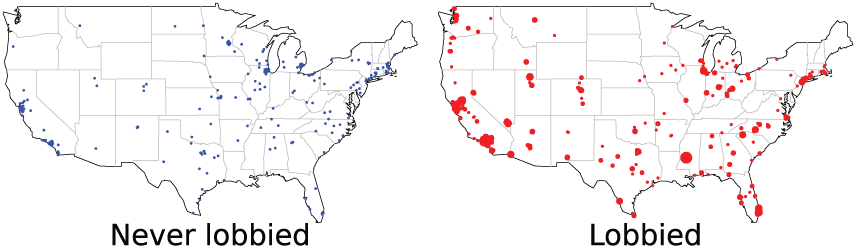
Average per capita lobbying in sample 1998–2008.
Bringing appropriate information to bear is crucial for our ability to draw correct conclusions about the hypotheses discussed above. Ideally, to fully understand municipalities’ motivations to lobby, we would study the issues on which they lobbied. Although these data are, technically, available, selection bias is a serious threat if we study the issues municipalities do lobby about. Data on the issues motivating cities to lobby are only available for the set of cities actually engaged in lobbying, meaning an analysis using this information would select cases on the dependent variable, leaving us ignorant of the needs of cities that do not lobby. Therefore, instead of studying cities’ stated motivations for lobbying, we have laid out basic expectations about why municipalities might lobby and the strategic factors they should consider when doing so, and we test them on a sample of cities chosen on the basis of factors unrelated to the outcomes of interest. Specifically, we explore how needs, operationalized as economic distress, motivate municipalities to lobby, and how changes in a city’s relationship to the national government influence its expectation of lobbying success. Finding that these two factors explain the decision to lobby and how much to spend can be considered evidence that local political leaders lobby strategically.
Two outcome variables are considered. First, we examine a city’s decision to lobby the federal government in a given congressional session—that is, a simple yes or no. Second, we consider the total amount of money per capita spent by a city to lobby the federal government during a particular congressional session. We code both variables from a database of lobbyist filings maintained by the Center for Responsive Politics. 7 These outcome variables reflect our dual interest in a city’s decision to take the step of paying for representation and its willingness to expend resources on representation. For details about the distribution of lobbying within the sample, the relative frequency of lobbying across states in our data can be seen in Figure A1 in Online Appendix A (http://prq.sagepub.com/supplemental/).
Our explanatory variables of interest include demographic, economic, and political factors. 8 First, we measure the average city unemployment rate during the two years of each congressional session to capture changes in needs. Although a variety of needs may motivate cities to engage in lobbying, using the unemployment rate helps us gauge the level of economic distress in the city (Lowery and Gray 1998). In addition, the unemployment rate is comparable across all cities and maintains the same interpretation across cases.
Second, we examine several variables capturing the city’s relationship to the national government, and specifically to the congressional majority. Most importantly, we include an indicator for whether a district is electorally competitive taking on a value of one when the vote percentage of the most recent winner of the city’s House district was smaller than 60 percent and zero otherwise. We capture the seniority of the district’s representative with two variables. The first is a count of the number of sessions the district’s current representative has served in Congress, and the second is an indicator variable for districts with freshman representatives—that is, one in his or her first term in office. This coding captures the special significance of having a freshman representative, but still allows us to draw conclusions about the effects of seniority.
An indicator variable for the 110th Congress is also included, as this marks the only change in the chamber majority during the period covered by our data. As a change in the chamber majority marks both a disruption in many cities’ connections to the chamber majority and the potential opportunity to get new issues on to the congressional agenda, we anticipate that this variable is related both to cities’ needs for federal government action and their ability to achieve lobbying success. Therefore, we expect that the change in majority will be associated both with an increased probability that cities will engage in lobbying and increased expenditures once cities do decide to lobby.
Finally, we measure each city’s average population over the course of the two-year congressional session as a potential confounder. Cities above a certain population level are all found in competitive districts in our data; however, these cities are also less likely to have freshmen representatives. This measure is logged to adjust for right skewness. Furthermore, all variables discussed above are included in both models because of the potential for confounding within this set of factors. The strategic position of a city in the federal government can impact its perception of its own needs, and a city’s needs may impact its capacity to act on its strategic situation. This strategy also allows us to confirm our expectation that strategic factors do not impact the decision to lobby and needs do not impact decisions about spending.
Targets of Federal Lobbying
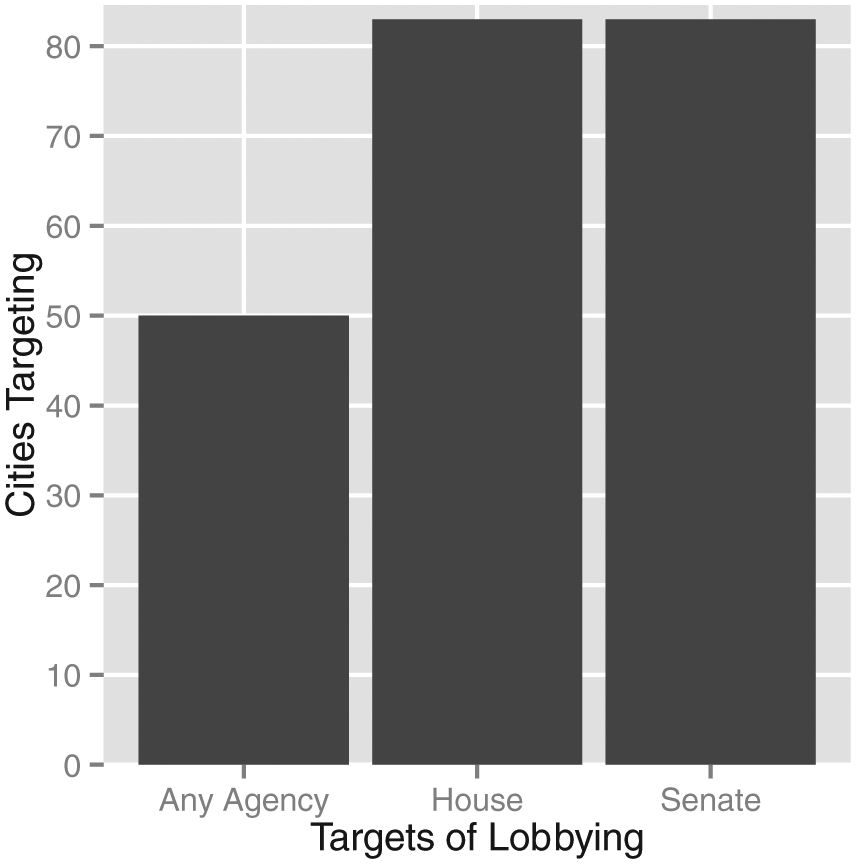
We focus on Congress as the target of city lobbying efforts. However, many cities’ lobbying activities may ultimately be aimed at influencing activities of federal bureaucratic agencies. If this is the case, then lobbyists hired by cities may bypass Congress and spend their time directly focusing on agencies. To probe our assumption that cities focus on Congress when lobbying, we examined a subset of the observations of lobbying in our data in greater detail. We randomly selected 86 of the 854 lobbying observations, 10 percent of the data, and accessed the original lobbying disclosure reports filed in the respective congressional sessions.
As indicated in Figure 2, we found that eighty-three of the eighty-six city reports indicated that both houses of Congress were targets of lobbying, while fifty reports indicated that at least one executive agency was targeted. Three city reports do not mention Congress. One of the three indicated the city targeted only a single agency, while the other two mention no targets. A complete list of all agencies lobbied and the frequency of their appearance in disclosure reports can be found in Figure A2 in Online Appendix B (http://prq.sagepub.com/supplemental/).
Reported targets of city lobbying in sample.
The results suggest that, although agencies are targeted more often than not, Congress is virtually always a target for cities when lobbying. Thus, we restrict our analysis to Congress because city lobbying efforts largely focus on that institution and targeting Congress can be an effective way to influence the bureaucracy. Even if agencies are the focus of city lobbying efforts, legislators frequently contact bureaucratic actors on behalf of various interests and groups in an attempt to influence bureaucratic policymaking (J. R. Carroll 2013; Ritchie 2014). For example, Representative Dan Maffei (NY-24) worked with the Federal Emergency Management Agency (FEMA) several times to help secure funding for a municipal fire department in his district (Weiner 2014). Therefore, having influence or contacts in Congress can help cities achieve success in bureaucratic policy or funding allocation. Although cities can and do lobby the bureaucracy directly, lobbying Congress seems to be of primary concern when local governments decide to pay for representation in Washington.
Statistical Models
We test our theoretical expectations using two statistical models. First, we consider the decision to lobby the federal government in a given congressional session as a function of the explanatory variables described above. Second, given that a city has chosen to lobby, we then model those cities’ per capita lobbying expenditures as a function of the same covariates. The dependent variable in the first model is an indicator that takes on a one when a city lobbies in a congressional session and zero otherwise. In the second model, the dependent variable is the logged per capita lobbying expenditures by each city in a congressional session lobbying the federal government. The first outcome we model with a Bernoulli logistic regression and the second with a Normal linear regression.
The drawback of this approach is that it does not model the city’s budget allocation to lobbying as a single decision that takes on values ranging from zero to any positive sum. Applied microeconometric studies of household budget allocation have treated zero budget allocations as a distinct spending choice since Tobin (1958) introduced a means of modeling zero as censored observations of the intended (albeit negative) budget allocated to a particular good. Since then, other mechanisms generating zero expenditures have also been explored, for example: exclusion of certain goods from the choice set due to dislike or infrequent purchase of a particular good leading to spending on that category being erroneously measured as zero due to the consumption schedule (Carlevaro, Croissant, and Hoareau 2012; Cragg 1971; Deaton and Irish 1984). Any of these censoring mechanisms might operate on cities’ decisions to purchase representation. It may be that a city does not lobby because its leaders or citizens do not support the idea. A city may also be happy to lobby, but once it has allocated its budget, the portion destined for lobbying is set at zero. Finally, a city may purchase lobbying only infrequently, and within the time frame of our data further expenditure was not necessary.
Our decision not to use one or a combination of these more sophisticated models is due to our theoretical expectations. We anticipate that city governments will purchase lobbying as a function of current local economic needs and that their expenditures will be a function of federal-level political factors. Our current set of expectations does not differentiate between censoring mechanisms that generate zero expenditures, and therefore, we do not anticipate bias from modeling these outcomes separately.
We do, however, suspect that unmeasured variation across geographic areas may affect our estimation. For this reason, both models are multilevel, in that we account for unmeasured heterogeneity across states by treating the effect associated with all cities grouped in a state as a random disturbance in the outcome variable. These disturbances are assumed to be mean zero and we estimate the variance of the distribution of state-level random disturbances—that is, we employ state random effects. The decision to lobby is quite sticky for cities, so accounting for unmeasured city-level variation when modeling the decision to lobby washes out all of the effects of interest. However, we are able to control for these city-level random effects when modeling expenditures. We do this in the same way as with states, by assuming that individual cities are each associated with mean zero random disturbances in per capita lobbying expenditures.
This approach allows us to make inferences about the effects of interest, controlling for unmeasured potential confounders at the state and city levels. As we are uninterested in the effects of individual states and cities, we focus on covariate effects when interpreting results. The estimated variances associated with specific states and cities are reported in Online Appendix C (http://prq.sagepub.com/supplemental/). The direction and statistical significance of all parameters remain the same when using a fixed effects estimator or ignoring state and city effects completely, but the multilevel approach ensures maximum statistical efficiency. Table A1, Online Appendix C (http://prq.sagepub.com/supplemental/), includes summary statistics for all variables in Model 1; Table A2 shows summary statistics for Model 2.
Results
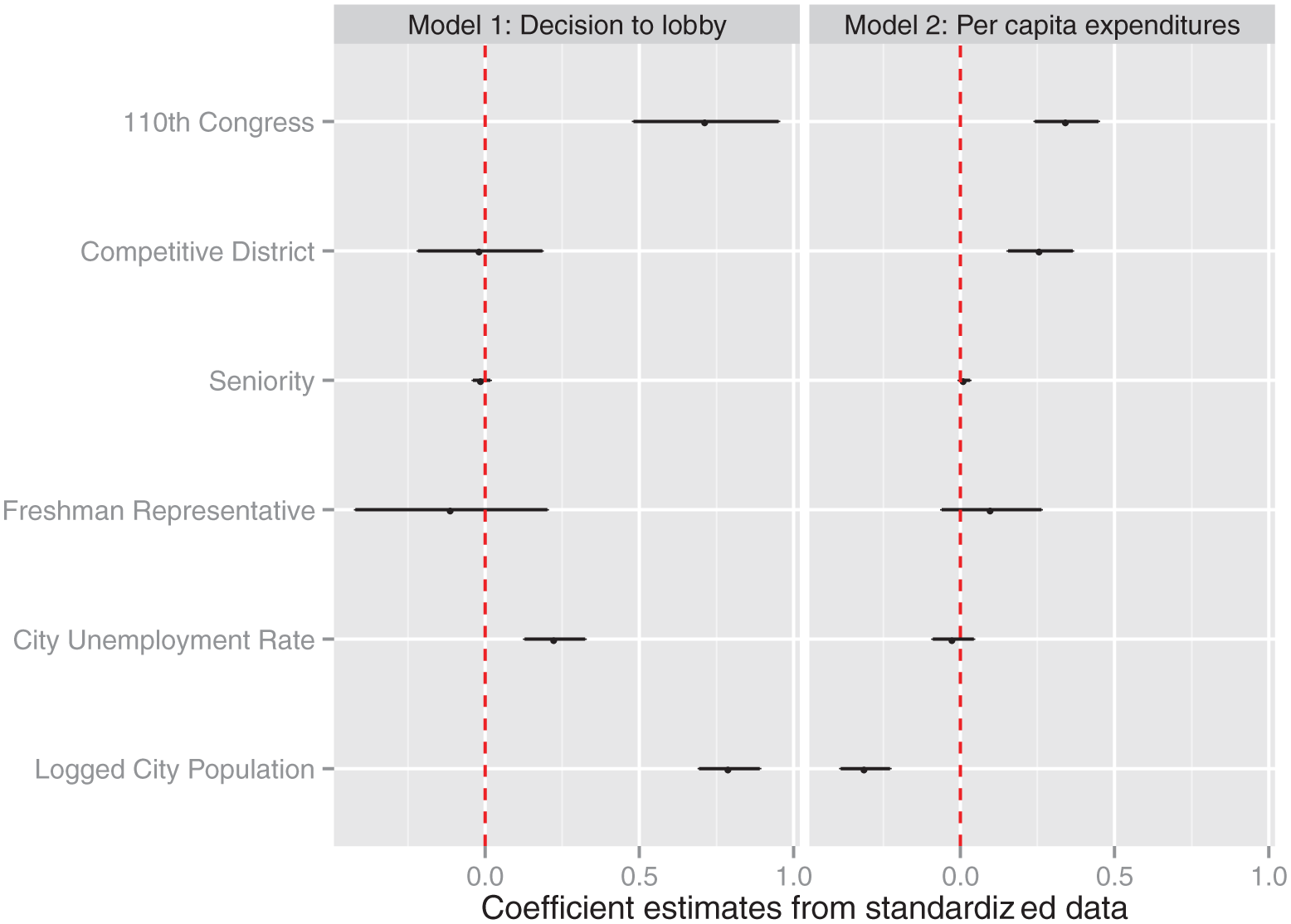
Main coefficient estimates from both models are summarized in Figure 3, with coefficient estimates in Table A3 in Online Appendix C (http://prq.sagepub.com/supplemental/). The results are in line with the expectations from our theoretical framework. Cities’ needs for federal policy activity influence the decision to lobby, while cities’ strategic situation influences their per capita expenditures. The unemployment rate, our measure of local economic hardship, is associated with a statistically significant increase in the probability that a city lobbies the federal government in a given congressional session. Cities in competitive districts, even controlling for both state-and city-level unmeasured factors, invest more money in lobbying, conditional on choosing to start lobbying. However, neither the House representative’s seniority, nor having a freshman representative, is associated with significant change in the probability of lobbying.
Main model results.
Both the probability of lobbying and the amounts cities invested were higher in the 110th Congress relative to the rest of the sample period, supporting the idea that the change in chamber majorities may have opened doors for Congress to consider a wider array of concerns facing cities and making it more likely that new concerns would be addressed. Importantly, our two key explanatory variables—unemployment and the competitive districts indicator—are important only in their respective models, and neither achieves statistical significance in the other. Local unemployment has no impact on the amount cities invest in lobbying—as previous literature indicates, we expect this is because it does not impact their likelihood of success, and therefore, it is not taken into consideration when deciding how much to invest. Being in a competitive district, however, is an important factor in deciding how much to invest in lobbying, but it does not determine a city’s need for federal funds or policy change and therefore has no impact on cities’ decisions to lobby. These coefficients indicate support for our initial expectations about municipal lobbying, but we probe them in detail below to be certain the effects are substantively meaningful as well.
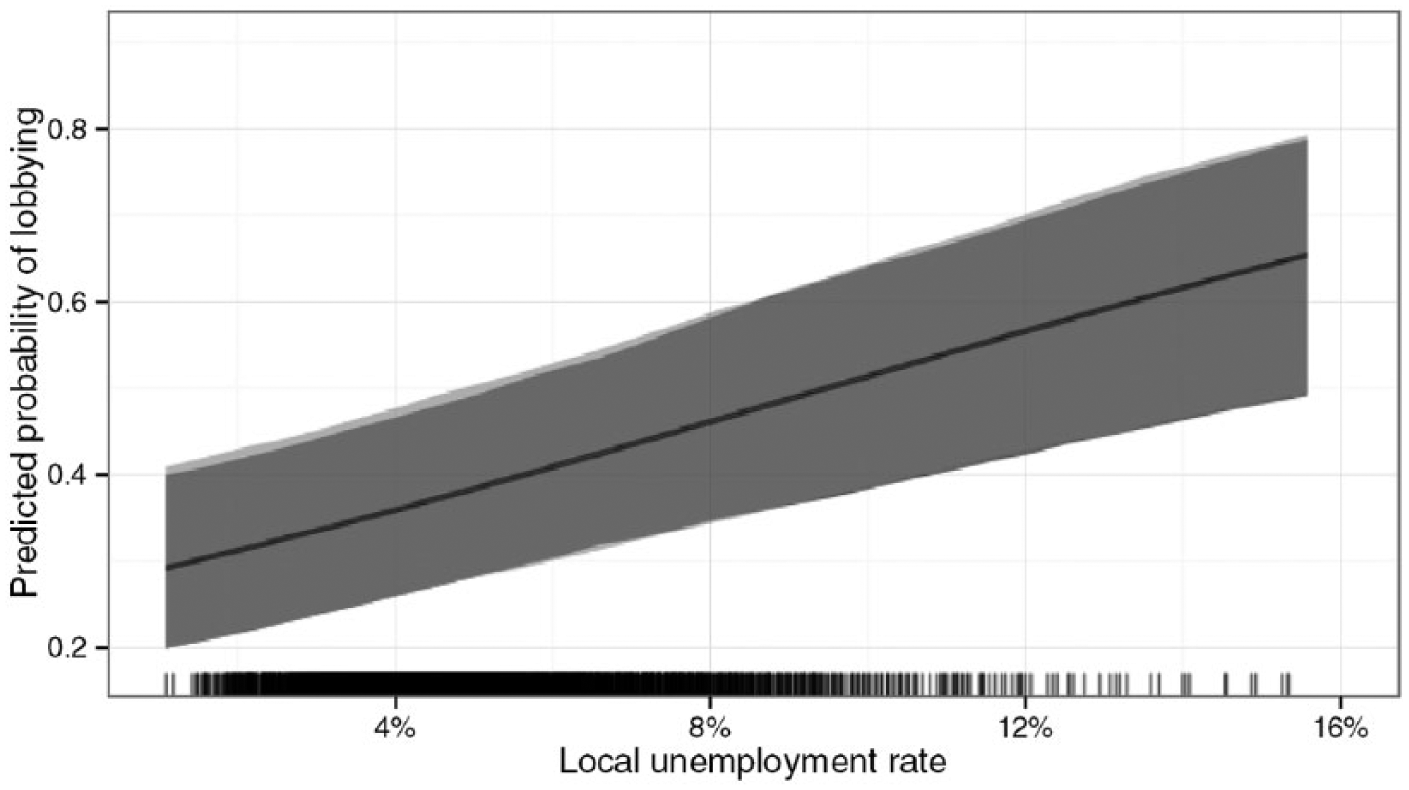
The key substantive results can be seen in the simulations plotted in Figures 4 and 5. 9 Figure 4 shows point estimates and 95 percent confidence intervals for the predicted probability of lobbying by an average sample city over different local unemployment rates. The lighter confidence interval is associated with the simulated probability of lobbying for an average city in an uncompetitive district, while the darker is the same in a competitive district. The areas are not distinguishable in this case, however. Overlapping confidence intervals do not necessarily mean the effects are statistically indistinguishable, but in this instance there is no difference between competitive and uncompetitive districts. This is reflected in the coefficient estimates. The plot shows that, at the lowest unemployment rates in the sample, an average city’s predicted probability of lobbying hovers between 20 percent and 30 percent. This prediction nearly doubles as unemployment exceeds 10 percent. As most of the data in the sample are concentrated at or below 10 percent, as shown by the tick marks along the bottom of the plot, the confidence intervals on the predictions grow larger beyond this point.
Simulated probability of lobbying for an average city.
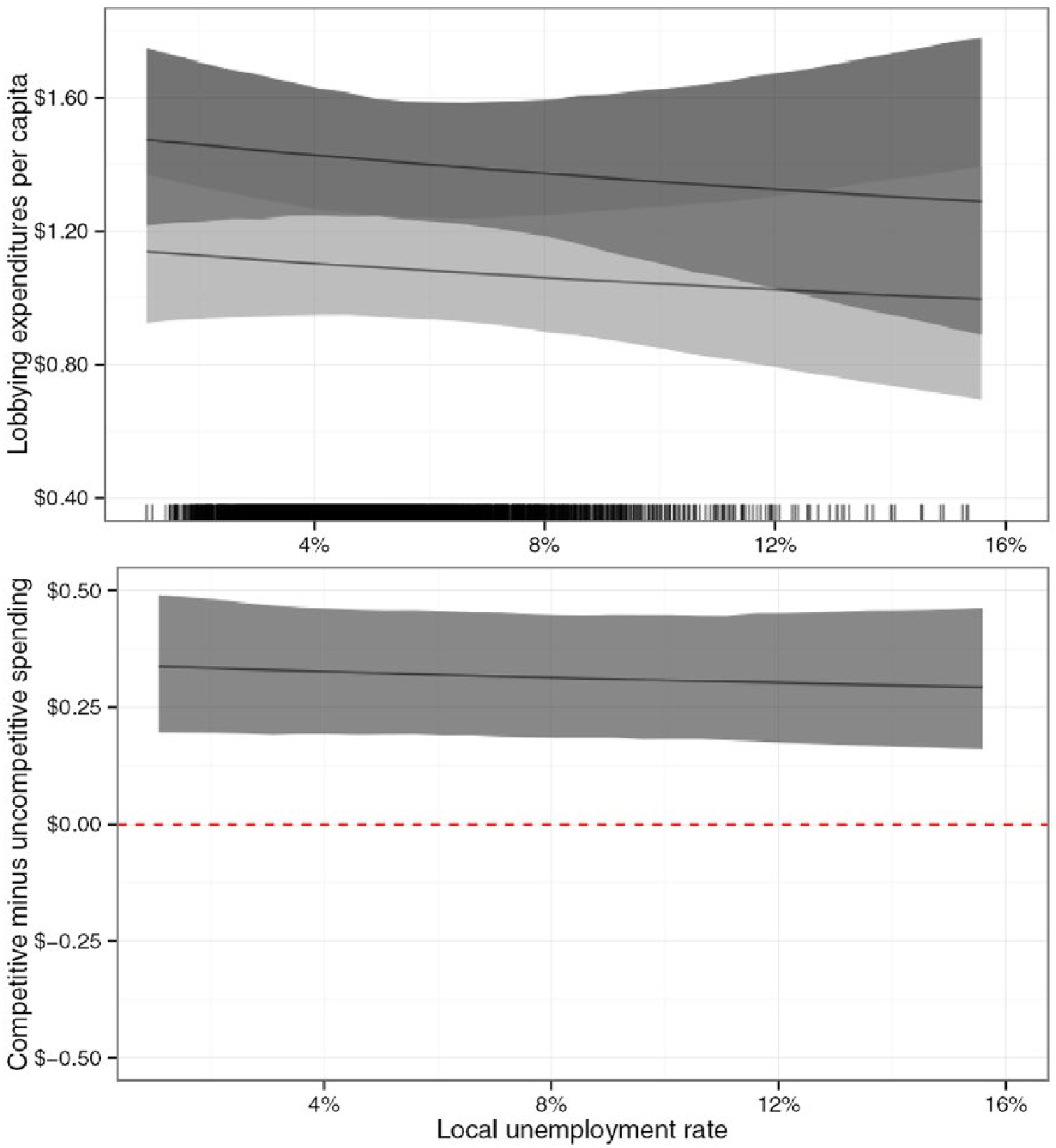
Simulated per capita lobbying expenditures for an average lobbying city.
Figure 4 clearly shows the impact of economic hardship on cities’ decisions to lobby is not only statistically significant but substantively large. Need appears to drive this decision and not strategy, which is supportive of our expectations about local governments’ decision making. Over the range of the most concentrated portion of our data, our model predicts nearly a 20 percentage point increase in the probability of lobbying as unemployment rises.
In the top panel of Figure 5, the lines are predicted levels of per capita lobbying expenditures for an average mid-sized city, simulated from the second model. In this picture, our predictions with regard to the effect of being in a competitive district are in evidence. Competitive districts, again marked by darker confidence intervals, are predicted to invest more heavily in lobbying than their counterparts in uncompetitive districts, all else equal. Support for two expectations is evident here. First, the local unemployment rate is statistically unrelated to per capita lobbying expenditures. Although the slope of the lines is slightly negative, thus higher unemployment means less money spent on lobbying, the confidence intervals are too large to draw the conclusion that the effect is different from zero. Second, at all levels of unemployment, cities in competitive House districts spend a statistically significantly larger sum lobbying Washington than do similar cities in uncompetitive districts.
This latter finding is not immediately obvious from the top panel of Figure 5. To make the difference clearer, the lower panel plots simulations of the difference in expenditures between cities in competitive versus uncompetitive districts over unemployment and its 95 percent confidence interval. The simulations show that the difference between competitive and uncompetitive districts is on average around $0.30 per capita, indifferent of unemployment rates. Thus, as we have argued, cities deciding to lobby make a strategic calculation about their ability to get a large return on investments in paid representation. For cities with sufficient political importance in Washington due to their positions in competitive House districts, efforts to mobilize support in Congress for their preferred policies are more likely to bear fruit.
We have not included plots of estimated effects for seniority and freshman representatives because of their statistical insignificance in both models. Our mixed theoretical expectations make these null findings unsurprising. As for the substantive impact of the change in congressional majority in the 110th Congress, our simulations indicate the average city engaged in lobbying in a competitive district spent $0.35 more per capita, an increase of 47 percent on average, in the congressional session following the change. Lobbying cities in uncompetitive districts spent an average of $0.27 more per capita, again an increase of 47 percent on average. The change in the majority also impacted the decision to lobby. In the 110th Congress, the average city was 16 percentage points more likely to lobby that session, all else equal, than in other sessions.
Robustness
The basic analyses above use a constrained set of covariates to model the decision to lobby and subsequent expenditures. To alleviate concerns of omitted variable bias, this section presents estimations using additional controls. These factors may correlate with certain explanatory variables and the decisions under consideration, despite our theoretical expectations to the contrary.
First, we reestimate both models including cities’ distance in miles from Washington, D.C. The decision to lobby is correlated with distance to the capital, such that cities more distant from Washington are likelier to purchase lobbying than those nearer. This may simply be practical, but if it is politically meaningful then there is some potential that excluding it can induce omitted variable bias. Second, we reestimate both models including indicators for whether the city’s House representative or at least one Senator serve on their chamber’s appropriations committee. These politically prized positions are strongly associated with seniority and have been shown in other research to increase the returns to lobbying (de Figueiredo and Silverman 2006). Cities may see appropriations committee membership as a signal that their concerns are more likely to reach the political agenda. This strategic advantage may encourage cities to lobby and to invest more heavily in lobbying.
Finally, we use several variables to capture majority status and changes in majority status of cities’ members of Congress. We include indicators in the decision to lobby models for any loss of majority status in either chamber. In any session after a city’s House representative changes from being in the majority party to being in the minority, this indicator takes on a one and zero otherwise. This can occur due to a change in chamber majority, a change in the representative’s party affiliation, or by the election of a representative of a different party. The variable for a loss of Senate majority is coded similarly; with the exception that it takes on a one only when no member of the city’s Senate delegation is any longer in the majority party. Losing majority status may limit cities’ capacity to get concerns onto the political agenda and could result in losing federal funds the city previously enjoyed, which might influence the decision to lobby.
In the lobbying expenditures model, we include indicators for majority membership of a city’s members of Congress. These variables take on a one when the city’s House representative or at least one member of the Senate delegation are affiliated with the chamber majority. The strategic advantage of majority membership can provide an additional incentive for cities to invest more in lobbying.
The results reported in Tables 1 and 2 support our focus on a limited set of explanatory factors. In each table, Model 1 shows the results of our basic specification, for comparison. The remaining columns show results for alternative specifications. In all cases, the results of all independent variables of interest remain unchanged. The only added variable having a statistically discernible relationship to either outcome is distance from Washington, D.C. More distant cities are much likelier to pay for lobbying, but spend no more or less than cities nearer the capital.
Choice to Lobby Models: Multilevel Logistic Regressions.

Data are standardized by mean-centering all nonbinary explanatory variables and dividing by 1 SD. Standard errors in parentheses.
Spending Level Models: Multilevel Linear Regressions.
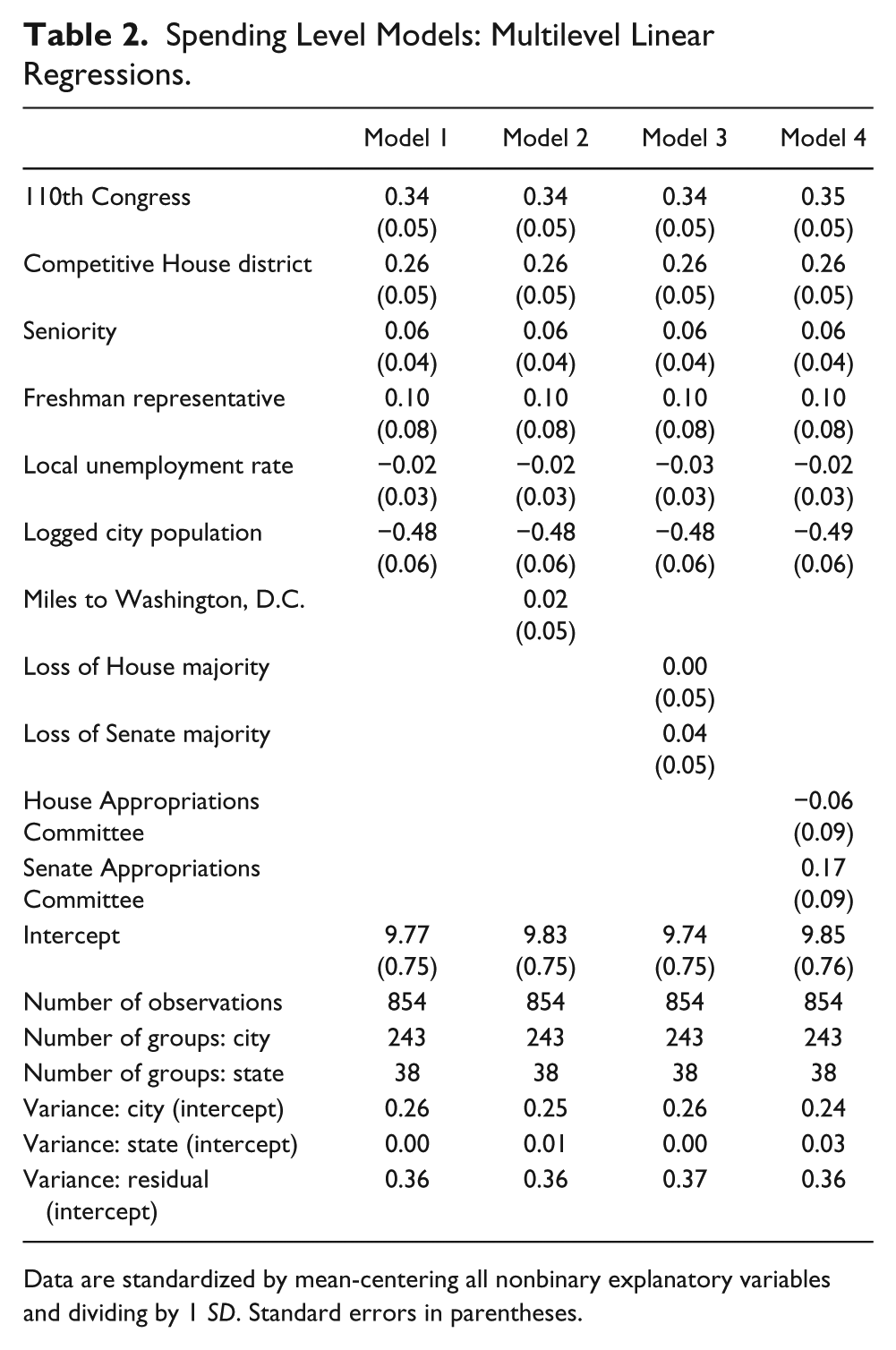
Data are standardized by mean-centering all nonbinary explanatory variables and dividing by 1 SD. Standard errors in parentheses.
Discussion
The picture emerging from this analysis is one of lobbying as a countercyclical investment in representation in Washington; an investment cities manage with an eye to their strategic situation relative to the centers of federal political power. When unemployment is high, cities invest in lobbying the federal government, but the depth of their investment depends on how well-positioned they are to be important to the national parties’ competition for majority status in Congress. The puzzle of why cities buy representation when they, presumably, should get it for free appears to come down in part to needs so acute that they make increased federal attention worth a monetary investment.
A noteworthy result of this analysis is that representatives’ seniority, and especially having a freshman representative, has little apparent relationship to patterns of local government lobbying. Cities appear to understand that seniority need not bring increased material benefits to a representative’s home district, evidenced by the fact that changes in seniority elicit no change in lobbying activity. Likewise, the lack of an expanded network of political influence that comes with being a freshman legislator is not, in itself, sufficient motivation for cities to lobby the federal government in the absence of a motivating need such as economic hardship. Furthermore, cities’ relationships to the chamber majority seem unrelated to their decision to lobby as well. The best opportunities to lobby seem to come when the chamber majority has changed—opening up the congressional agenda to new priorities—and it is most advantageous to invest heavily in this when cities are located in electorally competitive congressional districts.
The original question we posed was why cities purchase informal representation in addition to their geographically based formal democratic representation. Although the question might be posed about any entity in a democracy, including private individuals, groups, or businesses, lower levels of government pose a particular puzzle as they are themselves part of the larger system of government. What we have found is that, although cities have geographically connected representation in Congress, they are willing to pay for additional attention when their needs are especially pressing, and they are willing to invest more in paid representation when they are better positioned to get what they want in Washington. The findings fit well with the most rational and strategic behavior we might expect given previous research on U.S. politics and interest group lobbying. This is not only strong evidence that local leaders are aware of their position and importance in the larger federal system, but that they also use this knowledge to make advantageous decisions about investing local resources. Local government lobbying, then, appears to act as a kind of supplemental representation which cities tap into when traditional pathways of democratic representation are insufficient to meet their needs.
Although our data end in 2008, there is good reason to expect these findings to have continuing relevance. Since 2008, record-sized government projects have allocated enormous sums of money to local projects across the United States. The stimulus and the continuing spending on homeland security are two examples of massive allocations of resources that can be targeted to at local areas. Even though Congress does not directly approve each grant by these projects, as could happen with earmarks, Congress writes the rules for those decisions and oversees the processes and the individuals and institutions making the decisions. Research on American bureaucracy, administrative procedures, appointments, and other congressional decisions has long indicated that Congress can exercise control over outcomes even when decisions are delegated. 10 This means Congress will likely remain the focal point of city lobbying for the foreseeable future.
Footnotes
Acknowledgements
The authors wish to thank Robert Stein, Keith Hamm, Randy Stevenson, Megan Mullin, Joshua Mitchell, Mark Carl Rom, Aleks Ksiazkiewicz, Marvin McNeese, and participants at the Rice University Comparative and American Politics Workshop for their helpful comments and critiques. The authors also thank the editors and anonymous reviewers for their insightful and constructive comments.
Declaration of Conflicting Interests
The author(s) declared no potential conflicts of interest with respect to the research, authorship, and/or publication of this article.
Funding
The author(s) received no financial support for the research, authorship, and/or publication of this article.
1.
3.
Including the Hays v. Kalamazoo (1947) and the Peacock et al. v. Georgia Municipal Association, Inc. (1981) decisions.
4.
Public or government interest groups, such as the National League of Cities (NLC) or the U.S. Conference of Mayors (USCM), are another possible venue of representation in Washington, D.C., for municipalities (Pelissero and England 1987). However, these groups’ priorities are dominated by issues of concern to all or most cities, for example, encouraging federal investments in transportation infrastructure ( ). Our argument stresses the needs and opportunities of particular cities as motivations to pay for representation. Interest groups, with their focus on general issues, are a poor outlet for cities’ particular concerns. Furthermore, city interest groups infrequently hire firms to lobby Congress or the bureaucracy. For example, the USCM only spent money on lobbying in 2004. Although registered to lobby in additional years, the NLC reported lobbying expenditures only in 1999 and 2006. The irregularity of lobbying expenditures by these interest groups leads us to believe that they use alternative channels to influence policy. Therefore, to attain the more particular goods they desire for their cities, municipal leaders act independently of public interest groups.
5.
The year 1998 marks the first year systematic lobbying data was available. The congressional session ending in 2008 was the last one before the financial crisis and the changes in earmarks and general spending that followed.
6.
This range was selected with three goals in mind. We aimed to ensure we got a large sample of municipalities with budgets large enough to support independent lobbying, while avoiding selecting too many cities so large that they spanned multiple congressional districts.
8.
Previous research finds that city government-type (e.g., mayor, city manager) has little influence on policy, especially fiscal policy (Deno and Mehay 1987; MacDonald 2008; ). Despite this research, we thought it worthwhile to explore whether city government structure influences lobbying decisions. Results for the city government-type variable are insignificant, supporting the previous research. Due to concerns regarding the variable only being available for a portion of our data, we do not include city government-type in our final models.
9.
Simulations from each model are produced in the following way: since the coefficient estimates are asymptotically normal, we take 1,000 random draws from a multivariate normal distribution with a mean equal to the vector of coefficient estimates and a variance equal to the variance–covariance matrix of the parameters. These 1,000 sets of simulated coefficients represent the range of variability in the model results. We calculate the expected value of the outcome variable at different covariate values using the full set of simulated coefficients, and the plotted simulations show the mean prediction as the mean of the vector of expected values at each respective set of covariate values. The upper bound of the confidence interval is the 97.5 percentile of simulated expected values and the lower bound is the 2.75 percentile.
10.
See, for example, McCubbins, Noll, and Weingast (1987) or .
References
Supplementary Material
Please find the following supplemental material available below.
For Open Access articles published under a Creative Commons License, all supplemental material carries the same license as the article it is associated with.
For non-Open Access articles published, all supplemental material carries a non-exclusive license, and permission requests for re-use of supplemental material or any part of supplemental material shall be sent directly to the copyright owner as specified in the copyright notice associated with the article.
