




Abstract
Two apparently contradictory features have characterized the group of left-wing populists who have come to power in Latin America in recent years. First, these leaders share a tendency to centralize power in their own hands. Yet at the same time populist regimes have created new opportunities for ordinary citizens to participate directly in politics through the sponsorship of participatory governance programs. These apparently contradictory tactics have led to an intense debate whether the participatory programs sponsored by the populist regimes represent true attempts to deepen democracy or simply another mechanism for reinforcing the hegemony of populist leaders. This paper aims to transcend this contradiction by analyzing participatory fora created in Venezuela under Hugo Chávez. Neither a personalistic conception of populism nor pure participatory democracy conform to the actual design and practices of Venezuelan participatory organizations. I propose a new framework, which I call participatory populism, for analyzing the role of participatory fora in the broader political strategy of Chávez’s movement. Using qualitative analysis and public opinion data, I show that local-level participatory self-governance is used to meet the regime’s promises of popular inclusion and empowerment, thus justifying hegemonic politics at the national level.
Introduction
Two apparently contradictory features have characterized the group of left-wing populists who have come to power in Latin America in recent years. First, these leaders share a tendency to centralize power in their own hands. Yet at the same time populist regimes have created new opportunities for ordinary citizens to participate directly in politics. Participatory governance has been implemented for indigenous communities in Bolivia, community development (e.g., infrastructure investment) in Nicaragua, and a wide array of local-level policy issues in Venezuela, to name but a few.
This contradiction of practices exacerbates a perpetual difficulty in the analysis of populist regimes: how can one reconcile their participatory tendencies with their drive to centralize power? Both of these are core features of populism, but most analysts highlight one characteristic as the “true” nature of populism, while discounting the other as an aberration or illusion. Approaches which see populism as a form of radical or participatory democracy emphasize the participatory nature of self-governance programs, while downplaying the role of the leader. Conversely, theoretical frameworks which define populism as personalistic, unmediated leadership see the authority of the leader as the sole source of support for populist regimes. As a result, they view participatory programs as little more than instruments of clientelism or other forms of social control.
These one-sided assessments leave a number of questions unanswered: are self-governance programs sponsored by populist regimes truly participatory? If so, why would leaders who seek to centralize power in their own hands devolve power in some circumstances? In this paper, I challenge the assumption that populist tactics of power concentration and popular empowerment are theoretically irreconcilable. Instead, I argue that both personalistic hegemony and genuine participatory governance are part of a single, unified political strategy, which populists use to legitimate their regimes.
Participatory programs are a novel solution to an intrinsic problem of populist rule. I define populism as a political strategy wherein a leader wins support by promising to end the political exclusion of the masses. However, when the time comes to make good on these commitments, a problem arises: populists cannot afford to diminish their own authority, because the diversity and weak social roots of most populist coalitions require strong leadership to adjudicate disputes between factions and maintain unity. The necessity of maintaining hegemony while empowering the masses places populists between a rock and a hard place. If they concede too much power, they risk fracturing the cohesion of their movements and thus threaten their political survival; if they concede too little, the masses will lose faith in their promises and the regime will lose legitimacy. I call this tension the populist’s dilemma.
Although solutions to this dilemma vary from case to case, all involve a similar balancing act: participatory access must be granted, but in a form which does not threaten or diminish the predominance of the populist. Participatory programs allow populists to meet their commitment to empowering their supporters, and thus maintain legitimacy, especially among the true believers. In addition, the organizations which sprout up or gather around these programs can provide much-needed support for mobilization during times of crisis. However, strict limits are placed on these programs to ensure that they cannot challenge the populist. First, they are constrained to the local level; this confinement to a small scale and concrete policy issues ensures that they do not threaten the leader’s national predominance. In addition, access to these programs is preferentially provided to regime supporters, inducing them to remain loyal to the leader. I call this strategy for resolving the populist’s dilemma, wherein genuine participation at the local level serves to legitimate and reinforce hegemony at the national level, participatory populism.
This paper proceeds in three sections. In the first section, I briefly discuss existing approaches to the study of mass organization under populist regimes, and lay out the logic behind the populist’s dilemma and participatory populism. Scholars interpret this dilemma with three competing approaches: personalistic populism (personalism hereafter, for brevity), participatory democracy, and participatory populism. Each theory proposes distinct answers to the following questions: do participatory fora actually provide ordinary citizens an active role in making decisions which affect them? If so, are these fora independent, or is loyalty to the populist coalition a prerequisite for them to function? And finally, how do these programs build or reflect support for populist regimes? I focus on the case of Venezuela under Hugo Chávez to test these competing approaches. As mentioned before, several populist regimes may well be employing a participatory populist strategy at least in part, but no case has embraced participatory governance in its rhetoric and (arguably) in practice as Bolivarian Venezuela. I conclude the first section by giving a brief background sketch of this case.
In the second section, I focus on the communal councils (CCs), participatory community development programs, which act as umbrella organizations for civil society in a given locality. I find that in both design and practice, these programs conform to neither participatory democracy nor personalism. The councils do provide genuine opportunities for participatory self-management at the local level thus allowing the regime to keep its promises of empowerment. But because these opportunities are more available to regime supporters, they also reinforce Bolivarian hegemony at the national level by strengthening the ties between the regime and civil society. These findings are drawn from public opinion data and secondary analysis of an extensive body of qualitative analysis on this topic and from discussions with experts on the topic and my own interviews.
The extent to which programs like the councils meet objective standards of participatory self-governance is an important question. However, populist regimes do not rise and fall on academic comparisons; rather it is the perceptions of supporters and militants which are decisive. Whereas a great deal of qualitative work exists on this topic, quantitative analysis of the role participatory programs play in shaping public opinion, especially regime support, is extremely limited. Determining whether or not the participatory features of these programs help to legitimate populist regimes is an important question for adjudicating between theoretical approaches. In the third section, I use public opinion data collected from the 2010 and 2012 waves of the Latin American Public Opinion Project (LAPOP) survey to test predictions generated by participatory democracy, personalism, and participatory populist frameworks regarding the relationship between the councils and support for the Bolivarian state. The results support hypotheses derived from the participatory populist framework.
The Populist’s Dilemma: Popular Empowerment and Power Concentration
The theoretical divide in the literature on participatory programs in populist regimes can be distilled into a single question: why would populists sponsor participatory fora? Analysts who view populism through a radical or participatory democratic framework (e.g., Laclau 2005; Laclau and Mouffe 1985) generally see populism as fundamentally democratic (if somewhat illiberal), and thus take these programs at face value. They assume that these programs embody a genuine commitment to popular empowerment (e.g., Ellner 2011; Wilpert 2005, 2011).
Those who view populism as the domination of the masses by a single charismatic individual (see De la Torre 2010; Weyland 2001 for examples of this view) paint a far less rosy picture. Any “inclusionary” measures undertaken by such regimes are seen as little more than cynical attempts to divert the energies of the populace away from challenging the authority of the populist. Analysts who use this framework when studying participatory programs see them as either vehicles for clientelism (Álvarez and García-Guadilla 2011; García-Guadilla 2008), ways to circumvent representative institutions (McCoy 2006), or mechanisms for enforcing loyalty at the grassroots (Corrales 2011, 2014).
Neither approach can be reconciled with both characteristics of populist rule. The significant expansion of opportunities for participation these programs grant makes little sense within a personalistic framework, which views hegemony as the only goal of populist leaders. Participatory and radical democrats, in turn, cannot account for the dependence of these programs on the populist or their preferential treatment of groups which support the populist. A comprehensive explanation of the logic of participatory governance under populism requires a new analytical approach.
The Populist’s Dilemma: Hegemony and Control in Populist Regimes
My analytical framework begins with a definition of populism which is inspired by two sources. First I concur with Weyland (2001) that populism is best understood as a political strategy, which leaders use to gain popular support. However, while Weyland emphasizes the unmediated, disorganized aspects of populist rule, I focus instead on the tendency of these leaders to divide society into two camps: the wholly good people, and an evil elite which has usurped the people’s rightful sovereignty (Canovan 1999; Hawkins 2010). The core feature of the populist worldview is the belief that society is composed of haves and have-nots, and what is either possessed or lacked is access to political power (Laclau 1977, 2005). In other words, the populist worldview holds that access to the political system creates a fundamental cleavage that shapes social conflict as much as race or class.
Thus, I define populism as a political strategy wherein a leader propagates a populist worldview, courting the masses by promising to end their political exclusion. By bringing previously excluded citizens into the political system, these leaders are able to gain power, which would otherwise be unattainable. Once in power, they need the active support of their popular bases to survive elite counterattacks (Roberts 2006). Without a mobilized base, Juan Perón would have likely languished in prison in 1945 (De la Torre 2010, 24; James 1988, 185–86) and Chávez would not have regained the presidency after being overthrown in 2002 (Hawkins and Hansen 2006, 102).
However, an inherent tension exists when ambitious leaders promise to empower neglected segments of society to win power for themselves. One need not assume, as rational choice theorists (e.g., Levi 1997) often do, that populists care only about increasing their own power to demonstrate this. Even if populists genuinely wished to empower their followers, such leaders face severe structural constraints, which militate against devolving power. Populist movements react against exclusive oligarchic politics; they generally attempt to incorporate any and all groups who lack access to the political system. Due to this, populist coalitions tend to be exceptionally diverse, aggregating many groups with conflicting interests. For example, Perón’s coalition included the support of the working class, small and medium business, parts of the armed forces, bureaucracy, part of the church, and ideological nationalists (Spalding 1977, 167). Chávez’s movement has, at various times, included the urban poor, rural peasants, the military, intellectuals, social movements, and even some elements of the private sector (McCoy and Myers 2006).
Lacking institutionalized methods of conflict management, only the personal authority of the populist can settle disputes (Spalding 1977). Just as the populist depends on the people, “the people” in turn depend on the personal authority and charisma of the populist to prevent the dissolution of the movement into internecine struggle. In sum, populists must balance two contradictory requirements: the need to empower their base on one hand, and the need to maintain control of that base on the other. I refer to this tension as the populist’s dilemma. This dilemma flows directly from the contradictory imperatives of ending political exclusion while maintaining the hegemony of a single individual.
Solutions to the Populist’s Dilemma: Functional Incorporation and Participatory Populism
Although this dilemma plagues populism generally, solutions to it vary from case to case, depending upon the structure of exclusion to which each populist reacts. Although this paper focuses on contemporary populists, a brief discussion of the dilemma and its solutions under classical populists (such as Perón in Argentina, Vargas and Goulart in Brazil, and Cárdenas in Mexico) shows the general relevance of the populist’s dilemma and provides a useful baseline for comparison.
Contemporary populists must craft new strategies for escaping the populist’s dilemma because the structure of exclusion is fundamentally different from that faced by classical populists in two primary ways. First, the political exclusion to which classical populists reacted was far more severe. The classical populists generally predated the incorporation of poorer citizens into the formal political system (Germani 1978, 102). Activism outside of the formal political system (such as labor organization, unionization, and strikes) was frequently met with brutal repression (James 1988, 171). In this context, even modest expansions of participatory opportunities could be powerful. Second, the era of classical populism coincided with the ascendance of an organized working class, which provided both opportunities and risks for leaders who could gain control over the nascent labor movement.
Reacting to these two factors, Perón (Germani 1978; James 1988), Vargas (Spalding 1977), and Cárdenas (Middlebrook 1995) resolved their dilemmas by granting the working class access to the political system through state-approved unions, reversing the repression and neglect that had characterized earlier periods, while creating new forms of control. Unionization expanded, labor demands regarding wages and working conditions were taken seriously (if not always met), union members were elected to legislatures, and relations between labor and the state became relatively cordial (James 1988, 25). But these populists also marginalized more radical, autonomous labor leaders, and used state control over union funding and legal recognition to ensure the labor movement remained subordinate to populist authority (Germani 1978, 176–79; James 1988, 9–11). Although the level of empowerment under classical populists like Perón is a controversial topic, especially considering their imposition of new forms of control, these regimes represented a clear expansion of the political role of ordinary citizens.
Although functional incorporation worked for the classical populists, it is far less viable in present-day Latin America. Contemporary populists react not to competitive oligarchy but to the failures of liberal representative democracy. They must make their appeals to a populace, which has had formal political rights for decades, and where social groups (such as organized labor) have often been incorporated through previous populist movements or political parties. In this context, previously utilized populist tactics are unlikely to be viewed as genuinely empowering, and massive, nationwide social organizations are largely unavailable.
In short, modern populists cannot incorporate citizens along functional or corporatist lines; they must find novel forms of empowerment to give their appeals credibility. In this context, local-level participatory governance is an attractive alternative solution to the populist’s dilemma. Participatory governance grants citizens not merely a voice in politics but the ability to make some decisions directly. Yet the scope of such programs is inherently limited by geography: due to the difficulty of enacting macro-level participatory governance, such programs generally operate at the neighborhood level. As a result, their policy domain is confined mostly to basic-needs issues and community development.
In other words, modern populists grant opportunities for direct citizen participation in policy making, but the policy domain which those opportunities cover is far more constrained; participatory fora do not touch highly contentious national issues. And these new forms of participation are subject to many of the same controls as were labor unions under classical populists. As I show later, access to participatory opportunities is granted preferentially to regime supporters, and the organizations that coalesce around these programs are expected to mobilize to defend the regime during periods of crisis.
The preceding discussion suggests that populists likely do offer genuine participatory opportunities, at least at the local level, but these opportunities are not granted out of altruism or any ideological commitment to participatory democracy. Instead they are a strategic concession, made by populists to ensure their survival and maintain their authority at the national level. These programs allow populists to devolve power, thus meeting their commitments to empowerment and preserving the legitimacy of their regimes. I call this strategy, where local-level participatory governance is provided to legitimate national-level populist hegemony, participatory populism.
Summary
We now have three frameworks through which to analyze participatory programs in populist regimes: personalism, participatory democracy, and participatory populism. All three theories propose answers to the three questions raised in the “Introduction” section, as summarized in Table 1.
Theoretical Predictions.

Personalism emphasizes the unmediated connection of the masses and the leader as the primary source of support for populist regimes and would thus answer yes to the third and no to the others. Participatory democracy, which emphasizes bottom-up empowerment, would give the opposite answers. Participatory populism would answer affirmatively to all three. These predictions (which I specify in the second and third sections) can be tested with quantitative and qualitative data to determine which most closely conforms to those data. From this point forward, I focus on Venezuela under Chávez, certainly the most prominent and influential instance of populism in contemporary Latin America. I employ qualitative analysis to answer Questions 1 and 3 to adjudicate between participatory democracy and populism. In the final section, I use quantitative analysis to examine Question 2 to determine whether participatory or personalistic populism best fits the Bolivarian political strategy.
Participatory Populism and the Bolivarian Revolution
The history of Venezuela’s transition from liberal representative democracy (see Coppedge 1994; Ellner 2003a, 2003b; Hellinger 2003) to the populist regime of Hugo Chávez (McCoy and Myers 2006) has been well documented. I must point out a few historical factors which shaped the populist’s dilemma in this case. Chávez rose to power under a system which had practiced incorporation of the lower classes, particularly the working class and peasants, in a manner similar to that of the classical populists (Collier and Collier 2002). Those who joined organizations tied to the dominant parties, especially the center-left Democratic Action, gained a limited role in the political system, whereas those who refused to do so, especially communists and students, were ignored or repressed (Ciccariello-Maher 2013). The limitations of this system became clear when the dominant parties continually betrayed their promises to refrain from enacting painful structural adjustments, which convinced many that representative institutions could not bend the political class to the will of the people (López Maya 1999, 212–14). In short, Chávez came to prominence in a political environment in which representative institutions and controlled incorporation had been thoroughly discredited. Chávez’s promises of “participatory, protagonist democracy” may have won him power, but the political dynamics bequeathed by the regime he felled denied him clear mechanisms through which to keep these promises.
The Bolivarian movement turned to the provision of participatory self-management at the local level to develop its mobilization capacity. One of the earliest and most important of these programs were the Bolivarian Circles, which were formed in small cells of up to eleven individuals sworn to defend the Bolivarian Constitution and its principles, as well as serve their communities (Hawkins and Hansen 2006, 102–103). In 2002, Chávez issued a decree (in response to an earlier opposition demand for land titles for shantytown residents) to form Urban Land Committees (CTUs; Holland 2006). The CTUs were responsible for drawing up maps of their communities to be submitted to the government, at which time individual families would be granted titles to their land. The CTUs also had broad discretion to address other community issues (García-Guadilla 2011, 104). Other organizations, such as rural equivalents of the CTUs, Water Roundtables, and legally recognized cooperative associations were also established during Chávez’s first term (López Maya and Lander 2011).
The potential of these organizations to reinforce the faltering Bolivarian movement became apparent during the response to the 2002 coup and the recall election of 2004. The Bolivarian Circles played a key role in organizing the protests that returned Chávez to power after his brief removal (Hawkins and Hansen 2006, 102). The Circles, CTUs, and other organizations were extremely effective in mobilizing support for Chávez during the recall elections (García-Guadilla 2011, 94–98). These institutions proved capable of organizing large numbers of citizens from the popular groups which the movement relied upon for support, even when the Bolivarian elite was in total disarray, as it was during the coup. That these organizations could be redirected toward defense of the revolution at times of serious threat was no less important: as will be shown later, citizens involved in these organizations who might otherwise have preferred to maintain a focus on community issues felt compelled, either by a sense of duty or direct pressure from chavista elites, to do their part in defending the revolution in a time of peril.
Throughout the tumultuous period between the passage of the Bolivarian constitution in 1999 and the movement’s multiple existential crises through 2004, the drive to expand participation was undeniable, but only at the local level. Devolution of power to local-level self-management organizations was a uniquely attractive tactic because it avoided many of the inherent risks that populist movements face when devolving power to their bases. Participatory organizations concern themselves primarily with basic issues of community development, decided among groups of individuals with common social status and backgrounds. Even this limited empowerment could raise expectations of autonomy and thus lead to conflict with the Bolivarian movement (Hetland 2014), but such challenges have been rare and never seriously threatened the national chavista elite.
Clearly local participatory fora represent an attractive solution to the populist’s dilemma. Whether or not these programs actually fulfill this role is an empirical question that must be investigated. In the following section, I focus on the CCs as representative examples of Bolivarian participatory programs, using qualitative and public opinion data to determine whether or not the councils are truly participatory, and if so, whether that participation is truly democratic.
Legitimating Populism: Participatory Governance and Regime Support
Before investigating the councils’ practices, a clear standard for evaluating their participatory bona fides must be put forward, and potential violations of that standard posited. Participation is an extremely broad term that can include anything from signing a petition to running for office, depending on how the concept is defined. Many populist movements involve a substantial degree of mobilization, although this often takes the form of predominantly symbolic activities (such as rally attendance). This is a critically important distinction for the theory presented herein, as I will argue that the CCs provide much more genuine participatory opportunities than those provided by classical populists. Given the importance of genuine participatory access to my argument, a stricter standard is necessary here, one wherein the political action of common citizens has a meaningful and relatively direct effect on governance. I borrow a concept from participatory economics to serve as this standard: the concept of self-management, which requires that decisions be made by those who are governed by those decisions (Albert and Hanhel 1991). This concept overlaps a great deal with the top three rungs of Sherry Armstein’s (1969, 219–23) “ladder of participation, especially “delegation of power.” Applying this to the CCs specifically, decisions regarding policies and projects must be made by the assembly of citizens (wherein the citizenry as a whole has final authority), without undue interference from outside actors. Potential violations of this standard include higher level government organizations dictating policy to the councils (which would then be reduced to little more than a rubber stamp), or the hijacking of council governance by their administrative personnel (such as the voceros or council spokespersons).
The legal framework that establishes the council is clear: the assembly of citizens in the council is the “highest instance of deliberation and decision making for the exercise of community power.” Decisions in this body must be made by majority vote of at least 20 percent of community members to have legal force (Ley Orgánica de los Consejos Comunales, Art. 20–22). The councils determine community development priorities and may implement projects based on those priorities using resources transferred from municipal or regional governments, or from funds (such as Fundacomunal) managed by the central government. Often projects involve working with other Bolivarian organizations, such as the social mission for housing or the chavista union for construction workers, especially for major projects such as housing construction (Caripa 2012). Types of projects include housing, organizing sports teams, and developing basic infrastructure such as electricity and water.
The rules of procedure set out by law, supported by evidence from survey data, are sufficient to dismiss concerns that voceros may exercise undue dominance in their councils. As José Machado of Centro Gumilla (a research organization affiliated with the Jesuits) points out, voceros are subject to recall at any point; those who usurp the assembly’s authority can be easily dismissed (Machado 2009, 17). An analysis which relied on extensive interviews with council leaders found that the election of voceros was not a significant problem (Triviño Salazar 2013). Concerns over hijacking of the councils by their administrative personnel seem unfounded. The importance of funding from the central government is a more serious potential violation and thus requires closer analysis.
Although funds for council projects can, by law, come from a number of sources (including municipal and regional governments), in practice most of the funds for projects come from the national government, especially in poor communities where municipalities lack resources (Briceño 2012; Liendro 2012a). This dependence on external funding raises the questions of whether the funding decisions of the central government reflect stated community priorities or unilateral impositions. If national elites ignore or preshape the will of the community, participation cannot be considered genuine. Deepening this concern, the ministries often submit project proposals to the councils. For example, two voceros whom I interviewed mentioned that their councils were currently working on projects proposed by the central government (Liendro 2012b; Ripley 2012).
Although these objections are serious, neither proves common enough to abrogate the authority of the councils to make decisions. Both the voceros who mentioned government-proposed projects (one of whom is an opposition supporter) denied that there was any undue pressure to accept the government proposals. Relations between the councils and the central government were not always cordial, often due to conflict with the ministries over funding delays and a lack of transparency. Nevertheless a survey of 1,000 council members collected by Centro Gumilla (Machado 2009, 29) indicate that 71 percent of respondents felt that the community as a whole consented to all council projects in their community; only 7 percent felt that “official entities” (i.e., the central government) had the last word in council decisions. The ministries may not be entirely responsive to the stated priorities of the communities, but violations seem to be the exception rather than the rule. This undermines the suggestion that the existence of government proposals represent violations of participation. In the normal course of things, the assemblies appear to work largely as intended, at least in the planning phase: they set community priorities and create proposals for development projects based on participatory decision making.
The design of the councils in law clearly establishes them as participatory organizations, and no compelling evidence exists in either qualitative or public opinion data that the state or political actors intervene in the councils’ business in a manner sufficiently systematic to represent a violation of participatory norms. This is not to say that the councils function exactly as designed. Like everything else in Venezuela, serious problems of corruption, inefficiency, and outright incompetence create all manner of problems for the day-to-day functioning of the councils. Whether or not the participatory opportunities provided by the councils are also democratic is another question entirely.
Who Are “the People?” Participation and Democracy in the Communal Councils
Although the councils are clearly participatory, this does not address the question of whether or not they deepen democracy, as adherents of participatory democracy would expect (Burbach and Piñeiro 2007; Wilpert 2005, 2011). Two criteria are particularly relevant here. Following Dahl (1971) and Schedler (2002), I focus on importance of universality to democracy: that is, the requirement that whatever political rights they grant be available to all citizens, both in law and in practice, and that citizenship be fairly universal. The qualities of political rights and privileges are an entirely separate matter from the breadth of those rights; citizenship can provide extensive access to political power while being denied to substantial portions of the population.
Although most conceptions of democracy would hold violations of universality as undemocratic, a radical democratic approach (e.g., Laclau 2005; Laclau and Mouffe 1985) would not. Radical democrats are less concerned with competition and more concerned with the development of an autonomous civil society; that is, a civil society that can effectively organize and agitate for the interests of subaltern groups. The radical democratic approach, with its visions of bottom-up political organization, would have difficulty explaining the overwhelming importance of the national-level chavista elite. Therefore, the second criteria to be examined is the extent to which Bolivarian participatory programs depend upon the support of the national-level chavista movement to function effectively.
In short, if it can be shown that access to participatory opportunities (no matter how genuine) is granted preferentially to regime supporters, and that these programs are excessively intertwined with the broader Bolivarian movement, it would provide evidence against the applicability of participatory democracy (in both its liberal and radical variants) and in favor of participatory populism.
As mentioned before, the dependence of the councils on state funding raises the real possibility of deliberate politicization, wherein government allies may be given unfair access to resources. This dependence ties the effectiveness of councils to the central government, reinforcing delegative tendencies of the political system (Lovera 2008). With few safeguards for ensuring that funding decisions are apolitical, serious potential for abuse exists (Álvarez and García-Guadilla 2011, 177). There is further cause for concern because not all projects are funded, although ministry personnel involved in funding decisions claim that sufficient resources are available to fund major priorities for all councils (Araujo 2012). Centro Gumilla found that only 57 percent of councils had their projects funded, and of those 47 percent experienced significant delays in funding (Machado 2008, 37–38). Centro Gumilla further found that a plurality of individuals dissatisfied with their council cite the fact that the councils do not function at all, and this tendency is especially marked among opposition councils (Machado 2009, 16). These findings concur with other studies of other chavista programs, such as the social missions (Hawkins 2010; Hawkins, Rosas, and Johnson 2011). Nor is deliberate, top-down bias the most important source of exclusion from the CCs.
Although direct and intentional violations of democratic norms are difficult to conclusively show given available data, there is considerable evidence for another form of discrimination, more nebulous but nonetheless crucial. This violation of universality follows directly from the Bolivarian worldview, wherein political power is the sole right of “the people,” membership in which is synonymous with membership in the movement and support of its revolution. This association between the councils and chavismo has become so close that in some circumstances the distinction disappears entirely (Handlin 2012). One professor, trying to get a list of council participants in a given municipality was directed by the mayor’s office to another location where the list was available; the location turned out to be local headquarters for the Partido Socialista Unido de Venezuela (PSUV), Chávez’s political party (García-Guadilla 2013). Occasionally the lack of distinction between these programs and their political creators leads lower level functionaries to engage in demonstrably undemocratic activity. An employee in the complaints department of Fundacomunal reported, shortly after the new organic law for the councils was enacted (which required all councils to reregister and demonstrate their compliance with the new laws) that a local official was refusing to certify the founding documents of councils whose voceros were not PSUV members (Bowman 2013).
This partiality manifests itself not so much in what the state provides but in what it fails to provide: political education and organizational support for citizens, many of whom are new to political participation of any kind, much less direct deliberative participation. One ministry employee cited the lack of organization as the reason why opposition councils have trouble gaining funding; these councils often submit dozens of contradictory, underdeveloped proposals that require months of revision with ministry technical teams to become ready for action. Chavista councils, by contrast, tend to be high functioning, submitting proposals that demonstrate feasibility of the work proposed and have clear priorities already in place when they arrive at the ministries (Araujo 2012).
The reason that chavista councils are so much better organized is not entirely clear. Within the councils, the result is that many citizens who would prefer to focus on community priorities exclusively feel compelled to take a more active role in chavista politics to get the support their councils need. Many voceros reported feeling compelled to join PSUV to “be heard” (Álvarez and García-Guadilla 2011, 199–200; García-Guadilla 2008, 139). Even if there is no deliberate discrimination at the ministerial level, the crippling inefficiency of the central government means that a strong connection within the PSUV is a considerable advantage in getting through administrative bottlenecks.
This would mirror the experience of other participatory programs, where active work in chavista campaigns is expected of participants, especially when the revolution was seen as facing an existential threat (García-Guadilla 2011). In times of great need, the Bolivarian elite has on occasion thrown out all pretense of impartiality and demanded that the councils fulfill their “duties” to the movement. In 2009, the Minister of Participation directly ordered the councils to campaign for the chavista side in the constitutional referendum (López Maya and Panzarelli 2013, 257).
To summarize, discrimination against opposition councils is likely a mixture of direction from upper leadership, sporadic acts by individual chavistas, and unconscious adherence to a populist view of opponents as enemies. Whatever the relative proportions of each, the councils clearly fail to encourage the kind of autonomous civil society that participatory democracy would envision. Instead the councils are an instance of what one author who conducted extensive interviews with council participants called “conditioned participation” (Triviño Salazar 2013). Self-governance in local matters is a real aspect of the councils, but it is granted in such a way that it encourages movement unity and allows the councils to be turned toward defense of the regime when the need arises. This finding is consistent with those other researchers have found when studying other Bolivarian social organizations (Hawkins 2010; Hawkins and Hansen 2006)
It should be reemphasized that this does not cast any doubt on the reality of participatory governance within the councils; discrimination can be thought of as unacceptable restrictions on democratic citizenship, which is an entirely separate issue from the content of rights conferred by that citizenship upon those who possess it. This distinction is important, because it further supports the view of Bolivarianism as an instance of participatory populism. Partiality in the provision of access to functioning councils is clear, but that partiality does not extend to the principles of participatory decision making within the councils. This combination fits poorly within a framework influenced by personalism or participatory democracy, but is entirely consistent within a worldview that sees direct participation, and the empowerment it brings, as essential political rights, but which reserves political rights for those who prove themselves worthy through support of the struggle against an oligarchical class constantly scheming to usurp the authority of the people.
Council Participation and Regime Support: A Quantitative Analysis
Although the level of entanglement of the state and the councils shown through qualitative analysis casts immediate doubt on participatory democracy as an appropriate framework, such analyses cannot adjudicate between the two varieties of populism so conclusively. The mere existence of participatory programs does not favor one form of populism over the other: rather the disagreement between the two rests on their role in building popular support for the Bolivarian system. Quantitative analysis of public opinion data has the potential to reinforce the qualitative findings by addressing this. Personalism suggests that support for the populist is the primary determinant of regime support. Participatory populism, however, predicts that the populists’ dilemma is resolved via the councils (and other programs like them), by fulfilling the movement’s promises of empowerment and inclusion.
The preceding statements can be refined into hypotheses, which can be tested with survey data. Personalism suggests two hypotheses:
Participatory populism suggests two hypotheses, both of which require a bit more explanation. Recall that the populists’ dilemma is resolved through a trade-off: national hegemony of the populist for local self-governance. This satisfies the promises of empowerment upon which Chávez staked his movement’s legitimacy. Although this proposition is not directly testable, it does imply two subsidiary hypotheses which are. First, because the effect of the councils is dependent upon the satisfaction of a desire for participatory access, it suggests that the effect of council participation is not constant, but rather will be much stronger among those who have strong participatory preferences. Conversely, if personalism is correct and the “participatory” nature of the councils is illusory, then one would expect citizens with strong participatory preferences to become disillusioned and withdraw support. This hypothesis can be refined as follows:
In other words, a significantly positive interaction term supports participatory populism; a null or (especially) a negative one would provide strong evidence against it. Finally, while the satisfaction of the regime’s promises suggests a direct effect of council participation, the importance of empowerment described earlier also suggests an indirect effect. The councils should have an additional impact on regime support through their impact on a respondent’s sense of their ability to influence the political sphere. This hypothesis can be refined as follows:
H1a is consistent with both frameworks, but H1b cannot be true if any of the H2 hypotheses are true. A chart of these relationships is presented in Figure 1; equations specifying these hypotheses are included in the online appendix (http://prq.sagepub.com/supplemental/).
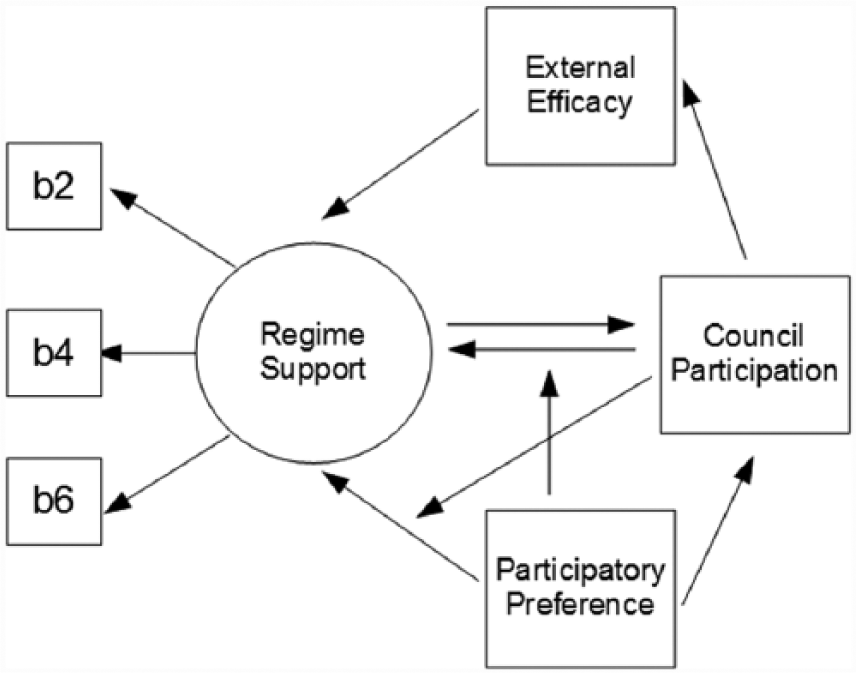
Relationship chart.
Data
To test these hypotheses, I use data from the 2010 and 2012 waves of the LAPOP survey in Venezuela. LAPOP is one of the most frequently used and highly respected regional public opinion surveys. Each wave includes roughly 1,500 respondents per country. Sampling is conducted using subnational clusters to ensure a representative sample; details can be obtained from LAPOP’s website (www.vanderbilt.edu/lapop/ab2012/AB-2012-Tech-Info-12.18.12.pdf).
Dependent Variable
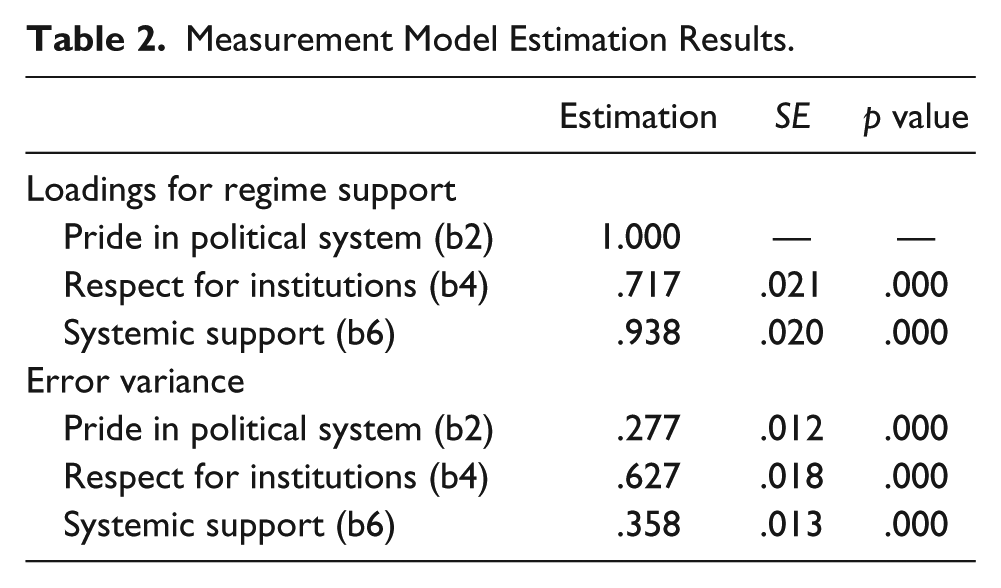
Regime support is difficult to measure; questions of whether any one indicator of the concept has the necessary validity to produce reliable conclusions militate against a single-variable approach. I use three questions to measure regime support: respect for political institutions (b2), pride in the political system (b4), and systemic support (b6). These indicators are recommended as measures of regime support by the creators of the LAPOP survey who have also demonstrated their validity as indicators of the concept (Booth and Seligson 2009). Results from the measurement portion of the model indicate that these indicators are appropriate measures of the latent concept; the results are presented in Table 2.
Measurement Model Estimation Results.
External efficacy is measured using a seven-point question about perceived interest of political actors in respondents’ opinions (eff1).
Independent Variables
Support for Chávez is measured by a seven-point measure of confidence in the President (b21a). Participation in the CCs is measured via a four-point scale of frequency of participation (cp15). The last of the substantively interesting variables, participatory preference, is measured via a seven-point scale question which asked respondents whether they agreed that the people should govern directly (pop107). Both council participation and participatory preference are rescaled to have a minimum of 0 and a maximum of 1, for ease of interpreting the interaction term. In addition to these, I include a number of standard demographic control variables: income, education, ideology, sex, race (a dummy coded 0 for white respondents and 1 for all others), urban/rural, and a dummy variable for survey year.
Estimation
Estimation of model parameters was conducted with Mplus version 7.2 (data and code are available on request), using maximum likelihood with missing values (MLMV). MLMV builds the likelihood function one observation at a time, using whatever information is available for each observation, without requiring the specification of a measurement model (Allison 2012).
Because CC participation is likely predicted in part by systemic support and chavismo (as personalism suggests), I allow participation to be endogenous to avoid bias. This requires treating the council participation variable as continuous, which is risky given its four-point scale; treating it as ordinal using a Weighted Least Squares (WLS) estimator did not substantially alter the results. The measurement model is identified via the three-factor rule. By excluding the “urban” dummy variable from the equation for support and including it in the equation for council participation, the structural portion of the model is identified via the rank and order conditions (Bollen 1989). As efficacy is not impacted by support, I conducted analysis of that model separately. This allowed the inclusion of all relevant control variables without concerns over identification issues. Results of the structural component of analysis are presented in Table 3.
SEM Analysis of Communal Council Participation.
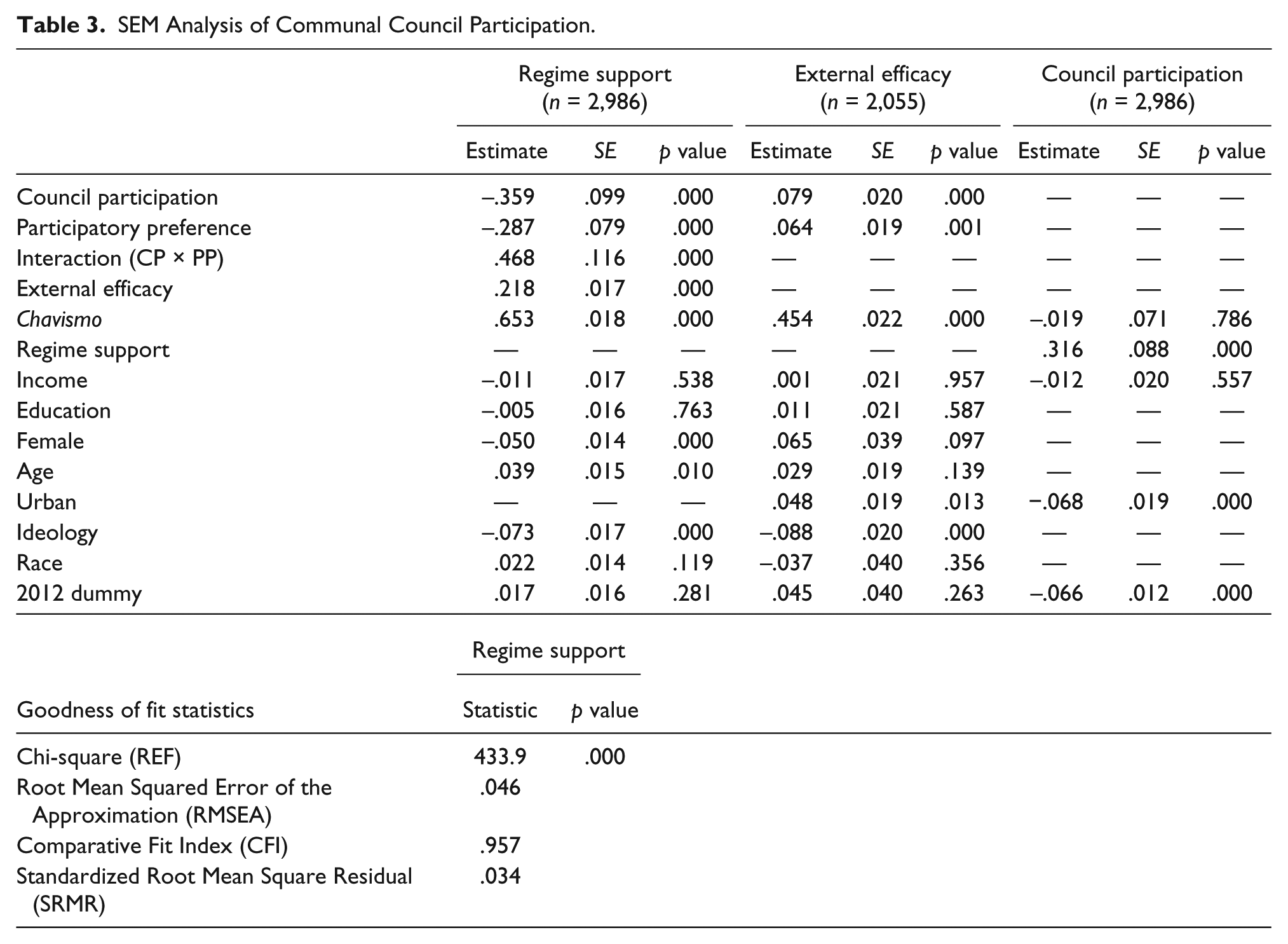
The first important result is that chavismo has an extremely strong positive impact on regime support. This is not very surprising. It does cast further doubt on participatory democracy as a reasonable framework for analysis (although it was already discredited by the qualitative analysis) but says little about which of the two types of populism discussed here best fits the Bolivarian state. The results for council participation are far more enlightening. Council participation has a substantial positive impact on support, but only among those with strong participatory preferences. Among those who do not prefer direct participation (participatory preference at zero), the effect is actually negative (−1.30), which may reflect dissatisfaction with some of the operational problems that impact many councils. However, among those with strong participatory preferences (participatory preference at 1), the impact of council participation rivals that of chavismo (.577 compared with .653), which is remarkable given the overwhelming dominance of Hugo Chávez in the Venezuelan political system. The results for efficacy further support participatory populism; the effect of council participation on external efficacy is significant and positive.
In sum, these analyses demonstrate that the councils allow the Bolivarian movement to convince its militants that its most important promise is being kept: that those who were long excluded from democracy as practiced prior to Chávez’s ascension are finally allowed to exercise power directly and collectively within their communities. They further show the importance of this promise to the legitimation of a regime which might otherwise have alienated its base with its authoritarian practices. With this contention supported, the view of chavismo as a straightforward incarnation of personalism becomes difficult to maintain. It would be foolish to deny that Chávez’s political style and personalism do not share a number of features, but the type of participatory self-management shown to exist in the councils, and the reliance on same to legitimate the regime, simply does not fit within a framework defined by the complete dominance of the leader, who uses his personal charisma and emotional connections with followers, rather than genuine empowerment, to maintain his position.
Conclusion
Personalism and participation are both readily apparent features of the Bolivarian political system, and theories which deny one or the other are incomplete. Although empirically focused on Venezuela, this paper has the potential to make important contributions to the study of populist organization strategies more generally. Most contemporary populist leaders have employed participatory rhetoric, and many have experimented with participatory programs of one kind or another, as mentioned in the introduction. Nicaragua is a possible example of another regime which practices participatory populism. Nicaraguan President and Chávez ally Daniel Ortega has sponsored Citizen Power Councils, which have a very similar function to that of the CCs; statistical analysis (presented in the online appendix) is consistent with the findings on the CCs I present in final section, albeit with less statistical confidence. Although very preliminary, these findings suggest that participatory populism likely is not confined to Venezuela.
The successful deployment of this strategy, with its combination of authoritarian and democratic practices, raises some interesting questions. Many students of participatory democracy experiments hope that such organizations can improve the quality of democracy (Biaocchi 2001). Following Rousseau (2002) and others, advocates argued that micro-level participation could train citizens to become more assertive and active in the political process at higher levels, challenging entrenched power holders and thereby enhancing representative institutions (Avritzer 2002; Barber 1984; Pateman 1970).
The case of Venezuela demonstrates an important caveat: that participatory governance can exist outside a liberal democratic framework. Participatory experiments do not exist in a vacuum, but are nested within a broader political system, and their effect on that system is not always straightforward. In the Venezuelan case, participatory governance actually serves to reinforce the ties between the masses and a dominant leader (Lovera 2008). The inherent constraints on participatory self-governance programs, particularly their confinement to local-level issues, make it an attractive choice for populists seeking novel ways to empower citizens without vitiating their own dominance.
Footnotes
Acknowledgements
I would like to thank Kurt Weyland and Fernando Rosenblatt for their extensive and invaluable comments on this paper. Alexandra Panzarelli, Maria Pilar García-Guadilla, Thais Maingon, and Héctor Briceño provided considerable assistance during fieldwork. I also thank the participants of the Latin American Student–Faculty group at the University of Texas at Austin, the anonymous reviewers, and the editors of Political Research Quarterly (PRQ) for their comments.
Author’s Note
Any errors that remain in this paper are the sole responsibility of the author.
The data for this article was supplied by the Latin American Public Opinion Project at Vanderbilt University, which takes no responsibility for any interpretation of the data (http://www.vanderbilt.edu/lapop/). Syntax files for this article can be viewed at  .
.
Declaration of Conflicting Interests
The author(s) declared no potential conflicts of interest with respect to the research, authorship, and/or publication of this article.
Funding
Research for this project was funded in part by a MacDonald Fellowship from the University of Texas at Austin. The author(s) received no additional financial support for the research, authorship, and/or publication of this article.
References
Supplementary Material
Please find the following supplemental material available below.
For Open Access articles published under a Creative Commons License, all supplemental material carries the same license as the article it is associated with.
For non-Open Access articles published, all supplemental material carries a non-exclusive license, and permission requests for re-use of supplemental material or any part of supplemental material shall be sent directly to the copyright owner as specified in the copyright notice associated with the article.
