



Abstract
Existing research suggests that supporters of gay rights have outmobilized their opponents, leading to policy changes in advanced industrialized democracies. At the same time, we observe the diffusion of state-sponsored homophobia in many parts of the world. The emergence of gay rights as a salient political issue in global politics leads us to ask, “Who is empowered to be politically active in various societies?” What current research misses is a comparison of levels of participation (voting and protesting) between states that make stronger and weaker appeals to homophobia. Voters face contrasting appeals from politicians in favor of and against gay rights globally. In an analysis of survey data from Europe and Latin America, we argue that the alignment between the norms of sexuality a state promotes and an individual’s personal attitudes on sexuality increases felt political efficacy. We find that individuals who are tolerant of homosexuality are more likely to participate in states with gay-friendly policies in comparison with intolerant individuals. The reverse also holds: individuals with low education levels that are intolerant of homosexuality are more likely to participate in states espousing political homophobia.
Keywords
Introduction
Recent research has established international divergence in both the national regulation of sexuality and public attitudes toward it (Hadler and Symons 2018; Roberts 2019). However, it is not clear what these divergent trends in state homophobia or state recognition of lesbian, gay, bisexual, and transgender (LGBT) 1 rights mean for political participation. One body of research suggests that economic development leads to more self-expressive values, like support for LGBT rights and gender equality, along with higher levels of participation (Inglehart and Norris 2003a, 2009, 2017; Inglehart, Ponarin, and Inglehart 2017). An underlying narrative in these studies is one of traditionalist disengagement. Studies also suggest that higher levels of economic prosperity and education are associated with higher levels of political participation (Blais 2007; Burns, Schlozman, and Verba 2001; Hillygus 2007; Verba, Schlozman, and Brady 1995). Yet, other bodies of research, especially ones also looking at illiberal and nondemocratic contexts, challenge these assumptions. Work on political participation shows that there are circumstances where increased education is linked to decreased political participation (Croke et al. 2016), and that different groups may be drawn to different strategies of conventional and nonconventional political participation (Carlin 2011; Marien, Hooghe, and Quintelier 2010). Furthermore, international relations research suggests a backlash is occurring in response to the global spread of new contentious norms (Sandholtz, Bei, and Caldwell 2018; Simmons 2009), which include spurring both political responses and societal countermobilization targeting LGBT people (Ayoub 2014; Bosia and Weiss 2013; Dorf and Tarrow 2014; Fetner 2008; Nuñez-Mietz and Iommi 2017; O’Dwyer 2012, 2018; Wilkinson and Langlois 2014).
These conflicts between the progressive embrace of tolerance and a traditionalist backlash present a puzzle for scholars and policymakers: if “traditionalist” values enervate political participation, when do opponents of gay and lesbian rights mobilize? The study described here explores this puzzle in tolerance of homosexuality, and specifically its effects on individual political participation, our central question being, “As LGBT rights become salient political issues in global politics, who is empowered to be politically active in various societies?” Analyzing the European Social Survey and Latinobarometer on political participation and attitudes toward gay and lesbian rights, we expect that the alignment citizens feel between their own attitudes on sexuality/gender identity and the norms of the state increases their sense of political efficacy (the belief that one matters and makes a difference in the political community) and ultimately the likelihood of their participation in politics. In other words, states that affirm one’s views on sexuality improve one’s perception of efficacy with respect to those state institutions, yielding greater political participation. The aspect of state behavior that increases political efficacy is the alignment between state policies on salient issues and citizen attitudes. We also expect that discrepancies between the state’s norms on sexuality and a person’s own views on sexuality reduce the feeling of efficacy, yielding less political participation. We test these assumptions, with a research design that compares political participation and efficacy across European and Latin American states by (1) levels of political homophobia in an individual’s country, (2) individual-level tolerance toward homosexuality, and (3) individual education levels.
Answers to the aforementioned puzzle shed light on both long-standing theoretical debates in political science and important political problems in contemporary world politics. First, while Inglehart and Norris (2003a) have argued that sexuality is a uniquely contentious issue that predicts many types of political behavior, political science research is still unclear about why it is so divisive in the first place. Furthermore, we know little about how state responses to homosexuality affect individual-level political behavior (cf. Page 2018a; Page 2018b). Second, this undertaking also addresses a practical problem in contemporary world politics: the intensification of state homo- and transphobia in some contexts (Weiss and Bosia 2013). 2 The problem of a “homophobic wave” is all the more puzzling in light of the fact that tolerance toward gay and lesbian people has been rising around the world in recent decades (Inglehart and Baker 2000; Inglehart and Norris 2003b). Importantly, recent work by Roberts (2019) and Hadler and Symons (2018) shows that there is an upswing in positive attitudes globally, but that such progress accompanies a widening attitudinal gap between countries and regions. 3 While research points to the structural nature of this homophobic wave (Ayoub 2016; Bosia 2014; Rahman 2014), we still do not know how circumstances of political homophobia affect individual-level political behavior, which is a key question this article seeks to answer. As LGBT rights become salient political issues in global politics, who is empowered to be politically active in various societies?
Our findings show that tolerant people in states where norms have developed that protect LGBT rights—states often referred to in modernization theory as having self-expressive cultures—exhibit the most political efficacy and subsequently higher levels of participation, and this phenomenon opens up over the years as such rights have become a more entrenched norm in their societies. By contrast, hostility on the basis of sexuality promoted in other states (e.g., several states in Eastern Europe; O’Dwyer 2012)—primarily in the form of political homophobia—decreases efficacy among pro-LGBT people. Thus, in states where proponents of gay and lesbian rights are needed the most, their participation might be the lowest. While we rely on Europe as our core case study, in the appendix, we take the study further by testing the robustness of the results in other regions, finding similar expected trends with respect to political efficacy in Latin America (again comparing states with varying levels of political homophobia; Encarnación 2011).
The LGBT Rights Gap and Varied Political Participation
Research on LGBT rights movements around the world indicates growing acceptance and opportunities for political inclusion, while a new and evolving body of research indicates that global progressive trends have also been preceded by or have led to local side effects of state homophobia such as antigay laws in Eastern Europe, Latin America, and Sub-Saharan Africa (Bosia and Weiss 2013). Bob (2012) refers to this dynamic as symbolic of a gap between regions in their treatment of LGBT people. We label this gap as one between states where homophobia is politicized and states that are conducive to gay rights; in the latter, they are sometimes even said to feel “inevitable” (Hawn 2014).
4
Drawing from Bosia and Weiss’s (2013, 2) definition, contexts espousing the state strategy of political homophobia are characterized as purposeful, especially as practiced by state actors; as embedded in the scapegoating of an “other” . . .; as the product of transnational influence peddling and alliances; and as integrated into questions of collective identity and the complicated legacies of colonialism.
Political homophobia has been used to analyze relatively similar and modular discourses around traditional values that institutionalize homophobia (and/or prohibit the introduction of LGBT rights) in state policy. However, the effects of this gap—of state homophobia and state acceptance with regard to LGBT rights—on individual political behavior are unclear. Political mobilization, like increased voting among those opposed to gay rights, would suggest the potential for some entrenchment of antigay rules as well as a greater incentive for politicians to promote homophobia.
Norm Diffusion, Polarization, and Backlash
World society scholars have optimistically argued that we should see the global proliferation of new and rational liberal ideas (Meyer et al. 1997; Soysal 1994). That said, issues like sexuality and gender identity show that this optimistic take must be qualified, at least in part (Gerhards 2010; Hadler 2012; Hadler and Symons 2018; Roberts 2019). Scholars have pointed to divergent trends in world politics, arguing that we live in a world of regions that produce very different political responses to contemporary world problems (Katzenstein 2005). Also here, we do not observe isomorphism around issues of sexuality and gender identity. Instead, societies respond to the issue in unique ways, depending on how it is politicized in their respective states and regions (Symons and Altman 2015; Wilkinson and Langlois 2014). For example, Roberts’s (2019) work explaining increasingly positive attitudes toward homosexuality—as linked to world society scholarship—also finds that a widening gap between regions and countries is the result of region- and state-specific cultural programs. Subsequently, contextual state differences may spur the political participation and empowerment of very different political actors.
While popular discourses in the United States and Western Europe sometimes frame the gay rights issue as inevitable—evidence of the arc of history bending toward justice—the personal experiences of LGBT people in many parts of the world (including in “the West”) tell a different story. Research on the diffusion of norms shows that international standards of appropriate behavior on sexuality play out differently depending on the states they spread to (Ayoub 2016; Kollman 2013). Domestic contexts moderate the reception of similar universal norms—which smack of an external imposition to some, and welcome modernity to others—in starkly different ways (Cortell and Davis 1996; Simmons 2009). For example, when a state passes a same-sex union law in Western Europe or North America, it quickly produces positive change in individual attitudes toward homosexuality (Bishin et al. 2016; Takács and Szalma 2011), but that effect has been less strong if we look only at states in Eastern Europe (Ayoub 2016, 151–52). 5 A similar dynamic of construing same-sex sexualities as a foreign imposition on local traditions and values has been charted in many of the contexts we see as ripe for political homophobia, including many states in Central and Eastern Europe (CEE; Ayoub 2014; Shevtsova 2017; Swimelar 2016).
Theory
Wedding the work on political participation, modernization, and the diffusion of norms in international relations, we develop a theory to explain the varied political participation by divergent types of individuals across states. Different levels of political homophobia across states should shape political participation differently. Inglehart and Norris (2009) argue that economic development leads to social change (modernization theory): people who can take their survival for granted are more open to self-expression and liberal ideas in comparison with those who focus on survival and parochial connections to in-groups and family. While we have reservations about the bluntness of the survivalist/self-expressionist categories for an issue like sexuality, rigid norms with respect to the family and sexuality (especially in terms of heterosexuality), arguably, are more appealing in situations of greater economic insecurity and uncertainty, because these norms provide people with a greater sense of predictability in their lives.
Inglehart et al. (2017) further argue that existential security (derived from economic prosperity) contributes to a shift from pro-fertility (conventional gender and sexual norms following reproduction) to individual-choice norms (including tolerance of homosexuality and diversified roles for women in society). Their examination of public opinion across eighty countries indicates that individual-choice norms like tolerance of homosexuality are spreading. In their words, “the repression and self-denial linked with traditional pro-fertility norms were no longer essential to societal survival” (Inglehart et al. 2017, 1338). However, Inglehart et al. (2017) warn that the shift to individual-choice norms has provoked a backlash among social conservatives around the world. This is demonstrated by the steep rise in populism, such as the election of Jair Bolsonaro in Brazil, who appealed to “traditional” norms regarding gender roles and sexual orientation. These scholars also contend that the social base for sexism and homophobia is eroding in high-income societies, meaning that the future political prospects of authoritarian populists are dim. 6 Yet, what they miss is a comparison of political mobilization between countries with higher and lower levels of economic development, and between those who hold these traditional values and those who do not.
We argue that another important element of their work requires evaluation: people’s political efficacy and political participation. Work in political behavior has found a positive and reciprocal relationship between political efficacy—both internal and external—and voting (Finkel 1987; Lane 1959; Niemi, Craig, and Mattei 1991; Shingles 1981) and civic engagement (Verba, Schlozman, and Brady 1995). Indeed, changes in feelings of efficacy have predicted participation even among citizens with remarkably little voice and recourse in society, such as homeless citizens (Corrigall-Brown et al. 2009). Alongside enhancing participation, feelings of collective efficacy can also subsequently produce collective identities—anchored in a sense of “we-ness” that encompasses real or imagined attributes—around salient issues. The positions these collectives take, always defined against a constructed “other,” can sustain participation on behalf of increasingly entrenched political positions (Polletta and Jasper 2001; Taylor and Whittier 1998), like defenders of traditional values or proponents of equal rights for LGBT people. Outside of political science and sociology, self-efficacy explains individual behavior on a number of issues related to sexuality (McCree et al. 2003), and such efficacy is developed in interaction with various institutions in which individuals are socialized (Thornton and Camburn 1989). We expect a similar dynamic here, in that the political participation of individuals should depend, in large part, on how their state politicizes sexuality and gender identity.
Alongside various structural factors, social movement scholars of the political process school have long argued that there is a correlation between perceived efficacy and political mobilization (McAdam 1999; McAdam, Tarrow, and Tilly 2001; see also a related literature by Dalton 1996; Welzel, Inglehart, and Kligemann 2003). The logic being that for mobilization to occur, individuals need to be cognitively liberated, in that they both perceive their situation to be unjust and feel they have collective efficacy to do something about it (McAdam 2013; Welzel, Inglehart, and Kligemann 2003). Anderson (2010, 62) shows that political efficacy derives from an individual’s sense of community: one’s feelings of (1) membership, (2) influence, (3) fulfillment of values (as defined in one’s community), and (4) shared emotional connection within one’s group.
Norms regarding family life, fertility, reproduction, and sexuality are central to an individual’s sense of community and efficacy (see Greil et al. 2010; Monga et al. 2004). We argue that states engender political efficacy using policies regarding sexuality. In contrast to the empirical fluidity of sexuality, state-making has a long history of establishing a hierarchy of values and prescriptions for sexual behavior (Peterson 2013). Hence, normatively, sexuality can be made a rigid construct that is threatened and needs defending (Ayoub 2014). We expect that states promoting gay rights fulfill the values of supporters of gay rights, leading to their greater efficacy; while states that denounce gay rights fulfill the values of opponents of gay rights, leading to their greater efficacy. People whose attitudes ascribe threat to gays and lesbians are more responsive to state homophobia by politicians who fulfill their beliefs (homophobic policies and messages) via political action. This suggests that in contexts where proponents of gay and lesbian rights are needed the most, their participation might be the lowest.
Rationale for Case Selection
Our theoretical ideas are informed largely by the patterns in norms of LGBT rights in Europe. Europe provides an opportunity to test the ramifications of the theory. This is because the continent has moved forward rapidly on LGBT rights in the post-Cold War period, housing many of the innovator states on this issue. The European Union (EU) and the Council of Europe (CoE) have also taken the lead globally as international organizations that tout such rights as part of their values and norms (Ayoub and Paternotte 2014; Mos 2014). At the same time, there remain sharp differences in the societal and legal recognition of such rights across the member states of these organizations. When the CoE’s European Court of Human Rights ruled in 2010 that Russia must allow the public assembly of LGBT people, Moscow responded by banning pride parades for a century. Various regions in Russia, and ultimately the Kremlin, reacted by also prohibiting “gay propaganda,” which effectively removes depictions of LGBT issues from the public sphere (Wilkinson 2014). The global politics around sexuality and gender identity, often framed as a clash between “traditional values” (or survivalist) and “decadent LGBT-friendly” (or self-expressionist) states, are apparent within Europe.
Existing studies indicate higher levels of political discrimination on the basis of sexuality in Eastern Europe in comparison with Western Europe (Asal, Sommer, and Harwood 2013). In the Communist era, like in many other parts of the world, gay people faced repression from the state and broader society, such as higher ages of consent, persecution by the secret police, and social stigma (O’Dwyer 2012, 108). While gay liberation movements began to break down similar patterns in Western Europe since the 1970s, silence around discrimination and stigma remained much higher in Eastern Europe; a legacy reflected in relatively more restrictive laws and less accepting opinions of gay people in CEE today. 7 That said, while newer democracies have lower civic participation than established democracies, new democracies have higher levels of informal civic participation than expected, making a strict East–West divide far less clear (Mirazchiyski, Caro, and Sandoval-Hernández 2014, 1043). We also do not wish to perpetuate the idea that the experience around homosexuality is uniform or homogeneous across states in CEE or Western Europe. Methodologically, there remains ample variation to exploit across states in Europe, from Spain to Italy in the West, from the Czech Republic to Latvia in the East (Ayoub 2016). We, thus, build on previous work, by breaking down regional analyses to look at varied scores on political homophobia across states, and, combined with insights from the modernization school, to ask who participates and why on the salient issue of sexuality. While we start with Europe to test the effect of the tolerance gap on individual political behavior, we then move forward to compare similar gaps in Latin America (see the appendix).
As Weiss and Bosia (2013) argue that political homophobia is exemplified by the actions of politicians who peddle homophobic rhetoric and propose policies to contrast their own societies from subjectively “foreign” and “decedent” societies, a comparison across states on the basis of an LGBT rights index (described below) drives the empirical analysis. The appeals to conventional family and sexual values examined by Weiss and Bosia (2013) are at least somewhat reflective of the survivalist attributes postulated by Inglehart and Norris (2003a). Inglehart et al. (2017, 1330) suggest that support for norms of self-expression like tolerance for homosexuality is declining in some states (within Europe, especially in CEE), reflecting rising political homophobia. Hence, we compare (1) rates of political homophobia across states and (2) individuals who hold more (homophobic) or less (tolerant) survivalist attitudes within each grouping. As explained above, differences across European countries provide variation in the treatment of sexual minorities and more variability in comparison with existing studies that focus on single country cases, multiple American states, or multiple cities. We also conduct robustness checks, examining more data regarding other forms of political participation (see Supplementary Appendix online) and political efficacy in Latin America (Latinobarometer) (in the appendix below).
For individuals in states where gains in LGBT politics are politicized as positive or inevitable, the political participation of people who hold pro-gay attitudes is heightened. The reverse should also be true. In these contexts, people with strong antigay views, who observe the proliferation of salient gay rights, feel defeated and, thus, generally less efficacious. This would align with the theorizing of cognitive liberation and the importance of efficacy for mobilization. Because sexuality has become a salient benchmark for various types of political behavior, with strongly held views at both ends, we expect the same for aligning homophobic sentiments between the individual and the state. In a context where pro-gay people do not yet feel efficacious (or at least not clearly more than their ideological opponents), they should be less likely to participate than their opponents.
Research Design
To test the hypotheses, we first examine data from the European Social Survey. These data include surveys conducted in thirty European countries 8 in 2002, 2004, 2006, 2008, 2010, 2012, 2014, and 2016 (360,017 survey responses). We selected these data because the surveys ask respondents about their opinions of gay people and about their political participation.
Variable Measurements
To operationalize political participation (the dependent variable), we use European Social Survey variables based on the eight available participation questions regarding voting, contacting a politician, working for a party, working for an organization, wearing a political badge, signing a petition, boycotting a product, and demonstrating (1 = engaging in the activity in the past twelve months, and 0 = otherwise). We represent voting with a dummy variable, which distinguishes the 77 percent of respondents who indicated that they voted from those who did not. We created a nonelectoral participation score by adding together the nonvoting values, yielding a scale where respondents participate in zero activities to seven nonelectoral activities in the past twelve months. This measure represents a score from low levels to high levels of nonelectoral participation. The modal value of this score is “0” (34% of respondents) and the mean value is 1.3.
We use the European Social Survey variable based on the following question to operationalize our key concept of support for gay and lesbian rights: Using this card, please say to what extent you agree or disagree with each of the following statements. Gay men and lesbians should be free to live their own lives as they wish. 1 (Agree strongly), 2 (Agree), 3 (Neither agree nor disagree), 4 (Disagree), 5 (Disagree strongly).
The modal category for this variable is “Agree,” the group with 37 percent of the respondents; 68 percent of the respondents responded either “Agree strongly” or “Agree” (15 percent responded as “3” or neither). We see that support for the rights of gay and lesbian people is more popular in Western Europe when compared with CEE (79% in Western Europe and 45% in CEE “Agree strongly” or “Agree”). The mean value is around “2” for Western Europe and around “3” for CEE. We unpack political homophobia by country, using the International Lesbian, Gay, Bisexual, Trans and Intersex Association (ILGA) Rainbow Index, which ranks European countries by their treatment of LGBT people: 0 (gross violations of LGBT rights, discrimination) to 100 (respect of LGBT rights, full equality). 9 Typically Western European countries like Belgium (79) are on the high end, and Eastern European countries like Latvia (16) are on the low end. In the middle on this continuum are countries like Hungary (47), Ireland (52), and Austria (56). We introduce controls for age and education to account for older and more educated people who are more likely to participate politically. We also introduce a control for political ideology to examine the influence of feelings about gay and lesbian people, while taking the support of those on the Left (and opposition on the Right) into account.
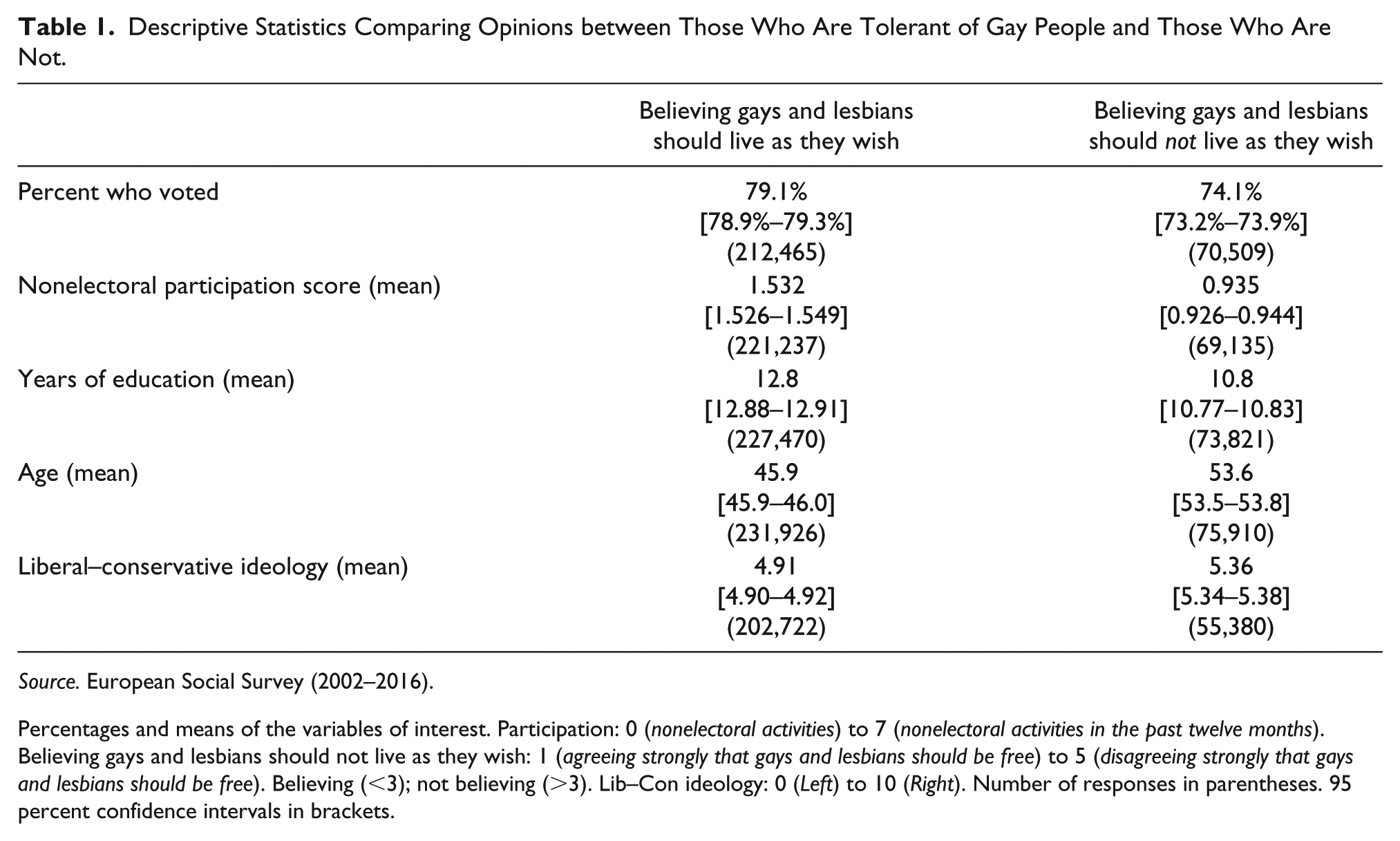
Table 1 presents the cross-tabulations of the probability of voting by whether or not the respondents are tolerant of gay and lesbian people, along with other important variables of interest. Those who are tolerant are more likely to vote in comparison with those who are intolerant. Those who are tolerant were more likely to be liberal, younger, and have more years of education in comparison with those who are intolerant. These results indicate a profile of tolerant people exhibiting characteristics that typically suggest more progressive values. With more years of education, those who are tolerant may be more likely to vote due to this education factor. Hence, we estimate the effects of feelings about gay and lesbian people on voting, with respect to ideology, age, and education.
Descriptive Statistics Comparing Opinions between Those Who Are Tolerant of Gay People and Those Who Are Not.
Source. European Social Survey (2002–2016).
Percentages and means of the variables of interest. Participation: 0 (nonelectoral activities) to 7 (nonelectoral activities in the past twelve months). Believing gays and lesbians should not live as they wish: 1 (agreeing strongly that gays and lesbians should be free) to 5 (disagreeing strongly that gays and lesbians should be free). Believing (<3); not believing (>3). Lib–Con ideology: 0 (Left) to 10 (Right). Number of responses in parentheses. 95 percent confidence intervals in brackets.
Model Estimation
To test the hypotheses, we estimate statistical models that allow us to compare levels of participation between people who report discrimination and do not report discrimination, with respect to important control variables. For the voting models (with a voting dummy variable), we estimate a mixed-effects logit model, where we let the intercepts vary by country-years. The mixed-effects model is appropriate because these data include individuals within the thirty countries. For the nonelectoral participation models (with an eight-point participation scale), we estimate a mixed-effects linear model, where we let the intercepts vary by country-years. The mixed-effects model is appropriate because these data include individuals within the thirty countries. To avoid biased parameter estimates, we model the context of the thirty countries, where individuals may have distinctive experiences. The intraclass correlation coefficients for the null models with no independent variables show that country-years account for 9 percent of the variation of the dependent variable for the voting model and 11 percent of the variation of the dependent variable for the nonelectoral participation model. The European Social Survey provides recommended poststratification and country population weights to offset sampling biases, which we use in our analysis. The findings we present below hold with and without respect to the recommended weighting.
To suggest whether the theoretical process is strictly about attitudes regarding homosexuality, as opposed to a broader set of ideological beliefs, we also included an interaction term for ideology and the Rainbow Index (see Online Supplementary Appendix 3). Our findings hold with respect to this interaction term, showing a unique association between gay rights, political homophobia, and participation. We also conducted a robustness check regarding political efficacy (believing one’s vote can make a difference) using the Latinobarometer data (see the appendix).
Results
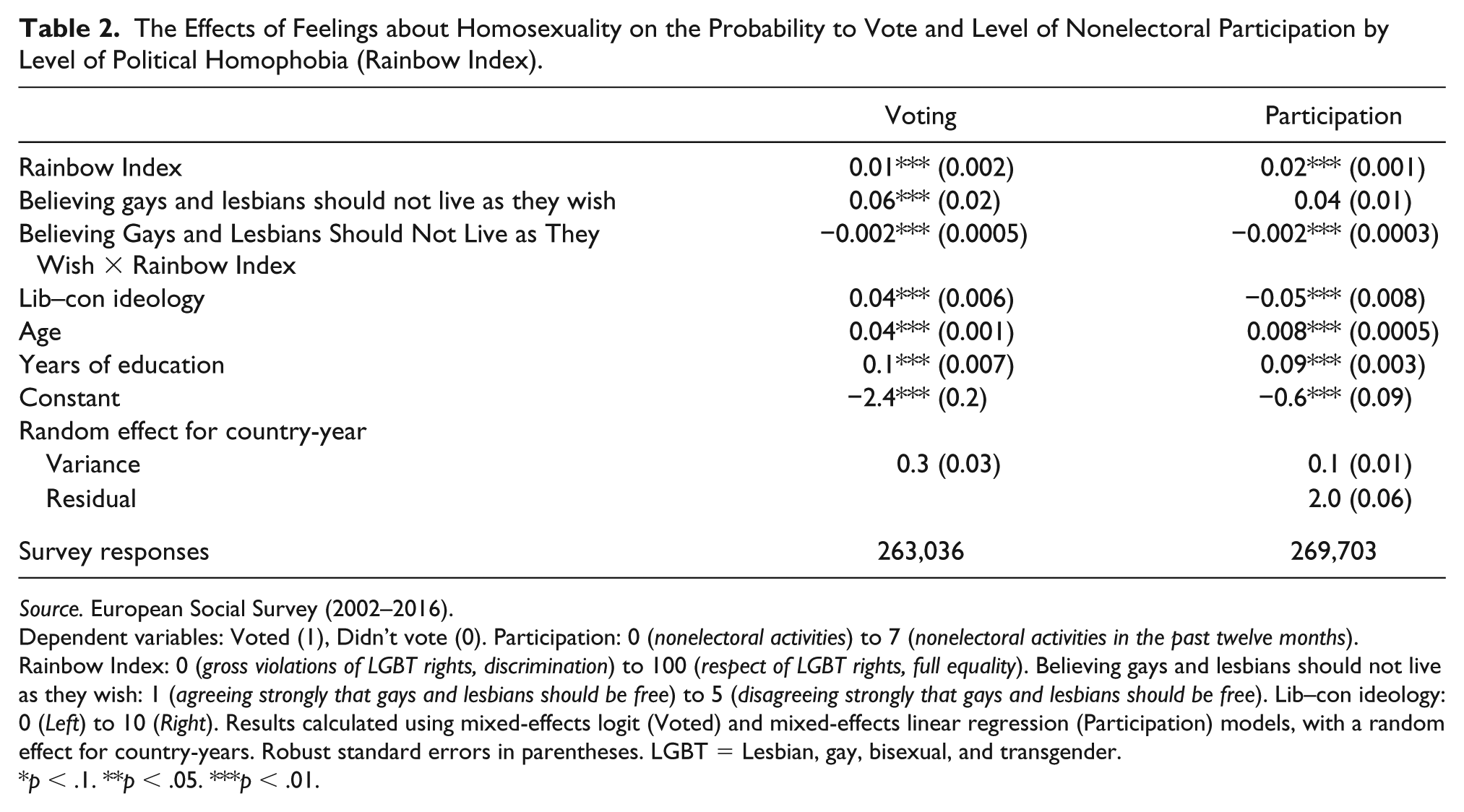
Table 2 presents the results of models where we estimate the probability of voting and levels of nonelectoral participation. For the voting model, the coefficient for Rainbow Index is positive and statistically significant, which suggests that respondents who are tolerant of homosexuality exhibit a higher probability of voting in less homophobic states in comparison with similar respondents in more homophobic states. The coefficient for Believing gays and lesbians should not live as they wish is positive and statistically significant, which suggests that those who are intolerant are more likely to vote in the homophobic contexts. The interaction term Believing Gays and Lesbians Should Not Live as They Wish × Rainbow Index is negative and statistically significant, which suggests that in less homophobic contexts, those who are intolerant are less likely to vote. The coefficient for Lib–Con Ideology is positive and statistically significant, indicating that those who are conservative are more likely to vote. The coefficient for Age is positive and statistically significant, indicating that those who are older are more likely to vote. The coefficient for Years of Education is positive and statistically significant, indicating those with more education are more likely to vote.
The Effects of Feelings about Homosexuality on the Probability to Vote and Level of Nonelectoral Participation by Level of Political Homophobia (Rainbow Index).
Source. European Social Survey (2002–2016).
Dependent variables: Voted (1), Didn’t vote (0). Participation: 0 (nonelectoral activities) to 7 (nonelectoral activities in the past twelve months). Rainbow Index: 0 (gross violations of LGBT rights, discrimination) to 100 (respect of LGBT rights, full equality). Believing gays and lesbians should not live as they wish: 1 (agreeing strongly that gays and lesbians should be free) to 5 (disagreeing strongly that gays and lesbians should be free). Lib–con ideology: 0 (Left) to 10 (Right). Results calculated using mixed-effects logit (Voted) and mixed-effects linear regression (Participation) models, with a random effect for country-years. Robust standard errors in parentheses. LGBT = Lesbian, gay, bisexual, and transgender.
p < .1. **p < .05. ***p < .01.
We also represent as a bar graph the predicted probabilities to visually unpack the interaction term (Figure 1). In less homophobic states (holding the Rainbow Index score at 67: the lower boundary of the index’s more gay-friendly countries), those who are tolerant are more likely to report voting in comparison with those that are intolerant of gays and lesbians. In more homophobic countries (holding the Rainbow Index score at 24: the upper boundary of the index’s more homophobic countries), those who are intolerant and tolerant are indistinguishable with respect to voting. The differences in predicted probability also show this result. Intolerant respondents are not demobilized in homophobic states. The model regarding nonelectoral participation yielded the same substantive findings (see the bar graphs in Online Supplementary Appendix 2). In sum, we found that tolerant people are more mobilized in tolerant contexts, but we do not find that intolerant people are more mobilized in intolerant contexts at this stage in the analysis. So far, homophobia does not seem to have the hypothesized mobilizing effect.
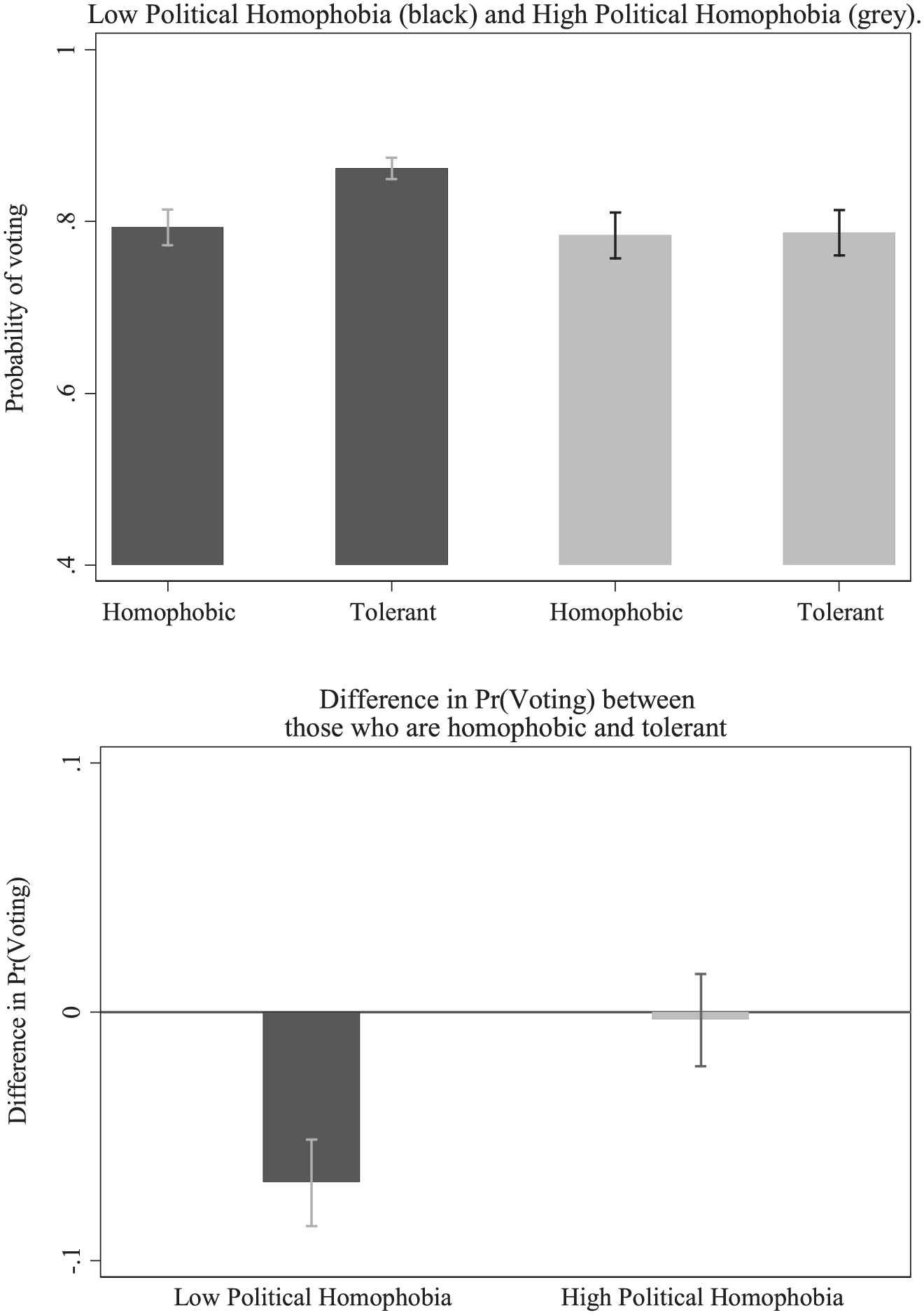
Probability of voting by opinions about homosexuality and level of political homophobia with 95 percent confidence intervals.
A Further Test of the Argument
Up until now, this study has focused on a comparison between states that make stronger and weaker appeals to political homophobia. People who harbor survivalist values were more likely to vote in the states that exhibit stronger appeals to those values, suggesting that alignment between individuals and the state regarding sexual norms can yield greater political mobilization. However, arguments regarding survivalist values presuppose economic insecurities that translate into discomfort regarding social change. More economic security and prosperity yield higher levels of tolerance for diverse and unconventional family and sexual values. Hence, we accompany our regional comparison with a comparison of individuals who are theoretically more or less survivalist within the respective regions. Inglehart and Norris (2017) argue that the inequality in opportunity between individuals with higher and lower levels of skills and education is resulting in greater feelings of insecurity, amplifying the appeal of survivalist values.
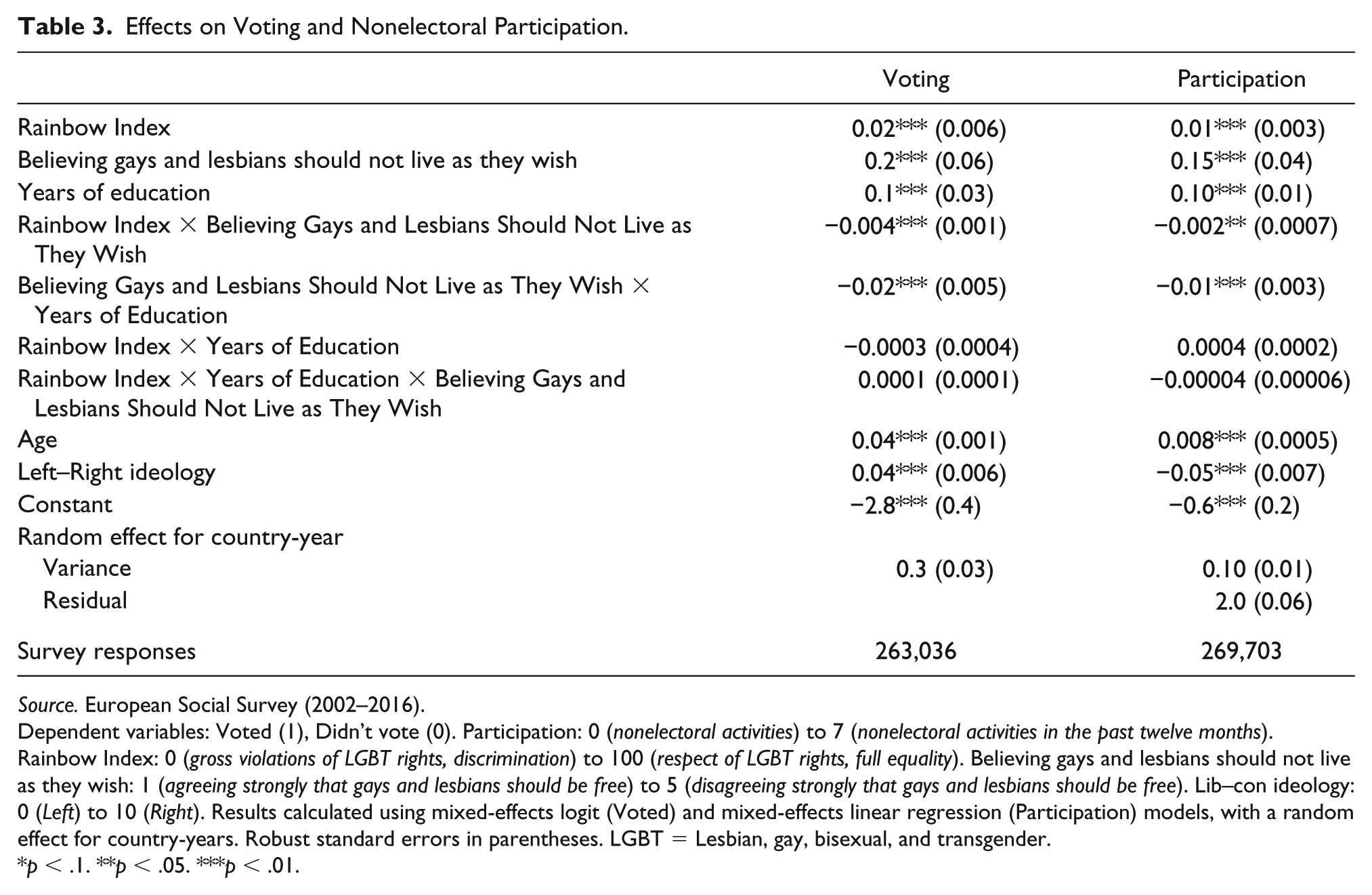
Therefore, in Table 3, we compare political participation between those with high and low levels of education across the regions. We expect that those with lower levels of education exhibit greater political mobilization in states that make stronger appeals to survivalist values. We represent the effects of tolerance toward gay and lesbian people by education and political homophobia with a statistical model that includes a triple interaction term between these variables (see Table 3). We interpret this interaction with a bar graph of predicted probabilities of voting by education, tolerance toward homosexuality, and political homophobia. We hold years of education at sixteen for the bar graph of high education levels (the mean years of education in these data are twelve, plus one standard deviation, which is four). We hold years of education at eight for low education levels (the mean minus one standard deviation). The bar graphs in Figure 2 show that across those with high and low education levels in less homophobic contexts, tolerant people are more likely to vote in comparison with homophobic people. Meanwhile, among low education individuals in more homophobic contexts, people intolerant of gays and lesbians are more likely to vote in comparison with tolerant people. Lower education levels intensify survivalism, and the larger homophobia effect among those with low education in more homophobic contexts is suggestive of the theoretical mechanism we propose: political homophobia mobilizes homophobic citizens when compared with tolerant citizens. The findings indicate that alignment between individual sexual norms and the norms of the state yield greater political mobilization among the individuals expected to have stronger survivalist values. In sum, the results confirm our primary theoretical intuition concerning the varied patterns of individual political behavior in states where homophobia is credibly politicized and states where it is not.
Effects on Voting and Nonelectoral Participation.
Source. European Social Survey (2002–2016).
Dependent variables: Voted (1), Didn’t vote (0). Participation: 0 (nonelectoral activities) to 7 (nonelectoral activities in the past twelve months). Rainbow Index: 0 (gross violations of LGBT rights, discrimination) to 100 (respect of LGBT rights, full equality). Believing gays and lesbians should not live as they wish: 1 (agreeing strongly that gays and lesbians should be free) to 5 (disagreeing strongly that gays and lesbians should be free). Lib–con ideology: 0 (Left) to 10 (Right). Results calculated using mixed-effects logit (Voted) and mixed-effects linear regression (Participation) models, with a random effect for country-years. Robust standard errors in parentheses. LGBT = Lesbian, gay, bisexual, and transgender.
p < .1. **p < .05. ***p < .01.

Probability to vote by tolerance toward gay people, education level, and level of political homophobia (high level = “gray” and low level = “black”) with 95 percent confidence intervals.
Conclusion
This article has been the first attempt to understand the effect of politicized homophobia on the political participation of individuals across countries. We set out to explore what mobilizes opponents to LGBT rights. Our findings show that, in contrast to a narrative of a linear march toward progress, the way states politicize the rights of LGBT people has a tremendous impact on the political participation of supporters or opponents of LGBT rights. In an analysis of public opinion data, the findings have shown that the discrepancy individuals feel between their personal attitudes on sexuality and the norms of their state inform their perception of their own political efficacy—and they act accordingly. In states where politicians appeal to traditional sexual mores, often in juxtaposition to “the gay-friendly West,” citizens holding intolerant views feel efficacious. This alignment between citizen and state intolerance toward gay and lesbian people subsequently increases their political participation. By contrast, in societies where state authorities present gay and lesbian rights as legitimate or “inevitable,” supporters of those rights have shown higher levels of political participation. We replicated our analysis using data from Latin America, where the Southern Cone exhibits more gay-friendly policies in comparison with the rest of the region (Encarnación 2011; see the appendix). Our findings held with respect to political efficacy and political homophobia in Latin America.
As such, we see an urgency for political science scholarship to investigate the uneven patterns of political participation around contentious social issues. For work on political participation, our findings speak to a widening literature that finds it important to look across varied contexts and outside of the global north. Along these lines, we think it would also be valuable to disaggregate different forms of political participation. Our findings also challenge popular optimistic accounts that had viewed the world as “won” for proponents of gay and lesbian rights (Hawn 2014), as well as the thesis that backlash to such advances is minimal everywhere. The excellent studies that partly make this claim have been rooted in the experience of the West, and the recent history of the United States in particular (Bishin et al. 2016; Flores and Barclay 2016). This research is, thus, a warning against the inevitability argument underlying many popular contemporary perceptions of human rights in the West. Indeed, the debate on gay and lesbian rights—as well as the divergent proliferation of both pro- and anti-LGBT policies—suggests a trend of polarization in global politics (Symons and Altman 2015). For human rights advocates, it requires carefully rethinking “one-size-fits-all” models—often rooted in universalist human rights frameworks (Ayoub and Chetaille 2018). The deployment of LGBT rights by state authorities is carried out in starkly different ways across countries, and with powerful effects.
Furthermore, while Inglehart and collaborators (Inglehart and Baker 2000; Inglehart and Norris 2009) have long suggested that the contexts they define as survivalist are typified by lower levels of political participation around “luxury” issues like LGBT rights, we also see this logic to be in need of revision. Political participation can be acutely high in survivalist cultures, but predominantly among people intolerant of difference. Our findings also shed light on varied patterns of individual political participation across contexts of politicized homophobia. As it applies to feelings of efficacy, this inquiry may help to explain why white supremacists felt emboldened to march in Charlottesville following the election of U.S. President Trump, or why hate-crime attacks on Poles rose in the United Kingdom after the nativist campaigns surrounding Brexit. In sum, the findings presented here connect to larger dynamics of illiberalism, nationalism, and populism that have mobilized people politically in CEE and across the globe in the last decade. Our findings shed light on the puzzle of why the world is observing such heterogeneous dynamics when it comes to the acceptance of LGBT people, with sweeping and unprecedented positive change in some corners of the globe, and retrenchment (including increased violence, imprisonment for gays, laws banning gay “propaganda,” etc.) in other parts. In existing research, including this study, the connection between antigay rhetoric and antigay citizen attitudes and behavior remains an untested assumption (see Bob 2012; Bosia 2014; Weiss and Bosia 2013). We suggest that policies like Putin’s ban on “gay propaganda” inform the political efficacy of homophobic citizens. Future research can unpack the effects of gay-friendly and homophobic messaging using survey and field experiments. These experiments could manipulate the messages respondents receive before they answer questions regarding support for their governments and the likelihood that they will participate politically.
Next, the article’s finding that homophobic national contexts are somewhat self-perpetuating, as they mobilize homophobic political actors, may beg the question, “How did LGBT movements arise anywhere?” This has partly to do with early reform movements, which under the right conditions (often in postmaterialist countries) required a small number of committed activists, rather than widespread participation. For example, this was seen during the more private (i.e., not public and on the streets) work of the post-World War II homophile movement, primarily centered around the Netherlands (Rupp 2011). Seeing how differently this issue is politicized today shows the varied nature of LGBT politics across time; it suggests that we need to think differently about (1) the types of contexts that engage in a conversation about LGBT rights and (2) the effects of those conversations.
One hope is that this article inspires future research to investigate similar dynamics in relation to support for trans rights and women’s rights, since politicized homophobia readily appears alongside politicized attacks on gender identity and changes in gender roles (Kuhar and Paternotte 2017). We emphasize again that the analysis and available data presented here have focused on attitudes toward gay and lesbian people. While we expect a similar pattern of political behavior concerning the politicization of gender identity and the rights of trans people, this relationship needs to be tested further. The debate opposing the rights of gay and lesbian people is typically closely tied to opposition to bisexual and trans people in the global mobilization for “traditional values” and against “gender ideology” (Kuhar and Paternotte 2017). 10 Such mobilization, which was a central impetus for this study, is being charted by new research on the diffusion of homophobia by international nongovernmental organizations (INGO) like the World Congress of Families, in conjunction with powerful states (e.g., Russia) and international organizations (e.g., the Catholic and Orthodox churches) (Ayoub 2018; Stoeckl and Medvedeva 2018).
Furthermore, while this article has been about Europe and Latin America, the findings may also help to understand political behavior in other regions that exemplify political homophobia. For example, at a September 2017 rock concert in Cairo by the queer Lebanese band Mashrou’ Leila, seven people were arrested for raising a rainbow flag (Walsh 2017). In the weeks that followed, over fifty others were also arrested. The crackdown by Egyptian President Abdel Fattah el-Sisi’s government exemplifies the use of politicized homophobia in constructing a narrative that paints the state as a protector of Egyptian society in opposition to a threatening and decadent “West.” 11 Far from an exception, the recent wave of repression in Egypt is symbolic of a much broader political problem requiring analysis (Bosia 2014), a problem that places LGBT rights squarely within contemporary international politics. In the fall of 2017 alone, similar waves of sweeping state repression and violence against LGBT people occurred in Azerbaijan, Indonesia, and Russia’s Chechen Republic. Since LGBT rights have become a salient signifier of modernity (Rahman 2014), in recent years a barometer of human rights progress for many powerful states, understanding contestation around them is essential for our understanding around social change in contemporary world politics. Our hope is that this study is a step in that direction.
Supplemental Material
Appendix_1 – Supplemental material for When Do Opponents of Gay Rights Mobilize? Explaining Political Participation in Times of Backlash against Liberalism
Supplemental material, Appendix_1 for When Do Opponents of Gay Rights Mobilize? Explaining Political Participation in Times of Backlash against Liberalism by Phillip M. Ayoub and Douglas Page in Political Research Quarterly
Supplemental Material
Online_Appendix_Supplement – Supplemental material for When Do Opponents of Gay Rights Mobilize? Explaining Political Participation in Times of Backlash against Liberalism
Supplemental material, Online_Appendix_Supplement for When Do Opponents of Gay Rights Mobilize? Explaining Political Participation in Times of Backlash against Liberalism by Phillip M. Ayoub and Douglas Page in Political Research Quarterly
Footnotes
Appendix
Acknowledgements
We are thankful for the insightful feedback received from three annoymous reviewers, Michael Bosia, Susan Burgess, Julie Moreau, and participants at the 2018 Midwest Political Science Association Annual Meeting in Chicago, Illinois, the 2019 Council for European Studies Meet and the 2019 International Studies Association Annual Meeting in Toronto, Canada.
Declaration of Conflicting Interests
The author(s) declared no potential conflicts of interest with respect to the research, authorship, and/or publication of this article.
Funding
The author(s) disclosed receipt of the following financial support for the research, authorship, and/or publication of this article: Ayoub’s research for this article was supported by the Postsecular Conflicts Project (PI: Kristina Stoeckl), European Research Council Grant STG-2015-676804.
Notes

Supplemental Material
Supplemental materials for this article are available with the manuscript on the Political Research Quarterly (PRQ) website.
References
Supplementary Material
Please find the following supplemental material available below.
For Open Access articles published under a Creative Commons License, all supplemental material carries the same license as the article it is associated with.
For non-Open Access articles published, all supplemental material carries a non-exclusive license, and permission requests for re-use of supplemental material or any part of supplemental material shall be sent directly to the copyright owner as specified in the copyright notice associated with the article.
