




Abstract
Understanding public preferences for governing processes is an understudied area of research. In this paper, I evaluate a set of critical assumptions relating to process preferences that the literature has thus far not addressed. I specifically address the claims made by John Hibbing and Elizabeth Theiss-Morse in their seminal book, Stealth Democracy, which suggests that people prefer political decisions to be made via expert-based governing arrangements to promote a level of efficiency and effectiveness within the government that elected officials cannot provide. Using original questions from the 2014 Cooperative Congressional Election Study, I find concurring evidence that citizens are not strongly attached to standard participatory processes found in democracy. However, upon using more precise measurements and placing expert processes into contemporary context, preferences weaken and appear to be shallow in nature. In an era where process preferences are receiving more attention as trust in government wanes, it is important to understand the depth of these preferences and their potential to change politics. These results suggest it is imperative for future scholars to approach the study of process preferences with care.
Introduction
Understanding public preferences for governing processes is an understudied area of research. This perspective contends that it is the means by which policies are made that shape citizens’ perceptions of the government rather than the actual policy outputs themselves. Yet one general criticism of the literature is that processes have been poorly conceptualized by scholars (Hibbing, Theiss-Morse, and Whitaker 2009, 162). This inquiry critically evaluates a core component of a controversial process perspective: stealth democracy and preferences for experts. I carefully delineate the assumptions made about expert preferences and address the claims made by John R. Hibbing and Elizabeth Theiss-Morse (2002, 141) in their seminal book, Stealth Democracy, which suggests that people want to defer to nonelected actors, such as independent experts or a bureaucratic elite, to promote a level of efficiency and effectiveness within the government that self-serving elected officials cannot provide.
There is much to be gained from a more thorough analysis of the assumptions surrounding expert preferences. Given the overwhelming skepticism of politicians and the era of delegating responsibility to unelected individuals, it is imperative that we understand how preferences for “expertise” map out in a democracy. Knowing more about expertise and its assumptions could potentially illuminate whether these sentiments will shape future expectations for politicians and the government generally 1 (Meier 1997; S. M. Miller 2013, 888–89).
Expertise is certainly a legitimate and necessary component of democratic government. Expert-based bureaucratic agencies, for instance, execute policy and provide a set of standard operating procedures that are essential to efficient governance. However, processes grounded in reliance on experts also stand in contrast to how the public perceives classic democratic participation. The extant literature on process preferences has not yet sufficiently defined these assumptions, leaving us with little idea about the degree to which citizens prefer alternatives that require less citizen participation. 1
I reconsider the underlying assumptions about experts and institutional processes using original questions I placed on the 2014 Cooperative Congressional Election Study (CCES). Recent scholarship recognizes that the original stealth measures from Hibbing and Theiss-Morse (2002) do not measure the same underlying dimension (Font, Wojcieszak, and Navarro 2015; Webb 2013). Because the processes of stealth democracy would rely on “neutral decision makers who do not require sustained input from the people in order to function,” 2 it is important that we understand the assumptions being made about these processes as expertise is a crucial pillar of stealth governance. This analysis attempts to move the literature forward by examining the implicit assumptions about expert-based preferences to refine and improve upon what we know about stealth preferences and, more broadly, their potential to shape politics.
This paper tests process preference explanations and also considers three main assumptions about expertise that have not received adequate attention in prior work. First, I move beyond previous survey items examining process preferences to examine who, specifically, are the policy-making actors citizens want to see in the government. To state that citizens prefer “unelected experts” over participatory processes is oversimplified and provides little usable information. If process claims about expertise are correct, we should expect to see various nonelected persons be more appealing to the public than elected officials or voters themselves.
I then reexamine the original measures of stealth democratic preferences, focusing specifically on the expertise dimension. Although very good comparative research has illuminated the characteristics that feed into nonelected, stealth preferences (Bengtsson and Mattila 2009; Coffe and Michels 2014; Webb 2013), and parsed the dimensionality of them (Font, Wojcieszak, and Navarro 2015), few have taken steps to evaluate how the measurement of stealth preferences can be made more precise. 3 I provide less abstract “stealth” questions of my own to formulate a measure that better captures citizens’ preferences to defer to experts.
Finally, I investigate responses to an instance of expert-based, stealth democratic influence used in contemporary politics: independent commissions. Commissions are stealth democratic decision makers that are an example of the type of processes citizens want (Hibbing and Theiss-Morse 2002, 216), and as such, they provide a more interesting test of attachment to stealth governance than questions that rely on less realistic scenarios for a democracy. The results of this analysis suggest that public support for expert-based governing processes is shallow. I conclude that assumptions about processes deserve more detailed investigations and that alternatives to representative democratic procedure should be studied beyond the abstract.
Stealth Democracy and Expert Process Preferences
The idea that citizens want to delegate political decision-making responsibilities to nonelected experts diverges from standard expectations about democratic participation. Although nonelected persons play a critical role in the implementation of public policy, the idea that citizens would prefer expert influence over that which requires standard political participation is novel. This is the argument, however, that Hibbing and Theiss-Morse make in Stealth Democracy. The authors contend that citizens have very little desire to engage in politics, particularly those who are conflict-averse, and that support for representative democracy is largely superficial.
Instead, people would actually prefer a less visible, “stealth” form of government that makes little noise. It has been recognized, for instance, that hierarchic institutions such as the military, the police, organized religion, and the Supreme Court gather the most public support due to their ability to hide conflict (Hibbing 1999, 58). Stealth democracy operates similarly in that it efficiently and objectively makes decisions without disagreement (Hibbing and Theiss-Morse 2002, 143–50). A government that is managed by non-self-interested individuals, such as civil servants, is preferred to one that relies on elected representatives. People participate politically only to keep politicians from making self-interested decisions, not because it is their preferred method of governing. They would instead prefer a government that operates by “autopilot” so they do not have to participate in democratic responsibility (Hibbing and Theiss-Morse 2002, 10).
Other scholars have picked up on the explorations of stealth processes, adding nuance to our understanding of stealth democratic preferences. For instance, some have transferred the idea of stealth democracy to political campaigns (Lipsitz et al. 2005). Others show that in comparison with traditional representative democracy, both stealth and direct democracy receive similar levels of support (Bengtsson and Mattila 2009; Coffe and Michels 2014). These authors conclude support for stealth processes is primarily a populist artifact of disaffected citizens’ unhappiness with their current system or “politics as usual,” a conclusion other scholars have suggested as well (Akkerman, Mudde, and Zaslove 2014; Font, Wojcieszak, and Navarro 2015; Webb 2013). Generally, however, process preferences have been labeled as particularly difficult to explain (Hibbing, Theiss-Morse, and Whitaker 2009, 162).
How Appealing Are Nonelected Experts?
The expert-based process argument is unique in its assertions about why and how citizens want government to operate. A few have critiqued the findings about stealth democracy (see Dryzek 2005; Font, Wojcieszak, and Navarro 2015; Neblo et al. 2010), yet the literature is relatively sparse—especially pertaining to the assumptions underlying process preferences. This is somewhat surprising considering the attention this concept has received and the tensions between each form of governing. 4 Some discount Hibbing and Theiss-Morse’s conclusions based on the enthusiasm with which many citizens receive direct democracy, particularly among citizens with lower levels of education (see Bowler, Donovan, and Karp 2007), and the overall transparency citizens prefer from government (Dalton 2004). Others have challenged Hibbing and Theiss-Morse’s conclusion by arguing that stealth attitudes may be more of an indicator for reform or populism rather than a deeply held distaste for democracy, and they suggest that the idea that citizens want more government by nonelected, non-self-interested bureaucratic experts may be misleading (Neblo et al. 2010, 578–80; Webb 2013). When given the opportunity, citizens are willing to engage with elected officials, though the evidence for this is based on less demanding participation and has some sampling issues (Neblo et al. 2010). 5
In general, neither the stealth democracy proponents nor their critics provide respondents with a clear outline of what is, and is not, stealth democracy. Preferences for stealth government and nonelected experts in general are based on relatively abstract survey questions that come with a host of underlying assumptions. For instance, agreeing that elected officials should “stop talking” and “compromise is selling out” are primary components of stealth democratic tendencies (Hibbing and Theiss-Morse 2002, 143)—a characteristic that follow-up studies have relied on as well (Bengtsson and Mattila 2009; Coffe and Michels 2014), that scholars have critiqued as having little relationship to preferences for experts (Akkerman, Mudde, and Zaslove 2014; Webb 2013) or political process preferences generally (Font, Wojcieszak, and Navarro 2015, 155). In more carefully evaluating these opinions as they relate to stealth preferences, it is clear that analyses of the processes citizens value could be better conceptualized.
The imprecise measurement in the existing literature makes it difficult to extrapolate opinion about specific processes and government designs, and risks leading to false conclusions about preferences for less visible government. As less visible, expert-based institutions are central to stealth governance, and because it is unclear where opinions about compromise and noisy debate map onto process preferences, getting a more accurate sense of stealth tendencies may be best investigated by using measures that cue specifics about expertise. It is difficult to make claims about the depth of preferences for nonelected expert-based decision making because little scholarly research speaks to how the public views unelected public actors (see also Hibbing, Theiss-Morse, and Whitaker 2009, 159). 6 This analysis is therefore admittedly exploratory in its attempt to map out preferences for nonelected expert involvement over elected officials and institutions.
What Do Citizens Want?
I attempt to break down the assumptions surrounding expert-based preferences by focusing on three aspects of expertise and the political process: (1) asking who the public views as “experts,” (2) analyzing how to best capture dispositions for expertise, and (3) translating expert preferences into real-world political scenarios. By understanding the sum of the conclusions for these 3 points, future scholarship should be better able to address the nature and extent to which citizens prefer the less visible governance that stealth democratic structures might bring.
Nonelected versus Elected Policy Makers
The first way to more comprehensively understand expert-based preferences is to clarify how respondents react to specific nonelected actors. To claim citizens are in favor of “experts” over politicians is not satisfying, as the expert label can encompass a variety of individuals (Font, Wojcieszak, and Navarro 2015, 168). Rather than a focus on abstract institutional procedures, forcing respondents to consider specific types of policy makers provides a baseline indicator of support for experts over representatives. If citizens trust elected officials more than business leaders or appointed agency heads, for instance, we might conclude preferences for status quo representation are quite strong. Alternatively, trusting nonelected actors more strongly suggests citizens may prefer the less visible institutional designs and procedures that come with stealth democracy.
My first hypothesis operates under the assumption that citizens will initially claim to prefer less visible actors, as the concept of stealth democracy does. With low trust in politicians (see Shribman 1999), it is unlikely that citizens will prefer elected officials to make political decisions over those who are perceived to have a less visible connection to politics.
Reexamining Expertise: Preference Intensity
The more extensive investigation of what citizens want begins by better capturing preferences for expertise and by contextualizing expert influence in the real world. Even if citizens claim to trust nonelected actors more than elected officials, it would still be unclear whether these preferences reflect in opinions about institutional design. I argue preference intensity can be measured in three distinct ways: by giving respondents an ambivalent choice, by providing specific stealth scenarios, and by prompting respondents to consider the value of a realistic stealth structure that is in practice. The combination of these should provide a richer understanding of how strongly citizens want an expert-based procedure.
Ambivalent Responses
Providing an ambivalent response option allows scholars to more accurately gauge the strength with which citizens prefer nonelected processes. The original stealth measures from Hibbing and Theiss-Morse’s survey (and subsequent follow-ups on this topic) run from strongly agree to strongly disagree, with no ambivalent response provided for the respondents. 7 This omission might be an important one because it is difficult to tell whether displeasure or frustration with representative democracy necessarily means one endorses an opposing form of governing. Although people may claim to like nonelected processes, not all may base their responses on similar motivations.
Some caution that providing an ambivalent “don’t know” or “unsure/no opinion” response allows survey participants to avoid thinking and fail to report meaningful feelings (Krosnick 1991; Krosnick et al. 2002; Oppenheim 1992). Providing an unsure opinion about stealth processes should not be taken as indicative of support for democratic ones if a respondent selects this. Instead, the role of the “don’t know” response is to ensure that respondents are not required to choose between two forms of governance that may not describe their actual preferences.
Specific Scenarios and Real-World Politics
Preferences for nonelected processes should also transfer from general to specific instances within institutions if these feelings run deeper than general discontent. The insight here borrows from the above discussion of ambivalence. If people prefer the influence of nonelected actors in general and in specific institutional scenarios, it provides us with a more precise sense of how strong the public’s distaste is for standard participatory norms. However, if people shy away from supporting these more specific nonelected reforms, it is unlikely that we can confidently state that people have stable process preferences. Although the addition of institution-based questions should help tap respect for decision-making norms in representative bodies, they remain fairly abstract and do not necessarily represent how institutions operate in actual republican democracy. Because of this issue, it is important to also understand reactions to a nonelected, expert-based reform that is either currently in practice or has a reasonable chance at becoming an important player in political decision making. It should not be assumed that preferences based on abstractions will necessarily transfer into real-world political settings. Thus, providing citizens with a real-world expert scenario rounds out the discussion of intensity.
I expect the consistent “stealth democrats” in these cases will be those who hold negative views of disagreement—Hibbing and Theiss-Morse’s (2002, 149) main variable of interest. This makes intuitive sense based on their findings. People who are made uncomfortable by political disagreement should be less likely to support the mechanics of democracy, and their uneasy relationship toward it should transfer to more specific settings that place experts in charge. We know, for instance, that persons with low levels of political interest—a portion of Hibbing and Theiss-Morse’s main explanatory variable—are less likely to participate politically (Verba, Schlozman, and Brady 1995); therefore, stealth democracy should strongly appeal to them. Combining the insights from both of the above discussions, I present my second hypothesis:
Data and Method
To test my hypotheses, I use a series of original questions I placed on the 2014 CCES as part of a research team. The CCES is a nationally representative survey of political opinions and behavior administered during general election cycles. Each team receives a subsample of 1,000 respondents, which is comparable with the size of Hibbing and Theiss-Morse’s original 1998 survey. 8 The CCES is ideal because I have access to geographic, demographic, and political identifiers along with other questions that can be used alongside my own.
Measuring Support for Potential Policy Makers
I measure support for potential policy makers in two ways. First, I mirror Hibbing and Theiss-Morse’s (2002, 138) original question on experts, which reads, “our government would run better if decisions were left up to non-elected, independent experts rather than politicians or the people.” Because their question combines both politicians and the people, it makes it difficult to decipher who respondents are judging the influence of nonelected experts against. In addition, they equate support for “experts” as being similar to that of supporting business leaders or a bureaucratic elite (Hibbing and Theiss-Morse 2002, 141). Yet what constitutes an “expert” in the public’s mind is not necessarily clear-cut, and it is a question that remains unanswered to date (Font, Wojcieszak, and Navarro 2015, 168).
To get a more precise understanding, I ask respondents to independently rank business leaders, independent experts, government bureaucrats, elected politicians, and the people—all actors that Hibbing and Theiss-Morse reference—according to the following question on a scale from 1 to 5
9
:
Our government would run better if decisions were left up to which types of people?
Business leaders, independent experts, and/or bureaucratic actors should rank more highly than politicians if support for designing government according to expert-based, stealth standards is strong. Against the first hypothesis, a higher placement of politicians or the people suggests nonelected influence may be less valued.
I combine two questions to further test the first hypothesis. I directly ask respondents how much they trust the involvement of different actors in the policy process instead of the vague “run better” terminology. The first question attempts to understand how respondents react to voters’ decision-making capabilities in a less abstract manner. Response options run from “just about always” to “hardly ever.”
How much do you trust voters to make the right policy decisions through ballot propositions?
I connect the results from the above question to a related one on trust in different officials to make policy. The question asks respondents to separately assess how much they trust each individual to “make the best policy decision.” The individuals they must evaluate include
a private-sector business leader,
an elected state official,
an elected federal official,
a politically appointed government worker, and
an interest group leader.
There are noticeably more individuals for respondents to assess in this question compared with the first. 10 The initial question asking respondents to rank which actors would help the government run better only uses those that the process literature has suggested the people are supportive (or opposed) to. On this question, however, I take greater license to explore whether a certain type of “expert” is more valuable than another to get a more detailed understanding of what it is the public wants. Interest group leaders are not a visible part of democracy, for instance, yet they also have expertise and are involved in policy-making efforts (Hall and Deardorff 2006). These additions help us ascertain the specific individuals people want to see in government and bring us closer to understanding the extent of nonelected process preferences.
Reexamining Stealth Democracy
To capture expert-based preferences for testing the second hypothesis, I first revisit Hibbing and Theiss-Morse’s measurement of stealth democratic preferences to compare the alternative measure against. I replicate three of the four questions on the CCES that comprise the stealth democracy index. I was not able to place the fourth question on business persons 11 ; however, the “run better” question mentioned above includes ranking business leaders and therefore may serve as a reasonable substitute. It should be expected that a high regard for business leaders as individuals who would help the government function would also agree with the statement that government should be run by successful business people. As such, I chose to include this question in the index. The questions I used are provided below:
Elected officials would help the country more if they would stop talking and just take action on important problems.
What people call compromise in politics is really just selling out on one’s principles.
Our government would run better if decisions were left up to nonelected, independent experts rather than politicians or the people.
Our government would run better if decisions were left up to which types of people? (including ranking of business leaders, 1–5).
I transformed the index to run from 0 to 1 as Hibbing and Theiss-Morse (2002, 246) do in their original model. The closer to 1 on the index, the greater the respondent’s preferences are for the less visible governing arrangements that stealth democracy promotes. These questions include the ambivalent response to help guard against the possibility of people appearing to have a preference for one of the two processes (traditional democratic vs. stealth democratic) when they might actually be unsure. 12
Measuring Expert Preferences and Real-World Reforms
I include a series of questions proposing that nonelected actors be included in decision making to further investigate the assumptions surrounding nonelected preferences. I place specific focus on “experts” in state-elected institutions to more precisely measure citizens’ inclination to allow greater nonelected expertise within the government. Expertise is a component of Hibbing and Theiss-Morse’s original index and is likely to produce a more precise measure of preferences for nonelected influence that speaks to citizens’ attachment to classic participatory norms. A similarly worded question on the World Values Survey asking about preferences for “experts” in decision making is positively related to broad-based support for democracy rather than particular incumbent authorities (Dalton 2004, 59). Support for more “experts” within the government exposes a deeper sentiment about democratic governance and a tougher test of attachment to democracy (Dalton 2004, 59) than do individuals’ quibbles about debate and compromise, and thus comes closer to more accurately gauging nonelected attitudes.
I modeled the survey questions after the third component of the original stealth democracy index. 13 The prompt is less extreme than their original question, however. Instead of implying that all decisions should be left up to experts, the questions gauge whether experts should be allowed to make more policy decisions, hence leaving room for elected officials to still be a part of decision making. How the public responds to nonelected influence in elected institutions—state legislatures and governors’ offices in particular—has the potential to be very informative due to the normative implications these reforms would have for representative democracy. Response options run from strongly agree to strongly disagree, with ambivalent “no opinion/unsure” also provided.
The state legislature would run better if more policy decisions were left up to nonelected, independent experts, rather than an elected state legislature.
The state executive branch would run better if more policy decisions were left up to nonelected, independent experts, rather than an elected governor.
Focusing on specific institutions has the potential to enhance our understanding of the assumptions about stealth preferences in two ways. First, framing stealth processes in the context of specific institutions, rather than only in general terms as others have done, informs us how expert influence is received when respondents are primed to think of representative democratic structures. The abstract expert-based preferences and institution-specific ones should tap a similar underlying dimension if greater technocratic is appealing.
Second, state institutions provide an even more stringent test of stealth preferences because state governments are often attributed as being more responsive and accessible to the citizens they serve (Jennings 1998). Previous research indicates people do possess relatively distinct attitudes about federal and state governments (Wolak and Kelleher Palus 2010), and that state-to-state differences in political processes and other state attributes affect institutional confidence (Kelleher and Wolak 2007). As such, state offices provide an interesting context for testing nonelected preferences.
I use these questions to more thoroughly investigate the nature of nonelected process preferences. This should serve as a more accurate indicator of stealth support when used in combination with the two existing measures within the stealth index that link up to nonelected preferences. By including specific institutional proposals, in addition to the existing stealth measures in the abstract, we are left with a more refined understanding of expert-based preferences and their assumptions.
Finally, I examine reactions to a “stealth” reform that made its way into contemporary politics: the use of nonelected, independent commissions. Nonelected commissions are used in politics today and are a popular political reform (Hibbing and Theiss-Morse 2002, 217). They are a prime example of the empathetic, non-self-interested decision makers (ENSIDs) that Hibbing and Theiss-Morse (2002, 216) find citizens claim to want to be involved in politics. Commissions thus serve as a good case study for examining base reactions to expert structures in the real world of politics. 14 The question reads,
Some government responsibilities, such as redistricting or administering codes of ethics for public officials, are fulfilled by the use of nonelected independent commissions. How much of the time do you think you can trust independent commissions to do the right thing?
This question primes respondents to think about the role of these nonelected structures in government, thus providing a more nuanced view of how they actually operate in the complex world of representative democracy. Respondents are asked to evaluate their trust on a 4-point “just about always” to “hardly ever” scale. I combine those who responded with “just about always” and “most of the time” and “some of the time” and “hardly ever” to form a dichotomous variable.
Taken together, evaluating specific institutional preferences and an actual example of stealth arrangements, along with the measurements of support for potential policy makers, should better inform us to the nature and assumptions surrounding expert process preferences. Instead of forcing respondents to select either exclusively expert or politician-based government in an abstract sense, these questions dig deeper into considering the mechanics that compose these processes that may (or may not be) appealing to citizens.
Key Explanatory Variable
To reevaluate nonelected preferences, I take interest in those respondents who hold “negative views of disagreement” (Hibbing and Theiss-Morse 2002, 145). The stealth preferences of these individuals should be apparent in the deeper investigation of assumptions about expert process preferences. In other words, these citizens should be the ones who most consistently prefer nonelected governance.
I only have two of the three questions that compose the negative view of disagreement variable that Hibbing and Theiss-Morse create. I ask respondents whether they believe most Americans agree on solutions to important problems as well as their interest in political issues. My survey does not include their measure of conflict aversion, and as such, the variable is better described as an indicator of the extent to which citizens perceive disagreement. 15 The authors do point out that only one of the three negative indicators needs to be present to push citizens toward stealth democracy (Hibbing and Theiss-Morse 2002, 145). As a robustness check, I ran their model using their original data and found leaving out the discomfort question makes no substantively interesting changes to the results. 15 I coded each of the variables according to the authors’ specifications and combined them as one variable. 16
Additional Explanatory Variables
I also account for a number of control variables. The CCES contains all of the individual-level variables Hibbing and Theiss-Morse use in their models predicting stealth democratic preferences, which include gender, age, income, minority status, education, party identification, and ideology. I included and coded all of them according to their specifications (Hibbing and Theiss-Morse 2002, 247).
Results
Assumption 1: Who Is an Expert?
I use basic descriptive statistics to provide a baseline understanding of the type of persons citizens want to see in government. Table 1 displays the percentage of respondents who give top rank to each of Hibbing and Theiss-Morse’s original group of potential policy makers in terms of their ability to help the government “run better.”
Potential Decision Makers Receiving No. 1 Rank.
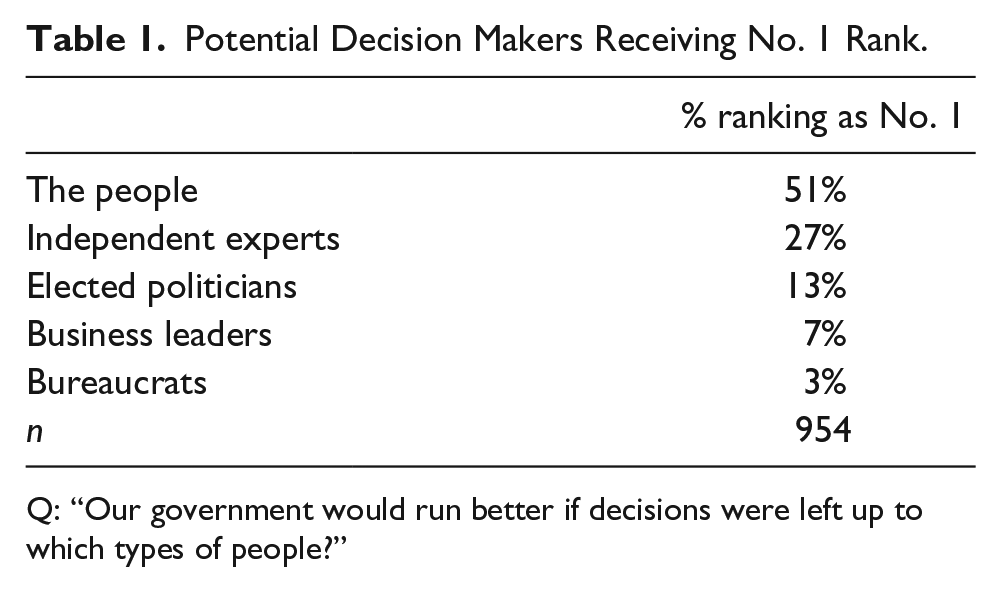
Q: “Our government would run better if decisions were left up to which types of people?”
In general, respondents believe citizens will help the government function, closely followed by independent experts. Surprisingly, elected politicians come in third place, beating business leaders and bureaucrats—two actors that are critical to a less visible and expert-based government design. Because only one stealth actor ranks in the top spots, it may be tempting to suggest nonelected arrangements are not wanted by the American people. We might conclude that citizens have a decent level of respect for the democratic norm of citizen participation. They ultimately want a government that is designed to directly incorporate citizen input, with a good amount of influence from experts, to help processes run more efficiently and effectively. Yet the ranking leaves much to be desired. How do people respond when explicitly asked about the policy-making capabilities of each? How might dropping the vague “nonelected expert” terminology affect these preferences? For this, I turn to my second test of H1 in Table 2.
Trust to Make the Best Policy Decision.
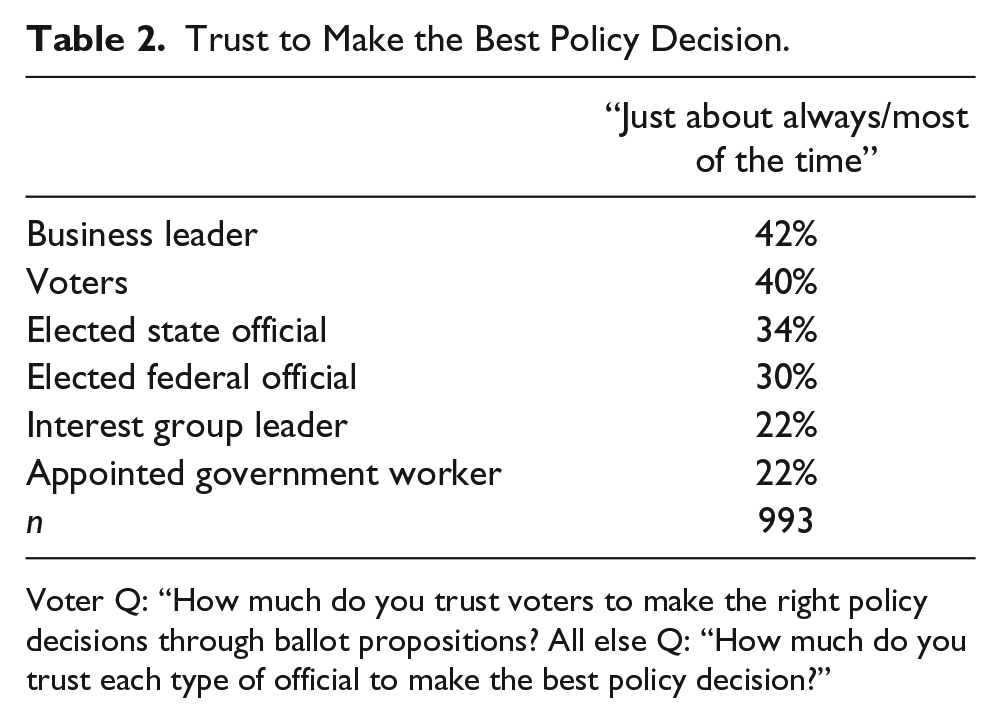
Voter Q: “How much do you trust voters to make the right policy decisions through ballot propositions? All else Q: “How much do you trust each type of official to make the best policy decision?”
These results provide more traction as to the type of “expert” policy makers people want to see in government. First, populist sentiments decline when respondents are asked to gauge the public’s policy-making abilities beyond the abstract (also see Hibbing and Theiss-Morse 2002, 118). Only 40 percent of respondents claim to trust voters to make the “right” policy decisions, while the remaining 60 percent are leery of their decision-making abilities.
Unlike the results in Table 1, stealth actors become more appealing when respondents are asked about their policy-making abilities. Yet the table also suggests the claim that people want less visible actors is a nuanced one. Business leaders, who ranked at the bottom of the first question, receive the highest level of trust to make the best policy decision. Political appointees and, unsurprisingly, interest group leaders—both unelected types of individuals who do their jobs without much citizen input—fall at the bottom. Thus, although business leaders, political appointees, and interest group leaders can all reasonably be labeled as nonelected, independent experts, it is apparent that nonelected actors are not judged similarly when broken down into specifics. 17 In addition, around one-third of respondents appear to trust the role of elected officials in policy making, particularly state-level politicians. While this is certainly not overwhelming support for representative democratic decision making, it does indicate that they are more highly valued than other types of nonelected actors.
In sum, citizens appear to be favorable to expert-based, stealth democratic designs. In the abstract, citizens want to allow more citizen input to govern more effectively. Yet, these sentiments fall away in a more detailed question about the public’s ability to make decisions, while business leaders rise to the top, thus providing support for the first hypothesis. Citizens seem to prefer a government designed around less visible, less accountable actors.
Yet what is more novel about these results is that citizens do not hold various nonelected persons up in the same light. For around one-third of citizens, the influence of elected politicians—both state and federal—are preferable to that of other nonelected persons. When stating that the public prefers expertise over elected or participatory influence, it is apparent that citizens expect a very specific kind of nonelected expertise. Outside of business leaders, the public would prefer to elect representatives rather than hand responsibility to either appointees or interest group leaders.
Assumption 2: Measuring Expertise
The above tests clarify that the nonelected expert category is composed of a fairly specific subset of individuals for citizens. Given this refinement to the types of experts citizens want, it would serve the literature well to further refine the measurement of stealth preferences in institutions. I now turn to more fully unpacking the assumptions surrounding citizens’ preferences for expertise by refining its measurement. A growing critique of the original stealth index is that attitudes about compromise and “getting things done” are largely not related to process preferences (Font, Wojcieszak, and Navarro 2015), especially expert-based ones (Akkerman, Mudde, and Zaslove 2014; Webb 2013).
The stealth state institution questions provide the opportunity to formulate an index that more accurately assesses citizens’ feelings toward nonelected expertise. One assumption of the stealth democracy literature is that stated preferences for the nonelected in the abstract are transferable to specific instances. Although the original additive stealth index surely reflects popular discontent with the government, it does not seem to be particularly good at tapping the assumption that citizens prefer nonelected expertise over elected representatives. The index in the 2014 CCES has a low reliability score overall (α = .29), which is not much different from the score in Hibbing and Theiss-Morse’s original survey (α = .40) (also see Webb 2013). I drop the compromise and “stop talking” question, as they have been shown to mostly capture distrust of politicians rather than expert-based processes, 18 and keep the business and general expert questions. The addition of the specific institutional questions from the CCES results in an index that appears to be much more dependably measuring the underlying factor of nonelected governance with a reliability score of α = .71, which meets the accepted level of reliability.
I use the same model Hibbing and Theiss-Morse use in their original exploration of stealth democracy 19 and compare the original stealth index with the refined measure of nonelected preferences as the dependent variable. In line with the second hypothesis, if the “negatives” think poorly about representative democracy in a general sense, they should react similarly in the refined measure including specific instances as well (see Table 3).
2014 CCES Preferences for Experts: OLS Regression.
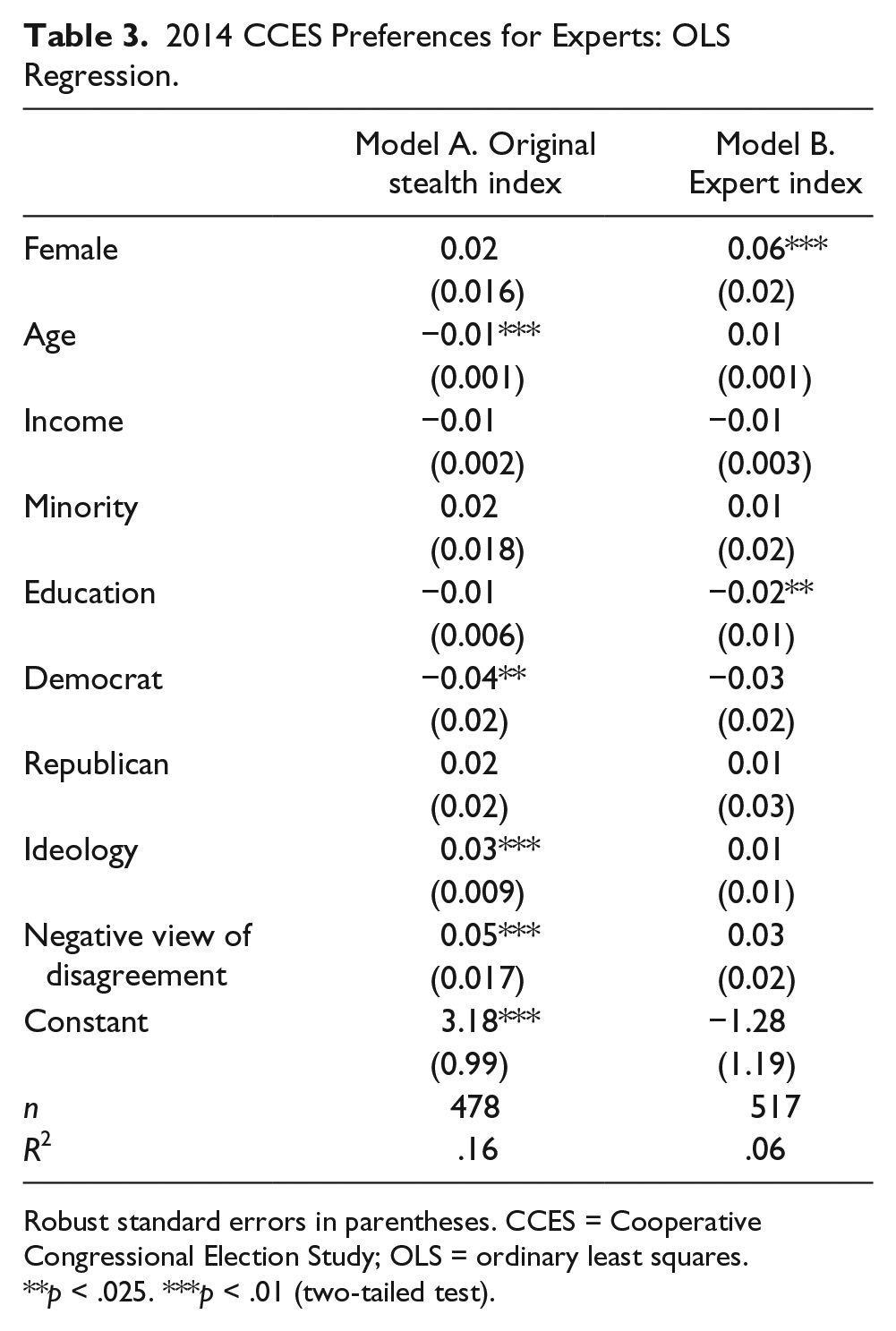
Robust standard errors in parentheses. CCES = Cooperative Congressional Election Study; OLS = ordinary least squares.
p < .025. ***p < .01 (two-tailed test).
A couple of things are apparent in this initial comparison. Most of the explanatory variables that were significant in the original exploration remain significant in the 2014 stealth index (Model A). 20 Negative view of disagreement is signed the same and remains about as substantively significant as the original model. Ideology is signed the same as well, with more conservative individuals being more receptive to stealth democracy. Democratic Party identifiers are also less likely to prefer stealth processes. 21 Education has a negative effect, but it just misses traditional statistical significance with a p value of .058. The closeness of the significance of education seemingly falls more in line with recent comparative research showing that education has a significant negative effect on support for stealth democracy (Bengtsson and Mattila 2009; Coffe and Michels 2014).
However, the more precise measurement of nonelected preferences in Model B tells a different story. The refined measurement introduces less confidence and predictive power for understanding process preferences. Difficult-to-explain process preferences appear to become even more difficult with precise measurement. Those with negative views are not significantly related to the updated index, against the expectations of the second hypothesis. In addition, the effect of ideology and partisanship, which was significant in the original model, drops out here. This is surprising given the business-oriented preferences of more conservative individuals (Hibbing and Theiss-Morse 2002). Education has a statistically significant effect on reducing nonelected preferences here, while being female increases it. This aligns with research showing women as more averse to conflict than men (see Ulbig and Funk 1999), yet the general story from this model is one of insignificance. The refined measure unexpectedly introduces uncertainty over stealth preference explanations that have been used in prior work. Why these variables fail to explain nonelected preferences is puzzling, and it suggests that the literature’s assumptions about stealth governance might require some reexamination.
Assumption 3: Stealth Democracy in the Real World
I conclude testing the assumptions surrounding expertise in stealth preferences by exploring citizens’ evaluations of commissions. Given the second hypothesis, we should expect those with negative evaluations to be the most likely to trust independent commissions. The results of the logistic regression are provided in Table 4.
Support for Independent Commissions: Logistic Regression.
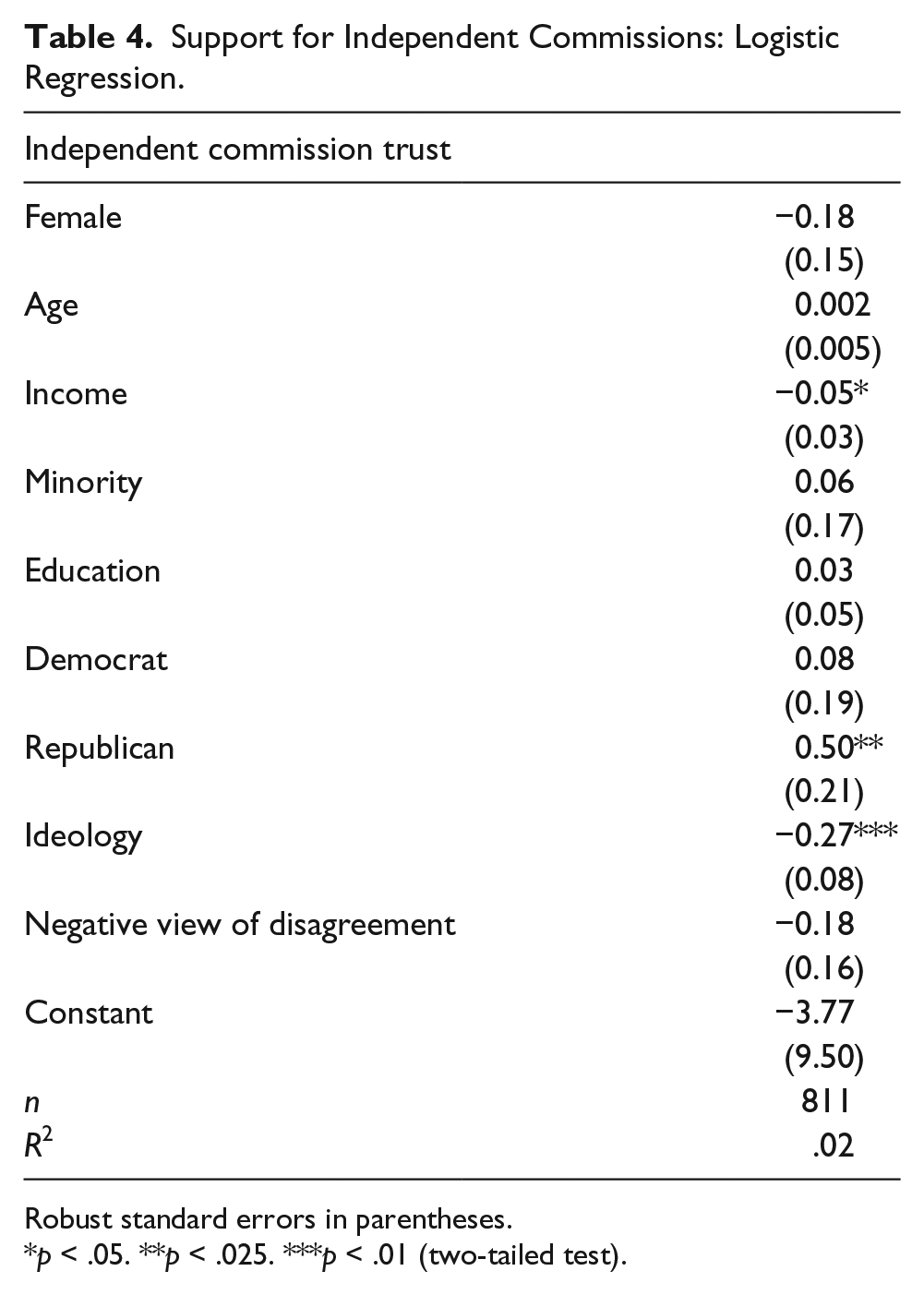
Robust standard errors in parentheses.
p < .05. **p < .025. ***p < .01 (two-tailed test).
These results are interesting because, again, they suggest that people who are more likely to find democratic processes distasteful do not have a particularly strong reactions to proposals that hand more influence to nonelected actors. The model overall tells us very little other than to suggest that support for the third assumption is essentially nonexistent.
After being informed about the role of independent processes in government, respondents again stray from the original expectations of the general stealth democracy model. The question does not force respondents to evaluate one form of government (expert-based) compared with another (representative democracy). It merely asks them to consider how much they might trust this particular type of nonelected influence in the government. Yet even with the disagreement term and a host of conventional explanatory variables, the variation the model is able to explain is appallingly low. When primed to think about an actual stealth structure in republican democracy, responses might be nonattitudes.
While this is only one case, it brings up a host of implications and meaningful questions for future work to explore. Although this study parallels the findings Hibbing and Theiss-Morse found about stealth democracy in the abstract, it also highlights the importance of exploring process preferences in the complex, real-world settings of democracy. Real-world process considerations are strikingly devoid of much usable information. Stealth preferences do not translate from the abstract to specific cases. Although citizens may not be deeply attached to democratic norms, these results question whether citizens have any meaningful attachment to alternative processes.
Discussion and Conclusion
Themes of efficiency and effectiveness are popular in discussions of how to improve the U.S. government, often relying upon nonelected officials to get work done (see Meier 1997) and remove the pressure of electoral forces on decision making. Stealth Democracy parallels the efficiency arguments by claiming that, in fact, nonelected processes may be what citizens want. This is a strong claim that has not yet been fully fleshed out by scholars. Researchers need to pursue questions that speak to how citizens prefer decisions to be made in a more detailed manner or, as Hibbing, Theiss-Morse, and Whitaker (2009, 164) warn, we are “doomed to misdiagnosing those desires.”
The contribution of this analysis is twofold. First, it provides an updated look at stealth preferences in the context of the United States. Much like the original findings by Hibbing and Theiss-Morse and others, my results show that citizens are not strongly attached to representative democracy’s processes and norms. Preferences for more participatory opportunities and democratic deliberation are shallow at best. In light of these results, the stealth preferences found by Hibbing and Theiss-Morse in focus groups and in their larger 1998 survey do not seem to be fleeting.
Yet this analysis also highlights why the premises of political processes deserve better investigation. The more detailed analysis of expert preferences reveals they have shallow support. Thus, the second, and most important, contribution of this exploration is that procedural assumptions need to be analyzed in more detail. As the above analyses highlight, expert process preferences appear to be inconsistent and weak. Differentiating who supports what form of governing process is only valuable if we understand the depth of these preferences.
The weakness of the results is intriguing and highlights the need to question what is known about process preferences. We do not gain much insight about the types of persons most likely to prefer expert processes in this analysis, and it challenges previous roots of support used in the literature. Weak results are, of course, an indicator that you are not adequately measuring the phenomenon of interest, and this is apparent for the above analyses. Refining the expert measurement does not clarify relationships to stealth preferences. Instead, difficult-to-explain process preferences become even more challenging to understand. The weak results suggest that although citizens may not be happy with the way democracy works, they do not necessarily have strong or detailed opinions about a procedural replacement. That citizens react positively to stealth democracy in the abstract may be attributed as a result of populist sentiment than an actual procedural preference.
Overall, this analysis of expert process preferences and its weak results open up many questions about our understanding of process and public opinion more generally. A starting point for future work is asking whether people have a set of procedural preferences that move beyond superficialities. This analysis suggests that the desire for expertise is not deeply rooted, much like Hibbing and Theiss-Morse originally discovered about democratic norms. What processes do citizens like, and who is more likely to prefer them? Although refinement has not offered the intended clarifying effect, this is not to suggest that future work should shy away from attempts to hone the measurement of process preferences.
There is a caveat to the findings from this analysis. Although preferences for expertise are muddy, this may not hold when other kinds of processes are refined. Would we get a similarly muddied result for, say, a refined measure of direct democratic processes? It might be that expert-based processes are too far removed from respondents’ mind-set for them to have a discerning opinion of them. However, given the use of expert preferences by prior work, it serves as an appropriate starting place for deeper investigations of process considerations.
One way the literature can refine our understanding of process preferences is to measure procedures in terms of how governing institutions actually operate, not by abstractions. Although this analysis attempts to do this, it only does so under a specific investigation of expertise. Future work should detail the basic processes used by legislatures, for instance, to examine the specific decision-making processes the public finds to be particularly appealing or unappealing. By breaking down the common processes used by institutions, the literature may be able to more closely approximate the procedural preferences of citizens.
Although this analysis tackles one type of political process (expert-based), it aligns with contemporary calls to examine whether process preferences are potentially shallow and volatile (Font, Wojcieszak, and Navarro 2015) to better inform the nature of them. In an era where process preferences are receiving more attention as trust in government wanes and citizens elect candidates—both in the United States and internationally—that represent alternative process perspectives, it is important that we explore the assumptions and implications of different types of processes to understand the depth of these preferences and their potential to change politics. It is imperative that future scholars approach the study of process preferences with care.
Footnotes
Declaration of Conflicting Interests
The author(s) declared no potential conflicts of interest with respect to the research, authorship, and/or publication of this article.
Funding
The author(s) disclosed receipt of the followingfinancial support for the research, authorship, and/or publication of this article: I received research funding from the Kinder Institute on Constitutional Democracy.
Supplemental Material
Replication data for this article are available with the manuscript on the Political Research Quarterly (PRQ) website.
Notes
References
Supplementary Material
Please find the following supplemental material available below.
For Open Access articles published under a Creative Commons License, all supplemental material carries the same license as the article it is associated with.
For non-Open Access articles published, all supplemental material carries a non-exclusive license, and permission requests for re-use of supplemental material or any part of supplemental material shall be sent directly to the copyright owner as specified in the copyright notice associated with the article.
