



Abstract
Demographic changes from decades of mass immigration and shifts in internal migration patterns are upending the traditional racial composition of many states throughout the United States, transforming the American electorate, and increasing both the political salience of immigration and the racial salience of Latinos. Politicizing these visible demographic shifts has become an increasingly common strategy by both Democrats and Republicans with potentially significant electoral effects. While many have examined the impact of these demographic changes on dominant receiving populations’ attitudes, few have examined how changing demographics are shaping immigration politics in electoral campaigns. Specifically, under what conditions do political candidates politicize demographic change? I hypothesize that both political and demographic considerations drive variation in immigration appeals. I test my hypotheses using a novel dataset of candidate campaign websites from 2010, 2012, and 2014 US Senate primary and general elections. I argue that racial party cleavages increase the electoral temptation of immigration appeals but it is the interaction between state-level Latino population growth, electoral competition, and Latino voters that determines campaign strategy more broadly and moderates the use of pro- and anti-immigrant appeals.
On October 9, just under a month before the 2014 midterm elections, Republican US Senate candidate Scott Brown took to New Hampshire’s WGIR talk radio to hammer home a central campaign theme: that “illegal” immigrants were threatening America’s national security. By October, generic anti-immigrant appeals had given way to a far more dramatic style. Brown warned WGIR listeners that undocumented immigrants with Ebola might be crossing the US–Mexican border. “One of the reasons I’ve been so adamant about closing our border, because if people are coming through normal channels, can you imagine what they can do through a porous border?” (Santana 2014). Nearly 2,000 miles west of New Hampshire, Republican US Senate candidate Cory Gardner ran an uphill battle against Democratic incumbent Senator Mark Udall in Colorado, a state with over one million Latinos. Immigration appeals were conspicuously absent from Gardner’s campaign. Given Colorado’s proximity to the US–Mexican border, sizable Latino population, and frontier conservative roots, we might expect immigration to emerge as a potent issue in Colorado, but not in New Hampshire, a racially homogeneous state nestled in New England. What explains these divergent approaches to campaign messaging?
More specifically, under what conditions do politicians politicize immigration in electoral campaigns? Past research has examined the role of racial attitudes in electoral campaigns (Mendelberg 2001; Tesler and Sears 2010), how immigration attitudes are formed (Brader, Valentino, and Suhay 2008; Kinder and Kam 2010; Nicholson 2012; Scheve and Slaughter 2001; Valentino, Brader, and Jardina 2013), what drives variation in the political salience of immigration (Brader, Valentino, and Suhay 2008; Hopkins 2010; Newman, Hartman, and Taber 2014), and the role that immigration plays in shaping party coalitions (Hajnal and Rivera 2014), yet none have examined the supply side of immigration appeals. How are shifting demographics shaping modern political campaigns?
Nearly every county in the United States has been experiencing growing Latino populations over the last several decades. Politicizing these demographic shifts, I argue, can be used toward two ends. First, anti-immigrant appeals might serve to mobilize conservative white voters and potentially pull less partisan white voters into the Republican Party, particularly for those in rapidly changing “acculturating” contexts (Hajnal and Rivera 2014; Newman 2013) as long as Latino countermobilization is not a credible threat. On the Democratic side, candidates in states with large Latino populations use pro-immigration appeals in an attempt to mobilize Latino voters (Barreto and Schaller 2015; Collingwood, Barreto, and Garcia-Rios 2014). 1
In what follows, I examine a novel dataset of US Senate campaign web appeals in 2010, 2012, and 2014. I find evidence that supports a model of immigration appeals that takes into account both political and demographic factors. I find that Republican candidates in states with rapidly changing demographics are more likely to use anti-immigrant appeals as long as the Latino population is not large enough to threaten a credible countermobilization. I find further evidence that Democratic candidates generally refrain from using pro-immigrant appeals until the Latino voting population reaches a critical mass. These relationships are moderated by the level of competition in each campaign, a variable that further shapes the incentives and strategic decision making of candidates.
This study makes three distinct theoretical and methodological contributions. First, in contrast to the majority of research on immigration politics, I look jointly at the electoral influence of both white and Latino voters in contemporary immigration politics rather than a single racial or ethnic group. Second, this study contributes to a broad literature on campaign communication and racial appeals, which has focused overwhelmingly on the use of traditional anti- or pro-black racial appeals. Third, while the vast majority of studies on campaign communications rely on television advertising data, which necessarily omits a significant number of candidates, this study exploits a unique data sources—campaign websites—allowing for a far more comprehensive look at campaign strategy. It suggests that scholars can use a combination of web archives and scraping techniques to gather large datasets of professional campaign appeals from nearly every candidate running for many professional elected offices from the national to the state and local level. Using these data, inferences about candidate messaging can be made about a far more comprehensive sample of candidates, not just those that are able to raise enough money for television advertising.
The Electoral Connection
The collapse of the Southern Democratic Party and party realignment throughout the latter half of the twentieth century has been one of the most important and consequential political developments of contemporary American politics, illustrating the importance of race in American politics (Black and Black 2002; Carmines and Stimson 1989). As the Democratic Party threw its support behind Civil Rights, Southern Democrats began to trickle out of the Party. Goldwater, Nixon, and Reagan’s attempts to woo moderate or conservative whites into the GOP helped tear apart the southern Democratic coalition and establish a strong Republican presence south of the Mason–Dixon line (Giles and Hertz 1994; Hajnal and Rivera 2014; Huckfeldt and Kohfeld 1989; Schickler 2016; Sears, Citrin, and Kosterman 1987).
The Democratic Party, while still majority white, continues to rapidly diversify. Over the last three decades, the Democratic Party has dropped from 80 percent to about 60 percent white. A majority of Latinos and Asian Americans now vote for Democratic candidates and most Latino and Asian American elected officials are Democrats. The Republican Party, by contrast, is now about 90 percent white and increasingly defined by its racial homogeneity (Hajnal and Rivera 2014; Olson 2008). These trends have only accelerated since President Barack Obama’s election in 2008 (Tesler 2016; Tesler and Sears 2010).
The potential impact of shifts in social group composition of each party cannot be overstated. Even those who believe strongly in the durability of partisan attachments (Goren 2005; Green, Palmquist, and Schickler 2002) argue that changing social group imagery has the power to shift voter partisanship, establishing a set of racialized incentives and strategies for Democratic and Republican candidates seeking to win elections (for strategic campaign decisions, more generally, see Jacobson and Kernell 1983).
Republicans have a strong incentive to mobilize their conservative white base and expand their electoral coalition, most fruitfully through appeals to racially conservative whites (Hillygus and Shields 2009). One of the most powerful and frequently used tools in the Republican repertoire has been racial appeals. Kinder and Sanders (1996) theorize that the “electoral temptations of race” are potent, given the historical success of racial appeals in mobilizing white participation (see also Edsall and Edsall 1992; Tesler and Sears 2010). As I argue in the next section, immigration has become a highly racialized issue that conservative candidates can exploit for electoral gain (Craig and Richeson 2014).
Democratic candidates face a different set of incentives. For a brief period from the late 1960s through the early 1990s, the Democratic Party served as the home of proracial policies and ideas like affirmative action and busing. In the 1990s, vast reforms spearheaded by President Clinton and the Democratic National Committee (DNC) helped purge non-color-blind policies from the party’s platform and steer it back toward the political center (Frymer 2009). The dominance of color-blind ideology today coupled with the party’s continuing reliance on both white and nonwhite voters structures Democratic electoral incentives. The key challenge for Democrats is maintaining enthusiasm among African American, Latino, and Asian American voters without alienating racially conservative white Democrats (Kinder and Sanders 1996).
The Politicization of Immigration
While the black–white racial divide in the United States has traditionally shaped racial appeals in American politics, candidates are increasingly racializing and politicizing immigrants, particularly Latino immigrants (McIlwain and Caliendo 2011). After years of massive immigration into the United States, conservative politicians honed anti-immigrant and anti-Latino appeals (Haney-Lopez 2014). Pat Buchanan warned of the cultural and political threat from the Hispanic “invasion” (Buchanan 2007; Huntington 2005). Republican wordsmith Frank Luntz wrote memos encouraging Republican candidates to focus on illegality, criminality, and antisocial behavior of Latinos in the United States. The illegality narrative has now become commonplace in Republican political campaigns (Haney-Lopez 2014).
At the same time, pro-immigration appeals are becoming common additions to Democratic candidate toolkits. With increasingly larger Latino voting populations, effective mobilization can make the difference between winning and losing elections (Fraga and Leal 2004). Senator Harry Reid’s effective mobilization of Latino voters in Nevada’s contentious 2010 senate race assured his victory against Sharron Angle. Senator Mark Udall’s loss to Cory Gardner in Colorado’s 2014 senate race can be attributed, in part, to Udall’s disregard of Latino voters. Immigration has become a “qualifying” issue for Latino voters (Barreto and Schaller 2015).
In sum, immigration appeals are a new form of racial appeal. As the social group imagery of the parties continues to change, Republicans face a set of electoral incentives that strongly encourage racialized anti-immigrant appeals. 2 Democrats, on the contrary, face incentives to avoid pro-immigration appeals generally, unless a sizable portion of their electorate is Latino. 3 But what drives variation across candidate campaigns?
Immigration Politics: When Do Candidates Go Nativist?
Immigration appeals may be unique in their potent ability to mobilize both the Republican base (see Miller and Schofield 2008) and Democratic base (Barreto and Collingwood 2015), as well as persuade cross-pressured swing voters (Hillygus and Shields 2009). It is likely that any campaign will use both strategies, though it may prioritize one over the other.
In the following sections, I argue that three key variables explain much of the variation in whether candidates and their campaign teams use immigration appeals: demographic change (rate of growth of the Latino population), voter composition (anticipated voting influence of Latino voters), and campaign competition.
Demographic Change and Immigration Threat
Attempts to apply the racial threat hypothesis to immigrants have resulted in conflicting findings (Campbell, Wong, and Citrin 2006; Dixon and Rosenbaum 2004; Gay 2006; Oliver and Wong 2003; Stein, Post, and Rinden 2000; Tolbert and Grummel 2003). Recent work on immigrant threat, however, persuasively shows that demographic change, particularly rate of demographic change conditioned on baseline demographics, threatens personal and collective goods attached to a community (Newman 2013; Newman, Hartman, and Taber 2014; Newman and Velez 2014).
This demographic change is affecting some states and communities more than others. For much of American history, Latino immigrants traditionally settled in just a handful of immigrant receiving states: California, Texas, New York, Illinois, and Florida. Over the last few decades, however, immigrants and their children have been bypassing these traditional receiving states in favor of new destinations, mostly across the South and Midwest. Similarly, there is considerable variation in percentage of Latinos who are registered voters in each state. In West Virginia, Maine, and Vermont, Latinos make up less than one half of 1 percent of registered voters. In New Mexico, California, and Texas, they make up a quarter or more of voters.
While the actual impact of Latino immigrants in these new receiving states is likely quite localized (Hopkins 2010; Newman 2013), and its effect on state-level policies mixed (Gulasekaram and Ramakrishnan 2012), I hypothesize that rapid demographic change in a state will increase the probability that conservative candidates will attempt to mobilize anti-immigrant attitudes with anti-immigrant appeals. 4 Rapid demographic change is likely to affect at least some communities and voters, generate media coverage in the state, increase the salience of immigration and demographic change, and provide a bridge for voters between local change and national debates (Hopkins 2010). If a candidate decides that politicizing demographic change and mobilizing attitudes around immigration will be electorally beneficial, immigration appeals will likely be featured prominently in campaigns (Druckman, Jacobs, and Ostermeier 2004). Not all of the variation in appeals will be determined by demographic shifts, some candidates will attempt to mobilize immigration attitudes as a general racialized dog whistle appeal regardless of state demographics (Haney-Lopez 2014), but I expect an overall positive relationship between demographic change and Republican anti-immigrant appeals.
Latino Voters and Countermobilization
While rapid demographic change could incentivize anti-immigrant appeals among conservative candidates, Latino countermobilization could disincentivize such appeals. This countermobilization theory, or “Pete Wilson Effect,” posits that anti-immigrant political appeals can increase ethnic solidarity (Martinez 2008; Pérez 2010). As the US Latino population continues to grow, register to vote, and engage in political activity, Latino countermobilization is increasingly becoming a political risk for politicians who opt for xenophobic appeals.
California’s experience in 1994 provides an illustrative case study. Governor Pete Wilson’s full throated support of famously anti-immigrant Proposition 187 was smart short-term politics. As Nicholson (2005) notes, by linking his campaign to the proposition, immigration became the defining issue of the election. It paid off. Wilson won the election with the help of white voters who cared deeply about immigration.
The long-term consequences, however, were devastating for California Republicans. After Proposition 187, immigration activists quickly shifted resources to electoral politics (HoSang 2010). By 1996, Latinos were naturalizing, registering to vote, and turning out in record numbers. In fact, Pantoja, Ramirez, and Segura (2001) find that newly naturalized Latinos in California after the Proposition 187 fight turned out at higher rates than Latinos in other states without the same nativist political climate. Latinos were also voting increasingly for the Democratic Party. Bowler, Nicholson, and Segura (2006) find that Proposition 187 (together with other racial Propositions 207 and 229) nearly doubled the probability that Latinos would vote Democratic (see also Barreto and Collingwood 2015). By 2000, the Latino share of the state electorate increased from 7 percent in 1990 to 14 percent with an addition of more than one million Latino voters to the rolls (DiCamillo and Field 2000), and by 1998, Democrats had won back the statehouse, state assembly, and state senate.
Politicians and political strategists learn from past mistakes and conduct cost–benefit calculations when constructing campaign agendas and strategies. Republican candidates need to decide if the increase in support that they might gain from mobilizing their base will have a net-positive impact given the probability of Latino backlash. The relationship between Latino voters and anti-immigrant appeals will therefore be nonmonotonic, an inverted U-shaped curve, where the probability of anti-immigrant appeals in racially homogeneous states is relatively lower due to the low salience of immigration, high in racially bifurcated states with moderate numbers of Latino voters where the population is visible but not politically threatening, and low again in states with large Latino voting populations where political backlash becomes a real risk.
There is electoral risk for Democrats making pro-immigrant appeals as well. The key challenge for Democratic candidates is maintaining enthusiasm among African American, Latino, and Asian American voters without alienating white Democrats (Kinder and Sanders 1996). In contemporary campaigns, this has often manifested in lip-service appeals to racial minority groups while openly espousing programs that please white “moderates,” as was the case with Bill Clinton’s presidential campaign (Frymer 2009). Democratic candidates will likely avoid pro-immigrant appeals unless the Latino voting population in the state is large enough to offset the risk of white voter alienation. Research in comparative politics finds that when a group is large enough to constitute a viable partner in a political coalition, then that group will be mobilized (Posner 2004). We might expect the same in the US context. That is, when the Latino voting population is large enough, pro-immigrant appeals signal to Latino voters that a candidate cares about Latino issues (Barreto and Schaller 2015).
Taken together, Hypotheses 2a and 2b suggest that Latino voters play a crucial role in moderating immigration appeals. In states with small Latino voting populations, Republicans are more likely to use anti-immigrant appeals without fear of Latino countermobilization. In states with large Latino voting populations, Republicans are expected to avoid anti-immigrant appeals and Democrats are expected to mobilize Latino voters with pro-immigrant appeals.
Competition
Finally, candidate electoral strategy is heavily influenced by perceived electoral competition. Competition is likely to increase or decrease the importance of each strategic decision made in my campaigns. As Cox and Munger (1989, 217) put it, “closeness stimulates elite effort.” In competitive elections, for example, candidates spend more money (Cox and Munger 1989), are more likely to go negative (Goldstein and Freedman 2002; Theilmann and Wilhite 1998), and are more likely to discuss issues (Kahn and Kenney 1999). Furthermore, campaigns might be more likely to attempt to reach out to and mobilize groups not represented by the other party in competitive elections (Frymer 2009). Competitive elections also amplify the importance of smaller groups of voters, like Latinos, because small shifts in support can alter the outcome of the election at the margins (Fraga 1992). Therefore, immigration appeals will also likely vary by electoral competitiveness.
The interaction between competition and demographics is complex. Campaigns face trade-offs in choosing who to mobilize with which issues. For Republicans and anti-immigrant appeals, the trade-off lies between mobilizing a conservative white base and risking Latino countermobilization. If a GOP candidate is running in a competitive election in a state with a small number of Latino voters who pose no electoral threat, anti-immigrant appeals might provide a boost in support from the base that could help win the election. If that same candidate is running in a state with enough Latino voters to swing an election, that candidate might choose different issue appeals, deciding that anti-immigrant appeals are too risky. If that same candidate is polling well ahead of the competition, those Latino voters are far less likely to pose a threat to their candidacy, and fear of countermobilization should diminish. Similarly, candidates who are losing by considerable margins often will use risky and radical appeals to try and improve their electoral standings, regardless of potential backlash. 5
For Democrats, the strategic trade-offs are different. A Democratic candidate needs to decide whether it is more beneficial to mobilize white Democrats and ignore Latino voters or to mobilize Latino voters and risk alienating white voters (Frymer 2009). As with Republicans, competition should increase the probability that candidates will attempt to mobilize Latino voters with pro-immigration appeals. In these elections, the strategic importance of Latino voters increases. For Democrats who hold a strong lead in the polls or are losing considerably, mobilizing Latino voters with pro-immigration appeals becomes less necessary or appealing. 6
In sum, my theory of immigration appeals posits that both demographic factors and political factors determine when candidates mobilize immigration attitudes. It is the interaction of demographic change, Latino voters, and competition that moderate campaign appeals from both Republicans and Democrats.
Data and Method: Measuring Campaign Issues
I examine US Senate races. US Senate campaigns offer significant variation in media coverage, competition, voter turnout, reactions to candidates and campaigns, incumbency, levels of campaign fund-raising and spending, state racial composition, and state demographic change that is not available in presidential elections (Abramowitz and Segal 1992; Kahn and Kenney 1999). Furthermore, campaigns for US House seats are increasingly safe for incumbents, rarely competitive (Abramowitz, Alexander, and Gunning 2008), and tend to focus less on issues and more on candidate character and style (Fenno 1978).
In all, my data consist of 616 candidates who ran for US Senate in 2010, 2012, and 2014: 56 percent were Republican (344) and 44 percent Democrats (272) 7 ; 423 (68%) of the candidates ran in the primaries, while 193 (31%) advanced to run general election campaigns. This number includes primary and general election Democratic and Republican candidates. Because Senate races are staggered, using three campaign years of data allows me to include all major US Senate candidates from all 50 states and allows me also to control for a presidential election year (Herrnson 2012).
Dependent Variables
Despite the importance of rhetoric and issue appeals in the study of campaigns and campaign strategy, it is difficult to choose the appropriate source of data for analysis given the increasing diversity of communication channels available to campaigns. Campaigns are complex and candidates today use a variety of mediums to communicate with various constituencies (Lau and Pomper 2004). In this study, I examine the website issue pages of 2010, 2012, and 2014 US Senate candidate campaigns. Druckman, Kifer, and Parkin (2009) argue that websites are ideal for studying campaign strategy, as they are unmediated by outside forces, cover a full range of rhetorical strategies, and are representative of the population of campaigns, given their wide adoption by candidates. Furthermore, campaigns prioritize undecided voters when crafting appeals (over press and other potential audiences). Therefore, we might assume that the issue positions crafted by campaigns and consultants on campaign websites reflect the strategic calculations made regarding anticipated campaign competition and demographic changes and composition, at least at the beginning of a campaign (Druckman, Kifer, and Parkin 2009). 8
Websites are ideal because nearly every candidate for political office creates a campaign website to communicate campaign materials to constituents and potential voters, allowing measures of campaign communication far more representative than TV ads and easily comparable across candidates. Furthermore, campaign websites are part of web archives, allowing researchers to more readily collect data on past elections. To my knowledge, television advertisements are the only form of political communication that is regularly collected and coded for researchers. These data, however, are generally embargoed for several years after elections, seriously hampering the ability of researchers to analyze campaign communication until several election cycles have passed. Websites have drawbacks as well. Most importantly, the largest limitation of website data is that it fails to measure issue saturation the same way that television advertising or other communications might, though websites do measure issue valence.
Website data were gathered from Stanford University’s web archiving initiative of at-risk materials for the 2014 campaign cycle. Stanford’s Political Science Department coordinated with web archive service, Archive-It, to provide an openly available and searchable database of captures of 2014 primary and general election congressional candidate websites. Depending on campaign site traffic, sites were archived between 2 and 145 times throughout the primary and general elections. 9 For 2010 and 2012 data, I used Archive-It to find a scrape of candidate websites during each respective primary and general election. Nearly all of the candidates had campaign websites that had been crawled by Archive-It during both the primary and general elections. As crawls are based partly on web traffic, the only sites that were not archived were those of extremely marginal candidates who have no campaign apparatus or communications strategy and whose messaging strategy would likely follow a different data generating process.
My dependent variables are dichotomous measures of immigration web appeals. 10 For each candidate’s archived website, I searched for “issues” pages and hand coded pro- and anti-immigrant language based on both issue framing and policy emphasis. There were very few ambiguous immigration appeals. Anti-immigrant appeals generally frame immigrants as “illegal,” explicitly oppose “amnesty,” and take a “border first” approach to reform. Pro-immigrant appeals generally refer to immigrants as “undocumented,” support Development, Relief, and Education for Alien Minors Act (DREAM Act) legislation, and call for “comprehensive immigration reform.” I explain my coding decisions in greater detail in the supplemental material.
Independent Variables
Demographic change and demographic composition
In this paper, I focus explicitly on change in the Latino population, as opposed to Asian American, Arab American, or African immigrant populations for two reasons. First, even though Asian Americans have surpassed Latinos and Hispanics as the fastest growing foreign-born group, most of the growth in the immigrant population after the Immigration and Reform Control Act of 1986 came from Mexican, Central American, and South American immigrants. Second, over the last two decades, immigration trends, media coverage, and elite rhetoric have established the archetypal immigrant as a low-skilled undocumented Latino. Therefore, most Americans associate immigrants with undocumented Latinos and more ably recognize demographic changes in Latino population than in Asian American population (Newman and Velez 2014).
To measure Latino population growth, I calculated changes in Latino population at the state level from 2000 to 2010, 2002 to 2012, and 2003 to 2013. All demographic information was collected from the US Census and American Community Survey (ACS) estimates. The year 2000 is a natural starting point for measuring Latino population growth. Throughout the immigration wave of the 1990s, Latinos increasingly dispersed from traditional immigrant receiving states into smaller towns, cities, and neighborhoods throughout the country. As they established roots, many started families, fueling Latino population growth (net migration from Latin America dropped to around zero during the great recession). Throughout the 2000s, Latino children enrolled in schools, increasing the salience of demographic change and the visibility of the community to native residents. Furthermore, September 11, 2001, is seen as an important turning point in public portrayals of immigrants and Latinos in particular. Thus, measuring Latino population growth from the early 2000s to the election year captures these important contextual changes. 11
I also use the US Census and ACS to collect information on the number of Latino registered voters for determining Latino backlash and Democratic pro-immigrant appeals. 12
Competition
To measure competition, I first collected all polling data from Real Clear Politics and race ratings from Cook Report. For those with Cook Report ratings (general election candidates), I coded the race as competitive for “toss-up” races, and ahead or behind if the race was leaning or safe for the candidate. For primary races, I calculated the average of the earliest polls available during the primary when they were crafting their website appeals. For races that had no polling, I substituted the final vote tally as an average measure of campaign competition, though nearly every race that had two or more candidates and was moderately competitive had at least one poll available. For those candidates that polled ahead throughout the race, I calculated the spread between their poll average and the nearest challenger. Each subsequent candidate in the race received a score equivalent to the size of his or her spread with the leading candidate. 13 I then split candidates into three categories and created three dummy variables: ahead, behind, and competitive. Given variability and uncertainty in polling, I categorized all candidates who averaged between 10 points behind and 10 points ahead in a race as competitive, which is the average range of polling for candidates who fell into the “toss-up” or “lean” categories in the Cook Report. Measuring competition this way is an improvement over more convenient measures, like winner margin of victory over opponents which is measured posttreatment, or worst, voter registration figures (see Nicholson and Miller 1997 for an overview).
Controls
To control for confounding explanations, I include a number of additional variables. I include a dummy for incumbency (Skaperdas and Grofman 1995), a variable measuring 2012 vote spread for Mitt Romney by state to rule out variation that might occur due to general voter ideology in a state and a measure for mean immigration attitudes. For immigration attitudes, I summed responses to five questions on immigration in the 2010 and 2012 Cooperative Congressional Election Study (CCES) and then calculated the mean anti-immigrant attitude score for Republicans and Democrats in each state. 14
In the pro-immigration models, I include a measure for white proportion of self-identified Democrats by calculating the percentage of Anglo respondents who self-identify as Democratic by state. I expect that Democratic candidates who have more white voters in their states will be less likely to use pro-immigrant appeals given their increased reliance on white voters for electoral success.
I include year dummies to control for effects of the presidential election or other time variant events not explicitly measured in my models. Means and standard deviations of all independent variables can be found in Table A3 of the supplemental material. 15
Method
Given that my dependent variables, whether a website includes anti- or pro-immigration appeals, are dichotomous, I model them using a logistic regression. In the Republican model, I interact Latino registered voters with level of campaign competition and Latino registered voters with Latino population growth, as I expect candidates to care about Latino voters differently across varying levels of campaign competition and state Latino population growth. I also square Latino population in Republican anti-immigrant models because I expect the relationship between Latino population and immigration appeals to be nonlinear. Specifically, I want to account for the theorized Latino countermobilization effect. For Democratic pro-immigrant appeal models, I interact competition with Latino voters, but not with Latino population growth, as population change should not matter for Democratic candidate strategy. I include the covariate for percentage of Democrats who are white in the model.
Results
I posited that Republicans would be more likely than Democrats to use anti-immigrant appeals and Democrats more likely than Republicans to use pro-immigrant appeals. In Table 1, I disaggregate appeals by party. Nearly all of the pro-immigrant appeals are found on Democratic campaign websites and anti-immigrant appeals are found on Republican campaign websites. As expected, Republicans generally do not use pro-immigrant appeals and Democrats generally do not use anti-immigrant appeals.
Pro- and Anti-immigrant Appeals Broken Out by Party.
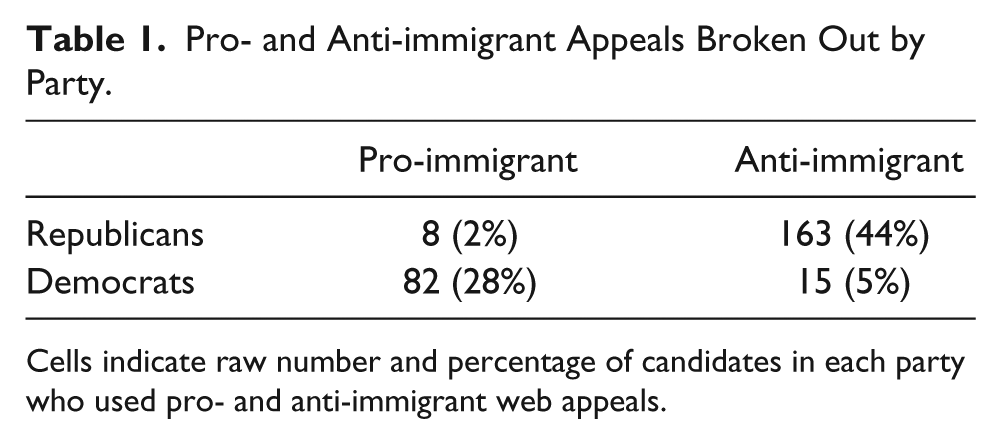
Cells indicate raw number and percentage of candidates in each party who used pro- and anti-immigrant web appeals.
Politicizing Demographic Change
For the remainder of the analyses in this paper, I estimate two separate models of pro- and anti-immigrant appeals for Republican and Democratic candidates. In Table 2, I display the point estimates and standard errors for both the Republican anti-immigrant model and Democratic pro-immigrant model. So few Democrats ran anti-immigrant and Republicans pro-immigrant appeals and are not modeled. Because it is difficult to interpret logistic coefficients, particularly when the model includes interactions and nonlinear terms, I instead calculate and plot counterfactual quantities of interest (King, Tomz, and Wittenberg 2000).
Main Regression Results.
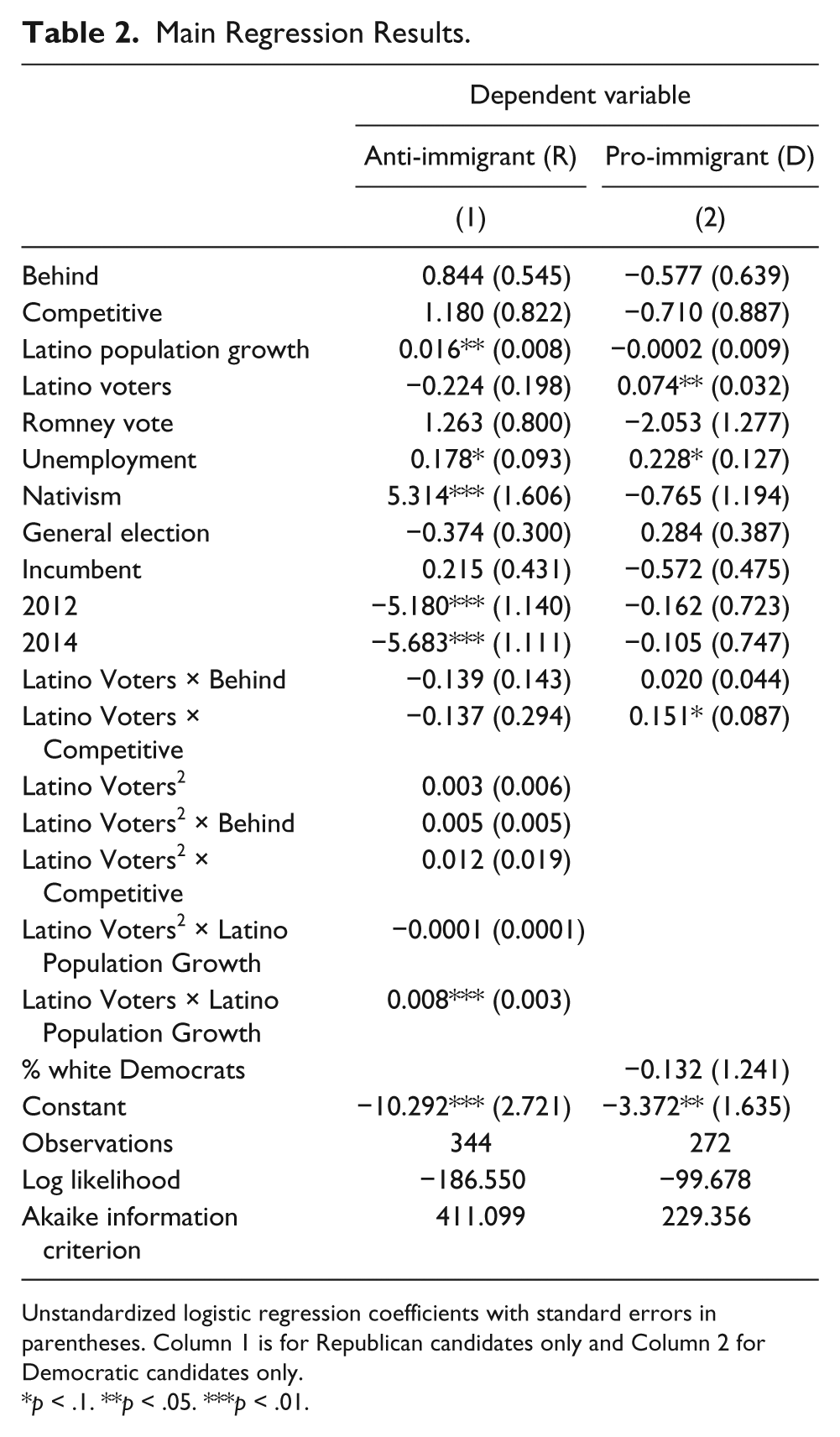
Unstandardized logistic regression coefficients with standard errors in parentheses. Column 1 is for Republican candidates only and Column 2 for Democratic candidates only.
p < .1. **p < .05. ***p < .01.
As hypothesized above, rapid Latino population growth should increase the salience of immigration in a state and prime anti-immigrant attitudes, particularly among conservative voters, increasing the probability that Republican candidates will use anti-immigrant appeals. I do not expect Latino population growth to have a significant impact on Democratic candidate strategy. Democrats care about cultivating Latino voters, which means that they are more likely to avoid anti-immigrant appeals, in general, and use pro-immigrant appeals only when there are enough Latino voters to make it electorally worthwhile. 16
I visualize the impact of the full range of Latino population growth on probability of immigration appeals in Figure 1, holding all other covariates at their means. We see a strong positive relationship between the two. Republican candidates in states experiencing the most rapid growth of their Latino populations are about 77 percentage points (95% confidence interval [CI] = [45.2, 92.8]) more likely to use anti-immigrant appeals than their counterparts in states with the slowest growing Latino population. Democrats in rapid Latino growth states, however, are only 4 percentage points (95% CI = [−31, 43]) more likely to use pro-immigrant appeals than their counterparts in states with slow Latino population growth. As above, I calculate in-sample first differences and find a smaller but still significant effect for Republican candidates, 55.6 percent (95% CI = [22, 82]), and a similar effect for Democratic candidates, 2.4 percent (95% CI = [−32.9, 36.3]).

Effect of demographic change on probability of Republican anti-immigrant and Democratic pro-immigrant web appeals.
In general, Republicans are significantly more likely to use anti-immigrant appeals in states with rapid Latino population growth, supporting my second hypothesis. Latino population growth appears to have no effect on Democratic pro-immigrant appeals. I do, however, argue that large Latino voting populations will incentivize Democratic candidates to mobilize pro-immigrant attitudes, particularly in competitive elections. I test this next.
Mobilizing Pro-immigrant Attitudes
Collingwood, Barreto, and Garcia-Rios (2014) find that Democratic presidential candidates face incentives to mobilize Latino voters in states with large Latino populations, particularly in competitive battleground states. I expect the same will be true with US Senate candidates. As hypothesized above, Democrats will avoid alienating white voters by avoiding pro-immigrant appeals until the size of the Latino voting population is large enough to outweigh that risk. Competition should increase the importance of Latino voters, too, further increasing the probability of pro-immigrant appeals, particularly in states with large Latino voting populations.
In Figure 2, I display the predicted probabilities of Democratic candidates using pro-immigrant web appeals given the full hypothetical range of Latino voting populations for candidates with competitive, winning, and losing campaigns. The impact of Latino voters also has a large and substantive impact on the probability of using pro-immigrant appeals. Democratic candidates in states with large number of Latino voters (µ + 1 SD) are about 34 percentage points (95% CI = [5.9, 60.8]) more likely to use pro-immigrant appeals than Democratic candidates in states with an average number of Latino registered voters (6.1%).
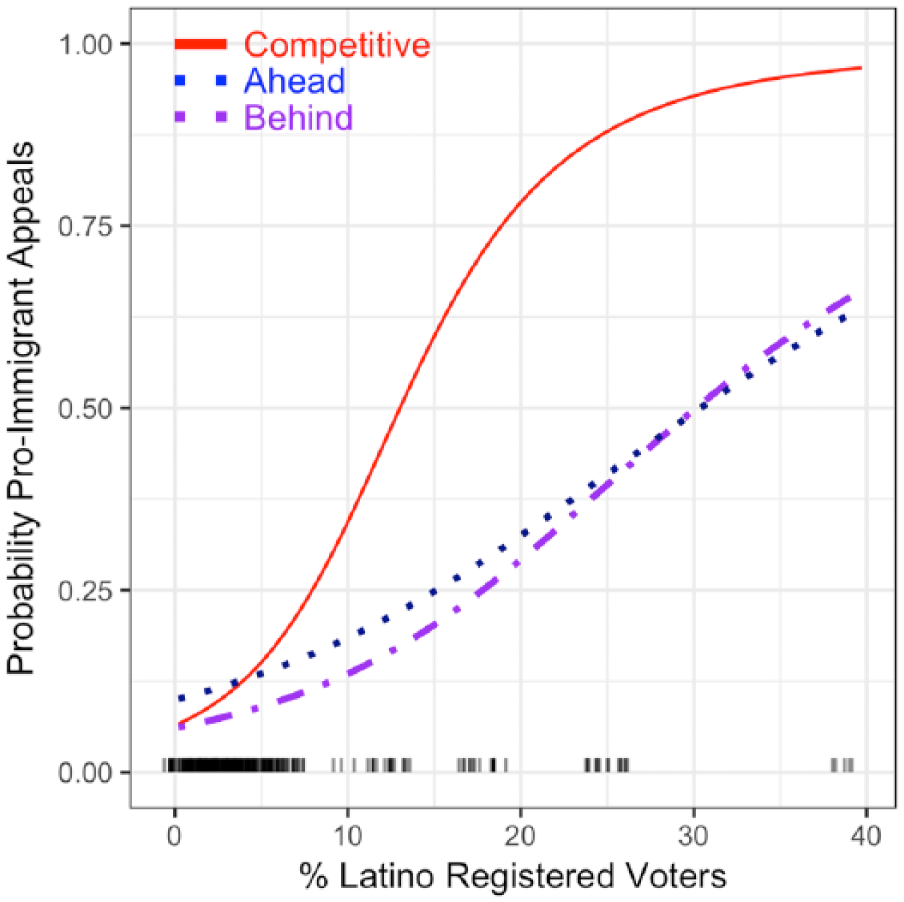
Effect of Latino population on probability of democratic pro-immigrant web appeals.
Also as expected, Democrats in competitive elections are more likely than others to use pro-immigrant appeals and more likely to use pro-immigrant appeals in states with smaller Latino voting populations than losing candidates. The predicted probability of using pro-immigrant appeals surpasses 50 percent when Latinos compose around 11 percent of the state’s total registered voters. Candidates in losing campaigns tend to only use pro-immigrant appeals in states with much larger Latino voting populations, suggesting that losing candidates are less likely to take risks mobilizing Latino voters than candidates with a large polling margin or in a competitive race.
Anti-immigrant Appeals
Using anti-immigrant appeals, I argue, is electorally tempting for Republican candidates, particularly in states with rapidly growing Latino populations and in competitive races. This relationship, however, is moderated by the size of the Latino voting population. Sizable Latino voting populations can countermobilize against anti-immigrant candidates. When the Latino voting population reaches a certain size, I expect the probability that candidates will peak and decrease. In the next plot, I visualize the relationship between competition, Latino population growth, and Latino voters for Republicans using anti-immigrant appeals.
Figure 3 displays the predicted probability that Republican candidates use anti-immigrant web appeals across varying levels of competition and Latino voting populations with all other covariates, except Latino population growth, held at their means. Because of how Latino population growth is calculated (percentage change, not percentage point change), growth rates are going to be larger in states with small baseline Latino populations and lower in states with large baseline Latino populations. Running counterfactual simulations while holding this variable at its mean would create unrealistic scenarios. To compensate for this, the Latino population growth variable decreases in equal increments in my model matrix from the mean growth rate for states with the smallest Latino populations (100%) to the mean growth rate for states with the largest Latino populations (28%) across the full range of Latino voting populations.
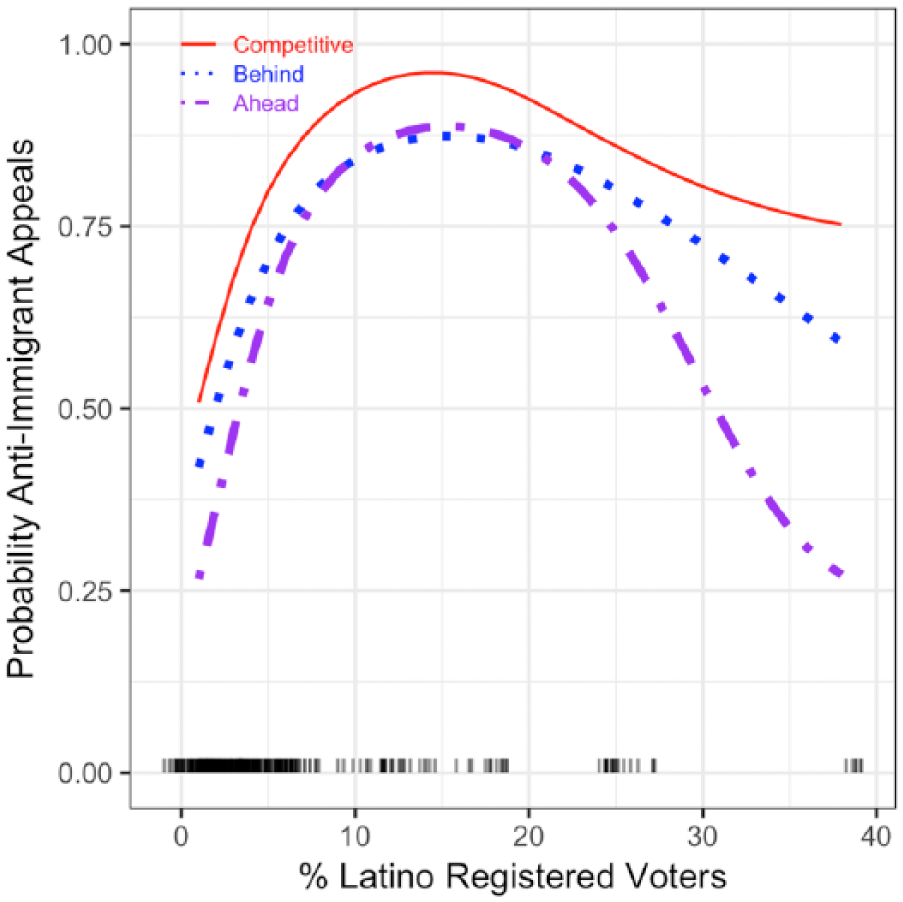
Effect of competition and Latino voters on probability of Republican anti-immigrant web appeals.
First, I find that Republican candidates in competitive elections are slightly more likely than Republican candidates in noncompetitive elections to use anti-immigrant appeals. Candidates who are winning or losing are less likely to use anti-immigrant appeals, though the difference is small.
Second, I find that Latino voters moderate this relationship as expected. In states with large Latino voting populations, I find that candidates are less likely to use anti-immigrant appeals across all levels of competition. I hypothesized that candidates in competitive races would be quicker to moderate their appeals given the increased importance of Latino voters in these races, but find little evidence of this. It appears that the presence of Latino voters decreases the likelihood that Republicans use anti-Latino appeals regardless of the level of competition in the race. We see, therefore, that there may be a tipping point of Latino voter influence where candidate strategy begins to shift away from xenophobic anti-immigrant appeals. We see this transition already in states like New Jersey (10.1%), New York (12%), Nevada (13.7%), and Florida (16.7%).
While these results are suggestive, one of this study’s largest liabilities is the lack of states with large Latino populations as illustrated by the rug on my x-axis, suggesting that the nonmonotonic relationship between Latino registered voters and anti-immigrant appeals is reliant, partly, on model specification. The trouble with forecasting electoral appeals in states where Latino voters serve as countermobilization threats is that there are so few. As the rug indicates, the vast majority states have between 0 and 10 percent Latino registered voters. The upper half of the plot is informed by data from just a few states (California and New Mexico). These concerns are partially assuaged by examining the nonparametric relationship between these two variables (see Figure A1 in the supplemental material). Future work should test this hypothesized relationship in House districts where we observe much greater variation in the size of the Latino voting population.
In sum, my data suggest that Republican US Senate candidates use anti-immigrant appeals, particularly in competitive elections and in states with rapid Latino population growth, but do fear potential backlash from Latino voters who might countermobilize in response and in opposition. Similarly, Democrats refrain for pro-immigrant appeals unless a state contains enough Latino voters to overcome the risk of losing white voters. Furthermore, as predicted, campaign competition ultimately moderates the perceived importance of Latino voters, at least as measured by immigration appeals.
Conclusion
Despite rapid and drastic demographic changes in the United States over the last several decades, and despite a brief attempt by Republican political operatives to mobilize Latinos during President George W. Bush’s 2000 and 2004 Presidential bids, the largely white GOP has coalesced around an anti-immigrant position, particularly with the candidacy of Donald J. Trump. Despite a 2012 Republican National Committee report calling for greater racial inclusiveness within the Republican Party, President Donald J. Trump ran a campaign focused on building a border wall with Mexico, deporting undocumented immigrants, and banning Muslims from the United States. Trump’s anti-immigrant appeals likely were a strong mobilizing factor for his largely white base of voters, helping him soar past his sixteen opponents in the primary and win a general election with strong support from working-class white voters in the Rust Belt.
The Democratic Party, in contrast, has increasingly become the home of Asian Americans and Latinos, who together with African Americans and progressive whites compose a racially diverse party and support liberal immigration policy. Democratic presidential candidate Hillary Clinton often appealed to minority voters in speeches on the campaign trail and in television advertisements. Indeed, many pundits have singled out Clinton’s focus on identity appeals to racial, ethnic, and religious minorities and her lack of outreach to working-class whites as two of the reasons for her loss.
Thus, Republican candidates up and down the ballot have strong short-term electoral incentives to mobilize racial conservatives. Republican candidates can, and do, turn to anti-immigrant appeals as long as they do not risk countermobilizing the Latino community. Democrats, as Clinton illustrated, must walk a finer line between maintaining white support and mobilizing minority voters.
Yet racial party cleavages do not alone explain why Senate candidates like Scott Brown in New Hampshire ran a campaign almost exclusively focused on anti-immigrant appeals while Cory Gardner in Colorado focused his attention primarily on energy and health care. My theory of contemporary immigration appeals helps explain campaign cost–benefit decisions regarding campaign issue appeals. It is ultimately the interplay of politics and demographics, specifically Latino population growth, Latino voters, and competition, that are increasingly driving the use of immigration appeals in US electoral campaigns, particularly at the state and local level.
As states continue to rapidly diversify, then, Republican candidates face incentives to racialize and politicize these demographic changes for electoral gain. As the minority population expands within a state, however, racial, ethnic, and religious minority voters can organize and countermobilize, threatening the electoral prospects of candidates running on xenophobic platforms and increasing the likelihood of electoral or policy concessions from Democrats. This is the pattern we have already seen in California and New York, and are starting to see in rapidly changing states like Nevada, Colorado, and Virginia. Each election cycle, Arizona and Texas become slightly more Democratic.
The increasing use of immigration appeals illustrates that the United States is far from postracial, particularly in electoral politics. The use of anti-immigrant appeals, which are less risky than anti-black appeals, is becoming commonplace around the country. More attention should be paid to the racialized content of these immigration appeals and their impact on racial attitudes in the United States. Furthermore, this research suggests that Republican candidates are using immigration appeals as wedge issues to persuade cross-pressured Democrats, further deepening racial cleavages between the two parties. As this cleavage widens, the policy implications of this racial divide are potentially drastic. Finally, this research highlights the increasingly important role that Latino voters are playing in electoral politics, influence that may result in better substantive representation in the future.
Footnotes
Acknowledgements
The author would like to thank Bob Turner, Matt Barreto, Mark Smith, Jeff Arnold, Francisco Pedraza, Ali Valenzuela, Bryan Wilcox, and the anonymous reviewers for their helpful comments.
Author’s Note
Earlier versions of this paper were presented at the State Politics and Policy Conference; Politics of Race, Immigration, and Ethnicity Consortium (PRIEC); the Western Political Science Association; Midwest Political Science Association; and American Political Science Association Annual Meetings.
Declaration of Conflicting Interests
The author(s) declared no potential conflicts of interest with respect to the research, authorship, and/or publication of this article.
Funding
The author(s) received no financial support for the research, authorship, and/or publication of this article.
Supplemental Material

Notes
References
Supplementary Material
Please find the following supplemental material available below.
For Open Access articles published under a Creative Commons License, all supplemental material carries the same license as the article it is associated with.
For non-Open Access articles published, all supplemental material carries a non-exclusive license, and permission requests for re-use of supplemental material or any part of supplemental material shall be sent directly to the copyright owner as specified in the copyright notice associated with the article.
