



Abstract
As of late, political theory, research, and practice have taken a deliberative turn, extolling the benefits of idealized public discourse. This paper explores how mass polarization impacts the preconditions for such discourse. Drawing from social identity theory, partisanship is conceptualized as having distinct, yet interrelated social and ideological dimensions. Through both online and telephone-based survey experiments, the paper then examines how these two dimensions affect attitudes toward discussion that theorists prioritize. Strong social attachments to one’s party consistently drive antideliberative attitudes toward disagreement; ideological partisan attachment, however, does not have this effect. The results suggest that the rise of social identity polarization has driven the public away from discursive norms that would support a deliberative democratic system.
When citizens and accountable officials disagree, and also recognize that they are seeking deliberative agreement, they remain willing to argue with one another with the aim of achieving provisionally justifiable policies that they can recognize as such. There’s nothing short of Trump shooting my daughter in the street and my grandchildren—there is nothing and nobody that’s going to dissuade me from voting for Trump.
During the run-up to the 2012 Presidential election, the radio show This American Life produced an episode on polarized politics titled “Red States Blue State.” In one particularly evocative scene, interviewer Lisa Pollack profiles Frank Mills and Ron Sexton. The two men were close friends who repeatedly discussed political issues on the phone. This is until, as Pollack describes on-air, “Ron urged Frank to support a Republican candidate for Congress. Frank balked. Didn’t Ron know he supported Democrats?
And he (Ron) said, “Who did you vote for for president?” And I said, “I voted for Obama.” Apparently this had not come up before. And then he said, “You must be a Socialist.” He said this seriously or jokingly? No, seriously. “You must be a Socialist.” And I said, “How can you make that assumption?” He says, “Well, you voted for Obama. He’s a socialist, and therefore you are.” And then I took it as if he had called me a dirty name. And we got into an argument. And then after a while, he said, “Well, I’m writing you off my list, Frank. Don’t ever talk to me again. You’re no longer a friend of mine,” is how that conversation ended. (Glass 2012)
The story of Frank and Ron may be common in America, and, for many, it may be troubling. With the rise of partisan polarization debated by academic and popular commentators alike, many point to a link between divergent political views and an incivility and breakdown of political discourse. Dating back to the ancient Greeks, political theorists have extolled the virtues of deliberative democracy, predicated on the ability of political decision makers to see divergent perspectives as legitimate and to be open to opinion change (Dryzek 2010; Gutmann and Thompson 1996; Rawls 1993). The closed-mindedness and lack of consideration evinced by Frank and Ron calls this possibility into question.
It is also perhaps puzzling, as many public opinion scholars demonstrate that while conservatives and liberals may have increasingly sorted into their “correct” party based on ideology, the public writ large is as moderate as it has been in the past half-century (Fiorina 2011). The acrimony may be real, but it is relatively untethered to ideological or issue position conflict—in other words, “a nation that agrees on many things but is bitterly divided nonetheless” (Mason 2015, 128). To help explain this puzzle, a body of recent research in political psychology (Huddy, Mason, and Aarøe 2015; Iyengar, Sood, and Lelkes 2012; Iyengar and Westwood 2015; Mason 2015, 2016) has drawn a distinction between the ideological and social identity bases of partisanship to suggest that it is not Democrats’ and Republicans’ political views, but social identities, that are polarizing.
This paper demonstrates that the polarization of partisan social identities is driving the public away from deliberative discursive ideals. In particular, the focus is on the concept of reciprocity (Gutmann and Thompson 1996), broadly defined as a good faith willingness to give reasons and respond to disagreement in dialogue with an open mind. Online and telephone survey experiments show that those with strong social attachments to their party are more likely to condition displays of reciprocity on party cues rather than argumentative substance. Those with high partisan social identity salience (“Social Partisans”) are both more likely to view inparty disagreement with reciprocity as well as less likely to view outparty disagreement with reciprocity, as compared with those with lower social identity salience. This partisan deliberative bias, however, is not consistently present for those with stronger ideological attachments to their party. These results highlight the negative effect of mass social polarization on interparty dialogue as well as deliberative decision making across the U.S. political system.
Deliberative Democratic Systems and Mass Discourse
Increasingly, democratic theory has taken a “deliberative turn” (Dryzek 2010, 3), placing public discourse and decision-making processes at the forefront of political thought, empirical political inquiry, and real-world institutional development. Rather than focusing on elections or rights, deliberative democratic theorists focus on political communication and decision making. It is about reason-giving (Thompson 2008); decisions are not made by fiat, but with collective, interactive discussion, and with justification toward those who disagree. Normative theorists vary in their requirements for the quality of reasons given, the role (if any) of power or bargaining, the proper site for this discussion, as well as the primacy of consensus as a discursive goal (Bächtiger et al. 2010). In a seminal work, though, Gutmann and Thompson (1996) argue that a key to ideal deliberation is a norm of reciprocity. While this basic moral concept broadly means that “we should return good for good, in proportion to what we receive” (Becker 1986, 4), Gutmann and Thompson (1996, 55) apply it to the realm of democratic politics by stating that “when citizens deliberate, they seek out agreement on substantive moral principles that can be justified on the basis of mutually acceptable reasons.” Recognizing the collective nature of democratic decision making, political reasoning is given in terms that those that disagree could, at least in theory, accept. Consensus is sought, but in recognizing the reality of moral disagreement (particularly in contemporary American politics—see Jacoby 2014), reciprocity only requires the honest effort to forge moral agreement, and mutual respect for competing legitimate viewpoints when consensus fails. While the term is Gutmann and Thompson’s, the concept is nearly universally accepted in deliberative literature, with roots in Habermas’s (1993) theory of communicative rationality.
Scholarship on deliberation has traditionally focused on discursive norms such as reciprocity for formal political institutions. A reason for this is, for deliberative democracy to matter, it cannot be just idle talk; deliberative norms have to be consequential in government decision making. Many studies of deliberation, thus, have focused on decision-making practices of legislative bodies (Bächtiger et al. 2007) or specific empowered public bodies such as juries (Sunstein 2002), advisory boards (Warren and Gastil 2015), or deliberative polls (Fishkin 1995). This being said, theorists have increasingly broadened their scope of inquiry and adopted a “systems” approach (Mansbridge et al. 2012; Neblo 2015). In this view, “deliberative democracy is more than a sum of deliberative moments” (Mansbridge et al. 2012, 26); it is rather a set of normative criteria that apply across a polity. For any component of a political system, the question is not whether it is normatively ideal on its own but whether it helps to foster policy making that is guided by values such as high epistemic quality, mutual respect across peoples and perspectives, and inclusive, impact participation in political discourse. There is thus a division of discursive labor, and components that may seem ill-suited for deliberative democracy can potentially (but not necessarily) serve a larger purpose. 1
Taking a systematic view emphasizes the “democracy” in deliberative democracy, opening it up to a much wider range of inquiry than has traditionally been the focus. Indeed, from this perspective, the public’s “everyday talk”—citizen discussion with representatives or activists, media exposure, and even interpersonal discussion about public matters—can be assessed for how it contributes to the overall quality of systematic decision making (Mansbridge 1999). 2 While everyday talk does not produce the singular, binding policy-making decision that many theorists argue is a necessary component of deliberation (Cohen 2007; Thompson 2008), collective public opinion does have a significant impact on political decision making, through both voting and elite responsiveness to public sentiment (Chambers 2012; Erikson, MacKuen, and Stimson 2002).
As such, standards of reciprocity can be applied to “everyday talk,” or mass democratic discourse, as well as to formal decision-making institutions. While there are good reasons for stricter requirements to apply to the latter, the difference is in degree, not kind (Mansbridge 1999). Certainly, there is a necessary division of labor in a deliberative system, but Chambers insists that this metaphor can be stretched too far, concurring with Mansbridge et al. (2012, 65) that “a healthy deliberative system requires some level of deliberative engagement by the general public.”. Contrary to what is often presumed in public opinion literature, citizens do engage in a good deal of discussion, consideration, and persuasion concerning public political matters (Jacobs, Cook, and Delli Carpini 2009). It makes sense, then, to attend to the discursive standards by which collective public opinion is formed, given what impact they can have on other parts of a deliberative system. For example, if reciprocal discourse can promote higher quality, more empathetic opinion formation (as much of the empirical research on deliberative democracy augurs), and this citizen opinion has an influence on policy making through voting and elite responsiveness, then reciprocity in mass discourse should promote higher quality, more mutually respectful policy making. Moreover, if representatives engage in pork barrel spending or adopt policy positions to demonstrate responsiveness to their constituents (Erikson, MacKuen, and Stimson 2002; Mayhew [1974] 2004), it is reasonable to suspect they adopt their constituents’ preferred rhetorical style or attitude toward disagreement as well. Reciprocity in public discourse can thus be seen as an “integrative virtue,” supporting healthy deliberative outcomes in representative institutions even though the mass public itself does not formally deliberate (Wilson 2011). Conversely, a gap in deliberative ideals between elites and the public, if it is stretched too wide, is unlikely to be sustainable, as ambitious politicians can then move away from reciprocal ideals toward misinformation, demagoguery, and power politics to successfully win elections and push policy agendas.
Deliberation and Polarization
Many popular commentators have lamented what they argue is a loss of reciprocal discourse in the modern era of partisan polarization. Politics has become what David Brooks (2016) characterizes as “good-versus-evil bloodsport,” where policy differences are viewed by others as having “false allegiances” and being “complicit in a system of oppression.” Despite this normative popular concern, the academy has not fully explored connection between partisan polarization and deliberative ideals such as reciprocity. For one, empirical work in deliberative democracy often glosses over the potential impact of partisanship on deliberation. Many theorists have argued for the ideal of reciprocity in discussion, positing benefits that include a greater normative and empirical legitimacy, a more informed citizenry, better and more consistent attitude formation, higher tolerance for diverse viewpoints, greater engagement and social capital building, and higher quality, more consensual decisions (see Mendelberg 2002, 153–54). As many of these claims of benefit are empirical, empirically minded scholars have given them scrutiny. While the evidence is mixed, many studies have found that deliberation produces salutary effects, such as consensus (Fishkin 1995), participant learning (Barabas 2004), greater attitude constraint (List et al. 2012), and resistance to manipulation through elite framing (Druckman and Nelson 2003). What this work has in common, though, is that it takes deliberation as an independent variable, constructing deliberative settings and measuring if and how benefits materialize. Less research on deliberation takes it as the dependent variable, exploring how contextual factors (such as partisanship or polarization) influence the likelihood of ideal discourse emerging. This is unfortunate, as Thompson (2008, 509) argues that “the aspect of deliberation about which empirical inquiry has potentially the most to say is the set of conditions that are necessary for, or at least contributory toward, good deliberation.” Indeed, if one views mass discourse as an important part of a deliberative system, it is particularly vital to assess the conditions by which the public will engage in laudatory discursive practices without moderators or formal institutional structures encouraging them to do so.
If empirical work on deliberative democracy often misses the connection to contextual factors such as polarization, polarization studies often miss the normative concerns of deliberative theorists. Scholars have traditionally studied polarization as an ideological construct, examining whether Democrats and Republicans are increasingly splitting apart with regard to ideology or issues of the day. Debate still rages as to whether the public is polarized in this way (Abramowitz 2010) or simply better “sorted” and as moderate as ever (Fiorina 2011; Hill and Tausanovitch 2015). This line of inquiry provides vital, yet incomplete insight into the impact of twenty-first-century partisanship on the quality of American democracy. This literature is primarily motivated by a concern over the electoral connection between representatives and the represented. Given the clear ideological rift between parties in government (McCarthy, Poole, and Rosenthal 2006), if the public is not similarly split ideologically (as Fiorina 2011 argues), there is a clear breakdown in this machinery. If, on the contrary, the public is ideologically polarized (as Abramowitz 2010 argues), the electoral connection is then healthy. While this line of inquiry is important and not misplaced, issues raised by deliberative theorists as well as popular commentators—of incivility, legislative gridlock, and an overall lack of reciprocity in elite and lay political discussion—do not factor in with a sole focus on ideology.
Recent studies of mass polarization, though, have drawn on social identity theory (SIT) to move beyond a sole focus on ideology (Huddy, Mason, and Aarøe 2015; Iyengar and Westwood 2015; Mason 2015). SIT posits that group affiliations (such as attachment to one’s party) play a key role in an individual’s identity development, and even the most arbitrary or “minimal” group affiliations can drive attitude formation and behavior (Tajfel et al. 1971; Turner 1987). While the idea that one’s social or group identities influence political behavior is nothing new (Campbell et al. 1960; Green, Palmquist, and Schickler 2002), SIT offers the insight that while group attachments can be stable, group identity salience is fluid and context dependent. With salient group identifications, individuals develop a host of attitudes and behaviors, including
engaging in self-stereotyping by adopting ingroup attitudes and behavioral norms (Suhay 2015; Terry and Hogg 1996),
exaggerating ingroup similarity and outgroup difference (Brown 2000; Ellemers, Spears, and Doosje 1997),
favoring the ingroup and prejudice toward the outgroup (Brewer 1999; Brown et al. 2001), and
positive ingroup emotions (such as pride; Suhay 2015) and negative outgroup emotions (such as anger; Mackie, Devos, and Smith 2000).
Drawing on SIT, scholars have recently argued that the partisan public is indeed polarizing, but it is a polarization of social identity salience, not of ideology or issues. Evidence for this can be found in Figure 1, which presents feeling thermometer scores for partisans toward the two parties from a nationally representative survey. Higher scores indicate that the respondents feel more “warmly,” as opposed to “coldly,” toward the parties. As the figure shows, partisans’ feelings toward their own party have been relatively stable and fairly warm through since 1978 (although 2016 does represent a nadir for inparty feeling). Their feelings toward their outparty, though, have steadily soured over the decades, and there is thus a growing distance in feeling between the two parties for partisan identifiers.
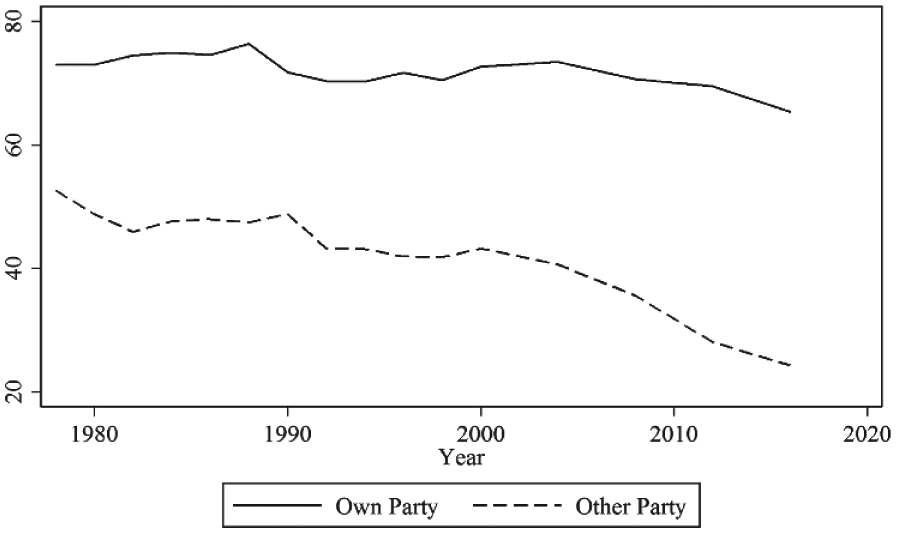
Feeling thermometer scores for parties: All partisans and leaners.
Other scholarship attest to the growth of mass “social” polarization. Iyengar, Sood, and Lelkes (2012), for example, find that partisans’ outparty dislike and stereotyping has increased significantly since the 1970s, and that ideology is a weak predictor of this trend. Mason (2015) also finds that partisans increasingly display anger and bias toward their outparty; she moreover finds an increase in “social sorting,” where partisans align other relevant group identities to match their partisanship (Mason 2016). Hetherington, Long, and Rudolph (2016), further, find evidence of an asymmetric “trait polarization,” where partisans are more likely to ascribe negative personality traits toward outparty candidates. Issues still do matter; otherwise, it would be difficult to explain how individuals are increasingly sorting into the “correct” party ideologically (Levendusky 2009). But a social identity perspective on polarization allows one to see the myriad ways the public is increasingly divided beyond ideology.
Theoretical Outline
The general expectation is that, for both Democrats and Republicans, partisan social identity produces a diminished capacity for argumentation based on reciprocity. Instead of relying on Habermas’s “unforced force of the better argument,” I expect those with strong partisan social identity salience (who will be called “Social Partisans” in this paper) to condition their response to disagreement based on party cues. “Social Partisans,” as opposed to partisans with weaker social identity salience (“Nonsocial Partisans”), will be less likely to evince reciprocal attitudes toward outparty argumentation and more likely to evince reciprocal attitudes toward inparty argumentation. This connects to the insight from SIT that, for salient group identities, one finds outgroup bias and anger, ingroup homophily and activism, and exaggeration of differences across groups. It also connects to recent research on partisan psychology that suggests that, far from open-mindedness, one’s partisanship conditions the quality and hue of information that he or she receives from his or her environment (Iyengar and Hahn 2009), how that information is processed and interpreted (Gaines et al. 2007; Lodge and Taber 2013), the attitude that results (Druckman, Peterson, and Slothuus 2013), and awareness and tolerance of competing perspectives (Mutz 2006). The project here extends the theoretical purview of SIT and partisan psychology research by positing a negative connection to deliberative democratic ideals.
Much previous research has primarily focused on negative outparty attitudes produced by partisan social identity salience (e.g., Hetherington, Long, and Rudolph 2016; Iyengar, Sood, and Lelkes 2012). Iyengar and Westwood (2015) attribute this outparty effect to the absence of partisan egalitarian norms. While explicit expression of racial or gender prejudice are often discouraged through social norms, negative campaigning and candidate rhetoric remove such barriers to outparty prejudice. What makes SIT different from other theories of group bias (e.g., Allport 1954), though, is its claim that the motivation for group identity formation is self-esteem created by positive intergroup differentiation. Thus, much of the psychological literature on SIT suggests that salient identities primarily produce ingroup bias (Brewer 1999; Tajfel et al. 1971), although the presence of intergroup conflict creates both positive ingroup and negative outgroup attitudes (Brown et al. 2001). Indeed, Huddy, Mason, and Aarøe (2015) find that partisan social identity salience produces not only outparty bias but positive inparty effects such as activism and positive emotions for one’s party. As such, I expect partisan social identity to have both an inparty and outparty effect on reciprocal attitudes.
I expect separate effects for the ideological dimension of one’s partisan identification. Given the strong role that party stereotyping and party-based affect play in political cognition (Achen and Bartels 2016; Green, Palmquist, and Schickler 2002), I expect partisan social identity salience to have the strongest effect on reciprocity. However, as self-stereotyping is also an indicator of social identity salience (Mackie 1986; Mason 2015), I expect one’s “ideological partisanship” (as an indicator of adopting prototypical ingroup norms) to have a secondary effect on reciprocal attitudes. Thus, for more conservative Republicans and more liberal Democrats, I expect to see an effect.
Data and Method
This project consists of two survey experiments. First, an online survey of 1,619 respondents was conducted during the summer of 2015. Respondents for this survey (hereafter referred to as the “Online Survey”) were recruited through Amazon’s MTurk Human Intelligence Task service. Each recruited respondent was paid $0.90 to complete the survey. This study focuses on the impact of treatment on the 1,336 respondents identifying with or leaning toward the Democratic or Republican Party based on the traditional, American National Election Studies (ANES) party identification scale. After a series of preliminary questions assessing the extent and dimensions of respondents’ partisan attachment, 3 the treatment consists of two vignette issue questions—one concerning immigration, the other civil liberties. With the vignettes, respondents are asked about the issue, and then a counterargument to the respondent’s position is provided. This approach draws from Jackman and Sniderman (2006); the key manipulation, though, is that the counterargument is attributed to either a Democrat, a Republican, or a person without a party identifier (the respondent is assigned through simple random assignment to one of these three groups). Respondents are then asked if the argument is (1) reasonable and (2) worth considering. For both of these questions, response options are “very,” “somewhat,” and “not at all” reasonable/worth considering. After this, respondents are asked for their opinion again. This series of questions is designed to, in different ways, tap into the concept of reciprocity. 4 I expect that partisans will be more likely to state that an inparty argument is reasonable and worth considering, and less likely to state that an outparty counterargument is reasonable or worth considering. I also expect respondents’ opinion to be more likely to change in response to an inparty argument, and less likely to change in response to an outparty argument.
As there is strong debate as to whether MTurk experiments are externally valid (Berinsky, Huber, and Lenz 2012; Krupnikov and Levine 2014), a second survey experiment reproduced key results from this study with a representative sample of the South Carolina population in the spring of 2016. Conducted by the Institute for Public Service and Policy Research at the University of South Carolina, a sample of 802 residents were interviewed via landline and cell phone sampling frames, with a response rate of 13 percent. The focus of this survey, hereafter referred to as the “Telephone Survey,” is the 515 of these respondents identifying with one of the two major parties based on the traditional ANES scale (“leaners” were not provided in the vignette). After a series of initial questions on respondents’ partisan attachment, this survey replicated the civil liberties issue vignette questions. Scripts for all vignette treatments, as well as rationale for developing the counterarguments, can be found in the online appendix.
Of primary interest is the conditional average treatment effect for different partisan subgroups based on measures of partisan social identity salience and ideological partisan attachment. For both of these measures, I expect the strongest treatment effects for those that score higher. For ideological partisanship, the Online Survey gives the respondent eleven declarative statements concerning an array of policy issues, allowing for a five-point response ranging from “strongly agree” to “strongly disagree.” Following a technique employed by Carsey and Layman (2002) as well as Iyengar, Sood, and Lelkes (2012), the eleven policy items were then used to create ideological partisanship scores for each respondent using confirmatory factor analysis (CFA). This measure assesses respondents’ commitment to their party’s ideological platform. For Republicans, a higher score indicates a more conservative ideology, and for liberals, a higher score indicates a more liberal ideology.
Partisan social identity is operationalized differently by the two survey instruments; in the Online Survey, partisans’ social identity score is calculated based on the following three statements, where the respondent is asked for their extent of agreement on a five-point scale:
When I talk about Democrats (Republicans), I usually say “we” rather than “they”;
When someone criticizes Democrats (Republicans), it feels like a personal insult;
I don’t have much in common with most Democrats (Republicans).
For the Telephone Survey, a different set of questions as follows, based on the work of Huddy, Mason, and Aarøe (2015), was used to create partisan social identity scores:
How important is being a Democrat (Republican) to you?
How well does the term Democrat (Republican) describe you?
When talking about Democrats (Republicans), how often do you use “we” instead of “they”?
To what extent do you think of yourself as being a Democrat (Republican)?
The Telephone Survey is thus not a complete replication of the Online Survey; the social identity measures are slightly different, and the Online Survey includes leaners while the Telephone Survey does not. However, a series of separate analyses, including a small separate survey of respondents who were given both scales, show that the two measures are highly correlated (r = .80). They also both are strongly correlated with two behaviors known to be associated with social identity salience—respondents’ expressed emotion toward the two parties (Mason 2016), as well as activism for one’s inparty (Huddy, Mason, and Aarøe 2015). They thus in very similar ways tap into partisan social identity salience, and using both of these scales can attest to the construct validity of the findings. More information on these measurement analyses, as well as the processes used to create partisan social identity and ideological partisanship scores, can be found in the online appendix.
In both surveys, both the partisan social identity and ideological partisanship measures are used to divide partisan respondents into binary subgroups at the medians. Following Gerber and Green (2012), this approach is taken because, as opposed to being evenly distributed across the range of values, most respondents are near the median of these measures (see the online appendix for details). A simple, clean comparison across two subgroups thus avoids an unwarranted assumption of linear effects that would come with treating the measures as continuous.
Table 1 indicates what proportion of respondents fall into each of four subgroups in the Online Survey. As one can see, partisans are allayed across the range of social and ideological attachment, and there is a low correlation between the two measures. Given the prevalence of partisan ideological sorting (Levendusky 2009), one may have expected fewer “Social Partisan, Low Ideology” and “Nonsocial Partisan, High Ideology” respondents. This may, though, highlight the line of research suggesting that, even for partisans, the public does not have ideologically consistent or polarized attitudes (Converse 1964; Fiorina 2011).
Distribution of Respondents among Partisan Subgroups, Online Survey.

n = 1,336; r = .16. PSI = partisan social identity.
The two survey samples, in some ways, contain similar sets of respondents; both the online and telephone Survey have samples that are Whiter and more educated than the nation as a whole. However, the samples have stark differences in partisanship. Mirroring past research on MTurk survey respondents (Krupnikov and Levine 2014), Online Survey respondents are more liberal and prefer the Democratic Party more than the country’s population writ large. The Telephone Survey sample, reflecting the state of South Carolina as a whole, skews Republican. Individually, the proportion of partisans in each survey may raise concerns of external validity. Together, though, a consistent effect across both sets of surveys attests to the robustness of the results across parties. Further descriptive information is in the online appendix.
As the dependent variables are ordinal, analysis is conducted through ordered logistic regression. Following Gerber and Green (2012; see also Rothwell 2005), treatment effect heterogeneity is assessed through the use of interaction terms. Indicators of vignette group are interacted with dummy partisan social identity (“PSI” in the following tables) and ideological partisanship measures; a 1 on these measures indicates that the respondents’ score is above the median. These interaction terms provide a formal test of the significance of differing responses to the vignettes across subgroups. The regression models also include a host of control variables to improve the efficiency of treatment effect estimate; more information on these variables can be found in the online appendix.
Results
Table 2 displays key results for the immigration vignette. Two models were run for both the question that asks if the counterargument is “reasonable” and the question that asks if the counterargument is “worth considering.” Both “base” and “interactions” models include binary indicators for whether the counterargument comes from an inparty or outparty interlocutor, but the latter models also include terms interacting these indicators with a dummy variable (PSI) for a partisan social identity salience score above the median. Negative coefficients indicate a more reciprocal response (i.e., a greater inclination to find the counterargument reasonable or worth considering). As the base models show, partisan respondents overall are significantly more likely to find disagreement on immigration reasonable and worth considering if it comes from an inparty arguer. There is not a statistically significant outparty effect. This, however, belies differing responses based on partisan social identity, as the outparty interaction terms are positive and significant. This indicates that partisans who have a stronger social attachment to their party are significantly more likely to respond to outparty treatment than partisans with weaker attachments.
Immigration Vignette, Online Survey.

Ordered logit regression with robust standard errors reported in parentheses; positive βs indicate less reciprocity. PSI = partisan social identity.
p < .1. **p < .05. ***p < .01.
Social Partisans thus respond to outparty immigration arguments with less reciprocity, while Nonsocial Partisans do not. This is illustrated by Figure 2, which shows predicted proportions for the “interactions” models. Displayed here are the proportions of respondents stating that the counterargument is “not at all” reasonable or worth considering, by their treatment group and partisan social identity score. While Nonsocial Partisans view inparty arguments more favorably than neutral arguments for both questions, Social Partisans are both more likely to view inparty arguments favorably and less likely to view outparty arguments favorably. For this subset, the predicted proportion responding “not at all” reasonable jumps from .35 in the neutral condition to .43 in the outparty condition, and the predicted proportion responding “not at all” worth considering jumps from .25 in the neutral condition to .32 in the outparty condition.
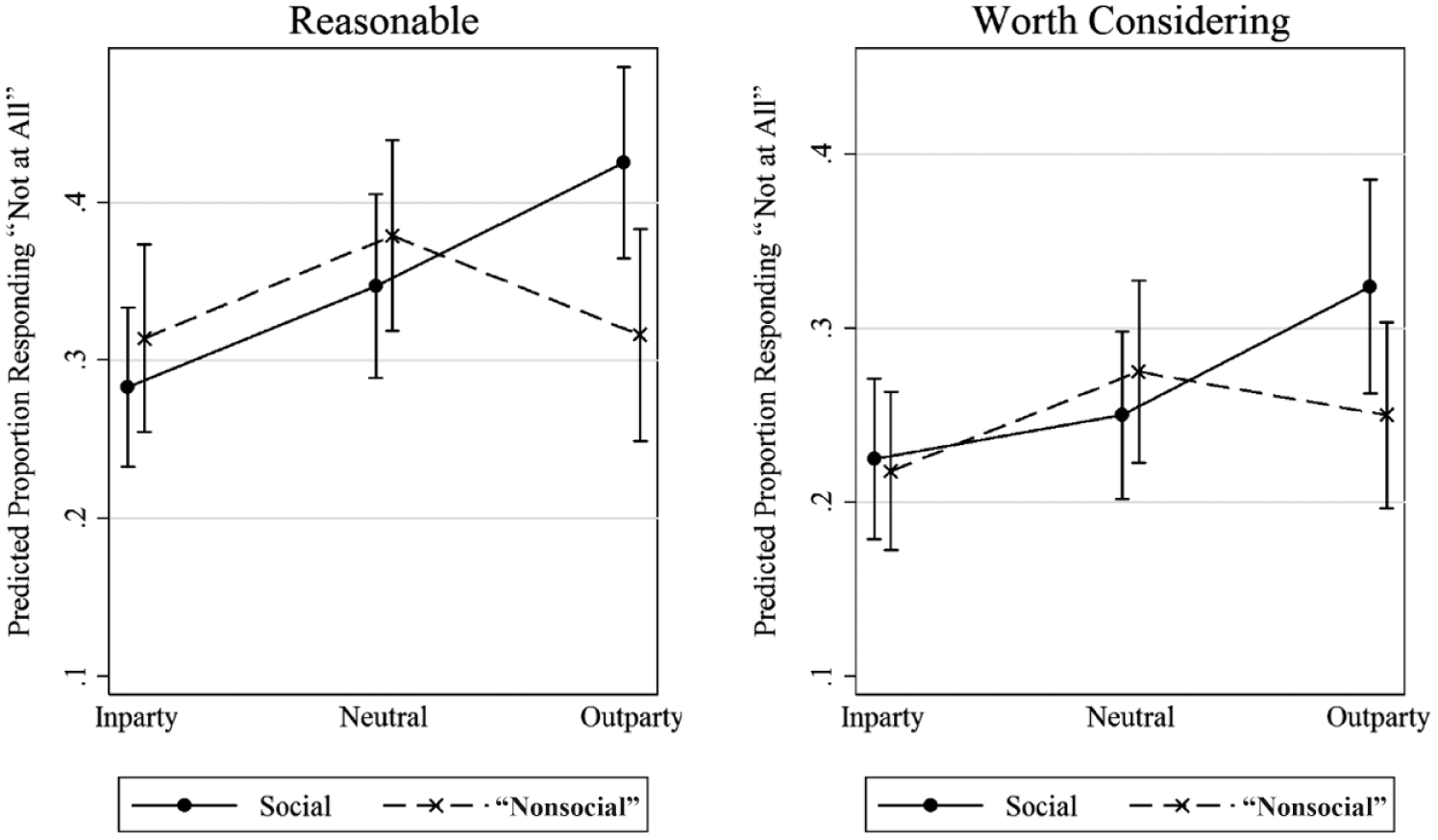
Response to immigration argument: Social versus Nonsocial Partisans, Online Survey.
There are also differences in civil liberties vignette response by partisan social identity salience. The base models in Table 3 indicate that partisans overall are significantly less likely to view outparty civil liberties arguments as reasonable or worth considering, but they are not significantly more likely to view inparty arguments as reasonable or worth considering. The interactions models, though, indicate that Social Partisans are more likely than Nonsocial Partisans to respond to the inparty vignette. For the “reasonable” model, this difference in response is statistically significant; while the difference is not significant for the “considering” model (p = .15), the inparty interaction term is in the same direction and nearly as substantively large as for the “reasonable” model. The differences in response across social identity subgroups are illustrated in Figure 3. All partisans are more likely to state that a civil liberties counterargument is “not at all” reasonable or worth considering if it comes from an outparty, as opposed to a neutral, interlocutor. Social Partisans, though, are also less likely to state that the argument is not at all reasonable or worth considering if it comes from an inparty interlocutor.
Civil Liberties Vignette, Online Survey.

Ordered logit regression with robust standard errors reported in parentheses; positive βs indicate less reciprocity. PSI = partisan social identity.
p < .1. **p < .05. ***p < .01.
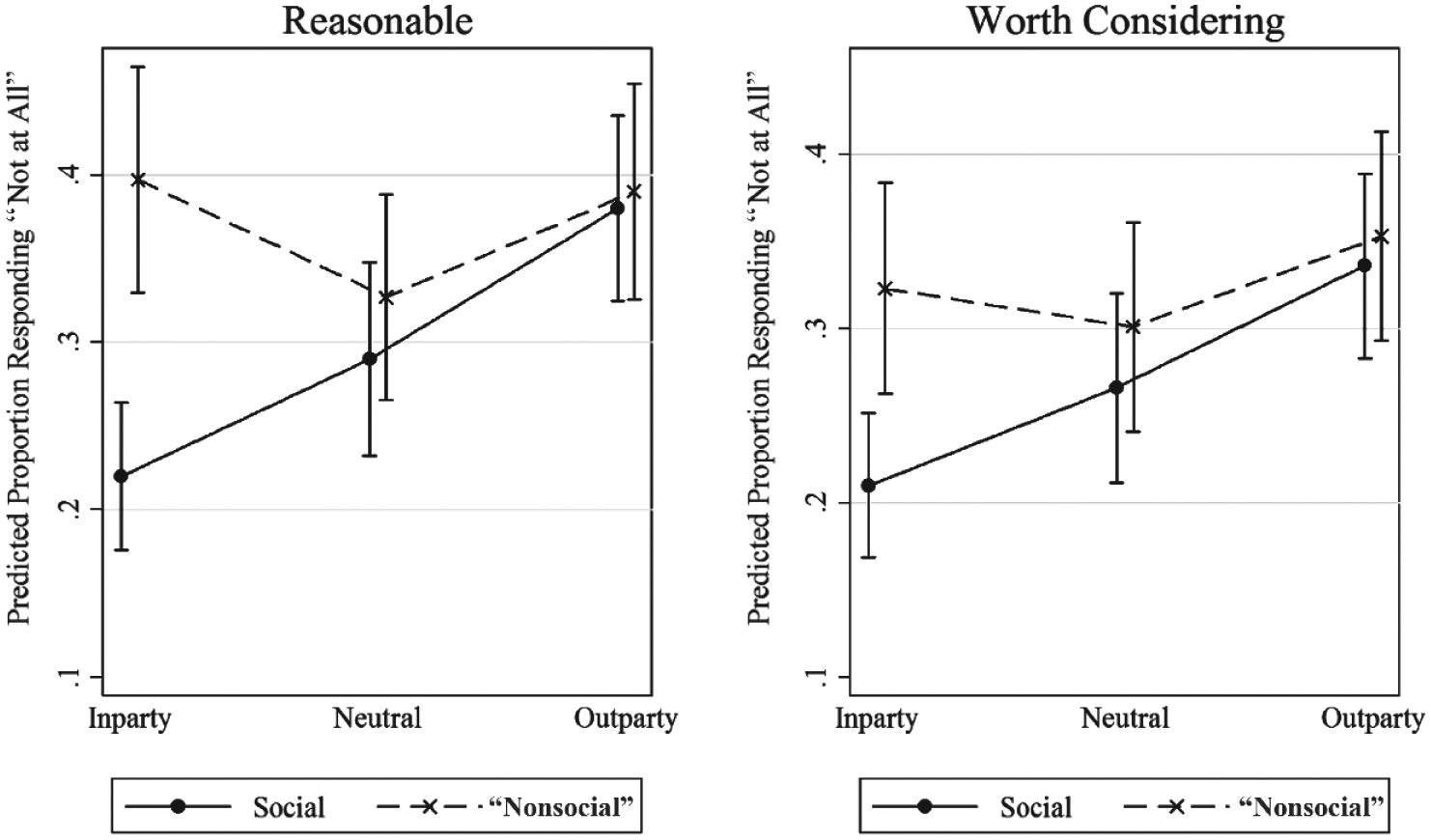
Response to liberties argument: Social versus Nonsocial Partisans, Online Survey.
In sum, Social Partisans consistently use party cues when deciding whether to respond to disagreement with an attitude of reciprocity. This is true across the two issue domains examined. What’s more, this is true for both inparty and outparty vignette groups; this runs counter to much of the extant literature on partisanship and social identity, which focuses primarily on outparty biases (Iyengar, Sood, and Lelkes 2012). It accords with SIT, however, as SIT suggests that salient group identities produce both ingroup boosterism and outgroup bias. As the online appendix indicates, results are consistent when looking at solely Democrats or Republicans.
While the questions asking whether the counterarguments are reasonable or worth considering elicited a response to treatment, none of the vignettes produced a significant difference in whether respondents changed their opinion. In fact, for both vignettes, only roughly 20 percent of respondents changed their mind in the direction of the counterargument when asked of their opinion a second time. It is perhaps not surprising given that the argument is a one-sentence statement displayed on a computer screen. However, the lack of demonstrated persuasive power suggests that the vignette treatment is weak. This makes presence of a significant effect for the “reasonable” and “worth considering” questions all the more remarkable.
What about ideology? Table 4 displays treatment effects across subgroups based on ideological partisanship, focusing on the “reasonable” question. There are no statistically significant differences in effects between respondents based on their commitment to their party’s ideological platform. Both interaction terms do run in the theoretically expected direction for the immigration vignette. However, for the civil liberties vignette, those with weaker, not stronger commitments to their party’s ideology are more likely to respond to the outparty vignette. This is illustrated in Figure 4; the right side shows that Low Ideology partisans are more likely to state that the civil liberties counterargument is not at all reasonable if it comes from an outparty, as opposed to a neutral, interlocutor. This is not true, though, for High Ideology partisans. This could be because Low Ideology respondents may be less politically sophisticated than High Ideology respondents (Zaller 1992). Civil liberties may also be a more complex issue domain than immigration. If these are both the case, Low Ideology respondents may be relying on party cues as an informational shortcut with the civil liberties question, whereas High Ideology respondents have less need to do so. More research would be needed to confirm exactly why different issue domains produce different patterns of responses across ideological partisanship. But in sum, while partisan social identity consistently produces strong responses to both inparty and outparty treatment (confirming H1), differences in response to treatment based on ideological partisanship are insignificant and mixed (disconfirming H2).
Vignette Response by Ideological Partisanship, Online Survey.

Ordered logit regression with robust standard errors reported in parentheses; positive βs indicate less reciprocity.
p < .1. **p < .05. ***p < .01.

Vignette response by ideology: Online Survey.
Finally, the civil liberties vignette was reproduced through a telephone survey of a representative sample of South Carolina adults. Table 5 displays these results, which incorporate survey weights and account for weighting loss using the Kish (1965) method. As with the Online Survey, the results from the Telephone Survey suggest primarily an outparty effect. Although only the “reasonable” model is close to conventional statistical significance (p = .052), the outparty terms for both base models indicate that partisans as a whole are less likely to view outparty, as compared with neutral, arguments as reasonable or worth considering. Moreover, the lack of significance for the outparty term in the “worth considering” model belies a difference in response between Social and Nonsocial Partisans. This is illustrated with the predicted probabilities displayed in Figure 5. While both Social and Nonsocial Partisans are more likely to view a counterargument as “not at all” reasonable if it comes from the outparty, only Social Partisans are more likely to view outparty arguments as “not at all” worth considering. For this subgroup, the predicted probability of responding “not at all” worth considering jumps from .17 in the neutral condition to .26 in the outparty condition. Due to the weighting loss as well as a sample size smaller than the Online Survey, the interaction term in this model is not significant. However, while they cannot offer a complete confirmation, the results from the Telephone Survey are nonetheless in line with the Online Survey results.
Civil Liberties Vignette, Telephone Survey.

Ordered logit regression with robust standard errors reported in parentheses; positive βs indicate less reciprocity. PSI = partisan social identity.
p < .1. **p < .05. ***p < .01.
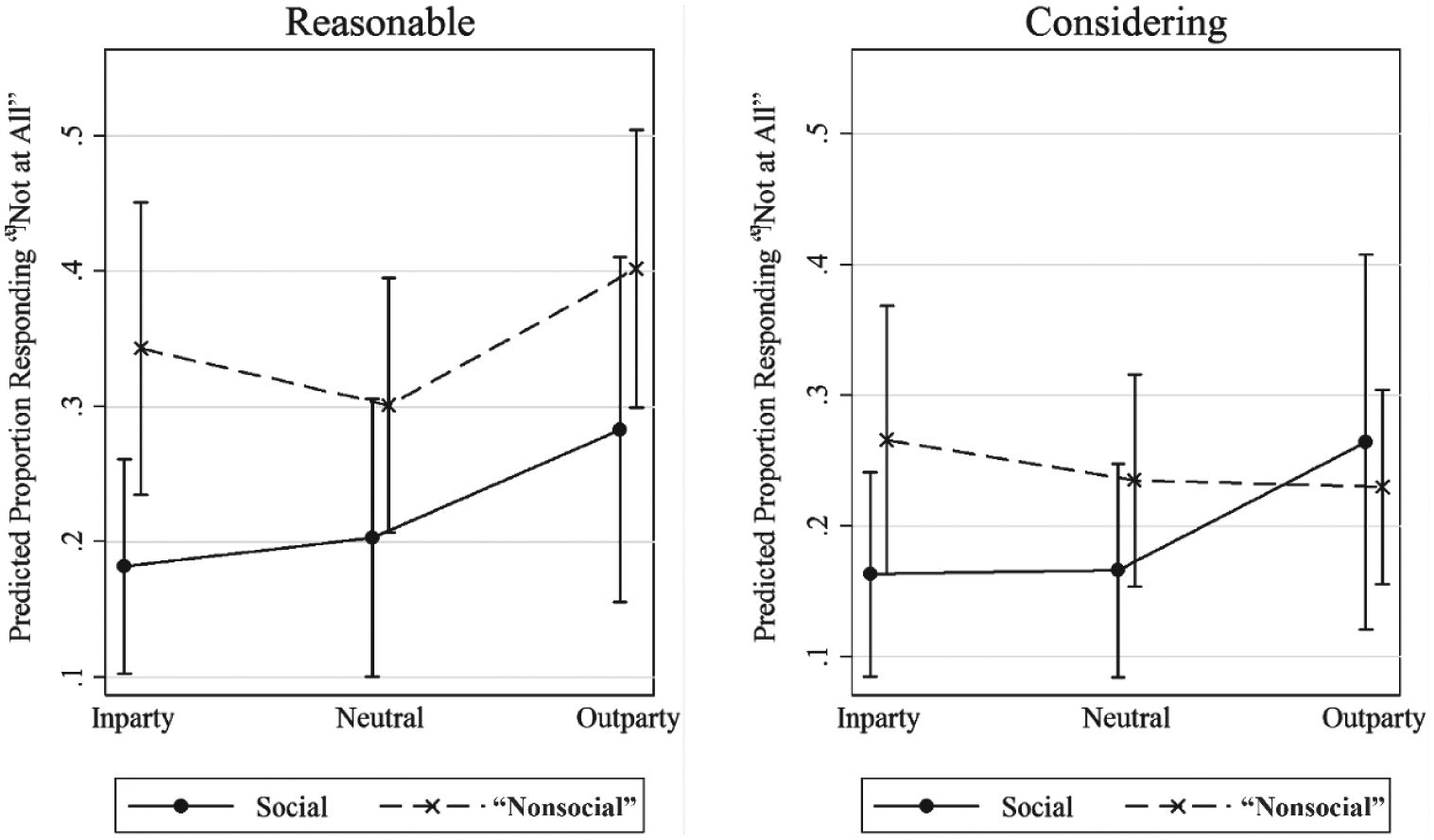
Response to liberties argument: Social versus Nonsocial Partisans, telephone survey.
Discussion and Conclusion
Does partisanship, and in particular partisan social identity salience, impact the extent to which citizens hew to deliberative discursive norms? The survey experiments discussed here suggest that it does. As opposed to following Habermas’s “unforced force of the better argument,” partisans take into account party cues when considering whether to approach disagreement with an attitude of reciprocity. The effects of partisanship on reciprocity are particularly pronounced for the subset for whom partisan social identity salience is high or “Social Partisans.” Diverging from past research on partisan social identity that primarily focuses on outparty effects (Hetherington, Long, and Rudolph 2016; Iyengar, Sood, and Lelkes 2012; Iyengar and Westwood 2015), “Social Partisans” display both less reciprocity toward outparty arguments and more reciprocity toward inparty arguments. These results for social identity are moreover consistent across issue domains and across both online and telephone survey experiments. Partisan ideological attachment, though, has at best a secondary effect on reciprocal attitudes, one that is statistically insignificant and hinges on the specific issue being considered.
The results help us to understand the impact of modern partisan polarization. Recent research on mass polarization suggests that the public is splitting along partisan lines, but it is a social and affective, not ideological, split (Huddy, Mason, and Aarøe 2015; Mason 2015, 2016). The experimental results in this study illustrate how “social polarization” is impacting political discourse. In sites of what Mansbridge calls “everyday talk”—interpersonal discussion about public matters, media exposure of political issues, listening to activist messaging, and so on—it suggests that social polarization is making good faith discussion and honest engagement with divergent perspectives more difficult. Instead, open-mindedness and mutual respect is increasingly only offered within partisan enclaves.
The findings here do not suggest that approaching a more deliberative democracy is impossible given modern partisan polarization. They also do not necessarily imply that partisan biases would persist outside the realm of mass discourse, such as in citizens’ juries, deliberative polls, or other formal deliberative institutions. That is a question for future research. 5 However, if one takes a broad view of deliberative democracy, where the focus is less on individual sites of deliberation and more on overall decision-making quality across a political system, the biases in reciprocal reasoning produced by partisan social identity can give one pause. While an ideal deliberative system does not require the same standards of reciprocity in both formal institutions and mass discourse, a basic-level reciprocity in citizen reasoning is necessary to support system-wide decision-making goals of epistemic quality, mutual respect, and inclusion (Mansbridge et al. 2012; Wilson 2011). A public that approaches political argumentation with reciprocity in mind, for example, will have better informed, higher quality opinions, which effects elite decision making through voting as well as representatives’ efforts to translate their constituents’ views into policy (Chambers 2012). In this regard, a loss in public reciprocity negatively affects the deliberative quality of the political system. At the same time, it is true that the growth of partisan social identity salience in the United States has brought normatively positive benefits, such as increased engagement and participation in politics (Huddy, Mason, and Aarøe 2015). An overall assessment of how polarization impacts systematic deliberative goals, then, needs to weigh this positive with the negative of increasingly antideliberative cross-party public discourse.
A line of theoretical and empirical research has shown that deliberative decision making comes with a host of benefits, such as better, more legitimate decision making; greater consensus; and empathy and learning from participants. Less research, though, has examined the conditions necessary for citizens to adopt deliberative discursive ideals. Studying the conditions for ideal deliberation is particularly important if one conceptualizes deliberative democracy not simply as isolated sites of decision making but as a set of system-wide normative decision-making criteria to which mass discourse contributes. This project represents an initial step in this regard. As stated earlier, future work could assess whether partisan deliberative bias extends beyond everyday discussion to formal sites of deliberative decision making. It could also better tease out in which issue and social contexts ideological partisan attachment matters for reciprocal attitudes. In addition, future research could expand on the theoretical framework here by researching how group identity more broadly impacts disposition toward deliberation. This could explore how racial, gender, and other identities both contribute to partisan social identity salience and interact with partisanship to impact deliberative attitudes. 6 Finally, future research could address the question of what can be done to counteract the effect of partisan social identity salience on reciprocity. For example, perhaps media reforms, or institutional reforms that encourage greater outparty social contact, could temper social identity salience and thus its negative effect on reciprocity. Efforts to reduce partisan social identity salience, though, would require a consideration of normative trade-offs, such as reduced political engagement or activism (Huddy, Mason, and Aarøe 2015).
The goal of this study is empirical—to examine how partisanship impacts citizens’ attainment of ideals of deliberative discourse, not to judge those ideals as such. Nonetheless, this study can contribute to the normative assessment of modern democracy in the United States. If deliberative democracy is of value, and if discursive norms apply not just to elites but to the public as well, these results are potentially troubling. Perhaps the benefits of greater political engagement outweigh the deliberative bias produced by partisan social identity. Or perhaps, as critics suggest, deliberative democracy is unrealistic or inherently exclusionary. However, a cursory look at the 2016 Presidential election suggests that we should at least consider what our standards of political discourse should be, and when those standards are transgressed. It has been an election season, at both the elite and the public level, marked by misogyny, calls for outgroup exclusion/vilification, misinformation and ad hominem attacks as a rhetorical norm, violence, and little in the way of substantive debate. Many would argue that these are not characteristics of a healthy democracy. To move in a more productive direction, it may be worth it to consider the ideals laid out by deliberative theory, as well as how factors such as partisanship and polarization impact the likelihood of adopting these ideals.
Footnotes
Author’s Note
The online appendix, data, and replication code are available at the Political Research Quarterly (PRQ) website for this article, under “Supplemental Material” section.
Declaration of Conflicting Interests
The author(s) declared no potential conflicts of interest with respect to the research, authorship, and/or publication of this article.
Funding
The author(s) disclosed receipt of the following financial support for the research, authorship, and/or publication of this article: This work was partially supported by a SPARC Graduate Research Grant from the Office of the Vice President for Research at the University of South Carolina.
Supplemental Material
Replication data for this article are available with the manuscript on the Political Research Quarterly (PRQ) website.
Notes
References
Supplementary Material
Please find the following supplemental material available below.
For Open Access articles published under a Creative Commons License, all supplemental material carries the same license as the article it is associated with.
For non-Open Access articles published, all supplemental material carries a non-exclusive license, and permission requests for re-use of supplemental material or any part of supplemental material shall be sent directly to the copyright owner as specified in the copyright notice associated with the article.
