



Abstract
A defining feature of democracies is an independent legal system, where elites and the public alike accept the broader legitimacy of its actions, even if they run counter to political preferences. Existing scholarship suggests that public support for rule of law institutions is rooted in perceptions of procedural fairness. However, amid increasing levels of affective polarization, we posit a partisan presidential heuristic wherein citizens’ views of legal institutions are influenced by their partisanship and signals from the president. Through multiple experiments, we demonstrate that support for two key institutions—the Federal Bureau of Investigation and the Department of Justice—is substantially derived from the intersection of one’s partisan identity and their partisan proximity to the president. These effects are strongest among respondents exhibiting high levels of affective partisanship. Our results suggest that in forming perceptions of the rule of law, partisan politics is increasingly competing with perceptions of procedural fairness, thereby subverting support for legal institutions in the United States.
During his 2021 confirmation hearing, Attorney General Merrick Garland stated that “decisions will be made by the department itself and led by the attorney general, without respect to partisanship, without respect to the power of the perpetrator or the lack of power, [or without] respect to the influence of the perpetrator or the lack of influence.” 1 Here, Garland gives voice to a bedrock value that lends legitimacy to all liberal democracies—the rule of law. Within a vibrant democracy, the legal process is fair, impartial, consistently followed, and elites accept legal outcomes even if they disagree. This provides a basis of perceived legitimacy with the public (Baird, 2001; Caldeira & Gibson, 1992; Tyler, 1990). Increasingly, though, the public may be tolerating, or even welcoming, political interference. Contrary to prior research, we argue that with the rise of affective polarization (Iyengar et al., 2019), partisan identity is increasingly competing with perceptions of fairness in public assessments of legal institutions (Armaly & Enders, 2022; Devins & Baum, 2019). This cuetaking occurs through signals supplied by the president. We test our expectations through multiple survey experiments focusing on two key rule of law institutions—the Federal Bureau of Investigation (FBI) and the Department of Justice (DOJ). 2 We find that support for both the institutions, as well as leaders within the institutions, are significantly influenced by what we refer to as the partisan presidential heuristic. What is more, this partisan presidential heuristic has the strongest effect amongst those with the deepest affective ties to their party.
Our work has implications for advancing our understanding on public support for rule of law and democratic institutions more broadly. In an era of heightened affective polarization (Abramowitz & Webster, 2016; Rogowski & Sutherland, 2016), legal institutions have limited ability to effectuate broad public support by bolstering a perception of independence, impartiality, and fairness. Instead, our work implies that the public is willing to support not just political candidates and electoral institutions, but rule of law institutions, only if the president signals that they are a part of the party’s “team.” Ultimately, the strengthening nexuses between party politics, the presidency, and public confidence in legal institutions can undermine democratic norms and exacerbate democratic backsliding in the United States.
Partisan Cuetaking, Procedural Fairness, and Legal Institutions
Partisan cuetaking is central to the study of politics and public opinion. A vast literature demonstrates that partisan compatibility is positively linked to higher levels of public support for political elites and diffuse support for electoral institutions (e.g., Campbell et al., 1960; Druckman et al., 2013; Lebo & Cassino, 2007; Zaller, 1992). It is an open question, though, the extent to which partisanship influences public assessment of “rule of law” institutions, or entities that enforce, prosecute, or adjudicate law (Gibson, 2007; Nelson & Tucker, 2021). While some research suggests partisanship can influence support for institutions such as the U.S. Supreme Court (Armaly & Enders, 2021; Bartels & Johnston, 2020; Nicholson & Howard, 2003), the evidence is more modest when it comes to other non-electoral institutions. With respect to the federal bureaucracy, recent studies find that competence, rather than partisan and ideological considerations, conditions public evaluations (Hollibaugh, 2016; Rogowski, 2020). In a similar vein, the procedural justice literature finds that perceptions of fair and unbiased decision-making processes play a preeminent role in fostering support for rule of law institutions (Tyler, 2006).
Although our focus is on institutions that enforce the law (i.e., the FBI and DOJ), we acknowledge important distinctions between these and others with a more adjudicative role. Scholars weighing the role of partisan and procedural considerations have paid considerable attention to the Supreme Court (Bartels & Johnston, 2013, 2020; Gibson & Nelson, 2015), which is substantially (Bickel, 1986), albeit not entirely (Clark, 2009, 2010), insulated from electoral politics. By contrast, the FBI and DOJ engage more directly in law enforcement, these institutions are organizationally within the executive branch, and their members are subject to removal by the president. These differences notwithstanding, there are also similarities that make all three institutions a difficult test of the cue-taking theory. The FBI, DOJ, and the U.S. Supreme Court are tasked with various law-based responsibilities, including enforcement or adjudication, and all have at least some measure of insulation from electoral politics. To be sure, even the U.S. Supreme Court is not impervious to political pressure (Bartels & Johnston, 2020) and, in some instances, the justices may find themselves substantially challenged by external political actors (Clark, 2010). 3
There are compelling grounds to expect that partisan motivated reasoning is playing an increasingly prominent role, alongside procedural considerations, in how the public evaluates these disparate institutions. Given extant low levels of knowledge about political institutions generally (Delli Carpini & Keeter, 1996), all but the most sophisticated in the public need a heuristic to evaluate federal institutions that enforce the rule of law. In the current context of mass affective polarization (Iyengar et al., 2019), one’s party identity is simply an easier cue to rely on than one’s general sense of fairness and impartiality. Today more than ever, one’s partisan allegiance informs candidate evaluations (Sides et al., 2018), policy positions (Barber & Pope, 2019; Mason, 2015; Ura & Ellis, 2012), and decisions to engage in activism (Huddy et al., 2015). Indeed, Graham and Svolik (2020) find that partisans are largely unwilling to vote across party lines even when a candidate is ready to violate democratic norms including checks and balances, electoral fairness, and even civil liberties. As such, we argue that, when given a choice, the public will be responsive to party cues when evaluating rule of laws institutions regardless of their belief in procedural fairness.
Despite the known linkages between partisan motivated reasoning and public evaluations of Congress and presidential elites (e.g., Arceneaux, 2008; Nicholson, 2012), the foundational question on how partisanship influences perceptions of electorally-insulated, legal institutions lacks the same rigorous empirical attention. We argue that external partisan cues from credible elites can strongly influence public perceptions. No political elite is more influential than the president. This is largely due to the fact that, unlike other elites, most citizens can identify the president and can correctly discern their partisan affiliation—a simple, dichotomous choice. As politics become more nationalized (Hopkins, 2018), political discourse is increasingly confined to supporting or opposing the president’s agenda. Further, the public can connect assessments of the president and rule of law institutions via nominations processes (Armaly, 2018; Gibson & Caldeira, 2009; Rogowski & Stone, 2021). It is well established that presidents use their nomination power to impart an ideological imprint on the executive branch (Wood & Waterman, 1991). As affective polarization continues to increase, the nomination processes for non-electoral institutions are receiving greater attention and becoming more contentious (Devins & Baum, 2019). For instance, during Brett Kavanaugh’s Supreme Court nomination, 58% of Americans polled stated that they followed his Senate Judiciary Committee hearing closely. Thus, knowledge of the power of presidential nominations, and the perception that these nominations can have a significant impact on non-electoral institutions, may strengthen the effect of partisan cues on favorability assessments.
We offer a theory on partisan cuetaking where the public’s perceptions of rule of law institutions are shaped by one’s partisan identity and partisan cues from the president. In our account, the public leverages the partisan information from a known elite to form opinions about lesser known entities. These elite cues manifest as partisan motivated responses among co-partisans and negative affect among out-partisans. We argue that presidential partisan cuetaking is likely to impact both (1) levels of support for key individuals and (2) levels of support for a non-elected, rule of law institution. To the best of our knowledge, ours is the first study to examine the extent to which elite partisan cuetaking is capable of influencing attitudes towards individual actors within rule of law institutions, as well as the institutions in the aggregate. Partisan Presidential Heuristic Hypothesis: Democrats (Republicans) are more likely to support a rule of law actor or institution if they believe the actor or institution is supported by a Democratic (Republican) president.
In addition, we argue that heightened levels of affective partisan polarization—“the tendency of people identifying as Republicans or Democrats to view opposing partisans negatively and co-partisans positively” (Iyengar & Westwood, 2015, p. 691)—moderate the connection between presidential partisanship and support for rule of law institutions and actors. Distinct from polarization based on ideology or issues, one’s level of affective partisanship is closely linked to the strength of one’s party as a social identity (Armaly & Enders, 2022). Partisans with stronger or more salient social identity attachments are more likely to harbor negative emotions towards the out-party (Enders & Lupton, 2021), seek out homogeneous social circles, and engage in activism on behalf of their team (Mason, 2018). Similarly, we argue that Democrats and Republicans with strong affective ties to their party, as an indicator of social identity salience, are more likely to seek out and rely on partisan cues supplied by a president. Affective Partisanship Hypothesis: Individuals expressing stronger levels of affective partisanship are the most likely to connect their support for rule of law actors and institutions to the support of a co-partisan (or out-partisan) president.
Study 1 (FBI) and Study 2 (DOJ)
We embed eight vignette-based experiments in an online survey conducted in May 2019. The survey draws from a nationally reflective sample recruited through Dynata, a leading survey data firm. While not a probability-based sample, the firm manages their participant pool to allow researchers to specify a target population. We draw on quotas to balance our sample to U.S. Census population estimates by age, gender, ethnicity, and region.
After obtaining consent and a series of background questions, subjects were randomly assigned to modules covering the FBI (N = 593) or the DOJ (N = 604). Within each module, subjects were exposed to four vignettes: three concerning key individuals within the FBI or DOJ and a fourth asking subjects to evaluate the institution as a whole.
4
For the FBI, we focused on three individuals—Director Christopher Wray, Deputy Director David Bowdich, and former FBI Director and Special Counsel Robert Mueller. For the DOJ, we focused on Deputy Attorney General Rod Rosenstein, Solicitor General Noel Francisco, and former Attorney General Jeff Sessions. For each vignette, we manipulated partisan signals contained in presidential nomination information for key posts they have held.
5
As an example: Christopher Wray has served in various law enforcement positions since the 1990s. He was appointed as FBI Director by [Republican President Trump/Democratic President Obama]. He has also served as a litigation partner in private practice. He is a graduate of Yale Law School.
To preserve face validity, we relied on former presidents within our manipulations for more high-profile targets. For instance, we used the following vignette for former Attorney General William Barr: Barr began his career in the Central Intelligence Agency before moving to the Department of Justice. He is currently serving his second stint as Attorney General, having previously been in this role for two years after being appointed by [Democratic President Jimmy Carter/Republican President George H.W. Bush]. Barr also worked on a criminal justice reform commission in the state of Virginia. He is a graduate of George Washington University Law School.
We also designed a vignette to assess the impact of partisan cues on the perception of the FBI and DOJ as institutions. For instance, we provide respondents the following vignette: Recently, a controversy has erupted over potential partisan bias in law enforcement agencies. These organizations have defended their work as politically neutral. A recent study found that a majority of the agents entered the FBI under [Democratic/Republican] presidents.
As apparent by the vignettes above, respondents are provided fairly sparse information. We believe that this corresponds with the average public’s information diet. Media trends toward ever-shorter sound bites and a greater focus on partisan conflict are well documented (e.g., Farnsworth & Lichter, 2011), as are the media’s attentiveness towards the president rather than other legal or political elites (Hopkins, 2018). Prior to any treatment, we captured party identification (PID) using the traditional seven-point scale. Our theoretical expectation is an interaction between PID and our partisan treatment. In other words, Republicans (Democrats) should more strongly support a key rule-of-law individual in the Republican (Democratic) appointment condition. For institutional support, we expect Republicans (Democrats) to offer greater support for the FBI/DOJ with a majority of individuals entering under Republican (Democratic) presidents. We use 4-point Likert scales to measure support (0 = Strongly disapprove → 4 = Strongly approve). 6 For all vignettes, the average treatment effects on approval are estimated using OLS regression, where we control for ideological self-identification, knowledge, and a standard set of demographic covariates including gender, race, ethnicity, and age. Following Kam and Trussler (2017), this targeted, and limited, set of covariates improve the efficiency of the estimates of our treatment effect interactions. 7
Figure 1 presents the predicted differences in approval across partisan identification, for the “Republican” and “Democratic” condition.
8
In three of the four models, we find strong and statistically significant effects of presidential partisan cuetaking influencing support. These effects are strongest for FBI Director Wray and Deputy Director Bowdich. We also find a significant, though less pronounced, interaction for the FBI as an institution. Institutional evaluations may tend to be more “sticky,” albeit still subject to partisan cuetaking. There is no conditional effect for Special Counsel Robert Mueller. The results show that Republicans are much less supportive of the Special Counsel than their Democratic counterparts. This suggests that, for high profile figures prominently covered in the news, partisan cues can overwhelm any exogenous attempt to manipulate. But for the two highest ranking individuals, as well as the institution itself, public support is higher among a president’s co-partisans when they believe the president had a major hand in staffing the agency. This result is consistent with the theoretical expectation in which citizens extend more support to the FBI for taking actions favored by their party, as opposed to prioritizing procedural fairness and the neutral administration of justice. Presidential Partisan Cues and Support for the FBI and DOJ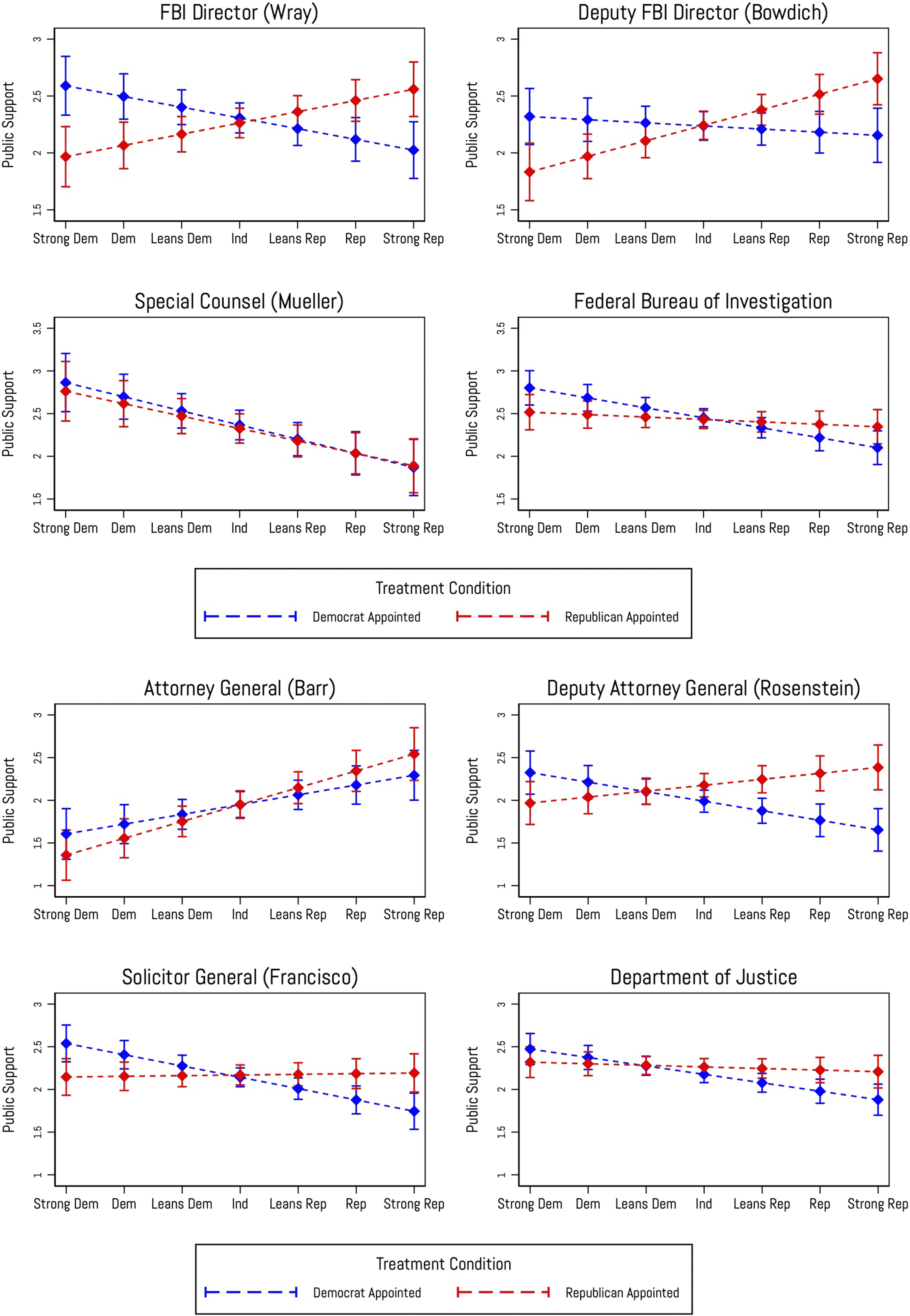
We find a similar story when we examine the DOJ. There is a significant interaction between treatment and party identity in three of the four DOJ models, including one demonstrating effects on support for the Justice Department as a whole. The one exception again involves a very high profile figure—Attorney General Barr, who was in the news throughout the spring of 2019 following the Mueller report. In fact, the results for Barr are almost the inverse of those for Special Counsel Mueller. Republicans display a high degree of support for the Attorney General—a likely result of his interpretations of the Special Counsel’s report and the corresponding media coverage. Aside from Barr, partisan cues exert a strong and consistent effect on the public’s evaluations of the FBI and DOJ.
Study 3 (Affective Polarization)
Has partisan cuetaking for rule of law institutions increased in the era of affective polarization? To explore this critical question, we conducted an additional online survey in December 2019, drawing from a convenience sample recruited through Amazon Mechanical Turk (MTurk). Recent research shows that MTurk samples produce internally valid results that replicate findings of high-profile political science experiments (Coppock, 2019). 9 In addition to pre-treatment questions measuring partisanship, ideology, political knowledge, and demographics, this survey also includes “feeling thermometer” questions, gauging how warmly or coldly responds feel to the two major parties. We operationalize affective partisanship as the difference between respondents’ in-party and out-party thermometer ratings. This operationalization is consistent with other measures of partisan affect, such as trait descriptions of the parties and varying levels of trust (see Druckman & Levendusky, 2019).
Within this survey, we again employ individual and institutional-level vignettes for the FBI (N = 974; 862 partisans) and DOJ (N = 959; 847 partisans). This analysis focuses on the subset of respondents that identify with or lean toward one of the major parties, excluding ‘pure’ independents. To help ensure the generalizability of our results, we modify our approach. As opposed to exclusively focusing on nominations, we cue presidential partisanship by using statements that highlight a presidential administration the rule of law actor has worked under. Figure 2 presents the results for the FBI, derived from OLS models.
10
We focus on the interaction between partisans’ level of affective polarization and whether the treatment received presented an in-party or out-party presidential signal. For all four models, we see a significant difference in treatment effect based on affective polarization. Whether it is FBI Director Wray, Deputy Director Bowdich, Special Counsel Mueller, or the FBI as a whole, partisans with stronger levels of affective polarization significantly condition their approval on the partisanship of the presidential signal they receive. For all vignettes, partisans that register a level of affective polarization one standard deviation below the mean exhibit little difference across experimental conditions. Partisans with a level of affective polarization one standard deviation above the mean, however, register anywhere from a 0.24 point difference (for Mueller) to a 0.52 point difference (for Wray) in the five-point approval scale. Thus, while the partisan presidential heuristic is strongest for less prominent individuals, for partisans with strong affective ties to their party, presidential cues can even influence public perceptions of high-profile figures such as Mueller. Affective Polarization, Presidential Cues, and Support for the FBI and DOJ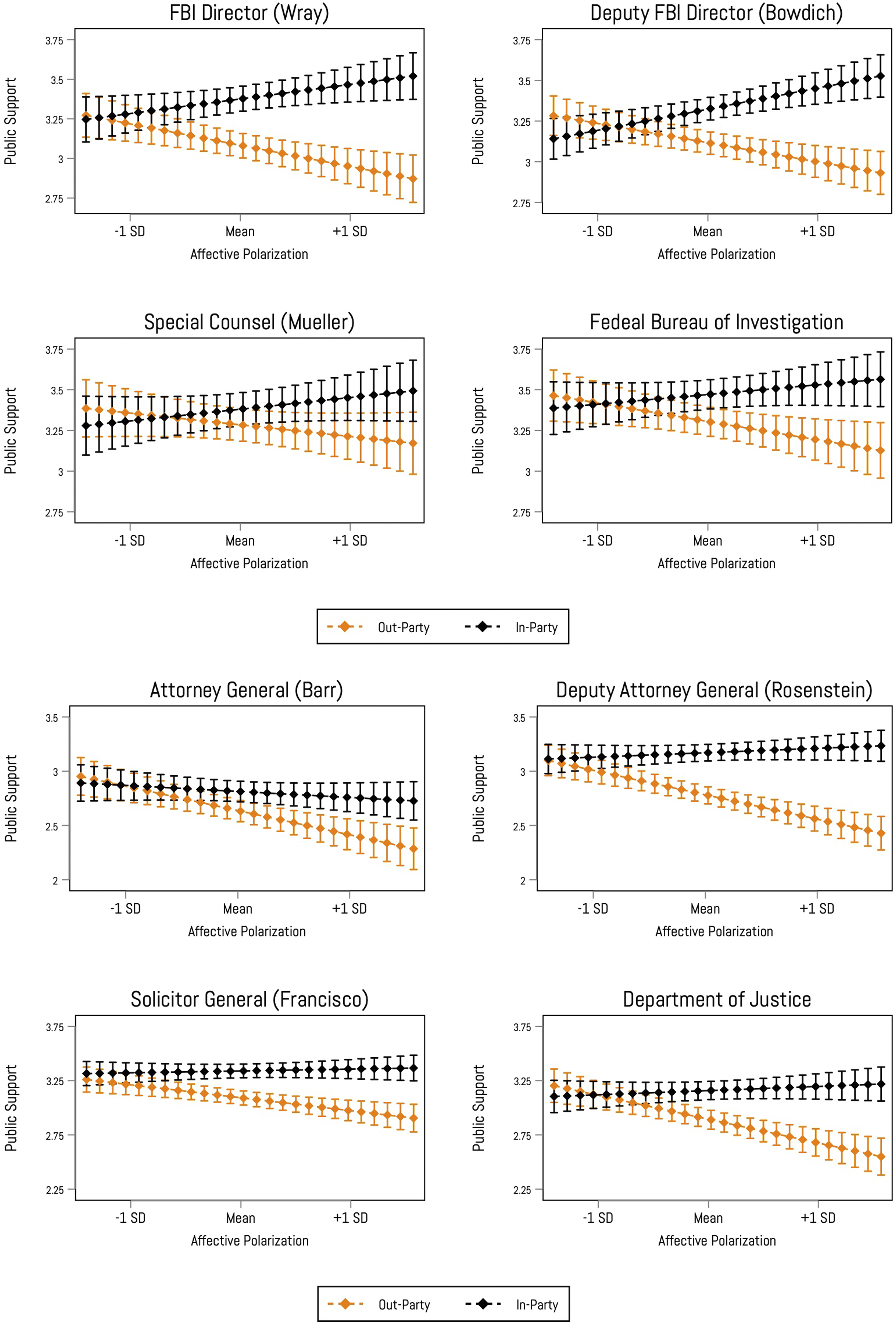
Similarly, in Figure 2 we also see that response to treatment with the DOJ vignettes is moderated by affective partisanship. Once again, there are significant interactions in all models between affective partisanship and whether respondents received an in-party or out-party presidential cue. For respondents one standard deviation below the mean for affective partisanship, there is limited or no difference based on whether an in-party or out-party cue is received. For those one standard deviation above the mean in affective partisanship, however, the cue matters greatly. Even for the higher-profile William Barr, respondents with high affective partisanship exhibit a 0.35 point predicted difference in approval based on whether the vignette presents an in-party or out-party cue. Overall, the results illustrate that as affective polarization increases, partisans increasingly view key leaders within rule of law institutions through a partisan lens, taking their cues from credible elites, such as the president.
Comparison to the U.S. Supreme Court
Our work demonstrates that partisan cues supplied by the president exert a strong and persistent influence on public perceptions of the FBI and DOJ. Does the partisan presidential heuristic work similarly with the courts? At a time when the partisan divide in support for the U.S. Supreme Court is at a historic high (Christenson & Glick, 2019; Devins & Baum, 2017), 11 there may be reason to believe so. At the same time, there are important institutional differences between the courts and law enforcement institutions. Notably, the courts are further separated from presidential influence since Article III justices enjoy lifetime appointments. This is contrary to the FBI and DOJ, where they are housed within the executive branch and their leaders can be removed by the president. This dynamic would suggest that partisan cuetaking should be stronger for the FBI and DOJ compared to the courts. As an initial test of differences across institutions, our 2019 Dynata study also embedded a series of experimental vignettes that assessed the impact of presidential partisan cuetaking on approval of the U.S. Supreme Court, as well as Justices Breyer, Roberts, and Thomas. The survey instrument and detailed regression results for these vignettes are provided in the appendix. We find that while partisanship conditions public support for individual justices and the Supreme Court as an institution, the interaction between the treatment and party identification is not significant across the individual and institutional Supreme models. These results suggest that the impact of partisan cuetaking is substantively weaker in shaping public perceptions for the Supreme Court compared to the FBI or DOJ. This means that when respondents are provided a cue connecting a partisan president to the justices and the Court, they do not substantially update their perceptions based on their partisanship. These interesting results suggest that there is important nuance to the efficacy of elite cues where institutional context impacts the extent to which the public engages in partisan cuetaking from credible elites like the president.
This does not imply, though, that partisanship plays no role in shaping perceptions of the Supreme Court. Extant work clearly demonstrates that partisan cleavages can impact both public support for the Court (Armaly & Enders, 2022; Johnston et al., 2014) and public acceptance of its decisions (Hansford & Coe, 2019; Nicholson & Hansford, 2014). In fact, our findings demonstrate that, across vignettes, partisanship significantly conditions approval of (liberal) Justice Breyer and (conservative) Justice Thomas. Moreover, a recent study by Bartels and Kramon (2022) shows that, over the past few decades, partisan approval of the Supreme Court has fluctuated based on who is in the White House. What is more, these results could be partly due to the timing of the survey. We might expect the interplay of contentious and politicized nominations (Armaly & Lane, 2023; Badas, 2023; Rogowski & Stone, 2021), allegations of scandal associated with Supreme Court justices (Boston et al., 2023), and unpopular decisions, such as the overturning of Roe v. Wade (Christenson & Glick, 2015; Haglin et al., 2021), to lead the public to view the Court through an increasingly negative partisan lens than in the recent past. Ultimately, our findings demonstrate that while partisan presidential cues can impact public perceptions of legal institutions across institutional contexts (i.e., the FBI and DOJ), there are some boundary conditions to the potency of presidential cues in modulating support for legal institutions like the U.S. Supreme Court, which has exhibited remarkable durability in maintaining public support (Nelson & Tucker, 2021). Future studies can help shed important light on how the heightened significance of partisanship and negative affect in the public’s perception of the Court may affect the institutional disparities in presidential partisan cuetaking identified in our research.
Discussion and Conclusion
Faith in the rule of law and legal institutions is foundational to liberal democracies. Yet the public possesses little information about the entities entrusted with administering justice. How then does the public form perceptions and maintain faith in key rule of law institutions? And can elite partisan cues meaningfully mold support for these institutions? Our experiments reveal that both individual and institutional support for the FBI and the DOJ are substantially derived from the intersection of one’s partisan identity and perceived presidential signals of support. This is not an ephemeral phenomenon or solely a product of former President Trump’s rhetoric. We find partisan cuetaking whether the source of the cue is Trump, Obama, Bush, Clinton, or “Democrats” and “Republicans.” Moreover, we find that the partisan presidential heuristic is stronger for those that exhibit higher levels of affective partisanship. Those with strong affective partisanship will even condition whether they approve of high-profile figures, such as Robert Mueller and William Barr, based on the partisan signals received. While we do not offer a direct test against procedural fairness concerns, our findings do suggest that the American public thinks of their party, in addition to or even in place of what they perceive is fair, in forming assessments of support for legal institutions.
As mass affective polarization continues to grow (Enders & Armaly, 2019; Iyengar et al., 2019), this is a cause for concern. While presidents do appoint like-minded agency leaders, rule of law institutions traditionally aspire to a norm of independence. As such, relying on partisanship and presidential signals may drive substantial public misinformation regarding what these agencies are actually doing. Across party lines, this could also result in a long term erosion of the perceived legitimacy of what has traditionally been regarded as impartial purveyors of justice. Assessing the extent to which partisan cuetaking impacts perceptions of legitimacy for rule of law institutions is, thus, a vital next step for further research. Additional research could also assess how the public responds when partisan cues compete with other types of informational cues (for example, a cue priming concerns of procedural fairness). In particular, within a polarized media environment, the cues to which citizens are exposed based on their media consumption may play a critical role in how they ultimately perceive legal actors (Badas & Justus, 2023; Baird & Gangl, 2006; Hoekstra, 2003; Zilis, 2015). This represents a fruitful avenue for future research.
Future work could moreover assess the extent to which the presidential partisan cue applies to non-electoral institutions that are outside of the “rule of law” context. 12 Ultimately, our findings suggest that partisan cues have a powerful capacity to make public support for key rule of law institutions highly malleable. By reiterating partisan signals and hardening perceptions of partisan bias, elites may very well be eroding diffuse support for legal institutions. This could serve as a troublesome conduit to democratic backsliding in the United States. Such a proposition, undoubtedly, requires further exploration.
Supplemental Material
Supplemental Material - The Rule of Law in Red and Blue: Affective Polarization and Support for Legal Institutions in the United States
Supplemental Material for The Rule of Law in Red and Blue: Affective Polarization and Support for Legal Institutions in the United States by Ali S. Masood, Ryan Strickler and Michael A. Zilisd in American Politics Research
Footnotes
Acknowledgments
Earlier iterations of this project were presented at the annual meetings of the American Political Science Association, the Midwest Political Science Association, and the Southern Political Science Association. We are grateful to Brandon Bartels, Justin Buchler, Robert Erikson, David Glick, Benjamin Kassow, Elizabeth Lane, Kash Radocha, Anand Sokhey, Rorie Solberg, Amy Steigerwalt, Joseph Ura, and Nicholas Weller for helpful comments and suggestions.
Author Contributions
Authors contributed equally and are listed in alphabetical order of last names.
Declaration of Conflicting Interests
The author(s) declared no potential conflicts of interest with respect to the research, authorship, and/or publication of this article.
Funding
The author(s) disclosed receipt of the following financial support for the research, authorship, and/or publication of this article: This work was supported by the American Political Science Association; Centennial Grant #1981412.
Ethical Statement

Supplemental Material
Supplemental material for this article is available online.
Notes
Author Biographies
References
Supplementary Material
Please find the following supplemental material available below.
For Open Access articles published under a Creative Commons License, all supplemental material carries the same license as the article it is associated with.
For non-Open Access articles published, all supplemental material carries a non-exclusive license, and permission requests for re-use of supplemental material or any part of supplemental material shall be sent directly to the copyright owner as specified in the copyright notice associated with the article.
