



Abstract
Is a federal prosecutor’s decision whether to pursue violent crime charges political? While prosecutors frequently assert their decision-making independence, their selection and operational constraints suggest a very different story. We assess whether political factors related to the prosecution priorities of the president, Congress, and the local public affect federal prosecutors’ decisions to pursue or decline charges in violent crime matters. To empirically examine this, we utilize data from 89 U.S. Attorneys offices from 1996 to 2011. The results provide rich new insight into when and why federal prosecutors’ decisions to pursue or decline prosecutions are driven by the preferences of the president, Congress, and the local public. The findings also have important broader implications for the role of political factors in a U.S. criminal justice system believed by many to be in crisis.
In the early days of his administration, President Trump’s message was clear: the government must move swiftly to stop violent crime. In his inauguration address, Trump decried “the crime and gangs and the drugs that have stolen too many lives and robbed our country of so much unrealized potential.” He went on to promise that “[t]his American carnage stops right here and stops right now” (Trump 2017). By February 9, 2017, Trump had signed three new executive orders directing the Department of Justice (DOJ) to aggressively target and reduce violent crime (Zapotosky 2017). While Trump’s position on violent crime may be clear, the potential effectiveness of his rhetoric in changing the DOJ’s approach to targeting violent crime in the United States is less so.
We focus on one primary avenue where this question is ripe for consideration: DOJ prosecutors’ decisions whether to bring or decline to bring charges for federal violent crimes. Traditionally, federal and state prosecutors in this country assert that their charging decisions are independent and free from political pressure. After a California police officer recently fatally shot an unarmed homeless man, the Los Angeles County District Attorney announced that “[d]ecisions on whether or not to file criminal charges [in this matter] will be based solely on the facts and the law—not on emotion, anger or external pressure” (Mather 2016). And in discussing the potential prosecution of Hillary Clinton, Attorney General Loretta Lynch noted that “[w]e will review all the facts and all the evidence and come to an independent conclusion as how to best handle it” (Goldman 2016). While prosecutors may adamantly assert their decision-making independence, as political scientists, we have good reason to believe that political factors systematically affect the decisions of prosecutors to charge crimes. Prosecutors in the United States are selected through a political process (elections or appointments; Goelzhauser 2013; Nelson 2014; Nelson and Ostrander 2016; Scott 2007). They generally operate within the purview of the executive branch. They receive their funding from the legislature and their authority to prosecute many crimes through laws passed by the legislative and executive branches. And, of course, their prosecuted cases are decided and reviewed by a judiciary that is itself frequently political (L. Epstein and Knight 1998; Hettinger, Lindquist, and Martinek 2004; Hettinger, Lindquist, and Martinek 2006).
The political pressure on prosecutors to address violent crime in America is especially pronounced. For federal prosecutors, President Trump’s signaling of a desired aggressive response to violent crime echoes the efforts of several other modern presidential administrations (Oliver 2003; Oliver, Marion, and Hill 2016). For example, Richard Nixon famously ran a “law and order” campaign in which he placed the safety of Americans as a central issue. When accepting the nomination of the Republican Party in 1968, Nixon pledged that he would direct a new Attorney General to “launch a war” against “merchants of crime and corruption in American society” (Nixon 1968). Congress has also devoted considerable attention to reducing crime in America, passing major legislation such as the Violent Crime Control and Law Enforcement Act of 1994 and maintaining oversight by holding more than a hundred hearings on violent crime since 1980 (Baumgartner and Jones 2013). The American public also expects prosecutors to prioritize the battle against violent crime. Despite falling national crime rates in recent years, nearly 70 percent of Americans polled believe that crime is actually rising (McCarthy 2015). Given these considerations, prosecutors are incentivized to pursue violent crime on the behalf of their political principals and constituents. Consequently, violent crime has become a centerpiece of federal prosecution, making up roughly 20 percent of federal criminal case filings annually (United States Attorneys’ Office 2015).
In this study, we examine the decisions of federal prosecutors to charge or decline to charge criminal violent crime matters. We anticipate that federal prosecutors (U.S. Attorneys) are incentivized to be responsive to the violent crime prosecution priorities of the president, Congress, and their local public. Using charging data made available by the DOJ from 1996 to 2011, we examine the effects of these political actors’ signals and preferences on the decision whether to prosecute violent federal crimes such as murder, assault, bank robbery, unlawful possession of firearms and explosives, arson, kidnapping, and domestic violence. As our empirical results reveal, these political constraints play a substantively strong role in explaining many prosecution decisions. The analysis also provides important broader insight into prosecutors’ agenda setting decision making for a U.S. criminal justice system believed by many to be in crisis for its treatment of critical issues such as race, punitiveness, drugs, criminal sentencing, overcrowding in prisons, and beyond (Gibson 1978; Hurwitz and Peffley 2005; Nelson 2014; Peffley and Hurwitz 2010; Tiede 2009).
Federal Prosecutors and Declinations
Housed in the DOJ, ninety-three U.S. Attorneys and their offices are charged with enforcing and executing federal criminal and civil law as federal prosecutors. U.S. Attorneys are appointed by the president, with the advice and consent of the Senate, for four-year terms (28 U.S. Code §541). They may also be removed by the president, something that is frequently exercised by new, incoming presidents seeking to appoint their own U.S. attorneys (Scott 2007).
U.S. Attorneys “sit at the center of the federal prosecutorial machine” (Whitford 2002, 11). In this role, they are responsible for making many pivotal decisions, each of which is saturated with discretion. These discretionary decisions include, for example, whether to prosecute or decline prosecution, what charges to bring, whether to argue against bail, when to offer a plea bargain, and what sentence to seek (e.g., Howard et al. 2000). This high degree of prosecutorial discretion and independence has hardly gone unnoticed, with scholars noting that U.S. Attorneys have “historically prosecuted the nation’s laws in a largely unfettered environment” (Whitford and Yates 2009, 116), that they hold “a degree of autonomy and independence from the department perhaps unmatched by any other field service in the federal government” (Eisenstein 1978, 11), and that they operate in “splendid isolation” (Seymour 1975).
Among their many decisions, U.S. Attorneys hold vast discretion in deciding whether to pursue or decline prosecution. 1 Pursued prosecutions proceed forward to a grand jury, 2 an information, or criminal complaint and, in most cases, a plea bargain, petit jury, or bench trial 3 ; declined prosecutions, or declinations, disappear. No charges are advanced, and suspects face no further proceedings or consequences.
U.S. Attorneys are aided by a staff of career (nonappointed) Assistant U.S. Attorneys but the “sole responsibility whether to initiate or decline prosecution” (Whitford 2002, 11) rests with the U.S. Attorney in the district (see also Seymour 1975). While a federal prosecutor is directed to “commence or recommend Federal prosecution if he/she believes that the person’s conduct constitutes a Federal offense and that the admissible evidence will probably be sufficient to obtain and sustain a conviction,” prosecution can be declined for a variety of nonevidentiary reasons including that “[n]o substantial Federal interest would be served by prosecution” (U.S. Attorneys’ Manual §9-27.220). The “no substantial federal interest” rationale for declination is broadly defined to include federal law enforcement priorities, the nature and seriousness of the offense, and the deterrent effect of prosecution, among other factors (U.S. Attorneys’ Manual §9-27.230). In addition, there is no formal oversight mechanism in place for individual federal prosecutorial decisions to pursue or decline prosecution; rather, “[i]t is left to the judgment of the attorney for the government” (U.S. Attorneys’ Manual §9-27.220 Comment). The U.S. Supreme Court has repeatedly endorsed this vast delegation of declination power and discretion to prosecutors, noting in Bordenkircher v. Hayes, 434 U.S. 357 (1978), that “so long as the prosecutor has probable cause to believe that the accused committed an offense defined by statute, the decision whether or not to prosecute . . . generally rests entirely in his discretion” (p. 364).
Political Constraints on the Decision to Prosecute
Despite working in an ostensibly “unfettered” and “isolated” environment bursting with discretion, we expect that U.S. Attorneys deciding whether to pursue or decline prosecution in the cases before them are in fact constrained by the political environment in which they serve. In particular, we expect that the preferences and priorities of the president, Congress, and a U.S. Attorney’s local public are likely to serve as important checks on the prosecutorial agendas of these federal actors.
The President and Congress as Principals
Like others before us studying federal administrative agency actors, we believe that U.S. attorneys serve at the behest of political principals—namely, the president and Congress. Through the lens of principal-agency theory, we can understand how these political principals may influence the behavior and policy priorities of local federal prosecutors and incentivize the production of outcomes (here, more or less violent crime prosecutions) that are desirable by the principals. Under principal-agency theory, “one party, the principal, considers entering into a contractual agreement with another, the agent, in the expectation that the agent will subsequently choose actions that produce outcomes desired by the principal” (Moe 1984, 756). The relationship necessarily involves the delegation of tasks, responsibilities, and the authorization of the agent to act on behalf of the principal (George and Yoon 2003). By authorizing agents to act on their behalf, principals can tackle a larger workload and achieve a more efficient processing of tasks.
Principals have several methods to help prevent agents from engaging in undesirable behavior or pursuing their own interests. Such tools are designed to reduce asymmetries, minimize shirking, and incentivize behavior and outcomes that the principals would have produced with the same information (Miller 2005; Moe 1984; Randazzo 2008; Ringquist 1995). Examples include the selection and screening of agents, incentives, sanctions, monitoring, and crafting administrative procedures (i.e., congressional deck-stacking) (e.g., Bawn 1995; McCubbins, Noll, and Weingast 1987).
When it comes to the president and Congress as principals to the U.S. Attorneys to whom they delegate federal prosecutorial power, a number of traditional ex ante controls exist. Careful screening and selection of agents is often the most direct and effective mechanism of agent control for principals (van Houten 2009). While a deliberate hiring process requires a substantial investment on behalf of the principal (Kiewiet and McCubbins 1991; Miller and Moe 1986), “both sides are better off if principals are able to identify those individuals who possess the appropriate talents, skills, and other personal characteristics prior to the establishment of the principal/agent relationship” (Kiewiet and McCubbins 1991). Together, the president and Congress nominate and appoint U.S. Attorneys, frequently seeking to control the bureaucracy through “politicized” appointments (Lewis 2008; Miller 2000; Nelson and Ostrander 2016). As a result, many of the selected U.S. Attorneys share broader prosecutorial preferences with their principals.
Presidents and Congress can also sanction ill-behaving U.S. Attorneys. Sanctions (and their threat) can serve as an important agent control mechanism. If the threat of sanctions is credible, agents should be more likely to behave according to their principals’ interests (Kiewiet and McCubbins 1991). Presidents can fire U.S. Attorneys or fail to reappoint them for a second four-year term (Scott 2007). The president and Congress can also utilize other threats of sanctions to incentivize good behavior like threatening the agency with reorganization (such as consolidating prosecution districts via altering 28 U.S. Code §541(a) 4 ), altered jurisdiction, reduced discretionary authority, and a greatly reduced budget (D. Epstein and O’Halloran 1999; MacDonald 2013; Shipan 2004). For U.S. Attorneys, these threats are likely meaningful, since their ability to maintain a large caseload depends on the size of their office staffs and the resources made available to them.
Principals are also likely to use positive incentives such as promotions, personal reputation-building, and the promise of career advancement to induce agent compliance (Kiewiet and McCubbins 1991; Peppers 2006). U.S. Attorneys frequently seek to use their temporary political appointment as a springboard for future political or legal job opportunities. With these future career ambitions comes significant emphasis on building and maintaining one’s reputation, something that prior work indicates does curb prosecutors’ behavior. As one federal prosecutor interviewed in Lochner (2002, 277) explained, many of the federal prosecutors “want to be judges or Department of Justice officials, and do not want to alienate potential supporters.” Or, as Eisenstein (1978, 74) puts it, federal prosecutors seek “favorable evaluations from those who can affect their future career prospects.” These ambitions place a high priority on staying in the good graces of the White House and Congress, since both are likely to play a role in the selection of future employment—whether that be in a federal judgeship, a higher ranking position within the DOJ, or something else. What is more, while concerns for organizational reputation may moderate the political behavior of U.S. Attorneys (Carpenter and Krause 2012; Krause 2009), their status as short-term political appointees means that they have less incentive than many other officials in the bureaucracy to focus exclusively on building a long-term bureaucratic reputation that is independent of all political influences (Krause 2009).
Even with ex ante controls such as careful selection, the threat of sanctions, and positive incentives, agents seeking to implement the preferred policies and outcomes of their principals may, in isolation, lack the information on the principals’ preferences necessary to do so. To overcome this agent uncertainty or imperfect information, principals can transmit information to the agent through signals (Carpenter 1996; Shipan 2004). Legislatures might use hearings or investigations to clearly raise or define an issue (Talbert, Jones, and Baumgartner 1995) or indicate their preferences on future agency action (Ferejohn and Shipan 1989). The president may do the same by “going public” through public speeches repeatedly emphasizing the importance of an issue to his administration (Kernell 1997). Presidential rhetoric, like legislative hearings, can serve multiple purposes, but one such effect is to signal to their agents missing information on where their priorities should lie.
Evidence indicates that it works. “[A]gencies are sensitive to a variety of signals that they receive from the political environment” (Shipan 2004, 478). Empirically, Wood (1988) and Wood and Waterman (1991) find that congressional budget signals affected the EPA’s abatement, monitoring, and inspection activities. Carpenter (1996) and Olson (1995) observe similar presidential and congressional signaling effects on the outputs of the Food and Drug Administration (FDA). Whitford and Yates (2003, 2009) and Eshbaugh-Soha (2008) find that presidential rhetoric provides a strong signaling effect on federal bureaucrats in agencies like the Drug Enforcement Administration (DEA) and DOJ.
In the case of U.S. Attorneys, we expect that presidential rhetoric and congressional hearings will provide important, meaningful signals regarding these principals’ priorities and how that should be translated to prosecution proclivity. Like with Whitford and Yates’s study of drug policy implementation and prosecutions, we expect that presidential rhetoric provides important policy signals to U.S. Attorneys about violent crime, both directly (hearing the president’s words) and indirectly (through directives coming from the U.S. Attorney General and her staff) (Whitford and Yates 2009, 28). For presidents, “speechmaking is an efficient means of signaling information because speeches can effectively penetrate multiple layers of a thickening federal bureaucracy” (Eshbaugh-Soha 2008, 118). The more presidential rhetoric provided on violent crime, the more likely U.S. Attorneys should be to prosecute those cases. Similarly, we anticipate that the frequency of congressional hearings on potential matters for prosecution will provide meaningful signals to U.S. Attorneys regarding congressional priorities. Congressional hearings are not commonplace or random; rather, “they are resource-intensive activities” that are generally not used when things in an issue or policy area “are operating smoothly” (Weingast and Moran 1983, 769). Once again, more hearings about violent crime should lead to a higher probability of prosecuting a case of that type.
The Local Public Connection
We also expect that U.S. Attorneys will be constrained by the prosecutorial preferences and priorities of their local public. While the relationship between the local public and prosecutors may be at its strongest in the state context where prosecutors tend to be elected (Gordon and Huber 2002), there is good reason to believe this relationship is powerful for federal prosecutors too. U.S. Attorneys “do not operate in a vacuum” (Benesh and Martinek 2002, 112). Rather, they are members of the local community in which they work and are likely to have a very strong sense of community values and priorities. They are, thus, likely to “share the core beliefs and views of the local population on salient public issues” (Whitford and Yates 2009, 118). And, indeed, the local public helps ensure this representativeness by playing an indirect role in the selection process of U.S. Attorneys via the norm of senatorial courtesy (Nelson and Ostrander 2016; Steigerwalt 2010; Steigerwalt and Martinek 2017). Finally, since most future employment opportunities for U.S. Attorneys will filter through their local or regional political environment, either directly or indirectly (Perry 1998; Whitford and Yates 2009), U.S. Attorneys are likely to be mindful of local prosecutorial preferences even if they themselves do not share them.
Because of this powerful connection between U.S. Attorneys and their local public, we anticipate that local public opinion about the perceived seriousness of the violent crime problem will help drive prosecution priorities. Where the local public views violent crime as an important negative issue, local U.S. Attorneys are likely to respond with more aggressive prosecutions. Similarly, as the local region gets more committed to punitiveness and law and order principles, we expect a higher overall priority among local U.S. Attorneys in pursuing prosecutions of violent crimes (L. Epstein and Kobylka 1992; L. Epstein, Walker, and Dixon 1989).
Data and Variables
To examine the political and other constraining effects on federal prosecutors’ decisions to pursue or decline violent crime prosecutions, this project combines case level data retrieved from the DOJ with compiled and newly collected presidential, congressional, public, judicial, and district variables. As part of the DOJ’s compliance with the Freedom of Information Act (FOIA), the agency has made publicly available rich and complex data tracking the entrance, processing, and exit of criminal and civil cases (matters). This includes detailed information on the decision to pursue a case for prosecution, the charges considered, the people involved in the case, trials conducted, and sentences or judgments entered. 5
We focus specifically on criminal matters disposed by DOJ U.S. Attorneys from 1996 to 2011 in the violent federal crime category as defined by U.S. Attorney offices’ program categories. 6 Our data include 194,907 violent criminal matters acted on by the U.S. Attorneys following referral to their office. Notable examples of federal violent crimes within the data include murder, assault, bank robbery, sexual abuse, violence against federal employees, and other violent crimes occurring across interstate lines. The DOJ also classifies numerous cases as violent crimes due to the presence of violence associated with major criminal enterprises such as drug cartels or mafia organizations. Another common federal violent crime falls within 18 U.S.C. §922(g)(1), which prohibits convicted felons from possessing firearms. Via a federal prosecutorial strategy known as Project Exile, this charge has been a vehicle for vigorously punishing members of street gangs and preventing firearm-related homicides in urban areas (Crime Solutions 2015; Green 2017).
Our unit of analysis is the individual criminal matter. The dependent variable is Prosecuted. Derived from the DOJ’s publicly available FOIA data, this is a dichotomous variable coded as 1 if the matter is prosecuted by a U.S. Attorney’s Office and 0 if it is declined for prosecution. Nearly 38 percent of violent crimes within our data are declined.
We measure a variety of independent variables related to the expected effects of political (presidential, congressional, public) factors on the prosecutorial declination decision. Summary statistics on all independent variables are provided in the supplemental material, and a summary of the expected direction of effects for these variables is provided in Table 1. To account for the potential signaling effect of presidential rhetoric, we follow Whitford and Yates (2009), Edwards and Wood (1999), Eshbaugh-Soha (2008), Eshbaugh-Soha and Collins (2015), Holmes (2007), and others, and code Presidential Rhetoric appearing in the Public Papers of the President (Peters and Woolley 2017). 7 To measure presidential rhetoric, we count the number of sentences in presidential public statements each month that contain policy mentions of violent crime. We then standardize this count by dividing it by the total number of statements in a month and then multiplying it by one hundred. To ensure proper temporal ordering, where the U.S. Attorneys are considering presidential statements on violent crime that have been made in the past, this measure is lagged one month. The resulting measure each (lagged) month is, thus, the number of sentences relating to crimes of violence per hundred statements. Figure 5 in the supplemental material depicts the distribution of this variable in our data. As it reveals, there is substantial variation in presidential rhetoric, including across and within individual presidencies.
Expected Direction of Effects for Variables.

Dependent variable is Prosecuted, indicating that prosecution, rather than declination, has been pursued for the individual matter.
Related to Congress as a principal, we code Congressional Hearings. Like with our presidential rhetoric variable, this variable captures the amount of public attention that Congress pays to violent crime-related policies. Here, we turn to the Baumgartner and Jones (2013) Policy Agendas Project. Using those data, we count the number of hearings related to violent crime. As with presidential rhetoric, this measure includes a one-month lag. The resulting variable is calculated as the percentage of total hearings per (lagged) month related to crimes of violence. The supplemental material provides full details on the congressional hearings measure.
In considering the public’s potential influence on declination decisions, we focus on three variables of interest. First, Local Public Opinion measures public opinion on violent crime. This variable is constructed using General Social Science (GSS) biennial opinion data for nine geographic regions in the United States (New England, Middle Atlantic, North Central, West North Central, South Atlantic, East South Central, West South Central, Mountain, and Pacific). The GSS survey question captures regional mood on the perceived seriousness of the violent crime problem as a matter of policy by asking respondents whether the United States is spending too much, too little, or about the right amount on “halting the rising crime rate.” This variable is computed as a percentage, with higher percentages reflecting respondents answering that “too little” is spent on this issue.
Second, we also account for Local Punitiveness toward criminal offenders. Measured as the number of incarcerated inmates in state-run prison facilities per hundred thousand residents for each state-year (per Bureau of Justice Statistics), this serves as a proxy measure for state level preferences regarding how much the justice system should assert itself in the lives of their citizens. States that imprison a large number of convicts relative to the population have more punitive preferences in responding to crime and disorder. This harshness provides a signal to federal prosecutors on how aggressive the local public wants them to be in pursuing alleged crimes. Violent crimes are an area where this signal is especially important, since acts of violence can often shock the public conscience and elicit a visceral reaction. Accordingly, we expect that as local punitiveness rises, U.S. Attorneys will respond with a higher likelihood of pursuing prosecutions in the area of violent crime.
Third, to capture the influence that the rate of violent crime in a state has in pressuring local prosecutors to address an underlying violent crime problem, the State Violent Crime Rate is included in the model. This variable captures the number of violent crimes as reported by the FBI’s Uniform Crime Reports for every state-year per hundred thousand residents. As the incidence of violent crime in a state increases, we anticipate that U.S. Attorneys will be more likely to prosecute those cases. 8
In addition to the variables capturing the potential effects of political principals on U.S. Attorneys’ charging behavior, we also account for resource constraints (internal staff size and workload), strategic and political considerations (court, U.S. Attorney party, president, Senate Judiciary Committee chair), individual criminal matter (referring agency and violent crime type), and other factors that may affect federal prosecution decisions. First, we control for the average workload of individual attorneys in local U.S. Attorney offices (Staff Workload). This variable divides the total number of civil and criminal matters pending in a U.S. Attorney office in a year (as reported in the U.S. Attorneys’ Annual Statistical Reports) by the number of Assistant U.S. Attorneys in an office in that year (per Nelson and Ostrander 2016). 9 While no U.S. Attorney office has the resources and time to pursue every prosecution, we expect that, all other things equal, less burdened attorneys and offices will be more likely to pursue prosecutions in individual cases than other offices facing higher workload constraints.
Second, we control for the prospective nature of the decision to charge a case. Specifically, we expect prosecutors to be forward looking, accounting for future courts’ influence on the case—from the probability of conviction to the length of sentence imposed—and adjust their calculation affecting whether to prosecute or decline accordingly. Previous research suggests lower court judges and litigants engage in this strategic behavior (Boyd 2015; Randazzo 2008; Scott 2006), so we expect prosecutors to behave in similar ways. To capture this in our variable District Court Conservatism, we control for the ideology of the appropriate district court using the median Judicial Common Space score for each district-year (Boyd 2010; L. Epstein et al. 2007; Giles, Hettinger, and Peppers 2001). These scores range from −1 (most liberal) to +1 (most conservative). We expect that more conservative prospective district courts will incentivize the decision to charge a case in law and order criminal matters like violent crimes (George 2001).
In addition, we control for the political preferences of the U.S. Attorney leading each district. We expect that Republican-leaning U.S. Attorneys will be more likely, as a baseline matter, to favor violent crime prosecutions than Democratic-leaning U.S. Attorneys. Like Whitford and Yates (2009), we measure U.S. Attorney Party using the party of the sitting president at the time the U.S. Attorney commences her work (coded as 1 for Republican, 0 for Democratic). We also control for whether the DOJ is being led by an Acting Attorney General, a time likely to be characterized by uncertainty for U.S. Attorneys about the overarching preferences and priorities of the DOJ. As a result of this uncertainty, we should expect to see fewer prosecutions.
Our statistical modeling also includes notable fixed effects. These include case-level factors about the federal agency that referred the matter to the DOJ for prosecution and the specific type of violent criminal matter in the case. Within our data, the most common federal agencies that refer violent crime matters to the DOJ for prosecution are the Bureau of Alcohol Tobacco and Firearms (ATF), the Federal Bureau of Investigation (FBI), and the DEA. We also incorporate a variable that captures the lead criminal charge for each matter using the title and section of the U.S. Code (e.g., 18 U.S.C. §2113, which covers bank robbery and incidental crimes, and 18 U.S.C. §2241, which criminalizes federal aggravated sexual assault). There are fifty such lead charge categories. This variable naturally controls for crime-specific considerations like the complexity of proving the offense, the substantive nature of the conduct involved, and the potential penalties for the crime. We also include fixed effects for district (to account for the individual U.S. Attorney offices), presidential administration (to account for presidential differences in prosecutorial preferences; within our data Clinton, Bush, and Obama administrations), chairperson of the Senate Judiciary Committee (to control for congressional differences in prosecutorial priorities; the Senate Judiciary Committee serves as the gatekeeping committee for U.S. Attorney nominations and was chaired by Senators Leahy, Specter, and Hatch during our time frame), 10 and year (to account for the longitudinal nature of the data).
Results
To empirically examine the effects of political and other factors on U.S. Attorneys’ decisions to prosecute federal violent crimes, we estimate a logistic regression model with robust standard errors. The results of these estimations are provided in Table 2. As the results indicate, four of our five key political variables have a statistically meaningful impact on the decision to prosecute federal violent crimes. The model accurately predicts nearly 70 percent of declination decisions with a proportional reduction in error of nearly 22 percent. Below, we provide a more in-depth examination of the individual political variables and their effects.
Logistic Regression Estimates for Whether a Case is Prosecuted.
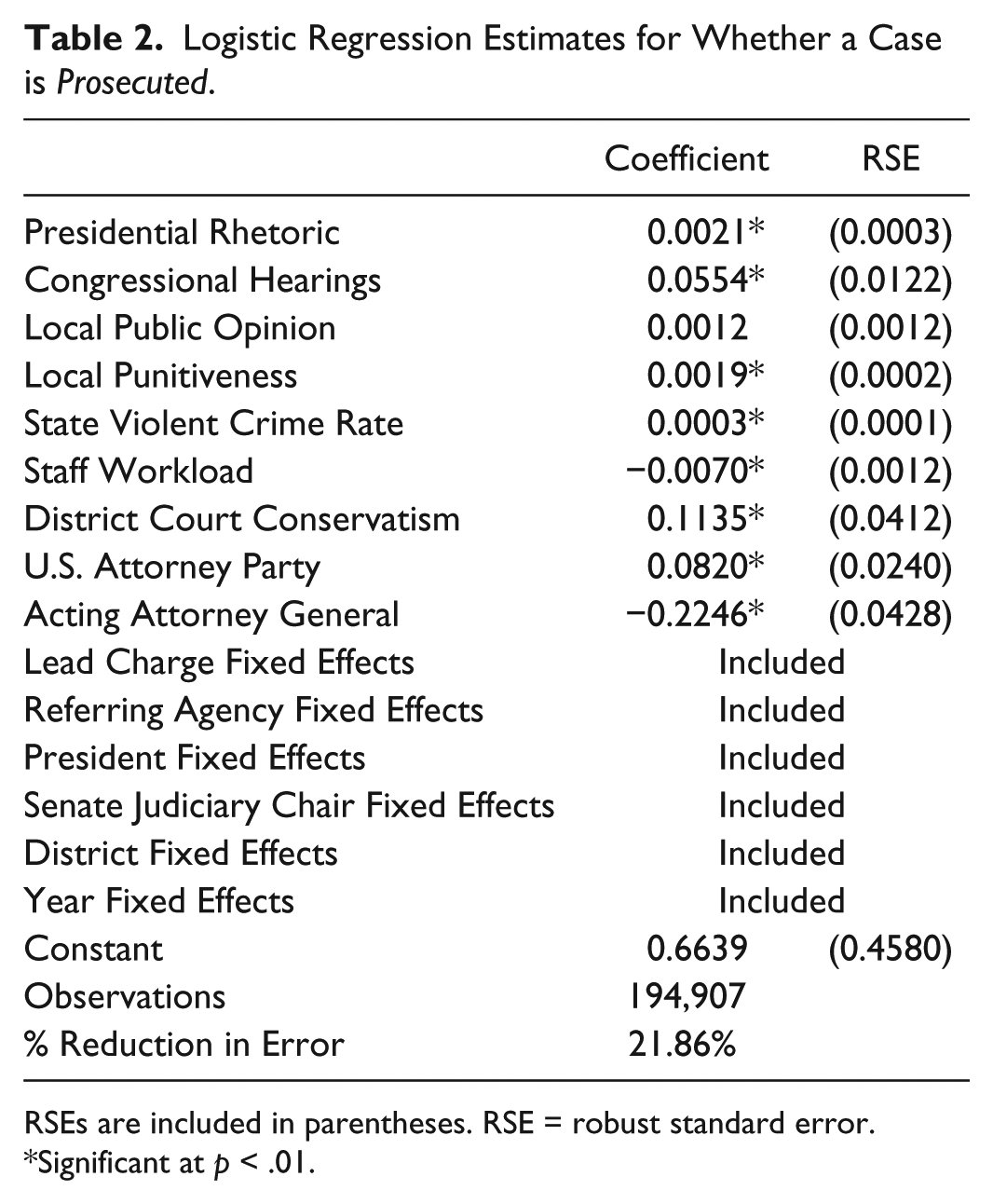
RSEs are included in parentheses. RSE = robust standard error.
Significant at p < .01.
First, we consider presidential effects on prosecution. As Table 2 reveals, Presidential Rhetoric, which captures the president’s signals to U.S. Attorneys regarding prosecution priorities for violent crime, has a statistically significant and positive effect. To further delve into the substantive effects of Presidential Rhetoric, Figure 1 plots the predicted probabilities of prosecution given the changing levels of a president’s rhetoric on violent crime. These estimated probabilities (and all others provided below) set all other variables at their mean and modal values.
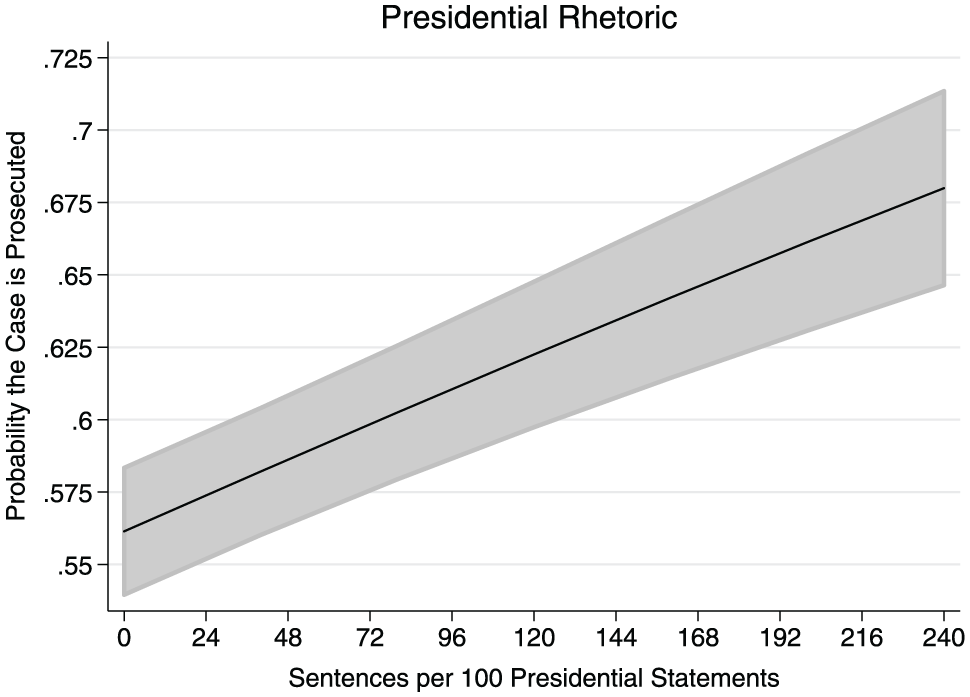
Estimated predicted probabilities of case prosecution given the changing values of presidential rhetoric.
The effect of presidential rhetoric is positive, meaning that, as expected, the more a president speaks about issues related to violent crime, the more likely U.S. Attorneys and their offices are to pursue prosecutions of those crimes. Presidential rhetoric’s effect ranges from a prosecution probability of .56 (during low violent crime rhetoric) to nearly .68 (during much higher periods of presidential rhetoric on violent crime). This is a substantial increase in the predicted probability of nearly .12.
While the above evidence indicates a high level of responsiveness among federal prosecutors to presidential priorities and policy certainty, is the same true for congressional prosecutorial priorities? To examine this, we look to the Congressional Hearings variable where we expect to observe a positive effect similar to presidential rhetoric. Returning once again to Table 2, we see a positive, significant effect on this variable. As Figure 2 reveals, the increase in the probability of case prosecution is approximately .07 as the percentage of hearings dedicated to violent crime moves from its minimum to maximum value. This is evidence that the more Congress discusses issues related to violent crime, the stronger and more effective the signal sent to prosecutors that this area is a prosecutorial priority.
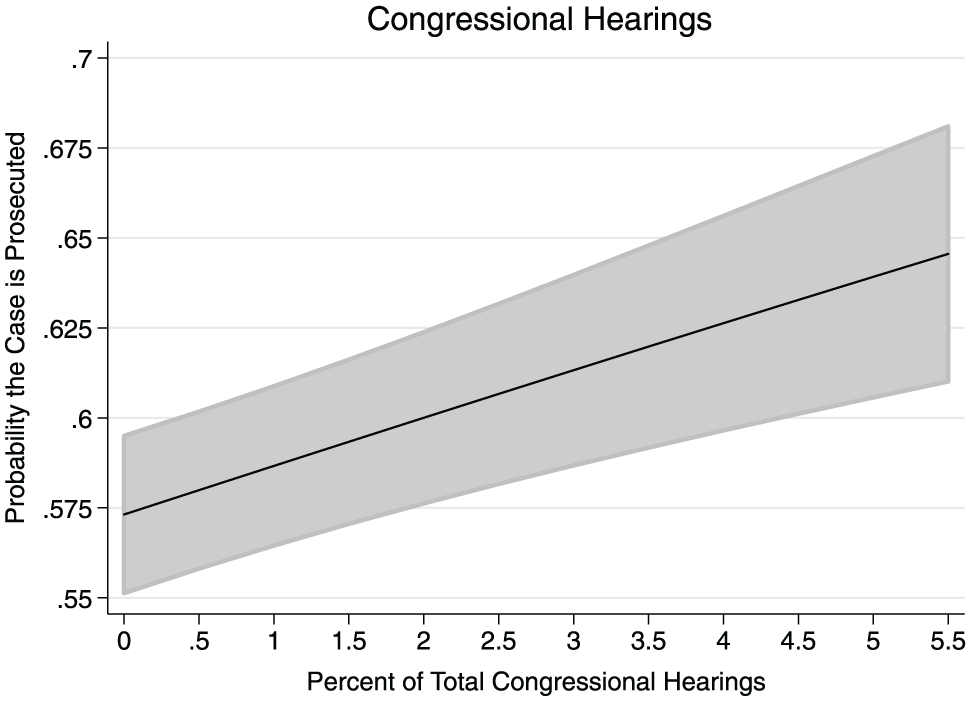
Estimated predicted probabilities of case prosecution given the changing values of congressional hearings.
For our final area of inquiry, we focus on the potential constraining effect of the local public. To do this, we examine Local Public Opinion, Local Punitiveness, and State Violent Crime Rate. Since Local Public Opinion does not have a statistically significant effect on the dependent variable (per Table 2), we do not have evidence that federal prosecutors’ declination decisions are driven by changes in the public’s opinion about the seriousness of violent crimes as a policy problem. However, prosecutors do appear to be strongly influenced by the punitiveness of their jurisdiction (Local Punitiveness). In those states with significantly more prisoners in state government facilities relative to the population, prosecutors are much more likely to bring a prosecution in a violent criminal matter. Figure 3 plots the predicted probability of prosecution across the state imprisonment rate, which serves as a proxy for local views about punishment. We find that area punitiveness has a large impact on how likely federal prosecutors are to pursue violent offenders. From the minimum state incarceration rate to the maximum, the probability that an individual criminal matter is pursued increases in predicted probability by nearly .34.
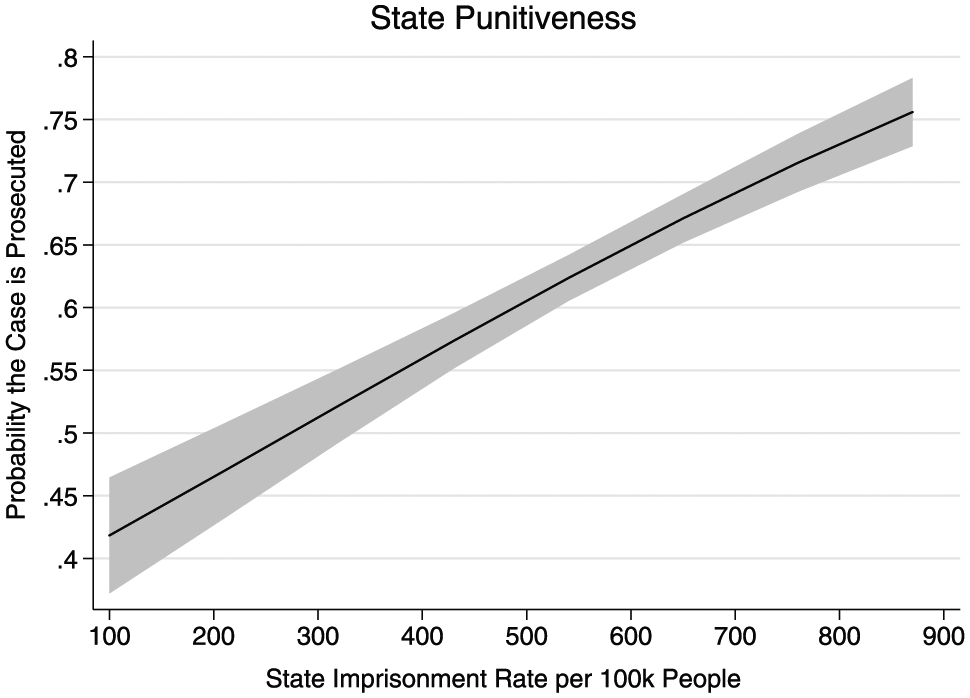
Estimated predicted probabilities of case prosecution given the changing values of the state imprisonment rate.
State Violent Crime Rate also has a meaningful impact on federal violent crime prosecutions. As Figure 4 depicts, there is up to a nearly .08 increase in the probability of violent crime prosecutions across the range of values of this variable. Overall, this indicates that federal prosecutors are mindful of whether violent crime is a problem in their state. Where it is, federal prosecutors will respond by vigorously pursuing offenders through federal laws.
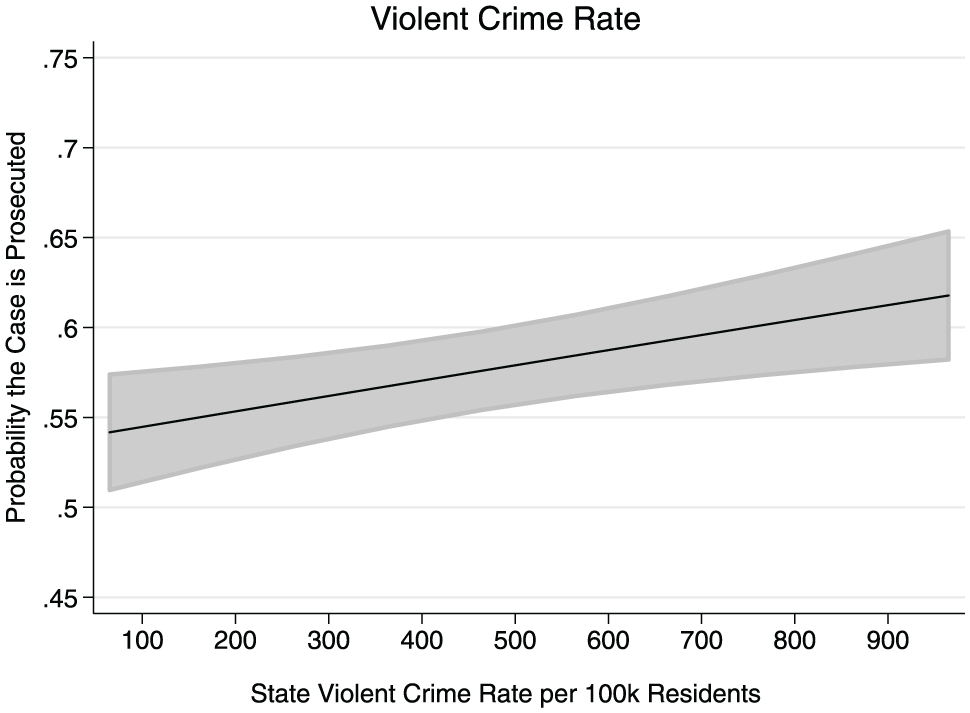
Estimated predicted probabilities of case prosecution given the changing values of the state Uniform Crime Reporting violent crime rate.
Turning briefly to the DOJ and prospective court control variables in the models, we find that these variables frequently perform as expected. In the case of Staff Workload, as a U.S. Attorney Office finds its workload increasing for the number of staff in the office, it is less likely to prosecute violent crime cases. From minimum workload to maximum, the predicted probability of prosecution decreases by roughly .15. District Court Conservatism also matters, albeit modestly. As expected, if a matter is reviewed in the most conservative district, it has nearly a .03 increased predicted probability of prosecution over being in the most liberal district. The influence of U.S. Attorney Party, while statistically significant and in the expected direction, is marginal with an increase in the predicted probability of prosecution at .02 if a Republican appointee oversees the district rather than a Democratic one. Finally, when an Acting Attorney General is leading the DOJ, the predicted probability of prosecution is nearly .06 lower than when a Senate-confirmed Attorney General is in place.
Discussion
While “the success of efforts at political control vary with agency resources and the salience and complexity of the policy area” (Ringquist 1995, 360), as our above evidence reveals, the explanatory power of political factors on the decision to prosecute violent crime matters is strong. In the nearly two hundred thousand violent crime matters in our data, we observe sizable prosecutorial responsiveness to presidential rhetoric, congressional hearings, and local concerns about crime. In the case of presidential rhetoric, our results indicated that federal prosecutors are up to .12 more likely to pursue an individual violent crime matter when the president has signaled his commitment to aggressively battling violent crime. Congressional hearings also send a powerful message about the federal legislative branches’ desired prioritization of curbing violent crime. All other things equal, our findings indicate that frequent congressional hearings on the issue of violent crime can bring up to a .07 increase in the chance that an individual violent crime matter is prosecuted. And we see that federal prosecutors are mindful of their local public’s appetite for an aggressive stance toward violent crime. Our results showed that a state’s punitiveness and levels of violent crime can lead to up to .34 and .08 increases in prosecution rates, respectively. In other words, political signals and the political culture matters when it comes to federal violent crime prosecutions, but the size of the effect and the source of the political influence varies. This fluctuation is to be expected since U.S. Attorneys must “make sense of a complex policymaking environment” (Whitford and Yates 2009, 32) that is likely to vary significantly for individual prosecutors and districts.
Despite countless declarations from prosecutors about their decision-making independence, the empirical evidence presented here paints somewhat of a different picture. Federal prosecutors’ decisions to prosecute crimes are often not wholly independent but, instead and as predicted by the bureaucratic control literature, are responsive to political signals and priorities yielding from the president, Congress, and the local public. This is all quite meaningful since U.S. Attorneys “represent a hard test” for political influence on the bureaucracy (Whitford and Yates 2009, 117), “do not have all the rational capacity and time necessary to choose the best course of action” in all situations (Maor 2010, 154), and are surely cognizant of organizational reputation and legitimacy considerations (Carpenter and Krause 2012; Krause 2009) cautioning them against behaving in an extremely political way.
Our results have important implications for the U.S. criminal justice system. Whether considering race and police-related crises in places such as Ferguson or Baltimore; federal governmental disputes with David Petraeus and Hillary Clinton regarding the protection of classified political materials; the firing of U.S. Attorney David Iglesias for, allegedly, refusing to prosecute Democrats on voter fraud charges just prior to the 2006 election (Whitford and Yates 2009); or the investigation into the Trump campaign’s connections with Russia, prosecutors continue to serve in the national spotlight. Decisions made by prosecutors that are seen as being driven by political factors, and not the law, can undermine the public’s essential confidence in government. The U.S. criminal justice system as a whole is regarded by many today to be in crisis with an apparently growing legitimacy deficit (Gibson and Nelson 2016; Rocque 2011). The presence of systematic national and local political influence on decisions to prosecute may do little to quell these concerns. U.S. Attorney responsiveness to presidential, congressional, and local priorities and preferences is rooted in majoritarian values. However, many of the ongoing concerns with and criticisms of the criminal justice system rest on what are inherently countermajoritarian ideals.
Concerns about how the U.S. criminal justice system treats violent crime are not likely to go away anytime soon. The Trump administration seems to embrace the “law and order” approach to violent crime reflective of an earlier time in presidential politics. Trump made key pledges about ending the “violence in our streets and the chaos in our communities” in the opening lines of his acceptance of the Republican Party’s nomination and offered similar remarks that featured prominently in his inauguration speech (Trump 2016, 2017). And Attorney General Jeff Sessions recently confirmed the DOJ’s commitment to aggressively enforcing and expanding federal prosecutions of violent crime via Project Exile (Green 2017). To what extent these words translate into action remains to be seen.
In addition to its direct insights into the political culture surrounding prosecution decisions, this project makes significant strides forward in the study of prosecutors’ roles as agenda setters for the U.S. criminal justice system’s adjudication, sentencing, and corrections institutions. Up until now, empirical difficulties have largely prevented us from understanding what cases do and do not get filed in courts Boyd (2017). Limitations no doubt remain. For example, there is no way to account for the strength of evidence in an individual matter in the prosecution decision. Systematic data simply do not exist (and/or are redacted in DOJ data releases) on this issue for individual matters, although separating violent crimes from other types of crimes and controlling for individual types of violent crimes within our analysis helps to naturally control for issue-area-specific evidentiary differences. Similarly, our data and findings reflect federal prosecutors’ political responsiveness during a particular period of time (1996–2011). The generalizability of this—or any—era of prosecution may be limited.
While our empirical results on federal prosecution decisions are consequential, we see two important related areas for future inquiry among political scientists. First, our results focus solely on federal prosecutions. These cases are frequently salient and have national policy consequences, but they also represent a small fraction of criminal proceedings. Nearly all ordinary criminal prosecutions—violent crime and otherwise—take place at the state level, and, as such, it is only through an empirical study of those cases that we can obtain a complete understanding of the political nature of prosecution. Unfortunately, expanding this work to states will be no small task given extreme data availability limitations. Nonetheless, doing so is important and will provide insight into whether Haider-Markel’s (2002, 147) finding that “federal law enforcement bureaucrats are more responsive to their political principals than are local bureaucrats” continues to hold. Second, we encourage the further exploration of the wholesale prosecutorial process, from the decision making and referral recommendations of investigative agencies, to grand jury proceedings following the prosecutor’s decision to pursue charges, to plea bargains, to the sentencing phase, and beyond. Only through an examination of federal prosecutors as actors within a “system of interactions” (Richardson and Vines 1967, 597) can we fully understand their discretionary behavior and their effectiveness as political agents.
Supplemental Material
BoldtBoydAppendix-PRQ-Accepted-March2018_(PRQ-2017-0333)_online_supp.docx – Supplemental material for The Political Responsiveness of Violent Crime Prosecution
Supplemental material, BoldtBoydAppendix-PRQ-Accepted-March2018_(PRQ-2017-0333)_online_supp.docx for The Political Responsiveness of Violent Crime Prosecution by Ethan D. Boldt and Christina L. Boyd in Political Research Quarterly
Footnotes
Acknowledgements
We thank Michael Nelson and Ian Ostrander for generously sharing their data on U.S. Attorney offices and nominees and Susan Haire, Alyx Mark, Margaret Williams, Jeffrey Yates, and panel participants at the 2016 Midwest Political Science Association Annual Meeting for their helpful comments on this project. We are grateful to Alex Corluyan, Ruth Ann Bailey, Bryan Black, Rebekah Phelps, Reid Powell, Cullen Threlkeld, Andrew Tyner, Nicholas Duffey, and Emma Brunner for their excellent research assistance. We also thank the University of Georgia’s Research Foundation (2014 Faculty Research Grant in the Sciences), Department of Political Science, and School of Public and International Affairs for supporting this research.
Declaration of Conflicting Interests
The author(s) declared no potential conflicts of interest with respect to the research, authorship, and/or publication of this article.
Funding
The author(s) received no financial support for the research, authorship, and/or publication of this article.
Notes
Supplemental Material
Project data are available at http://clboyd.net/research.html and  . Supplemental materials for this article are available with the manuscript on the Political Research Quarterly (PRQ) website.
References
Supplementary Material
Please find the following supplemental material available below.
For Open Access articles published under a Creative Commons License, all supplemental material carries the same license as the article it is associated with.
For non-Open Access articles published, all supplemental material carries a non-exclusive license, and permission requests for re-use of supplemental material or any part of supplemental material shall be sent directly to the copyright owner as specified in the copyright notice associated with the article.
