



Abstract
What is the relationship between the priorities expressed in party platforms before an election and the subsequent legislative agenda? The agenda setting literature often deemphasizes the role of political parties in agenda setting, instead focusing on the importance of problems bubbling up to the surface and demanding attention from policymakers. However, parties will often express different issue priorities during elections, and compete based on those priorities. If those promises are credible, voters should be able to choose between different sets of priorities during elections. The paper utilizes new data from the U.S. Policy Agendas Project and Wolbrecht on policy attention in U.S. party platforms to study the relationship between U.S. parties and legislative activities in Congress. A time-series cross-sectional analysis finds strong evidence to support the proposition that legislative agendas are influenced by the platform of the President’s party in the short term, although the relationship differs for different types of agendas and by issue, and fades over time.
In legislatures, 1 “the most important part of the legislative decision process is the decision about which decision to consider” (Bauer, Poole, and Dexter 1963, 405). Attention is a scarce resource; policymakers and their staff can only move on a few of thousands of possible issues at any given time. Given that most salient issues are what Egan (2013) labels “consensus issues,” where all citizens and elites would prefer an outcome ceteris paribus, information about the priorities of policymakers is often more important to voters than information about their outcome preferences. Attention scarcity forces a choice between these consensus issues (Mayhew 2006). If voters observe differences in the priorities of political parties during elections, they can choose between two different sets of outcomes.
However, the agenda setting literature has generally minimized the role of political parties in setting the agenda for legislatures (Baumgartner and Jones 1993). Given the importance of agenda setting in the policy process, the absence of political parties from determining the priorities of legislatures would be troublesome. During elections, parties make appeals to voters both by taking positions on public policy and by selectively emphasizing issues (Egan 2013; Petrocik 1996). If parties in governments do not represent these promised priorities, then the electoral conflict between parties does not structure political conflict in government over policy agendas.
This paper argues that political parties in the United States are able to contribute to agenda setting, but their impact varies by type of agenda and timing. Policy areas emphasized in the platform of the President’s party can predict issues emphasized in Congress but only immediately after the Presidential election. In the second Congress after the election, the opposition party may have some agenda setting power. The relationship between the platform and the Congressional agenda varies by issue, agenda type, and whether or not government is unified. Under divided government, Congress holds more roll call votes on their prioritized issues. Under unified government, Congress holds more referral hearings.
The paper proceeds as follows: In the section “Agenda Setting and Political Party Promises,” I review the conflict between modern theories of agenda setting and the responsible party framework. In the section “Legislative Agenda Setting in the United States and Party Platforms,” I develop a general theory of agenda setting and political parties in the U.S. system. In the section “Data and Method,” I build a time series cross sectional model using data on U.S. roll call votes, referral hearings, nonreferral oversight hearings, and party platforms from 1948 to 2014. In the section “Results,” I present the results of the model, finding strong evidence to suggest that parties make credible promises on agenda setting under some conditions, and highlight interesting cross-sectional variation.
Agenda Setting and Political Party Promises
Recent agenda setting scholarship has tended to deemphasize the role of promises made by candidates and political parties during elections in setting agendas for legislatures. Rather, it emphasizes that public priorities are largely set by the problem space, moderated by institutional friction (Bevan and Jennings 2014; Jones and Baumgartner 2005; Jones, Larsen-Price, and Wilkerson 2009; Sulkin 2005). Government attention lurches from pressing problem to pressing problem, leaving little discretion for individual actors to prioritize problems in advance. The literature suggests that both parties will weigh in on issues thrust on to the national agenda by circumstances in society. Often, they may apply very different solutions for those same problems, as processes prioritizing problems and generating solutions tend to operate independently (Cohen, March, and Olson 1972; Kingdon 1984), but the forces that push policymakers of one party to address an issue will push policymakers of other parties to do the same. In the counterfactual where a different party is in government, the agenda should be very similar.
Party agendas can be divided into a promissory agenda pledged by the party before the election and the anticipatory agenda reaction to new information when in government (Froio, Bevan, and Jennings 2017; Mansbridge 2003). Punctuated equilibrium theory suggests that the anticipatory agenda should carry more weight, as policymakers shift their limited attention capacity to the most pressing problems at any given time (Jones and Baumgartner 2005). Government will address problems where the most errors have accumulated, rather than the ones highlighted by partisans during electoral campaigns (Jones and Baumgartner 2005). Voters expect representatives to solve their immediate problems and hold them accountable when they fail to do so (Adler and Wilkerson 2012). These systems are not unresponsive, as the public signals a “public agenda” to policymakers about which problems must be addressed (Jones and Baumgartner 2004), but the responsive process occurs in between elections, rather than directly in response to elections.
This model of agenda setting conflicts with both positive and normative theories of political parties, legislative agenda setting, and democracy. Responsible political parties should take positions during elections and try their best to enact those positions if put into power. Once in government, legislative parties have the means to control information (Curry 2015), sanction members and set the agenda in Congress (Cox and McCubbins 2005), and exert negative agenda control (Gailmard and Jenkins 2007). Given the importance of agenda setting and issue prioritization in the policy process, voters should be able to choose between different sets of priorities for governing attention during elections. Political parties should play an important role in issue prioritization.
Scholars have also found some evidence that party manifestos predict legislative agendas in proportional representation systems. Issue attention from government increased as issue attention in manifestos increased in France and Belgium (Brouard et al. 2018; Green-Pedersen and Mortensen 2015; Walgrave, Varone, and Dumont 2006) but only under certain conditions. Coalitions in government will prioritize the issues of the party bloc in Denmark (Green-Pedersen and Mortensen 2015). Opposition parties may have considerable agenda setting power, even in parliamentary settings where they have little formal power in the legislature (Green-Pedersen and Mortenson 2010; Sulkin 2005). On the other hand, Froio, Bevan, and Jennings (2017) find at best a very weak relationship between the promissory agenda of the majority party and legislative outputs in the United Kingdom; instead, they find that policymakers are much more likely to react to newly emergent information after elections.
When we combine the responsible party model, where parties make promises before an election, and voters trust that they will follow through on those promises, and the punctuated equilibrium model, where parties in power are forced to respond to new information in a rapidly changing problem space, we can draw a fuller picture of party decision making. Political parties are torn between wanting to follow through with their campaign promises while also being pulled toward present-day demands of the anticipatory agenda. If all else were equal, parties would prioritize policymaking in the areas that they told voters they would prioritize if elected to power. These well-laid plans frequently do not survive contact with the constantly changing problem space, but some may.
Legislative Agenda Setting in the United States and Party Platforms
In a unitary parliamentary democracy, the causal relationship between party platforms and legislative outputs can be clearly observable. In the U.S. Presidential system, the relationship is more complicated. Presidents and Presidential candidates are the closest thing to party leaders in the United States (Aldrich 1995). U.S. party platforms are drafted and presented in the context of Presidential nominating conventions; national parties do not create formal platforms for off-year elections. The platforms are largely written as campaign documents by the party’s Presidential campaign (Maisel 1993). Thus, we should understand U.S. party platforms to disproportionately represent the potential President’s promises more than the promises of the party’s caucus in the legislature. However, Presidents are constrained by their extended party in what promises they can make. Networks of party activists, donors, and other elites will demand certain policy actions from a President (Bawn et al. 2012; Conger 2010; Wolbrecht 2002). These networks may play a role both in the drafting of platforms, using them to establish a public record of campaign promises, and in holding elected officials to those promises.
Like any other organization, legislatures must choose which problems to devote their scarce resources to. Many issues, such as expiring or annual legislation, require regular attention from legislators, while others are discretionary (Adler and Wilkerson 2012; Walker 1977). Often, exogenous events will turn discretionary problems into mandatory problems (Adler and Wilkerson 2012). Thus, legislators often have limited capacity to devote attention to solving discretionary problems that they promised to address during campaigns. Legislatures expand their agenda capacity by delegating responsibility and authority to committees, each acting somewhat independently (Adler and Wilkerson 2012; Jones 2001). Committees are able to prioritize, gather information, draft legislation, and conduct oversight somewhat independently. However, the floor of Congress still acts as a bottleneck, where only a limited number of legislative priorities can receive consideration (Lewallen 2017).
Presidents play a strong role in Congressional agenda setting. Executive offices often serve as a focal point of action and attention (Dahl 1960). U.S. Presidents, especially popular ones, have some ability to push certain issues on to the Congressional agenda (Baumgartner and Jones 1993; Beckmann 2010; Edwards and Wood 1999; Green and Jennings 2016; Kernell 1997; Lee 2009; Lovett, Bevan, and Baumgartner 2015). The effect is strongest for co-partisans and at the early stages of the legislative process (Beckmann 2010). Therefore, Presidents should be able to push Congress to emphasize the priorities expressed in their platform, especially when their party controls both chambers of Congress.
The relationship between party platforms and Congressional agendas should vary based on type of agenda. Congress has two primary channels to affect public policy: oversight of the bureaucracy and statutory changes through legislation (Bawn 1997; Lewallen 2017; Minta 2011; Talbert, Jones, and Baumgartner 1995). Oversight allows committees to direct bureaucratic attention toward particular problems or solutions, using their authority over budgets to threaten bureaucrats who do not follow their instructions (Fenno 1973; Redford 1969). While Congress can make small changes to policy outputs using oversight, most oversight involves the maintenance of subsystems, and does not require much attention from the floor of Congress. Larger policy changes normally require legislation and, thus, are constrained by the bottleneck of attention at the floor (Jones and Baumgartner 2005; Lewallen 2017). Party platforms promise large-scale change, as there is little reward to making low salience, status quo promises in an election. If attention to issues in party platforms can predict attention to issues in Congress after the election, we should expect the effect to be stronger for lawmaking attention than oversight attention. From this theory, we can draw the following hypotheses:
We should also expect the relationship between the issues prioritized in party platforms and the formal agenda to fade over time. U.S. party platforms are drafted every four years. In between platforms, two types of intervening events occur. First, the problem space changes. Issues that were important during the summer before the election compete with new issues that pop up and become salient. For example, the 2008 party platforms were released just weeks before the financial crisis began in earnest with the collapse of Lehman. The subsequent Congress was forced to devote a larger proportion of its attention toward responding to the crisis than the drafters could foresee earlier that summer. Second, midterm elections bring a different set of promises and priorities and may change partisan control of the legislature. Overall, the relevance of the priorities expressed in the party platform should decrease as time progresses.
Data and Method
To test these hypotheses, I analyze the policy topics addressed by Congress and U.S. party platforms from 1948 to 2014. All data are drawn from the Policy Agendas Project, which categorizes the policy content of outputs into one of twenty 2 major topic areas, such as macroeconomics, environmental policy, or defense. Table 1 shows the twenty topics of the Policy Agendas Project, and the distribution of attention to these topics in all of the data used in this article.
Average Distribution of Attention to Issues.
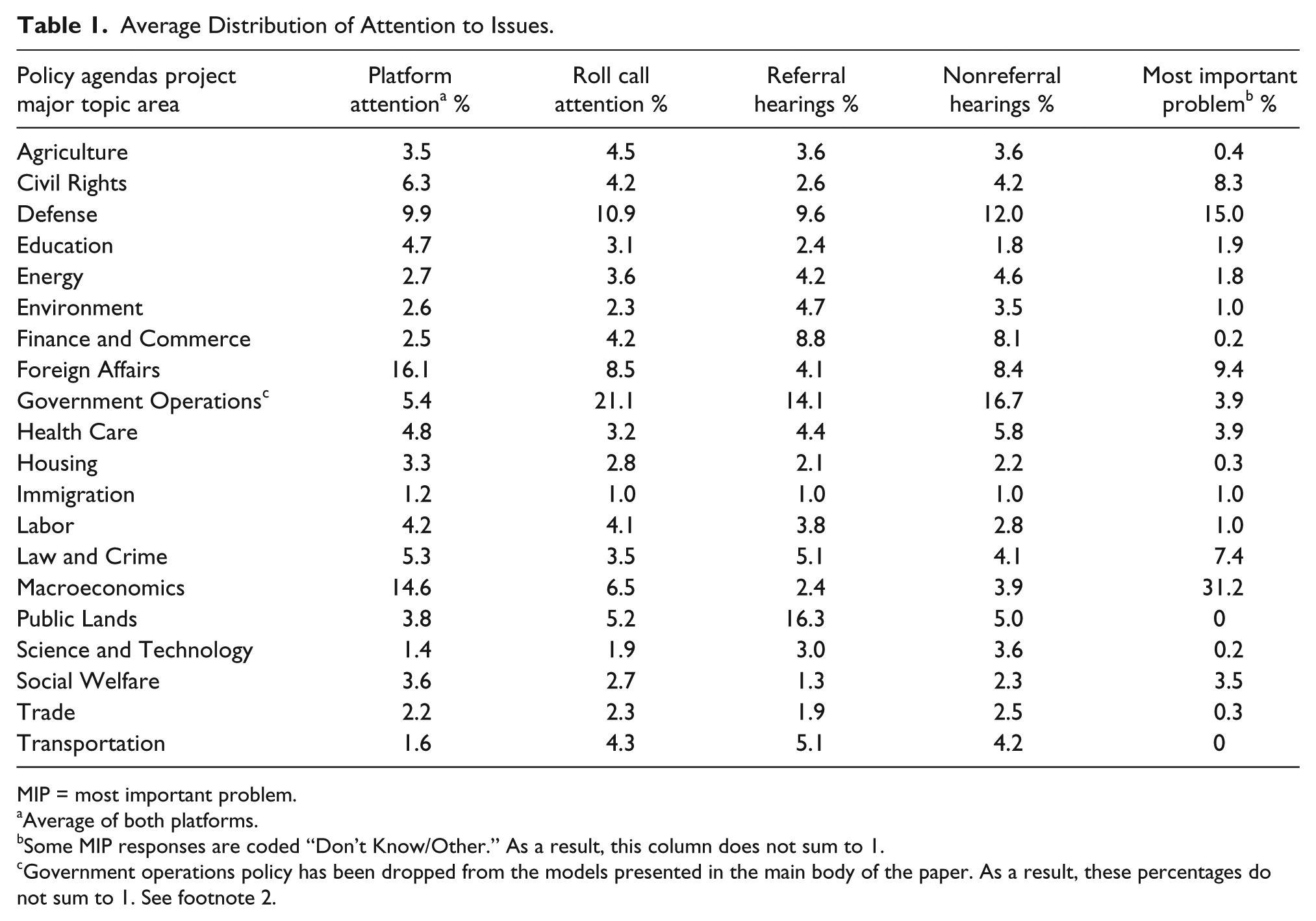
MIP = most important problem.
Average of both platforms.
Some MIP responses are coded “Don’t Know/Other.” As a result, this column does not sum to 1.
Government operations policy has been dropped from the models presented in the main body of the paper. As a result, these percentages do not sum to 1. See footnote 2.
I use an autoregressive distributed lag time-series cross-sectional design. This design has been used by recent scholars studying the agenda setting impact of executive speeches (Green and Jennings 2016; Lovett, Bevan, and Baumgartner 2015), parliamentary questioning (Vliegenthart and Walgrave 2011), and party platforms (Froio, Bevan, and Jennings 2017; Green-Pedersen and Mortensen 2010) on legislative outputs. The unit of analysis is one topic; the time variable is one Congress. 3 The national U.S. political parties released seventeen party platforms, one every four years just before Presidential elections, during this time period. 4 I model each new platform as a shock, and estimate the relationship between an issue receiving more or less emphasis in the platform and attention to the same issue in the subsequent Congress. All models contain panel-corrected standard errors (Beck and Katz 1995). All variables are expressed as a percentage of policy attention.
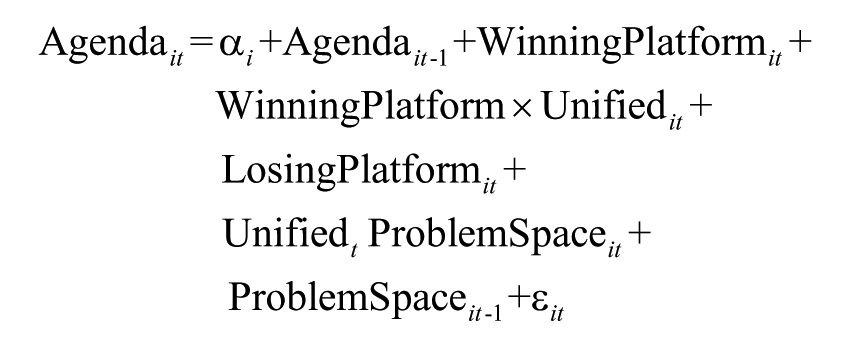
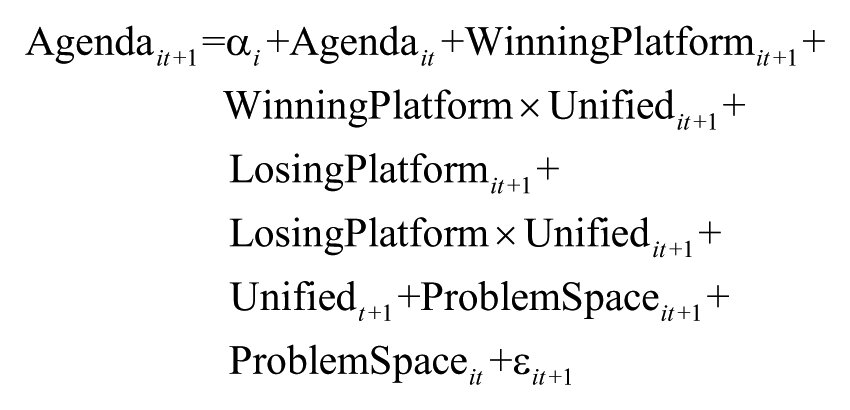
For each dependent variable, I ran two models: the first predicts the Congressional agenda at time t, the first Congress after the Presidential election. The second predicts the Congressional agenda at time t + 1, the second Congress after the Presidential election. The models are as follows:
First Congress after the Presidential election (t):
Second Congress after the Presidential election (t + 1):
Dependent Variables: Congressional Policymaking Attention to Lawmaking and Oversight
I report models with three different dependent variables representing Congressional policymaking attention to policy issues. The first two represent attention to lawmaking. The first model uses the percentage of attention to each policy issue in roll call votes from 1948 to 2014. Roll call votes are familiar to political scientists who study Congress and represent the chamber floor’s decision to devote scarce floor time to a priority. The second model uses the percentage of referral hearings devoted to the issue from 1948 to 2014. Referral hearings are defined by the Policy Agendas Project as any hearing where a bill is considered. These hearings also represent a scarce resource, although a different kind of one from roll call votes. Hearings require intensive work from committee staff and members but are not constrained by the floor’s limited agenda. Much of the legislation outputted by committees passes through the floor of Congress by voice vote or without objection with no roll call vote recorded. We should expect these two processes to function similarly, as they both involve changing the laws of the United States, but with some key differences. Roll call votes will generally be more contentious and may involve position-taking on laws that do not end up passing. Parties may prefer to use roll call votes to highlight the priorities promised in their platforms. Overall, we might expect a slightly stronger relationship between the platform and roll call votes than referral hearings.
The final dependent variable, which represents attention to oversight policymaking, is the percentage of Congressional nonlegislative hearings devoted to each issue. These hearings are the primary venue through which Congress directs oversight attention (Baumgartner and Jones 2015; Bawn 1997; Lewallen 2017; Workman 2015). Congress has held more nonlegislative hearings and fewer referral hearings as the federal bureaucracy has grown (Lewallen 2017). We should expect little connection between oversight agendas and party platforms.
Independent Variable: Party Platform Attention
Every four years, the American political parties release platforms stating their policy priorities if elected to office. If party agendas influence legislative agendas, we should see a response in legislative outputs following the shock of a new party platform in the subsequent Congress. To measure the party agenda, I include data on the policy content of U.S. party platforms. Data are coded at the quasi-sentence level, then aggregated yearly. These data were originally collected by Christina Wolbrecht (see Wolbrecht and Hartney 2014) and are now maintained by the Policy Agendas Project. 5 I include the percentage of policy attention to each issue topic in the platform of both the party of the winning Presidential candidate and the party of the losing candidate in the previous election. I include both platforms because the losing candidate’s platform’s effect on the future legislative agenda is interesting on its own and to control for potential confounding factors that could cause increased issue attention in both the legislative agenda and the previous platforms. If so, the counterfactual where voters choose the other political party in an election would not produce a different future legislative agenda. Many potential confounds, such as increased issue salience not observed in the MIP variable, should cause issue attention to increase in both party’s platforms.
Independent Variable: Unified Party Control of Congress and the Presidency
Presidents are more successful at agenda setting with co-partisans (Beckmann 2010). Thus, we should expect the effect of party platforms to be stronger when the President’s party also controls both chambers of Congress. I included a dummy variable, which is coded as a 1 when the government is unified under one party and 0 when there is divided government, and interacted it with both the platform of the party of the President and the losing party.
Independent Variable: Problem Space
The problem space is a difficult concept to operationalize. Policy problems bubble up to the surface and demand the attention of policymakers, often with little notice. Problems can arise both exogenously and within government (Jones and Baumgartner 2005). If policymakers fail to address a problem, voters may hold them accountable (Adler and Wilkerson 2012). Many of these problems are quickly dealt with by policy subsystems. However, many are not, and macro political actors such as Congress are forced to confront them (Baumgartner and Jones 1993). Some issues are dealt with before they become salient in the mass public; others rise to become highly salient and mobilizing issues. To measure changes in the problem space, I included average responses to Gallup’s Most Important Problem (MIP) question. MIP is often used to measure the prominence or salience of policy problems to the mass public (Jones and Baumgartner 2005; Jones, Larsen-Price, and Wilkerson 2009; Wlezien 2005). As problems become more severe, a higher proportion of respondents will declare a particular issue the most important problem facing the country. MIP tends to be dominated by macroeconomic issues and war (see Table 1). MIP is clearly an imperfect operationalization of the problem space but functions as a useful proxy for problem severity among the mass public that can be measured over a time period spanning six decades.
Results
Table 2 displays the results of the model during the first Congress after the Presidential election. These results vary by type of agenda but, overall, support the Lawmaking Hypothesis. As issue emphasis platform of the President increases, Congress tends to hold more roll call votes on that issue. The effect is positive and statistically significant under divided government (p = .015), while smaller under periods of unified government (p = .095). These effects are quite similar, indicating that the agenda setting relationship between the platform of the President’s party and roll calls is not strongly conditioned on divided government. Issues emphasized in the party out of the White House’s platform are no more or less emphasized by Congress. This relationship works slightly differently under referral hearings. There is a strong and significant relationship between the President’s platform and referral hearings under unified governments (p < .001) but not under divided governments (p = .160). There is also a negative and significant relationship between issue attention in the platform of the party out of the White House and referral hearings under both divided (p = .090) and unified (p = .011) governments. Lawmaking through roll call votes and referral hearings appears to function differently under divided and unified government.
Effect of the Platforms of the President’s Party on Congress, First Congress after the Presidential Election (t).
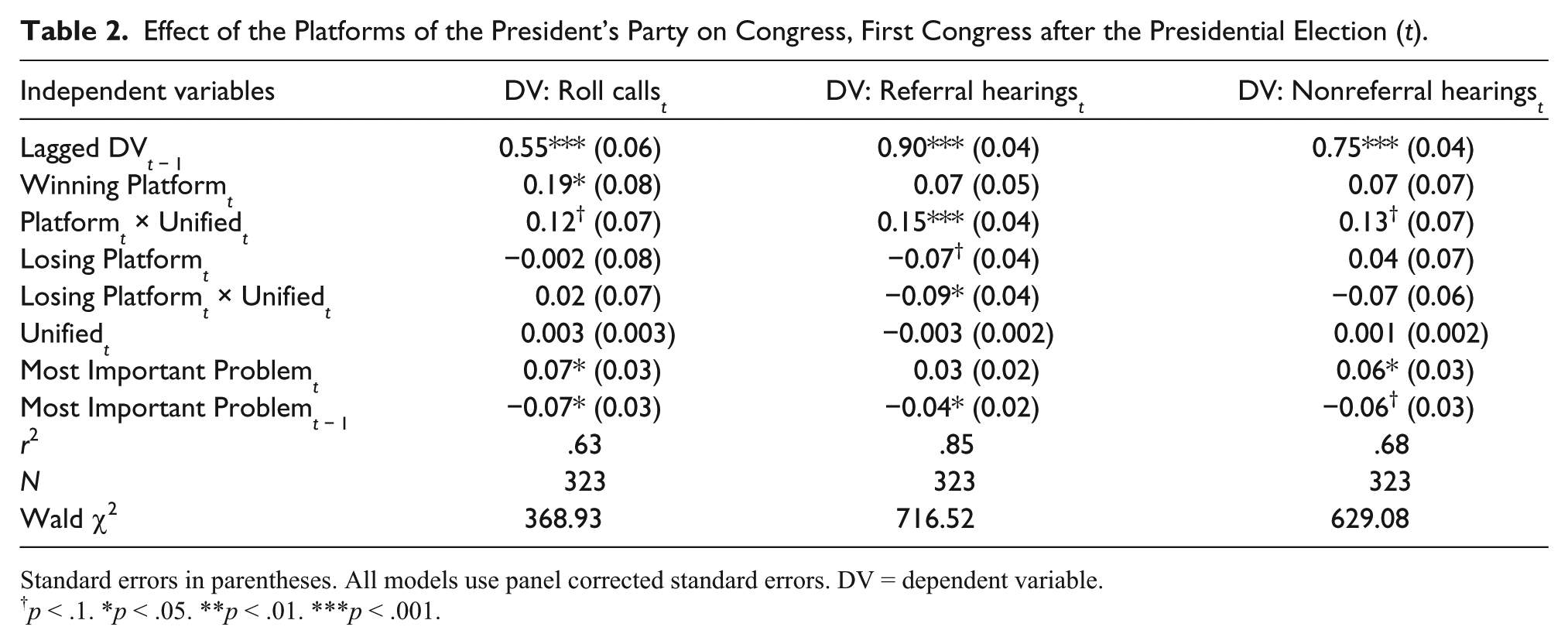
Standard errors in parentheses. All models use panel corrected standard errors. DV = dependent variable.
p < .1. *p < .05. **p < .01. ***p < .001.
We see a slightly different but generally consistent pattern for oversight attention in the first Congress after the election. Under unified government, there is a positive and significant (p = .050) relationship between issue attention in the platform of the President’s party and nonreferral hearings in Congress. Under divided government, there is no significant relationship (p = .325). There is no significant relationship between the losing party’s platform and oversight attention, although the coefficient is negative under unified government (p = .268). The effect of platform attention on attention to policy in referral and oversight hearings is not significantly different under either unified or divided government.
What explains the different processes for attention to policy for referral hearings and roll call votes? Both processes are performing a fundamentally similar function in considering changes to laws. Roll call votes highlight political conflict, while referral hearings are often held on bills that pass Congress through a voice vote or by unanimous consent. It may be the case that parties in power under unified government are less likely to force votes that highlight political conflict and are more willing to enact their expressed priorities on less controversial legislation.
The results change when the dependent variable changes to the agenda of the second Congress after the Presidential election (see Table 3). There is no significant relationship between roll call votes and the platform of the party holding the Presidency under either divided or unified government. However, there is a positive and significant (p = .046) relationship between issues emphasized in the losing party’s platform and Congress under unified government. This result is surprising, as the party in power in these cases holds neither the White House nor either chamber of Congress, and saw their issue priorities deemphasized in the prior Congress. In the referral hearing model, Congress holds fewer hearings on issues emphasized by the platform of the President’s party under both divided (p = .026) and unified (p = .08) government, and more on issues emphasized by losing party’s platform under divided government (p = .083). While many of these results are not significant at a .05 threshold, they suggest that referral hearings in the second Congress after the Presidential election follow a similar pattern as roll call hearings. In the oversight model, no platforms are significant at even a .1 threshold.
Effect of the Platforms of the President’s Party on Congress, Second Congress after the Presidential Election (t + 1).
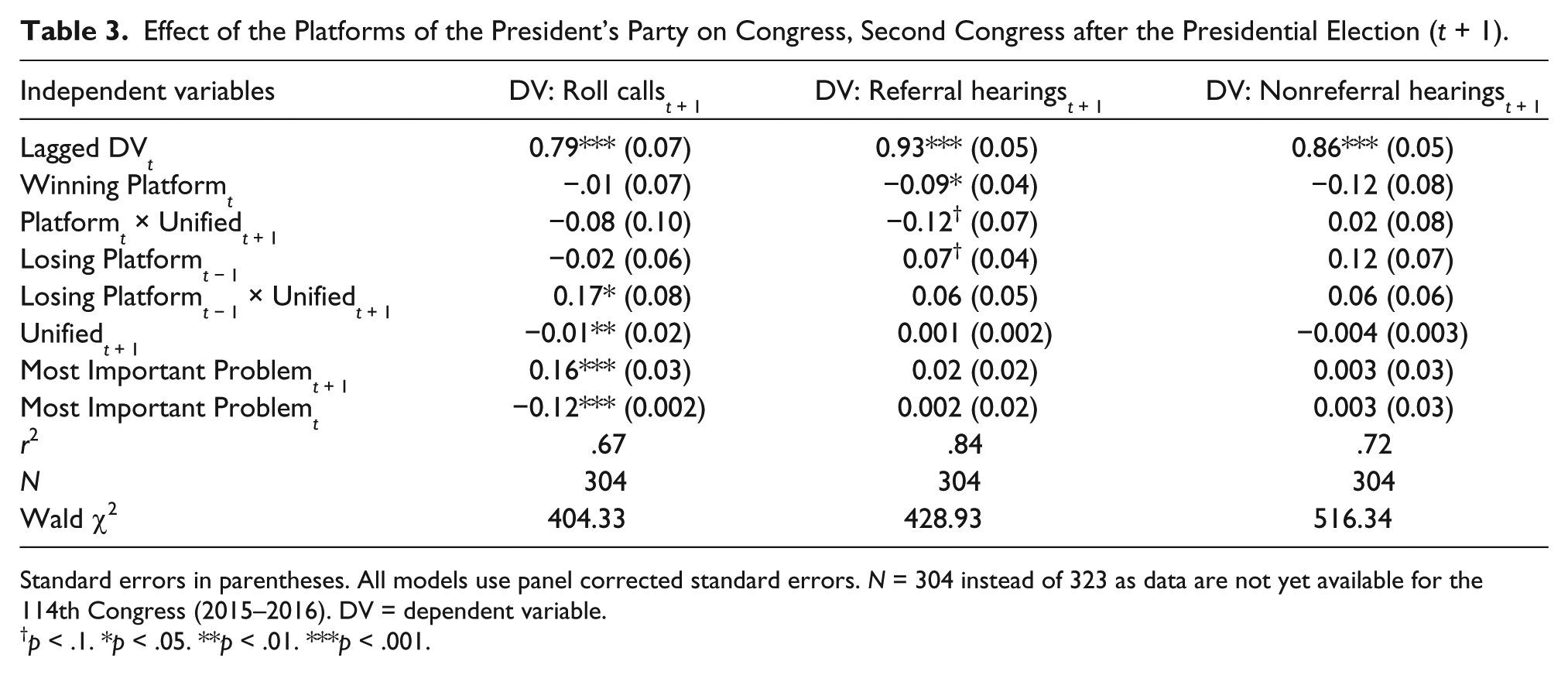
Standard errors in parentheses. All models use panel corrected standard errors. N = 304 instead of 323 as data are not yet available for the 114th Congress (2015–2016). DV = dependent variable.
p < .1. *p < .05. **p < .01. ***p < .001.
How do we explain these surprising results? The literature may point to two explanations. First, they may be caused by disproportionate information processing (Jones and Baumgartner 2005). When policymakers allocate scarce resources toward a priority, they must neglect other priorities. Eventually, they are forced to address those issues, as ignored problems bubble up to the surface. Thus, party platforms may have little-to-no long run effect on the agenda but can change priorities in the short term. Second, the party in the opposition may be able to push the agenda toward their issues, as Green-Pedersen and Mortenson (2010) observed in their study of Danish agendas. The opposition may also gain strength after the midterm elections.
Finally, Congress is responsive to changes in the problem space. The coefficient on MIP is positive and significant for both roll call votes and nonreferral hearings during first Congress, and for roll call votes after the second. Interestingly, effect size on MIP is more than twice as large in the second Congress (p < .001). With the previous election deep in the past, policymakers appear to be using their most visible agendas (roll call votes) to address current problems, rather than the problems they promised to emphasize in the last platform, in anticipation of the next election.
We can also observe some interesting cross-sectional variation across issues. Figure 1 plots roll call attention and attention in the platform of the President by issue. On many issues, such as energy and defense, the two series tend to track each other. However, there are notable exceptions. International Affairs and Macroeconomics do not follow party platforms. On both issues, Congress has a narrower role than on other issues. For international affairs, the President tends to set policy. For macroeconomics, actors such as the federal reserve often ultimately make policy. We not only see similar patterns on referral hearings in Figure 2 but also see the importance of public lands policy, which makes up just 3.7 percent of platforms but 16.2 percent of referral hearings. Public lands are one of the least polarized issue areas (Jochim and Jones 2013); Congress may be able to move through the committee process on public lands bills with lower levels of conflicts than other issues. As expected, we see less congruence between the party platform and nonreferral hearings in Figure 3. These cross-sectional differences by issue deserve further study.
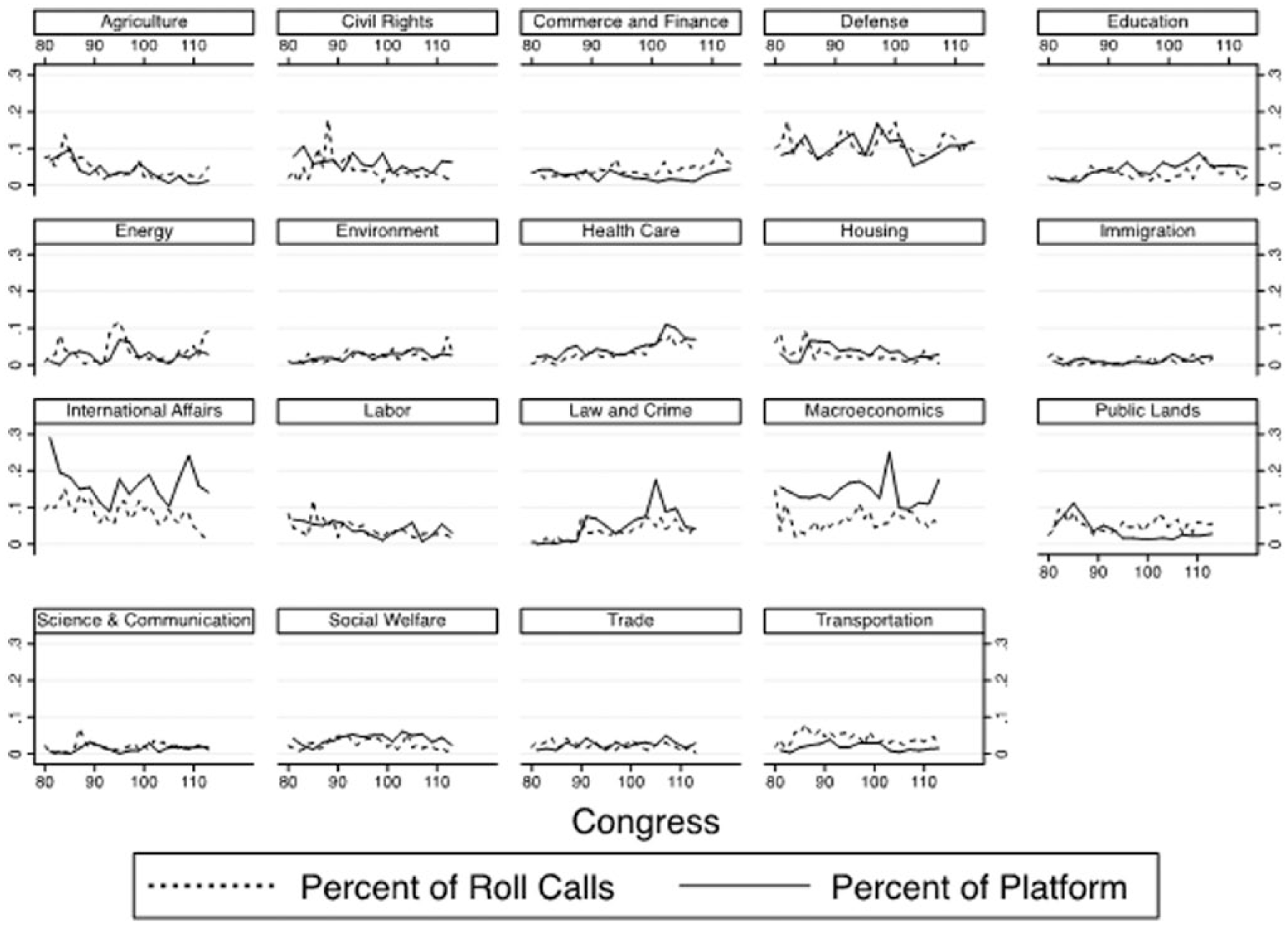
Attention to issues in platform of President’s party and roll call votes.
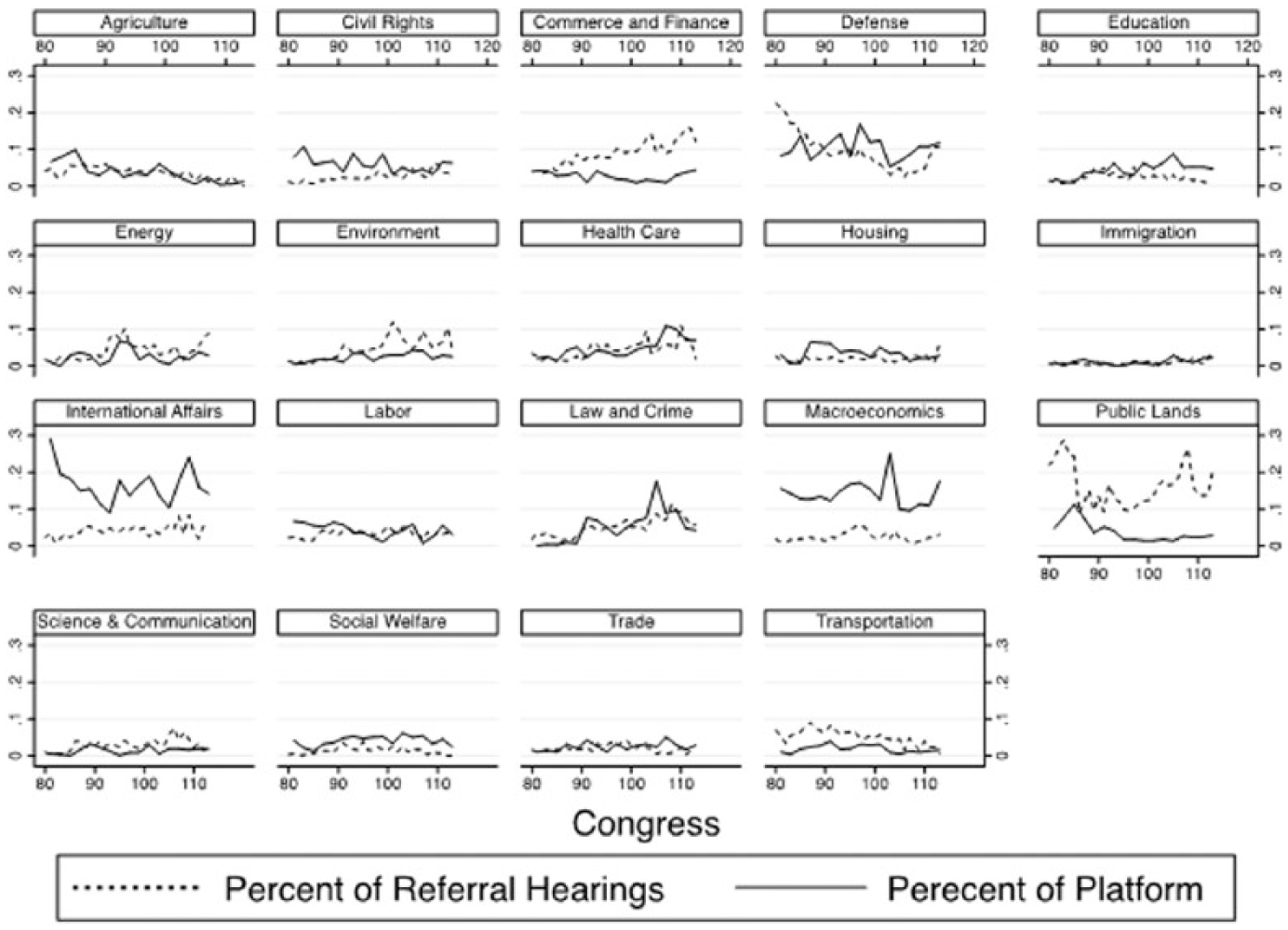
Attention to issues in platform of President’s party and referral hearings.
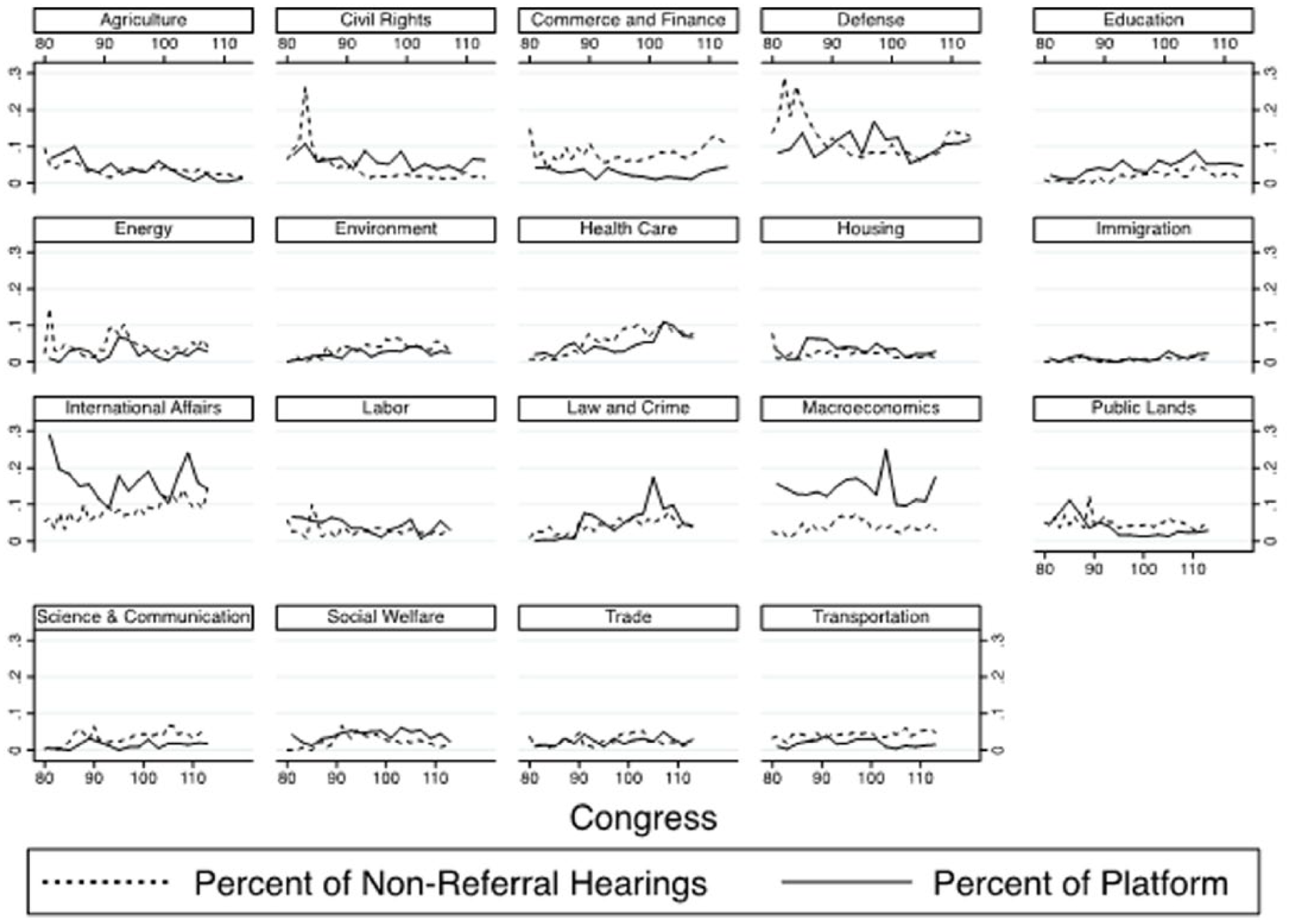
Attention to issues in platform of President’s party and nonreferral hearings.
Conclusion
This paper offers two key contributions to the literature on agenda setting and legislative behavior. First, it found that the elected officials do indeed follow through on the priorities promised in the platform of the party of the President. Voters can observe emphasized issues during the platform during the campaign and expect the party who wins the presidency to direct the government’s attention toward those issues. Previous work has suggested that the majority party often is forced to respond to new problems, rather than prioritizing issues emphasized in the campaign (Froio, Bevan, and Jennings 2017; Green-Pedersen and Mortenson 2010; Jones and Baumgartner 2005). The results presented here suggest both that parties can indeed influence the legislative agenda and that other factors do as well. Future research could further analyze the effect of issue attention in formal policy agendas, including examining potential effects on major legislation and attention to policy by political appointees in the bureaucracy.
However, they can only influence the agenda in the short run. The effect of platform attention on the Congressional agenda fades after the first Congress after the platform is issued and in some cases, becomes negative. It theorized that two processes contributed to the short run–long run differences in platform agenda setting. First, the information contributed to the policy process by party platforms fades quickly, requiring policymakers to respond to new information in the problem space. Second, policymakers are forced to increase attention to underemphasized issues immediately after devoting disproportionate attention to them. Both mechanisms are interesting on their own and deserve further study.
Finally, the relationship between issues emphasized in the platform of the President’s party and the Congressional agenda also varies by instrument and by issue. Congress holds more roll call votes under divided government on issues emphasized by the President’s platform but not under unified government. The opposite is true of referral hearings. Contrary to expectations, there is some weak evidence that oversight attention also increases following platform attention. Domestic policy issues tend to have a stronger relationship with the platform than international affairs, especially on roll call votes. Scholars should explore these interesting heterogeneous differences in future research.
Including this study, agenda setting scholars have examined the relationship between issue priorities in the party platform and the future legislative agenda in a number of developed Western democracies, often finding different results (Bonafont, Baumgartner, and Palau 2015; Brouard et al. 2018; Froio, Bevan, and Jennings 2017; Green-Pedersen and Mortensen 2015; Walgrave, Varone, and Dumont 2006). Researchers could study this interesting variation to better understand the mechanisms of linkage between party electoral promises and public policy, including institutions, taking advantage of the Comparative Agendas Project’s unified codebook, and data collection efforts.
Furthermore, given the results here and elsewhere finding that party platforms can predict future legislative agendas, scholars should explore issue attention in party platforms as a dependent variable. Researchers have already begun connecting party agendas to issue ownership (Egan 2013; Petrocik 1996; Tresch, Lefevere, and Walgrave 2015). Others have explored the role of elites in pushing party position-taking on certain issues (Bawn et al. 2012; Karol 2009; Wolbrecht 2002), but there is less work on the role of these same elites in agenda setting. Issue salience and campaign tactics may also play an important role.
Footnotes
Acknowledgements
The author thanks Bryan Jones, Christina Wolbrecht, Sean Theriault, Chris Wlezien, Daron Shaw, Frank Baumgartner, Peter Mortensen, Enrico Borghetto, Maraam Dwidar, Jonathan Lewallen, and all his other colleagues at the University of Texas at Austin and Policy Agendas Project for their feedback, and the anonymous referees and the editors of Political Research Quarterly.
Author’s Note
Versions of this paper were presented at the 2017 Midwest Political Science Association and Comparative Agendas Project conferences.
Declaration of Conflicting Interests
The author(s) declared no potential conflicts of interest with respect to the research, authorship, and/or publication of this article.
Funding
The author(s) received no financial support for the research, authorship, and/or publication of this article.
Notes
Supplemental Material
Replication data for this article are available with the manuscript on the Political Research Quarterly (PRQ) website.
