




Abstract
According to the conventional view, presidents are largely bereft of influence with an opposition-controlled Congress. Congress sends them legislation with a “take it or leave it” choice that maximizes the preferences of the opposition majority while minimizing presidents’ preferences. To extricate themselves from this bind, presidents threaten vetoes. Past research suggests that their efforts largely fail, however, for two model-driven reasons: first, veto threats amount to minimally informative “cheap talk,” and second, Congress is a unitary actor with firm control over its agenda. We relax both assumptions, bringing veto rhetoric into a setting more closely resembling real-world conditions. Presidents transmit credible veto threats to a heterogeneous, bicameral Congress where chamber rules enable the minority party to wield some influence over legislation. Examining the legislative histories of all veto-threatened bills passed between 1985 and 2016, we confirm that veto threats ward off about half of veto-targeted legislative provisions—a far greater share than for comparable unthreatened provisions. The House of Representatives is more likely to introduce and pass legislation objectionable to presidents and the Senate is more likely to accommodate presidents, findings consistent with the textbook description of the modern bicameral Congress.
“Bargaining ‘within the family,’ has a rather different quality than bargaining with members of the rival clan”
In his 2015 State of the Union address, President Obama set the tone of his relations with the new Republican Congress by threatening to veto five different Republican initiatives. During the first ten weeks of the new session, he followed this up with memoranda to Republican House and Senate floor leaders threatening to veto seventeen additional bills awaiting floor action. Although prolific in his early use of veto threats, Obama’s reliance on such threats was well precedented. Over the past thirty years, presidents have routinely signaled Congress their intention to veto pending legislation if it were not modified to their liking. A good indicator of their efforts can be found in Figure 1 in the volume of veto-threatening Statements of Administration Policy (SAPs) sent to congressional leaders from their introduction in 1985 through 2016.
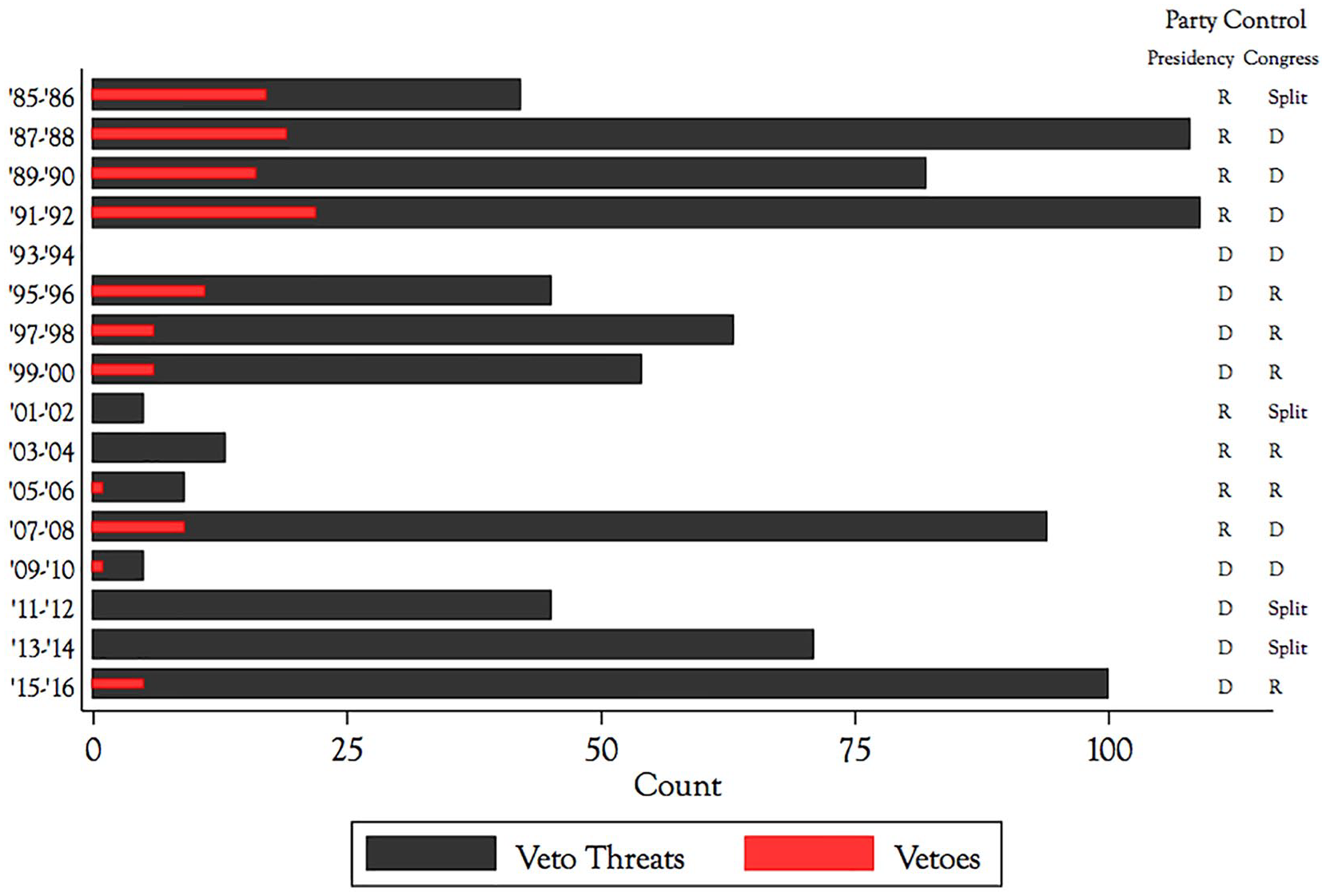
Veto threats of authorization bills by congress.
With modern presidents routinely issuing veto threats, the question arises: do these signals matter? Do they influence legislation? These questions take on special poignancy with the sharp drop-off of vetoes and hence opportunities for sequential veto bargaining (SVB; Cameron 2000) over the past three decades. 1 One of two policy purposes may underwrite veto rhetoric—blocking passage or persuading Congress to pass a different bill closer to the president’s preferences. 2 Over three-quarters of the 844 authorization bills threatened in Figure 1 met the first fate. In Washington’s present-day gridlock, this failure rate is unsurprising. Of unthreatened bills that pass the first chamber, 58 percent fail to reach enrollment. Perhaps more surprising are the 186 threatened bills that made it to the president’s desk and that he signed 133. Eight more became law after Congress overrode a veto.
This article continues a familiar theme of recent research on the prospects for successful governance in this era of divided party control of Congress and the presidency (Cameron 2000; Mayhew 1991). Each of the enrolled bills in this study began inauspiciously with the president threatening a veto. How did Washington’s politicians manage to circumnavigate their sharp partisan differences and reach agreement? Did presidents back down? Did Congress? Finding significant compromises in the enrolled bills, we then investigate where in congressional deliberations veto threats had an impact.
We begin in the next section by reviewing research that cedes presidents little or no opportunity to influence legislation. The prevailing model of veto threat politics, we argue, imposes two overly restrictive conditions. First, a unitary Congress exploits its agenda control to present presidents with barely acceptable “take it or leave it” choices. Second, presidents—unable to issue credible veto threats—are relegated to enlisting heavily discounted, minimally informative cheap talk.
In Section “Veto Threat Bargaining,” we develop a model of veto threat bargaining (VTB) that relaxes both restrictive assumptions. Congress is bicameral. Beyond this, each chamber is institutionally complex, its memberships diverse, and its business conducted by coordinated party teams (Cox and McCubbins 2005). Not only do presidents’ veto rhetoric signal their preferences to the opposition majority, it offers focal coordination to their copartisans, who are dispersed across the House, the Senate and the executive branch. Far from a product of negotiations between unitary, constitutional actors, successful legislation arises from a sequence of exchanges among partisans each of whom derives influence from their executive or legislative office. The model generates five hypotheses (Section “Hypotheses”) testing whether veto threats alter legislation and, when they do, if they track the bicameral differences in the prerogatives allocated to the president’s copartisans. Section “Data and Methods” introduces SAP as presidents’ preferred means for transmitting credible veto threats to Congress. In Section “Findings,” we test the impact of SAP-based veto threats on the legislative histories of all 186 threatened, eventually enrolled bills. Credible veto threats, we conclude, can be broadly effective in coordinating the president’s copartisans and establishing a bargaining position with the opposition majority.
Veto Threats: Anemic Instruments of Influence?
The standard separation-of-powers model has a unitary Congress exploit its agenda setting authority to present presidents with an ultimatum choice. Two common variants of this model differ sharply in the assumed quality of the information available to legislators about the president’s preferences. Yet, their equilibrium outcomes are the same, with Congress managing to capture most of the policy surplus while minimally accommodating the president.
The first assumes that Congress has complete information on presidents’ preferences enabling it to locate precisely their indifference points and render veto threats irrelevant (Kiewiet and McCubbins 1988; Primo 2002). The second variant has legislators uncertain about the president’s preferences and consequently welcome new information contained in a veto threat message. Presidents enlist rhetoric strategically (or are suspected of doing so), posturing to skew Congress’ perceptions of their preferences to gain their most preferred policy. Yet, as presidents can say one thing and do another, according to this model, veto threats amount to little more than costless, cheap talk. About all that legislators can reliably learn from veto rhetoric is that the president favors current policy over that contained in the legislation. 3
Given prevailing theory’s low expectations for veto rhetoric, the paucity of past research on the subject is understandable. Previous investigations of the effects of veto threats (Cameron, Lapinski, and Riemann 2000; Conley 2003) conclude that final bills on net gravitate toward the president’s position. Although the findings are consistent with effective veto threats, they fall short of offering a definitive test in several respects. First, in the absence of information about presidents’ objections when the veto threat was issued, measurement of legislative changes had to be reconstructed in part from presidents’ signing statements in which they may overstate their success in improving the legislation. 4 Moreover, these statements (and other sources, such as news coverage) typically lack the specific information necessary for comparing presidents’ initial objections to a proposed bill with the substance of the final bill.
Drawing from SAPs issued as appropriations bills were sent to the floor of the House of Representatives, Hassell and Kernell (2016) address these measurement issues by comparing the presence of threatened and non-threatened riders in the final appropriations bills. The probability of Congress removing threatened riders is about 60 percent, more than twice the rate for other major but unthreatened riders. What these results imply for the broader class of authorization legislation is unclear. Authorization provisions may not so easily be excised without undermining the proposed policy. Moreover, the need for annual appropriations may induce concessions by legislators who would be reluctant to accommodate presidents under less exigent circumstances. Employing recently opened SAPs containing veto threats of authorization proposals, we now have quality benchmark data on presidents’ legislative preferences for testing the policy impact of veto rhetoric.
Veto Threat Bargaining
We propose an alternative model on the use and efficacy of veto rhetoric. VTB describes an exchange of information between the president and opposition majority about each side’s policy preferences and contingent plans of action. The exchange involves a series of bids and counterbids through which partisan presidents and legislators determine whether their policy preferences intersect on a compromise bill. In using the “veto” to reveal valuable information about the president’s preferences and the availability of a compromise, VTB resembles Cameron’s (2000) SVB. It differs in allowing presidents to communicate this information with credible threat signals, obviating the need to actually veto a bill to confirm the president’s commitment.
Several ingredients are critical for successful VTB. First, as noted, presidents must have the capacity to send credible signals. Second, presidents must enjoy the support of their party. Third, their party must, in turn, enjoy control over pivotal votes. 5 When the minority party has the capacity to influence House and Senate decisions, their signing on to the president’s position transforms veto bargaining from a contest between two (typically depicted as unitary) constitutional actors—the Congress and the presidency—to a competition between party teams whose members gain influence by virtue of control of legislative and executive offices.
Minority Party Rights in the Bicameral Congress
If veto threats are to extricate presidents from the ultimatum bind, copartisans must have the wherewithal to force the opposition majority to negotiate. On this score, the modern Senate is more accommodating than the House and, if anything, the gulf between the chambers has widened with heightened partisan polarization (Bond, Fleisher, and Cohen 2015). In recent decades, as political parties in the House have become more ideological—particularly Republicans (Lewis 2019)—the chamber has made a pronounced shift toward majority party rule.
House–Senate differences start with the composition of committees—specifically, House committees stacked with members who report out more extreme policies than those preferred by the median floor member as chits for future bargaining in subsequent negotiations (Gailmard and Hammond 2011). As bills reach the House floor, the Hastert rule kicks in to ensure that the majority party will not get rolled. Only proposals that command the support of a majority of the majority party caucus reach the floor (Cox and McCubbins 2005). They typically arrive on the floor with closed and restrictive rules attached to prevent the president’s partisans from introducing objectionable provisions (Monroe and Robinson 2008).
The Senate is more accommodating to the minority party. Aside from individual members’ easy access to the floor, the filibuster largely assures that the administration’s objections will be aired during deliberations. Previous research reports a correlation between presidents’ opposition and their party’s success in defeating cloture votes (Bond, Fleisher, and Cohen 2015; Hassell and Kernell 2016). 6 In the following analysis, the asymmetric effects of House and Senate rules on minority party rights are a critical ingredient in explaining how veto threats gain presidents entry into deliberations.
Bicameralism increases the number of decision nodes available to the president’s party to block or modify the opposition majority’s program. But it also imposes transaction costs on party politicians’ efforts to formulate a collective response across chambers and branches. Presidents’ veto threats can fill the informational void and offer copartisans much needed focal coordination. As a senior advisor counseled President Clinton, veto threats represent “excellent opportunities to highlight your agenda and contrast it favorably with Republican proposals . . .. [and] unite Democrats” (emphasis added) (Reed 1998).
Veto Threats Signal Copartisans
Congressional research has long observed that administration copartisans behave as if they have a personal stake in the president’s success (Aldrich and Rohde 2000; Baumgartner and Jones 1993, 241; Fett 1994; Smith 2007). “Regardless of their views on the policy merits of a presidential initiative,” concludes Lee (2008, 914), legislators know that “how they handle a president’s priorities will affect his party’s collective reputation. Presidential successes create credit-claiming opportunities for the president’s party.” And when in the minority, the president’s performance might be all that it has to stand on. The public’s assessments of the minority party’s performance key less on congressional productivity than on the president’s performance (Jacobson 2019, 52). As one recent review summed it: the President’s influence on her party’s brand name may be in the role as her party’s chief bargaining agent in negotiations with the legislature . . . The President typically represents the public face of her party on matters of public policy. (Grynaviski 2010, 220)
7
Veto threats may focally coordinate copartisans’ behavior in one of several ways. Threat signals may simply clear up uncertainty among copartisans as to their best approach for parrying the opposition and passing an acceptable bill. With alternative proposals circulating around Capitol Hill early in deliberations, the president’s signal elevates one to primus inter pares status. It fills the party’s informational void and allows these natural allies to cooperatively pursue their common goal (Barrett and Eshbaugh-Soha 2007). Other circumstances may find presidents and copartisans at the outset disagreeing over the best collective response. Here, the veto threat signal will be designed to persuade copartisans to embrace the president’s party option to that induced by legislators’ constituent interests.
In the above scenarios, legislators and presidents adjust policy to match their externally induced policy preferences to serve their party’s collective interest. Finding a consensus response in the first cooperative scenario should be easy and painless. The second scenario, however, seriously taxes presidents’ skills as politicians—in learning the electoral cross-pressures confronting their copartisans, in identifying which alternative policy bundles will meet with least resistance and in fashioning a counter bid to extract concessions from the opposition majority. 8
Finally, on top of (or in lieu of) tendering a counter proposal, presidents may simply exhort copartisan legislators to back them, even when doing so imposes uncompensated costs on these politicians in the next election. Unable to produce a positive legislative record to stand on, the minority party’s reputation falls more heavily on the president’s performance (Jacobson 2019), failure to back the president’s veto threat and “take one for the gipper” could imperil the party in the next election.
VTB Pries Open the Black Box of Legislation
The purposes of presidents’ messages to Congress are familiar fodder for those who closely study the ongoing play of party politics in Washington. “As a practical matter,” observes Smith (2007, 72), “a president and party leaders of the president’s party are likely to seek to influence legislative outcomes in mutually compatible ways and, typically, with an explicit sense of teamwork.” This in-some-circles conventional wisdom is mostly ignored by much of the formal theory on presidential–congressional relations. The bare-bones separation of powers model (Eskridge and Ferejohn 1992; Kiewiet and McCubbins 1988; Matthews 1989) stipulates a monolithic, unitary Congress. There is nothing in the legislative process—not even bicameralism—offering entre to presidents or their copartisans when in the minority.
Krehbiel (1998) and others (Brady and Volden 1998) unpack Congress to expose its two chambers with their different pivotal locales for making collective decisions. The presence of legislators across the ideological spectrum who control pivotal votes is, of course, indispensable for successful veto bargaining (Beckmann 2010). It creates opportunities for the president’s allies to amend and defeat bills, to filibuster, and to block overrides. As policy shifts back and forth across the ideological grid, different pivots, which may be motivating the process, come into play.
The pivotal politics model retains other unrealistic features of the separation of powers model that our argument relaxes. Foremost, pivotal politics spurns political parties. For VTB, they constitute the critical players. Pivotal politics assume exogenous, fixed preferences all of which are fully known at the outset. VTB envisions quintessential strategic actors at both ends of Pennsylvania Avenue altering their preferences as necessary to reach a united front. Pivotal politics is static—a proposal triggers a revelation of preferences which are mapped across pivot points to produce a bill’s passage or gridlock. Working under pervasive uncertainty, VTB entails a series of bids and counterbids (depicted in Figure 2) as both sides search for alternative policies that will best satisfy copartisans’ collective needs.

Mapping legislative sequence of veto-threatened legislation.
Veto Rhetoric Threatens Bills but Targets Provisions
The hypothetical sequence mapped in Figure 2 illustrates the legislative histories that comprise our data. 9 Each panel’s x-axis locates the shifting ideological direction of legislation as the president and his or her legislative party contest the opposition majority’s proposal. In the first panel, the initiating chamber proposes a policy that is some distance from the status quo. The president responds in the second panel with a veto threat that counters the proposal with a more modest. Presidents need not threaten the initial proposal, but they commonly do. When asked about this, a senior Office of Management and Budget (OMB) official who personally vets draft SAPs with the White House, averred, “Every president I’ve worked with has been eager to get the threat out early to leave plenty of time for negotiation.” This sets the stage for a bargaining game if the other side assesses the president’s objections as possibly opening the way to compromise.
In the third panel, the initiating chamber passes its committee’s proposal, ignoring the president’s objections. This, too, represents the typical initiating chamber response to a veto threat. The second chamber takes its turn in the fourth panel and brokers a compromise bill. Finally, the chambers’ different bills are reconciled either in conference or some other mechanism such as an informal leadership conference or “ping ponging” legislation. Whatever the reconciliation process, the enrolled bill reflects the president’s influence. The president then signs or vetoes the bill. As we frame hypotheses (the next section) and test them (Section “Findings”) on veto-threatened bills and provisions that reached enrollment, this pruned decision tree allows us to concentrate on those junctures in legislative process where veto rhetoric is most likely to have its greatest impact on the production of new policy.
Hypotheses
VTB offers predictions both about the resultant policy and the process that produces it. On policy, credible veto threats lead Congress to alter legislation (Hypothesis 1), and, in so doing, increase the likelihood that Congress enrolls a bill that the president signs (Hypothesis 2). On process, the House of Representatives and the Senate differ both in their propensities to propose objectionable policy (Hypothesis 3) and in their willingness to offer compromises to veto-threatened provisions (Hypothesis 4). Finally, if VTB is to offer partisan politicians with a viable modus operandi to resolve contentious disagreements, the inter-chamber reconciliation stage must preserve compromises coming out of the House and Senate (Hypothesis 5).
Rationale: We begin with the question that motivates this research: do veto threats cause legislators to shift legislation closer to the president’s preferences? Where past research (Cameron, Lapinski, and Riemann 2000; Conley 2003) identified directional shifts in threatened legislation toward the president’s position, this hypothesis entertains a stronger causal claim: absent a veto threat, initial provisions are less likely to be altered. 11 We test this hypothesis with respect to net changes both in the final bill as well as at various stages of deliberations.
Rationale: The opposition’s capitulation represents the ideal outcome, but one that may rarely occur. Where enrolled legislation accommodates some but not all of a president’s objections, their decision to sign a bill may involve both strategic and substantive policy considerations, and hence pose a dilemma. Signing a bill with too few concessions risks incurring costs to reputation and prestige that outweigh the benefits of any policy gains. Other things equal, the greater the number of concessions, the greater the likelihood the president will sign the bill. 12
Our first two hypotheses test whether veto threats influence Congress and, in turn, the president’s likelihood of signing the bill. Hypotheses 3 and 4 predict House and Senate differences in their likelihood of proposing objectionable legislation and responding to veto threats. Hypothesis 5 tests the stability of threat-induced compromises when the chambers engage in bicameral reconciliation.
Rationale: The chamber whose members are more dissatisfied with current policy have stronger motivation to invest the time and effort to develop legislative improvements on the status quo. For the past several decades, opposition majorities in the House of Representatives have consistently been more ideological in their roll call voting than their Senate copartisans (Lewis 2019). 13 Combined with the House’s greater technical resources for formulating new policy (Rogers 1998) and its firmer control over the chamber’s decisions, opposition majorities in the House will be more motivated and better equipped to move forward legislation on objectionable policies. 14
Rationale: Extending the above rationale, the supermajority rule locates the pivotal Senator’s preferences closer to those of the president. 15 Just as it reduces the Senate’s likelihood of initiating threatened proposals or giving them serious consideration in committee, the supermajority rule also forces the chamber to deal with veto-threatened provisions if it wants to move legislation forward.
Rationale: Hypothesis 5 holds simply that with the fate of the enrolled bill at stake, conferees will be more motivated to ratify the removal of threatened than unthreatened provisions. When no threat is present, neither chamber’s version should be advantaged in reconciliation (Enelow 1983). Although VTB does not directly predict outcomes of bicameral reconciliation, Hypothesis 5 is an implication of the model. If conference is biased against or indifferent to compromises, legislators will have less incentive to undertake them.
Inter-chamber reconciliation becomes relevant when only one of the chambers comes to conference having removed a threatened provision. When both agree to keep or remove objectionable provisions in a bill, which in the following we refer to as “Stonewalling” in the first instance and “Bicameral modification” in the second, the issue will presumably not be a subject of negotiations.
House and Senate differences can arise in a couple of different ways. One is much more conducive to removal of threatened provisions than the other. The more common sequence finds the initiating chamber ignoring the veto threat, leaving it to the second chamber to remove objectionable provisions. (In the following, we refer to this as “2nd Chamber Modification.”) The second sequence is relatively uncommon, yet when it does occur, it can prove problematic for VTB. The initiating chamber modifies its proposal after a veto threat, but the second chamber undoes the accommodation by restoring the threatened provisions. (We refer to this sequence as “2nd Chamber Reversal.”) With the latter chamber rejecting the compromise bill, the chambers’ differences represent real disagreement that conference may be unable to reconcile.
Data and Methods
Treatment Variable: Veto Threats in SAPs
VTB rests on presidents’ capacity to transmit credible information. As their introduction in 1985, presidents have relied almost exclusively on SAPs to do this. While sending more than six thousand of these memoranda to congressional leaders registering their views on pending legislation (Kernell et al. 2019), they infrequently referred to specific legislation in their more public statements. In fact, our search through the Public Papers of Presidents Reagan through Obama turned up only four specific bills threatened in a speech, press conference, brief remarks or elsewhere that were not also covered in a SAP.
Until 1997, when OMB began posting SAPs on its website, few presidency scholars had ever heard of these memoranda. Without them, research was confined to summary news coverage and presidents’ signing statements for information about the targeted provisions and legislative results of veto rhetoric. 16 SAPs supply the specific information about presidents’ objections, recommendations, and likely actions that policy makers require to take their preferences into account. Legislators on both sides of the aisle parse these memoranda carefully to determine if some objections are more serious than others and if counterbids in the memorandum present an opening for negotiations and agreement. 17
To be credible, a threat message must also demonstrate the president’s commitment. Absent a compromise (or outright capitulation), would the president actually kill the bill? All of the utility comparisons will be conditioned by legislators’ appraisal of the probabilities that the president would actually veto each of the various proposals under consideration. To strengthen their threat’s credibility—that is, to boost legislators’ estimates of chances for a veto—presidents must, Schelling-like, impose clear costs on themselves for failing to follow through on threats and promises.
Scholars have long appreciated that presidents’ credibility with fellow Washingtonians depends on their reputation as negotiators (McCarty 1997; Neustadt 1960) and on the public’s support, especially in the next election. Self-imposed reneging cost also disciplines their rhetoric. As a senior Clinton advisor recalled, “The president had a rule, never issue an SAP threat he wasn’t prepared to make good” (personal interview, May 2015). By publicly issuing a veto threat in a SAP, presidents take a stand.
Presidents threaten bills but target provisions. The two are inextricably linked. Hypothesis 2, for example, predicts that the outcome of the bill will depend on the extent to which Congress removes objections with one or more provisions. This requires that we analyze the disputed legislative provisions both individually and as members of a bundle, the bill. For the period from mid-1985 through 2016, Congress enrolled 186 bills that the president had threatened with a veto in a SAP. 18 These bills initially contained 995 provisions to which presidents had attached a veto threat. Table 1 displays a representative sample of targeted provisions in the legislation and SAPs. 19 Testing the impact of veto threats on the content (Hypothesis 1) and success (Hypothesis 2) of legislation involves examination of both individual provisions and whole bills. To test the effectiveness of veto threats on legislation, we need to compare the legislative histories of both threatened and unthreatened provisions. For this, we have also collected and coded the provisions from these and comparable bills that presidents ignored in SAPs, which we employ in a matching procedure described in the following.
Sample Texts of Veto Threats and Targeted Bill Provisions.
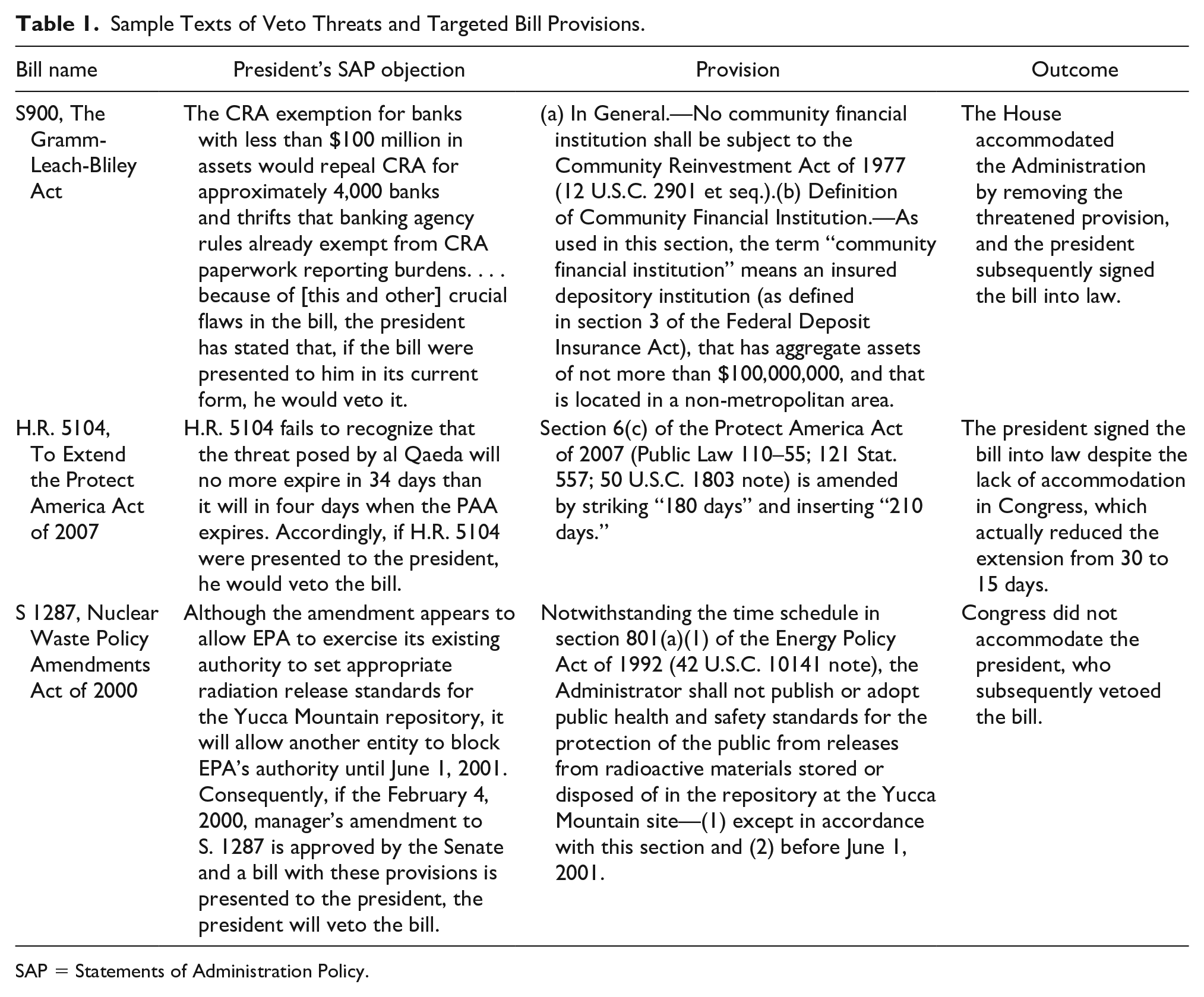
SAP = Statements of Administration Policy.
Tracking provisions through the legislative process is a daunting task. Not only do House and Senate rules provide numerous pathways of legislation, legislative language can be highly complex, with provisions cryptically citing statues according to their location in code rather than stating their substance. Finally, presidents can weigh in with a SAP threat at any time; we test legislative language against the most recent SAP. We have simplified the analysis by ignoring multiple referrals and focusing instead on the version that provoked the president’s threat.
Dependent and Control Variables
We track changes at each stage using bill text retrieved from the Library of Congress’s legislation tracker. Except for testing Hypothesis 2, where presidents decide the fates of whole enrolled bills, the unit of analysis is the congressional (Hypothesis 1), chamber (Hypotheses 3 and 4), or conference (Hypothesis 5) action on provisions. After a preliminary analysis found no significant differences in the treatment effect of veto threats between a provision’s removal or modification, we have collapsed all substantial changes into a binary “removal” action. For unthreatened provisions, the dependent variable is scored 1 if the provision was substantially modified or removed. 20 Finally, to prevent double counting chambers actions on threatened provisions in Hypotheses 3 and 4, we omit instances the second chamber accepts the first chamber’s provision removal.
Given that legislators are strategic actors, testing the treatment effects of veto threats requires thorough consideration of the potential impact of endogenous selection and spurious association on outcomes. All estimations include matching threatened and unthreatened provisions (and bills; Imbens and Rubin 2015). We have drawn heavily on indicators established by others and, with their generous guidance, have updated them through the 114th Congress (2016). These variables and their sources are listed in the Supplemental Appendix (Table S1.1).
Method
In estimating the treatment effect of a veto threat on congressional removal of a provision, one needs benchmark information on the likelihood that the provision would be removed had the president not issued the threat. To obtain a population of comparable unthreatened provisions, we have created a matched sample of unthreatened provisions. First, we sampled provisions from hundred randomly drawn enrolled bills. To ensure a proportional share of threatened and unthreatened provisions from large and small bills, we stratified the sampling by bill size (those containing more or fewer than hundred provisions). A quarter of the provisions in small bills and a ninth of those in large bills were sampled for six hundred unthreatened provisions. The procedure produced a combined sample of 1,539 unique observations. 21
We then match threatened and unthreatened provisions using a genetic matching algorithm to strengthen the comparability of the randomly sampled unthreatened provisions (see Diamond and Sekhon 2013; Ho et al. 2007). We match on the significant predictors of the equation predicting a provision-level veto threat in Table 2—chamber origin of the bill, bill size, cosponsor count, committee chair authorship, ideological distance between bill author and president in DW-Nominate space, and divided government. Results from other matching techniques, reported in the supplementary materials (Table S3.4), generate closely similar results. The supplemental materials describe the matching procedure and balance test comparisons in greater detail. 22 All estimates include administration fixed effects and standard errors clustered by bill.
Likelihood of a Veto Threat.
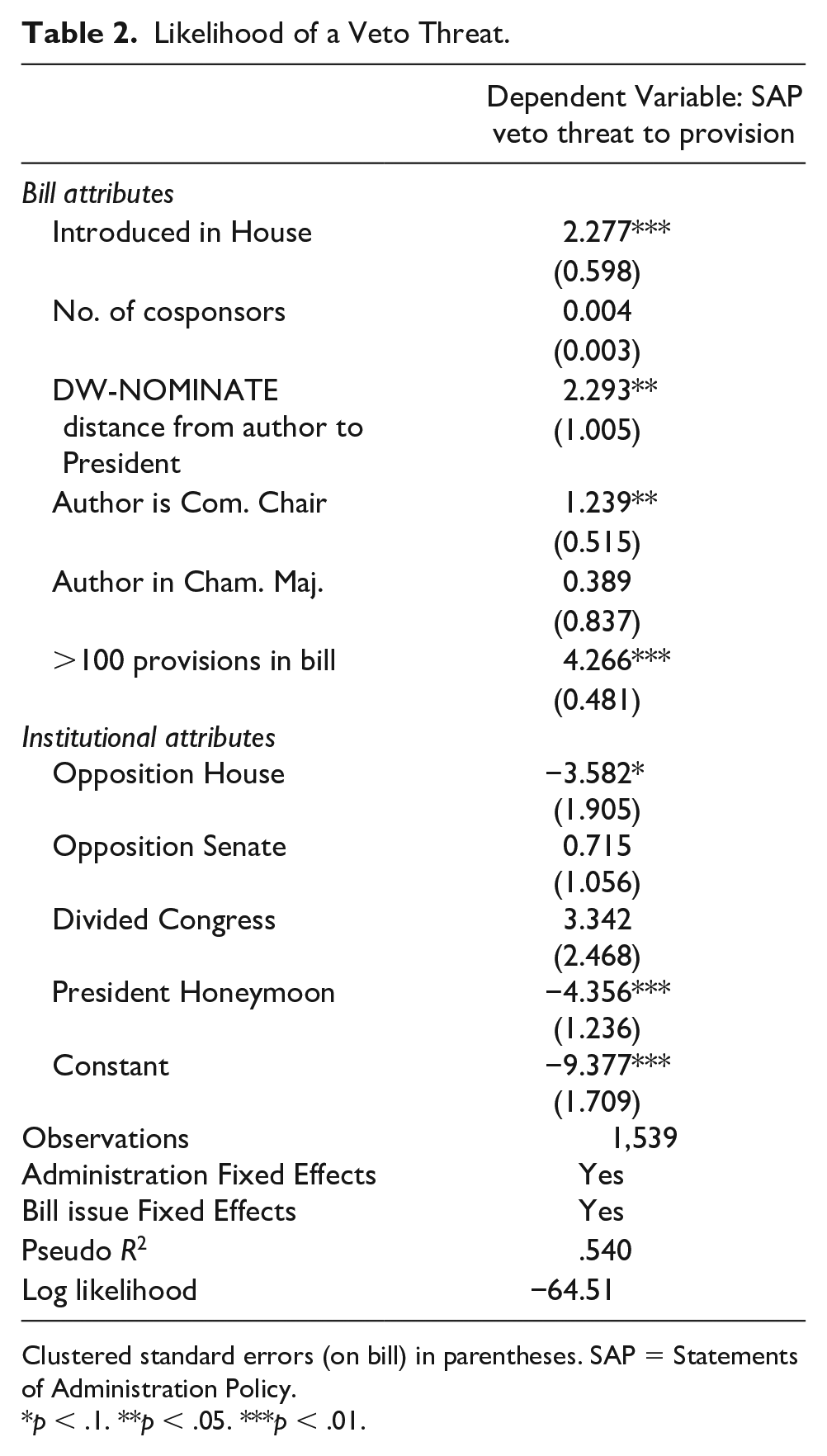
Clustered standard errors (on bill) in parentheses. SAP = Statements of Administration Policy.
p < .1. **p < .05. ***p < .01.
Findings
The relationships in Equation 1, Table 3 confirm the overall effect of veto threats on the substance of enrolled authorization bills. The predicted probability of a threatened provision’s removal is 46 percent—more than double the modification rate for matched unthreatened provisions. With over seventy percent of the threatened bills reaching the president’s desk containing one or more concessions, branding veto threats as ineffective “cheap talk” sells short their substantial impact on legislation.
Likelihood of Removal of Veto-Threatened Provision.

Standard errors clustered on bill in parentheses.
p < .1. **p < .05. ***p < .01.
The arrival of an enrolled bill on the president’s desk concludes the president’s VTB with Congress and begins the determination of whether the bargaining process was successful. The presence of concessions does not guarantee enrolled legislation’s success. Presidents vetoed nearly a third of these bills, half of which included one or more concessions. Conversely, they signed another twenty five bills originally passed without concessions but with veto-proof majorities. In these instances, presidents appear to have thrown in the towel after failing to rally copartisans to back their veto rhetoric.
Of course, comparatively few threatened bills command bicameral veto-proof support. The rest require congressional leaders to address some or all of the president’s objections. The predicted probabilities reported in Figure 3 Panel A confirm Hypothesis 2’s prediction that the greater the accommodation, the more likely the bill will win the president’s signature. 24 The predicted probability of vetoing a threatened bill drops 70 percentage points from a bill with no accommodation to one where Congress resolves every objection. Panel B sums up the relationships by reporting the frequency of presidents’ acceptance rates according to the extent of legislative accommodation. Presidents signed nearly all fully accommodated bills (forty-one of forty-three) and conversely vetoed almost all bills with no accommodations (twenty-five of twenty-eight). Of the 848 bills introduced bills ever to receive a veto threat, presidents ultimately signed only three that neither commanded veto-proof majorities nor made any concessions. Indeed, two of those three bills passed with two-thirds majorities in both chambers, but with enough abstentions to plausibly block a veto override vote. That leaves a single proposal, an obscure bill from 1987 barring lie detector tests when hiring employees, where the president backed down after failing to win any concessions from Congress.

Presidents’ veto action by share of accommodated provisions in bill.
Given that the House of Representatives initiates twice as many bills as the Senate, it is unsurprising to find about 80 percent of veto threats targeting House proposals. But the hypothesis claims more—specifically, that any given House bill initiated by the will more likely attract a veto threat than one coming out of the Senate. The best evidence available for testing this hypothesis can be found in Table 2, where we identify strong predictors of a veto threat for the purposes of selecting matching criteria. One of the strong covariates is the provision’s chamber of origin. After accounting for all the other controls in the model, the chamber initiating the bill remains one of the best predictors of a veto threat. Presidents are two and a half times more likely to threaten a provision initiated in the House than one initiated by the Senate, a great many other things equal.
Testing Hypothesis 4’s prediction that the Senate will be more adept at bridging the gap between the initial proposal and the president’s counter offer may appear straightforward. Yet demonstrating greater responsiveness requires that we reject the alternative explanation that it removes more objectionable provisions simply as an artifact of generally following House action in the modal legislative pathway. The estimation in Equation 2, Table 4, provides the complex interactions necessary to isolate each chamber’s actions at their first and second stages of deliberation. 25 Figure 4 maps the probabilities converted from Equation 2 estimates.
Removal of Veto Threatened Provisions by Chamber and Legislative Sequence.
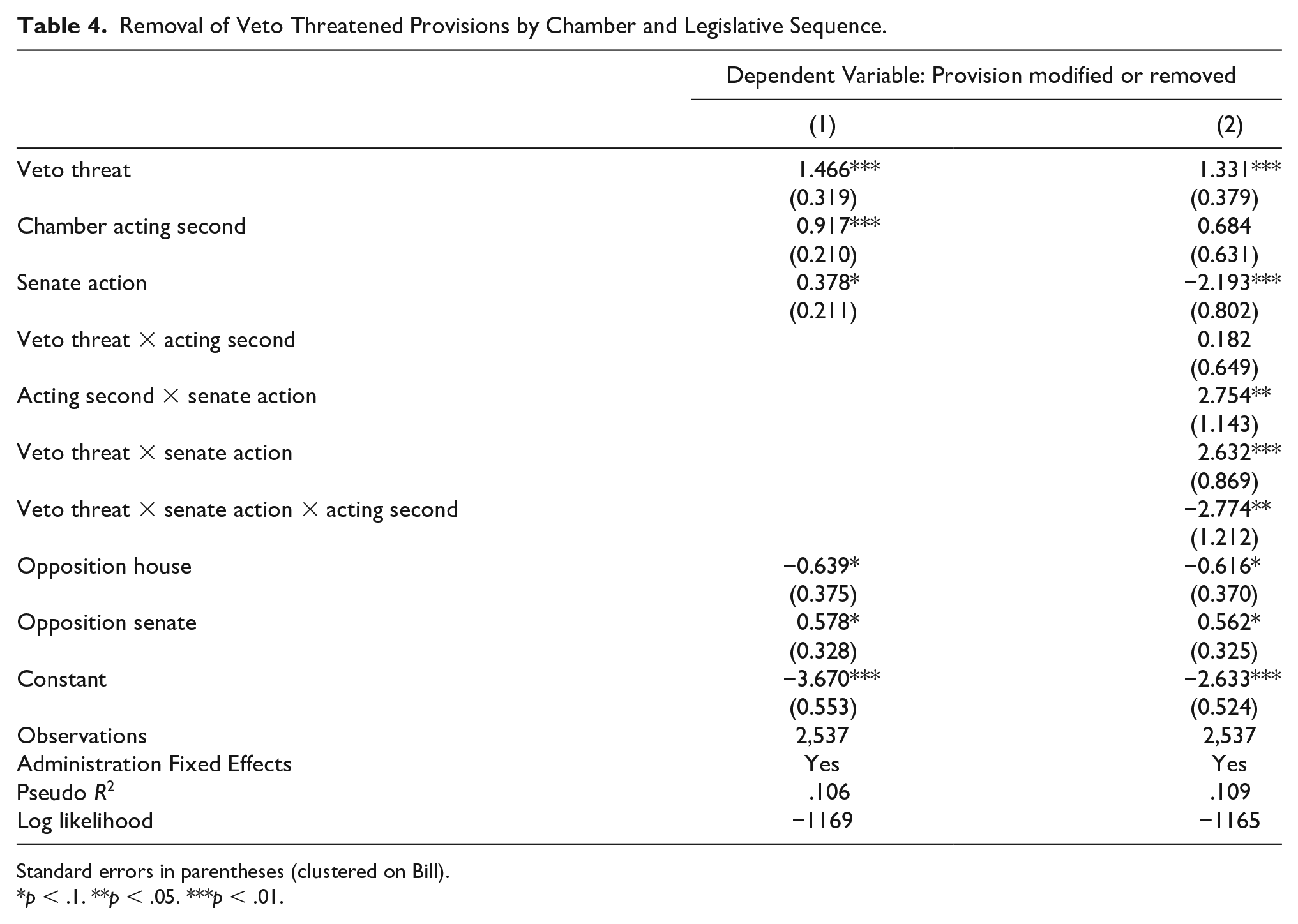
Standard errors in parentheses (clustered on Bill).
p < .1. **p < .05. ***p < .01.
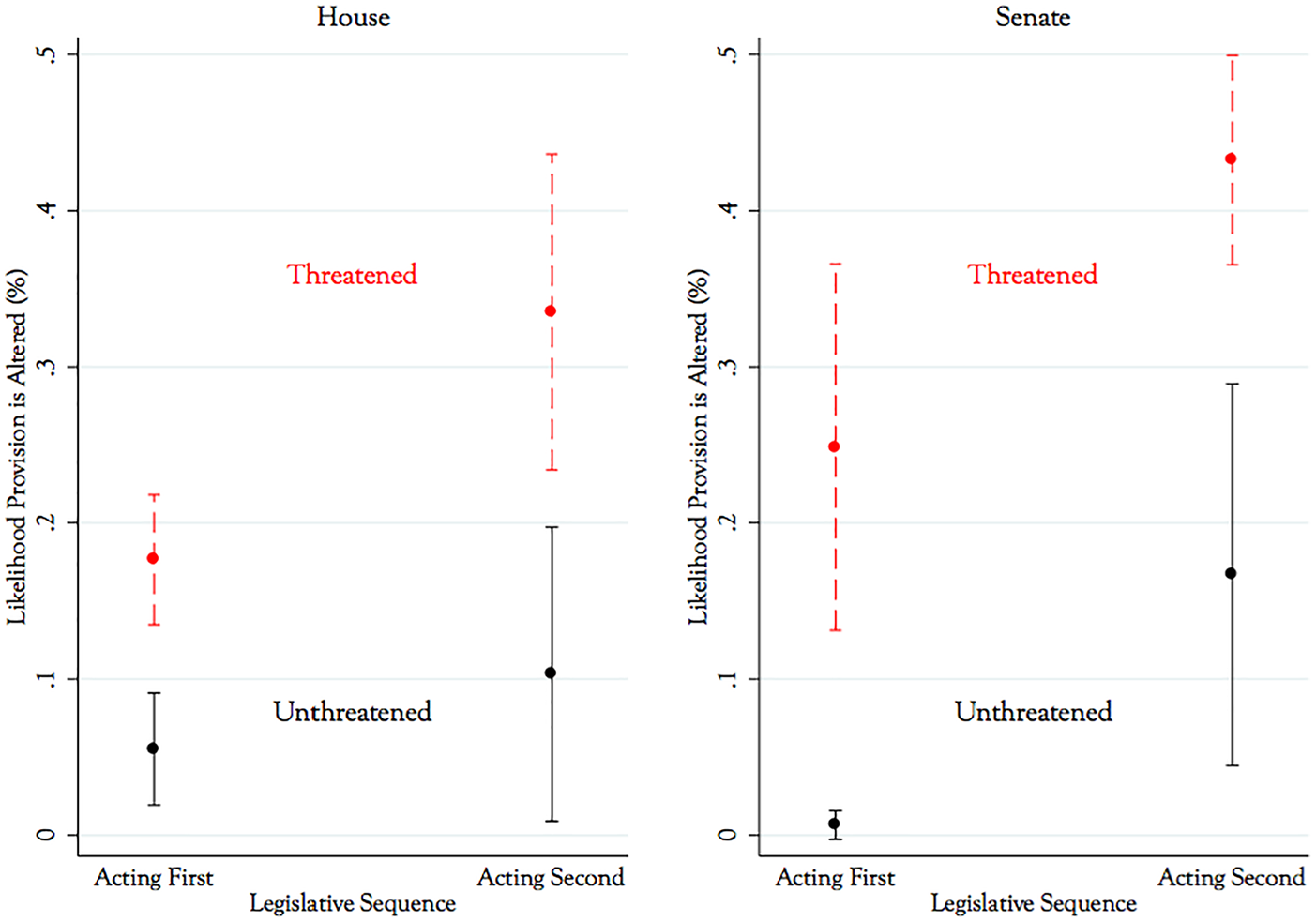
Chamber differences in response to veto threats.
The significant Veto Threat × Senate interaction in Equation 2 confirms that the Senate is consistently more likely to remove a threatened provision than is the House, controlling for their positions in the bicameral sequence. The pooled likelihood of removal whether acting first or second is 10 percentage points higher in the Senate—35 percent—compared to 25 percent for the House (p = .02; z-score: 2.33). Chamber differences in accommodating the president’s objections are only marginally significant at individual stages of the legislative process. But when assessed in aggregate, the Senate is significantly more likely than the House to remove an objectionable provision (Hypothesis 4).
Conversely, the House is more likely than the Senate to reinstate threatened provisions removed by the initiating chamber. Additional pairwise comparisons computed from the variable interactions in Equation 2, Table 4 show the House is more likely to reverse Senate actions than vice versa by 16 percentage points. With only a small sample (N = 84), the results are marginally significant (p = .056, z-score: 1.91).
Figure 4 repays close examination as it reveals several compelling patterns that attest to the overall performance of VTB in accounting for outcomes throughout legislative deliberations. First, the substantial and pervasive impact of veto threats in winning removal of objectionable provisions throughout deliberations is readily apparent (Hypothesis 1). Whether acting first or second, each chamber is more likely to remove a threatened provision than its unthreatened counterpart.
Second, the relationships mapped in Figure 3 reveal both chambers to be significantly more responsive to presidents’ threats when taking up the other chamber’s initiatives. One can see this by tracking the removal probabilities across the House and Senate according to their place in the sequence. When the House initiates a bill, its likelihood of removing a veto-targeted provision is less than 20 percent. But the chances of subsequent removal of the remaining provisions in the Senate improve considerably to 50 percent. Conversely, the Senate is 8 percentage points more likely than the House to remove threatened provisions initiated within their respective chambers, but, again, the House acting second removes a larger share of the remaining unchanged threatened provisions (34%). Pooling these marginal effects of each chamber, the legislative body acting first accommodates 21 percent of provisions, while the chamber acting second modifies an additional 38 percent of the remaining threatened provisions. That seventeen-point difference (p < .001, z-score: 4.07) confirms that the second chamber plays a critical role in moving the legislation toward compromise. The second chamber’s pattern of accommodation is logical, given that the chamber whose members are most dissatisfied with current policy are more likely to make the first move. The initiating chamber should simply be more reluctant than the other chamber to revise the bill in the face of a veto threat.
Finally, Figure 4 also reveals even stronger patterns of accommodation for the modal House-to-Senate legislative pathway. The institutional asymmetries that strongly advantage the majority in the House and empower the minority party in the Senate establish a bicameral pattern of first chamber proposal followed by second chamber negotiations, culminating in enactment. To be sure, the House and Senate are significantly more likely to remove the originating chamber’s threatened provisions than its unthreatened provisions, 40 to 13 percent (p < .001, z-score: 4.22). The Senate, however, takes accommodating action at a significantly higher rate– 46 versus 34 percent for the House (p = .05, z-score: 1.99). 26
The simple test for this hypothesis compares removal rates of veto-threatened versus unthreatened provisions in conference conditional on the preceding actions in the two chambers. The veto threat coefficient in Equation 2 of Table 3 shows a veto threat corresponding to an eight percentage point increase in the probability of a provision’s removal (p = .059, z-score: 1.89). But the purpose of conference ultimately is to reconcile differences between the two chambers. Testing whether the legislative sequences that lead to bicameral differences requires estimating a set of interactions between each chamber’s floor actions and the presence of a veto threat to isolate the various pathways to conference. This we have done by mapping the estimates from Equation 3 of Table 3 into predicted probabilities in Figure 5.

Impact of veto threat and legislative sequence on conference action.
Earlier we labeled the four possible outcomes of bicameral action on individual provisions. The two scenarios that find the chambers passing the same provision—either by ignoring the president’s veto threat (Stonewalling) or by both chambers agreeing to remove the threatened provision (Bicameral modification)—are left mostly undisturbed during conference. Eighty-one percent of unthreatened provisions fall into this consensus zone compared to just over half of threatened provisions. In Figure 5 we find that conference rarely alters bicameral consensus on either set of provisions. 27
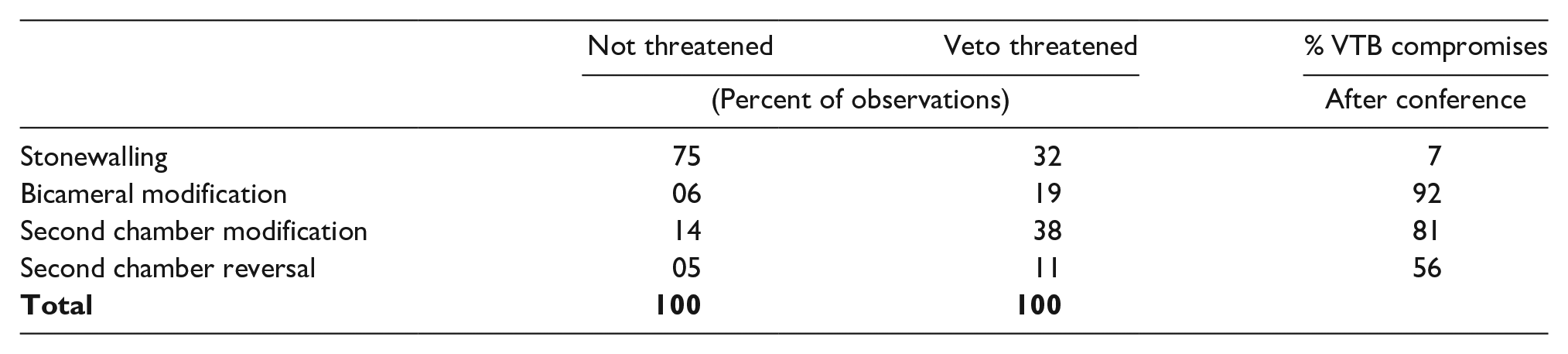
The pair of scenarios labeled “2nd Chamber” constitutes the real work of reconciliation. The chambers disagree, or at least differ, on nearly half of the threatened provisions entering reconciliation deliberations. When the initiating chamber ignores the veto threat, leaving it to the second chamber to act, conference accepts 81 percent of removals and major modifications. This represents a 32 percentage point increase (p = .003, z-score: 2.96) over the likelihood of accepting second-chamber modifications of unthreatened provisions. Not only is the second chamber—as we found above, normally the Senate—more likely to accommodate veto threats, so too is conference. By a 5:1 ratio, conference favors the second chamber’s removal of threatened provisions.
Then, there is the thorny case of actual disagreement when the second chamber reverses the first chamber’s accommodation with the administration. This infrequently occurs (11% of all threatened provisions), but when it does, conference restores the first chamber’s compromise 56 percent of the time, compared to 58 percent for unthreatened provisions. When the chambers explicitly disagree, a coin toss becomes a pretty good prediction of bicameral reconciliation.
Conclusion
During long stretches of mostly unified party control of government throughout the first six decades of the 20th century, the adage, “The president proposes, Congress disposes” summed up these branches’ institutional relations. It fell upon presidents to identify new problems and new solutions to old problems, to persuade their party’s legislative leaders to embrace them, and whenever close votes loomed, to cultivate marginal legislators with tangible inducements. With the president’s initiative and energy, Congress enacted laws that rewarded the governing party’s core constituencies and established a record of accomplishment, presumably putting them in good stead in the next election cycle.
Over time, divided party control of these branches became the norm and turned the venerable adage on its head. Opposition congresses frequently greet presidents’ initiatives with the sobriquet “dead on arrival.” Now, the opposition majority fills the legislative agenda with its own ideas for good policy. Presidents can retreat to the sidelines to neatly arrange their veto pens. Or if they (and their copartisans) also favor replacing current policy, they may issue veto threats that propose changes likely to win their acceptance. Opposition legislators may ignore these overtures, preferring instead to set the legislation aside or pass the original proposal, daring the president to veto it. But in 133 instances, the opposition majority accepted the veto threat as a basis for negotiation and passed a compromise policy.
In Divided We Govern, Mayhew (1991) argues that America’s national government functions reasonably well despite the presence of political parties. The reason, he explains, lies in subordination of party interest: “Unlike most politicians elsewhere, American ones at both legislative and executive levels have managed to navigate . . . without becoming minions of party leaders.” In VTB, we have proposed and marshaled evidence of successful lawmaking, even among politicians who are keenly motivated to serve their party’s collective goals. As leaders of their political parties, presidents do not so much rein in partisanship as harness it on behalf of their preferred policies.
With elections creating winners and losers, policy making frequently becomes a zero-sum game for which gridlock is a common outcome. Partisan competition then shifts from legislation to elections. But on some occasions, presidents and legislators recognize that gains from trade are more rewarding than obstruction. Perhaps current programs are on a trajectory of failure for which their party could be pilloried in the next election. Perhaps an obvious log roll is in the offing as politicians seek to accommodate their core constituency’s demand for new policy, policy that can only be won as part of a compromise package. On these and other occasions where each party’s interests prescribe compromise, VTB offers a method for discovering mutually preferred policy.
Supplemental Material
PRQ_Supplemental_Appendix – Supplemental material for Veto Threat Bargaining with a Bicameral Congress
Supplemental material, PRQ_Supplemental_Appendix for Veto Threat Bargaining with a Bicameral Congress by Scott M. Guenther and Samuel Kernell in Political Research Quarterly
Footnotes
Acknowledgements
We thank Derek Bonett, Lee Dionne, Huchen Liu and Laurie Rice for their data collection and coding assistance on the project. We thank participants at the 2015 Midwest Political Science Association Annual Meeting for thoughtful comments and suggestions on the manuscript. We are also grateful to the anonymous reviewers for their helpful suggestions, which improved the paper.
Declaration of Conflicting Interests
The author(s) declared no potential conflicts of interest with respect to the research, authorship, and/or publication of this article.
Funding
The author(s) disclosed receipt of the following financial support for the research, authorship, and/or publication of this article: A National Science Foundation Grant (SES-1655792) awarded to Samuel Kernell has generously supported the research reported here.

Notes
References
Supplementary Material
Please find the following supplemental material available below.
For Open Access articles published under a Creative Commons License, all supplemental material carries the same license as the article it is associated with.
For non-Open Access articles published, all supplemental material carries a non-exclusive license, and permission requests for re-use of supplemental material or any part of supplemental material shall be sent directly to the copyright owner as specified in the copyright notice associated with the article.
