



Abstract
How does the near-exclusion of working-class citizens from legislatures affect citizens’ perceptions of representation? We argue that when groups of people are continually denied access to representation, citizens are less likely to believe that their interests are represented by the legislature. By contrast, more inclusive institutions that incorporate members of the working class foster support for representative bodies. Using a multilevel analysis of eighteen Latin American countries—a region plagued by disapproval of and disenchantment with representation—we find that greater inclusion of the working class is associated with better evaluations of legislative performance. These findings have important implications for strengthening democracy in Latin America, as they indicate that more diverse political institutions may be key to deepening citizens’ attachments to representative bodies.
Democracy rests on the idea that power should reflect the will of the people. In practice, however, democracies vary dramatically in their representativeness, with different groups in society facing varying levels of inclusion (Alexander, Bolzendahl, and Jalalzai 2017; Escobar-Lemmon and Taylor-Robinson 2014; Hughes 2013). Working-class people are particularly underrepresented in democracies across the globe, as politicians are selected from a narrow set of elites (Best 2007; Carnes 2013; Taylor-Robinson 2010). In Latin America, for instance, working-class citizens—which we define based on one’s occupation or position in the labor force—make up the vast majority of the labor force, yet remarkably few legislators have working-class backgrounds (Carnes and Lupu 2015). This political exclusion of the working class calls into question one of the fundamental principles of democracy. How does the drastic underrepresentation of the working class influence citizens’ perceptions of and satisfaction with the legislature?
We provide the first study of workers’ symbolic representation. Scholars have defined symbolic representation as the feeling of being fairly and effectively represented (Schwindt-Bayer 2010; Schwindt-Bayer and Mishler 2005). Although previous research has investigated the symbolic effects of the descriptive representation of women (Barnes and Burchard 2013; Beauregard 2018; Carreras 2017; Kerevel and Atkeson 2017; Liu 2018) and minorities (Badas and Stauffer 2018; Hayes and Hibbing 2017; Rocha et al. 2010), and research has examined the policy (e.g., Carnes 2012, 2013; Carnes and Lupu 2015; Micozzi 2018) and electoral consequences (Carnes and Lupu 2016a; Carnes and Sadin 2015) of working-class representation, no study has considered whether descriptive representation of the working class improves perceptions of representation.
Building on previous research on democratic representation of marginalized groups (Schwindt-Bayer and Mishler 2005), we posit that workers’ descriptive representation may enhance evaluations of the legislature by signaling a more inclusive policy-making process. Moreover, given that working-class legislators hold different policy preferences (Carnes and Lupu 2015; Grumbach 2015) and advance different policy agendas (Carnes 2012, 2013; Micozzi 2018) than white-collar representatives from the same political party, working-class representation may also enhance evaluations of the legislature via policy responsiveness. Consequently, we anticipate that whereas workers’ exclusion may undermine citizens’ trust in and satisfaction with the legislature, greater inclusion of the working class serves to strengthen citizens’ satisfaction with the legislature both directly (by signaling that the legislature is more representative) and indirectly (via policy representation).
Furthermore, as we elaborate below, a more representative government should appeal to a broad range of voters—not just the working class (Mansbridge 1999). The inclusion of working-class representatives signals that democracy is inclusive of all citizens—rather than dominated by the rich or overrun by corruption—and enhances the de facto legitimacy of representative institutions for everyone (Mansbridge 1999). The presence of working-class lawmakers further signals the potential for more progressive economic policies that may appeal to the average voter. Consequently, we also anticipate that workers’ inclusion will be associated with more positive evaluations of legislatures for all citizens.
To evaluate support for our argument, we analyze elite and public opinion surveys from eighteen Latin American countries between 2008 and 2010, which exhibit substantial variation in the level of working-class representation in national legislatures. We use data from the University of Salamanca (USAL) to identify legislators with working-class backgrounds, and individual-level data from the Latin American Public Opinion Project (LAPOP) to evaluate citizens’ beliefs about representation. Using both affective trust and evaluative questions of policy-making performance, we find that higher levels of working-class representation are associated with more positive perceptions of the legislature. Citizens are more likely to approve of legislative performance, trust the legislature, and believe that the legislature has accomplished everything they hoped it would, when workers are represented in higher proportions. Importantly, we find this relationship extends to all citizens, not just members of the working class.
Our findings suggest that the underrepresentation of the working class can partially explain the “widespread disenchantment with and rejection of” legislatures over the last two decades (Mainwaring 2006, 16). This research, thus, has important implications for the quality and survival of democracy. Dissatisfaction with and mistrust in the legislature poses challenges for democratic stability and consolidation (Cleary and Stokes 2006; Linz and Stepan 1996) and the quality of democracy more broadly (Luna and Zechmeister 2005; Mainwaring, Bejarano, and Leongómez 2006). When representative linkages between citizens and the state break down, electoral participation declines (e.g., Barnes and Burchard 2013; Kittilson and Schwindt-Bayer 2012; Liu and Banaszak 2017), electoral volatility increases, and citizens turn to antiestablishment figures and political outsiders (Carreras 2012; Mainwaring, Bejarano, and Leongómez 2006; Morgan 2011). Breakdowns in representative linkages previously precipitated democratic setbacks in Latin America (Mainwaring, Bejarano, and Leongómez 2006), as well as in more entrenched democracies where dissatisfaction with representation has given rise to populist antiestablishment leaders (Bowler et al. 2017). Importantly, our findings suggest one way that democratic institutions can enhance citizens’ perceptions of representation and trust in institutions is by incorporating members of historically marginalized groups into the legislature.
Descriptive Representation and Workers’ Perceptions of Representation
Legislatures are the primary institutional vehicle for achieving democratic representation (Mainwaring 2006; Taylor-Robinson 2010), and interparty politics within the legislature is key to the success of programmatic policy goals (Crisp 2006). Indeed, it is within the legislature that descriptive representation generally yields substantive outcomes (Mansbridge 1999, 2015; Pitkin 1967). Despite legislatures’ representative function, Latin America has been characterized by a significant disenchantment with and mistrust of the legislature in recent decades (Mainwaring 2006; Mainwaring, Bejarano, and Leongómez 2006).
We posit that the exclusion of the working class—a group that constitutes a sizable majority of the population in Latin America—contributes to this mistrust of political institutions. Whereas workers make up the vast majority of the labor force across Latin America, they only hold a small share of legislative seats in the region. When white-collar representatives are left to act on behalf of the working class, this signals to workers that their participation in politics is not valued. By contrast, the mere presence of working-class representatives in decision-making bodies may have a direct effect on symbolic representation—improving citizens’ feelings about representation (Schwindt-Bayer and Mishler 2005). Moreover, when descriptive representation leads to improved policy representation, it may have an indirect effect on citizens’ evaluations of the government. In this section, we argue that representation of the working class may help restore trust in and satisfaction with legislatures among working-class citizens. In the next section, we explain why higher levels of working-class representation may improve perceptions of representation in society more broadly.
Symbolic Representation Emanates from Descriptive Representation
In Latin America, class is one of the most salient and defining societal cleavages. Working-class citizens have fundamentally different life chances, and they remain on the margins in politics (Carnes and Lupu 2015). Workers’ dramatic underrepresentation in Latin America has created an unequal political playing field. This legacy of elite, upper-class political dominance signals that politics does not work for lower-class citizens, thereby promoting a “political apathy and fatalism that is hard to overcome” (Taylor-Robinson 2010, 12). The chronic underrepresentation of historically marginalized groups is “intrinsically unfair” (Williams 1998), and efforts to remedy underrepresentation should be seen as a democratic good.
We argue one way that democratic institutions can enhance citizens’ perceptions of representation is by incorporating members of historically marginalized groups, such as the working class, into the legislature. When citizens see representatives who “look like them,” they are more likely to participate in and positively evaluate the political system (Banducci, Donovan, and Karp 2004; Barnes and Burchard 2013; Rocha et al. 2010). For this reason, some research finds that greater numeric representation of women (Karp and Banducci 2008; Liu and Banaszak 2017; Ulbig 2007) and racial and ethnic minorities (Hayes and Hibbing 2017; Tate 2001) fosters higher levels of trust in and satisfaction with the government.
Drawing on these insights about the descriptive representation of historically marginalized groups, we posit that workers’ incorporation into the legislature will increase the perceived legitimacy of the legislature among working-class citizens. Just as citizens draw on working-class backgrounds as a useful heuristic when evaluating candidates and voting (Carnes and Sadin 2015), we posit that the same heuristics structure workers’ attachments to their representatives. As such, greater descriptive representation of the working class may be associated with better perceptions of legislative representation among working-class citizens.
Symbolic Representation through Policy Responsiveness
Working-class legislators may also engender feelings of representation through policy responsiveness (Mansbridge 1999). Members of marginalized groups are more likely to represent those groups’ interests (Schwindt-Bayer 2010; Taylor-Robinson Heath 2003; Williams 1998), and policy representation may strengthen citizens’ feelings of being effectively represented. Representatives who have shared life experiences with the underrepresented are more likely to understand the nuances of issues and to “represent their working-class constituents more insightfully than even committed and well-meaning representatives who have not had similar experiences” (Mansbridge 2015, 263).
Consequently, despite that anyone can theoretically provide substantive representation, workers’ descriptive representation is associated with higher levels of substantive representation for working-class citizens (Carnes 2012, 2013). Across Latin America, for instance, working-class legislators are shown to have different policy priorities and preferences than their white-collar colleagues. Using elite survey data from eighteen Latin American countries, Carnes and Lupu (2015) find that working-class politicians are far more likely to favor state intervention and increased government spending for social and economic welfare programs. Evidence from bill cosponsorship and roll call data in Argentina indicates lawmakers from the private sector cosponsor a larger number of rightest economic bills and have more economically conservative roll call voting patterns than working-class politicians (Carnes and Lupu 2015). Further research from Argentina demonstrates that legislators with labor-based ties are more likely than other legislators from the same political party to introduce legislation addressing workers’ rights (Micozzi 2018).
This increased attention to policy issues that disproportionately influence workers’ lives may further engender working-class citizens’ trust in and satisfaction with the legislature. Given that working-class representatives are more likely to provide such policy representation, descriptive representation may further foster symbolic representation through increased attention to policy issues that disproportionately affect the working class, a group that constitutes the majority of the labor force in Latin America. In sum, insights from prior research on democratic representation suggest that descriptive representation of the working class may engender working-class citizens’ feelings of being fairly and effectively represented (Schwindt-Bayer and Mishler 2005), both directly (regardless of policy representation) and indirectly (via policy representation).
Descriptive Representation Improves Everyone’s Perceptions of Representation
Descriptive representation of the working class may also have profound implications for symbolic representation in society more broadly. Although it may seem obvious that descriptive representation of the historically excluded improves perceptions of representation among members of that group, theoretical and empirical insights from previous research on representation suggest that these benefits should extend to all groups. As we elaborate below, workers’ descriptive representation and policy responsiveness should appeal to blue-collar and white-collar citizens alike.
Greater descriptive representation may enhance the de facto legitimacy of the political system, not only for historically marginalized groups but for the powerful ones as well (Mansbridge 1999). In the same way that some white voters support the descriptive representation of racial and ethnic minorities (Hayes and Hibbing 2017) and some men support women’s numeric representation (Barnes and Córdova 2016; Morgan and Buice 2013), there may be a large number of white-collar professionals who—at least in principle—support the representation of working-class citizens. Such individuals are likely to view working-class representation as a sign that the legislature is representative and the democratic process is trustworthy—rather than dominated by the rich or overrun by corruption.
Indeed, beyond indicating that the legislature is more representative of the citizenry, workers’ political inclusion may signify that the democratic process is functioning properly by delivering transparency and impartiality in the exercise of power. In particular, working-class representatives could signal a general lack of corruption and elite dominance in government that appeals to white-collar and working-class citizens alike. Criminal activities such as corruption and bribery often operate through “networks of collusion” (Barlow 1993), and political outsiders are often perceived to be less corrupt because they lack the networks and political connections necessary to successfully engage in corruption (Barnes, Beaulieu, and Saxton 2018). Moreover, when the electoral process produces representative outcomes, it signals that all citizens—not merely political elites—have an influence in the policy-making process, and that ordinary citizens are capable of governing.
Research on elite cues offers further theoretical insights into how and why descriptive representation of marginalized groups may enhance everyone’s perceptions of representation. Elite behavior—such as nominating more working-class candidates to run for office—sends important pro-egalitarian signals, promoting support for working-class representation (Beaman et al. 2009; Hansen 1997). And, although elite behavior likely shapes most citizens’ attitudes, it particularly influences citizens with weak (or no) personal investment in, or uncertain views on, the issues (e.g., Barnes and Córdova 2016; Clayton, O’Brien, and Piscopo 2019). The presence of women political leaders, for instance, reduces gender stereotypes among men (Alexander 2015; Alexander and Jalalzai 2018; Kerevel and Atkeson 2015) and is associated with increases in men’s satisfaction with democracy and legislative trust (Barnes and Taylor-Robinson 2017; Schwindt-Bayer 2010; Schwindt-Bayer and Alles 2018). Morgan and Buice (2013) explain that because men are less likely than women to hold firm beliefs about women’s role in leadership, they are more susceptible to cues transmitted via elite behavior. In this vein, they demonstrate that men are more supportive of women’s leadership in countries where elites nominated women to serve as cabinet ministers. This argument implies that citizens who do not have a strong self-interest in working-class representation may rely heavily on elite cues from party leaders and Congress when assessing the quality of representation. Thus, where party leaders have incorporated members of the working class, this pro-egalitarian message is likely to extend beyond workers—shaping the mass-public opinion of all citizens.
Working-class lawmakers may also foster greater trust in legislatures by representing policy preferences that appeal to a broad swath of citizens, and not exclusively to workers. There is some evidence to suggest that legislators with working-class backgrounds are more economically progressive (Carnes and Sadin 2015; Grumbach 2015). As explained above, working-class legislators in Latin America espouse preferences for more statist economic policies, increased government spending, and more expansive social welfare policies (Carnes and Lupu 2015). These stances are more in line with average citizens’ preferences in Latin America (Barnes and Córdova 2016) than are white-collar legislators’ preferences, which favor the economic interests of the wealthy. As such, the presence of working-class lawmakers may indicate the potential for the government to advance progressive economic policies that may appeal to economically vulnerable white-collar professionals, progressive voters, and average citizens more generally. As a result, higher levels of working-class legislators may enhance all citizens’ evaluations of legislatures through policy responsiveness.
The Visibility of Working-Class Legislators in Latin America
Working-class status is arguably more difficult for citizens to observe than characteristics such as race, ethnicity, or gender. Importantly, however, there are at least three good reasons to believe that working-class legislators are visible and that citizens are generally aware of the extent to which workers are represented in the legislature. First, parties and individual candidates/deputies have incentives for voters to know about politicians’ personal backgrounds. In campaign communications, candidates’ job experience is the most frequently cited personal quality (Shyles 1984), as it provides an extremely useful information shortcut for voters (Campbell and Cowley 2014; McDermott 2005; Mechtel 2014).
In the United States, the “mill workers son” heuristic is often employed in political rhetoric to refer to candidates who grew up working class (Carnes and Sadin 2015; Vandello, Goldschmied, and Richards 2007). Individual candidates in Latin American countries with both low (e.g., Argentina) and high (e.g., Bolivia and Brazil) levels of personal vote-seeking incentives (Johnson and Wallack 2012) make similar appeals to their working-class backgrounds. National Argentine Deputy Facundo Moyano employs this tactic, telling constituents he was not the “hijo de” (son of) anyone powerful, rather he was raised by a working-class mother. 1 Likewise, Bolivian Deputy Herber Choque Tarqui, from La Paz, describes himself as “De padres Mineros” (of miner parents). 2 In Brazil, candidates frequently use professional nicknames, such as “Doctor Carlos,” on official ballots to stand out in crowded open-list races (Boas 2014).
Whereas individual candidates may have a stronger incentive to emphasize their class in candidate-centered electoral systems, political parties have incentives to emphasize individuals’ occupational backgrounds in party-centered electoral systems. This is because parties likely assume candidates who share the majority of the population’s life experiences will fare better electorally than members of the political elite as they can personally connect with voters (Castañeda and Navia 2007). There is ample evidence of such tactics in countries with low personal vote-seeking incentives. In Argentina, beyond providing clientelistic benefits, one of the primary roles of punteros (political brokers) includes organizing rallies and neighborhood meetings so that voters can meet candidates face-to-face and personally connect with them (De Luca, Jones, and Tula 2002; Zarazaga 2014). In Peru, clientelism is used to lure voters to campaign events, meetings, and rallies so that candidates can introduce themselves (Muñoz 2014). Evidence from Costa Rica indicates that political parties in party-centered electoral systems know that they benefit when their legislators build close rapport with constituents in neighborhoods and communities (Taylor 1992).
Second, news coverage and official government websites across Latin America (regardless of parties’ and candidates’ electoral incentives) routinely report broader trends about politicians’ occupational backgrounds. Consider for instance an article published prior to the 2014 election by La Razón, a national Bolivian newspaper out of La Paz, explaining that the “lists of candidates for national deputies include laborers, miners, micro-entrepreneurs, peasants, indigenous, truck drivers and merchants, among others.” 3 In Honduras, La Tribuna ran an article after the 2015 election explaining that although Congress was historically dominated by priests, large property owners, and ranchers, today lawyers, engineers, health professionals, and teachers, as well as some union leaders and peasant leaders hold office. 4 Ahead of the 2017 Argentine midterm elections, Ambito reported that of eleven deputies from labor unions currently serving in the Lower House, five of them will complete their term, and only two will run for reelection. 5 The article detailed each deputy’s district and union affiliation.
In other instances, news reports point to more systematic coverage of deputies’ backgrounds. Costa Rica Hoy, a national Costa Rican newspaper, launched a website “Yo Voto Elecciones 2018” where it reported information about all candidates competing for national deputy prior to the election and the winners, along with their political party, age, and occupation. 6 In February 2018, El Mundo, a national paper in El Salvador, ran a story listing all candidates for national deputy along with brief biographies that included occupational information when available. 7 Leading up to the 2018 Mexican election, a headline read “Do you know your candidates for senators and deputies? This page tells you who they are and shows their CV,” and directed readers to a website cataloging candidates’ occupational backgrounds. 8 Comparable articles ran in Uruguay profiling legislators after the 2015 election. 9 Beyond news coverage, many government websites include short biographies of national deputies.
Third, research demonstrates citizens are remarkably adept at inferring class status from facial images (Bjornsdottir, Alaei, and Rule 2017; Bjornsdottir and Rule 2017) 10 and speech (Kraus and Keltner 2009; Kraus, Park, and Tan 2017). Voters across Latin America (regardless of personal vote-seeking incentives) are regularly exposed to politicians’ facial images and speech. With respect to facial images, a large number of countries include candidates’ pictures on ballots (Tchintian 2018), most legislatures include photographs of deputies on their websites, and images of deputies and candidates frequently appear in newspapers. Bjornsdottir and Rule (2017) explain that because people are attuned to social class, they can use stereotype-related impressions to assess individuals’ class based on facial images alone. In a series of experiments, subjects were shown facial images and were able to categorize images by class at a rate significantly better than chance. Thus, even naïve judgments of politicians (i.e., judgments made by relying on headshots or pictures alone) inform voters’ assessments of working-class representation.
Voters in Latin America are also exposed to politicians’ speech when they hear them at campaign rallies, in neighborhood meetings, and (albeit less often) on the radio (e.g., De Luca, Jones, and Tula 2002; Taylor 1992; Zarazaga 2014). A growing body of research indicates that people can accurately perceive other’s social class (as measured using occupational status) based on minimal exposure to speech patterns, dialects, and accents (e.g., Giles and Sassoon 1983; Kraus and Keltner 2009). Kraus, Park, and Tan (2017), for example, argue that speech style is an accurate signal of social class even when the content of speech is held constant. Using isolated speech recordings from seven spoken words, they find that subjects’ evaluations of the speaker’s social class (using both measures of educational attainment and occupational status) were significantly and positively correlated with the speaker’s known social class, leading the researchers to conclude that “social class is rapidly and accurately perceived in the early stages of social perception” (Kraus, Park, and Tan 2017, 426). Although this research is based on English speakers, there is evidence that linguistic markers also vary by class in Latin America (Lipski 2011). Hence, even minimal exposure to politicians’ speech informs citizens’ perceptions of working-class representation.
Taken together, social science research on Latin American politics, campaigns, and social psychology, combined with primary and secondary accounts from newspapers, government websites, and Latin American scholarship, indicates strong evidence that citizens can detect working-class representation. As with the share of women legislators, people may not be able to accurately guess the exact share of seats held by working-class representatives (Carnes and Lupu 2016b). Nonetheless, because parties and candidates have incentives to showcase class during campaigns, news coverage and government websites often report occupational backgrounds, and ordinary citizens can infer legislators’ class from facial images and speech, working-class legislators are visible in Latin America.
Evidence from Latin America
Latin America offers an ideal setting to evaluate our hypotheses. Latin America hosts substantial variation in the level of working-class representation in national legislatures. During the period under investigation, workers’ access to legislative office ranges from a low of 0 percent in Costa Rica to upward of 17 percent in Bolivia. This variation is necessary to evaluate our hypothesized link between workers’ numeric representation and citizens’ beliefs about representation. Equally important, workers make up the vast majority of the labor force in Latin America—between 60 and 85 percent. 11 In many Latin American countries, poor and working-class citizens have suffered a history of social and political exclusion (Taylor-Robinson 2010) and they remain dramatically underrepresented (Carnes and Lupu 2015).
To evaluate the relationship between workers’ descriptive representation and citizens’ perceptions of legislative representation, we analyze three individual-level survey questions from LAPOP in eighteen countries from 2008 to 2010. 12 In addition, we leverage elite-level data on legislators’ occupational backgrounds as a measure of working-class descriptive representation. Occupational data comes from waves 3 to 5 of the USAL survey of Latin American legislators. 13
Dependent Variables
We measure citizens’ feelings of being “fairly and effectively represented” (Schwindt-Bayer and Mishler 2005, 407) with three questions designed to tap citizens’ feelings and attitudes toward the legislature. LAPOP asks: “Thinking of Congress as a whole, without considering the political parties to which they belong, do you think members of Congress are performing their jobs” very poorly (coded 1), poorly (2), fair (3), well (4), or very well (5)? Respondents are also asked to indicate their level of trust in the legislature on a scale from 1 (none) to 7 (a lot). Third, respondents were asked, “To what extent does the Congress accomplish what you would hope for it to?” Responses range from not at all (1) to a lot (7). 14
Figure 1 plots the percentage of respondents across each of the outcome options for the three dependent variables. Here, the data are pooled across all of the country-waves in the analysis. Online Appendix Figures A1 to A3 show the distribution of each of the dependent variables for each country-wave in the analysis. For the first, Legislative Approval, the modal response is “neither good nor bad” (3), with nearly half of all responses in this category. The modal response for Legislative Trust is “some” (4), with slightly more than 20 percent of respondents selecting this response, and closely followed by “none” (1) with 18.8 percent. For Legislative Accomplishment, the modal response is “somewhat” (4) with 22 percent of respondents, followed closely by the lowest response outcome (1) with 20 percent.
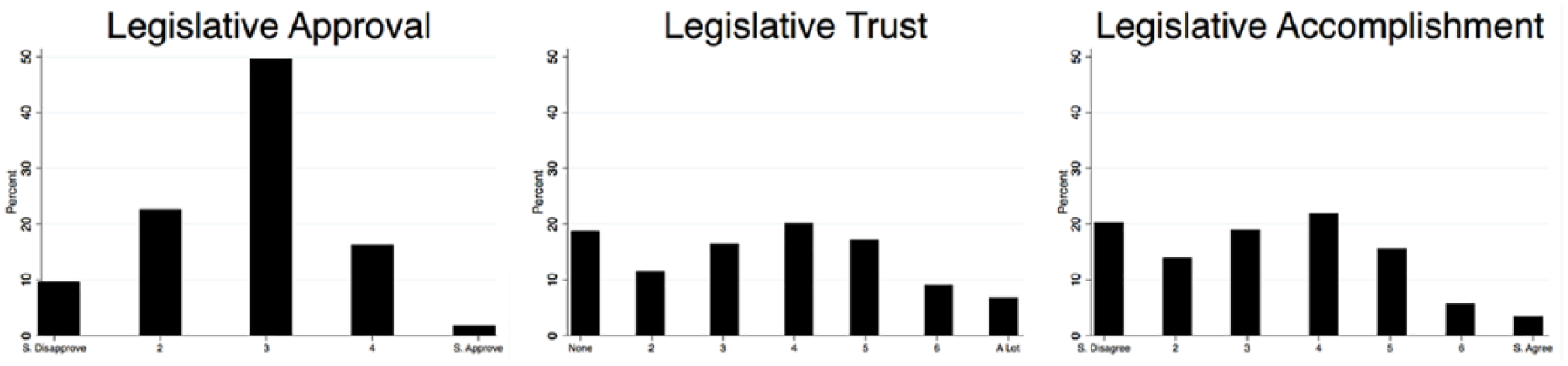
Perceptions of legislative representation in Latin America.
Independent Variables
Working-class representation
The key explanatory variable in this analysis is descriptive representation of the working class. We use data from USAL to construct a measure that captures the percentage of legislators that come from a working-class background. Following Carnes and Lupu (2015), we operationalize “working-class background” with a legislator’s occupation prior to getting elected. 15 As Figure 2 shows, the percentage of workers in the legislature varies dramatically across Latin American countries, from 0 percent in Costa Rica in 2008 to 17 percent in Bolivia in 2008. The occupation-based conceptualization of class is fundamentally distinct from socioeconomic status as defined by income (Carnes and Lupu 2015). In sharp contrast to income or education, how individuals earn a living most accurately reflects people’s place in society (Brooks and Manza 2007), and individuals in different professional strata, even those with the same income, face dramatically different life chances (Carnes and Lupu 2015). Occupational background reflects class better than income because “the dividing line between social classes in most societies revolves around the labor market, that is, how people earn a living” (Carnes 2013, 3).
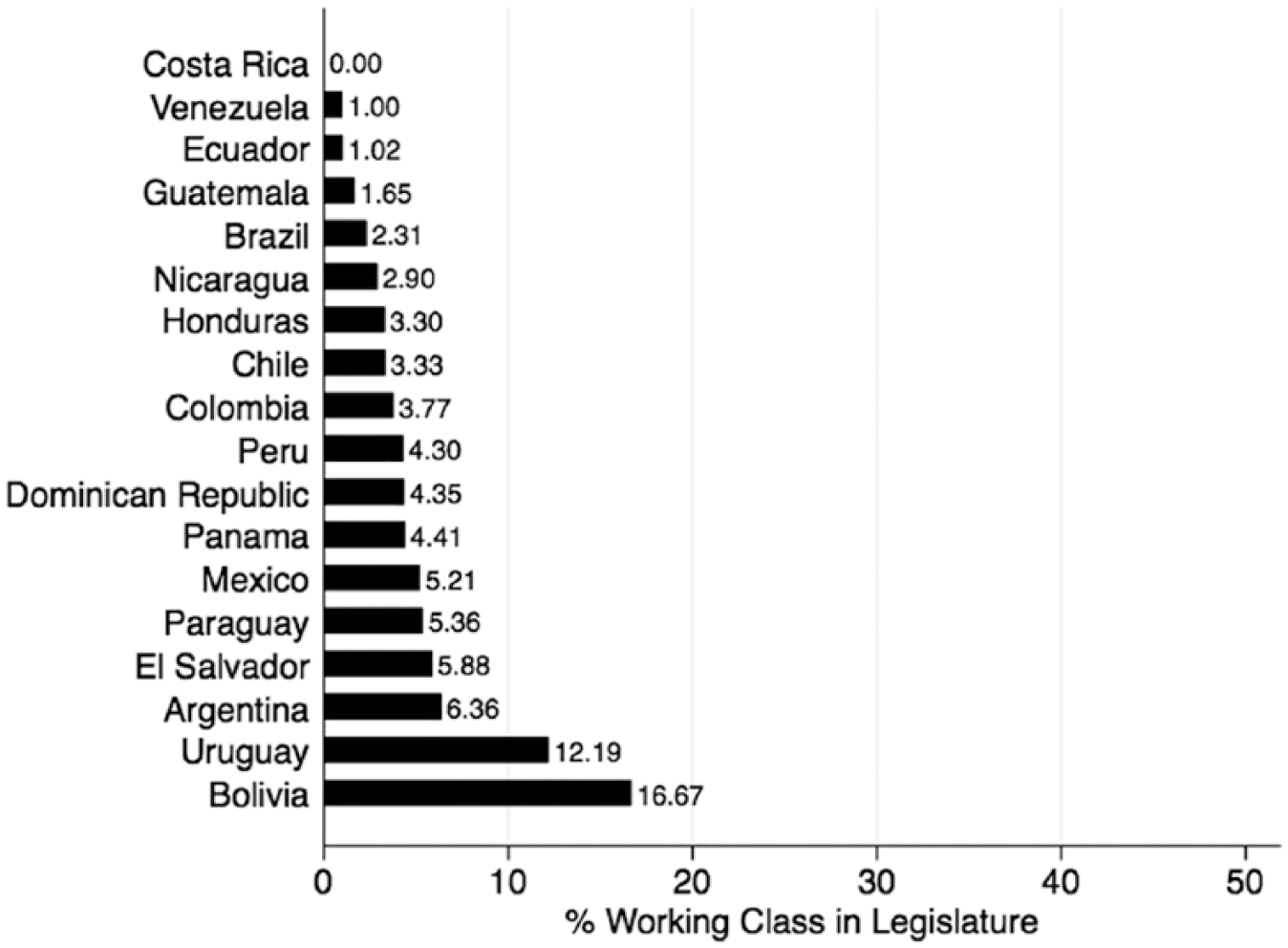
Distribution of percent workers in the legislature.
Working-class citizens
To test our first hypothesis, that the relationship between working-class legislators and positive evaluations of the legislature is stronger for working class citizens, we create a dummy variable that measures whether or not individuals belong to the working class. Following Carnes and Lupu (2015), we use occupational data from LAPOP and code individuals as working-class if they indicate that their main occupation or type of work is as a skilled worker, office worker, employee in the service sector, food vendor, farmhand, domestic servant, or servant. 16 All other occupations are coded as non working-class.
Control Variables
Individual level
We control for a number of individual-level variables that might influence attitudes toward the legislature. First, we control for political interest. LAPOP asks, “How much interest do you have in politics: a lot (coded 1), some (2), little (3), or none (4).” For the analysis, we recoded responses such that higher values indicate more political interest. We also control for political ideology. Ideology is measured using a question that asks respondents to place themselves on a 10-point scale: 1 (left) to 10 (right). We then collapse responses into four nominal categories: left, center-left, center-right, and right. To address the large number of nonresponses, we recode nonresponse values as a category and include them in our analysis (see Barnes and Córdova 2016). Next, we expect that working-class representation is positively correlated with perceptions of representation independent of economic performance, and thus we control for perception of the economy. LAPOP asks respondents whether they think economic conditions in their country are better, the same, or worse than they were twelve months ago. We recode responses such that better/same = 0 and worse = 1. Finally, we control for respondents’ age, income, education, sex, and marital status.
Country level
Currently, research does not have a clear understanding of the factors that lead to greater working-class representation (Carnes 2016, see also Online Appendix Table A5). Nevertheless, we account for a number of country-level variables in the analysis that theoretically could influence both working-class descriptive representation and citizens’ evaluations of the legislature. To control for the possibility that weak state capacity causes diminished perceptions of representation (Mainwaring 2006), or that a country’s socioeconomic development is associated with better representation of citizens’ policy preferences (Luna and Zechmeister 2005), we control for gross national income (GNI) per capita. In Online Appendix Tables B1 to B2, we demonstrate that the results are robust when controlling for other measures of political and economic development—that is, governance quality from the World Bank’s Worldwide Governance Indicators project and the Freedom House democracy indicator.
Next, we account for the possibility that left-leaning political parties could explain both the number of workers in office and more positive evaluations of the legislature. Using a USAL question that asks legislators to place their own party on a (1–10) left–right scale, we calculate the average ideological position for each party. We control for the percentage of parties in each chamber with a mean score less than 4. The percent leftist parties and percent workers in the legislature are only weakly correlated (r = .32), and 68 percent of the workers in the sample belong to either center or right parties. About 6 percent of legislators in leftist parties are workers, compared with 4.5 percent of the members of center and right parties. Online Appendix Tables B3 to B4 show the results are robust to other measures of left-parties, including a similar measure from USAL that asks legislators’ own (rather than their party’s) ideological placement, and a dummy variable for leftist-presidents from the Database of Political Institutions. 17
To ensure that the nature of the party system itself is not driving both the number of workers in office and citizens’ perceptions of representation, we include a control for personal vote-seeking incentives (Johnson and Wallack 2012). Online Appendix Figure B4 plots the distribution of personal vote-seeking incentives in our sample. Furthermore, we show in Online Appendix Table B5 that the relationship between working-class legislators and citizens’ perceptions of representation is not conditioned by the levels of personal vote-seeking incentives. Online Appendix Tables B6 to B7 demonstrate the results are robust when controlling for other features of the party system, specifically: political party fragmentation (Bormann and Golder 2013) and a measure of programmatic party systems from the Varieties of Democracy project.
Analyses and Results
Working-Class Legislators and Perceptions of Representation
We begin by looking at the correlation between the percent workers and each of the three dependent variables. In Figure 3, we plot the correlations between the average response (i.e., the country-year mean) to each dependent variable (y axis) and the percent workers in the legislature (x axis). We also include the corresponding regression line and the correlation coefficient for the relationship. 18 For all three dependent variables, the slope of the regression line is positive and significant, indicating that more working-class representation is associated with better legislative approval, trust, and accomplishment.
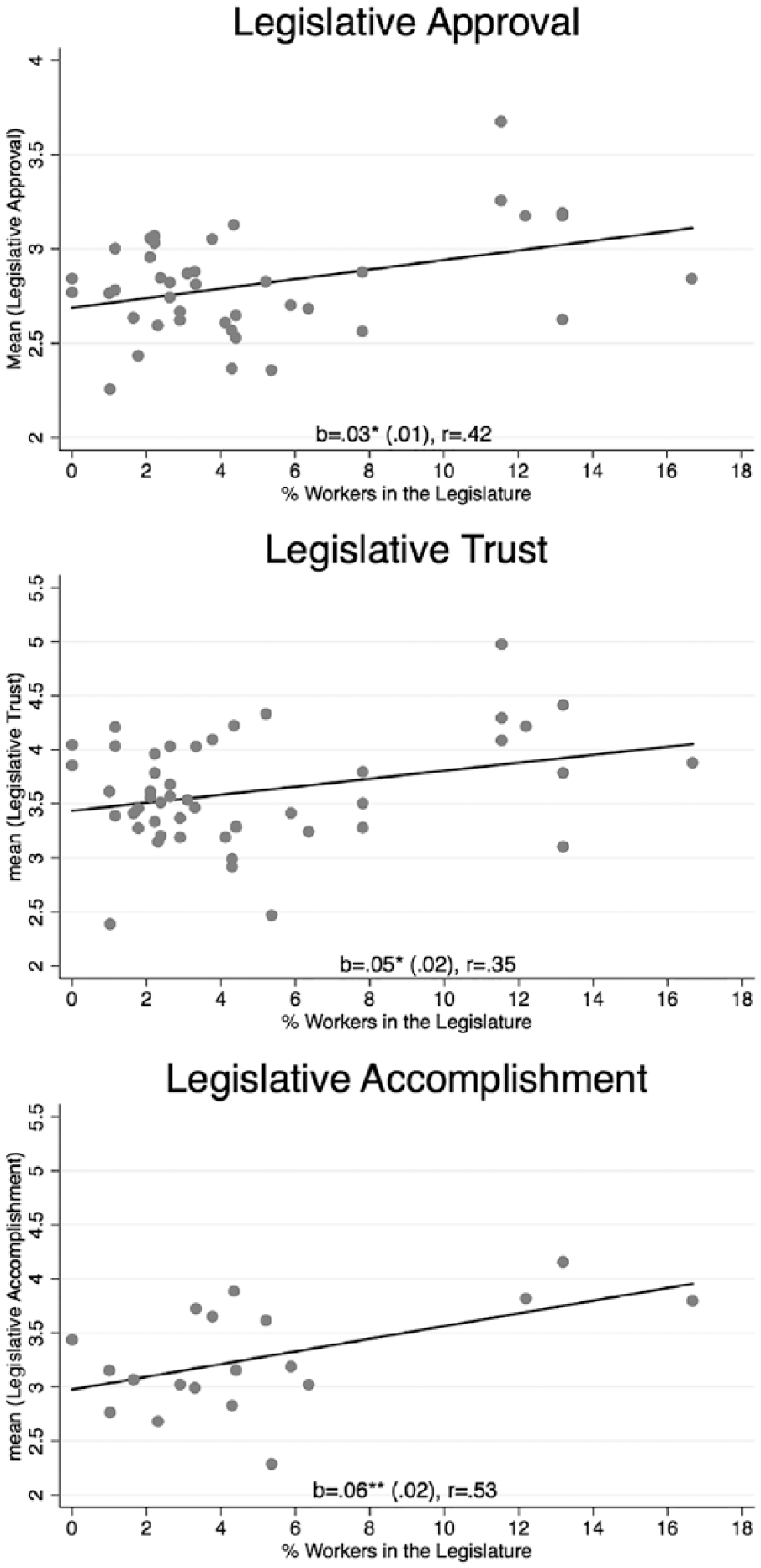
Correlation between working-class legislators and perceptions of representation.
Next, a one-way ANOVA reveals the three dependent variables vary significantly across the thirty-one country-years included in this analysis (p < .001), suggesting that factors measured at the country-year-level explain some of the variation in the individual-level dependent variables. To account for the nested nature of the survey—individuals i living in country-years j—as well as individual-level and country-level data, we estimate a series of multilevel ordered logit models to test our hypotheses about workers’ descriptive representation. Online Appendix Table B9 and Figure B5 demonstrate that the results are robust to a multilevel linear model specification.
Table 1 presents baseline and interactive models for each dependent variable. Models 1, 3, and 5 allow us to assess the direct relationship between working-class legislators and citizens’ perceptions of representation. Models 2, 4, and 6 include a cross-level interaction between percent workers and the individual-level variable for working-class respondent and allow us to investigate whether the relationship between descriptive representation and citizens’ perceptions is different for working-class compared with non working-class citizens. 19 The coefficient for percent workers is positive and significant in every model.
Working-Class Legislators and Perceptions of Legislative Representation.
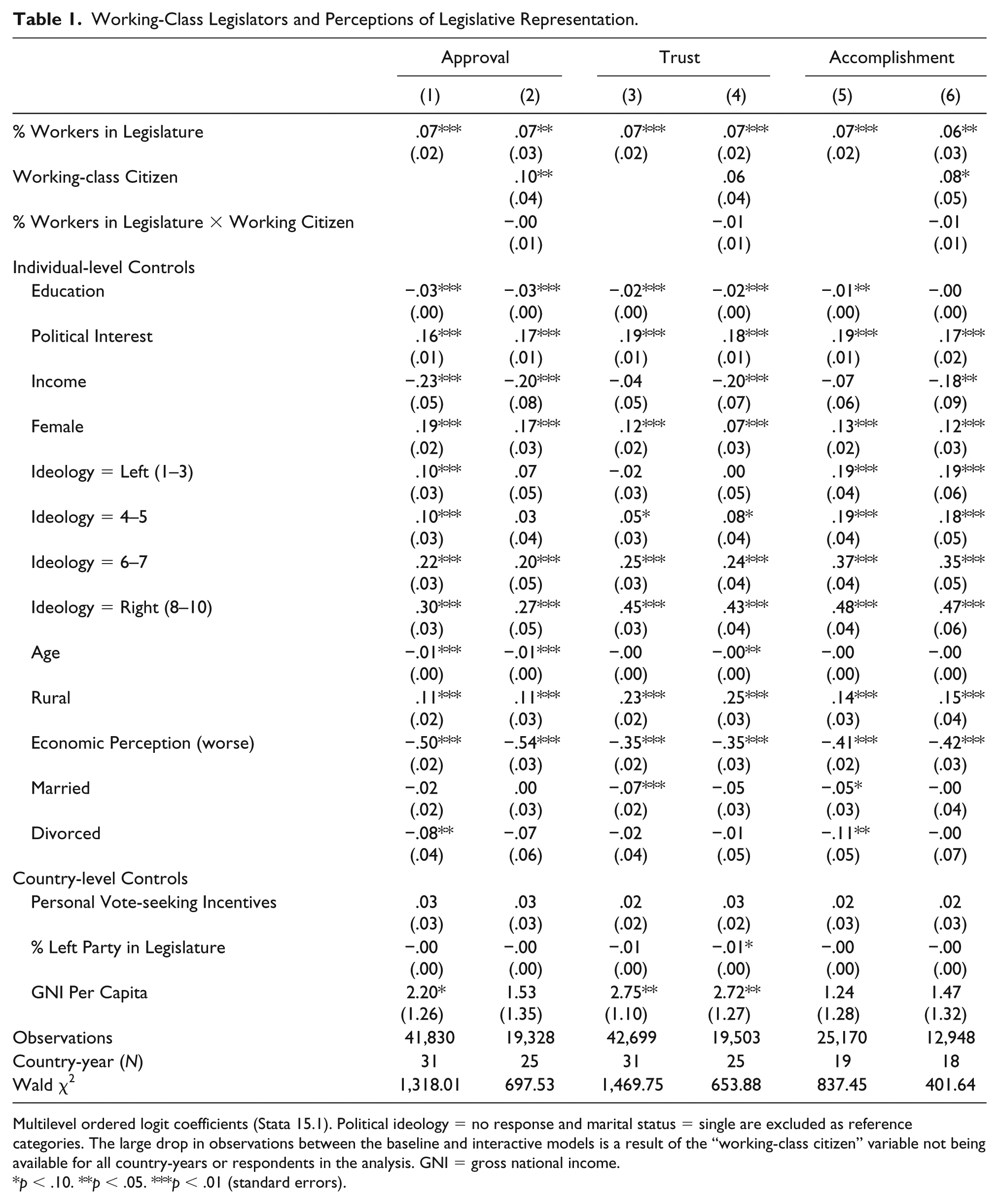
Multilevel ordered logit coefficients (Stata 15.1). Political ideology = no response and marital status = single are excluded as reference categories. The large drop in observations between the baseline and interactive models is a result of the “working-class citizen” variable not being available for all country-years or respondents in the analysis. GNI = gross national income.
p < .10. **p < .05. ***p < .01 (standard errors).
Turning to the interactive models, the coefficient for the interaction between percent workers in the legislature and working-class respondents is insignificant. To assist with the interpretation of the coefficients associated with the interaction terms and their constituent parts, we calculate and graph the average marginal effect of this interaction result for the bottom two and top two response outcomes for each dependent variable (Brambor, Clark, and Golder 2006).
The marginal effects plotted in Figure 4 represent the average effect of an increase in the level of percent workers on the probability of observing each response outcome. Whereas a higher percentage of workers is associated with a decreased probability of observing negative evaluations of the legislature, it is associated with an increased probability of observing positive evaluations. That said, across the three dependent variables, the average marginal effect of a higher percentage of working-class legislators on the probability of observing a given outcome is the same for working-class and other citizens. As a result, we do find support for hypothesis 1, but only to the extent that we observe a significant relationship between higher levels of working-class representation and all citizens’ perceptions of the legislature—including working-class citizens. Importantly this relationship is not different for working-class citizens compared with other citizens. As this positive relationship is the same for working-class and non working-class citizens, we also find support for hypothesis 2.
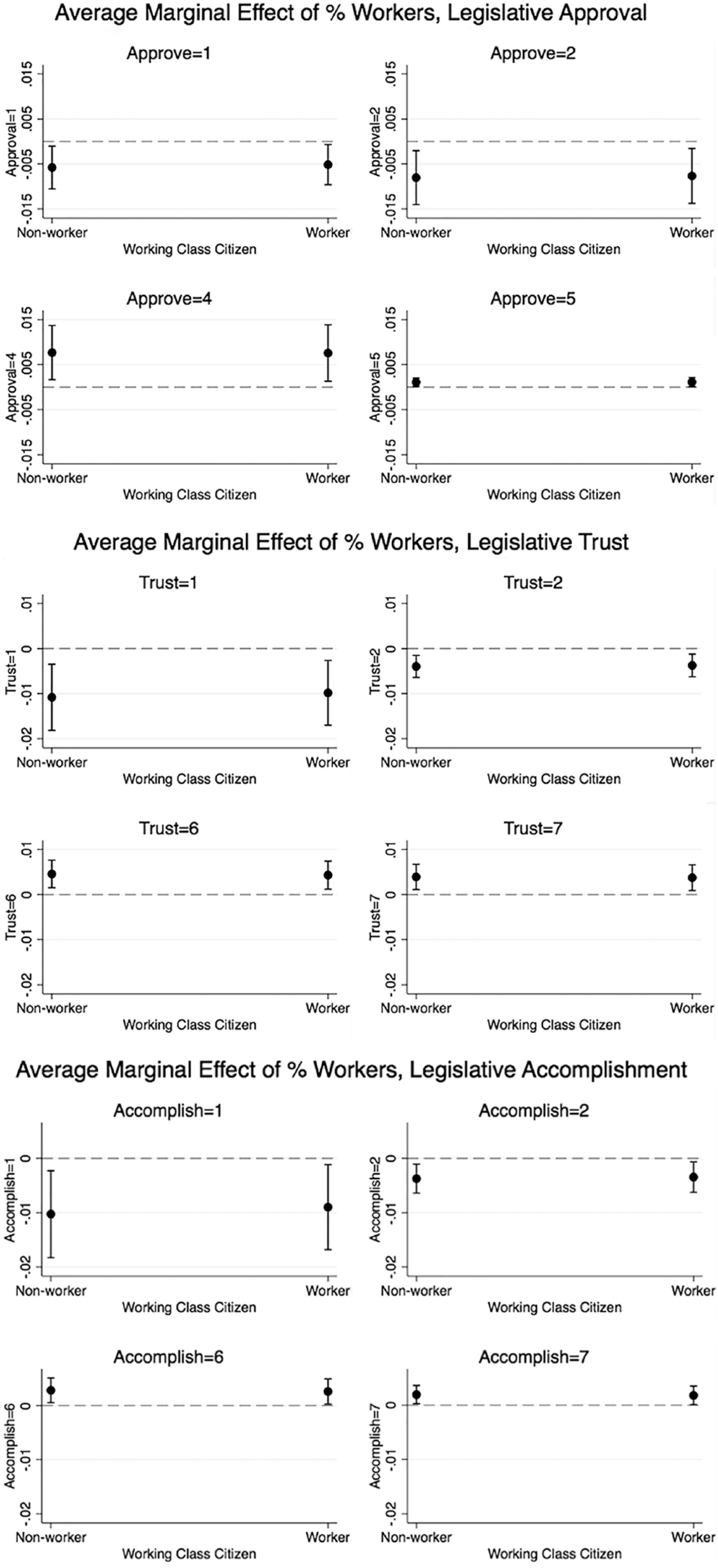
Marginal effect of percent workers on predicted satisfaction with representation.
To assess the magnitude of the relationship between percent workers and the outcome variables, Figure 5 plots the predicted probability of the bottom two and top two response categories for each dependent variable across the range of percent workers (i.e., 0% to 16.67%). 20 Given that the marginal effect of the percent workers variable is the same for working-class and non working-class citizens, we use the results in models 1, 3, and 5 to calculate predicted probabilities.

Working-class legislators and perceptions of legislative representation.
First for legislative approval, a move from the lowest to highest levels of working-class representation is associated with a .08 decrease in the probability of saying the legislature is performing “very badly” (=1), and a .14 decrease in the probability of saying “badly” (=2). Conversely, a move from the lowest to highest level of working-class representation is associated with a .18 increase in the probability of saying the legislature is performing “well” (=4), and a .03 increase in the probability of saying “very well” (=5). We observe the largest change in the probability of citizens saying the legislature is performing “well,” an increase from .12 at the lowest levels of working-class representation to .30 at the highest level.
As for legislative trust, a move from the lowest to highest level of descriptive representation is associated with a .14 decrease in the probability of indicating “no trust” in the legislature (=1), and a .06 decrease in the probability of indicating trust (=2). Conversely, this same increase in descriptive representation is associated with a .08 increase in the probability of indicating trust (=6) and .09 increase in the probability of saying “trust completely” (=7). The largest change in legislative trust is observed for the lowest response outcome—that is, the probability of indicating “no trust” declines from .23 to .09 as we move from the lowest level of descriptive representation to the highest level.
Finally, a similar pattern exists for legislative accomplishment: “how much do you agree or disagree that the legislature accomplished everything you hoped it would.” On a scale from 1 to 7, where 1 indicates not at all and 7 indicates completely, there is a modest decrease in the probability of observing the second response outcome. By contrast, there is a modest increase in the probability of observing the top two response outcomes when moving from the lowest to highest levels of working-class representation. As with the trust dependent variable, an increase in working-class representation is associated with the largest change in the probability of observing the lowest response outcome, a decrease from .27 to .10.
Combined, the results in Figures 4 and 5 lend support to both hypotheses. The average marginal effect of working-class legislators on the probability of observing high levels of legislative approval, trust, and accomplishment is positive and significant for all citizens, lending strong support for hypothesis 2. As the results in Figure 5 demonstrate, higher levels of working-class representation are associated with a decreased probability of expressing negative perceptions of representation, and an increased probability of expressing positive perceptions, on average, for all citizens.
Other Factors Shaping Perceptions of Representation
Turning briefly to some of the individual-level controls, most of these variables behave similarly across dependent variables and model specifications. Individuals who express higher levels of political interest evaluate legislative representation more favorably, as do women and individuals on the right of the political spectrum (as compared with those who did not indicate an ideological placement). Higher income earners exhibit diminished perceptions of legislative representation, as do individuals who perceive the country’s economic situation to be worse than a year ago. At the country-level, there is a positive relationship between economic development and trust in the legislature, as evidenced by the positive and significant coefficient on GNI per capita (Models 3–4). And, as previously mentioned, the results in Table 1 are robust to other country-level control variables, including the following: programmatic party system, governance quality, level of democracy, political party fragmentation, and the presence of a leftist president (see Online Appendix B).
Discussion and Conclusion
Widespread dissatisfaction with political institutions is evident in a number of Latin American countries (Mainwaring, Bejarano, and Leongómez 2006). Indeed, recent behavioral and attitudinal trends in Latin America, such as declining electoral turnout and increasing electoral volatility, led Mainwaring, Bejarano, and Leongómez (2006) to ask, if voters have free choice from an ample array of options, why do they remain so dissatisfied with representation? We argue that continued exclusion of the working class is a critical factor that erodes satisfaction with key agents of representation such as the legislature.
Leveraging elite-based surveys and mass-level public opinion data, we show that in Latin America, descriptive representation of the working class is associated with enhanced evaluations of the legislature. Where workers are better represented in the legislature, citizens are more likely to approve of the legislature’s job performance, trust the legislature, and say that the legislature accomplished everything they hoped it would. Moreover, the symbolic benefit of having more working-class legislators extends to all citizens, not just those from the working class. The observation that everyone benefits from descriptive representation is consistent with prior research findings that higher levels of women’s numeric representation are associated with both men’s and women’s satisfaction with democracy and legislative trust (Barnes and Taylor-Robinson 2017; Schwindt-Bayer 2010; Schwindt-Bayer and Alles 2018), beliefs about women’s ability to lead (Kerevel and Atkeson 2015), and perceptions of democratic legitimacy (Clayton, O’Brien, and Piscopo 2019).
That descriptive representation of the working class enhances all citizens’ evaluations of the legislature suggests multiple mechanisms may explain the link we observe between descriptive representation and citizens’ feelings about representation. First, it is possible that when democracies are more inclusive, they perform better on a number of measures that enhance citizens’ attitudes about representation. For instance, more inclusive legislatures may be more likely to produce distributive policies that improve the lives of multiple groups in society, beyond the working class. Second, the process through which working-class representatives are elected may also foster improved perceptions of representation. If the electoral process results in better descriptive representation, this may engender more trust in, satisfaction with, and positive evaluations of the legislature. Although we are unable to adjudicate between these different mechanisms with the current research design and available data, future research can examine the extent to which descriptive representation of historically marginalized groups, such as the working class, directly or indirectly enhances citizens’ perceptions of representation.
Although our empirical analysis focuses on Latin America, our main arguments are generalizable to other regions where inequality is high, trust in representative institutions is low, and wealthy elites dominate politics. In the United States, political trust has steadily declined since the 1960s (Hetherington 1998), economic inequality is escalating (Bartels 2008), and millionaires control all three branches of government (Carnes 2016). Similar trends are evident in the United Kingdom, with the wealth gap increasing 21 and the public desiring more workers in office (Carnes and Lupu 2016b). Our research suggests that increases in working-class representation could help improve perceptions and evaluations of legislatures in such contexts.
With respect to policy implications, the relationships uncovered in this research have important consequences for representative democracy. Our findings suggest that representative institutions would benefit from incorporating a more diverse array of class backgrounds. In Latin America, where class cleavages run deep and the gaps between the rich and poor are the largest in the world, political institutions such as the legislature draw their members from a very narrow set of elites. A common criticism of descriptive representation is that incorporating members of historically marginalized groups into representative bodies is dangerous for democracy, because it could bring unqualified representatives to power (Mansbridge 2015). Yet, our findings that higher levels of working-class representation are associated with better evaluations of the legislature contribute to a growing body of research demonstrating such fears are unfounded. Empirical research from Latin America and the United States, for example, finds that leaders without formal education perform at least as well as their college-educated colleagues—calling into question conventional beliefs about leadership qualifications (Carnes and Lupu 2016c). Similarly, research on Swedish municipal politicians and national legislators finds little trade-off between politicians’ competence and social backgrounds such as class (Dal Bó et al. 2017) and gender (Besley et al. 2017). Others have also demonstrated that descriptive representatives are at least as effective (Volden et al. 2013) and qualified (Murray 2015; Nugent and Krook 2015) as their colleagues.
In the same vein, our findings further rebut the criticism that workers’ descriptive representation could be dangerous for democracy by demonstrating that working-class descriptive representation actually strengthens democracy by enhancing trust in political institutions among working-class and non working-class citizens alike (Cleary and Stokes 2006). Not only are workers objectively qualified to serve as representatives, but citizens are positively disposed to working-class politicians (Carnes and Lupu 2016a; Wüest and Pontusson 2017). Moreover, we find that legislators from working-class backgrounds are associated with enhanced satisfaction with representation and improved perceptions of the legislature. Not only do workers exert a distinct effect on the policy-making process (Carnes and Lupu 2015; Micozzi 2018) but also our findings suggest working-class representation has the potential to wield a profound influence on citizens’ attitudes, thus bolstering the health of democratic institutions.
To address the challenges associated with underrepresentation of marginalized groups, our research suggests that political parties should adopt incorporation tactics such as recruiting representatives from underrepresented groups and working to strengthen representative linkages. Whereas most governments in Latin America have made major strides in the incorporation of women, other groups—such as marginalized urban and rural popular classes, indigenous communities, and the youth—remain on the margins of politics (Barnes and Rangel 2014; Hughes 2011, 2013; Morgan and Meléndez 2016). Although representative institutions can employ a number of different linkage strategies to strengthen their ties with constituents (Kitschelt and Wilkinson 2007), findings from this study imply that the incorporation of representatives from marginalized groups in society—for example, workers, indigenous groups, and the youth—has the potential to restore citizens’ attachments to formal mechanisms of representation.
Footnotes
Acknowledgements
The authors are grateful to Nicholas Carnes, Anthony DiMaggio, Mirya Holman, Christpoher Karpowitz, Fanny Maidana, Jana Morgan, Valeria Palanza, Jesse Johnson, and the University of Kentucky Political Science Research Colloquium for helpful comments on previous iterations of this work, as well as the editors at Political Research Quarterly, and four anonymous reviewers for invaluable feedback on this research. The authors also thank the Latin American Public Opinion Project and the University of Salamanca for making their data publicly available.
Authors’ Note
Previous versions of this work were presented at the American Political Science Association, Kentucky Political Science Association; Midwest Political Science Association; Southern Political Science Association; the first annual Southeast Latin American Behavior colloquium; El Grupo de Estudios de Legislativos de América Latina, GEL-ALACIP, IV Encuentro; and XIII Congreso Nacional de Ciencia Política—Sociedad Argentina de Análisis Político.
Declaration of Conflicting Interests
The author(s) declared no potential conflicts of interest with respect to the research, authorship, and/or publication of this article.
Funding
The author(s) received no financial support for the research, authorship, and/or publication of this article.
