



Abstract
The question whether democratic values are on the rise or in decline has received much attention in political-culture research. Yet, few scholars have studied the consequences either of these trends has for political trust. Although political trust has long been attributed a central role for the functioning and stability of any political system, we still know little about the relationship between citizens’ value orientations and political trust. Recent advances have furthered the discussion by conceptualizing this relationship to be conditional on the respective country’s level of democracy; yet this literature does not take into account findings that demonstrate citizens rarely have an accurate grasp of their country’s democratic quality. Integrating the two strands of literature, this contribution suggests a relationship between democratic value orientations and political trust that is universally contingent on citizens’ perceptions of democratic quality. Testing this proposition for over one hundred democracies and autocracies, it finds that democratic value orientations decrease political trust whenever citizens perceive their regime’s democratic quality as lacking and increase political trust whenever citizens perceive their political regime as being of high democratic quality. In contrast, the actual level of democracy plays no role for the effect of democratic value orientations on political trust.
Keywords
Introduction
A recent academic as well as public debate has raised the question whether democratic values are on the rise or in decline. Although, when asked in opinion surveys, citizens across the entire globe nowadays overwhelmingly choose democracy as their preferred political system (Chu et al. 2016; Haerpfer and Kizilova 2014; Klingemann 2014; Letsa and Wilfahrt 2018; Robbins 2015; Sanborn 2014), younger birth cohorts in established democracies place less importance on living in a democracy than older cohorts, suggesting a gradual decline of democratic value orientations (Foa and Mounk 2016). 1 Despite the enormous attention this debate has generated, it has yet to address one of the most fundamental questions: does it even matter? What are the consequences of citizens’ political value orientations?
With value orientations being very broad and abstract concepts that are unlikely to influence behavior (Ajzen 2012), we need to assess their effect on more proximate attitudes such as political trust if we want to infer anything about the real-world consequences of both a rise and a decline of democratic values. The relationship between democratic value orientations and political trust, however, has continually proven to be elusive.
Initially, pro-democratic value orientations were welcomed as bases of democratic support and thought to increase political trust in democracies (Almond and Verba 1963; Easton 1975). Yet, scholars in the critical-citizens tradition have repeatedly challenged this view, arguing that a shift toward more modern and pro-democratic values would make citizens more demanding of the political regime, thereby decreasing political trust (Dalton 2004; Dalton and Shin 2014; Inglehart 1999; Klingemann 2014; Norris 2011), and the empirical evidence on how pro-democratic value orientations affect political trust in democracies remains inconclusive (Catterberg and Moreno 2005; Hooghe, Marien, and Oser 2017; Klingemann 2014; Ma and Yang 2014; Park 2013; Singh 2018). For autocracies, the case seems less ambiguous: scholars consent that pro-democratic value orientations should result in lower trust in the autocratic regime (J. Chen and Dickson 2008). Yet, empirical substantiation is still lacking. The few studies that analyze the relationship between pro-democratic value orientations and political trust in autocracies are confined to countries in East Asia (D. Chen 2017; Ma and Yang 2014; Park 2013; Shi 2001), raising doubts about the generalizability of their findings. What is more, despite the well-documented spread of pro-democratic values even to the remotest and most authoritarian regimes (e.g., Letsa and Wilfahrt 2018; Tessler, Jamal, and Robbins 2012; Welzel and Dalton 2017; Wu, Chang, and Pan 2016), political trust in autocracies does not appear to be in meaningful decline (Ma and Yang 2014; Norris 2011; Wang and Tan 2013). The relationship between citizens’ value orientations and political trust thus remains puzzling both in democracies and in autocracies.
Recent advances have tried to solve this puzzle by introducing the level of democracy as a moderating variable. Arguing that political trust is relational, these scholars propose democratic value orientations to have a more positive effect on political trust in more democratic regimes (Hooghe, Marien, and Oser 2017; Huhe and Tang 2017). At the same time, however, another strand of recent research has pointed out that how citizens view their political regime does not always correspond to how political-science experts evaluate it (Kruse, Ravlik, and Welzel 2017; Mauk 2017; Park 2013, 2017; Pietsch 2014; Shi and Lu 2010). Picking up on the idea that citizen perceptions must not necessarily reflect a country’s actual level of democracy, this contribution adds to the discussion by suggesting that the relationship between democratic value orientations and political trust is not conditional on a country’s level of democracy but rather on citizens’ perceptions of democratic quality. Still conceptualizing political trust as being relational in nature, that is, dependent not only on citizens’ value orientations, it proposes a conditional relationship between democratic value orientations, perceptions of democratic quality, and political trust. Diverging from the previous literature, I hypothesize this conditional relationship to be independent of a country’s level of democracy and thus universal across regime types.
Aiming to disentangle the elusive relationship between democratic value orientations and political trust, the theoretical argument laid out in the following section emphasizes both the relational nature of (political) trust and the potential divergence between a country’s level of democracy and citizens’ perceptions of democratic quality. Its main proposition is that the effect of democratic value orientations on political trust is conditional on citizens’ perceptions of democratic quality regardless of the type of regime people live in. Empirically, this contribution tests its propositions on a unique data set combining recent data from six cross-national survey projects covering more than one hundred democracies and autocracies around the entire globe. Using multilevel regression modeling, it shows that rather than actual level of democracy, citizen perceptions of democratic quality condition how democratic value orientations affect political trust. In doing so, it makes two central contributions. First, it substantiates the relational nature of political trust and thereby enhances the scholarship on critical citizens: rather than democratic value orientations alone, it is the combination of democratic value orientations and perceptions of lacking democratic quality that may lead to a decline in political trust. Second, it points out the divergence between a country’s level of democracy and citizen perceptions of democratic quality: while political trust is still relational, the effect of democratic value orientations proves to be independent of a country’s level of democracy. The analysis hence demonstrates that the relationship between citizens’ value orientations and their trust in the political system rests on a universal mechanism that is at work regardless of the nature of the political regime in which people live.
Democratic Value Orientations and Political Trust
Political trust, defined as citizens’ confidence that the political system, its institutions, or actors will “do what is right even in the absence of constant scrutiny” (Miller and Listhaug 1990, 358), is a central concept in political-culture research. For decades, scholars have considered political trust as essential for the smooth functioning and stability of the political system (Abdelzadeh, Özdemir, and van Zalk 2015; Dalton 2004; Hetherington 1998; Hutchison and Johnson 2011; Letki 2006; Marien and Hooghe 2011; Newton 2009; Scholz and Lubell 1998; Tyler 2011). Examining how democratic value orientations influence political trust in democracies and autocracies can thus help identify whether a possible spread or decline of democratic values will foster or hinder the functioning and stability of either type of regime.
From a conceptual point of view, any kind of trust is at its core a relational concept: “A trusts B to do X” (Hardin 2002, 9). This means that trust always entails an evaluation of the relationship between A (the subject) and B (the object) of trust. With regard to political trust, the subject of this relationship is the individual citizen and the object of this relationship is the political system, its institutions, or actors. Political trust can therefore stem from three types of sources: exogenous variables, that is, characteristics of the individual citizen (the subject); endogenous variables, that is, characteristics of the political system, its institutions, or actors (the object); or the interaction of these two types of characteristics (van der Meer and Hakhverdian 2017).
Democratic value orientations clearly are a characteristic of the individual citizen and therefore the subject of political trust. With regard to the effect democratic value orientations have on political trust, the literature expects citizens’ value orientations to set the reference points for what citizens expect from the political system (Easton 1965, 1975; Fuchs 2009; Lipset 1959; Rokeach 1973; Williams 1968). People will then extend more trust to the political system if it meets these expectations. From this point of view, democratic political value orientations should be conducive to political trust in democracies but stifle political trust in autocracies (Breustedt and Stark 2015; Catterberg and Moreno 2005; J. Chen and Dickson 2008; Singh 2018). However, scholars in the critical-citizens tradition have pointed out that democratic value orientations may have a negative effect on political trust even in democracies (Dalton 2000, 2004; Norris 1999, 2011). Their argument rests on the assumption that no real-world political regime can ever actually meet ideal democratic standards (cf. Dahl 1971). Democratic value orientations would then set expectations that even democracies are bound to fall short of, prompting citizens to withdraw political trust.
If we take these arguments seriously, both perspectives in the literature actually conceptualize political trust as being determined not only by democratic value orientations as a characteristic of the individual citizen alone (the subject of political trust). Instead, they implicitly propose that these democratic value orientations interact with a characteristic of the political system (the object of political trust), that is, its level of democracy: the more democratic the political regime is, the more positive the effect of democratic value orientations on political trust should be. In a recent contribution, Hooghe, Marien, and Oser (2017) explicitly argue as well as show empirically that good governance conditions how citizens’ democratic ideals affect political trust in European democracies. Analyzing democracies and autocracies in East Asia, Huhe and Tang (2017) similarly find that democratic value orientations have a more negative effect on political trust in autocracies (=lower level of democracy) than in democracies (=higher level of democracy). These scholars hence suggest that the effect of citizens’ democratic value orientations, an exogenous variable, is conditional on the political system’s level of democracy, an endogenous variable.
Following these scholars, I also conceptualize political trust as being relational in nature and thus determined by the interaction of citizens’ democratic value orientations and the political system’s level of democracy. I do, however, argue that this—scarce—literature has so far overlooked an important caveat: a political system’s level of democracy and citizens’ perceptions of this democratic quality are not necessarily identical, neither conceptually nor empirically. The “objective” level of democracy can be conceptualized as the assessment of a political system’s structure and processes, usually by one or more experts, as compared with some predefined benchmark standard, most commonly liberal democratic ideals (Geissel, Kneuer, and Lauth 2016; Morlino 2004, 2011). In contrast, citizen perceptions of democratic quality entail the assessment of the political system by each individual citizen based on their own individual ideal conception of democracy and the information they receive about the political regime (Gómez and Palacios 2016; Kriesi and Saris 2016; Quaranta 2018). 2 Both the information and the ideals these assessments are based upon may differ considerably between not only individual citizens but also between citizens and experts, leading to divergent assessments of democratic quality. Accordingly, prior research has shown that how citizens perceive their political system’s democratic quality may vary greatly even within the same country (Pietsch 2014). Especially in autocracies, these perceptions are often heavily skewed and in fact rarely reflect the objective level of democracy (Kruse, Ravlik, and Welzel 2017; Mauk 2017; Park 2013, 2017; Shi and Lu 2010). Possible explanations for this phenomenon are the different understandings of democracy prevalent around the world, that is, citizens employing different standards (Dalton, Shin, and Jou 2007; Shi and Lu 2010), or regime propaganda portraying the political system as more democratic than it really is, that is, citizens having to rely on incorrect information (Xiang and Hmielowski 2017).
We must therefore qualify our expectations regarding the conditionality of the effect of democratic value orientations on political trust. Instead of actual level of democracy, citizen perceptions of democratic quality should moderate the relationship between democratic value orientations and political trust. I thus hypothesize democratic value orientations to have a more positive effect on political trust for citizens who view their political regime as more democratic, regardless of how democratic this political regime actually is.
This implies that the relationship between democratic value orientations, perceptions of democratic quality, and political trust is universal across regime types and therefore independent of whether the regime in question is democratic or autocratic.
Data and Method
To test this hypothesis on a comprehensive scale, this study employs micro-level data from six different cross-national survey projects: the World Values Survey (2010–2014; World Values Survey 2015), the Afrobarometer Survey (2011–2013; Afrobarometer 2015), the AmericasBarometer (2012; Latin American Public Opinion Project 2014), the Arab Barometer (2012–2014; Arab Barometer 2015), the Asian Barometer Survey (2010–2012; Asian Barometer 2013), and the Latinobarómetro (2012–2013; Corporacion Latinobarómetro 2014). Taken together, these surveys cover more than one hundred democracies and autocracies across the entire globe, encompassing a wide range of democratic quality (see online supporting information, Table B-1, for details). For political systems in which several opinion surveys were conducted within the same year, these surveys are collapsed into a single country-year case. Table A1 in the appendix lists all country-years included in the analysis.
The dependent variable political trust is measured as citizens’ confidence in four key regime institutions: government, parliament, the police, and the army (for question wordings, see online supporting information, Table B-2). Institutional confidence is a commonly used measure of political trust in both democratic and autocratic contexts (e.g., D. Chen 2017; Dalton 2004; Hooghe, Dassonneville, and Marien 2015; Moehler 2009; Pietsch and Clark 2015). By combining confidence in four different institutions, this measure captures a broad spectrum of both legislative and executive as well as political and protective institutions. Factor analyses confirm the unidimensionality of the measurement model and, accordingly, the factor score of political trust is used in all analyses (see online supporting information, Table B-3). 3
For the independent variable democratic value orientations, this analysis uses a question asking respondents about their support for a strong leader who does not have to be elected by popular vote and has full decisional authority. As such personalist rule is clearly undemocratic, this study uses the rejection of this type of political rule as a measure for democratic value orientations. To gauge citizens’ perceptions of democratic quality, it employs an item asking respondents where they would place the country’s current system of government on a scale from completely undemocratic to completely democratic.
The models include several individual-level control variables which have been identified in prior research as determinants of political trust: social trust (e.g., Kaase 1999; Zmerli and Newton 2008), performance evaluations (feelings of safety; for example, D. Chen 2017; Fernandez and Kuenzi 2010), 4 and political interest (e.g., Wang, Dalton, and Shin 2006; Q. Yang and Tang 2010). The analysis also controls for standard sociodemographic variables: income (measured in terms of whether income is sufficient), level of education (recoded into none, primary, secondary, tertiary), employment status (employed/unemployed), religious affiliation (recoded into major religious sects), religiosity, as well as gender and age.
As the data used here come from six different survey projects with slightly different question wordings and response scales and administered in heterogeneous cultural contexts, issues of cross-cultural comparability arise: do all respondents understand these survey questions in the same way and are their responses comparable (cf. Johnson and Braun 2016; Schwarz 2003; Y. Yang et al. 2010)? Although we cannot give a definitive answer to this question, multigroup confirmatory factor analysis finds partial scalar measurement invariance for the political-trust factor across individual surveys (see online supporting information, Table B-4), indicating that political trust can be measured in a comparable way even when using different surveys. As it is impossible to test the invariance of the single-item measures, robustness checks using each individual survey instead of the global combined data set serve as an additional countermeasure to problems of cross-cultural comparability.
Owing to the hierarchical nature of the data, this contribution employs multilevel modeling despite being interested predominantly in individual-level mechanisms. Model building proceeds in two steps. In the first step, the basic model includes all theoretically relevant sources of political trust as well as the control variables but no interaction terms. The second step introduces the interaction term of democratic value orientations and perceptions of democratic quality to the model. This stepwise approach allows assessing the average effect of democratic value orientations on political trust as well as whether and how this effect is conditional on perceptions of democratic quality.
The main analysis tests the hypothesized mechanism using the combined data set of all democratic and autocratic political systems. Additional analyses that separate between democracies and autocracies provide further tests of the universality of the proposed mechanism. To test the original hypothesis found in the literature (Hooghe, Marien, and Oser 2017; Huhe and Tang 2017), each section also models the interaction effect between citizens’ democratic value orientations and the country’s actual level of democracy. I measure this actual level of democracy by averaging a country’s Freedom House and V-Dem Liberal Democracy scores. Both Freedom House and V-Dem’s Liberal Democracy index employ a procedural and liberal conception of democracy (Coppedge et al. 2018; Freedom House 2015). However, as they have slightly different emphases—Freedom House focuses more on individual liberties and participation rights, while V-Dem takes into account more strongly the rule of law and horizontal accountability 5 —this study combines both measures to comprehensively gauge a country’s democratic quality. Robustness checks include analyses using only either one of these measures of democracy.
Results
Based on the global data set of over one hundred political systems, this section explores how democratic value orientations affect political trust. It does so both for the combined data set covering democracies and autocracies as well as for subsamples covering only democracies and only autocracies, respectively.
Beginning with the combined data set covering both democracies and autocracies, Model 1 in Table 1 initially shows no effect of democratic value orientations on political trust at all. Looking at only the main effect of democratic value orientations thus suggests that citizens’ value orientations play absolutely no role in how they view the political regime in which they live. This changes when introducing the interaction term of democratic value orientations and perceptions of democratic quality (Model 2, Table 1). For those who view their political regime as very undemocratic, democratic value orientations now substantially and significantly reduce political trust. In addition, the interaction term is positive and significant as well, indicating that the effects of democratic value orientations become more positive for those who perceive their political regime to be more democratic.
Democratic Value Orientations, Perceptions of Democratic Quality, and Political Trust.
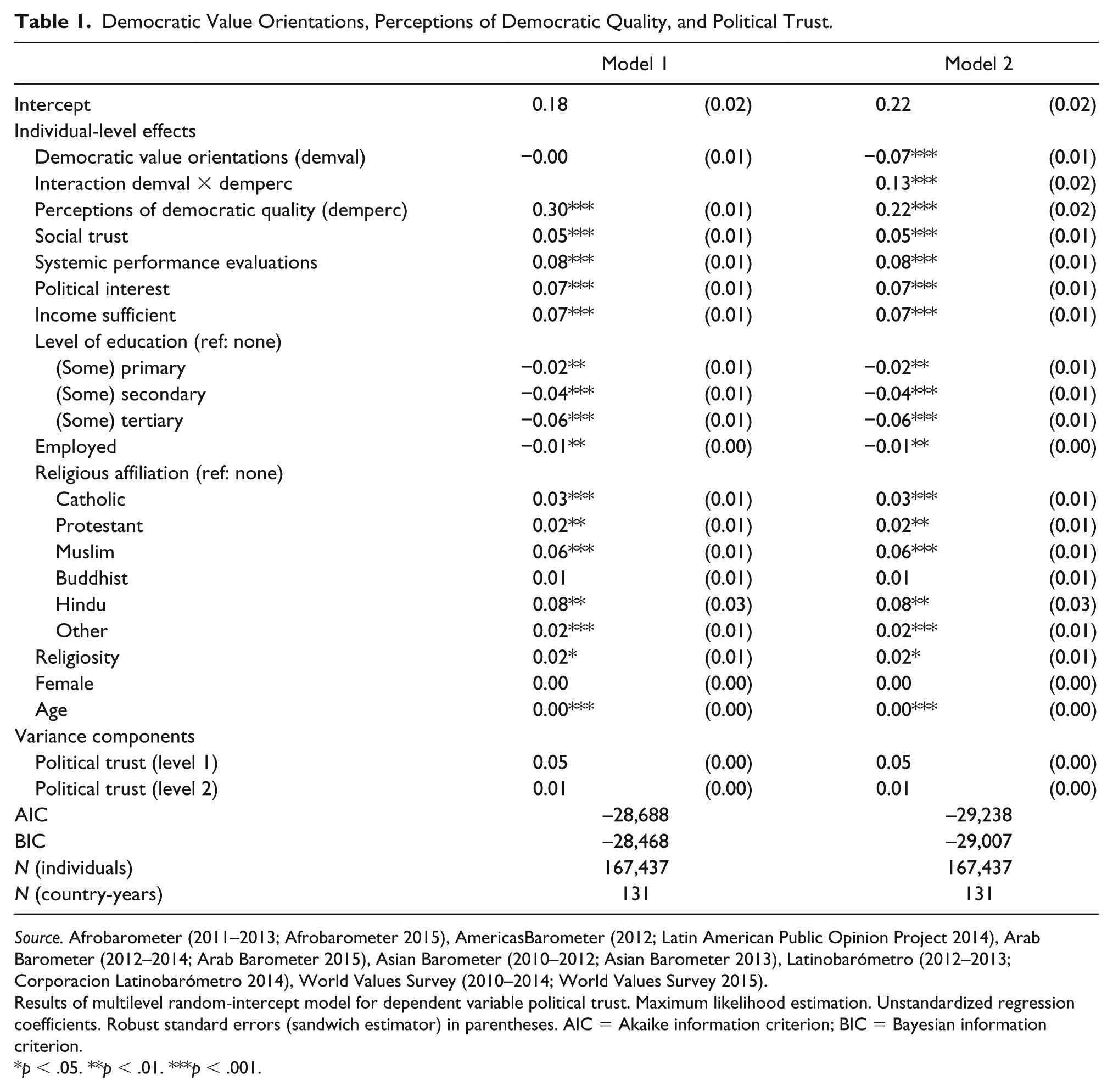
Source. Afrobarometer (2011–2013; Afrobarometer 2015), AmericasBarometer (2012; Latin American Public Opinion Project 2014), Arab Barometer (2012–2014; Arab Barometer 2015), Asian Barometer (2010–2012; Asian Barometer 2013), Latinobarómetro (2012–2013; Corporacion Latinobarómetro 2014), World Values Survey (2010–2014; World Values Survey 2015).
Results of multilevel random-intercept model for dependent variable political trust. Maximum likelihood estimation. Unstandardized regression coefficients. Robust standard errors (sandwich estimator) in parentheses. AIC = Akaike information criterion; BIC = Bayesian information criterion.
p < .05. **p < .01. ***p < .001.
For ease of interpretation, Figure 1 plots the conditional effect of democratic value orientations. It clearly demonstrates that, first, democratic value orientations decrease political trust for individuals who view their political regime as located on the undemocratic end of the regime spectrum. Second, it shows that the effect of democratic value orientations becomes increasingly positive when citizens view their political regime as more democratic. Third, for those citizens who see their regime as very democratic, democratic value orientations have a substantial and significant positive effect on political trust. These findings underline the relational nature of political trust. Furthermore, they enhance and refine the scholarship on critical citizens: instead of democratic value orientations by themselves, it is in fact the combination of democratic value orientations and perceptions of democratic quality that may lead to a decline in political trust. 6
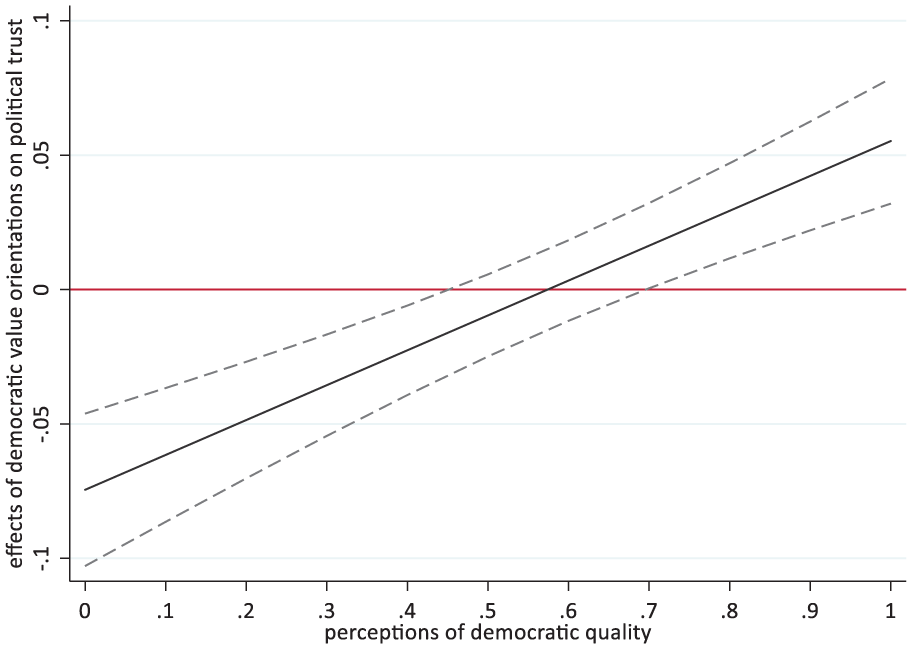
Conditional effects plot for democratic value orientations and perceptions of democratic quality.
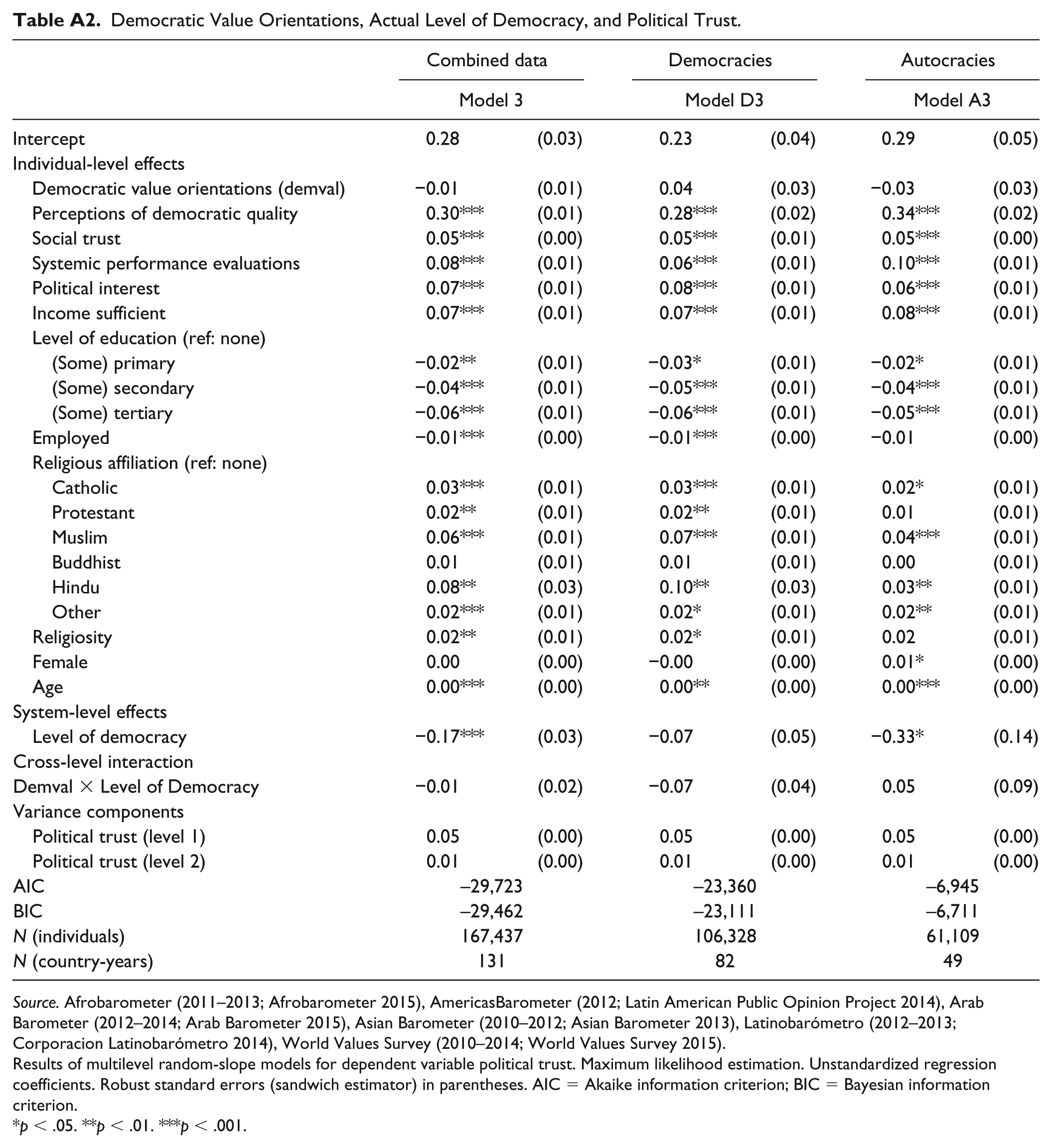
This is not the case when using the actual level of democracy as the conditioning variable instead of citizen perceptions of democratic quality. Other than prior research suggested, the level of democracy does not moderate the effect democratic value orientations have on political trust (see Table A2 in the appendix): the effect of democratic value orientations on political trust does not change depending on the level of democracy. 7 In addition, the effect that democratic value orientations have on political trust remains almost indistinguishable from zero for any level of democracy (see Figure A1 in the appendix): even in the most undemocratic of regimes, democratic value orientations do not have a significant negative overall effect on political trust. 8 These findings demonstrate that the effect of democratic value orientations does not depend on a country’s level of democracy but rather on how each individual citizen views their country’s democratic quality—which may differ considerably from what experts asses the level of democracy to be. In fact, level of democracy and citizen perceptions of democratic quality are correlated only very weakly for the 131 country-years in this analysis (on the individual level: r = .07 for all countries; r = .08 for democracies; r = −.03 for autocracies; on the system level: r = .18 for all countries; r = .24 for democracies; r = −.10 for autocracies), indicating that citizens seem to either know very little about their political systems or to employ very different standards of assessment. 9 Overall, the results thus strongly suggest that the effect of democratic value orientations is conditional on citizens’ perceptions of democratic quality rather than the political regime’s actual level of democracy.
This is further corroborated by the separate analyses of democracies and autocracies (Table 2). For both subsamples, the pattern from the combined data set repeats: on average, democratic value orientations have no effect on political trust in either democracies or autocracies. Yet, in both types of regimes, democratic value orientations decrease political trust for those citizens who perceive their regime as very undemocratic and increase political trust for those who perceive it as very democratic (Figure 2). This positive effect is, however, smaller in autocracies than in democracies and only reaches statistical significance for those citizens who score near the extreme positive end of the perceptions-of-democratic-quality scale (0.9 and above). 10 Again, we cannot find a similar conditioning effect of the actual level of democracy (see Table A2, Figure A2 in the appendix).
Democratic Value Orientations, Perceptions of Democratic Quality, and Political Trust in Democracies and in Autocracies.

Source. Afrobarometer (2011–2013; Afrobarometer 2015), AmericasBarometer (2012; Latin American Public Opinion Project 2014), Arab Barometer (2012–2014; Arab Barometer 2015), Asian Barometer (2010–2012; Asian Barometer 2013), Latinobarómetro (2012–2013; Corporacion Latinobarómetro 2014), World Values Survey (2010–2014; World Values Survey 2015).
Results of multilevel random-intercept model for dependent variable political trust. Maximum likelihood estimation. Unstandardized regression coefficients. Robust standard errors (sandwich estimator) in parentheses. AIC = Akaike information criterion; BIC = Bayesian information criterion.
p < .05. **p < .01. ***p < .001.
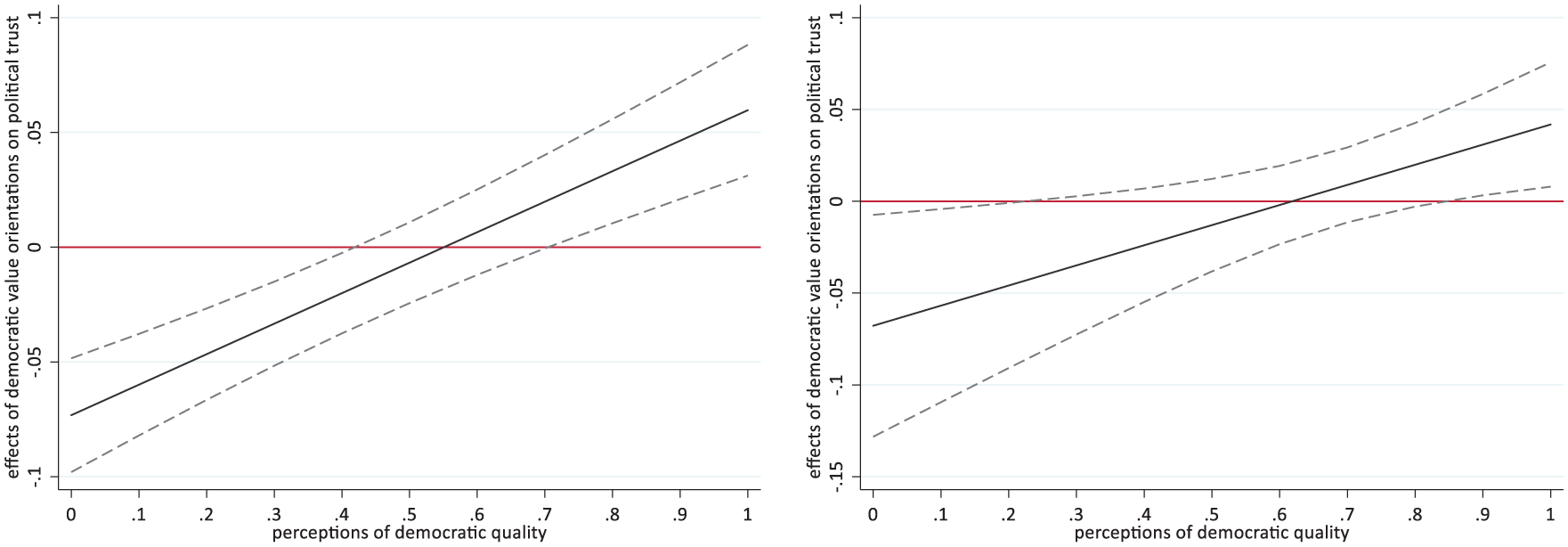
Conditional effects plot for democratic value orientations and perceptions of democratic quality in democracies and in autocracies.
Overall, we hence find strong support for the hypothesis that citizens’ perceptions of democratic quality condition the effect democratic value orientations have on political trust. In contrast, the actual level of democracy of the political regime does not play a significant role in moderating the effect of democratic value orientations. Democratic value orientations decrease political trust whenever citizens—rightfully or erroneously—think their political regime is undemocratic. Democratic value orientations, can, however, also increase political trust: this is the case whenever citizens—again, rightfully or erroneously—think their political regime is democratic. This is the case regardless of whether the political regime in question is democratic or autocratic. The results therefore corroborate the idea that the relationship between democratic value orientations, perceptions of democratic quality, and political trust is universal across regime types.
Conclusion
Although democratic ideas and values seem to have spread to almost every corner of the world, citizens in established democracies appear to have been turning away from core democratic values recently. Despite the lively academic debate revolving around the question whether democratic values are in retreat or not (Alexander and Welzel 2017; Foa and Mounk 2016, 2017a, 2017b; Howe 2017; Inglehart 2016; Mounk 2018; Norris 2017; Plattner 2017; Voeten 2017), few have paid attention to the consequences a potential decline of democratic value orientations has for political trust. With political trust being regarded as one of the central attitudes for the smooth functioning and stability of the political system, examining the relationship between democratic value orientations and political trust is crucial for drawing wider conclusions about the systemic consequences of both a potential decline and spread of democratic values.
Aiming to disentangle the elusive relationship between democratic value orientations and political trust, this contribution first conceptualized political trust as being relational in nature, that is, as being determined by the interaction between a characteristic of the individual citizens (the subject of political trust)—their democratic value orientations—and a characteristic of the political system (the object of political trust)—its democratic quality. Amending prior research on this relational nature, it then introduced citizen perceptions of democratic quality instead of the political system’s actual level of democracy as the conditioning variable based on several studies finding citizen perceptions of democratic quality to be inaccurate. It consequently proposed political trust to be universally determined by the interaction between citizens’ democratic value orientations and their perceptions of the system’s democratic quality.
The empirical analysis tested this proposition on a data set covering more than one hundred democratic and autocratic regimes from all over the world, providing the first truly global analysis of democratic value orientations and political trust. Multilevel analyses of the complete data set as well as of subsets composed of only democracies and only autocracies, respectively, show that the effect of democratic value orientations on political trust is indeed contingent on how citizens view the regime’s democratic quality. If citizens view the political regime they live in as very undemocratic, democratic value orientations decrease citizens’ trust in this regime; if citizens view the regime as very democratic, democratic value orientations increase their trust in the regime. This is the case regardless of whether the regime in question is actually democratic or not; in fact, the level of democracy of the political regime has no effect at all on how citizens’ value orientations relate to political trust. The results thus strongly support the idea of a universal relationship between democratic value orientations, perceptions of democratic quality, and political trust.
In addition to corroborating this universal relationship and the relational nature of political trust, results of this study point to an interesting phenomenon: how citizens view the democratic quality of their political regime appears to be largely disconnected from how experts rate this democratic quality. In fact, simple correlation analyses showed citizens’ perception of democratic quality and actual level of democracy to correlate only weakly. For example, the average citizen in Rwanda perceives its political regime to be what can be interpreted as a democracy with deficits (M = 0.69), while Freedom House and V-Dem both rate it as clearly undemocratic (combined rating of 0.18). In contrast, citizens in Spain appear overly critical of their political regime in comparison to how experts rate it: while the combined Freedom House and V-Dem rating is 0.91, the average citizen perception is only 0.62. Democratic value orientations therefore have about the same average effect on political trust in Spain and Rwanda, despite the former being a liberal democracy and the latter being a de facto single-party regime governed by an autocratic strongman.
Although this paper could not investigate further into the reasons for the disconnect between actual level of democracy and citizens’ perceptions of democratic quality, its results suggest that citizens either employ very different standards when evaluating the democratic quality of their political regime, that is, hold conceptions of democracy that differ gravely from the liberal conceptions predominant in political science, or base their evaluations on information that is different from what experts reply upon to evaluate a regime’s democratic quality. This implies that both democratic and autocratic regimes may be able to manipulate the effect democratic value orientations have on political trust by actively engaging in shaping citizens’ conceptions of democracy and/or the supply of information about the political regime. Autocracies in particular appear to be making use of these tactics already. Perhaps the most prominent examples include China and Singapore, where governments propagate their own conceptions of “guardian” and “Asian” democracy, respectively—both of which decisively are not defined by liberal and procedural characteristics (Han 2007; Holbig and Gilley 2010; Lu and Shi 2015). 11
Returning to the initial question of whether and how a potential spread or decline of democratic values may affect levels of political trust, the results thus do not allow for a definitive answer and should caution us against drawing general conclusions: democratic value orientations can both increase and decrease political trust in democracies as well as in autocracies. Regardless of regime type, what matters is how citizens view their political regime. The much-debated “democratic disconnect” (Foa and Mounk 2016) will then only be problematic if people in established democracies still perceive their regimes as delivering a high democratic quality. If, in contrast, citizens in established democracies have doubts about the democratic quality of the regimes they live in, democratic value orientations are already unlikely to serve as a source of political trust and a potential decline would likely have few negative consequences. At the same time, as long as autocratic regimes continue to successfully trick their citizens into believing they are being governed democratically, citizen trust in these regimes is unlikely to face serious challenges even if democratic value orientations continue to spread.
From a conceptual point of view, these findings illuminate the relationship between democratic value orientations and political trust. They show that democratic value orientations as a characteristic of the individual alone barely affect political trust but that it is rather the combination of democratic value orientations and perceptions of democratic quality that matters for how much trust people extend to their political regime. This constitutes an important refinement of the critical-citizens perspective: democratic value orientations on their own will neither decrease nor increase political trust, no matter how democratic or autocratic the political regime in question actually is. Instead, they only do so when accompanied by the respective perceptions of democratic quality, that is, decrease political trust for citizens who view their regime as undemocratic and increase it for citizens who view their regime as democratic.
Aside from clarifying the relationship between democratic value orientations and political trust, this study’s results also contribute to the study of political trust more generally. By showing that democratic value orientations affect political trust following the same patterns in both democracies and autocracies, this contribution gives some indication that there are universal processes that lead to the formation of political trust and that these processes work in very similar ways even within fundamentally different political contexts. Although we need more research to test whether this is also true for other common sources of political trust such as social trust, postmaterialist value orientations, or economic and political performance, the present findings may serve as the basis for formulating a general theory of political trust that is applicable to any type of political regime.
Supplemental Material
Online_Appendix1 – Supplemental material for Disentangling an Elusive Relationship: How Democratic Value Orientations Affect Political Trust in Different Regimes
Supplemental material, Online_Appendix1 for Disentangling an Elusive Relationship: How Democratic Value Orientations Affect Political Trust in Different Regimes by Marlene Mauk in Political Research Quarterly
Footnotes
Appendix
Democratic Value Orientations, Actual Level of Democracy, and Political Trust.
| Combined data |
Democracies |
Autocracies |
||||
|---|---|---|---|---|---|---|
| Model 3 | Model D3 | Model A3 | ||||
| Intercept | 0.28 | (0.03) | 0.23 | (0.04) | 0.29 | (0.05) |
| Individual-level effects | ||||||
| Democratic value orientations (demval) | −0.01 | (0.01) | 0.04 | (0.03) | −0.03 | (0.03) |
| Perceptions of democratic quality | 0.30*** | (0.01) | 0.28*** | (0.02) | 0.34*** | (0.02) |
| Social trust | 0.05*** | (0.00) | 0.05*** | (0.01) | 0.05*** | (0.00) |
| Systemic performance evaluations | 0.08*** | (0.01) | 0.06*** | (0.01) | 0.10*** | (0.01) |
| Political interest | 0.07*** | (0.01) | 0.08*** | (0.01) | 0.06*** | (0.01) |
| Income sufficient | 0.07*** | (0.01) | 0.07*** | (0.01) | 0.08*** | (0.01) |
| Level of education (ref: none) | ||||||
| (Some) primary | −0.02** | (0.01) | −0.03* | (0.01) | −0.02* | (0.01) |
| (Some) secondary | −0.04*** | (0.01) | −0.05*** | (0.01) | −0.04*** | (0.01) |
| (Some) tertiary | −0.06*** | (0.01) | −0.06*** | (0.01) | −0.05*** | (0.01) |
| Employed | −0.01*** | (0.00) | −0.01*** | (0.00) | −0.01 | (0.00) |
| Religious affiliation (ref: none) | ||||||
| Catholic | 0.03*** | (0.01) | 0.03*** | (0.01) | 0.02* | (0.01) |
| Protestant | 0.02** | (0.01) | 0.02** | (0.01) | 0.01 | (0.01) |
| Muslim | 0.06*** | (0.01) | 0.07*** | (0.01) | 0.04*** | (0.01) |
| Buddhist | 0.01 | (0.01) | 0.01 | (0.01) | 0.00 | (0.01) |
| Hindu | 0.08** | (0.03) | 0.10** | (0.03) | 0.03** | (0.01) |
| Other | 0.02*** | (0.01) | 0.02* | (0.01) | 0.02** | (0.01) |
| Religiosity | 0.02** | (0.01) | 0.02* | (0.01) | 0.02 | (0.01) |
| Female | 0.00 | (0.00) | −0.00 | (0.00) | 0.01* | (0.00) |
| Age | 0.00*** | (0.00) | 0.00** | (0.00) | 0.00*** | (0.00) |
| System-level effects | ||||||
| Level of democracy | −0.17*** | (0.03) | −0.07 | (0.05) | −0.33* | (0.14) |
| Cross-level interaction | ||||||
| Demval × Level of Democracy | −0.01 | (0.02) | −0.07 | (0.04) | 0.05 | (0.09) |
| Variance components | ||||||
| Political trust (level 1) | 0.05 | (0.00) | 0.05 | (0.00) | 0.05 | (0.00) |
| Political trust (level 2) | 0.01 | (0.00) | 0.01 | (0.00) | 0.01 | (0.00) |
| AIC | –29,723 | –23,360 | –6,945 | |||
| BIC | –29,462 | –23,111 | –6,711 | |||
| N (individuals) | 167,437 | 106,328 | 61,109 | |||
| N (country-years) | 131 | 82 | 49 | |||
Source. Afrobarometer (2011–2013; Afrobarometer 2015), AmericasBarometer (2012; Latin American Public Opinion Project 2014), Arab Barometer (2012–2014; Arab Barometer 2015), Asian Barometer (2010–2012; Asian Barometer 2013), Latinobarómetro (2012–2013; Corporacion Latinobarómetro 2014), World Values Survey (2010–2014; World Values Survey 2015).
Results of multilevel random-slope models for dependent variable political trust. Maximum likelihood estimation. Unstandardized regression coefficients. Robust standard errors (sandwich estimator) in parentheses. AIC = Akaike information criterion; BIC = Bayesian information criterion.
p < .05. **p < .01. ***p < .001.
Acknowledgements
The author greatly appreciates the provision of data by the Afrobarometer, AmericasBarometer (Latin American Public Opinion Project), Arab Barometer, Asian Barometer, Latinobarómetro, and World Values Survey as well as by Freedom House and the Varieties-of-Democracy Project. The author is also grateful to Carl Berning, Sven Hillen, and Nils Steiner as well as three anonymous reviewers for their insightful and constructive comments and suggestions.
Author’s Note
Data used in this paper are available from the respective projects’ websites. Code to recreate the merged data set and to replicate the analyses presented in this paper is available at https://dataverse.harvard.edu/dataverse/mmauk. Some of the data analyzed in this article were collected by the Asian Barometer Project (2010–2012), which was codirected by Professors Fu Hu and Yun-han Chu and received major funding support from Taiwan’s Ministry of Education, Academia Sinica and National Taiwan University. The Asian Barometer Project Office (see  ) is solely responsible for the data distribution. The author appreciates the assistance in providing data by the institutes and individuals aforementioned. The views expressed herein are the author’s own. The author thanks the Latin American Public Opinion Project (LAPOP) and its major supporters (the United States Agency for International Development, the Inter-American Development Bank, and Vanderbilt University) for making the data available.
Declaration of Conflicting Interests
The author(s) declared no potential conflicts of interest with respect to the research, authorship, and/or publication of this article.
Funding
The author(s) received no financial support for the research, authorship, and/or publication of this article.
Notes
Supplemental Material
Supplemental materials for this article are available with the manuscript on the Political Research Quarterly (PRQ) website.
References
Supplementary Material
Please find the following supplemental material available below.
For Open Access articles published under a Creative Commons License, all supplemental material carries the same license as the article it is associated with.
For non-Open Access articles published, all supplemental material carries a non-exclusive license, and permission requests for re-use of supplemental material or any part of supplemental material shall be sent directly to the copyright owner as specified in the copyright notice associated with the article.
