




Abstract
When is oil a curse for health outcomes? This paper addresses the question by analyzing the effect of oil wealth on child mortality rates in nondemocratic countries. We argue that oil is particularly likely to harm child mortality when leaders have short time horizons. Such leaders are more likely to use oil revenues to finance private goods and patronage which builds their support coalition at the expense of public goods that benefit the broader population. We test this argument using panel regression and a global sample of nondemocratic regimes, supplemented with a case study of Cameroon. Results from both empirical approaches are consistent with our argument. These findings identify some specific conditions under which oil can be detrimental to child mortality, and thus explain some of the variation in health outcomes across oil-producing states.
Introduction
A growing body of research suggests that natural resource wealth reduces leaders’ incentives to invest in the well-being of citizens and harms health outcomes (Chang and Wei 2017; de Soysa and Gizelis 2013; Kim and Lin 2017; Pendergast, Clarke, and Van Kooten 2011; Stretesky, Long, and Lynch 2017; Wigley 2017). By sharp contrast, other scholars suggest that natural resources provide critical funds for social spending and show that resource abundance is associated with improved population health metrics (Cotet and Tsui 2013; El Anshasy and Katsaiti 2015; Stijns 2006).
What explains these contradictory findings? We locate the problem in scholars’ tendency to explore whether there is a general relationship between resource wealth (and oil in particular) and health outcomes. By contrast, we focus on why similarly resource-abundant states demonstrate such vast differences in health outcomes. We focus on nondemocratic regimes and employ a mixed-methods analysis to show that oil income is only harmful for child mortality when leaders have short time horizons. Leaders whose hold on power is tenuous are more likely to use oil rents to shore up their political power, either through patronage or other private goods that crowd out essential public good investments which could improve health outcomes.
Our theoretical argument and empirical findings reflect two related trends in the broader literature on the “resource curse.” First, consistent with recent work including Smith (2007), Luong and Weinthal (2010), Torvik (2009), Dunning (2008), and Mahdavi (2019), we argue that the impact of oil wealth varies across institutional settings. Second, we shift from asking whether oil has a particular effect to asking why these effects materialize. This trend has been most evident in the studies linking oil abundance to the stability of authoritarian rule. For instance, recent studies emphasize the use of oil wealth to prevent coups (Wright, Frantz, and Geddes 2015), reduce protests through repression (Girod, Stewart, and Walters 2018), subsidize consumer goods in an effort to impede political challengers (Fails 2019), or reduce citizens’ incentives to exercise government oversight (Paler 2013), to name a few.
Our paper also contributes to the literatures on the political determinants of human development, which tends to emphasize broad differences between democratic and nondemocratic regime types (Kudamatsu 2012; Lake and Baum 2001; Wigley and Akkoyunlu-Wigley 2011b). However, recent empirical evidence suggests that there is considerable variation within democracies according to differences in institutional structures or the length of time that such institutions have existed (Gerring, Thacker, and Alfaro 2012; Mukherjee 2013; Wigley and Akkoyunlu-Wigley 2011a). Scholars of authoritarianism make similar arguments, suggesting that autocratic institutions such as elections and legislatures explain disparities in developmental outcomes (Cassani and Carbone 2016; Gandhi 2008; K. Kim and Gandhi 2010; Miller 2015; Teo 2019). Our work reinforces two broad conclusions from these studies: first, there is considerable variation in developmental outcomes within regimes, and second, the incentives of leaders matter for understanding such outcomes.
The rest of our paper unfolds as follows. We begin by reviewing prior research on the relationship between natural resources and health outcomes. We then develop our own theoretical argument which links the potential consequences of resource rents to variations in the time horizons, and thus the political incentives, of nondemocratic leaders. We adopt a mixed-methods approach of panel regression analysis and a case study of Cameroon, and conclude with a broader discussion of how these results move these various research agendas forward.
Resources and Health Outcomes: Existing Theory and Evidence
A number of theoretical arguments suggest that resource-abundant countries should enjoy superior health outcomes, since resource rents can finance social spending. The field’s foundational theory of the “rentier state” implies that resource rents allow political leaders to reduce the tax burden on their population while simultaneously increasing public goods and enhancing general welfare (Beblawi 1987; Chaudhry 1997; Mahdavy 1970). Ross (2001, 334), for instance, argues that oil wealth provides leaders with large and unconstrained budgets that provides for “fiscal pacification” of the population. Though designed to increase political support for incumbent rulers, this spending may nevertheless be associated with improved human health outcomes among the broader population.
By contrast, other scholars argue that resource abundance need not generate improved living conditions for citizens. Leaders may prefer to spend these rents on other items that ensure their survival, including private goods to narrow groups of critical supporters (Bueno de Mesquita et al. 2003). For instance, Wright, Frantz, and Geddes (2015) demonstrate that oil rents help stabilize autocratic regimes by boosting military spending and defusing the risk of coups. Similarly, resource-reliant countries may actively underinvest in public goods and block useful technological developments, lest such decisions empower other societal actors that may challenge their hold on political power (Acemoglu and Robinson 2006). When applied to human health outcomes, these arguments suggest that resource rents are unlikely to improve such metrics, and may even actively undermine them.
Existing quantitative cross-national work reflects this ambiguity. For instance, Wigley (2017) argues that resource-rich countries have fewer incentives to invest in societal health and finds a negative impact of oil production on the under-five mortality rate over the past five decades. Similarly, Chang and Wei (2017) demonstrate that resource abundance is positively associated with rates of malaria. Others provide further support that natural resources negatively affect health outcomes (de Soysa and Gizelis 2013; Kim and Lin 2017; Pendergast, Clarke, and Van Kooten 2011; Stretesky, Long, and Lynch 2017; Wigley 2017). By contrast, Sterck (2016) finds that these effects often are not statistically significant, while others document a positive impact of natural resources on health outcomes (Cotet and Tsui 2013; El Anshasy and Katsaiti 2015; Stijns 2006).
These contradictory findings are explained, in part, by the array of measurement and modeling choices confronting researchers. Nevertheless, they also reflect current scholarship’s general tendency to ignore the vast differences within resource-abundant countries in favor of testing for some (potentially illusory) universal impact. There is considerable variation among resource-dependent countries in most outcomes of interest to social scientists, but this is especially true of human development metrics.
To illustrate this variation, Figure 1 extends Ross’ (2012, 197) analysis examining the relationship between oil income per capita and the decline in child mortality. 1 The horizontal axis reports average levels of oil income per capita from 1980 to 2014, while the vertical axis reports the decline in (log) child mortality over the same time, inverted so that higher numbers indicate a more rapid reduction. We adopt Ross’ (2012, 22) approach and label “long-term producer” countries, defined as those producing at least US$100 worth of oil and gas per capita every year from 1980 to 2014. Three linear fit lines are included; the dashed line represents the global sample, the thin solid line represents the long-term producer sample, and the thick solid line represents the long-term producer sample while excluding democracies.

Oil income and reductions in child mortality, 1980-2014.
Each line has a slight positive slope, consistent with Ross’ (2012) argument that oil has not been an unmitigated “curse” for human development. Nevertheless, the starkest conclusion is the sheer range of outcomes on display. Long-term oil producers account for some of the best and worst performances in reducing child mortality over the recent decades, though similar variation exists across the entire range of the oil income variable. Moreover, this variation is not attributable to regime type; nondemocratic regimes do have slightly lower mean values than democracies (1.1 versus 1.3), but greater within-regime variation. For instance, for nondemocracies in 2010, the standard deviation of this measure of child mortality declines is almost twenty percent larger than the equivalent measure for democracies (.47 versus .38).
Further maturation of this literature requires developing theoretical arguments that emphasize not just the potential positive or negative impacts, but identify when these different effects materialize. We address this by emphasizing how leaders’ time horizons interact with oil wealth to influence health outcomes like child mortality. We turn now to this discussion.
Leader Security, Oil Rents, and Population Health
Our central claim is that oil income is more likely to harm population health when autocratic leaders are insecure in their hold on political power. Our argument draws on research emphasizing leaders’ time horizons, or their expected duration in power (Kendall-Taylor 2011, 322), a concept regularly invoked to explain a wide variety of political outcomes. For instance, Olson (1993) argues that only “stationary bandits” (that is, autocrats with long time horizons) will invest in public goods which improve well-being. Subsequent work in this tradition has connected autocrats with longer time horizons to other positive outcomes. These include stronger property rights (Li 2009), more foreign direct investment (Moon 2015), improved environmental protection (Cao and Ward 2015), increased likelihood of signing bilateral investment treaties (Chen and Ye 2020), more attention to public health crises like HIV/AIDS (Dionne 2011), and more effective use of foreign aid (Wright 2008), to name only a few. 2
Leaders’ time horizons similarly determine when resource rents harm population health. However, unlike the research cited above which tends to emphasize the benefits of long time horizons, we emphasize the negative consequences of short time horizons. We make two related points. First, insecure leaders with short time horizons are more likely to consume resource rents privately in ways that crowd out the provision of public goods and diminish human development. This process could unfold in several distinct ways. Insecure leaders may use these rents to pay off would-be challengers and expand their support coalition (Wright 2008). After all, most autocratic leaders are ousted by regime insiders, and pacifying elites in a way that limits their opportunity and incentive for rebellion is a paramount concern in dictatorships. In such settings, resource rents can finance these tools, including rewarding loyal supporters, buying support of the security apparatus, controlling appointments to important government positions, and suppressing opposition dissent, to name a few. 3 Alternatively, this insecurity may also manifest itself in the form of personal enrichment and extreme corruption. Insecure leaders are more likely to adopt kleptocratic rule, “as a form of insurance once the regime falls” (Wright 2008, 975). A steady stream of resource rents enables these behaviors, while simultaneously reducing governments’ ability to invest in population health.
Second, insecure leaders are less willing to tackle common institutional barriers to improved population health in resource-reliant states, including endemic corruption, low bureaucratic quality, and a weak rule of law. Each of these may undermine the development and implementation of supportive public policies. Of course, such problems are not solely present when leaders are insecure, and there is important variation in these barriers among similarly resource-abundant states (see Mahdavi 2019 for a recent review focused on corruption). We advance a simpler argument: to the extent that such problems exist, insecure leaders are less likely to mitigate them, especially when compared with their peers whose survival is more assured.
Our emphasis on time horizons is not wholly novel to the study of the resource curse. For instance, Kendall-Taylor (2011, 2012) argues that leaders’ expected tenure shapes their decisions to spend oil windfalls domestically, as opposed to the more financially prudent decision to invest abroad. Leaders with short time horizons are unlikely to tie their hands by investing rents abroad, as they “must rely on a continuous flow of income to buy political support and pay off potential threats” (Kendall-Taylor 2011, 322). We build on these studies to suggest a similar relationship when it comes to health outcomes among oil producers. More specifically, we contribute to this body of research by identifying a mechanism through which oil wealth can be detrimental to health outcomes among nondemocratic leaders with short time horizons.
In sum, our empirical approach evaluates the following hypothesis:
Empirical Approach
We first evaluate our argument with time-series cross-sectional regressions. Our sample includes all available autocratic regime-years, as defined by Geddes, Wright, and Frantz (2018). We focus on the years 1980 to 2010, since the domestic political impact of oil rents only appear after the wave of nationalizations in the oil industry in the late 1970s (Andersen and Ross 2014).
We follow convention in this literature and measure population health outcomes with the (log) rate of child mortality, from the World Development Indicators (The World Bank 2018). We have two key independent variables. The first, oil income per capita, is drawn from Ross and Mahdavi (2015). We use logged values to address the highly skewed distribution of oil income in the untransformed version.
Our second key independent variable measures the time horizons of autocratic leaders. Prior work on time horizons follows two distinct approaches. Some proxy time horizons with a measure of regime duration (Cao and Ward 2015; Li 2009). The key assumption is that the longer an autocratic regime (or a particular leader) holds power, the longer the time horizon. The second approach, dating at least to Cheibub (1998) but more recently associated with Wright (2008), uses an empirical model to generate predicted probabilities of regime failure; the greater the probability of regime failure, the shorter the time horizon. A key assumption in this approach is that leaders seeking to retain power and scholars modeling the process of regime failure focus on the same set of factors. Moon (2015), Kendall-Taylor (2011), Chen and Ye (2020), among others, use this approach.
Each approach has a number of potential flaws. Simple measures of regime duration fail to separate distinct authoritarian regimes from successive regime spells (Wright 2008, 330). Those that examine the number of executive changes fail to account for the existence of institutional features in autocracies that facilitate succession, even within the same regime. Focusing on the duration of individual dictators is a particularly problematic approximation of the dynamics of power, as the concept of time horizons requires, since long tenures can reflect either the consolidation of power by a leader or the effective sharing of it with regime insiders (Gandhi and Sumner, 2019). 4
Predicted probability measures have their own flaws. These models only look backward (Cheibub 1998, 361) and therefore cannot integrate rulers’ beliefs about their ability to alter their survival prospects (Cao and Ward 2015, 269). These measures also depend on scholars’ research designs, such as the covariates included in quantitative models and decisions regarding whether to separate out different modes of autocratic regime failure from one another. There is no standard model of autocratic regime failure in the existing literature, so the measurement error that exists in such a process will vary across studies.
We propose an alternative approach. Conceptually, we view leader’s time horizons as a function of the relative power of the regime leader and the group of regime insiders capable of removing him. This latter group could be the formal military institutions capable of launching a coup, or nonmilitary regime insiders whose credible threat to revoke their support would lead to the regime leaders’ loss of power. A growing literature identifies the distribution of power between these groups as a key determinant of authoritarian politics. For instance, most authoritarian leader exits from power have been “insider-led,” either through coups or other instances where regime insiders have constrained the behaviors of leaders and forced them to relinquish power (Kendall-Taylor and Frantz 2014, 36–37).
Importantly, the distribution of power between leaders and regime insiders is dynamic. Leaders can take steps to actively tilt the balance of power in their favor—for instance, by creating distinct paramilitary organizations and security forces that counteract the existing military, or by personally controlling appointments to higher office (Wright 2019, 5). It is also conceptually distinct from the existence of formal political institutions that exist in autocracies. Leaders may have concentrated their power vis-à-vis regime insiders even if autocratic legislatures and parties exist (Wright 2019, 2-3).
Given that the distribution of power between leaders and insiders shapes leaders’ survival prospects, we suggest that it can usefully serve as an approximation of their time horizons. Leaders who have consolidated autocratic power in their own hands enhance their survival prospects, and thus have longer time horizons. By contrast, leaders without this personalized autocratic power remain more vulnerable to insider-led exits, and thus have shorter time horizons. Oil rents should have a particularly detrimental impact on population health in these circumstances.
We measure this distribution of political power with Geddes, Wright, and Frantz’s (2018; see also Wright 2019) time-varying measure of autocratic personalization. This particular measure uses eight observable indicators that capture the distribution of power between leaders and their support party and the security apparatus. 5 An item-response theory model then constructs a latent variable measure that varies by autocratic regime-year. This variable is continuous, with larger values indicating that autocratic leaders have concentrated more political power vis-à-vis regime insiders, which we interpret as longer time horizons. 6 It is available for all autocratic regime-years, unlike prior categorical approaches that simply distinguished “personalist” autocracies from other models of autocratic rule. 7 Unsurprisingly, levels of autocratic personalization tend to be higher in personalist autocracies, although leaders are capable of concentrating power in their hands regardless of autocratic regime type. 8
Though time horizons cannot be directly observed, this measure is associated with a number of observable implications of leader’s variations in time horizons in the expected direction. For instance, Grundholm (2020) demonstrates that higher levels of this autocratic personalization measure reduces leader’s vulnerability to challenges from regime insiders, while Song (2018) shows that it similarly reduces the likelihood of coups. Geddes, Wright, and Frantz (2018, 196–97) demonstrate that higher levels of autocratic personalization are associated with a reduced probability of regime breakdown. More generally, Svolik (2012, 76–78) documents that “established autocrats”—his term for leaders who have monopolized power such that they can no longer be credibly threatened by their support coalition—are rarely brought down by members of their inner circle.
Given our focus on the extent to which leaders have concentrated power in their own hands, critical readers may wonder why we do not simply measure the presence of formal autocratic institutions like legislatures and parties. After all, these are regularly described in the literature as “power-sharing institutions” (e.g., Boix and Svolik 2013; Magaloni 2008). Moreover, these arguments tend to emphasize how the presence of such power-sharing institutions aids in the survival of autocratic regimes, findings that appear to be directly contrary to our assertion that high levels of autocratic personalization approximate longer time horizons.
However, despite the similar terminology, autocratic personalization and the presence of formal political institutions are distinct traits of authoritarian rule, both conceptually and empirically. Formal institutions and the relative power distribution of groups in dictatorships “need not be collinear in measurement” (Wright 2019, 3). Put differently, leaders can amass a high degree of power relative to other regime insiders, even if a legislature exists. Conversely, the absence of formal authoritarian institutions does not automatically suggest a high degree of autocratic personalization. Even in our sample below, the correlation between the level of autocratic personalization and the presence of competitive legislatures and autocratic parties is quite low (r = 0.16 and 0.02 respectively).
We view the measure of autocratic personalization as most clearly aligned with our theoretical argument, and thus rely on this measure, and the interactive term autocratic personalization (x) oil income to evaluate our conditional hypothesis that oil rents are especially harmful for population health when leaders have short time horizons. Nevertheless, our supplemental material discusses the results when substituting this measure with an indicator of competitively elected legislatures, including a discussion of whether the unique politics of oil-producing autocracies impedes the typical benefits of such institutions.
Our models control for factors likely to impact the observed rates of child mortality. These include (log) income per capita, (log) population size, and an ordinal measure of political regimes from the Varieties of Democracy project (Luhrmann and Tannenberg 2017). Data for income per capita and total population come from the World Development Indicators (The World Bank 2018). Since our sample includes only autocratic regime-years as classified by Geddes et al. (2018), the regime indicator principally distinguishes closed from electoral autocracies. 9 All independent variables are lagged by one period. 10 Country fixed effects are included to account for unit specific heterogeneity while year fixed effects account for the global patterns that have led to large reductions in child mortality over the last decades. We also cluster standard errors by country, and include a one-year lag of the dependent variable to help account for autocorrelation within panels.
Quantitative Results
Figure 2 plots the estimated regression coefficients and their 90 percent (thick line) and 95 percent (thin line) confidence intervals. Confidence intervals that exclude 0 indicate statistically significant regression coefficients. For the sake of clarity, these plots exclude regression constants, country and year fixed effects, and the lagged dependent variable.

Fixed effect regression coefficients and 95 and 90 percent CIs.
The regression estimates support our argument that oil income is particularly harmful for child mortality when leaders have short time horizons; the coefficient for the interaction term is negative and statistically significant. Moreover, the estimated coefficient for oil income is positive and statistically significant. Given the interaction, this suggests that an increase in oil income is associated with an increase in child mortality when autocratic time horizons are short (or, more specifically, when autocratic personalization takes a value of 0). The remaining covariates in the model have predictable signs. Larger countries are associated with higher levels of child mortality, but electoral autocracies are better able to reduce child mortality than are their closed autocracy counterparts (the coefficient for regime type is significant at the ten-percent level).
We examine the interaction effect more systematically by plotting conditional marginal effects. We focus on the marginal effect of oil income on mortality rates, calculated across the range of observed levels of autocratic personalization. This is the most direct test of our hypothesis that oil rents are particularly harmful for human development when autocratic leaders have short time horizons. If our argument is true, we should find that the effect is positive (that is, an increase in oil rents is associated with an increase, or worsening, of child mortality rates) when levels of autocratic personalization are low, but that this effect dissipates at higher levels of this moderating variable.
Figure 3 plots this conditional marginal effect (at the 90% level), while holding all other model covariates to mean values. Note also that the histogram included in Figure 3 reports the underlying distribution of autocratic personalization values in the sample.

Conditional marginal effect of oil income on child mortality.
The plot shows that oil income has a positive and statistically significant marginal effect—that is, an increase in the level of oil income is associated with an increase in the rate of child mortality—when autocratic personalization is low. This effect dissipates as the moderating variable increases, until it is no longer statistically significant. Since lower levels of this measure imply shorter time horizons, these results are consistent with the argument advanced in the prior sections. Put more directly, Figure 3 suggests that oil harms child mortality when time horizons are short, but that longer time horizons offset this negative impact. As predicted, the impact is largest when leaders have the shortest time horizons, though it is significant for at least the first quarter of the distribution of underlying values, as reported by the histogram. In other words, the impact is statistically significant in the expected direction, but also relevant for a large share of autocratic-regime years. 11
We assess the robustness of these findings with a number of alternative specifications, the results of which are available in our supplemental materials. These include Hainmueller, Mummolo, and Xu’s (2019) test for nonlinearity in our estimate of the conditional marginal effect. Their diagnostic tests and binning estimator both support our assumption of a linear interaction effect. The results are also robust to alternative covariates and samples. For instance, the results are identical when including a measure of party-based autocracies, replacing the ordinal measure of regime type with the interval-level polyarchy index from the same source, controlling for the levels of administrative state capacity, corruption, and the incidence of internal conflict, and excluding monarchies.
Our supplemental materials also address several potential issues with the variable autocratic personalization. First, we demonstrate that the findings are robust to clustering standard errors on individual autocratic regimes instead of countries. Second, we show that the results are consistent even when considering the relatively slow-to-change nature of the variable. These include estimation of the model via random effects, while controlling for three separate fixed factors (region, ethno-linguistic fractionalization, and colonial heritage), and re-estimation of the fixed effects specification while limiting the sample to those countries whose within-panel variation in autocratic personalization is above the mean. The results are also consistent if we drop the one-year lag on independent variables (Bellemare, Masaki, and Pepinsky 2017) or include a measure of whether a competitively elected autocratic legislature is present.
Finally, we show that the results are robust to differencing the dependent variable so that each year’s value reflects the change in (log) child mortality from the prior calendar year. We estimate these differenced dependent variable models with and without a lagged dependent variable, and the results remain consistent; when autocrats have short time horizons, an increase in oil income has a positive and significant impact, meaning that child mortality worsened (increased) from the prior year.
Qualitative Evidence from Cameroon
We examine the theoretical mechanisms in a brief analysis of health outcomes in Cameroon, a medium-sized oil producer governed by the autocratic leader Paul Biya. We begin by situating Cameroon in terms of the key concepts in our argument: overall levels of human development as approximated by rates of child mortality, the presence of oil rents, and the shifting time horizons of post-colonial leaders. We then use evidence from Cameroon to illustrate our theoretical mechanisms, focusing particularly on Biya’s use of oil rents to secure the loyalty of his support coalition when he was most vulnerable.
In 2015, child mortality rates in Cameroon hovered just slightly above the average for the rest of sub-Saharan Africa but this convergence masks the unusual trajectory over the recent decades. For instance, Figure 4 displays the rates of child mortality in Cameroon, in the rest of sub-Saharan Africa, and other oil-producing states in the region, from 1980 until 2015.
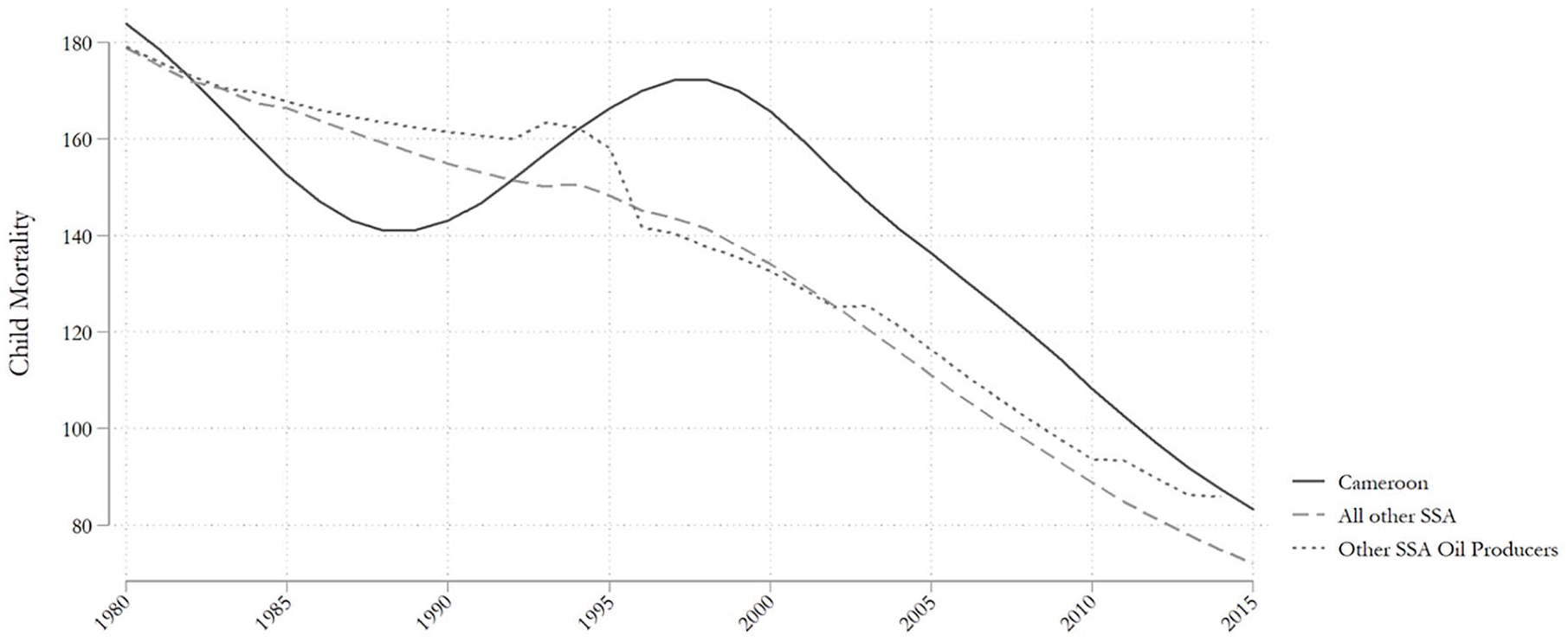
Child mortality trends in sub-Saharan Africa, 1980–2015.
Most notable is the decade-long sharp increase in mortality in Cameroon, starting in the middle of the 1980s. In 1986, child mortality in Cameroon hit a low point of 141 per 1,000, but by 1998 had risen to 172 per 1,000, an increase of over 20 percent. Cameroon did experience an economic crisis during this time (van de Walle 1994, 144), exacerbated by a concurrent decline in oil prices, but neither factor can completely explain this pattern. Economic crisis was widespread, yet child mortality rates across the region declined on average throughout the 1980s and 90s. Other oil producers did witness a smaller uptick in child mortality rates, though this started five years after Cameroon’s rates began their path upward and converged back to regional trends quicker. Cameroon’s spike in child mortality is also unique given that similar upticks in the region have typically been associated with protracted civil wars, which Cameroon has avoided.
Cameroon is also a long-term oil producer. Commercial production, led by the French firm Elf-Aquitaine, began in 1977, and reached a high point of 186,000 barrels daily in 1985 (Gauthier and Zeufack 2009). The global decline in oil prices in the late 1980s reduced productivity sharply, though given the size of the Cameroon economy, oil production remains a critical economic sector (Djiofack and Omgba 2011). The average value of oil production in Cameroon between 1986 and 2014 was nearly $130 in per capita terms (Ross and Mahdavi 2015). Though small compared with larger regional producers like Angola and Nigeria, oil constitutes a critical source of revenue. For instance, oil rents as a percentage of government revenue ranged between 30 and 40 percent from 1981 to 1993 and have been above 30 percent of government revenue in the 2000s as well (Gauthier and Zeufack 2009, 55–57).
Cameroon also illustrates the shifting time horizons of autocratic leaders. Paul Biya experienced considerable challenges to his hold on power for more than a decade, bookmarked on one end by an attempted coup in 1984, and on the other by electoral victory in 1997 that definitively snuffed out the post–Cold War pressures for political liberalization (Letsa 2017). We use the remainder of this case study to describe this period, paying special attention to the evidence that Biya responded to his relatively weak position vis-à-vis regime insiders by using oil rents to build a support coalition and marginalize political opponents, to the detriment of investments in general public goods.
In accordance with the constitution governing the single-party system, Cameroon’s independence leader Ahmadu Ahidjo, a northerner, handed power to the southerner Paul Biya in 1982 (Gros 1995, 114). He had a dubious start to his tenure; within the first eighteen months, Biya faced a conspiracy and a coup d’état attempt by the presidential guard (Gabriel 1999, 178), the latter of which was led by his predecessor Adhijo who sought a return to power. Biya responded to this “precarious position” (van de Walle 1994, 144) with a two-part strategy: devoting considerable economic resources to pacifying his opponents and maintaining his supporters, and taking steps to tilt the balance of power in his favor.
One of Biya’s first acts was a sizeable increase in wages for public sector employees and a large-scale public investment plan (van de Walle 1994, 144). Wages and salaries as a percentage of total government expenditure increased from 24 percent in 1980 to 60 percent in 1993 (Gauthier and Zeufack 2009, 55–57). Biya also doubled the size of the civil service, with most new positions going to members of his ethnic group (Fombad 2004, 361). By 1991, 37 out of the 47 senior administrative division heads and 22 of 38 high ranking bureaucrats were Biya’s Beti co-ethnics (Takougang 1993, 95–96).
Rewarding his supporters with government positions had consequences for health outcomes in the country, particularly in terms of the regional divide. The 1991 Demographic and Health Survey shows that infant and child mortality rates in the northern regions were nearly twice the size as compared with other regions—109 and 100, versus 60 and 47, respectively (Balepa, Fotso, and Barrere 1992, table 9.2, 135). Health infrastructure follows a similar trend; between 1985 and 1986, the northwestern and eastern regions only had 6 and 9 percent of hospitals and health centers while the central and southern regions had 31 percent of hospitals and health centers (Defo 1996, 404). 12 This regional divide got worse after Biya came into office in 1982. Between 1974 and 1975, the northwestern and eastern regions had slightly better health infrastructure with 9 and 11 percent of hospitals and health centers while the central and southern regions had 25 percent of hospitals and health centers. After Biya assumed office, health infrastructure in the central and southern regions showed relative improvement while conditions in the northwestern and eastern regions deteriorated further.
More generally, Biya responded to feeling “under siege” (Gauthier and Zeufack 2009, 23) by ushering in a series of highly populist moves designed to consolidate his support among younger citizens, including university scholarships and construction of student dormitories, and to reward the ethnic groups that backed him during the coup attempt. These expenditures were made easier by the spike in oil revenues, which by the mid-1980s had generated several hundred million dollars in revenues for the state, and a growing tolerance from Biya of the attendant corruption, rent-seeking, and patronage that surrounded the oil sector (van de Walle 1994, 144).
During these early years in power, Biya ushered in a number of other policy initiatives that were ostensibly designed to promote development throughout the country, including his “New Deal” vision for the country, which sought to address a range of issues such as education, employment, housing, as well as health, among others (Takougang 1993, 91). In the 1980s in an attempt to extend healthcare to all citizens, a Presidential Decree was issued to extend primary healthcare and state-provided medication to all citizens (Carbone 2012). However, in practice, insufficient funding and inefficiency in resource allocation reduced availability of key medications, particularly in rural areas. Instead, the Biya administration used state resources to enhance his political power. Carbone’s (2012, 170) assessment is striking: “overall, the regime appeared to remain much more concerned with the appropriation and distribution of private benefits to its core constituency, rather than with the provision of public goods to wider segments of the populace.”
Biya was further threatened by the region-wide wave of political liberalization that started in 1989. John Fru Ndi formed the first serious opposition movement in 1990, the Social Democratic Front (SDF), though Biya’s regime initially refused to register the group as a political party and violently cracked down on a SDF rally (Letsa 2017, 657). By 1992, growing opposition movements and widespread and well-organized strikes and protests gave Biya no choice but to announce multiparty legislative and presidential elections. Biya was now in his most insecure position politically since surviving the coup attempt eight years prior.
Once again, Biya used his position and control over resources to survive. Biya’s party, the RDPC, won a plurality of seats in the March 1992 legislative elections, and Biya won the presidential contest a few months later in October, though only because Biya “was able to use his position as president to manipulate the whole process by essentially determining the rules of the game” (Takougang 2003, 426–27). Key administrative agencies prevented opposition parties from monitoring voting centers, while ghost polling stations and security force intimidation marred the contest and tilted the election in Biya’s favor. The SDF’s opposition candidate for president, the party leader John Fru Ndi, was even placed under house arrest for 6 months (Morse 2018, 123–24). Biya officially obtained 40 percent of the vote in these first presidential elections, a plurality sufficient to hand him the election, though he had to engage in electoral fraud to achieve even this modest vote share (Gabriel 1999; Letsa 2017, 179; van de Walle 2002, 73). He further responded by absorbing key members of the opposition into his cabinet, including Hamadou Mustapha and Issa Tchiroma, the opposition NUDP’s party’s vice president and secretary general, respectively (Takougang 2003, 430–31). These outcomes suggest that Biya was particularly attuned to his weakness vis-à-vis rival elites and regime insiders, and took active measures to tilt the balance of power back in his favor.
The evidence from Figure 4 suggests that the spike in child mortality rates coincides with this period of insecurity. While the opaqueness of oil wealthy authoritarian regimes makes it difficult to identify exact sums diverted from public health initiatives to political supporters, the scholarly consensus as well as regional disparities in health outcomes provides us evidence that is at least consistent with this interpretation. Biya condoned—even exemplified—the use of state funds as a tool to achieve broader goals of political security, especially during his first decade in power, no matter the consequences for his citizens’ well-being. Gros (1995, 120) describes it in starker terms: “the strategy was simple: keep rewarding indispensable supporters, even if all other institutions were falling apart . . . ”
The window of political liberalization closed quickly. By the 1997 legislative elections, Biya’s regime had expanded their co-optation network and gerrymandered electoral districts to cement their power (Albaugh 2011). Opposition parties boycotted the presidential elections that year, allowing Biya to claim 93 percent of the vote. Never again would opposition parties be able to credibly threaten removing Biya at the ballot box. The RDPC won increasingly large legislative majorities throughout the 2000s, and Biya himself ushered in a constitutional change to abolish presidential term limits in 2001 (Letsa 2017; Morse 2018). At the age of 86, he now ranks among the oldest and longest serving civilian leaders in the world.
Of course, these patterns do not constitute definitive proof of our argument, and significant problems of corruption and resource sector mismanagement remain. Nevertheless, we note that there is little evidence that Biya had the interest in pursuing such policies when his hold on political power was weakest, opting instead to spend oil rents on maintaining and building his support coalition as our theory predicts.
Conclusion
Further maturation of resource curse scholarship requires the development of theories and research designs that account for the wide array of outcomes within similarly resource-abundant states. We have offered one example of this approach, illustrating that oil income harms child mortality only when authoritarian leaders have short time horizons. These findings fill a considerable gap in the literature on oil and development while also contributing to the growing literature on the developmental consequences of authoritarian dynamics.
If short time horizons are problematic, should one conclude that entrenched autocrats with long time horizons are preferable? There are several reasons to resist this conclusion, including the straightforward fact that our empirical results do not support it. Our analysis shows clearly the significant negative impact of oil rents when leaders are insecure. Yet the results also show that in the absence of oil income (i.e., half of all autocratic-country years in the sample), the level of autocratic personalization has no effect on child mortality. If anything, the positive coefficient on the constituent term suggest that for nonoil producers, more personalized authoritarian settings may be worse for population health. The coefficient was not statistically significant in our model, but such a conclusion would be unsurprising, given the other well-documented negative consequences of personalized autocracies, including higher levels of repression and lower likelihoods of eventual democratization (Frantz and Kendall-Taylor 2016; Frantz et al. 2020). Instead, it suggests more limited conclusions—namely, that leaders who worry less about their immediate survival make different decisions regarding large oil rents than do leaders for whom survival is a more pressing concern. In short, oil wealth harms child mortality only when leaders have short time horizons, and longer time horizons can offset this negative impact.
Our findings point to several future areas of research. For instance, the distribution of power between dictators and regime insiders is conceptually and empirically distinct from the presence of formal political institutions. Could the creation or strengthening of such institutions insulate oil-producing countries from the negative consequences of leaders with short time horizons? Such research would build on Menaldo’s (2016) recent work that links many of the problematic outcomes observed in oil-producing countries to institutional deficiencies. Alternatively, future work could examine whether such institutions have a direct impact on health outcomes among oil-producing states or whether time horizons influence the relationship between oil wealth and other political and economic outcomes. These efforts would help further unpack the political and economic consequences of resource wealth.
Supplemental Material
Online_Appendix_1 – Supplemental material for When Does Oil Harm Child Mortality?
Supplemental material, Online_Appendix_1 for When Does Oil Harm Child Mortality? by Nisha Bellinger and Matthew D. Fails in Political Research Quarterly
Footnotes
Acknowledgements
We thank Kelsey Hyslop of Boise State University for her excellent research assistance.
Declaration of Conflicting Interests
The author(s) declared no potential conflicts of interest with respect to the research, authorship, and/or publication of this article.
Funding
The author(s) received no financial support for the research, authorship, and/or publication of this article.

Notes
References
Supplementary Material
Please find the following supplemental material available below.
For Open Access articles published under a Creative Commons License, all supplemental material carries the same license as the article it is associated with.
For non-Open Access articles published, all supplemental material carries a non-exclusive license, and permission requests for re-use of supplemental material or any part of supplemental material shall be sent directly to the copyright owner as specified in the copyright notice associated with the article.
