



Abstract
Prior research demonstrates that acculturated co-ethnics of immigrant groups adopt restrictive immigration policy preferences akin to that of host country dominant groups. However, acculturated U.S. Latinxs still maintain relatively open immigration policy preferences despite their distance from the canonical immigrant archetype (e.g., Spanish-speaking, immigrant). To answer the puzzle, I draw on sociological perspectives and theorize that the increased societal integration of undocumented immigrants in tandem with an expanding interior immigration enforcement apparatus generates rebuff against Anglo political norms among acculturated Latinxs. Using 6 national Latinx surveys, I corroborate my theory and find perceptibly threatening immigration enforcement contexts forestall the adoption of restrictive immigration policy preferences via acculturation. Absent deportation threat, acculturated Latinxs adopt immigration preferences similar to white Anglos. I also replicate these findings for attitudinal dimensions outside immigration policy preferences. This paper suggests political assimilation is not preordained among acculturated immigrant co-ethnics in light of an unreceptive host society.
Introduction
Will acculturated Latinx co-ethnics adopt restrictive immigration policy preferences like their Anglo counterparts? History is replete with examples of acculturated immigrant group co-ethnics adopting restrictive immigration policy preferences akin to their Anglo counterparts, a quintessential aspect of the assimilation process (Williamson et al. 2021). Alonso Perales, the League of United Latin American Citizens’ second president (LULAC, 1930-31), while supporting immigration restrictions, indicated the Mexican-American people had to “draw a line between the American citizen of Mexican descent, and the alien of the same extraction.” Some LULAC members argued new immigration undercut assimilation into the Anglo-American mainstream and stigmatized the Mexican-American population by association. Others, like Cesar Chavez, who at one point facilitated a border patrol operated by the United Farm Workers Union, argued new immigration hurt the economic prospects of immigrants already in the U.S. (Gutierrez 1995).
The adoption of restrictive immigration preferences among acculturated Latinxs, members of the largest U.S. immigrant-origin group constituting 20% of the population, 1 is not simply historical. Contemporary evidence shows acculturated Latinxs (e.g., third-generation, English-dominant, citizens) hold more restrictive immigration policy preferences akin to Anglo whites relative to their less acculturated counterparts (e.g., immigrant, Spanish-dominant) (Rouse et al. 2010). However, other evidence shows some acculturated Latinxs still hold open immigration policy preferences, with limited attitudinal convergence vis-a-vis Anglos (Pedraza 2014). 2
I explain why some acculturated Latinxs still hold open immigration policy preferences despite pressure to adopt restrictive attitudes akin to Anglos. 3 I argue the contemporary interior immigration enforcement context and the societal integration of a large Latinx undocumented population not only affects immigrant Latinxs but even well-acculturated Latinxs distant from the immigrant experience (e.g., 2nd, 3rd, 4th generation, English-dominant, citizens). Drawing on segmented assimilation, reactive ethnicity, and integrative expectations theory, I posit the expansive, threatening contemporary immigration enforcement context motivates rebuff against anti-immigrant Anglo norms and sustains political commitments to new immigrant co-ethnics via open immigration policy preferences among acculturated Latinxs.
Evidence from 6 national Latinx surveys (2007–2019) corroborates my theory. Acculturated Latinxs threatened by immigration enforcement hold immigration policy preferences akin to unacculturated Latinxs. Conversely, acculturated Latinxs unthreatened by immigration enforcement possess attitudes more similar to Anglos. I also demonstrate immigration enforcement threat operates net of well-established alternative mechanisms that may undercut the adoption of restrictive immigration preferences among acculturated Latinxs.
This paper complicates forecasts that Latinxs will adopt the political standards, at least on the immigration policy dimension, of Anglos like other historic immigrant origin groups as they integrate in the U.S. (Alba 2016). Prior research suggests acculturated Latinxs are restrictive on immigration because they are less implicated by restrictive immigration laws and may perceive benefits from undermining new immigration (Bedolla 2003). Contrary to conventional wisdom, this paper demonstrates immigration enforcement can still frustrate political assimilation on immigration policy preferences even among acculturated Latinxs ostensibly protected from deportation, and maintains the distinct immigration preferences of Latinx communities (Mora and Rodriguez-Muniz 2017). In sum, accounting for heterogeneous exposure to a restrictive immigration context in tandem with a large undocumented Latinx population helps illuminate the segmented adoption of salient policy preferences among the largest U.S. immigrant group.
Perspectives on Anti-Immigrant Assimilation
Immigrant group members adopt the host country’s dominant group attitudes to increase their social, economic, and political status (Alba 2009; Alba and Logan 1992; Gans 1992). Accordingly, straight-line assimilation theory posits immigrant group member attitudes converge with the dominant group via acculturative mechanisms such as a higher generational status, learning the dominant language, intermarriage, or residential integration (Gordon, 1964). Politically, Latinxs adopt restrictive immigration policy preferences akin to Anglos as a function of generational status and exhibiting English dominance (Polinard et al. 1984; Rouse et al. 2010). Latinxs possess multiple motivations to adopt restrictive immigration preferences as they acculturate. Acculturated Latinxs may perceive themselves as prototypically American instead of connected to an immigrant community (Rouse et al. 2010). They may dissociate from newer Latinx immigrants due to their stigmatized attributes. They may backlash against new Latinx immigrants who critique their inability to maintain ethnic norms (e.g., speaking Spanish) (Bedolla 2003). Economic competition, perceived or real, could also generate anti-immigrant sentiment given acculturated Latinxs may compete with new immigrants within similar occupational strata (Gutierrez 1995; Ochoa 2004).
Despite the restrictive trend, Latinx immigration preferences do not fully converge with Anglos as they acculturate (Pedraza 2014). Multiple surveys show that although later generation Latinxs are more restrictive on immigration than their immigrant counterparts, there is still a gap between third + generation Latinx and Anglo preferences (Section A.1). 4 Sociological insights may explain why acculturated Latinxs still hold open immigration policy preferences. Segmented assimilation theory posits group characteristics and reception contexts determine if immigrant co-ethnics assimilate across multiple dimensions (Portes and Zhou 1993; Samson 2014). Discrimination, limited intra-group social capital, and economic inequality may undercut assimilation such that segments of acculturated immigrant group members still possess attributes similar to new immigrants (Portes and Zhou 1993; Suarez-Orozco and Suarez-Orozco 2009; Telles and Ortiz 2008).
Reactive ethnicity theory posits hostile anti-immigrant contexts motivate acculturated co-ethnics to develop a politicized group consciousness that protects the group and dissociates from the dominant group’s political commitments (Rumbaut 2008). Likewise, research at the intersection of politics and segmented assimilation theorizes discrimination sustains pro-immigrant policy preferences among third and fourth generation Mexican-Americans (Telles and Ortiz 2008). Pedraza (2014) explicitly tests this hypothesis by forwarding an integrative expectations theory. They posit acculturated Latinx co-ethnics exposed to discrimination rebuff against Anglo immigration policy attitudes since expectations the host society would incorporate them are frustrated.
However, absent from the discussion on segmented political assimilation is how host country rebuff via immigration enforcement affects immigration policy preferences among acculturated Latinxs. Prior research on how immigration enforcement undermines assimilation emphasizes socio-economic outcomes (Massey and Pren 2012; Massey et al. 2016). Other research provides qualitative evidence immigration enforcement may motivate Latinxs to reject Anglo norms (Jones 2019). Political science research typically focuses on political mobilization in response to immigration enforcement (Roman et al. 2021; White 2016; Zepeda-Mill´an 2017). Yet, there is no explicit and systematic test of whether the contemporary immigration enforcement context undercuts the adoption of immigration policy preferences akin to Anglos among acculturated Latinxs exposed to threatening immigration contexts.
How Immigration Enforcement Stops Anti-Immigrant Assimilation
How does immigration enforcement undercut the adoption of restrictive immigration policy preferences among acculturated Latinxs? Contemporary immigration enforcement is a salient and negative aspect of the host society for Latinxs. Since the 1996 Illegal Immigration Reform and Immigrant Responsibility Act (IIRIRA), immigration enforcement has increased precipitously. Thresholds for revoking residency were reduced, border enforcement escalated, and interior deportations increased over 1400%. Yearly deportations increased from 19,000 to a staggering 289,000 (Figure B2, Panel F). These policies incentivized undocumented migrants to stay in the U.S. for fear of entanglement with immigration authorities via cyclical migration (Massey and Pren 2012). Thus, the undocumented population increased from 3.5 to 11 million between 1990-present. Likewise, the proportion of undocumented living in the U.S. over 10 years increased from 33 to 66% between 1995 and 2017 (Figure B2, Panels A–B).
Restrictive immigration policies have had profound and disparate consequences on Latinxs regardless of acculturation level. Over 70% of undocumented are Latinx. Latin American immigrants are “over-deported” relative to their undocumented population proportion (Figure B2, Panel H). Over 40% of Latinxs know undocumented friends or family (Figure B2, Panels C–D). Social ties with undocumented immigrants among a sizable proportion of acculturated Latinxs are strong. Even 30% and 36% of 3rd generation+ and English-speaking Latinxs know undocumented friends or family. Some acculturated Latinxs are integrated in communities subject to immigration enforcement. 3rd generation + Latinxs live in zipcodes that are 20% foreign-born and 10% non-citizen (12% and 6% for Anglos, Figure B2, Panels D–E). Acculturated Latinxs with ties to legal immigrants are also implicated by immigration enforcement. After IIRIRA, permanent residents and their proximate social ties (e.g., second and third-generation children) were exposed to draconian rules that strip away legal status if immigrants were not economically self-sufficient or committed an expansive set of minor crimes (Morawetz 2000). Likewise, immigrants with liminal legal status such as Temporary Protected Status (TPS) or Deferred Action for Childhood Arrivals (DACA) may have second or third-generation friends and family concerned about their uncertain legal status (Menjivar 2006).
Outside of social ties with immigrants, some acculturated Latinxs are directly exposed to an expansive immigration enforcement apparatus. Latinxs are ethno-racialized as “illegal.” Whites over-estimate the proportion of Latinxs who are undocumented by 24% (40% instead of 16%) (Barreto et al. 2012). Anglos conflate the categories “illegal” and “Latino,” which may be motivated by xenophobic attitudes (Flores and Schachter 2018). Even acculturated Latinxs are aware of their ethno-racialization as “illegal” or “foreign,” which reduces their sense of belonging and motivates pro-immigrant solidarity (Asad 2017; Ochoa 2004). Ethno-racialization as “illegal” also motivates state-sanctioned behavior. Police may stop citizen Latinxs on the basis of immigration status (Armenta 2017). Even Latinx citizens have been detained by immigration authorities. ICE wrongfully detained 3,500 Texas citizens between 2006 and 2017, 462 Rhode Island citizens over 10 years, and 420 Florida citizens between 2017 and 2019 (Cunha 2019). Thus, immigration enforcement does not just affect the undocumented, but many acculturated Latinxs.
Moreover, prior research shows immigration enforcement has deleterious consequences on Latinx communities, negatively affecting health (Cruz Nichols et al. 2018), child development (Dreby 2015), wages (Fussell 2011), social service uptake (1) (Alsan and Yang 2022), education (Dee and Murphy 2020), government trust (Rocha et al. 2015), and civic incorporation (Brown and Bean 2016). These studies show consequences are not isolated to the undocumented given the strong social ties of acculturated Latinxs to immigrants.
However, relative to less acculturated Latinxs, well-acculturated Latinxs are, on average, less likely to be exposed to immigration enforcement given their distance from the immigrant experience and stronger opportunities to shed social ties with undocumented immigrants. For instance, first and second-generation Latinxs are more likely to know undocumented friends and family and live in immigrant neighborhoods relative to third + -generation Latinxs (Figure B2, Panel D, E). Additionally, well-acculturated Latinxs are less concerned about their friends, family members, or themselves being deported or detained by immigration authorities (Table F6). Therefore, some acculturated Latinxs are exposed to the threat of immigration enforcement, whereas many are not, generating variation in exposure to the threat of immigration enforcement.
Although prior research demonstrates immigration enforcement is more salient for unacculturated Latinxs (Asad 2020), I posit immigration enforcement threat will have a stronger influence on acculturated Latinx immigration preferences, forestalling the adoption of restrictive preferences similar to Anglos. Human beings seek security (Huddy et al. 2007). Thus, Latinxs threatened by immigration enforcement may support open immigration policies as a protective instinct (Eadeh and Chang 2020). However, immigration enforcement threat may have a limited marginal influence on the immigration policy preferences of less acculturated Latinxs closer to the immigrant experience. Unacculturated Latinxs may support open immigration policies regardless of their threatened disposition because they relatively benefit from open immigration (Maltby et al. 2020). Conversely, acculturated Latinx immigration preferences have more space to travel in response to immigration enforcement threat since they are predisposed to adopt restrictive attitudes (Bedolla 2003).
Immigration enforcement threat may undermine acculturated Latinxs’ restrictive predispositions, bringing their immigration preferences in line with new Latinx immigrants and away from Anglo political standards. Threat may increase information-seeking and reduce reliance on predispositional norms (Marcus and MacKuen 1993). Integrative expectations theory suggests host society rebuff via immigration enforcement may encourage acculturated Latinxs to question their sense of host society integration despite their distance from the immigrant experience (Pedraza 2014). Immigration enforcement threat, personal or proximal (e.g., via familial or friendship ties), signals rebuff from the American polity since it implies an association with illegality and a reduced sense of belonging (Mora and Rodriguez-Muniz 2017). Consistent with segmented assimilation and reactive ethnicity theory, acculturated Latinxs threatened by immigration enforcement may reject the dominant group’s political norms (Rumbaut 2008). In sum, acculturated Latinxs threatened by immigration enforcement may seek information concerning immigration policy (Gadarian and Albertson 2014), identify alternative policies to ameliorate the threat (Hetherington and Suhay 2011), and generate new preferences inconsistent with their relatively restrictive priors (Brader 2006).
Therefore, Latinxs experience segmented political trajectories conditional on their exposure to threatening immigration enforcement contexts.
Acculturated Latinxs threatened by immigration enforcement will continue to hold (open) immigration policy preferences similar to new immigrant counterparts.
Acculturated Latinxs unthreatened by immigration enforcement will adopt restrictive immigration preferences akin to Anglos.
Data and Design
I use 6 representative Latinx surveys to test
Outcome
Immigration policy preferences are a quintessential dimension of political assimilation among Latinxs. Open immigration is an ethnic interest since 66% of Latinxs are either immigrants or second-generation. On average, Latinxs are more supportive of open immigration relative to Anglos (Telles and Ortiz 2008). Supporting open immigration policies may suggest support for the most stigmatized subsets of the ethnic group (Ochoa 2004). Prior to the Chicanx movement, many acculturated Mexican-Americans would attempt to garner acceptance among Anglos by denigrating immigrant co-ethnics and supporting immigration restrictions (Gutierrez 1995). A core conflict between Chicanx and assimilationist activists was the question of labor solidarity with new Mexican immigrants (Ochoa 2004). More recently, some Latinxs voted for California’s Proposition 187, which barred undocumented immigrants from social services, on the basis undocumented immigrants take resources from Latinx-American communities and increase Anglo anti-Latinx stigma (Bedolla 2003). The 2020 election exhibited similar conflicts, where many acculturated Latinxs supported Trump despite his anti-immigrant policies (Medina 2020).
Thus, the outcome of interest characterizing anti-immigrant assimilation for each survey is an additive index of binary items measuring support for open immigration policies. The indices across the surveys include support for the following: not reducing immigration levels (Pew ’07, ’18), stopping immigration raids (Pew ’07, ’08, ’10), preventing police doing immigration enforcement (Pew ’07, ’08, ’10), reducing border enforcement (Pew ’10, ’19, CMPS ’16), a citizenship pathway (Pew ’10, CMPS ’16), preventing employment checks (Pew ’07, ’08), preventing prosecution of employers hiring undocumented immigrants and undocumented employees (Pew ’08), in-state tuition for undocumented students (Pew ’08, ’10), not increasing deportations (Pew ’10, CMPS ’16), drivers licenses for undocumented immigrants (Pew ’07), not implementing a national identity card (Pew ’10), maintaining jus soli for newborns of undocumented immigrants (Pew ’10), and providing legal status to undocumented immigrants brought to the U.S. as children (Pew ’18, ’19). For item wording, see Section D. 6
These items comport with the theory. Except the item on reducing border enforcement, all items implicate the rights and immigration status of undocumented immigrants, who are heavily integrated in the Latinx population. Therefore, these outcomes help test if exposure to immigration enforcement threat among acculturated Latinxs encourages support for undocumented Latinxs barred from fully integrating with the host society.
The additive index may reduce measurement error due to the binary individual outcomes and generates preference variation among a population supportive of open immigration (Barry et al. 2011). Although the indices do not contain the same items across surveys, consistency in associations of interest may suggest immigration enforcement threat motivates support for several immigration policies. 7 Regardless, the results are not driven by indexing the outcomes. Results are similar examining the outcomes independently, with all tests in the same theoretical direction albeit with some statistically insignificant (Figure E3). All indices are rescaled between 0 and 1.
Immigration Enforcement Threat
To measure immigration enforcement threat, I use items measuring deportation threat. Respondents are asked across all Pew surveys how much they worry about they, close friends, or family members being deported regardless of their citizenship status on a 0-3 scale from “Not at all” to “A lot.” Thus, the measure captures threat to oneself and important social ties. Measuring deportation exposure via close social ties is important given many acculturated Latinxs are embedded in social networks with undocumented immigrants and may not be directly exposed to immigration enforcement. For the CMPS, respondents are only asked about proximal threat on a 0–4 scale from “Not at all” to “Extremely” worried. These measures are similar to others in well-established research on threat and politics (Hetherington and Suhay 2011; Huddy et al. 2007). 8 I rescale threat between 0–1. 9
An alternative threat measure may be sociotropic instead of personal threat. In the context of deportation threat, sociotropic threat may be measured as perceptions of high deportation levels against the Latinx community writ large. Sociotropic measures are in the Pew ’07 and ’08 surveys (see Section Q.1). Consistent with prior research demonstrating personal threats supersede sociotropic threats (Hetherington and Suhay 2011); sociotropic threat is not associated with open immigration preferences or the maintenance of open preferences among acculturated Latinxs (Table Q25).
Since threat is subjective and psychological, I validate if the measure is associated with objective measures approximating deportation threat. Threat is positively associated with more county-level Secure Communities deportations, % foreign-born (zip), % non-citizen (zip), and self-reported measures of whether a respondent knows someone undocumented or a deportee. These findings suggest the subjective measure captures the concept of exposure to immigration enforcement (Section F.4).
Acculturation
Conceptually, acculturation is how much immigrant groups adopt dominant host country group attributes in addition to the maintenance of their own group’s attributes as they interact with the dominant group (Berry and Sam 1997). Acculturation can also occur vis-a-vis non-dominant groups (e.g., Black Americans, see Portes and Zhou (1993)). However, given acculturated Latinxs tend to adopt Anglo political attitudes (Branton 2007), I conceptualize acculturation as adopting dominant group norms. Acculturation is multi-dimensional; it includes political attitudes, cultural norms, socio-economic status, and integration in dominant social networks, among other factors (Cuellar et al. 1995). Acculturation is also heterogeneous within groups. Immigrant group co-ethnics experience different trajectories in adopting dominant group standards (Berry and Sam 1997).
Some argue specific acculturation dimensions should be measured in surveys (Cabassa 2003). This approach has shortcomings. First, acculturation scales concerning cultural norms, intermarriage, social networks, socio-economic status, and political beliefs are time-intensive and not often available across multiple immigrant group surveys (Cruz et al. 2008). Second, researchers may prefer acculturation measures that do not directly capture specific assimilation dimensions since these dimensions may be outcomes of interest (e.g., immigration preferences). Instead, researchers may seek acculturation measures encouraging assimilation yet allowing for the absence of assimilation along specific dimensions among acculturated co-ethnics. 10
Consequently, I measure acculturation with an additive index of generational status (0 = 1st, 1 = 2nd, 2 = 3rd + generation), English language-of-interview (0 = Spanish, 1 = English), and citizenship (0 = non-citizen, 1 = citizen) across all 6 surveys. The index is from 0–4 (non-citizen Spanish-speaking immigrant to third-generation + English-speaking citizen). 11 This proxy scale is advantageous since it measures factors that typically encourage the adoption of dominant group attitudes yet do not guarantee their adoption among all acculturated individuals. Prior research demonstrates proxy scales indexing language-of- interview and generational status are reliably associated with gold-standard scales measuring specific assimilative dimensions such as language proficiency, cultural attachments, geographic integration, and ethnic identification (Cruz et al. 2008). Similar scales have been used in prior Latinx public opinion studies and they operate consistent with the original conceptualization of acculturation (Branton 2007; Pedraza 2014). 12 Additionally, prior research suggests citizenship is positively associated with civic integration, education, dominant language skills, inter-ethnic contact, and restrictive immigration preferences (Portes and Curtis 1987; Liang 1994; Yang 1994; Just and Anderson 2015). 13
I validate the acculturation scale by demonstrating it is associated with multiple assimilation dimensions. The scale is linearly associated with restrictive immigration policy preferences across all surveys (Table E3). Consistent with Gordon (1964), who characterizes 7 assimilation dimensions, the index is positively associated with reduced ethnic identity salience (cultural assimilation), a stronger sense of American identity relative to Latinx identity (identification assimilation), American self-categorization (identification assimilation), higher education/income (structural assimilation), living with less Latinxs and immigrants (structural assimilation), a higher probability of marriage with a non-Latinx (marital assimilation), and lower discrimination levels (reception assimilation, see Section E.2). Therefore, the index reliably measures the concept of dominant group assimilation.
To ensure sufficient variation for assessing the heterogeneous influence of acculturation by deportation threat levels, I demonstrate threat and acculturation are not indistinct. Acculturation is negatively correlated with threat. From a Pearson’s ρ of −0.2 in Pew ’19, to −0.46 in the Pew ’08 survey, implying a low-to-moderate correlation. Across all surveys, at least 20% of the most acculturated Latinxs (third-generation+, English-dominant) indicate they are worried “some” or “alot,” up to 31% in the Pew ’18 survey. Likewise, across all surveys, at least 20% of the least acculturated (non-citizen immigrants, Spanish-dominant) indicate they are worried “not at all” or “not much,” up to 45% in the Pew ’19 survey.
In sum, there are sizable proportions of unacculturated Latinxs who do not experience threat and well-acculturated Latinxs who do experience threat. 14
Controls
I adjust for several theoretically motivated control covariates. Demographic covariates include age, gender, marital status, religion, and national origin. Socio-economic covariates include income, education, unemployment, and homeownership. Political covariates include partisanship, ideology, experienced discrimination, perceived discrimination, Latinx and American identity centrality, ethnic media consumption, social ties with undocumented friends/family, knowing a deportee, being stopped due to immigration violations. County-level covariates include the logged total population, population density, % Latinx, % foreign-born, % non-citizen, logged median household income, % college, % unemployed, the logged number of deportations via Secure Communities, 15 the proportion of deportations for minor misdemeanors, and the number of Secure Communities deportations normalized over the size of the foreign-born population. Zipcode-level covariates are the same in terms of measurement as the county-level covariates with the exception of Secure Communities deportations. Not all surveys include all aforementioned covariates. See Table H10, for an enumeration of covariate availability across surveys. For all surveys, I adjust for state fixed effects, except the Pew ’07, ’19 surveys, where I adjust for Census area fixed effects in the absence of state residence data. See Section H.2 on why each covariate was included in the models for each respective study.
Estimation Strategy
I use the following linear model to test my hypothesis

Y i is the open immigration policy index for respondent i, δ s is a fixed effect for state/census area s, threat i is perceived threat, acculturation i is the acculturation index, Σkk = 1 X k izc controls at the individual (i), zipcode (z), and county-level (c). ε are robust errors. I present estimates with and without controls to demonstrate no suppression effects.
Since all covariates are rescaled between 0 and 1, β1 is a second difference, the difference in the difference of support for open immigration policies between Latinxs at the highest and lowest threat level between Latinxs at the highest and lowest acculturation level. Consistent with
A model-based design is appropriate to test the hypothesis. Experimental designs pose several challenges. First, external validity and weak effects. Threat may be difficult to manipulate in short-term experimental settings since, for Latinxs, threat is likely the result of predispositional pre-adult experiences rooted in strong social relationships with undocumented immigrants or national immigration policy, both of which cannot be randomized (Figure F6, Table F7). Qualitative literature establishes threat is a function of predispositional, pre-adult experiences among Latinxs. Latinx children with limited investment in politics already have strong opinions about the extent to which they, their family, or friends may be implicated by immigration enforcement (Dreby 2015). Likewise, prior research suggests Latinx immigrants are already concerned about enforcement as a result of the migratory experience prior to becoming engaged with American politics (Massey and Pren 2012). Consistent with the notion threat is predispositional for Latinxs, aggregate, cross-sectional, Pew Latino Survey data demonstrates threat is highly stable across three presidencies with vastly different immigration policy approaches (2007–2018, Figure F8, Panels A–B), with only one time period being statistically different than the first period threat was recorded. Latino Immigrant National Election Survey panel data also demonstrates threat doesn’t shift substantially among immigrant Latinxs between two time periods when Trump implemented several anti-immigrant executive orders (e.g., sanctuary city ban, the Muslim Ban, repealing DAPA, see Figure F8, Panels C–D). Consistent with the notion threat is predispositional and experiments may not effectively manipulate threat, my own experiment cuing threat among acculturated Latinxs did not induce threat (Section F.8). Second, ethics. Experiments powerful enough to generate threat may be unethical given the risk of traumatizing undocumented Latinxs, who occupy a marginalized societal position (Lahman et al. 2011). Third, feasibility. The quantity of interest is an interaction with acculturation, an index of ascriptive attributes that cannot be randomized like generational status. Therefore, even if we could cue threat experimentally, we would still be interested in a heterogeneous effect subject to selection bias.
Additionally, evaluating variation in threatening/permissive immigration policies across geographic space using available surveys may not effectively answer the research question (e.g., assessing the effect of Secure Communities, see White (2016)). Repeated cross-section and/or panel data with large Latinx samples across acculturation levels and small geographies with consistently asked open immigration preference measures do not exist given most survey research prioritizes nationally representative samples.
Consequently, I opt for a model-based approach that attempts to adjust for major pre-existing explanations of Latinx pro-immigrant attitudes, rules out alternative explanations by adjusting for multiple interactions between acculturation and theoretically relevant explanations for Latinx pro-immigrant attitudes, and acknowledges β1 does not have a causal interpretation.
Results
Threat Sustains Open Immigration Attitudes Among Acculturated Latinxs.

Note: ∗∗∗ p < .001, ∗∗ p < .01, ∗ p < .05, † p < .1. All covariates scaled between 0–1. Robust standard errors in parentheses.
To get a stronger substantive sense of the heterogeneous influence of acculturation by threat, I plot predicted values of open immigration policy support conditional on acculturation and threat (Figure 1). Across all studies, visual patterns are consistent with Predicted Values of Support for Open Immigration Policies (y-axis) Conditional on Acculturation (x-axis) and Threat (min-max, denoted by color). Simulations from fully specified models with Census region fixed effects, assuming controls at means and a respondent from the Western region. 95% CIs from robust SEs displayed.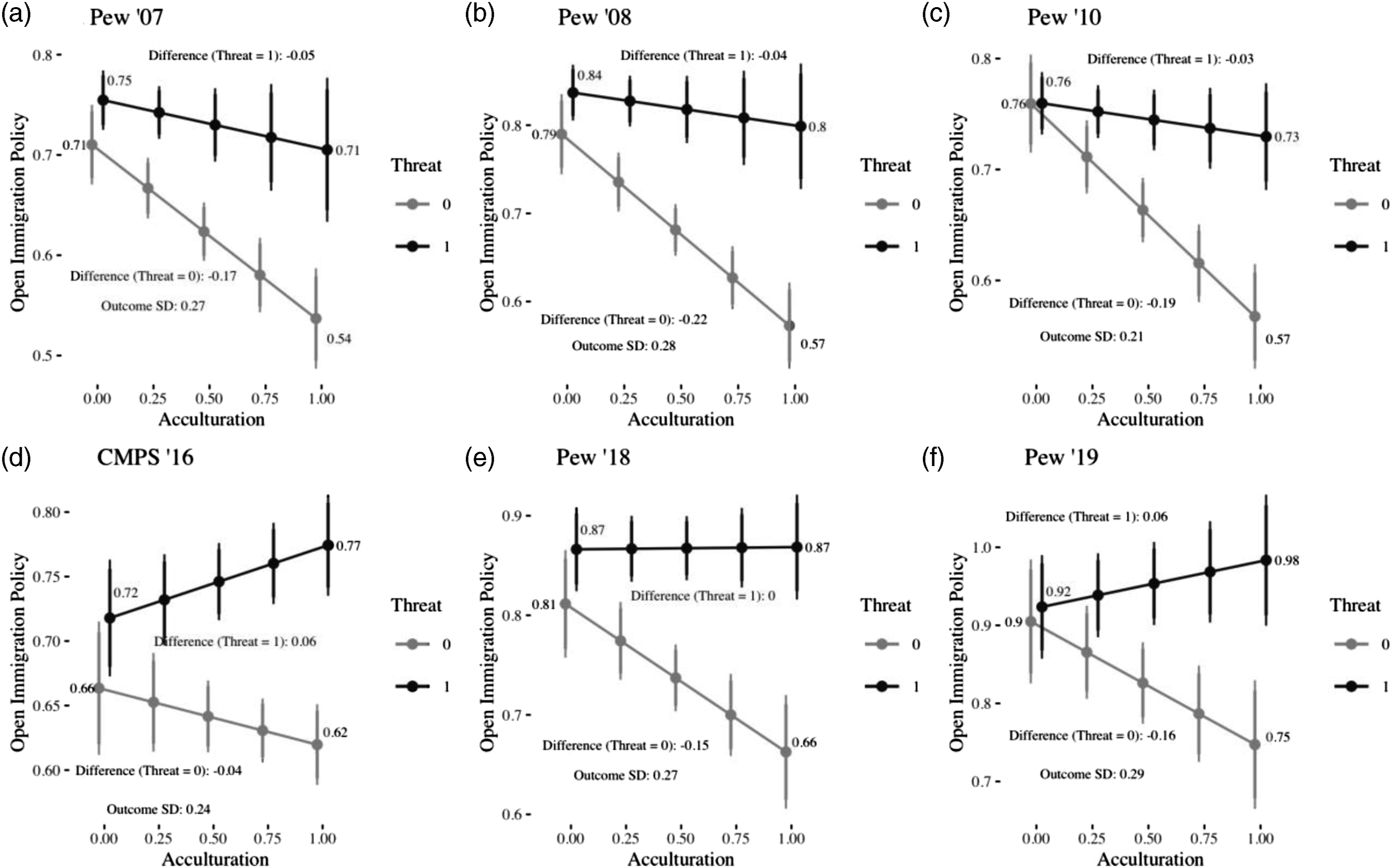
Robustness Checks
I rule out alternative mechanisms that may forestall political assimilation on immigration preferences. Prior literature finds discrimination (Pedraza 2014), Latinx identity (Binder et al. 1997), American identity (Rouse et al. 2010), ethnic geographic context (Bedolla 2003), ethnic media (Abrajano and Singh 2009), age cohort (Vega and Ortiz 2018), national origin (Mexican + Central American), and socio-economic status (Polinard et al. 1984) sustains open immigration preferences among Latinxs. I rule out if the maintenance of open immigration preferences among acculturated Latinxs is a product of these factors in addition to exposure to the objective deportation threat measures (e.g., knowing a deportee/undocumented immigrant; exposure to an immigration stop, Secure Communities deportations) by interacting acculturation with measures of these alternative mechanisms. This is a strong test, since it saturates the model with interactive terms and accounts for omitted interaction bias. The results are similar to the main results (Table M20).
I rule out latent liberalism. First, partisanship and ideology is unassociated with threat in the 2007 and 2010 Pew surveys, suggesting the results are not due to liberal ideology (Section F.5). Second, I use falsification tests on immigration-irrelevant policy preferences to rule out liberalism unaccounted for after adjusting for partisanship or ideology. The CMPS includes items on immigration-irrelevant policy preferences. Threat is not consistently associated with liberal policy preferences or an index of all policy preferences. 17 Likewise, the influence of threat conditional on acculturation is not consistently statistically significantly associated with liberal policy preferences and the liberalism index. Moreover, including an interaction between acculturation and the liberalism index in the model does not attenuate the heterogeneous influence of acculturation conditional on threat (Table N21).
I rule out if the results are driven by nativism. The Pew ’07, ’08, ’10, and CMPS ’16 surveys have items measuring the perceived economic and social threat immigrants pose. 18 I index these measures for each survey. 19 I interact nativism with acculturation in addition to threat to rule out nativism as an alternative mechanism. Although the influence of acculturation conditional on threat becomes statistically null for the Pew ’07 and CMPS ’16 surveys, the heterogeneous influence of acculturation conditional on threat is still positive and significant for the Pew ’08 and Pew ’10 surveys (Table P24). Moreover, attenuation in statistical significance may be the result of post-treatment conditioning. Nativism is a byproduct of acculturation (Knoll 2012).
Thus, adjusting for nativism adjusts for a mechanism motivated by acculturation that encourages restrictive immigration preferences. Indeed, threat undermines the conservative influence of nativism on restrictive preferences in the Pew ’07 and CMPS studies. These results suggest, in some cases, threat forestalls assimilation net of nativism. Where it does not, threat undermines the influence of nativist predispositions on restrictive preferences.
I rule out if the results are driven by linked fate (Sanchez 2006). Adjusting for linked fate in the CMPS ’16 and Pew ’19 surveys does not change the results (Table S28). Adjusting for linked fate as an alternative mechanism that could forestall assimilation on restrictive immigration preferences does not attenuate the threat/acculturation interaction in the Pew ’19 survey (Table S29). Moreover, acculturation is negatively associated with linked fate, but that association is attenuated for threatened Latinxs (Table S30), consistent with the spirit of the hypothesis. Therefore, linked fate does not appear to explain the associations of interest and deportation threat may be an antecedent to a strong sense of linked fate for acculturated Latinxs.
Results are not sensitive to acculturation measurement choice. The threat and acculturation interaction is positive and significant for an acculturation scale without the citizenship component and with a component for green card possession (Table K14 Panels A–B). The interaction is positive and significant if I use an English-dominance scale instead of an English-interview indicator (Panels C–D). The results hold interacting threat with generational status indicators in 4/6 surveys (Table K15, Panel A). They hold using only a US-born, English-language, and citizenship indicator in 4, 5, and 3 out of the 6 surveys, respectively. The results do not change using logistic regression (Table R27).
Finally, given threat approximates open immigration policy preferences, one concern may be reverse causality. Acculturated Latinxs may adopt a threatened disposition after developing immigration preferences. Theoretically, I posit this concern may not characterize the Latinx experience. Qualitative research suggests a sense of threat occurs prior to political socialization. For many acculturated Latinxs (e.g., 2nd and 3rd-generation), threat develops as a function of social ties with family, friends, and community members that are immigrants, undocumented or otherwise, during pre-adult socialization (Dreby 2015). For many Latinx immigrants, threat might develop during the migratory experience prior to engagement with American politics (Fussell 2011). As mentioned in the Estimation Strategy section, threat is stable in aggregate cross-sectional and panel data over time, suggesting threat may be predispositional as opposed to politically motivated (Figure F8). Moreover, I leverage cross-lagged panel estimates using data from the Latino Immigrant National Election Survey to show that Latinx immigrants, and acculturated Latinx immigrants (i.e., immigrant citizens) do not adopt a threatened disposition as a function of their immigration policy preferences over time, but, consistent with the theory’s causal arrow, adopt open immigration preferences due to their threatened disposition between two time periods where threat is salient due to Trump’s implementation of anti-immigrant policies (Table O22). These findings cast doubt on the possibility of reverse causality.
Does Deportation Threat Forestall Assimilation on Other Dimensions?
Given assimilation is multi-dimensional, I assess if threat undercuts assimilation to other quintessential Anglo attitudinal and cultural standards as Latinxs acculturate. I do this to demonstrate the theory has broader applicability and that immigration enforcement may forestall political assimilation on dimensions outside immigration preferences.
I assess if threat undercuts 3 other dimensions of attitudinal assimilation via acculturation: adopting a stronger sense of American identity, the erosion of ethnic salience, and the adoption of anti-Black attitudes. These outcomes comport with three key assimilation dimensions Gordon (1964) identifies in his seminal text: identification assimilation (feeling bonded to the dominant culture), cultural assimilation (adopting host society customs), and civic assimilation (the absence of value conflicts).
A strong American identity is a fundamental Anglo norm. Although liberal multicultural interpretations of American identity do not preclude maintaining an ethnic identity (Citrin and Sears 2014), the absence of a strong American identity among Latinxs may suggest the liberal interpretation of American identity failed to incorporate them (Rodriguez et al. 2010). Prior evidence also suggests, implicitly and explicitly, an American identity is strongly associated with Anglos (Zou and Cheryan 2017). Indeed, whites have a stronger sense of American identity (Rodriguez et al. 2010). Moreover, Latinxs tend to have a stronger sense of American identity via acculturation (Citrin and Sears 2014). Additionally, a strong American identity among Latinxs is associated with Anglo norms such as opposing new immigration and supporting Republicans (Hickel Jr et al. 2020). Given perceived deportation threat suggests Latinxs understand they or their social ties are institutionally excluded from the U.S., we may expect threat to similarly undercut the adoption of an American identity via acculturation.
The CMPS ’16, Pew ’18, and Pew ’19 surveys include American identity measures. The CMPS includes a centrality scale from 0 to 3. The Pew ’18 includes a pride scale from 0 to 3. These measures are indications of psychological investment in the host country (Leach et al. 2008). Since American identity investment does not preclude an ethnic identity, I measure the difference between American centrality (or pride) and Latinx centrality (or pride) (Hickel Jr et al. 2020). The Pew ’19 survey includes a binary relative American self-categorization measure, where respondents can choose to identify as an “American” (coded 1) instead of “Latino/Hispanic” or their national origin (coded 0). 20
Ethnic salience, in this study, is defined as the absence of acculturation to the norms and cultural practices of Anglos along with a continued attachment to Latinx cultural practices (Gordon 1964). 21 It is measured using a Pew ’19 item asking respondents how important they believe various cultural practices are to being Hispanic, that is: speaking Spanish, participating in Hispanic cultural celebrations, wearing attire representing Hispanic heritage, socializing with other Hispanics, having both parents of Hispanic heritage, having a Spanish last name, and being Catholic. Respondents can indicate these cultural practices are essential, not essential, or not essential but important to being Hispanic. I generate an additive index of whether respondents did not choose each cultural practice was not important to being Hispanic from 0 to 7. 22
Historical and empirical evidence demonstrate immigrant groups either adopt or continue to maintain anti-Black attitudes the longer they are exposed to an Anglo dominated anti-Black U.S. host society (Ignatiev 2012; Warren and Twine 1997). Many Latin American countries are also hierarchically anti-Black, which may make Latinxs receptive to adopting or maintaining anti-Black attitudes as they acculturate (Flores 2021). However, deportation threat may signal societal exclusion, an inability to assimilate to whiteness, and a shared sense of marginalization that generates support for other marginalized groups among acculturated Latinxs with integrative expectations (Jones 2012; Richeson and Craig 2011). Leveraging data from the 2016 and 2020 CMPS, I measure anti-Black attitudes using items that capture anti-Black appraisals (i.e., racial resentment, anti-Black stereotype, perceptions Black people are a threat to the nation (black threat), and preferences for living in white versus Black neighborhoods (white residential preference)) and opposition to Black political interests, specifically the Black Lives Matter movement (oppose BLM).
Importantly, these outcomes are racially polarized. Black people hold anti-Black attitudes less than white people. Latinxs are in the middle (Figure L16). Thus, if threat undercuts the adoption of or maintenance of anti-Black attitudes as Latinxs acculturate, similar to
Table L16, Panel B displays the heterogeneous influence of acculturation on American centrality, American pride, American self-categorization, and ethnic salience conditional on threat adjusting for controls. All covariates are scaled between 0 and 1 with the exception of centrality and pride, scaled between −1 and 1 since they are the difference between American centrality/pride and Latinx centrality/pride. For the CMPS, acculturation is associated with an increase in American centrality by 0.31. However, centrality is attenuated by 0.15 for acculturated Latinxs at the maximum threat level (p < .05, Model 1). The Pew ’18 and ’19 studies are corroborative. Acculturation is associated with a 0.42 increase in American pride. Yet, this increase is attenuated for acculturated Latinxs at the maximum threat level by 0.33 (p < .001, Model 2). Acculturation is associated with a 47 percentage point increase in American self-categorization. But, threat attenuates the influence of acculturation on self-categorization by 44 points (p < .001, Model 3). Moreover, acculturation is associated with a 0.21 decrease in ethnic salience. Again, threat reverses acculturation’s influence by increasing ethnic salience by 0.23 for the most acculturated Latinxs (p < .01, Model 4).
Figure L14 displays predicted probabilities of American centrality, pride, categorization, and ethnic salience. Visually, the adoption of an American identity via acculturation in Panels A–C is attenuated by threat such that acculturated Latinxs identify more with their ethnic identity like their new immigrant, Spanish-speaking counterparts. Moreover, ethnic salience is just as strong as unacculturated Latinxs for threatened acculturated Latinxs. Conversely, acculturated Latinxs unthreatened by deportation shed the importance they attach to Latinx cultural norms.
Likewise, deportation threat undercuts the adoption or maintenance of anti-Black attitudes as Latinxs acculturate. The second difference of the acculturation and threat interaction is −0.05, −0.11, −0.12, −0.24, −0.16, and −0.13 for the racial resentment, anti-Black stereotype, black threat, white residential preference, and the two oppose BLM outcomes in the ’16 and ’20 CMPS, suggesting threat has a stronger influence on acculturated Latinxs in reducing the adoption or maintenance of anti-Black beliefs (Table L18). These second differences are equivalent to 21%–54% of the respective outcome standard deviations. They are all statistically significant at least at p < .05.
Predicted values of anti-Black attitudes along acculturation and threat levels demonstrate Latinxs threatened by immigration enforcement are more likely to adopt beliefs toward Black people and their political interests akin to Black people as they acculturate (Figure L17). Conversely, unthreatened Latinxs are more likely to adopt or maintain beliefs toward Black people akin to Anglos as they acculturate.
In sum, threat forestalls the adoption of political beliefs or attitudinal norms akin to Anglos along multiple dimensions outside immigration preferences, suggesting host society rebuff via immigration enforcement broadly affects Latinx political assimilation.
Discussion and Conclusion
This paper explains how immigration enforcement shapes Latinx immigration policy preferences. Although acculturated Latinxs adopt immigration preferences akin to Anglos on average, many acculturated Latinxs maintain political commitments similar to their new immigrant co-ethnics. This paper answers the puzzle of persistent open immigration preferences among acculturated Latinxs by demonstrating deportation threat is still salient for acculturated Latinxs and undercuts the adoption of Anglo political standards on immigration policy. Moreover, I demonstrate deportation threat operates net of alternative mechanisms that may forestall political assimilation and mitigates assimilation to other Anglo political standards among acculturated Latinxs such as the adoption of an American identity, a reduction in ethnic salience, and the adoption of anti-Black beliefs.
This paper teaches us political assimilation among immigrants and their co-ethnics may not be guaranteed, but rather, conditional on heterogeneous circumstances experienced by members of immigrant origin groups. Although prior research establishes the prospect of assimilation is conditional on reception context (Portes and Zhou 1993; Telles and Ortiz 2008), sociological work on immigration enforcement tends to focus on assimilation along socio-economic dimensions while political science work has not explicitly tested how immigration enforcement may undercut political assimilation (Massey and Pren 2012; Pedraza 2014). This paper systematically demonstrates perceptibly threatening immigration enforcement contexts undercut political assimilation via acculturation among Latinxs. In contrast to many historic immigrant groups, contemporary Latinx co-ethnics contend with sustained undocumented migration, several rounds of border reinforcement, and the long-term social integration of undocumented immigrants with limited civil rights, unprecedented interior enforcement, and the ethno-racialized conflation of Latinx group membership with an “illegal” status. These unique circumstances of illegality in addition to their expansive net help explain why even well-acculturated Latinxs have not adopted Anglo political standards on immigration policy, American identity, attachments to ethnic culture, and anti-Black attitudes. In summary, this paper problematizes new conclusions positing Latinxs will “become white” in terms of their political beliefs like other historic immigrant groups (Alba 2016; Citrin and Sears 2014).
This study has limitations. The study is observational and subject to omitted variable bias despite my attempt to account for alternative explanations and multiple specifications. Future research should assess the causal effect of plausibly exogenous immigration policy changes on perceived deportation threat and immigration policy attitudes differentially among acculturated Latinxs. This is difficult, given the paucity of Latinx survey data across small geographic units and acculturation levels. One could also experimentally induce deportation threat. However, as discussed before, these interventions may be too weak in light of the predispositional qualities of threat among the Latinx population. Moreover, experimental inducement of threat may be unethical due to the marginalized societal position of undocumented immigrants.
Additionally, the focus on Latinxs may undercut the theory’s generalizability. However, the Latinx focus is important because each immigrant group experiences host society rebuff differently and Latinxs are the largest immigrant group. But, future research should assess how immigration enforcement or other mechanisms of rebuff undercut political assimilation among other immigrant origin groups. 23 Moreover, future research should extend beyond the U.S. For instance, Jamaican co-ethnics in the United Kingdom may have experienced a heightened sense of deportation threat in response to the Windrush Scandal, which may shape political assimilation profoundly.
Likewise, future research should assess if the attitudinal dynamics explicated here extend beyond the third generation. The analysis bundles the third with generations after due to data limitations. It is unclear if bundling leads to over or under-estimation bias for the heterogeneous influence of threat. Although prior evidence suggests 4th generation Mexicans do not fully adopt Anglo immigration attitudes (Telles and Ortiz 2008), it is unclear if threat forestalls political assimilation among 4th generation + Latinxs given their distance from the immigrant experience. Future research should replicate the findings with an explicit identification of 4th generation + populations. Likewise, the findings should be replicated in upcoming decades as the proportion of foreign-born Latinxs decreases. The influence of threat may differ as Latinxs become increasingly acculturated.
Finally, although this paper suggests the contemporary immigration enforcement context maintains support for policies benefiting new immigrants among acculturated Latinx co-ethnics, the findings are pessimistic for the sustainability of Latinx solidarity with new immigrants. In order for acculturated Latinxs to support policies benefitting new immigrants, they must endure a threatening immigration enforcement context. If a threatening context dissipates, solidarity may dematerialize as well. Although the contemporary context is still threatening, immigration policy is at a crossroads in a post-Trump context. It remains to be seen if reversals in perceptibly threatening immigration policies may generate the conditions for Latinxs to politically assimilate and shed commitments to newer Latinx immigrants.
Supplemental Material
Supplemental Material - Living in the Shadow of Deportation: How Immigration Enforcement Forestalls Political Assimilation
Supplemental Material for Living in the Shadow of Deportation: How Immigration Enforcement Forestalls Political Assimilation by Marcel F. Roman in Political Research Quarterly
Footnotes
Acknowledgments
I thank Matt Barreto, Roberto Carlos, Samantha Chapa, Angel Saavedra Cisneros, Marty Davidson, Kim Yi Dionne, Lorrie Frasure-Yokley, Donald Grasse, Gerald Higginbotham, Jangai Jap, Chelsea Jones, Nazita Lajevardi, Vivien Leung, Amy Liu, Angela Ocampo, Angie Ocampo, Efrén Pérez, Giovanny Pleites-Hernandez, Jason Anthony Plummer, Tyler Reny, David Sears, Rodolfo Solis, Hannah Walker, participants at the 2021 ASU Politics of Race, Immigration, and Ethnicity Consortium (PRIEC), participants at the 2021 MPSA conference, participants at the UCLA American Politics Lab, participants at the UCLA Political Psychology lab, participants at the UCLA Race, Ethnicity, Politics and Society (REPS) lab, participants at the UC-Riverside Mass Behavior workshop, participants at the UT-Austin American Politics Workshop, and participants at the UT-Austin Politics of Race and Ethnicity (PRE) lab for helpful feedback. Special thanks to Mark Hugo Lopez for assistance with the Pew National Survey of Latinos data. For full replication code and data, see the author’s research website: 
Declaration of Conflicting Interests
The author(s) declared no potential conflicts of interest with respect to the research, authorship, and/or publication of this article.
Funding
The author(s) received no financial support for the research, authorship, and/or publication of this article.
Supplemental Material
Supplemental material for this article is available online.
Notes
References
Supplementary Material
Please find the following supplemental material available below.
For Open Access articles published under a Creative Commons License, all supplemental material carries the same license as the article it is associated with.
For non-Open Access articles published, all supplemental material carries a non-exclusive license, and permission requests for re-use of supplemental material or any part of supplemental material shall be sent directly to the copyright owner as specified in the copyright notice associated with the article.
