



Abstract
Intergenerational political socialization is alive and well in the polarized American polity. But, by what mechanism do parental views transmit to children? We develop a theory (dyadic social learning theory) which posits the importance of dyadic familial communication in facilitating attitudinal concordance between parents and children. Using original survey data of 1,048 dyadic pairs of American parents and middle school-aged children, we develop a novel measure of political perception that combines the perceptive accuracy of parents with the perceptive accuracy of their children. This measure of parent-child alignment, which we argue signals quality communication in families, is a powerful determinant of parent-child congruence on political views and emotions, particularly polarization. When a dyadic pair accurately perceives each other politically, the likelihood of congruent views and shared polarization increases. This research has implications for how we understand political transference of polarized views, and for broader theories of how children are socialized into the political world. It also suggests that solutions to polarization will have to address the role of parents in initiating polarization.
Introduction
The intergenerational transmission of partisan affiliation that political scientist Fred Greenstein first described over 50 years ago has been replicated and refined over the years as scholars have used longitudinal studies and a variety of measures to confirm and expand our understanding of the process (Greenstein, 1965). In general, Republican parents raise Republican children; Democratic parents raise Democratic children. Over time, evidence about the centrality of this transference has ebbed and flowed, reflecting both changes in the broader political culture and improvements in research design and data (Greenstein, 1975; Hess and Torney, 1967). Recent research (Tyler and Iyengar, 2023) provides a much needed update on the topic for our hyper-polarized era, demonstrating the resurgence of interest in parent-child transmission and adding evidence that children are as polarized as their co-partisan parents. But what mechanism drives parent-child congruence in partisan and affective attitudes? This is an especially important question when reading Tyler and Iyengar’s (2023) findings as a harbinger of more polarization to come.
The traditional answer involves some variation of “social learning theory” (SLT), where children observe, retain, and reproduce the political views of their parents (Bandura, 1977; Bandura and Walters, 1977). Key to this mechanism is a child’s observation of parental political attitudes, so recent tests of SLT measure how accurately children perceive their parent’s attitudes and demonstrate that accurate perception is a precondition for meaningful transference (e.g., Hatemi and Ojeda, 2021). This theoretical framework essentially treats parents as models of political attitudes and children as reactive to parental views. We argue that this model of transference misses a key component of parent-child interactions. Parents surely model political behaviors and attitudes, but they also listen to and respond to their child’s development. We argue for the theoretical relevance of a dyadic social learning theory that emphasizes the importance of parental listening as a critical element in the quality of communication between family members. We expect quality of communication to positively moderate the relationship between parent and child attitudes over and above traditional notions of perception and communication derived from previous research.
Empirically, we assess parent-child attitudinal congruence using original survey data from a representative sample of parents and their 11–14-year-old children. Our data set itself is a unique contribution to the study of political socialization in that it is recent, centered on young adolescents, and provides measures of both parent and child perceptions of each other. Although political socialization research has experienced a resurgence of late, much of our growing understanding of processes and outcomes rely on somewhat dated samples, including “youth” from the 1970s and 1980s (e.g., Sears and Valentino, 1997) through the 2000s (e.g., Wolak, 2009; Dinas, 2014). Moreover, the preponderance of studies have focused on high school or college students, with some notable exceptions (Sears and Valentino, 1997; McDevitt, 2006; Lay et al., 2022; Tyler and Iyengar, 2023). Our data of 11–14-year-old opinions builds on and is able to interrogate Tyler and Iyengar’s (2023) finding that “adolescent partisan identification is well established by age 11” (349). Furthermore, our sample is well-suited to test the effects of parental listening and dyadic social learning with adolescents who should on average be more actively parented than older children. Finally, our study includes unique survey measures that allow us to capture both child perceptions of parental attitudes and parent perceptions of their children’s orientations. These dual measures provide an important testing ground for our theoretical innovation regarding the quality of communication between members of parent-child dyads.
Ultimately, we find strong support for our expectation that communication quality facilitates the process of political socialization (with respect to partisan congruence and in terms of polarized object evaluation). In our era of increasing partisan polarization, we illustrate how highly polarized parents appear to be passing down their polarized perspectives to their children—a phenomenon that has implications for the future of American democracy and governance but, with the exception of Tyler and Iyengar (2023), has been almost completely unstudied by political scientists.
Political Socialization Then and Now
The transmission of party identification from parents to children has become an axiom of political socialization. While not as powerful as may have been initially presumed, studies over the last half century have repeatedly documented the influence of parents on the partisanship of their children. Indeed, although research has added complexity and nuance to our understanding of the process, the main conclusions of the earliest works (Greenstein, 1965; Jennings and Niemi, 1974; Tedin, 1974) remain true: parents play a significant role in a child’s political socialization, with the transmission of partisan identification remaining the strongest and most central attitude that parents transfer to their offspring.
These pioneering studies of political socialization, along with their predecessors (Hyman, 1959; Easton, Dennis and Easton, 1969), were inspired by cross-disciplinary research (Niemi and Sobieszek, 1977). In particular, socialization studies borrowed hypotheses and methods from education research (Merriam, 1931) and broad studies of national cultural persistence and difference (Inkeles and Levinson, 1969). In addition, parent-child congruence in partisan identification coincided quite nicely with dominant social theories of the centrality of partisanship (Berelson, Lazarsfeld and McPhee, 1954; Campbell et al., 1960). Thus, the literature concerned itself with demonstrating empirical patterns rather than developing consistent theoretical narratives. That is, until Tedin (1974) effectively introduced the discipline to Bandura and Goslin’s (1969) early formulation of what has come to be known as “social learning theory” (Bandura, 1977; Bandura and Walters, 1977).
According to the social learning perspective, the home provided an environment for parents to teach children their political values, partisan leanings, and habits of behavior through direct modeling and cue giving, both of which can be reinforced over time (Jennings, Stoker and Bowers, 2009). In Jennings & Niemi’s (Jennings and Niemi, 1974) landmark Youth Parent Socialization Study (YPSS, Jennings et al., 2005), which surveyed parents and their high school children, parent-child congruence for partisanship (correlation of .47) was more strongly aligned than any other orientation. Subsequent studies over the next four decades reinforced the unique position of party identification as a political value most amenable to intergenerational transmission (Tedin, 1974; Jennings and Niemi, 1981; Beck and Jennings, 1991; Jennings, Stoker and Bowers, 2009). Critically, recent research indicates that this process is even more pronounced now, with parent-child congruence levels significantly higher today than they were 40 years ago (Tyler and Iyengar, 2023).
With the centrality and distinctiveness of partisan transmission generally accepted, research has focused on the key factors that are associated with high degrees of concordance between parents and offspring. Scholars have documented the positive relationship between parental consistency and parental transmission (Jennings and Niemi, 1974; Jennings, Stoker and Bowers, 2009; Westholm, 1999), which can be magnified by the “echo chamber” produced by spouses marrying politically like-minded people (Iyengar, Konitzer and Tedin, 2018; Tedin, 1974). A family’s level of political engagement has also been linked to transmission rates, with studies showing that in homes where politics is discussed and parents are politically active, children receive stronger messages about politics and are more likely to share their parents’ partisanship—at least until they leave the house and confront alternative perspectives (Jennings, Stoker and Bowers, 2009; Hatemi and Ojeda, 2021; Dinas, 2014). Scholars have also examined relational factors, such as parental support (Ojeda and Hatemi, 2015), parenting styles (Murray and Mulvaney, 2012) and family communication patterns (Shulman and DeAndrea, 2014). Others have moved the focus outward, documenting the ways in which the broader local community can influence parental transmission (Gimpel, Lay and Schuknecht, 2003). Outside of social learning-influenced theories, some scholars have suggested that parent-child congruence in political attitudes is at least partially produced by genetics (e.g., Alford, Funk and Hibbing, 2005; Settle, Dawes and Fowler, 2009).
Longitudinal studies of the “parental partisan legacy” have established it as remarkably resilient even in the face of competing pressures (Beck and Jennings, 1991), and even if it diminishes somewhat over time (Niemi and Jennings, 1991). In particular, the extensive YPSS panel data have allowed scholars to unpack the transmission process. While many hold firm to the direct transmission model (e.g., Jennings, Stoker and Bowers, 2009), others have offered modifications that take into account the accuracy of a child’s perception of parental partisanship (Tedin, 1974; Westholm, 1999). Prominent among these are the work of Ojeda and Hatemi (2015) and Hatemi and Ojeda (2021), who outline a two-step process in which children first perceive parental views and then decide whether to adopt or reject. This work is supported by evidence that increased intergenerational congruence in partisanship is due in part to “increased perceptual accuracy” among children (Iyengar, Konitzer and Tedin, 2018, p. 1336).
By untangling the perception and adoption steps of the transmission process, Ojeda and Hatemi (2015) add their voices to a chorus of scholars who argue that children play a role in their own socialization process. In this framework, children can influence the political environment of the home, often prompted to do so by school curricula, national events (McDevitt and Chaffee, 2002; McDevitt, 2006) or their own “political personality” (Wolak, 2009). As Wolak explains, “partisanship appears not to be merely something passed directly from parents to their offspring—adolescents are also active participants in their own political socialization” (Wolak, 2009, p. 581-582).
Dyadic Social Learning Theory and the Importance of Quality of Communication
As described above, contemporary socialization scholars regard parent-child transmission of partisanship as a two-step process involving, first, a child’s perception of their parent’s partisanship and, second, a decision to adopt or reject this partisanship (Ojeda and Hatemi, 2015; Hatemi and Ojeda, 2021). Among the variables that have been identified as critical for explaining successful parental partisan transmission, top-down parent-child communication patterns stand out. Specifically, research has documented that attitudinal congruence is higher in families where there are frequent political discussions (Jennings, Stoker and Bowers, 2009; Iyengar, Konitzer and Tedin, 2018). In addition, the “probability of partisan change” (at least in the short-term) among adolescents is higher when families engage in frequent discussions about political campaigns (Wolak, 2009, 579-80). Measures of political communication vary widely (Valentino and Sears, 1998; Jennings, Stoker and Bowers, 2009; Wolak, 2009; Ojeda and Hatemi, 2015; Wolak and Stapleton, 2020), but the focus is primarily on communication initiated by parents and directed at children.
In our approach, we draw on the breadth of studies in the fields of political communication and media studies that go beyond parental modeling and the frequency of parent-initiated discussions. Specifically, we turn to the “family communication patterns” (FCP) (McLeod and Chaffee, 1972) framework to provide a deeper conceptualization about the importance of interactive communication between parents and children. As developed below, this allows us to generate hypotheses that take communication quality (as opposed to quantity) into account. Over the years, various FCP scholars have developed a multi-dimensional conception of communication that emphasizes the importance of parent-child interaction and the mutual development of familial attitudes. Broadly conceived, the FCP framework outlines two ways to describe how families make sense of the world around them (social reality). In one version, “concept orientation,” family members interactively discuss ideas and concepts and thus form mutually agreed upon social attitudes (McLeod and Chaffee, 1972). “Socio-orientation,” on the other hand, is less of a shared venture and instead reflects person-to-person emulation, such as children directly imitating their parents’ views.
If we apply these broad constructs to political socialization, this latter process, socio-orientation, reflects the parental modeling and child reception processes that have dominated socialization research (Jennings, Stoker and Bowers, 2009; Iyengar, Konitzer and Tedin, 2018; Ojeda and Hatemi, 2015; Hatemi and Ojeda, 2021). This person-to-person modeling mechanism can be directly measured by assessing the extent to which children accurately perceive parental attitudes and then decide to either follow or reject the social model presented to them.
The second main orientation from FCP (concept orientation) has been largely—but not fully—missing from the socialization literature. McDevitt and Chaffee (2002) pointedly distinguish between top-down socialization (captured by the person-to-person perception and emulation discussed above) and “trickle-up” processes that involve active child participation. According to McDevitt and colleagues, parents still model social behaviors, but there is more to the dyadic interaction between parents and children. For example, McDevitt (2006) has argued that partisan identity formation is driven by adolescents who, when stimulated by political events, engage in political conversations with family and peers (and in schools). In a series of studies that look at child-initiated political discussions, McDevitt and colleagues document the critical role that the nature of family communication (as opposed to its frequency) plays in the process of adolescent party identification (McDevitt and Chaffee, 1998; 2002; McDevitt and Kiousis, 2004; McDevitt, 2006). Importantly, these scholars argue that communication patterns that go beyond top-down emulation are more effective at creating lasting political identities in children. Using the FCP framework, and building on the work of McDevitt et al., we seek to understand parent-child political congruence as a process where political discussions are not simply child-receptive, but parent-child interactive.
We posit that social learning understood as concept orientation results from the process of familial interaction. Such procedural communication goes beyond top-down learning and involves the interaction of parents and children as they arrive at mutually developed social attitudes (Koerner, Schrodt and Fitzpatrick, 2017). This process crucially requires back-and-forth conversation. As, Rauscher et al. (2020) put it, “in families high in conversation orientation, members freely interact with one another, share ideas, and make decisions together, whereas members from families low in conversation orientation interact less frequently, share fewer private thoughts, and make decisions individually” (p. 98). That is, conversation lends itself to mutual attitude formation precisely because it is two-sided and interactive. Just as children are not passive receptors of political orientations, parents are not passive models of political attitudes. Parents often do more than simply model their attitudes: they engage by listening, questioning, and encouraging independence from their children. This mutual engagement facilitates the development of mutually agreed upon attitudes among participating family members. Applied to intergenerational socialization, we expect that two-way conversations between parents and their children are a primary mechanism of attitudinal similarity.
Conversation as a socialization mechanism is less straightforward to measure than person-to-person modeling (Tims and Masland, 1985), so we turn to a voluminous line of research from the family communication patterns framework as a guide. Such work proceeds with the expectation that conversation orientations between family members strongly condition a host of political and social outcomes (e.g., Shulman and DeAndrea, 2014; Ledbetter, 2015; Graham, Tang and Mahoney, 2020; Scruggs and Schrodt, 2021). For example, Hovick et al. (2021) demonstrate that members of families that converse more richly about health issues are more likely to appropriately seek information from family health histories when needed. Similarly, Jia and Yu (2021) show that children are most likely to adopt pro-environmental attitudes from their parents when environmental behaviors are an active conversation topic in the household. And most closely related to our interest in political attitudes, Graham, Tang and Mahoney (2020) and Scruggs and Schrodt (2021) find that familial conversation orientations affect political efficacy and eventual political participation of adolescents. In these studies, communication does not affect attitude formation solely through modeling, but does so primarily via conversational interaction.
Each of these studies measures conversation orientations with complex batteries of survey items meant to tap into the direction and tenor of communication regarding relevant outcomes. While useful in each of these studies, the younger age of our child respondents cautioned us against asking direct questions regarding child-led conversational orientations. Instead, we follow Essiz and Mandrik (2022) and develop a dyadic political “accuracy” measure that can be used as a proxy for the conversational quality of parent-child political communications. As we describe in the hypotheses and data sections below, this measure is not created from a single side of the parent-child dyad, but incorporates perspectives of both, highlighting the agency of both sides of familial dyads. As in Essiz and Mandrik (2022), we assume that the accuracy of such dyadic perceptions reflects effective communication. If only parents are accurate about their children’s views, or if only children are accurate about their parent’s views, this would suggest one-way non-conversational communication. By measuring such perceptions dyadically below, we can be confident that interactive conversations take place within the family.
Hypotheses – Communication’s Effects on Intergenerational Concordance
Given the previous discussion, we aim to scrutinize three primary hypotheses regarding the mechanisms of intergenerational attitudinal concordance. The first two are derived from the now standard social learning theory account. The third is novel to our study and represents an empirical re-statement of the expected effects of the conversation orientation from family communication patterns theory. To synthesize the separately developed frameworks of social learning theory and family communication patterns theory, we use the term dyadic social learning theory to emphasize that we are building on the conventional wisdom in this area by explicitly recognizing that just as parents vary in terms of their modeling behavior, they also vary in their willingness or ability to engage in the mutually reinforcing tendencies of political conversation.
Each hypothesis is meant to reflect the moderating effects of different dimensions of familial communication on intergenerational attitudinal similarity. As we will show, there is a great deal of baseline concordance between parents and children on the four attitudinal outcomes that we study. But the theory developed above posits that such intra-family similarity should be significantly conditioned by several key factors.
First, we expect that parents and children who engage in more frequent political conversations will have higher rates of congruence on political attitudes (Hypothesis 1) (Jennings, Stoker and Bowers, 2009; Iyengar, Konitzer and Tedin, 2018). This hypothesis is consistent with both the social learning theory and family communication patterns research cited above, but there are reasons that it may not always hold. For example, a pure quantity measure does not capture the substance of political conversations and self-reported communication frequency by itself could mask significant dis-agreement and conflict within the dyad (Huckfeldt, Johnson and Sprague, 2004; Hatemi and Ojeda, 2021).
Building on this, we hypothesize that quality communication should matter most in conditioning attitudinal socialization, in two distinct ways. In line with previous research, we expect that children who accurately perceive the responding parent’s political attitudes will have higher rates of congruence with that parent on these political attitudes (Hypothesis 2) (Iyengar, Konitzer and Tedin, 2018; Hatemi and Ojeda, 2021). Here, we are assessing not the frequency of communication, but an aspect of its quality. Regardless of how often politics is discussed, if a child is inaccurate in their assessment of parental attitudes, it is unlikely that parental modeling has effectively occurred. In addition, monadic “accuracy of perception” measures allow for effective, but non-conversational, methods of political communication. A family in which politics is seldom discussed, but in which a modeling parent frequently watches political media, wears political apparel, and goes to political rallies would be captured by this measure.
The second quality of communication expectation (and final hypothesis overall) that we derive is generated through incorporating family communication patterns theory into what we call dyadic social learning theory. In short, we expect that parents and children who dyadically accurately perceive each other’s political attitudes will have higher rates of congruence on political attitudes generally (Hypothesis 3). Dyadic accuracy has been used in FCP research as a way to operationalize interactive conversation orientations. We follow previous research in this tradition to assess the extent to which mutual accuracy conditions intergenerational congruence (Essiz and Mandrik, 2022). While a dyadic accuracy of perception measure cannot directly capture the interactivity of conversations between parents and children, “higher prediction accuracy indicates that dyad partners know more about what the other thinks, suggesting that some form of effective communication must have taken place between partners” (Essiz and Mandrik, 2022, p. 13).
Original Survey Data and Descriptive Concordance
Our data come from a national sample of 1044 parent-child dyads recruited by Qualtrics, an online survey company, using its panel partners. Parents were offered an opportunity to take part in a short, compensated online survey, and were required to have a child between the ages of 11 and 14. The child was also separately asked if they were willing to participate. The parent and child were instructed to answer the questions separately. We did not give instructions on how to choose a child respondent if a parent had more than one child in the appropriate age range, which could introduce some bias if a parent selected their more politically minded child or the child with whom they feel most connected for the survey. Respondents who did not qualify were eliminated through a series of screening and quality measures. These include not having children in the correct age range, answering questions too rapidly or giving other indications of non-authentic or poor-quality responses. Surveys were conducted from early February through late March, 2021. The full parental survey is available as Appendix A, with the full child survey in Appendix B.
The sample was stratified to stay within nationally representative parameters for race, region, and sex and thus, the demographic and partisan characteristics of children and parents in the sample, as evident in Appendix Table C1, are fairly representative of the broader US population. The youth sample somewhat over-represents males (52.9% vs. 47.1% female), but reflects national racial trends, with approximately 70% Whites, 16% Blacks, 7% Asian/Pacific Islander and another 6% Native American, multi-racial, or other race; 87.7% are native born, and 19.7% are Hispanic (of any race). The parent sample is slightly more female (55.8%), white (72.3%), and foreign born (16.2%), but otherwise reflective of their children. 1
About half (51.5%) of participants live in the suburbs; about a quarter (25.8%) in rural communities and another 22.7% in urban areas. In addition, the sample included geographic diversity, with 17.2% from the Northeast, 42% living in the South, 22.3% in the North Central (Midwest) region, and the remaining 18.4% from the West. To correct for any sampling biases, we create survey weights to target population parameters for sex, race, native born status, Hispanic identification, region, suburban/urban/rural environment, and party identification. Since our stratified sample is so close to population proportions, these sample weights do not affect our inferences, so we present unweighted correlations and regressions in the main text and weighted versions in Appendix D (for cross-tabulations) and in Appendix G (for regressions).
Our hypotheses regard the concordance between parental and child political attitudes, and we assess these expectations across a range of different outcome measures. In line with existing research on partisan socialization, we measure parent and child partisan identification with both 5-point (Strong Democrat; Weak Democrat; Independent/Not Affiliated; Weak Republican; Strong Republican) and 3-point (Democrat; Independent/Not Affiliated; Republican) versions. The simpler measure (omitting “leaners” from the partisan categories and collapsing strong and weak partisan support) is appropriate for the main empirical tests because half of our sample are children who are less likely to think about gradations in partisanship.
In addition, we aim to discern whether other salient attitudes besides partisan identification converge between generations of respondents. In particular, given the recent work of Tyler and Iyengar (2023), we measure person-directed affect towards President Joe Biden and former President Donald Trump, as well as the polarization of object-oriented attitudes between these two. We measure such affect with a battery of questions about Biden and Trump. In two separate questions, respondents were asked if they loved, liked, felt neutral, didn’t like, or hated these men. They were also given the option to state that they didn’t know how they felt about Biden or Trump. We considered “don’t know” responses, in the aftermath of the high-profile Trump presidency, the election of 2020, and the Capitol riot of January 6th, to be the same as “neutral” feelings (though we demonstrate in Appendix Table F2 that this decision does not affect our main results). We subtracted the respondents’ scores on these two variables and took the absolute value of the result to create a partisan-neutral or “folded” measure of polarization. In this measure, a respondent who hated Biden and loved Trump was given the same value as someone who hated Trump and loved Biden; that is, both would count as highly polarized. Respondents who had similar opinions about both men were considered unpolarized, and the rest were categorized by the distance between the two opinions.
We measure quantity of political communication to capture a pure communication precondition (Hypothesis 1) and each child’s perceptual accuracy of their parent’s attitude to capture the first step in Ojeda and Hatemi’s (2015) two-step theory or perception and adoption (Hypothesis 2). Thus, in each model below, we include measures of “How Often Parent Talks Politics w/Child” (response options are “Never,” “Rarely,” “Occasionally,” and “Frequently,” which we generally treat numerically as 0–3) and “Child Knows Parent’s {Attitude}.” This latter measure reflects whether the child accurately perceives their responding parent’s Party ID, Trump Feeling, and Biden Feeling, depending on which model specification one considers.
To operationalize our novel Quality of Communication mechanism (Hypothesis 3), we create a variable that captures the extent to which each side of the parent-child dyad perceives the other’s attitudes accurately. Child respondents were asked to assess both parents (if they had two) as to their partisan identity, their parents’ feelings about Trump and Biden, and whether their parents had friends in both parties. Crucially, given our theoretical development of Hypothesis 3, parents were asked the same questions about the child taking the survey. We used these questions to derive a Quality of Communication Index (QCI) across each dyad. 2
This index measures how accurately a parent estimated their child’s feelings about Trump and Biden and their partisan identity, as well as how accurately the child estimated the responding parent’s same orientations. When grouped together we argue that this index captures the quality of the political communication within each family; high levels of accuracy reflect strong and robust political communication. While we cannot directly observe parental listening, dyads in the upper ranges of the QCI are likely to be there because children observe and listen to their parent’s political attitudes and parents observe, listen to, and attempt to shape their children’s attitudes.
Attitudinal concordance is our central dependent variable. Past research has consistently revealed positive relationships between parental and child attitudes, and this has been probed most thoroughly with respect to partisan identification (Greenstein, 1965; Jennings and Niemi, 1974; Tedin, 1974; Beck and Jennings, 1991; Jennings, Stoker and Bowers, 2009), but we can also assess it with regarding the Trump and Biden attitudes described above. We use “concordance” rather than “transmission” because given our theoretical framework, we are open to the possibility that children’s attitudes may influence parental attitudes, although we expect the parental influence to be stronger. As described below, we approach measuring parent-child concordance in two separate ways, one focusing on absolute similarity and one focusing on relative similarity. Parental and child attitudes on Party ID and affect towards Trump and Biden contribute to the concordance measures that we use as our primary dependent variables.
Pearson and Polychoric Intergenerational Correlations.

Consistent with the literature, there is a strong correlation between parents and children in Party ID (.544) (Table 1 and Appendix Table D1)). It is possible that if a child thinks their parent is a Democrat, but they are actually an Independent, the misperception will lead to a child believing they are adopting or rejecting their parents’ beliefs, when in fact they may not be doing so, as Ojeda and Hatemi (2015) have illustrated. Thus, we separately examined correlations between a child’s attitudes and what that child perceived their parent’s attitudes to be. We find that there is somewhat higher correlation with parent’s perceived Party ID than with the parent’s actual identity (.607 vs. .544), suggesting some children may be projecting their views onto their parents, or simply misperceiving their party allegiance. A small number may be parents who used to be one affiliation, imprinted that affiliation on their children’s perception, and then shifted their position by the time of the survey in a way that had not yet been perceived by their children.
The alignment in parents and children in terms of attitudes towards Trump (.766) (Table 1 and Appendix Table D2) and Biden (.72) (Table 1 and Appendix Table D3) were somewhat stronger, although this could also reflect the difference in number of response choices. Given previous research on this topic, it is a bit surprising that for children aged 11–14 in 2021, the correlation between their feelings about the two candidates and their parent’s candidate assessments was as strong (or slightly stronger) as the correlation between the two generations on Party ID, which has been a longer presence in their lives than their parents’ feelings about Trump or especially Biden. 4
What we find from the bivariate analysis is that at first glance, the parental role in affective person-directed polarization of a child is at least as strong as its role in partisan identity. However, a simple bivariate examination is insufficient to distinguish whether these patterns are driven by familial communication or rather reflect the fact that parents and children are sorted into homophily driven social groups. In addition, the simple correlations as yet do not inform us regarding conditions under which attitudinal congruence may be amplified or dampened. In the next section, we describe our strategies for robustly testing Hypotheses 1–3.
Models and Results
Having just demonstrated high baseline levels of attitudinal concordance, we now seek to establish that such intergenerational correlation varies with theoretically expected conditions across our four attitudinal outcomes (Party ID, Trump Feeling, Biden Feeling, and Folded Trump-Biden Polarization). Specifically, we expect that parent-child dyads who communicate more frequently (Hypothesis 1, operationalized with How Often Parent Talks Politics w/Child), dyads where the child is able to correctly perceive parental attitudes (Hypothesis 2, operationalized with Child Knows Parent’s {Attitude}), and those where communication is dyadically accurate (Hypothesis 3, operationalized with Quality of Communication Index), will exhibit higher concordance than those with less pervasive social learning conditions.
Our first approach to modeling such concordance is to consider absolute intergenerational similarity. Here, the dependent variables (the four attitudinal outcomes of interest) reflect dichotomous congruence or discordance between parents and children. Pairs that answered the outcome question exactly the same are coded as 1, and those that do not are 0. Reaching such exact concordance is a high bar that will be relaxed below, but it is a natural starting point.
Each theoretical hypothesis is represented by the operationalized measurements of How Often Parent Talks Politics w/Child, Child Knows Parent’s {Attitude} (where the attitude changes depending on the attitude captured by the dependent variable), and Quality of Communication Index. We initially include rather parsimonious models that additionally control for parental party, child’s sex, child’s race, and geographic indicators for rural/suburban/urban and region of the country. 5
Absolute Intergenerational Concordance Linear Probability Models (DV: Concordance in …).

***p < 0.001; **p < 0.01; *p < 0.05. Entries are linear regression coefficient estimates and robust (“HC1”) standard errors. For each column, the dependent variable is concordance (coded as 1) or discordance (coded as 0) in the child’s and parent’s response to the question at hand. Thus, coefficients give the effect of each variable on the linear probability of concordance, controlling for the other included regressors. The reference category for party is “DkIndOth,” the reference category for race is “White,” the reference category for local environment is “Rural” and the reference category for region is “Northeast.”
The results from Table 2 demonstrate strong statistical support for each of the three hypotheses described above. Each coefficient (How Often Parent Talks Politics w/Child, Child Knows Parent’s {Attitude}, and Quality of Communication Index) is statistically distinguishable from zero for each dependent variable, with one exception noted below. Where Table 2 provides coefficient estimates, Figure 1 demonstrates substantive effects visually, with effects of the three primary independent variables displayed across the columns of the figure and the different dependent variables down the rows. Predicted Probabilities of Attitudinal Concordance, by Communication Measures.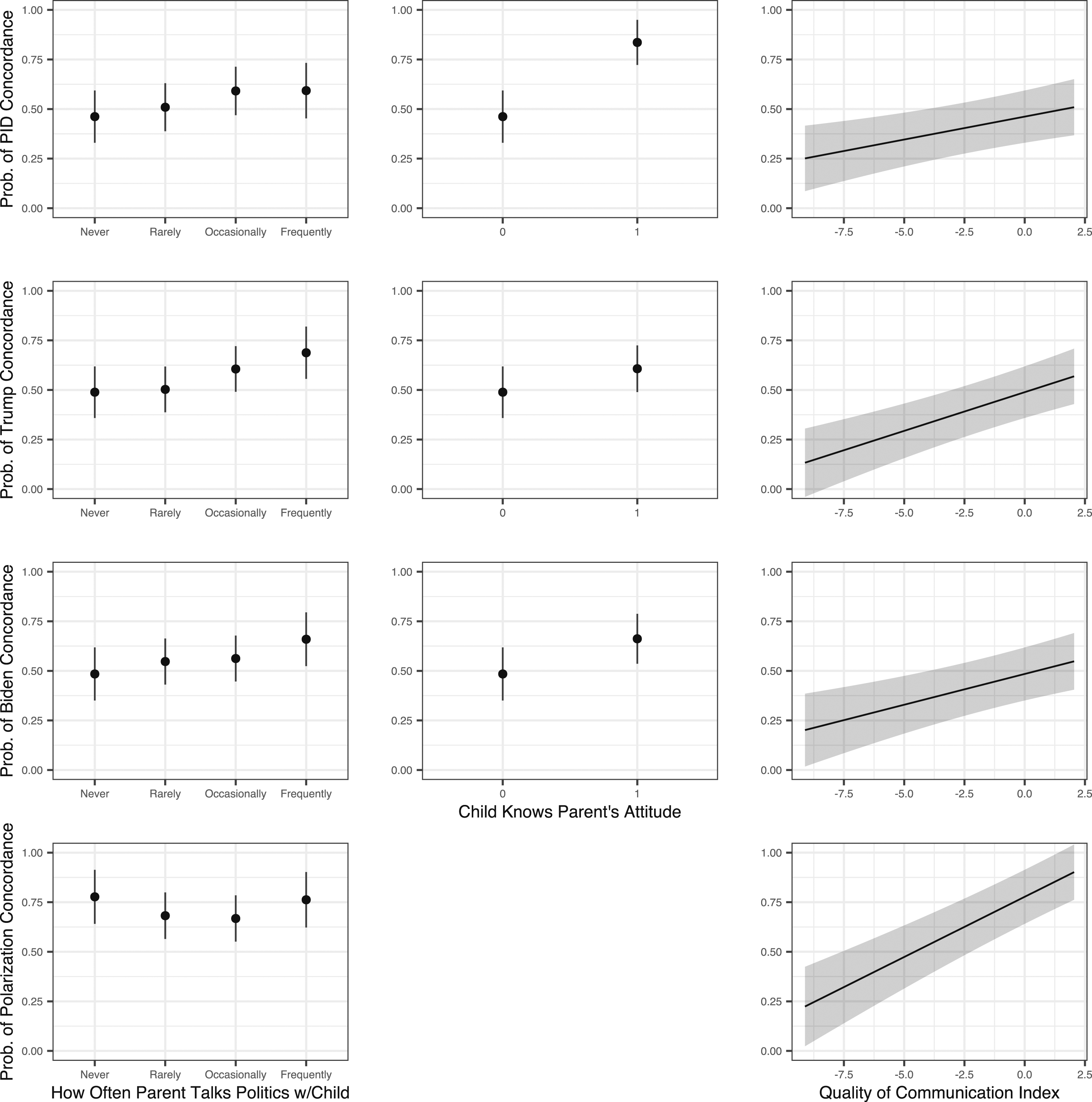
First, regarding Hypothesis 1, the integer-level How Often Parent Talks Politics w/Child covariate significantly increases the probability of intergenerational concordance on the Party ID, Trump Feeling, and Biden Feeling attitudes, but does not have a discernible effect on Trump/Biden Polarization concordance (the one exception noted above). Yet, the coefficients in Table 2 reflect that such improvements in concordance are rather small (ranging from .047 for Biden Feeling to .075 for Trump Feeling) for each step up the frequency of communication ladder (again, measured “Never,” “Rarely,” “Occasionally,” and “Frequently”). Figure 1 adds nuance to the linear results by more flexibly plotting the level-by-level effects of communication frequency. Here, we see that there is generally no systematic increase in concordance when moving from “Never” to “Rarely,” but for each outcome variable except for Trump/Biden Polarization, there is a slope increase moving from “Rarely” to “Occasionally.” In addition, there is another significant jump from “Occasionally” to “Frequently” with respect to the affect-laden Trump and Biden Feeling concordances. Frequency of communication reliably increases concordance in Party ID and Trump and Biden Feelings. While the effects are statistically significant, the substantive changes in the probability of concordance are quite small. And as noted, frequency of communication seems to have no impact on the concordance of polarization.
On the other hand, Hypothesis 2 receives strong support from Table 2 and Figure 1. Here, the dichotomous indicator for Child Knows Parent’s {Attitude} demonstrates that when children know their responding parent’s Party ID, Trump Feeling, and Biden Feeling,
7
they are more likely to share that parent’s attitude on that dimension (increases in probability of concordance of .374 for Party ID, .118 for Trump Feeling, and .177 for Biden Feeling). While each of these represents a non-zero slope at the .05 level, the substantive impact of such accuracy of perception is striking especially for the Party ID outcome. Figure 2 makes clear that there are stark group differences in Party ID concordance between those dyads where children accurately perceive their parent’s Party ID and those where this feature of political identity is obscured from the child’s knowledge. This finding is fully consistent with those of Tedin (1974), Iyengar, Konitzer and Tedin (2018), and Hatemi and Ojeda (2021). Simply put, children are much more likely to share their parent’s Party ID and affective feelings towards Trump and Biden when such feelings are communicated/modeled visibly by their parents. The magnitude of the effects here are especially impressive given the concurrent inclusion of the Quality of Communication Index which operationalizes our Hypothesis 3.
8
Marginal Effects of Parental Attitudes on Child Attitudes, by Communication Measures.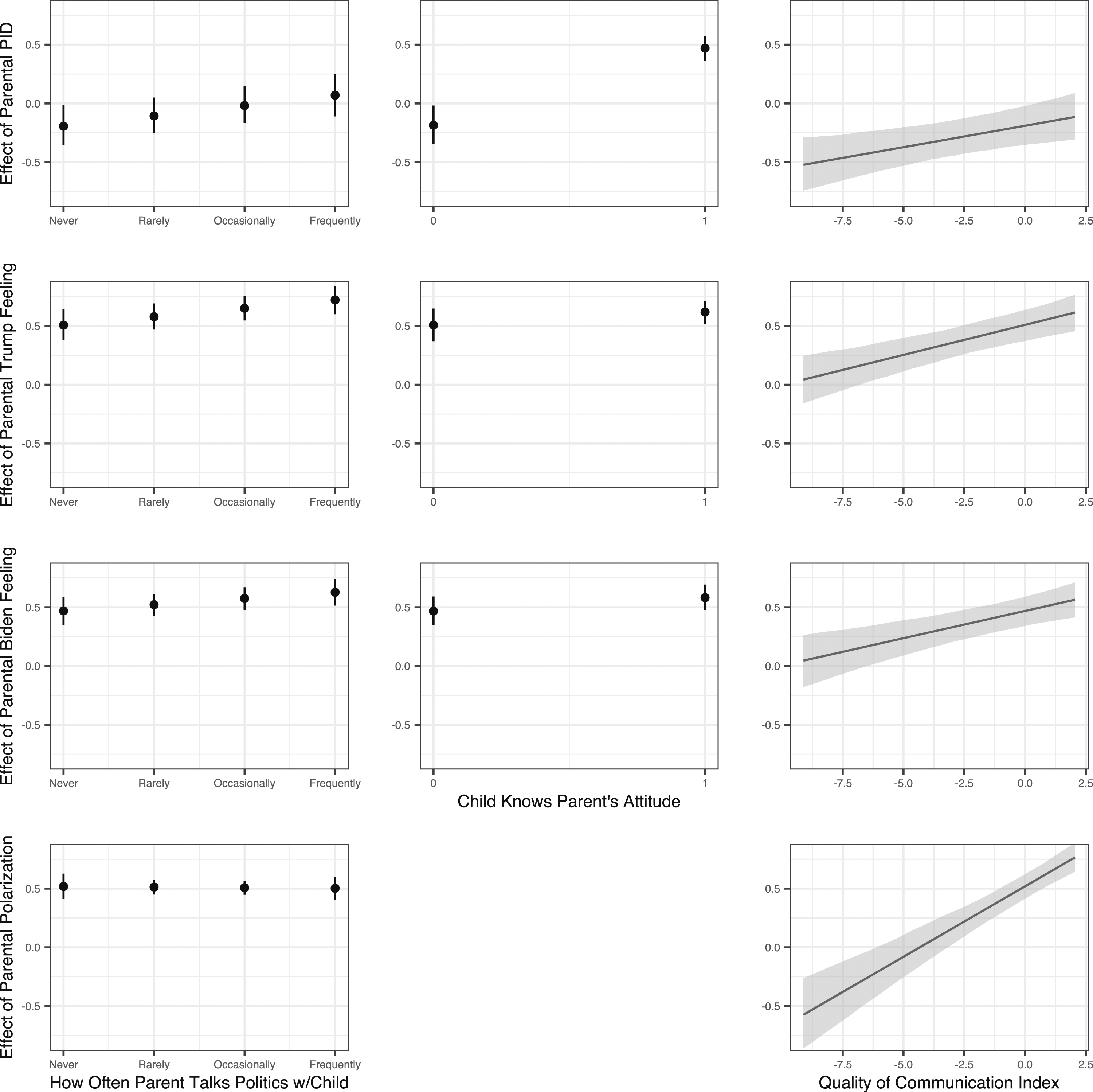
As developed above, Hypothesis 3 represents our extension of the theoretical literature on generational political socialization. We hold that the direct application of social learning theory (as represented in Hypotheses 1 and 2 and the hypothesis tests just described) can be improved upon in this context. In particular, we argue that dyads where both actors can accurately perceive each other’s views indicates conditions of deliberative dyadic social learning. While there is ample evidence here that parental modeling accelerates attitudinal concordance, we additionally expect that parental listening and effective dyadic communication should further increase concordance (controlling for parental modeling). As described, we operationalize this expectation by measuring a dyadic Quality of Communication Index.
Coefficients and effects from Table 2 and Figure 1 provide strong support in favor of our novel expectation. The Quality of Communication Index is a significant determinant of concordance across each dependent variable, with marginal increases in predicted probability that range from 0.023 for Party ID to 0.059 for Trump/Biden Polarization. Figure 2 reflects that the slope of the relationship between QCI and concordance is steepest for the Polarization measure and then less steep for the distinct Feelings measures and for Party ID, but it is substantively important in each case. For example, moving from the least dyadically accurate parent-child combinations to the most is associated with increases in concordance probability of 0.263 for Party ID, 0.448 for Trump Feelings, 0.345 for Biden Feelings and 0.678 for Trump/Biden Polarization (all controlling for other factors). Thus, this Quality of Communication Index is by far the most consequential determinant of concordance in these data using this modeling strategy.
But, could these effects be epiphenomenal? That is, could there be other demographic or environmental factors that drive communicative dyads to share political attitudes without such concordance being driven by a communication mechanism? In the baseline versions of these intergenerational concordance models, we have controlled for a variety of family demographic factors, such as party, race, ethnicity, geographic environment, and region. The most interesting controls for these baseline models are the partisan ones, which allow us to assess whether Democratic or Republican parents have higher rates of concordance with their children on these attitudes. Both Republicans and Democrats were less “successful” at transference of PID than were the non-aligned parents (very few parents were in the other party category, so this is mostly “don’t knows” and independents—those divorced from partisan politics). Thus, it may be that apathy is more strongly modeled than political engagement in our sample. Regarding the remaining outcomes, there is some evidence that dyads with Democratic parents have more concordance than non-aligned and Republican dyads when it comes to Trump Feelings and less concordance in Polarization than the non-partisan groups.
Very few of the remaining control variables appear to condition levels of parent-child concordance. Regarding Party ID, Black and Hispanic respondents have less concordance (compared to White and Non-Hispanic), and those from the South have slightly more (compared to the Northeast reference category). While no controls affect concordance in Biden Feelings, respondents from the South exhibit more Trump Feeling concordance and those in Urban environments display less. Finally, besides Democrat-parent dyads displaying less concordance in Polarization, the only other determinant of such intergenerational similarity is living in a Suburban region, which reflects less concordance than the Rural reference category. This could reflect some differences in parenting styles, perhaps, in which suburban parents are more tolerant of opinion differences in children, or that rural areas were simply more uniform in the broader community’s political views. A more politically uniform community can have a profound impact on children’s socialization (Gimpel, Lay and Schuknecht, 2003).
Including these demographic and regional controls ameliorates some concern regarding spurious findings driven by parenting styles that are highly correlated with these characteristics, but there are also other environmental determinants of political socialization that we should account for. In Appendix F, we additionally control for whether parents and children report being in partisan social “bubbles.” This measure derives from a survey item which asks whether the respondent has friends from both major political parties—if the answer is “no,” we consider an individual to belong to a partisan social bubble. While perhaps more substantively meaningful in the next empirical strategy that we describe, including this variable allows us to account for extra-familial community-based influence on political attitudes. Along these lines, we also measure the responding child’s school context (Home-schooled, Non-Religious Private, Religious Private, or Public) and media consumption habits. In addition, the models in Table F1 and F4 include aggregated political and social characteristics of what can be considered the “neighborhood” of respondents. Our data allow us to match Cook Partisan Vote Index measures at the congressional district level and census measures of median income of the family’s census tract, and the proportion of bachelor’s degree earners in the family’s census tract. Including these social and environmental controls does not change the inferences that we draw from the baseline models from Table 2.
Relative Intergenerational Correlation Models (DV: Child’s Level of …).

***p < 0.001; **p < 0.01; *p < 0.05. Entries are linear regression coefficient estimates and robust (“HC1”) standard errors. For each column, the dependent variable is the child’s response on the question, mapped onto a general ordinal scale (with neutrals/don’t knows in the center). The parent’s response is mapped on the same scale and used as the primary regressor, with positive coefficients thus indicating positive correlations between dyadic responses, controlling for the other included regressors. The reference category for race is “White,” the reference category for local environment is “Rural” and the reference category for region is “Northeast.”
Here, a child’s response to the outcome question is modeled as a linear function of their responding parent’s answer to the same question and a battery of control variables. 9
For example, for the Party ID outcome, a child’s Party ID response is the dependent variable, and parental Party ID is the main regressor. Since other control variables are included, the coefficient on the parental Party ID term is the conditional correlation between generational attitudes. To examine how relative generational similarity varies by context, we can measure how such conditional correlations respond to contextual modifiers with multiplicative interaction terms. Thus, in order to assess how our hypothesized communication mechanisms condition intergenerational similarity in the child’s Party ID outcome, we can interact each communication measure with the parent’s Party ID term. The constitutive term for parent’s Party ID now gives the baseline conditional correlation with all communication measures set to zero, and the separate interaction terms estimate the changes in intergenerational correlation that come with one unit increases in the respective communication measures. Thus, for each outcome variable, we replicate this strategy of modeling the child’s response as a function of their parent’s response conditional on communication quantity (Hypothesis 1), accuracy of perception (Hypothesis 2), and dyadic communication quality (Hypothesis 3).
Table 3 reports results from each relative intergenerational correlation model and Figure 2 visualizes, for each outcome attitude down the rows of the figure, the marginal effects of the parental attitude on the child attitude (i.e., the conditional correlation) as modified by the communication measures (across the columns of the figure).
It is clear that parental responses strongly predict child responses in general. These are non-nested models (with different outcomes), so it is difficult to statistically compare effect sizes across columns of Table 3, but the Trump Feeling, Biden Feeling, and Trump/Biden polarization effects are cardinally larger than intergenerational relative congruence in Party ID. That this is consistent with the correlations in Table 1 and the cross-tabulations from Appendix Tables D1-D3 indicates that parent-child congruence in affective polarization is a strong empirical pattern in the United States. Affectively polarized parents tend to have affectively polarized children, in addition to the axiom regarding Democratic parents raising Democratic children, Republican parents raising Republican children, and (most strikingly from Table 2), disaffected parents raising disaffected children.
Support for Hypotheses Across Outcomes From Table 3.

Of these mechanisms, it is clear that Hypothesis 3 regarding the “Quality of Communication Index” exhibits the most consistent support and contributes most to the importance of this research. Before fully interpreting and contextualizing this contribution, though, we will cover some interesting aspects of these findings with respect to the particular outcomes studied.
First, regarding the Party ID outcome, Figure 2 demonstrates that there are significant negative correlations between parental and child Party ID when there is “Never” any political communication within the dyad, when the child does not accurately perceive their responding parent’s Party ID, and when the Quality of Communication Index falls below its mean value. Reading down the second column of Table 4 tells us that each communication mechanism significantly conditions the marginal effect of parental Party ID, thus allowing positive correlations in many cases, consistent with previous literature. Still, it is telling that when communicated is both low in frequency and low in quality, parents and children tend to have partisan attachments that move away from each other in these models. There may be an important distinction to be made here between the frequency measure and the perception measure. The causality may be more complicated with frequency of conversation. Perhaps the parent and child had, via some form of earlier communication, established that they had strongly different political views, and thus don’t engage in conversation at all or only rarely, in which case it is the gap in views that causes the communication to be infrequent. But the perception index is relatively immune from this type of causality. It seems unlikely that a lack of concordance causes a misperception, and more likely that poor communication causes a misperception and a subsequent low level of concordance.
Second, the extent to which quantity of communication (Hypothesis 1) and perceptual accuracy (Hypothesis 2) significantly conditions intergenerational attitudinal correlation is inconsistent across the affective attitudes measured towards Trump and Biden. This contrasts with the Table 2 results regarding absolute concordance where both hypotheses were supported with respect to both outcomes. Here, when it comes to more relative intergenerational patterns, the logic of Hypothesis 1 does not explain familial socialization with respect to Biden Feeling and Hypothesis 2 falls short in explaining Trump or Biden similarity. These are perhaps surprising findings given the salience of these affective measures and the previous literature on communication and modeling in the social learning theory framework.
Our novel Quality of Communication Index (Hypothesis 3), on the other hand, excels in explaining variation in intergenerational correlations, particularly with respect to the person-oriented attitudes towards Trump, Biden, and the polarization of these attitudes. The Quality of Communication Index is constructed to have a mean of zero, so looking at the right side of each 4th column plot in Figure 2 is illustrative of the correlations for dyads where communication is qualitatively strong.
As noted above, Hypothesis 3 is supported with respect to the Party ID outcome, but at no point on the QCI scale does parental Party ID positively predict child Party ID. This is a surprising and illuminating finding that should be probed in future research. Intergenerational similarity in Party ID is apparent in the cross-tabulations, but such correlation is driven entirely by the accurate perception of parental attitudes (middle column, top row of Figure 4 makes this clear). Thus, with respect to Party ID, Ojeda and Hatemi (2015) appear to have identified the most plausible mechanism of intergenerational socialization.
By contrast, our unique dyadic accuracy formulation of communication quality goes above and beyond the standard account of social learning theory in explaining the other outcomes. The steep slopes found in the rightmost column of Figure 4 indicate that parent-child attitudinal agreement are more likely than not if and only if (controlling for other factors) the pair communicates in a dyadically accurate way (as measured by our Quality of Communication Index). This is an important finding suggesting that our proposed communication mechanism is at play in explaining socialization in our sample.
Discussion
On the whole, our data confirm the continued relevance of familial socialization in explaining the intergenerational persistence of political attitudes. Children in our sample (who are younger than those in most similar studies) empirically respond to 1) the quantity of political communication with their parents, 2) explicit modeling of parental attitudes (reflected in a child’s perceptual accuracy of these views), and 3) dyadic communication quality—crucially including parental attention to their child’s attitudes. Parental modeling explains much intergenerational congruence, but it does not explain all, especially with respect to attitudes regarding feelings about Trump, Biden, and affective Trump/Biden Polarization. This research allows us to offer an update to social learning theory (by applying social cognitive theory (Koerner and Fitzpatrick, 2006) to political socialization in the United States) that acknowledges that parents are not passive models in the socialization process of their children. Instead, our theory and evidence implies that when parents listen to and engage their children about politics, they are more likely to see their offspring share their own political attitudes. Dyads where parents and children are mutually attuned to each other’s attitudes produce the largest and most consistent intergenerational correlations in our data.
In addition to supporting our Hypothesis 3, empirical confirmation of this third mechanism increases our confidence that these attitudes are transmitted rather than shared by happenstance. We are not certain as to the causality of this relationship. It is most likely that parents and children who effectively communicate their political views will tend to have greater commonality in those views. But it is also possible that parents and children who have similar views, tend to communicate more effectively. It is also quite plausible that parents and children who increasingly find themselves diametrically opposed politically will communicate less often and/or more ineffectively. If either of both begin to shift their views, the lack of communication may lead to inaccuracy. Regardless of the dynamic—downward, upward or mixed socialization—the conclusion that the most accurate perceptions are associated with the strongest parent-child correlations reinforces the critical role that political discussions play in American households.
Another significant contribution of this work is evidence that polarization appears to be passing from one generation of Americans to the next. We have demonstrated (column 4 of Table 3) that one of the best predictors of a child’s level of polarization is whether their parent is polarized. Given how sizable a problem polarization is for the American political system, discovering that it is concordant from generation to generation is an important practical finding. Polarization in children is relatively difficult to understand or predict, in that many of our control variables show no effect on a child’s polarization. For middle school-aged children, parents are the most important source of polarization.
Further, the discovery that parents are at least as likely to share their polarized affect-laden perspectives with their children as they are to share their partisan affiliation is troubling. In his early work on children and politics, Greenstein (1965) noted that before children form opinions on issues, they develop party preferences, which he theorized served as “a link between the child, his parents, and other significant individuals and groups” (74). It is likely that children’s polarized perspectives, steeped in emotion and facilitated by communication with parents, are the building blocks for subsequent perspectives on a host of policy issues. Thus, just as affective partisanship has been shown to filter and shape policy positions in adults, polarized perspectives in children may serve to limit the range of “acceptable” public policies, link them to extreme ends of the political parties, and guide the development of their cognitive understanding of politics.
We, like many scholars who study polarization, are also intrigued by the possibility that our research could suggest a normative solution to our hyper-polarized politics, or at least a potential way to stop its intensification. We regret we find no such hope in this research at first cut. It seems likely that polarization, perhaps best defined simply as the hatred and demonization of the other side in American politics, is being passed down from parents to children in America, with remarkable effectiveness.
Yet, in an era when technology and social media are portrayed to have hijacked the role of interpersonal relationships in conditioning political socialization, perhaps this is an illuminating finding. In many American homes, parents and children communicate effectively about politics and share political views. Children learn from their parents—and parents are aware of (and perhaps also learn from) their children’s views. Understanding the familial roots and mechanisms of polarization can assist scholars and policymakers in developing strategies to mitigate polarization. Although our research falls short in recommending such interventions, it suggests that once developed, they could be deployed strategically to help build political bridges, rather than the barricades that we have come to expect in our digital age.
Supplemental Material
Supplemental Material - Listen to Me: Quality of Communication and Intergenerational Political Socialization
Supplemental Material for Listen to Me: Quality of Communication and Intergenerational Political Socialization by Jeremy D. Mayer, Molly W. Andolina, and Robert J. McGrath in Political Research Quarterly.
Footnotes
Declaration of Conflicting Interests
The author(s) declared no potential conflicts of interest with respect to the research, authorship, and/or publication of this article.
Funding
The authors would like to thank participants at the Schar School’s Brown Bag workshop and anonymous reviewers for their helpful comments and suggestions. This research was partially funded by a grant from the Charles Koch Foundation (grant #223514).
Ethical Statement

Data Availability Statement
Data replication file materials for this article are located at https://doi.org/10.7910/DVN/GJNX4T
Supplemental Material
Supplemental material for this article is available online.
Notes
References
Supplementary Material
Please find the following supplemental material available below.
For Open Access articles published under a Creative Commons License, all supplemental material carries the same license as the article it is associated with.
For non-Open Access articles published, all supplemental material carries a non-exclusive license, and permission requests for re-use of supplemental material or any part of supplemental material shall be sent directly to the copyright owner as specified in the copyright notice associated with the article.
