




Abstract
Supreme Court justices sometimes strategically use unanimity in an attempt to bolster the legitimacy of a court ruling and of the court itself. Do unanimous court rulings promote legitimacy? We pair evidence from three experiments based on real Supreme Court cases (including rulings on Donald Trump’s ballot eligibility) with observational analyses of the General Social Survey (1975–2024) to examine the influence of unanimity in more realistic environments than used in prior studies. Contrary to the belief that judicial consensus signals impartiality and bolsters legitimacy, we find that unanimity has little to no consistent effect on decision approval or broader evaluations of SCOTUS. Unanimity also does not reliably improve attitudes among people predisposed to disagree with the Court’s rulings. These findings challenge assumptions about judicial strategy and raise broader questions about the role of consensus in institutional legitimacy.
Donald Trump was re-elected President in November 2024. 1 This possibility was in legal jeopardy during late 2023, however, as he had been disqualified from appearing on ballots in Colorado and Maine due to his role in the January 6th insurrection. The US Supreme Court heard his appeal of these decisions in February 2024. Ultimately, SCOTUS unanimously ruled in favor of the former president thereby clearing the way for him to continue his candidacy. The justices took some pains to arrive at, and communicate, this unanimity. Metadata on the concurring opinion written by the liberal justices, for instance, suggests that at least one was going to dissent before being convinced otherwise (Stern 2024). Justice Amy Coney Barrett, meanwhile, authored a concurring ruling explicitly highlighting the unanimous nature of the Court’s decision: “For present purposes, our differences are far less important than our unanimity: All nine Justices agree on the outcome of this case. That is the message Americans should take home” (Trump v. Anderson, 144 S.Ct. 662, 218 L.Ed.2d 1 (2024), 14).
The effort taken to obtain and communicate a united front regarding this ruling may have reflected concerns regarding the Court’s legitimacy. The Supreme Court’s power stems from the deference of others. However, the rightward drift of SCOTUS over the past decade has significantly dented its public evaluation (Clark et al. 2023; Copeland 2024; Gibson 2024; Jessee et al. 2022). The possibility of a Supreme Court dominated by Republican appointed justices casting a narrow vote to effectively exonerate Trump for his part in the January 6th insurrection was seen as a further landmine threatening the Court’s already ailing legitimacy (e.g., Schoenherr and King 2024). SCOTUS has consistently turned to consensus as a potential means for addressing these types of legitimacy concerns. Chief Justice John Marshall helped establish a “norm of consensus” in the early 19th century as a means of bolstering the prestige of the Court (Epstein et al. 2001; Sunstein 2014). A concern with unanimity and legitimacy can likewise be seen in landmark cases such as Brown v. Board of Education where Chief Justice Earl Warren worked assiduously to obtain a unanimous ruling to bolster its legitimacy (Kluger 2011) or in Justice Stephen Breyer’s concern that the split ruling in Bush v. Gore “runs the risk of undermining the public’s confidence in the Court itself” (Bush v. Gore Bush v. Gore, 2000, 157–58). Current Chief Justice John Roberts is no stranger to these ideas. He explicitly highlighted the goal of obtaining more unanimous decisions when taking on the role of Chief Justice with the hope that doing so would mean “having the Court acquire more legitimacy” (Rosen 2007).
Do unanimous rulings preempt negative evaluations of the ruling and the court that issued it? Existing work on this topic provides some evidence in favor of these possibilities (Gibson et al. 2005; Salamone 2014, 2018; Zilis 2015; Zink et al. 2009). However, this work is limited in two important ways that we seek to address. First, existing studies of the direct influence of unanimity utilize experimental methods to investigate reactions to hypothetical cases or decisions. It is thus unclear whether unanimity matters in relation to real-world decisions where people may have stronger prior attitudes and where the stakes are higher. Second, these studies focus on approval and acceptance of a ruling without considering the potential influence of unanimity on attitudes towards SCOTUS itself. 2 This is an important omission given the role that some justices ascribe to unanimity per the examples discussed above.
We examine the effects of SCOTUS unanimity via two studies that enable us to investigate its influence in far more realistic contexts than preceding research. First, we predict confidence in the Supreme Court as measured on the General Social Survey (1975–2024) with a measure of the extent of unanimity in the Court’s rulings during the month prior to the respondent’s interview date. This provides us with a window into the total influence of unanimity on Court attitudes across an extensive time frame. Second, we extend prior experimental work via three pre-registered experiments fielded over the course of a three-wave panel survey. 3 The first experiment involves the Supreme Court’s unanimous ruling for Trump in his ballot eligibility case while the final two experiments focus on unanimous rulings regarding the abortion drug mifepristone and the validity of state laws restricting the moderation powers of social media platforms. These experiments enable us to investigate the potential direct (or unmediated) influence of unanimity both on attitudes regarding the rulings themselves, as done in prior experimental research, as well as on attitudes towards SCOTUS as an institution. Ultimately, we find little evidence that unanimity positively impacts attitudes toward court decisions, or toward the Supreme Court itself, in both studies. We also find scant evidence that unanimity particularly influences those predisposed to disagree with court decisions, which one might expect based on theories of procedural justice (Tyler 2006). These results have important implications for the incentives of justices, and for theories of procedural justice and legitimacy, as we discuss further in the conclusion.
Unanimity and Court Evaluations
The Supreme Court’s power relies on beliefs about its legitimacy to render judgments towards which others should defer (Gibson and Nelson 2014; Tyler 2006). Judicial behavior is thus partially influenced by the need to maintain support from other political actors. For instance, Supreme Court justices use public appearances and shape their rhetoric to focus on topics and themes meant to bolster the Court’s legitimacy (Glennon and Strother 2019; Krewson 2019). Justices may also respond to public opinion or the preferences of other elite actors to preempt discord (Casillas et al. 2011; Hall 2014; Segal et al. 2011). And, per our focus, justices may use consensus as a means for preempting negative reactions although, of course, unanimity may emerge for other reasons as well (Corley et al. 2013; Edelman et al. 2012; Epstein et al. 2001, 2013; Hall and Windett 2016; Sunstein 2014). The goal in each instance is to positively shape attitudes toward the Court and thus increase the willingness of others to defer to its rulings.
To discuss how unanimity might matter for evaluations of the Supreme Court, we need to discuss where these evaluations come from in the first place. Existing research highlights two important influences relevant to the study of unanimity. First, people evaluate institutions, including courts, better when they agree with institutional outputs. For instance, the public evaluates the performance of the Supreme Court more positively when it agrees with the content of its decisions (Hetherington and Smith 2007; Malhotra and Jessee 2014; Krewson and Schroedel 2023). Unpopular rulings may also negatively dent the Court’s broader legitimacy and particularly so with continual rulings of this sort (Bartels and Johnston 2013; Christenson and Glick 2015; Gibson 2024, 2025; Gibson and Nelson 2016; Levendusky et al. 2024; Mondak and Smithey 1997). Second, people also evaluate courts, and other institutions, based on the process by which decision-making occurs (Tyler 2006). In particular, institutions and their outputs are judged more legitimate when decision-making is perceived as open to all sides in a dispute and when decision makers are perceived as unbiased (Gangl 2003; Gibson and Nelson 2014; Tyler 2006). One explanation for the traditionally high levels of SCOTUS legitimacy is the belief that justices are legally principled when rendering decisions (Baird and Gangl 2006; Farganis 2012; Gibson and Caldeira 2011; Ramirez 2008; Scheb and Lyons 2000). Procedurally just decision-making may be especially important for those that disagree with institutional outputs as fair procedures signal that decision makers are not fundamentally biased against you (Baird 2001; Magalhães and Aguiar-Conraria 2019; Werner and Marien 2022).
Unanimous rulings would lead to positive reactions by members of the mass public insofar as they influence the instrumental and procedural evaluations discussed above. Unanimity could plausibly do this via both indirect and direct routes of influence. We expand on the logic of both pathways in turn.
First, unanimity might matter indirectly by influencing the nature of media coverage of SCOTUS. Most people do not directly read Court rulings but instead react to mediated accounts of its behavior (e.g., Boddery et al. 2023; Johnston and Bartels 2010; Nie and Waltenburg 2017). Coverage with a negative tone, for instance, is associated with worse Court evaluations (Zilis 2015). Media framing highlighting the ideological or political motives of justices, meanwhile, tends to negatively impact evaluations because it undermines the perception that the Court behaves in a procedurally just manner (Baird and Gangl 2006; Boston and Krewson 2025; Hitt and Searles 2018; Ramirez 2008; Wedeking and Zilis 2025). Notably, Court rulings with a larger decision majority receive more positively toned coverage that involves a narrower set of media frames focused on legalistic, rather than political, explanations for Court behavior (Johnson and Socker 2012; Lin 2025; Salamone 2018; Zilis 2015). As such, unanimity might matter not on its own but because of how it shapes the type of information that people receive about SCOTUS.
It is possible that unanimity also directly matters, that is, that people more positively evaluate SCOTUS when directly exposed to unanimous rulings. On the one hand, many people rely on simple cues when making inferences about the acceptability of a ruling and hence whether to credit, or blame, the court for making it (Boddery and Yates 2014; Clark and Kastellec 2015; Montgomery et al. 2019; Nicholson and Hansford 2014). Unanimity may operate as such a cue. A unanimous ruling from an ideologically heterogeneous court may provide observers with sufficient information to infer that the decision is congruent with their broader interests or values given that they can find justices on their side of the ideological aisle supporting the decision. Bolsen et al. (2014) find evidence consistent with this possibility in relation to consensus party cues in a non-court setting. Additionally, consensus may signal to observers that the case facts must be strong enough to overwhelm the personal biases of justices and thus that the ruling is well grounded in legal, rather than partisan, motivations. 4 Observers may thus use unanimity as a positive cue regarding the instrumental and/or procedural qualities of a ruling thereby attenuating negative reactions that might have occurred otherwise.
Existing work on this subject lends some credence to the idea that unanimous decisions promote positive evaluations albeit with important limitations. Zilis (2015), for instance, examines the relationship between unanimity and media coverage and, separately, media coverage and decision approval, but does not investigate whether unanimity directly impacts attitudes toward SCOTUS. The relatively scarce empirical work on the direct influence of unanimity indicates that it may promote decision acceptance particularly among those that disagree with the ruling and when it is less salient (Gibson et al. 2005; Salamone 2014, 2018; Zink et al. 2009). However, these studies focus on attitudes toward a hypothetical ruling thereby leaving it uncertain whether unanimity impacts broader evaluations of SCOTUS, for example, its “specific” or “diffuse” support. It is possible that unanimity may fail to influence people’s attitudes about a policy dispute but nevertheless still positively impact the evaluations of the court issuing it. Finally, these studies utilize experimental methods, which maximize the internal validity of the treatment used in the study but leave questions about the broader external validity of treatment effects. Ultimately, the proposition that unanimity positively influences reactions to Court behavior remains in need of further exploration (Sunstein 2014).
We draw on this existing work to advance three hypotheses: 5
Attitudes toward a judicial decision will be more positive when the decision is unanimous than when not
Attitudes toward the judicial body making the decision will be more positive when the decision is unanimous than when not
Unanimity will have a larger effect among those predisposed to disagree with the decision than those predisposed to agree with it
Study 1: Observational Evidence
We begin with observational analyses to investigate the relationship between unanimity and attitudes toward SCOTUS in realistic environments. Specifically, we turn to data from the General Social Survey (hereafter GSS) using data collected between 1975 and 2024. 6 GSS respondents were asked to indicate whether they have “a great deal of confidence, only some confidence, or hardly any confidence” in the Supreme Court. We rescaled this variable to range from 0 (hardly any confidence) to 1 (a great deal of confidence) for our analyses.
One question that can be asked is whether our dependent variable is an indicator of “specific” support towards the Court (i.e., an evaluation of how it is doing its job) or a measure of “diffuse” support (i.e., an indication of the Court’s legitimacy). Separating these two concepts is not always easy given that they are often positively correlated and performance evaluations may influence legitimacy beliefs (Gibson 2025). Gibson et al.’s (2003) analyses suggest that confidence reports are picking up on both types of evaluation, but are more strongly related to the type of performance evaluations core to specific support. If reported confidence is indeed mainly about short-term performance, then it may be the case that our estimates will over-state the influence of unanimity on Court legitimacy. While we cannot examine that possibility with the GSS analyses, the experiments we describe below measure both outcomes and thus enable this type of comparison.
We use data from the Supreme Court Database (Spaeth et al. 2025) to estimate each respondent’s unique unanimity “dose,” that is, the proportion of unanimous rulings made by SCOTUS in the month prior to the respondent’s interview date. 7 We created four versions of this measure. The first is the simplest as it incorporates data from all rulings made by SCOTUS during this time frame. A limitation of this approach is the failure to differentiate between more and less salient rulings, that is, cases more and less likely to reach the attention of the public. Our other measures speak to this concern in various ways. The second measure focuses only on rulings where SCOTUS overruled a lower court as these rulings tend to be more ideological in nature and more likely to be covered in the media (Casillas et al. 2011; Collins and Cooper 2015; McGuire et al. 2009). Our final two measures, meanwhile, utilize data on a ruling’s salience via the Case Salience Index (CSI) dataset (Collins and Cooper 2015; Cota et al. 2026). The first of these indicators measures the proportion of unanimous judgments observed among highly salient rulings with “highly salient” referring to rulings with a greater than median CSI score. This enables an explicit focus on the type of rulings that ordinary people are most likely to be exposed to, but, of course, any cut point for “high salience” will be a bit arbitrary. Our final measure utilizes data from all rulings with CSI data but via the form of a weighted proportion (i.e., unanimity weighted by case salience).
Our data is clustered by time (i.e., respondents are sampled within years) so we use multilevel linear regression models (Steenbergen and Jones 2002). Our control variables include respondent level attributes such as partisanship, ideology, confidence in Congress and the president, and demographics (see Online Appendix A for details). We further control for the following characteristics of SCOTUS rulings in the month prior to the respondent’s interview date: the proportion of 5–4 rulings, conservative rulings, and rulings that involved civil liberties; the average CSI score of rulings; and the total number of rulings issued. Finally, our models incorporate two year-specific predictors: an indicator for the identity of the Chief Justice and a measure of the extent of polarization between justices based on Martin-Quinn ideal point estimates (Martin and Quinn 2002). We include these variables as they may help explain variation in the extent of unanimous Court rulings as well as public confidence in SCOTUS (Bartels and Johnston 2013; Corley et al. 2013; Epstein et al. 2013).
Figure 1 summarizes our analyses with full model results provided in Table OA1. Each facet in Figure 1 provides the coefficient for a unanimity measure from models that either do or do not include covariates. If unanimity increases public confidence in the Court, then we should see positive and statistically significant coefficients. However, all coefficients in Figure 1 are statistically insignificant. Moreover, the point estimates on offer are virtually zero. A common finding thus emerges regardless of measure: unanimity appears unrelated, or at best trivially related, to confidence in the Supreme Court. Unanimous rulings and Supreme Court confidence, GSS analyses. Note. Markers provide coefficients from multilevel models with 95 percent confidence intervals. Each facet provides the coefficient for a different measure of SCOTUS unanimity. “No Controls”: the model did not include control variables; “Controls”: the model included control variables. See Table OA1 for full results.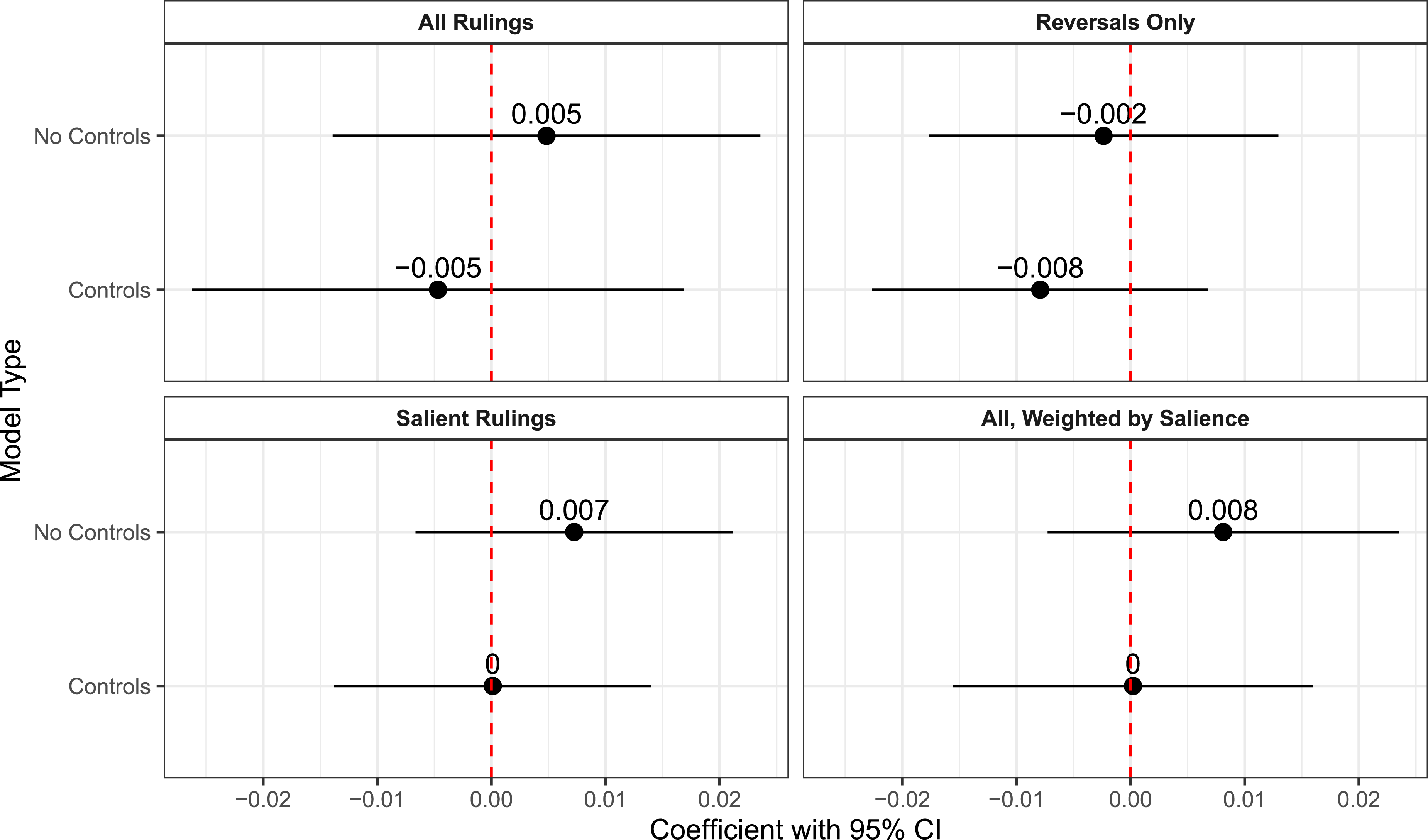
Confidence in the Supreme Court was not greater, on average, in contexts where unanimous rulings were recently more common. However, it is possible that unanimity matters more when rulings go against the respondent’s ideological priors insofar as people who agree with the Court’s decisions simply “take the win” while those that disagree may require some procedural reassurance. We investigated this question by re-specifying the control variable models to also include the full set of interactions between three variables: (1) the unanimity measure, (2) the measure recording the proportion of cases decided in a conservative direction, and (3) an indicator of the respondent’s ideological self-identification (see Table OA2).
8
Figure 2 plots the marginal effect of each unanimity measure (the column facets) by proportion of cases judged in a conservative direction (x-axis) for each value of the moderator (the row facets). If unanimity helps to ameliorate negative reactions among those disagreeing with the Court’s rulings, then we would expect to see: (1) a positive effect of unanimity among liberals when the share of conservative rulings is high and (2) a positive effect of unanimity among conservatives when the share of conservative rulings is low. The evidence in Figure 2 does not follow these patterns. The expected effect of unanimity among conservative respondents is close to zero and statistically insignificant in contexts where SCOTUS is making predominately liberal rulings across all models. A similar pattern emerges among liberal respondents in contexts where SCOTUS is making predominately conservative rulings. Ultimately, we do not find much evidence that more unanimous contexts can mollify, much less positively impact, those disagreeing with court outputs. Unanimity, ideology, and SCOTUS confidence, GSS analyses. Note. Lines provide the average marginal effect of the unanimity variable (column facets) by proportion of cases ruled in a conservative direction (x-axis) and ideology (row facets). Full results are provided in Table OA2.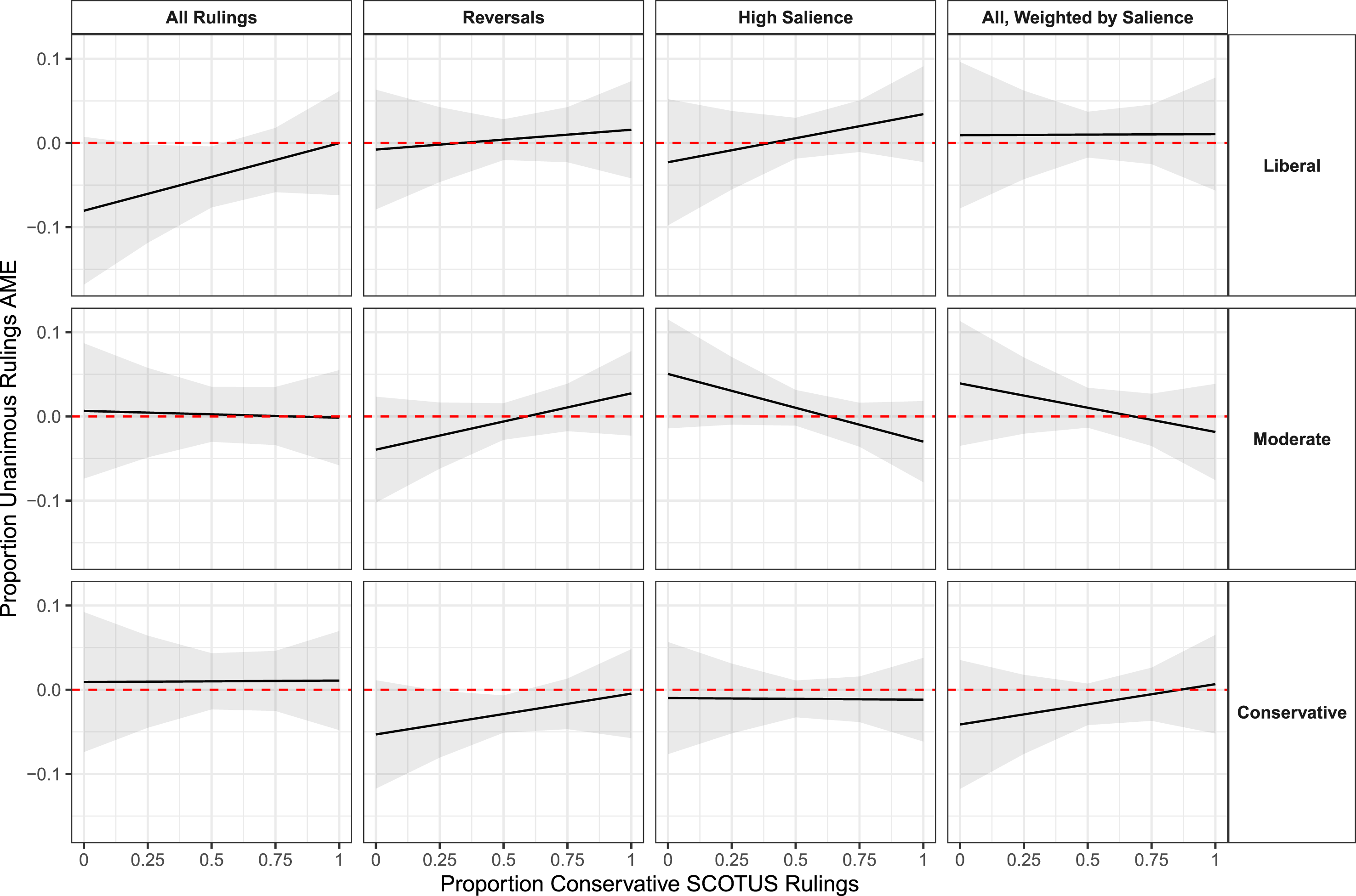
Study 2: Experimental Evidence
Our observational analyses in Study 1 revealed little support for the contention that unanimity affects confidence in the Supreme Court. However, what we can learn from these analyses is limited by their very nature. Even if we had found a positive association, for instance, we would not have been able to show whether people were reacting directly to unanimity or instead to media coverage caused by unanimity. Likewise, the null results seen in Study 1 could emerge due to other features of the environment drowning out the effects of consensus. Finally, while the GSS analyses benefit from a long time-series of data on confidence in the Court (i.e., specific support), these analyses do not tell us whether unanimity influences attitudes toward specific rulings or the broader legitimacy (or diffuse support) of the Court. We thus turn to the results of three pre-registered survey experiments conducted over the course of a three-wave panel survey in 2024. 9
Sample
We recruited an initial sample of 1205 US respondents using the Prolific platform with quota-matching on sex, age, and ethnicity; see Online Appendix B for sample characteristics. This first survey took place on February 7–8, 2024, prior to the Court’s hearing of the Trump ballot case on the 8th. 10 This survey included questions pertaining this case, evaluations of the Supreme Court, and a variety of additional measures that will be used as pre-test covariates. 984 of these respondents then completed the Wave 2 survey between March 20th and April 3rd. 11 This survey included our first experiment and questions related to the two cases at the heart of the final two experiments. These latter experiments were included on Wave 3 of the panel, which was fielded from July 11 to July 25 (n = 835). While our sample is not probability based, Prolific samples tend to be of high quality (Peer et al. 2021) and experimental results generated by convenience samples tend to reproduce results found in probability-based ones (Coppock et al. 2018; Mullinix et al. 2015).
Procedures
The Wave 2 survey began with Experiment 1 which focused on the Trump ballot case. Respondents were first asked how much they had heard about the Court’s decision (see Online Appendix B for question wordings). Respondents assigned to the Control condition were then asked for their approval of the ruling via this question:
12
The Supreme Court recently ruled against Colorado and Maine and for Trump. The Court ruled that states do not have the authority to remove candidates from the ballot in races for federal office under the relevant Constitutional provision. The Court also ruled that only Congress has the power to enforce the relevant Constitutional provision and must do so via legislation. Their decision ensures that Trump can appear on presidential ballots in all 50 states.
All in all, to what extent do you approve or disapprove of this decision?
There were two treatment groups. Respondents assigned to the Unanimous condition read the same question as above but one that began by highlighting the unanimous nature of the court’s ruling on the central component of the case (emphasis added here): “In a unanimous decision, the Supreme Court …”. While SCOTUS did indeed rule unanimously against Colorado and Maine, it also made a secondary ruling concerning the necessity of Congress acting to enforce the insurrection provisions of the 14th Amendment that divided the justices.
13
Respondents assigned to the Mixed Ruling condition were thus also informed about this aspect of the ruling. The first and last sentences of this treatment were the same as above with the remainder reading: The Court ruled that states do not have the authority to remove candidates from the ballot in races for federal office under the relevant Constitutional provision. This aspect of the ruling was a unanimous decision. The Court also ruled that only Congress has the power to enforce the relevant Constitutional provision and must do so via legislation. This aspect of the decision split the Court 5–4.
Experiment 1 focuses on Donald Trump, a figure regarding whom respondents almost certainly had strong prior attitudes. In addition, the ballot case was a highly salient one as we discuss below. Both of these factors could potentially attenuate the influence of unanimity on resulting evaluations (Salamone 2014). We thus fielded two additional experiments focused on rulings not involving Donald Trump to help ameliorate this concern.
The Wave 3 survey began with questions about the Supreme Court and its recent rulings although we randomly manipulated the survey’s order in two ways. First, we randomly assigned respondents to either first evaluate recent SCOTUS rulings and then the Court itself or, alternatively, to evaluate the Court first and then its recent rulings. The battery of questions concerning recent rulings began by first querying respondents about their level of attention to several cases, proceeded to the two experiments discussed below, and then concluded with ruling approval questions regarding the other cases. Second, the order of the two experiments described below was randomly assigned such that respondents could either complete the social media experiment and then the abortion experiment or vice versa.
Experiments 2 and 3 concerned cases where SCOTUS issued a unanimous ruling in June 2024. Experiment 2 concerned NetChoice v. Paxton, which focused on efforts by the states of Texas and Florida to prevent large social media platforms from moderating user posts based on the post’s political content. Respondents read the following question prompt with the unanimity prime featured in brackets: The Supreme Court recently ruled on the case of NetChoice v Paxton, which concerned laws passed in the states of Florida and Texas that restricted the power of social media companies to engage in content moderation of political content posted by users. The Court [unanimously (9–0)] ruled against Texas and Florida, vacating the law and enabling social media sites to engage in content moderation in these states.
Experiment 3 focused on FDA v. Alliance for Hippocratic Medicine, which involved the regulation of a drug used in medical abortions. Respondents read the following question prompt with the unanimity treatment information provided here in brackets for display purposes: The Supreme Court recently ruled on the case of FDA v Alliance for Hippocratic Medicine. The Supreme Court’s [unanimous (9–0)] decision over-turned a lower court ruling that would have led to a ban on the use of the drug mifepristone, which is one of two drugs used in medication abortion. The ruling means that access to the drug can continue.
Experiments 2 and 3 focus on real-world rulings on politically contentious topics much as in Experiment 1. At the same time, there is reason to expect variation when it comes to the prior attitudes of respondents regarding these cases and their attention to the rulings. The abortion case concerned one of the central policy debates in recent US history. The social media experiment, on the other hand, involved a technical ruling on a state law with which most respondents were likely only dimly aware. The three rulings not surprisingly differ in terms of media coverage with the Trump ballot eligibility and abortion rulings receiving an 8 out of 8 CSI score while the social media ruling received only a 1 on this measure. Self-reported attention to the rulings was similarly varied. Respondents were asked whether they had “heard or read” a lot, a little, or nothing at all about these decisions prior to the experiments. Attention to the Trump ballot ruling was quite high (33.2 percent, 59 percent, and 7.89 percent, respectively). The abortion ruling received an intermediate level of attention from respondents with three times as many respondents saying that they had heard “nothing at all” on the matter (30.8 percent, 42.7 percent, and 26.5 percent). Finally, respondents were much less aware of the social media ruling with nearly half of the sample saying that they had heard “nothing of all” about it (11.0 percent, 40.3 percent, 48.7 percent). We should thus expect respondents to have particularly weak prior attitudes, and low knowledge, regarding the social media ruling such that it represents a best-case scenario for finding a direct effect of unanimity in our experiments.
Outcome Measures & Models
We analyze four dependent variables. 14 Our first is the respondent’s approval of the ruling on a 1–5 pt scale ranging from strongly disapprove to strongly approve. Our final three dependent variables concern evaluations of the Supreme Court itself. We assessed respondents’ level of specific support for the Court by asking them whether they “approve or disapprove of the way the Supreme Court is doing its job” on a 1–5 pt scale ranging from strongly disapprove to strongly approve. Respondents’ reported their beliefs about the procedures that the Court uses to render its decisions via a four item index adapted from Bartels et al. (2023). These items focus on perceptions of the role of political vs. legal principles in the SJC’s decision-making, the role of factual evidence, and the even-handedness of the Court; see Appendix OB for question wordings. Higher values on this scale indicate a more positive assessment of the Court’s decision-making procedures. Finally, we assess diffuse support with the same three-item scale used by Gibson (2024, 2025) wherein higher values on the index indicate a greater belief in the legitimacy of the Court. We rescale all items to range from 0 to 1 for the analyses below.
Results
Hypotheses 1 and 2 hold that decision approval and Court evaluations will be more positive when the decision is unanimous than not. We examine these hypotheses by regressing each dependent variable on indicators for treatment assignment and a battery of pre-test covariates. 15 Per our pre-analysis plan, we control for attitudes regarding the case in question (e.g., did the respondent want SCOTUS to rule for or against Trump), party identification, ideology, political interest, case awareness, and demographics in all models. These models also include general attitudes toward democracy and the rule of law given their influence on SCOTUS evaluations (Gibson and Caldeira 2009). Finally, the models analyzing evaluations of the Court itself include the respondent’s score on the dependent variable from the preceding survey wave. These covariates substantially predict the dependent variables and thus increase our power to detect smaller treatment effects (Clifford et al. 2021; see the discussion in Online Appendix D for further details).
Figure 3 plots the OLS coefficient for treatment assignment from models predicting each dependent variable; see Table OB2 for full model results. Ultimately, Figure 3 provides scant evidence in favor of Hypotheses 1 and 2. Assignment to the Unanimous condition yields a consistently small, and statistically insignificant, effect in relation to decision approval, specific support, and diffuse support. There is some evidence that respondents assigned to learn about the Court’s unanimity on the Trump ballot case reported more positive impressions of the Court’s procedures (Unanimous Condition: b = 0.03 [0.01, 0.06], Mixed Condition: b = 0.02, [−0.003, 0.05]) although this did not translate into more a positive overall assessment of the Court. However, this result must be considered in relation to the statistically significant negative effect of being assigned to the unanimous condition in the abortion experiment (b = −0.04 [−0.07, −0.004]) on evaluations of the Court’s procedures. Overall, Figure 3 suggests that unanimity is likely to have only a minimal direct influence on Court attitudes. Hypotheses 1 and 2 analyses. Note. Markers provide the OLS coefficient for treatment assignment with 95 percent confidence intervals. Each column represents a distinct dependent variable. See Table OB2 for full results.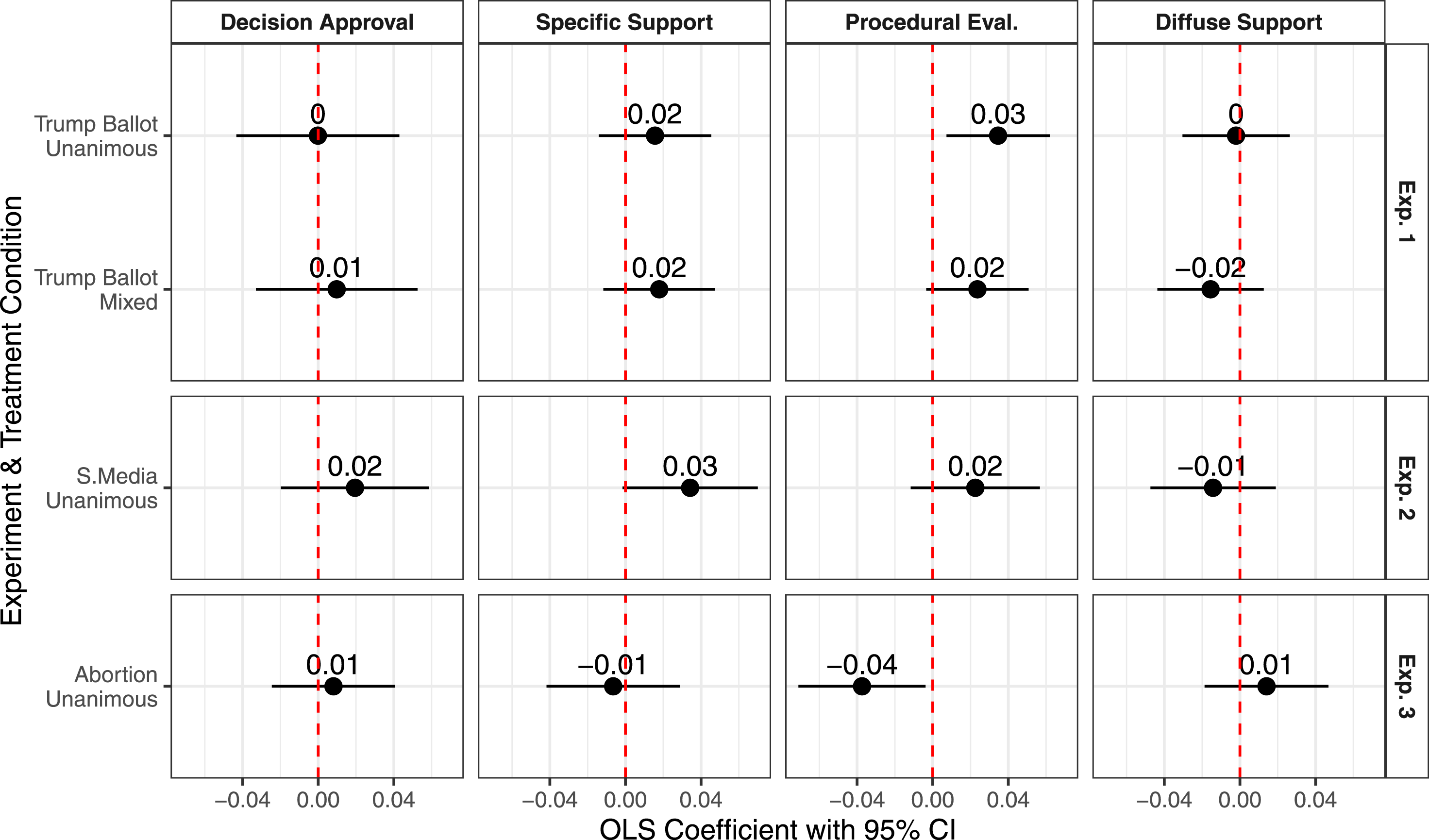
Treatment assignment generally had null effects in Figure 3. However, one concern may be that these null results are driven by pre-treatment, i.e., by individuals having already been exposed to information about SCOTUS unanimity on these cases (Druckman and Leeper 2012; Slothuus 2016). We believe that various aspects of our study design help mitigate against this concern. First, Figure 3 shows null effects even on the social media ruling where the possibility of pre-treatment should be minimized given the lack of attention to this ruling both by the media and by respondents. We also do not see a substantial degree of learning regarding the highly salient Trump case as evidenced by a measure included on both Waves 1 and 2 concerning the constitutional amendment at the heart of the case. Only 44.5 percent of respondents correctly answered this question on Wave 2 with most of these respondents already knowing the answer before the ruling. Among respondents who answered this question incorrectly on Wave 1, only 21 percent selected the correct response on Wave 2. It strikes us as plausible that knowledge and learning is significantly lower on the other two cases given the case attention scores we discussed previously. Second, we examine whether knowledge of the unanimous nature of the ruling for Trump affects Court attitudes among members of the Control group in Experiment 1 using entropy balancing analyses (see Online Appendix D). We again find null effects. We also examine in that Appendix whether pre-treatment political interest and case awareness moderate treatment effects. However, we fail to find consistent evidence that treatment effects were greater among those least likely to have been pre-treated. While we cannot definitively rule out the possibility that pre-treatment is masking treatment effects in our study, we believe that this combination of considerations suggest that unanimity is likely to have a very small effect, if any at all, a finding further bolstered by our observational analyses. 16
Are the null results in Figure 1 hiding heterogeneous reactions consistent with Hypothesis 3? We begin by considering this possibility in relation to Experiment 1 where we pre-registered analyses focused on two moderators measured on Wave 1 of the panel. First, we consider the role of partisanship where H3-consistent evidence would manifest in a larger treatment effect among Democrats than Republicans given that SCOTUS ruled for Trump. Second, we consider prior attitudes related to the case. We use a Wave 1 measure in which we asked respondents what they think SCOTUS should do after hearing the ballot case. Here, H3-consistent evidence would manifest in stronger reactions among those that wanted SCOTUS to either remove Trump from all state ballots or leave matters up to the states.
We re-specified our regression models to include either an interaction between treatment assignment and partisanship or case attitudes to test H3 (see Tables OB3-OB4 for full results). Figure 4 plots the marginal effect of treatment assignment by these moderators. Overall, Figure 4 provides scant evidence in favor of differential reactions by prior attitudes. Reactions to the treatment were broadly the same regardless of prior partisanship with none of the interaction terms in Table OB3 being statistically significant. This pattern is broadly replicated when considering prior case attitudes with two partial exceptions. Specifically, assignment to the Unanimous (but not Mixed) condition is associated with positive treatment effect on specific support and procedural evaluations in Experiment 1 among those that preferred that SCOTUS remove Trump from state ballots. However, the effect among this group is not significantly different from the one seen among those that wanted the Court to let Trump remain on the ballot. In general, unanimity simply did not greatly move respondents regardless of prior attitudes in Experiment 1. Moderation by PID and case attitudes, Experiments 1 & 2. Note. Markers provide the marginal effect of treatment assignment (with 95 percent CIs) by either partisanship (Plot A) or prior case preference (Plot B). Empty circles indicate a non-significant effect. Ind. = Independent. Remain = Court should rule to let Trump remain on ballot. Remove = Court should rule to remove Trump. States Decide = Court should rule that the states should decide. See Tables OB3-OB4 for full results.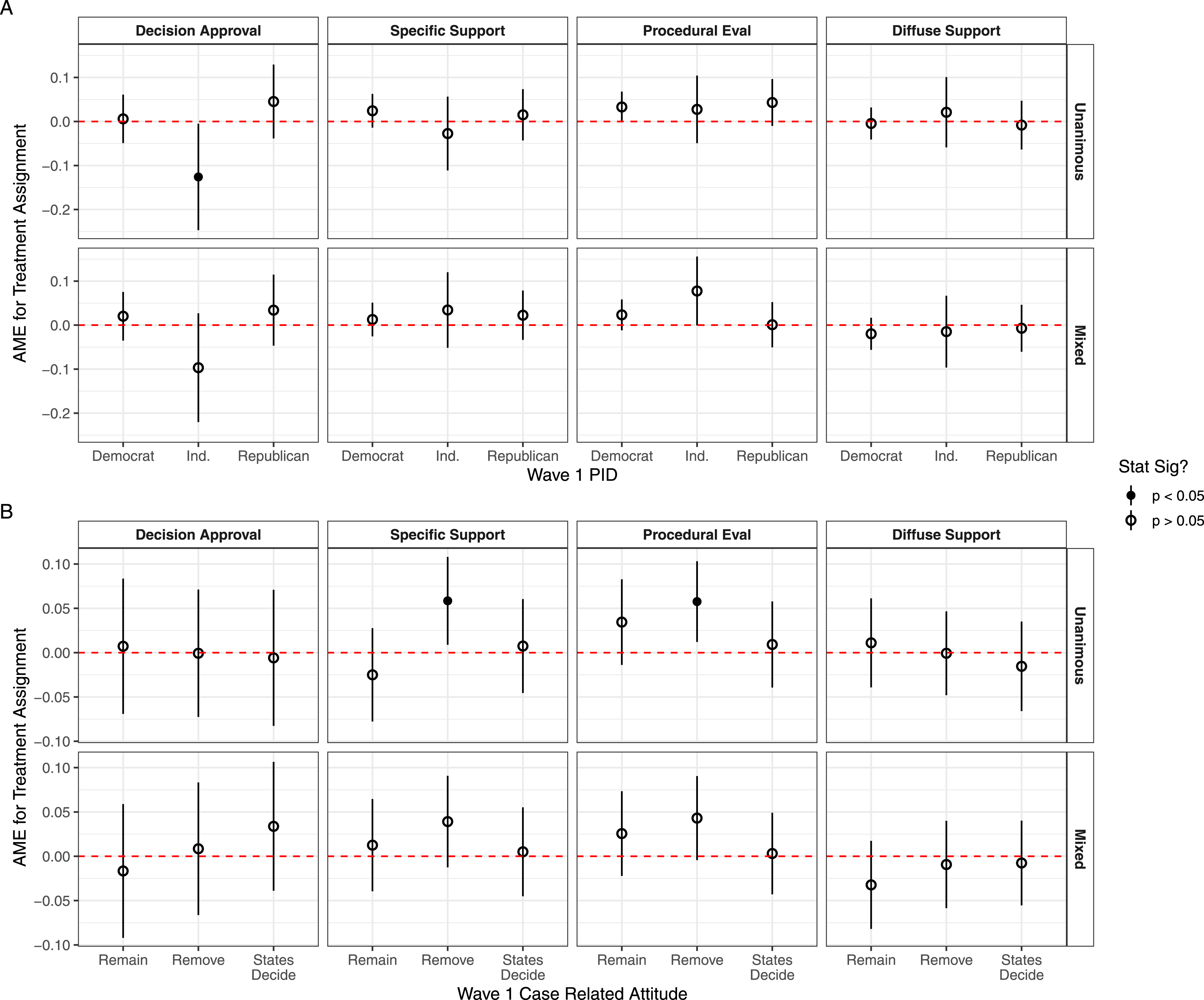
Did unanimity have heterogeneous effects in Experiments 2 and 3? Our pre-registered analyses focus on prior attitudes regarding the topic of the ruling as measured on the Wave 2 survey. We measured attitudes regarding social media content regulation via the following question: “Some people believe that state governments should have the ability to limit the ability of large social media platforms to engage in content moderation of political content posted by users. Other people believe that social media companies possess a right to do so under the First Amendment.” Respondents could either indicate that state governments should have this ability (28.3 percent) or alternatively that social media platforms have a right to moderate content (71.7 percent). Evidence consistent with H3 would manifest in a larger effect of unanimity among those that said that states should have the right to limit social media platforms from moderating content.
We assessed respondents’ abortion attitudes via two Wave 2 measures. First, we asked respondents how much they approved or disapproved of the Dobbs ruling on a 1–5 pt. scale (higher = approve; Mean (SD) = 2.23 (1.53)). We also asked respondents whether they thought that abortion should be legal in all cases (=1), legal in most cases (=2), illegal in most cases (=3), or illegal in all cases (=4; Mean (SD) = 1.88 (0.87)). Responses on the two items were highly correlated (r = .64). We rescaled each item to a 0–1 range (higher = more conservative abortion attitude) and then averaged the items together (Mean (SD) = 0.3 (0.31)). If unanimity matters more for those that disagree with the substance of a ruling, then we should find larger treatment effects as we move from the minimum to maximum on this item.
We analyze H3 by re-specifying our models to include an interaction between treatment assignment and the prior attitude measure. Figure 5 illustrates our results by plotting the marginal effect of being assigned to treatment by prior attitude (see Table OB5 for full model results). There is no evidence in support of H3 when it comes to the social media experiment. Respondents whose prior attitude conflicts with the Court’s decision do not report higher approval of the ruling, or the Court itself, when unanimity is present than when it is not. Indeed, the only time that unanimity matters is for those predisposed to agree with the ruling where we see a positive and statistically significant effect on the specific support measure but not on ruling approval or diffuse support. There is more evidence in favor of H3 in relation to the abortion experiment. Plots 5B (decision approval), 5F (procedural evaluations), and 5H (diffuse support) all show a positively sloped line indicating a more positive treatment effect as we move from those with liberal abortion attitudes to those with conservative ones, although the interaction term is only statistically significant in the diffuse support model (Ruling Approval: p = 0.106; Procedural Evaluations: p = 0.11; Diffuse Support: p = 0.014). Note, though, that the effect of unanimity is only positive and statistically significant among those with more conservative abortion attitudes on one of the dependent variables (diffuse support).
17
Moderation by priors (Experiments 3 & 4). Note. Plots A, C, E, and G consider the marginal effect of being assigned to the Unanimous condition by Wave 2 social media attitude. Plots B, D, F, and H consider the effect of being assigned to this condition by Wave 2 abortion attitudes. See Table OB5 for full results.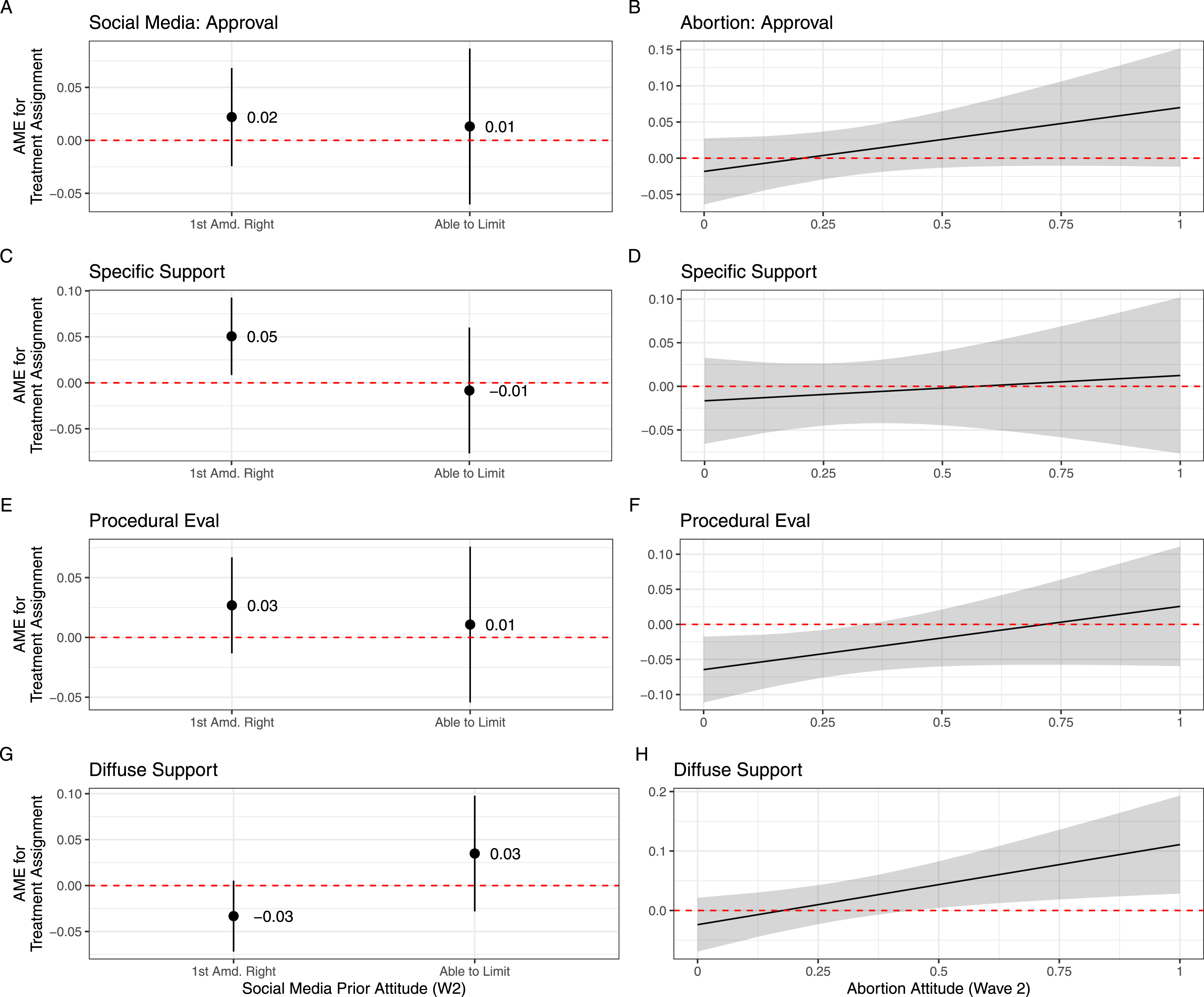
Conclusion
Courts often rule on politically contentious topics. Justices may rightfully worry about whether their rulings in these contexts will negatively impact public evaluations of Court performance and legitimacy. Consequently, justices may be incentivized to show a united front to the public via a unanimous decision. We investigated whether unanimity affects attitudes toward the Supreme Court and its decisions via a combination of observational and experimental methods. In doing so we extend prior work by investigating the potential association between unanimity and Court attitudes in more realistic settings and by focusing on attitudes toward SCOTUS itself rather than just its rulings. Overall, we believe the evidence from both studies best supports a claim that unanimity does not meaningfully impact attitudes toward the Supreme Court or its rulings. Our remaining discussion considers potential reasons underlying these null results and their potential broader implications.
Our first study used observational data drawn from the General Social Survey. We discuss here two robustness checks concerning these null results (see Online Appendix A for further details). The first analysis concerns timing. Survey responses generally depend on considerations accessible at the time of response with accessibility influenced by recent events and media coverage (Zaller 1992). Our analyses thus focused on unanimity in the month (or week) prior to the respondent’s interview date. However, it may be the case that there is a cumulative effect for unanimity such that it is the degree of unanimity over the course of a SCOTUS term that matters. 18 We investigate this possibility by including in our models a measure of the extent of unanimous rulings from the start of the SCOTUS term until the respondent’s interview date. The coefficients for these variables are generally larger in size but typically null with the exceptions representing negative effects. It is possible, then, that a cumulative or gradual effect might exist but also one that may require truly substantive changes in Court behavior (i.e., moving from very few if any unanimous decisions to nearly all unanimous ones) for meaningful differences to emerge. Second, unanimous rulings may only be impactful among those exposed to rulings (and/or media coverage of them) and our attempts to incorporate case salience into our analyses may not fully capture this possibility. Unfortunately, the GSS does not contain measures of case awareness or attention to the Supreme Court. We thus examine the interaction between each unanimity measure and two variables that we expect to be related to attention: newspaper use and education. Our analyses show that the effect of unanimity does not increase with newspaper use in any model. We did find some evidence that unanimity had a positive impact among respondents with a graduate degree but only significantly so with one indicator while unanimity had a consistently null effect among those with “only” a BA degree. As such we believe the evidence that greater awareness moderates the effect of unanimity is paltry at best.
We advanced the argument that unanimity would influence Court attitudes based on evidence from different theoretical perspectives. It is thus worth reflecting on why we instead observed null results. One potential explanation for the lack of results in the GSS analyses could come from the information environment. Whether a ruling is unanimous or not is only one aspect of the information that people receive about Court behavior and it is possible that other aspects of media coverage mitigate its influence on mass attitudes. This is assuming, of course, that ordinary people even hear about this element of a ruling, which may be a strong assumption given generally low levels of political attention and decreasing media coverage of the Court over time (Cota et al. 2026). Of course, we also failed to observe treatment effects when directly exposing people to information about the unanimity of a ruling in our experiments well. One possibility is that we failed to observe treatment effects for methodological reasons. Some respondents in the Control conditions of our experiments may simply have inferred that the Court ruled unanimously in the case which would depress our ability to find treatment effects. Some evidence in favor of this proposition comes from post-test responses to a question asking Control group respondents in Experiment 1 about the size of the majority in relation to the aspect of the case that split the justices. Notably, 31.7 percent of respondents (erroneously) indicated that SCOTUS unanimously ruled on this portion of the case. However, we did not see differences in SCOTUS evaluations between Control group respondents who correctly identified the unanimity of the main portion of that ruling and those that did not, as discussed above, which we believe partially attenuates this concern. Likewise, our pre-test control variables give us the power to detect even small effects (see Online Appendix D). We believe that the bulk of the evidence points to a limited role for unanimity although we cannot rule out that these methodological concerns are contributing to that outcome.
One question that might arise is whether our null results are being driven by the growing polarization of US politics. Democrats and Republicans have become more ideologically sorted over the past 40 years at both the mass and elite levels, such that evaluations of public policies, government performance, and institutions are now more strongly impacted by the partisan implications of these objects (Davis and Hitt 2025; Druckman et al. 2013; Hetherington and Rudolph 2015; Teeselink and Melios 2025). It is thus possible that unanimity might matter more in less polarized contexts. We partially investigate this possibility in two ways with our GSS data given (see Online Appendix A). First, we consider whether unanimity has a stronger effect when polarization on the Supreme Court is lower, but do not find significant evidence in favor of this possibility. Second, we investigate whether the effect of unanimity varies over time by interacting our unanimity measures with the decade of the survey response. Here, we do see some evidence for this time story as the coefficient for unanimity is positive (albeit only statistically significant in one model) during the 1970s. Insofar as SJC justices are guided by a belief that unanimity matters, they may be relying on an older impression that is now moot.
Unanimity did not meaningfully impact participants in our experiments or respondents to the General Social Survey. These null findings have broader relevance to theories of institutional legitimacy and to the Supreme Court’s current legitimacy crisis. On the one hand, while procedural evaluations surely matter for evaluations of institutions and their outputs (Magalhães and Aguiar-Conraria 2019; Tyler 2006), our results are consistent with evidence that their influence is relatively circumscribed relative to more instrumental concerns (e.g., Esaisson et al. 2017). On the other hand, our results ultimately suggest that Supreme Court justices should not hope to hide behind the fig leaf of narrow but unanimous rulings to avoid censure after politically meaningful decisions. If SCOTUS is to regain confidence among the broader US population, then this would seem to require more meaningful changes to the content of its rulings than to its procedural dressings.
Supplemental Material
Supplemental Material - No Shelter in Unanimity: The Limits of Consensus for Supreme Court Legitimacy
Supplemental Material for No Shelter in Unanimity: The Limits of Consensus for Supreme Court Legitimacy by Joshua Robison in Political Research Quarterly.
Footnotes
Ethical Considerations
The experiments were approved by the Ethics Review Committee Social Sciences at Leiden University. An anonymous version of the pre-registration plan for Experiments 1 and 2 can be found  while the anonymous pre-registration plan for Experiments 3 and 4 can be found here.
Consent to Participate
Experimental participants provided informed consent in written form at the beginning of the survey.
Funding
The authors disclosed receipt of the following financial support for the research, authorship, and/or publication of this article: Funding for the experiments was obtained via an internal grant from the Department of Political Science at Leiden University (Stimuleringsbeurs Van Holsteyn).
Declaration of Conflicting Interests
The authors declared no potential conflicts of interest with respect to the research, authorship, and/or publication of this article.
Data Availability Statement
Supplemental Material
Supplemental material for this article is available online.
Notes
References
Supplementary Material
Please find the following supplemental material available below.
For Open Access articles published under a Creative Commons License, all supplemental material carries the same license as the article it is associated with.
For non-Open Access articles published, all supplemental material carries a non-exclusive license, and permission requests for re-use of supplemental material or any part of supplemental material shall be sent directly to the copyright owner as specified in the copyright notice associated with the article.
