



Abstract
The purpose of this study was to examine how a prominent framework of commitment, Johnson’s Tripartite Model, fits within the context of cohabiting same-sex and opposite-sex partnerships to test the applicability of the model to diverse types of relationships. Specifically, this study sought to operationalize the dimension of moral commitment, or the extent to which one feels obligated to stay in a relationship, as this construct has yet to be developed in intimate relationships outside of the marital context. The results provide support for Johnson’s Tripartite Model and provide researchers and counselors with a conceptualization of moral commitment from partners in cohabiting same-sex and opposite-sex relationships.
After the U.S. divorce rate rose in the 1960s, researchers began to focus more intently on the construct of relationship commitment, the intention to remain in one’s relationship, in hopes of increasing the stability of marital relationships (Adams & Jones, 1999). From that body of research, relationship commitment has emerged as the most salient predictor of relationship stability, independent of the level of relationship quality (Adams & Jones, 1997, 1999; Kurdek, 2007). Currently, researchers remain interested in the construct of commitment as it explains, at least in part, why and how individuals make decisions and engage in behaviors in their daily lives to maintain their relationships (Rusbult, Martz, & Agnew, 1998). One challenge in this line of research, however, is that commitment is difficult to operationalize and differentiate from other influencing concepts. Even after 50 years of research, investigators have yet to reach a consensus on the definition, dimensionality, or determinants of relationship commitment.
Further, the majority of researchers who explore relationship commitment focus on married partners. Diverse types of intimate committed relationships, however, are increasingly prevalent in the United States. Two types of intimate committed relationships, in particular, cohabiting same-sex partnerships and cohabiting opposite-sex relationships, are becoming more widespread (Bumpass & Lu, 2000; Kreider, 2010; Smith & Gates, 2001). Accordingly, it is necessary to define and test the models of relationship constructs with a diverse array of intimate partnerships.
Johnson’s Tripartite Model of Commitment
Ongoing debate abounds in the scholarly literature about which theories of relationship commitment best explain the processes of commitment in interpersonal relationships (Ramirez, 2008). One of the most prominent theories of commitment that is gathering increasing empirical support is Johnson’s (1991, 1999) Tripartite Model of Commitment. Johnson (1991, 1999) developed a commitment framework in which he contends that there are three distinct types of commitment (personal, moral, and structural) that are experienced in a unique manner, with each having distinct causes and different behavioral, cognitive, and emotional consequences (Johnson, 1999; Johnson, Caughlin, & Huston, 1999).
In addition to the three types of commitment, Johnson (1991, 1999) further theorized commitment as including two dichotomous dimensions of the commitment experience: (a) the components of attractions and constraints and (b) the internal and external processes that influence one’s decision and behaviors to maintain a relationship. The attractions force of commitment captures the idea that partners want to maintain their relationships based on personal dedication and love. The constraints force of commitment refers to the extent that partners remain in their relationships to avoid the consequences of relationship dissolution (Adams & Jones, 1997; Johnson, 1999). The internal processes that influence relationship commitment refer to occurrences within an individual, such as attitudes, identity, and values. Processes external to the relationship that impact one’s decisions and behaviors to maintain a relationship refer to those forces that exist outside of an individual. These include social pressures, difficulty of terminating the relationship, availability and quality of relationship alternatives, and irretrievable investments into the relationship (Johnson, 1991, 1999).
Types of Commitment
The three types of commitment identified by Johnson (1991, 1999) are personal, moral, and structural. Personal commitment refers to the extent to which a partner wants to maintain their relationship and encompasses the attractions dimension of commitment. Moral commitment is the feeling that one ought to or should remain in their relationship and is a part of the constraints dimension. Johnson (1999) defines the components of moral commitment as relationship-type values, person-specific obligation, and general valuing of consistency. Both personal and moral commitment are a result of internal experiences, such as one’s general and relationship-specific attitudes and values (Johnson, 1999). Finally, structural commitment is part of the constraints dimension and refers to the degree that a partner feels they must or have to stay in their relationship. Structural commitment is a result of external experiences that makes one perceive the dissolution of the relationship as costly (Adams & Jones, 1997; Johnson, 1991, 1999; Johnson et al., 1999; Ramirez, 2008).
Uniqueness of the Tripartite Model
There are a number of facets of Johnson’s Tripartite Model that are unique. First, Johnson (1991, 1999) was the first to propose that commitment was a multidimensional construct. Second, Johnson (1991, 1999) conceptualized moral commitment as a distinct dimension separate from personal and structural commitment. While other researchers have conceptualized commitment as having an attractions force similar to personal commitment, which is predicated on an individual wanting to stay in a relationship (Adams & Jones, 1997, 1999; Ramirez, 2008), Johnson’s (1991, 1999) model also includes a constraining force that includes the dimensions of moral and structural commitment. The majority of other theories, however, only capture the having or needing to components of the constraints force (i.e., structural commitment) and omit the idea that one may feel he or she ought to stay in a relationship (i.e., moral commitment; Adams & Jones, 1997, 1999; Ramirez, 2008).
Most investigators agree that the wanting to (i.e., attractions force) and needing and having to (i.e., constraints force) components of commitment are distinct constructs (Adams & Jones, 1997; Ramirez, 2008; Rusbult, 1991). Some researchers argue, however, that the internal and external dynamics that shape moral and structural commitment are not discrete enough to make moral commitment a stand-alone factor (Rusbult, 1991). Yet, few researchers have developed measures of moral commitment that fully capture the construct as proposed by Johnson (1991, 1999). In multiple studies intended to develop reliable measures of commitment with samples of married partners, researchers have found commitment to be a multidimensional phenomenon consistent with Johnson’s Tripartite Model (e.g., Adams & Jones, 1997; Bagarozzi & Atilano, 1982; Johnson et al., 1999; Ramirez, 2008; Stanley & Markman, 1992). Other researchers have claimed to test Johnson’s (1991, 1999) Tripartite Model in diverse types of intimate committed relationships. In these studies, however, the researchers did not include measures to assess all three dimensions of commitment (Kurdek, 2000, 2007; Lydon, Pierce, & O’Regan, 1997) or defined moral commitment in a manner different from Johnson’s conceptualization (Johnson, 1985; Oswald, Goldbert, Kuvalanka, & Clausell, 2008; Rusbult, 1991). Therefore, the evidence remains inconclusive as to whether moral commitment is truly a distinct construct that significantly influences relationship stability in committed intimate relationships (Johnson, 1999; Ramirez, 2008; Rusbult, 1991).
Rather than leaving moral commitment out completely or defining it outside of Johnson’s (1991, 1999) conceptualization, researchers need to work to create a measure of moral commitment that is consistent with Johnson’s conceptualization and generalizable to those in diverse types of intimate committed relationships, such as cohabiting same-sex or opposite-sex partners. Until this happens, those in the social science fields cannot reach any decisive conclusions about the dimensionality of relationship commitment among diverse types of couples. That is, at this point, it is not possible to substantiate Johnson’s (1991, 1999) assertion that the Tripartite Model is applicable to various types of committed relationships. Then, the purpose of this study was to operationalize the dimension of moral commitment in accordance with Johnson’s (1991, 1999) Tripartite Model of Commitment for those in diverse types of intimate committed partnerships.
Method
The mixed-methods approach of concept mapping was used to develop a structured conceptualization of moral commitment among participants. Concept mapping is a structured process that uses groups to develop a conceptual framework (Kane & Trochim, 2007). The concept mapping methodology used in this study was developed out of the evaluation and program planning literature in business and education, but concept mapping also has been used by the researchers for theory and measurement development around abstract constructs that are difficult to define and quantify (Campbell & Salem, 1999). Concept mapping was selected as a methodology for this study given that no conceptualization of moral commitment for partners in varying types of intimate relationships existed in the literature to this point, despite Johnson’s (1991) claim that his Tripartite Model applies to all committed relationships, intimate or otherwise. Thus, concept mapping provided a process to develop a conceptual framework of the Tripartite Model, particularly the construct of moral commitment, for diverse types of intimate partnerships. The data were collected for this study in three rounds, each with procedures consistent with the concept mapping process as described by Kane and Trochim (2007).
Participant Recruitment
When using concept mapping methodology, there is neither no one way to recruit participants, nor is there an exact lower or upper limit of participants needed to conduct the concept mapping process (Campbell & Salem, 1999; Kane & Trochim, 2007). Although using random sampling and having a broad heterogeneous group involved in the generation of statements phase to produce a variety of viewpoints is ideal, using purposive sampling and smaller homogeneous groups is permissible given what is feasible within a certain population.
We chose to use purposive sampling in order to recruit participants for the focus group component in Round 3 of the methodological process. As the focus group component was set up to be held in person, we purposively centered our recruitment efforts to the local area in which we lived. Limiting the number of participants involved in the focus group helped to make the interpretation process more dynamic and manageable, particularly as the participants had no familiarity with concept mapping before participation in this study. Although using purposive sampling may have resulted in a smaller, more homogeneous sample for this study, the resulting concept maps are not meant to be an all-inclusive framework for understanding the Tripartite Model in diverse relationships. Rather, the concept maps are meant to advance Johnson’s theory by providing a starting point for development of a comprehensive and generalizable measure of personal, moral, and structural commitment. Finally, when reviewing the literature on same-sex relationships, we noted that achieving a heterogeneous sample of same-sex partners in terms of race, education, and socioeconomic status has proven to be difficult for researchers no matter what sampling procedures were used. Thus, the sampling procedures and sample size used in this study are adequate in terms of the methodology and intended applicability of the results.
Participants in this study were partners who self-identified as being in an intimate committed relationship for at least 1 year that was outside of the marital context. Specifically, participants were either in cohabiting same-sex partnerships or cohabiting opposite-sex partnerships. An intimate committed relationship was defined as a relationship in which two individuals share an emotional, romantic, and/or sexual connection, have an influence and mutual reliance on each other (i.e., interdependence), and both intend to share a long-term relationship with one another (Adams & Jones, 1997; Johnson, 1991; Pope, Murray, & Mobley, 2010). Participants were recruited via e-mail listservs at one public university in the southeastern United States and through posting flyers in restaurants and coffee shops in the same city. Additionally, snowball sampling was used as a recruitment method as participants were asked to forward the study information to potential candidates in their social circles.
Round 1
Round 1 of the data collection process involved brainstorming by individual participants to generate statements that represent the conceptual domain of moral commitment for cohabiting same-sex and opposite-sex partners. Participants were asked to read over a brief description of Johnson’s Tripartite Model of Commitment and provided a visual depiction of his model to help facilitate participants understanding of the idea of moral commitment. Next, the focus statement and brainstorming prompts were presented, and participants were asked to fill in the response box with as many ideas as possible. The focus statement read as follows: “Please attempt to form ideas that fit the INTERNAL PROCESSES and CONSTRAINTS COMPONENT of moral commitment. You may consider your experience of moral commitment in your current relationship, your past relationships, or how you would imagine moral commitment in relationships similar to your own.” The brainstorming prompt was intended to help participants generate statements that translated the abstract concept of moral commitment into concrete ideas, and read as follows: “I ought (or feel obligated) to stay in my relationship with my partner because ________________.” Participants completed the survey by providing demographic and contact information to be mailed packets for Round 2 of the data collection process.
Once the statements were generated, the open-ended responses were synthesized by the researchers following concept mapping guidelines for reducing and editing the statement set to (a) ensure that each statement contained only one concept, (b) edit statements for clarity, and (c) reduce the data set to a manageable size for the data analyses (Kane & Trochim, 2007). The purpose of the synthesis was to produce the final set of 75 statements that were used for the sorting and ratings tasks in Round 2 of the data collection process.
Participants
Thirty-four participants completed Round 1 of the data collection process. For the first round of the data collection process, the only demographic question participants responded to was their identification as being in a cohabiting same-sex or opposite-sex partnership. Of the 34 participants, 16 (47%) were self-identified as being in a cohabiting same-sex partnership and 18 (53%) as being in a cohabiting opposite-sex partnership.
Round 2
For Round 2 of the data collection process, participants were mailed data collection packets to complete the structuring of the statements step of the concept mapping process. The data collection packets included a demographic questionnaire, rating task, and sorting task. The synthesized statements were printed onto a rating form, and the participants were instructed to rate each statement based on the rating focus scale developed by the researcher according to concept mapping guidelines. Participants were asked to assess the relevance of each statement based on how true each statement was to the experiences in their relationships on a Likert-type scale of 1 (not at all true of myself) to 5 (true of myself).
The statements were also printed onto small cards for participants to sort the statements into groups that made sense to them based on similarity of the statements (Kane & Trochim, 2007). The stipulations of the sorting task were that each statement could only belong to one stack although a statement can be in a stack by itself, and that participants must create more than one stack of statements (Kane & Trochim, 2007). Participants added a label that described each of their stacks once they finished the sorting process. The sorting and rating of the statements were used to create an objective representation of the conceptual domain of moral commitment.
Participants
All 34 participants from Round 1 were mailed data collection packets. Of these participants, 19 returned their packets by the start of the focus groups, resulting in a 56% response rate. One packet was incomplete. Of the 18 respondents for Round 2, 13 (72.2%) were female and 5 (27.8%) were male. In all, 8 (44.4%) participants identified themselves as being in opposite-sex relationships and 10 (55.6%) as being in same-sex relationships. The average length of participants’ relationships was 7 years, 9 months (standard deviation [SD] = 5 years, 3 months) with a range of relationship length from 11 months to 22.5 years. On average, participants had cohabited for 6 years, 8 months (SD = 7 years), with a range of cohabitation from 2 weeks to 22 years. Additionally, the majority of participants (77.8%) reported having no children together.
Data analyses
The rating task and sorting task data were analyzed to create the following conceptual representations of moral commitment for cohabiting same-sex and opposite-sex partners: (a) the point map, (b) the cluster map, and (c) the point rating map with designated clusters. These concept maps were used during Round 3 of the data collection process to inform the conceptualization of moral commitment in cohabiting same-sex and opposite-sex partners.
A group similarity matrix (GSM), an aggregate of participants’ sort task data, was generated using R editor. The GSM then was used as the input for a two-dimensional nonmetric multidimensional scaling (MDS) analysis in Systat to create the point map. To check the fit of the two-dimensional solution, the stress value of the MDS analysis was calculated. The stress value was 0.25, which falls within the range recommended for concept mapping by Kane and Trochim (2007). Next, an agglomerative hierarchical cluster analysis using Ward’s minimum variance algorithm was run on the coordinates generated through the MDS to produce the cluster map in Systat. Based on the grouping of statements in the cluster map, 10 preliminary clusters were identified. The 10 clusters were drawn onto the point map to create the point rating map with designated clusters, which was created by using the MDS X–Y coordinate values. Additionally, the means for participants’ responses to the statements on the rating task were found using SPSS and these were entered as a third set of coordinates to produce a graphical representation of the rated importance of each statement to indicate participants’ experience in their relationships with their partners.
Round 3
The third round of data collection in this study was the interpretation of the concept maps. Two focus groups took place: one for cohabiting same-sex partners and the other for cohabiting opposite-sex partners. Although all participants completed the same rating and sort tasks during Round 2 of the data collection process, the participants were split into two samples for the interpretation of the resulting maps in order to test the similarities and differences in conceptualizations of moral commitment between cohabiting same-sex and opposite-sex partners.
The participants met a 2-hr focus group to discuss the three maps generated from the concept mapping analysis. The concept maps were presented in the following order: (a) point map, (b) cluster map, and (c) point rating map with designated clusters. Participants were asked to determine the sensibility of the statement groupings (Kane & Trochim, 2007). Participants were allowed to move the items to different clusters based on the similarities of the groupings or to determine some items as outliers if they did not seem to fit into the themes of surrounding clusters. Additionally, the participants negotiated suitable labels to describe the statements grouped in each cluster as they went through the process of deciding the final cluster solution (Kane & Trochim, 2007).
After all clusters were labeled, the participants were given the Relationship Commitment Type Identification Task (RCTIT), in which they were instructed to individually indicate the best fit for each cluster in terms of personal, moral, and structural commitment. Based on the previous disagreement between researchers as to whether moral commitment is a construct distinguishable from personal and structural commitment, the identification of the clusters served to assess whether participants were able to differentiate moral commitment as a separate concept.
Participants
Seven participants attended the focus group for cohabiting same-sex partners and six for cohabiting opposite-sex partners. The majority of the focus group participants were female, with one (14%) male attending the cohabiting same-sex partners’ group and two (33%) attending the cohabiting opposite-sex partners’ group. All participants were Caucasian. All the participants in the same-sex partners’ group had been in their current relationships longer than 3 years, with six (86%) of the participants having relationship lengths over 8 years, whereas most (83%) of the participants in the opposite-sex partners’ group had been in their current partnerships for less than 3 years. Three of the participants in the cohabiting opposite-sex partners group indicated a relationship length between 8 months and 1 year. Moreover, the participants from the same-sex partners’ group generally were older, with the youngest being 29 years old, than the participants in the opposite-sex partners’ group, who mostly (83%) were 29 years of age and younger. Finally, three (43%) of the participants in the same-sex group had children, two having one child together with their current partner and one having one child from her previous relationship with another partner. Only one (14%) participant in the opposite-sex partners’ group had children, reporting four children from her partner’s previous relationship.
Similarity between final cluster solutions
To determine the agreement between statements in the final cluster solutions for participants in the cohabiting same-sex and opposite-sex partners’ focus groups, the researcher used the final cluster solutions from the focus groups as input for an analysis of inter-rater agreement, determined using the Crosstabulation and Kappa statistic in SPSS. The results of this analysis were used to inform the researcher’s interpretation of the similarities and differences between cohabiting same-sex and opposite-sex partners’ conceptualizations of moral commitment.
Testimonial validity
The interpretation sessions, particularly the labeling of the cluster maps by participants, are a means of building testimonial validity into the research design (Bedi, 2006). Testimonial validity is the idea that the researcher’s interpretation of the data, including researcher bias, is checked through eliciting the participants’ understanding of the concept maps. Study participants were the primary interpreters of the concept maps, thus ensuring a more accurate representation of their experiences as reported in the results (Bedi, 2006).
Results
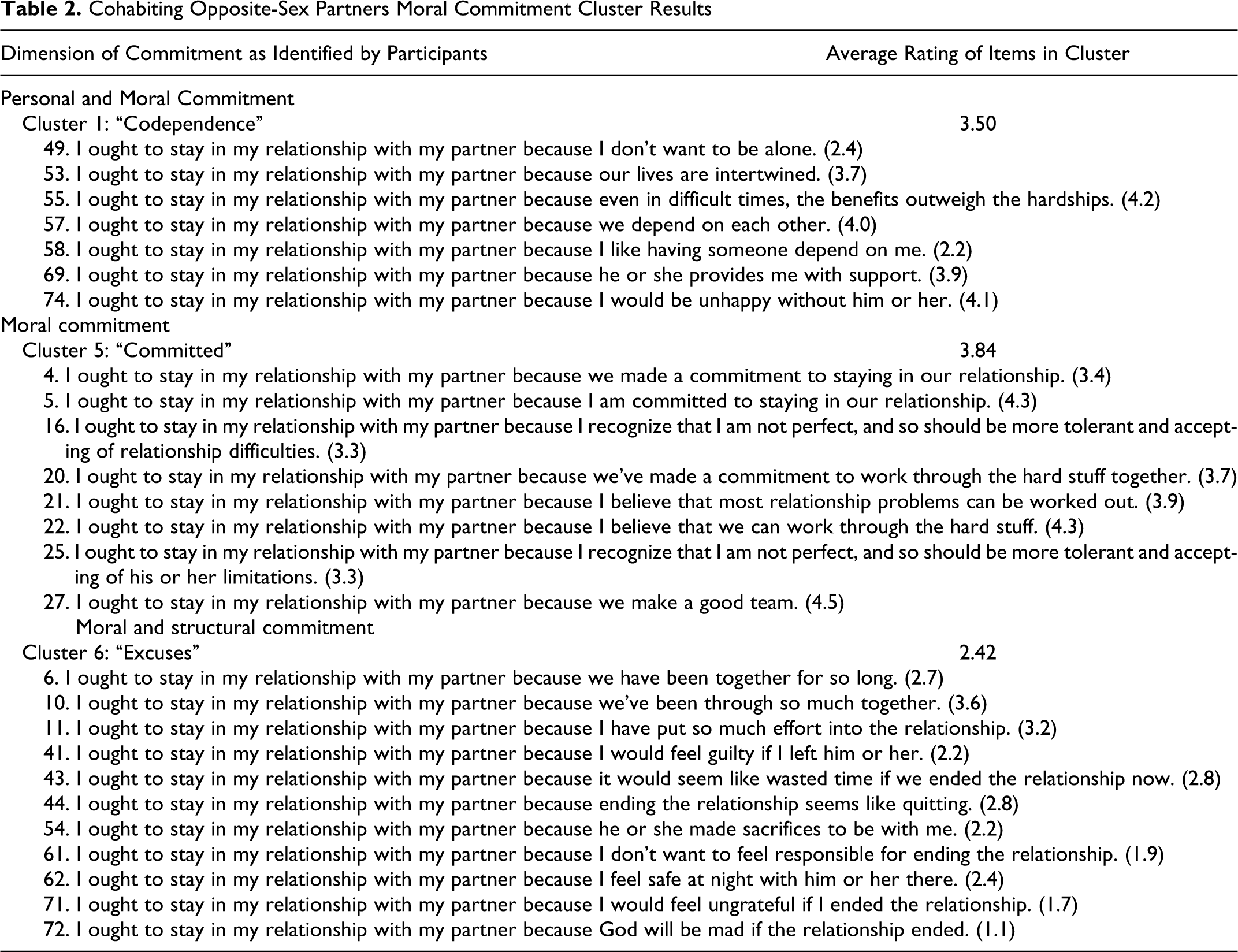
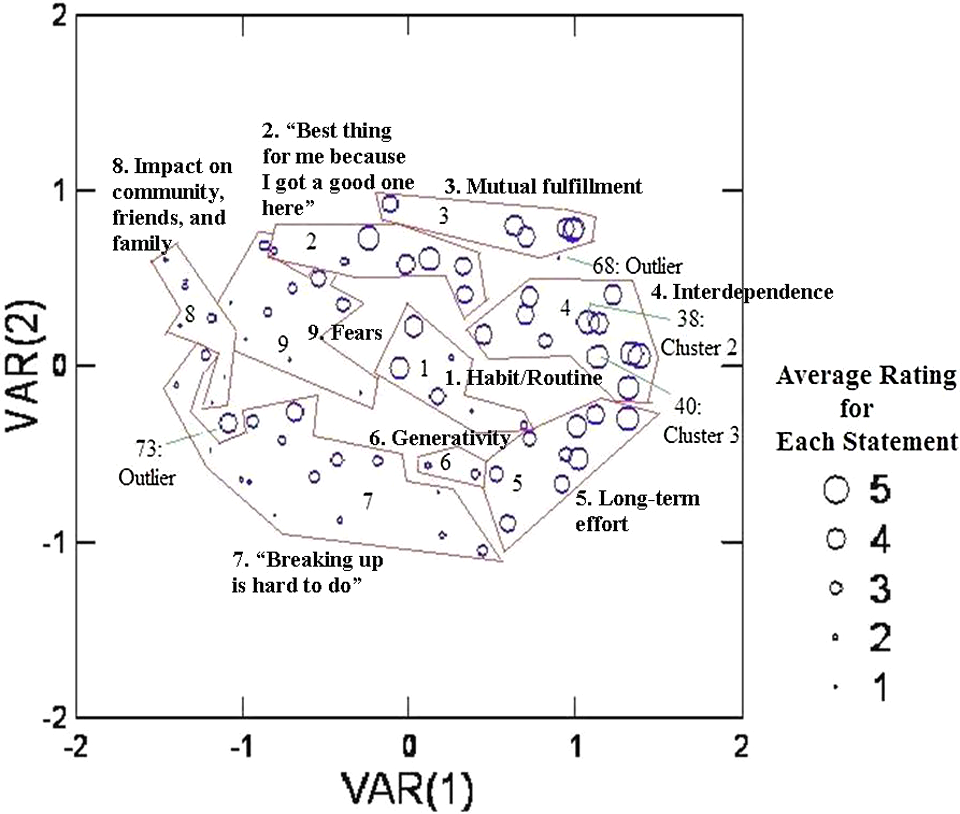
The participants in both groups decided on a final solution of 9 clusters (see Figures 1 and 2). To test whether cohabiting same-sex and opposite-sex partners conceived of moral commitment as a dimension separate from personal and structural commitment, the participants completed the RCTIT. Cohabiting same-sex partners typed 2 of the 9 clusters as descriptive of moral commitment, labeled “Long-term Effort” and “Breaking Up is Hard to Do” (see Table 1). Two other clusters, “Generativity” and “Fears” were equally typed as moral and structural commitment. Similarly, cohabiting opposite-sex partners typed one cluster as descriptive of moral commitment, “Committed” (see Table 2). Opposite-sex partners typed the cluster labeled as “Codependence” equally as personal and moral commitment, and “Excuses,” equally as moral and structural commitment. Moreover, participants rated the clusters typed as personal commitment as most descriptive of their experience in their relationship with their partner, with moral commitment being moderately descriptive and structural commitment the least descriptive.
Cohabiting Same-sex Partners Moral Commitment Cluster Results

Cohabiting Opposite-Sex Partners Moral Commitment Cluster Results
Final point rating map with designated clusters for cohabiting same-sex partners.

Final point rating map with designated clusters for cohabiting opposite-sex partners. Figures 1 and 2 are graphical representation of the clusters as decided by participants during the focus group based on the preliminary cluster map analysis. VAR(1) and VAR(2) represent the x- and y-axis of a two-dimensional scatterplot. Each statement is represented by a circle. The size of each statement (i.e., circle) is based on the averages of participants’ responses to the rating scale (see below) for each statement. For example, participants rated most of the statements in Cluster 5 as being true to their experience in their relationship with their partner, which is represented by the larger circles.
Cohabiting same-sex partners typed clusters of moral commitment with items that perceptibly fit with two of the three components of moral commitment as described by Johnson (1991, 1999), person specific obligation and relationship-type values. The cluster “Breaking Up is Hard to Do” contained items that described obligation to one’s partner, while “Generativity” contained items that described influential values for same-sex partners’ relationships. The clusters typed as moral commitment by cohabiting opposite-sex partners, however, only discernibly described Johnson’s components of person specific obligation. “Codependence” and “Excuses” contained items that described obligation to one’s partner. Neither group had clusters that were overall indicative Johnson’s third component, general valuing of consistency. Finally, both groups identified clusters of moral commitment, entitled “Long-term Effort” by same-sex partners and “Committed” by opposite-sex partners, which contained similar groupings of items that described general values and beliefs about one’s relationship that encourage relationship maintenance. These clusters did not visibly fit with the components of moral commitment as proposed by Johnson (1991, 1999).
Comparison Between Cohabiting Same-Sex and Opposite-Sex Partners
The researchers compared the final cluster solutions for cohabiting same-sex and opposite-sex partners to explore whether there were any distinct similarities and/or differences in their conceptualizations of moral commitment. Using the Crosstabulation analysis in SPSS, the researchers determined the Kappa statistic to be 0.62, indicating substantial agreement (Landis & Koch, 1977) between cohabiting same-sex and opposite-sex partners’ final cluster solutions. As for similarities, both cohabiting same-sex and opposite-sex partners conceived of the person-specific obligation component of moral commitment. Further, both groups conceived of another component, “Long-term Effort” and “Committed,” respectively, which described personal attitudes and beliefs that sustained them through relationship difficulties.
There were also several differences in cohabiting same-sex and opposite-sex partners’ conceptualization of moral commitment. First, cohabiting same-sex partners grouped two items (I ought to stay . . . because I want to have a child with him or her and . . . because our relationship is a model for others in our social network.) into a cluster labeled “Generativity,” consistent with the relationship-type values component of moral commitment. Opposite-sex partners, on the other hand, considered these items to be outliers. The other difference found was that several clusters were similar in composition of statements between groups but were typed as different dimensions of commitment by each group (see Tables 1 and 2 for comparison).
Discussion
Several interesting results were obtained from this study. First, participants’ responses to the RCTIT indicate that cohabiting same-sex and opposite-sex partners were able to distinguish certain clusters as moral commitment distinct from that of personal and structural commitment. Several clusters, however, were labeled as personal and moral commitment or moral and structural commitment by participants. This finding is consistent with Johnson’s (1991, 1999) conceptualization of moral commitment as sharing the internal processes component with personal commitment and the constraints force with structural commitment. No clusters were typed by the majority of participants as personal (internal processes, attractions force) and structural commitment (external processes, constraints force). Thus, the findings from this study lend support to Johnson’s (1991, 1999) theory that commitment is a multidimensional experience and his claim that the Tripartite Model is applicable to diverse types of intimate relationships.
The results provided mixed results in terms of Johnson’s (1991, 1999) conceptualization of the three components of moral commitment: general valuing of consistency, person specific obligation, and relationship-type values. Cohabiting same-sex partners typed clusters of moral commitment with items that perceptibly fit with person-specific obligation and relationship-type values. Participants in the cohabiting opposite-sex partners group, however, only had one cluster of moral commitment that was discernibly descriptive of one of Johnson’s components, person-specific obligation. Neither group had clusters that were overall indicative of the general valuing of consistency component. Both groups also had clusters typed as moral commitment that were not perceptibly fitting with Johnson’s components. Thus, Johnson’s (1991, 1999) theory of the components of moral commitment was partially supported by the results of this study.
Finally, the findings of this study indicated several similarities and differences between cohabiting same-sex and opposite-sex partners’ conceptualizations of moral commitment based on the interpretation of the final cluster solutions from each focus group. Intimate relationships seem to share a comparable basis in that cohabiting same-sex and opposite-sex partners engage in and maintain these relationships because they have feelings of attraction and commitment toward their partner and the relationship. Differing social discourses, however, surround same-sex and opposite-sex relationships. Cohabiting opposite-sex partnerships may be less validated in U.S. society than marital partnerships (Yabiku & Gager, 2009), but opposite-sex partners do not have to contend with the social discrimination and stigma against their relationships that is faced by same-sex partners (Kurdek, 2004; Peplau & Fingerhut, 2007; Pope et al., 2010). The findings of this study are consistent with other researchers (e.g., Kurdek, 2000, 2004; Peplau & Fingerhut, 2007) who have noted the similar processes of all intimate committed relationships, while distinguishing the unique factors that impact same-sex and opposite-sex relationships in light of the differing social contexts in which these relationships are situated.
Limitations
The results of this study must be considered within the context of some limitations. First, the generalizability of the findings is limited to the demographics of the participants in this study, most of whom were White, female, college-educated, working to middle class, and residing in one geographic area in the southeastern United States. Ideas of relationship commitment, particularly moral commitment, could vary across populations, including ethnicity, gender, relationship status, socioeconomic status, and religious/spiritual affiliations, among other factors, and could also be impacted by one’s level of satisfaction within their relationship. Therefore, generalizations beyond the demographics of this sample should be made cautiously.
Implications for Counselors
One purpose of this study was to examine the dimensionality of relationship commitment in order to contribute to the debate on which framework of commitment is the most applicable to those in diverse types of intimate relationships. As the literature stands, no model of relationship commitment has emerged as the dominant framework that captures the experience of commitment for partners in diverse types of relationships. Thus, counselors are left to choose among frameworks, which are fundamentally different from each other, to provide background for the conceptualization of commitment with their clients. The way counselors address their clients’ experiences of relationship commitment may vary depending on the framework the counselor chooses to use for their conceptualization.
In particular, counselors may include or omit the dimension of moral commitment based on which framework they use for conceptualization of their clients’ relationship experiences. The findings of this study, along with the results from other researchers (Adams & Jones, 1997; Bagarozzi & Atilano, 1982; Johnson et al., 1999; Ramirez, 2008; Stanley & Markman, 1992), provide support for a multidimensional structure of commitment in which moral commitment is a discrete component with distinct causes and consequences. Although researchers also have demonstrated empirical support for other models of commitment (e.g., Rusbult’s Investment Model of Commitment), the validity of these frameworks has not been tested in conjunction with an adequate measure of the moral commitment construct. Commitment frameworks, such as Rusbult’s (1991; Rusbult et al., 1998), that only capture the internal attractions and external constraints components, thus omitting the internal constraints dimension of moral commitment, may cause counselors to overlook a potentially valuable and influential piece of commitment in their work with their clients.
One of the most significant findings of this study that can inform counselors’ practice with cohabiting same-sex and opposite-sex couples is that both groups of participants conceived of clusters of moral commitment that described beliefs and attitudes that helped them to remain positive during trying times in their relationships. Moreover, both groups rated these clusters as mostly true to their experience in their relationship with their partner. It seems that cohabiting same-sex and opposite-sex partners perceive ideas of moral commitment that not only operate as internal barriers to prevent dissolution of their relationship but also increase hope and optimism for the future with their partner during the difficult points of their relationship. It is possible that these attitudes may help partners remain satisfied in their relationships throughout the highs and lows, enhancing relationship stability over time.
Implications for Future Research
Future research studies should continue to examine the construct of moral commitment as it applies to diverse types of intimate partnerships. Many other diverse configurations of intimate relationships were not included in this study. For one, this sample was racially homogeneous. Further research is needed to explore how racially and ethnically diverse individuals conceptualize moral commitment in their relationships. Additionally, researchers have found moral commitment positively correlated with religiosity (Adams & Jones, 1997; Johnson et al., 1999), and thus studies examining moral commitment in partners with varying religious backgrounds may be warranted. Moreover, the Tripartite Model needs to be explored in empirical studies with larger samples before more definite conclusions can be made as to its validity and applicability as a theory of relationship commitment. Another next step in the research would be to use the conceptualization of moral commitment generated in this study to inform existing measures of commitment that correspond to Johnson’s model, which to date have operationalized moral commitment in terms of marital relationships, to enhance their applicability to diverse types of intimate partnerships.
This study highlighted the importance of examining moral commitment in diverse types of intimate partnerships. The results of this study indicate the need for more research on the various models of commitment, particularly Johnson’s (1991, 1999) Tripartite Model, to determine the definitions, dimensionality, and determinants of commitment that are most descriptive individuals’ experiences in various types of intimate committed relationships. Based on the findings of this study, it appears that moral commitment is a salient factor in cohabiting same-sex and opposite-sex partners’ experiences of commitment in their relationships, and that commitment is best described as a multidimensional rather than unidimensional construct.
Footnotes
Declaration of Conflicting Interests
The author(s) declared no potential conflicts of interest with respect to the research, authorship, and/or publication of this article.
Funding
The author(s) received no financial support for the research, authorship, and/or publication of this article.