



Abstract
Increasingly, people spend time online, communicating via e-mail, websites, instant messages, and various social media platforms that incorporate text, video, and online photo albums. Social media have altered the way people spend their time and communicate with each other; this includes mental health professionals. It is imperative that therapists are knowledgeable about the ways social media affects clients’ personal interactions as well as the ethical implications of their own professional use of social media. Professional organizations do not provide adequate ethical guidelines for therapeutic practice regarding social media; therefore, ethical codes should be adjusted to include the new media as they arise. After reviewing related literature from other mental health disciplines, the authors offer recommendations to be integrated into the professional ethical codes for mental health professionals to ensure the ethical use of social media in therapy. The authors organize their recommendations around several key principles from various mental health codes of ethics.
Keywords
Social media such as Facebook, Twitter, eHarmony, and MySpace have come to dominate popular culture. People have access to friends and family through social media virtually at all times. Whether at home on the desktop computer, in the library with a laptop, or on the go with a smart phone, friends, “fans,” and “followers” are never more than a few clicks away. For the purposes of this work, social media—sometimes referred to as social networks—are defined as Internet-based applications used in direct and indirect social interactions.
Social media have become entrenched in how many people communicate with one another. It has even been argued that the order of relationship development has changed (Palfrey & Gasser, 2008). In the past, it would have been necessary to engage in some sort of conversation in order to find out if a potential partner had a pet or siblings, where he went to high school, and what his interests and life goals are. Today, a couple on a first date might come armed with the most insignificant and intimate details of each other’s lives without ever having had a conversation.
Not only providing new ways for friends and family or romantic partners to connect, social media increasingly serve as a platform for professional communication. Seemingly no one is immune to the siren’s song of social media. For example, on the American Association for Marriage and Family Therapy (AAMFT) website, one can find Facebook, Twitter, and MySpace icons at the bottom of the page; the American Counseling Association (ACA) page links to several blogs and an official Twitter page. The ACA, American Psychological Association (APA), National Association of Social Workers (NASW), and International Association of Marriage and Family Counselors (IAMFC) all maintain active Facebook pages. In both the personal and the professional realm, social media are providing a new vehicle for self-promotion.
In a capitalist society, there is nothing unusual about business self-promotion. But when it comes to mental health professionals, even those running a private business, such self-promotion creates a host of questions. Specific media hold their own ethical questions. Facebook, for example, allows professional pages—but to follow a therapist’s page, one must “like” the page, which creates a public record of each person who follows a therapist’s online presence. This in itself could create a violation of confidentiality. Twitter’s 140-word character limit creates problems in relation to language and adequately communicating ideas. And while some ethical boundaries may be obvious, many are unclear across the realm of social media. In the supervision relationship, for example, one could ask if it is ethical for supervising therapists to use Skype in order to supervise over long distances; and if such supervision should be able to count toward licensure. Or in the case of a vacationing therapist, is it ethical to maintain client contact via computer-mediated text messaging (e.g., America Online Instant Messenger)? Are those service hours billable?
Trust and confidentiality are both murky concepts when social media are involved—especially in the context of a professional therapeutic relationship. And while there is a plethora of research surrounding social media and its widespread effect on personal and romantic relationships, marketing, and personal development, the authors found very few articles addressing social media in relation to therapeutic practice (Kaslow, Patterson, & Gottlieb, 2011; Zur, Williams, Lehavot, & Knapp, 2009). No definitive ethical guidelines seem to exist; and we found more questions than answers. In an almost universal fashion, the mental health field is silent on how to—or whether mental health professionals even should—use social media in therapy.
Among the AAMFT, Commission on Accreditation for Marriage and Family Therapy Education, ACA, NASW, IAMFC, and APA, none provide officially recognized ethical standards for the use of social media in therapeutic practice. A serious problem arises: Therapists are using social media without any effort on the part of professional organizations to understand how social media are being used, to investigate and educate about the legality of such interventions, or to provide ethical guidance for practitioners who may not fully understand the possible implications of their actions (AAMFT, 2011; ACA, 2005; APA, 2010; Hendricks, Bradley, Southern, Oliver, & Birdsall, 2011; Workers, 2008).
This work attempts to build an initial list of guidelines for family therapists, counselors, social workers, and psychologists to consider before integrating social media into therapeutic practice. First, we will review applicable literature describing the use of social media in mental health and the ways in which various mental health practitioners manage social media. Next we will provide recommendations for several key principles that could be adapted and amended to each professional group’s Code of Ethics. We do this in the hope that future mental health professionals are more likely to practice mindfully and ethically when incorporating social media into their practice. Finally, we will discuss implications for future directions in research regarding ethics and social media. Please note that for the purposes of this work, we use the terms therapist, psychologist, mental health professional, and practitioner interchangeably.
Review of the Literature
In the last two decades, the use of media technology has increased, leading to changes in how mental health professionals communicate with clients and each other (Negretti & Wieling, 2001). Social media platforms have transformed online communication and provide a new realm for many mental health professionals to provide services (Fitzgerald, Hunter, Hadjistavropoulos, & Koocher, 2010; Jencius & Sager, 2001). This review focuses specifically on work related to how mental health professionals and accrediting bodies use social media and electronic forms of communication in therapeutic practice.
The increase in the use of first electronic and then social media to provide information and enhance communication has encouraged new forms of mental health services to develop (Pollock, 2006). Many professionals have endorsed the use of electronic communication in practice as a way to provide care and services to underserved populations in a cost-effective way, as well as a way to facilitate supervisory, clinical, and educational opportunities (Rosik & Brown, 2001). Some use electronic discussion groups, chat, and videoconferencing to facilitate support groups or provide resources for mental health concerns (Guterman & Kirk, 1999; Pollock, 2006). In addition, e-mail, Facebook, and LinkedIn are often used to collaborate and consult with others in the field, to share articles and resources, and to plan meetings and workshops. Mental health professionals have increasingly offered online services to clients (Guterman & Kirk, 1999), and with the growth of social media applications, this trend is likely to continue.
The Internet has been used in the mental health field by the major national professional organizations to market their services, including the AAMFT (Guterman & Kirk, 1999), and some organizations have begun addressing the use of Internet-based services in practice. The ACA established standards for the use of online counseling and communication, and the American Mental Health Counselors Association revised its code of ethics in 2000 to include an online counseling section, acknowledging the considerations for the electronic transfer of client information, confidentiality, and counselor identification (Jencius & Sager, 2001). The IAMFC proposed revisions in 2001 to urge members to refrain from providing specific advice to individuals through the media and other public venues, without providing follow-ups or comprehensive assessments (Jencius & Sager, 2001). Unfortunately, no recent revisions have provided guidance in terms of appropriate uses for social media like Facebook, MySpace, Twitter, and YouTube.
Professional organizations provide guidelines for appropriate practice through their ethical codes. Therefore, with communication technology continually advancing, there is a need for the accompanying legal standards and ethic codes to develop at a similar pace (Jencius & Sager, 2001; Rosik & Brown, 2001). Organizations should examine what services are being provided through social media use and assess the risk or liability in such practices (Rosik & Brown, 2001). In addition, to avoid ethical and boundary violations associated with using communication technology, mental health professionals should develop expertise and practice with social media technologies (Jencius & Sager, 2001). Therapists should hold up-to-date knowledge of the social media platforms themselves, as well as technical and ethical issues involved prior to and while employing them in a therapeutic context (Negretti & Wieling, 2001; Pollock, 2006). Currently, the AAMFT, NASW, ACA, and APA do not include specific information about the use of social media in their codes of ethics (AAMFT, 2011; ACA, 2005; APA, 2010; Workers, 2008). For this reason, we offer recommendations for mental health professionals to encourage mindful practice in the use of social media. We have selected general principles from the ACA, NASW, AAMFT, and APA’s Code of Ethics that are most representative of the issues raised by the use of social media in mental health. Whenever possible, case vignettes are used to illustrate some possible ethical dilemmas therapists may face.
Ethical Considerations
As mental health professionals, supervisors, educators, and students, we argue that the current state of ethics across disciplines regarding the use of social media is insufficient. The IAMFC, the NASW, the ACA, and the APA offer no guidelines in the specific use of social media in therapeutic practice (ACA, 2005; APA, 2010; Hendricks et al., 2011; Workers, 2008). Even the most recent revisions of the AAMFT ethics code which address some potential issues that arise from computer-mediated family therapy fail to mention social media by name (AAMFT, 2011). We believe this to be a serious concern.
We offer guidelines for the use of social media in mental health practice, applying them in conjunction with applicable state and federal laws. These guidelines are not intended as exhaustive or definitive considerations. Rather, the following guidelines provide overarching themes to consider and act as a beacon for mental health professionals to follow toward mindful use of social media. The authors do not claim to know whether using social media in mental health is, in fact, ethical at all; rather, we begin asking the difficult questions associated with the use of social media in therapeutic practice and encourage readers to determine their own sense of where social media fit into their individual ethical practice and contribute their perspective to the larger professional conversation.
Principle 1: Social Media in Therapy
Mental health professionals are aware that social media in general blur boundaries (Palfrey & Glaser, 2008); therefore, mental health professionals consider how clients may perceive information through social media.
The rules for communicating are different through social media than more traditional forms of expression (Zur & Zur, 2011). The odds of offense through miscommunication are already high; communication through social media only increases that probability. Contextual components of communication such as tone and body language are often absent. Even the crafting of an appropriate “good-bye” in an e-mail could leave writers open to unintended consequences. Much the same way a hug, handshake, or wave signifies both a physical and an emotional relationship; the way one closes an e-mail—“Best wishes,” “Sincerely,” “Kind regards,” “Warmly,” or “Affectionately”—provides different connotations to the interaction, and can significantly impact relationship development between therapist and client. Professionals wishing to use social media in their practice must be descriptive, transparent, and aware of the social rules that govern communication.
Principle 2: Responsibility to Clients
Guideline 1.1: Informed Consent
To avoid misunderstandings and to ensure the boundaries of the therapeutic relationship are clear, mental health professionals inform clients of their policy on the use of social media in therapy, including possible risks and communication styles (sample informed consent, Appendix A).
In order to adhere to the general informed consent guidelines, mental health professionals should include a section within the document addressing social media. Such policies should contain information about whether or not a therapist will search for a client using social media sites or general web searches prior to or during sessions, as such a search could be considered an invasion of privacy; it is also recommended such searches be discussed with clients in session beforehand. To address client and therapist boundaries, policies should also describe whether and how the therapist would respond to a client on social networking sites should contact be initiated—intentionally or otherwise. If contact is anticipated, the mental health professional should communicate expected boundaries, including the type of information the therapist is comfortable sharing over social media and the therapist’s availability outside of sessions. For example, a policy might explain that while a therapist will respond to client e-mails concerning the scheduling of appointments, he or she will not discuss therapeutic issues over e-mail (Pollock, 2006). In addition, a professional might detail a no-contact policy for social networking sites, meaning he or she will not respond to clients’ requests to connect on such sites, nor will he or she initiate such requests. Finally, a professional might also specify he or she does not check e-mail over weekends and might take up to 24 hr to reply to an e-mail (Negretti & Wieling, 2001).
If a mental health professional does choose to incorporate the use of social media into therapy, he or she should conservatively disclose possible risks to the client. For professionals who conduct sessions online, it is imperative the client understand the therapist will not be able to adequately respond to the client in an emergency, especially if the client and therapist are far away from each other. Therapists who are working with clients using only a written channel, such as e-mail or text chat, might also have difficulty assessing the client’s risk of endangering self or others because the therapist does not have access to nonverbal cues (Negretti & Wieling, 2001). To mitigate this concern, the client should be informed that the therapist requires a means of contacting him or her offline, as well as the name of at least one other person who can serve as an emergency contact. The therapist should also inform the client that he or she will work with him or her to make a connection with a local treatment provider who will be able to respond promptly should an emergency occur (Pollock, 2006).
Mental health professionals should also relay the possible risk of unintentional breach of confidentiality. Therapists communicating with clients over e-mail or social media should specify whether this communication is secure (encrypted) and should disclose the possibility of another party gaining access to the communication, including companies such as Skype and Facebook (Jencius & Sager, 2001). Practitioners should also inform clients about the risks of granting access to their pages on social networking sites for therapeutic purposes, such as the possibility that the therapist might gain access to information that the client did not intend to share. Clients should understand the therapists’ status as a mandated reporter (if self-harm or harm of another is anticipated, or if elder or child abuse is suspected) is still applicable to information obtained from social networking sites. Clients who choose to connect through their professional pages on social networking sites should be informed that there is a potential for third parties to identify them as clients. Finally, client expectations of the mental health professional should be discussed in session.
Case vignette
A teenager, still a minor, allows her therapist to read her blog, since she finds it easier to express herself in writing. One of her blog entries mentions that she and her adult boyfriend are having sex. According to state law, the therapist is mandated to report this information, since the client is underage, which constitutes neglect in the therapist’s state. However, the therapist’s informed consent document did not clarify that mandated reporting laws are applicable to online material. The teenager becomes angry and accuses the therapist of violating confidentiality.
Guideline 1.2: Multiple Relationships
Mental health professionals and supervisors are aware of the impact their self-disclosure on social media sites may have on professional relationships. The use of social media in the professional relationship is negotiated as a part of the therapeutic contract. Educators who use social media in their instruction have a clear social media policy integrated into their syllabi.
Professionals who include personal information and have contact with clients on social networking sites could likely be described as taking part in a dual relationship. Since personal information is exchanged, professional and personal boundaries could be blurred, which could impair professional judgment or diminish credibility among clients and colleagues (Lehavot, Barnett, & Powers, 2010). For this reason, professionals should seriously consider how these connections can impact their clients. While dual relationships are not inherently negative and healthy boundary crossing can be helpful for some clients; such relationships will not benefit all clients, and mental health workers should be very careful to avoid boundary violations that could negatively affect clients (Pope & Keith-Spiegel, 2008). Therapists should remain intentional about deciding to access clients’ personal information and how he or she chooses to use this information in session (Lehavot et al., 2010). The choice should not be made to access clients’ personal information unless the therapeutic benefits outweigh the risks and never simply to appease curiosity. Further, online searches for client information—perhaps with the aim of verifying a client’s statement—could damage the therapeutic relationship if it is not done in the context of informed consent and collaborative therapeutic work.
Guideline 1.3: Confidentiality
To ensure ethical violations are avoided, mental health professionals take additional care when utilizing social media in their practice. Mental health professionals protect client privacy by using encryption software when possible and by discussing any risk of confidentiality breach.
Total confidentiality while utilizing e-mail or social networking site correspondence is almost impossible (Rosik & Brown, 2001). In addition to disclosing risks to confidentiality, there are measures that mental health workers can take to better protect their clients’ privacy. E-mail hosts should employ encryption software to maintain sole access by the client and mental health professional (Jencius & Sager, 2001; Rosik & Brown, 2001). For example, encryption software allows access by the two parties by granting both parties with an encryption key to access the e-mails (Jencius & Sager, 2001). It is up to the therapist to explain to the client the importance of protecting the key. This will prevent access by hackers and those who may intercept the e-mails during transmission over the Internet (Rosik & Brown, 2001).
Mental health workers should also use a digital signature to ensure authenticity when sending e-mails. Some universities and institutions may have the rights to access employees’ e-mails. This may be unavoidable in some circumstances, so clients should be informed of the risks involved. E-mails should include a disclaimer stating the confidentiality of the e-mail and the recipient’s privacy rights. Access to the client’s computer and network should be discussed, as e-mail correspondences may be accessible by others. This should be an explicit conversation with couples and families because e-mails may be accessible by all members of the household. Secure networks and password-protected screen savers should be used at all times (Rosik & Brown, 2001). Appropriate disposal of e-mails must also be implemented because of the permanency of the Internet. The California Association of Marriage and Family Therapy has already included an ethical guideline concerning therapy by electronic means whereby marriage and family therapists must inform the clients of the issues of confidentiality. Due to the limited nature of privacy over the Internet, mental health practitioners should be transparent in explaining all of the risks involved.
The use of social media sites and online group formats may bring up additional confidentiality issues. Practitioners should be aware of information that may be accessed on their own sites that could lead to the identification of clients. Practitioners should explain the confidentiality risks to their clients if they are interacting in online group formats, as identities may be revealed if accessibility is not properly understood. Because of the risk to confidentiality, we suggest therapists do no frame online group formats as therapy, but instead frame them as nontherapeutic or support groups; and billing options would change accordingly.
At the time this work was written, the authors could find no practical solution for messaging except for through e-mail. Social media are inherently nonconfidential and unfortunately, there is no practical way to encrypt communication through social networking sites like Facebook, Twitter, MySpace, and so on.
Case vignette
A social worker who works in a rural area returns home from a stressful day at work and posts the following as her Facebook status: “Just got yelled at by my client with six children for inquiring about her thoughts on birth control. I hate my job.” One of her friends on Facebook is aware that a friend of hers is currently in therapy and has six children. She then asks her friend whether the social worker is indeed her therapist, which her friend then confirms. She tells her friend about the status post. The client’s trust and confidentiality has been violated and the therapeutic relationship remains damaged. The client then seeks out a new therapist but remains scarred by the violation of trust.
Guideline 1.4: Professional Competence and Integrity
Mental health professionals receive training on the appropriate and ethical use of social media in therapy, as well as how social media impact individuals, couples, and families. Further, professionals assist clients in developing their own competence in the safe/healthy use of social media.
As it is clear that social media and other web-based communications will increasingly affect therapeutic relationships in one way or another, it is imperative for graduate programs to include curriculum regarding online communication and social networking in order to educate mental health workers on ethical issues related to the Internet. Graduate programs are advised to include a focus on social media and associated ethics within the discussion. Additionally, practitioners should seek out continuing education opportunities to enhance understanding of social media interaction and to maintain standards of professional competence.
Guideline 1.5: Responsibility to Students and Supervisees
Training supervisors and their supervisees are aware of the impact their self-disclosure on social media sites have on professional relationships.
The use of clinical supervision via the Internet has been widely successful, and given the delicate topics and issues that arise in training for supervisees, a set of guidelines that includes the sphere of social media and the web would be beneficial to trainees and clients that are in their care as well (Fenichel, 2002).
As in daily life, online interactions between supervisors and supervisees—or students and professors—are not inherently problematic. However, supervisors and educators should be mindful of how they present themselves online and the tone in which they interact with those under their care. In most cases, adding a student or supervisee as a Facebook friend should be avoided because of the risk of a potentially harmful dual relationship. The unintended exposure of personal information by either party could damage the relationship. Supervisors should have conversations in supervision about the agreed upon guidelines concerning supervision (Lehavot et al., 2010). Additionally, as many students may be more informed about the evolving technology, supervisors will need to educate themselves about the current social media sites and their use among students (Lehavot et al., 2010).
Videoconferencing in supervision is another area of ethical concern. While using videoconferencing software in remote areas, supervisors should take additional steps to ensure privacy. Supervisees need to consider whether anyone else could potentially hear the conversation and take the necessary steps to protect the clients’ confidentiality. There is also the risk of third-party involvement, as the video may be stored on the site’s database (Skype, for example, is completely nonsecured). This should be taken into consideration by using either initials or first names of the clients until security can be guaranteed.
Case vignette
A supervisor posts his involvement in a rally against troops in Iraq on Facebook. A supervisee whose father is stationed in Iraq and supports the war is offended by the posts. The supervisor’s personal agenda has now leaked into the professional relationship and may affect his impact on the supervisee involved.
Guideline 1.6: Responsibility to Research Participants
Mental health professionals set up appropriate safeguards when recruiting participants through social media sites. Further, mental health researchers take all necessary precautions when protecting the confidentiality of the participants.
To minimize the risks, researchers should be selective in their choice of sites used to collect the data. If the participants are to remain anonymous, the IP (Internet Protocol address; this number is assigned to a specific computer on the Internet. This number contains the location information of that computer) addresses should be hidden from the researchers. Informed consent should be explained in a way that participants understand all the risks involved. When using social media sites, researchers should be aware that friending participants on sites such as Facebook constitutes a risk in the development of a dual relationship.
Conclusion and Future Directions
The seven guidelines set forth here are meant to assist mental health professionals in evaluating and monitoring their own use of social media (Appendix B). Hopefully, the major mental health professional organizations will make formal recommendations soon. Until then, it is the onus of individual practitioners to wrestle with the ethical implications of their social media involvement. Practitioners who choose to utilize social media are encouraged to receive ongoing supervision and consultation in how to do so ethically and effectively in their practice. For example, the AAMFT has an excellent “phone a professional friend” program for these types of issues as well as formal ethical consult procedures.
While mental health services continue to expand to include or consider media use in practice, mental health organizations should address these uses in the standards for their field. These ethical guidelines could lay the groundwork for the revision of the ethical codes for various professional organizations. Given the nature of rapid change in social media and communication technology, ethical considerations should be reviewed and modified regularly.
Mental health professionals should become familiar with media platforms and evaluate them for possible ethical issues prior to using them in a therapeutic context. As technology advances and is integrated into professional practice in the mental health field, it is important for practitioners to stay informed of the changes and possible impact on practice and training needs. Furthermore, it is appropriate to explore the benefits of Internet use and technology and to be aware of applicable ethical standards.
Mental health professionals are encouraged to educate themselves about the dangers and benefits of social media in order to help clients make better choices in using them. We also recommend that practitioners explore ethical practices regarding the use of social media and that therapists provide input to professional organizations to assist in the creation of appropriate ethical guidelines.
Footnotes
Appendix A
Appendix B
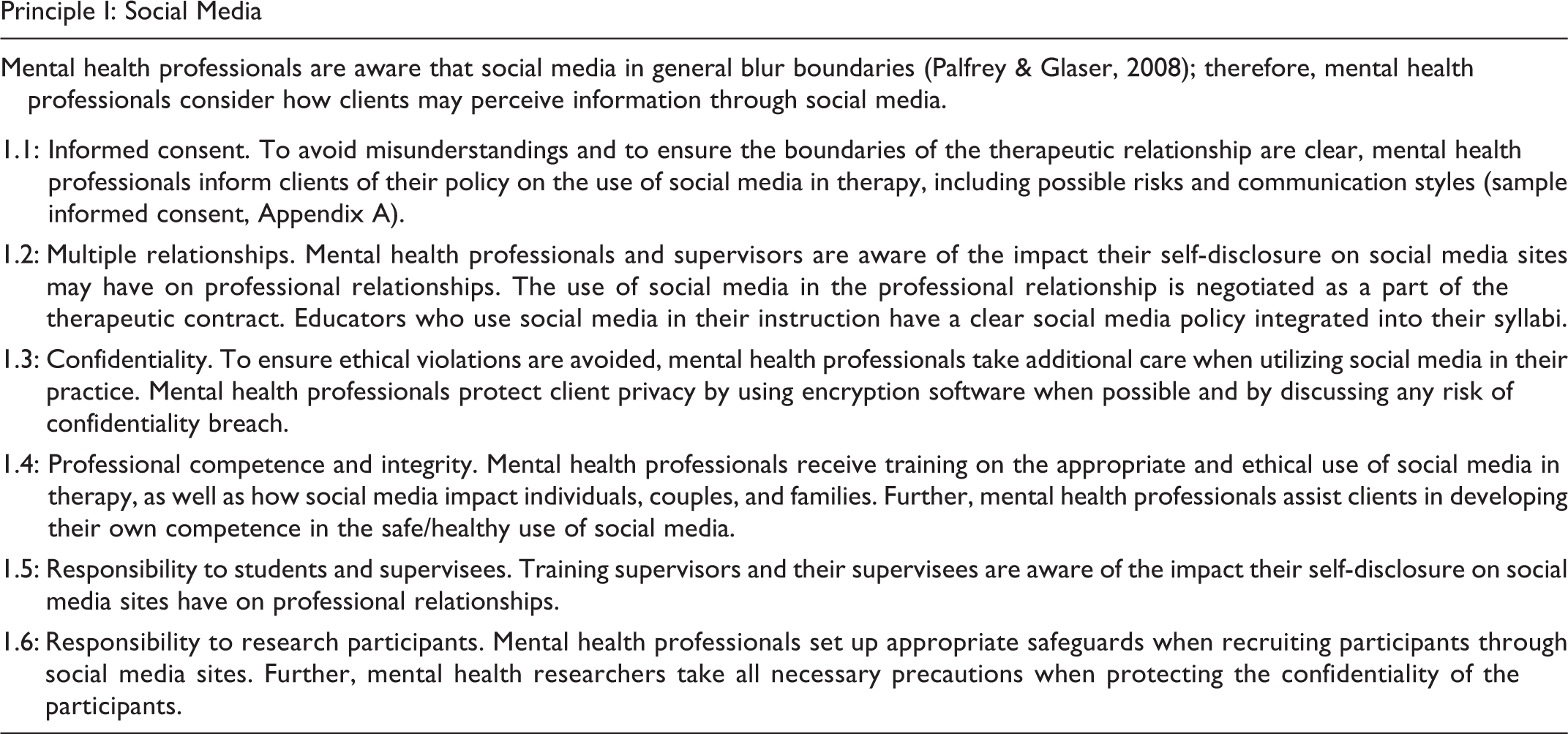
Principle I: Social Media
| Mental health professionals are aware that social media in general blur boundaries (Palfrey & Glaser, 2008); therefore, mental health professionals consider how clients may perceive information through social media. |
| 1.1: Informed consent. To avoid misunderstandings and to ensure the boundaries of the therapeutic relationship are clear, mental health professionals inform clients of their policy on the use of social media in therapy, including possible risks and communication styles (sample informed consent, Appendix A). |
| 1.2: Multiple relationships. Mental health professionals and supervisors are aware of the impact their self-disclosure on social media sites may have on professional relationships. The use of social media in the professional relationship is negotiated as a part of the therapeutic contract. Educators who use social media in their instruction have a clear social media policy integrated into their syllabi. |
| 1.3: Confidentiality. To ensure ethical violations are avoided, mental health professionals take additional care when utilizing social media in their practice. Mental health professionals protect client privacy by using encryption software when possible and by discussing any risk of confidentiality breach. |
| 1.4: Professional competence and integrity. Mental health professionals receive training on the appropriate and ethical use of social media in therapy, as well as how social media impact individuals, couples, and families. Further, mental health professionals assist clients in developing their own competence in the safe/healthy use of social media. |
| 1.5: Responsibility to students and supervisees. Training supervisors and their supervisees are aware of the impact their self-disclosure on social media sites have on professional relationships. |
| 1.6: Responsibility to research participants. Mental health professionals set up appropriate safeguards when recruiting participants through social media sites. Further, mental health researchers take all necessary precautions when protecting the confidentiality of the participants. |
Declaration of Conflicting Interests
The author(s) declared no potential conflicts of interest with respect to the research, authorship, and/or publication of this article.
Funding
The author(s) received no financial support for the research, authorship, and/or publication of this article.