




Abstract
Singleness emerges as a theme in studies on contemporary relationships across societies, including in Indonesia. While in most Western societies, singleness reflects an individual’s personal preference, marriage is viewed as cultural imperative in Indonesia, and being single is often held involuntarily by most never-married adults. This study outlines the reasons of why Indonesian individuals remain involuntarily single. The interviews of 40 never-married adults aged 27–52 years (M age = 33.14; SD = 4.04) revealed that gender and religious differences regarding marriage expectation are central themes in understanding involuntary singleness. The study particularly revealed four gender-specific reasons for why individuals remained involuntarily single: obtaining a career, having an incompatible marriage expectation, having dependent family members, and having temporal perspectives of singleness. Two themes emerged regarding the religious perspective of singleness: religious interpretations about singleness and religion-related coping ways of being involuntarily single. The themes suggest that marriage is not a mere personal fulfillment as cultural and religious values determine individuals’ marriage feasibility. While offering a new perspective of involuntary singleness from non-Western perspective, the results inform strategies to cope with unwanted singleness, particularly in the marriage- and religion-preoccupied societies.
Worldwide, societies tend to agree that marriage is a privileged social status (DePaulo & Morris, 2005; Himawan et al., 2018a; Timonen & Doyle, 2013) that brings with it a sense of social accomplishment and positive reputation. Singleness is considered as a temporary state (Hsu, 1998), and the negative social connotations pertaining to being single tend to interact positively with age (Himawan et al., 2018c). Many societies around the world have various negative connotations attached to those remaining single past the socially acceptable marriage age, such as being a leftover, being a parasite to their parents, being selfish, or having a homosexual orientation (DePaulo & Morris, 2016; Himawan et al., 2018a).
Not every individual is given the privilege to choose their desired marital status. The decision whether or not to marry is sometimes not a choice for some single adults, particularly those living in a marriage-preoccupied society. Scholars consider two motives for individuals to remain single: by choice (voluntary singles) or by circumstance (involuntary singles) (Slonim et al., 2015). The different motives for being single determine many various outcomes. For instance, those who are single by choice are more likely to have a positive experience of singleness that persists until old age (Timonen & Doyle, 2013). Voluntary singleness is associated with the sense of independence, autonomy, and self-fulfillment, with wide opportunities to build various social relationships (DePaulo, 2013). By contrast, those whose circumstances preclude them from marrying appear to view their singleness as frustrating and lonely (Shuzhuo et al., 2010), resulting in a regretful life in their old age (Timonen & Doyle, 2013).
There are studies focusing on the experience related to voluntary singleness (Dales, 2014; Jones et al., 2012; Simpson, 2015), but there is a paucity of studies providing the reasons for why individuals are involuntarily singles, particularly in Asia. While being single is unwanted, remaining single in such a marriage-obsessed society also entails being socially evaluated as lacking personal attributes necessary to attract partners (Himawan, Bambling, Edirippulige, Underwood, 2019). In Asian societies with conventional marriage values, such as Indonesia, Malaysia, and China (Himawan et al., 2018a), marriage is more regarded as a cultural practice, and societal pressures toward marriage are intensely experienced by single people, as the society favors social compliance more than Western societies do (Hofstede, 2001). There is much evidence to support this claim, including (1) the social perception that it is an acceptable practice to ask about a stranger’s marital status in casual and public discourses (Himawan et al., 2018a), (2) marital status and the wedding ceremony are important artifacts that determine family success and reputation (Schrauwers, 2000), (3) long-term dating denotes negative social connotations and early marriage are positively regarded (Hull, 2016), and (4) the conservative stereotype that associates singleness with mental or physical abnormality still exists (Jones, 2010).
Statistics show a consistent trend toward an increase in never-married individuals in many Asian countries (Himawan, Bambling, & Edirippulige, 2019; Jones, 2018). In societies where marriage is socially favored and social compliance is expected, the proportion of involuntary singles seems to dominate the never-married group (Gould & Paserman, 2002; Himawan, 2019a; Ibrahim & Hassan, 2009). With the increasing prevalence of individuals being involuntarily single particularly in Indonesia, and the persisting cultural values favoring marriage, the study aims to address the underlying reasons that preclude individuals from marrying and how such an involuntary singleness is experienced in the marriage-obsessed society. By doing so, the study is expected to provide valuable insights and directions to the government, nonprofit organizations, or even counselors in assisting involuntarily single adults to mitigate challenges leading to delayed marriage.
Gender and Religious Perspectives on Singleness: The Indonesian Context
Modernization is believed to be a major factor in explaining various marriage constraints. Himawan, Bambling, and Edirippulige (2019) noted that a major change brought by modernization in Indonesia is the demand for gender equality in education and industry. Modernization creates more opportunities for women to be in the workforce and to build their careers. In Indonesia, this is reflected through a high female participation rate in the workforce, which has increased from 48% to 50.2% from 2006 to 2014 (International Labour Organization, 2015). Women’s university participation has also more than doubled between 1980 and 2010 to 46.8% (Minnesota Population Center, 2018). The rising rate for women completing higher education would logically be followed by a higher expectation that women would establish career paths and thus delay marriage.
The gender-equal career opportunities striven for by the younger generation of women does not come without a consequence, particularly in regard to shifting marriage expectations. Vignato’s (2012) study, for instance, demonstrated how single women, despite demanding involvement in a career, expressed their worries of having a financially dependent partner, which lead them to not marrying. This dilemma represents a conflict with traditional gender roles where women do not expect to be the primary family breadwinner. Thus, whereas women are more strongly defending gender equality in the workforce, it does not seem to be the case when it comes to marriage. Previous studies (e.g., Himawan, 2019a; Utomo, 2012) pointed out that most single women still expect their marriage to follow the hypergamy ideal in which the husband’s superiority is acknowledged. The persisting preference for hypergamy marriage may represent strong sociocultural compliance among individuals since it is the form of marriage that is both socially and religiously encouraged. While expecting a husband with higher socioeconomic attributes, women who are involved in careers might have a reduced chance of encountering a partner of their preference. This occurs because their chance of getting a partner with higher career profile is decreased (Himawan, 2019b) and their time devoted for work tends to reasonably increase in parallel with their career level, resulting in a reduced time for socialization. Thus, gender equality is likely to be a contributing factor in the rising involuntary singleness rate.
Apart from modernization and economic factors, culture is also an important aspect in explaining involuntary singleness in Indonesia. In line with cultural values and gender roles, men are expected to initiate a relationship, while women tend to assume the role of waiting. This practice is even present in the Ta’aruf way of marriage, which is regarded as the religiously endorsed marriage process for Muslims (Asyari & Abid, 2016). This cultural attitude provides a framework in which marriage is deemed culturally ideal when the man shows dominance by initiating the relationship.
Like marriage, religion is also an important aspect of social identity for most Indonesians (Himawan et al., 2018b). Religious interpretations are commonly involved in understanding nearly all aspects of life including marriage. Being one of the world’s largest Muslim countries, many Muslim believers are influenced by Islamic teaching that generally regard marriage as a religious mandate (Asyari & Abid, 2016). Some Muslims consider marriage as an act of observance to God (Ibrahim & Hassan, 2009). Being single is thus discouraged and remaining single enhances the probability of committing the sin of promiscuity (Hull, 2016). Previous study demonstrated how religion is an important consideration in determining the sexual, emotional, spiritual, and emotional fulfillment of Indonesian single people (Himawan, 2020). Not only is religion pressuring singles to marry, but single individuals are also expected to find partners who are of the same religious affiliation (Parker et al., 2018; Susanto & Zhang, 2017). Interfaith marriage creates an unfavorable impression, despite being legally acknowledged (Varagur, 2018). Involuntary singles thus have to overcome challenges related to two important social identities in society: being married in both a socially and a religiously acceptable way.
The Present Study
The present article aims to outline the reasons and the experience of individuals who are involuntarily single in Indonesia. In particular, this study asks (1) What are the reasons for some Indonesian individuals remaining single? and (2) How is singleness experienced? Participants’ perspectives were prioritized in analyzing the findings, and the emerging themes suggest the interrelation of religion and gender identities as important constructs in understanding their singleness experience. This approach allows the exploration of socioreligious dynamics that create constraints on marriage for involuntary singles. The study was conducted among Indonesian singles. The Indonesian context is deemed to be the ideal setting for studying this phenomenon from non-Western perspective, considering that Indonesian society regard both marital status and religious affiliation as important social identities.
Method
Participants
The participant group consisted of 40, never-married, heterosexual individuals, of which six were men and 34 were women. The criteria for participation were (1) having an age of 26 or above, (2) never having been married and not currently in a serious courtship, (3) being capable of communicating in the Indonesian language, and (4) having a heterosexual orientation—in consideration of the fact that homosexuals often remain single because same-sex marriage is illegal in Indonesia (Davies & Bennett, 2015; McNally et al., 2015).
The age of participants ranged from 27 to 52, with 10 participants below 30 (M age = 33.14; SD = 4.04). Most of them (n = 27) had completed master’s degrees, whereas all held university degrees, except one participant who was a high school graduate. Muslim participants, as expected, dominated the sample group, given that Islam is the dominant religion in Indonesia. Regarding the participants’ ethnicity, the majority were Javanese, which represents the biggest ethnic group in Indonesia. Table 1 presents the demographic characteristics of the participants. Participants’ initials were masked.
Characteristics of the Interviewed Participants.

Note. NTT = Nusa Tenggara Timur (East Timor); NTB = Nusa Tenggara Barat (West Timor).
Eight participants were interviewed in a face-to-face setting and the rest were interviewed using video (employing the Zoom platform) or audio (using WhatsApp or phone calls). The decision regarding the interview modes was dependent upon the participants’ preferences and geographical distances.
Procedure
Study recruitment was obtained through advertising on several social media platforms. Some potential participants were also approached via snowball sampling by asking the interviewed participants to refer relatives who met the study criteria. In the recruitment advertisement, the interested participants were asked to register their interest by filling in the digital application form in the provided link. The form included contact details of the participants, several criteria questions to assess their acceptability for inclusion in the study, and their available time for an interview. Once they completed the form, an email invitation was sent to those who satisfied the inclusion criteria. The email consisted of a participant information sheet, an informed consent form, along with an explanation of the interview mode to be employed, and the time and place for the interview. Participants were required to indicate their agreement (or disagreement) to participate in the study within 14 days of receiving the email. Should they agree to participate, they were asked to sign the informed consent form and to electronically return the signed form.
The interviews lasted about 50–90 min (42 min on average) and were audio recorded with two devices (an audio recorder and a smartphone) for data backup. Data were transcribed in a de-identified format by a professional transcriber prior to analysis. Participants who completed the interview were rewarded with a shopping voucher of IDR 100.000—(equal to US$13). Other participants who were located in remote areas were rewarded with a phone credit voucher with the same value, provided that this was their preference. As soon as the interview was completed, the recording was sent to the independent transcriber. The ethical aspect of this study has been approved by the Institutional Human Research Ethics Committee of the University of Queensland (No: 2017000826).
Analysis
Data analysis processes adhered to the protocol described by King and Horrocks (2010), which includes three stages: descriptive coding, interpretive coding, and identification of an overarching theme. There were two parts to the first stage of the analysis: (1) every transcript was read through without any attempt to code it and (2) for every meaningful response, a descriptive code was applied. Descriptive coding was done in English by the researcher. English translations of the responses were only made to the responses that were included in the result presentation. To maintain the independence of the results, meaningful responses at this stage were coded without any reference to particular perspectives.
After all transcripts were descriptively coded, the second stage of the analysis was undertaken. This consisted of interpretive coding. In this stage, similar descriptive codes were grouped together on the basis of the research topics. For instance, descriptive codes: “continuing education” and “focusing on work” were grouped into “prioritizing career.” While performing this part of the analysis, recoding occurred to better fit the responses with more representative codes. Overarching themes were generated in the third stage of the analysis. The emerging codes suggested patterned responses based on gender and religion.
The whole coding process was not a single, one-way process. There were several iterations as the coding process underwent numerous revisions to ensure the emerging themes comprehensively represented the data. The author was the only bilingual researcher in the research team and, thus, performed the descriptive coding. Upon the completion of descriptive coding, a bilingual psychology scholar assisted in examining the representativeness of the response coding. Revisions were made until the codes were mutually agreed upon. After the author and the independent scholar reached an agreement, the latter stages of coding were performed. Revisions of the later stages were made based on the agreement of the author and three team members who had extensive experience in conducting qualitative research. All analyses were performed through NVivo Version 12.
As suggested by Lincoln and Guba (1985), four criteria were considered to establish the quality of the analysis: credibility, transferability, trackable variance, and confirmability. To ensure credibility, data analysis included expert opinions from the team members and an independent scholar who had experience in conducting qualitative analysis. Such a procedure allows interrater confidence in the results. Transferability was achieved by providing sufficient detail about the results for readers to grasp the rationale in arriving at conclusions. In presenting the findings, direct verbatim reporting of some participant responses was presented along with the relevant demographic information. This would allow the readers to make their own inferences about the conclusions being arrived at. For the sake of parsimony, however, the Indonesian version of the direct verbatim responses was omitted. Trackable variance was attained through the extent to which replicating this study is possible, which was time-restricted and demographically restricted. A time restriction occurred because future replication studies may achieve different results because of the dynamic nature of the phenomenon. Some evidence pointed to younger Indonesian cohorts beginning to accept marriage-alternative arrangements (Himawan et al., 2018a) and, therefore, their perceptions of social pressures and urgency to marry might be different in the future. The demographic restriction could occur because the current study was conducted among more highly educated participants and more woman participants, and the results might be incongruent if it were to be conducted with participants who had different demographic profiles. Finally, confirmability was established by presenting detailed information about the process of collecting and analyzing data, as described in this and previous sections.
Results
Results are presented in two parts: singleness through a gender perspective and through a religious perspective. The discussion of participants’ motives was provided to highlight the involuntary nature of singleness. Direct verbatim responses were presented with capital font being used to represent the interviewer’s voice.
Motives of Being Single
Most participants appeared to be in favor of marriage. Only two participants saw themselves as single for the rest of their lives and their reasons for being single represented their thoughts that marriage was improbable at their ages, as reflected in F’s response: Because referring to my so many failed dating experience, I just want to go with the flow. If God gives me a blessing, and I meet him, and we are matched, then why not? If not, that is fine, too. I will not put too much hope on it.
Singleness Through a Gender Perspective
Four gender-specific themes emerged relating to the reasons and the experience of remaining single: (1) remaining single for career optimization, (2) having incompatible marriage expectations, (3) having dependent family members, and (4) having a temporary perspective on singleness. Figure 1 summarizes more detail on the emerging themes.
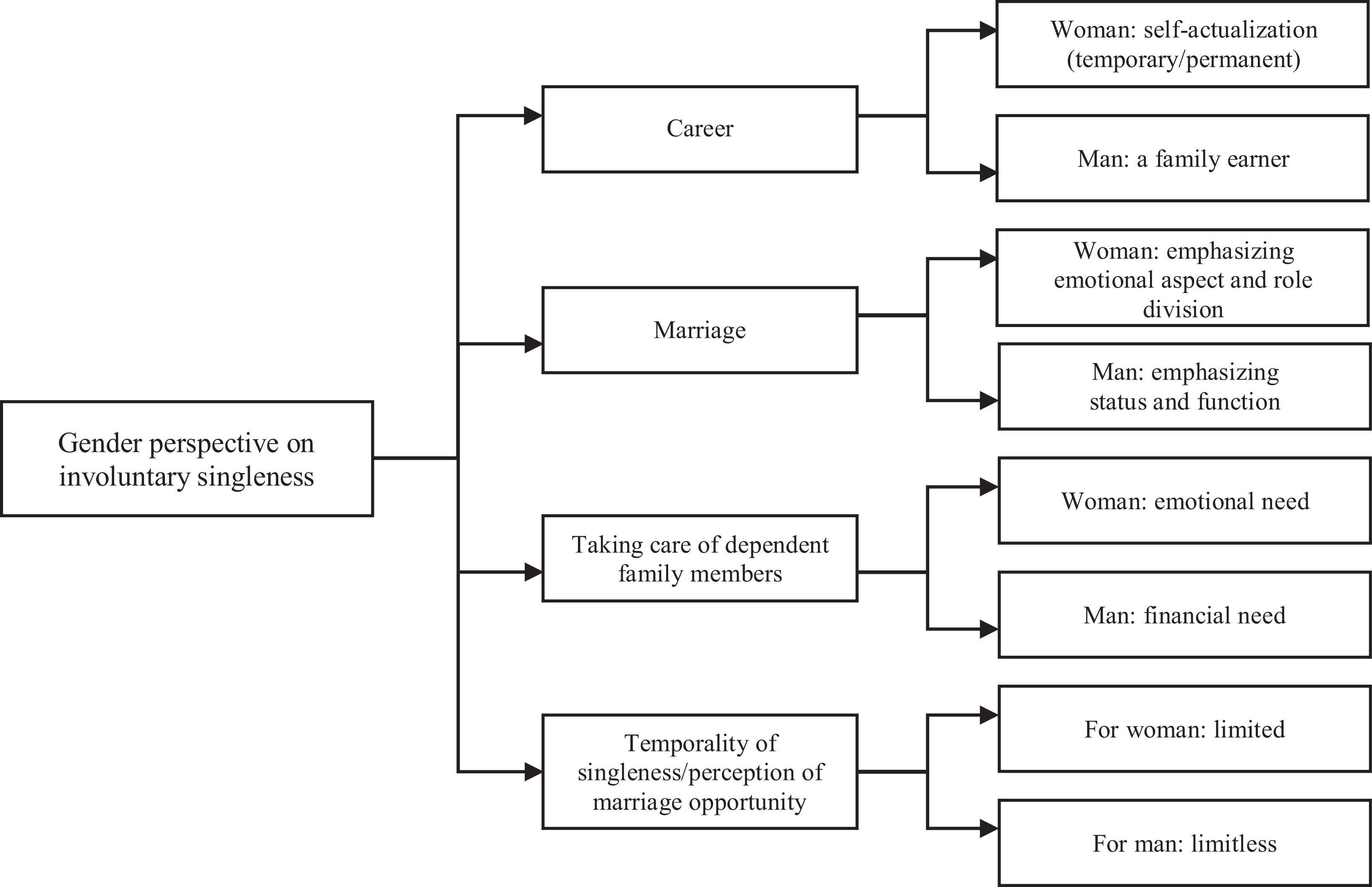
The emerging themes on the gender perspective of the involuntary singleness in Indonesia.
Remaining single for career optimization
Half of the participants admitted that career establishment was the reason for them delaying marriage. Almost all participants were university graduates, so it was likely that building career was among their expectations from life. However, the motive of career pursuit seemed to be remarkably different between genders.
Woman participants tended to associate career pursuit with the desire to advance to the highest possible level. There is an impression that consolidating career was seen as beyond economic survival, but for potential self-actualization. The struggle is…there is a temptation when I actually want to leave my current field of career…I feel kind of boring, less challenging, and I want to leave it. I want to find the other one, to achieve another one, to have something different. (S, 30)
For men, the pattern emerged that man participants tended to view their career from the perspective of being a family provider. AF’s (31) response below illustrated the point: I am still single because I am now working to set up a family. With my own calculation, another 2–3 years being single should be okay because by then, when I got married and have children, I would still be able to financially provide my family until my children are self-sufficient by the time I retire.
Having a mismatched marriage expectation
This theme illuminated the tendency toward mismatched marriage expectations between single man and single woman participants. When single women described their expectations of marriage, the word mitra [partner] was repeatedly used. Positioning self as a partner implies a desire for an equal proportion of responsibility in managing household-related tasks. For some woman participants, equality was also understood as having the same degree of independence and authority as men. He has to understand that looking after children will not be my sole responsibility…although raising children is irreplaceable moment, the opportunity for a specialist education also cannot come again, that opportunity is limited. (AO, 29, medicine degree)
Single men, by contrast, appeared to define marriage in terms of its legal and formal status and its functionality by associating marriage with the procreation function. The most common responses of men when being asked to describe marriage were normative, such as thinking that marriage was a long-term commitment and a union of two people to be better persons. They focused on the attributes related to the marital status rather than the quality. Besides mentioning the formal definition of marriage, A (40) also alluded to the procreation function in his concept of marriage: “I would simplify it [marriage] this way: A friend that would struggle together in living the life, and including having offspring.” The man’s tendency to relate marriage with having offspring was also observed in AJ’s (34, woman) response as she struggled to find a man who would accept her preference of not having children: The most extreme [unpopular attitude] perhaps is I do not think I want to have children, and that is the most difficult thing an Indonesian man would accept. I actually do not really like children. When I was dating and we had a chat, I interpreted that he wanted to have children and I was a bit of anxious: “What if I have children, how can I manage my work…How can I manage my time?”
Having dependent family members
Many participants reported that responsibility for their current family members, particularly their dependent parents, led them to delay their marriage. It has been a frequent practice in Indonesia that when parents are retired, their children would be responsible for looking after them.
There is an impression that their reasons for being responsible were gender-typical. For the man participants, responsibility of the dependent family was accepted as a part of cultural compliance where fulfillment was focused on the financial side, whereas for woman participants, the responsibility seemed to be voluntarily undertaken, and fulfillment was focused on the emotional side.
Five woman participants described their current circumstances of being a caregiver to their dependent parents. For M (32), being the fourth of five children in the family, where the third and the fifth siblings were single, there was no cultural expectation associated with her taking care of her elderly mother. However, upon the passing of her father in recent years, M voluntarily committed to paying extra attention to looking after her mother, even beyond fulfilling her mother’s basic needs.
For men, a pattern emerged that looking after parents and family members seemed to be regarded as a cultural mandate. I am the breadwinner of my current family. I am the first son and according to my culture, I am expected to be the one who is more responsible to my family. (H, 36)
Having a temporal perspective of singleness
In Indonesia, singleness is perceived as a temporary and transitional state that one should normatively get married by the time they are 30. Thus, if one remains single beyond, or far beyond, the age of 30, they are stigmatized for failing to meet the cultural expectation to marry within a reasonable time.
Participants stated that society tends to associate marriage with those who are mapan (financially capable), dewasa (mature), tampan/cantik (physically attractive), and pintar (well-educated); thus, marriage symbolizes social achievement. Therefore, when someone still single passes marriageable age, he or she is considered to have the opposite characteristics, for which they are often stigmatized.
Most participants stated that the most common attribute associated with being single was tidak normal; berbeda (not normal; deviant). Another typical expression included the analogy of marriage with halal. In this context, the meaning of halal was generalized beyond a description of food, to which the term usually refers, but was understood as “the right or the blessed thing to do.” The use of this analogy could be understood as an Islamic assertion that marriage tends to be favored when it occurs without a prior, or at least only short, dating period. Many Muslim participants argue that dating could lead someone toward sexual promiscuity. Therefore, never-married individuals who were involved in romantic but not necessarily sexual relationships were labeled as having a non-halal (“forbidden”; “not the right way of having”) relationship. Marriage was thereby seen as the only halal relationship and those in dating relationships should rush into marrying. E’s (31, woman) response illuminates this claim: It’s just funny when people say, “come on, make it halal.” Do they imply that my dating now is like—no offense—“pork,” which is very haram, for which I have to do certain rituals to make it halal?
Single woman participants appear to be more likely to experience stronger perceptions of it being too late for marriage; this tended to be related to their limited period of reproductive function. Hence, fertility is often the underlying reason why women are rushed into marriage. It explains the very typical stigma experienced by F (46, woman): keburu alot (alot is an Indonesian expression of tough meat as it gets expired), which clearly suggests a distinct period when it is good (fertile) and when it becomes not good (not fertile anymore) to marry.
On the other hand, although marriage probability was perceived as reducing as age increased, the responses of older single men in this study suggested that marriage was actually still feasible for them and they were still actively seeking a partner. With less perception of lateness, productivity is often suggested as that which describes the marriage capability of men. Therefore, when a man fails to marry past the marriageable ages, according to D (30, woman), society tended to stigmatize him for being kere [impecunious].
A’s (40) experience provided support for the above argument. He shared an experience of his associates judging him for being late to marry by saying, “Nanti anaknya dewasa orang tuanya sudah apa namanya, tidak produktif lagi.” (“Once your children grow up, their parents would not be productive—working—anymore.”)
Singleness Through the Religious Perspective
Two themes arose when viewing singleness through the lens of religion: (1) religious interpretations of singleness and marriage and (2) various religious practices for coping with challenges related to involuntary singleness. Figure 2 summarizes the emerging themes.

The emerging themes on the religious perspective of the involuntary singleness in Indonesia.
Religious interpretations of singleness and marriage
Participants were divided into four religious affiliations: Islam, Protestant Christianity, Catholic Christianity, and Buddhism. Influenced by their religious beliefs, participants expressed various meanings of, and related to, their singleness. In particular, the interviews suggested that participants employed religious interpretations to guide them in their understanding of the causes and the consequences of remaining single.
For Buddhist participants, singleness was understood as a karma, a result of what they had done in the past. I always believe in karma. So I always wonder, “uhm. maybe I often rejected men in my past life, therefore until now I couldn’t get the right one.”(D, 30) Well, I am a Muslim. What was fundamental for Muslims is how to be grateful and to show endurance in whatever we currently have. For all that we already have, we should show gratitude, and for what we have not get, we should be patient. Being patient means either those things are not for us or maybe later we will have them, so this maybe our temptation as well. (M, 32) When referring back to my past, there is no justifiable reason [to explain why I am punished by being single now]. In fact, if I am married, it perhaps a punishment for me now. For me,…it is not a punishment from God but, I learned that it [remaining single] was so that I could do a good work because if I have a partner, I cannot do the work [like I do now]. (AJ, 34, Catholic)
Such a perception of singleness was also reflected in their attitude toward marriage. Eight Muslim participants considered marriage to be compulsory, whereas only one Protestant participant considered it as a religious mandate. By quoting a verse from their Bible: lebih baik dua daripada satu [two are better than one] (Eccl. 4:9), Z (45, Protestant) argued that her religion encouraged, but did not oblige, her to marry. Nevertheless, all participants, regardless of their religions—including Catholics and Buddhists who acknowledge celibacy—appeared to believe that marriage was what was preferred for them according to their religious beliefs.
Another attitude that was more typical among Muslim participants was the perceived link between marriage and avoidance of sin. This is also reflected in the idea of the Ta’aruf tradition and the popular social trend Gerakan Menikah Tanpa Pacaran [the social movement of marrying without dating], which is observed among young generations in Muslim society. Dating was believed to cause someone to be vulnerable of the sin of out-of-marriage sexual activities and, therefore, they believed that one had to avoid dating and had to marry as soon as they felt ready for a marital relationship.
Religious practices to cope with involuntary singleness
The findings indicated notably different ways Protestant, Catholic, and Muslim participants employed their religious resources as a coping mechanism. Protestant participants tended to describe their personal connection with God as an important resource when dealing with their challenges. Responses like: berserah pada Tuhan [surrendering it up to God] and percaya kehendak Tuhan yang terbaik [trust His will is the best] were predominant among participants with a Protestant affiliation. Their religious practices were often more intrinsic and were rarely related to religious rituals in a certain place, time, or custom.
Catholic participants tended to express their spiritual experience through their involvement in religious communities or through performing certain religious activities in a particular place believed to be holy, such as a church. I have a favourite place if I have a problem, it was an adoration room in St. Theresia Church, and I often pray there when I have problems. (Q, 37)
For Buddhists, when something bad happened, they inferred it was karma, resulting from their previous life. It appeared that there was no particular way to cope with it, except always attempting to do good for the sake of a positive future.
Discussion
The study aimed to outline the reasons why people are remaining single, despite their wish to marry, and to explore the singleness experience of those whose status is involuntarily held. The patterns of the findings that appear to be gender- and religion-specific contribute to a framework that provides an understanding of singleness and its ramifications in the current social and religious ideologies related to marriage in Indonesia.
The study identified the struggle of unmarried Indonesian women in challenging normative gender roles in which their society perceives them as personally and socially incomplete until they are married. Normative gender identity defines the completion of a woman’s identity through marriage and, as a result, single women are a marginalized group. The same struggle in challenging normative gender roles has been found in many countries (Dales, 2014; Ibrahim & Hassan, 2009; Lahad, 2013; Simpson, 2015; Yeung & Hu, 2016). It is likely that the study’s finding represents an attempt to define a new cultural representation of modern single women: one that is associated with a professional career rather than personal deviance. However, the discursive arguments of single women participants regarding their preference on remaining single might indicate that at this point, getting married is a strong social value in Indonesia, and choosing to be single is likely to be more about situational issues, since the actual choice most participants had made was to delay marriage and focus on personal goals.
This study demonstrated that involuntary singleness could be explained by an increasing interest in career optimization and gender equality. Nevertheless, career pursuit among single women was not motivated by being able to financially contribute to a family but rather a desire to actualize their potential. This result aligns with previous studies conducted in some other Asian countries (Wang & Abbott, 2013; Yoshida, 2017). Despite reflecting a more global pattern, the single woman participants’ perspectives on the impact of career and education and on when to marry differed in varying degrees. Some considered their career was a priority, and if they could not find a partner who would support their choices, they may not marry. Others perceived their career as temporary, and they were willing to conform to the traditional gender role expectation once they had achieved certain career goals. Their decision to prioritize career might be potentially risky because the socially acceptable age window for women to marry in Indonesia is relatively narrow, between 22 and 29 (Himawan, 2019a; Hull, 2016; Situmorang, 2007; Vignato, 2012). Thus, prioritizing a career could potentially have a negative impact on their opportunities for marriage, given the current cultural marriage norms.
Whereas the study findings suggested that woman participants tended to strive for gender equality, some proportion of women seemed to tolerate, or even expect, husband superiority in their marriage. While this may capture a slow cultural change related to the permeability of contemporary gender role to some women, the persistence of gender superiority in marriage could be understood from a religious perspective, and it serves a greater relevance in this context, given that religion is an important part of their identity for Indonesians (Himawan et al., 2018c). Religious interpretations of the patriarchal system in marriage generally acknowledge the role of the husband as the leader (Imam) and the wife as the one to be led (Utomo, 2014). As the leader, a husband is expected to possess superior social, economic, and educational attributes to his wife. Traditional hypergamy marriage also defines women through the nurturing role and not career. Hence, financial independence among women poses a challenge to the long-standing traditional gender role expectation of the role of a wife. The increase in women entering the workforce is an inevitable consequence of living in an era of consumerism, where modern lifestyle demands cannot be accommodated by only a single earner in the household (Nilan, 2008). The most likely scenario as this trend develops is that the role of a wife will include being a secondary income earner (Utomo, 2012), whereas still accepting the husband as being in the leader’s role.
The study also discovered the differing tendencies between how single men and women defined marriage. Single men defined marriage in terms of a formal union with social status for the purpose of procreation. By contrast, single women emphasized the emotional relationship with their partner when defining marriage. An explanation for this might lie in how men rely more on marriage to satisfy their emotional needs than women do (Monin & Clark, 2011). Therefore, having a formal marital status might give more reassurance for the fulfillment of their needs to men. On the other hand, given that women tend to be able to benefit more from close relationships outside marriage (Monin et al., 2008), formal reassurance of marital status is not what they primarily seek in marriage.
The temporary perspective on singleness that appears to be different between men and women suggests greater challenges for single women. This is because marriage, as determined by reproductive functionality, seems to be time-limited for women, but not for men. Understanding singleness in terms of reproductive functionality appears to be consistent with the common stigmatization of single women. Old virgin is a common stigma for single women (Wang & Abbott, 2013). Virginity refers to sexual intercourse activities (Barnett et al., 2017) and is related to the biological function of sex: procreation. On the other hand, productivity seems to be the determinant of stigmatization of single men. Attaching singleness with being less productive (or being financially insufficient) for men might be related to the conservative gender role of men as financial providers (Becker, 1991). Such stigmatization might be understood in relation to the high cost of marriage and wedding ceremonies in Indonesia (Schrauwers, 2000), knowing that a wedding serves as an important showcase for the family’s reputation.
The second half of the study provided an understanding of the singleness phenomenon from a religious perspective. In terms of religious interpretations related to being single, despite having various interpretations of marriage and remaining single, each of the four religions subscribed to among the study participants generally favored marriage over singleness. Even Buddhism and Catholic participants in this study, who believe that celibacy in certain situations is an endorsed practice, argued that celibacy symbolized a privilege for certain people rather than a desperate condition of not being able to marry. In this case, they believed that their religion still advocated marriage for them, which concurs to the previous study on this topic (Himawan, 2019a). Therefore, involuntary singles in Indonesia might experience marriage pressures resulting from religious compliance.
Whereas participants of all religions believed that marriage was endorsed by their religion, Muslim participants appeared to be under a greater pressure to get married as they perceived marriage as a religious mandate. The observation that Muslims regarded marriage as a religious obligation concurred with the conclusions arrived at in previous studies (Asyari & Abid, 2016; Himawan, 2020; Ibrahim & Hassan, 2009). Such a strong religious endorsement of marriage might potentially impose a threat for single people (Darrington et al., 2005; Engelberg, 2016), for which an effective coping strategy is required.
Limitation
The interpretation of the current findings must take into account the limitations of this study. Single women with higher educational degrees were the dominant group among the study participants. The study results may be specific to singles with a similar demographic profile to the study participants. The nature of the study also does not allow prediction of any causal relationships between the variables, such as career optimization and remaining single, examined in this study. It might be the case that, for some singles, placing importance on having a career might serve as a subliminal way of justifying their lack of success in the marriage market. Expressing a desire for career optimization may be a means for it to be socially acceptable for them to remain unmarried if they have a career that people regard highly. Gender and religion provided the parameters bounding the data collection. Both of these variables have predominant roles in determining how society operates within Indonesia. However, there are other important variables, such as career types, geographic location, and family history, that may also contribute to explaining involuntary singleness.
Summary and Recommendations
The exploration of singleness in Indonesia through gender and religious perspectives expands our understanding of why some individuals remain involuntarily single. The findings provide insights highlighting the feminist movement of Indonesian never-married women in challenging traditional gender role expectations as single women strive to be valued beyond their marital status. Religion seems to preserve a positive view of marriage. Whereas in the present study, religion could act as a stress relief, it could also potentially impose a stressor when a person is rigidly embedded in the teaching of marriage as a religious mandate.
Practical recommendations can be drawn from the study. There is an urgency to introduce modification of gender role expectation in marriage that allows a room for women to achieve self-actualization through their career position rather than through the traditional gender role within marriage. Such a modified concept could be promoted in social discourses through campaigns and education so that women’s involvement in the workplace could be accommodated. Religious institutions could also take action to support the psychological and spiritual needs of their never-married congregations in order to maintain and improve their members’ well-being. Mental health practitioners might also benefit from the insights offered by this study by considering nonpersonal circumstances (social and religious values) in evaluating their clients’ challenges related to being unmarried.
Footnotes
Acknowledgments
The author thanks Dr. Matthew Bambling, Dr. Mair Underwood, and Dr. Sisira Edirippulige— the research team members for their valuable contributions in the study conceptualization and the coding processes of the responses; Eunike Mutiara for her contribution in reviewing the coding and the translation of participants’ verbatim; and Dr. Leonce Newby for her critical comments while proofreading the manuscript.
Declaration of Conflicting Interests
The author(s) declared no potential conflicts of interest with respect to the research, authorship, and/or publication of this article.
Funding
The author(s) disclosed receipt of the following financial support for the research, authorship, and/or publication of this article: This work was supported by Indonesian Endowment Funds for Education.
