



Abstract
As ethnic diversity grows within the United States, so does the need for understanding ethnic identity (EI), which develops through ethnic socialization (ES). In a family context, this is known as familial ethnic socialization (FES), whereas parental ethnic socialization (PES) refers to ethnically socializing one’s children. This study explores differences and similarities in EI, FES, and PES between ethnic majority, minority, and multiracial groups. It also introduces PES as an emerging construct in EI research.
The term “melting pot” has described the United States since its birth as a nation, referencing the large ethnic and immigrant populations that have maintained, developed, and assimilated their cultures within the country (Abu-Laban & Lamont, 1997). First- and second-generation Americans are often touted as one of the fastest growing populations within the United States and will account for “around 93% of the growth of working-age individuals between now and 2050” (Passel & Rohal, 2015, p. 33). Most of these same immigrants will bring with them cultural ideas, values, traditions, and ways of life through parents, grandparents, cousins, siblings, and other relatives who teach one another about ways to retain their ethnic identities within a Western culture historically rooted in individualism and colonialism (Triandis, 2000; Umaña-Taylor et al., 2013; Vandello & Cohen, 1999). As the number of ethnic minority (MI) populations continues to grow in the United States at a rate much higher than ever before, so too does the conversation around how different cultures acknowledge their ethnic identity (EI) in the face of discrimination, racism, and prejudice.
The acquisition of EI, including how individuals develop and maintain their sense of ethnicity, occurs through an overarching process in social psychology known as ethnic socialization (ES). ES refers to the level and type of information individuals are exposed to that is then incorporated into their EI. This study focuses on three concepts: EI, familial ethnic socialization (FES), and parental ethnic socialization (PES).
EI
For the purpose of this study, ethnicity is defined as the ethnic values, behaviors, and traditions that are associated with one’s ethnic background. EI is a developing construct of self that relates to the values and characteristics that individuals connect to their identified ethnicity. It represents a complex and lifelong dynamic between an individuals’ ethnicity and their identity. Ethnic majority (MA) refers to individuals who identify as White or European American; MI refers to individuals belonging to an MI group (e.g., Mexican, Jamaican, or Filipino); and biracial and/or multiracial (MU) refers to individuals who identify as more than one ethnicity.
Most research has shown that EI in MA and MI groups differs significantly, with MA individuals typically showing lower EI than their MI counterparts (Hart et al., 2016; Phinney & Alipuria, 1990; Ponterotto et al., 2003). Regardless of ethnicity, most studies have found evidence supporting that individuals who identify as part of the MI group typically have a better developed EI than their MA peers (Phinney & Alipuria, 1990).
MU individuals remain one of the most underrepresented and most difficult populations to study within research, despite a growing presence within the United States (Parker et al., 2015). One of the complexities surrounding MU individuals, compared to their MA or MI counterparts, is how individuals theorize the pieces of their EI, either as unique pieces that form a whole or as an entirely new and unique identity (Cheng & Lee, 2009). This distinction makes conceptualizing MU identity difficult because the constituent elements often make comparing analyses and findings more difficult to examine, unless explicitly viewed as a single group to be compared alongside MA and MI groups. EI studies evidence that, compared to MI individuals, MU individuals typically report more engagement in exploration and resolution of their EI, underlining the need for research within this group (Brittian et al., 2013).
ES
Johnson (1981) explains socialization as a “preparation of newcomers for life in their social, economic, physical, cultural and extra-physical surroundings, i.e. their group in society” (p. 25), and ES shares many similarities as a method for EI acquisition and development. ES covers specific external experiences that individuals use to process or learn about their ethnic background and culture, even if they may not fully identify with that ethnicity at that moment of input (Brown et al., 2007). Research has shown that ES significantly relates to EI formation in multiple ethnic groups inside and outside of the United States (Chavez & Guido-DiBrito, 1999; French et al., 2006; Jaspal & Cinnirella, 2012). The range of influence that falls under ES is incredibly extensive because nearly any aspect of socialization that can be used to shape EI could be considered a form of ES. This includes media exposure in film, television, music, and even within video games that depict different ethnic behaviors and stereotypes. Phinney’s (1993) diffusion, or the lack of an ethnic event, can also be considered a form of ES because the unavailability of information about one’s ethnic group may make an individual feel limited or muted in their cultural understanding.
Although ES significantly relates to EI, research surrounding ES is relatively limited and usually contained within exploring academic environments for adolescents. Because adolescence is typically the key impetus phase for EI development based on traditional identity development (French et al., 2006; Quintana & Vera, 1999; Umaña-Taylor et al., 2013), the level of research that exists for adult individuals outside academia is relatively sparse (Chavez & Guido-DiBrito, 1999; Phinney, 1990). As the population of MA, MI, and MU individuals grow and become older, the relative need for studying ES and EI as a developing psychological construct also grows (Tajfel, 1982). Arnett (2000) places an emphasis on young adulthood, individuals aged between 18 and 25, as key points where most individuals will learn what it means to be part of a workforce, explore interpersonal relationships, and continue exploring their worldview, all of which can be considered as points for EI development. The case for adulthood is not fixated quite as much on how individuals learn about their EI before they are considered adults but rather what they have identified as salient aspects of their EI, what they have retained from adolescence, and possibly which aspects of their EI they would like to share with the next generation through a subset of ES known as family ethnic socialization (FES; Juang & Syed, 2010).
FES
FES begins at home as one of the most influential sources of EI, which is simply the family’s role in teaching individuals about their ethnic group. Individuals can learn about their ethnicity via FES explicitly through the type of foods their family eats, ethnic language and phrases used at home, or implicitly through watching how different family members communicate and treat each other. Regardless of race, research shows that FES strongly relates to a developing EI, and through the family structure, individuals can learn about ethnically connected values and traditions that then further their understanding of their EI (Umaña-Taylor et al., 2006, 2009). Although practicing or observing behaviors are helpful mechanisms for supporting development of EI, direct conversations within the family regarding ethnicity and race are key salient and explicit contributors to EI, communicating more about what it means to be of a specific ethnicity, including the kinds of difficulties that one may encounter in the face of racism or discrimination (Johnson, 1981; Phinney & Chavira, 1995; Quintana & Vera, 1999).
For individuals, conversations about race and ethnicity are integral to EI development because they can more directly challenge and inform ideas and opinions about EI, correcting, or connecting context to internalized beliefs of ethnicity. The theoretical importance of familial conversations as opposed to peer conversations lies in the relationship individuals have with their in-group and the shared ethnicity which may not be present outside of the home, making FES a unique form of socialization. FES ties in characteristics about one’s own ethnicity as members of ethnic in-groups relate unique experiences and coping mechanisms. FES provides information that individuals use to consciously and subconsciously shape how they view their membership to their own ethnicity and, just as importantly, how they believe others view their ethnicity.
Similar to EI, the research looking at FES for MA groups is relatively limited with a greater focus on the use of other comparative variables aside from ethnicity (e.g., sex, gender, religion) or with the MA groups continuing as a “default” comparison in order to study familial experiences of MI populations (Baer & Schmitz, 2007; Clay et al., 2007; Juang & Syed, 2010). Studies related to FES topics such as time spent with the family or quality of childhood often are similar to those in the MI groups, but familial cohesion, closeness, and conversations related to discrimination response within the household are often reported as lower among MA groups compared to their MI counterparts (Baer & Schmitz, 2007; Juang & Syed, 2010; Rivas-Drake et al., 2009).
Modern FES research is relatively focused on finding differences between MI subgroups and crafting a better understanding of what FES looks like and how it can manifest differently between various MI ethnicities, through the primary use of young adult or adolescent experiences (Breton, 1990; Brittian et al., 2013). The differences help illustrate FES as not a direct precursor to EI but rather as a significant influence on EI development within MI households, with some studies finding gender differences within certain MI subgroups (Umaña-Taylor, 2001, 2009). FES is crucial for EI development as it relates to education of cultural values, traditions, and how individuals deal with prejudicial or discriminatory environments, promoting better resilience and group-esteem (Baer & Schmitz, 2007; Juang & Syed, 2010). Reported exposure of FES within MI groups, regardless of race, has been typically higher than MA and MU groups (Clay et al., 2007; French et al., 2006).
Complications related to understanding MU identity are not only found within the individual but also within the home, where the family in-group is likely to include unique combinations of MA or MI individuals who may not be adequately prepared for explicit conversations or techniques to incorporate other ethnicities in regular socialization, with some households even suppressing notions of race or ethnicity in mixed ethnic households (Milan & Keiley, 2000; Soliz et al., 2009; Spencer et al., 2000). These complications can lead to issues of authenticity, denial, and a desire for ethnic exploration (Nadal et al., 2013). Regardless, the presence of MI individuals within the family, either as a parent, sibling, or close relative, has been shown to help facilitate the exposure of FES as it relates to EI (González et al., 2006). FES is still consistently positively related to EI development for both MI and MU individuals, but some research shows that although FES is a positive influence on the EI process, it may not have as strong an effect for MU individuals in EI affirmation, given variables such as family composition and environment (Brittian et al., 2013; Umaña-Taylor, 2001).
PES
PES has been conceptualized by some as a subset of FES because it refers specifically to parental influence in ES (Phinney & Chavira, 1995). In this study, we define PES as the intention (or process) of incorporating ES as a part of the parenting process. In other words, PES is the intent and relative desire for an individual to pass down ethnic traits and beliefs through socialized methods in order to educate, transmit ideals, or prepare children for the outside environment (Phinney & Chavira, 1995). The research regarding PES from direct biological in-groups to offspring is limited with most of the research tailored toward studying cross-ethnic parenting in transracial adoption (Mohanty et al., 2007) or in interviewing adolescents about their upbringing experiences (Phinney & Chavira, 1995). Unfortunately, although research on how parents have ethnically socialized their children exists (Milan & Keiley, 2000; Mohanty et al., 2007; Nadal et al., 2013), the desire for individuals to incorporate ES into raising their own offspring remains a new concept with little to no direct research affiliated with PES among various ethnic groups.
Purpose of Present Study
This study aims to increase our understanding of EI, FES, and PES in MA (e.g., White and Western European Americans), MI (e.g., African American, Latino), and MU (e.g., Black Latina, Scottish Korean) ethnic groups. Although most EI research has found that MA cultures typically score lower in EI than MI cultures, some research has found that MU cultures might have statistically similar EI scores to their MI counterparts (Spencer et al., 2000). Similarly, prior research has found that MA cultures typically have experienced lower FES than MI cultures (Clay et al., 2007; French et al., 2006). Data regarding MU cultures have also suggested lower FES than MI cultures; however, these data are scarce (Brittian et al., 2013; Umaña-Taylor, 2001). We expected that upon examining EI and FES differences between groups, MA groups would display significantly lower EI and FES scores than MI and MU groups. In addition, we hypothesized that there would not be a significant difference between MI and MU for EI or FES. The “intent to socialize” as a parent (i.e., PES) is a new topic within EI development; therefore, our examination of PES is largely exploratory. However, previous FES studies suggest that FES and PES are positively-related (Phinney & Chavira, 1995). Thus, we anticipate that the results for PES will parallel the results for FES. More specifically, we anticipate that MA cultures will have lower PES than MI cultures. Given the overall lack of research surrounding PES, we had no specific hypotheses regarding how those in the MU group would score on PES in relation to other groups.
Method
Participants
Participants were U.S. residents who had lived in the United States for at least 2 years and were at least 18 years of age or older. Individuals who did not complete at least 80% of the questions were excluded from analysis. The final sample size (N = 374) consisted of participants between the ages of 18 and 50 years (M = 26.28, SD = 6.43). Of the participants, 72% (n = 271) identified as part of the MA culture, 14% (n = 53) identified as MI, and 13% (n = 50) identified as MU. In terms of ethnicity, 72.3% of our sample was “White or European American”; 1.3% “Black, African, or African American”; 2.9% “Hispanic, Latino/a, Chicano/a, or Spanish Origin”; 1.1% “Native American, American Indian, or Alaska Native”; 8.5% “Native American, American Indian, or Alaska Native”; 0.3% “Middle Eastern or Middle Eastern American”; 13% “biracial or multiracial”; and 0.5% identified as “Other.” Regarding gender, 59.2% (n = 223) of participants identified as female, 32.1% (n = 121) identified male, and roughly 8.7% (n = 33) identified as either transgender, nonbinary, or other.
Measures
The instrument used in this study included basic demographics, the Multigroup Ethnic Identity Measure–Revised (MEIM-R), Familial Ethnic Socialization Measure (FES-M), and the Parental Ethnic Socialization Measure (PES-M).
MEIM-R
The MEIM-R (Phinney, 1992) was designed as a universal tool that allows individuals, regardless of their ethnicity, to answer questions related to their EI development. Each item is scored using a 5-point Likert-type scale ranging from 1 (strongly disagree) to 5 (strongly agree). MEIM-R scores are averaged, with higher scores indicating a higher EI. Reliability analysis showed a Cronbach’s α of .88, suggesting suitable reliability.
FES-M
The FES-M was designed to gauge the level of FES that individuals experience growing up by how much they agreed or disagreed with statements about different elements of FES (Umaña-Taylor et al., 2009). Each item on this 12-item measure is scored using a Likert-type scale ranging from 1 (not at all) to 5 (very often). Item scores are then averaged to produce an overall score with higher scores indicating a higher level of FES exposure. An “(s)” was added at the end of each statement to capture MU individuals. Reliability analysis showed a Cronbach’s α of .91, suggesting strong reliability.
PES-M
The PES-M, modified from Umaña-Taylor et al., (2009) original FES-M, was developed for the purpose of this study to capture PES. The PES-M measures how willing individuals would be to ethnically socialize their children if they were a parent (hypothetically or otherwise). To accomplish this, the statements from the FES-M were modified to be future tense. In addition, “(s)” was added at the end of each statement to capture MU individuals. Items on the PES-M are scored using a Likert-type scale ranging from 1 (not at all) to 5 (very often). Item scores are then averaged to produce an overall score with higher scores illustrating greater intent to ethnically socialize one’s children. Because this measure is new, no previous data exist regarding its reliability; however, reliability analysis for this study revealed a Cronbach’s α of .94, suggesting strong reliability.
Procedure
This study was reviewed and approved by a university institutional review board. Participants were recruited online using Reddit, an online forum, and completed an online survey without any benefit or reward. Respondents who were interested in the topic header were guided to the survey posting where they would read a short introduction and a link to the online survey, which was created in Qualtrics survey software. Informed consent was gathered at the beginning of the survey and participants were informed that submission of their data was completely voluntary and anonymous.
Results
On the MEIM-R, the MA group scored slightly below the scale’s midpoint, with MI and MU groups scoring above midpoint. Scores on the FES-M showed that MA and MU groups scored slightly below the scale’s midpoint and the MI group scored slightly above midpoint. On the PES-M, the MA group scored below midpoint with both the MI and MU groups scoring above midpoint. Table 1 presents more detailed information about MEIM-R, FES-M, and PES-M scores by ethnic group.
MEIM-R, FES-M, and PES-M Scores Among Ethnic Groupings.
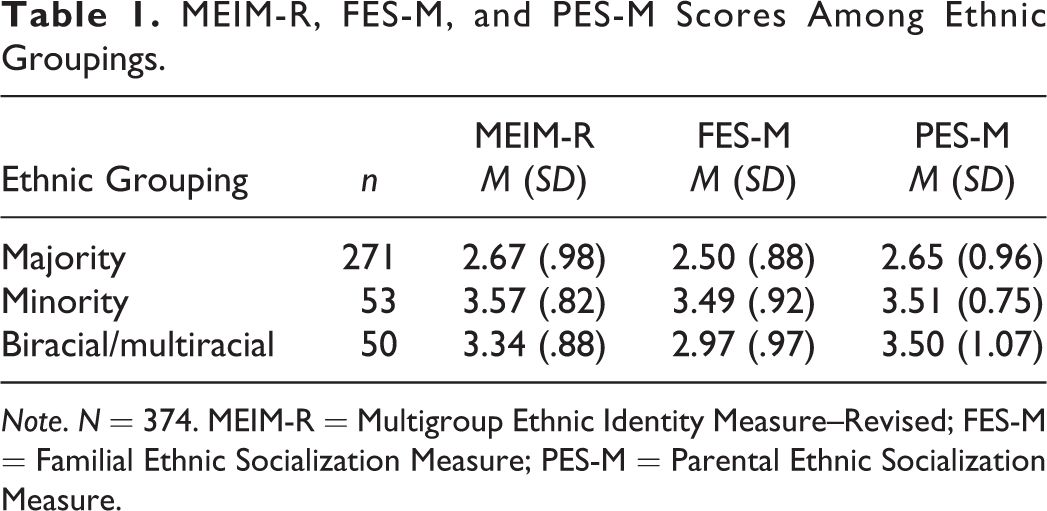
Note. N = 374. MEIM-R = Multigroup Ethnic Identity Measure–Revised; FES-M = Familial Ethnic Socialization Measure; PES-M = Parental Ethnic Socialization Measure.
To examine differences between ethnic groups (MA, MI, and MU), a one-way analysis of variance (ANOVA) for each of our three measures (MEIM-R, FES-M, and PES-M) was run using ethnic group as the independent variable for each of our three measures: MEIM-R, FES-M, and PES-M. Statistically significant ANOVA results were followed up with post hoc pairwise comparisons using an adjusted α of .016.
Our one-way ANOVA for the MEIM-R showed significant differences among ethnic groups, F(2, 371) = 26.39, p < .001. Post hoc pairwise comparison tests showed that for MA individuals scores on the MEIM-R were significantly lower than both MI individuals (p < .001) and MU individuals (p < .001). However, MI and MU individuals were statistically similar (p = .68).
Our one-way ANOVA for the FES-M also showed significant differences among ethnic groups, F(2, 371) = 29.52, p < .001. Post hoc pairwise comparison tests showed that MA individuals scored lower on the FES-M compared to both MI individuals (p < .001) and MU individuals (p = .002). MI individuals also scored significantly higher on the FES-M compared to MU individuals (p = .01).
Finally, our one-way ANOVA for the PES-M showed significant differences among ethnic groups, F(2, 371) = 30.53, p < .001. Post hoc pairwise comparison tests showed that MA individuals scored significantly lower than both MI individuals (p < .001) and MU individuals (p < .001). However, there was no statistical difference between MI and MU individuals (p = 1.00).
Discussion
The findings of this study add to the existing research on EI, FES, and now PES by using an adult population, straying from the norm of adolescents as the typical population researched in academia. Our results indicate that MA individuals experience significantly lower EI than either MI or MU groups, which was consistent with prior research (Hart et al., 2016; Phinney & Alipuria, 1990; Ponterotto et al., 2003). In addition, our findings show that MI and MU individuals experience similar levels of EI, suggesting that regardless of the possible underlying mechanisms, both groups achieve similar levels of EI development (Phinney & Alipuria, 1990; Spencer et al., 2000).
With FES being one crucial factor impacting EI development through the lifespan, prior research suggests that MI groups, for whom EI is often more salient compared to MA and MU groups, tend to have higher levels of FES than MA and MU groups (Clay et al., 2007; French et al., 2006). Our findings surrounding ethnic group differences in FES are consistent with this prior research suggesting that MI households may, either consciously or unconsciously, convey their ethnicity through socialization more often with their children as compared to MU households. This could be an indication that MI homes may have ethnic influence as resource more readily available compared to MA and MU individuals.
Although the MA group showed an expected significantly lower level of PES than MI and MU groups, the similar level of PES between the MI and MU groups mirrors our results regarding EI suggesting a possible relation between EI and PES. Furthermore, the similar level of PES in both MI and MU groups, as opposed to these groups’ significant differences in FES, provides insight into how PES, being theoretically based on FES, could possibly be more related to EI than FES, given that MU scores were statistically similar to their MI peers in both EI and PES. That is, one’s level of EI development may relate to one’s desire to ethnically socialize their children. In addition, our results indicate a significant difference in FES between MI and MU groups. This suggests that FES and PES could be distinctively different constructs. However, the current lack of research regarding PES limits our ability to infer the reason for these discrepant results.
The pattern of results regarding the MU population was particularly interesting. For MU individuals, the results from both the MEIM-R and FES-M were in line with prior research (Brittian et al., 2013; Umaña-Taylor, 2001), supporting the perspective that for MU individuals, specifically, FES exposure does not necessarily equate to an equally developed EI. From a theoretical standpoint, this could imply that MU individuals are just as aware of their EI as their MI peers, despite weaker FES exposure, and furthermore, the results from the PES-M indicated an equally strong desire for both MI and MU individuals to incorporate ES during child-rearing.
It is important to acknowledge limitations of this study as a measure of improving the research within EI development and its related constructs. Although the overall sample size obtained in this study was adequate, the MI and MU group sizes were relatively smaller than anticipated, indicating a greater need for data within MI and MU communities. Within the data set, individuals were asked whether they had specific ethnicities that they identified with (e.g., Korean, Mexican, or Irish), in addition to the “typical” ethnic categories to further clarify for the researchers. Of the individuals who clarified, every MU participant identified as belonging to both the MA and MI group (e.g., Scottish Korean). In future research, there may be interest in comparing results from individuals who identified as two MI groups (e.g., Black and Asian) and individuals belonging to an MA and MI group (e.g., White and Asian).
Although the use of websites to collect data for research is becoming more popular, the use of a subforum community such as Reddit is worth consideration because the site is growing among one of the most visited websites within the United States (Feinn, 2017), and the use of Reddit for data collection is relatively new, compared to traditional outreach methods. Although the subforums of Reddit are also varied and diverse based on interest and topic, our sample was gathered from one subreddit (i.e., subforum) and may not represent users of other portions of the website, nor the population at large. In addition, our sample was unable to capture any individuals above the age of 50, indicating that perhaps a technological divide was evident in our data collection, which is important because this study recognizes EI development as a lifelong process.
In terms of future research, obstacles include the ability to collect data that is sensitive to emerging multiracial populations and the flexibility of researchers in designing future measures to accommodate additional psychological constructs that may be connected to EI. For counselors, a more fine-tuned understanding of how ES can facilitate an individual’s EI is beneficial to therapy, research, and promoting a greater understanding of the human experience. Because of the positive psychosocial constructs related to EI, more studies should incorporate ethnicity as an integral component of identity formation. By casting off this notion that the word “ethnic” is synonymous with “of color,” we can promote that all individuals, regardless of ethnic group, can be encouraged to develop an EI that works not only for understanding themselves but for others as well. Through research that includes the typically less examined MA and MU adult populations, as well as the newer PES construct, this study was aimed at fine-tuning how we can look at ethnicity with a broader perspective.
Footnotes
Declaration of Conflicting Interests
The author(s) declared no potential conflicts of interest with respect to the research, authorship, and/or publication of this article.
Funding
The author(s) received no financial support for the research, authorship, and/or publication of this article.
