



Abstract
This study investigated the premarital experiences (dating, engagement, and wedding) in women with divorce tendency. The population of the study included all married women with divorce tendency who referred to counseling centers in Isfahan, Iran due to marital problems over the years 2020–2021. Moreover, this study was conducted with the participation of specialists and therapists familiar with marital and premarital issues and divorce. The relevant literature including texts, articles, and scientific books related to the subject was also reviewed. The data for the study were gathered via three tools of (1) 10 semistructured interviews with married women with divorce tendency, (2) interviews with eight experts, and (3) study of scientific texts. Ten female participants were selected using purposive sampling from those who expressed a tendency to divorce in the diagnostic interview. Thematic analysis was used to analyze the data. The results consisted of 12 subcategories over the three stages of dating, engagement, and wedding. These were then classified according to their similarities and differences by comparing their content under two main categories of cognitive-dispositional experiences and behavioral experiences. The results showed that identifying premarital experiences of women with divorce tendency and providing appropriate preventive and therapeutic strategies could be a great help in stabilizing the couple's relationship, increasing marital satisfaction, preventing divorce, and promoting community health.
Introduction
The Iranian National Organization for Civil Registration reported about 175,000 cases of divorce in 2020 for about 600,000 marriages. In other words, one divorce happened for almost every three marriages, which is the highest number of divorces in the history of Iran. Iran is the fourth country in the world in terms of the ratio of divorce per marriage. Divorce is a process that begins with the couples experiencing emotional crisis and ends with trying to resolve the conflict by entering a new situation with new roles and lifestyles (Quinn & Odell, 1998). The experience of divorce affects people's adaptation at various levels (e.g., psychological, physical, social, emotional, and economic) and results in reduced performance and inefficiency of family members after divorce (Hogendoorn et al., 2020; Thadathil & Sriram, 2020). For investigating the causes of divorce, in addition to social, economic, and legal factors, attention to individual, psychological, and emotional causes, including the tendency for divorce is of particular importance (Hajloo et al., 2014).
Before divorce, people first get a tendency toward divorce. The concept of divorce tendency refers to the degree of desire and interest to get separated and break off marital relationships (Quinn & Odell, 1998). In the past, divorce was considered as disgraceful and frightening. However, divorce has currently become a common solution to help people free themselves from the status quo. Therefore, nowadays people have less fear and anxiety about divorce compared to the past, which has its roots in society (Oldham, 2018). Divorce involves a long and arduous path that can begin years before marriage, from the time of dating, engagement, and continue after the marriage (Clarke-Stewart & Brentano, 2009).
One of the pre-marriage phases is the dating or acquaintance stage. Without proper coping skills, people may get hurt at the dating stage. Moreover, they may suppress or deny their fears, worries, and thoughts to gain the other party's attention (Patton, 2014). Past research shows that marital satisfaction is related to factors such as marriage with a loved one, commitment, wit, ability to reach agreement, having the same religious orientation (Janesick, 2011), age and spiritual similarities (Litzinger & Gordon, 2005), and doing favors for the spouse (Leavitt, 2010). Past research also indicates that lack of such positive components increases the likelihood of divorce (Liu, 2012).
Another premarital stage is the engagement. Although the engagement period provides many developmental experiences for couples such as companionship, open interaction, and emotional support, most couples are exposed to conflict and violence due to the special circumstances of this period (Helms et al., 2013). Failure to fulfill the mental beliefs that people have before marriage can have positive or negative effects on the relationship between spouses (Knobloch-Fedders & Knudson, 2009). Therefore, the likelihood of conflict during engagement is very high (Straus, 2008). This can increase the possibility of their recurrence after marriage (Arriaga & Foshee, 2004).
In the Iranian society, marriage begins formally after wedding, which legitimizes the relationship between a man and a woman. The Iranian marriage starts with a contract of matrimony during wedding and leads to living together. Marriage is an important human covenant that combines religion, law, and customs (Photography, 2009). Traditionally, most people consider marriage as a decision, but experts believe that marriage is a process. Therefore, just as engagement after dating deepens the goals and convictions of the parties, wedding results in even more conviction and resolution. Marriage requires some necessities including economic preparation, sexual knowledge, and interaction with the spouse's family (Mir Mohammad Sadeghi, 2010).
Olson and Olson-Sieg (1999; as cited by Karimi Sani et al., 2010) emphasize that the quality of marital relationship and successful marriage can be predicted through premarital factors. At each stage of life cycle, growth of the family depends on performing certain tasks. Neglecting such tasks will hinder family development (Goldenberg & Goldenberg, 2012). Couples who have not had the opportunity to adjust to their marital roles will face challenges in their married life. Such couples may not develop a full understanding of marriage and its long-term emotional and social commitments. As a result, they are not prepared to prevent and solve problems (Clarke-Stewart & Brentano, 2009). Developmental and structural theories also highlight the occurrence of interpersonal conflicts at this stage of life cycle, which may be due to the changes in behavioral patterns, rules, and expectations derived from the families of origin (Carr, 2000).
So far, many studies have dealt with divorce, divorce tendency, and the factors affecting divorce tendency after marriage (Doherty et al., 2021; Grether & Jones, 2021). However, no in-depth and qualitative study has yet explored the factors, experiences, and mistakes related to the interactions before marriage in couples with divorce tendency. Therefore, it is important to address this gap by investigating the experiences, pathologies, and mistakes of this period through a qualitative study. The couple's beliefs during engagement are influenced by their distinct cultural backgrounds (Willoughby et al., 2015). The period after wedding has its specific characteristics in the Iranian culture and involves some unique dynamics and complexities. Therefore, it is necessary to identify the experiences and mistakes of couples at this stage. Moreover, premarital relationships are also changing due to social and cultural changes (Clyde et al., 2019). Evidence shows a fundamental diversity in premarital relationships including dating, engagement, and wedding, which are influenced by various social and cultural factors as well as significant differences in the level and pattern of communication during and after this period (Lehrer, 2006). Therefore, it can be argued that there are important differences between women during dating, engagement, and wedding.
Therefore, in-depth studies that identify the significant premarital issues and experiences in couples with divorce tendency can be a great help to family therapists and a big step toward preventing marital problems and reducing the rate of divorce. The goal of this study was to conduct an in-depth investigation of premarital experiences (dating, engagement, and wedding) in women with divorce tendency in Isfahan, Iran. This study also aimed to investigate the premarital experiences (dating, engagement, and wedding) in women with divorce tendency in Isfahan, Iran.
Method
The present study used a qualitative methodology and thematic analysis to explore premarital experiences (dating, engagement, and wedding) in women with divorce tendency. Similarly, semistructured interviews were used to provide the couples with the opportunity to express their experiences freely (Bernard & Bernard, 2012). This study was not pre-registered.
Participants
The population of the present study included women with divorce tendency who went to counseling centers in Isfahan to get help for their marital problems from 2020 to 2021. Likewise, the researchers used other sources of data such as interviews with specialists and therapists working on premarital relationships and divorce. Moreover, they used papers, texts, and scientific books on problems in marital interpersonal relationship, premarital relationship, and divorce. The scientific data and interviews were performed to triangulate diverse data sources.
The researchers performed 18 interviews with eight experts in the field of premarital relationships in couples and divorce. They also conducted interviews with 10 women with divorce tendency. Furthermore, the relevant scientific literature on premarital relationship and divorce from 2000 to 2019, including book, dissertations and journal articles, were collected from local and international sources. Past research in the field was continued to the point of saturation and when categories were obtained.
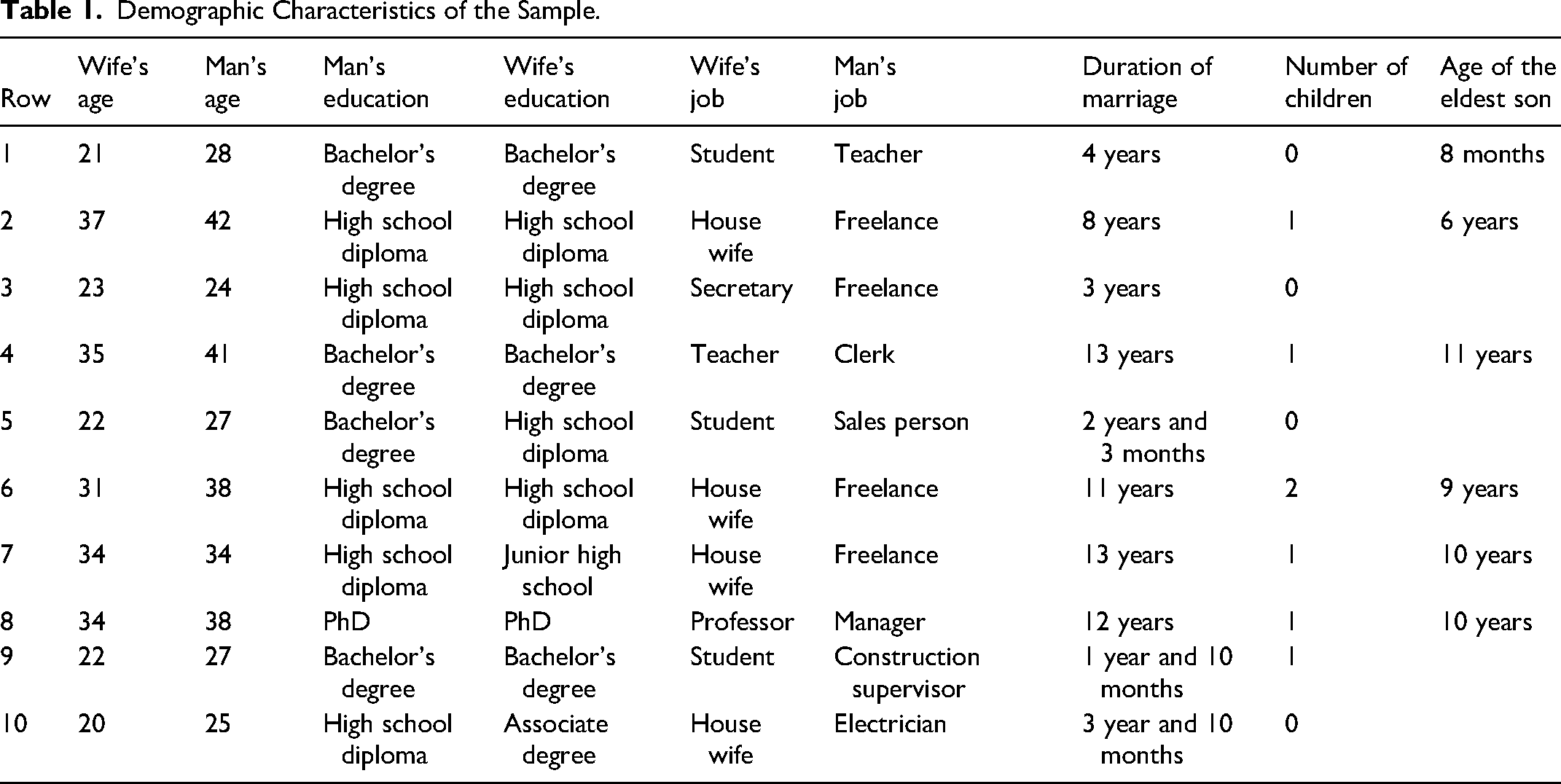
The participants for this study were collected via purposive sampling. This sampling strategy refers to selecting participants who provide the maximum possible information about the responses to study questions (Cresswell, 1998). Maximum variability in the data was ensured in order to reach information saturation. Information saturation is the point at which no further concepts are formed and all conceptual levels are completed (Elo & Kyngas, 2008). The researchers selected the participants via homogeneous purposive sampling method interviews to identify divorce tendency in married women. Prior to the interviews, a self-report questionnaire was administered to collect demographic information. The questionnaire required the participants to indicate their information on, sex, age (25–45), education level (minimum high school diploma), duration of marriage (more than 1 year), and their key reasons for referring to the counseling center (e.g., marital dissatisfaction and desire for divorce). Table 1 presents the demographic information about the participants and their husbands. In addition, the criteria for inclusion in the study were:
Divorce tendency (diagnosed by interviews); Not having referred to court for divorce at the time of the research; More than 1 year duration of marriage; and Education level of high school diploma or higher.
Demographic Characteristics of the Sample.
Further, the exclusion criterion in the present study was lack of cooperation with the researchers.
Procedure
The research team, who were experts in the premarital relationships and divorce worked on the interview questions and confirmed their appropriateness for the interview. The interviews started with a short explanation on the objectives for the research study. The length of the interviews varied from 30 to 120 min. The interviewer asked some general questions first (e.g., how long and how well was your experience of dating, engagement, and wedding). These questions were employed to commence the interviews. They were then developed during the interviews. The interviewer also asked questions on similar areas of premarital experiences. Some of the questions were: What experiences do you have from your dating, engagement, and wedding? How do you see the role of your families and those around you in these experiences? Tell me about your knowledge and your families’ knowledge during this period. Tell me about your thoughts, beliefs, and cultural traditions and those of your families during this period, etc.
Ethical Considerations
Many measures were used to protect human volunteer participants. One of the key principles in research is to respect the participants. One of the ways to ensure respect was to obtain informed consent. In the present study, all participants signed an informed consent. Moreover, the interviewer explained the reasons for the study and the reason for using a voice recorder. The interviewer assured the participants that their information will be kept confidential. Data of this study are not available to public.
Data Collection and Analysis
In this study, semistructured interviews were used to collect the data. An interview protocol was developed based on the goals of the study. The interviewer had a framework that guided the data collection processes (Delavar, 2014). In the present study, the questions were developed after reviews and hearing the specialists in the research team.
The thematic analysis (Braun & Clarke, 2006), including six stages of familiarizing oneself with the data, generating initial codes, searching for themes, reviewing the themes, defining and naming the themes, and writing the report. To this end, the participants’ talks were audiorecorded and transcribed. The transcriptions were read several times and the semantic units were developed. Semantic units are keywords or categories of analysis that are extracted from the interviews and then summarized (Streubert & Carpenter, 2006). After identifying the initial semantic units, the compact semantic units were developed and the codes were extracted. At this stage, summarizing is used to reduce the size of the semantic units while not changing the quality of information and to create compact semantic units. The prepared united were later read and re-read and categorized according to the conceptual and semantic similarities. Next, categorization is the process in which the codes with higher similarity are placed under one category (Downe-Wamboldt, 1992). The researchers tried to have the highest homogeneity within categories and the highest heterogeneity between categories. They continued categorization to prepare separate codes and reviewed and merged similar codes to produce the main categories (Grove & Burns, 2005). The researchers implemented included requisite modifications to the content of the categories and the names of categories were selected to reflect their content. The new data were compared with the previous ones to obtain the desired convergence. Additionally, the results of the data analysis were presented to the experts in the research team to include necessary revisions and refinements. These experts also commented on the analysis and the presentation of information and the codes. Finally, the data analysis resulted in the development of 12 subcategories.
Through more detailed classification two main categories emerged about premarital experiences of women with divorce tendency. The main categories were cognitive-dispositional experiences and behavioral experiences. Finally, the main theme was extracted from the basic meanings and latent content through the main categories.
Trustworthiness
Devoting enough time to the study and friendly relationship with the interviewees were among the factors contributing to the validity of the results. To enhance the dependability, the whole research process was completely recorded together with all other documents (e.g., transcripts). To ensure transferability, the researchers tried to take advantage of the maximum diversity created through differences in age, education, duration of married life, etc. (Sandelowski, 2000).
Results
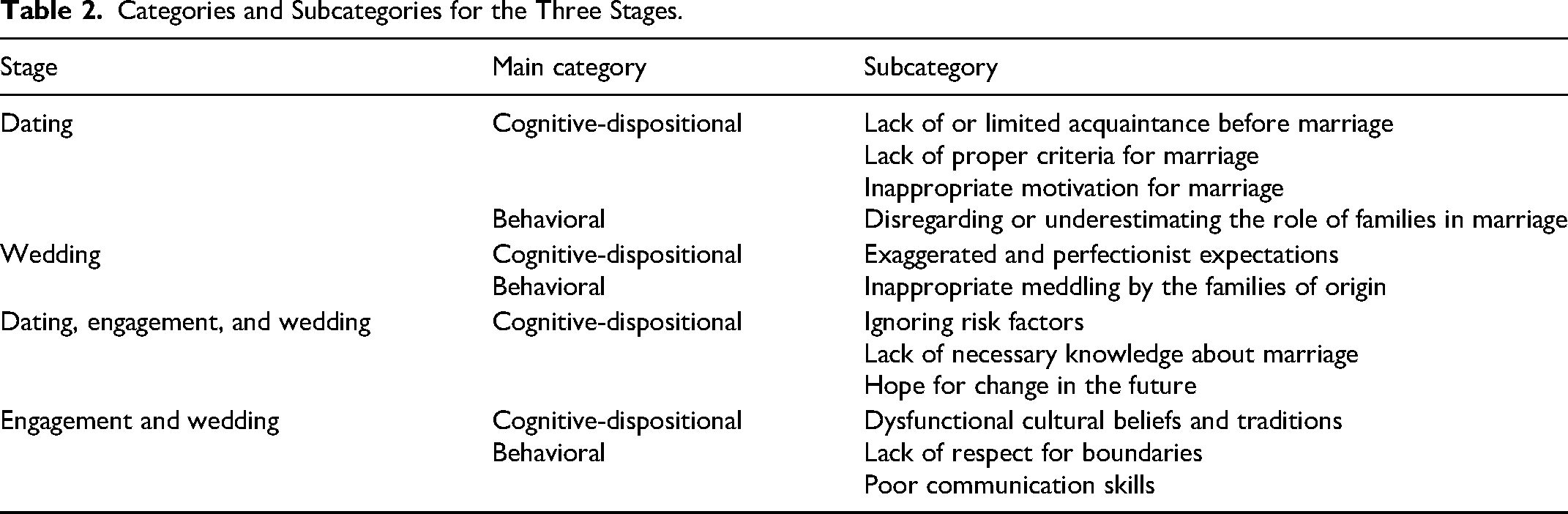
By examining the interviews and studying the relevant scientific literature (triangulation), 248 codes were identified for the three stages of dating, engagement, and wedding. Classifying the initial codes based on their similarities and differences led to identification of 12 subcategories (lack of or limited acquaintance before marriage, lack of proper criteria for marriage, inappropriate motivation for marriage, disregarding or underestimating the role of families in marriage, exaggerated and perfectionist expectations, inappropriate interference by the families of origin, ignoring risk factors, lack of necessary knowledge about marriage, hope for change in the future, dysfunctional cultural beliefs and traditions, lack of respect for boundaries, and poor communication skills) and two main categories of cognitive-dispositional experiences and behavioral experiences. The main categories and subcategories are presented in Table 2.
Categories and Subcategories for the Three Stages.
Stage: Dating
Cognitive Dispositional
Lack of or limited acquaintance before marriage: Lack of dating, short period of dating, families opposing dating, dating only remotely, online dating or dating only by phone, and dating only in fun or exciting places were some of the experiences reported by most of the interviewees.
Our marriage was very hasty. My parents did not want us to talk a lot or go out together. Perhaps I didn't have enough time to know him better. I always blame my parents for this. (Interviewee No. 7, woman with divorce tendency)
Lack of proper criteria for marriage: The interviewees showed that there was a lack of proper criteria for marriage in various ways. Having only one specific criterion for marriage, marriage only based on logic, marriage only based on love and emotions regardless of personality, values, or family compatibility, ignoring the appearance, marriage only based on family reputation, appeal to self-schema, and subconscious attraction were some of the issues mentioned by the interviewees. This can be seen in the following comment.
Since they were financially well-off, he attracted me and I closed my eyes to many other issues. Because we were not wealthy and we always experienced a lot of tension and dissatisfaction on the part of my mother due to financial issues. (Interviewee No. 9, woman with divorce tendency)
Inappropriate motivation for marriage. Interviewees expressed a lack of proper motivation for marriage in various ways. Marriage to escape loneliness, marriage to get away from home, marriage to heal the wounds of failures in love, marriage for real or perceived compulsion by the family, others, or the society, marriage to compete with friends, marriage out of pity, marriage due to disclosure of friendship with the other party, marriage due to having sexual intercourse and its disclosure, and marriage due to pregnancy were among the cases mentioned by the interviewees.
I was friends with our neighbor's son and my family found out. My family quickly arranged for our marriage to prevent dishonor. My brother and his brother were friends. They talked and made arrangements. I had quarrels with my father over this issue and I was not in good conditions so I lived at my sister's home. (Interviewee No. 8, woman with divorce tendency)
Behavioral
Disregarding or underestimating the role of families in marriage: Hiding the relationship from the family, continuing the relationship despite family opposition, and marriage based solely on the views, criteria, values, or cultural beliefs of the family were among the experiences reported by most of the interviewees. As a participant commented:
My father strongly opposed this marriage. My father was a truck driver. He went on a trip with him to get to know him. After returning, he said that he was strongly opposed to this marriage. But because of my insistence, he agreed. Maybe that was a reason why I hid my problems and dissatisfaction with my husband from my family and I tried to tolerate everything. I was afraid to complain and hear them reminding me that I wanted this marriage myself. (Interviewee No. 4, woman with divorce tendency)
Stage: Wedding
Cognitive-Dispositional
Exaggerated and perfectionist expectations: High emotional, supportive, or financial expectations from the spouse's family, high supportive or financial expectations from the spouse, perfectionist expectations about minor problems and catastrophizing minor issues during the wedding were the most frequent themes at this stage. A participant told us:
This is a transition period and many of its problems are natural. However, couples and especially women have very high expectations and catastrophize issues and feel that everything should be great. Therefore, they become disheartened quickly and sometimes even think about divorce. (Interviewee No. 3, specialist)
Behavioral
Inappropriate interference by the families of origin: Disagreements between the families and offering wrong or one-sided solutions to solve the couple's problems were the two key issues mentioned by the interviewees at this stage.
His family always considered themselves to be right. His sister and mother coached him, and often it was quite clear that they told him many bad things about me so that my husband was cold to me. I understood this from his own words. His mother was always jealous of me as if I wanted to kidnap her son. (Interviewee No. 6, woman with divorce tendency)
Common Themes in Three Stages of Dating, Engagement, and Wedding
Cognitive-Dispositional
Ignoring risk factors: Emotional attachment or fear of losing the other party prevented them from seeing the negative signs and risk factors in their relationship or made them appear less important. As one of them commented:
He used to tell me that he was sensitive and overprotective about me because he loved me so much and only wanted me for himself. When I told my friends about this, they told me that the guy was not normal and asked me not to marry him. But I loved him and couldn't pay attention to the warnings. (Interviewee No. 6, woman with divorce tendency)
Lack of necessary knowledge about marriage: Lack of self-awareness, lack of awareness about the characteristics of the opposite sex, lack of awareness about the negative effects of previously failed emotional relationships on thoughts, beliefs, and emotions, lack of awareness about one's own real criteria for marriage and those of the other party, lack of knowledge about the negative consequences of sexual relationship before marriage, lack of awareness about the other party's cultural traditions, lack of awareness about their readiness for marriage and the readiness of the other party, lack of awareness about the appropriate level of disclosure with regard to personal and family information, and lack of knowledge about how to examine the personality and values of the other party were among the issues mentioned by most of the interviewees.
I thought that his being a believer is enough for my happiness and the rest of the problems could be solved later. I was wrong and no one told me that. Now I understand how important personality, understanding, and love are in a man. (Interviewee No. 5, woman with divorce tendency)
Hope for change in the future: The hope for change in future was another common theme in all three stages, which led women to decide on moving ahead with marriage or fail to solve problems in the early stages. The role of hope can be seen in the following comment by the participants.
He did not say prayers and this was important to me, but I told myself that I could change him later with love and in a friendly way. (Interviewee No. 3, woman with divorce tendency)
Common Themes in the Two Stages of Engagement and Wedding
Cognitive-Dispositional
Dysfunctional cultural beliefs and traditions: Paying too much attention to the views, opinions, and judgments of others, being ashamed of divorce, extreme attention to reputation, paying too much attention to the type and amount of dowry, too much emphasis on cultural and family customs and traditions, differences in cultural views about stereotypical gender roles, differences in cultural beliefs and values about the position of the bride and groom in the spouse's family, and differences in cultural views and customs about the manner and degree of interacting with each other before marriage were among the issues mentioned by most of the interviewees.
In our family, the bride and women are very important, but his family is different. Although my mother respects the groom very much, her parents do not value the bride. His father does not value women in general and my husband is like his father and he is not emotional. (Interviewee No. 10, woman with divorce tendency)
Behavioral
Lack of respect for boundaries: During engagement and wedding stages, lack of respect for boundaries was a cause of conflict. It also contributed to later conflicts and the woman's tendency toward divorce. Prioritizing the husband's family or friends over the wife, disclosing personal information about the wife, asking for personal advice from friends, colleagues, or his family, making decisions based on his family's opinions and expectations, allowing his family to interfere, saying negative things about the wife to his family, revealing intimate secrets about his wife or their marital relationship to his friends, colleagues, or family members, and extreme intimacy with colleagues or female friends were among the issues reported by most interviewees. As a participant commented:
He constantly asked for advice from his brother for everything. He could not make a decision at all, and this bothered me a lot. (Interviewee No. 2, woman with divorce tendency)
Poor communication skills: Poor conflict resolution skills, empathy, listening skills, problem solving, dialogue and negotiation, assertiveness, the ability to say no, sexual expression, expression of desires and needs, expression of emotions, criticism, anger management, stress management, control over other negative emotions, and poor skills in relationship with the spouse's family were among the issues reported by most of the interviewees.
Due to their lack of awareness or experience, many couples do not have the necessary and required skills for the relationship during this period. This issue causes and exacerbates their problems. One of the skills that many women lack in this period is the expression of sexual desires and expectations to the other party, which may be due to cultural reasons or shame. (Interviewee No. 8, specialist)
He criticized me a lot and lowered my self-confidence. But I tolerated everything and could not express my displeasure about it. But now I am too tired and cannot take it anymore. (Interviewee No. 1, woman with divorce tendency)
Discussion
The goal of this study was to qualitatively investigate premarital experiences (dating, engagement, and wedding) in women with divorce tendency. Lack of dating experience and limited opportunities for acquaintance were among the issues related to the dating or acquaintance stage. The cultural belief that prohibits relationship between a girl and a boy before formal wedding, fear of social stigmatization, or acting according to traditional norms of marriage sometimes prevents the family from allowing the couples to have enough time and opportunities to get to know each other better in the premarital stage. Also, the increase in online communication and friendships causes people to assume that they know each other enough, while their face to face meetings are arranged at exciting places, which is not enough to get to know each other. In this way couples’ communications are distorted by misconceptions. When after marriage they face the reality of their relationship with the other person, they are often shocked by the differences between reality and fantasy. This finding is consistent with the results reported by Litzinger and Gordon (2005).
Lack of proper criteria for marriage was another experience related to the dating period. The mistaken belief that all problems can be solved through love and affection alone or pure logic, the belief that religious belief is enough as a criterion for marriage, and the effect of opposite polarities or schemas as well as subconscious attractiveness in marriage often causes women or their families to ignore the right criteria for marriage. Also, sometimes the Iranian society and especially the culture of Isfahan attach too much importance to the way others approve of a man or his family. As a result, factors such as high social status or prestige, economic conditions, and fame of the man or his family is relied on as the most important criteria for choosing the partner for marriage, while ignoring other criteria such as their personality and values. This finding is in line with the findings reported by Rostami and Ghezelseflo (2019).
Inappropriate motivation for marriage was another experience attributed to the dating stage. In the Iranian society, women sometimes get a feeling of real or perceived compulsion by others or their family and friends to marry and they think that if a woman marries late it is probably due to not being attractive. As a result, their only motive for marriage is sometimes to satisfy others or to escape feelings of insecurity and low self-esteem, regardless of whether they are ready for marriage. Also, the prevalence of premarital relationships and their failures often causes young women to resort to marriage immediately after failure in another relationship without giving themselves a chance to forget and go through the stages of grief. They may also get married to escape their loneliness and unpleasant mood or to heal their emotional wounds. These findings are in agreements with the results reported by Taghavi Dinani and Khalatbari (2020) about marriage in Iran.
Another experience related to the dating period was disregard for the role of families or its importance in marriage. Lack of close relationship with family prevents women from expressing their emotions. Moreover, not having learned expression of feelings by the parents or being blamed by parents may cause women to hide their premarital friendships and acquaintances from their families. This can result in more emotional decision making and reduced emphasis on logic and rationality in choosing the partner for marriage and subsequent mistakes. Sometimes, the opposite is the case in some Iranian families, where the family chooses their children's future spouse. However, in such cases the couple may not experience a quality and intimate relationship, something that is consistent with the findings by Rostami et al. (2019).
One of the experiences attributed to the wedding stage was exaggerated and perfectionist expectations. Sometimes women have high expectations of their husbands before marriage and they believe that a happy couple should not have any disagreements and arguments. This may often cause them to exaggerate and catastrophize any disagreement. This attitude can result in a lack of effort to solve problems, which in turn creates more problems in the marital relationship and ultimately ends in a tendency toward divorce. However, problems at this transitional stage are normal and considering that before marriage the couple still live with their parents, it is natural to experience limitations and shortcomings. As such, they should not have high expectations of each other. On the other hand, Iranian women have high expectations from their husband's family. Iranian families tend to attach more importance to the groom compared to the bride. As a result, women often compare the amount of emotional support they receive from the husband's family with the emotional support that their family offers to the husband. This comparison and high expectations cause dissatisfaction with the husband's family and negatively affects the relationship with the husband. This finding is consistent with the results reported by Moeti et al. (2017).
Inappropriate interference by the families of couples was another experience attributed to the wedding period. Living with parents before marriage can be a justification for inappropriate meddling by the family. Moreover, the mutual dependence between sons and families in the Iranian society causes the families to feel extreme sympathy and offer wrong and one-sided solutions to solve marital problems. To the extent that even many families confront each other about the problems and each family supports their child. This can create rifts and frictions, further undermine the couple's relationship with each other and with the spouse's family. This finding confirms the results found by Rostami et al. (2019).
One of the experiences attributed to all three stages of dating, engagement, and wedding was ignoring the risk factors. Dependence and fear of losing the other party can justify ignoring or underestimating the risk factors and negative signs in the other person and in the relationship. Many women consider the loss of their partner as an indication of their lack of attractiveness or lovability, which may cause negative feedback from their family or friends. Thus, they try hard to keep their partner at any cost and ignore or downplay the risk factors. However, after marriage, the negative effects of wrong choices in marriage show themselves in the marital problems that may influence the tendency toward divorce in these women. This research finding is also consistent with the results reported by Rahmati and Bahraminezhad (2019).
Another common experience identified in all three stage of dating, engagement, and wedding was lack of adequate knowledge about marriage. Lack of reliable sources to gain knowledge about marriage can undermine young women's awareness about marriage. Particularly in the Iranian society, many young women do not have the necessary sexual knowledge, which may be explained by the fear of losing the other party. Because of this fear, many young women accept premarital sexual relationships before gaining enough knowledge and experiencing love, while the choice of partner for marriage is based solely on excitement or dependence. Such women interpret the excitement or dependence as mutual understanding which results in wrong marriage choices. Also, premarital sexual relationship often prolongs the period of dating, engagement, or wedding that may lead to the man's lack of commitment to marriage. Also, having premarital sex can cause suspicion and pessimism in Iranian men about their wives’ loyalty after marriage. These issues can influence marital conflicts and divorce tendency in women. This finding is in line with the results reported by Torkian et al. (2020).
Hope for change in the future was another commonly recognized experience at all three stages of dating, engagement, and wedding. Fear of losing the partner, the stigma of divorce in the Iranian society especially for women, and the advice of families to follow traditional models of marriage often cause women or their families to be optimistic about the other person's problems or incompatibilities, and mistakenly move forward to the next stages of marriage. However, after marriage, these women often face their inability to change the other person, which results in dissatisfaction, frustration, and the tendency toward divorce. This is also in line with the findings reported by Mir Mohammad Sadeghi (2010).
One of the experiences commonly identified at two stages of engagement and marriage was dysfunctional cultural beliefs and traditions. Placing too much emphasis on reputation and judgment of others, customs and ethnic rituals in Iranian families and especially the culture of Isfahan, such as the importance of dowry and the differences in customs and beliefs of couples or their families regarding the level of interaction after engagement or wedding can result in communication conflicts. These communication conflicts in the premarital stages also affect the couple's relationship after marriage and the negative experiences of women can cause dissatisfaction and lack of intimacy. Sometimes, recalling such negative memories increase their tendency toward divorce. These results confirm the ones reported by Parrott and Parrott (2016).
Lack of respect for boundaries was another commonly recognized experience related to engagement and wedding stages. Lack of independence and the fact that many Iranian women live with their parents before marriage results in the disclosure of private matters regarding the couple's issues and decisions. As a result, many women fail to create and maintain boundaries. This, in turn, results in family interferences, loss of respect, communication problems with the husband and his dissatisfaction. Such issues can continue to influence marital life after marriage. The inability to set boundaries with friends is also observed in many young women at this stage, which can be fueled by the misconception that “we have not moved together yet and therefore we are free.” However, this belief and attitude can negatively impact the couple's relationship during engagement or wedding and subsequently influence the couple's relationship after marriage and increase women's tendency toward divorce. This finding is consistent with the results reported by Khojaste Mehr et al. (2015).
Another experience commonly attributed to the engagement and wedding period was poor communication skills. Engagement and wedding are stressful periods for couples, particularly because they are exposed to new circumstances, a new family, and another person with different characteristics while they do not yet have enough experience in managing a marital relationship. Therefore, the need for strong communication skills and maturity in couples at this stage is very high. As a result, strong communication skills are very important at this stage and poor communication skills can cause problems in the premarital stage and consequently lead to negative outcomes after marriage including the increased tendency toward divorce in women. This finding is consistent with the results reported by Asa and Nkan (2017) and Borowski and Tambling (2015).
Conclusion
The results of the present study showed that negative experiences, cognitive-dispositional, and behavioral mistakes during dating, engagement, and wedding periods could negatively influence the marital life of women. Therefore, this study can help counselors and family therapists to identify premarital experiences and provide advice to young women to prevent marital problems and subsequent tendency toward divorce. Moreover, it seems that conducting applied research is important for examining appropriate strategies to prevent wrong choices for marriage and help women to avoid mistakes during the premarital stage, to improve the quality of life for the couples, families, and the society and reduce the number of divorce cases.
Limitations of the present study include the lack of attention to the husbands’ personality traits, the general dynamics of marital relationships, the communication patterns between the couples, and their family life cycle. Considering that the present study was conducted with the participation of married women in Isfahan, Iran, its results should be generalized with caution to other cities, countries, and cultures. Therefore, conducting similar studies in other statistical populations and comparing the results can help in obtaining richer understanding of the premarital problems.
Footnotes
Declaration of Conflicting Interests
The author(s) declared no potential conflicts of interest with respect to the research, authorship, and/or publication of this article.
Funding
The author(s) received no financial support for the research, authorship, and/or publication of this article.
Ethics Approval
All procedures performed in this study involving human participants were in accordance with the ethical standards of the institutional and/or national research committee and with the 1964 Helsinki declaration and its later amendments or comparable ethical standards.
