



Abstract
Belief systems guide an individual's perceptions, behaviors, and interactions. Understanding an individual's belief systems can be beneficial in assessment, treatment planning, and service delivery. Belief system development is impacted by different factors, including the belief systems held by an individual's family-of-origin. At this time, there is not an available theory or instrument that identifies the components and characteristics that are included within family belief systems. To fill this current gap, we developed a typology of family belief systems and an associated illustrative figure labeled as The Family Belief Systems Wheel. The proposed typology is presented followed by discussion of the practical applications for the field.
Belief systems are defined as sets of principles, convictions of truth, or statements of perceived reality that individuals utilize to make sense of the world around them (Uso-Domenech & Nescolarde-Selva, 2016; Walters, 2002). Belief systems connect the individual and their internal and external environments (Walters, 2002) by guiding perceptions, behaviors, and interactions. For clinicians, it may be beneficial to understand the different factors involved in belief system development in order to effectively support and challenge clients in reaching their treatment goals.
Belief system development begins at a young age and originates in a child's interaction with their social environment (Walters, 2002). These systems are then reinforced by culture, theology, and experience through the actions, beliefs, and perceptions of others (Uso-Domenech & Nescolarde-Selva, 2016). The development of an individual's personal beliefs is guided by interactions between aspects of their social world, including the variety of persons, institutions, and experiences surrounding them, and the resulting interactions among all these variables (Lightfoot & Valsiner, 1992). Belief systems are not directly copied from these influences but instead are constructed through the complex interactions of these variables (Lightfoot & Valsiner, 1992; Walters, 2002). Scholars have hypothesized that beliefs from one's environments are transmitted through multiple avenues including cultural transmission (Kwak, 2003; Saggers & Sims, 2005; Tam, 2015; Vollebergh et al., 2001), spiritual transmission (Bader & Desmond, 2006; Gap Min & Young Kim, 2005), and intergenerational transmission (Gadsden & Hall, 1996; Holden & Zambarano, 1992; Lochner, 2008).
There is a consensus among scholars that an individual's personal belief systems are impacted by the belief systems held by influential members of their family-of-origin (Bleakley et al., 2009), most notably their caregivers (Goodnow, 1992; Walters, 2002). Intergenerational transmission describes the transfer of beliefs, attitudes, interests, practices, and behaviors from generation to generation (Gadsden & Hall, 1996; Holden & Zambarano, 1992; Lochner, 2008). Parents can deliver their beliefs through multiple methods including parenting practices (Simons et al., 1991), explicit statements (Goodnow, 1992), vague statements, practice without words, displays of affect, and protection from outside or competing messages. According to Holden and Zambarano (1992), the transmission of thoughts or behaviors from caregiver to child occurs through a variety of, often co-occurring and interrelated, mechanisms including: (a) child modeling in which children imitate caregivers’ actions or behaviors, (b) parental instructing in which parents (caregivers) engage in direct and intentional instruction of their own beliefs and preferred actions to the child, and (c) accordance which involves children behaving in accordance with the expectations that have been internalized from their caregiver. Belief transmission across generations can also be mediated by different variables such as the attachment between caregivers and the child (Gamble & Modry-Mandell, 2008; Vonk et al., 2019). Although these processes have been thoroughly explored in the scholarly literature, a holistic and comprehensive understanding of family belief systems has yet to be articulated.
Family Belief Systems
The Health Resources and Services Administration (HRSA) defined a family as “a group of two or more persons related by birth, marriage, or adoption who live together” (Health Resources & Services Administration, 2017, p. 1). A family-of-origin includes the family in which an individual grew up (adopted or biological) for the majority of their formative years (Brock, 2021). Thus, families are diverse. Rapoport and Rapoport (1982) identified that families may contain diversity in a number of ways including through organizational diversity (e.g., patterns of work outside and inside the home, changes in marital trends), cultural diversity, social class diversity, life cycle diversity (e.g., historical period in which family members were born), and family life course diversity (e.g., life trends based on ages of children, transitions in the home).
The thoughts and beliefs of caregivers, children, and other members within a family unit have been referenced in the literature but there is a lack of an agreed upon term or definition to use when exploring these phenomena. McGillicuddy-DeLisi (1980) highlighted the significant impact of parental beliefs, noting that parents’ belief systems or constructs about child development states and processes impact caregiving, interactions with children, and parental practices. Hirsjärvi and Perälä-Littunen (2001) explored parental beliefs or parents’ ways of thinking and understanding, specifically about child-rearing. Dattilio (2006) identified the difference between the individual schemas held by family members and what he termed “family schemas,” the jointly held beliefs that likely become deeply ingrained amongst family members which form from years of unifying interactions.
We identified six key characteristics of family belief systems that appear to have strong conceptual support and around which a consensus seems to exist in the literature.
Beliefs and values held by individual family members impact the beliefs of other family members (Dishion et al., 2004; Goodnow, 1992; Holden & Zambarano, 1992). Beliefs and values held by individual family members, and those shared amongst the family, direct family members’ behaviors (Fingerman & Bermann, 2000; Rubin & Mills, 1992; Sigel et al., 2014). Family beliefs may be overt, unconscious, not consciously known by all members, or potentially incorrectly assumed as common among all members (Fingerman & Bermann, 2000; Goodnow, 1988). Family beliefs can affect the quality of family functioning and family satisfaction (Bandura et al., 2011). Beliefs between spouses are not necessarily the same and caregivers’ beliefs may vary depending on their child's gender, their child's behaviors, or the current age of the child (McGillicudy-DeLisi, 1992). Belief systems held by family members influence their reactions and behavioral responses to familial or caregiving stress (Blunt Bugental, 1992; Rubin & Mills, 1992).
Furthermore, a variety of different caregiver beliefs can be transmitted to children including attitudes and practices about: child-rearing techniques (Erzinger & Steiger, 2014; Holden & Zambarano, 1992; Simons et al., 1992), risk-taking (Dohmen et al., 2012), gender-related cognitions (Klann et al., 2018; Tenenbaum & Leaper, 2002), prejudicial and stereotypical beliefs about others (O’Bryan et al., 2004), and expectations of social norms or values (Dishion et al., 2004). For the purposes of this article, a family belief system is defined as the ideology or set of principles held by the primary influencers of the family unit that help interpret everyday reality including the organized beliefs, values, morals, ideals, assumptions, attitudes, ideas, and findings (Fingerman & Bermann, 2000).
Despite the apparent connection between belief systems within a family and the interactions, behaviors, and continued belief system development of individuals, there is still no single definition of family belief systems and no identification of the components and characteristics included within this concept. The lack of consensus around the definition and included dimensions of family belief systems has notable consequences including: (a) confusion during communication about this concept, (b) complexity in development and selection of instruments to measure belief systems among families, (c) difficulty for clinicians attempting to identify or analyze family belief systems for a client's present family unit or family-of-origin, and (d) errors and difficulties for researchers when comparing results related to the variety of conceptualizations, definitions, and measurement scales of family belief systems. To address this current gap, we examined the literature and developed a conceptual, literature-based typology of family belief systems and an associated illustrative figure labeled as the Family Beliefs Systems Wheel (see Figure 1).
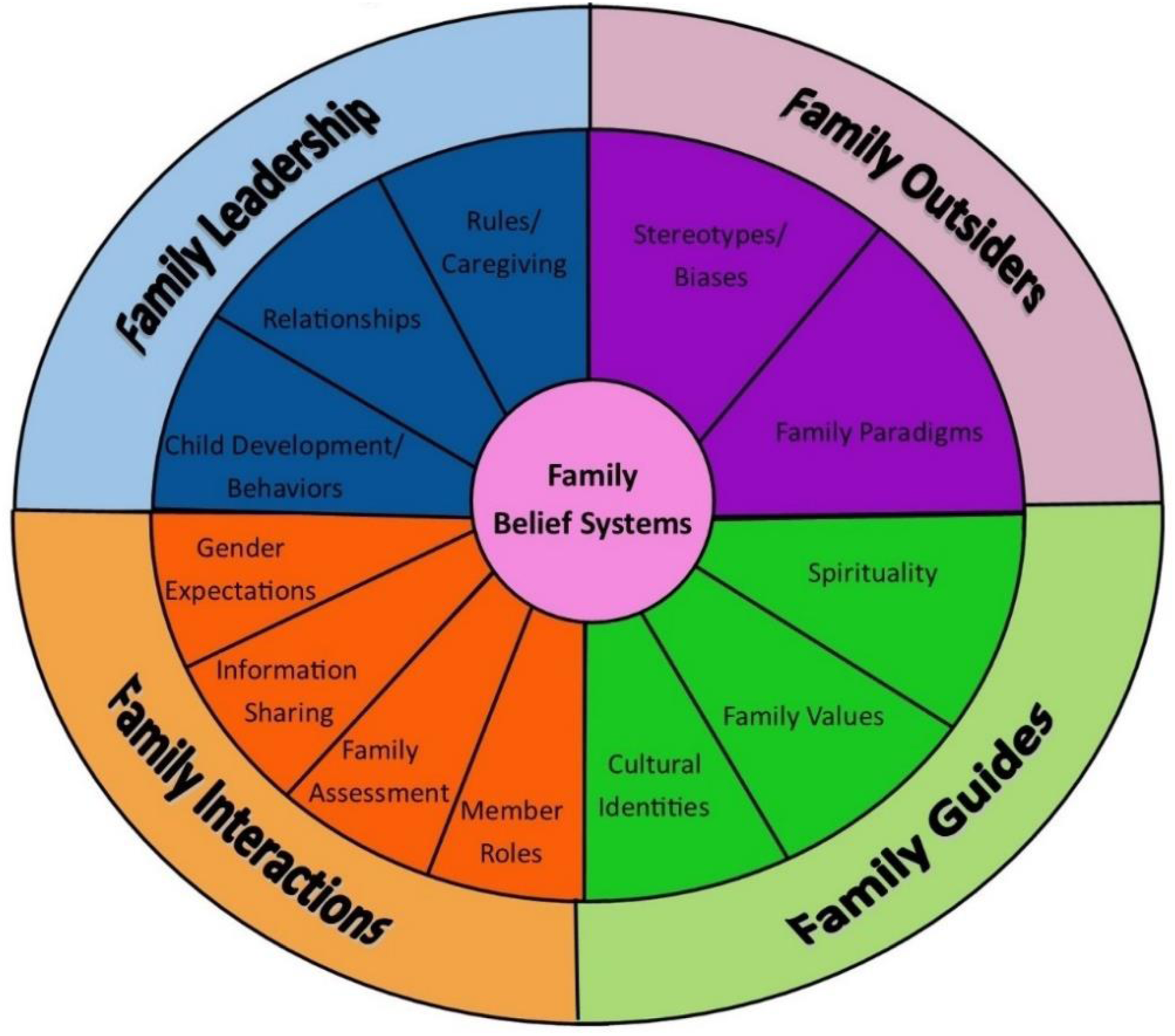
Family beliefs system wheel.
Proposed Typology of Family Belief Systems
Dattilio (2006) defined a typology as a means of classifying data into types based on theoretically derived or somewhat intuitively categorized qualities of an observed phenomenon. Informed by the process proposed by Datilio (2006), we developed the Family Belief Systems Wheel to classify the current literature on family belief systems. We began the classification process by conducting a comprehensive review of the family literature, specifically gathering beliefs referenced within empirical studies, measurement instruments, and theoretical works. Relevant beliefs may be held by families as a whole or beliefs of specific family members. Leung (2010) argued that beliefs can be classified into three categories: psychological beliefs (characteristics of individual), social beliefs (beliefs about social interactions and social groups), and environmental beliefs (beliefs about physical world or supernatural context). These three categories proposed by Leung (2010) were used as a loose guideline to identify what we considered a family belief during the review of the literature.
Following a comprehensive review of the literature, identified family beliefs were then organized into groups of common types and then given a identifying name that best communicates the set of principles within this specific family belief system. After all family belief systems were identified, we grouped related belief systems in separate domains. We determined that classification of family belief systems would be a nominal categorization without any ranking or hierarchical comparisons.
After we reviewed the literature, identified family beliefs, and grouped similar beliefs together, we had identified 12 total family belief systems. Then, we organized each of the 12 family belief systems across four main dimensions, which we labeled: (a) family interactions, (b) family leadership, (c) family guides, and (d) family outsiders. The twelve belief systems we identified aligned with one or more of Leung's three categories, and all of Leung's categories were represented by our 12 belief systems. However, we organized our findings by dimensions in order to more clearly represent the systemic and applied dimensions of the wheel's intended utility.
Though most literature references “parent” beliefs when referring to the beliefs held by the family leaders, we used “caregiver” to refer to the primary caregivers in the family since the primary caregiver of the family is not always a parent of the children. Additionally, it should also be noted that belief systems within one of the four domains, family leadership, do not apply to families that do not involve a caregiving role (e.g., no children in the family) and these family belief systems would not be considered when used with non-caregiver family units. Next, we will review each dimension and their associated family belief systems, noting beliefs that are included within each identified belief system. Citations identify the source (e.g., empirical study, measurement instrument, theoretical work) that referenced the belief included in the proposed family belief system.
Family Interactions
The family interactions domain contains belief systems that make up the basic assumptions of how members of a family are expected to interact with each other and member's place, position, and duties within the family unit. The family interactions domain includes four family belief systems: (a) family assessment, (b) member roles, (c) information sharing, and (d) gender expectations. The family assessment belief system involves family members’ perceptions or evaluation of family dynamics and family relationships as well as member's perceptions of who they are in the context of the family an individual's belief of “who they are” (Gordon, 2015). This also includes assessment of efficacy, the ability to be successful in familial roles (Bandura et al., 2011) including parenting efficacy (Bandura et al., 2011; Guidubaldi & Cleminshaw, 1985; Palacios et al., 1992), marital efficacy (Bandura et al., 2011), and collective family efficacy (Bandura et al., 2011). Additional beliefs in the family assessment belief system include family members’ perceptions of: (a) family cohesion, the sense of belonging and closeness within the family (Bischof et al., 1992; Phillips Smith et al., 2001), (b) family collectivism, beliefs about the nature and significance of family life (Brown & Crace, 1996; Kibria, 1994), and (c) family solidarity, unity and agreement of mutual support within the family (Merz et al., 2009). Also included in this belief system are beliefs about obligations of family members to the family as a whole (Buex et al., 2010; Vedder et al., 2009) and children's obligations to their caregivers (Phinney et al., 2000).
The second family belief system within family interactions is member roles, the responsibilities and expectations for different individuals within the family communicated and promoted by different members of the family (Buex et al., 2010; Dattilio, 2006; Pinquart & Silbereisen, 2004; Saggers & Sims, 2005). Also included within the member roles belief system are beliefs about ideal sibling interactions (Gamble & Modry-Mandell, 2008). Specific to caregivers’ roles in the family are beliefs about parenthood (Hirsjärvi & Perälä-Littunen, 2001) and expectations of caregiver socialization of the children (Stewart et al., 2019). Beliefs included in the member roles belief system also include beliefs about caregiver control versus child autonomy (Vonk et al., 2019) such as the beliefs of appropriate levels of control over children (Guidubaldi & Cleminshaw, 1985; Juang et al., 2007; Sitney & Kaufman, 2020), ideal caregiver control (Stewart et al., 2019), and caregivers’ perceptions of their current level of control over their children (Blunt Bugental et al., 1989).
Information sharing is the third belief system within family interactions and includes perceptions about disclosure of information, thoughts, and feelings amongst family members. Beliefs about information sharing include secrets within the family (Baker et al., 2003; Lieberman, 1979; Ow & Katz, 1999)., such as secrets between parents and children or secrets between spouses (Ow & Katz, 1999; Vangelisti, 1994). Information sharing within the family also includes the beliefs and perceptions about whether, how, or when family members can share information about themselves such as expressing personal feelings or thoughts (Daly, 2003).
The final belief system in the family interactions category is gender expectations. This belief system includes beliefs about gender distribution of work outside the home, caregiving, and household labor (Goodnow, 1988; Graham-Bermann & Brescoll, 2000; Hirsjärvi & Perälä-Littunen, 2001; Hoffman & Kloska, 1995; Klann et al., 2018; McLoyd et al., 2000; Simons et al., 1992). This belief system also includes general gender ideologies, members’ beliefs about traits and characteristics aligned with specific genders (Odenweller et al., 2018). These gender expectations are frequently found to direct caregiver socialization of their children (Palacios et al., 1992).
Family Leadership
The family leadership domain only applies to families with children; belief systems within this domain are guided by the caregivers’ perceptions and expectations of relationships and bonding within the family and of individual roles, behaviors, and presentations and expression for themselves and for their children. The family leadership domain includes three family belief systems: child development/behaviors, relationships, and rules/caregiving. Child development/behaviors includes beliefs held by caregivers about the developmental and behavior expectations for their children (Goodnow, 1988; Grusec et al., 1994; Hirsjärvi & Perälä-Littunen, 2001; McGillicuddy-DeLisi, 1980; Palacios et al., 1992; Sigel et al., 1980; Stelter & Halberstadt, 2011; Rubin & Mills, 1992). This belief system also includes caregivers' beliefs about the causes or explanations for children's behaviors in general (Miller, 1988; Mills & Rubin, 1990; Yeh et al., 2004), including expectations about children's abilities and interests based on the child's gender (McGillicuddy-DeLisi, 1992).
The belief system of relationships includes caregivers’ beliefs about ideal interactions and connections with their children. Included in this belief system are caregivers' attachment beliefs, the expectations of closeness, warmth, responsiveness, and sensitivity with their children (Bogaerts et al., 2005; Craissati et al., 2002; Gibson & Francis, 2019; Guidubaldi & Cleminshaw, 1985; Vonk et al., 2019). Additional expectations of relationships are specific to the ideal level of involvement or flexibility as evidenced by levels of enmeshment or rigidity (Alaggia & Kirshenbaum, 2005; Coe et al., 2018; Garber, 2011; Little Kivisto et al., 2015; Yoder et al., 2016).
The final belief system in family leadership is rules/caregiving. This belief system includes caregivers’ beliefs about discipline and preferred caregiver styles (Dishion et al., 2004; Erzinger & Steiger, 2014; Fry, 1993; McLoyd et al., 2000; Simons et al., 1992). A specific belief that would be included in this belief system are beliefs about harsh parenting, the acceptance of violence toward children (Holden & Zambarano, 1992; Markowitz, 2001). This belief system also includes caregivers' beliefs about appropriate supervision of children (Roche et al., 2014) and expectations of children's obedience to caregivers and teachers (Albanese et al., 2016).
Family Guides
Family guides include the norms and values that direct the family's behaviors, interactions, beliefs, and practices. Family guides is separated into three family belief systems: cultural identities, family values, and spirituality. Cultural identities includes the beliefs that are guided by cultural groups with which the family identifies (Saggers & Sims, 2005; Vedder et al., 2009) which may influence their psychological, social, and environmental beliefs (Leung, 2010). Cultural norms may direct the family's beliefs about symptoms, rituals, and guides to action (Daly, 2003). This belief system also includes family myths (Sameroff & Fiese, 1992) and family rituals (Sameroff & Fiese, 1992) such as religious holidays, daily family interactions, celebrations, and traditions (Schuck & Bucy, 1997).
The belief system of family values includes the values that members ascribe to and are taught and reinforced within the family. This belief system includes child rearing values, the desirable characteristics that caregivers want to instill in their children (Gamble & Modry-Mandell, 2008; McKay & Fanning, 2004). Family values may also include caregivers' beliefs about sexuality such as perceptions about permissiveness (Taris, 2000) or potential consequences from engaging in sexual behavior (Bleakley et al., 2009). This belief system also includes the potentially implicit caregiver rationalizations of their own problematic behaviors. This may involve beliefs involving acceptance of immoral or illegal behaviors (Phillips Smith et al., 2001) or problematic caregiver behaviors such as negative communication or caregiver aggressiveness (Mathe, 2007).
The spirituality belief system involves the beliefs that are guided by religiosity (service attendance, religiousness, and religious ideology; Bengtson et al., 2009; Vonk et al., 2019). This includes beliefs about the importance of religion in everyday lives (Brown & Crace, 1996; Okagaki & Bevis, 1999; Wieting, 1975), belief in religion as the basis for determining right and wrong (Okagaki & Bevis, 1999), and individualistic religion, the degree to which beliefs are individualistic or institutionally organized (Wieting, 1975). This also includes the beliefs about the external control of religiosity including belief in a deity/supernatural entity as omnipotent, ordering, external, and controlling in human affairs (Vonk et al., 2019; Wieting, 1975). Cultural messages socialized through religion may also be included in this belief system such as beliefs about attending services and congregation (Gap Min & Young Kim, 2005; Halgunseth et al., 2016). This belief system also includes beliefs of non-religion that are becoming a recent focus of research (Strhan & Shillitoe, 2019).
Family Outsiders
The final domain in the Family Belief Systems Wheel is family outsiders and is comprised of family beliefs about individuals or groups outside the family and beliefs about the family's position compared to and the ideal level of interactions with individuals outside of the family unit. The first belief system in this domain is family paradigms. A family paradigm is defined as the understanding of one's family and their family's interaction with the outside world (Fingerman & Bermann, 2000; Sameroff & Fiese, 1992). These beliefs can be socialized through family narratives to explain how children should feel about and interact with people outside the family unit (Gordon, 2015; Sameroff & Fiese, 1992). Family paradigms can also include family beliefs about ideal contact with others such as level of social isolation of the family from others (Alaggia & Kirshenbaum, 2005). Intra-familial secrets, secrets that the whole family keeps from their extended family or non-family members (Ow & Katz, 1999; Vangelisti, 1994), are also incorporated into the family paradigms belief system.
Stereotypes/biases is the other belief system included in the family outsiders category. This includes family members’ stigmatizing beliefs, simplified or standardized images of disgrace of certain people, held common by a community at large (Zhu & Smith, 2016). Family beliefs in this area may include racial stereotypes, sex-role stereotypes, and prejudice against LGTBQ+ populations, individuals with specific diseases (HIV/AIDS) or overweight individuals (Alexander et al., 1991; O’Bryan et al., 2004), for example. These belief systems are characterized by family members’ stigmatizing perceptions of specific groups of people outside the family unit; however, these beliefs about these groups may impact family dynamics and beliefs about specific members who are part of these disenfranchised groups. This belief system also includes family members’ tolerance of differing opinions or customs held by outside groups (Albanese et al., 2016). Finally, within this belief system are the specific beliefs about racial and ethnic socialization of children which often emerge in response to awareness of the stigmatizing beliefs potentially held by individuals outside of the family unit; for example, discussions about tolerance or preparing children for potential future prejudice (McLoyd et al., 2000).
Special Designations Between Categories
Attempts were made to identify family belief systems that are independent from each other in which a specific belief, value, or principle identified relevant to families can be easily assigned to one of the family belief systems named within the Family Belief Systems Wheel. While presenting definitions and descriptions of the separate family belief systems within the typology, we found some topics that may pose confusion about their recommended placement between categories.
Specifically, clarification appeared necessary when designating between beliefs related to gender. If the concept of gender beliefs was presented generally, there may be confusion on placement of these beliefs within the typology. However, further clarification of the specific nature of the gender beliefs allows for easier classification across the family belief systems categories. The family belief system gender expectations, within the family interactions domain encompasses beliefs held by family members about distribution of work based on gender as well as general gender ideologies. These beliefs held by children or caregivers likely guide family interactions through expectations of roles, activities, and bonding within the family based on these underlying beliefs about gender. Specific beliefs about how children should develop and act based upon gender that direct how caregivers socialize their children would be categorized under the domain of family leadership, most often within the belief system of child development/behaviors, as these are beliefs that held solely by the caregiver and correlated to child-rearing. Finally, stigmatizing perceptions related to gender, such as sex-role stereotypes, would be classified within the belief system of stereotypes/biases under the domain of family outsiders as these beliefs are generalized to gender across all environments. While these generalized beliefs may impact family dynamics if a specific member within the family identifies as a member of the stereotyped group, the belief would be categorized within this domain because the belief does not only impact interactions with members of the identified group within the family but also with members of the identified group outside the family unit.
Practical Application of the Typology
A synthesized, conceptual understanding of a complex body of literature, such as the one just described, has the potential to benefit both clinicians and researchers. The proposed typology provides a clear and consistent characterization of belief systems relevant to family dynamics and relationships, allowing differentiation between family belief systems.
For professional counselors working with families or from a family systems perspective, the Family Belief Systems Wheel can serve as a useful map with which to explore clients’ experiences of their own family-of-origin belief systems, as well as how they are creating belief systems within their own families, with their children and partners.
For researchers, clarity about the myriad of family beliefs and belief systems can allow for a more comprehensive assessment of various influences in individual or family behavior. The typology allows for specification and categorization of related concepts which may make it easier to compare research results. Given the speculative nature of the proposed typology, qualitative investigations could serve to confirm the initial categorization and organization of the identified belief systems.
We will also be using this typology as a guide in the development of an exploration scale that may be used for: (a) screening of clients to explore information about family-of-origin and current family dynamics, (b) needs assessment to determine family belief systems that appear to be guiding client's interactions, behaviors, and understanding within their family, and (c) identifying family belief systems as an initial avenue to explore client's underlying belief systems that drive their behaviors and interactions in settings and relationships outside of their family environment.
Conclusion
Personal belief systems are significant in one's behaviors, interactions, evaluation of world around them. The development of an individual's belief systems is influenced by the belief systems held by members within their family. Despite the agreed upon impact of family belief systems, there has been a lack of a consensus regarding the definition and relevant components to include. This manuscript presents a proposed typology that identifies 12 distinct family belief systems across four domains, reflecting the multidimensionality of family belief systems. The potential increase in understanding could support greater nuance in scholarship and practice to the benefit of client insight and change.
Footnotes
Declaration of Conflicting Interests
The author(s) declared no potential conflicts of interest with respect to the research, authorship, and/or publication of this article.
Funding
The authors received no financial support for the research, authorship, and/or publication of this article.
