



Abstract
Customer success (CS) management is being implemented across global business markets. CS management is unique, as it exists within a broader CS community of professionals who actively support the new customer management practice. However, academic research has yet to investigate nonfirm epistemic communities (i.e., knowledge communities related to a specific domain) that support CS management and how they differ across geographic settings in ways that may affect the overall practice of CS management. To address this gap, the authors investigate how the CS community is implemented across countries that vary in their levels of uncertainty avoidance. The authors focus on the CS community and its impact on CS management operational factors that represent people, process, and performance factors of CS management. Following a phenomenological approach, interviews from the United States, Brazil, and Portugal drive the findings and indicate different levels of reliance on the external CS community to guide internal CS management operational factors. This research contributes by establishing the importance of the CS community and by uncovering insights based on CS managers’ perceptions of the CS community and its effect on CS management operational factors. The authors offer salient insights into how managers can optimize CS management operational factors, and they provide a discussion of future research topics.
Keywords
In recent years, customer success (CS) management has matured into a global B2B practice. At the individual level, CS managers prioritize and maximize customers’ value in use throughout their journey to improve customer retention and expansion (Hilton et al. 2020; Hochstein et al. 2020). Underlying the growth of CS management has been a growing number of CS managers who participate in the CS community. The CS community refers to nonfirm epistemic (i.e., knowledge) communities of CS managers and top-level management who prioritize customers’ value in use as a main goal (Mehta, Steinman, and Murphy 2016). The CS community is made up of national conferences (e.g., Pulse), regional conferences (e.g., SuccessCon), local meetups (e.g., organic events), and forums (e.g., Slack and LinkedIn). The CS community is large and growing, as attendance at the Pulse conference, a leading CS community event hosted in various international markets, has grown from 300 attendees from the United States in 2013 to over 25,000 attendees from over 50 countries in recent years (Gainsight 2023; Immerman 2017; Salkin 2021). Although conferences in related domains (e.g., sales) obviously occur, the level of interfirm sharing and the formation of grassroots groups that focus on learning together and prioritizing the customer distinguish the CS community from other customer management practice communities. Calls for furthering nonfirm epistemic community research (Fransson, Håkanson, and Liesch 2011) have largely gone unanswered in the international sales literature. To address this deficiency, we employ a phenomenological approach to conduct a qualitative exploration of the CS community and its influence on CS management operational factors in different cultural settings.
Early scholarship on CS management documents origin stories, case studies, and best practices of CS management (Mehta, Steinman, and Murphy 2016; Porter and Heppelmann 2015; Vaidyanathan and Rabago 2020; Zoltners, Sinha, and Lorimer 2019). These works establish CS management as a new practice that global firms (e.g., Dell, GE, and SAP) have used to restructure their sales strategy (e.g., new functional units, job roles, and participation in interfirm communities). Recent research defines CS management as “the proactive (versus reactive) relational engagement of customers to ensure the value potential of product offerings is realized by the customer” (Hochstein et al. 2020, p. 3). A growing body of research has situated CS management as an evolution of customer management practices (Hilton et al. 2020), defined and differentiated CS management (Eggert, Ulaga, and Gehring 2020), explored it within firm settings (Hochstein et al. 2021), and provided a three-tiered theoretical perspective of CS management (Hilton et al. 2020). More recent studies investigate customer perceptions of CS management (Prohl-Schwenke and Kleinaltenkamp 2021) and antecedents to CS management (Kleinaltenkamp, Prohl-Schwenke, and Keränen 2022). However, a focus on international topics and the role of the CS community have not been addressed in the sales, marketing, or international literature.
The CS community is recognized as an essential driver of CS management in the business press. Arguably, the CS community is critical not only for the continued growth of CS management but also for the continued innovation of CS management across industries and business markets. Whereas international literature emphasizes the importance of knowledge transfer through nonfirm epistemic communities and promotes further research on the latter (Fransson, Håkanson, and Liesch 2011), a review of both the international marketing and sales-related literature provides scant guidance on how B2B nonfirm epistemic communities relate to firms’ implementation of customer management practices. To address this gap, we seek to investigate and develop answers to two main research questions:
These research questions aim to investigate in what ways CS managers perceive the CS community differently across cultures and the varying impact of the CS community on the CS management operational factor in cross-cultural contexts. We believe that Hofstede's theory of uncertainty avoidance will provide profound insights into these intercultural distinctions. Uncertainty avoidance is the degree to which members of a society feel threatened by uncertain or ambiguous situations (Hofstede, Hofstede, and Minkov 2005). Specifically, we examine the CS community from an international perspective based on the expectation that countries with lower levels of uncertainty avoidance will exhibit a more dynamic and engaged CS community. This is because high uncertainty avoidance is related to a fear of change and resistance to deviation from established patterns, whereas low uncertainty avoidance is related to a general sense of curiosity toward changes (Hofstede, Hofstede, and Minkov 2005). If uncertainty avoidance leads to fluctuations in the strength of the CS community across international settings, it is reasonable to expect differences in how CS management implements operational factors relevant to firms.
Given the limited existing research in the CS management literature, we employed a qualitative approach conducted in two phases. In the initial phase, a preliminary set of overarching themes was uncovered. We develop an understanding of the CS community, as well as operational factors (see Table 1) that relate to how people and process can lead to performance (Gratton et al. 1999) in firms utilizing CS management from the United States, Brazil, and Portugal. In Phase 2, we investigate the role and impact of a CS community on operational factors explored in Phase 1. Our research provides insights for scholars and managers into how uncertainty avoidance may affect the CS community and its impact on CS management operational factors. Our study draws from 106 interviews, with 35 from the United States, 43 from Brazil, and 28 from Portugal. These countries were chosen because they exhibit considerable differences in CS community levels and they reflect a wide range of uncertainty avoidance, with Hofstede scores of 46, 76, and 104, respectively (Hofstede, Hofstede, and Minkov 2005). We find that countries with lower levels of uncertainty avoidance, such as the United States, exhibit a more active CS community, and more effective CS management; this is reflected to a lesser degree by the country with a middle level of uncertainty avoidance: Brazil. Portugal, which has higher levels of uncertainty avoidance, exhibits a less active CS community and less effective CS management. The findings demonstrate that uncertainty avoidance plays a significant role in the establishment of robust CS management through CS nonfirm epistemic communities.
CS Community and Operational Factors Critical to CS Management.

Our focus on the CS community addresses a lack of attention on nonfirm epistemic communities in academic research. We offer three main contributions to the literature. First, our qualitative investigation across three countries (n = 106 participants) provides support for variance in the CS community based on the uncertainty avoidance of each country. Second, we examine CS managers’ perceptions of the CS community and its effect on CS management operational factors across cultural contexts. The findings summarized in Tables 1 and 2 offer evidence that the CS community manifests differently depending on the cultural values of the society in which it develops. Furthermore, Table 2 offers evidence that differences in the CS community may affect the implementation of CS management operational factors, suggesting that researchers should consider not only the cultural settings but also the effects of nonfirm epistemic communities when designing research on customer management practices. Finally, we offer useful insights to managers by drawing on Hofstede's theory of uncertainty avoidance to provide a context that managers can use when considering community aspects of a customer management practice. We focus our findings by adapting the people, process, and performance framework (Rangarajan et al. 2020) to organize operational factors specific to CS management. Altogether, our exploratory study provides a view of CS nonfirm epistemic communities and their effects on CS management operations.
Summary of Research Findings.
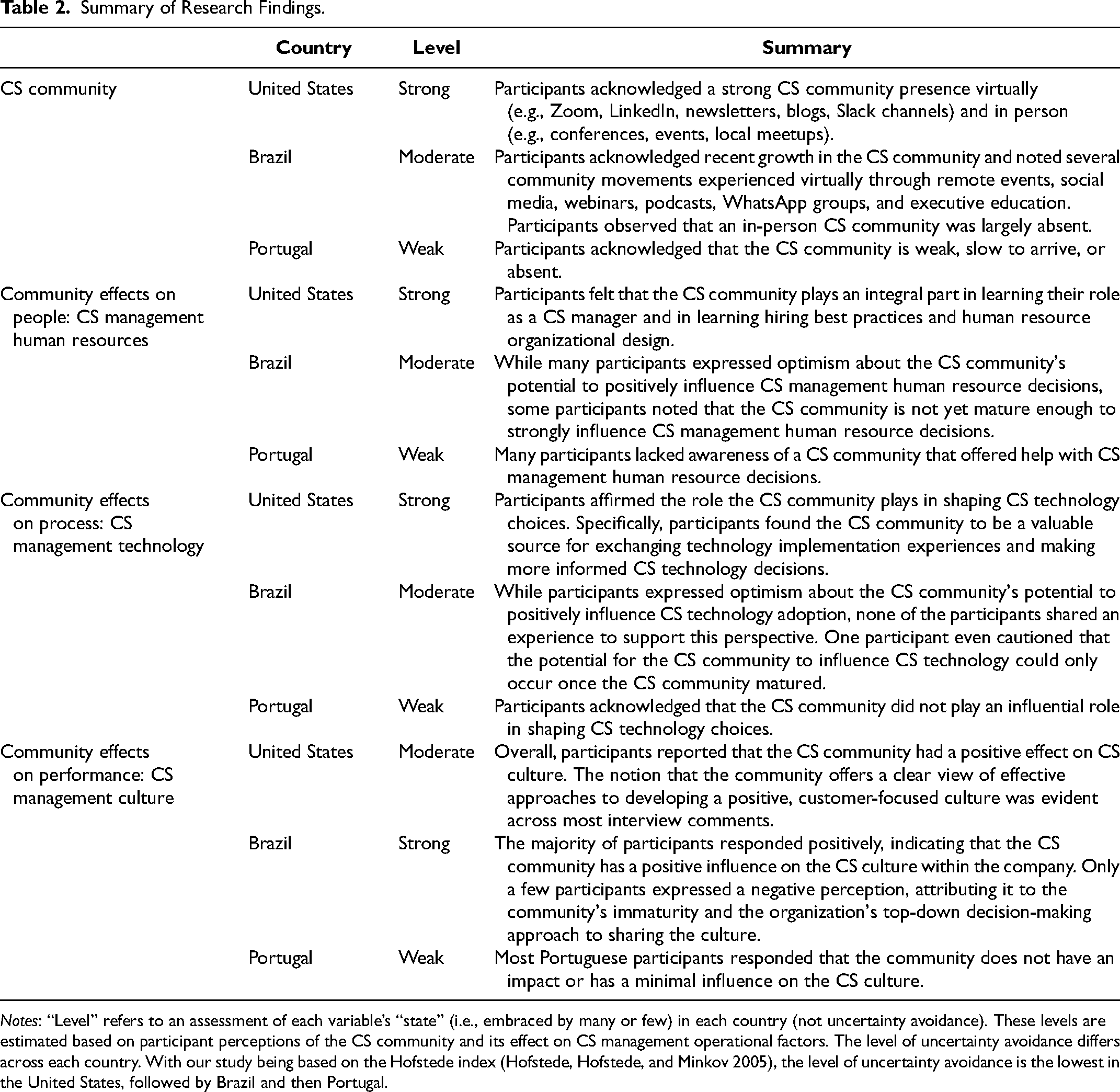
Notes: “Level” refers to an assessment of each variable’s “state” (i.e., embraced by many or few) in each country (not uncertainty avoidance). These levels are estimated based on participant perceptions of the CS community and its effect on CS management operational factors. The level of uncertainty avoidance differs across each country. With our study being based on the Hofstede index (Hofstede, Hofstede, and Minkov 2005), the level of uncertainty avoidance is the lowest in the United States, followed by Brazil and then Portugal.
Conceptual Background
The following sections discuss the motivations for our research into the CS community and its effect on CS management operational factors from a global perspective. First, we offer a brief overview of the existing literature on CS management and establish how it relates to sales practices. Next, we report on nonfirm epistemic communities and their role in the global, sales, and CS management literature. Our review of the international, sales, and CS management literature reveals a clear gap in the research related to nonfirm epistemic communities and their effect on operational factors of firms across international settings. Finally, we draw on uncertainty avoidance to guide our sensemaking as we investigate differences in the CS nonfirm epistemic community and its effect on operational factors across cultural contexts. Our intention is to provide a clear foundation for our focal topic and explain the “why,” “how,” and “what” that guide our international qualitative investigation.
Customer Success Management and Sales
CS management was developed in response to market changes as products and services transitioned to digital delivery and subscription-based sales models. The importance of add-on services that enhance the sale of solutions in different purchase configurations is clear (e.g., Reinartz and Ulaga 2008; Tuli, Kohli, and Bharadwaj 2007). However, as firms have focused on dynamic and cloud-based service delivery, the sales function has not been able to pay adequate proactive attention to ensure customers receive enough value to keep them from churning. For example, the customer expects to continue receiving value as the product evolves and is adapted over time, which can fall beyond the scope of a sales role. Clearly, sales and customer support professionals have traditionally offered postsale service, yet in a subscription setting, greater attention to customer use of products is required to ensure continued successful outcomes. CS management emerged as a solution to this issue, in essence moving responsibility for maintaining product value-based relationships from sales to CS managers.
CS management is related to customer-facing roles (e.g., sales, service, support) and addresses demands of the customer journey (e.g., presales, postsales). Hochstein et al. (2021) and Mehta, Steinman, and Murphy (2016) have advocated that CS management ought to fulfill a specialized customer-facing role that is its own function, separate from sales. Work by Eggert, Ulaga, and Gehring (2020) provides a good review and foundational descriptions of CS management and the CS manager role. In their work, the authors conceptually differentiate the CS manager role from existing service and sales roles based on its focus on the customer's use of the vendor's products and perceptions of goal achievement via the vendor's solutions. Hilton et al. (2020) suggest that CS management ought to hold a fiduciary perspective across all aspects of the customer journey, including customers’ goals, learning, and stakeholder management touchpoints. More recent works are also broadly related to the customer journey, such as how business customers judge CS management (Prohl-Schwenke and Kleinaltenkamp 2021) and the antecedents of CS management from a customer/supplier perspective (Kleinaltenkamp, Prohl-Schwenke, and Keränen 2022). Overall, existing research differentiates CS from sales and acknowledges its primary role is to retain customers, which complements the sales function. Missing from the literature is an investigation of the nonfirm CS epistemic community and whether and how its knowledge transfer affects individual-firm CS management operational factors related to people (human resources), process (technology), and performance (CS culture).
Nonfirm Epistemic (Knowledge) Communities
Firms and groups can learn from internal (i.e., firm) or external (i.e., nonfirm) sources. A review of the international, CS, and sales literature elucidates similarities and differences related to the role of epistemic communities. An epistemic community refers to “a network of professionals with recognized expertise and competence in a particular domain” united by a shared set of common principles and practices (Haas 1992, p. 3). The international literature emphasizes the importance of knowledge transfer through nonfirm epistemic communities and promotes further nonfirm epistemic community research (Fransson, Håkanson, and Liesch 2011). However, prior literature has focused on customer management practice knowledge transfer from perspectives outside nonfirm epistemic communities (e.g., industry, market, product, and organizational perspectives; see Bresman, Birkinshaw, and Nobel 1999; Kumar, Sunder, and Ramaseshan 2011). The CS community is particularly suited for nonfirm epistemic research, owing to CS practitioner beliefs emphasizing that the CS community is critical not only for the continued growth of CS management but also for the continued innovation of CS management across industries and business markets (Mehta, Steinman, and Murphy 2016). This perspective is unique to the area of CS management, as we find only limited literature on nonfirm epistemic communities in customer management practices outside CS management.
The sales literature does provide guidance on firm-based knowledge. For example, the sales literature reports on how firms can develop internal competitive market intelligence as an advantage (e.g., Hall et al. 2017; Itani, Agnihotri, and Dingus 2017). However, competitive market intelligence is generated by firms from the perspective of one on the inside looking out. The role of knowledge is also an aspect of communication competence (Koponen, Julkunen, and Asai 2019), which relates to a seller's ability to communicate with customers and internal stakeholders in ways that improve sales effectiveness. These topics indicate that the sales function traditionally takes more of a competitive, guarded, inward-looking stance on knowledge transfer. Only recently has the topic of “communities of practice” been found in the sales literature, where a netnography investigates nonfirm online sales knowledge forums (Conde, Prybutok, and Sumlin 2021). Thus, our investigation of CS nonfirm epistemic communities offers novel insights building on a solid history of their role in global knowledge transfer.
CS Nonfirm Epistemic Communities and Uncertainty Avoidance
To understand the variation in CS community formation across cultural contexts, this article investigates the impact of cultural values. National culture has been found to have a significant influence on the perceptions or behaviors of individuals in line with their cultural environment. This can lead them to be more likely to have a disposition congruent with the beliefs and norms of the dominant cultural environment (Steenkamp, Ter Hofstede, and Wedel 1999; Triandis 1989). Specifically, this research focuses on the cultural value of uncertainty avoidance because (1) it is considered to be the most related to innovative behavior among cultural values (Shane 1993; Van Everdingen, Fok, and Stremersch 2009) and (2) innovation inherently involves a certain degree of uncertainty and ambiguity in relation to its potential performance and risk taking (Singh 2006). For countries with high levels of uncertainty avoidance (e.g., Portugal and Greece), there is a general fear of change (Hofstede, Hofstede, and Minkov 2005). In such cultures, customers tend to resist deviation from established patterns and avoid perceived risks. In low uncertainty avoidance countries (e.g., the United States, Denmark, and Sweden), there is a general sense of curiosity toward change, and people tend to consider this change worth exploring (Hofstede, Hofstede, and Minkov 2005).
The present research focuses on the ways in which uncertainty avoidance can be related to CS epistemic communities. Exploring a new business strategy can signal risk, leading to a greater level of ambiguity in performance than established systems (Steenkamp, Ter Hofstede, and Wedel 1999). Thus, countries with high uncertainty avoidance are less able to support innovation than those characterized by low uncertainty avoidance. High levels of uncertainty avoidance relate to intolerance of ambiguity, where there is a general distrust of new ideas and adherence to historically proven patterns of behavior (Singh 2006). When uncertainty avoidance is low, the exploration of new ideas and concepts is implicitly valued. Thus, a country low in uncertainty avoidance may embrace new practices like CS management as a new innovative customer management practice and should be more likely to build a CS nonfirm epistemic community, compared with a country high in uncertainty avoidance.
The CS nonfirm epistemic community, a form of interpersonal network, is expected to improve and expand the practice of CS management for two reasons:
Social ties support the flow of information and resources and the impact people have on one another (Gondal 2023). While much information may be available through impersonal channels, such as digital platforms, in-person affirmation from a close network is often key to actors adopting an innovation (Strang and Soule 1998). Interpersonal networks can reduce the perceived risks associated with new innovative strategies. This impact is related to adoption by some actors having a cumulative effect on the adoption decisions of others in the social network. Thus, the number of adoptions progresses exponentially until only those who avidly oppose it are still resistant (Wejnert 2002). Consequently, adoption is often regarded as a network-based decision because exposure to the innovation has a cumulative impact as the perceived risks of adoption decrease and pressure builds to conform (Valente and Rogers 1995).
Our research suggests that a local nonfirm epistemic community can be instrumental in affecting CS management. This community would include various actors, from top-level managers who can enact top-down CS policy and environmental changes to firm talent engaging in bottom-up or top-down action taking, implementation, and realization of CS, as well as external stakeholders (Wejnert 2002). In a country where a robust local CS community is established, organizations are likely to have greater exposure to CS-relevant information and increased opportunities to engage with firms implementing CS management. As a result, organizations are more likely to adopt and implement CS management, such as management practices, firm structures, and technologies within their own operations. We investigate these communities across three countries to determine how uncertainty avoidance plays a role in the formation and effectiveness of CS management through CS nonfirm epistemic communities.
Methodology
Our method follows a qualitative, phenomenological approach to study CS management and CS nonfirm epistemic communities from a global perspective. Given the novelty and relatively unexplored nature of CS management, we found the phenomenological approach particularly appropriate for our study. The phenomenological approach facilitates the generation of new insights, enabling us to identify underlying themes and patterns (Graebner, Martin, and Roundy 2012; Thompson, Locander, and Pollio 1989). The approach enables researchers to identify and interpret basic processes that are complex in nature and deeply embedded in organizations (Eisenhardt and Graebner 2007; Martin, Gustafsson, and Choi 2016).
Qualitative research enables us to explore novel concepts with the goal of augmenting theoretical insights with manager attitudes, beliefs, and practices pertaining to CS communities in global settings. Finally, the approach helps uncover insights from top-level managers (i.e., executives, with authority to enact top-down CS policy and change) and firm talent (i.e., managers that engage in bottom-up or top-down action taking, implementation, and the realization of a CS strategy) that navigate complexity embedded in cross-cultural research.
We explore these topics by conducting research in three different countries: the United States, Brazil, and Portugal. We chose these countries because each represents different levels of CS community and CS management availability. A global CS management market report (Mordor Intelligence 2023) identifies North America as the largest and fastest-growing CS management market and identifies South America and Europe with moderate growth. In all three regions, a growing number of companies are prioritizing multichannel solutions to deliver value, a practice that lends itself to CS management. Also, the selected countries exhibit different levels of uncertainty avoidance, with Hofstede scores of 46, 76, and 104, respectively (Hofstede, Hofstede, and Minkov 2005). This cultural difference may help explain the varying levels of CS community formation across countries, which, in turn, can influence the implementation of CS management practices within organizations.
Data collection was accomplished across two phases. We conducted a balanced qualitative approach through the use of semistructured and structured interviews. Phase 1 consisted of semistructured interviews using an interview guide. Phase 1 was designed to confirm the variation in CS community formation across countries and identify integrative CS management operational categories. We developed our investigation of the CS community and its effect on CS management operational factors based on the common drivers of sales enablement: people, process, and performance (Rangarajan et al. 2020). We adapted these organizing categories to relate to key CS operational factors likely to be affected by involvement with a nonfirm epistemic community (see Table 1). In Phase 2, we focused on the role of the CS community and its impact on key operational factors of CS management. Specifically, we investigated whether and how participation in a CS community impacted the people of CS management (human resources), the process of CS management (technology), and the performance of CS management (CS culture) (see Table 2).
Participants were purposefully recruited through a professional networking platform (i.e., LinkedIn) and personal contacts to focus on a variety of industries and experience levels, as well as to include a mix of leaders and individual contributors. A total of 106 participants were included from the United States (35), Brazil (43), and Portugal (28) (see Table 3). The participants have an average of 16 years of work experience and fulfill various roles in their companies, ranging from CS managers to directors and CEOs. Their companies vary in size, with an average of 14,297 employees, and span diverse industries such as training, education, financial information, and health. Theoretical sampling enhanced transferability, as a conscious effort was made to include participants from different countries, industries, positions, and experiences.
Participant and Company Details.

Notes: Participants 1–35 are from the United States, 36–78 are from Brazil, and 79–106 are from Portugal. Industry sectors: Cons = consulting and training, Edu = education, Fin = financial information, Hlth = health, Ind = industrial, Log = logistics, Mkt = marketing, Prof = professional services, RE = real estate, Rent = rental service, Serv = services, Tech = technology. Business types: Corp = corporation, Gov = government, Start = startup. “Employees” denotes the total number of employees in the organization. Positions: Dir = CS director, Mgr = CS manager, VP = CS vice president. Gender: F = female, M = male. Experience is divided into three categories: time spent in the current company, time spent in CS roles, and total years in the job market.
The coauthor team contains both English- and Portuguese-speaking colleagues; thus, the interviews in the United States, Portugal, and Brazil were administered in the local language and according to the accepted practice in each setting. Overall, our interviews lasted an average of 30 minutes and were recorded and transcribed, as well as translated into English as the common language for analysis. The content was analyzed using phenomenological research procedures, as outlined subsequently (Finlay 2012; Goulding 2005; Thompson, Locander, and Pollio 1989). To prevent any potential bias in respondents’ interpretation of the interview questions due to inherent cultural differences, the researchers made careful choices with regard to the phrasing of the questions based on personal knowledge of each business culture and native language.
For the interviews, while we adopted a semistructured style, probes and prompts were also employed as necessary to gain greater clarity. The interview guide was based on a thorough and in-depth exploration of the literature. We asked questions related to objective variables (e.g., “What software is adopted by your company to perform CS activities?”) that enabled us to understand the contexts and standards by which CS management has been implemented. This approach is important in qualitative international business research for adding context (Reuber and Fischer 2022; Welch et al. 2010). The questions associated with subjective variables (e.g., “How strong is the CS community near you? Describe how it was in the past, is today, and might be in the future.”) provide insight into the external factor. Our questions examine dimensions of customer success in organizations related to human resources, technology, and CS culture. Based on these perceptions, we formulated an understanding of CS management that is widely held across countries. See the Web Appendix for details on our question protocol.
To validate our data collection and to verify that the best interpretations were made (Lincoln and Guba 1985; Wallendorf and Belk 1989), methods of trustworthiness were used. Trustworthiness criteria for qualitative research include confirmability (capacity for an independent auditor to trace the process to the original transcripts), transferability (findings to be transferred to another research context), credibility (findings are adequate and acceptable), and dependability (findings are consistent and reliable, regardless of any change; see Chaker, Zablah, and Noble 2018). In this study, confirmability was assured using MAXQDA software to perform all analysis and synthesis. Coding took place at the line-by-line level so that findings could be easily traced and confirmed. The objective was to ensure comprehensiveness, so all passages that discussed a topic of interest were flagged and compared. “Thick descriptions” (direct quotations of what the participant said) to flag the findings were used to ensure transferability (Geertz 1973). After gathering all the quotes from an interview on a given topic, we constructed a synthesis of the meaning of these quotes in relation to the purpose of the research, with emphasis on highlighting the position of that company as an element among others in the category. The Web Appendix offers examples of the coding process based on participant quotes.
To finalize our research findings, the researcher team read, discussed, and reviewed interpretations and the grouping of insights into themes. The transcripts were also cross-coded to ensure intercoder reliability (.88 agreement), with all differences being discussed to arrive at the final set of themes. For credibility, the researchers sought feedback from participants to confirm their understanding of participants’ intended meanings and our interpretations. We next report on the results of this qualitative process by highlighting themes and presenting verbatim quotes that support the themes.
Findings
The findings, summarized in Table 2, are based on an analysis of the subjective variables and participants’ perceptions of each country. We offer this summary as an illustration of the differences related to CS managers’ perceptions of the CS community and its effect on CS management operational factors related to people (CS management human resources), process (CS management technology), and performance (CS management culture). In the following sections, we offer insights and direct quotes from our qualitative study. The sections are organized to present representative findings from each country (the United States, Brazil, and Portugal), followed by discussions of each dimension and the overall findings.
Perceptions of CS Communities
Communities formed by customer success professionals are physical or virtual spaces where people disseminate CS practices and knowledge. However, little is known about the difference between the prevalence of CS communities 1 in different countries or the impact of CS communities on CS management operational factors. We examined CS communities across countries by asking participants to describe a given CS community and how it impacts their company.
Perceptions of the U.S. CS community
Participants acknowledged a strong CS community presence in virtual (e.g., Zoom, LinkedIn, newsletters, blogs, Slack channels) and in-person (e.g., conferences, events, local meetups) settings where CS managers gather regularly to discuss topics related to human resources, technology, and CS culture. Several respondents reported their experiences with the United States CS community as follows: MASSIVE benefits. As a relatively new function with a diverse range in how they are leveraged, structured, or invested in by their organizations, CS communities are a great source of insights, advice, support, and encouragement for CS professionals who are trying to bring best practices and mature CS as a function in the companies they represent. (CS vice president [VP], female, technology) I believe that being part of an active CS community is very beneficial from a best-practice-sharing [perspective], growing your expertise (especially when new) and learning about perspectives on new opportunities/technologies.” (CS manager, male, consulting and training) We get good input from other leaders who face similar problems and have innovative ideas. Overall, we value the community, and we see real benefits to our company from the items we implement. (CS director, male, technology) The CS community helps with best practice sharing, seeing industry trends, talking about challenges and how to overcome them. (CS director, female, technology) Gainsight is very well respected with some great stuff coming out … and they don’t commercialize it; they just provide a platform for everyone to work together. So again, that knowledge has become really widespread. … The marketplace for customer success technology is huge.” (CS director, male, technology)
Participants also noted the value of networking for employment and other opportunities. The absence of the CS community would limit my access to best practices, potential employment opportunities, and visibility to colleagues working in the same space. (CS director, male, technology)
Perceptions of the Brazil CS community
Participants acknowledged recent growth in the CS community and noted several community movements experienced virtually through remote events, social media, webinars, podcasts, WhatsApp groups, and executive education. Participants observed that an in-person CS community was largely absent. Several participants shared their experience gaining emotional support, collaboration, and employment support through the CS community: I know [about the community on] one or two social media platforms. Events happen from time to time, not very frequently. It definitely makes a difference participating in CS events because in a single day, we learn a lot, and it enriches our work. (CS manager, female, technology) I participate in a WhatsApp group where job vacancies in the CS field are posted, materials are shared, and updates on lectures and courses related to the field are shared via LinkedIn. (CS manager, male, real estate) It certainly brings benefits such as staying up to date on the latest market trends and having contact with professionals to exchange experiences. (CS director, female, financial information) Definitely a customer success community reflects many more benefits, sharing best practices, innovation, and identifying deviations to be corrected along the way; the power of large-scale communication favors an increasingly strategic approach to such a relevant topic. (CS manager, female, consulting and training)
Perceptions of the Portugal CS community
Participants acknowledged that the CS community is weak, slow to arrive, or absent. Comments like the following note the absence of the CS community: Unfortunately, we see more communities and forums for human resources, supply chain, and others than for customer success. (CS director, male, consulting and training) There isn’t much of a community in Portugal—some companies work together and may have conference calls—but the events I hear about in the U.S. are not here. It is difficult to get support, and many people don’t understand what we do because the awareness isn’t there outside of companies that have CS. … In the region, it is not much. Portuguese are more closed in this regard. Startups aren’t big, either. … There are larger companies that are a little afraid to share information with each other. Others are startups and are more closed off. But in Portugal, [the CS community] is not well evolved as a whole.” (CS director, female, technology) I don’t necessarily think that not belonging to a CS community causes problems because each professional has their own way of growing. (CS manager, female, consulting and training)
Insights: CS Community
The CS community aspect of CS management has not been investigated before. Our interviews showed that the CS community is where CS management professionals exchange experiences, take courses, and help each other. In the United States, which has the lowest level of uncertainty avoidance among the three countries studied (Hofstede score 46), participants noted that some communities were formed by commercial vendors of CS software, yet there are also grassroots communities in many major cities operating as local associations or informal groups. The use of technology, such as LinkedIn, Meetup, and Slack, has helped develop a strong network of CS professionals who compare best practices and develop solutions to challenges. For those in Brazil, which is in the middle in terms of uncertainty avoidance (Hofstede score 76), the community is emerging, described as “limited to our area,” and in Portugal (Hofstede score 104), which has the highest uncertainty avoidance of the three countries, the community is underdeveloped. In ranked order, the communities in the United States, Brazil, and Portugal represent a spectrum of broad and well-formed (United States) to narrow and well-formed (Brazil) to nearly nonexistent (Portugal). These findings offer evidence that countries with lower levels of uncertainty avoidance are correlated with more dynamic and thriving local CS communities.
The CS Community's Effect on People, Process, and Performance Operational Factors
We begin each section by first examining how CS managers perceive the effect of the CS community on each CS management operational factor, and we then examine how CS managers perceive the state of implementation of the CS management operational factor. We organize our findings around elements that relate to the people, processes, and performance outcomes of CS management. This organizational framework is adapted from research on sales enablement that identified this framework as including key managerial aspects of functions related to sales efforts (Rangarajan et al. 2020). Thus, we used the framework as we analyzed the data to identify specific aspects of CS that represent these elements, resulting in the following factors: (1) human resources (people), (2) technology (process), and (3) culture (performance) as the main aspects of how CS management is operationalized for each category. We next describe insights on each unique element in a CS setting.
People: CS Management Human Resources
We examined CS human resources across the three countries by asking participants to describe (1) how the CS community has affected CS management human resource implementation and (2) the state of CS human resource implementation across departmental structures, hiring/career paths, and reporting structures. Our participants described the role of human resources as critical to CS management effectiveness, as understanding the practice and role is required to hire the correct type of employees to carry out the mission of CS management. In essence, hiring more salespeople and calling them CS managers is not adequate.
U.S. perceptions of CS community influence on human resources
Participants felt that the CS community plays an integral part in learning their roles in CS management, hiring best practices, and human resource organizational design. Quotes like the following describe the CS community's influence on human resources: Everyone in the CS community is talking about how and who to hire and how layoffs are changing things. I’d say the community is important for HR. (CS director, male, technology) The CS community helps [us] to think about team design and structure, which influence the hiring profile. (CS director, female, technology)
U.S. perceptions of the state of CS management human resource implementation
Participants expressed that CS management roles are well structured with defined unique paths and that departments or business units dedicated to fostering CS management careers are established. Hiring and retaining CS managers is highly competitive. The following quotes represent the focus on the competitive market for CS managers: We hired early-in-career folks and matured them up. And now they have really good experience … so now they become that much more valuable and that much more attractive out in the market. So, we have to compete with people offering, you know, 40 to 50% more salary based on what they were doing here. (CS director, male, technology) When I joined, they were extremely activities oriented, and they didn’t really have a lot of variable comp [bonuses and equity] for the postsales group. Variable comp is an effective tool to drive focus and prioritization. … In my opinion, it's more about, like, hey, if this is on my comp plan (commission and salary), it's going to get my attention. (CS director, female, technology)
Brazil perceptions of CS community influence on human resources
While many participants expressed optimism about the CS community's potential to positively influence CS management human resource decisions, some participants noted that the CS community is not yet mature enough to strongly influence CS management human resource decisions. Again, a moderate level of uncertainty avoidance (76) provides a contrast in the responses of our participants from Brazil versus those from the United States. The cautious development of and reliance on knowledge from the community may limit some firms.
Brazil perceptions of the state of CS management human resource implementation
While participants in Brazil expressed that many CS management roles report directly to the CEO, participants also complained that firms had not appropriated the budget to hire senior CS managers and that entry-level CS managers are paid below-market wages. Several participants complained that it is challenging to hire CS management professionals: It is difficult for us to find good professionals with the profile we are looking for, which is not a pure customer service profile, like a call center person; it is a much more relational profile with the student and not so transactional, which is missed. (CS director, female, education) The main challenges we face are the difficulty of [developing] a clear understanding of the concept, with many professionals claiming to work in the customer success area but actually working in customer service, and vice versa. (CS manager, male, technology) As it is still a relatively new topic in Brazil, one of the major challenges is finding qualified professionals and courses that can support daily activities. (CS manager, male, technology) The challenges lie in finding professionals who effectively practice the customer success experience on a day-to-day basis. Many have the theory but lack practice. (CS director, male, technology) With hiring, the difficulty I have is with doing the best possible analysis of soft skills, mainly because we have daily situations that require [this] skill. Dealing with ERP [enterprise resource planning software] clients is an extreme mix of hard skills and soft skills. (CS director, male, education) Finding a professional with all the key competencies and knowledge of tools and data, along with empathetic alignment in customer interactions, is really a challenge. (CS manager, male, technology)
Portugal perceptions of CS community influence on human resources
Many participants lacked awareness of a CS community that offered help with CS human resource decisions. As we see across operational factors, the high level of uncertainty avoidance (104) limits the CS community in Portugal, resulting in less knowledge of effective practices. Participants were internally focused, taking more of a competitive view.
Portugal perceptions of the state of CS management human resource implementation
Portugal participants reported that CS management roles are new and that there is great difficulty hiring new CS managers. In particular, participants noted that there is confusion within human resources concerning what role a CS manager plays within a firm and that there is a lack of qualified CS managers to hire, as illustrated in the following quotes: It's a new profession; the recruitment itself doesn’t know the person's profile very well and sometimes confuses the CS management with the commercial or the support technician. Then, when the hiring staff arrives at the interview, they suddenly think, hey, that wasn’t quite what we wanted. This person here is just a commercial, she or he doesn’t have the competence to be a CS manager, or she's just a person who has the competence to support. (CS manager, male, technology) We struggle with it [human resources] every day because we don’t have room for error. Our mission is to retain the customer base, but we can’t find the right employees to do that well. When we invest in CS management and we still lose customers, it is a problem. (CS director, female, technology)
People Insights: CS Management Human Resources
The role that the CS community played varied across the three countries. In many ways, the community was described as both a help and a hindrance. The United States, which has an active CS community, perceived the CS community as helpful because it allows CS managers to learn from each other about the hiring procedures and development of CS departmental structures while reinforcing the training processes required for their professionals. In Brazil, concerns over a poor perception of the CS field were commonly described as something the CS community could help overcome. In Portugal, the lack of a CS community was described as a problem, as awareness of the job and the skills it requires are lacking. Regarding human resources, CS management is a new functional area that is experiencing problems associated with a lack of understanding, experience, and vision by many who might excel in the job. Overall, there is evidence that a stronger CS community enhances firms’ CS human resources.
Process: CS Management Technology
We examined CS technology across the three countries by asking participants to describe (1) how the CS community has affected CS management technology implementation and (2) the state of CS management technology implementation. Our interviews made it clear that technology is the main connection of CS management to other functions within and outside of the firm. The tools of CS management are specific technology platforms that analyze data and transform it into actionable insights. We found that the use of the “tools” of CS management was varied, resulting in different paths to help customers in being successful. Overall, without new data on product use and technology to analyze it, CS management is hindered in its efforts to develop a deep understanding of customers that it shares across the firm.
U.S. perceptions of CS community influence on technology implementation
Participants affirmed the role the CS community plays in shaping CS technology choices. Specifically, participants found the CS community to be a valuable source for exchanging technology implementation experiences and for making more informed CS technology decisions. The following quotes describe the CS community's influence on technology: I have heard a lot about new/existing technologies—AI usage, Gainsight, etc.—and it is great to be able to speak with other professionals on their use cases prior to exploring these myself. Oftentimes, if you sign up for a trial with a tech company, they immediately go into sales mode and try to force something on you. It's great to collaborate on other CS management's use cases first before understanding if something actually would work for us. (CS manager, male, consulting and training) The CS community helps in knowing what others may be using and how they use [them]; also, the community experience provided by the tech company is a factor when selecting a vendor. (CS VP, male, technology) We are always discussing new technologies that can automate—the community is a good “test market” to learn about the positives and negatives of these products. We use community connections a lot to learn from others. (CS director, male, technology)
U.S. perceptions of the state of CS management technology implementation
Participants’ implementation of CS technology is strong. Participants are using a mix of CS technology developed by third-party CS software providers, internally built CS software, and hybrid solutions comprising third-party and internally built CS software, as in the following quotes: We created additional functionality [to improve a commercial system] because none of the CS management tools moved at the pace we needed internally. (CS director, male, technology) [We utilize] both internal-facing tracking mechanisms, like [CS software], and also a customer-facing version [internally built] … that allows for customers to engage with their success teams and not have to go to multiple places for support tickets. (CS director, male, technology)
Brazil perceptions of CS community influence on technology implementation
While participants expressed optimism about the CS community's potential to positively influence CS technology adoption, none of the participants shared an experience to support this perspective. One participant even cautioned that the potential for the CS community to influence CS technology could only occur once the CS community matured. The lack of findings here may relate to Brazil's moderate level of uncertainty avoidance (76), where business leaders often take a “wait and see” approach to accepting the input of others in the CS community. This lack of connection between the community and firms around technology provides a clear example of differences in how firms approach CS technology across countries.
Brazil perceptions of the state of CS management technology implementation
The participants’ interpretation of the implementation of CS technology is mixed, with some participants noting that CS technology implementation is based on company size. It is primarily the major corporations that adopt CS technology. While there is a growing interest among smaller companies in exploring the implementation of CS technology, they often lean toward adopting systems that have been developed and pretested by larger companies instead of creating their own. Well, I think for larger companies, it's [CS technology] more common to use, right? I mean, for companies at our level, I don’t see a widespread use of CS technologies or other tools, considering our size. (CS director, male, technology) I think practically all large companies use it. I have seen and talked a lot with … Lately, with startups, too, they have used it. Some startups end up developing their own software, but many of them, for speed and practicality, hire from the market. And I’ve been doing a lot of benchmarks; companies have been looking for me to find out what we’re using. So yes, it's very common. (CS director, male, real estate) What I perceive is that the large retailers have these tools very well consolidated, including those allied to the issue of logistics, or large industries, such as fintechs, which only exist because of this technology. But in our market, it is still very uncommon. (CS manager, female, education)
Portugal perceptions of CS community influence on technology implementation
Since the CS community lacks strength in Portugal (uncertainty avoidance score 104), participants tend to rely less on the community when establishing the CS management process. Instead, in the development of CS technology, information and strategic plans are often shared and cultivated through personal connections with professionals in the field or within the company. Thus, participants acknowledged that the CS community did not play an influential role in shaping CS technology choices, as the following quotes make clear: In the case of customer success, it doesn’t influence me because I seek peers I know but who are not necessarily part of a community that we could call that area. Many pieces of information I seek are from other areas. (CS director, male, consulting and training) At the moment, there is no influence from the CS community in my company due to a very specific business model. All improvements and strategies are discussed internally. The research and choice of tools are more influenced by investors. (CS manager, female, consulting and training)
Portugal perceptions of the state of CS management technology implementation
The participants noted that the implementation of CS technology is heavily influenced by the size of the company. In smaller companies, the cost of adopting CS technology is perceived as a substantial barrier, further compounded by a limited awareness of the benefits of CS management. For example, participants state: I think the customer success department is not for small companies; it is for large companies with some involvement and some growth. So, in large companies, they use integrations with Pipedrive [technology platform] to be able to manage the customer success and account management part. (CS manager, male, technology) As long as the company has 100 to 500 employees, it is quite common. Software companies all use CRM [customer relationship management] systems, especially SaaS [software as a service] companies. Below that, for cost reasons, many people do things by hand, Excel. (CS director, female, technology)
Process Insights: CS Management Technology
Comments from all three countries revealed valuable insights into the CS community. In the United States, comments like “We need to keep up,” “We see how it helps,” and “I was in a forum that had some good advice” demonstrate an awareness of technology based on its use by others connected within the same community. In Brazil, comments like “We’re not there yet,” “We are being cautious,” and “We see some value in outside technology solutions” in relation to new technologies were common, indicating an awareness yet a more measured approach to technology than in the United States. Portuguese participants offered different comments like “We don’t understand,” “It isn’t clear how well it works,” and “We don’t want to be the first.” These are all signs that the awareness and desire for CS technology are weak, which seems to relate to the lack of a nonfirm epistemic community that can help build awareness of and insights into technology products. Across all three countries, it was either mentioned or implied that the community was aiding or hindering the use of technology depending on how well the community operates to connect and transfer new ideas, thoughts, and experiences between its members.
Performance: CS Management Culture
We examined CS management culture 2 across the three countries by asking participants to describe (1) how the CS community has affected CS culture and (2) the state of CS culture implementation based on changes in operations. Adapting the definition of workplace culture by Deshpandé, Farley, and Webster (1993), we suggest that CS culture is “the pattern of shared values and beliefs [about CS management] that help individuals understand organizational functioning and provide them with norms for behavior in the organization” (Deshpandé, Farley, and Webster 1993, p. 24). In essence, when a firm adopts a CS management perspective, the pervasiveness of it (in the firm's culture) determines if it is just another department or a firmwide philosophy that drives improved performance outcomes. We state this view to reflect our interviews, where it was clear that CS management, translated into the culture, is needed to arrive at desired performance outcomes. Thus, we investigate CS culture with regard to the performance aspect of our guiding framework.
U.S. perceptions of CS community influence on culture
Overall, the participants reported that the CS community had a positive effect on CS culture, influencing employees’ personal career growth, nurturing a CS culture within the workplace, and contributing to organizational development. The notion that the community offers a clear view of effective approaches to developing a positive, customer-focused culture was evident across most interview comments: I try to include my team (leaders and contributors) in the community stuff—it helps them to see the bigger picture. This helps us to keep growing our internal culture based on what we see and work with outside our walls. It is informal but helps our teams to have a good attitude. (CS director, male, technology) CS communities are great at reinforcing a culture of excitement around CS as a career and as a function. (CS VP, female, technology)
It's good to learn from others in terms of what is working/not. Probably less influential overall, though. (CS director, female, technology)
While in the United States, low levels of uncertainty avoidance (46) were evident, professionals seemed to have a more difficult time connecting CS community involvement with firms’ CS culture. Overall, responses indicate that the CS community has a lesser influence on CS culture in comparison to CS human resources and CS technology.
U.S. perceptions of the state of CS management culture implementation
Many participants noted that CS culture had become integrated through firm disciplines and that CS culture was embraced firmwide, as indicated in the following quote: Over the past five years, I’ve seen CS have a larger seat at the table. Most companies realize it's easier to expand within a current customer than to close net new business. (CS manager, female, technology)
We are no longer focusing on sentiment but adoption shown by usage and integration to drive firm operations toward customers. (CS manager, female, technology)
We did away with NPS [net promoter score]. We focus on buying, adoption, and onboarding as key metrics of how well we are doing as a firm. (CS director, female, technology)
[We had a] large shift from more of a service-oriented approach to a true driver of growth and retention. (CS VP, female, technology)
The notion of a “CS culture” resonated with our participants, who pointed to the pervasiveness of CS management business strategies across the functional units of many firms. Notwithstanding, despite lower levels of uncertainty avoidance in the United States (46), there appears to be a weaker connection between a strong CS community and firms’ CS culture.
Brazil perceptions of CS community influence on CS culture
The majority of participants responded positively, indicating that the CS community has a positive influence on the CS culture within the company. Companies recognize the importance of operating their businesses with a customer-centric approach and view the CS community as a hub for exchanging crucial information to shape customer-centered business strategies. The CS community plays an essential role in influencing the company's decisions related to the culture of customer success. The alignment of the company's strategy with the actions of leadership, knowledge, resources, networking, feedback, and decision making are valuable for the culture of the best customer experience and should be embraced by everyone with a focus on meeting the needs and expectations of customers. (CS manager, female, technology) The community is always bringing new models for strengthening culture and guiding the culture that should be adopted for the company to be more customer-centric, and these initiatives generate a lot of value for the company as a whole. (CS manager, male, technology) [The CS community] doesn’t have much influence [on CS culture] because the culture comes from the top. (CS manager, male, industrial)
In contrast to the United States (uncertainty avoidance score 46), these findings suggest that in Brazil (76) the CS community's influence on firms’ CS culture is much stronger than the CS community's influence on other operational factors. For example, we find it interesting that for CS culture, the CS community relationship was described as “essential” and “strengthening,” which are stronger relationship descriptions in comparison to other CS operational factors.
Brazil perceptions of the state of CS culture implementation
When asked about recent changes in the CS culture, participants described CS culture transformations across a wide range of areas. Participants recognized the importance of CS culture and highlighted its active discussion within the organization. Participants also considered the implementation of CS culture within the firm as a tool to enhance customer relationships and retention. Finally, participants asserted that CS culture had a positive effect on firm operations through organizational transformation, increased focus on customer needs, and changes toward customer-centric metrics as central to culture as follows: The company used to talk very little about the topic, but now, with a more demanding customer environment and customer churn, this subject is one of the most discussed in the company. (CS manager, male, professional services) Customer success didn’t exist a year ago, and with its introduction, everything changed. The way the company operates today, governance model, hiring of new professionals, policies involving the client, the care for the clients, and the way data is measured have all been changed, and this is already reflected in positive results in the indicators. (CS manager, male, technology) CS has been in the company for one year, since I joined. Without a doubt, the results are very positive. Before CS, there was no concern for the customer, and churn rates were much higher. (CS manager, female, technology)
Portugal perceptions of CS community influence on CS culture
Portuguese participants responded that the community does not have an impact or has a minimal influence on the CS culture as follows: I don’t think it influences. (CS manager, female, technology) There is no influence. (CS manager, female, consulting and training)
Portugal perceptions of the state of CS culture implementation
Participants indicated that CS management is perceived as a new change within the organization, as it did not exist previously. As part of the initial stages of introducing CS management, the organization hired personnel specifically focused on CS management and introduced relevant technologies. However, there were no specific testimonies of witnessing positive effects resulting from these changes, as illustrated in the following quotes: The culture I try to pass on to all sectors is to be a customer success specialist, to be in all branches, to talk to the commercial department, the retention department, the onboarding department, and to realize that this has to be intrinsic to company culture. (CS manager, male, technology) It is a new area in transition, and culturally, it is difficult to explain to other technical areas what is done. The company came from a system that was all organized by hand and Excel, so CRM and CS are all very new. (CS director, female, technology)
The customer is no longer seen as an entity to be won over solely through competitive prices and technically solid products, but as someone with whom it is necessary to establish a healthy long-term relationship. (CS manager, female, technology)
CS emerges as a great need to take care of and treat the customer in an exclusive way. (CS director, male, consulting and training)
The biggest change in recent years has occurred in processes and attitudes toward customer success. This has been reflected in the design of a more comprehensive customer journey, taking into account the challenges of implementing our product. (CS manager, female, consulting and training)
A lot has changed, especially our focus. Our focus, at this moment, is on the product, it is on developing the product, it is on meeting the customer's needs and what they ask of us, and solving problems that have been pending for some time—this is the main focus so that we can then deliver better service as a customer success company. (CS manager, male, technology)
Despite virtually no reliance on the CS community to help develop culture, responses from Portugal indicate a growing commitment to developing a positive CS culture.
Performance Insights: CS Culture
In each region, we observed that while some participants observed CS culture throughout the firm, other participants found that CS culture struggled to take root and influence operational disciplines. In general, there is some evidence that firms in the United States have reached a greater level of CS culture maturity relative to firms in Brazil and Portugal. U.S. respondents noted several iterations of CS culture within their firms, which indicates an evolving and embedded business strategy. However, respondents expressed that culture is more of an internal aspect, making it challenging to incorporate lessons from the CS community. Whereas CS culture in Brazil is more mature, CS culture in Portugal is still gaining prominence and acceptance. Further investigation of CS culture across different characteristics of global markets could help fine-tune understanding of these differences. Overall, CS culture is central to effective CS management, even if developed from different sources.
General Discussion and Implications
Our research is based on a qualitative approach to investigate the CS community and its effect on CS management. We offer insights into nonfirm epistemic communities and their role in guiding customer management practice. This contribution is advanced by incorporating the perceptions of managers and directors from three countries chosen for their variance of uncertainty avoidance. Our investigation draws on the CS community and how it influences three internal firm factors related to the people, process, and performance framework (Gratton et al. 1999). We focus discussion on insights related to each dimension to guide more effective CS management, with consideration for the differences and nuances found across global settings.
CS Communities
CS communities are embraced in the United States (uncertainty avoidance score 46), less accepted in Brazil (76), and questioned in Portugal (104). Overall, we found that greater participation in CS communities is related to lower levels of uncertainty avoidance found across countries, and that greater participation in the CS community is correlated with more mature CS management operations related to CS human resources, CS technology, and CS culture. CS communities that support CS management are nurtured through training, conferences, lectures, meetings, and benchmarking to improve practices and spread innovation. When the CS community is strong, the people participating drive the dissemination of ideas. According to Rogers (2003), diffusion is described as a process by which an innovation is consistently communicated through specific channels among the members of a social system. Mehta, Steinman, and Murphy (2016) reinforce that communities influence the customer experience, produce continuous improvement in all functions, and improve product development. Scholars have shown that communities can help form connections between people through formal and informal mechanisms of interpersonal communication, build trust and engagement among their members (Crespin-Mazet et al. 2021), contribute to innovative learning (Wani and Ali 2015), offer avenues for research, and empower innovation (Kim and Park 2010). Overall, we found that stronger CS communities are correlated with stronger CS management operational factors related to CS human resources, CS technology, and CS culture.
People (Human Resources), Process (Technology), and Performance (CS Culture)
The CS management area is nascent relative to customer management areas that are part of the traditional value chain, such as sales, marketing, human resources, and customer service. We found that in most firms, CS management is supported by executive-level stakeholders, demonstrating the strategic importance of CS human resources, CS technology, and CS culture. These findings converge with what Porter and Heppelmann (2015, p. 113) predicted in a Harvard Business Review article early in the development of the CS field: “Customer success management units are rare, but their roles are starting to be recognized and differentiated. Over time these may emerge as formal functional units.” According to Prohl-Schwenke and Kleinaltenkamp (2021), the organizational structure of CS management is becoming increasingly crucial by encompassing activities that aim to monitor, ensure, and improve customer success. Among our sample, firms implement CS management not only for customers but also to ensure that people, processes, and culture are congruent with prioritizing customers’ value maximization.
Crespin-Mazet et al. (2021) suggest that firms can innovate on the state of the art in customer practice through bottom-up behavior. How to best encourage bottom-up behavior may partly depend on cultural considerations related to uncertainty avoidance and other dimensions. Ramanathan, Chacko, and Andrlic (2022) advise that organizational culture and national culture are different, as are regional and geographic culture. Whereas the implementation of new customer management practices should be viewed from a cultural perspective (Kumar 2014), we find evidence that the United States (uncertainty avoidance score 46), Brazil (76), and Portugal (104) are at different stages in the practice of CS management, which relates to diverse cultures, priorities, timings, and perspectives on uncertainty and corresponding CS community involvement.
For firms seeking to implement people, process, and performance to support a new customer management practice, managers could first assess the uncertainty avoidance of their region, industry, and firm. On the one hand, if uncertainty avoidance is low, managers might introduce a new customer management practice as part of a new innovation and sponsor a bottom-up process using a community to help individual contributors innovate in management areas related to human resources, technology, and culture. On the other hand, if uncertainty avoidance is high, managers could introduce a new customer management practice as part of a minor change to an existing customer management practice. Managers could then deploy top-down norms, rules, and regulations whereby individual contributors are afforded opportunities to make more minor adjustments to the existing customer management practice.
Future Research and Limitations
Our findings offer new directions for future research on CS management, as well as some limitations. As a foremost limitation, our study does not investigate all aspects of CS management. We opted to focus on the CS community and its effect on internal CS management factors related to human resources, technology, and culture at the expense of examining effects on the customer through the customer journey, customer engagement, and the role of product and service offerings in CS management. Though of critical importance, these unexamined factors fell beyond the scope of our internal operational focus. However, researching these factors ought to yield interesting future insights.
As a main objective of our research, we addressed a gap in the knowledge of CS communities. Our approach was to investigate communities in countries that respond to uncertainty differently, as we expected perspectives on uncertainty avoidance to provide different levels of community and implementation of CS management. We did find differences and identified ways that both strong and weak CS communities impact CS management. However, further investigation of CS communities is needed. Our exploratory investigation offers guidance, yet empirical research can offer more precise recommendations on how uncertainty avoidance relates to communities and their impact on customer practice outcomes. For example, because many aspects of CS communities are vendor supported, investigation of grassroots efforts versus vendor-supported efforts could offer insights related to the authenticity, trust, and credibility.
While our study is based on investigating a phenomenon implemented across a diverse global marketplace, we did not investigate all global markets. The practice of CS management is growing across Europe, as well as in Asia, Africa, and Australia. Therefore, future research ought to consider additional cultural settings. One challenge of studying global markets is that respondents from different countries may interpret the same survey questions differently, potentially confounding the research findings. To address potential cultural bias, we discussed the matter and carefully designed interview questions by reviewing them with native speakers from each country. For future empirical research, we recommend that researchers consider employing appropriate tools (i.e., anchoring vignettes; Pourmasoudi et al. 2022) to proactively account for potential cultural differences in the interpretation of survey questions and items.
Finally, our study also uncovered that CS communities involve industries well outside CS management’s technology industry origins, such as education, consulting, finance, and real estate. Whereas CS communities originally involved business-to-business firms, we also found that CS communities offer support to business-to-consumer organizations, such as universities and real estate firms seeking to better serve students and tenants, respectively. Future research ought to consider industry settings and firm offerings as a way to expand our understanding and generalizability of CS community and CS management research.
Supplemental Material
sj-pdf-1-jig-10.1177_1069031X231222417 - Supplemental material for The Customer Success Community: An Exploration of Nonfirm Epistemic Communities and Their Influence on a New Sales Practice
Supplemental material, sj-pdf-1-jig-10.1177_1069031X231222417 for The Customer Success Community: An Exploration of Nonfirm Epistemic Communities and Their Influence on a New Sales Practice by Roberto Madruga, Bryson Hilton, Hyeyoon Jung, Bryan Hochstein and Edison Renato Silva in Journal of International Marketing
Footnotes
Declaration of Conflicting Interests
The authors declared no potential conflicts of interest with respect to the research, authorship, and/or publication of this article.
Funding
The authors received no financial support for the research, authorship, and/or publication of this article.
Special Issue Editors
Nawar Chaker, Johannes Habel, Alex Zablah, and Kelly Hewett

Notes
References
Supplementary Material
Please find the following supplemental material available below.
For Open Access articles published under a Creative Commons License, all supplemental material carries the same license as the article it is associated with.
For non-Open Access articles published, all supplemental material carries a non-exclusive license, and permission requests for re-use of supplemental material or any part of supplemental material shall be sent directly to the copyright owner as specified in the copyright notice associated with the article.
