



Abstract
This longitudinal study examines the effects of Israeli counselors’ and clients’ ratings of their working alliance on clients’ career exploration (CE), using a sample of 94 three-session career counseling processes. Results reveal that both clients’ and counselors’ working alliance ratings increased over time; yet, clients’ ratings remained constantly above counselors’ ratings. Results also suggest that clients’ working alliance ratings are a better predictor of clients’ CE than counselors’ ratings. Implications for career counseling are discussed.
Modern approaches to career counseling emphasize the importance of establishing a collaborative relationship between counselor and client, and creating a supportive atmosphere for the client to explore oneself as well as the world of work in order to take better career decisions (Crites, 1981). Research has shown that the in-session relationship plays an important role in providing the conditions for a positive outcome, not only in personal counseling but also in career counseling. Specifically, studies have shown that positive working alliance contributes to positive changes through individual, face-to-face, long- and short-term career counseling interventions (Masdonati, Massoudi, & Rossier, 2009; Perdrix, de Roten, Kolly, & Rossier, 2010; Whiston & Rahardja, 2008).
In a study comparing the ratings of satisfaction or perceptions of quality of the counseling relationship by clients presenting personal–social concerns and vocational concerns at intake, no differences were found by clients presenting either type of concern (Vargo-Moncier & Jessell, 1995). Nevertheless, even though many studies examined working alliance in psychotherapy, only few studies have been conducted on this subject in other types of counseling relationships, particularly in the field of career counseling (Masdonati et al., 2009; Meara & Patton, 1994; Perdrix et al., 2010). Two of the few studies conducted to examine the effect of process variables on outcome in career counseling (Heppner, Multon, Gysbers, Ellis, & Zook, 1998; Multon, Heppner, Gysbers, Zook, & Ellis-Kalton, 2001) demonstrated positive growth on process measures over the course of counseling and positive outcomes on a variety of criteria. However, in both studies, the relationship between process and outcome was either not significant or only a small amount of variance of the outcome variables was accounted for by the process measure. Hence, additional research is needed to better understand the relationship between process and outcome in career counseling.
According to Bordin (1979), the quality of the working alliance arises from a combination of agreement between the client and the therapist about the goals of the therapy, agreement about the tasks that lead toward achieving these goals, and the development of an emotional bond between them. Research findings in psychotherapy demonstrate that the quality of the working alliance, as a process indicator, is one of the best predictors of outcome in all modes of therapy (Horvath & Greenberg, 2000; Horvath & Luborsky, 1993; Horvath & Symonds, 1991). A meta-analytic study examining 24 studies in psychotherapy found that the average correlation between working alliance and outcome was 0.26 (Horvath & Symonds, 1991), defined by Cohen (1988) as a moderate correlation coefficient.
Change in Working Alliance Ratings Over Time
Recent research on working alliance emphasizes its temporally dynamic and developmental nature (Kivlighan & Shaughnessy, 1995). Previous research indicates that a working alliance develops in both short- and long-term therapy, typically during the first five sessions, and even after a single session (Horvath, Gaston, & Luborsky, 1993; Horvath & Greenberg, 1989). Studies measuring the working alliance at different times during long- and short-term psychotherapy found an increase in working alliance ratings over time (Bethea, Acosta, & Haller, 2008; Hersoug, Høglend, Havik, von der Lippe, & Monsen, 2009). In most studies, however, working alliance was measured only after the third session (Kramer, de Roten, Beretta, Michel, & Despland, 2008). In one study examining growth in alliance ratings in 3- to 12-session career counseling processes, linear growth was found in both client and counselor ratings over time (Heppner et al., 1998). No other studies were conducted to examine the pattern of change in working alliance ratings in short-term career counseling processes. Specifically, measuring the alliance after each session of a counseling process might shed some more light over the pattern of change in alliance ratings over time, especially in short-term counseling.
Client and Counselor Evaluation of Working Alliance
Working alliance is considered a variable that is affected by the rater’s perspective. Although many studies in psychotherapy have found that client ratings have a stronger correlation to outcomes than do therapist ratings (Fitzpatrick, Iwakabe, & Stalikas, 2005; Muran et al., 2009), others found that therapists’ ratings, measured at the end of the counseling process, accounted for a large proportion of the outcome variance (Bethea et al., 2008; Kivlighan & Shaughnessy, 1995). Further research is needed to determine how rater’s perspective on the quality of the alliance is related to specific outcomes in career counseling processes. One might suggest that in a short-term career counseling process, in which clients are expected to be very active in setting goals and achieving them, clients’ ratings of the alliance will be a more sensitive predictor of outcome.
Numerous studies have found moderate-to-large correlations between therapist and client ratings in short- and long-term psychotherapy (Bethea et al., 2008; Fitzpatrick et al., 2005; Muran et al., 2009). Previous studies in psychotherapy have also reported that clients’ working alliance ratings are usually higher than therapists’ ratings (Fitzpatrick et al., 2005; Kramer et al., 2008). However, very few studies have examined these questions in career counseling.
Career Exploration
In the career counseling process, the counselor encourages the client to gather information about oneself and the world of work, both in and between sessions (Brown & Ryan Krane, 2000). In the counseling process, both parties play an important role in client’s career exploration (CE), which is considered a crucial stage in the career development process (Bluestein, 1997), and a central element in career decision making (Krumbolz, Schreba, Hamel, & Mitchell, 1982). CE seems to have a positive impact on the decision-making process, in job search and placement, and on occupational satisfaction and attainment (Taveira & Moreno, 2003). Consequently, encouraging client’s exploration should be considered an important element in most career counseling processes, especially when focused on career decision making and job seeking (Taveira & Moreno, 2003).
Few studies have examined the relationship between working alliance and outcome in career counseling. Levy-Hayardeni (2000) found positive correlations between Israeli client working alliance ratings and client satisfaction from the counselor, the counseling process, and the career decision. Other studies have found that the working alliance has a positive effect on desired counseling outcomes, including satisfaction from counseling and from life in general (Masdonati et al., 2009), and acquiring career information (Massoudi, Masdonati, Clot-Siegrist, Franz, & Rossier, 2008).
Previous studies have shown that CE is affected by various personal and cognitive variables (Blustein & Phillips, 1988; Burge et al., 1997), but no studies have examined whether the working alliance, a situational and interrelational variable, affects CE. In a study conducted in Israel, which was one of the few studies examining the effect of counselor–client relationship on client CE, Littman-Ovadia (2008) found that clients’ perceptions of the relationship as supportive and their perceptions of counselors’ role as a secure base increased client exploration, but the effect of working alliance on CE was not examined.
Even though these findings suggest that exploration is affected by the client’s relationship with the counselor, client perceptions of the counselor as a secure base is more strongly related to the emotional dimension of the working alliance, embodied in the bond dimension, than to the instrumental aspects of the working alliance, embodied in the tasks and goals dimensions (Horvath & Luborksy, 1993). More specifically, the study by Littman-Ovadia (2008) does not examine collaboration or congruence on the task and goals dimensions, which are the very essence of the working alliance measure. Since exploration is one of the main tasks in career counseling processes, and is also considered an instrumental element in the counseling process, a correlation between the instrumental dimensions of the alliance and CE should also be expected. Furthermore, CE research inspired by attachment theory (Bowlby, 1982) indicates that motivation for, and competence in, CE is associated with securely based and supportive family relationships (Taveira & Moreno, 2003). Hence, it is important to consider interrelational and developmental factors of CE. At the same time, it has been noted that interrelational support offered by counselors in counseling contexts could be seen as a basic condition for self- and environment-oriented exploration (Blustein & Flum, 1999).
Career Counseling in Israel
In Israel, vocational psychology is a fully recognized specialty regulated by a committee in the Ministry of Health. Nevertheless, it is still considered a relatively small specialty which is an amalgam of several subspecialties, including career counseling and assessment, selection and assessment, and organizational psychology (Benjamin, 2007).
The use of psychological tests is prevalent in career counseling in Israel. Moreover, psychometric tests determine acceptance to many jobs and higher education institutions, where the student must choose a profession from the first year of undergraduate studies (Nevo & Wiseman, 2002). Furthermore, there is a growing tendency within the Israeli education and social systems to focus more on the present, that is, the general and current well-being and/or achievements of the person, rather than to devote their efforts to a comprehensive life planning and vocational counseling (Israelashvili & Benjamin, 2009). Hence, in most institutions in Israel, career counseling is planned to be a short process that includes an interview, tests, and feedback. Clients are led to expect career counseling to be brief (Nevo & Wiseman, 2002).
In applying some specific characteristics to client–counselor relationships in individual counseling in Israel, Israelashvili and Benjamin (2009) argue that Israeli clients tend to be initially very suspicious but become more open and cooperative as the session progresses, and exhibit a high tendency to share and disclose their personal lives, plans for the future, and problems. In addition, it seems that many Israelis share a tendency to explore in a curious fashion, along with possessing an exceptional eagerness to progress and achieve (Friedman, Friedlander, & Blustein, 2005). Hence, once the Israeli client moves from a defensive mode to cooperation with the counselor, they may be ready to proceed with new experiences and exploration, sometimes even beyond the counselor’s initial expectations (Israelashvili & Benjamin, 2009).
To our knowledge, no studies were conducted to examine the effect of working alliance on CE. Examining the development of working alliance between Israeli clients and counselors in short-term career counseling, as well as its effect on CE, might take another important step in the cross-cultural research on the working alliance within the field of career counseling.
The Present Study
The purpose of this study was to explore an issue that has not been previously examined in the field of career counseling: the contribution of the working alliance to client CE from the perspectives of the counselor and the client. This purpose was achieved by using field data from 94 three-session counseling processes conducted in Israel. This unique sample of naturalistic data was acquired in 2000–2001, as part of a broader study on career counseling (Littman-Ovadia, 2008).
Based on the findings and predictions discussed earlier, the following three hypotheses were tested in this study: (a) Clients’ and counselors’ ratings of the working alliance will increase over time; (b) Client’s ratings will be higher than counselors’ ratings; and (c) CE after counseling will be more strongly correlated to clients’ ratings of the working alliance than to counselors’ ratings.
Method
Participants
Participants were clients of private and public career counseling centers in Israel during the years 2000–2001. Prior to the first counseling session, 110 clients were asked to take part in the research, and in return would receive a report on study findings. Of the 94 clients who agreed to participate in the study, and completed all counseling sessions and questionnaires, were 43 women (45.7%) and 51 men (54.3%), whose ages ranged from 18 to 56 (M = 28.4, SD = 8.51) and whose education years ranged from 9 to 20 (M = 13.6, SD = 2.28). The majority (67.0%) were adults facing their first career decisions or seeking counseling services for a second career. The remainder (33.0%) sought support in coping with career crises, dejection in the job-seeking process, or initial job adjustment. The majority (89.4%) had no previous experience with career counseling.
Of the eight counselors, six women counseled 73% of the clients in the study and two men counseled the remainder. The number of clients for each counselor ranged from 1 to 36 (M = 11.75, SD = 11.52). Counselors differed in age and professional experience: Ages ranged from 31 to 57 (M = 41.25, SD = 9.56) and professional experience ranged from 2 to 20 years (M = 9.88, SD = 7.41). All counselors had at least master’s degrees in psychology and were certified counseling and vocational psychologists by Israeli or U.S. institutions.
Instruments
Career exploration
CE was assessed using a self-report questionnaire developed by Littman-Ovadia (2002). The questionnaire is based on Blustein and Flum’s (1999) conceptualization of CE. The 15 items derived from this conceptualization were rated on a 5-point scale, ranging from 1 (very rare) to 5 (very often). The scale assesses both external (e.g., “I collect data about organizations and jobs”) and internal CE (e.g., “I think about my vocational goals”), as reflected in clients’ current behaviors outside the sessions, using items generated from theoretical descriptions of these two areas of searching. The total CE score is calculated as the mean score of all items, whereas higher scores indicate higher CE. High reliabilities were found by Littman-Ovadia (2002) for the first administration of the scale, before the first counseling session (Cronbach’s α = .87), and for the second administration of the scale, at the final counseling session (Cronbach’s α = .86). The high correlations (r = .72) found between counselors’ and clients’ ratings by Littman-Ovadia (2002), indicate a high convergent validity of the instrument.
High internal consistencies were found in this study for the first administration of the scale (Cronbach’s α = .86) and for the second administration after the final counseling session (Cronbach’s α = .83), consistent with the high internal consistencies found by Littman-Ovadia (2002).
Working Alliance Inventory (WAI)
The WAI (Horvath & Greenberg, 1989), developed as a measure of the working alliance (defined by Bordin, 1979), is a self-report questionnaire of 36 items, rated on a 7-point scale, ranging from 1 (never) to 7 (always). The WAI yields three 12-item, summed subscale scores (Tasks, Bond, and Goals) as well as one overall score.
In this study, two versions of the WAI were used with corresponding items for clients (e.g., “What I am doing in therapy gives me new ways of looking at my problem”) and counselors (e.g., “My client and I both feel confident about the usefulness of our current activity in therapy”). According to Horvath and Greenberg (1989), this inventory is appropriate for administration even after a single session and meets the criteria for convergent and discriminate validity.
High reliabilities were found in the current study for the counselors’ ratings at all three times of measurement (Cronbach’s α ranged from .70 to .87 for goals, from .80 to .88 for bond, from .80 to .84 for tasks, and from .90 to .95 for the total score). Moderate-to-high reliabilities were found for the clients’ ratings at all three times of measurement (Cronbach’s α ranged from .65 to .83 for goals, from .79 to .83 for bond, from .76 to .88 for tasks, and from .89 to .94 for the total score). Internal consistencies for the total scores are similar to the ones found by Horvath and Greenberg (1989), ranging from .87 to .93, as well as to the one found by Perdrix et al. (2010) in a career counseling setting (r = .87).
Procedure
After turning to the counseling centers, each client was randomly assigned to one of the centers’ counselors. Both clients and counselors were approached by the counseling centers’ secretaries and asked to participate in the study independently. Counselors were not involved in recruiting the clients, nor had any access to clients’ reports. Both clients and counselors were clarified that declining participation will not have any future consequences whatsoever. Clients who turned to the counseling centers for career counseling were informed that each counseling process consisted of three counseling sessions, which is compatible with the number of sessions for effective career counseling interventions pointed out by Brown and Ryan Krane (2000). They were also informed that counseling process includes an 8- to 10-hr evaluation session consisting of various vocational questionnaires administered by other members of the centers’ personnel. The number of counseling sessions and length and content of evaluation sessions constitute the standard counseling process administered to clients in counseling centers in Israel (Littman-Ovadia, 2002). The first counseling session was dedicated to building working alliance: agreement on the goals to be achieved in counseling, agreement on the tasks involved, and creating initial bond. The first session was followed by an evaluation session, in which client’s abilities, interests, values, and other relevant vocational variables were assessed using various vocational questionnaires administered in groups. The counselors were not involved in the evaluation sessions nor were they present during the administration of the tests. The second counseling session focused on providing feedback to the client on the assessment of various career variables and their integration with the goals of counseling, as well as discussing future career options and information-seeking and exploration tasks. The third counseling session focused on evaluating clients’ exploration and implementation of recommendations, and summarizing the counseling process. The questionnaires were administered independently: WAI was administered after each counseling sessions and CE was administered before the first counseling session and after the final session.
Results
Preliminary Analyses
Clients and counselors rated all WAI subscales positively, with mean values ranging between 5.16 and 5.98 for clients and between 4.83 and 5.94 for counselors. Table 1 shows the intercorrelations for clients’ and counselors’ WAI total scores at all times of measurement, CE before counseling and CE after counseling. Intercorrelations for WAI subscales for each time of measurement ranged from .40 (p < .01) to .77 (p < .01) in clients and from .68 (p < .01) to .85 (p < .01) in counselors. Intercorrelations for measurements for each subscale ranged from .42 (p < .01) to .85 (p < .01) in clients and from .31 (p < .01) to .65 (p < .01) in counselors.
Intercorrelations for Counselors’ and Clients’ WAI Total Scores at All Times of Measurement, Career Exploration Before Counseling, and Career Exploration After Counseling
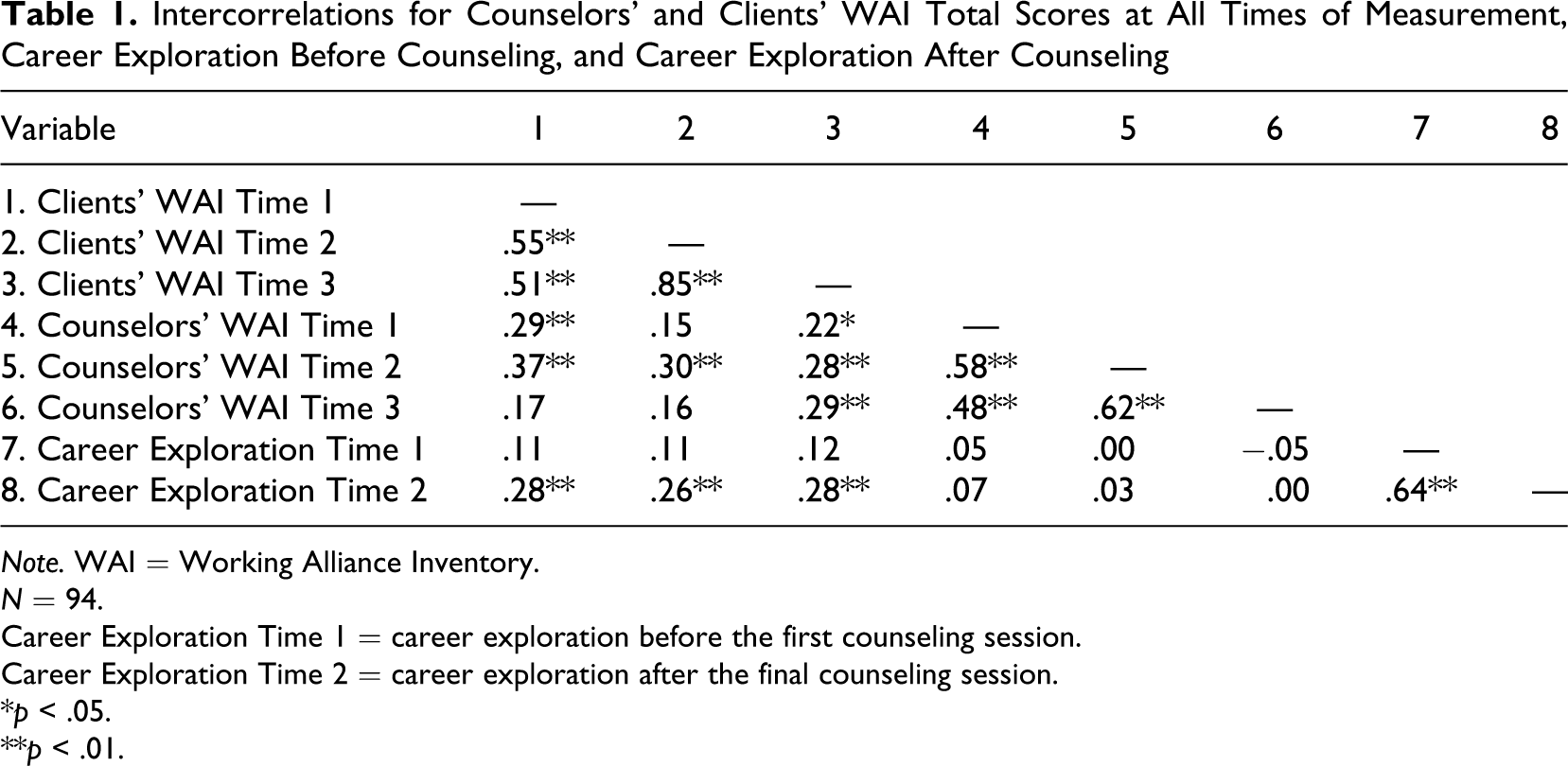
Note. WAI = Working Alliance Inventory.
N = 94.
Career Exploration Time 1 = career exploration before the first counseling session.
Career Exploration Time 2 = career exploration after the final counseling session.
*p < .05.
**p < .01.
To examine changes in clients’ CE over time, a paired-samples t test was conducted to compare the first CE measurement (before) and the second CE measurement (after). Results indicate that clients’ CE was significantly higher following the counseling (M = 3.86, SD = 0.58) than prior to it (M = 3.57, SD = 0.68), t(93) = 4.79, p < .001, Cohen’s d = .49.
Pearson’s r correlations of client and counselor ratings on the WAI were calculated to determine the degree of convergence between client and counselor views of the working alliance at all three times of measurement. There were significant weak-to-moderate positive correlations between clients’ and counselors’ ratings on all three subscales and on the total score, at all three times of measurement, r ranging from .19 to .30 (p < 0.01).
Hypotheses Testing
Changes in client and counselor working alliance ratings over time
To examine changes in working alliance ratings over time, a series of latent growth models (LGM; see Bollen & Curran, 2006) with maximum likelihood (ML) multilevel methods were used to account for the nested nature of the data (i.e., multiple clients for each counselor; for more information see Bentler & Wu, 1995). Two latent factors were estimated: one to define the initial levels of the working alliance ratings (i.e., intercept) and one to explore whether the trajectory of change in working alliance ratings was constant over time (i.e., linear) or took any other shape (by assessing which type of trajectory fits most to the observed data). To examine whether clients and counselors differ in their initial levels of working alliance ratings and/or trajectory of change in these measures, a dummy variable tapping participants’ role (1 = clients; 0 = counselors) was regressed on the models’ latent intercept and shape factors using the ML multilevel method. The EQS 6.1 Structural Equation Models software (Bentler & Wu, 1995) was used to assess the appropriateness of the LGMs. A model is judged as reasonably fitting the data when the comparative fit index (CFI), and the Bentler–Bonett nonnormed fit index (NNFI) are larger than .95, and the root mean square error of approximation (RMSEA) is lower than .05.
The nested LGMs assessing the trajectories of participants’ goals, tasks, bond, and total WAI scores showed excellent fit to the observed data, χ2s(3) < 7.3, ps > .05, CFIs > .99, NNFIs > .97, RMSEAs < .06. The analyses revealed that participants’ goals ratings linearly increased by .25 points following each session, t(187) = 7.48, p < .001, r = .48, from 4.99 in the first session to 5.58 in the last session. Participants’ tasks ratings linearly increased by .20 points following each session, t(187) = 5.28, p < .001, r = .36, from 5.29 in the first session to 5.68 in the last session. Participants’ bond ratings linearly increased by .24 points following each session, t(187) = 7.10, p < .001, r = .46, from 5.53 in the first session to 5.96 in the last session. Finally, participants’ total WAI score linearly increased by .25 points following each session, t(187) = 7.48, p < .001, r = .48, from 5.27 in the first session to 5.74 in the last session.
Divergence in client and counselor working alliance ratings
To examine the differences between clients’ and counselors’ WAI scores, and to account for the multiple comparisons, nested paired t tests were conducted using Hierarchical Linear Modeling (HLM; Bryk & Raudenbush, 1992). Means, lower-level standard deviations (σ; i.e., client’s level), upper-level standard deviations (τ q ), statistics, and their level of significance are presented in Table 2 . Since the differences between clients and counselors ratings of all four WAI scores in all three times of measurement were assessed, the level of significance of these tests was adjusted using familywise Bonferroni correction to avoid inflation of Type I error. The analyses revealed that following Bonferroni adjustment, clients’ ratings of the goals subscale and total score were significantly higher than their counselors’ ratings in the first and second sessions, but not in the third session. Clients and counselors did not differ in their ratings of the tasks and bond dimensions.
Means, Lower-Level Standard Deviation (σ; i.e., Clients Level), Upper-Level Standard Deviation (τ q ), Statistics, and Their Level of Significance of Clients’ and Counselors’ WAI Scores
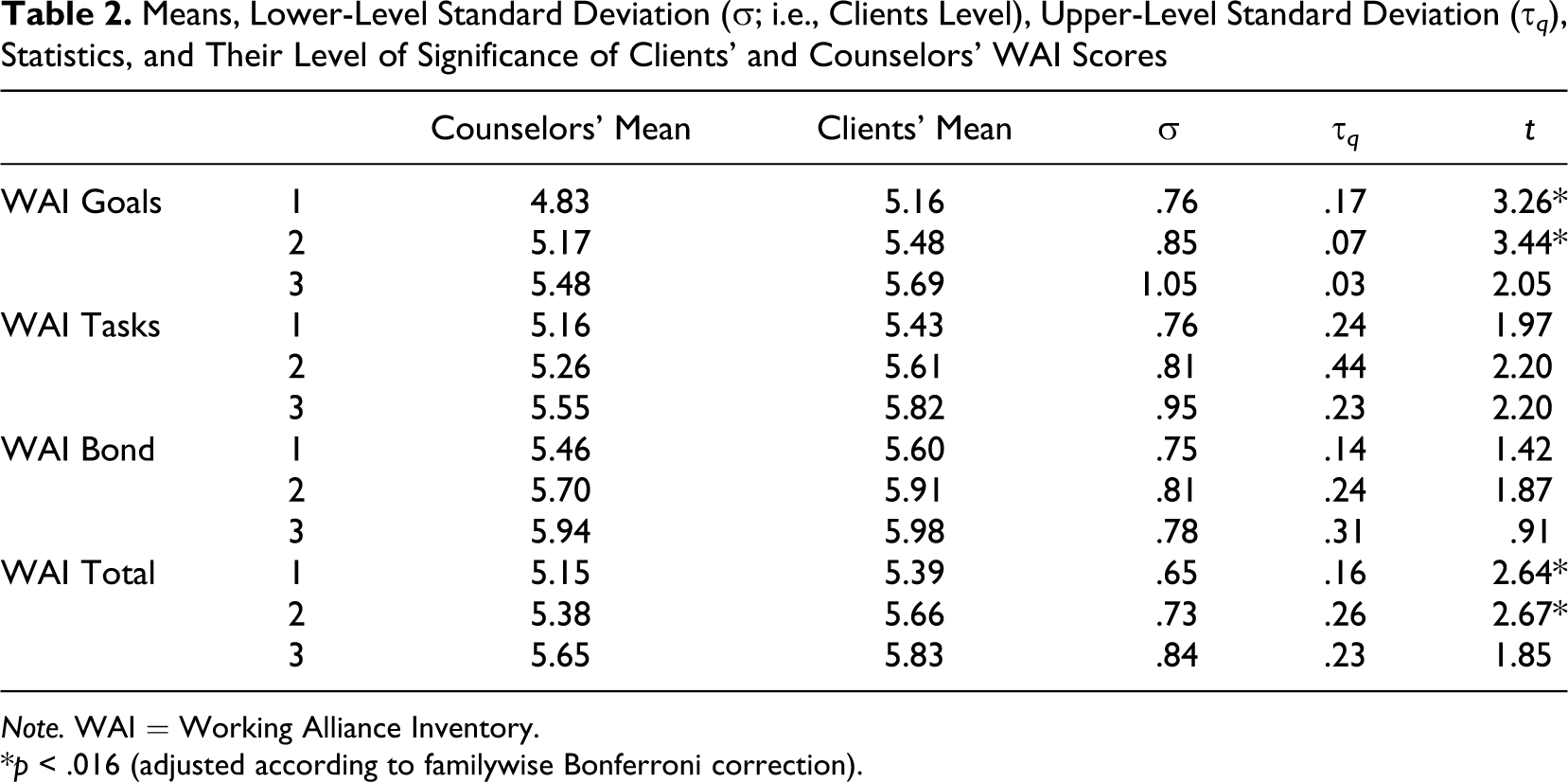
Note. WAI = Working Alliance Inventory.
*p < .016 (adjusted according to familywise Bonferroni correction).
Working alliance and career exploration
A three-step HLM analysis was conducted to examine the role of clients’ and counselors’ ratings of the working alliance in all three times of measurement in predicting clients’ CE after counseling. In the first step, clients’ and counselors’ WAI total scores at the first session were entered. Total WAI scores, and not the WAI subscales, were used to avoid multicollinearity between predictors (tolerance around .2). In the second step, clients’ and counselors’ WAI total scores measured at the second session were added to the model and finally, in the third step, clients’ and counselors’ WAI total scores measured at the third session. The outcome measure was clients’ CE after counseling. The final model was defined by the following equations:
Level 1 model: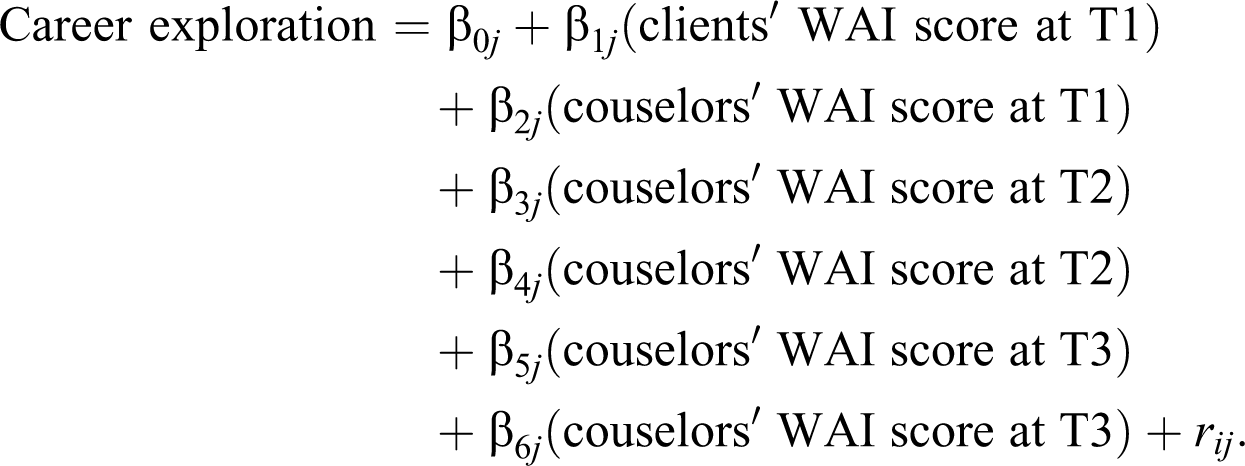







Hierarchical Multilevel Modeling Equation Predicting Clients’ Career Exploration After Counseling Using Clients’ and Counselors’ WAI Scores
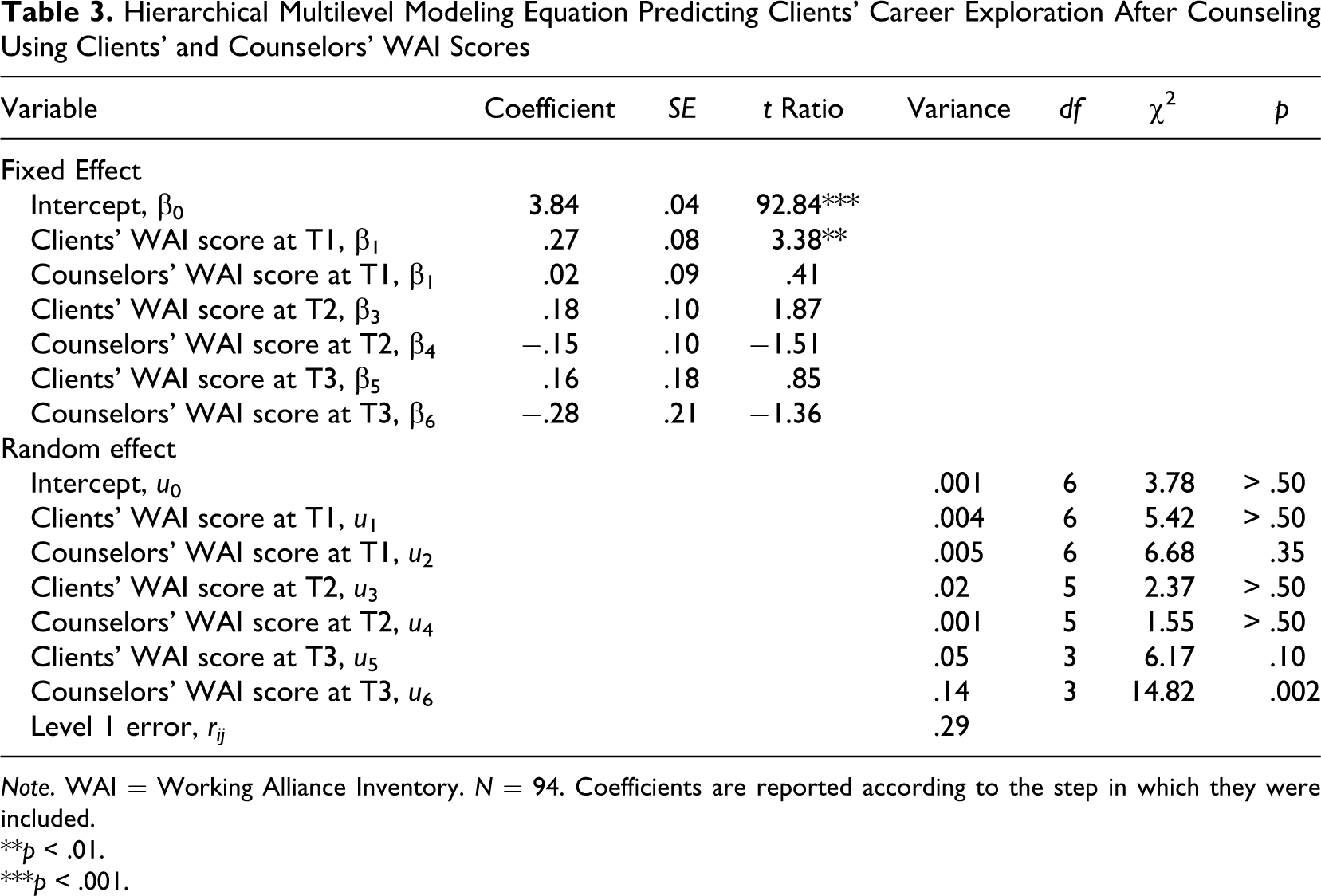
Note. WAI = Working Alliance Inventory. N = 94. Coefficients are reported according to the step in which they were included.
**p < .01.
***p < .001.
The analysis revealed that clients’ working alliance ratings in the first session (β = .27, p < .01; β is a standardized coefficient and thus refers to the size of the effect. Its values equal the values of r), but not counselors’ working alliance ratings (β = .02, p = .85), significantly predicted clients’ CE after counseling: The higher clients’ working alliance ratings in the first session, the higher their CE after counseling. Entering the clients’ and counselors’ total scores of the second session or the third session did not add significantly to the prediction of clients’ CE after counseling, Δχ2(2) = .55, p = .76, and Δχ2(2) = 1.81, p = .40, respectively; thus, both clients’ and counselors’ working alliance ratings reported after the second and third sessions were not related to clients’ CE after counseling.
Discussion
The main purpose of the study was to make a novel contribution to the career counseling and career development literature by linking working alliance and CE. We were specifically interested in CE behaviors exhibited by the client immediately after completing a three-session series of personal career counseling. The core assumptions of this field-based research were that a sense of emotional bond and a sense of agreement on the instrumental dimensions (goals and tasks) of the working alliance are related to greater exploration and that these desired relations were best understood from the clients’ perspective.
In the present study, clients’ and counselors’ working alliance ratings were positively correlated at all times of measurement as was found in psychotherapy studies (Bethea et al., 2008; Muran et al., 2009).
As hypothesized, both counselors’ and clients’ working alliance ratings linearly increased as the counseling process proceeded. This finding is consistent with previous findings in psychotherapy (Fitzpatrick et al., 2005). Our findings also indicate that clients’ CE ratings increase over the counseling process. The effect size found in this study for the change in CE ratings over time (Cohen’s d = .49) is consistent with effect sizes found in previous studies examining career intervention (Whiston & Rahardja, 2008) and is considered a low-medium effect if Cohen’s (1988) classification system was used. The linear growth in ratings of all alliance dimensions found in this study, even though small, supports the notion that working alliance may develop as quickly as after the first session (Horvath & Greenberg, 1989) and develop over time even in three-session career counseling processes. Nevertheless, future work is needed to examine the practical significance of the change in CE ratings throughout the counseling process, for instance, by examining whether this change is evident in clients’ actual exploration behaviors.
As hypothesized, clients’ total scores of the working alliance were significantly higher than counselors’ total scores as measured after the first and second sessions. This finding is consistent with previous research in psychotherapy (Hersoug et al., 2009; Wei & Heppner, 2005). One possible explanation for this finding is that counselors tend to be more judgmental and critical of themselves than do clients, hence give lower ratings to the alliance (Bachelor, 1991). Another possible explanation is that there is a fundamental difference in the way that counselors and clients view the counseling relationship: Counselors tend to view the relationship through a theoretical lens of the features of an ideal relationship, in which the quality of the alliance is high. As a result, their assessment of the working alliance is influenced by the degree of similarity between such ideal elements and what they observe in the sessions. Client assessments, on the other hand, may be based on subjective past experience in similar situations, not necessarily ideal ones (Horvath, 2000). However, the difference between counselor and client ratings after the third session did not reach significance, indicating that client and counselor ratings may become more similar as the counseling process progresses. It may be that clients’ optimistic expectations regarding the counseling outcome at the initiation phase of the counseling process are projected onto their relationship with their counselors. It is also possible that the client’s expectations become more realistic over time, resulting in a nonsignificant difference between client and counselor ratings.
Results also reveal that the difference between clients’ and counselors’ ratings of the bond and tasks dimensions of the alliance, as opposed to the goals dimension, did not reach significance. It may be that the goals dimension is less tangible for the client, as it is located in the unseen future. As a result, the client’s optimism is generally expressed in the rating of goals rather than in the rating of the bond and tasks dimensions. This might explain why the discrepancy between the ratings of client and counselor is higher in this dimension than it is in the others.
As hypothesized, clients’ working alliance ratings in the first session, but not counselors’ ratings, predicted clients’ CE after counseling. These findings are consistent with previous research in psychotherapy, in which the quality of the working alliance was most predictive of treatment outcomes based on clients’ assessments, less so on therapists’ assessments (Fitzpatrick et al., 2005; Horvath & Symonds, 1991). One possible explanation is that counselors’ ratings are less affected by their expectations of counseling outcomes compared with their clients. One may suggest that clients’ expectations of positive outcomes from the counseling process play an important and integral part in their evaluations of the working alliance. However, neither counselors’ nor clients’ ratings at the second and third sessions contributed significantly to the prediction of CE after counseling. This finding is consistent with previous findings in psychotherapy, suggesting that early sessions are particularly important for facilitating positive change (Lambert & Ogles, 2004). One possible explanation is that expectations for positive outcomes of the counseling process are more salient to both counselors and clients in the initial phase of the counseling process, as opposed to the next phases of counseling. In addition, results regarding the third session of the counseling process may be seen as further indication that clients’ initial optimism regarding the outcome of the counseling process is reduced over time, and that their expectations become more realistic and more similar to the counselors’ ratings as the counseling process progresses.
Limitations and Future Research
Limitations of this study include those inherent to self-report measures (Boulet & Boss, 1991). Also, clients’ ratings may be suffering from mono-source bias, since clients rated both predictor and outcome variables. The study was also limited by the relatively small number of working alliance measurements administered over the counseling process. Future research is recommended to further examine the effect of working alliance ratings on outcomes in more extended career counseling processes. In addition, findings might have been affected by the differences between counselors’ experience and number of clients. These limitations cannot be fully avoided in a field-based sample; nevertheless, we hope future research will examine their potential effects on outcomes. Finally, it is possible that some of the findings in the present study could be attributed to specific cultural and social characteristics of the Israeli population in general, and Israeli career counseling clients in particular. One might suggest that Israeli clients’ tendency to readily and openly share their personal lives with the counselor during short-term counseling, and their tendency to explore in a curious fashion (Israelashvili & Benjamin, 2009), account for the growth in exploration and working alliance over a short-term counseling process. Since very little research has been done examining the effect of working alliance on CE, future research could further examine the influence of the specific cultural characteristics on these process variables.
Conclusions
This study suggests that career counseling should not only be considered as a cognitively oriented intervention but also as a process that involves interrelational aspects that may have an effect on the outcome, specifically CE.
The findings of the present study also have important practical implications for the field of career counseling. Clients’ ratings being the better predictor of outcome might suggest that even when counselors evaluate their working alliance as limited, client outcomes might still be positive, indicating that counselors cannot assume that their evaluation of the quality of the therapy climate corresponds to their clients’ perceptions. Furthermore, clients’ ratings of the working alliance in the first session being the strongest predictor of outcome might suggest that establishing a positive alliance in the early stages of the counseling process is of particular importance to facilitate positive change, especially in short-term counseling processes. These findings indicate that professional training of career counselors should consider emphasizing working alliance formation and strengthening, especially in view of the lack of sufficient formal attention to interrelational factors in career counseling training (Bedi, 2004; Schedin, 2007).
Footnotes
The authors declared no potential conflicts of interest with respect to the research, authorship, and/or publication of this article.
The authors disclosed receipt of the following financial support for the research, authorship, and/or publication of this article: Financial support for the authorship of this article was received from Ariel University Center of Samaria, Israel.