



Abstract
The relationship of environmental exploration (EE) and self-exploration (SE) with three dimensions of career decision-making difficulties was examined in a sample of Chinese college students (N = 911) using a structural equation modeling model comparison approach. Results indicated that neither self- nor environmental exploration predicted lack of readiness difficulties, but both were equally predictive of information-deficit problems. Finally, only SE was predictive of information inconsistency. The implications of this study are discussed and suggestions for future research are provided.
Parsons (1909) long ago proposed the career development model of learning about the world of work (environmental exploration [EE]) and about the aspects of one’s abilities and interests (self-exploration [SE]) and then using the results of these two processes to find an area of match. The model continues to serve the field as a guiding model (e.g., Blustein, 1997; Flum & Blustein, 2000; Zikic & Hall, 2009). While there has been an extensive literature on the matching of self with the world of work (e.g., Allen & Robbins, 2010; Grotevant, 1986; Nauta, 2010; Spokane, Meir, & Catalano, 2000; Tinsley, 2000), there has been much less research on the importance of both environmental and self-exploration. The purpose of the present study was to examine the importance of both self- and environmental exploration as it is related to the key domain of career indecision. This examination was conducted within the context of career development in China.
Career Exploration
Career exploration is conceived as a career-related information gathering process. The key aspects of exploration are knowing the self and knowing the vocational world (Stumpf, Colarelli, & Hartman, 1983). SE is exploratory behavior with the purpose of knowing individual characteristics, including interest, values, skills, and personality. EE is exploratory behavior with the purpose of knowing environmental characteristics, including possible career paths, job requirements, and job benefits. The centrality of these two separate areas of exploration has served as the cornerstone of most career development theories (Holland, 1997; Sampson, Lenz, Reardon, & Peterson, 1999). It is assumed that quality career decisions cannot result unless there has been adequate exploration in both of these areas. However, there has been little research that has explicitly examined the validity of this key assumption. Does thorough exploration of both self and environment result in better career decisions? A key area to examine this relation is with respect to career indecision, as this is exactly the point at which the information gathered from self- and environmental exploration is utilized. At a global level, it is assumed that the better the self- and environmental exploration, the less the career indecision. However, such an assumption ignores the fact that career indecision is not a single entity but a multidimensional one.
Career Indecision
Different theoretical perspectives and research approaches have developed diverse models of career indecision (e.g., Brown et al., 2012; Chartrand, Robbins, Morrill, & Boggs, 1990; Gati, Krausz, & Osipow, 1996; Kelly & Lee, 2002). We used Gati et al.’s (1996) model, given its sound combination of theoretical rationale and empirical investigation based on decision-making and information-processing theories, Gati, Krausz, and Osipow (1996) first defined a model of an ideal career decision maker and then defined any deviation from the ideal career decision maker as a potential problem resulting in career decision-making difficulties. Then, the various career decision-making difficulties could be categorized into three higher order domains according to the time when they arise, the sources, the impact on the decision, and the type of required intervention (Gati, 2011; Gati et al., 1996). Empirical evidence was found to support this proposed taxonomy model (Gati, 2011; Gati et al., 1996).
Contrary to the single-dimensional model of career indecision, Gati et al.’s (1996) multidimensional model depicts multiple sources of career decision-making difficulties, which allows for more specific diagnosis of career indecision (Osipow, 1999). The three higher order domains in Gati et al.’s (1996) model are (a) lack of readiness (LR), (b) lack of information (LI), and (c) information inconsistency (II). LR refers to the difficulties before the decision-making process, which comprises of the lack of motivation, indecisiveness, and dysfunctional beliefs. The LI and II refer to the difficulties during the decision-making process itself. LI comprises of the lack of knowledge about the process, the LI about self, occupations, and ways obtaining information. Inconsistent information (II) comprises of unreliable information, as well as internal and external conflicts.
LR should be associated with both less self- and environmental exploration as this dimension focuses on a general lack of motivation to explore. LI should also be associated with low levels of either self- or environmental exploration (or both), as the individual does not have the needed amounts of information. Finally, II could occur in either SE or EE. We view both self- and environmental exploration salient in each type of career indecision.
In the present study, we were interested in the relation of information-gathering behaviors with career indecision and investigated it in Chinese context with the hope that results could be informative for career counseling practice, especially in Chinese context. More detailed research hypotheses thus would be proposed after the introduction of Chinese context.
Chinese Context
The function of universities in Chinese students’ career development has shifted dramatically since the end of last century. Originally, students’ careers after colleges were determined by the government based on the national needs. So the importance of individual career decision making was much lower, as individuals have relatively little impact on their careers. Exploration of either self or environment was less salient as there was little choice. However, China has shifted away from this system of career allotment and thus students have to make their own career decisions for the first time. Making career decisions is not an easy task in general, but it is harder in China as there are no models for how to do this and few assistance structures as it is a new process. This process of decision making would thus not be expected to go easily and that career indecision would be an especially important issue. Given this situation, China’s Department of Education has been advocating career guidance classes for a while in the high education system and plans to make them compulsory class gradually.
Besides the institutional influence, cultural factors could also provide important contextual clues for this study. The self–environment exploration model portrays career exploration as an information gathering process in two fundamental domains: one is information about individuals and the other is information about careers. This distinction reflects the individualism value salient in the Western culture (Kim, 2007), which highlights the satisfaction of individual needs. Compared to the Western society, Chinese culture is considered as a more collective culture (Triandis, 1989, 1995), whereby individual attributes and needs are subordinated to the bigger unit’s needs. This bigger unit refers to a family, an organization, a society, or a country. Traditionally, Chinese parents have high influence on their children’s career decision making and even make the decisions for them (Bai, 2005). As a result, the importance of EE may be minimal as the individual may rely more on the desires of others regarding world of work options. The real crucial information related to career decision in Chinese context thus could be the characteristics, values, and needs of one self and the significant others instead of the vocational world.
Literature has revealed that family and parental expectations have significant influence on Chinese individuals’ career decisions (Hou & Leung, 2011; Leung, Hou, Gati, & Li, 2011). Studies indicated that higher level of parental expectation could predict higher level of global career indecision (Leung et al., 2011) and parental expectation is associated with students’ career aspiration (Hou & Leung, 2011). These data suggested that parents–children conflicts in career choice could be a primary source of information inconsistency in Chinese context and result in career indecision. The influence of parental expectation on individual career decision might be universal across different cultures, but the link between career indecision and the incongruence of parental expectation with self-expectation could be unique to Chinese context. Compared to the individualistic culture highlighting the individual responsibility, again Chinese culture emphasizes responsibilities to family and parents. Individuals are expected to obey and please their parents according to the indigenous moral concept “filial piety,” which in Chinese literally means subservience and obedience. It is not hard to imagine that Chinese students cannot make the career decisions easily if the significant incongruence with their parents exists. In order to resolve the incongruence with parents, individuals need to clarify their values and learn to balance all views. In this sense compared to EE, SE could be more beneficial for Chinese students suffering from information inconsistency as it facilitates the clarification of one’s needs and desires.
Research Hypotheses
The model we are proposing is depicted in Figure 1 where all variables (SE, EE, and the three different types of career indecision) are represented as latent constructs and the predictive relation of each type of exploration with each type of career indecision is explored. The specific relations are labeled with letters A–F). There were three specific hypotheses examined. First, environmental and self-exploration were hypothesized to be equally predictive of LR (path A = path D), because students who are more active in either information gathering behavior are expected to be the students with higher career decision-making motivation and readiness. Second, SE was hypothesized to be more predictive of LI difficulties than EE (path E > path B), because the real crucial information for career decision making in Chinese context might be the information of one’s interest and value and the needs of significant others instead of the vocational world. Finally, SE was hypothesized to be more predictive of II difficulties than was EE (path F > path C), because the central piece of information inconsistency in Chinese context is the conflict between one’s own desire and the parents’ desire instead of the inconsistent knowledge of the vocational world. More self-understanding is thus critical to the final balance of both views.

The full structural model.
Method
Participants
From five universities, which are located in the capital, northern, central, southern, and southwestern urban areas of mainland China, 911 undergraduate students voluntarily provided valid responses in the current study. Of the entire sample, 360 were male, and 540 were female. Eleven students did not declare their gender. They ranged in age from 18 to 25 (M = 21.02, standard deviation [SD] = 1.35). In regard to grade status, 29.7% (n = 271) were freshmen, 22.6% (n = 206) were sophomore, 28.0% (n = 255) were junior, and 19.0% (n = 173) were senior. They also reported diverse majors, among which 45.3% (n = 413) were science, mathematics, engineering, and technology majors and 54.0% (n = 492) were literature, history, linguistics, economics, and education majors. As a part of the college entrance examination, all Chinese students need to declare a major before entering into colleges.
Procedure
Participants in this study were students attending career guidance classes. These classes were open to all students in Chinese universities with the hope of building up students’ awareness of career planning and facilitating their career decision making. The curriculums were diverse across universities slightly but all using Parsons’ (1909) model consistently as the foundation. All students recruited were invited to voluntarily participate in a study and informed of the purpose of the current study. Students who consented to participate finished the package of instruments in paper and pencil form described below and a demographic information questionnaire in classrooms. Afterward, small souvenirs were given to participants to express appreciation for their participation. Their signatures on the informed consents were discarded upon the conclusion of the data collection and thus the answers were anonymous throughout the analysis process. Missing data for all the variables used in this study ranged from .0% to 5.4%. Expectation maximization method (Schlomer, Bauman, & Card, 2010) provided in the Statistical Package for the Social Sciences (SPSS) 18.0 was employed for imputing the missing data of career exploration and career decision-making difficulties.
Instruments
Career exploration survey (CES)
The 6-item EE subscale and the 5-item SE subscale of CES (Stumpf et al., 1983) were designed to assess the degree to which the individual has engaged in that form of career exploration activities during the past 3 months. Each subscale was scored on a 5-point Likert-type scale ranging from 1 (very little) to 5 (very much). EE involves exploration regarding occupation, jobs, and organizations, whereas SE includes self-understanding and retrospection. Research has revealed internal consistency α coefficients ranging from .60 to .88 for the CES subscales (Bartley & Robitschek, 2000; Nauta, 2007; Stumpf et al., 1983). A Mandarin Chinese translation of the CES (Xu, 2008) was administrated in the present study. It was translated from the original English CES by two master students who are good at English using the standard back-translation procedure. Confirmative factor analysis results and the significant relation with career decision making self-efficacy and trait/status anxiety in Chinese students (Xu, 2008) supports its validity for the investigated population. In the current study, the α coefficients for the EE and SE subscales were .87 and .79, respectively. The correlation between EE and SE subscales was .47. The content coverage and psychometrics of this Chinese version were equivalent to the original CES (Stumpf et al., 1983).
Career decision-making difficulties questionnaire (CDDQ)
CDDQ was established based on Gati and his colleagues’ (1996) taxonomy of career decision-making difficulties. It has three main subscales including 10-item LR subscale, 17-item LI subscale, and 17-item II subscale. These 44 items are designed to assess the extent to which individuals encounter difficulties in each category when making career decisions. Participants were asked to rate on a 9-point Likert-type scale ranging from 1 (does not describe me) to 9 (describes me well). Gati et al. reported the α coefficients for the three subscales as .63, .95, and .89; other research has consistently revealed acceptable internal consistency for CDDQ (Gati, Osipow, Krausz, & Saka, 2000; Gati & Saka, 2001; Mau, 2001; Tien, 2005). We used the Mandarin Chinese translation (Hou, 2010) of CDDQ in the current study. The Chinese version of CDDQ was translated from the original English CDDQ by counseling psychologists who are fluent in both English and Mandarin, using the standard back-translation procedure. Empirical studies have found significant associations of career decision making self-efficacy and problem solving with this instrument in Chinese students (Li, 2008; Tian, 2007), supporting its validity for the population being investigated in the current study. In this study, the α coefficients were, respectively, .62, .93, and .90. Correlations between LR, LI, and II were .45, .45, and .66. The content coverage and psychometrics of this Chinese version were equivalent to the original CDDQ (Gati, et al., 1996).
Data Analysis
Mplus 6.1 was employed for structural equation modeling (SEM) analysis in this study. Such an approach is warranted in this context because of the need to establish the factor structure of the instruments in a Chinese context and the desire to examine relations among variables that are not confounded by measurement error. SEM enables an assessment of the factor structure of the instruments using confirmatory factor analysis while also removing error variance from the latent constructs to enable a better examination of relations among variables. With the purpose of making the statistical tests robust to nonnormality, we adopted the robust maximum likelihood parameter estimation. The fit of the models was evaluated using the criteria recommended by Hu and Bentler (1999), robust χ2, comparative fit index (CFI > .95), root mean square error approximation (RMSEA < .06), and standardized root mean squared residual (SRMR < .08). A model comparison approach was used in this study to examine the hypothesized differential predictions of self- and environmental exploration to career indecision. Differences between nested models were compared using the χ2 difference test. However, this test is inaccurate in robust maximum likelihood estimation so the Santorra–Bentler scaled χ2 difference was used (Muthén & Muthén, 2012).
Results
Table 1 shows the means, SDs, and correlations of the constitute variables of EE, SE, LR, LI, and II. The fit indices of the full structural model (Model 1) in which all the parameters were estimated freely were presented in Table 2. The fit of this model was adequate, as can be seen by the values of CFI (.92), RMSEA (.059), and SRMR (.062). Model 2 pairwise constrained all the regression coefficients for the paths from self–environmental exploration to each career indecision domain to test whether there were differential predictions for any indecision type. The model fit was adequate, as can be seen by the values of CFI (.92), RMSEA (.059), and SRMR (.062). The corrected χ2 difference testing between Model 1 and 2 was significant, scaled Δχ2(3, N = 911) = 13.85, p < .05, indicating that the fully constrained model was not a good representation and thus there were differences in the path coefficients between self- and environmental exploration. We then conducted pairwise tests to determine which paths were different.
Means, Standard Deviations, and Correlations of Constitute Variables.
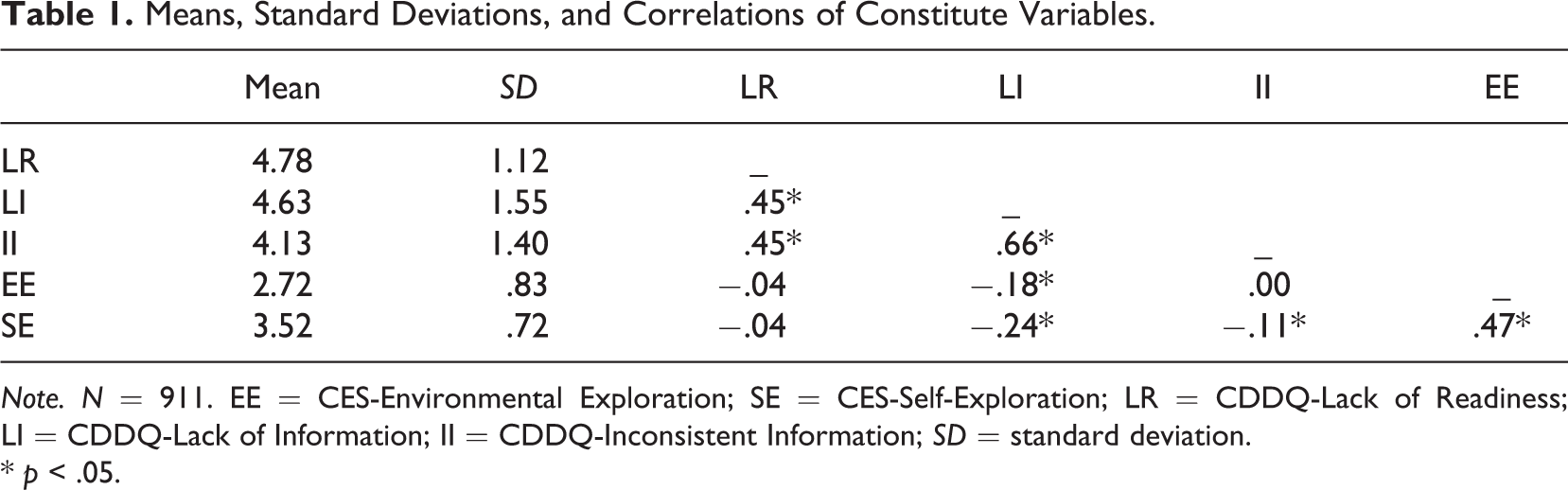
Note. N = 911. EE = CES-Environmental Exploration; SE = CES-Self-Exploration; LR = CDDQ-Lack of Readiness; LI = CDDQ-Lack of Information; II = CDDQ-Inconsistent Information; SD = standard deviation.
* p < .05.
Summary of Model Fit Index for Model Comparison.
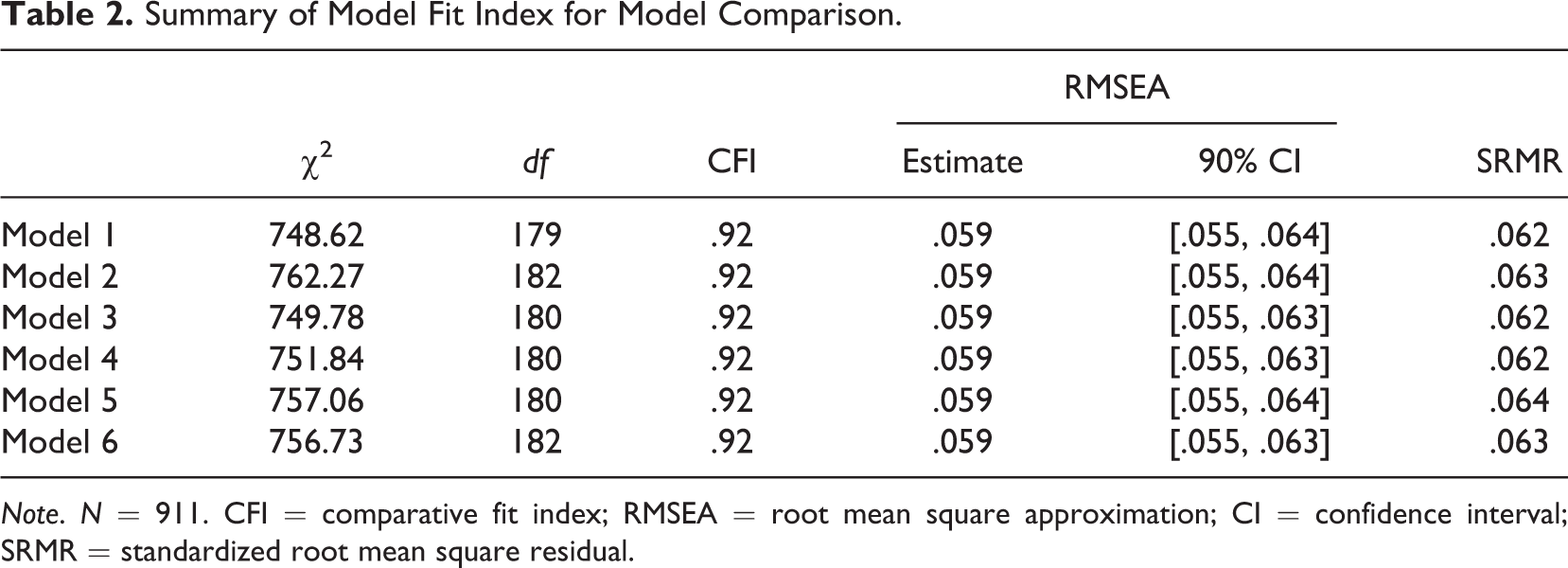
Note. N = 911. CFI = comparative fit index; RMSEA = root mean square approximation; CI = confidence interval; SRMR = standardized root mean square residual.
Model 3 constrained the paths from self (path D) environmental (path A) exploration to LR. It was found that the model fit was adequate, as can be seen by the values of CFI (.92), RMSEA (.059), and SRMR (.062). The corrected χ2 difference testing between Model 1 and 3 was not significant, scaled Δχ2(1, N = 911) = .50, p > .05, indicating that self- and environmental exploration had equivalent prediction of LR. However, an examination of the parameters themselves revealed that both were not significantly different from 0. So neither self- nor environmental exploration could predict LR difficulties (i.e., path A = path D = 0).
Model 4 constrained the paths from self- and environmental exploration to LI (paths B and E). It was found that the model fit was adequate, as can be seen by the values of CFI (.92), RMSEA (.059), and SRMR (.062). The corrected χ2 difference testing between Model 1 and 4 was not significant, scaled Δχ2(1, N = 911) = 2.80, p > .05, indicating that the model where the parameters were different was not different from the model where they were equal. So the equality of path B and path E was supported. Further both parameter estimates (−.16 and −.16) were found to be significant. This result did not support the hypothesized more predictive role of SE compared to EE regarding LI difficulty.
Model 5 constrained the regression paths from self–environmental exploration to II. It was found that the model fit was adequate, as can be seen by the values of CFI (.92), RMSEA (.059), and SRMR (.064). The corrected χ2 difference testing between Model 1 and 5 was significant, scaled Δχ2(1, N = 911) = 9.20, p < .05, indicating that self- and environmental exploration had nonequivalent prediction on information inconsistency. Further examination of the individual regression paths found EE’s prediction was not significant (path C = .08, p > .05), while the prediction of SE was significant (path F =
To obtain final parameter estimates for all paths, we used the results above to specify a final model. This model fits the data well as can be seen by the values of CFI (.92), RMSEA (.059), and SRMR (.063). The corrected χ2 difference testing between Model 1 and 6 was not significant, scaled Δχ2(3, N = 911) = 7.61, p > .05, indicating that the more parsimonious model predicted the data as well as the more complete one. The standardized parameter estimates of this final model are presented in Figure 2. Neither environmental nor SE could predict LR (path A = path D = 0). EE and SE equally predicted LI (path B = −.15; path E = −.14). SE predicted information inconsistency (path F = −.14) while EE did not (path C = .00).

The standardized parameter estimates of the final model (Model 6).
Discussion
The results of the study support the relation of self- and environmental exploration with career indecision, but the results are more nuanced than hypothesized originally. The results varied by types of exploration. While both types of exploration are assumed important, they were not equally important for all indecision types. Very different patterns existed with the different types of indecision.
First, the result that neither type of self–environmental exploration could predict LR is surprising in the sense that we expected people engaging in more information-gathering behaviors would be the people with higher motivations for career decision making as well. The nonsignificant link could suggest that the students’ exploratory behaviors are not related to their decision-making motivation but other variables in the particular research context. Participants of the current study were students attending the career guidance classes that focus on both career explorations. Students’ exploratory behavior thus might not result from their motivation for career decision making but rely more on their adherence to the class assignments. Chinese students typically have high conscientiousness and commitment to academic performance. They would like to engage in career exploration activities required by the class curriculum even though they do not see the connection of those activities with their own career decision making. The nonsignificant link could be looked at from another perspective. Previous data showed that career decision-making readiness only improved in the long term (Perdrix, Stauffer, Masdonati, Massoudi, & Rossier, 2012) and LR did not significantly decrease after a career exploration course (Fouad, Cotter, & Kantamneni, 2009) or a short-term workshop (Gati, Ryzhik, &Vertsberger, 2013). The current result was consistent with these findings. Together, they portrayed LR as a more chronic issue, which could not be relieved by simply acquiring more information.
Second, it was interesting that SE did not predict LI more strongly than EE in this study. We originally proposed that the culture-specific exploration, such as knowing parents’ desire, would supplant EE since it is not directly related to the crucial information for decision making in Chinese context, which is more about one self and the significant others. The current data supported the equivalent importance of both explorations on predicting information deficit and challenged the idea that compared to SE the importance of knowing the vocational world would fade due to its minimal relevance in Chinese context. In general, Chinese students are less likely than American students to work before they graduate from colleges. The lack of exposure to world of work might boost up the importance of EE in the current study. The data could also suggest that information about the vocational world is becoming increasingly relevant for individual career decision-making process in China. However, the culture-specific information, such as family and parental expectation for student (Hou & Leung, 2011; Leung, et al., 2011), might still play an important role. It is worth investigating the relative importance of universal and culture-specific career exploration by examining them simultaneously in the future studies.
Third, the present study found that only SE could predict II while EE did not. Conflict with significant others is an important source of information inconsistency among Chinese students. Previous studies conducted in Chinese context showed that the gap of parental–self expectation and intergenerational family conflicts were associated with individual career indecision (Chen, 2011; Ma & Yeh, 2005), which reflected the significance of adherence to parents in Chinese family-oriented collectivistic culture. Mau (2001) also found Taiwanese college students reported greater career decision-making difficulties than American students and attributed the additional difficulty to the collectivistic cultural factors. The influence of collectivistic cultural factors applied to Asian American students as well, contributing to their greater career decision-making difficulties, especially information inconsistency, than other ethnic groups (Mau, 2004). Taken together, these data suggested that Chinese students’ information inconsistency could be attributable to the extensive emphasis on family aspirations, which is rooted in the collectivistic culture. It is culturally insensitive to prejudge Chinese students as immature as they preferred a dependent decision-making style (Leong, 1991). Instead, career interventions would be beneficial for the resolution of conflicts with parents among Chinese students if interventions could raise up students’ self-awareness and facilitate their rational balancing process. SE is thus expected to help individuals relieve the information inconsistency issue more than EE since it is focused on the culturally ignored individual aspiration and could clarify individual needs and values. The current data supported this differential importance of self–environmental exploration regarding information inconsistency. As of now, the information conflict issue is increasingly drawing attention from career development scholars in China. However, the focus of career assistance structures is still to bring more information about either self or jobs without deliberating the differential importance of self–environmental knowledge with respect to each indecision type. The present study suggested that regarding the issue of information inconsistency helping students gain more self-knowledge could be more beneficial.
Finally, the magnitude of both types of exploration predicting different types of career indecision was relatively modest. This result did not support the prominent role of career exploration in career decision making as proposed by Parsons (1909). Data indicated that information acquiring process generally was beneficial, but the benefits were limited. Regarding the information-deficit issue, self–environmental career explorations were expected to relieve individual information deficit significantly. However, the magnitude of the paths was moderate at best indicating an unexpected small effect size of SE and SE on information deficit. Data suggested that there could be another process contributing to the individual information status. Kelly and Shin (2009) found that neuroticism was linked to chronic information deficit and argued that chronic information deficit could not be resolved by simply acquiring more information. Larson, Heppner, Ham, and Dugan (1988) identified a group of individuals who are well informed but still need more information. The similar pattern appeared in Brown and his colleagues’ recent factor analytic work of career indecision model (2012), in which information deficit and chronic commitment anxiety were loaded on the same factor. Collectively, data seemed to portray information deficit as an outcome resulting from not only insufficient information acquiring but dysfunctional personality attributes as well. The current study in this sense provided added support for this claim and revealed the limited benefits of information acquiring for people with information-deficit issue.
The measurement model of the current study had a satisfactory fit with the data, as can be seen by the fit indices of Model 1. Liu, Hao, and Li (2006) provided preliminary support for the construct validity of CDDQ in Chinese college students using a cluster analytic approach. The current SEM result provided added support for the factor structure of Gati et al.'s (1996) indecision instrument as well as the self–environmental exploration instrument in Chinese context. Future studies could have more confidence using these two instruments to measure career indecision and career exploration in China. Instrument validation generally is an important process for career development in China, because career research is a relatively new area in China and more well-validated instruments are needed for a solid scientific foundation.
A Chinese college students sample was examined in this study and thus the results might not generalize to other contexts. Unanswered questions still exist regarding the relation between career exploration and career decision-making difficulties. One potentially fruitful research line is testing the causality direction of this relation through longitudinal examination. We also encourage researches to further investigate the issue of information inconsistency in China, given its significance for career development in China. Examination of other meaningful predictors of this construct could inform the interventions potentially.
Footnotes
Declaration of Conflicting Interests
The author(s) declared no potential conflicts of interest with respect to the research, authorship, and/or publication of this article.
Funding
The author(s) received no financial support for the research, authorship, and/or publication of this article.