



Abstract
This study explores calling in the context of career decision making. Specifically, the authors examine receptivity to advice that discourages individuals from pursuing a professional path in their calling’s domain. The authors hypothesize that people with a strong calling will be more likely to ignore negative career advice. In Study 1, a four-wave, 7-year longitudinal study following 450 amateur musicians across career stages, the regression analyses showed that those with a stronger calling toward music reported being more willing to ignore the discouraging career-related advice of a trusted mentor. These results held over time, such that an early calling predicted the degree to which young people were willing to ignore career advice equally strongly 6 weeks, 3½ years, and 7 years later. In Study 2, the authors replicated these findings in a cross-sectional study of 131 business students. The authors discuss the implications for research on calling, as well as for counseling strong-calling individuals.
A New York Times investigation into the lives of alumni of The Juilliard School, the prestigious music conservatory, found that their careers, though seemingly attractive, are also challenging. The article notes “how hard it can be to live as a classical musician in a society that seems increasingly to be pushing classical music to the margins, even as Juilliard and scores of other music schools pour out batches of performers year after year” (Wakin, 2004, p. 1). These musicians’ careers are competitive as well, since New York’s three main conservatories “pump out more than 500 degree holders a year. And that is not to mention universities in the New York region and conservatories around the country that send their graduates to New York” (Wakin, 2010, p. 1). Nationally, labor statistics indicate that thousands of young musicians pursue orchestral careers every year (U.S. Department of Labor, 2005). Indeed, approximately 3,000 orchestra instrument-playing majors graduate annually in the United States, while only 150 job openings are available, that is, one job for every 20 graduates (Druckenbrod, 2005).
Contrary to general expectations, the musicians who win these positions experience relatively low levels of job satisfaction, ranking just below federal prison guards in a study of 13 diverse occupations (Allmendinger, Hackman, & Lehman, 1996). Thus, the pursuit of a professional music career is risky in terms of a low likelihood of objective success and may not even be rewarding to those who do obtain a coveted position. In spite of the tremendously challenging odds of succeeding in this winner-take-all labor market (Frank & Cook, 1995), young musicians considering a career in music frequently say things such as “I have no doubt that I’ll make it. I want it that bad” (Dobrow, 2006). This situation raises two core questions: (a) How can we understand what is going on in the minds of young people who choose to embark on this career path? (b) Doesn’t anyone tell them not to?
A strong calling—defined as “a consuming, meaningful passion people experience toward a domain” (Dobrow & Tosti-Kharas, 2011), such as music—encourages young musicians to decide to pursue the challenging professional music career path (Dobrow, 2006; Dobrow & Heller, 2011). The dominant view of calling in the management literature is that it leads to positive outcomes in general, and, in particular, to positive career decision-making outcomes (e.g., Dobrow & Tosti-Kharas, 2011; Duffy & Sedlacek, 2007; Rosso, Dekas, & Wrzesniewski, 2010). As a result of this focus on the positive outcomes of calling, an array of potentially important consequences of calling remain unexplored, particularly the notion that calling may be linked to risky—and even negative—outcomes. Moreover, although many scholars consider calling to be positive for career development, there is as yet limited research evidence connecting calling to career decision making.
Inspired by the question “Doesn’t anyone tell them not to embark on risky career paths?” the present study addresses theoretical gaps in the calling literature by proposing that a strong calling might be linked to one such unexplored negative career outcome. The intensity of a strong calling might encourage people to overfocus on self-perceptions and underfocus on external information regarding their careers. To test this notion, we examine whether calling is associated with underfocusing on a particular type of external information that should be especially useful to people in the early stages of their careers: career advice from a trusted mentor (Kram, 1985). Specifically, we examine individuals’ receptivity to advice that discourages them from pursuing a professional path in the domain of their calling. This approach sheds light on the possibility that calling is associated with unfavorable outcomes (Bunderson & Thompson, 2009; Dobrow & Heller, 2011) and also provides a direct link between calling and a construct related to career decision making. Building on career advice and feedback-orientation research, we develop a hypothesis suggesting a negative relation between a strong calling toward a domain and receptivity to career advice about pursuing a career in this domain, such that the stronger people’s calling toward a domain, the more likely they are to ignore discouraging career advice. We test our hypothesis in two studies. Study 1 is a four-wave, 7-year longitudinal survey study of 450 amateur musicians who transitioned from high school to college to postcollege life (e.g., working or graduate school). Study 2 establishes the generalizability of our findings in a single-wave survey study of 131 business students.
This study contributes to research on calling in several regards. Existing empirical calling research typically occurs in cross-sectional samples of people who have not yet entered their occupations (i.e., university students) or who are already in their occupations (i.e., working adults; Bunderson & Thompson, 2009; Dik, Sargent, & Steger, 2008; Duffy & Sedlacek, 2007, 2010; Hirschi, 2011; Steger, Pickering, Shin, & Dik, 2010; Wrzesniewski, McCauley, Rozin, & Schwartz, 1997). As such, research has not explored the role calling may play across career stages, including the relation between calling and factors related to subsequent pursuit of a career path. Insight into a wider range of calling’s career decision-making outcomes is fundamental to understanding the role calling plays in people’s lives and careers, especially as they make important decisions about their potential career paths (Rosso et al., 2010). More broadly, this study contributes to research on the effects of calling by offering an alternative to the notion that a strong calling is typically associated with positive career effects (Bunderson & Thompson, 2009; Dobrow & Heller, 2011). In fact, those with a strong calling might ignore potentially valuable career advice that could prevent future career rejection or dissatisfaction. In addition, this study offers practical implications for people pursuing careers in a given field as well as those in the position of advising or counseling them. We discuss the implications of ignoring career advice, especially in highly competitive fields.
Theory
Understanding Calling
What is going on in the minds of young musicians who decide to pursue the challenging professional music career path? A strong calling might compel them to do so. We selected Dobrow and Tosti-Kharas’s (2011) definition—“a consuming, meaningful passion people experience toward a domain”—for the present study. In this view, a calling is directed toward a domain, such as music or business; it is a continuous rather than binary (i.e., have vs. don’t have) construct; and the domain toward which the calling is oriented can be a work or non-work context (Dobrow & Tosti-Kharas, 2011). This definition thus allowed us to study the domain-specific relation between calling and receptivity to career advice (i.e., the relation between a calling toward music or business and receptivity to career advice about pursuing a career in music or business).Furthermore, because this definition does not limit a calling to the work domain, we can study people for whom listening to career advice is most critical: those who are about to begin pursuing their career paths and are therefore not yet working in the area to which they sense a calling.
Receptivity to Career Advice
Calling might not be helpful toward an important part of making career decisions: taking career advice. A primary factor in attaining numerous positive career outcomes, including making effective job-relevant decisions and setting appropriate aspirational levels, is having an accurate self-view (Yammarino & Atwater, 1997). Yet, self-insights are consistently inaccurate and people are generally overconfident (e.g., Alicke & Govorun, 2005; Dunning, 2005; Ehrlinger, Johnson, Banner, Dunning, & Kruger, 2008; Kruger & Dunning, 1999). People can potentially avoid this trap and cultivate accurate, beneficial self-insights through accepting career-related mentoring support, that is, sponsorship, exposure, visibility, and protection (Kram, 1985). Career-related mentoring support is linked to various positive outcomes including high levels of career-related self-efficacy (Higgins, Dobrow, & Chandler, 2008), greater optimism (Higgins, Dobrow, & Roloff, 2010), personal learning at work (Lankau & Scandura, 2002), work satisfaction, and intentions to remain in one’s job (Higgins, 2000; Higgins & Thomas, 2001). Furthermore, people are more likely to pay attention to the opinions of powerful individuals, including mentors, particularly at transitional times (Fiske & Depret, 1996; Levinson, Darrow, Klein, Levinson, & McKee, 1978; Roberts, Dutton, Spreitzer, Heaphy, & Quinn, 2005). In general, it is adaptive for people to receive, consider, and follow career advice from trusted, knowledgeable mentors who have their best interests in mind and can tailor their advice to their advisees’ particular strengths and weaknesses.
Yet, people are not equally receptive to feedback, guidance, or coaching, even from trusted mentors. That is, feedback orientation, defined as people’s “overall receptivity to feedback and the extent to which the individual welcomes guidance and coaching,” varies across individuals (London & Smither, 2002, p. 82). People high in feedback orientation are more likely to seek feedback and coaching, believe in the value of the advice they receive, and feel compelled to act on this advice (London & Smither, 2002). Furthermore, people’s willingness to accept feedback often depends on whether the feedback is positive or negative (London & Smither, 2002). In a challenging labor market context, such as professional music, where the risks inherent in pursuing the career path are high, advisors might provide young aspirants with feedback that discourages them from pursuing this path. However, people are especially likely to resist following discouraging career advice (London & Smither, 2002). In the context of performance feedback, negative feedback can lead to increased awareness of the gap between one’s goals and one’s actual performance, thus motivating people to increase their effort or reduce their goals to reduce this gap (e.g., Bandura, 1997; Cianci, Klein, & Seijts, 2010; Klein, 1989; Locke & Latham, 1990) or to reduce intrinsic motivation (Vallerand & Reid, 1988). Negative feedback can also lead to people ignoring or rejecting the feedback altogether (Bazerman, 1998; Ilies & Judge, 2005; Nease, Mudgett, & Quinones, 1999).
People might ignore or reject negative though potentially useful career advice for several reasons. First, inconsistent feedback—positive from some sources and negative from others—can lead people to make external attributions. They might view the negative feedback as idiosyncratic to the person who provided it and therefore reject it (London & Smither, 2002).
Second, people might ignore or reject negative feedback because they view it as inaccurate. In an experimental study of the impact of positive and negative teacher feedback on students’ perceptions of their own performance, students viewed negative feedback as more representative of the teacher’s true evaluation of their performance than positive feedback, but they also viewed this negative evaluation as highly inaccurate (Coleman, Jussim, & Abraham, 1987). The rationale for this finding was that negative evaluations appear unreasonably unfavorable because a strong social norm against providing negative feedback causes most people to expect positive evaluations (Coleman et al., 1987). The implication is that many students would reject this seemingly inaccurate negative feedback.
Finally, people might be unreceptive to career advice that threatens their self-concept. Self-verification theory argues that “people are invested in preserving their firmly held self-conceptions and that they do so by soliciting self-verifying feedback” (Swann, Pelham, & Krull, 1989, pp. 782–783). Studies have examined self-verification theory through the lens of confirming feedback, generally finding that people seek it out, remember it better, and view it as more accurate and helpful (Swann et al., 1989). By extension, people who strongly identify with certain career paths would be likely to ignore career advice that contradicts their career ambitions. Ironically, by ignoring advice that closely relates to central aspects of their identity, people miss out on the advice that could be most valuable to them (London & Smither, 2002).
Calling and Receptivity to Career Advice
We propose that a prime reason people might ignore discouraging career feedback is that they experience a strong calling toward the career domain. The intensity of a strong calling might prevent individuals from heeding useful external information, including the professional opinion of trusted mentors. A study of the relation between self-efficacy and individuals’ responses to consistently negative feedback found that high self-efficacy individuals are less receptive to negative feedback than low self-efficacy individuals (Nease et al., 1999). As calling and career-related self-efficacy are positively related (Dobrow & Tosti-Kharas, 2011), calling might also be linked with ignoring negative feedback.
In addition, people with a strong calling might overfocus on self-perceptions of their aptitude rather than on external or objective assessments. In one study, calling was positively associated with self-perceptions of ability, above and beyond objective ability, which then led to pursuit of a career in the calling domain, reflecting a form of career “tunnel vision” (Dobrow & Heller, 2011). Similarly, we argue that when people receive negative feedback, they overfocus on their self-perceptions—namely, their experience of their calling and desire to engage in the calling domain—and reject discouraging career advice.
Finally, people with a strong calling might ignore negative feedback for the reasons reviewed earlier. They might classify this negative feedback as being inconsistent with positive feedback received from other sources. They then view the negative feedback as inaccurate and therefore ignorable. Consistent with self-verification theory, people with strong callings are more likely to see the calling domain as central to their identities (Dobrow, 2006; Dobrow & Tosti-Kharas, 2011) and will thus be more likely to ignore advice that runs counter to this self-view.
Hypothesis
Based on these arguments, we develop a hypothesis about the relation between calling and receptivity to career advice. Because careers and career development occur, by definition, over time, empirical research must take time into account, through utilizing longitudinal designs (Barley, 1989; Hall, 2002). Given our focus on why young people decide to embark on their career paths, we adopt a longitudinal perspective that sheds light on the real-life stages and transitions that occur as people select their career paths. As accurate self-assessments are most critical during periods of transition (Ashford, 1989), ignoring useful career advice from a trusted mentor during early career transitions can be quite significant in these young individuals’ lives. Moreover, cognitive bias research suggests that “adolescents and young adults may block out disconfirming data about their future chances of success and continue to escalate commitment to a poor course of action” (Feldman, 2002, p. 97) and will be more likely than older adults to forget discouraging feedback in the future (Baumeister, Bratslavsky, Finkenauer, & Vohs, 2001; Mischel, Ebbesen, & Zeiss, 1976). Thus, those at the threshold of embarking on a career path might be the most susceptible to ignoring valuable career advice that could inform or even change their career decisions. Stated formally, we hypothesize the following:
Hypothesis 1: Calling is related to ignoring negative career advice in the (a) short term, (b) medium term, and (c) long term.
The Present Research
We tested our hypothesis in two studies. In Study 1, we tested the relation between calling and receptivity to career advice musicians at three points in time: over the spans of 6 weeks (short term), 3½ years (medium term), and 7 years (long term), respectively. Although individuals’ degree of calling can shift over time (Dobrow, 2007), we build on the argument that beginnings, including those of careers, are important (Gersick, 1988; Levinson et al., 1978; Lieberman, 1956) and hypothesize that calling early in one’s career continues to be related to receptivity to career advice several weeks and even several years later. A strong calling can be a powerful lens through which individuals view and interpret their careers (Berg, Grant, & Johnson, 2010; Bunderson & Thompson, 2009). Empirically, levels of calling in early career relate to various life and career outcomes many years later (Dobrow & Tosti-Kharas, 2011).
In Study 2, we built on Study 1 to examine the generalizability of our results. We tested the relation between calling and receptivity to career advice in a contrasting sample: business students. As in Study 1, both calling and receptivity to negative career advice were salient constructs for participants. Likewise, Study 2 participants were in the early stages of their careers and were about to make initial decisions about how and whether to pursue a business career.
Study 1
Method
Participants and procedure
Participants were amateur musicians who had not yet embarked on their professional career paths. They were high school students who had been admitted to prestigious summer music programs that could potentially prepare them for careers as professional musicians. We recruited from two such programs in the United States in 2001. We invited all students attending the programs to participate in the study, and we informed them that the researchers would continue to follow up with them over time.
We administered an initial survey at the beginning of the program (Time 1) and a second survey 6 weeks later at the program’s conclusion (Time 2). The survey was completed by 426 participants at Time 1, and 342 at Time 2. All participants who had completed either survey at Time 1 or Time 2 (n = 450) and had provided contact information received a third survey 3½ years later (Time 3). The Time 3 survey was completed by 306 participants (response rate = 68%). At this point, most participants had graduated from high school and were pursuing degrees at either a college or music conservatory. We sent a fourth survey 3½ years later (Time 4) to all participants with current contact information (n = 410). The Time 4 survey was completed by 262 participants (response rate = 64%) by which time most participants had graduated from college and entered graduate school or started working. Over the seven total years of the study, from 2001 to 2008, we followed participants through several educational and career stages, including high school, college, graduate school, and employment, where applicable.
Of the participants, 76% were female; 78.5% were White, 6.5 % were Asian or Asian American, 4.7% were Hispanic/Latino, 3.7% were African or African American, and 6.7% were other ethnicities; and the mean age at Time 1 was 17.33 years (SD = .95, range = 14.50–20.50 years). Seven percent of respondents reported their socioeconomic status as lower class or lower-middle class, 27% middle class, 48% upper-middle class, 9% upper class, and 9% did not report their socioeconomic status. At Time 1, 47% of respondents were planning on pursuing music professionally, 14% were not planning on doing so, and 33% were undecided.
Instruments
Calling
We measured calling at Time 1 using Dobrow and Tosti-Kharas’s (2011) 12-item scale. Participants responded to items such as “I am passionate about playing my instrument,” “I would sacrifice everything to be a musician,” and “Even when not playing music, I often think about music,” using a 7-point scale (1 = strongly disagree to 7 = strongly agree; Cronbach’s α = .88). Psychometric analyses show the scale’s unidimensional factor structure, temporal stability, and convergent, discriminant, and criterion-related validity (Dobrow & Tosti-Kharas, 2011).
Receptivity to negative career advice
We measured the extent to which participants would follow or ignore negative career advice from their private music teachers. Typically, these private teachers serve as significant mentors for young musicians by offering insights about the music profession, as well as psychosocial support (Higgins & Kram, 2001), to their students. We assessed the extent to which respondents reported they would follow or ignore their teachers’ career advice with the item, “If my private music teacher discouraged me from becoming a professional musician, I would follow his/her advice and do something else.” Respondents rated this item on a 7-point scale (1 = strongly disagree to 7 = strongly agree). A low value indicates the intent to ignore the teacher’s career advice, whereas a high value indicates the intent to follow this advice. Single-item measures are appropriate for constructs such as this one that are straightforward and relatively unambiguous (Wanous, Reichers, & Hudy, 1997). We assessed this measure at Times 2, 3, and 4, which correspond to short term (6 weeks after Time 1), medium term (3½ years after Time 1), and long term (7 years after Time 1), respectively.
Control variables
We assessed demographic variables that could affect the relation between calling and receptivity to career advice: gender, age in years, and self-reported socioeconomic status (1 = lower class to 5 = upper class). We included two variables we expected to relate to musicians’ level of receptivity to career advice from their primary music teachers. We assessed participants’ objective ability in their calling domain, music, by collecting ratings from their summer program auditions. Students either performed these auditions live or on a recording, and a panel of expert judges rated them prior to the beginning of this longitudinal study. The summer programs provided the researchers with access to these audition ratings, which were not shared with participants. The two summer programs used different rating scales, so we standardized these scores such that they indicate whether the ratings were higher or lower than the program’s average. We also measured whether participants had received career advice from their parents that supported pursuit of their calling. Participants responded to the question “What career advice do your parents give you?” by selecting from a broad list the types of career advice they had received. We focused on two pieces of career advice oriented toward the calling domain, “Follow your heart/Do what you love” and “Go into music professionally” (coded as 0 = received neither piece, 1 = received either one of the pieces, 2 = received both pieces).
Results
Table 1 presents descriptive statistics, coefficient αs, and zero-order correlations for scores on all measures. The means for the receptivity to career advice variable at Times 2, 3, and 4 were 3.45, 3.71, and 3.46, respectively, which indicate that participants were slightly more likely to ignore than follow their music teachers’, on average. We tested our hypothesis using multiple regression analysis that leveraged our longitudinal data by using calling at Time 1 to predict receptivity to career advice at Times 2, 3, and 4. In all analyses, we first entered into the model the control variables and then added calling.
Descriptive Statistics, Coefficient αs, and Correlations, Study 1
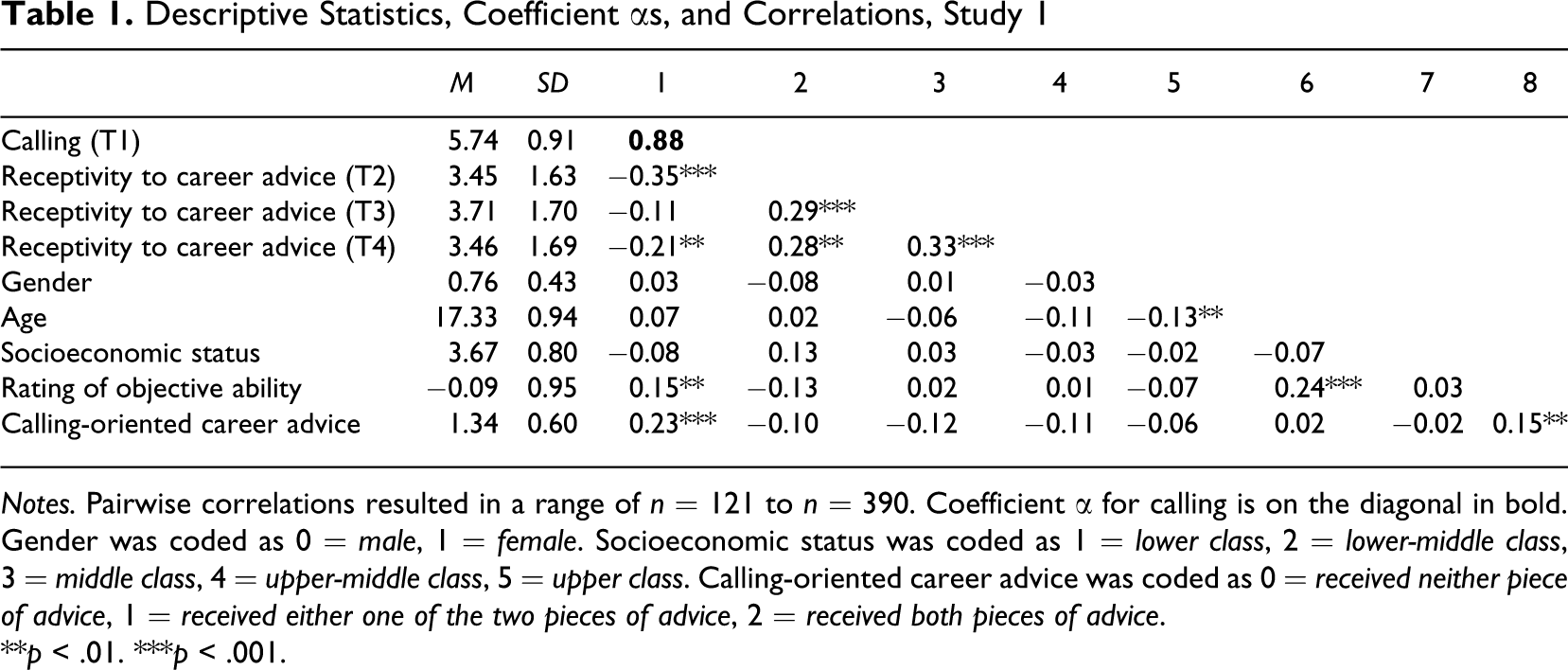
Notes. Pairwise correlations resulted in a range of n = 121 to n = 390. Coefficient α for calling is on the diagonal in bold. Gender was coded as 0 = male, 1 = female. Socioeconomic status was coded as 1 = lower class, 2 = lower-middle class, 3 = middle class, 4 = upper-middle class, 5 = upper class. Calling-oriented career advice was coded as 0 = received neither piece of advice, 1 = received either one of the two pieces of advice, 2 = received both pieces of advice.
**p < .01.
***p < .001.
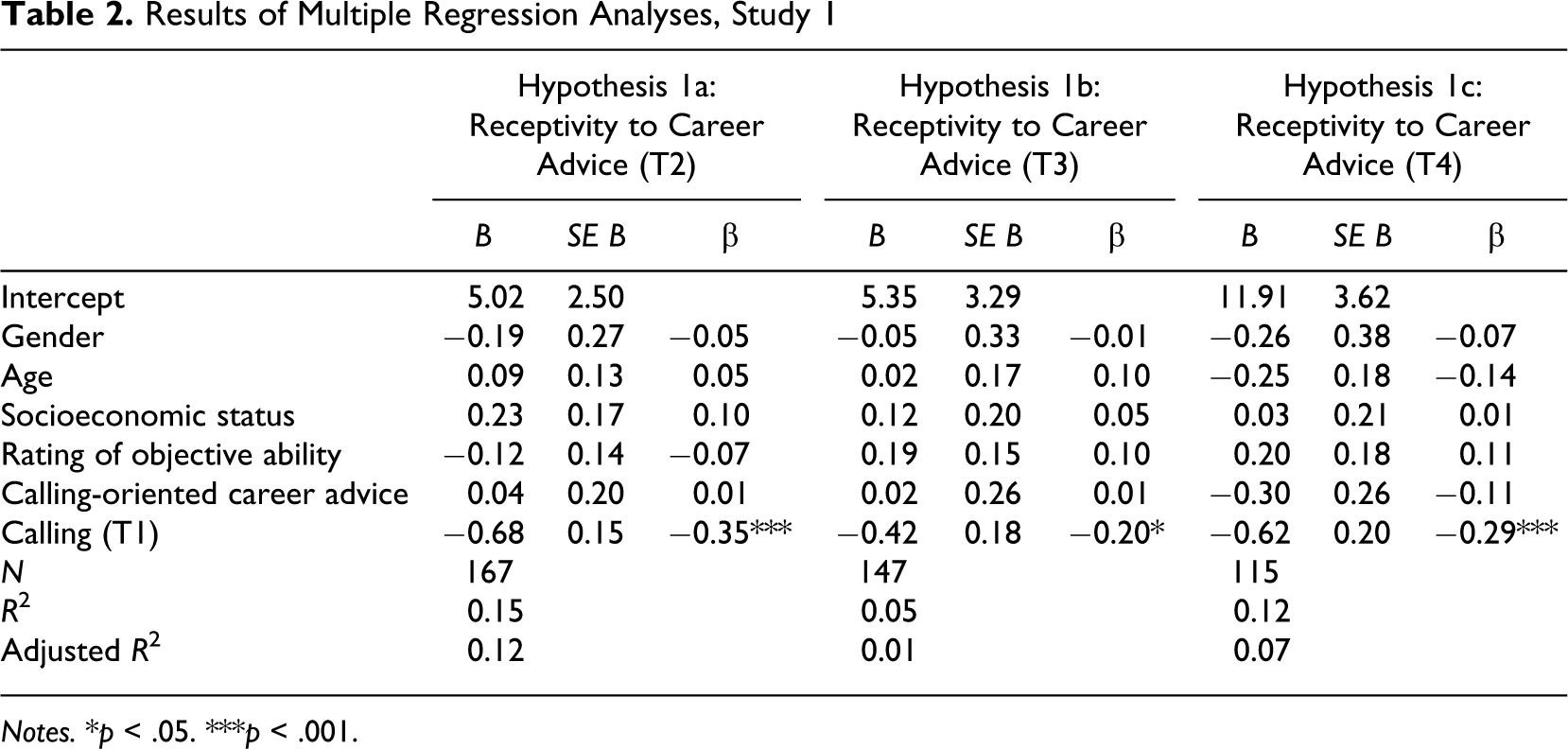
Our hypothesis predicted that calling would be related to ignoring negative career advice in the short, medium, and long term. Consistent with this hypothesis, we found that calling was negatively related to receptivity to career advice 6 weeks later (β = −.35, p < .001), 3½ years later (β = −.20, p < .05), and 7 years later (β = −.29, p < .001; see Table 2 ). That is, those with a strong calling reported being less willing to pursue a career in an area other than music if their music teacher advised them to do so.
Results of Multiple Regression Analyses, Study 1
Notes. *p < .05.
***p < .001.
We used the results of our regression models to assess the magnitude of the effect of calling on receptivity to career advice. When we set all variables in the model to the sample average, participants who reported a strong calling—1 SD above the mean—reported they were likely to ignore career advice in the short, medium, and long term (Ŷ = 2.82, 3.34, and 2.94 at Times 2, 3, and 4, respectively). By contrast, those who reported a weak calling—1 SD below the mean—reported a greater willingness to follow career advice at all three time durations (Ŷ = 4.06, 4.10, and 4.07 at Times 2, 3, and 4, respectively). Thus, controlling for a range of variables, the model predicts that those with a strong calling were likely to ignore potentially useful career advice from their music teachers; that is, they scored below the neutral midpoint, 4, on the dependent variable’s scale. However, those with a weak calling were likely to follow their teachers’ advice—scoring at or above the midpoint on the dependent variable’s scale. These effects endured over time and across career stages.
Study 2
Method
Participants and procedure
Participants were business students, both undergraduate and graduate (MBA), in core introductory management classes at an East Coast U.S. university, n = 131; 73 (56%) undergraduate, 58 (44%) MBA; response rate = 94%, the number of responses divided by the total number of enrolled students (139). Participants completed an online survey as part of a course module on career development. Of the participants, 38% were female; 60% were White, 20% were Asian or Asian American, 7% were Hispanic/Latino, 4% were African or African American, and 9% were other ethnicities; and the mean age was 24.88 years (SD = 5.57, range = 19–51 years). Five percent of respondents reported their socioeconomic status as lower class or lower-middle class, 37% middle class, 47% upper-middle class, 8% upper class, and 3% did not report their socioeconomic status.
Instruments
Calling
We measured calling using the same 12-item scale as in Study 1 (Cronbach’s α = .91). The scale is domain-oriented, so the items were worded in terms of “business.”
Receptivity to negative career advice
We used two measures of receptivity to negative career advice. First, we adapted the single-item variable used in Study 1 to be appropriate for the business student context. Business students do not necessarily have one primary source of career advice, such as the primary music teachers in Study 1; therefore, in Study 2, we asked about career advice gained from a trusted source, without specifying who the source might be. The revised item read, “If a trusted mentor discouraged me from working in business after graduation, I would follow his/her advice and do something else.” Next, we extended this single-item measure by creating a 6-item scale of the extent to which participants would be receptive to career advice. This scale included the original single item and five newly generated items, such as “I would not stop trying to work in business after graduation, even if I received negative career feedback from someone I trust” and “If I received discouraging advice about my career in business, I would disregard it (reverse-coded)” (Cronbach’s α = .65). We report the results for both the single-item and scale measures of receptivity to career advice.
Control variables
As in Study 1, we controlled for gender, age, socioeconomic status, and whether participants had received calling-oriented career advice from their parents. 1
Results
We present descriptive statistics, coefficient αs, and zero-order correlations for all Study 2 variables in Table 3 . The mean level of calling for the business school students was 4.67, which is significantly lower than the mean calling of 5.74 for the musicians in Study 1, t(555) = 11.37, p < .001. This result is consistent with previous findings that musicians tend to report higher levels of calling than do business professionals (Dobrow & Tosti-Kharas, 2011). The means for receptivity to calling advice were 3.02 for the single-item measure and 3.88 for the 6-item measure, which indicates that, on average, participants were inclined to ignore rather than follow the career advice of trusted mentors. As in Study 1, we used multiple regression analysis.
Descriptive Statistics, Coefficient αs, and Correlations, Study 2
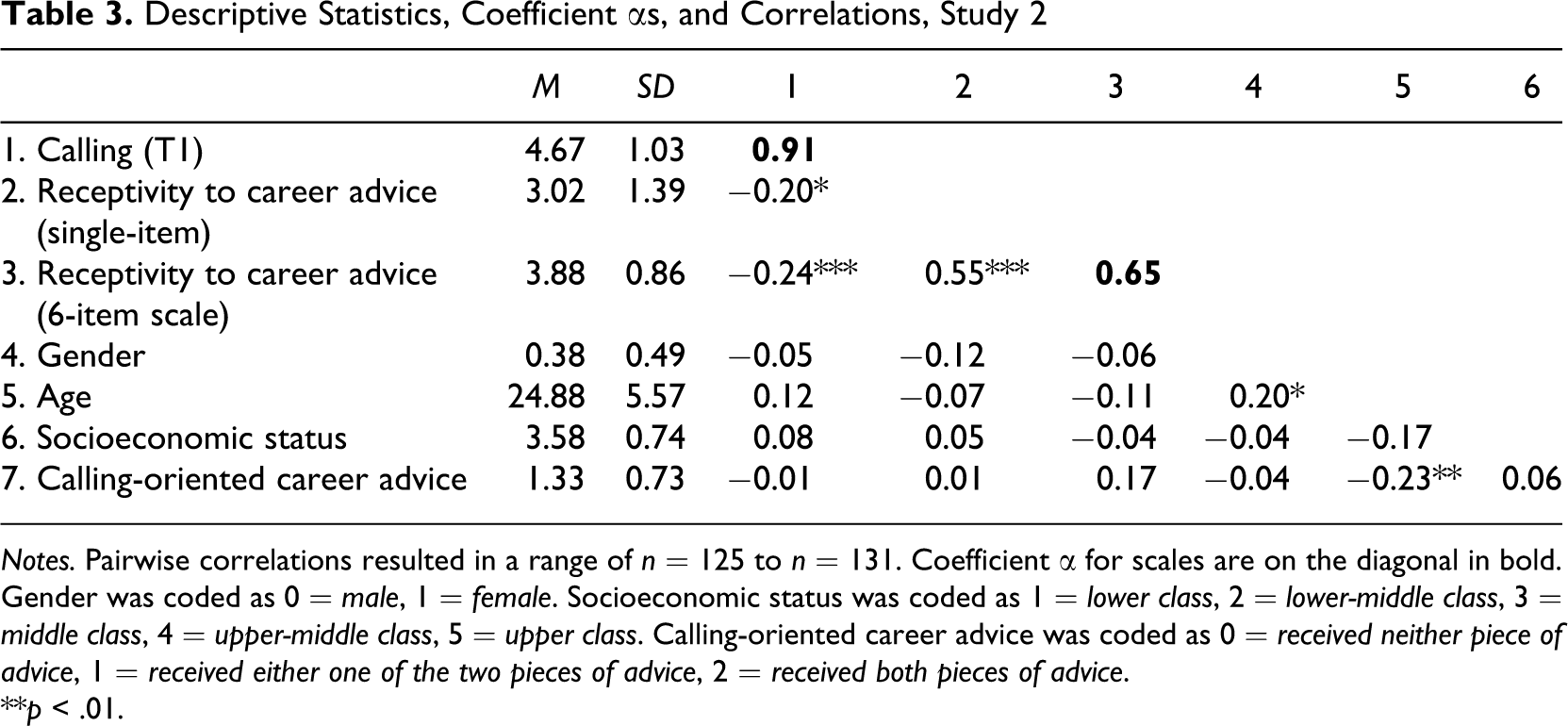
Notes. Pairwise correlations resulted in a range of n = 125 to n = 131. Coefficient α for scales are on the diagonal in bold. Gender was coded as 0 = male, 1 = female. Socioeconomic status was coded as 1 = lower class, 2 = lower-middle class, 3 = middle class, 4 = upper-middle class, 5 = upper class. Calling-oriented career advice was coded as 0 = received neither piece of advice, 1 = received either one of the two pieces of advice, 2 = received both pieces of advice.
**p < .01.
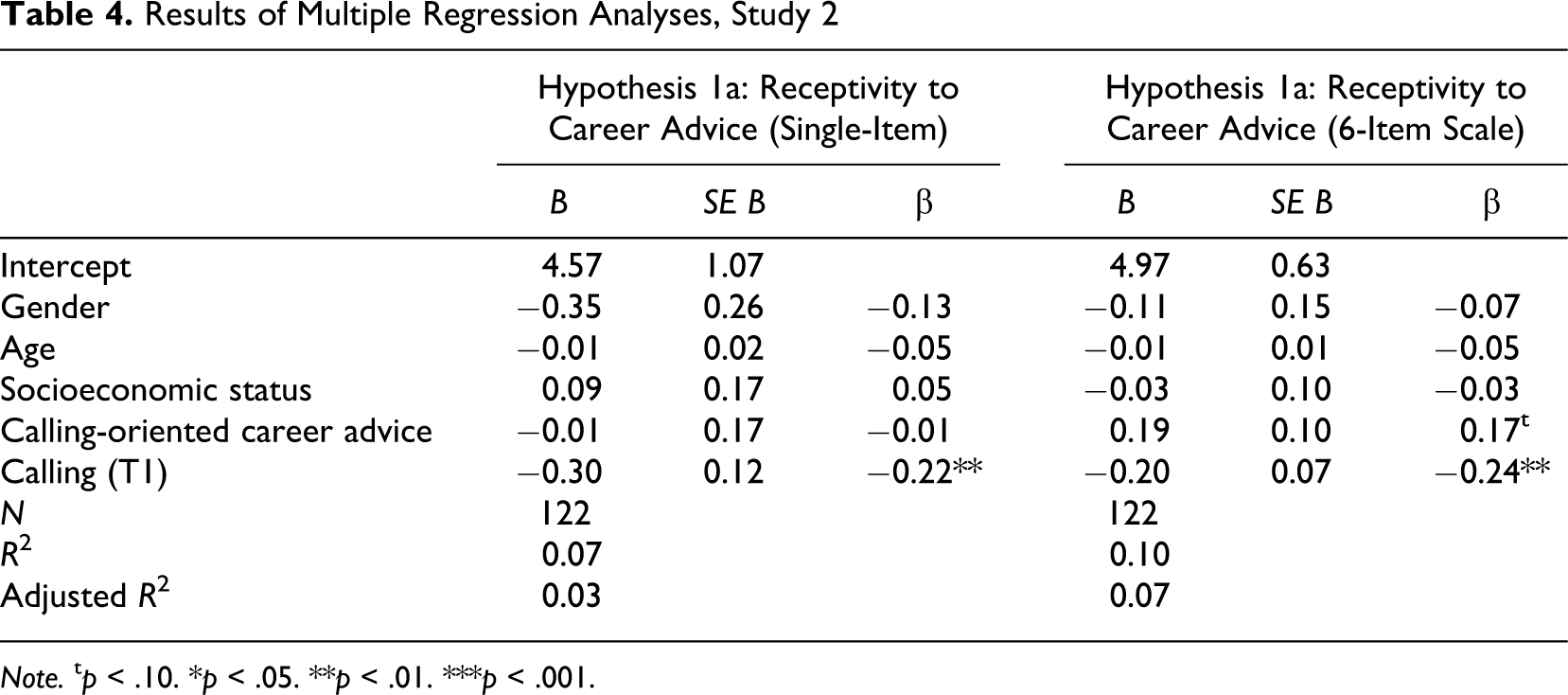
In Hypothesis 1a, we predicted calling would be related to ignoring negative career advice in the short term. In support of this hypothesis, we found that calling was negatively related to receptivity to career advice for both the single-item measure (β = −.22, p < .01) and 6-item scale (β = −.24, p < .01; see Table 4 ). Thus, participants who reported a stronger calling toward business were less likely to heed the advice of a trusted mentor who discouraged them from pursuing a career in business.
Results of Multiple Regression Analyses, Study 2
Note. t p < .10.
*p < .05.
**p < .01.
***p < .001.
As in Study 1, we used these results to investigate the magnitude of the effect of calling on receptivity to career advice. When we set all variables in the model to the sample average, participants who reported a strong calling—1 SD above the mean—reported they were likely to ignore career advice (Ŷ = 2.78 and 3.73 for the single-item measure and 6-item scale, respectively). By contrast, those who reported a weak calling—1 SD below the mean—were less likely to ignore career advice (Ŷ = 3.40 and 4.14 for the single-item measure and 6-item scale, respectively). Consistent with Study 1’s findings, business students experiencing a strong calling were likely to ignore potentially useful career advice from a trusted mentor, whereas those with a weak calling were likely to follow their mentor’s advice.
Discussion
This study extends calling research by exploring calling in the context of the unfolding career decision making that occurs over time during people’s career trajectories. In particular, we focused on the relation between calling and receptivity to career advice from a trusted mentor. Our analyses in both Studies 1 and 2 showed that people with a stronger calling toward music and business, respectively, reported being more willing to ignore discouraging career advice from a trusted mentor. These results held over time in Study 1, such that young people’s early calling predicted the degree to which they were willing to ignore discouraging career advice equally strongly across the critical years during which initial career decisions occur. Specifically, our models predicted that individuals who experienced a strong early calling would ignore potentially useful career advice (i.e., score below the neutral midpoint, 4, on the dependent variable’s scale). In contrast, individuals who experienced a weak early calling would follow this career advice (i.e., score above the neutral midpoint, 4, on the scale). Our results highlight the short-, medium-, and long-term impact of a calling as young people embark on their career paths within two different occupational contexts: music and business.
Theoretical Implications
This study contributes to research on calling in several ways. First, our results shed light on a possible negative effect of calling. The predominant view of calling in the literature is that it leads to positive outcomes in general and is beneficial to career development in particular (e.g., Duffy, Allan, & Dik, 2011; Duffy & Sedlacek, 2007; Wrzesniewski et al., 1997). Yet, to our knowledge, only two studies have considered calling’s potential for negative as well as positive effects (Bunderson & Thompson, 2009; Dobrow & Heller, 2011). Our results, which show that a stronger calling is linked with greater willingness to ignore potentially useful but negative career advice over time, provide empirical evidence that calling can be associated with risky—and even negative—career outcomes. Future research should continue to explore the prospect that calling can result in both positive and negative outcomes.
Second, our Study 1 results contribute to longitudinal research on calling. We build on a critical aspect of the definition of careers—namely, that they occur “over the span of the person’s life” (Hall, 2002, p. 12)—which implies that to understand career phenomena, scholars must consider their temporal nature. Our longitudinal approach allowed us to test the relation between calling and receptivity to career advice at several significant points in people’s career trajectories, as our participants progressed from high school through college and into postcollege life. Furthermore, we demonstrated that the negative relation between calling and receptivity to career advice persisted over the span of many years, such that the degree of calling 17-year-old (on average) musicians experienced predicted their receptivity to career advice at age 24. Prior empirical research on calling (Bunderson & Thompson, 2009; Duffy & Sedlacek, 2007; Wrzesniewski et al., 1997), and more broadly on meaning of work topics, such as intrinsic motivation, work orientation, and spirituality, has typically utilized a cross-sectional approach (see Dobrow, 2006; Dobrow & Tosti-Kharas, 2011; Duffy, Manuel, Borges, & Bott, 2011; Wrzesniewski, 1999, for exceptions). As such, these studies provide insights into the correlational relations between calling- and career-related variables, yet cannot account for the passage of time inherent in understanding career development as it unfolds. Similarly, Allen, Eby, O’Brien, and Lentz’s (2008) review of mentoring research found that 91% of published mentoring studies used cross-sectional designs, leading the authors to conclude that longitudinal research is “sorely needed” (p. 350). Our study thus provides insight into the role calling can play in predicting a mentoring-related career outcome over time. We also consider the relatively unexplored subject of calling across formative stages of people’s career paths, starting in late adolescence and continuing into early adulthood. We strongly encourage future research to build on this model by adopting longitudinal perspectives, which will yield greater understanding of calling’s role in career development across the lifespan.
Our study’s third contribution is its examination of the relation between calling and a novel outcome for the calling literature, receptivity to career advice. Extant empirical calling research has typically focused on linking calling to either affective outcomes, such as job satisfaction (Peterson, Park, Hall, & Seligman, 2009; Wrzesniewski et al., 1997), academic satisfaction (Duffy et al., 2011), finding significance in one’s work (Bunderson & Thompson, 2009), number of days of work missed (Wrzesniewski et al., 1997), or pursuing a career in the calling domain (Dobrow & Heller, 2011). In this study, we focus squarely on a construct—receptivity to career advice—that departs from these prior constructs by tapping into individuals’ reactions to feedback from a trusted mentor. As such, this construct incorporates a relational perspective, which scholars frequently cite as critical for understanding career development (de Janasz, Sullivan, & Whiting, 2003; Dobrow & Higgins, 2005; Higgins, 2001; Kram, 1996; van Emmerik, 2004). Previous research has explored relational perspectives in the context of how people create meaning at work (Pratt & Ashforth, 2003 Wrzesniewski & Dutton, 2001; Wrzesniewski, Dutton, & Debebe, 2003), but the calling literature has not commonly explored them (see Berg et al., 2010, for an exception). Future studies should further explore how those with a strong calling relate to those around them.
Our focus on receptivity to career advice contributes to both the calling literature and more generally to the careers literature. Research on individuals’ reactions to feedback from others (e.g., Linderbaum & Levy, 2010; London & Smither, 2002) typically examines reactions to performance feedback in either laboratory or workplace settings, not to career advice specifically. Receptivity to career advice likely represents a specific type of receptivity to feedback, so the concepts remain distinct though they are probably related. We therefore encourage future research that explores the nuances of how people receive and act on career advice, as well as research that considers predictors of receptivity to career advice beyond calling, and research that examines calling in relation to additional career development outcomes, such as career choice and job transition.
Limitations
Our study contains several limitations. First, we measured receptivity to negative career advice via self-report survey items. This approach assessed participants’ reactions to a hypothetical situation in which they imagined how they would respond to negative career advice from a trusted mentor. We recommend that future research explore receptivity to career advice from additional angles, including individuals’ responses to real, rather than hypothetical, negative feedback, whether or not they follow the discouraging career advice, and what career decisions they actually make. Given that people view negative events as more powerful than positive events (Baumeister et al., 2001), the relation between calling and receptivity to career advice might be stronger for discouraging advice than for encouraging advice. We recommend that future research explore receptivity to both negative and positive advice.
Second, we assessed participants’ reactions to receiving career advice from a single trusted mentor. Although this person generally plays a critical role in the lives and careers of our participants, we acknowledge that multiple people likely influence these young people’s career development, including parents, peers, and educators. In particular, we recommend that future research adopt a developmental network perspective (Dobrow, Chandler, Murphy, & Kram, 2012; Higgins & Kram, 2001) to explore the ways in which the career and psychosocial support multiple developers provide over time affects receptivity to career advice and, more generally, to other career development outcomes.
Third, we focused on how the career “tunnel vision” that can accompany strong callings relates to one career-relevant outcome: receptivity to career advice. We expect the proposed mechanism underlying this relation—relying more on self-perceptions than on external perspectives—may affect other work-related outcomes, such as reactions to performance evaluations, reactions to managers’ coaching, and job-seeking behaviors. Future studies should investigate such constructs to better understand how career “tunnel vision” relates to strong callings.
Practical Implications
Although research supports the notion that advice can be helpful and that people at the beginnings of their careers should heed it (Lapan, 2004), a key practical implication of this study addresses the potential consequences for these young people of ignoring discouraging career advice. Our results suggest that individuals experiencing a strong calling might experience both costs and benefits in heeding discouraging career advice.
Strong-calling individuals who ignore discouraging career advice gain the significant benefit of being able to pursue, and possibly fulfill, their callings (Berg et al., 2010). For instance, in spite of the hardships of pursuing a professional music career, even those who are barely succeeding can express great enthusiasm for their work. A New York–based freelance violinist who saw his own musical work shrivel up in recent years articulated this point: “I do what I do 24 hours a day, and I love every second … That’s what an artist is. We love it so deeply. We go with what it is. It’s not a job. It’s our life” (Wakin, 2010, p. 1). In other words, the deep fulfillment that comes from engaging in a calling domain might compensate for the less enjoyable aspects of sustaining a career in that domain.
In contrast, strong-calling individuals who ignore discouraging career advice might pay a significant cost. Many people are lured into winner-take-all markets, “where thousands compete for a handful of big prizes at the top” (Frank & Cook, 1995, p. viii). Frank and Cook (1995) argued that “in comparison to [the] optimal mix, market incentives typically lure too many contestants into winner-take-all markets, and too few into other careers. One reason involves a well-documented human frailty—namely, our tendency to overestimate our chances of prevailing against our competitors” (p. 103). The existence of too many contestants results in waste, for both individuals and society. Being one of too many contestants in a winner-take-all market, as would be the case for many strong-calling individuals who ignore discouraging career advice, might take a significant psychological toll, including repeated disappointment, rejection, and depression (Wakin, 2004). People’s desire to fulfill their callings might also make them vulnerable to overwork, low pay, and other mistreatment (Bunderson & Thompson, 2009).
In light of these benefits and costs, how should career counselors or mentors advise individuals with a strong calling? Individuals who are more open to feedback likely have a learning, rather than performance, orientation (Dweck, 1986; London & Smither, 2002). Those with a learning orientation focus on cultivating their abilities through seeking challenging problems that might provide an opportunity for improvement, whereas those with a performance orientation seek easier problems that provide less risk of failure (Dweck, 1986). A learning-oriented person would take advantage of the information contained in a trusted mentor’s negative feedback, whereas a performance-oriented person might feel threatened. Thus, a paradoxical implication of our results is that strong-calling individuals—those individuals most in need of a learning orientation to navigate a high-risk career path—appear to have a performance, rather than learning, orientation. Future research can explore the degree to which learning and performance orientations generalize from the level of a “problem” to the broader level of an overall career. As learning is important for career growth and identity development throughout people’s lives (Hall, 2002), career counselors and mentors must consider how to provide developmental advice to those likely to feel the most threatened by it. To address this issue with strong-calling, performance-oriented individuals, advisors could actively seek to change their orientation from performance toward learning (Dweck, 2006).
The persistence of the relation between early-career calling and receptivity to negative career advice over time in Study 1 suggests that advisors need to be mindful of when in a young person’s career trajectory to provide feedback. Advisors should recognize that the discouraging feedback they are providing might conflict with callings their advisees have experienced for many years. Therefore, advisors must try to understand the depth and origins of their advisees’ connections to their fields. Once they have an understanding of the strength of the calling, counselors should approach the feedback process—regardless of the type of feedback they are providing—with sensitivity for the deep psychological connection those with strong callings feel toward the domains in which they are involved. Moreover, advisors should encourage advisees to consider the feedback they receive from multiple mentors in their lives, such as from the members of their developmental network (Dobrow et al., 2012; Higgins & Kram, 2001).
Our results also suggest practical implications for the trusted mentors who provide feedback to young people. Providing negative feedback to their protégés can be challenging for mentors (Allen, Poteet, & Burroughs, 1997; Coleman et al., 1987; Ensher & Murphy, 2011). The challenges are even greater when protégés are young people, novices to the career field, or both. Teachers who serve as mentors to their students might refuse to provide negative feedback since they fear dashing the students’ hopes or they might purposefully provide negative feedback as a screening device to see which students are truly committed to pursuing a challenging career path. For instance, music teachers sometimes encourage their students to switch away from music performance to a less competitive area of music, such as music education or music administration. Similarly, business school professors might suggest students pursue jobs in industries with more jobs available, but that involve lower pay or prestige. In such cases, teachers often feel conflicted about what type of career advice, if any, to provide students, as well as how to continue teaching and supporting students who might ignore their advice. Our results can help mentors interpret the behavior of protégés who do not follow their advice, and decide whether to continue to support the protégés’ efforts going forward (Allen et al., 1997).
Conclusion
The relation between strong callings and low receptivity to discouraging career advice found in our analyses often manifests itself in young people’s risky career decisions and their mentors’ conflicted feelings about how to advise their passionate young students. One strong-calling participant in Study 1 who aspires to become a “triple threat” as a singer, dancer, and actress aptly summarized the complicated experience of receiving discouraging advice from her music teacher: “My choir teacher says, ‘Please, please don’t be a professional.’ All I hear is how hard it is and I see how hard they live. [I keep doing it] because I love it so much. They discourage me from doing it, but they still help me.” This situation might apply to many people in competitive fields, who, despite the risks and challenges associated with their chosen careers, cannot help but “listen to their hearts.”