



Abstract
Career calling is a pervasive, purposeful, transcendent, and passion-driven approach to a job that is perceived as central to individuals’ identity, that contributes to the greater good, and for which individuals are willing to make sacrifices. Research on the dynamics of career calling has grown exponentially, but clarity on whether and how a career calling changes during key life transitions is still lacking. In this article, we report the results of a two-wave study in which changes in perceiving a calling, living out a calling, and calling motivation were compared across groups of college students (n = 781), college-to-work transitioners (n = 143), and workers (n = 270). The results show that perceiving a calling is stable for students, decreases during college-to-work transitions, and slightly increases for workers; living out a calling is stable for students, decreases during college-to-work transitions, and slightly decreases for workers; motivation to pursue a calling is stable in all groups and higher for students entering the job market. Workers have lower levels of perceiving and living out a calling than students.
Introduction
The global average median age was 30 years in 2021, whereas the average international lifespan was approximately 70 (Worlddata). This picture underscores the need to recognise younger people as the most important stakeholders when we talk about the global future. Young people firmly believe in the transformative impact of education on their future professional lives (Gallup & Lumina Foundation, 2023), and the transition from college to work represents a critical juncture that can serve as a gateway to either success and satisfaction or a cycle of low-quality employment (Bauer et al., 2007; Wendlandt & Rochlen, 2008). By examining the challenges and opportunities associated with the college-to-work transition, we can understand how individuals thrive in their chosen career path and identify strategies and best practices for supporting them on this important journey.
During college-to-work transition, some individuals might be guided by the perception of being called toward a work or study domain, which is the disciplinary field, job, or broad set of activities for which a calling can be felt (e.g., mechanical engineering, law, teaching, or nursing). Such a feeling might have developed during college and can guide career choices thereafter (Kaminsky & Behrend, 2015). Career calling is a multidimensional construct whose conceptualisation is still debated. In this study, we define calling broadly as the perception that an individual’s own job or involvement in a study domain is key to defining who they are; a source of purpose in life; something for which they could sacrifice other areas of their lives and toward which they feel summoned by something greater or beyond themselves; and a job that engulfs their consciousness, that is useful to others or the society as a whole, and for which they feel a strong passion (Vianello et al., 2018). Perceiving a calling has been associated with positive outcomes for individuals and organisations, such as higher satisfaction, well-being, and better performance (Dobrow et al., 2023), and found to protect individuals from stress, burnout, and turnover intentions (Gerdel et al., 2022). Perceiving a calling is also important for career development. Individuals who perceive a calling have clearer career goals and are more determined to pursue a particular career (Hirschi & Herrmann, 2013), possess clearer job search goals, and engage in more intense job search activities (Dalla Rosa et al., 2020; Dobrow & Heller, 2015; Dobrow & Tosti-Kharas, 2012).
Calling has been defined as the extreme form of subjective success (Hall & Chandler, 2005), and increasing attention has been devoted to understanding the dynamics of perceiving a calling over time. Half of the scientific papers (8 out of 16, source: Google Scholar) that investigated changes in career calling using multiple observations over time have been conducted in the last 5 years, suggesting that scholarly interest in the development of calling is exponentially increasing. Longitudinal evidence suggests that calling is not a stable trait, but a dynamic and malleable phenomenon (Dik & Shimizu, 2019; Lysova et al., 2019; Vianello et al., 2020). The transition from college to work may be one of the key life events that contribute to the development of a calling. To our knowledge, only three longitudinal studies have investigated individuals’ calling with a focus on career and life transitions (Dobrow & Heller, 2015; Zhang et al., 2021, 2022). Dobrow and Heller (2015) found that career calling decreased slightly from high school to college (Cohen’s d = −.23.) Zhang et al. (2021) found that, before and after graduation, perceiving a calling among college students was high and decreasing (75% of the sample) or high and stable (23%). Finally, Zhang et al. (2022) showed that a more developed calling (perceived as coming from an internal source or both internal and external sources) is associated with a more successful university-to-work transition.
The work as a calling theory (WCT; Duffy et al., 2019) postulates that the positive effects of a career calling depend on the extent to which a calling is lived out and proposes a distinction between perceiving a calling, living out a calling, and the motivation to pursue a calling. The process from perceiving a calling to living out a calling is moderated by being motivated to pursue that calling. Previous studies have focused on perceiving a calling but have not analysed the effects that life transitions might have on being motivated to pursue a calling (i.e., calling motivation) and being able to realise a calling in life (i.e., living out a calling). These are different constructs that are likely to be predicted by different factors; therefore, the college-to-work transition may have a different effect on them. The concept of calling motivation has been introduced recently in the literature (Duffy et al., 2019) and, given its crucial role in facilitating the realisation of one’s calling, understanding whether and how calling motivation changes during college-to-work transitions is a gap in the literature that needs to be addressed. Finally, individuals who are performing the same role (i.e., students and workers) in a relatively stable environment (i.e., college and the world of work) are facing different challenges that can differently impact perceiving and living a calling. Hence, changes in calling should be analysed in different groups of people. The goal of the current study is to further develop our knowledge of calling development by investigating whether perceiving a calling, living out a calling, and calling motivation change differently during college-to-work transitions and among individuals in stable career stages (i.e., students and workers). The results of this investigation have important implications.
What is learned about a calling during the college-to-work transition may apply to other transitions in life, such as from one career to another, from employment to unemployment, and to retirement. Unemployed individuals are as likely as employed individuals to have a calling (Duffy et al., 2015), and their calling can support more clear and intense job search activities (Dalla Rosa et al., 2020). Perceiving and living out a calling were found to be positively related to life meaning among retirees (Duffy, Torrey, et al., 2017) but may represent a risk to well-being when individuals cannot find a way to change the domain of their calling (Bengtsson & Flisbäck, 2017). Taken together, this evidence highlights the importance of understanding the dynamics of perceiving a calling, living out a calling, and calling motivation to better understand what may happen throughout an individual’s life.
Finally, the rate of change and instability of careers in the contemporary world of work increase the importance of understanding what happens to a calling throughout career development and across career transitions. Identifying the mechanisms behind calling development would facilitate career counsellors in helping their clients navigate career decisions and designing interventions to promote and sustain the experience of work as a calling during all stages of career development.
The Development of a Calling
In this article, we define perceiving or having a calling according to a unified model (Vianello et al., 2018) that integrated the neoclassical and modern approaches to calling (Dobrow, 2013; Duffy et al., 2019). According to this approach, one’s calling is a pervasive and profound passion (pervasiveness and passion) and is experienced as a transcendent summons to engage in a domain of work activities that defines individuals’ identities and contributes to their life purpose (identity and purposefulness). Individuals are willing to sacrifice time and energy in order to pursue their calling, and they believe that what they do directly or indirectly helps others (prosocial orientation). This approach has been supported by extensive empirical evidence (Gerdel et al., 2022; Vianello et al., 2018). As suggested by the WCT, perceiving or having a calling does not imply that individuals are motivated to pursue that work domain or role in life or that they are currently living their calling in their life. For example, an individual perceives a calling to work in an animal shelter but currently does not work in this domain. Individuals have also different levels of willingness to pursue a calling. This calling motivation unfolds after people have developed a perception of having a calling and influences the likelihood of living out a calling (Duffy et al., 2015, 2019). Individuals who perceive a calling and are motivated to pursue it will enter environments that fit them well (higher person-environment fit). Then, they will experience greater work meaning and career commitment, which, in turn, will lead to an increased sense that they are living their calling. Living out a calling refers to the degree to which individuals are currently engaging in activities that allow them to fulfil their calling (Duffy et al., 2012). An example is a doctor who perceives a calling for helping individuals and is currently living it out by working in the emergency room of a hospital. A clear and shared account of how individuals develop the perception of having a calling is still lacking in the literature. Two recent attempts in this direction have been made.
First, Reed et al. (2022) propose that an individual develops a calling through work identity formation, which is related to cognitive processes. According to their approach, a calling develops through four antecedent conditions: effort calculation, reflection, appraisal, and fusion. Second, according to the a posteriori hypothesis on calling development, one’s calling is the result of an ongoing process of interaction between individual characteristics and the environment that is activated and shaped by everyday life (Dalla Rosa et al., 2019). The hypothesis states that individuals develop the perception of having a calling for a work domain or set of activities through a cyclical process of exploration, involvement in the calling domain, and self-reflection. Empirical evidence supports this hypothesis (Dalla Rosa et al., 2019; Duffy et al., 2014; Mauno et al., 2022; Ahn et al., 2017; Sturges et al., 2019). The two approaches align and suggest that a calling develops through interaction with the environment and an understanding of the self.
Like other job attitudes and orientations (Wrzesniewski, 1999), a calling presents both trait-like (stable individual differences) and state-like (within-individual variation) properties, and, compared to dispositional traits, its development is likely to be more contextualised in time, place, and social role (Vianello et al., 2020; Zhu et al., 2021). Changes in the physical, social, and cultural environments that involve the domain of activity are likely to affect the development of a calling (Bott & Duffy, 2015; Dalla Rosa et al., 2019; Duffy et al., 2014). For instance, evidence suggests that the degree to which the educational context allows college students to successfully live out their calling influences the perception of having a calling, which, in turn, predicts higher levels of living it out one year later (Vianello et al., 2020). One of the changes in the physical, social, and cultural environments that might affect a calling is the transition from college to work.
Calling and College-to-Work Transition
According to Super’s (1980) life-space, life-span developmental theory, individuals play nine major roles in their life span across four main theatres. The most important roles for calling development are being a student and a worker: Students can perceive a calling for their study domain or the future job they want to pursue (Dobrow & Heller, 2015; Duffy & Sedlacek, 2010) while workers can perceive their work as a calling and have the opportunity to fulfil their calling at work. College students enter a new role and stage in life when they complete their college degree and enter the world of work assuming full-time the role of workers.
The average transition from college to work occurs during emerging adulthood, which is the developmental period of late teens to mid-twenties (Arnett, 2000). This period is characterised by high uncertainty and wide-open possibilities. For most students, college years are a time for identity exploration, questioning, and searching for meaning in life and a place in the world of work. The initial entry into the world of work is approached with a baggage of beliefs about themselves and work, attitudes toward work and career, motivations, interests, and work values that have been built in interaction with their social and educational environment. Work experience impacts this set of beliefs, attitudes, motivations, and values. For example, one newcomer may enter the world of work expecting it to be meaningful and enjoyable but then find that work is tedious and void of meaning, while another might expect work to be an instrument for gaining financial independence and then find that it is interesting, enjoyable, and deeply meaningful.
At the end of college, students have developed a certain degree of calling for their study domain based on their experience and interaction with the academic environment. Fluctuations in their calling during college are likely to happen depending on the classes and activities they are engaged in as well as the social environment and role models that are accessible to them. Indeed, the level of engagement in learning activities, social support, and the presence of mentors and their work orientation have been found to predict the perception of a calling during college years (Dalla Rosa et al., 2018, 2019; Dobrow, 2013; Duffy et al., 2014). Entering a new job represents a change in the social and cultural environment that requires newcomers to re-evaluate their calling for the work domain and set of activities and identify new ways to live it out.
Wendlandt and Rochlen (2008) identified the three most common professional obstacles that college students face when transitioning from college to the world of work: the change in culture, the lack of experience and skills required by employers, and inaccurate expectations of working life. Entering the world of work implies a transition into an environment that, especially during first work socialisation, is likely to either threaten or foster the opportunities for developing and pursuing a calling. Guidance and feedback provided during college promote self-reflection, which is important for the development of a sense of calling (Dalla Rosa et al., 2019; Dobrow & Tosti-Kharas, 2012). Employees, on the other hand, are less guided and often required to perform tasks unexpectedly and with limited or delayed feedback. Some characteristics of the organisational context, such as low work discretion and participative decision-making (Rawat & Nadavulakere, 2015), supervisor ostracism, and work orientation (Dalla Rosa et al., 2018; Han & Hwang, 2021; Xie et al., 2019), have been found to be negatively related to calling and may represent obstacles for its development and realisation.
In addition to a change in culture, college students enter the world of work with inaccurate expectations of working life and lack the experience and skills required by employers. The transition from college to work is a period of adjustment between ‘pre-owned’ occupational identity and skills and the realities and requirements of the job market (Arnett, 2000; Gardner & Lambert, 1993). The skills cultivated in college typically differ from those required to succeed in the workplace. During socialisation (Bauer et al., 2007), newcomers continue to learn the skills and tasks essential to their job, create new relationships, develop role clarity, and evaluate their performance (Wendlandt & Rochlen, 2008). Understanding what is required of them and acquiring familiarity with the new activities are likely to be high priorities for newcomers.
Furthermore, students have inaccurate expectations of working life and tend to attach great importance to intrinsic values (Jin & Rounds, 2012), which is likely to result in frustration because their expectations exceed what can be offered in the labour market. The lack of clarity about the job, the need to learn how to perform the job, and the frustration of expectations can lead individuals to re-evaluate the perception of a calling they developed during college or to develop a new calling. On the one hand, a decrease in the perception of calling among students entering the world of work is expected. On the other hand, the perception of having a calling is expected to be more stable when the context, role, and activities do not change, such as for students in college or employees working in the same role and organisation. Therefore, the following hypothesis was developed. HP1: The perception of having a calling is stable over time for students and workers but decreases when students enter the job market.
On average, the transition from college to work implies a change in culture, role requirements, and expectations. Given these changes and the need to understand and explore the work domain, we believe that students entering the workforce need to identify new ways to live out their calling in the professional environment. According to the WCT, P-E fit, career commitment, and work meaning mediate the path from perceiving to living out a calling. Greater P-E fit can be achieved through career choices: People who perceive a calling may be motivated to seek out educational and occupational environments that allow them to express their calling. A high P-E fit, in turn, facilitates perceptions of meaningful work and a desire to remain employed in the position through which the perceived calling can be fulfilled. Individuals who perceive a sense of meaning in their work and grow a commitment to their career will, in turn, perceive a greater sense that they are living out a calling (Duffy et al., 2019). Greater P-E fit, meaning of work, and commitment can also be reached by crafting the task, cognitive, and relational boundaries of work. Hence, living out a calling is likely to be the result of a series of experiences in the workplace that help individuals create or identify new ways to express their calling, increase the perception of fit, find meaning, and commit to their new role as workers. The extent to which a calling is lived out is expected to be more stable when the activities do not change, such as for students in college or workers. The following hypothesis was therefore developed. HP2: Living out a calling is stable over time for students and workers but decreases when students enter the job market.
In the literature, calling motivation has been conceptualised as a consequence of perceiving a calling that mediates (Duffy et al., 2015) or moderates (Duffy et al., 2017, 2018, 2019) the relation between perceiving and living out a calling. Calling motivation, as operationalised by Duffy et al. (2015), concerns beliefs about what one will do in the future. Given this conceptualisation, calling motivation is expected to be relatively independent of current changes and transitions in the educational or professional context. Individuals who are high in calling motivation will be motivated to pursue a calling in their career while they are in college or at work as well as during and after their college-to-work transition. According to this premise, the following hypothesis was developed. HP3: Calling motivation is stable over time for students, workers, and those who enter the job market.
Method
Participants
The data used in this study represent a follow-up of a previous longitudinal project on calling (Dalla Rosa et al., 2019; Vianello et al., 2018, 2020). In 2018, after the conclusion of the first project, a subsample (33%) of students who participated in the previous project and a new sample (67%) of students who did not take part in the previous project were invited. Students were enrolled at a public university in the northeast of Italy. Data were collected in three waves: April–May 2018 (T1), October–November 2018 (T2), and May–June 2019 (T3).
The total sample collected was composed of 4940 subjects. For the purpose of this study, we selected a subsample of subjects (n = 1194) who were students or workers at both T1 and T2 (stable students and stable workers) or changed status from being students at T1 to being workers at T2 (transitioners). The assignment to one of these groups was based on a set of questions. Participants were asked whether, at the time of the survey, they were students (yes/no) and workers (yes/no). If they chose both options, they were asked to select the role that was more important to them in their life (‘In the previous question, you indicated being both an active student and a worker. Please indicate which of these activities, at this moment, represents the most important part of your life’). By allowing participants to self-discretely determine their most salient role, without deciding a set of external determinations of role salience, the study aimed to capture the unique perceptions and priorities of each participant. The data collected at T3 were not used due to the low number of participants that would have been included in the three groups.
The first group consisted of stable students (N = 781). Of this group, 37.5% were male (n = 287). At T1, stable students were, on average, 24 years old (SD = 3.20). The most represented majors were psychology (19.3%), engineering (18%), business (7.2%), and medical sciences (6.6%). Most participants were enrolled in master’s degree programmes (T1: 81.2%; T2: 83.4%), followed by single-cycle degree programmes (T1: 11%; T2: 10.8%) and bachelor’s degree programmes (T1: 7.8%; T2: 5.9%). The differences between these groups in terms of having a calling (ηT1 = .02; ηT2 = .02), calling motivation (ηT1 = .02; ηT2 = .01), and living out a calling (ηT1 = .03; ηT2 = .01) were tiny. Considering the small subsample of students enrolled in single-cycle degree programmes and bachelor’s degrees and the trivial differences we observed in the levels of key variables, we decided to merge the three groups. No relevant difference was observed in the results reported in the paper by including only one type of degree.
The second group consisted of stable workers (N = 270). Of this group, 40.6% were male (n = 106). At T1, stable workers were, on average, 29.46 years old (SD = 6.97). They worked, on average, 35 hours per week (MT1 = 34.68; SD T1 = 10.75; M T2 = 35.52; SD T2 = 9.92). The most represented job categories were education and training specialists, high-school and middle-school teachers (10%), qualified professionals and technicians in healthcare and social services (10%), specialists and technicians in mathematical, computer, chemical, physical, and natural sciences (8%), engineers (7%), employees in administrative, economic, and financial management (7.4%), and researchers (4%) (job categories derived from the Italian National Institute of Statistics - ISTAT).
The third group was composed of college-to-work transitioners: Participants self-categorised themselves as students at T1 and workers at T2 (N = 143). At T1, the most represented majors were engineering (26.7%), psychology (12.6%), mathematics (6.7%), and business (5.9%). At T2, they worked, on average, 34 hours per week (SD = 11.47), and the most represented job categories were education and training specialists, high-school and middle-school teachers (9.3%), qualified professionals and technicians in healthcare and social services (7.4%), engineers (7.4%), specialists and technicians in mathematical, computer, chemical, physical, and natural sciences (6.3%), employees in administrative, economic, and financial management (5.9%), and researchers (3.3%). Of this group, 41.3% were male (n = 57). At T1, the transitioners were, on average, 25.69 years old (SD = 5.13).
Procedure
Data were collected online using LimeSurvey. The link to the questionnaires was sent out to the institutional email provided by the university to former and current students or—when available—their personal email if they had previously declared their willingness to be contacted for a follow-up. Data protection followed the regulations of Italy (Legislative Decree n. 196/2003) and the European Union (regulation n. 2016/679, GDPR). Informed consent was provided on the first page of the survey and electronically signed. Anonymised data and analysis codes are publicly available on the Open Science Framework (Dalla Rosa et al., 2023; https://osf.io/9be75/). Further exploratory analyses including moderation tests were conducted and are available in an external web supplement: https://osf.io/9sbnu.
Measures
The questionnaire was administered in Italian. Scales that were originally in English were translated and back-translated following Brislin (1970). All measures were administered at both T1 and T2. Respondents indicated the extent to which they agreed with each item on a Likert scale ranging from ‘strongly disagree’ to ‘strongly agree’ or from ‘not at all’ to ‘very much’ (for living out a calling).
Calling
Calling was measured with the unified multidimensional calling scale (UMCS; Vianello et al., 2018). The UMCS consists of 22 items and measures seven facets of a calling: pervasiveness, prosociality, passion, identity, transcendent summons, sacrifice, and purpose. The wording of the items was adapted to the main life role of participants, either student or worker. Example items are ‘I am passionate about my work/about what I am studying’ and ‘What I study/My work is part of who I am’. The scale underwent an extensive validation study (Vianello et al., 2018), which provided evidence of satisfactory-to-excellent reliability and convergent, discriminant, and predictive validities. The scale was found to be invariant over time and across study domains. Cronbach’s alpha in the current study was .93 at T1 and .94 at T2.
Living Out a Calling
Living out a calling, which measures the degree to which individuals are currently engaging in activities that allow them to fulfil their calling, was measured with one item: ‘Are you living out your calling in the program you are enrolled in/at work?’. This single-item measure was validated in a previous study using samples of college students and workers (Vianello et al., 2020). Scale scores demonstrated adequate test–retest reliability and concurrent, convergent, and predictive validity, supported by correlation in the expected direction with having a calling, a multi-item measure of living out a calling, and academic satisfaction (Vianello et al., 2020). For the purpose of this study, we tested whether correlations with living out a calling were attenuated by unreliability. In previous studies, living out a calling was found to correlate with the presence of a calling (r ranged between .32 and .68; Duffy & Autin, 2013; Duffy et al., 2013; Duffy et al., 2012; Duffy et al., 2019; Duffy, England, et al., 2017; Duffy et al., 2022) and calling motivation (r ranged between .45 and .51; Duffy, England, et al., 2017; Duffy et al., 2019). In the current study, we found that living out a calling correlated in the expected direction and with similar intensity to the presence of a calling (rT1 = .67; rT2 = .71) and calling motivation (rT1 = .44; rT2 = .43). Furthermore, in this study, the single-item measure of living out a calling showed a test–retest reliability of rT1-T2 = .56 (r = .60 among stable students and r = .59 among stable workers), which is in line with previous results obtained using the multi-item measure of living out a calling (r ranged between .53 and .75; Duffy et al., 2014; Duffy et al., 2022).
Calling Motivation
Calling motivation was measured using the Calling Motivation Scale (CMS; Duffy et al., 2015). The CMS is composed of three items; examples are ‘It is important to pursue my career calling’ and ‘No matter how difficult, I will try to achieve my career calling’. The CMS measures the extent to which individuals are motivated to pursue their calling. Regarding validity, the CMS has been found to correlate moderately with perceiving and living out a calling and possesses good internal consistency reliability, ranging from .82 to .92 (Duffy, Bott, et al., 2015; Duffy et al., 2019; Duffy, England, et al., 2017). Cronbach’s alpha in the current study was .90 at T1 and .92 at T2.
Statistical Approach
All analyses were performed using SPSS software (version 24.0). Between-group differences in demographic characteristics were tested using t-tests for age and chi-square (Fisher’s exact test) for gender. Attrition analysis was performed to analyse the presence of non-random sampling and the effect of attrition on both means and variances of variables at T1.
General linear models (GLMs) for repeated measures were used to test our hypotheses. The dependent variables were having a calling, living out a calling, and calling motivation. The independent variable was the participant’s status: stable students, stable workers, and transitioners. A full factorial design was estimated with the main effects of both the within-subject (time) and between-subjects (status) factors and the interaction term between time and status. Pairwise comparisons based on Bonferroni correction were conducted to assess whether the dependent variables significantly changed over time within each group and test the difference between groups in the level of dependent variables. Partial eta squared values were calculated as a measure of effect size for mean differences across time and groups. Values around .01, .06, and greater than .14 were interpreted as indicators of small, medium, and large effects, respectively (Cohen, 1988). Cohen’s d was computed as a measure of effect size for within-group differences across time and between-group differences within time. The former was computed by subtracting the mean at T1 from the mean at T2 and dividing the difference by the pooled standard deviation. The latter was determined by calculating the mean difference between paired groups (students – workers; transitioners – students; transitioners – workers) and then dividing the result by the pooled standard deviation. Values around .2, .5, and larger than .8 were interpreted as indicators of small, moderate, and large effects, respectively (Cohen, 1992).
Results
Descriptive Statistics and Correlation Among Variables at T1 and T2.
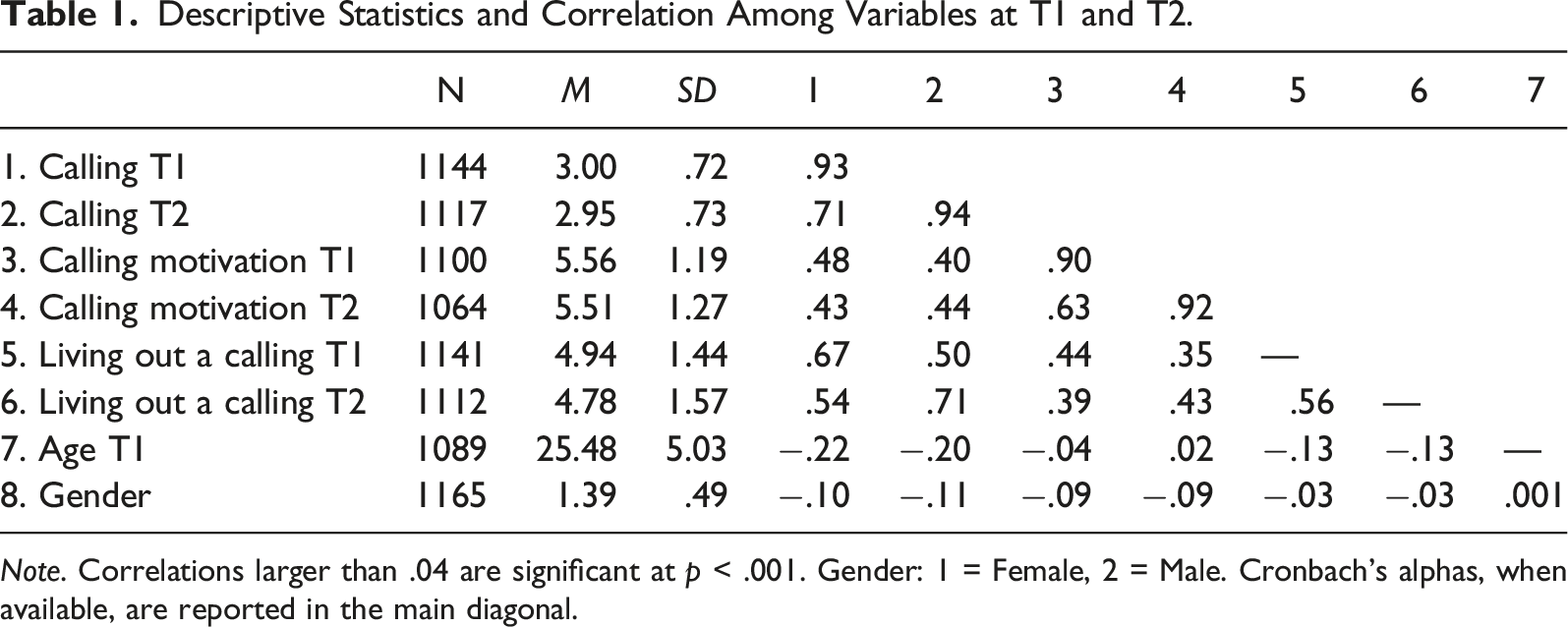
Note. Correlations larger than .04 are significant at p < .001. Gender: 1 = Female, 2 = Male. Cronbach’s alphas, when available, are reported in the main diagonal.
Preliminary Analysis
The result of Fisher’s exact test suggests that there was no statistically significant association between gender and status (Fisher’s F = 1.32, p = .52). The three groups differed for age at T1 (F = 124.47, p < .001). Stable workers were older than stable students (ΔW-S = 5.35, 95% CI [4.54, 6.16], p < .001) and transitioners (ΔW-T = 3.77, 95% CI [2.60, 4.95], p < .001). Given that groups differed in age and that gender correlated with having a calling and calling motivation (Table 1), we partialled out the effects of gender and age in the analysis.
Attrition Analysis
Before proceeding with hypothesis testing, we analysed the presence of non-random sampling and the effect of attrition on both means and variances of variables collected at T1 (Goodman & Blum, 1996). As a first step, we assessed whether attrition affected the probability of being included in the final sample based on measures of having a calling, calling motivation, living out a calling, age, and gender at T1. The logistic regression model suggests that these variables did not influence the probability of dropping out of the study. To assess the effect of non-random sampling on means, t-tests for independent samples were performed in which stayers and leavers were compared on measures of having a calling, calling motivation, living out a calling, and age at T1. A small and trivial difference between stayers (M = 4.91, SD = 1.45) and leavers (M = 4.80, SD = 1.50) was found on living out a calling (t = −2.12, p = .03, Cohen’s d = .08). Finally, we analysed whether reducing the sample to only those who participated in the two data collections reduced or enhanced the variance of variables assessed at T1. The only significant difference emerged for age (z = −3.10). Reducing the sample to those who participated in both data collections significantly decreased the variance of age. Non-random sampling did not have a significant influence on our dependent variables, with only null or tiny differences between stayers and leavers on both means and variances.
Calling
Hypothesis 1 stated that the perception of a calling will be stable for students and workers and decreasing for transitioners. The results of the GLM for repeated measures partially support this hypothesis. Specifically, we found a significant interaction between status and time (F = 124.79, p < .001, η2 = .20), meaning that changes in perceiving a calling over time differ according to individuals’ status. Figure 1 displays the change in individuals’ calling over time for the three groups. Perceiving a calling is stable over time for students (ΔT2-T1 = −.02, 95% CI [–.06, .02], p = .38; d = .03), supporting HP1, and changes significantly only for transitioners and workers. Transitioners’ perception of a calling largely decreases (ΔT2-T1 = −.72, 95% CI [–.80, −.63], p < .001; d = −1.12), and workers’ calling slightly increases (ΔT2-T1 = .10, 95% CI [.02, .17], p = .013; d = .14). Means of career calling over time for students, workers, and transitioners. Note. Bars represent 95% confidence intervals.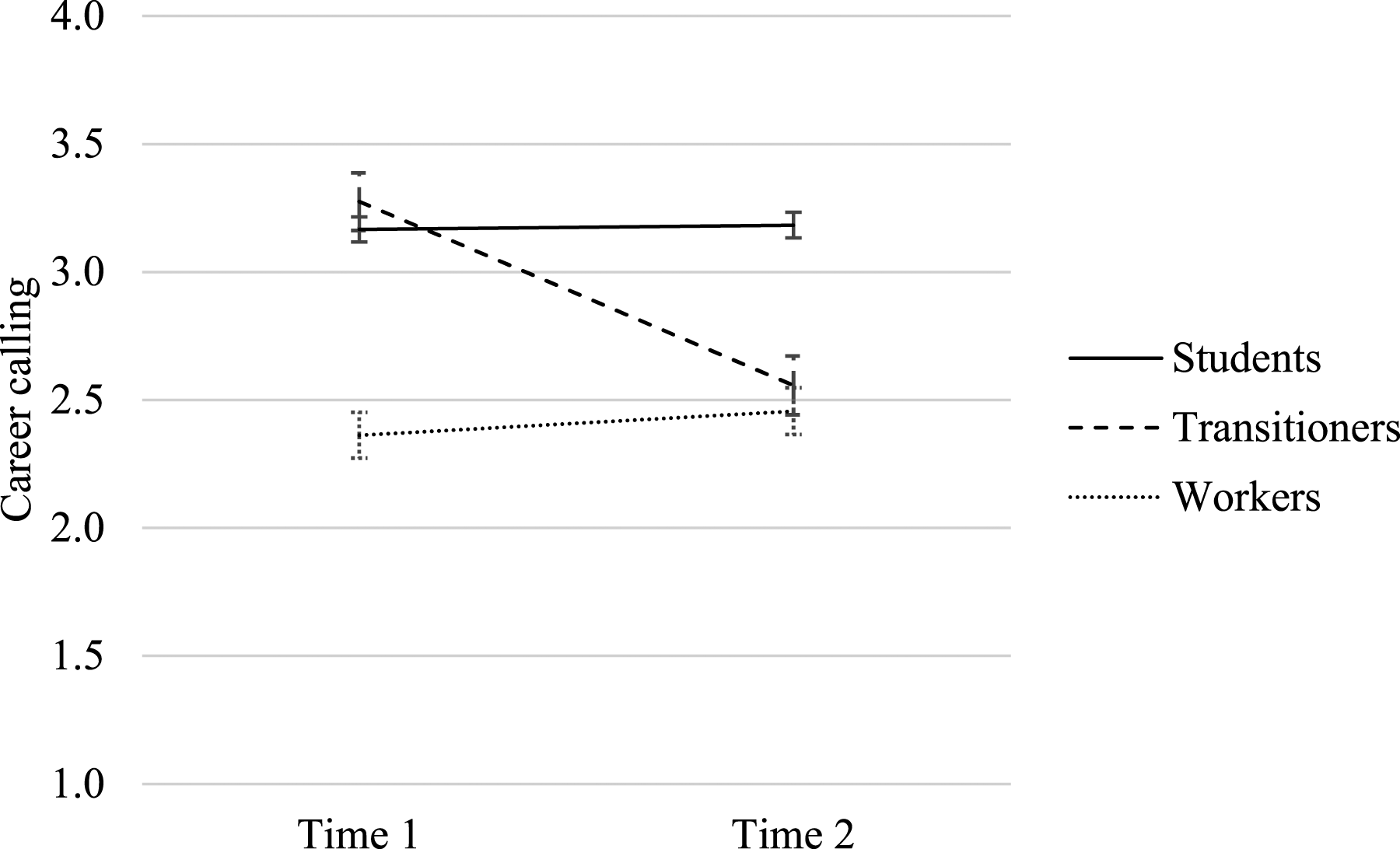
The within-subject effect of time on calling was non-significant (F = 3.04, p = .08, η2 = .003), but there was a significant and large between-subject effect of status on calling (F = 116.49, p < .001, η2 = .19). Pairwise comparisons (Bonferroni) showed that students have higher levels of a calling than workers both at T1 (ΔS-W = .80, 95% CI [.697, .923], p < .001) and T2 (ΔS-W = .73, 95% CI [.6591, .86], p < .001). At T1, transitioners presented the same level of calling as students (ΔT-S = .10, 95% CI [–.058, .258], p = .30) and a higher calling than workers (ΔT-W = .91, 95% CI [−1.079, −.743], p < .001). At T2, the opposite pattern was observed, that is, transitioners had a lower level of calling than students (ΔT-S = −.634, 95% CI [-.789, −.487], p < .001) and the same level of calling as workers (ΔT-W = .10, 95% CI [−.26, .048], p = .55).
Living out a Calling
Hypothesis 2 stated that living out a calling will be stable for students and workers and decrease for transitioners. The results partially support this hypothesis. The interaction between status and time was significant (F = 25.29, p < .001, η2 = .05) suggesting that living out a calling changes over time depending on status. Figure 2 shows the change in living out a calling over time for the three groups. Supporting hypothesis 2, living out a calling is stable for students (ΔT2-T1 = 0.008, 95% CI [–.10, .12], p = .89; d = .01) and decreases over time for transitioners (ΔT2-T1 = −.95, 95% CI [–1.20, −.71], p < .001; d = −.65). Contrary to hypothesis 2, living out a calling also decreases over time in workers (ΔT2-T1 = −.35, 95% CI [-.54, −.15], p = .001; d = −.22). Means of living out a calling over time for students, workers, and transitioners. Note. Bars represent 95% confidence intervals.
Furthermore, we found a small within-subject effect of time on living out a calling (F = 5.93, p = .02, η2 = .006) and a significant between-subject effect of status on calling (F = 27.95, p < .001, η2 = .05). Pairwise comparisons based on Bonferroni correction showed that workers have lower levels of living out a calling than students at both T1 (ΔS-W = .64, 95% CI [.35, .93], p < .001) and T2 (ΔS-W = .99, 95% CI [.68, 1.30], p < .001). At T1, workers have lower levels of living out a calling than transitioners (ΔT-W = 1.03, 95% CI [.64, 1.42], p < .001). This difference decreases at T2, when workers and transitioners present a similar level of living out a calling (ΔT-W = .42, 95% CI [.005, .84], p = .05).
Calling Motivation
Hypothesis 3, according to which calling motivation is stable regardless of individuals’ status, was supported. The results of the GLM for repeated measures showed that time (F = 5.25, p = .02, η2 = .005) and the interaction between status and time have no significant effects on calling motivation (F = .74, p = .48, η2 = .002). Figure 3 shows the level of calling motivation over time for the three groups. Calling motivation was stable and did not change significantly for students (ΔT2-T1 = −.05, 95% CI [-.14, .03], p = .21; d = −.04), workers (ΔT2-T1 = −.14, 95% CI [-.29, .02], p = .08; d = −.10), and transitioners (ΔT2-T1 = .01, 95% CI [-.18, .21], p = .90; d = .01). Means of calling motivation over time for students, workers, and transitioners. Note. Bars represent 95% confidence intervals.
We observed a small significant between-subject effect of status on calling (F = 7.80, p < .001, η2 = .02). Transitioners presented a higher level of calling motivation than students and workers at both T1 (ΔT-S = .39, 95% CI [.09, .68], p = .005; ΔT-W = .41, 95% CI [.07, .75], p = .01) and T2 (ΔT-S = .45, 95% CI [.14, .76], p = .002; ΔT-W = .56, 95% CI [.19, .92], p = .001).
Discussion
This study aimed to explore the development of a calling during the transition from university to work. Using a two-wave design, we investigated changes in perceiving a calling, living out a calling, and calling motivation across three groups composed of college students, students experiencing the transition from university to work, and workers. The results add insight to the debate on the development of a calling by focusing on a major transition in individuals’ lives.
The results showed that the perception of having and living out a calling decreases over time for students transitioning from college to work and remains stable for students. The decrease in calling we observed for transitioners might suggest that entering the world of work generates, on average, a large decrease in the experience of being called towards a career. This result is in line with Zhang et al. (2021), who observed a decreasing trajectory for 74% of their sample of transitioners. Most of the literature on callings focuses on individuals’ characteristics as predictors of calling development over time. The results of the present study highlight the need to take context into account. It might be that perceiving and living out a calling are more stable when individuals play the same role in a stable context and that perceiving and living out a calling decrease when individuals have to face a change in the context or need to move from performing a role in one context to another role and context.
The specific reasons behind the decrease in perceiving and living out a calling might be different. For transitioners, the decrease in perceiving a calling might be due to a shift from an idealistic to a more realistic view of a job. Erikson (1968) declared that late adolescence is the most idealistic time in life. The college years are the time to dream about a future that is still open; a time when everything is still possible. The perception of being called to engage in a work domain might clash with the reality of a world that unfulfills expectations. The adaptation to a new reality requires a change in self-concept and perspectives regarding the meaning of the calling itself (Hall & Chandler, 2005; Ng & Feldman, 2007; Wendlandt & Rochlen, 2008). Indeed, our results might be interpreted as a sign that workers hold a more realistic view of their job (they present a lower perception of having a calling than students). In their meta-analysis, Jin and Rounds (2012) observed a switch in the importance of work values during and after college. They found that students attach more importance to intrinsic or self-actualisation values (e.g., ability utilisation, independence, creativity, and learning), whereas after college they attribute more importance to extrinsic or security/material values (e.g., financial success, work environment, and security). To cope with the new reality, newcomers might need to focus on extrinsic rewards, neglecting or underestimating intrinsic values. In line with this dynamic in the development of work values, we might expect an increase in individuals’ calling over time as a consequence of a successful adaptation to the new context and an increase in the importance of intrinsic values. Partially in line with this expectation, the workers in our samples showed a slight increase in calling over time.
If a calling is to be lived out, changes in context require newcomers to figure out new strategies to realise their calling in performing new tasks and activities in the work environment. The loss of familiarity and the general lack of mastering, which is likely to occur during transitions, reduce the amount of meaningful activity in the work domain that were previously informative about one’s calling. Hence, the characteristics and context of the job are more likely to influence living out a calling than perceiving a calling. Indeed, living out a calling was found to be negatively influenced by performing unnecessary tasks (Mauno et al., 2022) and promoted by job satisfaction, career commitment, and work meaning (Duffy et al., 2014).
These reflections need to be considered in the light of another result: in our study, workers experience having and living out a calling to a lower degree than students. Hence, the decrease we observed might not be due to the transition from college to work but could be interpreted as the adjustment of having and living out a calling to a level that is common for workers. A calling for a study domain (e.g., psychology) might be higher than a calling measured for one’s specific job (e.g., working with patients as a clinical psychologist, managing recruitment and personnel selection processes, etc.), as people might feel a strong calling for some activities but not for others that are included in their job position. For instance, a professor might feel a strong calling to conduct research in vocational psychology but might not feel called to teach psychology even if it is part of the job’s task and duties. A student might have had a high calling for psychology and enjoyed talking and learning about psychology, but the strong sense of having a calling for psychology decreased once they entered the job market because of specific job activities that reside outside of the discipline for which they felt a calling.
Over time, people’s values and priorities can evolve. What may have felt like a strong calling during college years may no longer hold the same level of importance or significance as individuals mature and their perspectives shift. Personal circumstances, such as starting a family or pursuing other personal goals, can also influence one’s sense of calling and lead to a decreased emphasis on career-related aspects. For instance, there is evidence that work–family imbalance is negatively related to career calling (Shin et al., 2022) and that changes in calling are related to changes in work–nonwork conflict through workaholism (Hirschi et al., 2019). A high calling might be hard to sustain for workers as it might be related to higher conflict and imbalance between work and non-work life domains.
Furthermore, the organisational culture and dynamics within the workplace can impact an individual’s perception of having and living out a calling. If the work environment is unsupportive, lacks opportunities for personal growth and development, or is driven primarily by financial incentives rather than a sense of purpose, employees may experience a decline in their sense of calling. Future research should investigate other possible explanations for the decrease in calling and the lower level of calling among workers that were observed in this study and previous investigations (Duffy et al., 2022; Vianello et al., 2020; Zhang et al., 2021).
Regarding workers, we observed that, within the same 6-month time frame, having a calling slightly increased, while living out a calling slightly decreased. The development of having and living out a calling is likely to be promoted by different characteristics of individuals and the environment. For instance, the perception of having a calling might be promoted by positive feelings and energy at work, opportunities for meaning and self-actualisation, and identification with the work domain, whereas living out a calling might be promoted by higher autonomy and more opportunities for job crafting. Different predictors might explain why having a calling increases and living it out decreases simultaneously. This pattern might also be explained by the reciprocal developmental relation between having and living out a calling that has been observed in the past (Vianello et al., 2020). Exploring one’s calling at work might at the same time prevent a complete fulfilment of one’s calling, which can be reached in a longer time frame.
A second contribution of this study is about calling motivation. In this study, we observed that calling motivation does not change over time. Stability over time suggests that calling motivation is a ‘mindset’ or a stable disposition that is not influenced by changes in the environment, nor by the levels of perceiving and living out a calling, or by the experiences that cause a decrease in perceiving and living out a calling. Calling motivation refers to individuals’ beliefs about what they will do in the future versus what is currently occurring in the workplace. In addition, predictors of calling motivation are likely to be different from predictors of perceiving and living out a calling. For instance, calling motivation might be predicted by individuals’ stable characteristics, such as values, interests, and beliefs, rather than by the interaction between individuals and the context. Based on these results, calling motivation might even be a predictor of both perceiving and living out a calling. Specifically, individuals develop an early belief about the importance of pursuing a calling in life and career, which will motivate the search for a calling, its development, and fulfilment at work.
Furthermore, calling motivation might be important for the well-being of unemployed individuals and retirees. Calling motivation, being more stable than perceiving a calling during transitions, might be more effective in supporting job search activities over time (Dalla Rosa et al., 2020). In the same way, being motivated to pursue a calling might help retirees to transform the calling they experienced as workers and find other sources of life meaning. A deeper reflection is needed on the role of calling motivation in the process that leads from perceiving to living out a calling as this might be key to supporting a calling throughout the lifetime of individuals.
We also observed that students transitioning from college to work presented a higher calling motivation than students and workers. This result might be due to the anticipation of change; that is, the importance of finding a job that aligns with a calling or can be a source of calling that is higher in those who are preparing for a change in role and identity. Many students approaching the end of their college degree experience feelings of loss or intense stress and anxiety as they leave a familiar role to develop a new social identity (Perrone & Vickers, 2003; Wood, 2004). Being motivated to pursue a calling might represent a goal that supports students who are preparing to enter the job market. This result suggests that a major life transition reduces the presence and fulfilment of a calling but does not reduce the willingness to pursue a calling.
Identifying what happens to a calling during different career stages and life transitions would facilitate individuals in facing the challenges of pursuing and developing a calling and support career counsellors in helping their clients navigate career decisions and development. Students and counsellors should realise that entering the world of work could be challenging for the experience of having and living out a calling. Accurate information about the job and the differences between college and work environments might help students develop more realistic expectations of the job and their professional self-efficacy. Finally, training interventions should focus on how to develop and realise a calling rather than increasing the motivation to pursue a calling, which was found to be stable and higher among transitioners.
Limitations and Future Directions
The results of this study need to be considered in light of some limitations. First, we studied sample-level means across two time points in a relatively short period. This time lag was sufficient to capture large effects on individuals’ calling due to entering the labour market, but a longer time frame or more waves would have allowed us to detail the dynamics of calling changes. For instance, with two waves we cannot rule out the possibility that changes observed in workers are carry-over effects due to transitions. Furthermore, to understand what happens to one’s calling during other key life transitions and at different degrees of career maturity, more longitudinal research is needed on the development of calling throughout the professional life of individuals. For instance, an investigation of the development of calling during first work socialisation and after voluntary and involuntary career changes would be highly informative for both theory and practice.
Second, living out a calling was measured with a single item, which might represent an issue in terms of larger measurement error and validity. Even with relatively high reliability, validity might be weaker than with multiple-item scales as different items may capture different features of the construct, resulting in a more valid composite measure. Although living out a calling is a relatively narrow construct (and, thus, single-item measures may do well), it is recommended that future research replicates the results obtained in this study using a multiple-item measure of living out a calling.
Third, in this study, we did not analyse the role of contextual variables in influencing the change in calling. For instance, we did not control for social support, which has been proven to increase an individual’s career calling (Dalla Rosa et al., 2020; Dobrow, 2013) and support successful career transitions (Greer & Kirk, 2022). Neither did we analyse the role of job characteristics and person–job fit in the dynamics of calling development. Future research is needed to explore whether job characteristics and different levels of person–job fit might explain changes in calling among workers and transitioners.
Furthermore, it is crucial to acknowledge that this study was conducted before the global spread of the COVID-19 pandemic, which has had significant impacts on the lives of both students and workers. Remote learning and restricted social interactions may have limited students’ exposure to diverse experiences and networking opportunities. This lack of exploration of different career paths could hinder their ability to fully explore and live out their career callings. Indeed, engagement in learning and social support, which were found to increase calling among college students (Dalla Rosa et al., 2019), were reported as lower in the online learning environment than in the traditional environment (Salta et al., 2022). Regarding transitions, the pandemic is likely to have represented a career shock (Akkermans et al., 2020; Blustein et al., 2020). The economic downturn and job market uncertainties have created a more pragmatic and survival-oriented mindset among students entering the world of work. Focusing on immediate employment prospects and financial stability may have diverted their attention and reduced their emphasis on perceiving and living out a calling. It is plausible that the decrease in perceiving and living out a calling observed in this study may have been even more pronounced and that individuals’ resources, such as career competencies and employability, would have helped young adults navigate the transition more effectively (Akkermans et al., 2020).
Regarding workers, we believe that the changes brought about by the pandemic (e.g., remote work, safety protocols, higher job demands) might have affected the levels and changes in perceiving and living out a calling. These differences are likely to have been moderated by the type of job and individuals’ resources. Perceiving and living out a calling may have been higher during the COVID-19 pandemic due to a stronger sense of purpose and meaning being attributed to some jobs, as observed by Zhu et al. (2021) among nurses. On the other hand, the levels of perceiving and living out a calling may have been lower due to the strain associated with job dissatisfaction and reduced social support. In contrast, the pandemic might have increased individuals’ motivation to pursue a calling. The phenomena known as the ‘Great Resignation’ and ‘Great Re-Negotiations’ (Hatfield et al., 2022; Liu, 2023) reflect a shift in people’s attitudes towards work and the heightened importance they place on finding meaning and purpose in their jobs. Further research should explore the lasting impact of the COVID-19 pandemic and investigate individual and contextual resources that could drive an increase in career calling, even in extreme circumstances such as those caused by the COVID-19 pandemic.
Conclusions
Experiencing a calling in life is related to several positive outcomes for individuals and organisations. In the current study, we investigated changes in perceiving a calling, living out a calling, and calling motivation among students, college-to-work transitioners, and workers. The results highlight that calling motivation is the stable component of the experience of one’s calling, while perceiving and living out a calling decrease during the college-to-work transition. The study contributes to the discussion about changes in career calling by highlighting the need to analyse the role of context and develop an understanding of how calling motivation develops and is related to perceiving and living out a calling.
Supplemental Material
Supplemental Material - What Happened to Your Calling? The Development of Calling Across College-To-Work Transition
Supplemental Material for What Happened to Your Calling? The Development of Calling Across College-To-Work Transition by Anna Dalla Rosa, Sophie Gerdel, and Michelangelo Vianello in Journal of Career Assessment
Footnotes
Author Contributions
Designed the study: Anna Dalla Rosa, Michelangelo Vianello (These authors contributed equally to this activity).
Developed materials: Anna Dalla Rosa.
Performed and interpreted statistical analyses: Anna Dalla Rosa, Sophie Gerdel, Michelangelo Vianello.
Collected the data: Anna Dalla Rosa, Michelangelo Vianello (These authors contributed equally to this activity).
Wrote the report: Anna Dalla Rosa, Sophie Gerdel, Michelangelo Vianello.
Declaration of Conflicting Interests
The author(s) declared no potential conflicts of interest with respect to the research, authorship, and/or publication of this article.
Funding
The author(s) disclosed receipt of the following financial support for the research, authorship, and/or publication of this article: This work was supported by one departmental grants awarded to the first author (DALL_BIRD23_01) and a PhD fellowship awarded to the second author by the CARIPARO Foundation. The funding source was not involved in the study design; the collection, analysis and interpretation of the data; the writing of the report; or the decision to submit the article for publication.

Data Availability Statement
The datasets generated and analysed during the current study and the code are available in the OSF repository: https://osf.io/9be75/. Please contact the corresponding author (
References
Supplementary Material
Please find the following supplemental material available below.
For Open Access articles published under a Creative Commons License, all supplemental material carries the same license as the article it is associated with.
For non-Open Access articles published, all supplemental material carries a non-exclusive license, and permission requests for re-use of supplemental material or any part of supplemental material shall be sent directly to the copyright owner as specified in the copyright notice associated with the article.
