



Abstract
The present study examines whether vocational interests, measured by Holland’s RIASEC model, and objectively assessed cognitive abilities, were useful in discriminating among various major categories for a sample of 1990 German university students. Interests and specific abilities, in combination, significantly discriminated among major categories and furthermore, ability measures added incremental validity to prediction based on interest measures alone. Logistic regression analyses revealed significant differences in predictor importance between women and men. Furthermore, overall gender differences in interests and cognitive abilities were identifiable within major categories as well. Implications for career counseling are discussed.
Introduction
Career counseling research points to the importance of assessing an individual’s prerequisites and matching them to the requirements of educational choices and occupations. As Lubinski (2004) states, people do not select educational and occupational paths randomly, but base their decision decisively on stable features of their personality. Interests and interest-major congruence are identified as major determinants of educational choice, satisfaction, achievement, and degree attainment (Allen & Robbins, 2010; Holland, 1997; Rounds & Tracey, 1990). The most influential theory in vocational counseling is Holland’s (1997) RIASEC model. It suggests that six interest types (RIASEC; realistic, investigative, artistic, social, enterprising, and conventional) can be used to characterize individuals and environments. Furthermore, the level of congruence of individuals’ interests and their environment affects continuity in occupational decisions, as well as occupational success and satisfaction (Holland, 1997). Meta-analytic studies support the notion of interests as predictors of academic achievement (Schiefele, Krapp, & Winteler, 1992), as well as the relation between interest congruence and satisfaction (Tranberg, Slane, & Ekeberg, 1993; Tsabari, Tziner, & Meir, 2005) and well-being (Assouline & Meir, 1987).
Several studies investigated the relationship between interests and major choice. Lent, Brown, and Hackett (1994) conducted a meta-analysis of studies examining interest relation with career choice and found that interests correlated .60 with career choice. When questioned retrospectively about reasons for college major choice, individuals indicated the importance of interests as the primary factor determining their choices (Webb, Lubinski, & Benbow, 2002). Allen and Robbins (2010) found, using longitudinal data, that interest-major congruence had a direct effect on timely degree attainment. Tracey and Robbins (2006) examined interest-major congruence and college success relationship using longitudinal data from a large sample. They found that greater interest-major congruence was associated with higher rates of retention and was predictive of grade point average (GPA). Moreover, interest-major congruence predicted overall GPA after 5 years better than ability measures American College Testing (ACT) scores. Tracey and Robbins argue that individuals with interest congruent major choice find the content more interesting, therefore spend more time studying and earn better grades. Furthermore, Feldman, Smart, and Ethington (1999) used Holland’s framework to study the extent that college students gained in selected abilities as a function of congruence between their interests and major environment. Students, who entered a major congruent with their dominant interest type, gained on relevant abilities, whereas those, who did not enter a congruent major, either preserved their status quo or declined in these abilities.
Debate arises on the importance of cognitive ability assessment for career counseling purposes and the study of college major choice. Although Dawis (1992) points out that collectively ability and interest patterns are highly relevant for vocational counseling and, following Cronbach's (1949) distinction, denotes them as the “can do” and “will do” aspects of vocational counseling, several studies investigating the relative importance of both interests and abilities in educational and occupational choice reached inconsistent results. Allen and Robbins (2008, 2010) found that first-year GPA and a measure of interest-major congruence both had large effects on students’ major persistence. The authors argue that students with greater interest-major congruence are more satisfied with their educational program and are thus more likely to graduate in a timely fashion due to not changing their majors. When accounting for interests, Porter and Umbach (2006) found that ability measures (SAT scores) were no longer significantly related to students major choice. Similarly, Humphreys and Yao (2002) found that abilities were less useful than interests when predicting category of major degree. Tracey and Hopkins (2001) showed that although both interests and abilities accounted for occupational choice, interest had a higher unique relation to occupational choice than ability estimates. However, findings were based on self-estimates of abilities. When using interests and objectively assessed abilities as predictors of occupational groups, both Austin and Hanisch (1990) and Lunneborg and Lunneborg (1975) extracted ability measures as the most important discriminant function.
In line with Austin and Hanisch (1990), Gottfredson (2003) states that abilities are as important as interests in career choice and development, and argues for a revival of cognitive assessment in career counseling as general mental ability (GMA) is the best overall predictor of job performance and is further related to training success and learning. Matching a person’s abilities with the ability requirement of jobs increases the likelihood of future job success, sufficient for ability assessment to be considered as a critical aspect of career counseling. Especially, when working with a range restricted sample like college students, the assessment of specific abilities is advised for career counseling purposes (Gottfredson, 2003; Kline, 2000), and the importance of incorporating objective ability assessment is stressed (Lubinski, 2010). Thus, GMA is critical for predicting educational or occupational level or prestige, whereas specific abilities help precise predictions about content or the nature of activities, wherein cognitive abilities are expressed. Thus, in journalism and law, effortlessness in handling verbal material is much more important than facility with numbers or figures, whereas the opposite is true in architecture, engineering, or physical sciences. Several studies indicate that different ability profiles are indeed associated with differences in major choice (Porter & Umbach, 2006; Shea, Lubinski, & Benbow, 2001; Wai, Lubinski, & Benbow, 2009). In general, these studies suggest that higher verbal ability, relative to mathematical and spatial ability, is characteristic of group membership in the social sciences, arts, and humanities, whereas higher levels of math and spatial abilities, relative to verbal abilities, characterize group membership in engineering, physical science, math, and computer science.
Furthermore, gender is an important covariate in career choice and should be considered by vocational counselors. Meta-analyses reveal a persistent trend of significant mean differences in vocational interests between women and men (Su, Rounds, & Armstrong, 2009). Gender differences are strongest in the “people-versus-things” dimension, with women gravitating toward working with people and men toward working with things. Furthermore, gender differences in ability patterns (i.e. intraindividual ability differences) have been revealed in longitudinal studies (Benbow, Lubinski, Shea, & Eftekhari-Sanjani, 2000; Schmidt, Lubinski, & Benbow, 1998; Shea et al., 2001). Although, men and women are comparable in terms of overall GMA (Halpern, 2000), men excel in mathematical and spatial abilities, whereas women tend to excel in verbal abilities. In their study Webb et al. (2002) found that mathematically gifted women tend to be at the same time more verbally talented than mathematically gifted men and, thus, inclined to gravitate toward educational and vocational opportunities outside math and science. Men were observed to have more high math-tilted profiles and more frequently pursue educational and vocational opportunities in the math/science field. Therefore, Larson, Wu, Bailey, Borgen, and Gasser (2010) argued for researchers to carefully examine gender as an important variable in major choice and called for attention to gender differences within the career counseling process. Using the Strong Interest Inventory (SII; Harmon, Hansen, Borgen, & Hammer, 1994), the authors found that female engineering majors reported less interest (large effect size) in the mechanical domain than their male counterparts. Likewise, female computer science and accounting majors showed less interest in programming and information systems. Thus, women and men within the same field of study differed considerably in their interest profiles.
Aim of the Study
This study investigates the association between vocational interests, ability profile, and major choice with a special focus on group differences. We argue that both vocational interest and ability profile are valid predictors of career choice and that ability measures add incremental validity to the prediction of educational group membership.
Previous research has shown consistent gender differences in both vocational interests (Su et al., 2009) and ability profile (Benbow et al., 2000; Schmidt et al., 1998; Shea et al., 2001). Furthermore, Larson et al. (2010) showed that when predicting college major choice based on vocational interests and confidence separately for women and men results varied. We, therefore, investigate the relative importance of vocational interests and ability profile in predicting group membership separately for women and men.
Hypotheses
The first hypothesis concerns the importance of vocational interests as measured by Holland’s RIASEC model in educational choice. Vocational interests are important determinants of individuals’ college major choice (Humphreys & Yao, 2002). Holland (1997) argues that individuals will search for and enter environments, i.e. college majors that are congruent with their vocational interests. Furthermore, individuals retrospectively indicate the importance of interests as the primary factor determining their major choices (Webb et al., 2002). Therefore, it is proposed that Holland’s dimensions explain considerable amounts of variance in college major choice and are able to distinguish between various college major categories.
In the second hypothesis, we anticipate that like vocational interests cognitive ability measures help to explain college major choice (Hypothesis 2a), and furthermore, that they add incremental validity for the explanation of college major choice (Hypothesis 2b). Nevertheless, interests are considered to have a higher unique relation to college major choice than ability measures (Hypothesis 2c).
As the third hypothesis, we suppose that the relation between interests and ability profile to college major choice will vary by gender.
Method
Participants and Procedures
Participants were students and alumni from various German universities taking part in an evaluation study of a newly developed self-assessment tool (N = 9,169). Participants were recruited via faculty mailing lists or addressed directly by lecturers, and were in some cases compensated with credits. First, all participants completed a Holland-type interest inventory. Afterward, participants were requested to complete three ability tests (verbal, numerical, and spatial). However, only 2,984 participants completed all three ability test. Furthermore, only data of those individuals indicating serious completion of all three ability tests in addition to the interest inventory (N = 2,688) and recent or past field of study (N = 2,655) were included in the study. Furthermore, participants were only taken into account when they indicated satisfaction with their choice of major (N = 1,990), that is participants were included when they responded with “applies” or “applies perfectly” to the statement “Altogether, I am satisfied with my major”. As Humphreys, Lubinski, and Yao (1993) state, relating individuals’ test scores to the mean obtained by successful and satisfied members of an existing group is an alternative approach to demonstrate test validity. Approximately 59% of the participants included were females and the average age was 22.6 years.
Measures
Interest inventory
Vocational interests were measured according to Holland’s (1959, 1997) model. We used the inventory was-studiere-ich.de (what should I study) designed for career counseling purposes. It is a free online-based interest inventory with 64 items. Answers are provided on a 5-point Likert-type scale from not interested at all to very interested. Reliabilities (Cronbach’s
Ability tests
Additionally, three ability tests are part of was-studiere-ich.de. The verbal composite consists of six tests (e.g., word analogies, sentence completion, antonyms) assessing verbal reasoning. The numerical composite consists of five tests (e.g., number sequence, rule-of-three problems, arithmetic problems) measuring facility in dealing with numbers and solving arithmetic problems. Lastly, the spatial composite consists of five tests (e.g., mental rotation, matrices) and measures the ability to visualize two- and three-dimensional figures and understand relations in figural material (see in Supplementary Tables 1 and 2 for details. Supplementary Tables for this article is available on the Journal of Career Assessment website at http://jca.sagepub.com/supplemental). Reliabilities (Cronbach’s
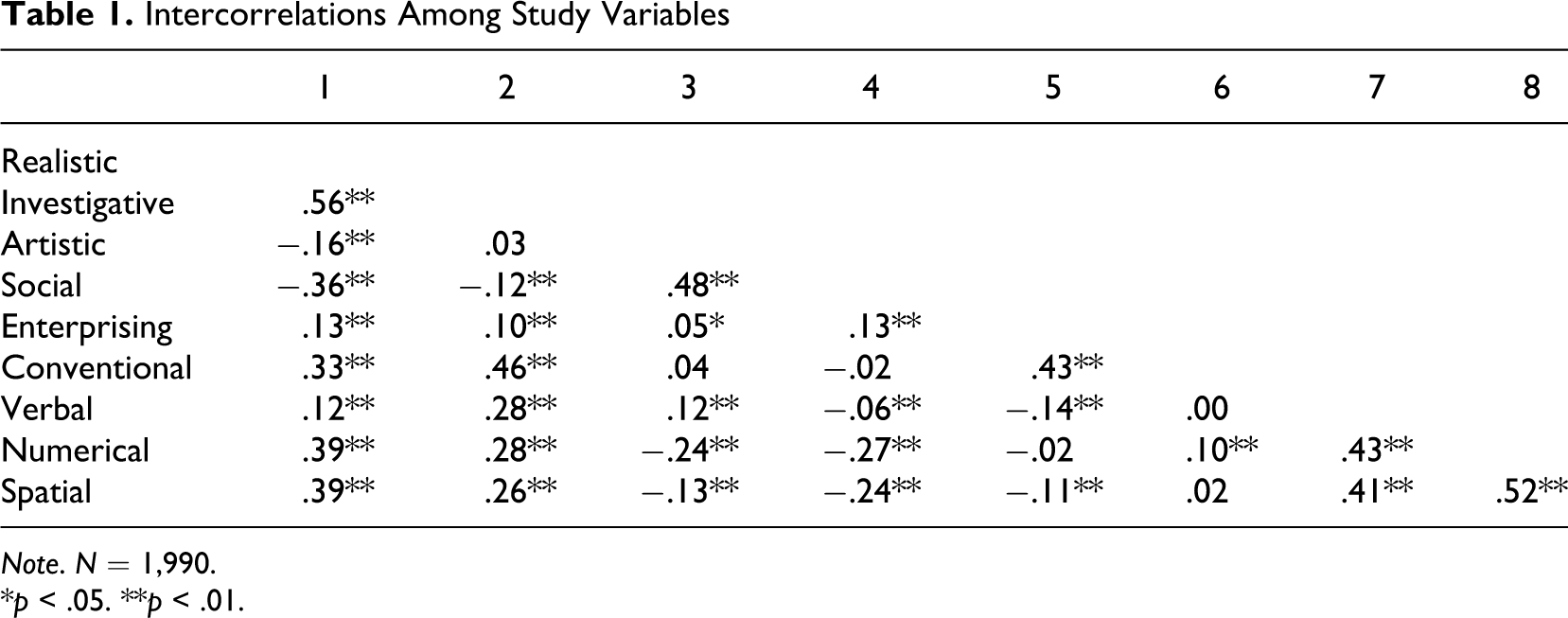
Intercorrelations Among Study Variables
Note. N = 1,990.
*p < .05. **p < .01.
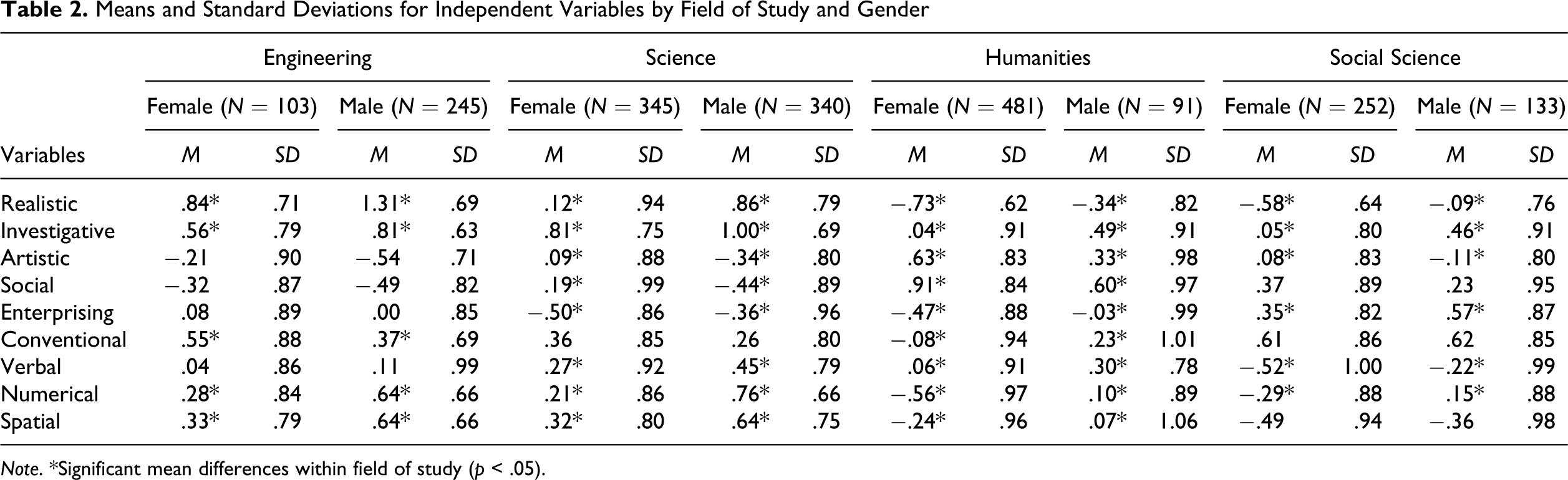
Means and Standard Deviations for Independent Variables by Field of Study and Gender
Note. *Significant mean differences within field of study (p < .05).
Satisfaction
Participants were asked to respond to the statement “Altogether, I am satisfied with my major” on a 5-point Likert-type scale (1 = doesn’t apply at all, 5 = applies perfectly).
Academic major
Participants indicated recent or past field of study. The classification of graduate majors was based on the classification scheme of Humphreys and Yao (2002). The authors discriminated eight major groups: physical science, biological science, social science, humanities, education, business, law, and engineering. After controlling for satisfaction with major choice the number of cases for law (N = 43) was rather small. As suggested by Humphreys and Yao (2002), this category was combined with social science. Furthermore, as we intended to conduct analyses separately for women and men, it was examined whether each category contained enough female and male participants. Analyses indicated that there were insufficient males in the field of biological science (N = 46), humanities (N = 49), social science (N = 71), education (N = 26), and business (N = 77). Thus, we considered how major categories could be meaningful combined to gain sufficient number of cases for gender specific analyses. Thus, physical science and biological science were combined to one science category. Engineering was chosen as a discrete category since most participants within this major category were students of universities of applied science, whereas participants within the science category were mostly students of universities. Preanalyses indicated significant differences in ability measures between those two types of universities. Therefore, engineering and science are treated as separate categories. Education and humanities were combined to one category labeled humanities, as were social science and business to one category labeled social science. Thus, all majors were classified into four categories: engineering, science (e.g., biological science, computer science, mathematics, physical science), humanities (e.g., art, education, literature, history, philosophy), and social science (e.g., social science, business).
Results
Preliminary Analysis
Intercorrelations among the study variables are shown in Table 1. Analyses indicate weak to moderate correlations between the predictor variables. In line with past studies (as summarized by Ackerman & Heggestad, 1997), realistic and investigative interests were moderately positively associated with numerical and spatial abilities, whereas verbal abilities were positively correlated with artistic interests. Furthermore, social interests were negatively associated with numerical and spatial abilities, and enterprising, as well as conventional interests showed rather weak associations with all ability measures.
Analyses of variance (ANOVAs) were used to check for possible differences related to gender for the study variables. The analyses indicated significant differences associated with gender (except for conventional interest). Means and standard deviations for the independent study variables are listed by field of study and gender in Table 2.
Prediction of Group Membership
Multinominal logistic regression was applied as statistical method since it allows prediction of group membership (academic discipline) based on the analysis of the independent variables. Multinominal logistic regression was chosen because, unlike discriminant analysis, it makes no assumptions about the distributions of the predictor variables. Furthermore, in logistic regression predictors do not have to be normally distributed or of equal variance within each group (Tabachnick & Fidell, 2007).
Multiple logistic regression analyses were performed through SPSS NOMREG to assess prediction of membership in academic discipline, on the basis of the predictor variables. Predictor variables included the six RIASEC dimensions, the scores on verbal, numerical, and spatial ability tests. Predictors were standardized prior analyses as suggested by Tabachnick and Fidell (2007) to get standardized regression coefficients. As science was the largest major category, and past research focused largely on the discrimination of math/science versus humanities, it was administered as the reference category in the multinominal logistic regression model.
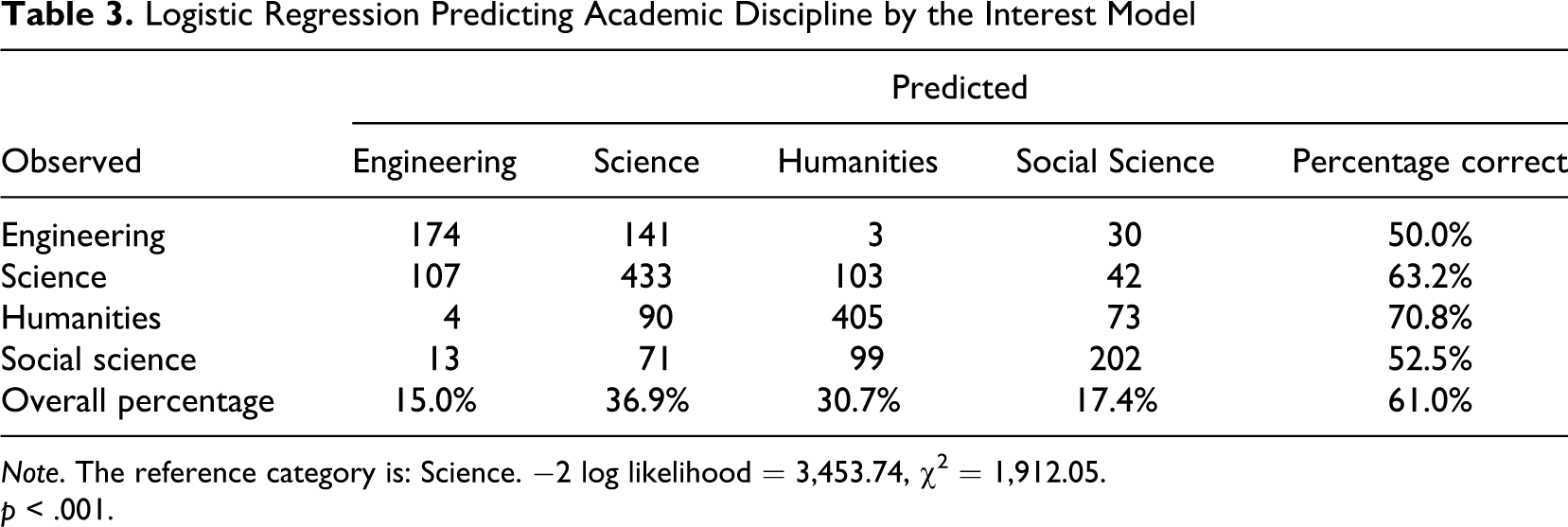
In Hypothesis 1, we argue that the six RIASEC dimensions are significant predictors of college major choice. A logistic regression analysis was performed on field of study as an outcome and the six RIASEC dimensions as predictor variables. The logistic regression indicated that the equation containing the RIASEC scores was significant (χ2 = 1,912.05, df = 18, p < .001). Thus, the predictors, as a set, reliably distinguished between the four college major categories. The χ2 statistic test is computed based on the −2 log likelihood figure for the model containing the independent versus the constant-only model. The smaller the likelihood value the better the model fit, that is the fit between the dependent and independent variables. According to Tabachnick and Fidell (2007), Nagelkerke’s R 2 is viewed as an analogous to R 2 in multiple regression, and thus provides an indicator for the percentage of variance explained. The variance in academic discipline accounted for is considerable, with Nagelkerke’s R 2 = .66, with a 95% confidence interval ranging from .64 to .68, calculated using Steiger and Fouladi’s (1992) R2 software. Correct classification on the basis of interest variables is 61.0% overall, with 70.8% for humanities, 63.2% for science, 52.5% for social science, and 50.0% for engineering (see Table 3). Overall correct classification of 61.0% shows an increase of 34% compared to hit rate attributable to chance alone. Thus, Hypothesis 1 is supported by the data. For testing Hypothesis 2b this is the baseline model used to evaluate improvement in the model when ability predictors are added. That is, we are interested in evaluating the predictive validity of ability variables after adjusting for interest differences.
Logistic Regression Predicting Academic Discipline by the Interest Model
Note. The reference category is: Science. −2 log likelihood = 3,453.74, χ2 = 1,912.05.
p < .001.
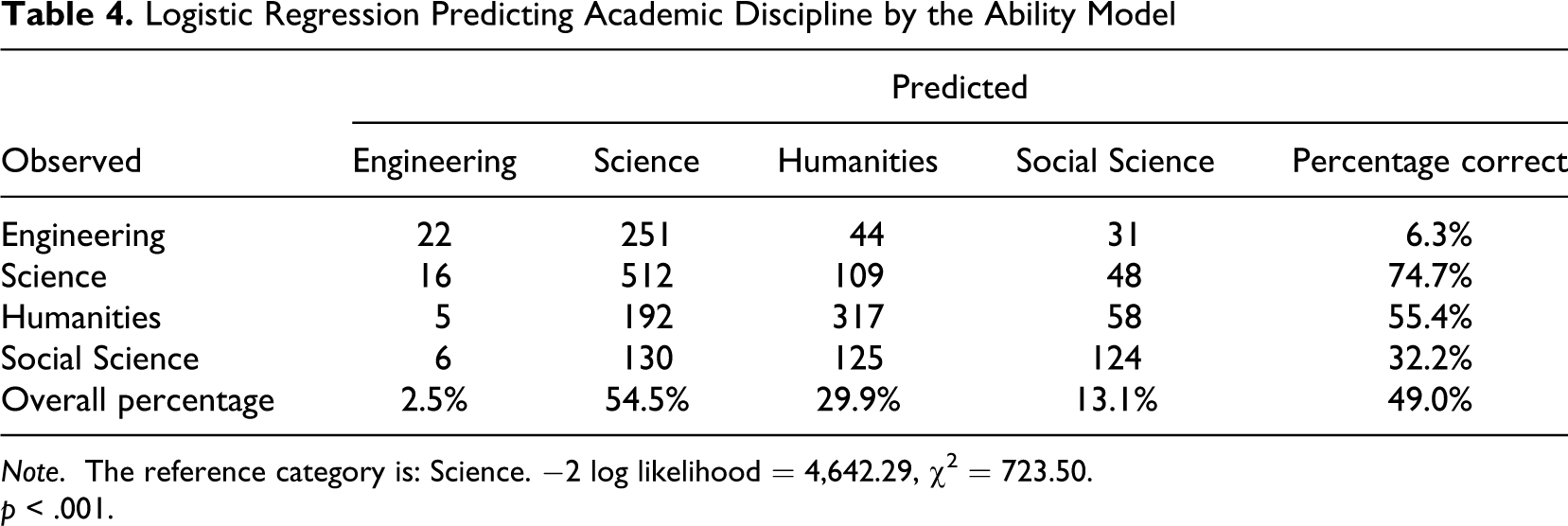
A second logistic regression analysis was performed on fields of study as an outcome and three predictors: verbal, numerical, and spatial ability. The logistic regression results indicated that the equation containing the ability scores was significant (χ2 = 723.50, df = 9, p < .001). Thus, the predictors, as a set, reliably distinguished between the four college major categories. The variance in field of study accounted for is .33 (Nagelkerke’s R 2), with a 95% confidence interval ranging from .29 to .36. The classification table shows that 49.0% of the cases now are correctly classified, ranging from 55.4% for humanities, 74.7% for science, 32.2% for social science, to 6.3% for engineering (see Table 4). Thus, the model resulted in a noticeable poor discrimination between engineering and science majors relying on ability profile alone. Nevertheless, Hypothesis 2a is supported.
Logistic Regression Predicting Academic Discipline by the Ability Model
Note. The reference category is: Science. −2 log likelihood = 4,642.29, χ2 = 723.50.
p < .001.
For testing Hypothesis 2b, regarding the incremental validity of ability profile, a third logistic regression analysis was performed on fields of study as an outcome and nine predictor variables: six RIASEC dimensions, verbal, numerical, and spatial ability measures. The logistic regression results indicated that the equation containing the RIASEC scores and ability scores was significant (χ2 = 2063.29, df = 27, p < .001). Thus, the predictors, as a set, reliably distinguished between the four college major categories. The variance in field of study accounted for is considerable with Nagelkerke’s R 2 = .69, with a 95% confidence interval ranging from .67 to .71. The classification table shows that 63.9% of the cases now are correctly classified, ranging from 73.4% for humanities, 65.8% for science, 57.4% for social science, to 51.4% for engineering (see Table 5). Overall correct classification of 63.9% shows an increase of 37% compared to hit rate attributable to chance alone. Model comparison by computing the difference between the log likelihoods and using χ2(151.24, df = 9, p < .05) indicates significant improvement in the model with the addition of the three ability scores as predictors. Thus, Hypothesis 2b, which supposes that ability measures add incremental validity to the prediction of interests can be supported, although the increase in R 2 and correct classification is relatively small in size. When comparing the relative importance of vocational interests (R 2 = .66) and ability profile (R 2 = .33) as independent predictors of group membership, results highlight the importance of vocational interests. Thus, Hypothesis 2c is supported by our data.
Logistic Regression Predicting Academic Discipline by the Interest + Ability Model
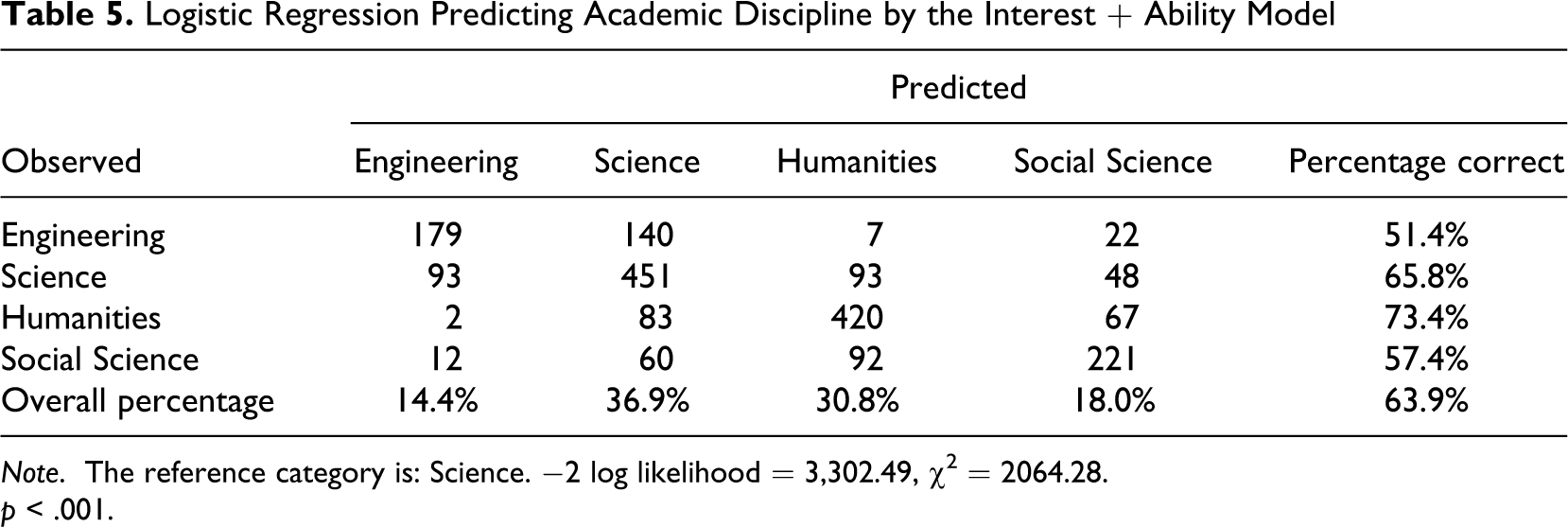
Note. The reference category is: Science. −2 log likelihood = 3,302.49, χ2 = 2064.28.
p < .001.
As stated above, mean differences in vocational interests and the abilities between women and men within the same field of study were identified (Table 2). For examining the third hypothesis, the above specified logistic regression analysis was split by gender. The logistic regression results indicate that the equation containing the variables RIASEC scores and ability scores was significant for both females and males (females: χ2 = 1,084.76, df = 27, p < .001; males: χ2 = 713.74, df = 27, p < .001). Thus, the predictors, as a set, reliably distinguished between the four college major categories. The variance in field of study accounted for is considerable for both women (Nagelkerke’s R 2 = .65 [.62, .68]) and men (Nagelkerke’s R 2 = .64 [.59, .67]). In addition, classification tables indicate (Table 6) small hit rate differences for females and males. However, the model seems less able to identify female engineering majors and male humanity majors correctly, and this effect might be attributed to the smaller sample size in those groups.
Logistic Regression Predicting Academic Discipline by an Interest + Ability Model by Gender
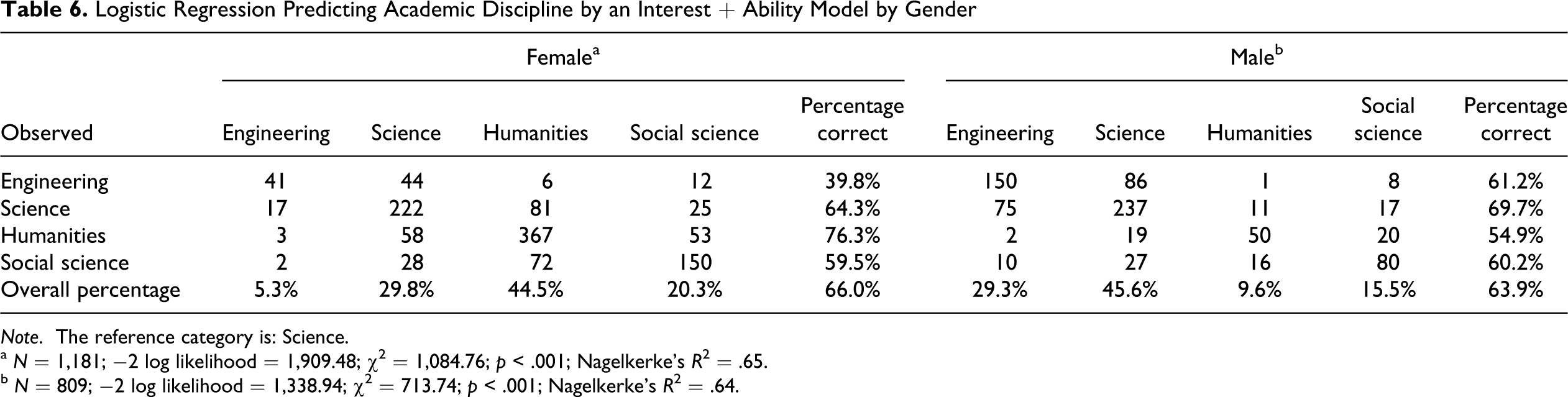
Note. The reference category is: Science.
a N = 1,181; −2 log likelihood = 1,909.48; χ2 = 1,084.76; p < .001; Nagelkerke’s R 2 = .65.
b N = 809; −2 log likelihood = 1,338.94; χ2 = 713.74; p < .001; Nagelkerke’s R 2 = .64.
Furthermore, regression coefficients, Wald statistic, and odds ratios indicate that when splitting analyses by sex, predictor relevance differs (see Table 7). Nevertheless, although sex differences in predictor importance were found, there seems to be consistence regarding the most important discriminators, namely interest dimensions. Thus, the most important discriminators between engineering and science students for both females and males were level of realistic and enterprising interest. Artistic and social interest levels seem to best distinguish between humanities and science, for both sexes. For discriminating social science and science, enterprising and conventional interest show the highest Exp(B), for both females and males.
Parameter Estimates: Interest + Abilities Model by Gender
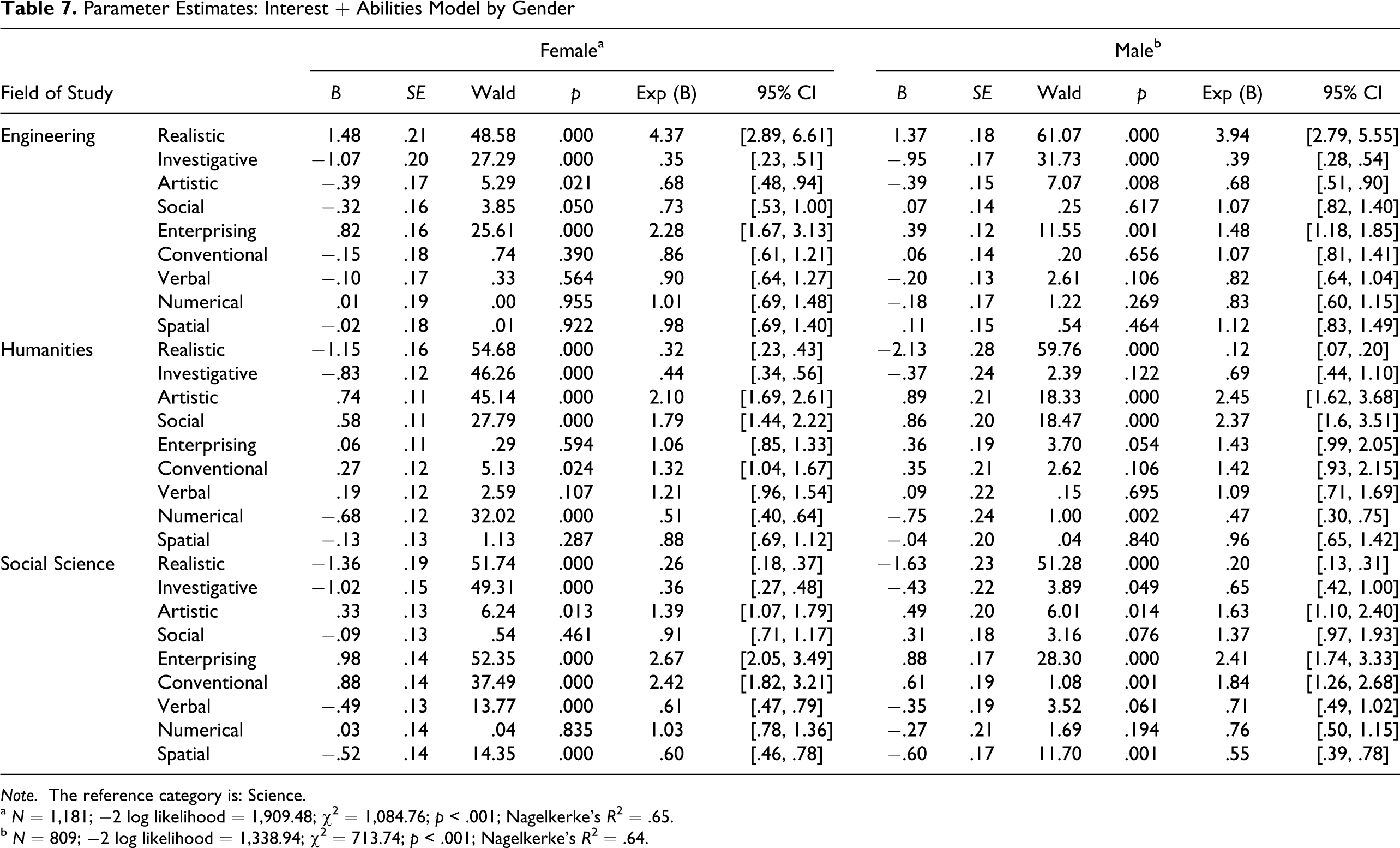
Note. The reference category is: Science.
a N = 1,181; −2 log likelihood = 1,909.48; χ2 = 1,084.76; p < .001; Nagelkerke’s R 2 = .65.
b N = 809; −2 log likelihood = 1,338.94; χ2 = 713.74; p < .001; Nagelkerke’s R 2 = .64.
Discussion
As hypothesized, both vocational interests and ability measures were identified as significant predictors of major choice. When examined together, ability profile adds incremental validity to the prediction of major choice. Nevertheless, vocational interests were identified as having a higher unique relation to college major choice than ability measures. Gender differences were found between females and males within the same major group. Furthermore, different interest dimensions and ability measures were identified as significant predictors when analyses were split by gender.
In line with past research (Austin & Hanisch, 1990; Lunneborg & Lunneborg, 1975), results indicated that vocational psychologists should combine relevant information on vocational interests and specific abilities for career counseling purposes. As interests can motivate vocational choices that do not draw on individual strengths, as well as that individuals can be competent in various areas but prefer not to engage in certain activities. In this study, vocational interests and specific abilities accounted for nearly 70% of variance in the career choice variable. Furthermore, a very high degree of accuracy in classifying members of the four major categories was achieved.
Ability measures alone accounted for 33% of variance. Results support the notion that individuals with strengths in verbal reasoning relative to quantitative or spatial reasoning tend to choose disciplines within the humanities, whereas engineering and science tend to attract individuals with strengths in numerical and spatial abilities versus verbal abilities (Achter, Lubinski, Benbow, & Eftekhari-Sanjani, 1999; Humphreys et al., 1993). Moreover, ability measures in this study added incremental validity (ΔR 2 = 3%) to the prediction based on interest profile alone and improved classification of academic discipline. The rather small increase in variance accounted for might be due to study characteristics. First, classification tables indicate that ability variables poorly discriminated between two disciplines, namely engineering and science. Engineering and science students display rather similar ability profiles, that is strengths in numerical and spatial abilities relative to verbal abilities. Past research, focusing on the importance of cognitive ability in vocational preference prediction, mostly combined these two major categories to one science, technology, engineering, and mathematics (STEM) or math/science category. Nevertheless, both groups differed in relevant interest dimensions, thus, indicating that analyzing them as distinct groups is meaningful when predicting group membership based on both ability and interest measures. Future studies might profit by applying a less broad categorization of majors.
Furthermore, ability and interest measures correlate at least moderately. Realistic and investigative interests were positively associated with numerical and spatial abilities, whereas verbal abilities were positively correlated with artistic interests. Social interests were negatively associated with numerical and spatial abilities and, lastly, enterprising, as well as conventional interests, showed weak associations with all ability measures. As Ackerman’s Process, Personality, Interests, and Knowledge (PPIK) theory (1996) suggests, interests and other personality variables guide the direction of developing knowledge structures. Ackerman identified four trait complexes (science/math, clerical/conventional, social, and intellectual/cultural) that combine certain interests and ability dimensions. According to Ackerman, individuals select environmental niches according to their individual characteristics and augment their knowledge within this area of choice. This theory further highlights the importance of combining personality and ability variables for research on both educational and occupational choice and practice.
Methodological, determining the relative importance of predictor variables based on regression coefficients or changes in R 2 has been criticized, especially in the presence of multicollinearity. Multiple regression, as well as logistic regression analysis, will overestimate the importance of the strongest predictor and underestimate the importance of the less important predictors. Budescu (1993) and Johnson (2000) suggested two alternative measures of relative importance of predictors in multiple regression: dominance analysis and relative weights. Future studies might profit by applying these alternative measures in determining the relative importance of vocational interests and ability measures.
Significance of Gender Differences
For all academic disciplines, female and male students within the same category differed significantly in their interest and ability profiles. In line with past research (Su et al., 2009), gender differences were most distinct on the “people-versus-things” dimension, with women gravitating toward working with people and men toward working with things. Furthermore, evidence is given that the results of the logistic regression analysis differ for women and men. Differences were found in variance accounted for, overall rate of correct classification, and number of significant predictor variables. Thus, when distinguishing between the academic disciplines, different interest and ability predictors differentiated between the groups, although those variables adding most to the prediction were the same for both women and men. Related studies also report gender differences in predictor relevance for major choice as criterion (Humphreys & Yao, 2002; Larson et al., 2010; Larson, Wei, Wu, Borgen, & Bailey, 2007). Humphreys and Yao (2002) accounted for these group differences by stating that they reflect differences in socialization. However, as their data were collected in 1960, it is questionable whether results are still transferable to recent samples. Larson et al. (2010) argue in their study that group differences might be partly due to the fact that across majors men compared to women were less differentiated in their interest and confidence pattern. As Su et al. (2009) point out, when individuals make vocational choices they not only compare their interest in a certain area with their interest in other areas but also compare their interest profile with relevant other people’s interests. Seymour and Hewitt (1997) consider that intraindividual comparisons may be one factor why women leave science. The authors found that, for women, the notion that educational options outside the STEM field better matched their interests was the most common reason reported for leaving STEM majors. Similar results were reported by Webb et al. (2002), where participants stated importance of interests as primary factor determining career choice and change of interest as primary factor for pursuing another major. These findings seem to support the claim of Armstrong, Fouad, Rounds, and Hubert (2010) that focusing research on Holland’s (1997) constructs of elevation and differentiation instead of merely on interest congruence might advance the understanding of group differences in educational and occupational choices, as well as career aspiration stability and long-term satisfaction. Furthermore, when assigning interest codes and identifying matching vocational and occupational choices, the concept of merely assigning a 3-letter code might be oversimplified. Our analyses showed that various interest dimensions significantly differentiated between the four academic disciplines and gender differences emerged regarding relative predictor importance.
Concerning differentiation of ability profiles, Webb et al. (2002) found among a sample of gifted students that mathematically gifted women tended to be at the same time more verbally talented than mathematically gifted men and, thus, inclined to gravitate toward educational and vocational opportunities outside math–science or within specific fields of science, for example, life or medical sciences. Men were observed to have more high math-tilted profiles and more frequently pursued educational and vocational opportunities in the math–science field. Thus, group differences in individual preferences might be amplified by differences in ability profile differentiation. Further research needs to establish whether these findings can be validated with more heterogeneous samples.
Thus, differences between women and men seem to influence major choice in addition to individual differences present in individuals’ interest and ability profiles. Nevertheless, although sex differences in educational and occupational choice are well established, it remains a question for future research to identify underlying mechanism and infer counseling guidelines (e.g., Cohen-Bendahan, van de Beek, & Berenbaum, 2005; Hell & Päßler, 2011). All the same, counselors should be aware of sex differences in interests and specific abilities, as well as stereotypes and gender differences in socialization when supporting students to select future educational and vocational paths.
Limitations
There are a number of limitations to the present research that should be considered when evaluating the presented findings. First, though participants were pre-selected on basis of indicated satisfaction with their academic major, no preselection based on performance variables was administered. Nevertheless, correctness of group membership prediction would benefit if only satisfied and successful group members were included in the analysis. Furthermore, the question of relative importance of vocational interests and specific abilities for prediction of career choice should be addressed in a longitudinal design including variables such as retention, satisfaction, and performance. This would, additionally, enable investigations to determine whether observed group differences between females and males within the same major category indeed influence retention rates and performance. Further, a larger sample size analyses would profit from less broad categorizations of majors.
Implications for Future Research
According to social cognitive theory (SCCT; Lent et al., 1994), individuals’ self-efficacy is enhanced through successful performance that, in turn, influences vocational choice. Armstrong and Vogel's (2009) article on the interaction of interest constructs and competence has recently been the subject of much debate, leading Lubinski (2010) to call for research combing all three aspects of individual differences: interests, self-efficacy, and ability assessments, and emphasize the importance of objective ability measures. It would be interesting to determine whether self-efficacy measures or self-estimates of abilities add incremental validity to objectively assessed ability measures and interests in the prediction of vocational and occupational choices. Moreover, this combined approach might further illuminate the influence of group differences and lead to a more comprehensive understanding of the career choice process. Patrick, Care, and Ainley (2011) analyzed the combined influence of vocational interests, self-efficacy, and academic achievement on educational choices and reached inconsistent conclusions. Thus, leaving the question—whether self-efficacy measures add incremental validity to interest and ability assessment when predicting vocational choices—open.
According to Holland (1997), profile differentiation refers to the degree of distinctiveness of an individual’s interest. Studies investigating group differences in interest differentiation found that men generally have less differentiated interests than women (Fouad & Mohler, 2004; Hirschi, 2009; Miner, Osborne, & Jaeger, 1997). For counselors, undifferentiated profiles are problematic because they could imply both insecurity and lacking stability in career aspirations, as well as multiple potentials, that is actual interest in various domains. Hirschi and Läge (2007) found that individuals with undifferentiated and high evaluated interest profiles showed higher career choice readiness than individuals with low differentiated and low evaluated profile. Further research should focus on the question whether gender differences in profile differentiation deliver further insight into gender differences in educational and occupational choice.
Counseling Implications
Results have strong implications for career counseling. First, they indicate that vocational interests and ability profile play an important role in predicting students’ choice of major. Thus, counselors should encourage students to explore both their individual interests and their abilities. Moreover, counselors should be aware that although there are often overlaps between profiles of interests and abilities, mismatches can emerge between interests in one domain and individual abilities in this domain, and vice versa. Thus, as Lubinski (2010) points out, individuals may have the ability to perform certain activities they may not altogether be interested in, and vice versa. Especially, regarding the area of abilities students should learn about what tasks or activities will come easy to them, as well as which might require more effort, motivation, or even compensation strategies. Furthermore, as Gottfredson (2003) highlights, interests can override ability profiles, that is individuals might choose not to consider academic disciplines or occupational choices their abilities would match as their interests are concentrated on other areas. As, Tracey and Rounds (1999) indicate, both counselors and clients poorly use redundant information. Thus, when giving feedback on interest and ability profile, care should be taken that both congruencies and deviations are discussed and that clients receive a realistic appraisal of their potential. This could either be achieved by presenting interest profile first and then integrating ability information, or vice versa. When assessing individual abilities, counselors should not merely rely on self-estimates of relevant abilities as depending on their group of comparison (big-fish-in-small-pond effect) students might underestimate or overestimate their abilities but apply objective ability measures. Furthermore, research indicates that especially women tend to underestimate their abilities (e.g., Furnham, 2001).
When administering interest inventories for career counseling purposes, individuals are often classified based on a 3-letter code. This procedure might lead to an oversimplification and considerably reduce information about an individual’s interest profile. As discussed above, counselors should be aware that clients with less differentiated profiles might not simply be referred to as insecure or indecisive but also as essentially possessing multiple potentials in terms of interests. Especially, for those clients with broad interest profiles, reaching a decision about which interest dimensions are occupationally relevant and which interests, though relevant, can be realized within leisure activities or volunteer work, is important.
Footnotes
Declaration of Conflicting Interests
The authors declared no potential conflicts of interest with respect to the research, authorship, and/or publication of this article.
Funding
The authors received no financial support for the research, authorship, and/or publication of this article.
References
Supplementary Material
Please find the following supplemental material available below.
For Open Access articles published under a Creative Commons License, all supplemental material carries the same license as the article it is associated with.
For non-Open Access articles published, all supplemental material carries a non-exclusive license, and permission requests for re-use of supplemental material or any part of supplemental material shall be sent directly to the copyright owner as specified in the copyright notice associated with the article.
