



Abstract
Educational success among Asian American students has often been misunderstood as an occupational development separate from any experience of racism. However, several theorists have suggested that racial barriers in occupational mobility correlate with educational pursuits. Therefore, this research aims to examine the direct effect of perceived occupational racial barriers on educational pursuits and cultural factors as potential coping resources to moderate this effect. Research was conducted on 205 participants with East Asian backgrounds through hierarchical multiple regressions. Although cultural factors did not serve as moderators between a racial barrier and educational pursuits, the results suggested a racial barrier in less-educationally relevant occupations, such as politics, and a culture-specific variable, honoring parents, predicted effort-related activities. Further, enculturation and honoring parents accounted for significant variances in utility of education and educational intentions.
Keywords
Asian Americans have been frequently described as a successful minority because significant attention has been paid to their high educational pursuits (Leong & Okazaki, 2009). They were first projected with the image of high achievers in the media during the 1960s, including in The New York Time Magazine (Peterson, 1966) and U.S. News and World Report (1966). Although the current media may be less inclined to promote this image, it is still experienced by Asian Americans from society in general (Thompson & Kiang, 2010). There is some evidence that Asian Americans are indeed performing well academically, including the relatively high proportion of this group receiving bachelor and advanced degrees (U.S. Census Bureau, 2011). However, this model minority stereotype ignores a wide range of educational pursuits within Asian American groups (Leong & Okazaki, 2009), influenced by a number of factors associated with gender (Shea, Ma, & Yeh, 2007), social economics (Kao & Thompson, 2003), refugees (e.g., Tseng, Chao, & Padmawidjaja, 2007) and generation status (e.g., Tran & Birman, 2010). More importantly, one significant consequence of this stereotype is that Asian Americans are often perceived as examples of a racial minority with an equal opportunity to succeed (Tran & Birman, 2010; Zhou, 2004), potentially discrediting the demands for social justice of other minority groups (Suzuki, 2002). Conversely, many researchers have argued that Asian Americans continuously face racial barriers in occupational development, and this has become a salient factor driving them to educational pursuits (Sue & Okazaki, 1990).
Very little empirical study has been conducted to examine the relationship between Asian American educational goals and the racial barriers which are perceived to affect occupational mobility (Tran & Birman, 2010; Tseng et al., 2007). Therefore, the primary focus of this study is to investigate this particular association. Furthermore, Sue and Okazaki (1990) suggested that Asian Americans’ behavioral patterns, including their educational pursuits, are a product of cultural values and minority status, as is also true for other ethnic minority groups. Currently, there is a lack of a model integrating these two perspectives to provide a relatively deeper understanding of Asian Americans’ educational pursuits. Thus, we proposed an integrated model incorporating racial and Asian cultural variables to better explain their educational pursuits. In particular, Asian cultural variables were identified to test whether they serve as moderators facilitating Asian Americans to deal with racial barriers by pursuing the setting of higher educational goals and educational activities. The educational pursuits of Asian Americans may be identified through various aspects of their learning, including their educational attainment, performance, academic motivation, and adjustment. Therefore, to understand thoroughly their educational pursuits, the following review covers studies with these constructs, correlated with cultural factors and occupational mobility.
Racial Barriers in Occupational Mobility
Educational success among Asian American students has often been misunderstood as an occupational development separate from experiences of racism and discrimination (Tseng et al., 2007). However, using the notion of relative functionalism, Sue and Okazaki (1990) suggested how the decreased social mobility accompanying less-educationally relevant occupations, such as politics and entertainment, leads education to be perceived as a functional means for occupational mobility. Therefore, Asian Americans adopt education as a way to cope with racial barriers in less-educationally relevant occupations because education may provide an objective credential for employment.
Asian Americans may face racial barriers to occupational mobility in many ways, such as receiving relatively lower salaries, not being hired by employers in some fields, and being passed over for promotions (Leong & Chou, 1994). Convergent evidence shows how Asian Americans have experienced difficulties in obtaining supervisory positions—the so-called glass ceiling effect also experienced by women (Leong & Chou, 1994; Sakamot, Goyete, & Kim, 2009; Tang, 1993). Self-selection could be one of the reasons U.S.-born Asians may not be leaders; however, Zane and Song (2007) have argued that although Asian Americans as a group possess the traits and management decision-making skills necessary for leadership positions, they are very much underrepresented in corporate management, partly due to racial discrimination. Similarly, Asian Americans may experience occupational segregation, resulting in limited access to certain occupations, such as administrative work (Leong & Gupta, 2007; U.S. Department of Labor, 2010). They are underrepresented as schoolteachers, craftsmen, farmers, and protective service workers, and overrepresented in professional occupations including doctors, lawyers, and scientists (Xie & Goyette, 2003).
Hirschman and Wong (1986) argued, “Education was a channel for the social mobility of Asians, partly because they were frozen out of some sectors of the economy” (p. 23). In other words, they indicated Asian Americans used “overachievement in educational attainment” to attain overall parity with European Americans.
Acculturation, Enculturation, and Family Obligation
Developmental psychologists have been increasingly interested in applying cultural orientation explanations for Asian American and other racial/ethnic minorities’ educational motivation. As a racial and ethnic minority group, Asian Americans may have both retained an Asian lifestyle (enculturated) and learned to adapt to the norms of the dominant U.S. culture (acculturated). Acculturation was previously assessed with a unidimensional scale, from maintaining the cultural origins to assimilating to the host culture. However, it was found that changes in enculturation may not lead to the changes in acculturation simultaneously and vice versa (Schwartz, Unger, Zamboanga, & Szapocznik, 2010). Therefore, acculturation and enculturation are currently conceptualized as two separate constructs to understand Asian Americans’ bicultural experiences (Kim, 2007; Ryder, Alden, & Paulhus, 2000), and it is suggested that they are measured with psychological scales separately in multiple areas, including behavior and value, and so on (Miller, 2010).
Some research has indicated that modifying individuals’ cultural orientation to accommodate new cultural experiences does not directly enhance educational performance (e.g., Schwartz, Zamboanga, & Jarvis, 2007). However, Suinn (2010) found that emphasizing one’s own culture of origin (enculturation) plays an important role in facilitating educational development among Asian Americans. For example, based on a study of Chinese students, Benner and Kim (2009) found that adolescents who were low in Chinese orientation fared worse in school engagement than their more enculturated peers. Therefore, it is possible that by maintaining their Asian cultural orientation Asian Americans could increase their academic adjustment.
Asian cultural orientation may include the life domain areas such as language, social affiliation, cultural pride, foods, and so on (Ying, Lee, & Tsai, 2000). It is very important to further identify what specific Asian cultural factors could directly enhance educational pursuits in Asian Americans. The cultural construct—obligation to family—has been correlated with undergraduate students’ academic motivation (Tseng, 2004) and college entry (Phinney, Dennis, & Osorio, 2006) in both Asian and other ethnic groups. Asian American families in the United States have often been characterized as having a stronger emphasis on familial duty and obligation than European American families (Fuligni, Tseng, & Lam, 1999). Despite cultural differences across Asian societies, one important way to understand Asian family obligation is to consider the different roles within an overall family system of reciprocity and interdependence (Chao & Tseng, 2002).
The obligations of children from Asian American families extend into their lives as adults (Fuligni & Pedersen, 2002). Furthermore, the means to fulfill family obligation could vary across different life stages. Several studies have shown that during the adolescent stage, teenagers’ family obligation included assisting with household tasks, respecting and following the wishes of their parents, as well as supporting their families in the future (e.g., Fuligni et al., 1999; Telzer & Fuligni, 2009). However, entering the young adult stage, college students can become self-reliant and develop some specific family responsibilities, such as financial and instrumental obligations which cannot be fulfilled by adolescents (Fuligni & Pedersen, 2002). For example, Chen, Liu, Fouad, and Walker (2009) found that taking care of the family financially and honoring parents were two important work motivations during college for Asian American undergraduates. Because education is highly valued in most Asian families, to perform well academically could be a way for college students to bring honor to the family or to find a good job to help with fulfilling family obligations (Kim & Park, 2006).
In summary, Asian cultural orientation and family obligation could motivate Asian Americans to adopt educational pursuits to satisfy family needs. Students maintaining stronger Asian cultural orientation, particularly in terms of family obligation, may be more likely to believe in the utility of education and may be eager to spend extra time studying to cope with racial barriers than those maintaining a weaker Asian cultural orientation. Therefore, the prevalence of Asian cultural factors is likely to enhance the association between occupational racial barriers and education. Based on the above discussion, four hypotheses for predicting East Asian Americans’ educational pursuits are proposed in this study, as follows:
Hypothesis 1: When Asian American college students perceive more racial barriers in occupational mobility, they are more likely to engage in educational pursuits as a coping mechanism.
Hypothesis 2: When Asian American college students are more enculturated, they are more likely to engage in educational pursuits.
Hypothesis 3: When Asian American college students have stronger family obligations, they are more likely to engage in educational pursuits.
Hypothesis 4: With the increase in Asian cultural enculturation and family obligation, the relationship between racial barriers in occupational mobility and educational pursuits will be enhanced.
This study will focus on East Asian American students, because there has been a call for paying attention to the needs and distinctive features of a specific group within diverse Asian American groups. It should be noted that although the Vietnamese are thought to share similar cultural backgrounds with other East Asians (Columbia University, 2009), many Vietnamese American families still have refugee status (Tseng et al., 2007). Therefore, this research focuses on the educational pursuits of Chinese, Japanese, and Korean American college students.
Method
Procedures
In total, 215 students with East Asian American backgrounds were recruited online through 25 ethnically identified Asian American student organizations and three offices of Asian American student affairs at various campuses with a broad geographic representation. The majority of these campuses were from nationally renowned public and elite private universities in California, the Midwest, and the West coast. All potential participants were informed of the purpose, risks, and benefits of the study, and were required to confirm their agreement before starting to complete the survey. Nine participants with a Vietnamese American background were removed from the study. In addition, one female participant who did not provide her ethnic background was excluded from the analysis.
Participants
The present sample consisted of 205 participants who self-identified as Korean Americans (n = 25), Japanese Americans (n = 9), Chinese Americans (n = 114), Taiwanese Americans (n = 51), and East Asian from multiple ethnicities (n = 6). The participants’ average age was 20.34, and ranged between 16 and 30. Forty-five (22%) of the participants were male and 160 (78%) were female. Furthermore, 77(37.6%) self-identified as first generation (i.e., they were born in Asia or in a country other than the United States). Among these 77 participants, 59 (28.8%) who came to the United States before they were 13 years old could be categorized as 1.5 generation, since researchers have suggested their immigration status is different from those with first generation status (Boyd, 2009; Zhou, 1997). Furthermore, 116 (56.6%) self-identified as second generation (i.e., U.S.-born children of immigrants), 4 (1.9%) as third generation, 5 (2.4%) as fourth generation, and 3 (1.5%) as fifth generation. In addition, 17 (8.3%) self-identified as freshmen, 57 (27.8%) as sophomores, 51 (24.9%) as juniors, 65 (31.7%) as seniors (of whom 8 completed the survey shortly after they had graduated), and 15 (7.3%) as graduate students.
The participants in this study reported a higher annual family income than most Asian American families. Over 58.5% of participants indicated their annual family income was over $75,000; this compares to the median Asian American annual income of $68,780 (U.S. Census Bureau, 2011). Over 60% of participants indicated that their parents held at least a bachelor’s degree; 10.7% of their mothers and 23.9% of their fathers had a doctoral degree, or professional degree (i.e., medical degree, juris doctor degree, or doctor of dental surgery).
Instruments
Racial barriers in occupational mobility
Currently, there are no specific scales measuring racial barriers in occupational mobility for Asian Americans. Therefore, the development of the scale was based on a review of previous literature (e.g., Leong & Gupta, 2007; Sue & Okazaki, 1990), and some ideas adopted from Chung and Harmon’s (1999) Perceived Occupation Opportunity scale. Chung and Harmon asked African Americans to indicate how they encountered racial discrimination in their workplace. However, Asian Americans may have experienced some different forms of racial discrimination in their occupations than those experienced by African Americans (Bell, Harrison, & McLaughlin, 1997). Based on the literature review, the first author developed a composite of 17 items for two types of occupational barriers, including 9-item barriers to obtaining higher social status (difficulties in gaining a job with a higher income or with higher social prestige, such as becoming a CEO) and 8-item barriers to obtaining a job in some fields (difficulties in finding employment in some occupations rather than others, such as entertainment, politics, etc.) related to occupational segregation, as discussed previously. The second author served as an expert reviewer and provided feedback on these 17 items. In addition, an advanced doctoral student specializing in psychometrics evaluated the clarity and representation for each type, and the results were incorporated into the revision of these items.
Participants responded using a 6-point continuous scale (1 = strongly disagree, 6 = strongly agree). Based on the ViSta-PARAN program, a Parallel Analysis (PA) using Principal Axis Factoring (PAF) was conducted to identify the number of underlying factors with the multivariate permutation method for this 17-item scale. One factor was retained because only the first eigenvalue (eigenvalue 1 = 6.90) is greater than the first eigenvalue at the 95th percentile (eigenvalue 1 = 0.76) from a random permutation of observed data (Ledesma & Valero-Mora, 2007). With PAF, the total variance explained by this factor was 43.49% and factor loadings ranged from .42 to .82. For further validating the scale, a Confirmatory Factor Analysis (CFA) with the LISREL 8.8 program was conducted to test a one-factor model with the current sample. Robust maximum likelihood (ML) was adopted to examine the fitness of the model under the condition of identified violation of multivariate normality (Schmitt, 2011) since Satorra and Bentler rescaled statistics works well over a variety of distributions (Curran, West, & Finch, 1996; Hu, Bentler, & Kano, 1992; Jöreskog, 2004). The value of the Satorra-Bentler scaled chi-square statistics for the 17-item racial barriers, χ2(119, N = 205) = 227.56, p < .01, indicated a poor fit of the model.
After carefully examining the modification indices, 7 items were removed from the scale, since the measurement errors of these items were involved in the residuals of other items, weakening the unidimensional construct of racial barriers (Anderson & Gerbing, 1988). Using PA again, with the same procedure described above, it was suggested that one factor for the 10-item racial barriers should be retained. Under the condition of identified violation of multivariate normality, robust ML was conducted and the value of the Satorra-Bentler scaled chi-square statistics for racial barriers, χ2(35, N = 205) = 41.97, p = .19, indicated a statistical fit of the model. The results showed a good fit with Goodness-of-Fit Index (GFI), Adjusted Goodness-of-Fit Index (AGFI), Non-normed Fit Index (NNFI), and Comparative Fit Index (CFI) values higher than .92, and a Root Mean Square Error of Approximation (RMSEA) value as well as a Standardized Root Mean Square Residual (SRMR) value less than .04. Finally, a racial barrier with 10 items was kept with Cronbach’s α, .85. The range for participants’ overall responses was from 16 to 60, with a mean total score equal to 40.54.
The example of the finalized 10-item racial barriers scale included, “It’s difficult for an Asian American to be a CEO in a company,” “Asian Americans have more difficulties in attaining a successful career than European Americans,” “Asian Americans do not get promoted as easily as European Americans,” “In any field, the opportunities to find a job are as good for Asian Americans as European Americans (reverse item),” “It’s hard for an Asian American to be a politician in the U.S.,” and “It is almost impossible for an Asian American to be a professional athlete due to social barriers.”
Acculturation and enculturation
Enculturation and acculturation was measured using a 20-item Vancouver Index of Acculturation (VIA; Ryder et al., 2000). This measure consists of 20 items, 10 of which assess Asian orientation (e.g., “It is important for me to maintain or develop the practices of my heritage culture”) and 10 of which assess European orientation (e.g., “It is important for me to maintain or develop North American cultural practices”). Participants responded to each item using a 9-point scale ranging from 1 (strongly disagree) to 9 (strongly agree). In the initial validation, the scale was tested with Chinese, East Asian, and other Asian Canadian groups with good validity evidence. For example, VIA European orientation negatively correlated with interpersonal adjustment variables mildly to moderately, such as social anxiety; however, VIA Asian orientation did not correlate with them. The correlation between the heritage and mainstream subscale ranged from −.18 to −.01; furthermore, the Cronbach’s α coefficients for Asian orientation ranged from .91 to .92 and for European orientation ranged from .89 to .85. This scale has been adopted for Asian Americans in various studies (e.g., David & Okazaki, 2006).
In this study, the heritage subscale did not correlate with mainstream subscale (r = .04, ns). Cronbach’s α coefficient for enculturation and acculturation were .85 and .84, respectively. Although acculturation is not included in our hypothesis, this measure could be used for comparing the effects of acculturation and enculturation on the educational pursuits of East Asian American college students.
Family-based work motivation
This measure was based on a study of a work motivation scale developed by Chen et al. (2009). A mixed method with both qualitative and quantitative approaches was adopted to develop the scale. Based on the results of a pilot qualitative study through interviews with 14 Asian American college students with diverse backgrounds, including Chinese, Japanese, Vietnamese, Laotian, Hmong, and Indian American backgrounds, five themes of work motivation during the college years were identified. Secondly, participants responded using 6-point continuous scales (1 = strongly disagree to 6 = strongly agree). Two of these were family-based work motivation scales, including a 3-item Family Financial Obligation (FFO; e.g., “I work to help my family financially”) and a 7-item Honoring Parents (HP; e.g., “I want to get a good job so my parents are respected in the community”).
Based on the ViSta-PARAN program, PA using PAF was conducted to identify the number of underlying factors with the multivariate permutation method for a 10-item family-based work motivation scale. Two factors were retained because only the first two eigenvalues (eigenvalue 1 = 3.85 and eigenvalue 2 = 1.16) are greater than the first two eigenvalues at the 95th percentile (eigenvalue 1 = 0.54 and eigenvalue 2 = 0.38) from a random permutation of the observed data (Ledesma & Valero-Mora, 2007). With PAF, a two-factor solution was examined with oblique rotation (i.e., the promax method in SPSS) because of considering their mild association theoretically. The total variance explained by these two factors was 60.35%, while factor loadings for HP ranged from .53 to .80 and for FFO ranged from .59 to .86. For further validating the scale, CFA was conducted to test a two-factor model with the current sample. Under the condition of identified violation of multivariate normality, robust ML was conducted and the value of the Satorra-Bentler scaled chi-square statistics for the 10-item family obligation, χ2(34, N = 205) = 164.55, p < .01, indicated a poor fit of the model.
After carefully examining the modification indices, 3 items were removed from the Honoring Parents scale, since the measurement errors for these items were involved in the residuals of other items, weakening the unidimensional construct of honoring parents (Anderson & Gerbing, 1988). Using PA again, with the same procedure described above, it was suggested that two factors for the 7-item family-based work motivation should be retained. Under the condition of identified violation of multivariate normality, robust ML was conducted and the value of the Satorra-Bentler scaled chi-square statistics for family-based work motivation, χ2(13, N = 205) = 17.61, p = .17, indicated a statistically significant fit of the model. The results showed a good fit with GFI, AGFI, NNFI, and CFI values higher than .93, with both RMSEA and SRMR values less than .05. The Cronbach’s α for FFO and HP were .76 and .74, respectively, and these two factors were moderately correlated (r = .34, p < .001).
Utility of education
There are no specific validated scales measuring belief in the utility of education for college students. Tseng (2004) used 5 items to measure students’ perceptions of the utility of education for their future success. Students responded to items such as “doing well in school is the best way for me to succeed as an adult;” however, these items were designed specifically for adolescents. For the college students in our survey, many may have perceived themselves as adults, so the descriptions in Tseng’s scale were not appropriate for them and were modified for college populations. Belief in the utility of education was measured with a composite of 8 items. Examples of the items in this scale include “If I have a good GPA in college, it is more likely I will get a job I like” and “Employers are more likely to hire someone with good educational performance at school.”
Participants responded using a 6-point continuous scale (1 = strongly disagree to 6 = strongly agree). Based on the ViSta-PARAN program, PA using PAF was conducted for identifying the number of underlying factors with the multivariate permutation method for this 8-item scale. One factor was retained because only the first eigenvalue (eigenvalue 1 = 2.54) is greater than the first eigenvalue at the 95th percentile (eigenvalue 1 = 0.45) from a random permutation of the observed data (Ledesma & Valero-Mora, 2007). With PAF, the total variance explained by this factor was 39.93% and factor loadings ranged from .36 to .78. For further validating the scale, CFA was conducted to test a one-factor model with the current sample. Under the condition of identified violation of multivariate normality, robust ML was conducted and the value of the Satorra-Bentler scaled chi-square statistics for utility of education, χ2(20, N = 205) = 27.58, p = .12, indicated a statistically fair fit of the model. The results showed a good fit with GFI, AGFI, NNFI, and CFI values higher than .92, and both RMSEA and SRMR values equal .05. Finally, an 8-item utility of education was kept with Cronbach’s α, .77.
Effort-related activities
Rosenthal and Feldman (1991) developed a 5-item scale measuring adolescents’ efforts for learning in school, such as how hard they tried in class. Each question was asked of four subject areas (mathematics, science, English, and social studies). Since the scale was specifically designed for high school students, their original scale was modified for the college population. Examples of items in this scale included, “How often have you gone to the library to check out books in the current semester?” and “How often do you read optional textbooks that are not required by your professors?”
Participants responded using 6-point continuous scales (1 = never to 6 = very frequently). Using the ViSta-PARAN program, PA using PAF was conducted to identify the number of underlying factors with the multivariate permutation method for a 5-item effort-related scale. One factor was retained because only the first eigenvalue (eigenvalue 1 = 1.34) is greater than the first eigenvalue at the 95th percentile (eigenvalue 1 = 0.32) from a random permutation of the observed data (Ledesma & Valero-Mora, 2007). With PAF, the total variance explained by this factor was 42.69% and factor loadings ranged from .42 to .67. Furthermore, CFA was conducted to test a one-factor model with the current sample and the value of chi-square statistics for effort-related activities, χ2(5, N = 205) = 5.66, p = .34, indicated a statistically significant fit of the model. The results showed a very good fit with GFI, AGFI, NNFI, and CFI values higher than .95, and the RMSEA and SRMR values were less than .04. Finally, an effort-related activity with 5 items was kept with Cronbach’s α, .66.
Educational intention
Participants were assessed for their intention to pursue an advanced degree and professional training after graduation, in order to understand their potential pursuits. In terms of their intention to pursue an advanced degree, the participants were asked, “How much do you want to pursue an advanced degree such as a M.A., Ph.D., J.D., or M.D. after graduating from college?” Participants responded by using a 10-point continuous scale (1 = I do not want to pursue it at all to 10 = I really want to pursue it). Regarding their intention to pursue professional training, the participants were asked, “How much do you want to pursue professional training after graduating from college?” Participants responded using a 10-point continuous scale (1 = not at all to 10 = very much).
Grade point average (GPA)
The grades of the participants were obtained from their self-report. The participants were asked, “What is your overall GPA?”
Control variables
Gender, parental education, and GPA were included as control variables in regression analyses because these variables are known to predict educational aspirations (e.g., Beal & Crockett, 2010). Gender was recoded as 0 = female and 1 = male. Participants reported the level of their fathers’ and mothers’ education separately, and these were separately recoded as 1 = less than high school, 2 = high school, 3 = associate’s degree, 4 = bachelor’s degree, 5 = master’s degree, 6 = doctoral degree, medical degree, juris doctor degree and doctor of dental surgery.
Statistical Analyses
Hierarchical multiple regression was conducted to examine the relationship between racial and cultural predictors and the outcome variables, including utility of education, effort-related activities, and intention to pursue professional training and an advanced degree after graduation.
Several researchers have suggested centering or standardizing the predictor and moderator before the interaction term is computed, in order to reduce multicollinearity among these variables (e.g., Frazier, Tix, & Barron, 2004). Therefore, all predictors and moderators were standardized in this study, with the exception of gender status. The two-way interaction terms were created by multiplying the racial barriers, enculturation, acculturation, honoring parents, and FFO (e.g., Racial Barriers × Enculturation).
To distinguish the specific effects of racial and cultural variables on educational pursuits, four background variables, including gender, the educational levels of both father and mother, and GPA were entered at the first step of the regression models. The specific order of variable entry was based on theoretical considerations (Petrocelli, 2003). In the research conceptualization, the impact of racial barriers on educational pursuits was the major research interest; therefore, the racial variable was entered into the regression models before the cultural predictors. Two-way interactions, were entered in the final step.
Means, Standard Deviations, and Correlations Matrix Among Variables.
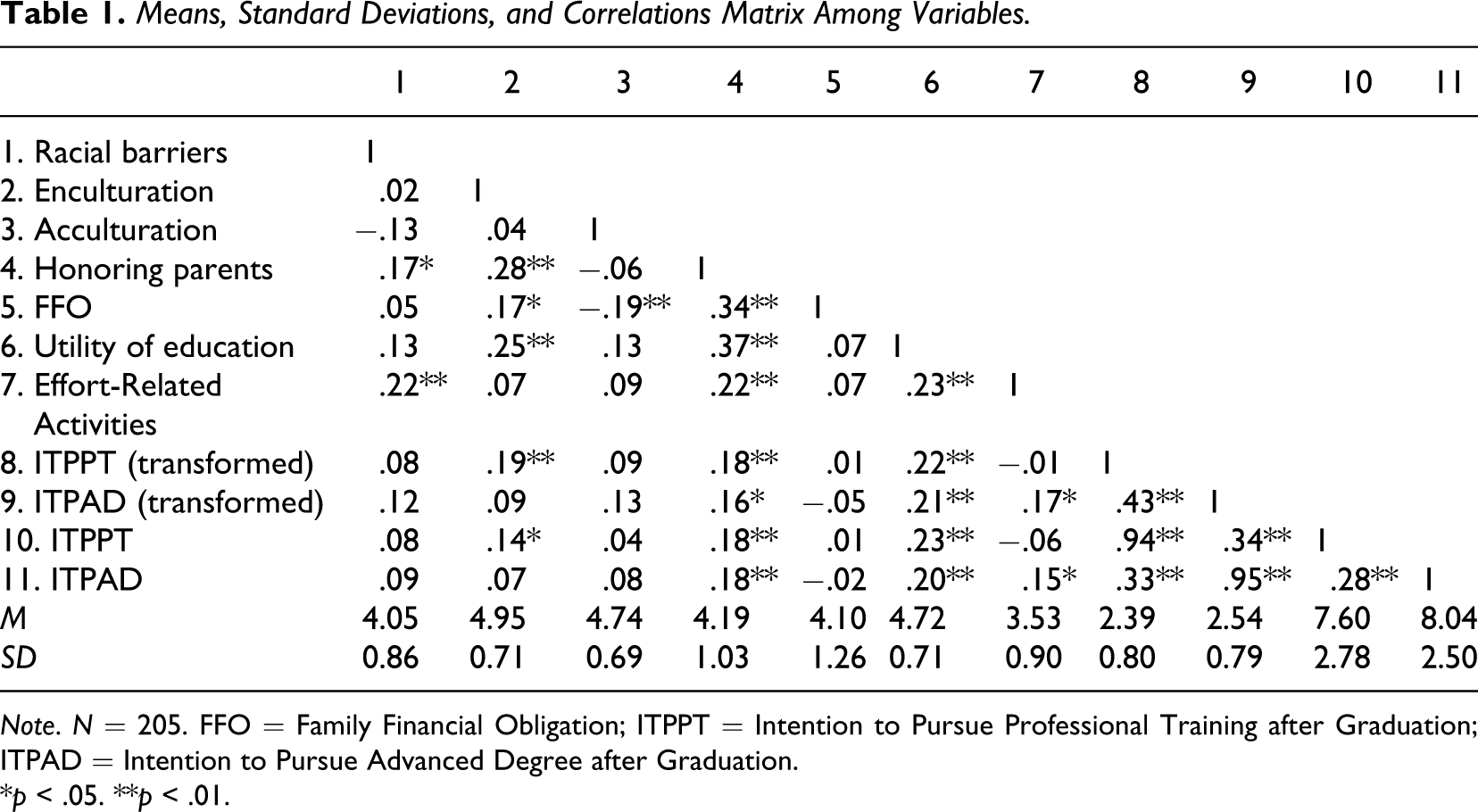
Note. N = 205. FFO = Family Financial Obligation; ITPPT = Intention to Pursue Professional Training after Graduation; ITPAD = Intention to Pursue Advanced Degree after Graduation.
*p < .05. **p < .01.
Hierarchical Multiple Regression Analyses Predicting Utility of Education and Effort-Related Activities From Racial Barriers, Cultural Factors and Their Interactions.

Note. N = 205. RB = Racial Barriers; HP = Honoring Parents; FFO = Family Financial Obligation.
*p < .05. **p < .01.
Hierarchical Multiple Regression Analyses Predicting Intention to Pursue Education after Graduation From Racial Barriers, Cultural Factors and Their Interactions.
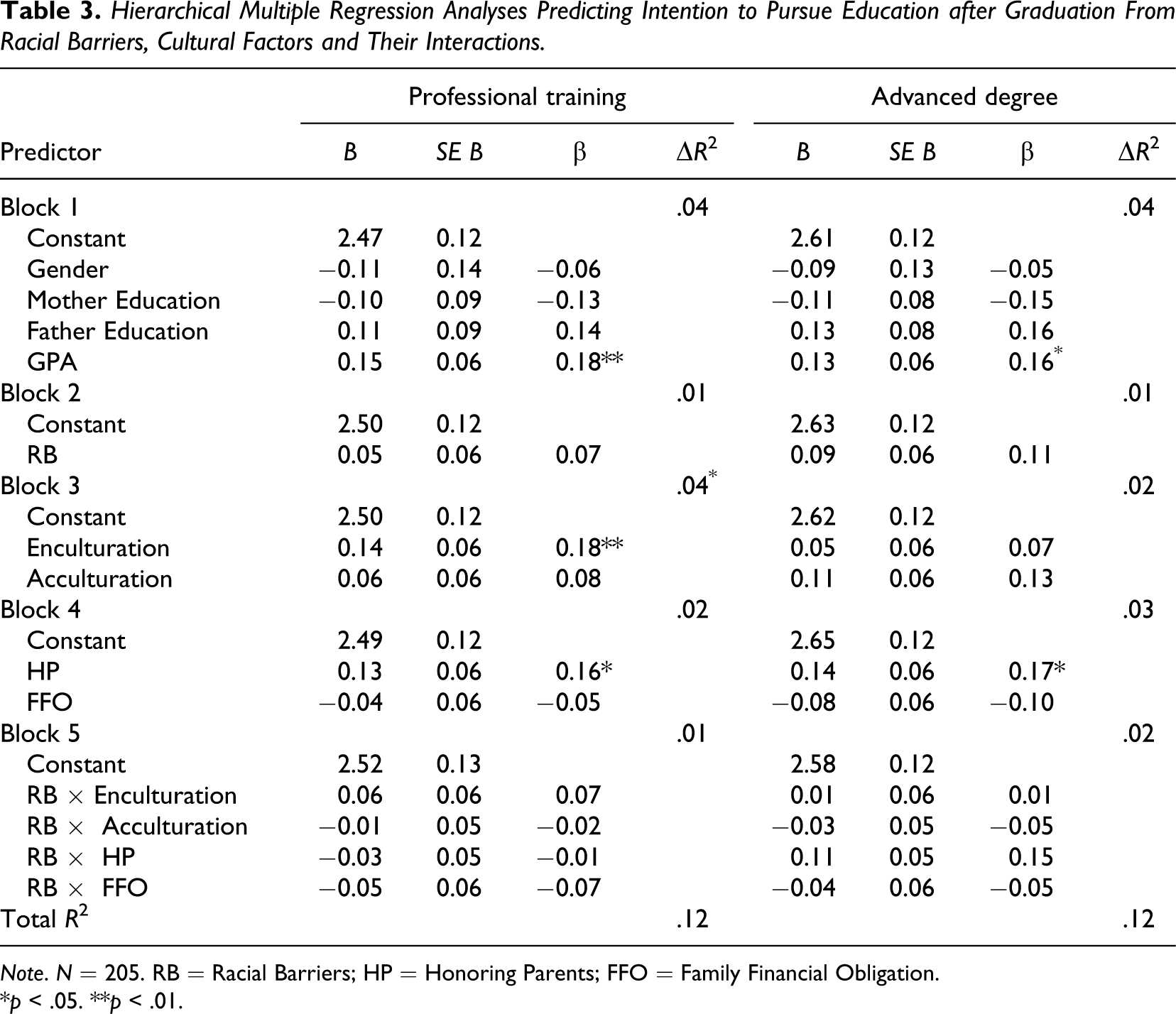
Note. N = 205. RB = Racial Barriers; HP = Honoring Parents; FFO = Family Financial Obligation.
*p < .05. **p < .01.
Results
Regression Diagnostics
The assumptions of residual normality, linearity, homoscedasticity, and multicollinearity were examined. Four separate regressions for utility of education, effort-related activities, and intentions to pursue professional training and an advanced degree after graduation were conducted separately. Based on SPSS statistical analyses, the results indicated none of these four regressions violated the multicollinearity assumption, because all the variance inflation factor (VIF) values were between 1.01 and 2.56 and tolerances were between 0.41 and 0.98.
All other assumptions for the regression of utility of education and effort-related activities were confirmed. Specifically, the residual skewness and kurtosis for these two regressions were in an acceptable range. Because the scatterplots of residuals for utility of education and effort-related activities were randomly scattered around the 0 of residual values across predicted values, the assumptions of linearity and homoscedasticity were met. However, the residual normality for intentions to pursue professional training and to pursue advanced degrees after graduation was not met. Consequently, a log transformation was computed for these two dependent variables. The transformed variables were used in the regression model, resulting in a skewness and kurtosis of residual scores of −0.22 and −0.93, respectively, for the intention to pursue professional training after graduation and −0.43 and −0.86, respectively, for the intention to pursue an advanced degree after graduation. The transformed variables indicated a mild non-normality satisfying the residual normality assumption in these two regression analyses. Thus, the transformed scores for intentions to pursue an advanced degree and to pursue professional training were used in all the remaining analyses. The assumptions of homoscedasticity and linearity for intentions to pursue professional training and an advanced degree after graduation were mildly violated, so the generalizability of their results was limited.
Preliminary Analyses
Table 1 presents the intercorrelations between the main research variables, means, and standard deviations of these variables. It is important to note how cultural orientation was significantly correlated with other cultural and racial predictors. Specifically, enculturation had a positively moderate correlation with honoring parents (r = .28, p < .001) and FFO (r = .17, p = .017). Acculturation had a negatively moderate correlation with FFO (r = −.19, p = .007). In addition, fathers’ (r = .22, p < .001) and mothers’ (r = .23, p < .001) educational levels had a positively moderate correlation with acculturation. However, fathers’ (r = −.25, p < .001) and mothers’ (r = −.21, p = .002) educational levels had a negatively moderate correlation with FFO.
Racial barriers had positive correlation with honoring parents (r = .17, p = .018). Based on descriptive analyses of 10 items for racial barriers, participants perceived some significant barriers in obtaining a job or obtaining a higher social status as Asian Americans (M = 4.05, SD = 0.86). In particular, they indicated more racial barriers in some areas or situations, including difficulties in becoming a politician in the United States (M = 4.93, SD = 1.13), barriers to finding a job in the entertainment field (M = 4.80, SD = 1.26), and challenges in gaining promotion as easily as European Americans (M = 4.26, SD = 1.27). However, participants also indicated fewer barriers in making as much money as European Americans with same educational level (M = 3.35, SD = 1.30) and for becoming a professional athlete (M = 3.35, SD = 1.51).
Most of the participants were female, creating an unrepresentative sample that may have skewed the results. Therefore, the gender effect on racial barriers and cultural variables was examined to assess its impact on the results. With analysis of variance, male participants did not differ from female participants in terms of their experience with enculturation, F (1, 203) = 1.28, p = .260; acculturation, F (1, 203) < 0.01, p = .974; honoring parents, F (1, 203) = 1.28, p = .260; and FFO, F (1, 203) = 0.01, p = .924. Female participants (M = 4.12, SD = 0.80) perceived slightly higher racial barriers in terms of occupational mobility than male participants (M = 3.82, SD = 1.02), F (1, 203) = 4.33, p = .04. Overall, the gender variance may have had only a limited impact on the results.
Main Results
Four sets of hypotheses were tested with the regression results in Tables 2 and 3. Part of the results supported Hypothesis 1. Racial barriers significantly predicted effort-related activities, R 2 = .07, ΔR 2 = .06, ΔF(1, 199) = 11.91, p = .001. Specifically, racial barriers were found to significantly predict effort-related activities (β = .24, p = .001) over and above the background variables. However, racial barriers did not add significant increments to the explained variance for utility of education, ΔF(1, 199) = 2.31, p = .130, intention to pursue professional training after graduation, ΔF(1, 199) = 0.90, p = .347, and intention to pursue an advanced degree after graduation, ΔF(1, 199) = 2.33, p = .130.
Some of the results supported Hypothesis 2. Two cultural identification factors, including enculturation and acculturation predicted utility of education, R 2 = .16, ΔR 2 = .07, ΔF(2, 197) 7.65, p = .001 and intention to pursue professional training after graduation, R 2 = .09, ΔR 2 = .04, ΔF(2, 197) = 4.00, p = .020. In particular, enculturation significantly predicted utility of education (β = .24, p < .001) and intention to pursue professional training after graduation (β = .18, p = .011). However, enculturation did not predict effort-related activities (β = .06, p = .405) and intention to pursue an advanced degree after graduation (β = .07, p = .333). On the other hand, acculturation did not predict utility of education (β = .09, p = .175), effort-related activities (β = .12, p = .09), intention to pursue professional training after graduation (β = .08, p = .263), and intention to pursue an advanced degree after graduation (β = .13, p = .065).
In addition, some of the results supported Hypothesis 3. Two specific cultural factors, including honoring parents and FFO, significantly predicted utility of education, R 2 = .26, ΔR 2 = .10, ΔF(2, 195) = 13.09, p < .001, effort-related activities, R 2 = .13, ΔR 2 = .04, ΔF(2, 195) = 3.89, p = .022. Specifically, work for honoring parents was found to predict utility of education (β = .34, p < .001) and effort-related activities (β = .19, p = .0011). Although the block of cultural predictors failed to significantly improve the models for predicting intention to pursue professional training, ΔR 2 = .02, ΔF(2, 195) = 2.15, p = .119, and an advanced degree, ΔR 2 = .03, ΔF(2, 195) = 2.77, p = .062, after graduation, work for honoring parents demonstrated a mildly significant relationship with both outcome variables for intention to pursue professional training after graduation (β = .16, p = .039) and for intention to pursue an advanced degree after graduation (β = .17, p = .024). Furthermore, FFO did not predict utility of education (β = −.01, p = .945), effort-related activities (β = .02, p = .775), intention to pursue professional training after graduation (β = −.05, p = .526), and intention to pursue an advanced degree after graduation (β = −.10, p = .213).
Overall, the results did not support Hypotheses 4. In other words, cultural factors did not serve as moderators to enhance the association between racial barriers and educational pursuits. The overall effects for four two-way interactions between racial barriers and the cultural factors did not add significant increments to the explained variance for utility of education, ΔF(4, 191) = 1.32, p = .263, effort-related activities, ΔF(4, 191) = 1.37, p = .245, intention to pursue professional training after graduation, ΔF(4, 191) = 0.479, p = .751, and intention to pursue an advanced degree after graduation, ΔF(4, 191) = 1.12, p = .350.
Discussion
Overall, parts of our findings support Sue and Okazaki’s (1990) perspective, by suggesting that effort plays an instrumental role in dealing with racial barriers. Perhaps, effort is already an important East Asian cultural value (Heine et al., 1997) and is, therefore, adopted by East Asian Americans to cope with racial barriers naturally. However, racial barriers did not predict utility of education and educational intention, so it is likely that the association between racial barriers and the belief in the utility of education, as well as educational pursuits, could be influenced by others factors including study skills, field of study, career planning, and economic situations.
There are several possible reasons for cultural factors not facilitating the association between racial barriers and using education as a means of coping. One explanation is that racial barriers and cultural experiences are different kinds of life experiences and, therefore, do not interact with each other. Another possibility is that there are other important cultural factors that this study did not identify, such as East Asian values, which could possibly serve as a moderator between racial barriers and educational activities.
In terms of the association between enculturation and the utility of education, the results also suggested that traditional Asian orientation emphasizes the value of education and educational pursuits, but that mainstream culture in the United States may not promote the value of education. In addition, enculturation did not predict effort-related activities and the intention to pursue an advanced degree. Several factors could have influenced these results. One possible explanation is that effort and pursuing advanced degrees are specific strategies and pursuits that may not be directly suggested in regular East Asian cultural practices.
It was found that work for honoring parents predicted all the criterion variables from negligibly to moderately significantly. It is possible that these East Asian American students could have been taught that educational success is one way to bring honor back to their families. The results showed how the adoption of an Asian cultural orientation may not be enough to explain the educational pursuits of East Asian Americans. Specific Asian variables, such as work for honoring parents, could be more relevant to their educational engagement. Conversely, FFOs did not predict any outcome variables and may not be an important factor in motivating these students to engage in study. Students with FFOs may need to find a part-time job or try to develop occupation-based skills in the near future. As a result, it would be difficult for them to spend most of their time studying.
Researchers have long suggested that the field of career counseling practices has been built largely on the worldviews of European Americans, with a strong emphasis on individualism, autonomy and structure of opportunity being open to everyone (e.g., Flores & Heppner, 2002). Thus, career counselors or psychologists could have been unaware of the cultural backgrounds and minority status of East Asian Americans. For example, many contemporary vocational and career inventories, such as the Strong Interest Inventory, are used as important instruments for assessing clients’ vocational interests; however, occupational racial barriers and family obligations could influence significantly East Asian Americans clients’ attitudes to pursuing these interests, and thus need to be incorporated into career assessment and counseling. Based on the results in this study, different types of family obligations could influence East Asian Americans’ vocational development in different ways, therefore, an exploration of the type of family obligation with HP and FFO scales in career counseling could help counselors to understand the meaning of work in clients’ lives. More specifically, career counselors could clarify and acknowledge the role of the family in clients’ lives by discussing the scores of HP and FFO, or the importance of fulfilling these two types of obligations and how they have influenced their career development and decisions.
With the use of the racial barriers scale developed in this study, career counselors could discuss with the clients the overall level of perceived occupational racial barriers, and the related experiences learned from the media, significant others, and from their personal encounters. Nonetheless, the perceived occupational racial barriers could vary across a variety of occupations or positions along with some other factors, including gender, geographic areas, types of organizations, and so on. For example, the participants in this study perceived higher racial barriers in entering the field of entertainment rather than the field of sport. Therefore, career counselors need to clarify specific racial occupational barriers that East Asian American students may perceive or experience, not being assessed with our racial barriers scale, and help them to identify appropriate coping strategies. Taking an active approach, career counselors could suggest how East Asian clients may conduct informational interviews with East Asian successful professionals working in certain occupations or positions in which they are interested, to gain an understanding of the potential racial challenges, resources, and opportunities, facilitating them to evaluate the impact of potential racial barriers in their career development and to decide whether and how to pursue careers in these areas. While facing occupational racial barriers in many fields, many of our participants might still believe that opportunities exist for making as much money as European Americans. Therefore, their resilience in dealing with racial barriers needs to be understood and supported.
With the influence of model minority stereotypes, the educational and social services for East Asian Americans could be ignored and excluded (Suzuki, 2002; Thompson & Kiang, 2010). The racial barriers could also circumscribe East Asian American college students’ vocational options and opportunities, therefore, the policy makers and leaders in higher education, corporations, and government agencies are encouraged to support East Asian American college students and workers by creating an affirmative learning and working environment for Asian Americans’ vocational development.
The findings presented in this study should be interpreted with caution because the effect sizes were relatively small. Furthermore, there are several limitations to this study, and one of the major limitations stems from the issues related to online self-report surveys, as it is evident that these can lead to several methodological errors (Umbach, 2004). For example, the results of this study were based on mostly East Asian Americans students who actively participated in ethnically based student cultural organizations. These students could possibly engage in school learning more strongly than those without any involvement with student organizations. Furthermore, our results also indicated that parental education also negatively correlated with FFO, suggesting that those from families with a high socioeconomic status (SES) were less likely to provide their families with financial support. Because many participants in this study reported a higher annual family income than most Asian American families, they could have less of a FFO, meaning that they are able to spend extra time on their studies. The results of this study may not be applied to those with relatively low SES and studying in community colleges. Most of the participants were female; therefore, this study’s sample may not be representative of a typical East Asian American college student population. Future studies could investigate similar research questions with participants of diverse backgrounds in terms of their SES, types of colleges, and ethnic Asian groups (e.g., Southeast Asian Americans and Indian Americans). Another major limitation is that this study only focused on college students, potentially restricting the range of association between racial barriers and educational pursuits in a correlation design. With the increase of perceived racial barriers, college students may be more likely to adopt education as a coping strategy than young adults not enrolled in college; however, these young adults were not recruited in this study for statistical analysis. Therefore, it is likely that the inclusion of a broader range of participants with these young adult samples might enhance the association, thereby supporting our hypotheses.
The correlation between two constructs could result from the effect of other methodological errors, such as the “consistency motif of the participants” and “social desirability” (Podsakoff, MacKenzie, Lee, & Podsakoff, 2003). In this study, because the predictor and outcome variables were collected through the same webpage and at a single point in time, it is possible that participants were influenced by these methodological errors. Thus, the significant associations could be false relationships. To reduce methodological errors, it is important to examine the relationship between racial barriers and educational pursuits with more rigorous approaches, such as collecting students’ educational performance data from teachers and classroom observations. Because multiple statistical tests have been conducted in each regression model, it is possible that the Type I errors could be inflated.
Some of the scales, including racial barriers in occupational mobility and educational pursuits, were developed specifically for this study. The lack of substantive validity, particularly for racial barriers and reliability could impact on the accuracy of the results and contribute to weak associations between predictors and outcome variables. Regarding racial barriers, 5 items in the occupational racial barriers asked participants to compare their experiences or perceptions as Asian Americans with those of European Americans; for example: “Asian Americans do not get promoted as easily as European Americans.” However, the remaining 5 items did not ask them to make such a comparison. The items with a comparison may have caused the participants to interpret them differently to those without the comparison. In future studies, items used to measure this construct should remain consistent. Additionally, future researchers should measure perceived and actual experiences separately, which might predict educational pursuits differently. Furthermore, the scales developed in this study have not been tested with other independent samples; therefore, the results of our measurement models tested with CFA might not be generalized to other samples. For further validating racial barriers and family obligation scales, conducting cross-validations with a parallel specification search process in CFA, based on different independent samples, would provide a good assessment of the consistency in the model modifications, and the goodness of fit from the results of this sample (MacCallum, Roznowski, & Necowitz, 1992).
In addition, participants were asked about their intention to pursue professional training after graduation; however, this question seemed to overlap with another about their intention to pursue an advanced degree (such as an MA, PhD, JD, or MD) after graduation. It is likely that the participants would consider law and medicine as “professional” training; therefore, the question about the intention to pursue professional training after graduation needs to be revised. Similarly, effort-related activities showed an inadequate inter-item reliability of .66; thus, the scale for this construct needs to be revised.
Furthermore, several key variables were overlooked, such as academic self-efficacy, personality factors, intelligence factors, and academic support from Asian communities. These variables could also serve as moderators between racial barriers and educational pursuits. Future relevant research should enhance the validity of the scales in this study, such as racial barriers in occupational mobility, and should incorporate these overlooked variables. Another consideration is that generation status could influence the participants’ educational pursuits, but this was not incorporated in the regression analysis because the sample size for each generation was small. Since there is a glass ceiling for women, it is likely that Asian American women could experience both racial and gender barriers simultaneously. Finally, although a slightly significant difference in racial barriers for occupational mobility between men and women was found in this study, more research needs to examine the potential intersection between gender and upward mobility.
Footnotes
Authors’ Note
This manuscript is based on dissertation research conducted by Yung-Lung Chen at the University of Wisconsin–Milwaukee under the supervision of Nadya Fouad.
Declaration of Conflicting Interests
The authors declared no potential conflicts of interest with respect to the research, authorship, and/or publication of this article.
Funding
The authors disclosed receipt of the following financial support for the research, authorship, and/or publication of this article: This study was supported by grants from the UW-System Institute on Race and Ethnicity and from the Chiang Ching-kuo Foundation for International Scholarly Exchange.