



Abstract
This study examined the predictive utility of Lent and Brown’s social cognitive model of educational and work well-being with a sample of Asian American college students, indexing well-being in terms of academic and social domain satisfaction. In addition, we examined the role of acculturation and enculturation as culture-specific predictors of domain satisfaction. Participants were 122 Asian American college students who completed measures of domain-specific environmental support, self-efficacy, goal progress, and satisfaction, along with global measures of behavioral acculturation and enculturation. Path analyses indicated that the modified social cognitive model, including the two cultural variables, provided good fit to the data and accounted for substantial portions of the variance in academic and social satisfaction. Both acculturation and enculturation were linked to domain satisfaction indirectly through their relation to perceived environmental support. This suggests that students who actively engage both in Asian and in mainstream cultures are more likely to access environmental support, which in turn is linked to self-efficacy, goal progress, and domain satisfaction. The present findings offer preliminary support for the cross-cultural validity of the social cognitive model with Asian American college students and suggest ways in which the model’s variables may operate jointly with culture-specific variables. Implications for future research and practice are considered.
Keywords
Asians and Pacific Islanders currently constitute about 5% of the U.S. population (U.S. Census Bureau, 2010) and 7% of U.S. college students (U.S. Department of Education, 2011). As a group, they are often viewed as well adjusted both by the general public and by mental health professionals (Sue, Sue, Sue, & Takeuchi, 1995). However, this “model minority” myth has been challenged by research findings indicating that many Asian Americans experience major adjustment and emotional problems (e.g., Yoo, Burrola, & Steger, 2010). In the context of college adjustment specifically, findings suggest that Asian American students report more mental health concerns (Greene, Way, & Paul, 2006; Sue & Chu, 2003) and lower self-esteem (Greene et al., 2006) than their non-Asian peers. Asian American college students have also been found to report more career decision-making difficulties than White and Hispanic American students (Mau, 2004), and concerns about their social adjustment to college (Liang & Sedlacek, 2003).
In general, both individual characteristics (e.g., self-efficacy beliefs, self-concept) and environmental factors (e.g., social support, discrimination) have been found to be related to the adjustment of Asian American college students (e.g., Gloria & Ho, 2003; Kenny & Stryker, 1996; Ying, Lee, & Tsai, 2007). However, much of the research on Asian Americans’ college adjustment has focused on academic outcomes (Sue & Okazaki, 1990), with less attention to social functioning, and relatively few studies have been based on comprehensive theories of well-being or adjustment. While a number of existing theories could be used to guide the study of Asian American college students’ educational and social well-being, it is important to examine their validity specifically with this population.
Social Cognitive Model of Well-Being
Lent (2004) recently proposed a unifying theoretical perspective on well-being and psychosocial adjustment that incorporated key components from social cognitive career theory (Lent, Brown, & Hackett, 1994). Lent and Brown (2006, 2008) later extended this framework to the specific contexts of adjustment in vocational and educational settings, and conceptualized domain relevant satisfaction as an aspect of individuals’ school and work adjustment. Their model includes five variables that are assumed to be directly linked to satisfaction experienced in individuals’ occupational and educational pursuits. As shown in Figure 1, these variables include personality and affective traits (Path 1), self-efficacy (Path 2), progress at goal-directed activities (Path 3), favorable work conditions and outcomes (Path 4), and environmental supports, resources, and obstacles (Path 5).
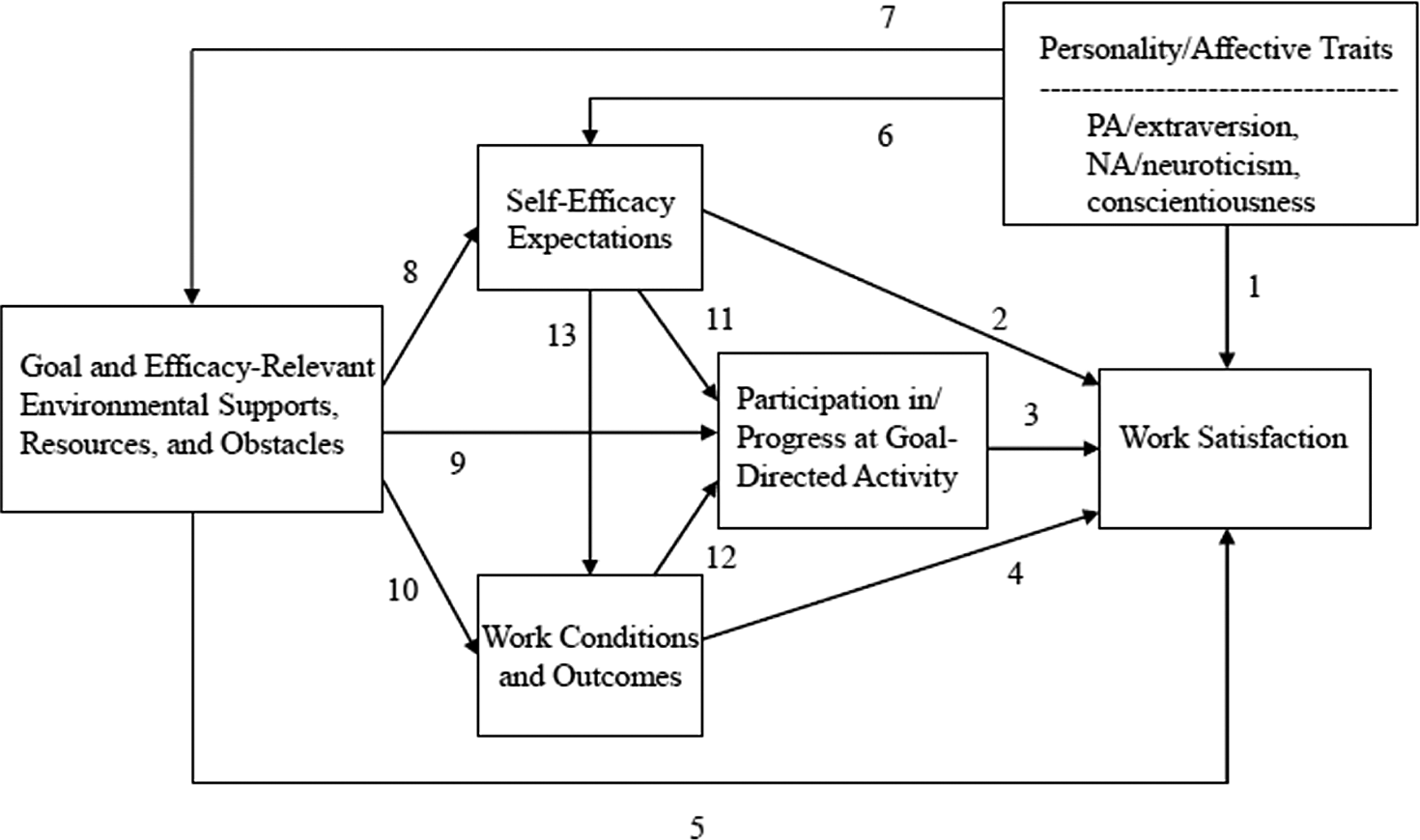
A social cognitive model of work satisfaction. Adapted from Lent and Brown (2008).
Lent and Brown (2006) also proposed a number of indirect paths among the variables that are linked to domain satisfaction. Personality traits, such as positive or negative affect, may indirectly affect educational satisfaction through self-efficacy (Path 6) and environmental resources and support (Path 7). Environmental resources and obstacles are likely to affect satisfaction indirectly through self-efficacy (Path 8), goal progress (Path 9), and work-related conditions and outcomes (Path 10). Self-efficacy (Path 11) and work conditions and outcomes (Path 12) are linked to satisfaction indirectly through goal progress. Finally, part of the relation of self-efficacy to satisfaction is also seen as mediated by work conditions and outcomes (Path 13). These paths imply that those who perceive their environments as supportive, see themselves as capable of achieving their goals, and view their work conditions as favorable are more likely to make progress at their goals and, in turn, to feel satisfied with their work/educational lives.
Lent’s (2004) social cognitive model of well-being has been tested in several cross-sectional studies with college students. Lent et al. (2005) found good fit of the model to the data in predicting academic and social satisfaction. Lent, Singley, Sheu, Schmidt, and Schmidt (2007) also found good overall fit of the model in explaining academic satisfaction. Although most of the social cognitive predictors produced significant paths to the satisfaction outcomes in both of these studies, outcome expectations did not contribute uniquely either to the prediction of goal progress or satisfaction. In a recent cross-sectional study of academic satisfaction in Mexican American college students, Ojeda, Flores, and Navarro (2011) found support for most model paths, except for the path from outcome expectations to goal progress. A few longitudinal studies have also found support for the temporal relations among many of the model’s predictors (Lent, Taveira, Sheu, & Singley, 2009; Singley, Lent, & Sheu, 2010). In particular, self-efficacy and environmental support have been found to predict goal progress and academic adjustment criteria over time.
The social cognitive model may offer a useful framework for examining the college well-being of Asian American students, particularly because it provides a coherent basis for integrating individual and environmental predictors, both of which have been linked to Asian American college students’ adjustment in prior studies (e.g., Gloria & Ho, 2003). Lent and colleagues have acknowledged possible cross-cultural variations in the prediction of well-being and adjustment criteria (Lent, 2004; Sheu & Lent, 2009). For example, acculturation experiences may influence how an individual perceives support from the environment or the nature of the goals that he or she sets. Such cultural variations suggest the potential value of incorporating culture-specific variables into model tests with particular racial/ethnic minority groups. Similar to Ojeda et al.’s (2011) study with Mexican American college students, we examined the ways in which two key cultural variables, acculturation and enculturation, operate along with the social cognitive variables in predicting the well-being of Asian American college students.
Acculturation and Enculturation
Acculturation refers to the process by which an individual adapts to dominant cultural values, behaviors, and cognitions as he or she comes into contact with a new mainstream culture (Lee, Yoon, & Liu-Tom, 2006; Yeh, 2003). Enculturation, by contrast, is the process by which an individual maintains the values, behaviors, and cognitions of his or her native culture (Kim & Abreu, 2001). Previous studies have suggested the importance of both acculturation and enculturation in the adjustment of Asian Americans (see Suinn, 2010).
The relations between acculturation and enculturation have been captured in two competing unilinear and bilinear models (Miller, 2007). The fundamental difference between the two models lies in their assumptions about how an individual’s native cultural behaviors, values, and identity change during the adaptation process to the new mainstream culture (Ryder, Alden, & Paulhus, 2000). While the unilinear model posits a negative relationship between acquisition of the mainstream culture and adherence to one’s native culture (Berry, 1997, 2003), the bilinear model asserts that adherence to the mainstream culture and to one’s native culture represent independent processes (LaFromboise, Coleman, & Gerton, 1993). Earlier studies based on the unilinear model have generally found that low acculturation/high enculturation is predictive of psychological maladjustment and mental health risks in Asian American college students (e.g., Abe & Zane, 1990). For example, Asian American students with low acculturation/high enculturation reported less college satisfaction (Abe & Zane, 1990), higher distress (Shim & Schwartz, 2008), and a narrower range of options in their choice of majors than did those reporting high acculturation/low enculturation (Sue & Zane, 1985).
Despite its parsimony, the unilinear model has been deemed problematic because it implies that individuals are incapable of simultaneously maintaining competence in both mainstream and native cultures (Flannery, Reise, & Yu, 2001; Ryder et al., 2000). Thus, unilinear models may not provide a complete or ecologically valid view of the acculturation process. In their recent studies based on the bilinear model, Kim and Omizo (2005, 2006) found that high levels of both acculturation and enculturation significantly predicted Asian Americans’ collective self-esteem. Kim and Omizo also found that acculturation was significantly associated with cognitive flexibility and general self-efficacy, while enculturation was associated with perceived valuing of one’s Asian American identity. Other bilinear studies have found that acculturation was related to better adjustment outcomes, such as higher self-esteem, lower depression, better quality family relationships, and better academic performance (Nguyen, Messe, & Stollak, 1999; Ryder et al., 2000). Collectively, these studies highlight the utility of bilinear models of acculturation and enculturation. However, the mechanisms through which culture-specific variables influence adjustment outcomes in Asian American students deserve greater study.
Purpose of the Study
The current study tested the explanatory utility of the social cognitive model of well-being (Lent & Brown, 2006) in a sample of Asian American college students. Consistent with Lent et al. (2005), the well-being of Asian American college students was indexed in terms of academic and social domain satisfaction. While the study of domain satisfaction (academic, social) in the educational context is important in its own right, it may also be seen as a developmental precursor of work satisfaction (Singley, Lent, & Sheu, 2010), a key aspect of career development. We specifically tested a modified version of the Lent–Brown model. First, because this study is intended to focus on variables that may be relatively open to personal and environmental control, and thus directly relevant to interventions, we omitted personality variables from our model tests. Second, we also omitted outcome expectations, given that they have not been found to produce consistent, unique paths to domain satisfaction in most prior studies with college students (Sheu & Lent, 2009). Third, we added acculturation and enculturation to our model tests predicting academic and social satisfaction in order to examine aspects of well-being that are assumed to be both universal (e.g., self-efficacy) and culture-specific (e.g., enculturation) for Asian Americans.
As shown in Figure 2, in addition to the basic paths hypothesized by the social cognitive model specified earlier, we tested the possibility that acculturation and enculturation would each relate to domain satisfaction largely through their relation to academic and social domain support. That is, students who engage more actively with both the mainstream culture and their culture of origin may have access to more sources of environmental support, which in turn could lead to greater self-efficacy, goal progress, and domain satisfaction. Thus, in line with the bilinear model of cultural adaptation, we assumed that both forms of cultural orientation—acculturation and enculturation—could be relevant to the well-being of Asian American college students. We tested two model variations in each satisfaction domain: (a) an indirect effects model in which the relations of acculturation and enculturation to domain satisfaction were assumed to be fully mediated by domain support and (b) a partially mediated model in which the relations of acculturation and enculturation to satisfaction were assumed to be both direct and indirect, via environmental support.
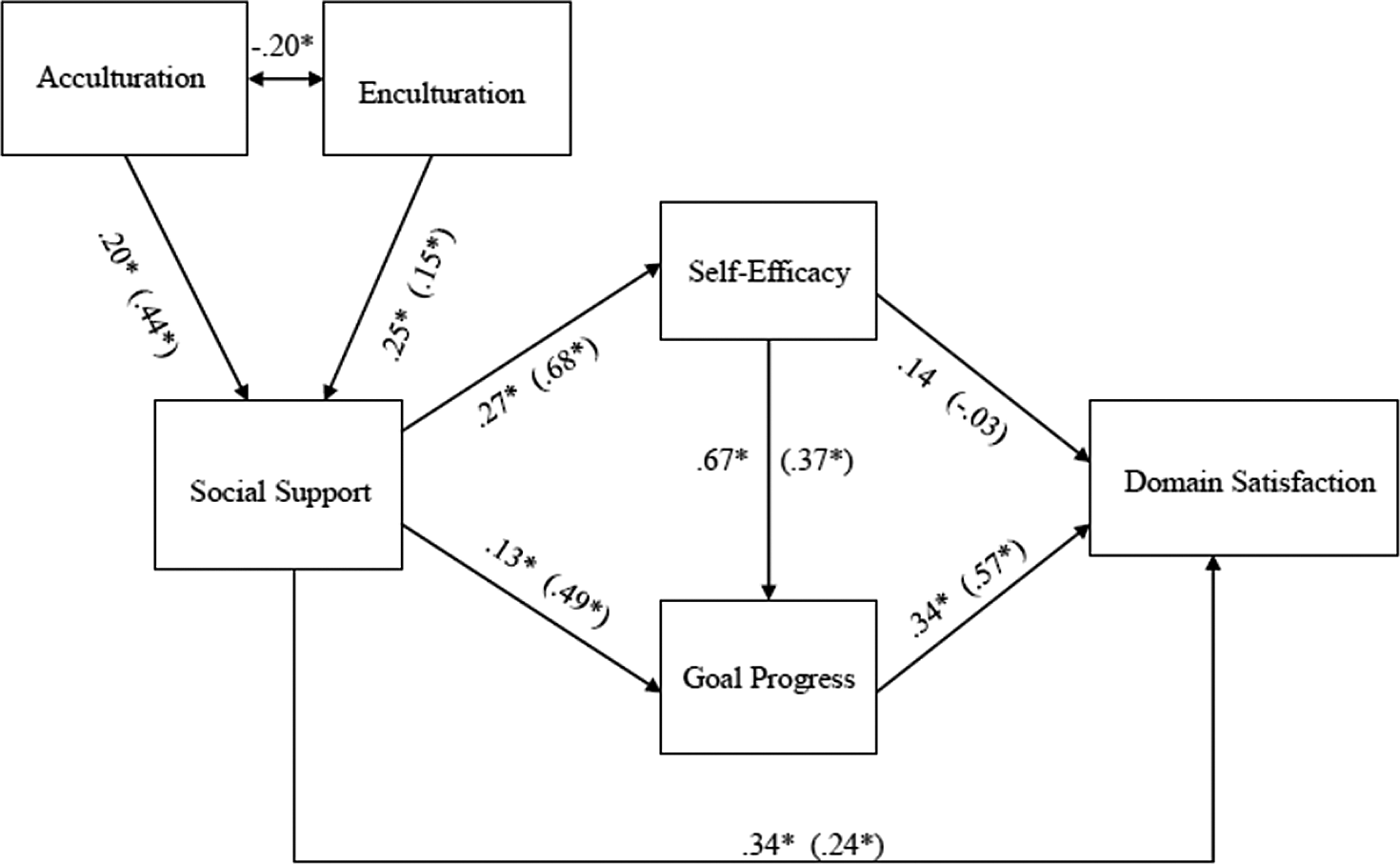
Social cognitive and cultural predictors of domain satisfaction. The first coefficient on each path is for the academic domain; the second coefficient, in parentheses, is for the social domain. Note that this model depicts the indirect effects of acculturation and enculturation on domain satisfaction. *p < .05, one-tailed.
Method
Participants
Participants were 122 (68 female, 50 male, 4 gender unspecified) college students at a large Mid-Atlantic university who self-identified as Chinese (32%), Asian Indian (15%), Korean (15%), Taiwanese (10%), Vietnamese (10%), Filipino (6%), Japanese (3%), or Thai (2%). Less than 1% identified as Bangladeshi, Malaysian, Pacific Islander, or Pakistani, and 6% did not report their specific ethnicity. Twelve students (10%) identified as first generation (i.e., born outside of the United States, arriving in the United States as an adult), 33 (27%) as 1.5 generation (i.e., born outside the United States, coming to the United States as a child or adolescent), 67 (55%) as second generation (i.e., born in the United States, with either parent born outside of the United States), 3 (3%) as third generation (i.e., born in the United States, with both parents also born in the United States), 2 (2%) as fourth generation (i.e., born in the United States, with both parents and at least one grandparent also born in the United States), and 5 (4%) did not report their generational status. The average period of residence in the United States was 16.46 (SD = 6.38) years; the average age was 20.54 (SD = 2.21). Twenty percent were freshmen, 22% were sophomores, 30% were juniors, and 23% were seniors; 5% did not report their year in school. Their mean reported grade point average (GPA) was 3.41 (SD = 0.41).
Measures
We used the same measures of academic and social domain support, self-efficacy, goal progress, and satisfaction as developed by Lent et al. (2005). In each case, scale scores were calculated by summing item responses and dividing by the number of items on the scale. Higher scores indicate more positive perceptions (e.g., greater support, higher self-efficacy). All scales yielded internal consistency reliability estimates of .80 and above in the Lent et al. study. Internal consistency values in the present sample are shown in Table 1. In terms of validity, Lent et al. reported that each of the measures yielded theory-consistent relations with domain-relevant predictors and criterion variables.
Means, Standard Deviations, Internal Consistency Estimates, and Correlations.

Note. N = 121.
Correlations ≥ .19 are significant at p < .05; correlations ≥ .24 are significant at p < .01.
Domain Support
Academic support was assessed with a 9-item measure asking participants to indicate how much they agreed with a set of statements referring to available support in their intended major. A sample item was, “[I] get encouragement from my friends for pursuing my intended major.” Social support was assessed with a 10-item measure referring to current access to social resources (e.g., “I have close relationships that provide me with a sense of belonging”). Items on both scales were rated along a 5-point scale, ranging from strongly disagree (1) to strongly agree (5).
Domain Self-Efficacy
Academic self-efficacy was assessed with 12 items tapping participants’ confidence in their ability to perform well academically (e.g., “excel in your intended major over the next semester”) and to cope with barriers or problems related to academic success (e.g., “find ways to study effectively for your courses despite having competing demands for your time”). Social self-efficacy was assessed with a 12-item scale reflecting participants’ confidence in their ability to perform effectively in social situations (e.g., “start up a conversation with a stranger”). Responses on both scales were obtained along a 10-point scale, ranging from no confidence (0) to complete confidence (9).
Domain Goal Progress
Academic goal progress was assessed with a 7-item measure asking participants to indicate how much progress they feel they are making toward various academic goals (e.g., “completing all course assignments effectively”). Social goal progress was assessed with a 7-item measure reflecting progress toward social goals (e.g., “finding other people who can support you in difficult times”). On both measures, responses were obtained along a 5-point scale, ranging from 1 (no progress at all) to 5 (excellent progress).
Domain Satisfaction
Academic satisfaction was assessed with a 7-item measure asking participants to indicate their level of satisfaction with different aspects of their academic experience along a 1 (strongly disagree) to 5 (strongly agree) scale. A sample items is, “I am generally satisfied with my academic life.” Social satisfaction was assessed with a 6-item measure, asking participants how often they had had positive social experiences over the past week, along a 1 (not at all or never) to 5 (frequently or all the time) scale. A sample item is, “… enjoyed talking with or being with friends or relatives.”
Acculturation and Enculturation Behaviors
Participants’ self-reported acculturation and enculturation behaviors were assessed with the modified Acculturation Rating scale for Mexican Americans (ARSMA-II; Cuellar, Arnold, & Maldonado, 1995). The ARSMA-II, a bilinear measure, was modified for Asian Americans by changing the terms Mexican to Asian/Asian American and Anglo to European/Caucasian (Lee et al., 2006). The modified ARSMA-II contains two subscales that assess, respectively, an individual’s acculturation to Western culture (13 items; e.g., “My friends now are of European/Caucasian origin”) and enculturation to Asian culture (17 items; e.g., “I speak an Asian language”). The items reflect behaviors related to language usage, ethnic identity, language preference in social activities, and social affiliation. Participants were asked to indicate the degree to which the items apply to them along a 5-point Likert-type scale (1 = not at all, 5 = extremely often or almost always). Item responses were summed and divided by the number of items on each subscale, with higher scores representing a greater orientation to Western (acculturation) and Asian (enculturation) cultures. Because the modified ARSMA-II was used to assess behavioral engagement with Western and Asian cultures, 6 items designed to reflect internal ethnic identification (e.g., “I like to identify myself as Asian”) were not included in this study. The measure has produced adequate internal consistency and validity estimates in prior research with Asian American college students.
Procedure
Two methods were used to recruit participants. First, a random sample of 600 self-identified Asian, Asian American, or Pacific Islander undergraduate students was generated by the University registrar’s office. Students were invited by e-mail to participate in an online study of Asian/Asian Americans’ college experiences. Second, letters of invitation were distributed to over 300 students in undergraduate psychology department courses, undergraduate courses in Asian Americans studies, and an international student listserv. Some of the course instructors in Asian American studies offered course credit as an incentive for participation in the study; in other cases, no explicit compensation was provided. We omitted the data of participants who either identified as graduate students (n = 20) or had more than 5% incomplete responses (n = 60). Missing item responses on a particular scale were replaced by the individual’s mean score for the completed items on that scale.
Results
Path Analyses
Means, standard deviations, internal consistency, and correlations among the variables are presented in Table 1. We tested the fit of the model shown in Figure 2 using EQS (Version 6.1; Bentler & Wu, 2005), the covariance matrices of the observed variables, and maximum likelihood estimation. Adequacy of model–data fit was assessed with three primary fit indicators: the comparative fit index (CFI), the standardized root mean squared residual (SRMR), and the root mean square error of approximation (RMSEA). Hu and Bentler (1999) suggested that SRMR values close to .08 in combination with CFI values close to .95 or RMSEA values close to .06 imply good model–data fit. Mardia’s normalized estimate was <5 in both path analyses, suggesting that the data were not unduly affected by multivariate nonnormality. Separate path analyses were conducted for each of the two outcome variables, academic and social domain satisfaction. We modeled the covariance between acculturation and enculturation in both analyses.
The indirect effects model of academic satisfaction produced excellent fit to the data, CFI = 1.00, SRMR = .03, RMSEA = .00, 90% confidence interval [CI] = [.00, .10], χ2(6, N = 121) = 4.25, p = .64. The partially mediated model, which added direct paths from acculturation and enculturation to academic satisfaction, also produced excellent fit indices, CFI = 1.00, SRMR = .03, RMSEA = .00, 90% CI [.00, .07], χ2(4, N = 121) = 1.33, p = .86. Comparison of the two models using the χ2 difference test indicated that the addition of the two direct paths from acculturation and enculturation to academic satisfaction did not significantly improve model fit, Δχ2(2) = 2.92, p > .05. The path coefficients for the indirect effects model, shown in Figure 2, indicated that acculturation and enculturation were each associated significantly with academic support; academic support, in turn, produced a significant direct path to academic satisfaction and an indirect pathway via self-efficacy and goal progress. Self-efficacy was linked to satisfaction only indirectly via goal progress. The model accounted for 42% of the variance in academic satisfaction.
Analysis of the indirect effects model of social satisfaction also yielded strong fit to the data, CFI = 1.00, SRMR = .04, RMSEA = .00, 90% CI [.00, .07], χ2(6, N = 121) = 3.02, p = .81. Fit indices for the partially mediated model were CFI = 1.00, SRMR = .03, RMSEA = .00, 90% CI [.00, .11], χ2(4, N = 121) = 2.68, p = .61. The two models did not differ significantly in terms of fit, Δχ2 (2) = .34, p > .05, suggesting that the addition of the direct paths from acculturation and enculturation to social support did not improve model–data fit over the more parsimonious indirect effects model. (The path coefficients for the indirect effect model are displayed in Figure 2). Acculturation and enculturation each produced a significant path to social support. Support was, in turn, linked to social satisfaction both directly and indirectly through the self-efficacy/goal progress pathway. Self-efficacy was related to satisfaction only indirectly via goal progress. The model accounted for 56% of the variance in social satisfaction. In both path analyses, acculturation and enculturation were inversely and weakly related with one another. Using the test of joint significance (MacKinnon, Lockwood, Hoffman, West, & Sheets, 2002), a significant indirect effect may be inferred when the paths from the predictor to the mediator and from the mediator to the criterion variable are significant. Thus, the findings of both path analyses were consistent with a model in which the relations of acculturation and enculturation to domain satisfaction were mediated by social support.
Discussion
The present findings generally support the tenability of the modified social cognitive model in predicting the academic and social satisfaction of Asian American college students. In particular, the model fits the data well and accounted for large portions of the variance in both satisfaction criteria. The findings are, thus, generally consistent with those of previous studies that have applied the well-being model with primarily European American and European samples (e.g., Lent et al., 2005, 2009). Similar to Ojeda et al.’s (2011) findings with a sample of Mexican American college students, our results also offer empirical support for the cross-cultural utility of the social cognitive model, with the addition of acculturation and enculturation, in explaining the college well-being of particular U.S. minority groups.
Although the relations of the social cognitive predictors to both satisfaction criteria generally conformed to theoretical expectations, the path coefficients from support to self-efficacy and goal progress, and from goal progress to satisfaction, were generally larger in the social than in the academic domain. It is important to note that the direct path from self-efficacy to satisfaction was nonsignificant in both domains. According to the test of joint significance, the path from self-efficacy to satisfaction was, rather, mediated by goal progress. Support, meanwhile, was linked to satisfaction both directly and indirectly through the self-efficacy/goal progress pathway. This general pattern of findings is largely consistent with those of Lent et al. (2005). Further research is needed to determine the basis for the differing magnitude of path coefficients in the social versus the academic domains, which may be due to measurement or theoretical considerations (e.g., interpersonal adjustment may draw on social support to a greater degree than do academic domain tasks, such as studying, that are often performed alone).
Similar to the Ojeda et al. (2011) study, we also examined the interplay of two cultural variables, acculturation and enculturation, with the social cognitive predictors. In both studies, support was found for an indirect pathway from these cultural variables to domain satisfaction, although the nature of this pathway differed slightly in the two studies. Ojeda et al. had modeled indirect paths from acculturation and enculturation to academic satisfaction via self-efficacy and outcome expectations. They did not include a separate measure of environmental support but rather conceived of acculturation and enculturation as indictors of environmental resources that enable connectedness, respectively, to culturally different and similar others. In the present study, we modeled acculturation and enculturation as variables that may affect the experience of environmental support, which may, in turn, promote self-efficacy, goal progress, and domain satisfaction. Whether conceived as sources or indicators of support, the findings of both studies suggest that cultural variables may operate in tandem with the social cognitive predictors (cf. Sheu & Lent, 2009).
The negative, significant correlation between acculturation and enculturation in both the present study and Ojeda et al.’s (2011) study suggest that engagement in European American culture tends to vary inversely with engagement in one’s culture of origin. Students who are more engaged in the one culture may be less involved in the other. However, the relation between the two cultural orientations was fairly modest in our study (r = −.20) and both orientations were uniquely predictive of environmental support in both academic and social life domains. While the two produced roughly equivalent path coefficients predicting academic support, acculturation yielded a somewhat larger coefficient than enculturation in predicting social support. This does not imply that immersion in Asian cultural activities is an ineffective source of social support. Rather, it may suggest that, for Asian students who constitute a minority on a predominantly White campus, engagement in the mainstream culture offers the potential for added access to social support, for example, via cross-racial friendships and involvement in a range of racially integrated social activities. Other studies have also found higher levels of acculturation to be predictive of Asian students’ social adjustment (Nguyen et al., 1999; Ryder et al., 2001).
The current findings should be interpreted in light of the study’s limitations. First, it should be noted that the sample consisted predominantly of second generation students of Chinese, Korean, and Indian descent. Unfortunately, the limited sample size precluded testing the model in particular subsamples differing in ethnicity or generational status. Further research is, therefore, needed to examine the issue of within-group variability with respect to the social cognitive and cultural predictors of Asian American students’ domain satisfaction within the college context. Second, the present study was cross-sectional in nature. Thus, the findings should not be taken as evidence of causal relations between the predictor and criterion variables. Longitudinal studies could shed light on the temporal predominance among the variables, and experimental research could be used, for example, to assess the effects of theory-derived intervention elements (e.g., does social support enhance self-efficacy, goal progress, and domain satisfaction?). Third, the study had a fairly low response rate. Although such a response rate is not uncommon in web-based studies, particularly where limited or no incentives are provided for participation, it does encourage caution in efforts to generalize the findings.
Fourth, the present study may have been limited by the ways in which it operationalized culture. Including other cultural dimensions (e.g., values, identification) may help clarify the role of culture in predicting the well-being of Asian American college students. Likewise, the study assessed well-being only in terms of domain (academic and social) satisfaction. It would be useful for future research to examine additional indicators of well-being, such as perceived stress, life satisfaction, and college persistence. Fifth, the correlations among the domain-specific variables may have been inflated by common method variance, though prior research suggests that these variables represent relatively distinct constructs (e.g., Lent, Singley et al., 2005). Finally, the version of the social cognitive well-being model we tested contained only a subset of the model’s variables (Lent, 2004), omitting personality factors and outcome expectations. While such omissions are reasonable on theoretical and practical grounds, it would be useful for future research to test fuller versions of the social cognitive well-being model with Asian American students.
The present findings provide tentative implications for counselors working with Asian American college students. First, it may be beneficial to focus on aiding students to establish support networks that provide access both to academic and social resources. For instance, orientation programs, living-learning programs, and peer counselors can be employed to help students build positive, meaningful connections with other students. In addition, domain satisfaction may be promoted via activities that build self-efficacy and aid goal progress. For example, counselors may provide access to coping models, or offer feedback and assistance at goal setting. Finally, given the minority status of Asian American students at most universities and the potential relevance of acculturation and enculturation to their adjustment, it may be valuable to foster engagement both in cross-cultural and in culture-of-origin activities. This combination may increase opportunities for environmental support, which in turn facilitates goal progress and domain satisfaction.
In summary, the present results suggest that both pancultural (social cognitive) and culture-specific factors may help explain the academic and social satisfaction of Asian American college students. In particular, these results are consistent with prior findings on the predictive utility of the social cognitive model of well-being as applied both to predominantly European American samples (Lent et al., 2005) and to students of color (Ojeda et al., 2011). They also confirm other findings indicating the important role that social support plays in the environmental adjustment of Asian American college students (Gloria & Ho, 2003; Kenny & Stryker, 1996). Additional research is needed to examine both the universal and the culture-specific factors related to domain satisfaction in Asian American and other ethnic minority samples.
Footnotes
Declaration of Conflicting Interests
The authors declared no potential conflicts of interest with respect to the research, authorship, and/or publication of this article.
Funding
The authors received no financial support for the research, authorship, and/or publication of this article.