



Abstract
We present the PreferenSort, a career counseling instrument that derives counselees’ vocational interests from their preferences among occupational titles. The PreferenSort allows for a holistic decision process, while taking into account the full complexity of occupations and encouraging deliberation about one’s preferences and acceptable trade-offs. We describe three validation tests: (a) comparing the vocational interests derived by the PreferenSort to those accumulated using Holland’s Self-Directed Search (construct validity); (b) exploring the relations between the participants’ derived interests and their field of study (concurrent validity); and (c) the degree of improvement in the prediction of the participants’ field of study in the derived over the accumulated vocational interests (incremental validity). As hypothesized, by allowing for a holistic decision process, the PreferenSort explains the vocational interests of intuitive individuals better. These findings provide evidence that the PreferenSort is important as a supplementary counseling tool for individuals with an intuitive decision style—people who currently lack self-help counseling instruments.
Choosing a career is one of the most challenging decisions a person makes. Individuals approach this decision in varied ways (Gati, Landman, Davidovitch, Asulin-Peretz, & Gadassi, 2010) and encounter a variety of difficulties (Gati, Krausz, Osipow, & Saka, 2000). It is not surprising, then, that various counseling instruments have been developed to aid counselees in their career decision making. In this article, we present a new career counseling instrument, named the PreferenSort. The new instrument relies on Holland’s theory for conceptualizing vocational interests (Holland, 1985a, 1997; Walsh & Holland, 1992) while allowing for a holistic decision process, taking into account the full complexity of occupations and encouraging deliberation about one’s preferences and acceptable trade-offs.
We begin by discussing the nature of existing instruments for career counseling. We then present the PreferenSort and explain how it complements the existing instruments by addressing some of their limitations. We provide evidence for the construct, concurrent, and incremental validity of the PreferenSort and discuss its unique contribution as a career counseling aid, especially for individuals with an intuitive decision-making style.
Career Counseling Instruments
Vocational instruments are often used in career development sessions, providing counselors and counselees with diagnostic information. Existing instruments vary in form and focus, but can be generally classified into one of two types: those in which vocational interests are accumulated from preferences for various vocational attributes and those in which interests are extracted from preferences for representative occupations.
Many self-help decision-making tools (e.g., Career Information System [CIS], DISCOVER, CHOICES, MBCD, Self-Directed Search [SDS]; Gati, Gadassi, & Shemesh, 2006) ask participants to report their preferences for various attributes of occupations (e.g., required skills, level of payment, amount of responsibility, etc.). These attributes allow for comparisons across occupations. Making Better Career Decisions (MBCD; Gati, Kleiman, Saka, & Zakai, 2003), for example, lists 31 “aspects” (e.g., responsibility, income, flexibility of hours); Holland’s SDS (Holland, 1985a) asks counselees to check their preferences on a list of activities, competencies, and abilities as well as occupations. Counselees’ vocational interests are then accumulated from their reported preferences on the listed attributes.
These instruments, which are aimed at facilitating the decision-making process, are intended to encourage counselees to reflect upon their goals and expectations. In addition to diagnostic evaluation, these instruments provide counselees with relevant general knowledge about career decision making. Thus, for example, the SDS highlights the fact that occupations are combinations of activities and skills, and that they are organized in several main fields (e.g., Realistic, Investigative, Artistic, etc.). The MBCD encourages counselees to think about occupations in terms of general criteria that serve to characterize them and to explicitly express not only their ideal level, but also additional acceptable levels (i.e., compromises).
If occupations are characterized as lists of components or attributes, counselees need to be aware of their own preferences regarding each relevant attribute. Moreover, these instruments require counselees to follow a systematic procedure for processing this information. Thus, for example, when individuals are asked about their preferred level of responsibility at work, they need to know how much responsibility they would like to have. This requires them to isolate the responsibility attribute or component, of occupations from other components (e.g., prestige). We reason that this process may be natural for some individuals but unappealing to others, depending on their decision-making style (see below).
Taking a different, more holistic, approach, other instruments present counselees with a list of occupations chosen as representative of various work environments. The counselees are asked to indicate their preferences for those occupations. Notable examples of such instruments are the General Occupational Themes (GOT, e.g., in the Strong Interest Inventory; Hansen & Campbell, 1985), the Vocational Preferences Inventory (VPI; Holland, 1985b), and the RAMAK (Barak & Meir, 1974). These instruments do not require listing attributes of occupations, but rather allow for a more holistic evaluation. Typically, each occupation in these inventories is assumed to represent a single vocational interest, overlooking the complexity of occupations (Eggerth & Andrew, 2006; Gati, 1985). Furthermore, the rating task used in these instruments neither requires nor allows for the expression of compromises and trade-offs, as each alternative is evaluated and rated separately. These tools are therefore more suitable for use as part of a guided career counseling session rather than as self-help tools, as counselors encourage counselees to contemplate their choices, considering the trade-offs involved in choosing one occupation over another. (e.g., photography is a creative occupation that allows for the expression of inner feelings, but it is not well paid and often requires working odd hours. In contrast, bookkeeping requires carefully following meticulous rules and does not allow for expressions of creativity and individualistic thought, but it provides job security and often has standard working hours.)
In sum, existing career counseling instruments that encourage consideration of trade-offs also require breaking down occupations into a list of components or attributes. In contrast, instruments that allow more holistic processing tend to overlook the complexity of occupations and do not encourage trade-offs. The proposed PreferenSort allows for a deliberated process, taking into account the complexity of occupations while encouraging trade-offs and compromises. The PreferenSort does not require breaking down occupations into components and may therefore appeal more to counselees who prefer holistic processing.
Individual Differences in Decision-Making Style
Different individuals process career-related information and make decisions in different ways (Gati et al., 2010; Harren, 1979; Phillips & Jome, 2006). Researchers have suggested models with different types of focus and terminology, but there is a general agreement that there are at least two main decision-making styles: rational and intuitive (Phillips, Pazienza, & Walsh, 1984; Rayner & Riding, 1997; Scott & Bruce, 1995).
Individuals with a rational style tend to use rules and systematic methods to analyze and process information. They analyze a situation and logically evaluate various alternatives in an attempt to discover underlying rules. These rules help them organize the world in systematic patterns on which they can rely when making a decision (Perkins, 1981; Scott & Bruce, 1995). In contrast, individuals with an intuitive style focus on associative, context-dependent processing of information. They have a more holistic and global perception (Scott & Bruce, 1995) and are often unaware of their own thinking patterns and processing structure. They process information by integrating associations and relying on instincts, taking into account not only facts, but feelings and context as well (Perkins, 1981; Sternberg, 1998).
Individuals who make decisions following a strategy compatible with their decision-making style are more satisfied with their career decision and more committed to it (Zakay & Tsal, 1993). They also experience less regret and perceive the valence of their choice as greater than participants who use an incongruent decision strategy (Betsch & Kunz, 2008). Thus, it may be beneficial to tailor interventions to individuals’ decision-making style (Tinsley, Tinsley, & Rushing, 2002).
Introducing the PreferenSort
The PreferenSort was designed to encourage contemplation and the evaluation of trade-offs as encouraged in self-help tools, while allowing for a more intuitive decision process. The PreferenSort is based on the well-known counseling technique of vocational card sorts. Evidence for the effectiveness of card sorts as career counseling interventions is inconsistent (Bikos, Krieshok, & O’Brien, 1998; Rayman & Atanasoff, 1999). However, it is often used in personal counseling sessions to encourage deliberation and reflection (Slaney & MacKinnon-Slaney, 2000) and is considered a useful way to provide counselees with the opportunity to organize their personality and interest patterns and understand themselves better (Bikos et al., 1998). Card sorts are typically used as a basis for a personal semistructured interview, but they may also be used to elicit counselees’ vocational interests (as with the Missouri Occupational Card Sort; Bikos et al., 1998).
Acknowledging the complex nature of occupations, the occupations used in the cards of the PreferenSort were meticulously selected to create an exhaustive list representing all combinations of two of Holland’s (Holland, 1985a, 1997; Walsh & Holland, 1992) work environments (i.e., Realistic-Investigative, Realistic-Artistic, Realistic-Social, Realistic-Enterprising, Realistic-Conventional etc.). Thus, the PrefenSort takes into account the complexity of occupations and the commonalities and differences in the vocational interests that underlie each occupation.
Counselees using the PreferenSort are asked to rank and rate the occupations according to how attracted they are to each occupation. The ranking procedure encourages the counselees to contemplate their preferences. Many dimensions may influence an individual’s preference for one occupation over another (e.g., work values Dawis & Lofquist, 1978; employment options Gottfredson, 1981). We posit that when ranking Occupation A higher than Occupation B, a counselee is also partially indicating that the vocational interests underlying Occupation A are more important to her than those underlying Occupation B (see below). The ratings of the occupations in the card sort task are analyzed for each counselee and are then used to derive her vocational interests from her preference ratings for the occupations on the list.
Thus, the PreferenSort was designed to combine the usefulness of self-help tools with a more intuitive decision process. Like other self-help tools, the PreferenSort encourages a deliberate process that promotes thinking about compromises and trade-offs. Unlike other current self-help tools, the PreferenSort encourages a holistic assessment of occupations rather than a process based on breaking them down into components. While current holistic counseling tools (e.g., the GOT, VPI, or RAMAK) consider each occupational title as a representative of a single vocational interest, the PreferenSort allows for the representation of the complexity of each occupation. Taken together, these characteristics make the PreferenSort a potential self-help tool for intuitive counselees who currently lack self-help counseling instruments.
The Current Study
In this study, we take a first step in validating the PreferenSort. We investigated its construct validity by comparing the participants’ vocational interests, as accumulated using the SDS, to the vocational interests derived by the PreferenSort. 1 We further attempted to validate the PreferenSort by exploring the relations between the derived vocational interests and the participants’ current major field of study (i.e., concurrent validity), so as to provide evidence for the contribution of the PreferenSort above and beyond the SDS (i.e., incremental validity). Upon validation, we explored the PreferenSort’s appropriateness for individuals with an intuitive decision-making style. We next derive our hypotheses.
Construct validity
To provide evidence for the validity of the instrument, we inspected the correlations between the interests derived using the PreferenSort and those accumulated using the SDS. Using the Multitrait Multimethod approach (MTMM), we hypothesized that each vocational interest derived by the PreferenSort would be positively correlated with the corresponding interest accumulated with the SDS (i.e., convergent validity). We further hypothesized that the correlation with the corresponding interest would be higher than the correlations with all other vocational interests (i.e., discriminant validity; Hypothesis 1).
Concurrent and incremental validity
The PreferenSort derives participants’ vocational interests in terms of Holland’s RIASEC typology (Realistic, Investigative, Artistic, Social, Enterprising, and Conventional). Assuming that individuals choose to major in areas that fit their vocational interests (Holland, 1997), we predict that the derived vocational interests will match the interests characterizing the field they choose to major in. We therefore explored how vocational interests explain participants’ choice of a field of study. We hypothesized, for example, that the stronger individuals’ realistic interest is, the more realistic is their field of study; the stronger their investigative interest, the more investigative their field of study, and the like (Hypothesis 2). We compared the concurrent validity of the implicitly derived vocational interests (using the PreferenSort) with the explicitly accumulated vocational interests (using the SDS). Since the PreferenSort enables, but does not compel, holistic processing, we predicted that it would do well at deriving the vocational interests of both intuitive and systematic individuals. We hence predicted that the vocational interests derived by the PreferenSort would match the interests characterizing the participants’ field of study above and beyond the vocational interests accumulated by the SDS (Hypothesis 3).
Method
Participants and Procedure
The participants were 235 students at an Israeli university (63.4% female, mean age = 23.11) majoring in various fields of study (30.6% business, 20.7% education, 15.9% sciences, 14.2% psychology and sociology, 7.3% arts, 6% history, and 5.2% agriculture). This research was a part of a larger project studying occupational choice (Amit & Sagiv, 2009). 2 The participants were approached twice, at least a week apart. During the first session, they completed several questionnaires, including the SDS (Holland, 1997), and two scales of the General Decision-Making Style inventory (GDMS, Scott & Bruce, 1995). This part usually took 20–30 min. During the second session, the participants performed the PreferenSort task, in which they ranked and rated occupations. No time limit was imposed; this part usually took 10–20 min. Participation was on a volunteer basis. To combine the two parts while ensuring anonymity, the participants were asked to provide an anonymous 4-digit code and write the same code on both questionnaires (e.g., the last four numbers of their phone number). Students received course credit when appropriate and participated in a lottery for approximately $50. Only those who participated in both parts were included in the analysis below.
Instruments
The PreferenSort
Each participant received an envelope containing 39 cards, with a single occupational title printed on each one. They were asked to rank order the cards from the most attractive occupation (to be placed at the top of the pile) to the least attractive one (placed at the bottom). They were then asked to go over the pile and rate the level of attractiveness of each occupation on a scale ranging from 0 to 100, when “0” is the card on the bottom and “100” is the card on the top of the pile. Participants were allowed to give the same rating to two or more occupations, if they appealed to them to the same degree.
To compose the set of occupational titles used in the PreferenSort, we included occupational titles that represent all possible combinations of two work environments (adding up to 30 occupations, five for each of the six vocational interests). For example, the occupations representing the realistic category are: plumber (RC), electrical engineer (RI), airline pilot (RE), sound engineering technician (RA), bus driver (RS), and the additional mechanical inspector (RC). We added nine additional occupations to increase the variability of the choices (see Study 1 in Amit & Sagiv, 2009 for the selection criteria). We could not find occupations that combine the Artistic and Conventional environments (CA or AC) in Holland’s classification. In an attempt to cover this unusual combination, we included two occupations (draftsman and scribe), but had to remove them from the analysis because many participants were unfamiliar with these occupations. We used the O*NET data set (O*NET, http://www.onetcenter.org) 3 to extract an Occupational Interest Profile (OIP) for each of the occupations included in the card sorting task. The Holland code and the OIPs of the 37 occupations used in the analysis are provided in the appendix.
In a pilot study, 16 students performed the PreferenSort twice, a month apart. Test–retest reliabilities were measured using Pearson correlations between the first and the second rating scores the participants provided for the 37 occupations. This analysis provided 16 correlations, one for each participant. The median test–retest correlation was r = .78. All the correlations were significant at the p < .01 level, ranging from r = .54 to .90.
Derived vocational interests
For each participant, a separate data set was constructed, with the list of the 37 occupations as observations, the OIPs as the six independent variables, and the preference rating for the occupations as the dependent variable. Importantly, the OIPs (extracted from the O*NET database) are identical for all participants. The only difference among the individual data sets is the dependent variable, namely, the preference ratings.
A regression analysis was performed on each individual data set separately, predicting the participant’s preference ratings for the occupations from the OIPs. Each regression yielded six regression coefficients, one for each vocational interest. The coefficients represent the derived vocational interests of that participant. The higher the regression coefficient, the more this vocational interest dominates that individual’s preferences as expressed in her preference ratings for the occupations. The regression coefficient of the Realistic interest, for example, is the unique contribution of the Realistic interest to that participant’s preference ratings. The higher the coefficient, the more the Realistic interest determines her ratings of the occupations in the PreferenSort. Since all the independent variables use the same scale (all extracted from the O*NET), we rely on the unstandardized regression coefficients (B-weights).
Accumulated vocational interests
We used the SDS (Holland, 1985a, 1997) to measure interests by accumulating preferences across occupational attributes. For each of the six interest types, the respondents replied to yes/no items regarding their competencies (11 items) and their preferences for activities (11) and occupations (14). They also rated their perceived abilities (2 items, using a 7-point scale). The combined interest scores thus ranged from 2 to 50 for each respondent. We used the Hebrew version of the SDS, which was developed by translating and back translating the original version of the SDS (Holland, 1985a). This version has been used previously for both counseling and research (e.g., Feldman & Meir, 1976; Gati & Blumberg, 1991; Meir & Navon, 1992; Sagiv, 2002).
Decision-making style
We measured decision-making style with the rational and the intuitive scales of the GDMS (Scott & Bruce, 1995). The rational decision style was measured with 4 items on a scale ranging from 1 to 5, with higher scores indicating a more rational style (e.g., I make decisions logically and systematically, α = .67). The intuitive decision style was measured with 5 items on a scale ranging from 1 to 5, with higher values indicating a more intuitive style (e.g., When I make decisions, I tend to rely on my intuition, α = .84). The scales were translated into Hebrew using the translation and back-translation method (Bornstein, 2003).
Field of study
Participants indicated their major field of study. Using the O*NET database, we extracted the appropriate OIP for most of the fields of study. Forty-five participants either did not report their major or majored in a field of study that did not have an equivalent entry in the O*NET database (e.g., Middle East studies). They were excluded from the concurrent and incremental validity analyses (but were included in all other analyses).
Results
Construct Validity
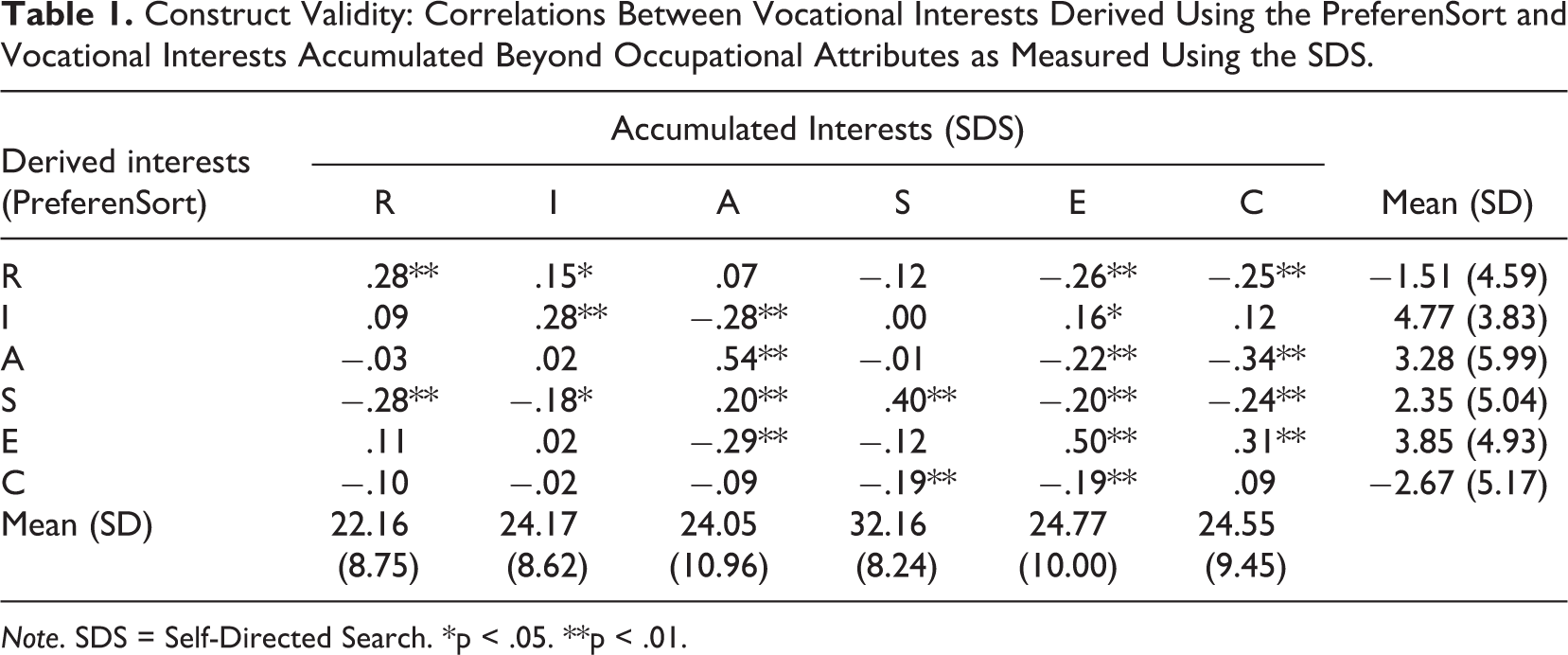
We used the MTMM approach to investigate the construct validity of the PreferenSort as an instrument that derives vocational interests. Table 1 presents the correlations between vocational interests derived using the PreferenSort and the vocational interests accumulated beyond occupational attributes using the SDS. The findings followed the hypothesized pattern (Hypothesis 1) for five of the six interests (all but the Conventional interest). Five of the six correlations on the main diagonal were significantly positive, ranging from .28 to .54 (all p < .01). Thus, the pattern of correlations indicates that the two interest instruments measure the same theoretical construct. The magnitude of the correlations, however, indicates that while the two measures have a similar meaning, they are not identical.
Construct Validity: Correlations Between Vocational Interests Derived Using the PreferenSort and Vocational Interests Accumulated Beyond Occupational Attributes as Measured Using the SDS.
Note. SDS = Self-Directed Search. *p < .05. **p < .01.
The findings further indicate the discriminant validity of the interests. For each of the five interests, the correlation between the two measures of the same interest is higher than any of the other correlations with that interest (i.e., all correlations in the same line or in the same column in Table 1). Thus, for example, the correlation between the Realistic interest as measured using the SDS and that derived from the PreferenSort is .28 (p < .01) indicating a sufficient convergent validity. It was also the highest correlation for the derived Realistic interest (correlations with I, A, S, E, and C as accumulated using the SDS are .15, .07, −.12, −.26, and −.25, respectively). Similarly, it was the highest correlation for the accumulated Realistic interests (correlations with I, A, S, E, and C derived using the PreferenSort are .09, −.03, −.28, .11, and −.10, respectively). This pattern emerged for the Realistic, Investigative, Artistic, Social, and Enterprising interests, providing supporting evidence for both convergent and divergent validity. The Conventional interest did not yield a significant convergence correlation (r = .09, ns). Instead, the derived Enterprising interest correlated strongly with the accumulated conventional interest (r = .31, p < .01). This deviation is discussed below.
Concurrent and Incremental Validity
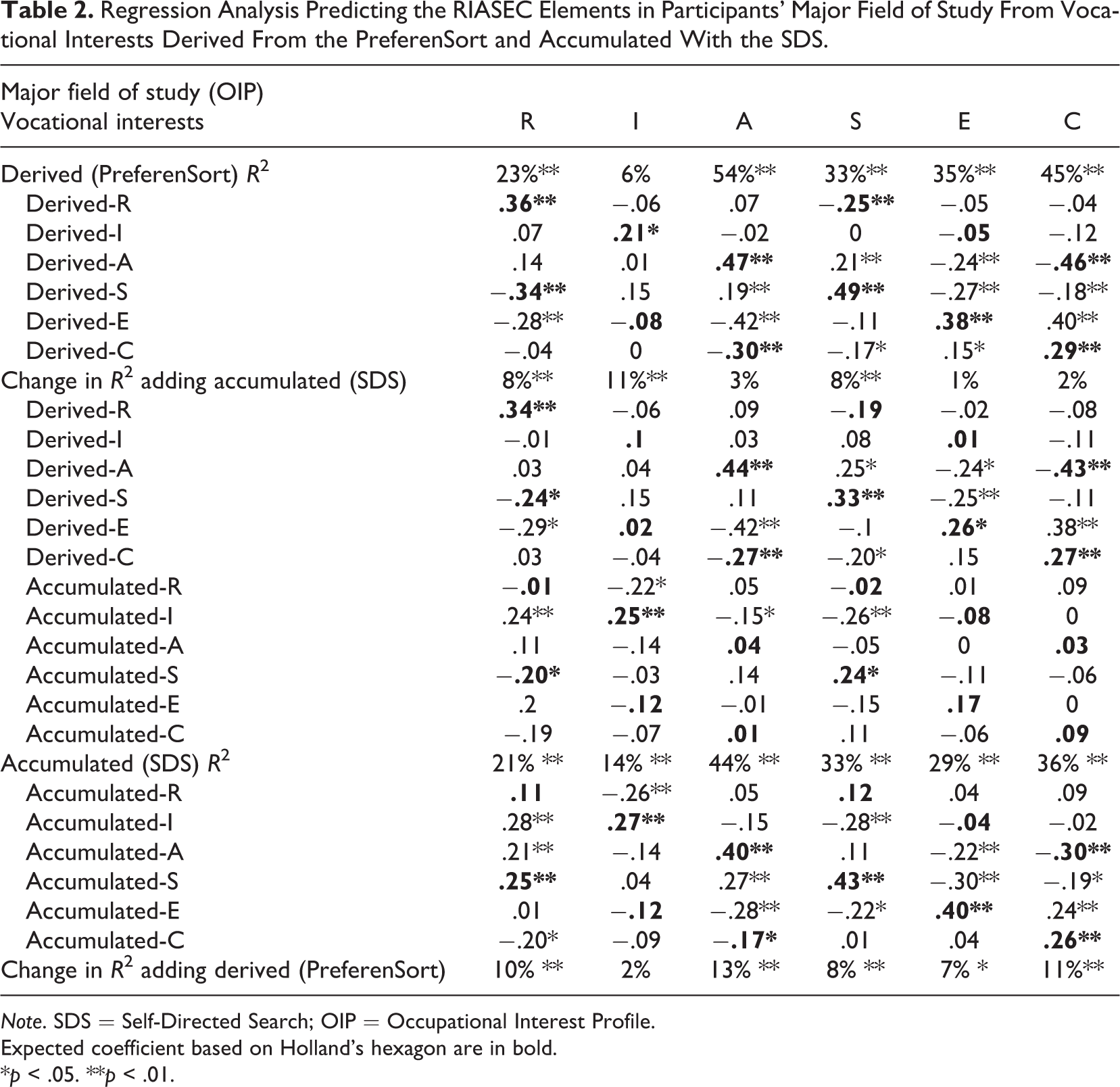
Assuming that individuals choose to major in areas that fit their vocational interests (Holland, 1985a), we hypothesized that the derived vocational interests would match the interests characterizing the field they chose to study. Each field of study was characterized by the appropriate O*NET OIP, which indicates its loading on each of the six interests (see above). We performed a series of regression analyses. The derived set of interests (PreferenSort) and the accumulated set of interests (SDS) served as the predicting variables. The dependent variable was the extent to which the field of study was loaded on a specific interest (The OIP of the field of study). Thus, we had six sets of regressions one for each of the RIASEC elements in the participants’ fields of study. Each set included two hierarchical regressions. In the first regression, the derived set of interests (PreferenSort) was entered first and the accumulated set of interests (SDS) second. This order was reversed in the second regression to investigate the unique contribution of derived over accumulated interests and accumulated over derived interests (see Table 2).
Regression Analysis Predicting the RIASEC Elements in Participants’ Major Field of Study From Vocational Interests Derived From the PreferenSort and Accumulated With the SDS.
Note. SDS = Self-Directed Search; OIP = Occupational Interest Profile.
Expected coefficient based on Holland’s hexagon are in bold.
*p < .05. **p < .01.
The findings indicate that the participants’ field of study can be predicted from the vocational interests derived by the PreferenSort with a substantial explained variance for five of the six work environments (explained variance of 23%, 6%, 54%, 33%, 35%, 45% for each RIASEC element). Predictions using interests accumulated based on the SDS were lower for four work environments (explained variance of 21%, 14%, 44%, 33%, 29%, 36% for each RIASEC element). Adding the derived interests beyond the accumulated interests increased the explained variance for most work environments (5/6), whereas adding the accumulated (SDS) interests increased the explained variance for only half (3/6) of the work environments.
All the regression coefficients of equivalent interests derived by the PreferenSort were significantly positive (6/6). In addition, for four work environments (Realistic, Artistic, Social, and Conventional), the coefficient of the opposite interest on the hexagon was significantly negative, as predicted. The accumulated interests (using the SDS) displayed a similar but somewhat weaker pattern (5/6 equivalent interests and 2/6 opposing interests were significant). Furthermore, the derived interests (PreferenSort) contributed significantly to the explained variance—above and beyond the accumulated ones (SDS)—for 5 of the 6 vocational interests (all but the Investigative interest), whereas the accumulated interests (SDS) added significantly—above and beyond the derived interests (PreferenSort)—for only 3 of the 6 interests.
In sum, in the current sample, the PreferenSort slightly outperformed the SDS, both in predicting participants’ current field of study (i.e., incremental validity) and in displaying a structure more compatible with the theoretical hexagonal RIASEC structure (i.e., concurrent validity).
Intuitive Decision-Making Style
In addition to the regression coefficients, the regression analysis provides the percent of explained variance in the regression model (R2). The greater the explained variance (R2), the more vocational interests determine the participants’ occupational preferences as expressed in the card sorting task. Thus, the greater the explained variance (R2), the more the participants’ occupational preferences are guided by their vocational interests. Low levels of explained variance indicate that the participants’ preferences depend less on differences in vocational interests among occupational alternatives and may reflect reliance on other criteria.
Overall, vocational interests seem to guide the participants’ preferences for the occupations in the PreferenSort. The mean explained variance (R2) of the individual regressions (one per participant) was 46% (standard deviation [SD] = 15%, ranging from 12% to 79%, median = 47%). To find out whether this is above and beyond random, we created 50 fake cases simulating participants’ giving random preference ratings (ranging from 0 to 100) to each of the 37 occupations. We then ran a separate regression analysis for each of these fake entries (with the random numbers as the dependent variable). The 50 regressions yielded a much lower explained variance, with a mean of only 18% (SD = 1%, ranging from 4% to 51%, median = 16%). Thus, overall, the linear regression model is highly predictive of individuals’ preferences among the 37 occupations.
Our findings further indicate considerable individual differences. The derived interests explained most of the variance in some people’s preferences (with the explained variance as high as 79%), whereas it explained a minimal amount of variance for others (with a minimal explained variance of merely 12%). To the extent that the PreferenSort is more suitable for individuals with an intuitive decision-making style, we predicted that intuitive individuals would express more solid preferences. Indeed, the higher the participants’ scores on the GDMS intuitive scale, the greater the amount of variance in their preferences explained by their derived interests (r = .19, p < .01, d = .39). The correlation was near 0 for the systematic decision-making style (r = −.04, ns).
Discussion
The PreferenSort is proposed as a new career counseling instrument that derives counselees’ vocational interests from their preferences among a set of occupational titles. Counselees are presented with 37 occupational titles, each listed on a separate card. They rank and rate the cards according to their preferences. The PreferenSort then derives the participants’ vocational interests using a separate regression analysis for each participant, in which the O*NET profiles of the occupations (the OIPs) are the six independent variables and the preference ratings are the dependent variables.
Construct and incremental validity were investigated by comparing the derived interests (using the PreferenSort) with the accumulated interests (measured by the SDS). The findings provide evidence for both convergent and discriminant validity for all but the Conventional interest. Concurrent validity was examined by predicting participants’ current field of study from their derived and accumulated interests (PreferenSort and SDS, respectively). The pattern of prediction resulting from the derived interests matched the hexagonal structure of vocational interests for most interests. Moreover, the PreferenSort contributed to the prediction of the participants’ major above and beyond the accumulated interests in five of the six work environments (all but the Investigative one; see below). Interestingly, the accumulated interests (measured by the SDS) contributed to the prediction of participants’ major above and beyond the derived interests in only three of the six work environments.
In addition, we showed that the O*NET occupation profile (i.e., the occupations’ characteristics in terms of Holland’s typology) explains a substantial amount of variance in participants’ ratings of their preferred occupations. As hypothesized, the explained variance was higher the more intuitive the participants’ decision-making style, indicating that the PreferenSort is more appropriate for counselees with an intuitive decision-making style.
To test for concurrent validity we focused on the participants’ major field of study. Individuals’ choice of major is influenced by various factors, with vocational interests being only one of them. Moreover, students’ commitment to their chosen major varies. Future studies could overcome this limitation by studying adults working in various occupations. Being an imperfect dependent variable, the choice of major provides a conservative test of the validity of the PreferenSort. The present study focused on students who had already made a career choice. The fact that they have already chosen their field means that our participants are not a typical group for career counseling interventions. Future studies could evaluate the PreferenSort among individuals who have not yet made their career choice.
The PreferenSort was designed as a computerized instrument that makes it possible to perform a regression analysis of each counselee’s responses and provides feedback on the importance of each interest as derived from the regression analysis. The study described in this article employed a paper-and-pencil version designed to test the validity of the PreferenSort. Since we did not know the validity of the instrument in advance, we did not provide the participants with feedback based on it. A computerized version of the PreferenSort, to be used as part of a face-to-face counseling session or serve as a self-help tool, will make it possible to provide the participants with personalized feedback regarding their derived vocational interests. Special caution should be taken in developing the personalized feedback to maintain its relevance for intuitive decision makers.
The Conventional Interest
The derived and accumulated Conventional interests were both predictive of participants’ choice of major (see Table 2 for the analysis of concurrent validity). However, the two measures were not correlated (see Table 1 for the analysis of construct validity). These intriguing findings may indicate that the derived and accumulated measures capture different aspects of the Conventional interest.
Alternatively, our findings may indicate that there is no clear distinction between Conventional and Enterprising occupations. A careful look at Tables 1 and 2 reveals that the accumulated Enterprising interest correlates with the derived Conventional one (see Table 1) and both the derived and the accumulated Enterprising interest predict participants’ Conventional major (see Table 2). Consistently, Amit and Sagiv (2009) found that people overlook the distinction between the Conventional and the Enterprising work environments. 4 Future research could further explore this issue. For example, varying the list of occupations included in the PreferenSort may serve to fine-tune the distinction between the derived Enterprising and Conventional interests.
The Investigative Interest
The PreferenSort contributed to the prediction of the participants’ major above and beyond accumulated interests (using the SDS) for all but the Investigative interest. Although both derived and reported measures predicted the Investigative element of participants field of study (β = .21 and β = .27 respectively, both p < .05), together they explained only 17% of the variance of this element, somewhat less that all other elements in the participants’ major (31–57%, see Table 2). The participants in this study were all university students with declared majors. Therefore, they are currently in a rather highly Investigative work environment. The variance in the Investigative interest of this sample is therefore likely to fall short of the variance in a more representative group. Future studies could investigate other groups, including those who have not yet chosen their major and hence are more typical of the target population for the new counseling tool.
Recent findings indicate that the Investigative work environment is consistently misperceived: people tend to overlook the Investigative nature of occupations, perceiving them in terms of their content. Consider the example of a physicist, an Investigative–Realistic occupation. In three studies (Amit & Sagiv, 2009), this occupation was perceived as a Realistic occupation. Similarly, economist, an Investigative–Enterprising occupation, was perceived as an Enterprising occupation. The consistent misperception of the Investigative work environment could explain why the PreferenSort (and the SDS) predict the Investigative work environment less well than other work environments.
The Explained Variance
In addition to deriving participants’ vocational interests, the PreferenSort provides a unique measure of the extent to which participants’ preferences are explained by vocational interests—the explained variance (R2). The higher the explained variance, the more the counselees’ occupational preferences are explained by their vocational interests. For some counselees, vocational interests play an important role in vocational choice. In our sample, vocational interests explained over 50% of the variance in the preference ratings among 39% of our participants. For other participants, vocational interests explained a very small amount of the variance in preference ratings. Future studies could further investigate the variation in the level of explained variance—testing, for example, if the vocational interests of those with a low explained variance are less consistent or less differentiated.
The explained variance may provide important information for counseling sessions. We found that it is somewhat higher among participants who prefer a more intuitive decision-making style. A discussion between the counselor and the counselee about how the latter performed the task could provide additional insight into counselees’ difficulties and help them obtain a better understanding of themselves, not only in terms of vocational interests (and other factors, such as values or abilities), but also in terms of their decision-making style.
The PreferenSort: Beyond Vocational Interests
As a self-help career counseling tool, the PreferenSort requires ranking and rating a set of occupations. This task encourages evaluating relevant information holistically—comparing occupations as a whole and considering trade-offs, without explicitly thinking about preferences for various attributes of occupations. The PreferenSort goes beyond existing card sort techniques (e.g., Missouri Occupational Card Sort (MOCS), Bikos et al., 1998) by providing each counselee with the full six interest profile based on Holland’s theory of vocational interests as well as computing the extent to which derived interests explain the preferences (R2) for that individual.
Since only a rather small number of occupations are used (compared to other card sorts), counselees are able not only to mark occupations they consider appropriate (as in the VPI) but also to rank and rate them. The ranking process encourages counselees to think about why they prefer one occupation over another, while the rating allows for a more fine-tuned derivation of their interests. Thus, although we based our analysis on the ratings of the occupations, we reason that the ranking task is essential for helping counselees progress in the decision-making process. We propose that thinking about one’s preferences may serve as a useful tool for progressing in current and future career-related decisions, by encouraging the creation of reflective feedback. Future studies may evaluate the usefulness of reflection for progressing in the decision process and the accuracy of subjective feedback based on reflection compared to objective theory-based feedback.
In this article, we presented the PreferenSort as a counseling instrument based on Holland’s theory of vocational interests. The notion of derivation, and the technique used, are not exclusive to vocational interests and can be extended to other theories of personality and work environment, such as Dawis and Lofquist’s (1976) theory of work values. The set of occupations might need refining accordingly, and a meticulous, complex description of the occupations must be obtained, but the same procedure may be used to derive counselees’ work values, using a holistic task.
Intuitive Decision Makers
Our findings indicate that the PreferenSort is somewhat more appropriate for individuals with an intuitive decision-making style. The amount of explained variance of the participants’ preferences was greater the more intuitive they were. This finding may indicate that highly intuitive individuals rely more on their vocational interests than less intuitive ones. It may also indicate that the PreferenSort allows intuitive individuals to form preferences that reflect their vocational interests. Either way, the more individuals’ occupational preferences are guided by their vocational interests, the more appropriate it is to use the PreferenSort for deriving these interests.
Discussing the role of rational and intuitive modes of career decision making, Krieshok, Black, and McKay (2009) suggest that rational/conscious thinking may provide a supplementary view of individuals’ career aspirations. They further review supportive evidence that intuitive thinking may reflect career preferences more authentically. The PreferenSort offers an opportunity to derive counselees’ vocational interests from their intuitive, holistic evaluations, without requiring them to be aware of their underlying decision processes. It could be of further interest to explore cases of incongruence between accumulated and derived interests, as has been done with expressed and measured (or inventoried) interests (see review in Spokane & Decker, 1999), and further explore the consequence of such incongruence. Do such individuals experience more difficulty in making a career decision or reduced satisfaction from their career choice? Exploring such cases could also shed light on which set of interests guides behavior more—accumulated, more conscious ones, or derived, more intuitive ones.
This research thus joins the recent trend in vocational counseling aiming at tailoring counseling schemes to counselees (e.g., Gati et al., 2010; Gati, Saka, & Krausz, 2001). We suggest that evaluating participants’ decision-making style might be useful as a preliminarily step in career counseling. It will allow counselors to adapt the appropriate counseling tool to their counselees’ personal attributes. We suggest that the PreferenSort has the potential to provide suitable counseling intervention for counselees who may find other self-help tools less appropriate for their preferred way of making vocational decisions.
Footnotes
Appendix
Acknowledgments
We thank Anat Bardi, Itamar Gati, Avi Kluger, Nimrod Levin, and Naomi Goldblum for their useful comments on earlier drafts of this article.
Authors’ Note
This research was conducted while the first author was a graduate student at the School of Business Administration, The Hebrew University of Jerusalem, Israel.
Declaration of Conflicting Interests
The authors declared no potential conflicts of interest with respect to the research, authorship, and/or publication of this article.
Funding
The authors disclosed receipt of the following financial support for the research, authorship, and/or publication of this article: This project was supported by the Recanati Fund of the School of Business Administration at the Hebrew University to the second author.