



Abstract
The most recent economic downshift demands that researchers gain a better understanding of the type of decisions individuals are making regarding work and the basis for those decisions. The state of the economy over the past few years warrants further examination, as the economic downturn has resulted in a dramatic shift in the availability of jobs in the workforce. The current study examined the impact of the economic downturn on the emotional and cognitive processing of individuals in regard to the decisions they make about work in two separate studies (N = 179 and N = 82), using two measures (Perceptions of Economy [POE] scale and Work Decisions scale) that allowed us to assess economic perceptions and work-related decisions quantitatively. Results indicated support for the instruments and that POEs account for 5% of the variance in work-related decisions.
Over the past years, the declining economy in the United States has captured worldwide attention. Media headlines continue to report on the personal and societal level impact of the recent recession. At the time of data collection for this study, national unemployment rates had increased from 6.4% in July 2008, to 9.5% in July 2009 and July 2010. While the rate has dropped to 8.2% in June 2012, this is still high compared to the unemployment rates prior to the economic recession (Bureau of Labor Statistics, 2012). Additionally, underemployment rates (this includes individuals who are unemployed but currently looking as well as part-time workers who are looking for full-time work) have also risen dramatically to 19.6%, which is the highest rate since April 1994 (Bureau of Labor Statistics, 2012). Thus, approximately every one in four individuals living in the United States is currently unemployed or underemployed. This rise in underemployment leads us to wonder if individuals in the workforce are less likely to make risky decisions to pursue promotions or to leave their current lower paying and lower prestige positions for higher paying jobs.
In this study, we address these questions and explore the factors that influence peoples’ work-related decisions and intentions in the face of an economic downturn. We explore whether the impact of the current recession increases their sense of commitment to their current employer or if the thought of unknown personal economic consequences prevents them from seeking better employment. Specifically, we examined the degree to which an individual is likely to discontinue tenure with their employer (turnover intentions [TI]), the degree to which an individual is both intrinsically and extrinsically satisfied with his or her job (job satisfaction), and the degree to which individuals embody positive attitudes toward their employer (organizational commitment). Further, we considered the degree to which individuals’ perceptions of the current economic state predicts the types of decisions they may make regarding their employment. For example, are people more or less likely to seek other employment, alter their work schedules, work longer hours, and so on, because of their perception of the economy (POE), or are there other factors that influence those decisions such as job satisfaction or organizational commitment?
Throughout the years, vocational psychologists have examined the many contextual variables that impact the career decision-making process of individuals at various stages throughout their career trajectory (Byars-Winston & Fouad, 2008; Duffy & Sedlacek, 2007; Fouad & Byars-Winston 2005a; Fouad et al., 2008; Houser & Garvey, 1983; Phillips, Jome, Walsh, & Savickas, 2005; Zhang et al., 2009). Researchers have argued for years that the consideration of various contextual influences leads to a better understanding of how people make career decisions, as well as more accurate empirical inspection within the vocational literature (Fouad & Kantamneni, 2008). Absent from the contextual literature is research that explains how an individual’s perception of an economic downturn influences his or her vocational decision-making process. This research study investigates how economic perceptions contribute to career or work-related decision making.
The Role of Context
According to Fouad and Kantamneni (2008), the context of one’s vocational choices involves the intersection of three levels of influence: individual factors, group factors, and societal factors. The individual-level includes factors such as interests, values, and abilities. This level embodies the traditional variables that have long been studied by vocational psychologists (Dawis & Lofquist, 1984; Holland, 1985; Lent, Lopez, Lopez, & Sheu, 2008; Nauta, 2007). The group level includes factors such as race, family influence, and religion. This level considers the immediate social environment and how it may influence an individual’s vocational decision-making process. Finally, the societal level includes factors such as cultural influences, discrimination, and institutionalized racism (Fouad & Kantamneni, 2008). Societal factors may include the traditions, mores, and values that shape a particular society’s world of work. In addition to each level of contextual influence, it is important for vocational psychologists to understand an individual’s perception of these personal, group, and societal level influences, and the effect those perceptions have on the vocational decision-making process of the individual (Fouad & Kantamneni, 2008).
In this model, it is the interaction of the three levels of influence that guides an individual’s vocational decision-making process. This interaction emphasizes the complex nature context plays in an individual’s vocational development (Fouad & Kantamneni, 2008). Fouad and Kantamneni’s (2008) theoretical model is derived from Bronfenbrenner’s Ecological Development model (Bronfenbrenner, 2004), which posits that an individual’s development is comprised of multiple layers of influence, including the microsystems (individual influences), macrosystems (cultural-level influences), mesosystems (group-level influences), and exosystems (larger societal levels of influences). According to Fouad and Kantamneni’s model, these layers interact in a complex and dynamic integration, helping to explain how contextual factors interrelate and influence the meaning of vocational decisions. These interactions include the intersection between the individual and group levels, the individual and societal levels, the group and societal levels, and the collective intersection between the individual, group, and societal levels. The state of the economy over the past few years is a particularly relevant societal factor that warrants further examination, as the economic downturn has impacted the availability of jobs in the workforce.
Work Decisions and Outcomes
Research on career- and work-related decisions are essential because of their link to work-related outcomes for the individual employee, which in turn influence the organization for whom the employee works (Earl & Bright, 2007). Studies have found relationships between job satisfaction and work decisions (Chartrand & Walsh, 1999), organizational commitment and work decisions based on met expectations at work (Wanous, Poland, Premack, & Davis, 1992), and job satisfaction and organizational commitment predicting TIs (Currivan, 1999; Horn & Griffeth, 1995). While it is important to uncover these associations, the factors previously studied reflect work decisions made from an individual level of analysis. These factors do not take into account the group-level and societal level influences that could be impacting work decisions.
Anecdotal evidence through interviews, stories, and blogs inviting citizens to share how they have been impacted by the recent economic recession prevail throughout the media. A recent article in the New York Times (Norris, 2011) highlights the relationship between economic downturn and work decisions, specifically detailing how low turnover rates have enhanced the long-term unemployment problem. In fact, this article reports that since 2007, 13 million fewer workers have switched jobs than would be expected, and these individuals may be experiencing frustration, dissatisfaction, or a sense of stagnation. These news headlines reveal the degree of emotional turmoil that concerns about the economy have had on people. Sampson, Reardon, Peterson, and Lenz (2004) assert that career decisions are influenced by both emotional and cognitive processes within an individual. Based on this assertion, Bullock-Yowell, Peterson, Reardon, Leierer, and Reed (2011) found that life stressors can elicit both emotional and cognitive reactions, and thus significantly influence an individual’s career decision-making process.
The current study examines the impact of a societal level stressor, the economic downturn, on the emotional and cognitive processing of individuals in regard to the decisions they make about work. This research consists of two separate studies in which we developed and assessed the validity of two measures that allowed us to assess economic perceptions and work-related decisions. We then explored how perceptions of the most recent economic downshift may influence individuals’ implementation of work-related decisions among graduate students and employed adults. We examined how economic perceptions affect overall life satisfaction, job satisfaction, intentions to leave, and commitment to place of employment. Specifically, we will address the following research questions:
Study 1: Scale Development, Reliability, and Validity
Method
Participants
Participants were 179 individuals who are working either full time or part time. Of the total, 80 were male, 94 were female, and 5 did not report their gender. The average age of participants was 31.47 with a range from 21 to 60. In terms of racial/ethnic identification, 137 (77%) participants identified as White, 11 (6%) identified as African American, 11 (6%) identified as Asian American, 5 (3%) identified as Latino/Latina, 5 (3%) as Multiracial (3%), 1 (1%) as Native American, and 4 (2%) Other. Five participants in the sample did not provide information about their racial/ethnic identification. Regarding highest level of education, 56% of the participants had a bachelor’s degree, followed by 36% with a master’s degree, 2% with a doctorate degree, and 3% with a high school degree. Five participants did not provide educational information. Regarding family income level: 7% reported income less than 20K, 15% between 20K and 40K, 13% between 40K and 60K, 16% between 60K and 80K, 11% between 80K and 100K, 10% between 100K and 120K, 9% between 120K and 140K, 5% between 140K and 160K, 5% between 160K and 180K, and 5% reported family income greater than 180K. Six participants did not offer family income information.
Measures
Demographics Questionnaire
Participants completed a demographics questionnaire that assessed for age, gender, race/ethnicity, education level, family income level, and social class. Social class in this study was examined by having participants self-identify a class group (e.g., lower middle class, middle class, upper middle class, etc.) with which they perceive themselves to belong in rather than determine social class based on participants’ income level. Some researchers have argued that similar to race, gender and other self-identifying variables, providing individuals the opportunity to self-identify class status appears to be a more accurate reflection of one’s internal experiences and the life choices that are made based on those experiences (Liu, Soleck, Hopps, Dunston, & Pickett, 2004).
Perception of the Economy Scale
The POE was conceived by the research team based on discussions team members had regarding the global financial crisis that started in 2008. These conversations occurred during the beginning of the current economic recession, when financial institutions crumbled, resulting in housing market crashes, foreclosures, bank bailouts, and downturns in stock markets around the world. Initially, members informally shared how the economic downturn has impacted each of us personally. Our educational institution was not spared from the global crisis as there were pay cuts to faculty salaries, mandatory furloughs, and a decrease in available funding for students. While there was general agreement that the economy has taken a downward turn, the degree that it had impacted each member of the research team differed. This in turn affected how each of us utilized resources and planned for the future. Thus, members became interested in how to systematically measure the degree one has been impacted due to economic conditions. The group was also interested in assessing the economic recession as part of the third dimension of Fouad and Kantamneni’s (2008) contextual model, described earlier.
The initial set of items was developed based on a literature review of contextual influences on career development as well as media reports of current economic challenges in the United States. A list of items was generated from each research team member individually. These statements were then reviewed as a team and consolidated to make up a set of items. The initial scale included 26 items assessing changes in an individual’s spending behavior based on perceptions about current economic conditions on a 6-point Likert-type scale (1 = strongly disagree to 6 = strongly agree). Items included statements such as Gas prices have affected the way I travel, I am worried about securing credit for purchases, and I am trying to use resources longer rather than buying new. The items are worded such that higher scores reflect poorer POEs.
Work Decisions Scale
The Work Decisions Scale (WDS) was also constructed by the research team in response to a literature search that generated limited information regarding employees/workers’ willingness to make job-related changes. Most of the vocational literature examining career decision-making attitudes focuses on the decisions made by college students prior to actually entering the workforce. Little is known about the process by which working adults make career or work-related decisions. Thus, the initial set of items for this scale was developed based on a review of the literature on work decisions and how they are measured. The available research indicated that the concept of work decisions has generally been measured by examining TIs (Currivan, 1999; Horn & Griffeth, 1995) and work expectations (Wanous et al., 1992) based on job tasks. Most researchers overlooked components such as work hours, work schedule, and travel time to work that may be pertinent to individuals, particularly as the economic recession has led to furloughs, changes in schedules due to work hours being reduced and concerns over travel due to rising gas prices.
Similar to the POE, research team members each came up with a list of statements individually regarding any work-related decisions that could be impacted due to the economy. These statements were then reviewed as a team and consolidated to make up the initial set of work decision-making items. The initial scale consisted of 11 items that measure an individual’s attitude toward willingness to take risks or make compromises in regard to work based on a 6-point Likert-type scale (1 = strongly disagree to 6 = strongly agree). Items include statements such as I am willing to alter my work hours to keep my job, I have considered working more hours to meet my financial need, and I feel I can begin looking for a new job and be confident that I will find a suitable one. The items are worded such that higher scores reflect greater confidence and willingness to take work-related risks.
Satisfaction With Life Scale (SLS)
The SLS (Diener, Emmons, Larsen, & Griffin, 1985) consists of 5 items using a 7-point Likert-type scale (1 = strongly disagree to 7 = strongly agree) and measures cognitive judgments of how satisfied an individual is with his or her life. Items are summed and a mean score calculated. Higher scores indicate greater satisfaction with life. The SLS was initially normed using a college student sample with an α reliability of .87. The measure has subsequently been validated for use with diverse populations, including working adults (e.g., George, 1991). The internal reliability of the SLS is .86 for the current sample of participants.
Turnover Intentions
The TI scale (Kelloway, Gottlieb, & Barham, 1999) consists of 4 items based on a 5-point Likert-type scale (1 = strongly disagree to 5 = strongly agree) and evaluates the degree an individual is thinking about leaving an organization. Items are summed and a mean score calculated. Higher scores indicate greater intentions to leave the organization. The reliability of the scale was determined on employees. The measure demonstrated good internal consistency as the Cronbach’s α reliability ranged from .92 to .93 in two samples (Kelloway et al., 1999). The internal reliability of the TI in this current participant sample is .93. Kelloway, Gottlieb, and Barham (1999) demonstrated that TI was predicted by stress and work–family strain.
Global Job Satisfaction Scale (GJS)
The GJS (Warr, Cook, & Wall, 1979) is a 15-item measure based on a 6-point Likert-type scale (1 = extremely satisfied to 6 = extremely dissatisfied) and measures the degree an individual is satisfied with various aspects of his or her job. Eight items assess extrinsic satisfaction and seven assess intrinsic satisfaction. Items are summed for the overall satisfaction and subscales and mean scores calculated. Higher scores denote greater overall satisfaction with work. The reliability of the scale was determined on adult workers (Abraham & Hansson, 1996; Norman, Collins, Conner, Martin, & Rance, 1995; Warr et al., 1979) and ranged from .81 to .91. The overall GJS demonstrated good internal reliability with a Cronbach’s α of .90 for this current sample. In support of the validity of the GJS, Winefield, Winefield, Tiggemann, and Goldney (1991) found that the GJS significantly discriminated satisfied and dissatisfied employees on measures of well-being. Abraham and Hansson (1996) found that the GJS correlated negatively with job tension and Norman, Collins, Conner, Martin, and Rance (1995) found the GJS correlated positively with satisfaction with pay and perceived competence.
Consumer Confidence Index (CCI)
The CCI (Colin, 2008) consists of 5 items on a 3-point Likert-type scale (1 = negative, 2 = neutral, 3 = positive) and measures the degree of optimism consumers have on the state of the economy. Items are summed and a mean score calculated. Higher scores indicate greater confidence/optimism in the economy. The reliability of the scale has been validated with numerous populations including a large Michigan-based sample that Merkle, Langer, and Suassman (2003) examined. The Cronbach’s α for the Michigan sample was .91. The internal reliability of the CCI was adequate at .73 for the current sample of participants.
Organizational Commitment Scale (OCS)
The OCS (Balfour & Wechsler, 1996) consists of 9 items on a 7-point Likert-type scale that measures the degree an individual feels positively toward the organization in which he or she is employed. Items are summed and a mean score calculated for three subscales: (1) affiliation (pride) with the organization, (2) identification with the organization, and (3) satisfactory exchange with the organization (feeling appreciated by the organization). Higher scores denote greater commitment to the organization. The reliability of the scale was determined on public sector workers (Balfour & Wechsler, 1996). The measure demonstrated good internal consistency as the Cronbach’s α reliability ranged from .72 to .83 across the three subscales. The internal reliability of the subscales was .80 for identification commitment, .76 for affiliation commitment, and .73 for exchange commitment in this study. Kacmar, Carlson, and Brymer (1999) found support for the three factors of organizational commitment and demonstrated that affiliation commitment was more highly related to job involvement than the other two types of commitment.
Procedure
Participants were recruited from graduate-level courses in the business school of a university in the Midwest. Researchers contacted the instructors teaching these courses to gain their approval to distribute the survey (paper-and-pencil format) in their classes. Participants who agreed to complete the survey signed an informed consent acknowledging that their participation was voluntary and anonymous. Some participants who completed the survey received extra credit from the instructor.
Results
Exploratory Factor Analysis and Internal Reliability
The final items of the POE and WDS instruments were identified through a combination of principal components factor analysis with varimax rotation and reliability analysis of the internal consistency of items by identified factors. Since the POE and WDS are newly created measures, an exploratory factor analysis was used to explore the underlying factor structure of the new instruments without imposing a predetermined structure on the outcome. Factor analysis of the POE resulted in seven components with eigenvalues greater than 1, ranging from 1.01 to 6.75. These components were then examined based on the following characteristics: (1) a minimum factor coefficient loading of .40 (Guadagnoli & Velicer, 1988), (2) a minimum of 3 items per factor, (3) each item did not also load on another component with a difference smaller than .20, and (4) the items in the component were interpretable (Tabachnick & Fidell, 2001). Two components were identified and accounted for 37% of the total variance. The first component consisted of 9 items, while the second component had a total of 6 items. However, the items in both components address financial spending, with no clear distinctions between the two factors. Thus, the decision was to retain these 15 items as the full POE scale without subscales. The internal consistency reliability of the POE was .81. The items are listed in Table 1.
Items for the Perceptions of the Economy Scale.
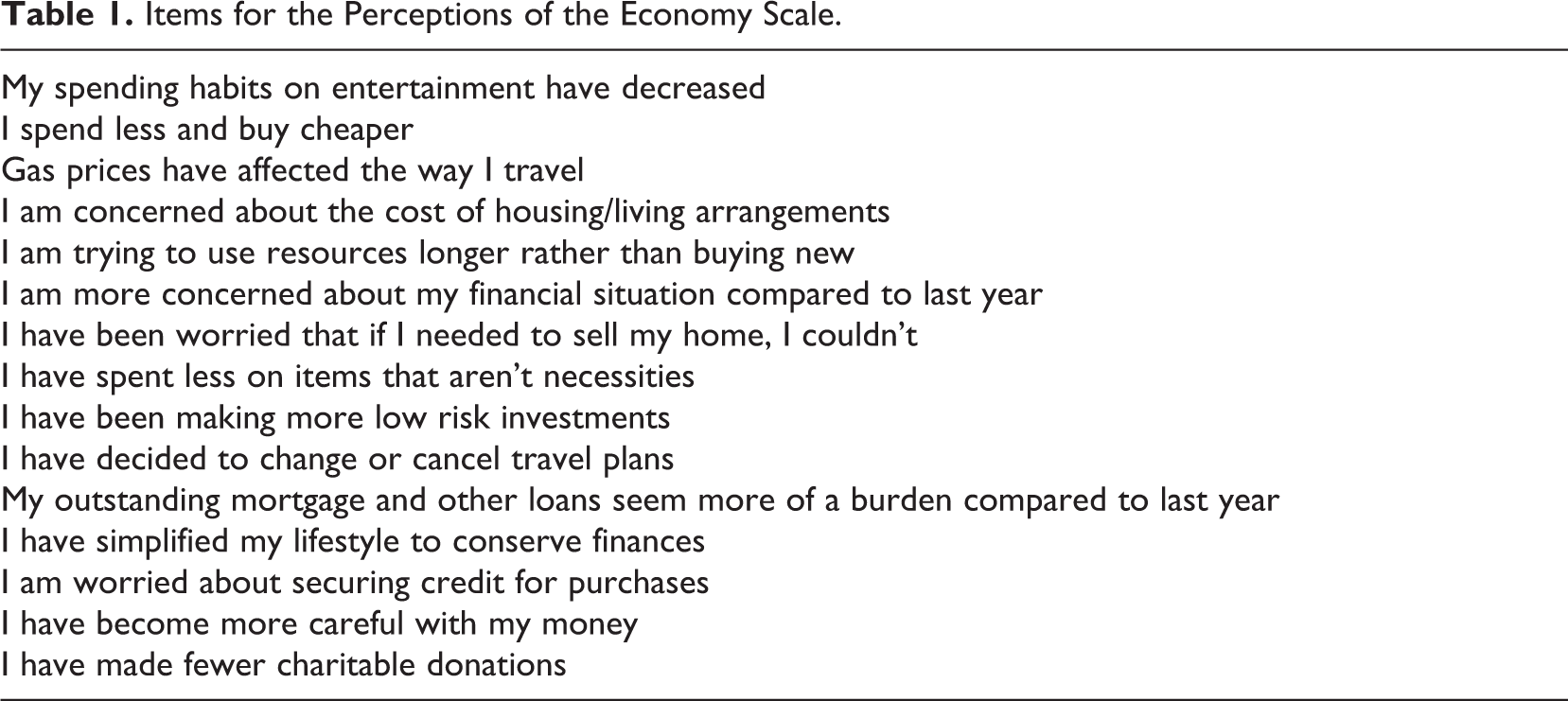
For the WDS items, a factor analysis resulted in four components with eigenvalues greater than 1, ranging from 1.01 to 3.14. None of the components, except for 1, had at least 3 items that solidly loaded onto one factor. Rather than retaining just 3 items for the scale, the decision was made to conduct a reliability analysis that included all 11 items. The initial reliability estimate was fairly low at .67. However, deleting 3 items increased the internal reliability to .77. Thus, the decision was to retain the remaining 8 items as the full WDS scale without subscales. The final set of items are in Table 2.
Items for the Work Decisions Scale.

Preliminary Analyses
Analyses of skewness and kurtosis were conducted for all instruments used in the study; all were in the normal range. The means and standard deviations for each scale are presented in Table 3, as are the reliability results for each scale. All scales evidence acceptable internal consistency. Overall, the participants are relatively satisfied with their job, have pride in and are committed to their organization, and have a sense of well-being. They are neutral when asked if they intend to leave that job, neutral when asked if they are willing to take risks in work decisions, but have somewhat poor POEs (recall that the data were collected in 2010–2011). Analyses of variance on all of the scales were conducted to examine any differences among the participants on the basis of gender, age, race, education level, social class, and family income with an a priori probability level of .01 set to account for experiment-wise error rate. No significant differences were found except for social class. There were significant differences between working poor and those of middle-, upper-middle-, and upper-class participants on POEs, F(6, 161) = 3.997, p = .001, and on subjective well-being, F(6, 161) = 5.76, p < .001. Those who identified themselves as working poor had poorer POEs and a lower sense of well-being.
: Means, Standard Deviations, and Intercorrelations of Study 1 Variables.
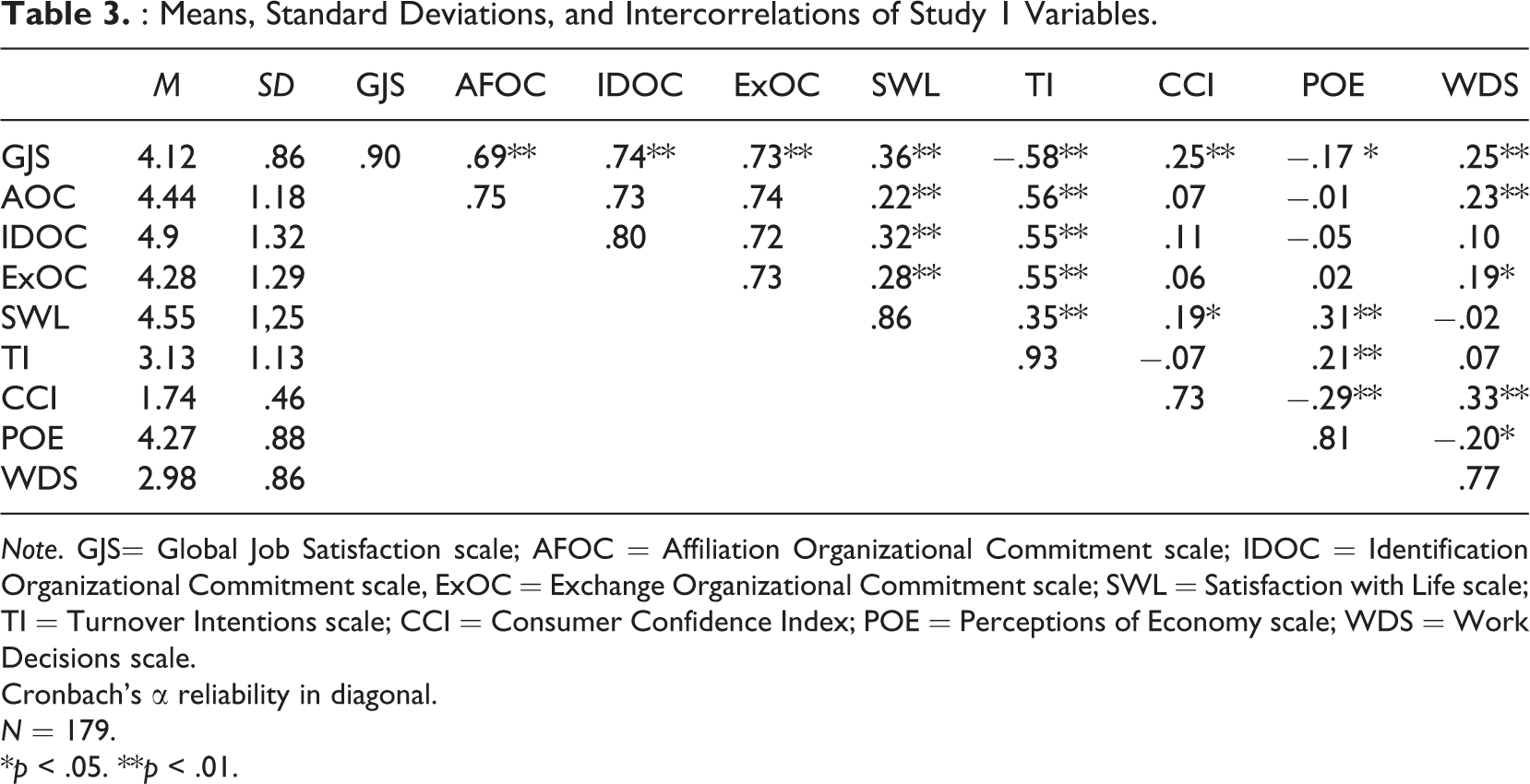
Note. GJS= Global Job Satisfaction scale; AFOC = Affiliation Organizational Commitment scale; IDOC = Identification Organizational Commitment scale, ExOC = Exchange Organizational Commitment scale; SWL = Satisfaction with Life scale; TI = Turnover Intentions scale; CCI = Consumer Confidence Index; POE = Perceptions of Economy scale; WDS = Work Decisions scale.
Cronbach’s α reliability in diagonal.
N = 179.
*p < .05. **p < .01.
Construct Validity
The final 15-item POE and 8-item WDS were used to examine construct validity of the measures. Table 3 presents the correlations among the study variables. The reliability of each scale is presented in the diagonal. Based on the first research question, we expected to find the POE to negatively correlate with consumer confidence, job satisfaction, life satisfaction, TIs, and work decision risk and positively correlate with the three types of organizational commitment. Convergent validity of the POE was supported as poorer POEs (higher scores) were significantly correlated with lower consumer confidence (r = −.29, p < .001), lower job satisfaction (r = −.18, p < .03), and lower life satisfaction (r = −.33, p < .001). However, no relationship was found between POEs and aspects of organizational commitment and an opposite association was found between POEs and TIs (r = .20, p < .01).
For the WDS, we expected to find the scale to positively correlate with job satisfaction, organizational commitment, and consumer confidence. Convergent validity of the WDS was supported as greater confidence or risk in making work decisions was significantly correlated with greater job satisfaction (r = .26, p < .001), greater affiliative (r = .23, p < .001), and exchange organizational commitment (r = .19, p < .02), and higher consumer confidence (r = .33, p < .01).
We also expected that there would be a negative relationship between POEs and work decision-making confidence and risk. This association was also supported as a poorer POE was related to lower work decision-making confidence and risk (r = −.22, p < .01).
Regression
A two-step hierarchical linear regression was conducted to answer the second and third research questions about organizational variables and POEs and work decision-making risk (Table 4). The framework for these research questions stemmed from Fouad and Kantanmeni’s (2008) model that individual-, group-, and societal level factors combine to influence career development. Since most vocational research focuses on individual- and group-level factors, the purpose of this study was to determine how the societal level factor of economic perceptions uniquely contributes to decision made about work, after controlling for individual-level factors. Thus, TIs, job satisfaction, and organizational commitment subscales were entered in Step 1 of the regression model. As a group, the three variables significantly accounted for 18% of the predictive variance in work decision-making confidence and risk (F = 7.74, p < .001). TIs (β = .39) and GJS (β = .45) were significant predictors (p < .001). To determine whether the societal level variable of the economy predicted work decision making on top of the individual-level variables, POE was entered in Step 2 of the model and significantly accounted (β = −.23) for an additional 5% of the variance in work decision-making confidence and risk, over and above TIs, job satisfaction, and organizational commitment (F = 8.32, p < .001).
Study 1 Hierarchical Multiple Regression.
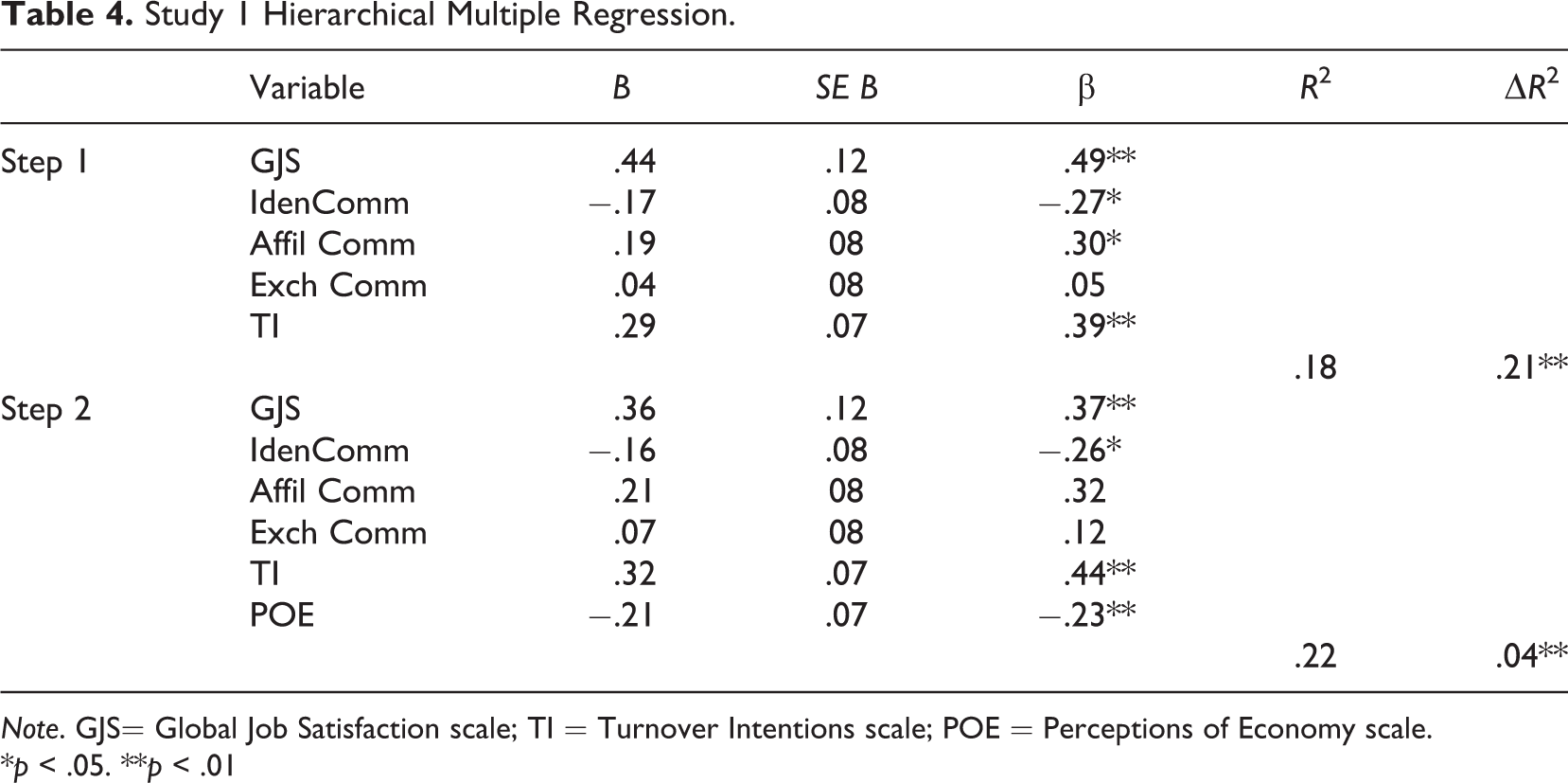
Note. GJS= Global Job Satisfaction scale; TI = Turnover Intentions scale; POE = Perceptions of Economy scale.
*p < .05. **p < .01
Study 2: Further Validation of the Refined POE and WDS
Study 2 was designed to include a group of working individuals to address the limitation inherent in sampling a group of students. Rather than a battery of surveys and to reduce the survey load, participants were asked a series of short questions about their job, organization, and career commitment and satisfaction.
Method
Participants
Participants included 82 full-time working adults. Of the total participants, 10 (12%) were male and 72 (88%) were female, with a range in age from 24 to 65. The racial/ethnic breakdown of participants included 74 (90%) Whites, 4 (5%) African Americans, 1 (1%) Latino, and 3 (4%) Asian Americans. Educationally, the majority of participants reported having a bachelor’s degree (45%), followed by a master’s degree (40%), associate’s degree (7%), high school diploma (5%), and doctorate/professional degree (2%). In terms of social class identification, 63% identified as being upper-middle class, 29% lower-middle class, 7% working class, and 1% upper class.
Procedure
Participants were recruited from a local leadership conference in a large urban city in the Midwest. Researchers contacted a presenter at the conference who agreed to announce the research study to conference attendees. Attendees were provided information to the website which hosted the study.
Measures
Participants completed a demographics questionnaire at the beginning of the survey which asked about age, gender, race, education level, and social class. As in Study 1, participants completed the 15-item POE scale, 8-item WDS, and the SLS. Reliability results for this group of participants for these scales were .90, .77, and .92, respectively.
Work Satisfaction and Commitment
Work satisfaction was assessed with three 5-point Likert-type scale 1-item questions asking participants’ satisfaction with their job, organization, and career with the item All things considered, how satisfied are you with your current job [organization], [career]? The use of 1 item to measure satisfaction has been found to capture participants’ overall global satisfaction with their work, rather than their satisfaction with facets of their work (Dolbier, Webster, McCalister, Mallon, & Steinhardt, 2005; Patrician, 2004; Wanous, Reichers, & Hudy, 1997). The 3 items were combined into an overall satisfaction with work, with a reliability of .82. Similarly, 3 items were used to assess participants’ overall commitment to their job, organization, and career. The 3-item work commitment scale had an internal consistency reliability of .74.
Likelihood to Change or Stay in Current Job
Participants were also asked to indicate on a 5-point Likert-type scale Once the U.S. economic recession is over, how likely are you to stay (or change) your current job, organization or career? Three items related to career change were combined into a Likelihood to Change scale (α = .89) and the 3 items related to staying in their current job, organization, or career were combined in to a Staying scale (α = .87). The means for the participants indicated that they were fairly committed (M = 4.2) to their work and not likely to change (M = 2.7).
Results
Preliminary Analyses
Analyses of skewness and kurtosis were conducted for all instruments used in the study; all were in the normal range. The means and standard deviations for each scale are presented in Table 3, as are the reliability results for each scale. All scales evidence acceptable internal consistency. Overall, analyses of variance on all the scales were conducted to examine any differences among the participants on the basis of gender, age, and race, education level, social class, and family income with an a priori probability level of .01 set to account for experiment-wise error rate. No significant differences were found except for social class. There were significant differences between working poor and those of middle-, upper-middle-, and upper-class participants on work decisions, F(4, 77) = 3.77, p = .001, but not on POEs.
Confirmatory Factor Analysis and Internal Reliability
Two confirmatory factor analyses with varimax rotation were conducted to confirm the one-factor structure for each scale. Similar to Study 1, factor solutions were based on an examination of the scree plots, a minimum of 3 items per factor, having eigenvalues greater than 1.0, a minimum factor coefficient of .40 for each item, and interpretation of the factors (Guadagnoli & Velicer, 1988; Tabachnick & Fidell, 2001). For the POE scale, the same 15 items that comprised the one factor in Study 1 accounted for 45% of the variance in the scale with an eigenvalue of 6.6. The internal consistency reliability of the POE obtained from Study 2’s sample of full-time working adults was higher compared to findings in Study 1 at .90. For the WDS scale, the same 8 items that comprised the one factor in Study 1 accounted for 41% of the variance in work decisions with an eigenvalue of 3.3. The internal consistency reliability of the WDS in Study 2 was consistent with those obtained from the sample in Study 1, with the α reliability remaining the same at .77.
Construct Validity
Further validity evidence was found between economic perceptions, work decision-making risk, and satisfaction with life. Poorer economic perceptions were significantly correlated with lower work decision-making risk (r = −.27, p < .02), lower life satisfaction (r = −.35, p < .001), and work satisfaction (r = −.23, p < .05; Table 5). Furthermore, greater willingness to take risks in regard to work decisions significantly correlated with higher life satisfaction (r = .27, p < .02). Individuals’ POEs were positively correlated with the notion that once the recession was over, they planned to change work setting (r = −.35, p < .002).
Means, Standard Deviations, and Intercorrelations of Study 2 Variables.
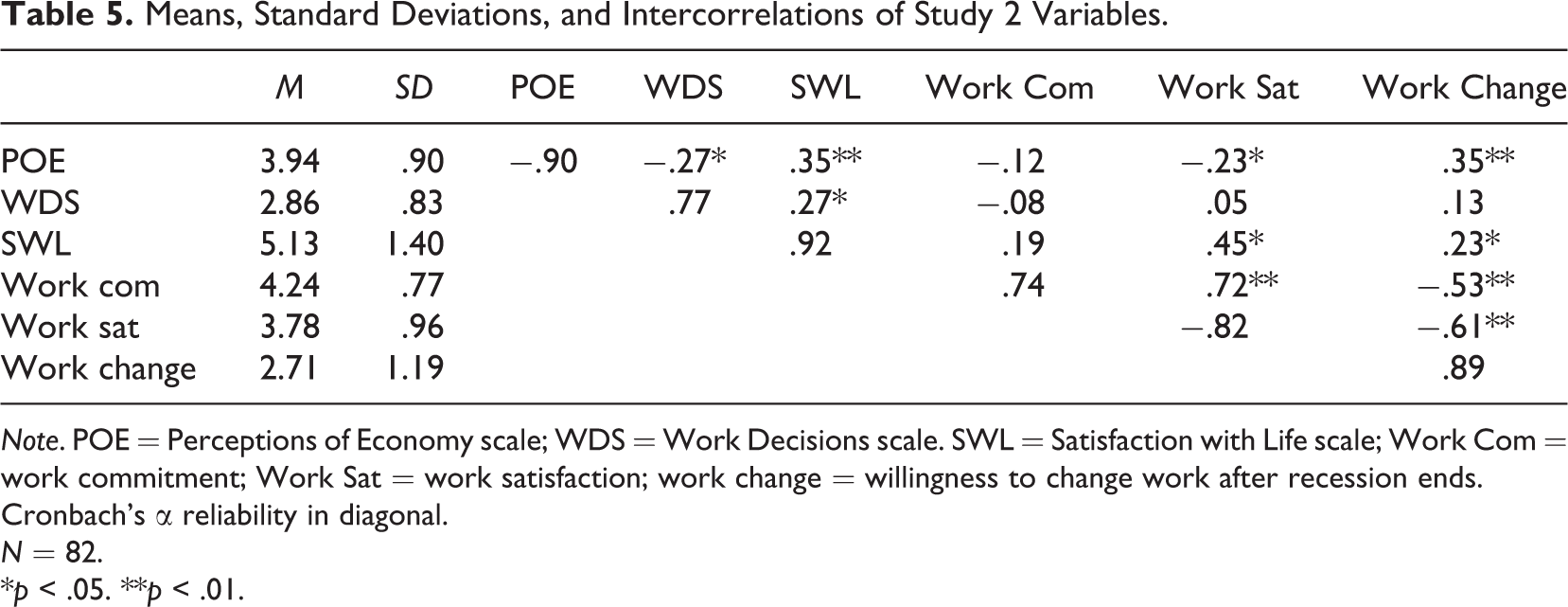
Note. POE = Perceptions of Economy scale; WDS = Work Decisions scale. SWL = Satisfaction with Life scale; Work Com = work commitment; Work Sat = work satisfaction; work change = willingness to change work after recession ends.
Cronbach’s α reliability in diagonal.
N = 82.
*p < .05. **p < .01.
Discussion
The purpose of this research was to examine how POEs may influence individuals’ decisions about work. Specifically, two scales were developed and validated by the authors: the POE scale and the WDS. Two separate studies were conducted in order to examine the reliability and validity of these scales, along with their relationships to other relevant constructs. The main findings of this research are discussed below, along with study limitations, and implications for research and practice.
This study led to the creation of two scales: the POE and the WDS. The POE is a measure of the degree to which a person has changed or adjusted their spending behaviors, based on their perception of the state of the economy (e.g., “Because of the economy, over the past year I have been saving more and spending less”). The WDS is a measure of confidence and risk taking in regard to work decisions (e.g., “I feel I can begin looking for a new job with confidence that I will find a suitable one”). Both scales displayed adequate internal consistency and construct validity. As expected, poorer POEs were directly related to lower consumer confidence, lower job satisfaction, and lower life satisfaction. Higher risk in making work decisions was directly related to greater job satisfaction, greater organizational commitment, and higher consumer confidence.
The development of these scales highlights the relationship between societal level variables and job attitudes, as suggested by Fouad and Kantamneni (2008), as well as the relationship between societal level variables and overall well-being. Individuals with poorer POEs were less likely to be willing to take risks in regard to work. In addition, both POEs and lower decision-making risks were related to less satisfaction with life. These findings are in line with a 2008 Gallop Healthways poll that examined how emotional well-being shifts with economic changes. According to this research, throughout 2008, individuals’ emotional health steadily declined in correspondence with the economic downturn. Reports of happiness were lowest on days when dire news was released, such as the Dow plunging (Mendes, 2010).
Given the current state of the economy in the United States, the development of these scales seems particularly timely. Stories in the media (e.g., Norris, 2011) have highlighted how economic downturn may lead to less risky work decision making, including low turnover rates. We believe the WDS could be used to clarify the specific factors that deter individuals from making these decisions (e.g., inability to find a new position, lack of options, etc.). Interestingly, results from Study 1 indicated a positive association between poor POEs and TIs, although this relationship was weak. This finding was contrary to our original expectation that TIs would be negatively correlated with poorer POEs. Perhaps, this is indicative of decreasing rates of job satisfaction and engagement sometimes associated with economic downturn (Love, Tatman, & Chapman, 2010; Matz-Costa, Pitt-Catsouphes, Besen, & Lynch, 2009). Individuals may have the desire to leave their current position, leading to increased TIs, but the opportunity may not actually be available for them to do so.
A limitation of this research was the use of convenience sampling. Participants were recruited from graduate-level business courses (Study 1) and a leadership conference (Study 2), which resulted in a primarily White, female, highly educated, upper-middle-class pool of participants. It seems apparent that POEs, and associated work decision making, may vary greatly in relationship to one’s socioeconomic status (SES) and/or cultural background. Therefore, both the POE and the WDS require additional validation in a larger, more representative pool of workers. Future research should focus on a larger sample, preferably with greater racial/ethnic representation and a greater range of SES. A second limitation involves the reduction of items from both scales during Study 1. While shortening the POE and WDS led to more streamlined, internally consistent scales, it also limited the comprehensiveness with which we could assess the constructs of interest. The lack of viable factor solutions for both the POE and the WDS suggests that the items that were created for each scale appear to be measuring one latent construct. Perhaps, additional latent constructs exist that were not captured from our conceptualization of the ways to go about measuring economic perceptions and work decisions. Future research should further explore and expand on new approaches to assess these constructs.
In addition to further validation of the scales, we believe there are a number of other research areas that could be examined in the future. One area includes examining the role of anxiety or other forms of distress in the relationship between POE and SWL. Various articles and news reports (e.g., Elias, 2009; Zivin, Paczkowski, & Galea, 2011) suggest that economic downturn is associated with emotional distress. Future research could examine the possible mediating role certain forms of distress may play in the relationship between POE and SWL.
In addition, we believe more research is needed to clarify the relationship between POE and TIs. While the present research found a weak positive relationship between poor POE and turnover intent, previous research and articles in the media suggest the opposite to be true (e.g., De Kuyper, Mauno, Kinnunen, & Makikangas, 2011; Griffeth, Steel, Allen, & Bryan, 2005; Norris, 2011). Perhaps a larger, more representative sample could provide clearer evidence of this relationship. In addition, it would be helpful to examine individuals’ perceived marketability in comparison to others, which may moderate the relationship between POE and TIs.
We believe that both the POE and the WDS are of value to career practitioners. Career counselors can use these measures to assess clients’ feelings toward the economic downturn and their confidence in pursuing their career goals. In addition, these measures can be used as a starting point to assess a range of important issues, such as clients’ levels of financial stress, hopelessness regarding career options, or feelings of stagnation. These scales could be especially useful for work with less privileged, lower SES populations, who may be particularly affected by the economic downturn. Career counselors can use answers to the scale items as a starting point to discuss these clients’ most salient career barriers that should be addressed in counseling. Answers can also provide insight into dysfunctional versus realistic career thoughts related to POEs, which counselors should help clients challenge and adapt as needed.
While career counselors should certainly take a realistic standpoint regarding the additional barriers the economic downturn can bring to career development, we also believe counselors can assist clients in feeling more hopeful and in control of their career path. For example, when clients report particularly low scores on the WDS, counselors may want to instill hope in clients that they can still work toward their career goals. Interventions with this aim could include helping clients build self-efficacy in job search–related skills, shifting expectations from the perception that the organization will manage one’s career to career self-management, and helping clients identify manageable goals and develop pathways to attain them. In addition, career counselors should assist clients in developing other coping resources that may serve to buffer the stress associated with the economic downturn, such as seeking out more social support or increasing involvement in avocational activities.
In conclusion, this article presented two separate studies both focused on the development and validity of the POE and the WDS. These scales are particularly relevant, given the current economic downturn in the United States. We believe these scales can be used by career counselors and organizations alike, to assess individuals’ POEs and associated work decisions. Future research should seek to further validate these scales, as well as examine the constructs in relationship to job attitudes and mental health.
Footnotes
Declaration of Conflicting Interests
The author(s) declared no potential conflicts of interest with respect to the research, authorship, and/or publication of this article.
Funding
The author(s) received no financial support for the research, authorship, and/or publication of this article.